
Last Updated May 29, 2026
Discrete mathematics studies structures made of distinct elements: numbers, symbols, sets, graphs, relations, sequences, trees, logical statements, algorithms, codes, networks, and finite or countable systems. It is the mathematics of separated units rather than continuous flow. Where calculus studies smooth change, limits, rates, and continua, discrete mathematics studies combinatorial possibility, logical structure, connectivity, finite procedure, recurrence, proof, and formal organization.
Discrete mathematics matters because much of the modern world is discrete. Computers operate on bits. Databases store records. Networks connect nodes. Algorithms process finite inputs. Programs manipulate symbols. Cryptographic systems depend on number-theoretic structure. Digital communication uses codes. Artificial intelligence systems operate through data structures, graphs, matrices, tokens, sequences, and computational rules. Even when the world is continuous, many of the systems humans build to represent, analyze, and govern it are discrete.
This article examines discrete mathematics as the logic of structure. It explores sets, logic, proof, counting, recurrence, graph theory, trees, algorithms, modular arithmetic, Boolean structure, combinatorics, finite state systems, computation, databases, Haskell-style typed modeling, and the ethical responsibilities that arise when discrete categories, relations, rankings, and algorithms shape real-world decisions.
What Discrete Mathematics Means
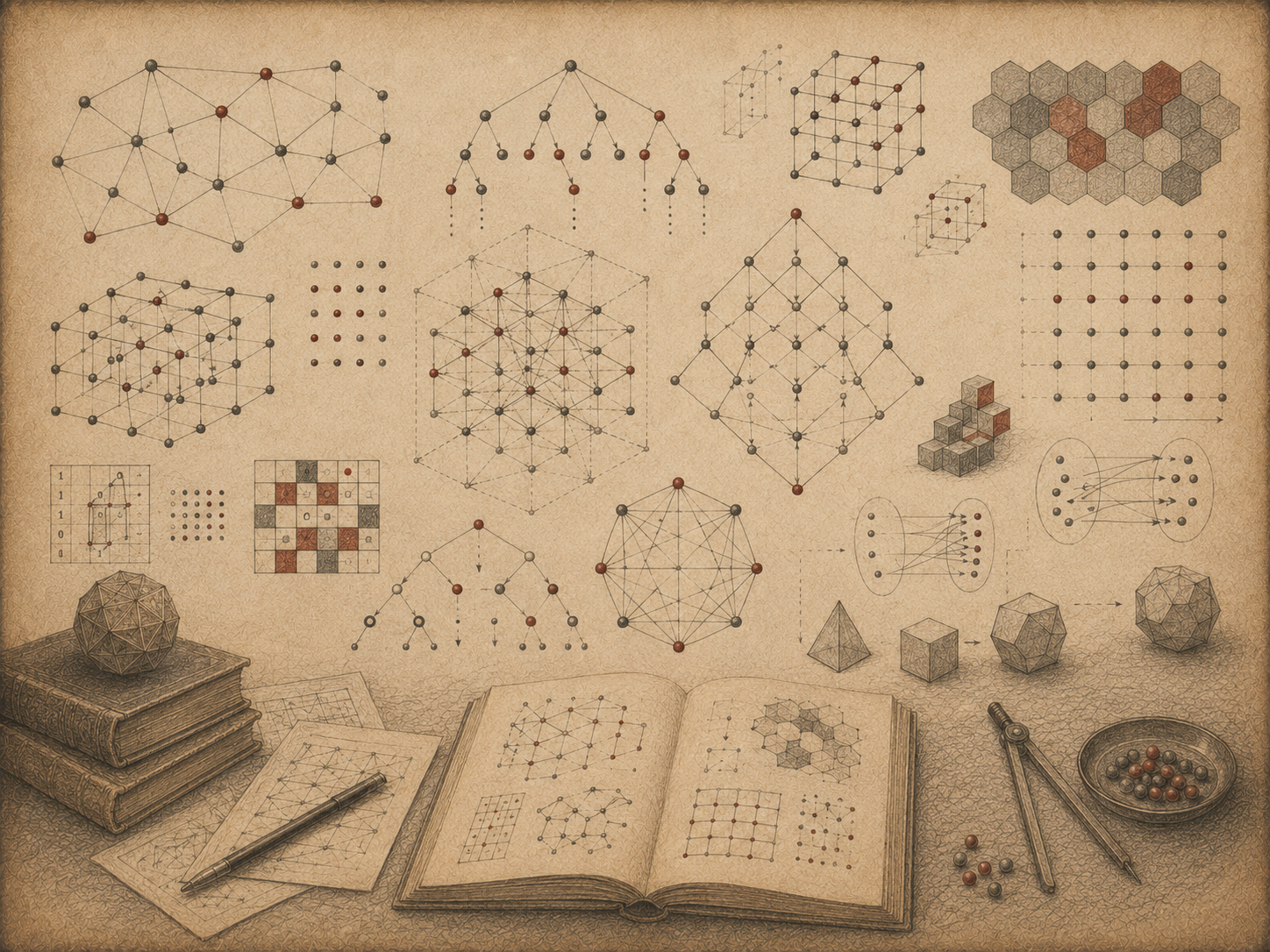
Discrete mathematics is the study of mathematical structures whose elements are distinct, separated, countable, symbolic, or combinatorial. It studies what can be listed, counted, connected, ordered, encoded, transformed, or processed through finite rules. Its objects include integers, propositions, sets, sequences, graphs, trees, permutations, combinations, functions on finite domains, logical formulas, algorithms, state machines, codes, and formal languages.
The word “discrete” does not mean simple. A system may consist of separated units and still be extraordinarily complex. A network may have billions of nodes. A combinatorial space may be too large to search exhaustively. A logical system may have subtle proof structure. A recursive process may generate unexpected behavior. Discrete mathematics provides tools for understanding these structures precisely.
\text{discrete mathematics}=\text{units}+\text{relations}+\text{rules}+\text{structure}
\]
Interpretation: Discrete mathematics studies distinct elements organized by relations, rules, operations, constraints, and transformations.
Discrete mathematics is central to computer science, but it is not only computer science. It supports number theory, logic, combinatorics, graph theory, cryptography, optimization, operations research, probability, linguistics, formal verification, network science, database theory, artificial intelligence, and mathematical modeling. It provides a rigorous language for finite and symbolic structure.
| Discrete Object | Example | Structural Question |
|---|---|---|
| Set | \(\{1,2,3,4\}\) | What belongs to the collection? |
| Relation | \((a,b)\in R\) | How are elements connected? |
| Graph | Vertices and edges | What connection pattern exists? |
| Sequence | \(1,1,2,3,5,8,\ldots\) | What rule generates the pattern? |
| Algorithm | Finite procedure | What steps transform input into output? |
Discrete mathematics is therefore a way of seeing structure in distinct parts. It asks what the parts are, how they connect, how many arrangements are possible, what rules govern transformation, and what can be proven from those rules.
Discrete and Continuous Thinking
Mathematics includes both discrete and continuous ways of thinking. Continuous mathematics studies quantities that vary smoothly: real numbers, curves, limits, derivatives, integrals, fields, flows, and continua. Discrete mathematics studies separated units: integers, symbols, graph nodes, logical statements, program states, database rows, and finite choices.
The distinction is not absolute. Many mathematical problems involve both. A digital image represents continuous visual reality through discrete pixels. A simulation approximates continuous dynamics through discrete time steps. A neural network may process discrete tokens with continuous weights. A physical system may be modeled continuously but implemented computationally through discrete numerical methods.
\text{continuous model}\rightarrow \text{discrete representation}\rightarrow \text{computational analysis}
\]
Interpretation: Many modern systems translate continuous phenomena into discrete representations so they can be stored, computed, transmitted, or analyzed.
Discrete thinking focuses on boundaries, cases, possibilities, states, transitions, choices, and exact structures. Continuous thinking focuses on smoothness, approximation, change, limit behavior, and variation. Both are essential, but they train different mathematical habits.
| Continuous Thinking | Discrete Thinking | Example Contrast |
|---|---|---|
| Change over a continuum | Change by steps or states | Differential equation versus recurrence |
| Real-valued function | Function on finite domain | Curve versus lookup table |
| Limit and approximation | Exact cases and enumeration | Integral versus sum |
| Smooth geometry | Graph or combinatorial structure | Surface versus network |
| Infinitesimal reasoning | Inductive and recursive reasoning | Derivative versus recurrence relation |
Discrete mathematics is especially important in a digital age because digital systems are built from distinct states and finite representations. The world may be continuous in many respects, but computation requires discretization, encoding, symbol manipulation, and finite procedure.
Logic as Structural Discipline
Logic is one of the foundations of discrete mathematics. It studies statements, truth values, connectives, implication, equivalence, quantifiers, inference, proof, and formal validity. Discrete mathematics uses logic not only to prove theorems, but also to structure programs, databases, circuits, algorithms, specifications, and verification systems.
(P\Rightarrow Q)\land P \Rightarrow Q
\]
Interpretation: This is the logical form of modus ponens: if \(P\) implies \(Q\), and \(P\) is true, then \(Q\) follows.
Logical thinking is discrete because statements are treated as units that can be combined, negated, evaluated, and transformed. A proposition may be true or false. A compound statement may be built from smaller statements. A proof may be represented as a finite sequence of justified steps. A Boolean circuit may implement logical operations electronically. A program branch may execute depending on a condition.
| Logical Structure | Notation | Discrete Role |
|---|---|---|
| Negation | \(\neg P\) | Switches truth condition |
| Conjunction | \(P\land Q\) | Requires both statements |
| Disjunction | \(P\lor Q\) | Allows at least one statement |
| Implication | \(P\Rightarrow Q\) | Supports proof and conditional reasoning |
| Equivalence | \(P\Leftrightarrow Q\) | States two conditions have the same truth value |
Logic is the discipline that makes discrete reasoning accountable. It separates valid inference from plausible association. It asks whether the conclusion follows from the premises, whether cases have been exhausted, whether negation has been handled correctly, and whether quantifiers apply to the intended domain.
Sets, Relations, and Structured Collections
Discrete mathematics depends heavily on sets and relations. A set identifies a collection of distinct objects. A relation describes connections among objects. Together, they provide the basic language for discrete structure.
A graph, for example, consists of a set of vertices and a set of edges. A database contains sets of records and relations among tables. A partially ordered set consists of a set together with an order relation. An equivalence relation partitions a set into classes. A finite automaton consists of states, an alphabet, a transition function, a start state, and accepting states.
G=(V,E)
\]
Interpretation: A graph \(G\) is commonly defined by a set of vertices \(V\) and a set of edges \(E\) connecting pairs of vertices.
Set and relation thinking make structure explicit. Rather than treating objects as an unorganized list, discrete mathematics asks which objects belong, how they are connected, what properties the connection relation has, and what follows from those properties.
| Discrete Structure | Set Component | Relation or Rule |
|---|---|---|
| Graph | Vertices | Edges connect vertices |
| Partial order | Elements | Comparison relation |
| Equivalence partition | Domain elements | Equivalence relation |
| Database | Records and tables | Keys and foreign-key relations |
| State machine | States and inputs | Transition function |
Discrete mathematics is therefore not only about counting objects. It is about organizing objects into structures whose rules can be studied, proven, computed, and applied.
Proof in Discrete Mathematics
Proof is central to discrete mathematics because many discrete claims concern all cases, all finite structures of a type, all natural numbers, all possible paths, all subsets, all algorithms, or all arrangements satisfying a condition. Discrete proof often uses direct proof, proof by contradiction, proof by contrapositive, proof by cases, induction, strong induction, invariants, bijections, and constructive arguments.
P(1)\land \forall n\,(P(n)\Rightarrow P(n+1))\Rightarrow \forall n\geq1\,P(n)
\]
Interpretation: Mathematical induction proves a statement for all positive integers by proving a base case and an inductive step.
Discrete mathematics trains proof discipline because finite cases can tempt intuition. A claim may hold for the first hundred examples and fail later. A pattern may appear obvious but require induction. A graph property may seem visually true but depend on definitions. An algorithm may work on small cases but fail on edge cases. Proof protects reasoning from finite illusion.
| Proof Method | Discrete Use | Example Question |
|---|---|---|
| Direct proof | Unfold definitions and derive conclusion | Show sum of two even integers is even |
| Proof by cases | Exhaust finite possibilities | Analyze parity: even or odd |
| Contrapositive | Prove implication by reversing and negating | If \(n^2\) is odd, then \(n\) is odd |
| Induction | Prove statements over natural numbers | Prove a formula for a sequence |
| Bijection | Show two finite sets have equal size | Count objects by pairing them with known objects |
Discrete proof often has a constructive character. It may build an object, define an algorithm, construct a counterexample, create a bijection, or show how a recursive process works. This makes proof and computation closely connected.
Counting, Combinatorics, and Possibility
Counting in discrete mathematics is not merely counting one by one. It is the study of possible arrangements, selections, orders, partitions, paths, assignments, configurations, and outcomes. Combinatorics asks how many structures satisfy a given set of constraints and how those structures can be organized.
The multiplication principle, addition principle, permutations, combinations, binomial coefficients, inclusion-exclusion, recurrence relations, and generating functions are all tools for reasoning about possibility. These tools matter in probability, algorithms, cryptography, scheduling, optimization, network design, experimental design, and statistical modeling.
\binom{n}{k}=\frac{n!}{k!(n-k)!}
\]
Interpretation: The binomial coefficient counts the number of ways to choose \(k\) objects from \(n\) distinct objects without regard to order.
Combinatorial thinking asks what counts as distinct. Does order matter? Can objects repeat? Are there constraints? Are cases overlapping? Are all outcomes equally likely? Is the counting method double-counting or missing possibilities?
| Counting Situation | Question | Common Tool |
|---|---|---|
| Choose items | Does order matter? | Combinations or permutations |
| Build a password | How many choices at each position? | Multiplication principle |
| Count overlapping sets | What has been double-counted? | Inclusion-exclusion |
| Count paths | What transitions are allowed? | Graph or recurrence method |
| Count recursive objects | How does size \(n\) depend on smaller sizes? | Recurrence relation |
Combinatorics is the mathematics of structured possibility. It shows that counting is not trivial when structure matters.
Recurrence, Induction, and Recursive Structure
Recurrence is a central discrete idea. A recurrence relation defines a term, state, or structure in terms of earlier terms, states, or structures. Recursive thinking appears in sequences, algorithms, trees, dynamic programming, population models, grammar rules, proof systems, and computational processes.
F_n=F_{n-1}+F_{n-2}
\]
Interpretation: The Fibonacci recurrence defines each term after the first two as the sum of the two preceding terms.
Recurrence and induction are deeply connected. Recurrence defines structure step by step. Induction proves properties of that structure step by step. If a sequence is generated recursively, induction often proves a closed-form formula, divisibility property, bound, or invariant.
Recursive structure is also central to computation. A recursive function calls itself on smaller inputs. A tree is defined recursively by subtrees. A grammar generates strings recursively. An algorithm may divide a problem into smaller subproblems. Dynamic programming stores solutions to recursive subproblems to avoid repeated work.
| Recursive Structure | Definition Pattern | Discrete Use |
|---|---|---|
| Sequence | Term depends on earlier terms | Recurrence relations |
| Tree | Node has subtrees | Data structures, syntax, hierarchy |
| Algorithm | Problem reduced to smaller problem | Divide and conquer |
| Grammar | Symbol expands into symbols | Formal languages and parsing |
| Proof | Case \(n+1\) follows from previous cases | Induction and strong induction |
Recurrence teaches that structure can unfold from rules. Discrete mathematics studies not only static arrangements, but also the rule-governed generation of arrangements.
Graphs, Networks, and Relational Form
Graph theory is one of the most important areas of discrete mathematics. A graph consists of vertices and edges. Vertices represent objects. Edges represent relationships. This simple structure can model transportation systems, social networks, communication networks, dependency graphs, proof graphs, biological networks, citation networks, electrical circuits, knowledge graphs, and computational workflows.
G=(V,E),\qquad E\subseteq V\times V
\]
Interpretation: A graph can be represented by a set of vertices and a set of edges connecting vertices. In directed graphs, edges may be ordered pairs.
Graph thinking is relational thinking. It asks what is connected, how strongly, through what path, with what direction, under what constraints, and with what consequences. Concepts such as path, cycle, degree, connected component, cut, matching, coloring, centrality, shortest path, and flow make relational structure analyzable.
| Graph Concept | Meaning | Example Use |
|---|---|---|
| Vertex | Object or node | Person, city, concept, task |
| Edge | Connection between vertices | Friendship, road, dependency |
| Path | Sequence of connected vertices | Route, proof chain, workflow |
| Cycle | Path returning to its start | Feedback loop, circuit, recurrence |
| Connected component | Maximal connected subgraph | Cluster, community, isolated subsystem |
Graphs are powerful because they abstract relation from material context. A transportation network and a dependency graph may look different in the world, but mathematically both can be studied through nodes, edges, paths, and constraints. This is one of the deep strengths of discrete mathematics: it sees common structure across different systems.
Trees, Hierarchies, and Branching Logic
Trees are graphs with no cycles, usually used to represent hierarchy, branching, ancestry, dependency, syntax, decision processes, file systems, taxonomies, organizational structures, and recursive data. A tree is one of the most important discrete structures because it combines relation, order, and recursion.
A rooted tree has a distinguished root. From the root, branches lead to children, descendants, leaves, and subtrees. This makes trees ideal for representing nested structure: mathematical expressions, proof trees, parse trees, decision trees, genealogies, classification systems, and knowledge architectures.
\text{tree}=\text{connected graph with no cycles}
\]
Interpretation: A tree is a graph structure that connects all vertices without forming loops.
Tree thinking is important because many systems are recursive or hierarchical. A sentence has parts within parts. A mathematical expression has subexpressions. A proof has dependencies. A decision process has branches. A software project has directories and modules. A taxonomy has categories and subcategories.
| Tree Use | Discrete Structure | What It Reveals |
|---|---|---|
| Expression tree | Operations and operands | Symbolic structure |
| Proof tree | Premises and conclusions | Logical dependency |
| Decision tree | Branching conditions | Classification pathway |
| Parse tree | Grammar expansion | Syntax structure |
| Taxonomy | Nested categories | Hierarchy and classification |
Trees show how discrete mathematics turns hierarchy into analyzable structure. They make branching logic visible.
Modular Arithmetic and Cyclic Structure
Modular arithmetic studies remainders and cyclic structure. Instead of asking only what a number is, modular arithmetic asks where it falls in a repeating cycle. Clocks are the most familiar example: after 12 comes 1, not 13. Days of the week repeat modulo 7. Angles repeat modulo \(360^\circ\) or \(2\pi\). Computer arithmetic may overflow modulo a fixed power of two.
a\equiv b\pmod n
\]
Interpretation: This means \(a\) and \(b\) leave the same remainder when divided by \(n\), or equivalently, \(n\) divides \(a-b\).
Modular arithmetic is central to number theory, cryptography, hashing, error detection, calendars, coding theory, random number generation, and digital computation. It is also a powerful example of equivalence-class thinking: integers are grouped by their remainders modulo \(n\).
| Modular Context | Modulus | Structure |
|---|---|---|
| Clock arithmetic | 12 | Hours repeat in a cycle |
| Weekdays | 7 | Days repeat weekly |
| Parity | 2 | Even and odd classes |
| Hashing | Table size | Keys map to buckets |
| Cryptography | Large integer modulus | Arithmetic structure supports secure protocols |
Modular thinking teaches that equality can be relative to a structure. Two numbers may be different as integers but equivalent modulo a chosen cycle. This is a deep discrete idea: sameness depends on the relation being studied.
Boolean Logic, Bits, and Digital Structure
Boolean logic is a discrete structure with two truth values: true and false, often represented as \(1\) and \(0\). It is the mathematical basis of digital circuits, logical conditions, search filters, program branches, database queries, and binary computation.
0,1\quad\text{with operations}\quad \land,\lor,\neg
\]
Interpretation: Boolean structure operates on two truth values using logical operations such as AND, OR, and NOT.
The digital world depends on Boolean abstraction. A voltage range becomes a bit. A bit becomes part of a byte. Bytes encode characters, images, audio, programs, models, and data. Logical gates compose into circuits. Conditions compose into algorithms. Boolean queries retrieve records from databases. Machine learning pipelines still depend on discrete choices: tokenization, labels, thresholds, class assignments, and branching rules.
| Boolean Operation | Meaning | Computational Use |
|---|---|---|
| AND | Both conditions hold | Filter records satisfying multiple criteria |
| OR | At least one condition holds | Search for alternatives |
| NOT | Condition is negated | Exclude cases |
| XOR | Exactly one condition holds | Error detection, cryptography, circuits |
| Implication | If condition, then consequence | Rules, specifications, formal verification |
Boolean thinking is powerful, but it can also oversimplify when applied to complex human or social realities. A binary classification may be mathematically clean while ethically or empirically inadequate. Discrete structure must be interpreted responsibly.
Algorithms and Finite Procedure
An algorithm is a finite, well-defined procedure for solving a problem or transforming input into output. Algorithms are central to discrete mathematics because they operate through discrete steps, conditions, data structures, loops, recursion, and termination criteria.
Discrete mathematics helps analyze algorithms through correctness, complexity, invariants, recurrence relations, graph structure, combinatorial bounds, and proof. It asks whether the algorithm always terminates, whether it produces the correct output, how much time and memory it uses, and how it behaves on edge cases.
T(n)=2T\left(\frac{n}{2}\right)+n
\]
Interpretation: This recurrence describes the time complexity of many divide-and-conquer algorithms, including merge sort.
Algorithmic thinking is discrete because it treats computation as structured sequence: input, state, operation, branch, loop, output. It also requires proof. A program may appear to work on examples but fail on untested cases. Algorithmic correctness is a mathematical claim.
| Algorithmic Concept | Discrete Structure | Proof or Audit Question |
|---|---|---|
| Loop | Repeated finite step | What invariant is preserved? |
| Recursion | Problem reduced to smaller problem | Does it reach a base case? |
| Search | Explore finite space | Are all cases covered? |
| Sorting | Order relation on elements | Is output ordered and a permutation of input? |
| Graph algorithm | Traversal of nodes and edges | Are reachability and path rules correct? |
Algorithms show why discrete mathematics is a foundation of computation. Programs do not merely calculate. They manipulate discrete structure according to rules.
Discrete Mathematics in Data Systems and AI
Data systems and artificial intelligence rely heavily on discrete mathematics. Records, tables, keys, labels, tokens, graphs, categories, features, classes, trees, rules, sequences, and finite state spaces are all discrete structures. Even when AI systems use continuous numerical weights, their inputs and outputs are often discretized into tokens, labels, decisions, rankings, categories, or generated symbol sequences.
Databases use relations. Knowledge graphs use nodes and edges. Natural language systems process token sequences. Classification systems assign labels. Recommendation systems rank discrete items. Search engines index documents. Planning systems traverse state spaces. Neural networks may optimize continuous parameters, but the surrounding infrastructure is full of discrete representation and decision structure.
\text{data system}=\text{records}+\text{relations}+\text{queries}+\text{rules}
\]
Interpretation: Data systems organize discrete records through relations, constraints, queries, and transformation rules.
| Technical System | Discrete Structure | Risk to Audit |
|---|---|---|
| Database | Tables, keys, relations | Schema assumptions and missing data |
| Knowledge graph | Nodes, edges, labels | False or oversimplified relations |
| Classifier | Input records mapped to labels | Category design and bias |
| Language model | Token sequences | Generated structure without proof or grounding |
| Recommendation system | Ranked discrete items | Feedback loops and hidden prioritization |
Discrete mathematics helps make these systems intelligible. It clarifies how objects are encoded, how relations are represented, how categories are assigned, how paths are traversed, how structures are counted, and how outputs should be audited.
Learning Discrete Mathematical Thinking
Learning discrete mathematics requires a shift in mathematical attention. Students accustomed to algebraic manipulation or calculus may find discrete mathematics unfamiliar because it emphasizes definitions, cases, structures, proof, examples, counterexamples, algorithms, and finite objects. The central question is often not “what is the numerical answer?” but “what structure is present, and what follows from it?”
Students must learn to read definitions carefully. A graph may be directed or undirected. A relation may be reflexive or not. A function may be total or partial. A counting problem may or may not allow repetition. A proof by induction requires a valid base case and inductive step. A recurrence needs initial conditions. A statement with “for all” differs from a statement with “there exists.”
| Learning Challenge | Underlying Issue | Instructional Response |
|---|---|---|
| Overreliance on examples | Finite evidence mistaken for proof | Use counterexamples and proof-status labels |
| Weak definition reading | Missed conditions and edge cases | Compare examples and nonexamples |
| Counting errors | Double-counting or omitted cases | Use structured case tables and bijections |
| Graph confusion | Visual layout mistaken for structure | Separate graph drawing from graph definition |
| Induction difficulty | Unclear link between cases | Use recurrence, domino, and invariant models |
Discrete mathematics develops habits that are useful beyond mathematics: precise classification, structured problem decomposition, logical argument, edge-case awareness, algorithmic reasoning, and responsible interpretation of formal systems.
A Mathematical Lens: Unit, Relation, Rule, Structure
A useful lens for discrete mathematics is the sequence: unit, relation, rule, structure. First, identify the distinct objects. Then identify how they are connected. Then identify the rules that govern them. Finally, analyze the structure that emerges.
\text{Unit}\rightarrow \text{Relation}\rightarrow \text{Rule}\rightarrow \text{Structure}
\]
Interpretation: Discrete thinking begins with distinguishable units and builds toward relational, rule-governed structure.
This lens applies across discrete mathematics. In graph theory, vertices are units, edges are relations, paths follow rules, and connectivity is structure. In logic, propositions are units, connectives relate them, inference rules transform them, and proof is structure. In computation, data values are units, operations relate them, algorithms define rules, and programs create structured behavior.
| Lens Element | Guiding Question | Example |
|---|---|---|
| Unit | What are the distinct elements? | Vertex, bit, statement, object, state |
| Relation | How are elements connected? | Edge, implication, order, dependency |
| Rule | What transformations or constraints apply? | Algorithm, recurrence, inference rule |
| Structure | What pattern follows from the units, relations, and rules? | Tree, graph, proof, code, network |
| Interpretation | What does the structure mean in context? | Model, classification, decision, system behavior |
Discrete mathematics is the logic of structure because it makes the architecture of finite and symbolic systems visible.
Computational Companion Examples
The companion repository for this article should extend the Mathematical Thinking codebase with examples focused on finite sets, relation audits, graph traversal, combinatorial counting, recurrence, modular arithmetic, Boolean logic, tree structure, algorithmic invariants, Haskell algebraic data types, SQL schemas, and responsible interpretation of discrete categories and mappings. The examples below are compact article-level previews; the repository can expand them into richer professional workflows.
Python: Graph Structure and Relation Audits
from collections import deque

Graph = dict[str, set[str]]

def connected_component(graph: Graph, start: str) -> set[str]:
    visited: set[str] = set()
    queue: deque[str] = deque([start])

    while queue:
        node = queue.popleft()
        if node in visited:
            continue
        visited.add(node)
        queue.extend(graph.get(node, set()) - visited)

    return visited

def degree_table(graph: Graph) -> dict[str, int]:
    return {node: len(neighbors) for node, neighbors in graph.items()}

graph = {
    "A": {"B", "C"},
    "B": {"A", "D"},
    "C": {"A"},
    "D": {"B"},
    "E": set()
}

print("degrees:", degree_table(graph))
print("component from A:", connected_component(graph, "A"))
print("component from E:", connected_component(graph, "E"))
R: Combinatorial Counting and Inclusion-Exclusion
n_total <- 100
multiples_of_2 <- floor(n_total / 2)
multiples_of_3 <- floor(n_total / 3)
multiples_of_6 <- floor(n_total / 6)

count_multiples_2_or_3 <- multiples_of_2 + multiples_of_3 - multiples_of_6

audit <- data.frame(
  total_domain = n_total,
  multiples_of_2 = multiples_of_2,
  multiples_of_3 = multiples_of_3,
  overlap_multiples_of_6 = multiples_of_6,
  inclusion_exclusion_count = count_multiples_2_or_3,
  interpretation = "subtract the overlap to avoid double-counting"
)

print(audit)
Julia: Recurrence and Modular Structure
function fibonacci(n)
    if n == 0
        return 0
    elseif n == 1
        return 1
    end

    previous = 0
    current = 1

    for _ in 2:n
        previous, current = current, previous + current
    end

    return current
end

function residues(modulus, n)
    return [k % modulus for k in 0:(n - 1)]
end

println("Fibonacci values: ", [fibonacci(n) for n in 0:10])
println("Residues mod 5: ", residues(5, 20))
println("Interpretation: recurrence and modular arithmetic reveal discrete rule-governed structure.")
Haskell: Discrete Structures as Algebraic Data Types
{-# OPTIONS_GHC -Wall #-}

data Vertex = A | B | C | D | E
  deriving (Eq, Ord, Show)

data Edge = Edge Vertex Vertex
  deriving (Eq, Show)

data Tree a
  = Leaf a
  | Node a [Tree a]
  deriving (Eq, Show)

neighbors :: Vertex -> [Edge] -> [Vertex]
neighbors v edges =
  [ y | Edge x y <- edges, x == v ] ++
  [ x | Edge x y <- edges, y == v ]

degree :: Vertex -> [Edge] -> Int
degree v edges =
  length (neighbors v edges)

treeSize :: Tree a -> Int
treeSize tree =
  case tree of
    Leaf _ -> 1
    Node _ children -> 1 + sum (map treeSize children)

main :: IO ()
main = do
  let edges = [Edge A B, Edge A C, Edge B D]
  let proofTree = Node "claim" [Leaf "premise 1", Leaf "premise 2"]
  print (degree A edges)
  print (neighbors B edges)
  print (treeSize proofTree)
SQL: Discrete Structure Metadata Schema
CREATE TABLE discrete_object (
  object_id TEXT PRIMARY KEY,
  name TEXT NOT NULL,
  object_type TEXT NOT NULL,
  description TEXT NOT NULL
);

CREATE TABLE relation_edge (
  edge_id TEXT PRIMARY KEY,
  source_id TEXT NOT NULL,
  target_id TEXT NOT NULL,
  relation_type TEXT NOT NULL,
  interpretation TEXT NOT NULL,
  FOREIGN KEY (source_id) REFERENCES discrete_object(object_id),
  FOREIGN KEY (target_id) REFERENCES discrete_object(object_id)
);

CREATE TABLE algorithm_audit (
  algorithm_id TEXT PRIMARY KEY,
  name TEXT NOT NULL,
  input_structure TEXT NOT NULL,
  output_structure TEXT NOT NULL,
  invariant_note TEXT NOT NULL,
  complexity_note TEXT NOT NULL
);

CREATE TABLE structure_warning (
  warning_id TEXT PRIMARY KEY,
  structure_id TEXT NOT NULL,
  warning TEXT NOT NULL,
  mitigation TEXT NOT NULL
);
These examples treat discrete mathematics as executable structure. Graphs can be traversed, overlaps can be counted, recurrences can be generated, modular cycles can be audited, trees can be represented with algebraic data types, and databases can store relation metadata. The deeper goal is to make structure explicit, testable, and interpretable.
GitHub Repository
The companion repository for this article is designed as a reproducible mathematical-thinking workspace focused on finite sets, logic, proof patterns, combinatorics, recurrence, graph theory, trees, modular arithmetic, Boolean structure, algorithmic invariants, Haskell algebraic data types, SQL schemas, and responsible interpretation of discrete structures in computation and modeling.
Complete Code Repository
Companion article folder with Python, R, Julia, SQL, Haskell, Rust, Go, C++, Fortran, and C examples for professional mathematical exploration of discrete mathematics, logic, finite structure, graph theory, recurrence, combinatorics, algorithms, Boolean systems, typed structures, and the logic of structure.
Discrete Structure and Responsible Interpretation
Discrete mathematics gives powerful tools for classification, ranking, connection, optimization, and decision-making. But these tools also carry ethical responsibility. When human realities are discretized into categories, labels, records, scores, rankings, eligibility rules, graph edges, or decision states, something is always preserved and something is omitted.
A discrete category may simplify a complex identity. A graph edge may imply a relationship that needs context. A ranking algorithm may impose order where values are uncertain or contested. A Boolean rule may force a binary decision where human circumstances are ambiguous. A database schema may shape what an institution can see and what it ignores.
| Discrete Structure | Applied Use | Risk | Responsible Habit |
|---|---|---|---|
| Category | Classification or eligibility | Oversimplification or exclusion | Audit definitions and boundary cases |
| Graph | Network analysis | False implication of meaningful connection | Define what edges mean and how they were measured |
| Ranking | Priority or recommendation | Hidden value judgments | State criteria, uncertainty, and consequences |
| Boolean rule | Automated decision | Rigid yes/no classification | Include review pathways and contextual safeguards |
| Algorithm | Procedure or model output | Correct computation of flawed assumptions | Validate inputs, rules, outcomes, and harms |
Responsible discrete thinking asks: What are the units? Who defined them? What relations are encoded? What cases are excluded? What assumptions govern the rules? What happens at the boundaries? Who is affected when the structure becomes operational?
Discrete mathematics can clarify structure, but it should not be used to hide interpretation, uncertainty, or power behind formal precision.
Why Discrete Mathematics Matters
Discrete mathematics matters because it is the mathematics of structured possibility. It teaches how to reason about distinct objects, finite rules, symbolic systems, logical inference, networks, algorithms, data structures, and digital representation. It is one of the main bridges between mathematical proof and computational systems.
It also matters because many modern systems are discrete in practice. Databases, software, networks, AI systems, cryptographic protocols, communication channels, knowledge graphs, decision systems, and institutional rules all depend on discrete structure. Understanding those structures requires more than coding skill. It requires mathematical reasoning about units, relations, cases, constraints, proofs, and consequences.
Discrete mathematics trains the mind to ask precise questions. What are the objects? What counts as a connection? What cases are possible? What rule generates the next state? What invariant remains unchanged? What can be proven? What can be computed? What has been counted twice? What has been excluded? What happens at the edge case?
In that sense, discrete mathematics is not only a technical field. It is a way of thinking about structure itself. It reveals how complexity can be built from distinct elements, how systems can be governed by rules, how finite procedures can generate vast possibilities, and how formal reasoning can make symbolic systems accountable.
Discrete mathematics is the logic of structure because it shows how separate parts become organized worlds.
Related Articles
- What Is Mathematical Thinking?
- Number, Pattern, and the Origins of Mathematical Thought
- Sets, Relations, and Functions as Modes of Thought
- Logic and the Structure of Formal Inference
- Proof and the Logic of Mathematical Justification
- Patterns, Structure, and the Mathematical Imagination
- Abstraction and the Power of Generalization
- What Makes Algebraic Thinking Distinct?
Further Reading
- Biggs, N.L. (2002) Discrete Mathematics. 2nd edn. Oxford: Oxford University Press.
- Bondy, J.A. and Murty, U.S.R. (2008) Graph Theory. London: Springer. Available at: https://link.springer.com/book/10.1007/978-1-84628-970-5
- Graham, R.L., Knuth, D.E. and Patashnik, O. (1994) Concrete Mathematics: A Foundation for Computer Science. 2nd edn. Reading, MA: Addison-Wesley.
- Grimaldi, R.P. (2004) Discrete and Combinatorial Mathematics: An Applied Introduction. 5th edn. Boston: Pearson.
- Rosen, K.H. (2019) Discrete Mathematics and Its Applications. 8th edn. New York: McGraw-Hill.
- Stanley, R.P. (2012) Enumerative Combinatorics, Volume 1. 2nd edn. Cambridge: Cambridge University Press. Available at: https://www.cambridge.org/core/books/enumerative-combinatorics/1B8B4C8D3C58D9A1B6E31519B7E4D82A
- Tucker, A. (2012) Applied Combinatorics. 6th edn. Hoboken, NJ: Wiley.
- Velleman, D.J. (2019) How to Prove It: A Structured Approach. 3rd edn. Cambridge: Cambridge University Press. Available at: https://www.cambridge.org/highereducation/books/how-to-prove-it/6D2965D625C6836CD4A785A2C843B3DA
References
- Biggs, N.L. (2002) Discrete Mathematics. 2nd edn. Oxford: Oxford University Press.
- Bondy, J.A. and Murty, U.S.R. (2008) Graph Theory. London: Springer. Available at: https://link.springer.com/book/10.1007/978-1-84628-970-5
- Graham, R.L., Knuth, D.E. and Patashnik, O. (1994) Concrete Mathematics: A Foundation for Computer Science. 2nd edn. Reading, MA: Addison-Wesley.
- Grimaldi, R.P. (2004) Discrete and Combinatorial Mathematics: An Applied Introduction. 5th edn. Boston: Pearson.
- Rosen, K.H. (2019) Discrete Mathematics and Its Applications. 8th edn. New York: McGraw-Hill.
- Stanley, R.P. (2012) Enumerative Combinatorics, Volume 1. 2nd edn. Cambridge: Cambridge University Press. Available at: https://www.cambridge.org/core/books/enumerative-combinatorics/1B8B4C8D3C58D9A1B6E31519B7E4D82A
- Tucker, A. (2012) Applied Combinatorics. 6th edn. Hoboken, NJ: Wiley.
- Velleman, D.J. (2019) How to Prove It: A Structured Approach. 3rd edn. Cambridge: Cambridge University Press. Available at: https://www.cambridge.org/highereducation/books/how-to-prove-it/6D2965D625C6836CD4A785A2C843B3DA