
Last Updated May 27, 2026
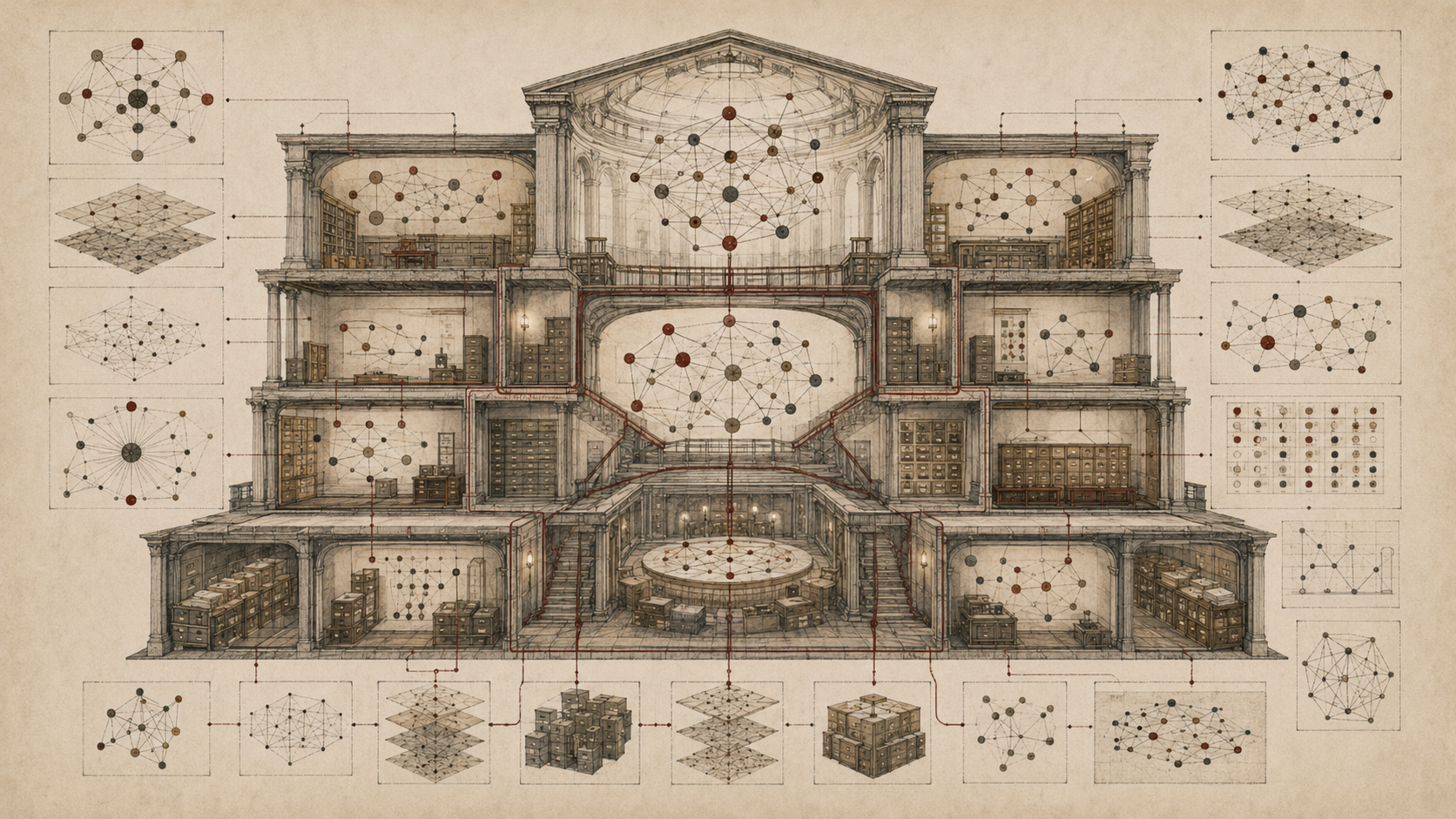
Knowledge graphs and semantic relationships make complex knowledge systems navigable by representing concepts, documents, datasets, methods, sources, institutions, and ideas as connected structures. A knowledge graph is not merely a visual network. It is a structured representation of meaning: nodes identify knowledge objects, edges define relationships, and metadata preserves context, provenance, and interpretation. Where a taxonomy classifies knowledge and an ontology defines semantic rules, a knowledge graph connects knowledge objects into a queryable, inspectable, and extensible network.
Semantic relationships are the foundation of this work. They explain what kind of connection exists between two things: broader than, narrower than, part of, supports, cites, contradicts, depends on, applies to, uses method, is evidence for, belongs to series, or is governed by. Without named relationships, a graph becomes a tangle of links. With named relationships, it becomes intellectual infrastructure.
Within knowledge architecture, knowledge graphs provide a way to move beyond flat classification and isolated documents. They support article maps, research repositories, digital libraries, AI-assisted retrieval, semantic search, evidence tracing, internal linking, interdisciplinary synthesis, and governance. They help a knowledge system preserve not only what it contains, but how its parts relate.
What Are Knowledge Graphs?
A knowledge graph is a structured network of entities and relationships. Entities may include concepts, documents, articles, datasets, methods, people, institutions, events, locations, categories, sources, code repositories, or research outputs. Relationships describe how those entities connect. A knowledge graph therefore represents knowledge as a set of meaningful connections rather than as isolated records.
The basic idea is simple: knowledge objects become nodes, and relationships become edges. A node might represent an article such as “Taxonomy Design for Knowledge Systems.” Another node might represent the concept “controlled vocabulary.” An edge between them might state that the article discussesConcept controlled vocabulary. A source might definesStandard SKOS. A repository folder might supportsArticle a publication. A dataset might isGeneratedBy a script. These relationships make the system intelligible.
Knowledge graphs can be implemented in different ways. Some use RDF triples. Some use property graphs. Some use relational tables that store entities and relationships. Some begin as CSV edge lists and later mature into graph databases. The implementation matters, but the architectural principle is broader: knowledge becomes more powerful when its relationships are explicit, typed, traceable, and governed.
KG = (V, E, L, M)
\]
Interpretation: A knowledge graph \(KG\) can be represented as vertices or nodes \(V\), edges \(E\), labels \(L\), and metadata \(M\). Nodes identify entities, edges connect them, labels define meaning, and metadata preserves context.
In knowledge architecture, a knowledge graph is not a decorative visualization. It is a model of intellectual relationships. It can support search, navigation, internal linking, recommendation, evidence tracing, research synthesis, and AI-assisted retrieval. It helps users understand how a knowledge system is connected.
What Are Semantic Relationships?
Semantic relationships are meaningful connections among concepts or knowledge objects. They tell users and systems what kind of relationship exists. Two nodes may be connected, but connection alone is not enough. The relationship label determines whether one concept is broader than another, part of another, evidence for another, required by another, similar to another, or in tension with another.
For example, “ontology modeling” may be relatedTo “knowledge graphs.” But it may also structures knowledge graphs, uses RDF or OWL, and dependsOn defined classes and properties. These are different semantic relationships. Treating them all as generic links weakens the graph.
Semantic relationships can be hierarchical, associative, evidentiary, causal, methodological, temporal, institutional, interpretive, or governance-related. A research platform may need relationships such as belongsToSeries, discussesConcept, usesMethod, citesSource, supportsClaim, generatedByScript, updates, contrastsWith, and requiresRevision.
| Relationship Type | Meaning | Example |
|---|---|---|
| Hierarchical | One concept is broader or narrower than another. | Knowledge Architecture is broader than Knowledge Graphs. |
| Part-whole | One entity is part of another. | Metadata fields are part of a metadata schema. |
| Associative | Two concepts are related without hierarchy. | Knowledge graphs are related to semantic search. |
| Evidentiary | One object supports a claim or model. | A W3C standard defines RDF concepts. |
| Methodological | One method is used to analyze or model another object. | Graph centrality is used to analyze semantic networks. |
| Governance | One object maintains, reviews, or revises another. | A revision log governs taxonomy changes. |
| Contrastive | One concept differs from or challenges another. | Information architecture contrasts with knowledge architecture. |
Semantic relationships are therefore the grammar of a knowledge graph. If nodes are nouns, relationships are verbs. A knowledge graph becomes meaningful when its verbs are precise enough to express the logic of the domain.
Why Knowledge Graphs Matter
Knowledge graphs matter because knowledge systems become harder to understand as they grow. A platform may contain many articles, categories, datasets, code folders, references, images, and source lists. Search can retrieve individual items, but it does not necessarily explain how those items fit together. A knowledge graph helps preserve the relationships that make a system intelligible.
In a conventional website, related material may be connected through menus, tags, and internal links. These are useful, but often limited. A tag may say two articles share a topic, but not why. An internal link may connect two pages, but not whether one depends on the other, extends it, critiques it, or applies it. A knowledge graph can make those relationships explicit.
Knowledge graphs also support discovery. A user may begin with one concept and follow relationships to adjacent concepts, supporting sources, methodological examples, related articles, datasets, or code repositories. This kind of navigation is different from browsing a static menu. It allows users to move through meaning.
For researchers, knowledge graphs can reveal structural gaps. They can show which concepts are central, which topics are isolated, which articles lack evidence links, which methods are reused, which sources support many claims, and which domains need stronger bridges. A graph can make the architecture of knowledge visible enough to review.
For AI-assisted systems, knowledge graphs provide structured context. They can help retrieval systems distinguish foundational articles from technical examples, concepts from sources, datasets from code, and related terms from equivalent terms. This improves not only retrieval, but interpretation.
Knowledge Graphs as Knowledge Architecture
A knowledge graph is a form of knowledge architecture because it organizes relationships among knowledge objects. It is not merely a database structure or visualization. It expresses the intellectual structure of a knowledge system: what exists, how objects relate, what evidence supports what claims, what methods are used, what concepts bridge domains, and how the system can be maintained.
In a research platform, a knowledge graph can connect article maps, concepts, datasets, code repositories, references, methods, models, and outputs. It can show that a particular article belongs to a series, discusses several concepts, uses a method, cites a standard, links to a repository folder, and produces outputs. This makes the research system more transparent.
Knowledge graphs also connect editorial architecture with computational architecture. An editor may think in terms of related articles and series context. A developer may think in terms of entities, tables, APIs, or graph nodes. A researcher may think in terms of concepts, evidence, and methods. A knowledge graph can align these perspectives by representing them in one relationship-aware structure.
KGA = f(E, R, M, O, G)
\]
Interpretation: Knowledge-graph architecture \(KGA\) depends on entities \(E\), relationships \(R\), metadata \(M\), ontology or schema design \(O\), and governance \(G\).
The architectural value of a knowledge graph depends on its relationship quality. A graph with poorly defined edges may create confusion. A graph with clear relationship types, provenance, metadata, and governance can become durable intellectual infrastructure. It helps the knowledge system preserve meaning across scale.
Nodes, Edges, Triples, and Metadata
Knowledge graphs are often described through nodes and edges. Nodes represent entities. Edges represent relationships. In RDF-style modeling, relationships are often expressed as triples: subject, predicate, object. For example: “Knowledge Graphs and Semantic Relationships” — “isPartOfSeries” — “Knowledge Architecture.”
Triples are powerful because they make meaning explicit in a compact form. The subject identifies the thing being described. The predicate names the relationship. The object identifies what it relates to. A collection of triples can represent a semantic network that is queryable and extensible.
Triple = (s, p, o)
\]
Interpretation: A semantic triple consists of subject \(s\), predicate \(p\), and object \(o\). The predicate gives meaning to the relationship between subject and object.
Metadata gives the graph context. A relationship may need a source, date, confidence level, reviewer, version, evidence note, or status. Without metadata, a graph may show a relationship but not explain where it came from or how reliable it is. Metadata turns a graph from an assertion network into a traceable knowledge system.
| Graph Element | Function | Example |
|---|---|---|
| Node | Represents a knowledge object or entity. | Article, concept, dataset, method, source, repository folder. |
| Edge | Connects two nodes. | Article → discussesConcept → Knowledge Graph. |
| Predicate | Names the semantic relationship. | supports, cites, dependsOn, isPartOf, contrastsWith. |
| Label | Provides human-readable naming. | “Knowledge Graphs and Semantic Relationships.” |
| Metadata | Preserves context about a node or edge. | Status, source, reviewer, date, confidence, version. |
| Provenance | Documents origin or evidence. | W3C RDF standard supports a definition. |
A knowledge graph should not only connect entities. It should explain the type, context, and status of those connections. This is what makes it useful for research, governance, and AI-assisted retrieval.
Relationship Types and Meaning
The quality of a knowledge graph depends heavily on relationship design. If all edges are labeled “related to,” the graph may show connection but not meaning. Relationship types should be specific enough to support interpretation and broad enough to remain usable.
For example, an article may citesSource a W3C standard, discussesConcept RDF triples, usesMethod graph diagnostics, belongsToSeries Knowledge Architecture, and linksToRepositoryFolder a GitHub path. These relationships represent different kinds of meaning. They should not be collapsed into a generic link.
Relationship design should also distinguish direction. “A supports B” is not the same as “B supports A.” “A is broader than B” is not the same as “B is broader than A.” Direction matters for retrieval, reasoning, navigation, and interpretation.
| Relationship | Direction | Use Case |
|---|---|---|
| belongsToSeries | Article → Series | Connects a publication to its article map or knowledge series. |
| discussesConcept | Article → Concept | Identifies concepts covered by an article. |
| usesMethod | Article or model → Method | Links research outputs to analytical procedures. |
| citesSource | Article → Source | Connects claims or articles to references. |
| supportsClaim | Evidence source → Claim | Preserves evidentiary relationships. |
| generatedByScript | Output → Script | Supports reproducibility and repository traceability. |
| broaderThan | Concept → Concept | Represents hierarchical semantic structure. |
| contrastsWith | Concept → Concept | Preserves conceptual distinction or disagreement. |
Good relationship types are part of the knowledge system’s grammar. They should be documented, governed, and used consistently. If a relationship type is vague, users and machines will interpret it inconsistently. If relationship types are too numerous, the graph becomes difficult to maintain. The design task is to create a controlled set of meaningful predicates that fit the system’s purpose.
Knowledge Graphs, Taxonomies, and Ontologies
Knowledge graphs work best when they are connected to taxonomies and ontologies. A taxonomy provides classification. An ontology defines entity types and relationship rules. A knowledge graph stores or represents specific entities and relationships. These layers serve different purposes, but they reinforce one another.
A taxonomy might place “knowledge graphs” under “semantic structure.” An ontology might define KnowledgeGraph as a class and specify that it has nodes and edges. A knowledge graph might include actual article nodes, concept nodes, source nodes, dataset nodes, and repository nodes connected by typed relationships. Together, these structures create a richer knowledge architecture than any one layer can provide alone.
| Structure | Primary Role | Contribution to Knowledge Graph Design |
|---|---|---|
| Taxonomy | Classifies topics and categories. | Provides broad-to-narrow placement and controlled vocabulary. |
| Ontology | Defines entity types, properties, and relationship rules. | Gives semantic precision to nodes and edges. |
| Metadata | Preserves context, status, provenance, and retrieval fields. | Documents node and edge context. |
| Knowledge graph | Connects entities through typed relationships. | Represents the live semantic structure of the knowledge system. |
| Governance | Maintains definitions and relationship quality over time. | Prevents drift, ambiguity, and unsupported links. |
The distinction matters. A taxonomy without a graph can organize categories but may hide cross-domain relationships. A graph without a taxonomy can become complex and difficult to orient. An ontology without implementation can remain abstract. A knowledge graph without governance can become noisy. Strong knowledge architecture integrates all of these layers.
Knowledge graphs are therefore not replacements for taxonomies or ontologies. They are relationship structures that depend on classification, semantic modeling, metadata, and governance to remain meaningful.
Semantic Relationships in Research Platforms
Research platforms need semantic relationships because they contain many types of knowledge objects. A platform may include articles, references, datasets, code repositories, notebooks, models, figures, concepts, source documents, policies, standards, and outputs. If these objects are not connected, the platform becomes a storage environment rather than a research environment.
Semantic relationships can show how an article connects to its evidence, how a dataset connects to a model, how a code folder supports a publication, how a source defines a standard, how a method applies to a problem, and how a concept appears across multiple domains. This improves transparency and reuse.
For example, an article on taxonomy design may discuss controlled vocabularies, cite ISO and W3C standards, use a Python taxonomy audit script, generate output tables, and belong to the Knowledge Architecture series. A knowledge graph can represent each of those relationships. Users can then move from article to concept, from concept to standard, from standard to metadata, and from metadata to repository outputs.
Semantic relationships also support article sequencing. Foundational articles may support later methods articles. Conceptual articles may frame applied articles. Repository examples may operationalize theoretical claims. A knowledge graph can show these relationships more precisely than a simple “related articles” list.
| Research Object | Relationship Examples | Architectural Value |
|---|---|---|
| Article | belongsToSeries, discussesConcept, citesSource. | Connects publication to topic, series, and evidence. |
| Dataset | usedByModel, generatedByScript, supportsArticle. | Supports reproducibility and interpretation. |
| Method | appliesTo, tests, models, validates. | Links analytical procedure to research purpose. |
| Source | definesStandard, supportsClaim, providesContext. | Preserves evidence and provenance. |
| Repository folder | supportsArticle, containsCode, producesOutput. | Links public article to reproducible assets. |
| Concept | broaderThan, narrowerThan, relatedTo, contrastsWith. | Supports semantic navigation and synthesis. |
When research platforms use semantic relationships well, they become more accountable. A reader can see not only what the platform says, but how its claims, examples, methods, references, and outputs connect.
Evidence, Provenance, and Traceability
Knowledge graphs become more valuable when they include provenance. Provenance records where a claim, relationship, dataset, or concept came from. It may include source citations, standards, authorship, date created, revision history, confidence level, review status, or evidence notes. Provenance helps users evaluate trust.
A graph that says “RDF defines triples” should connect that claim to a source. A graph that says “knowledge graphs support AI-assisted retrieval” should distinguish whether the statement is conceptual, empirical, methodological, or implementation-specific. A graph that links an article to a dataset should clarify whether the dataset is synthetic, observational, experimental, administrative, or archival.
Traceability is especially important in research systems. Users should be able to move from a claim to its supporting source, from a figure to the script that generated it, from a script to the dataset it used, from a dataset to its documentation, and from documentation to revision history. A knowledge graph can support this chain of accountability.
Traceability = \frac{|R_P|}{|R_T|}
\]
Interpretation: Traceability can be approximated as the share of total relationships \(R_T\) that include provenance \(R_P\). The measure is simplified, but it highlights the importance of source-aware graph design.
Without provenance, knowledge graphs can become assertion machines. They may connect concepts, but users cannot evaluate why the connection exists. With provenance, relationships become inspectable. They can be reviewed, challenged, updated, or retired. This is essential for responsible knowledge architecture.
Provenance also supports AI governance. Retrieval systems need to know whether a source is current, whether a dataset is synthetic, whether an article is foundational or speculative, and whether a relationship is authoritative, provisional, or contested. A knowledge graph can carry this context when its metadata is designed properly.
Knowledge Graphs and AI-Assisted Retrieval
AI-assisted retrieval benefits from knowledge graphs because graphs provide structured context beyond text similarity. A language model or retrieval system may find passages that contain similar words, but a knowledge graph can help identify conceptual roles, relationship types, source provenance, article level, and domain placement.
For example, a user asking about semantic networks may need definitions, ontology context, knowledge graph examples, RDF standards, repository code, and related articles. A graph can connect these objects explicitly. It can help the retrieval system distinguish between a foundational explanation, a technical schema, a Python example, a standards reference, and an adjacent concept.
Knowledge graphs can also reduce ambiguity. If “framework” is defined as a class distinct from “method,” “model,” and “theory,” retrieval can better preserve those distinctions. If “synthetic dataset” is marked as a dataset type, AI systems are less likely to treat it as empirical evidence. If article relationships are typed, recommendations can explain why one article is suggested after another.
Graph-augmented retrieval can also support multi-hop discovery. A user may begin with taxonomy design, move to controlled vocabularies, then to SKOS, then to semantic relationships, then to knowledge graphs, then to AI-assisted retrieval. A knowledge graph can represent these pathways and support deeper exploration.
However, graphs do not automatically solve AI reliability problems. A poor graph can mislead retrieval. Incorrect relationships, outdated nodes, vague predicates, missing provenance, or biased classifications can all weaken AI outputs. The quality of graph-augmented AI depends on graph governance.
Graph Governance and Maintenance
Knowledge graphs require governance because relationships change. New articles appear. Concepts are revised. Sources become outdated. Repository structures change. Relationship types need refinement. Some nodes become obsolete. Others become overloaded. Without governance, a graph can decay into a confusing network of stale links.
Graph governance includes node governance, relationship governance, metadata governance, provenance review, versioning, validation, and deletion or deprecation policies. It should define who can add nodes, who can approve relationship types, how evidence is documented, how deprecated concepts are handled, and how graph changes are reviewed.
Governance also requires structural audits. Are there orphaned nodes? Are some nodes overloaded? Are relationship types being used consistently? Are sources linked to claims? Are repository folders connected to articles? Are older nodes still accurate? Are interdisciplinary concepts overconnected without sufficient distinction?
| Governance Area | Purpose | Example Review Question |
|---|---|---|
| Node governance | Maintains entity quality. | Are article, concept, source, and dataset nodes clearly typed? |
| Relationship governance | Maintains semantic meaning. | Are “supports,” “cites,” and “relatedTo” used consistently? |
| Metadata governance | Preserves context. | Do edges include provenance, status, and review notes? |
| Versioning | Tracks change over time. | Can users see when relationships were added or revised? |
| Validation | Checks structural consistency. | Are required node fields and relationship fields present? |
| Deprecation | Handles outdated objects responsibly. | Are obsolete concepts redirected or archived with notes? |
Governance should be part of graph design from the beginning. A small graph can be maintained informally for a while, but as the system grows, informal memory fails. A governed graph becomes part of the knowledge system’s long-term infrastructure.
Mathematical and Computational Modeling
Knowledge graphs can be analyzed using graph theory, network science, database queries, semantic-web standards, and computational workflows. These methods can help identify structure, gaps, centrality, clustering, isolated nodes, relationship imbalance, and provenance coverage.
G = (V, E)
\]
Interpretation: A graph \(G\) is composed of vertices \(V\) and edges \(E\). In a knowledge graph, vertices are knowledge objects and edges are semantic relationships.
C_D(v) = \frac{deg(v)}{|V|-1}
\]
Interpretation: Degree centrality measures how directly connected a node \(v\) is relative to the number of possible connections. It can identify hubs, bridge concepts, or overloaded nodes.
Density = \frac{|E|}{|V|(|V|-1)}
\]
Interpretation: Directed graph density compares existing edges \(E\) to the maximum possible directed edges among nodes \(V\). It can help evaluate whether a graph is sparse or dense.
OrphanRate = \frac{|O|}{|V|}
\]
Interpretation: Orphan rate measures the share of nodes \(O\) with no meaningful relationships among all nodes \(V\). Orphaned nodes may indicate weak integration or newly introduced concepts.
Metrics should be interpreted with care. A highly connected node may be a central concept, but it may also be a vague category that has accumulated too many relationships. A sparse graph may be underdeveloped, but it may also reflect a carefully curated domain. A dense graph may support discovery, but it may also create noise. Graph metrics are signals for review, not automatic judgments.
Computational modeling becomes most useful when combined with editorial and domain expertise. A script can identify structural patterns. Human review must decide what those patterns mean. This combination of computational inspection and interpretive judgment is central to knowledge architecture.
Python Section: Building a Lightweight Knowledge Graph
The following Python example builds a small knowledge graph as node and edge tables. It calculates degree counts, orphan nodes, relationship-type frequencies, and provenance coverage without requiring external dependencies.
# knowledge_graph_semantic_relationships.py
# Lightweight knowledge graph diagnostics for knowledge architecture.

from pathlib import Path
import csv
from collections import defaultdict, Counter

ROOT = Path(".")
OUTPUTS = ROOT / "outputs"
OUTPUTS.mkdir(exist_ok=True)

nodes = [
    {"id": "ka", "label": "Knowledge Architecture", "type": "Series"},
    {"id": "kg_article", "label": "Knowledge Graphs and Semantic Relationships", "type": "Article"},
    {"id": "taxonomy", "label": "Taxonomy Design", "type": "Concept"},
    {"id": "ontology", "label": "Ontology Modeling", "type": "Concept"},
    {"id": "metadata", "label": "Metadata Systems", "type": "Concept"},
    {"id": "rdf", "label": "RDF Triple", "type": "StandardConcept"},
    {"id": "ai_retrieval", "label": "AI-Assisted Retrieval", "type": "Application"},
    {"id": "repo", "label": "Article Repository Folder", "type": "RepositoryFolder"},
    {"id": "source_w3c", "label": "W3C RDF Documentation", "type": "EvidenceSource"},
]

edges = [
    {"source": "kg_article", "target": "ka", "relationship": "belongsToSeries", "provenance": "article_metadata"},
    {"source": "kg_article", "target": "taxonomy", "relationship": "discussesConcept", "provenance": "article_body"},
    {"source": "kg_article", "target": "ontology", "relationship": "discussesConcept", "provenance": "article_body"},
    {"source": "kg_article", "target": "metadata", "relationship": "discussesConcept", "provenance": "article_body"},
    {"source": "kg_article", "target": "repo", "relationship": "supportedByRepository", "provenance": "github_link"},
    {"source": "source_w3c", "target": "rdf", "relationship": "definesStandardConcept", "provenance": "reference_list"},
    {"source": "ontology", "target": "rdf", "relationship": "canUseStandard", "provenance": "semantic_model"},
    {"source": "metadata", "target": "ai_retrieval", "relationship": "supports", "provenance": "article_body"},
    {"source": "ontology", "target": "ai_retrieval", "relationship": "grounds", "provenance": "article_body"},
    {"source": "taxonomy", "target": "ontology", "relationship": "relatedTo", "provenance": "article_body"},
]

degree = defaultdict(int)
relationship_counts = Counter()
provenance_count = 0

for edge in edges:
    degree[edge["source"]] += 1
    degree[edge["target"]] += 1
    relationship_counts[edge["relationship"]] += 1
    if edge["provenance"]:
        provenance_count += 1

node_lookup = {node["id"]: node for node in nodes}

with (OUTPUTS / "knowledge_graph_node_degrees.csv").open("w", newline="", encoding="utf-8") as f:
    writer = csv.writer(f)
    writer.writerow(["node_id", "label", "type", "degree", "is_orphan"])
    for node in nodes:
        node_id = node["id"]
        writer.writerow([
            node_id,
            node["label"],
            node["type"],
            degree[node_id],
            degree[node_id] == 0
        ])

with (OUTPUTS / "knowledge_graph_edges.csv").open("w", newline="", encoding="utf-8") as f:
    writer = csv.DictWriter(f, fieldnames=["source", "target", "relationship", "provenance"])
    writer.writeheader()
    writer.writerows(edges)

with (OUTPUTS / "relationship_type_summary.csv").open("w", newline="", encoding="utf-8") as f:
    writer = csv.writer(f)
    writer.writerow(["relationship", "count"])
    for relationship, count in relationship_counts.items():
        writer.writerow([relationship, count])

summary = {
    "node_count": len(nodes),
    "edge_count": len(edges),
    "orphan_count": sum(1 for node in nodes if degree[node["id"]] == 0),
    "relationship_type_count": len(relationship_counts),
    "provenance_coverage": round(provenance_count / len(edges), 3) if edges else 0,
}

with (OUTPUTS / "knowledge_graph_summary.csv").open("w", newline="", encoding="utf-8") as f:
    writer = csv.writer(f)
    writer.writerow(["metric", "value"])
    for key, value in summary.items():
        writer.writerow([key, value])

print("Wrote knowledge graph diagnostics to outputs/")
This example can be extended with RDFLib, NetworkX, graph databases, SPARQL endpoints, JSON-LD, ontology files, repository metadata, article exports, and visualization tools. The essential principle remains the same: nodes and edges should preserve meaning, provenance, and governance context.
R Section: Relationship and Node Diagnostics
The following R example summarizes node types, relationship types, degree counts, orphan nodes, and provenance coverage. This kind of audit can support knowledge-graph governance and editorial review.
# knowledge_graph_relationship_diagnostics.R
# Lightweight knowledge graph diagnostics for semantic relationship review.

nodes <- data.frame(
  id = c(
    "ka",
    "kg_article",
    "taxonomy",
    "ontology",
    "metadata",
    "rdf",
    "ai_retrieval",
    "repo",
    "source_w3c"
  ),
  label = c(
    "Knowledge Architecture",
    "Knowledge Graphs and Semantic Relationships",
    "Taxonomy Design",
    "Ontology Modeling",
    "Metadata Systems",
    "RDF Triple",
    "AI-Assisted Retrieval",
    "Article Repository Folder",
    "W3C RDF Documentation"
  ),
  type = c(
    "Series",
    "Article",
    "Concept",
    "Concept",
    "Concept",
    "StandardConcept",
    "Application",
    "RepositoryFolder",
    "EvidenceSource"
  )
)

edges <- data.frame(
  source = c(
    "kg_article",
    "kg_article",
    "kg_article",
    "kg_article",
    "kg_article",
    "source_w3c",
    "ontology",
    "metadata",
    "ontology",
    "taxonomy"
  ),
  target = c(
    "ka",
    "taxonomy",
    "ontology",
    "metadata",
    "repo",
    "rdf",
    "rdf",
    "ai_retrieval",
    "ai_retrieval",
    "ontology"
  ),
  relationship = c(
    "belongsToSeries",
    "discussesConcept",
    "discussesConcept",
    "discussesConcept",
    "supportedByRepository",
    "definesStandardConcept",
    "canUseStandard",
    "supports",
    "grounds",
    "relatedTo"
  ),
  provenance = c(
    "article_metadata",
    "article_body",
    "article_body",
    "article_body",
    "github_link",
    "reference_list",
    "semantic_model",
    "article_body",
    "article_body",
    "article_body"
  )
)

dir.create("outputs", showWarnings = FALSE)

node_type_summary <- as.data.frame(table(nodes$type))
names(node_type_summary) <- c("node_type", "count")

relationship_summary <- as.data.frame(table(edges$relationship))
names(relationship_summary) <- c("relationship", "count")

degree_table <- data.frame(
  id = nodes$id,
  label = nodes$label,
  type = nodes$type,
  degree = sapply(nodes$id, function(x) {
    sum(edges$source == x) + sum(edges$target == x)
  })
)

degree_table$is_orphan <- degree_table$degree == 0

provenance_summary <- data.frame(
  edge_count = nrow(edges),
  edges_with_provenance = sum(edges$provenance != ""),
  provenance_coverage = mean(edges$provenance != "")
)

write.csv(node_type_summary, "outputs/kg_node_type_summary.csv", row.names = FALSE)
write.csv(relationship_summary, "outputs/kg_relationship_summary.csv", row.names = FALSE)
write.csv(degree_table, "outputs/kg_degree_table.csv", row.names = FALSE)
write.csv(provenance_summary, "outputs/kg_provenance_summary.csv", row.names = FALSE)

print(node_type_summary)
print(relationship_summary)
print(degree_table)
print(provenance_summary)
R can be useful for governance dashboards, relationship audits, metadata completeness checks, and graph-summary tables. In larger systems, these diagnostics can be linked to article exports, repository metadata, source lists, and taxonomy records.
SQL Section: Knowledge Graph Schema
SQL can support knowledge-graph work by storing nodes, relationship types, edges, provenance records, source references, and revision history. A relational implementation is not always the final graph infrastructure, but it can provide a practical, auditable foundation for research platforms.
-- knowledge_graph_semantic_relationship_schema.sql
-- Minimal schema for knowledge graph nodes, edges, provenance, and governance.

CREATE TABLE IF NOT EXISTS kg_nodes (
  node_id TEXT PRIMARY KEY,
  label TEXT NOT NULL,
  node_type TEXT NOT NULL,
  description TEXT,
  status TEXT DEFAULT 'active',
  created_at DATE,
  updated_at DATE
);

CREATE TABLE IF NOT EXISTS relationship_types (
  relationship_type_id TEXT PRIMARY KEY,
  label TEXT NOT NULL,
  inverse_label TEXT,
  definition TEXT,
  domain_node_type TEXT,
  range_node_type TEXT,
  status TEXT DEFAULT 'active'
);

CREATE TABLE IF NOT EXISTS kg_edges (
  edge_id INTEGER PRIMARY KEY,
  source_node_id TEXT NOT NULL,
  relationship_type_id TEXT NOT NULL,
  target_node_id TEXT NOT NULL,
  confidence_level TEXT DEFAULT 'provisional',
  status TEXT DEFAULT 'active',
  created_at DATE,
  updated_at DATE,
  FOREIGN KEY (source_node_id) REFERENCES kg_nodes(node_id),
  FOREIGN KEY (relationship_type_id) REFERENCES relationship_types(relationship_type_id),
  FOREIGN KEY (target_node_id) REFERENCES kg_nodes(node_id)
);

CREATE TABLE IF NOT EXISTS evidence_sources (
  evidence_id TEXT PRIMARY KEY,
  citation TEXT NOT NULL,
  source_type TEXT,
  url TEXT,
  notes TEXT
);

CREATE TABLE IF NOT EXISTS edge_provenance (
  edge_id INTEGER NOT NULL,
  evidence_id TEXT NOT NULL,
  provenance_role TEXT,
  note TEXT,
  PRIMARY KEY (edge_id, evidence_id),
  FOREIGN KEY (edge_id) REFERENCES kg_edges(edge_id),
  FOREIGN KEY (evidence_id) REFERENCES evidence_sources(evidence_id)
);

CREATE TABLE IF NOT EXISTS graph_revisions (
  revision_id INTEGER PRIMARY KEY,
  object_type TEXT NOT NULL,
  object_id TEXT NOT NULL,
  change_type TEXT NOT NULL,
  change_note TEXT,
  changed_at DATE
);
This schema separates nodes, relationship types, edges, evidence sources, provenance, and revisions. That separation is essential. A relationship type is not the same as an edge. An edge is not the same as evidence. A node is not the same as the article, dataset, or concept it represents unless its type and metadata are defined. A revision is not noise; it is part of graph governance.
A schema like this can support SPARQL-oriented exports, graph database imports, article-map validation, AI retrieval metadata, repository documentation, and evidence traceability. It also gives the platform a way to audit its semantic relationships over time.
GitHub Repository
This article is supported by a companion repository folder with reproducible examples, small synthetic datasets, documentation, and language-specific modeling scaffolds for knowledge graph and semantic relationship analysis.
Complete Code Repository
This folder contains companion research and code assets for the Knowledge Graphs and Semantic Relationships article, including Python, R, Julia, SQL, Rust, Go, C++, Fortran, C, documentation, data, and generated outputs.
The repository structure mirrors the article’s graph-design argument. Python supports lightweight knowledge-graph construction and diagnostics. R supports relationship summaries, node-type analysis, and provenance coverage. SQL supports graph nodes, relationship types, edge provenance, and revision tracking. Systems-language folders provide space for validation utilities, graph-processing experiments, and reproducible tooling. Documentation, data, and outputs preserve the connection between semantic design, computational review, and knowledge-system governance.
Quality Criteria for Knowledge Graph Design
A good knowledge graph should be meaningful, typed, traceable, governed, interoperable, and useful. It should not merely connect things. It should connect them in ways that preserve meaning, context, and evidence. Users should be able to understand what nodes represent, what relationships mean, where assertions came from, and how the graph is maintained.
Meaningfulness means nodes and edges correspond to real intellectual objects and relationships. Typing means entities and relationships have defined classes. Traceability means relationships can be linked to sources, evidence, or editorial rationale. Governance means the graph can be reviewed and revised. Interoperability means the graph can connect to metadata, taxonomies, ontologies, repositories, and article maps. Usefulness means the graph supports real tasks such as discovery, retrieval, synthesis, validation, or navigation.
| Quality Criterion | Evaluation Question | Warning Sign |
|---|---|---|
| Node clarity | Are entities clearly defined and typed? | Concepts, articles, sources, and datasets are mixed without distinction. |
| Relationship clarity | Are edge meanings specific and documented? | Most edges are vague “related to” links. |
| Provenance | Can relationships be traced to sources or rationale? | The graph asserts connections without evidence notes. |
| Consistency | Are relationship types applied consistently? | “Supports,” “cites,” and “uses” are treated interchangeably. |
| Governance | Can graph changes be reviewed? | No versioning, revision log, or review process exists. |
| Interoperability | Can the graph connect to taxonomies, ontologies, and metadata? | Graph structure conflicts with the rest of the knowledge system. |
| Usefulness | Does the graph support real user or research tasks? | The graph is visually complex but not actionable. |
Knowledge graph design should be evaluated with both computational diagnostics and human review. A script can identify orphan nodes, relationship imbalance, or missing provenance. Human reviewers must evaluate whether the relationships are meaningful, whether concepts are represented responsibly, and whether the graph supports the knowledge system’s purpose.
Interpretive Cautions and Ethical Limits
Knowledge graphs are powerful because they make relationships visible. They are risky because visibility can be mistaken for truth. A graph can make weak relationships appear authoritative. It can make contested categories appear settled. It can amplify dominant sources while hiding marginal ones. It can create a sense of objectivity because relationships are encoded in structured form.
Every graph is built from choices. Someone decides which nodes exist, which relationships matter, which sources count, what relationship labels mean, what is excluded, and how uncertainty is represented. These choices shape the graph’s interpretation. Technical structure does not eliminate judgment; it formalizes judgment.
This is especially important for social, cultural, historical, political, legal, religious, ecological, and interdisciplinary knowledge. Some relationships are contested. Some concepts have different meanings across communities. Some archives preserve power imbalances. Some sources are missing because histories were suppressed. A knowledge graph should not treat absence as insignificance or connectivity as importance without review.
Responsible graph design should include provenance, uncertainty, review status, contested relationships, alternate labels, deprecated terms, and revision history. It should distinguish equivalence from similarity, evidence from association, influence from causation, and visibility from authority.
The goal is not to avoid graphs. The goal is to build graphs that are transparent, revisable, and accountable. A knowledge graph should help users think more clearly, not replace interpretation with network aesthetics.
Why Knowledge Graphs Belong to Knowledge Architecture
Knowledge graphs belong to knowledge architecture because they represent the relationships that make knowledge systems meaningful. Taxonomies classify. Hierarchies organize levels. Ontologies define entity and relationship types. Metadata preserves context. Knowledge graphs connect these elements into a navigable semantic structure.
For article maps, knowledge graphs can show how articles depend on, extend, or relate to one another. For research repositories, they can connect code, data, outputs, and documentation. For digital libraries, they can support subject relationships and evidence pathways. For AI-assisted retrieval, they can provide structured grounding. For interdisciplinary platforms, they can preserve relationships that do not fit neatly into a hierarchy.
Knowledge graphs also make governance more concrete. If relationships are stored, they can be reviewed. If provenance is attached, it can be audited. If nodes are typed, they can be validated. If graph outputs are reproducible, they can be regenerated. This turns knowledge architecture from a static design into a maintained system.
At their best, knowledge graphs help knowledge systems move from accumulation to relation. They show not only what exists, but how things connect, why they connect, and what context is needed to interpret those connections. That is why knowledge graphs and semantic relationships are not optional decorations. They are core infrastructure for any knowledge system that hopes to remain coherent as it grows.
Related Articles
- Foundations of Knowledge Architecture
- What Is Knowledge Architecture?
- Taxonomy Design for Knowledge Systems
- Hierarchical Knowledge Structures
- Ontologies and Semantic Networks
- Knowledge Mapping and Conceptual Models
Further Reading
- Allemang, D. and Hendler, J. (2011) Semantic Web for the Working Ontologist: Effective Modeling in RDFS and OWL. 2nd edn. Amsterdam: Morgan Kaufmann.
- Antoniou, G., Groth, P., van Harmelen, F. and Hoekstra, R. (2012) A Semantic Web Primer. 3rd edn. Cambridge, MA: MIT Press.
- Ehrlinger, L. and Wöß, W. (2016) ‘Towards a Definition of Knowledge Graphs’, SEMANTiCS 2016 Posters and Demos.
- Hogan, A. et al. (2021) ‘Knowledge Graphs’, ACM Computing Surveys, 54(4), pp. 1–37.
- Sowa, J.F. (2000) Knowledge Representation: Logical, Philosophical, and Computational Foundations. Pacific Grove, CA: Brooks/Cole.
- Staab, S. and Studer, R. (eds.) (2009) Handbook on Ontologies. 2nd edn. Berlin: Springer.
References
- Allemang, D. and Hendler, J. (2011) Semantic Web for the Working Ontologist: Effective Modeling in RDFS and OWL. 2nd edn. Amsterdam: Morgan Kaufmann.
- Ehrlinger, L. and Wöß, W. (2016) ‘Towards a Definition of Knowledge Graphs’, SEMANTiCS 2016 Posters and Demos. Available at: https://ceur-ws.org/Vol-1695/paper4.pdf
- Gruber, T.R. (1993) ‘A Translation Approach to Portable Ontology Specifications’, Knowledge Acquisition, 5(2), pp. 199–220. Available at: https://doi.org/10.1006/knac.1993.1008
- Hogan, A. et al. (2021) ‘Knowledge Graphs’, ACM Computing Surveys, 54(4), pp. 1–37. Available at: https://doi.org/10.1145/3447772
- Hitzler, P., Krötzsch, M., Parsia, B., Patel-Schneider, P.F. and Rudolph, S. (2012) OWL 2 Web Ontology Language Primer. W3C Recommendation. Available at: https://www.w3.org/TR/owl2-primer/
- RDF Working Group (2014) RDF 1.1 Concepts and Abstract Syntax. W3C Recommendation. Available at: https://www.w3.org/TR/rdf11-concepts/
- RDFS Working Group (2014) RDF Schema 1.1. W3C Recommendation. Available at: https://www.w3.org/TR/rdf-schema/
- SKOS Working Group (2009) SKOS Simple Knowledge Organization System Reference. W3C Recommendation. Available at: https://www.w3.org/TR/skos-reference/
- Sowa, J.F. (2000) Knowledge Representation: Logical, Philosophical, and Computational Foundations. Pacific Grove, CA: Brooks/Cole.