
Last Updated May 27, 2026
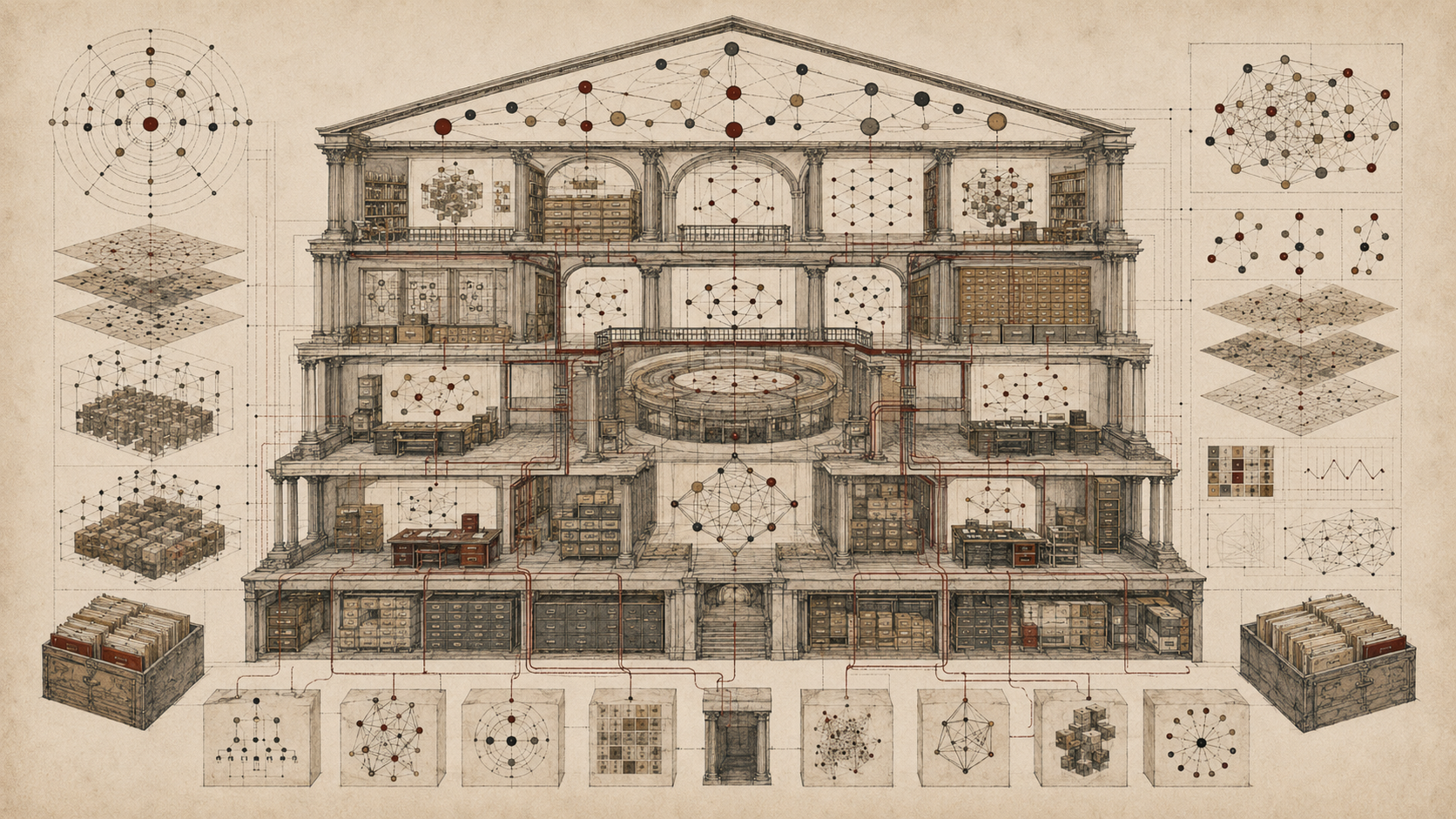
Ontologies and semantic networks organize knowledge by making relationships explicit. Where taxonomies classify concepts into categories and hierarchies, ontologies define entities, properties, constraints, and formal relationships. Where article maps guide readers through a structured series, semantic networks show how concepts, documents, datasets, methods, institutions, and ideas connect across a wider field of meaning.
Ontology modeling and semantic-network design are foundational to knowledge architecture because complex knowledge systems need more than labels. They need structured meaning. They need to know whether one concept is a type of another, part of another, dependent on another, evidence for another, adjacent to another, or contested by another. They need vocabularies, relationship types, provenance, definitions, and governance. Without these structures, knowledge systems may remain searchable but not truly intelligible.
Within knowledge architecture, ontologies and semantic networks provide the bridge between human conceptual organization and machine-readable structure. They support metadata, knowledge graphs, digital libraries, AI-assisted retrieval, research repositories, interdisciplinary synthesis, and long-term governance. They help a knowledge system move beyond flat categories toward structured relationships that can be inspected, queried, revised, and reused.
What Are Ontologies and Semantic Networks?
An ontology is a structured model of a domain that defines the kinds of things that exist, the properties they have, and the relationships that connect them. In knowledge architecture, an ontology may define concepts such as article, dataset, method, framework, taxonomy, ontology, knowledge graph, metadata record, evidence source, governance rule, and research pathway. It may also define relationships such as isPartOf, supports, requires, extends, cites, documents, contrastsWith, or belongsToSeries.
A semantic network is a relationship structure that connects concepts, entities, documents, or knowledge objects through meaningful links. Unlike a simple hierarchy, a semantic network can represent many kinds of relationships at once. It can show that one article depends on a framework, a method supports a dataset, a concept bridges two fields, a source provides evidence for a claim, or a taxonomy category is adjacent to another category.
Ontologies and semantic networks are closely related. An ontology defines the formal vocabulary and relationship types. A semantic network uses concepts and relationships to represent connected knowledge. A knowledge graph may implement both: entities and relationships stored in a form that can be queried, analyzed, visualized, and governed.
O = (C, P, R, A)
\]
Interpretation: An ontology \(O\) can be understood as a structure of classes \(C\), properties \(P\), relationships \(R\), and axioms or constraints \(A\). The expression is conceptual, but it clarifies the main components of ontology design.
In simpler terms, an ontology answers: what kinds of things are in this knowledge system, what can be said about them, and how can they relate? A semantic network answers: how are these things actually connected? Together, they help knowledge architecture move from classification toward meaning-rich structure.
Why Semantic Structure Matters
Semantic structure matters because knowledge systems are not made only of documents. They are made of relationships among ideas. A digital platform may contain hundreds of articles, datasets, code folders, references, and images, but if their relationships are not explicit, the platform remains difficult to interpret. Search may find text, but it may not reveal meaning.
Taxonomies help group knowledge. Hierarchies help organize levels. Metadata helps preserve context. Ontologies and semantic networks help make relationships explicit. They allow a system to distinguish between a concept that is broader, a concept that is narrower, a concept that is related, a concept that is equivalent, a concept that is part of another, and a concept that is evidence for a claim.
This matters for research because knowledge often depends on relational meaning. A source may support an argument. A dataset may operationalize a construct. A method may test a model. A theory may frame a question. A policy may implement a principle. A concept may translate across disciplines. Without semantic structure, these relationships remain implicit, fragile, and difficult to maintain.
Semantic structure also matters for AI-assisted systems. Retrieval systems and language models often operate through similarity, but similarity is not the same as meaning. Two texts may be similar in wording while belonging to different conceptual roles. Two concepts may use different wording while occupying the same semantic function. Ontologies and semantic networks help preserve structured relationships that similarity alone can miss.
| Structural Layer | Main Question | Knowledge-System Function |
|---|---|---|
| Taxonomy | Where does this belong? | Classifies knowledge into categories and hierarchies. |
| Metadata | What context travels with this object? | Supports retrieval, provenance, status, filtering, and governance. |
| Ontology | What kinds of things and relationships exist? | Formalizes domain meaning, entity types, and relationship rules. |
| Semantic network | How are knowledge objects connected? | Represents meaningful relationships across concepts, documents, data, and methods. |
| Knowledge graph | How can relationships be stored, queried, and analyzed? | Implements semantic relationships as a graph-like knowledge structure. |
Semantic structure therefore turns knowledge architecture from a navigational system into a meaning system. It does not merely help users find things. It helps users understand why things belong together and how they can be used in relation to one another.
Ontologies as Knowledge Architecture
Ontologies are part of knowledge architecture because they define the conceptual grammar of a domain. A taxonomy can say that “knowledge graphs” belong under “semantic structure.” An ontology can say that a knowledge graph is a structure composed of nodes and edges, that nodes may represent concepts, documents, datasets, or entities, and that edges may represent relationships such as supports, requires, cites, extends, or contradicts.
This formalization matters because large knowledge systems need consistency. If one article treats a “framework” as a method, another treats it as a theory, and another treats it as a category, the knowledge system becomes semantically unstable. An ontology can define the difference among framework, theory, model, method, concept, dataset, evidence source, and repository artifact.
Ontologies also support interoperability. If a platform’s metadata, article maps, repository folders, and knowledge graphs use compatible concepts and relationships, the system becomes easier to query, maintain, and extend. Ontology design helps align editorial structure with computational structure.
For example, an ontology for a knowledge architecture platform might define these classes:
| Ontology Class | Meaning | Example Instance |
|---|---|---|
| Article | A published knowledge object. | Ontologies and Semantic Networks. |
| Concept | A unit of meaning used across articles or systems. | Semantic network. |
| Framework | A structured model that organizes inquiry. | Conceptual framework for knowledge architecture. |
| Dataset | A structured data object used for analysis or demonstration. | Synthetic concept relationship table. |
| Method | A procedure for analysis, modeling, or interpretation. | Graph centrality analysis. |
| RepositoryFolder | A reproducible folder containing article-level assets. | articles/ontologies-and-semantic-networks/ |
| EvidenceSource | A source supporting a claim, definition, or model. | W3C RDF, OWL, or SKOS documentation. |
The ontology does not eliminate human interpretation. It makes interpretation more structured. It gives the knowledge system a formal vocabulary for what it contains and how its contents can relate.
Semantic Networks as Relationship Structures
A semantic network represents knowledge through nodes and relationships. Nodes may represent concepts, documents, people, institutions, datasets, methods, claims, categories, or events. Relationships may represent meaning: broader than, narrower than, part of, depends on, supports, contradicts, cites, applies to, is evidence for, is method for, or is governed by.
Semantic networks are useful because many knowledge relationships are not hierarchical. A concept may be related to several domains without being a child of any one of them. A method may support multiple article series. A dataset may serve several models. A source may be relevant to several arguments. A semantic network can represent these many-to-many relationships more effectively than a single tree.
SN = (V, E, L)
\]
Interpretation: A semantic network \(SN\) can be represented as vertices \(V\), edges \(E\), and labels \(L\) that describe the meaning of nodes and relationships.
The labels are essential. A network without relationship types may show connection, but not meaning. If one node is connected to another, users need to know whether that connection means “is part of,” “depends on,” “is similar to,” “contrasts with,” “is evidence for,” or “is broader than.” Semantic networks become useful when relationship meaning is explicit.
In knowledge architecture, semantic networks can support related-article recommendations, internal linking, article-map design, evidence tracing, repository documentation, concept mapping, curriculum design, and AI-assisted retrieval. They allow the knowledge system to become relational rather than merely categorical.
Semantic networks also help reveal structural problems. They can identify orphaned concepts, overloaded hubs, isolated clusters, missing bridges, weakly documented relationships, and concepts that appear in many domains. These diagnostics support governance and editorial review.
Entities, Classes, Properties, and Relationships
Ontology modeling requires several core distinctions. An entity is a specific thing in the domain. A class is a type of thing. A property describes an attribute or relationship. A relationship connects entities, classes, or concepts. These distinctions allow a knowledge system to represent meaning more precisely than a simple tag list.
For example, “Conceptual Frameworks in Research” is an article. “Article” is a class. “hasSlug” is a data property. “isPartOfSeries” is a relationship property. “Knowledge Architecture” is a series or knowledge domain. “Conceptual framework” is a concept that may appear in many articles. This level of modeling helps separate publication objects from conceptual objects.
| Ontology Element | Definition | Knowledge Architecture Example |
|---|---|---|
| Entity | A specific object or instance. | The article “Ontologies and Semantic Networks.” |
| Class | A type or category of entity. | Article, Concept, Dataset, Method, Framework. |
| Data property | An attribute with a literal value. | title, slug, publicationStatus, dateReviewed. |
| Object property | A relationship between entities. | isPartOfSeries, citesSource, usesMethod, supportsConcept. |
| Axiom or constraint | A rule about classes or relationships. | Every Article should have a title and slug. |
| Instance | A specific member of a class. | “Taxonomy Design for Knowledge Systems” as an instance of Article. |
These distinctions prevent common knowledge-system errors. An article is not the same as a concept. A category is not the same as a relationship. A source is not the same as evidence unless its evidentiary role is defined. A dataset is not the same as the model that uses it. Ontology modeling makes these distinctions explicit.
In a research platform, such distinctions matter for retrieval and interpretation. A user searching for a concept may need all articles that discuss it. A user searching for an article may need the specific publication object. A user searching for a method may need repository examples. A user searching for evidence may need sources linked to claims. Ontology design helps the system answer different kinds of questions.
RDFS, OWL, SKOS, and Linked Data
Several widely used standards and vocabularies support ontology and semantic-network work. RDF provides a basic way to express statements as triples: subject, predicate, object. RDFS extends RDF with vocabulary for classes, properties, labels, and subclass relationships. OWL supports richer ontology modeling with more formal semantics. SKOS supports knowledge organization systems such as thesauri, taxonomies, controlled vocabularies, and concept schemes.
These standards are important because they allow semantic structures to be shared, queried, and connected. A taxonomy can remain a local editorial tool, but it can also be expressed in SKOS. An ontology can remain a design document, but it can also be expressed in OWL. A semantic network can remain a diagram, but it can also be represented as RDF triples.
| Standard or Vocabulary | Main Purpose | Knowledge Architecture Use |
|---|---|---|
| RDF | Represents statements as subject-predicate-object triples. | Express article-concept-source relationships. |
| RDFS | Defines classes, properties, labels, and subclass relationships. | Create basic semantic structure for concepts and article objects. |
| OWL | Supports formal ontology modeling and reasoning. | Define richer class relationships, constraints, and logical structure. |
| SKOS | Represents thesauri, taxonomies, concept schemes, and controlled vocabularies. | Model preferred labels, alternate labels, broader terms, narrower terms, and related terms. |
| Linked Data | Connects structured data across systems through web identifiers. | Support interoperable knowledge graphs and reusable semantic metadata. |
For many knowledge systems, SKOS is a practical starting point because it maps well to taxonomy and controlled-vocabulary work. It can represent preferred labels, alternate labels, broader and narrower concepts, related concepts, and scope notes. OWL becomes more useful when the system needs stronger formal constraints or logical reasoning.
The goal is not to use formal standards for their own sake. The goal is to choose the level of semantic structure appropriate to the system. A small article map may need only clear metadata and a controlled vocabulary. A large research platform may benefit from SKOS. A complex semantic knowledge system may require RDF, RDFS, OWL, and graph databases.
Ontologies, Taxonomies, and Knowledge Graphs
Ontologies, taxonomies, and knowledge graphs are often discussed together, but they perform different roles. A taxonomy classifies concepts. An ontology formalizes domain meaning. A knowledge graph stores and connects instances, entities, concepts, and relationships in graph form. A semantic network may be a broader relationship model that can inform or be implemented as a knowledge graph.
A taxonomy might say that “Ontology Modeling” belongs under “Taxonomies, Hierarchies, Ontologies, and Semantic Structure.” An ontology might define OntologyModeling as a concept, specify that it uses classes and properties, and relate it to RDF, OWL, SKOS, semantic networks, and knowledge graphs. A knowledge graph might store specific articles, datasets, sources, and code folders connected through these relationship types.
| Structure | Primary Function | Example Role |
|---|---|---|
| Taxonomy | Classifies and organizes concepts into categories. | Place ontology modeling inside a knowledge architecture article map. |
| Ontology | Defines entities, classes, properties, constraints, and relationship types. | Define Article, Concept, Dataset, Method, and EvidenceSource. |
| Semantic network | Represents meaningful relationships among concepts or objects. | Show how ontology modeling relates to metadata, taxonomy, and AI retrieval. |
| Knowledge graph | Implements connected entities and relationships for querying and analysis. | Store articles, sources, methods, datasets, and concepts as graph nodes and edges. |
These structures should reinforce one another. The taxonomy provides navigable order. The ontology provides semantic precision. The semantic network provides relational context. The knowledge graph provides implementation. The metadata system preserves context and provenance. Governance keeps all of these structures aligned over time.
The danger is treating these tools as interchangeable. A taxonomy is not automatically an ontology. A network diagram is not automatically a knowledge graph. A knowledge graph without well-defined relationships may be visually impressive but semantically weak. A strong knowledge architecture is clear about what each layer does.
Semantic Modeling for Research Platforms
Research platforms need semantic modeling because they connect many types of knowledge objects: articles, references, datasets, methods, figures, code, notebooks, source documents, concepts, categories, frameworks, and outputs. A platform that treats all of these as generic content loses important distinctions.
Semantic modeling can define the relationships among these objects. An article may use a dataset, cite a source, apply a method, extend a framework, belong to a series, discuss a concept, produce an output, or depend on a prior article. A repository folder may support an article, store code, generate figures, and document methods. A source may support a claim or provide background context. These relationships can be modeled explicitly.
For a knowledge architecture platform, semantic modeling helps article maps become more than navigation pages. It allows the system to show how articles connect to concepts, how concepts connect to evidence, how evidence connects to repositories, and how repositories connect to reproducible workflows. This creates a richer research environment.
| Knowledge Object | Possible Semantic Relationships | Example |
|---|---|---|
| Article | belongsToSeries, discussesConcept, citesSource, usesMethod. | Ontologies and Semantic Networks belongs to Knowledge Architecture. |
| Concept | broaderThan, narrowerThan, relatedTo, contrastsWith. | Ontology modeling is related to semantic networks. |
| Dataset | supportsModel, generatedByScript, usedByArticle. | Synthetic concept table supports semantic-network example. |
| Method | appliesTo, tests, models, validates. | Graph diagnostics model concept relationships. |
| RepositoryFolder | supportsArticle, containsCode, containsData, producesOutput. | Article folder supports the WordPress article and examples. |
| EvidenceSource | supportsClaim, definesStandard, documentsMethod. | W3C RDF documentation defines RDF concepts. |
This kind of semantic modeling supports transparency. Users can see not only that an article exists, but what it discusses, what it cites, what code supports it, what concepts it belongs to, and what methods it uses. The research platform becomes more auditable and more navigable.
Ontology Governance and Versioning
Ontologies require governance because domain meanings change. New concepts appear. Old terms become inadequate. Relationships need refinement. Classes become too broad. Properties become ambiguous. Some definitions become outdated. A semantic model that is not maintained eventually becomes misleading.
Ontology governance defines how semantic structures are created, reviewed, changed, deprecated, and documented. It should specify who can add classes, who can approve new relationship types, how definitions are written, how scope notes are maintained, how deprecated terms are handled, and how versions are released.
Versioning is especially important because semantic changes can affect many downstream systems. If a relationship type changes meaning, existing article links, metadata records, graph queries, and AI retrieval workflows may be affected. If a class is split into two classes, older instances need migration or mapping. If a term is deprecated, redirects and historical notes may be needed.
| Governance Area | Purpose | Example Practice |
|---|---|---|
| Class governance | Maintains entity-type definitions. | Review whether “Framework” and “Model” need separate classes. |
| Property governance | Controls relationship meaning. | Distinguish “supports,” “requires,” “extends,” and “cites.” |
| Vocabulary governance | Maintains labels and synonyms. | Record preferred labels, alternate labels, and deprecated labels. |
| Versioning | Tracks semantic changes over time. | Document ontology releases and migration notes. |
| Validation | Checks structural consistency. | Require every Article to have a title, slug, and series. |
| Review | Prevents drift and misuse. | Schedule periodic audits of classes and relationships. |
Governance also has an interpretive dimension. Ontologies can make categories appear fixed when they are contested. A responsible ontology should document uncertainty, scope, and disagreement where needed. It should make semantic choices explicit rather than hiding them inside technical structure.
A well-governed ontology is not static. It is stable enough to support reuse and flexible enough to evolve with the knowledge system.
Semantic Networks and Interdisciplinary Knowledge
Semantic networks are especially valuable in interdisciplinary knowledge systems because interdisciplinary concepts rarely fit into one hierarchy. A concept such as “resilience” may connect ecology, psychology, infrastructure, economics, public health, climate adaptation, and governance. A strict hierarchy may force one primary location. A semantic network can preserve multiple relationships.
Interdisciplinary semantic modeling must be careful. Similar terms may not mean the same thing across fields. “Adaptation” in climate science, evolutionary biology, psychology, and organizational theory carries different meanings. “Value” in economics, ethics, ecology, and cultural studies reflects different assumptions. “System” in engineering, sociology, ecology, and philosophy may refer to different kinds of structure.
A semantic network can represent these differences by using relationship types, scope notes, domain tags, and concept variants. It can show that two concepts are related but not equivalent. It can show that a term has different meanings in different domains. It can show that one field’s model informs another field without collapsing them into one framework.
| Interdisciplinary Problem | Semantic-Network Response | Example |
|---|---|---|
| Same term, different meanings. | Use domain-specific concept nodes and scope notes. | Resilience in ecology vs. resilience in psychology. |
| Different terms, similar ideas. | Use related-term or close-match relationships. | Controlled vocabulary, thesaurus, taxonomy, subject heading. |
| Concept bridges multiple domains. | Use cross-domain relationships. | Knowledge graphs bridge AI, data systems, and knowledge architecture. |
| Conceptual disagreement exists. | Document contested relationships rather than forcing equivalence. | Development, justice, sustainability, governance. |
| Evidence types differ. | Model sources, methods, and evidence roles explicitly. | Legal text, survey data, ecological indicator, interview narrative. |
Semantic networks help interdisciplinary knowledge systems remain connected without becoming careless. They provide bridges, but they also preserve boundaries. This is essential for responsible knowledge architecture, where the goal is not merely to connect everything, but to connect things accurately.
Ontologies and AI-Assisted Retrieval
AI-assisted retrieval depends on the structure of the knowledge environment. Language models and retrieval systems can search text, summarize documents, and identify similarity, but they often need additional structure to preserve meaning, provenance, and relationship context. Ontologies and semantic networks can provide that structure.
An ontology can define what counts as an article, source, dataset, method, concept, framework, model, or evidence object. A semantic network can show how those objects connect. Metadata can provide status, version, domain, source, and review context. Together, these structures help AI-assisted systems retrieve more than text fragments. They help retrieve knowledge objects in context.
For example, a user asking about “knowledge graphs” may need foundational definitions, related taxonomy articles, ontology articles, code repositories, metadata schemas, and AI retrieval discussions. A semantic architecture can help the system distinguish between introductory content, technical examples, related concepts, and evidence sources. It can retrieve across levels rather than returning only keyword matches.
Ontologies can also help reduce ambiguity. If the system knows that “framework” and “model” are related but distinct, it can avoid treating them as identical. If it knows that “source” and “evidence” are different roles, it can preserve interpretive context. If it knows that a dataset is synthetic, it can avoid treating it as empirical evidence.
AI does not remove the need for human governance. Automated systems can suggest relationships, cluster concepts, or extract entities, but human review is needed to determine whether those relationships are meaningful, accurate, ethical, and aligned with the knowledge system’s purpose. Ontology design gives AI better structure; governance keeps that structure accountable.
Mathematical and Computational Modeling
Ontologies and semantic networks can be modeled computationally as graphs, triples, adjacency lists, matrices, relational tables, RDF datasets, or graph databases. These structures allow researchers and knowledge architects to query relationships, calculate network measures, detect orphaned concepts, identify hubs, trace pathways, and evaluate semantic coverage.
Triple = (s, p, o)
\]
Interpretation: An RDF-style triple consists of subject \(s\), predicate \(p\), and object \(o\). For example: “Ontologies and Semantic Networks” — “isPartOfSeries” — “Knowledge Architecture.”
C_D(v) = \frac{deg(v)}{|V|-1}
\]
Interpretation: Degree centrality estimates how directly connected a concept \(v\) is within a semantic network. High centrality may indicate a bridge concept or an overloaded hub.
RelationCoverage = \frac{|R_D|}{|R_T|}
\]
Interpretation: Relationship coverage can be approximated as the share of total relationships \(R_T\) that are explicitly documented \(R_D\). The measure highlights the importance of named, traceable semantic relationships.
OrphanRate = \frac{|O|}{|V|}
\]
Interpretation: The orphan rate estimates the share of nodes \(O\) with no useful relationships among all nodes \(V\). Orphaned concepts may indicate weak integration or future expansion areas.
These measures should be interpreted cautiously. A highly connected node may be an important bridge, but it may also be too broad. An orphaned node may indicate a problem, or it may be a newly introduced concept awaiting integration. A sparse network may be underdeveloped, or it may reflect a carefully bounded domain. Metrics support review; they do not replace interpretation.
Computational modeling is most useful when linked to governance. Scripts can detect missing labels, undefined relationship types, isolated nodes, duplicate terms, inconsistent assignments, deprecated concepts, or relationships without evidence notes. This makes semantic architecture auditable rather than purely aspirational.
Python Section: Modeling a Semantic Network
The following Python example models a small semantic network using concepts and typed relationships. It produces degree summaries and a relationship table without requiring external dependencies.
# semantic_network_model.py
# Lightweight semantic-network model for knowledge architecture.

from pathlib import Path
import csv
from collections import defaultdict

ROOT = Path(".")
OUTPUTS = ROOT / "outputs"
OUTPUTS.mkdir(exist_ok=True)

nodes = [
    {"id": "ka", "label": "Knowledge Architecture", "type": "Domain"},
    {"id": "ontology", "label": "Ontology Modeling", "type": "Concept"},
    {"id": "semantic_network", "label": "Semantic Network", "type": "Concept"},
    {"id": "taxonomy", "label": "Taxonomy Design", "type": "Concept"},
    {"id": "metadata", "label": "Metadata Systems", "type": "Concept"},
    {"id": "knowledge_graph", "label": "Knowledge Graph", "type": "Concept"},
    {"id": "ai_retrieval", "label": "AI-Assisted Retrieval", "type": "Application"},
    {"id": "rdf", "label": "RDF", "type": "Standard"},
    {"id": "owl", "label": "OWL", "type": "Standard"},
    {"id": "skos", "label": "SKOS", "type": "Standard"},
]

edges = [
    ("ka", "ontology", "includes"),
    ("ka", "semantic_network", "includes"),
    ("taxonomy", "skos", "can_be_represented_with"),
    ("ontology", "owl", "can_be_represented_with"),
    ("semantic_network", "knowledge_graph", "can_inform"),
    ("metadata", "ai_retrieval", "supports"),
    ("ontology", "knowledge_graph", "structures"),
    ("rdf", "knowledge_graph", "can_encode"),
    ("skos", "taxonomy", "models"),
    ("owl", "ontology", "models"),
    ("knowledge_graph", "ai_retrieval", "supports"),
]

degree = defaultdict(int)

for source, target, relationship in edges:
    degree[source] += 1
    degree[target] += 1

node_lookup = {node["id"]: node for node in nodes}

with (OUTPUTS / "semantic_network_node_degrees.csv").open("w", newline="", encoding="utf-8") as f:
    writer = csv.writer(f)
    writer.writerow(["node_id", "label", "type", "degree"])
    for node_id, value in sorted(degree.items(), key=lambda item: item[1], reverse=True):
        node = node_lookup[node_id]
        writer.writerow([node_id, node["label"], node["type"], value])

with (OUTPUTS / "semantic_network_edges.csv").open("w", newline="", encoding="utf-8") as f:
    writer = csv.writer(f)
    writer.writerow(["source", "target", "relationship"])
    writer.writerows(edges)

summary = {
    "node_count": len(nodes),
    "edge_count": len(edges),
    "orphan_count": sum(1 for node in nodes if degree[node["id"]] == 0),
}

with (OUTPUTS / "semantic_network_summary.csv").open("w", newline="", encoding="utf-8") as f:
    writer = csv.writer(f)
    writer.writerow(["metric", "value"])
    for key, value in summary.items():
        writer.writerow([key, value])

print("Wrote semantic-network diagnostics to outputs/")
This example can be extended with graph libraries, RDF parsing, ontology files, article metadata, source links, validation rules, and visualization. The important principle is that semantic relationships should be typed, documented, and auditable.
R Section: Semantic-Network Diagnostics
The following R example summarizes semantic-network nodes and relationship types. It can help identify overloaded relationship types, weakly connected concepts, or underdeveloped areas in a knowledge system.
# semantic_network_diagnostics.R
# Lightweight semantic-network diagnostics for knowledge architecture.

nodes <- data.frame(
  id = c(
    "ka",
    "ontology",
    "semantic_network",
    "taxonomy",
    "metadata",
    "knowledge_graph",
    "ai_retrieval",
    "rdf",
    "owl",
    "skos"
  ),
  label = c(
    "Knowledge Architecture",
    "Ontology Modeling",
    "Semantic Network",
    "Taxonomy Design",
    "Metadata Systems",
    "Knowledge Graph",
    "AI-Assisted Retrieval",
    "RDF",
    "OWL",
    "SKOS"
  ),
  type = c(
    "Domain",
    "Concept",
    "Concept",
    "Concept",
    "Concept",
    "Concept",
    "Application",
    "Standard",
    "Standard",
    "Standard"
  )
)

edges <- data.frame(
  source = c(
    "ka",
    "ka",
    "taxonomy",
    "ontology",
    "semantic_network",
    "metadata",
    "ontology",
    "rdf",
    "skos",
    "owl",
    "knowledge_graph"
  ),
  target = c(
    "ontology",
    "semantic_network",
    "skos",
    "owl",
    "knowledge_graph",
    "ai_retrieval",
    "knowledge_graph",
    "knowledge_graph",
    "taxonomy",
    "ontology",
    "ai_retrieval"
  ),
  relationship = c(
    "includes",
    "includes",
    "can_be_represented_with",
    "can_be_represented_with",
    "can_inform",
    "supports",
    "structures",
    "can_encode",
    "models",
    "models",
    "supports"
  )
)

dir.create("outputs", showWarnings = FALSE)

relationship_summary <- as.data.frame(table(edges$relationship))
names(relationship_summary) <- c("relationship", "count")

node_type_summary <- as.data.frame(table(nodes$type))
names(node_type_summary) <- c("node_type", "count")

degree_table <- data.frame(
  id = nodes$id,
  label = nodes$label,
  type = nodes$type,
  degree = sapply(nodes$id, function(x) {
    sum(edges$source == x) + sum(edges$target == x)
  })
)

write.csv(relationship_summary, "outputs/semantic_relationship_summary.csv", row.names = FALSE)
write.csv(node_type_summary, "outputs/semantic_node_type_summary.csv", row.names = FALSE)
write.csv(degree_table, "outputs/semantic_node_degree_table.csv", row.names = FALSE)

print(relationship_summary)
print(node_type_summary)
print(degree_table)
R is useful for semantic-network diagnostics because it can summarize node types, relationship types, central concepts, and potential gaps. In a larger workflow, these diagnostics can be linked to article metadata, taxonomy records, ontology files, and repository outputs.
SQL Section: Ontology and Semantic Relationship Schema
SQL can support ontology and semantic-network work by storing classes, entities, properties, relationships, source notes, and revision records. A relational schema is not a substitute for RDF or OWL, but it can provide a practical governance layer for many research platforms.
-- ontology_semantic_network_schema.sql
-- Minimal schema for ontology and semantic-network governance.

CREATE TABLE IF NOT EXISTS ontology_classes (
  class_id TEXT PRIMARY KEY,
  label TEXT NOT NULL,
  definition TEXT,
  parent_class_id TEXT,
  status TEXT DEFAULT 'active',
  FOREIGN KEY (parent_class_id) REFERENCES ontology_classes(class_id)
);

CREATE TABLE IF NOT EXISTS entities (
  entity_id TEXT PRIMARY KEY,
  class_id TEXT NOT NULL,
  label TEXT NOT NULL,
  slug TEXT,
  status TEXT DEFAULT 'active',
  FOREIGN KEY (class_id) REFERENCES ontology_classes(class_id)
);

CREATE TABLE IF NOT EXISTS properties (
  property_id TEXT PRIMARY KEY,
  label TEXT NOT NULL,
  property_type TEXT NOT NULL,
  definition TEXT,
  domain_class_id TEXT,
  range_class_id TEXT,
  status TEXT DEFAULT 'active',
  FOREIGN KEY (domain_class_id) REFERENCES ontology_classes(class_id),
  FOREIGN KEY (range_class_id) REFERENCES ontology_classes(class_id)
);

CREATE TABLE IF NOT EXISTS semantic_relationships (
  relationship_id INTEGER PRIMARY KEY,
  subject_entity_id TEXT NOT NULL,
  property_id TEXT NOT NULL,
  object_entity_id TEXT NOT NULL,
  evidence_note TEXT,
  status TEXT DEFAULT 'active',
  FOREIGN KEY (subject_entity_id) REFERENCES entities(entity_id),
  FOREIGN KEY (property_id) REFERENCES properties(property_id),
  FOREIGN KEY (object_entity_id) REFERENCES entities(entity_id)
);

CREATE TABLE IF NOT EXISTS ontology_revisions (
  revision_id INTEGER PRIMARY KEY,
  object_type TEXT NOT NULL,
  object_id TEXT NOT NULL,
  change_type TEXT NOT NULL,
  change_note TEXT,
  changed_at DATE
);
This schema separates classes, entities, properties, semantic relationships, and revisions. That separation matters. A class defines a type. An entity is an instance. A property defines the kind of relationship or attribute. A semantic relationship connects entities through a named property. A revision record preserves governance history.
A schema like this can support article maps, semantic search, repository documentation, evidence mapping, AI retrieval, and ontology governance. It can also serve as a bridge between lightweight editorial systems and more formal RDF or graph-based infrastructure.
GitHub Repository
This article is supported by a companion repository folder with reproducible examples, small synthetic datasets, documentation, and language-specific modeling scaffolds for ontology design and semantic-network analysis.
Complete Code Repository
This folder contains companion research and code assets for the Ontologies and Semantic Networks article, including Python, R, Julia, SQL, Rust, Go, C++, Fortran, C, documentation, data, and generated outputs.
The repository structure mirrors the article’s semantic-design argument. Python supports semantic-network modeling and node diagnostics. R supports relationship summaries and semantic-network audits. SQL supports ontology classes, entities, properties, relationships, and revision tracking. Systems-language folders provide space for validation utilities, graph-processing experiments, and reproducible tooling. Documentation, data, and outputs preserve the relationship between ontology design, semantic modeling, and knowledge-system governance.
Quality Criteria for Ontology Design
A good ontology should be clear, coherent, scoped, reusable, governed, and aligned with the purpose of the knowledge system. It should define classes and relationships precisely enough to support consistent use, but not so rigidly that it distorts the domain. It should make meaning more transparent, not merely more technical.
Clarity means classes and properties are understandable. Coherence means relationships follow a consistent logic. Scope means the ontology defines what it covers and what it does not cover. Reusability means the structure can support multiple articles, datasets, repositories, or applications. Governance means definitions and relationships can be reviewed and revised. Alignment means the ontology supports the intellectual purpose of the system.
| Quality Criterion | Evaluation Question | Warning Sign |
|---|---|---|
| Class clarity | Are entity types defined clearly? | Concept, article, method, and framework are used inconsistently. |
| Relationship clarity | Are properties named and scoped? | Different relationship types are collapsed into vague links. |
| Logical coherence | Do classes and relationships make sense together? | Subclass or part-whole relationships are confused. |
| Scope control | Is the ontology bounded? | The model tries to represent everything at once. |
| Interoperability | Can the ontology connect to metadata, taxonomy, and repository structures? | Semantic definitions do not map to actual system objects. |
| Governance | Can changes be reviewed, documented, and versioned? | Classes and properties change without revision history. |
| Interpretive accountability | Are contested or sensitive categories handled carefully? | The ontology makes disputed concepts appear fixed or neutral. |
Ontology evaluation should include both technical and interpretive review. A technically consistent ontology may still be conceptually narrow. A simple ontology may be more useful than an overbuilt one if it fits the system’s needs. A strong ontology should help people and systems understand the domain better than they could without it.
Interpretive Cautions and Ethical Limits
Ontologies and semantic networks are powerful because they formalize meaning. That power creates risk. A formal model can make contested categories appear settled. A relationship type can hide interpretation inside technical language. A class hierarchy can reproduce dominant assumptions. A knowledge graph can make relationships appear objective because they have been encoded.
Semantic structure is never purely neutral. Someone decides what classes exist, which relationships matter, what labels are preferred, what counts as evidence, what gets connected, and what remains outside the model. These decisions shape what users and systems can retrieve, compare, and trust.
This is especially important for cultural, historical, political, legal, religious, ecological, and social knowledge. Some knowledge traditions do not fit neatly into formal classes. Some relationships are contested. Some categories have histories of exclusion. Some archives preserve dominant voices while silencing others. Ontology design should not hide these issues behind technical precision.
Responsible ontology and semantic-network design should include scope notes, provenance, revision history, contested-category documentation, alternate labels, and mechanisms for review. It should preserve ambiguity where ambiguity is real. It should distinguish between equivalence, similarity, analogy, dependency, influence, and disagreement. It should make structure accountable.
The goal is not to avoid formal modeling. The goal is to formalize carefully. Strong semantic architecture makes knowledge more navigable while remaining open to critique, revision, and plural interpretation.
Why Ontologies and Semantic Networks Belong to Knowledge Architecture
Ontologies and semantic networks belong to knowledge architecture because they make meaning explicit. Taxonomies can classify. Hierarchies can organize levels. Metadata can preserve context. But ontologies and semantic networks define and connect the underlying knowledge objects, concepts, and relationships that give a system its intellectual structure.
For article maps, they clarify how articles, concepts, methods, sources, and repositories relate. For digital libraries, they support subject relationships and discoverability. For research platforms, they connect claims, evidence, datasets, and models. For AI-assisted systems, they provide structured context for retrieval and summarization. For interdisciplinary knowledge, they preserve relationships that do not fit into a single hierarchy.
They also strengthen governance. If relationship types are defined, they can be reviewed. If concepts are modeled, they can be versioned. If semantic structures are documented, they can be audited. If knowledge graphs are connected to metadata and ontology rules, they become more than visual networks; they become maintained intellectual infrastructure.
At their best, ontologies and semantic networks help knowledge systems become more transparent, interpretable, and durable. They allow complexity to remain connected without becoming chaotic. They make relationships visible without pretending that every relationship is final. They give knowledge architecture one of its deepest capacities: the ability to organize not only information, but meaning.
Related Articles
- Foundations of Knowledge Architecture
- What Is Knowledge Architecture?
- Taxonomy Design for Knowledge Systems
- Hierarchical Knowledge Structures
- Knowledge Graphs and Semantic Relationships
- Knowledge Mapping and Conceptual Models
Further Reading
- Allemang, D. and Hendler, J. (2011) Semantic Web for the Working Ontologist: Effective Modeling in RDFS and OWL. 2nd edn. Amsterdam: Morgan Kaufmann.
- Antoniou, G., Groth, P., van Harmelen, F. and Hoekstra, R. (2012) A Semantic Web Primer. 3rd edn. Cambridge, MA: MIT Press.
- Gruber, T.R. (1993) ‘A Translation Approach to Portable Ontology Specifications’, Knowledge Acquisition, 5(2), pp. 199–220.
- Hodge, G. (2000) Systems of Knowledge Organization for Digital Libraries: Beyond Traditional Authority Files. Washington, DC: Council on Library and Information Resources.
- Sowa, J.F. (2000) Knowledge Representation: Logical, Philosophical, and Computational Foundations. Pacific Grove, CA: Brooks/Cole.
- Staab, S. and Studer, R. (eds.) (2009) Handbook on Ontologies. 2nd edn. Berlin: Springer.
References
- Allemang, D. and Hendler, J. (2011) Semantic Web for the Working Ontologist: Effective Modeling in RDFS and OWL. 2nd edn. Amsterdam: Morgan Kaufmann.
- Gruber, T.R. (1993) ‘A Translation Approach to Portable Ontology Specifications’, Knowledge Acquisition, 5(2), pp. 199–220. Available at: https://doi.org/10.1006/knac.1993.1008
- Hitzler, P., Krötzsch, M., Parsia, B., Patel-Schneider, P.F. and Rudolph, S. (2012) OWL 2 Web Ontology Language Primer. W3C Recommendation. Available at: https://www.w3.org/TR/owl2-primer/
- Hodge, G. (2000) Systems of Knowledge Organization for Digital Libraries: Beyond Traditional Authority Files. Washington, DC: Council on Library and Information Resources. Available at: https://www.clir.org/pubs/reports/pub91/
- McGuinness, D.L. and van Harmelen, F. (2004) OWL Web Ontology Language Overview. W3C Recommendation. Available at: https://www.w3.org/TR/owl-features/
- RDF Working Group (2014) RDF 1.1 Concepts and Abstract Syntax. W3C Recommendation. Available at: https://www.w3.org/TR/rdf11-concepts/
- RDFS Working Group (2014) RDF Schema 1.1. W3C Recommendation. Available at: https://www.w3.org/TR/rdf-schema/
- SKOS Working Group (2009) SKOS Simple Knowledge Organization System Reference. W3C Recommendation. Available at: https://www.w3.org/TR/skos-reference/
- Sowa, J.F. (2000) Knowledge Representation: Logical, Philosophical, and Computational Foundations. Pacific Grove, CA: Brooks/Cole.