
Table of Contents
- Abstract
- Prototype Repository
- SDG Alignment
- Why Flood Monitoring Systems Matter
- Hydrological Indicators of Flood Risk
- System Architecture
- Environmental Sensors for Flood Monitoring
- Bill of Materials
- Engineering Specifications
- Measuring River Water Levels
- Sensor Calibration
- Handling Sensor Noise and Measurement Error
- Rainfall Monitoring
- Flood Risk Detection Logic
- Distributed Flood Monitoring Networks
- AI and Predictive Flood Detection
- Engineering Notes
- Validation and Testing
- Suggested Performance Metrics
- Flood Monitoring and Sustainable Development
- The Future of Flood Monitoring Infrastructure
- Reproducibility
- Conclusion
Abstract
This project presents a prototype Raspberry Pi flood monitoring system built around hydrological sensing, local data logging, threshold-based alert logic, and optional networked deployment. The platform measures river or channel water levels, rainfall conditions, and supporting atmospheric variables in order to identify environmental conditions associated with flood risk.
From an engineering perspective, the build demonstrates a compact edge-monitoring node for hydrological observation and flood warning. From a sustainability perspective, it illustrates how low-cost distributed monitoring can strengthen climate adaptation, watershed awareness, and local disaster preparedness.
Prototype Repository
This project is published as an open prototype so that engineers, researchers, students, and advanced makers can reproduce and extend the design. All code, documentation, setup notes, and example flood-monitoring data are available in the project repository.
GitHub Repository:
Raspberry Pi Flood Monitoring System – Source Files and Documentation
The repository contains the complete prototype build materials:
- Python sensor-reading scripts
- water-level and rainfall monitoring examples
- alert detection logic
- deployment notes
- example flood-monitoring datasets
- supporting environmental analysis files
Engineers can clone the repository, fork the design, or download the complete project using GitHub’s Download ZIP feature.
All materials are released under the MIT License to support reuse in research, education, and prototype engineering work.
Repository Structure
raspberry-pi-flood-monitoring-system/

README.md
LICENSE
requirements.txt

src/
  read_water_level.py
  log_flood_data.py
  rainfall_monitor.py
  flood_alerts.py
  anomaly_detection.py

docs/
  setup_guide.md
  deployment_notes.md
  sensor_notes.md

data/
  example_flood_readings.csv

hardware/
SDG Alignment
This project aligns most directly with SDG 6: Clean Water and Sanitation and SDG 13: Climate Action.
It supports water-resource monitoring by making river and watershed conditions more visible over time. It supports climate action by strengthening resilience to flood hazards and improving the ability of communities to respond to climate-related hydrological events.
It also connects to SDG 11: Sustainable Cities and Communities because flood preparedness is a core component of resilient urban and regional infrastructure.
Why Flood Monitoring Systems Matter
Flood hazards often emerge from measurable environmental changes before damaging overflow occurs. River levels rise, rainfall accumulates, and atmospheric conditions shift. Monitoring systems matter because they transform these precursors into actionable information.
A Raspberry Pi–based flood monitoring node matters for several reasons:
- it supports continuous local observation rather than only occasional manual checks
- it helps identify emerging risk before full flood onset
- it can scale across multiple sites in a watershed or drainage system
- it provides a foundation for threshold-based alerts and later predictive analytics
The platform is not a replacement for national hydrological infrastructure. Its value is that it translates the logic of flood monitoring into a reproducible edge-computing system that is accessible to researchers, communities, and educators.
Hydrological Indicators of Flood Risk
Flood events rarely occur without warning. Environmental indicators often reveal increasing risk before floodwaters reach dangerous levels.
Important flood indicators include:
- rapid increases in river water level
- high rainfall intensity or prolonged precipitation
- soil saturation and surface runoff
- changes in atmospheric pressure during storm systems
- storm surge conditions in coastal regions
Monitoring these indicators continuously allows environmental monitoring systems to detect conditions that may precede dangerous flooding. Early detection gives communities and emergency responders more time to act.
System Architecture
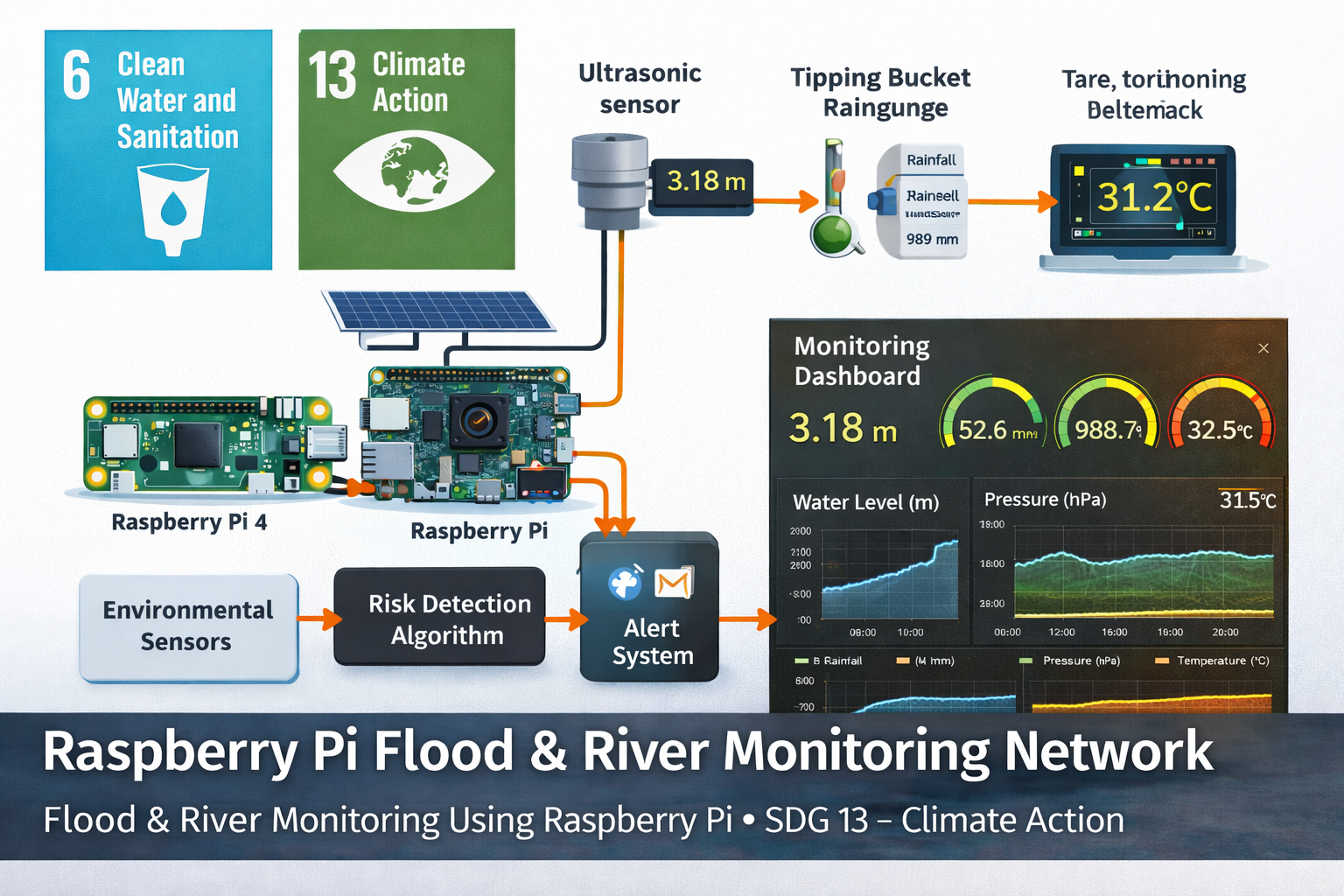
A Raspberry Pi flood monitoring station combines environmental sensors with edge computing, local data storage, and automated alert logic.
Typical architecture:
Water Level Sensors → Raspberry Pi Edge Processing → Flood Risk Detection → Alerts & Data Storage
Multiple monitoring stations can be deployed along river systems or flood-prone areas. Environmental measurements from each station may be transmitted to a central server where regional flood conditions can be analyzed. This distributed architecture allows monitoring networks to scale across watersheds and urban drainage systems.
Environmental Sensors for Flood Monitoring
Flood monitoring systems often integrate several sensor types to capture hydrological and atmospheric conditions.
Common sensors include:
- ultrasonic water level sensors
- tipping-bucket rainfall gauges
- soil moisture sensors
- temperature and humidity sensors
- barometric pressure sensors
Combining multiple environmental measurements improves the reliability of flood detection systems and allows monitoring algorithms to identify more complex environmental patterns associated with flood events.
Bill of Materials
- Raspberry Pi 4 or Raspberry Pi Zero 2 W
- ultrasonic distance sensor (HC-SR04)
- tipping-bucket rain gauge
- BME280 environmental sensor
- solar power supply with battery storage
- microSD card
- weatherproof enclosure
Outdoor monitoring stations often operate in remote locations and must run continuously using solar-powered energy systems. Weather-resistant enclosures and protective mounting systems are essential for long-term reliability.
Engineering Specifications
| Parameter | Specification |
|---|---|
| Compute platform | Raspberry Pi 4 or Raspberry Pi Zero 2 W |
| Primary hydrological sensor | Ultrasonic distance sensor for water-level estimation |
| Rainfall sensing | Tipping-bucket rain gauge |
| Atmospheric sensing | BME280 (temperature, humidity, pressure) |
| Storage options | CSV, SQLite, dashboard export |
| Alert mode | Threshold-based flood risk detection |
| Deployment mode | Distributed flood-monitoring node |
| Target scope | Educational, prototype, and experimental flood-risk observation |
Measuring River Water Levels
Ultrasonic sensors estimate the distance between the sensor and the water surface by measuring the time required for a sound pulse to travel to the water and return to the sensor.
The HC-SR04 emits a high-frequency acoustic signal and calculates distance using the speed of sound in air.
Example Python code for distance measurement:
import time
import RPi.GPIO as GPIO

TRIG = 23
ECHO = 24

GPIO.setmode(GPIO.BCM)
GPIO.setup(TRIG, GPIO.OUT)
GPIO.setup(ECHO, GPIO.IN)

def measure_distance():
    GPIO.output(TRIG, True)
    time.sleep(0.00001)
    GPIO.output(TRIG, False)

    start = time.time()
    stop = time.time()

    while GPIO.input(ECHO) == 0:
        start = time.time()

    while GPIO.input(ECHO) == 1:
        stop = time.time()

    elapsed = stop - start
    distance = (elapsed * 34300) / 2

    return distance
Sensor Calibration
To convert ultrasonic distance measurements into river height estimates, the system must account for the installation height of the sensor above the water surface or riverbed reference point.
If the sensor is mounted at a known height above the reference surface, water height can be estimated using:
Water Height = Sensor Mount Height − Measured Distance
Calibration is critical because environmental conditions such as temperature and humidity affect the speed of sound and therefore measurement accuracy. Regular calibration improves long-term reliability in field deployments.
Handling Sensor Noise and Measurement Error
Environmental sensors often produce noisy measurements due to:
- water surface turbulence
- wave reflections
- wind interference
- temperature variation
Monitoring systems commonly implement filtering techniques such as:
- moving average smoothing
- outlier rejection
- median filtering
These methods help stabilize water-level measurements and improve flood detection accuracy.
Rainfall Monitoring
Flood risk is often strongly influenced by rainfall intensity. Rain gauges measure precipitation levels and allow monitoring systems to detect heavy rainfall events.
Rainfall accumulation data may be used to calculate:
- rainfall intensity
- cumulative precipitation
- runoff risk
When rainfall exceeds predefined thresholds, monitoring systems may increase measurement frequency or trigger alerts.
Flood Risk Detection Logic
Flood detection algorithms typically combine multiple environmental signals.
Example monitoring logic:
if water_level > flood_threshold:
    send_alert("Flood risk detected")

if rainfall_rate > rainfall_threshold:
    increase_monitoring_frequency()
Combining rainfall data with water-level measurements improves flood detection reliability and reduces false alarms. More advanced systems may also incorporate trend detection, persistence rules, and threshold escalation.
Distributed Flood Monitoring Networks
Individual monitoring stations can be connected into distributed monitoring networks. Multiple Raspberry Pi stations may transmit environmental data to a centralized database or dashboard.
Applications include:
- river basin monitoring
- urban drainage monitoring
- community flood early-warning systems
- agricultural water management
Distributed networks improve regional flood awareness and enable more coordinated emergency response.
AI and Predictive Flood Detection
Machine learning models can analyze historical environmental data to identify patterns associated with flood events.
Potential applications include:
- predicting flood probability
- analyzing rainfall-runoff relationships
- detecting abnormal water-level trends
- predicting river overflow conditions
Lightweight machine learning frameworks such as TensorFlow Lite can run directly on Raspberry Pi devices, allowing predictive flood detection to occur at the edge.
Engineering Notes
A few technical considerations are especially important in this build:
- mounting geometry: water-level interpretation depends heavily on stable sensor placement.
- environmental noise: wind, turbulence, and surface reflection can distort ultrasonic measurements.
- power resilience: flood-monitoring nodes may be most critical during storms when power conditions are unstable.
- threshold realism: warning levels should reflect local watershed behavior, not only generic values.
- network design: distributed systems benefit from consistent data structures and synchronized timestamps.
These considerations make the project more than a single-purpose sensor demo. It becomes a prototype hydrological resilience infrastructure node.
Validation and Testing
To bring this project closer to engineering-grade documentation, validation should include:
- verify sensor communication with the BME280 and any additional rainfall or water-level sensors
- confirm that ultrasonic distance readings remain plausible under controlled conditions
- test calibration logic against known reference heights
- simulate threshold crossings for rainfall and flood-alert rules
- verify CSV or SQLite logging over repeated intervals
- run extended trials to assess uptime and storage reliability
If the system behaves inconsistently, the issue may be related to sensor placement, threshold selection, power instability, logging configuration, or environmental interference rather than to the monitoring concept itself.
Suggested Performance Metrics
For a more rigorous evaluation, the system can be assessed using several simple metrics:
- sensor stability: consistency of repeated readings under unchanged conditions
- alert reliability: whether warning logic triggers under intended conditions without excessive false alarms
- logging reliability: whether observations are stored without loss over long runs
- uptime: how consistently the station continues operating without intervention
- operational usefulness: whether the collected data improves local understanding of flood risk
Even simple tracking of these metrics improves the project’s value as an experimental flood-monitoring platform.
Flood Monitoring and Sustainable Development
Flood monitoring systems contribute directly to sustainable development goals.
They support:
- SDG 6 – Clean Water and Sanitation by improving water-resource monitoring and watershed awareness
- SDG 13 – Climate Action by strengthening resilience to climate-related hazards
- SDG 11 – Sustainable Cities and Communities by improving disaster preparedness and local infrastructure awareness
Environmental monitoring infrastructure enables governments, researchers, and communities to detect environmental risks earlier and respond more effectively.
The Future of Flood Monitoring Infrastructure
Next-generation flood monitoring systems will increasingly integrate:
- sensor networks
- satellite observations
- machine learning models
- real-time emergency alert systems
Accessible computing platforms such as Raspberry Pi allow researchers, students, and communities to prototype systems capable of collecting valuable environmental data. These systems demonstrate how open hardware and open-source software can contribute to climate resilience and sustainable water management.
Reproducibility
All code, documentation, and supporting build materials necessary to reproduce the prototype are included in the project repository. The design intentionally relies on widely available Raspberry Pi hardware, open-source Python libraries, and common environmental sensing components so that it can be rebuilt in classrooms, labs, and independent flood-monitoring projects.
The system is intended as a reference implementation rather than a certified public warning network. Engineers adapting it for longer-term deployment should validate threshold design, enclosure resilience, power systems, data retention, and sensor maintenance under local operating conditions.
Conclusion
Building a Raspberry Pi flood monitoring system demonstrates how embedded sensing and local computation can support stronger hydrological resilience infrastructure. By combining river-level sensing, rainfall monitoring, and threshold-based alert logic, the platform creates a flexible foundation for distributed flood-risk observation.
Although compact, the design reflects a broader sustainability principle: flood resilience depends on environmental visibility. When local hydrological conditions can be measured continuously and interpreted early, communities are better positioned to anticipate hazards and respond more effectively.