
Table of Contents
- Abstract
- Prototype Repository
- SDG Alignment
- Why Climate Early Warning Systems Matter
- System Architecture
- Environmental Sensors for Climate Monitoring
- Bill of Materials
- Engineering Specifications
- Reading Environmental Sensor Data with Python
- Flood Risk Monitoring
- Storm Detection Using Atmospheric Pressure
- Distributed Environmental Monitoring Networks
- AI and Predictive Climate Risk Detection
- Climate Resilience and SDG 13
- Engineering Notes
- Validation and Testing
- Suggested Performance Metrics
- The Future of Climate Monitoring Infrastructure
- Reproducibility
- Conclusion
Abstract
This project presents a prototype Raspberry Pi climate early warning system built around environmental sensing, local data logging, threshold-based alert logic, and optional distributed network integration. The platform collects atmospheric and hydrological observations such as temperature, humidity, pressure, rainfall, and water-level data in order to identify conditions associated with emerging climate risk.
From an engineering perspective, the build demonstrates a compact edge-monitoring node for climate hazard observation and alerting. From a sustainability perspective, it illustrates how distributed low-cost monitoring can strengthen climate adaptation and disaster preparedness by making environmental shifts visible before hazards escalate.
Prototype Repository
This project is published as an open prototype so that engineers, researchers, students, and advanced makers can reproduce and extend the design. All code, documentation, setup notes, and example climate-monitoring data are available in the project repository.
GitHub Repository:
Raspberry Pi Climate Early Warning System – Source Files and Documentation
The repository contains the complete prototype build materials:
- Python sensor-reading scripts
- data logging utilities
- alert detection logic
- deployment notes
- example climate-monitoring datasets
- supporting environmental analysis files
Engineers can clone the repository, fork the design, or download the complete project using GitHub’s Download ZIP feature.
All materials are released under the MIT License to support reuse in research, education, and prototype engineering work.
Repository Structure
raspberry-pi-climate-early-warning-system/

README.md
LICENSE
requirements.txt

src/
  read_climate_sensors.py
  log_climate_data.py
  anomaly_detection.py
  alert_engine.py

docs/
  setup_guide.md
  deployment_notes.md
  sensor_notes.md

data/
  example_climate_readings.csv

hardware/
SDG Alignment
This project aligns most directly with SDG 13: Climate Action, which emphasizes strengthening resilience and adaptive capacity to climate-related hazards.
It also connects to:
- SDG 11: Sustainable Cities and Communities — through better disaster preparedness and local resilience infrastructure
- SDG 9: Industry, Innovation and Infrastructure — through distributed environmental sensing and edge analytics
Early warning systems reduce risk by making emerging environmental hazards more visible before they become full-scale emergencies.
Why Climate Early Warning Systems Matter
Climate disasters often unfold in stages. Environmental conditions gradually shift before critical thresholds are reached.
Examples include:
- rapid atmospheric pressure drops before severe storms
- prolonged rainfall before flooding
- extreme heat accumulation before heatwaves
- rising river levels before flood events
Monitoring these signals allows early warning systems to detect emerging hazards. When environmental thresholds are crossed, automated alerts can notify responders or community monitoring networks before impacts intensify.
At a practical level, this is what makes early warning infrastructure valuable: it turns environmental change into actionable time.
System Architecture
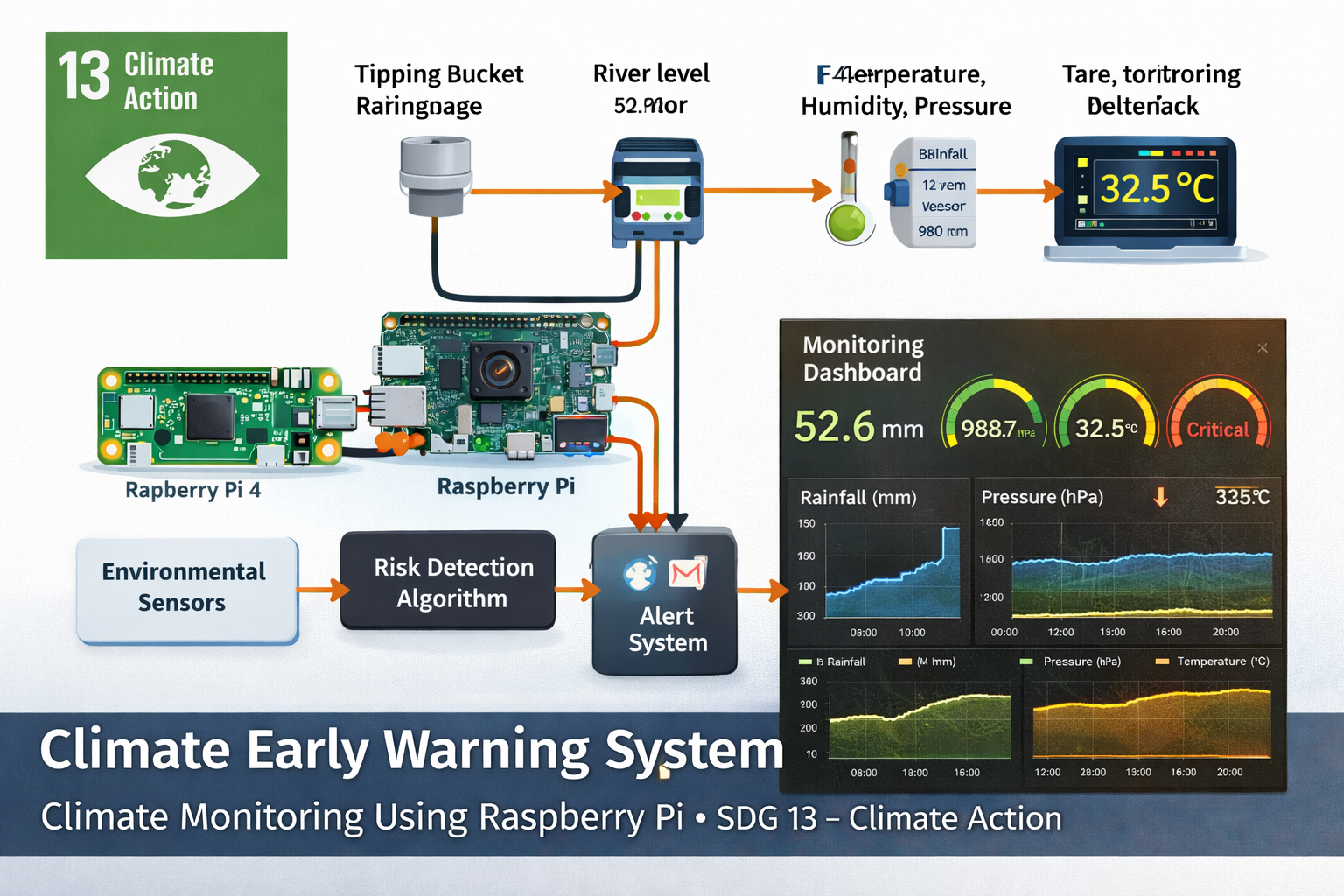
A Raspberry Pi early warning system combines environmental sensors, local data processing, and communication systems to detect hazardous conditions.
Typical architecture:
Environmental Sensors → Raspberry Pi Data Processing → Risk Detection Algorithms → Alert System
Sensors measure environmental conditions continuously, while the Raspberry Pi analyzes data streams and triggers alerts when thresholds are exceeded. The same architecture can also support local storage, dashboard export, and regional aggregation across multiple nodes.
Environmental Sensors for Climate Monitoring
Early warning systems typically integrate multiple sensors to monitor atmospheric and hydrological conditions.
Common sensors include:
- temperature sensors
- humidity sensors
- barometric pressure sensors
- rainfall gauges
- river or water-level sensors
- wind speed sensors
Combining multiple environmental indicators improves the accuracy of risk detection because many hazards emerge from interacting signals rather than from a single variable alone.
Bill of Materials
- Raspberry Pi 4 or Raspberry Pi Zero 2 W
- BME280 environmental sensor (temperature, humidity, pressure)
- tipping-bucket rainfall gauge
- ultrasonic water level sensor
- optional wind speed sensor
- microSD card
- weatherproof enclosure
- solar power supply for remote deployment
Outdoor monitoring stations often operate using solar panels and battery storage to support long-term field deployment in locations where grid power is unavailable.
Engineering Specifications
| Parameter | Specification |
|---|---|
| Compute platform | Raspberry Pi 4 or Raspberry Pi Zero 2 W |
| Primary atmospheric sensor | BME280 (temperature, humidity, pressure) |
| Hydrological sensing | Ultrasonic water-level sensor |
| Rainfall sensing | Tipping-bucket rain gauge |
| Storage options | CSV, SQLite, dashboard export |
| Alert mode | Threshold-based local risk detection |
| Deployment mode | Distributed climate early warning node |
| Target scope | Educational, prototype, and experimental disaster-preparedness monitoring |
Reading Environmental Sensor Data with Python
The Raspberry Pi can collect environmental measurements using I2C sensors such as the BME280.
import time
import board
import busio
import adafruit_bme280

i2c = busio.I2C(board.SCL, board.SDA)
sensor = adafruit_bme280.Adafruit_BME280_I2C(i2c)

while True:
    temperature = sensor.temperature
    humidity = sensor.humidity
    pressure = sensor.pressure

    print("Temperature:", temperature)
    print("Humidity:", humidity)
    print("Pressure:", pressure)

    time.sleep(10)
These measurements can be logged continuously to build long-term local climate datasets and detect environmental shifts as they unfold.
Flood Risk Monitoring
Flood monitoring systems can use ultrasonic sensors to measure river or drainage-channel water levels.
If water levels rise rapidly or exceed defined thresholds, the system can trigger alerts.
Example logic:
if water_level > flood_threshold:
    send_alert("Flood risk detected")
This simple rule-based approach allows early detection of rising water levels and can be extended with additional context such as recent rainfall or historical baseline conditions.
Storm Detection Using Atmospheric Pressure
Rapid drops in atmospheric pressure often signal approaching storms.
A monitoring system can detect pressure anomalies by comparing current measurements to historical averages.
Example detection logic:
if pressure_drop > threshold:
    trigger_storm_alert()
Machine learning models can later extend this logic by detecting more complex patterns that precede severe weather events.
Distributed Environmental Monitoring Networks
Individual monitoring stations can be connected into larger environmental monitoring networks.
Multiple Raspberry Pi nodes may transmit environmental data to a central server that aggregates regional climate information.
Applications include:
- community flood monitoring systems
- regional climate observation networks
- citizen science weather monitoring
- agricultural climate monitoring
Distributed networks significantly improve environmental visibility across larger geographic areas and can reveal patterns that isolated stations might miss.
AI and Predictive Climate Risk Detection
Machine learning models can enhance early warning systems by identifying environmental patterns associated with emerging hazards.
Examples include:
- flood prediction models
- storm risk detection
- heatwave forecasting
- drought monitoring
Lightweight frameworks such as TensorFlow Lite allow predictive models to run directly on Raspberry Pi devices. This enables climate risk detection even in remote locations without reliable internet connectivity.
Climate Resilience and SDG 13
Climate adaptation requires reliable environmental monitoring infrastructure.
Early warning systems provide communities with the information needed to anticipate environmental risks and respond more quickly.
These systems contribute to:
- SDG 13 – Climate Action by strengthening resilience to climate hazards
- SDG 11 – Sustainable Cities and Communities by improving disaster preparedness
Engineering Notes
A few technical considerations are especially important in this build:
- field reliability: enclosure design, power resilience, and sensor placement matter as much as code.
- threshold realism: alert logic must reflect local environmental conditions rather than generic assumptions.
- multi-signal value: combining rainfall, pressure, and water-level data improves risk interpretation.
- distributed scaling: local node consistency becomes important when multiple stations are compared.
- edge usefulness: local alert logic matters most when connectivity is intermittent or absent.
These considerations make the project more than a weather station. It becomes a prototype climate resilience infrastructure node.
Validation and Testing
To bring this project closer to engineering-grade documentation, validation should include:
- verify sensor communication with the BME280 and any additional rainfall or level sensors
- confirm that temperature, humidity, and pressure readings remain plausible under known conditions
- test threshold-based flood and storm logic using simulated input values
- verify CSV or SQLite logging over repeated intervals
- test alert logic under repeated trigger conditions
- run extended trials to assess uptime and storage reliability
If the system behaves inconsistently, the issue may be related to sensor placement, threshold selection, power instability, logging configuration, or environmental noise rather than to the monitoring concept itself.
Suggested Performance Metrics
For a more rigorous evaluation, the system can be assessed using several simple metrics:
- sensor stability: consistency of repeated readings under unchanged conditions
- alert reliability: whether warning logic triggers under intended conditions without excessive false alarms
- logging reliability: whether observations are stored without loss over long runs
- uptime: how consistently the station continues operating without intervention
- operational usefulness: whether the collected data improves local understanding of environmental risk
Even simple tracking of these metrics improves the project’s value as an experimental climate early warning platform.
The Future of Climate Monitoring Infrastructure
Advances in sensor networks, edge computing, and satellite data are transforming environmental monitoring.
Future early warning systems will increasingly integrate:
- satellite weather observations
- ground-based sensor networks
- AI-based risk detection
- automated emergency alerts
Platforms such as Raspberry Pi allow researchers and communities to prototype these systems at low cost while contributing valuable environmental data to broader resilience efforts.
Reproducibility
All code, documentation, and supporting build materials necessary to reproduce the prototype are included in the project repository. The design intentionally relies on widely available Raspberry Pi hardware, open-source Python libraries, and common environmental sensing components so that it can be rebuilt in classrooms, labs, and independent climate-monitoring projects.
The system is intended as a reference implementation rather than a certified public warning network. Engineers adapting it for longer-term deployment should validate threshold design, enclosure resilience, power systems, data retention, and sensor maintenance under local operating conditions.
Conclusion
Building a Raspberry Pi climate early warning system demonstrates how embedded sensing and local computation can support stronger climate resilience infrastructure. By combining environmental sensors, alert logic, and optional distributed monitoring workflows, the platform creates a flexible foundation for disaster-preparedness observation.
Although compact, the design reflects a broader sustainability principle: climate resilience depends on environmental visibility. When local conditions can be measured continuously and interpreted early, communities are better positioned to anticipate hazards and respond more effectively.