
Last Updated June 17, 2026
Divide-and-conquer methods solve problems by breaking them into smaller parts, solving those parts, and combining the results. This strategy is one of the most important patterns in algorithm design because it turns scale into structure. A large problem becomes a collection of smaller problems. A difficult computation becomes a recursive process. A complex task becomes a sequence of division, solution, and recombination.
Divide-and-conquer reasoning appears in binary search, merge sort, quicksort, fast multiplication, computational geometry, parallel computing, distributed systems, numerical methods, signal processing, scientific computing, and data pipelines. It is also a general intellectual pattern: understand the whole by decomposing it into parts whose relationships can be recombined.
But division alone is not enough. The subproblems must be well formed. The base cases must be clear. The combination step must be correct. The recursion must terminate. The cost of dividing and recombining must be understood.
This article explains divide-and-conquer methods as foundational strategies for algorithm design, computational reasoning, recursive structure, efficient computation, and responsible procedural judgment.
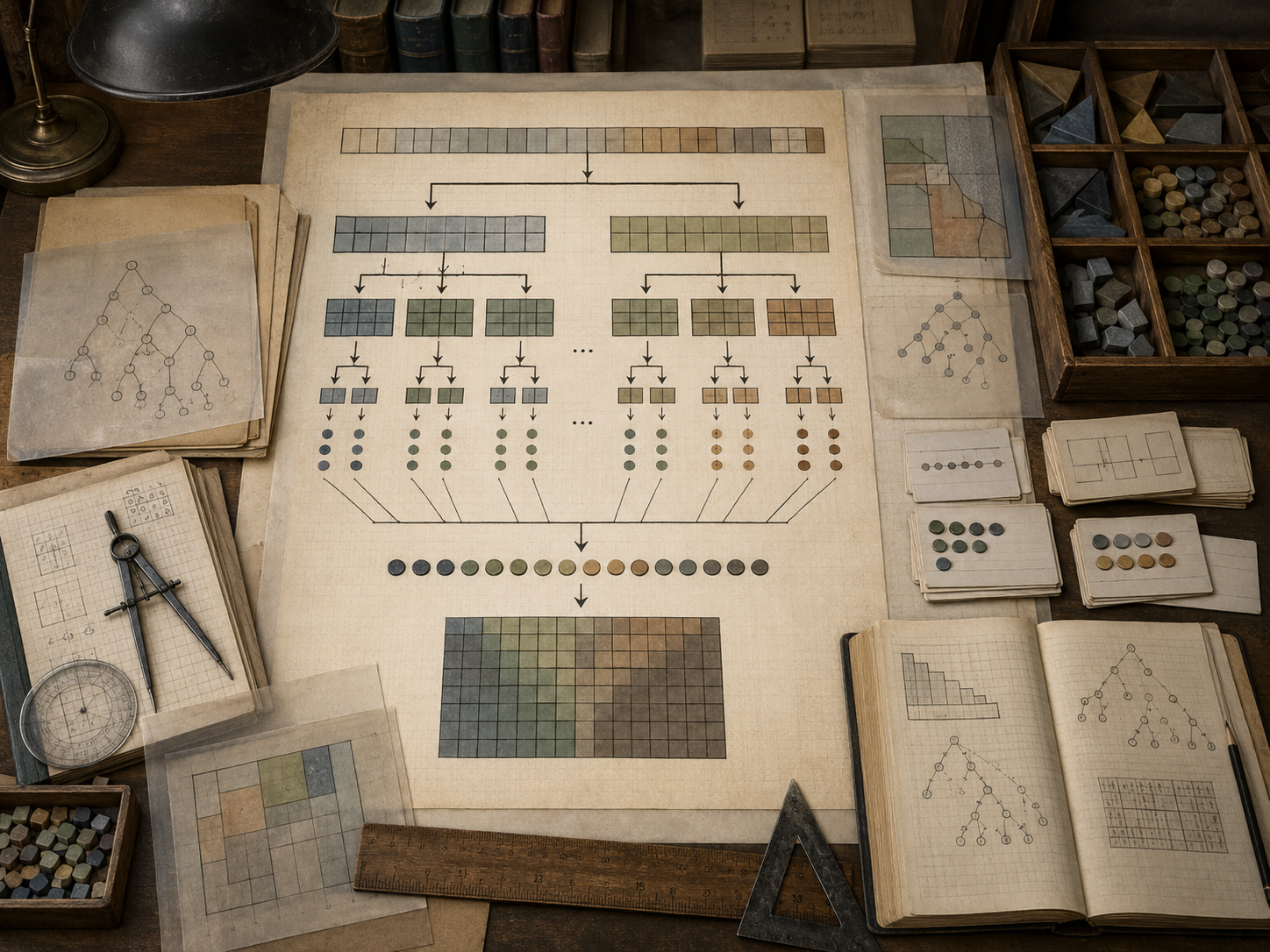
This article explains divide-and-conquer as a design pattern for computational reasoning. It introduces recursive decomposition, base cases, subproblem independence, combination steps, recurrence relations, merge sort, binary search, quicksort, recursive tree structures, parallelism, distributed computation, numerical methods, correctness reasoning, complexity analysis, representation risk, and governance. It emphasizes that divide-and-conquer is not merely a programming technique. It is a disciplined way of deciding how a problem can be separated without losing the meaning of the whole.
Why Divide-and-Conquer Matters
Divide-and-conquer matters because many problems are too large or complex to solve directly. Instead of attacking the whole at once, the algorithm divides the problem into smaller parts, solves each part, and combines the partial results.
This design pattern is powerful because it aligns with recursive structure, parallel computation, hierarchical data, mathematical induction, and scalable systems. It also provides a bridge between algorithmic technique and broader systems reasoning: large systems are often understandable only when decomposed into parts whose relationships can be analyzed.
| Reason divide-and-conquer matters | Computational benefit | Design question |
|---|---|---|
| Scale reduction | Large problems become smaller problems. | How should the problem be divided? |
| Recursive structure | The same method can solve smaller instances. | What is the base case? |
| Efficiency | Subproblem structure can reduce cost. | How does the recurrence grow? |
| Parallelism | Independent subproblems may be solved simultaneously. | Which subproblems can run independently? |
| Clarity | Problem structure becomes visible. | Does decomposition preserve meaning? |
| Reusability | Subproblem solvers can be reused. | Are interfaces between parts clear? |
| Auditability | Intermediate results can be inspected. | Can partial outputs be traced and checked? |
Divide-and-conquer is not only a way to make algorithms faster. It is a way to make large computational problems thinkable.
What Divide-and-Conquer Is
A divide-and-conquer algorithm solves a problem by applying three steps: divide the problem into subproblems, solve the subproblems, and combine the results. When subproblems have the same form as the original problem, the method is usually recursive.
The structure can be simple, as in binary search, or elaborate, as in computational geometry, parallel numerical methods, and distributed systems.
| Component | Meaning | Example |
|---|---|---|
| Divide | Break the original problem into smaller subproblems. | Split a list into halves. |
| Solve | Solve each subproblem, often recursively. | Sort each half. |
| Combine | Merge or assemble subproblem results. | Merge two sorted lists. |
| Base case | Stop recursion at a small directly solvable instance. | A list of length zero or one is already sorted. |
| Progress measure | Show that subproblems get smaller. | Each recursive call uses half the input. |
| Correctness argument | Show that combined subproblem results solve the original problem. | If both halves are sorted and merge preserves order, the whole list is sorted. |
| Cost analysis | Estimate the work across recursive levels. | \(T(n) = 2T(n/2) + O(n)\). |
A divide-and-conquer method succeeds only when division, solution, and recombination are all correct.
The Basic Pattern: Divide, Solve, Combine
The basic divide-and-conquer pattern can be stated in procedural form:
solve(problem):
    if problem is small enough:
        solve directly
    else:
        divide problem into subproblems
        solve each subproblem
        combine subproblem solutions
        return combined solution
This pattern is simple, but the design choices are substantial. What counts as “small enough”? How many subproblems are created? Are they independent? Do they overlap? How expensive is division? How expensive is combination? Does the combination step preserve correctness?
| Design decision | Question | Risk if ignored |
|---|---|---|
| Base-case threshold | When should recursion stop? | Infinite recursion or unnecessary overhead. |
| Partition rule | How is the problem divided? | Unbalanced subproblems or lost information. |
| Subproblem type | Do subproblems resemble the original problem? | Recursive structure may be invalid. |
| Subproblem independence | Can subproblems be solved separately? | Hidden dependencies break correctness. |
| Combination rule | How are partial results recombined? | Correct subresults may form incorrect whole. |
| Cost distribution | Where is most work spent? | Combination overhead may dominate. |
| Evidence trail | Can partial results be inspected? | Failure becomes hard to localize. |
The pattern is powerful because it separates the design into intelligible phases. The hard work is making sure the phases fit together.
Recursive Decomposition
Divide-and-conquer often relies on recursive decomposition: each subproblem is solved using the same method used for the original problem. This produces a recursion tree. The root is the original problem. The leaves are base cases. The internal nodes are divided subproblems whose results must be recombined.
Recursive decomposition works best when the problem has self-similar structure. Sorting a list, searching an ordered interval, multiplying large numbers, subdividing a geometric space, or computing a transform can often be expressed recursively.
| Recursive design feature | Purpose | Example |
|---|---|---|
| Self-similarity | Subproblems have the same form as original problem. | Each half of a list can be sorted. |
| Size reduction | Recursive calls move toward base case. | Problem size decreases from \(n\) to \(n/2\). |
| Local solver | The same procedure solves every subproblem. | Recursive merge sort function. |
| Recursion tree | Shows subproblem structure across levels. | Two subproblems per level in merge sort. |
| Combination layer | Reassembles lower-level results. | Merge sorted halves. |
| Depth | Number of recursive levels. | \(\log n\) levels for repeated halving. |
Recursive decomposition is elegant when every recursive call is smaller, meaningful, and eventually reaches a directly solvable base case.
Base Cases and Stopping Conditions
A base case is the simplest form of the problem that can be solved directly. Without a base case, recursion does not stop. Without a correct base case, the algorithm may stop with the wrong answer.
In divide-and-conquer methods, base cases often include empty inputs, single elements, small arrays, leaf nodes, trivial geometric regions, or threshold sizes where direct computation is simpler than further division.
| Base-case concern | Design question | Example |
|---|---|---|
| Minimal input | What is the smallest valid problem? | Empty list or one-element list. |
| Direct solvability | Can the base case be solved without recursion? | A one-element list is already sorted. |
| Threshold choice | Should recursion stop before the smallest case? | Use insertion sort for small subarrays. |
| Progress guarantee | Does each division move toward the base case? | Subproblem size strictly decreases. |
| Invalid input | What happens outside the valid domain? | Reject negative size or malformed structure. |
| Termination proof | Can stopping be demonstrated? | Recursive depth is bounded by repeated halving. |
A divide-and-conquer algorithm is only as reliable as its stopping logic.
Subproblem Independence and Overlap
Subproblems may be independent, dependent, or overlapping. Divide-and-conquer is most straightforward when subproblems are independent: each can be solved separately, and the only interaction occurs during the combination step.
If subproblems overlap heavily, dynamic programming may be more appropriate because repeated subproblems should be stored rather than recomputed. If subproblems depend on each other, decomposition must include communication, ordering, or synchronization.
| Subproblem relationship | Meaning | Design implication |
|---|---|---|
| Independent | Subproblems can be solved separately. | Good fit for divide-and-conquer and parallelism. |
| Overlapping | Same subproblems appear repeatedly. | Consider memoization or dynamic programming. |
| Dependent | One subproblem needs another’s result. | Need ordering, synchronization, or different strategy. |
| Unbalanced | One subproblem is much larger than others. | Efficiency may degrade. |
| Boundary-coupled | Subproblems interact at boundaries. | Combination step must handle cross-boundary effects. |
| Shared-state | Subproblems mutate common state. | Risk of interference or race conditions. |
The phrase “divide the problem” hides a crucial question: what relationships remain between the pieces?
Combination Steps
The combination step turns subproblem results into a solution to the original problem. In some algorithms, combination is trivial. Binary search discards one half and needs little recombination. In merge sort, combination is central: two sorted halves must be merged into one sorted whole. In computational geometry, combination may require checking boundary cases between regions.
Combination steps are often where correctness is won or lost.
| Combination concern | Question | Example |
|---|---|---|
| Completeness | Do combined results include all needed information? | Merged list contains every original item. |
| Correctness preservation | Does recombination preserve subproblem correctness? | Merging two sorted lists produces sorted output. |
| Boundary handling | Are cross-subproblem effects included? | Closest pair may cross partition boundary. |
| Duplicate handling | Are repeated items preserved or deduplicated intentionally? | Stable merge preserves equal-key order. |
| Cost | How expensive is recombination? | Merge step costs \(O(n)\). |
| Traceability | Can combined output be traced to subproblem outputs? | Record merge provenance or partition IDs. |
The combination step should be designed with as much care as the division step.
Recurrence Relations and Cost
Divide-and-conquer algorithms are often analyzed with recurrence relations. A recurrence expresses the cost of solving a problem of size \(n\) in terms of the cost of solving smaller problems and the cost of dividing and combining.
For example, merge sort divides the input into two halves, recursively sorts each half, and merges in linear time. Its recurrence is:
T(n) = 2T(n/2) + O(n)
\]
Interpretation: Two half-size problems are solved recursively, then their results are combined in linear time.
| Recurrence form | Algorithmic pattern | Typical meaning |
|---|---|---|
| \(T(n) = T(n/2) + O(1)\) | Binary search | One half is kept; constant work per level. |
| \(T(n) = 2T(n/2) + O(n)\) | Merge sort | Two halves are solved; linear merge per level. |
| \(T(n) = 2T(n/2) + O(1)\) | Simple balanced recursion with cheap combine. | Work grows linearly across leaves. |
| \(T(n) = aT(n/b) + O(n^d)\) | General divide-and-conquer recurrence. | Compare subproblem growth with combine cost. |
| \(T(n) = T(k) + T(n-k-1) + O(n)\) | Quicksort partitioning | Cost depends on pivot balance. |
Recurrence analysis helps reveal whether decomposition actually improves efficiency.
Binary Search as Divide-and-Conquer
Binary search is a simple divide-and-conquer algorithm. It searches a sorted collection by comparing the target with the middle item and discarding half the search space. Unlike merge sort, binary search solves only one subproblem at each step because the comparison tells which half could contain the target.
| Divide-and-conquer component | Binary search version | Design requirement |
|---|---|---|
| Divide | Split search interval around midpoint. | Collection must be sorted. |
| Solve | Search only the half that can contain target. | Comparison rule must be consistent. |
| Combine | No major recombination required. | Return found index or not-found result. |
| Base case | Interval is empty or target is found. | Bounds must update correctly. |
| Cost | \(O(\log n)\). | Each step halves the candidate interval. |
Binary search shows that divide-and-conquer can be powerful even when only one subproblem is pursued.
Merge Sort
Merge sort is a classic divide-and-conquer sorting algorithm. It divides a list into halves, recursively sorts each half, and merges the sorted halves. Its structure is clean and its worst-case behavior is predictable.
Merge sort is often used to teach divide-and-conquer because its correctness argument is clear: if each half is sorted, and the merge step preserves order while including every item, then the full result is sorted.
| Merge sort element | Role | Reasoning |
|---|---|---|
| Divide | Split list into two halves. | Each subproblem is smaller. |
| Base case | List of length zero or one. | Already sorted. |
| Solve | Recursively sort both halves. | Same problem form at smaller size. |
| Combine | Merge sorted halves. | Preserve ordering and all elements. |
| Complexity | \(O(n \log n)\). | Linear work across each of logarithmic levels. |
| Stability | Stable versions preserve equal-key order. | Useful for multi-key sorting. |
Merge sort demonstrates the full divide-and-conquer pattern: balanced division, recursive solution, and meaningful combination.
Quicksort and Partitioning
Quicksort uses divide-and-conquer through partitioning. It chooses a pivot, rearranges the array so smaller items come before the pivot and larger items come after it, then recursively sorts the partitions.
Quicksort is often fast in practice, but its performance depends on pivot quality and partition balance. Poor pivot choices can produce highly unbalanced subproblems and degrade performance.
| Quicksort element | Role | Risk or design concern |
|---|---|---|
| Pivot selection | Chooses partition point. | Poor pivots create unbalanced recursion. |
| Partitioning | Separates items around pivot. | Must handle duplicates and comparison rules correctly. |
| Recursive sorting | Sorts partitions. | Subproblem sizes determine cost. |
| Combination | Often implicit after partitioning. | Correct partitioning makes recombination simple. |
| Average cost | Often \(O(n \log n)\). | Depends on pivot behavior. |
| Worst-case cost | Can be \(O(n^2)\). | Requires safeguards or randomized pivoting. |
Quicksort shows that divide-and-conquer efficiency depends not only on division, but on balanced division.
Tree, Graph, and Geometric Methods
Divide-and-conquer appears in tree structures, graph algorithms, spatial indexes, and computational geometry. A tree naturally divides into subtrees. A spatial region can be divided into quadrants. A graph may be decomposed by components, separators, communities, or dependency layers.
In geometric problems, divide-and-conquer often reduces a large spatial question into smaller regional questions, then handles boundary cases where results may cross partitions.
| Domain | Divide-and-conquer pattern | Design concern |
|---|---|---|
| Tree traversal | Process root and recursively process subtrees. | Base case for leaf or empty tree. |
| Spatial indexing | Divide space into regions. | Boundary effects and uneven distribution. |
| Computational geometry | Solve regional subproblems and check cross-boundary cases. | Combination step may be subtle. |
| Graph decomposition | Split graph into components or communities. | Edges across partitions matter. |
| Expression parsing | Divide expression into subexpressions. | Operator precedence and grammar correctness. |
| Hierarchical clustering | Build or split clusters recursively. | Distance metric and stopping threshold. |
In structured domains, divide-and-conquer is also a representational choice: the way the problem is divided shapes what the algorithm can see.
Parallel and Distributed Computation
Divide-and-conquer naturally supports parallelism when subproblems can be solved independently. If a problem can be divided into many subproblems that do not require shared mutable state, those subproblems can often be processed simultaneously.
This idea appears in parallel sorting, map-reduce systems, distributed analytics, numerical simulation, image processing, model training, and large-scale data pipelines.
| Parallel design issue | Question | Example |
|---|---|---|
| Independence | Can subproblems be solved without communication? | Map step over independent records. |
| Load balance | Are subproblems similarly sized? | Balanced partitions improve utilization. |
| Combination cost | Does recombination dominate runtime? | Reduce step or merge step bottleneck. |
| Synchronization | When must workers coordinate? | Barrier before merge. |
| Fault tolerance | What happens when a subtask fails? | Retry failed partition. |
| Traceability | Can each partial result be linked to its partition? | Partition ID, run manifest, worker log. |
| Determinism | Do parallel execution orders affect results? | Floating-point reductions may vary by order. |
Parallel divide-and-conquer requires more than splitting work. It requires coordination, evidence, and careful recombination.
Divide-and-Conquer in Data, AI, and Modeling
Data systems, AI workflows, and modeling pipelines frequently use divide-and-conquer ideas. Large datasets are partitioned. Documents are chunked. Images are tiled. Models are trained on batches. Simulations divide regions or time periods. Complex decisions are broken into subcriteria.
These decompositions make computation possible, but they also shape meaning. A chunking method can affect retrieval. A partitioning method can affect fairness. A batching method can affect learning dynamics. A spatial decomposition can hide boundary interactions.
| System | Divide-and-conquer pattern | Review concern |
|---|---|---|
| Data pipeline | Partition records by date, region, or category. | Do partitions preserve relevant relationships? |
| Retrieval-augmented AI | Chunk documents before indexing and retrieval. | Do chunks preserve context and citation meaning? |
| Machine learning | Train on batches or split data for validation. | Are splits representative and leakage-free? |
| Simulation | Divide time, space, or agents into submodels. | Are boundary interactions modeled responsibly? |
| Distributed analytics | Map work across partitions and reduce outputs. | Is aggregation correct and reproducible? |
| Decision support | Break decision into criteria and subcriteria. | Do subcriteria recombine into valid judgment? |
| Governance workflow | Route cases into review categories. | Are category boundaries justified and auditable? |
In modern systems, divide-and-conquer is often hidden inside pipelines, indexes, schedulers, and model workflows. Its assumptions still need review.
Correctness, Termination, and Edge Cases
Correctness in divide-and-conquer requires showing that the base case is correct, the recursive calls solve smaller valid subproblems, and the combination step produces a valid solution to the original problem.
Termination requires showing that each recursive call reduces the problem toward a base case. Edge cases often involve empty inputs, single-element inputs, uneven partitions, duplicate values, boundary-crossing effects, invalid inputs, and recursion depth limits.
| Reasoning concern | Question | Example |
|---|---|---|
| Base-case correctness | Is the directly solved case valid? | A one-element list is sorted. |
| Subproblem validity | Are recursive calls well formed? | Each half is a valid list. |
| Progress | Does problem size decrease? | Each call uses smaller input. |
| Combination correctness | Do subproblem solutions produce full solution? | Merge preserves sorted order. |
| Uneven division | What if the input size is odd? | One half may have one extra item. |
| Duplicate values | Are equal items handled correctly? | Stable sorting preserves order. |
| Boundary effects | Can a solution span partitions? | Closest pair across split line. |
| Depth limits | Can recursion exceed runtime stack? | Convert to iterative or use threshold. |
A divide-and-conquer proof must explain not only the parts, but the whole they form.
Governance and Responsible Decomposition
Divide-and-conquer becomes a governance issue when decomposition affects interpretation, access, ranking, modeling, public decisions, or institutional responsibility. How a system divides a problem can determine what relationships are preserved, what contexts are lost, and what errors become invisible.
Responsible decomposition requires documenting partition rules, base cases, boundary handling, recombination logic, and evidence trails.
| Governance concern | Review question | Evidence |
|---|---|---|
| Partition rule | Who decided how the problem is divided? | Design rationale and partition specification. |
| Boundary handling | What relationships cross partitions? | Boundary-case tests and cross-partition checks. |
| Base-case threshold | Why does recursion stop where it does? | Threshold rationale and sensitivity tests. |
| Combination rule | How are partial results recombined? | Aggregation or merge specification. |
| Parallel execution | Can execution order affect results? | Determinism tests and run manifests. |
| Traceability | Can outputs be traced to subproblems? | Partition IDs, logs, provenance records. |
| Accountability | Who reviews failures in subproblem or recombination logic? | Review workflow and incident record. |
When the whole is divided, responsibility must not be divided away.
Representation Risk
Divide-and-conquer carries representation risk because the act of dividing a problem can distort the problem. A partition may cut across meaningful relationships. A chunk may remove context. A spatial boundary may hide interaction. A category split may create artificial separation. A recursive structure may imply hierarchy where the real system is networked.
The decomposition is part of the model.
| Representation risk | How it appears | Review response |
|---|---|---|
| Artificial separation | Related elements are placed in different subproblems. | Review cross-boundary interactions. |
| Lost context | Chunking removes information needed for interpretation. | Preserve metadata and surrounding context. |
| Unbalanced partition | One subproblem dominates work or meaning. | Test balance and alternative partition rules. |
| Boundary error | Important result crosses partition line. | Add boundary checks and recombination tests. |
| False hierarchy | Recursive structure imposes hierarchy on networked reality. | Check whether graph or systems model fits better. |
| Aggregation loss | Combined result hides variation in subproblems. | Report partial outputs and uncertainty. |
| Responsibility fragmentation | No one owns the whole pipeline. | Define end-to-end accountability. |
Divide-and-conquer should make complexity manageable without making important relationships invisible.
Examples Across Computational Systems
The examples below show how divide-and-conquer methods appear across algorithms, data systems, scientific workflows, AI pipelines, infrastructure, and institutional decision support.
Merge sort
A list is divided into halves, each half is sorted recursively, and the sorted halves are merged.
Binary search
A sorted search interval is divided around the midpoint, and only the relevant half is searched.
Quicksort
A pivot partitions data into smaller and larger elements, then each partition is sorted recursively.
Document chunking
A long source document is divided into smaller passages for indexing, retrieval, summarization, or review.
Map-reduce analytics
A large dataset is divided into partitions, processed independently, and recombined through aggregation.
Spatial modeling
A geographic region is divided into cells or zones, with boundary effects checked during recombination.
Parallel simulation
A computational model divides work across agents, time blocks, regions, or parameter sets.
Decision decomposition
A complex decision is broken into criteria, scored separately, and recombined into a structured judgment.
Across these cases, divide-and-conquer makes scale manageable while creating new responsibilities around boundaries and recombination.
Mathematics, Computation, and Modeling
A general divide-and-conquer recurrence can be written as:
T(n) = aT(n/b) + D(n) + C(n)
\]
Interpretation: A problem of size \(n\) is divided into \(a\) subproblems of size \(n/b\), with division cost \(D(n)\) and combination cost \(C(n)\).
When division and combination are summarized together as nonrecursive work \(f(n)\), the recurrence becomes:
T(n) = aT(n/b) + f(n)
\]
Interpretation: The total cost depends on the number of subproblems, their size, and the work done outside recursive calls.
Merge sort follows the recurrence:
T(n) = 2T(n/2) + O(n)
\]
Interpretation: Two half-size subproblems are sorted, and linear work merges them.
Binary search follows the recurrence:
T(n) = T(n/2) + O(1)
\]
Interpretation: Only one half-size subproblem remains after each comparison.
A correctness claim for divide-and-conquer can be framed inductively:
\left(\forall i,\; S_i \text{ solves } P_i\right) \land \text{Combine}(S_1,\ldots,S_k) \Rightarrow S \text{ solves } P
\]
Interpretation: If all subproblem solutions are correct and the combination step is correct, the combined result solves the original problem.
These mathematical forms show why divide-and-conquer is both an algorithmic and modeling discipline: it depends on how the whole is divided, how the parts are solved, and how the parts are reassembled.
Python Workflow: Divide-and-Conquer Audit
The Python workflow below creates a dependency-light audit for divide-and-conquer design. It scores problem decomposition, base-case clarity, subproblem validity, progress toward termination, combination correctness, recurrence awareness, edge-case coverage, boundary handling, traceability, and governance readiness.
# divide_conquer_audit.py
# Dependency-light workflow for auditing divide-and-conquer methods.

from __future__ import annotations

from dataclasses import asdict, dataclass
from pathlib import Path
import csv
import json
from statistics import mean

ARTICLE_ROOT = Path(__file__).resolve().parents[1]
TABLES = ARTICLE_ROOT / "outputs" / "tables"
JSON_DIR = ARTICLE_ROOT / "outputs" / "json"


@dataclass(frozen=True)
class DivideConquerCase:
    case_name: str
    problem_context: str
    design_choice: str
    decomposition_clarity: float
    base_case_clarity: float
    subproblem_validity: float
    progress_toward_termination: float
    combination_correctness: float
    recurrence_awareness: float
    edge_case_coverage: float
    boundary_handling: float
    traceability: float
    governance_readiness: float


def clamp(value: float, low: float = 0.0, high: float = 100.0) -> float:
    return max(low, min(high, value))


def design_quality(case: DivideConquerCase) -> float:
    return clamp(
        100.0 * (
            0.12 * case.decomposition_clarity
            + 0.10 * case.base_case_clarity
            + 0.10 * case.subproblem_validity
            + 0.12 * case.progress_toward_termination
            + 0.12 * case.combination_correctness
            + 0.10 * case.recurrence_awareness
            + 0.10 * case.edge_case_coverage
            + 0.08 * case.boundary_handling
            + 0.08 * case.traceability
            + 0.08 * case.governance_readiness
        )
    )


def design_risk(case: DivideConquerCase) -> float:
    weak_points = [
        1.0 - case.decomposition_clarity,
        1.0 - case.base_case_clarity,
        1.0 - case.subproblem_validity,
        1.0 - case.progress_toward_termination,
        1.0 - case.combination_correctness,
        1.0 - case.recurrence_awareness,
        1.0 - case.edge_case_coverage,
        1.0 - case.boundary_handling,
        1.0 - case.traceability,
        1.0 - case.governance_readiness,
    ]
    return clamp(100.0 * mean(weak_points))


def diagnose(quality: float, risk: float) -> str:
    if quality >= 84 and risk <= 20:
        return "strong divide-and-conquer discipline"
    if quality >= 70 and risk <= 35:
        return "usable divide-and-conquer discipline with review needs"
    if risk >= 55:
        return "high risk; decomposition, base case, combination, boundary handling, or recurrence reasoning may be weak"
    return "partial discipline; strengthen decomposition, progress, combination, edge cases, and governance"


def build_cases() -> list[DivideConquerCase]:
    return [
        DivideConquerCase(
            case_name="Merge sort workflow",
            problem_context="A sorting workflow divides records into halves and merges sorted results.",
            design_choice="Balanced recursive merge sort with stable merge and explicit base case.",
            decomposition_clarity=0.92,
            base_case_clarity=0.92,
            subproblem_validity=0.90,
            progress_toward_termination=0.92,
            combination_correctness=0.92,
            recurrence_awareness=0.90,
            edge_case_coverage=0.86,
            boundary_handling=0.84,
            traceability=0.84,
            governance_readiness=0.82,
        ),
        DivideConquerCase(
            case_name="Document chunking for retrieval",
            problem_context="Long documents are divided into chunks for indexing and retrieval.",
            design_choice="Chunking with overlap, metadata preservation, boundary checks, and citation traceability.",
            decomposition_clarity=0.84,
            base_case_clarity=0.78,
            subproblem_validity=0.82,
            progress_toward_termination=0.88,
            combination_correctness=0.76,
            recurrence_awareness=0.70,
            edge_case_coverage=0.78,
            boundary_handling=0.86,
            traceability=0.90,
            governance_readiness=0.88,
        ),
        DivideConquerCase(
            case_name="Parallel aggregation pipeline",
            problem_context="A large dataset is partitioned, summarized independently, and recombined.",
            design_choice="Map-reduce style partitioning with deterministic aggregation and partition-level logs.",
            decomposition_clarity=0.88,
            base_case_clarity=0.82,
            subproblem_validity=0.86,
            progress_toward_termination=0.88,
            combination_correctness=0.86,
            recurrence_awareness=0.78,
            edge_case_coverage=0.82,
            boundary_handling=0.82,
            traceability=0.90,
            governance_readiness=0.88,
        ),
        DivideConquerCase(
            case_name="Unreviewed spatial partition",
            problem_context="A spatial model divides a region into zones without checking boundary interactions.",
            design_choice="Recursive partitioning with weak boundary validation and limited recombination evidence.",
            decomposition_clarity=0.64,
            base_case_clarity=0.58,
            subproblem_validity=0.60,
            progress_toward_termination=0.72,
            combination_correctness=0.46,
            recurrence_awareness=0.52,
            edge_case_coverage=0.44,
            boundary_handling=0.30,
            traceability=0.42,
            governance_readiness=0.38,
        ),
    ]


def merge_sort(values: list[int]) -> list[int]:
    if len(values) <= 1:
        return list(values)

    midpoint = len(values) // 2
    left = merge_sort(values[:midpoint])
    right = merge_sort(values[midpoint:])
    return merge(left, right)


def merge(left: list[int], right: list[int]) -> list[int]:
    result: list[int] = []
    i = 0
    j = 0

    while i < len(left) and j < len(right):
        if left[i] <= right[j]:
            result.append(left[i])
            i += 1
        else:
            result.append(right[j])
            j += 1

    result.extend(left[i:])
    result.extend(right[j:])
    return result


def binary_search(values: list[int], target: int) -> int:
    low = 0
    high = len(values) - 1

    while low <= high:
        midpoint = (low + high) // 2
        if values[midpoint] == target:
            return midpoint
        if values[midpoint] < target:
            low = midpoint + 1
        else:
            high = midpoint - 1

    return -1


def recurrence_estimate(n: int, branches: int = 2, shrink: int = 2, combine_power: float = 1.0) -> dict[str, float]:
    depth = 0
    size = max(1, n)
    while size > 1:
        size = max(1, size // shrink)
        depth += 1

    estimated_leaf_count = branches ** depth
    combine_work = sum((n / (shrink ** level)) ** combine_power * (branches ** level) for level in range(depth + 1))

    return {
        "n": float(n),
        "recursion_depth": float(depth),
        "estimated_leaf_count": float(estimated_leaf_count),
        "estimated_combine_work": round(float(combine_work), 3),
    }


def run_algorithm_demos() -> dict[str, object]:
    values = [9, 3, 7, 1, 4, 8]
    sorted_values = merge_sort(values)

    return {
        "original_values": values,
        "merge_sort_result": sorted_values,
        "binary_search_for_7": binary_search(sorted_values, 7),
        "binary_search_for_missing_10": binary_search(sorted_values, 10),
        "merge_sort_recurrence_estimate": recurrence_estimate(1024, branches=2, shrink=2, combine_power=1.0),
        "binary_search_recurrence_estimate": recurrence_estimate(1024, branches=1, shrink=2, combine_power=0.0),
    }


def run_audit() -> list[dict[str, object]]:
    rows: list[dict[str, object]] = []
    for case in build_cases():
        quality = design_quality(case)
        risk = design_risk(case)
        rows.append({
            **asdict(case),
            "divide_conquer_quality": round(quality, 3),
            "divide_conquer_risk": round(risk, 3),
            "diagnostic": diagnose(quality, risk),
        })
    return rows


def write_csv(path: Path, rows: list[dict[str, object]]) -> None:
    path.parent.mkdir(parents=True, exist_ok=True)
    with path.open("w", newline="", encoding="utf-8") as handle:
        writer = csv.DictWriter(handle, fieldnames=list(rows[0].keys()))
        writer.writeheader()
        writer.writerows(rows)


def write_json(path: Path, payload: object) -> None:
    path.parent.mkdir(parents=True, exist_ok=True)
    path.write_text(json.dumps(payload, indent=2, sort_keys=True), encoding="utf-8")


def summarize(rows: list[dict[str, object]]) -> dict[str, object]:
    return {
        "case_count": len(rows),
        "average_divide_conquer_quality": round(mean(float(row["divide_conquer_quality"]) for row in rows), 3),
        "average_divide_conquer_risk": round(mean(float(row["divide_conquer_risk"]) for row in rows), 3),
        "highest_quality_case": max(rows, key=lambda row: float(row["divide_conquer_quality"]))["case_name"],
        "highest_risk_case": max(rows, key=lambda row: float(row["divide_conquer_risk"]))["case_name"],
        "interpretation": "Divide-and-conquer quality depends on decomposition clarity, base cases, subproblem validity, progress, combination correctness, recurrence awareness, edge cases, boundary handling, traceability, and governance."
    }


def main() -> None:
    rows = run_audit()
    summary = summarize(rows)
    demos = run_algorithm_demos()

    write_csv(TABLES / "divide_conquer_audit.csv", rows)
    write_csv(TABLES / "divide_conquer_audit_summary.csv", [summary])
    write_json(JSON_DIR / "divide_conquer_audit.json", rows)
    write_json(JSON_DIR / "divide_conquer_audit_summary.json", summary)
    write_json(JSON_DIR / "divide_conquer_demos.json", demos)

    print("Divide-and-conquer audit complete.")
    print(TABLES / "divide_conquer_audit.csv")


if __name__ == "__main__":
    main()
This workflow treats divide-and-conquer as an auditable pattern of decomposition, recursion, recombination, and evidence.
R Workflow: Decomposition Summary
The R workflow reads the Python-generated audit table and creates summary outputs and visualizations using base R. It compares divide-and-conquer quality and risk across synthetic cases.
# divide_conquer_summary.R
# Base R workflow for summarizing divide-and-conquer design evidence.

args <- commandArgs(trailingOnly = FALSE)
file_arg <- grep("^--file=", args, value = TRUE)

if (length(file_arg) > 0) {
  script_path <- normalizePath(sub("^--file=", "", file_arg[1]), mustWork = TRUE)
  article_root <- normalizePath(file.path(dirname(script_path), ".."), mustWork = TRUE)
} else {
  article_root <- getwd()
}

setwd(article_root)

tables_dir <- file.path(article_root, "outputs", "tables")
figures_dir <- file.path(article_root, "outputs", "figures")

if (!dir.exists(tables_dir)) {
  dir.create(tables_dir, recursive = TRUE)
}

if (!dir.exists(figures_dir)) {
  dir.create(figures_dir, recursive = TRUE)
}

input_path <- file.path(tables_dir, "divide_conquer_audit.csv")

if (!file.exists(input_path)) {
  stop(paste("Missing", input_path, "Run the Python workflow first."))
}

data <- read.csv(input_path, stringsAsFactors = FALSE)

summary_table <- data.frame(
  case_count = nrow(data),
  average_divide_conquer_quality = mean(data$divide_conquer_quality),
  average_divide_conquer_risk = mean(data$divide_conquer_risk),
  highest_quality_case = data$case_name[which.max(data$divide_conquer_quality)],
  highest_risk_case = data$case_name[which.max(data$divide_conquer_risk)]
)

write.csv(
  summary_table,
  file.path(tables_dir, "r_divide_conquer_summary.csv"),
  row.names = FALSE
)

comparison_matrix <- rbind(
  data$divide_conquer_quality,
  data$divide_conquer_risk
)

colnames(comparison_matrix) <- data$case_name
rownames(comparison_matrix) <- c("Divide-and-conquer quality", "Divide-and-conquer risk")

png(
  file.path(figures_dir, "divide_conquer_quality_vs_risk.png"),
  width = 1400,
  height = 800
)

barplot(
  comparison_matrix,
  beside = TRUE,
  las = 2,
  ylim = c(0, 100),
  ylab = "Score",
  main = "Divide-and-Conquer Quality vs. Risk"
)

legend(
  "topleft",
  legend = rownames(comparison_matrix),
  pch = 15,
  bty = "n"
)

grid()
dev.off()

png(
  file.path(figures_dir, "divide_conquer_dimensions.png"),
  width = 1400,
  height = 800
)

dimension_means <- colMeans(data[, c(
  "decomposition_clarity",
  "base_case_clarity",
  "subproblem_validity",
  "progress_toward_termination",
  "combination_correctness",
  "recurrence_awareness",
  "edge_case_coverage",
  "boundary_handling",
  "traceability",
  "governance_readiness"
)]) * 100

barplot(
  dimension_means,
  las = 2,
  ylim = c(0, 100),
  ylab = "Average score",
  main = "Average Divide-and-Conquer Evidence by Dimension"
)

grid()
dev.off()

print(summary_table)
This workflow helps compare merge sort, document chunking, parallel aggregation, and spatial partitioning by decomposition clarity, base cases, subproblem validity, progress, combination correctness, recurrence awareness, boundaries, traceability, and governance.
GitHub Repository
The companion repository for this article will provide reproducible code, synthetic datasets, workflow documentation, generated outputs, divide-and-conquer examples, calculator scripts, audit tables, visualizations, and governance artifacts that extend the article into executable examples.
Complete Code Repository
Companion article folder with Python, R, Julia, SQL, Haskell, C, C++, Fortran, Rust, Go, Java, TypeScript, Prolog, Racket, notebooks, documentation, synthetic teaching data, generated outputs, schemas, and Canvas-ready workflow artifacts for divide-and-conquer methods, recursive decomposition, base cases, subproblem validity, merge sort, binary search, quicksort, recurrence relations, recursion trees, parallel partitioning, boundary handling, recombination logic, traceability, and responsible decomposition governance.
articles/divide-and-conquer-methods/
├── python/
│   ├── divide_conquer_audit.py
│   ├── merge_sort_examples.py
│   ├── binary_search_examples.py
│   ├── quicksort_examples.py
│   ├── recurrence_examples.py
│   ├── partitioning_examples.py
│   ├── calculators/
│   │   ├── divide_conquer_quality_calculator.py
│   │   └── recurrence_complexity_calculator.py
│   └── tests/
├── r/
│   ├── divide_conquer_summary.R
│   ├── recurrence_visualization.R
│   └── decomposition_governance_report.R
├── julia/
│   ├── divide_conquer_examples.jl
│   └── recurrence_examples.jl
├── sql/
│   ├── schema_divide_conquer_cases.sql
│   ├── schema_partition_records.sql
│   └── divide_conquer_queries.sql
├── haskell/
│   ├── DivideConquer.hs
│   ├── RecurrenceExamples.hs
│   └── Main.hs
├── rust/
│   └── src/
├── go/
│   └── main.go
├── c/
│   └── divide_conquer_audit.c
├── cpp/
│   └── divide_conquer_audit.cpp
├── fortran/
│   └── divide_conquer_quality_model.f90
├── java/
│   └── src/main/java/org/contentcatalyst/algorithms/
├── typescript/
│   └── src/
├── prolog/
│   └── divide_conquer_rules.pl
├── racket/
│   └── divide_conquer_checker.rkt
├── docs/
│   ├── methodology.md
│   ├── article-notes.md
│   ├── divide-and-conquer-methods.md
│   ├── governance-notes.md
│   └── responsible-use.md
├── data/
│   └── synthetic_divide_conquer_cases.csv
├── outputs/
│   ├── tables/
│   ├── figures/
│   ├── json/
│   ├── logs/
│   └── reports/
├── notebooks/
│   └── divide_and_conquer_methods_walkthrough.ipynb
├── canvas/
│   ├── canvas_manifest.json
│   ├── canvas_cards.json
│   └── canvas_index.md
└── shared/
    ├── schemas/
    ├── templates/
    ├── taxonomies/
    ├── benchmarks/
└── governance/A Practical Method for Reviewing Divide-and-Conquer Design
A practical divide-and-conquer review begins with the question: does the division preserve the problem, do the subproblems make progress, and does recombination produce a correct whole?
| Step | Question | Output |
|---|---|---|
| 1. Define the original problem. | What must the full procedure solve? | Problem specification. |
| 2. Define the partition rule. | How is the problem divided? | Partition specification. |
| 3. Check subproblem validity. | Are subproblems well-formed instances of the original problem? | Subproblem contract. |
| 4. Define the base case. | When does recursion stop? | Base-case rule. |
| 5. Prove progress. | Does each recursive call move toward the base case? | Termination argument. |
| 6. Specify combination. | How are partial solutions recombined? | Merge or aggregation rule. |
| 7. Analyze recurrence. | How does work grow across recursive levels? | Time and space estimate. |
| 8. Test boundaries. | What relationships cross partition boundaries? | Boundary-case tests. |
| 9. Preserve evidence. | Can each output be traced to subproblems? | Partition logs and run manifest. |
| 10. Review responsibility. | Does decomposition hide meaning, context, or accountability? | Governance review. |
Divide-and-conquer review should examine not only the recursive idea, but also the validity of the partition and the responsibility of recombination.
Common Pitfalls
A common pitfall is assuming that decomposition automatically simplifies a problem. Division can make a problem easier, but it can also create hidden boundary errors, duplicate work, unbalanced subproblems, lost context, and incorrect aggregation.
Common pitfalls include:
- missing base case: recursion does not stop;
- weak progress measure: subproblems do not get meaningfully smaller;
- invalid subproblems: divided parts are not valid instances of the original problem;
- incorrect combination: correct subresults are recombined into an incorrect whole;
- boundary blindness: important relationships cross partitions and are ignored;
- unbalanced partitioning: one subproblem dominates work and reduces efficiency;
- overlapping subproblems: repeated work suggests dynamic programming may be better;
- stack-depth risk: recursion exceeds runtime limits;
- parallel nondeterminism: execution order affects combined results;
- lost accountability: no one can explain how partial outputs produced the final result.
The remedy is to treat decomposition as a design claim that must be tested, justified, and traced.
Why Divide-and-Conquer Shapes Computational Judgment
Divide-and-conquer methods matter because they provide a disciplined way to transform scale into structure. By dividing a problem into subproblems, solving those subproblems, and recombining their results, an algorithm can become clearer, faster, more parallel, and easier to reason about.
But divide-and-conquer is not automatically correct. The division must preserve the problem. The base cases must stop the recursion. The subproblems must be valid. The combination step must be justified. The recurrence must be understood. Boundary effects must be reviewed. The final result must remain traceable to its parts.
This is why divide-and-conquer is more than a technical pattern. It is a form of computational judgment. It asks whether the whole can be understood through parts, whether the parts are meaningful, and whether recombination restores what division temporarily separated.
The next article turns to a different strategy: greedy algorithms, where local choices are made step by step and must be judged by whether they can produce reliable global outcomes.
Related Articles
- Search and Sorting as Foundational Algorithms
- Greedy Algorithms and Local Choice
- Iteration, Recursion, and Control Flow
- Algorithm Design Principles
- Trees, Hierarchies, and Recursive Structure
- Computational Complexity and Scalability
- Dynamic Programming and Optimal Substructure
- Parallel and Distributed Algorithms
Further Reading
- Aho, A.V., Hopcroft, J.E. and Ullman, J.D. (1974) The Design and Analysis of Computer Algorithms. Reading, MA: Addison-Wesley.
- Bentley, J. (2000) Programming Pearls. 2nd edn. Boston, MA: Addison-Wesley.
- Cormen, T.H., Leiserson, C.E., Rivest, R.L. and Stein, C. (2022) Introduction to Algorithms. 4th edn. Cambridge, MA: MIT Press. Available at: MIT Press.
- Goodrich, M.T. and Tamassia, R. (2014) Algorithm Design and Applications. Hoboken, NJ: Wiley.
- Kleinberg, J. and Tardos, É. (2006) Algorithm Design. Boston, MA: Pearson/Addison-Wesley.
- Knuth, D.E. (1998) The Art of Computer Programming, Volume 3: Sorting and Searching. 2nd edn. Boston, MA: Addison-Wesley.
- Manber, U. (1989) Introduction to Algorithms: A Creative Approach. Reading, MA: Addison-Wesley.
- Mehlhorn, K. and Sanders, P. (2008) Algorithms and Data Structures: The Basic Toolbox. Berlin: Springer.
- Sedgewick, R. and Wayne, K. (2011) Algorithms. 4th edn. Boston, MA: Addison-Wesley. Available at: Princeton Algorithms.
- Skiena, S.S. (2020) The Algorithm Design Manual. 3rd edn. Cham: Springer.
References
- Aho, A.V., Hopcroft, J.E. and Ullman, J.D. (1974) The Design and Analysis of Computer Algorithms. Reading, MA: Addison-Wesley.
- Bentley, J. (2000) Programming Pearls. 2nd edn. Boston, MA: Addison-Wesley.
- Cormen, T.H., Leiserson, C.E., Rivest, R.L. and Stein, C. (2022) Introduction to Algorithms. 4th edn. Cambridge, MA: MIT Press. Available at: https://mitpress.mit.edu/9780262046305/introduction-to-algorithms/.
- Goodrich, M.T. and Tamassia, R. (2014) Algorithm Design and Applications. Hoboken, NJ: Wiley.
- Hoare, C.A.R. (1962) ‘Quicksort’, The Computer Journal, 5(1), pp. 10–16.
- Kleinberg, J. and Tardos, É. (2006) Algorithm Design. Boston, MA: Pearson/Addison-Wesley.
- Knuth, D.E. (1998) The Art of Computer Programming, Volume 3: Sorting and Searching. 2nd edn. Boston, MA: Addison-Wesley.
- Manber, U. (1989) Introduction to Algorithms: A Creative Approach. Reading, MA: Addison-Wesley.
- Mehlhorn, K. and Sanders, P. (2008) Algorithms and Data Structures: The Basic Toolbox. Berlin: Springer.
- Sedgewick, R. and Wayne, K. (2011) Algorithms. 4th edn. Boston, MA: Addison-Wesley. Available at: https://algs4.cs.princeton.edu/home/.
- Skiena, S.S. (2020) The Algorithm Design Manual. 3rd edn. Cham: Springer.