
Last Updated July 3, 2026
Compression, noise, and informational tradeoffs explain how mathematical models simplify high-dimensional systems while deciding what structure to preserve, what variation to suppress, and what information to lose. In linear algebra, compression often appears through low-rank approximation, singular value truncation, principal components, projections, sparse representation, filtering, denoising, and residual analysis.
This article concludes Part VI of the Linear Algebra for Systems Modeling series by connecting singular value decomposition, principal component analysis, dimensionality reduction, latent structure, low-rank approximation, compression, noise filtering, reconstruction error, residual diagnostics, information loss, weak signals, rare events, validation, and responsible interpretation.
The central modeling question is not only “Can the system be compressed?” It is “What structure does compression preserve, what variation does it discard, which residuals are treated as noise, and whether the simplified representation remains trustworthy for the system purpose?”
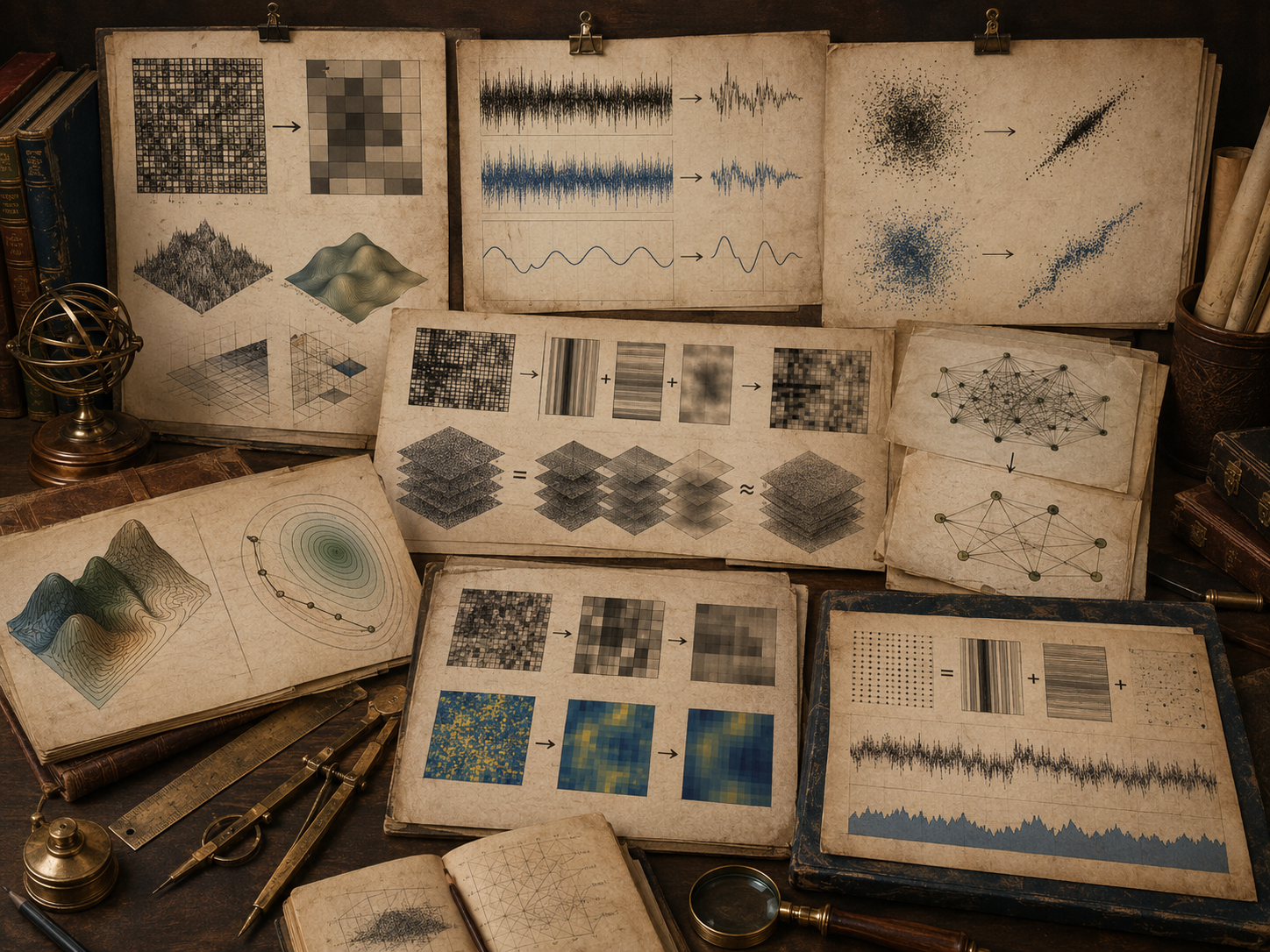
Compression is the act of representing a system with fewer numbers, dimensions, components, variables, or parameters. Noise refers to variation treated as random, irrelevant, measurement error, or uninformative for a particular purpose. Informational tradeoffs arise because compression and denoising always change what the model can see.
Linear algebra makes these tradeoffs visible. Singular values rank structural strength. Low-rank approximations show how much of a matrix can be reconstructed from fewer components. Residuals show what has been discarded. Norms quantify reconstruction error. Projections determine which subspaces are retained. PCA explains variance retained by reduced components. Sparse representations reduce storage. Matrix factorizations extract latent structure. Every one of these operations simplifies, but none is neutral.
Why Compression and Noise Matter
Compression matters because systems data can be too large, high-dimensional, noisy, redundant, expensive, or complex to use directly. A climate simulation may produce massive spatial-temporal fields. Infrastructure networks may generate continuous sensor streams. Public health systems may track hundreds of correlated indicators. Machine learning pipelines may operate on high-dimensional feature spaces. Text systems may contain enormous document-term matrices or embeddings.
Noise matters because measurements are imperfect and systems are variable. Some variation reflects random measurement error. Some reflects short-term fluctuation. Some reflects omitted structure. Some reflects rare events. Some reflects a weak signal that becomes important later. The problem is that mathematics alone does not always tell which is which.
| Modeling need | Compression role | Noise tradeoff |
|---|---|---|
| Storage efficiency | Represent data with fewer numbers. | Fine detail may be lost. |
| Computational speed | Use lower-rank or lower-dimensional approximations. | Approximation error may affect conclusions. |
| Visualization | Project high-dimensional data into two or three dimensions. | Visual clarity can hide structure. |
| Signal extraction | Keep dominant components. | Weak signals may be suppressed. |
| Denoising | Remove components interpreted as noise. | Discarded variation may contain meaningful structure. |
| Model governance | Make simplification explicit. | Compression choices require documentation and validation. |
Compression is useful because it simplifies. It is risky because simplification can erase what matters.
Compression as Representation
Compression is not merely storage reduction. It is a representation choice. A compressed model decides which aspects of a system are important enough to keep and which aspects can be approximated, summarized, filtered, or discarded.
A generic compression workflow can be written as:
X \longrightarrow Z \longrightarrow \hat{X}
\]
Interpretation: The original data \(X\) are encoded into a compressed representation \(Z\), then reconstructed or used as an approximation \(\hat{X}\).
| Object | Meaning | Modeling role |
|---|---|---|
| \(X\) | Original representation. | Full observed matrix, signal, feature table, image, field, or system state. |
| \(Z\) | Compressed representation. | Reduced coordinates, coefficients, factors, components, or encoded state. |
| \(\hat{X}\) | Reconstructed approximation. | Approximation of the original representation. |
| \(X-\hat{X}\) | Residual information. | Lost, unexplained, or compressed-away structure. |
| Compression method | Encoding and reconstruction rule. | Determines what structure is preserved. |
A compressed representation can be useful even when it is not perfectly faithful. The key is knowing what kind of fidelity matters for the task.
Noise as a Modeling Judgment
Noise is often described as unwanted variation. But “unwanted” depends on purpose. A fluctuation that looks like noise in a compression workflow may be an early warning signal in a safety workflow. A residual that looks random globally may be structured for a subgroup, region, time period, or rare event.
X = S + N
\]
Interpretation: The observed data are modeled as structured signal \(S\) plus noise or residual variation \(N\).
| Variation type | Could be treated as | Governance question |
|---|---|---|
| Measurement error | Noise. | Is there evidence from instruments, provenance, or calibration? |
| Short-term fluctuation | Noise or dynamic signal. | Does temporal structure matter? |
| Weak component | Noise or subtle structure. | Could it represent rare or emerging behavior? |
| Residual cluster | Omitted structure. | Does the compressed model fail for a subset of cases? |
| Outlier | Error, anomaly, or transition. | Should it be removed, modeled, or investigated? |
| Low-frequency pattern | Background signal. | Does the model objective prioritize local or global structure? |
Noise is not purely mathematical. It is a claim about relevance, reliability, purpose, and acceptable loss.
Low-Rank Approximation
Low-rank approximation is one of the central linear algebra tools for compression. A matrix \(X\) is approximated by a matrix \(X_k\) of rank \(k\), where \(k\) is smaller than the original rank:
X \approx X_k, \qquad \operatorname{rank}(X_k)=k
\]
Interpretation: The original matrix is represented using fewer independent structural directions.
Low-rank approximation is useful when data contain redundancy, correlated variables, dominant modes, latent structure, or compressible patterns. It is common in image compression, recommendation systems, scientific simulations, sensor systems, text analysis, signal processing, and reduced-order modeling.
| Low-rank feature | Meaning | Compression implication |
|---|---|---|
| Few dominant directions | Most structure lies in a low-dimensional subspace. | Strong compression may be possible. |
| Fast singular value decay | Later directions are weak. | Truncation may preserve much energy. |
| Slow singular value decay | Structure spread across many directions. | Compression may lose important information. |
| Clear spectral gap | Possible separation between signal and residual. | Rank choice may be easier but still requires validation. |
| Localized residuals | Error concentrated in certain observations or variables. | Aggregate metrics may hide compression harm. |
Low-rank approximation is not just a numerical shortcut. It is a statement that the system can be meaningfully summarized by fewer structural degrees of freedom.
SVD Compression
Singular value decomposition provides the standard framework for low-rank compression. If:
X=U\Sigma V^T
\]
Interpretation: The matrix is decomposed into orthogonal directions and ordered singular values.
Then the rank-\(k\) truncated approximation is:
X_k=U_k\Sigma_kV_k^T
\]
Interpretation: The approximation keeps only the first \(k\) singular components.
The Eckart-Young-Mirsky theorem explains why truncated SVD is so central: among all rank-\(k\) approximations, \(X_k\) is optimal under common matrix norms such as the Frobenius norm and spectral norm.
| SVD compression object | Meaning | Review question |
|---|---|---|
| \(U_k\) | Retained left singular directions. | Which observation patterns are preserved? |
| \(\Sigma_k\) | Retained singular strengths. | How much matrix energy is retained? |
| \(V_k\) | Retained right singular directions. | Which feature patterns are preserved? |
| \(X_k\) | Compressed reconstruction. | Does this approximation serve the system purpose? |
| \(X-X_k\) | Residual matrix. | What information has been lost? |
SVD compression is mathematically elegant because it ranks directions by strength. It still requires judgment because strength is not the same as meaning.
PCA Compression
PCA compresses centered data by retaining leading principal components. If \(X_c\) is centered and \(V_k\) contains the first \(k\) principal directions, the compressed coordinates are:
Z_k=X_cV_k
\]
Interpretation: Observations are compressed into \(k\)-dimensional principal component scores.
The reconstructed approximation is:
\hat{X}_{c,k}=Z_kV_k^T
\]
Interpretation: The retained components reconstruct the part of the centered data captured by the PCA compression.
| PCA compression measure | Meaning | Limitation |
|---|---|---|
| Explained variance | Variance retained by selected components. | Variance is not the same as decision importance. |
| Cumulative explained variance | Total variance retained by first \(k\) components. | Can hide localized loss. |
| Reconstruction error | Difference between original and reconstructed data. | Aggregate error can miss subgroup or rare-case failure. |
| Scores | Compressed observation coordinates. | Axes may be difficult to interpret. |
| Loadings | Variable contributions to components. | Component meaning depends on scaling and context. |
PCA compression is useful when the leading variance directions represent structure worth retaining. That assumption should be checked rather than assumed.
Denoising and Filtering
Denoising uses mathematical structure to suppress variation interpreted as noise. In SVD-based denoising, the leading singular components may be retained while smaller components are discarded:
X = X_k + E_k
\]
Interpretation: The retained low-rank component \(X_k\) is treated as signal, while the residual \(E_k\) is treated as noise or unexplained variation.
This can be effective when the signal is low-rank and the noise is weak, random, or spread across many directions. It is risky when important signals are weak, sparse, local, rare, nonlinear, or hidden in smaller components.
| Denoising choice | Mathematical effect | Risk |
|---|---|---|
| Hard threshold | Discard components below a cutoff. | Sharp cutoff may remove meaningful weak structure. |
| Soft threshold | Shrink component strengths. | May dampen signal as well as noise. |
| Low-rank filter | Keep leading components. | Dominant structure may reflect bias or scale. |
| Spectral smoothing | Suppress high-frequency variation. | May erase local events or discontinuities. |
| Residual anomaly review | Inspect what remains after filtering. | Requires domain interpretation and follow-up. |
Denoising should not be confused with truth extraction. It is a filtering decision under assumptions about signal and noise.
Reconstruction Error
Reconstruction error measures how much information is lost when compressed data are reconstructed. A common relative error is:
\frac{\|X-\hat{X}\|_F}{\|X\|_F}
\]
Interpretation: This measures reconstruction loss relative to the size of the original matrix.
For SVD compression, the Frobenius reconstruction error has a direct relationship to discarded singular values:
\|X-X_k\|_F^2 = \sum_{i=k+1}^{r}\sigma_i^2
\]
Interpretation: The squared reconstruction error equals the sum of squared discarded singular values.
| Error metric | Meaning | What it can hide |
|---|---|---|
| Frobenius error | Overall matrix reconstruction loss. | Localized errors or subgroup failures. |
| Spectral error | Largest remaining singular direction. | Total distributed residual energy. |
| Row residual | Error for each observation. | Variable-specific failure. |
| Column residual | Error for each variable. | Case-specific failure. |
| Task error | Effect on downstream use. | Interpretive or accountability consequences. |
Reconstruction error is necessary but not sufficient. A compressed model can have low aggregate error while failing precisely where the system is most vulnerable.
Residuals and Lost Information
The residual matrix is where compression leaves traces of what was not preserved:
R = X-\hat{X}
\]
Interpretation: Residuals show what the compressed representation failed to reconstruct.
Residuals should be examined rather than ignored. They may contain noise, measurement error, local structure, rare events, omitted variables, nonlinear dynamics, subgroup differences, regime changes, or early warning signals.
| Residual pattern | Possible meaning | Review response |
|---|---|---|
| Random-looking residuals | Noise model may be plausible. | Check assumptions and distribution. |
| Structured residuals | Omitted process or nonlinear structure. | Reconsider model form or variables. |
| Large row residual | Observation poorly represented. | Investigate case, outlier, subgroup, or anomaly. |
| Large column residual | Variable poorly represented. | Review measurement and importance. |
| Temporal residual drift | Changing system behavior. | Review nonstationarity and regime shift. |
| Spatial residual cluster | Local mismatch. | Review geography, infrastructure, exposure, or context. |
Residual analysis is the accountability layer of compression. It asks what the compressed model failed to carry forward.
Weak Signals and Rare Events
Compression often prioritizes dominant structure. That creates a risk: weak signals and rare events may be treated as noise. In many systems, however, weak or rare patterns are exactly what matter most. Early infrastructure stress, emerging disease clusters, ecological threshold changes, small subgroup harms, financial instability, cyber anomalies, and extreme climate signals may all begin as weak residual patterns.
| Weak pattern | Why compression may miss it | Review strategy |
|---|---|---|
| Rare event | Low frequency contributes little to aggregate variance. | Inspect residuals and event-specific metrics. |
| Small subgroup signal | Dominant components reflect majority structure. | Review subgroup reconstruction error. |
| Local failure | Global compression favors broad patterns. | Use spatial or network residual diagnostics. |
| Early warning signal | Weak change may precede visible transition. | Monitor residual drift over time. |
| Nonlinear pattern | Linear compression may not represent curved structure. | Compare nonlinear or local methods. |
A compression workflow should not automatically optimize away the weak. It should ask whether weak structure matters for the purpose of the model.
Sparse Representation
Sparse representation compresses systems by using many zeros or few active coefficients. A sparse vector or matrix can store meaningful structure efficiently when only a small number of entries carry most of the signal.
\|\mathbf{x}\|_0 \ll n
\]
Interpretation: A sparse vector has far fewer nonzero entries than its full dimension.
Sparsity appears in network adjacency matrices, incidence matrices, document-term matrices, recommender systems, high-dimensional features, optimization, compressed sensing, and scientific computing. Sparse representation is a form of compression because it stores only the structure that is present or active.
| Sparse structure | Compression benefit | Interpretive caution |
|---|---|---|
| Sparse network | Store only existing edges. | Missing edges may mean absence, unobserved relation, or data gap. |
| Sparse text matrix | Store only observed terms. | Absence of terms may not mean absence of meaning. |
| Sparse coefficients | Use few active predictors or basis functions. | Selection depends on penalty, scale, and data. |
| Sparse signal | Recover signal from fewer measurements. | Sparsity assumption must be justified. |
| Sparse computation | Reduce memory and runtime. | Representation choices affect numerical workflow. |
Sparsity can clarify structure, but zeros are also modeling claims. They require interpretation.
Compression Ratio and Storage
Compression ratio compares the size of the original representation to the size of the compressed representation. For a dense matrix \(X\in\mathbb{R}^{m\times n}\), storing the full matrix requires \(mn\) values. A rank-\(k\) SVD approximation stores \(U_k\), \(\Sigma_k\), and \(V_k\), requiring roughly:
mk + k + nk = k(m+n+1)
\]
Interpretation: A rank-\(k\) SVD representation stores fewer values when \(k(m+n+1) < mn\).
The compression ratio can be written as:
\text{compression ratio} = \frac{mn}{k(m+n+1)}
\]
Interpretation: This compares full matrix storage to rank-\(k\) SVD storage.
| Quantity | Meaning | Review question |
|---|---|---|
| Original storage | Number of values in full representation. | Is the original object dense or sparse? |
| Compressed storage | Number of values in reduced representation. | Does compression actually save space? |
| Compression ratio | Storage reduction factor. | What accuracy is lost for this reduction? |
| Retained rank | Number of kept components. | How was \(k\) chosen? |
| Reconstruction quality | Faithfulness of approximation. | Is loss acceptable for the task? |
Storage savings are not the only goal. A compressed representation should also preserve the structure needed for interpretation and use.
Information Loss and Model Purpose
Information loss is not inherently bad. Every useful model simplifies. The question is whether the loss is acceptable for the purpose. A compressed image may look visually faithful while losing pixel-level detail. A reduced simulation may preserve broad dynamics while losing local extremes. A denoised signal may improve trend detection while suppressing anomalies. A PCA reduction may retain most variance while losing group-specific structure.
| Purpose | Acceptable loss may involve | Unacceptable loss may involve |
|---|---|---|
| Visualization | Some distance distortion. | Misleading apparent clusters or separation. |
| Compression | Small reconstruction error. | Loss of important local features. |
| Denoising | Suppression of random variation. | Suppression of weak real signals. |
| Prediction | Loss of irrelevant features. | Loss of predictive variables or subgroup reliability. |
| Monitoring | Smoothing of routine fluctuation. | Loss of early warning residuals. |
| Policy or governance | Transparent simplification. | Hidden loss affecting accountability or equity. |
Compression should be evaluated against purpose-specific loss, not only mathematical elegance.
Validation of Compressed Models
A compressed model should be validated before it is trusted. Validation should examine reconstruction error, residual structure, stability across ranks, sensitivity to preprocessing, subgroup error, downstream performance, and domain plausibility.
| Validation layer | Question | Evidence to report |
|---|---|---|
| Rank validation | How does performance change with \(k\)? | Rank sweep, error curve, retained energy, residual review. |
| Preprocessing validation | Does scaling change compression results? | Comparison across centering, scaling, normalization, and weighting. |
| Residual validation | What information remains after compression? | Row, column, temporal, spatial, and subgroup residuals. |
| Task validation | Does compressed representation support the intended use? | Prediction, simulation, monitoring, retrieval, or visualization metrics. |
| Robustness validation | Are results stable across data changes? | Cross-validation, time splits, perturbation tests, resampling. |
| Governance validation | Is information loss acceptable and documented? | Assumption log, thresholds, error reports, sign-off criteria. |
Validation converts compression from a mathematical trick into a defensible modeling workflow.
Compression in Systems Modeling
Systems modeling often depends on compression because real systems generate more information than can be directly interpreted. Compression supports reduced-order models, sensor monitoring, scenario analysis, embeddings, network analysis, climate simulation, public health dashboards, infrastructure resilience, and machine learning pipelines.
| System domain | Compressed object | Tradeoff |
|---|---|---|
| Infrastructure monitoring | Sensor streams and operating modes. | Routine noise may be suppressed along with early warnings. |
| Climate modeling | Spatial-temporal simulation fields. | Broad modes may hide local extremes. |
| Public health | Indicator matrices and regional profiles. | Population-level compression may hide subgroup patterns. |
| Economic systems | Sectoral indicators and input-output structure. | Dominant sectors may obscure smaller dependencies. |
| Knowledge systems | Document-term matrices and embeddings. | Semantic compression may hide source context or minority topics. |
| Machine learning | High-dimensional features. | Feature reduction may improve performance but reduce interpretability. |
Compression is often necessary. Its risks can be managed only when loss, residuals, and assumptions are made visible.
Mathematical Deepening
This section adds a more formal layer. Compression, noise, and informational tradeoffs connect low-rank approximation, singular value truncation, matrix norms, reconstruction error, sparse representation, denoising, filtering, residual diagnostics, rank selection, validation, and information governance.
Compression Structure Review
Original Representation
The original matrix, signal, feature table, image, or state field contains the full observed structure.
Compressed Representation
The compressed representation stores fewer components, coordinates, coefficients, or factors.
Reconstruction
The reconstructed approximation shows what the compressed representation can recover.
Residual
The residual shows what compression failed to preserve.
Noise Review
Signal Definition
The retained structure should be explicitly defined as signal under documented assumptions.
Noise Assumption
Variation treated as noise should be justified through measurement, domain, or validation evidence.
Weak Signal
Small components, residuals, or rare patterns should be reviewed before being discarded.
Denoising Threshold
Thresholds and retained-rank decisions should be documented and sensitivity-tested.
Information Loss Review
Reconstruction Error
Measures aggregate information loss from compression.
Localized Error
Row, column, time, spatial, and subgroup residuals reveal concentrated loss.
Task Loss
Measures how compression affects the intended modeling use.
Accountability Loss
Asks who or what becomes less visible after compression.
Governance Review
Rank Choice
Retained rank should be justified by error, stability, purpose, and domain review.
Residual Audit
Residuals should be inspected before being dismissed as noise.
Validation Context
Compressed models should be validated against the system question and downstream use.
Responsible Simplification
Compression should clarify structure without hiding consequential loss.
Examples from Systems Modeling
Compression, noise filtering, and informational tradeoffs appear wherever system data are large, redundant, noisy, high-dimensional, or difficult to interpret directly.
Sensor Stream Compression
Infrastructure sensor matrices can be compressed into operating modes while residuals reveal unusual behavior or possible faults.
Climate Field Reduction
Large spatial-temporal climate outputs can be approximated by dominant modes while local extremes require residual review.
Public Health Indicator Denoising
Correlated indicators can be smoothed or reduced, but subgroup residuals may reveal where compression hides disparity.
Economic Matrix Approximation
Sectoral matrices can be compressed into dominant structural patterns while smaller dependencies remain important for resilience.
Document-Term Compression
Large text matrices can be reduced through truncated SVD, but rare concepts and source-specific context may be lost.
Machine Learning Feature Compression
Feature spaces can be compressed for speed or regularization, but validation must check accuracy, stability, and interpretability.
Across these examples, compression should be paired with residual diagnostics, rank sensitivity, and documentation of what was lost.
Computation and Reproducible Workflows
Computational workflows for compression and denoising should document the original matrix, preprocessing, scaling, retained rank, singular values, retained energy, compression ratio, reconstructed approximation, reconstruction error, row residuals, column residuals, discarded energy, threshold choices, weak-signal review, validation context, and interpretation warnings.
The companion repository treats compression as an auditable approximation workflow. Python, R, Julia, SQL, Haskell, C, C++, Fortran, Rust, Go, notebooks, schemas, generated outputs, Canvas artifacts, advanced reports, and calculators each support a different layer of reproducible compression diagnostics.
For this article, the computational examples focus on SVD-based compression, retained energy, compression ratio, reconstruction error, residual diagnostics, weak-signal warnings, SQL governance tables, and responsible simplification.
Python Workflow: Compression and Noise Audit
The Python workflow below computes a compression audit for a synthetic systems measurement matrix. It performs SVD compression, reports retained energy, compression ratio, reconstruction error, residual diagnostics, and weak-signal warnings.
from __future__ import annotations

from dataclasses import asdict, dataclass
from pathlib import Path
import csv
import json
import numpy as np


@dataclass(frozen=True)
class CompressionNoiseAudit:
    model_name: str
    rows: int
    columns: int
    method: str
    preprocessing: str
    retained_rank: int
    retained_energy_ratio: float
    discarded_energy_ratio: float
    compression_ratio: float
    relative_reconstruction_error: float
    maximum_row_residual: float
    highest_residual_row: int
    noise_warning: str
    interpretation_warning: str


def build_measurement_matrix() -> np.ndarray:
    return np.array(
        [
            [82.0, 71.0, 18.0, 22.0, 41.0, 3.2],
            [79.0, 69.0, 17.0, 20.0, 39.0, 3.0],
            [85.0, 73.0, 20.0, 25.0, 43.0, 3.5],
            [48.0, 52.0, 35.0, 40.0, 62.0, 6.1],
            [51.0, 54.0, 38.0, 42.0, 64.0, 6.4],
            [46.0, 50.0, 34.0, 39.0, 60.0, 5.9],
            [68.0, 61.0, 27.0, 31.0, 52.0, 4.8],
            [70.0, 63.0, 29.0, 33.0, 54.0, 5.0],
            [90.0, 78.0, 42.0, 47.0, 71.0, 7.8],
        ],
        dtype=float,
    )


def standardize(x: np.ndarray) -> np.ndarray:
    return (x - x.mean(axis=0)) / x.std(axis=0, ddof=1)


def compression_noise_audit(retained_rank: int = 2) -> tuple[CompressionNoiseAudit, np.ndarray, np.ndarray]:
    x = build_measurement_matrix()
    xs = standardize(x)

    u, singular_values, vt = np.linalg.svd(xs, full_matrices=False)

    uk = u[:, :retained_rank]
    sk = singular_values[:retained_rank]
    vtk = vt[:retained_rank, :]

    reconstructed = uk @ np.diag(sk) @ vtk
    residuals = xs - reconstructed

    retained_energy = float(np.sum(sk ** 2) / np.sum(singular_values ** 2))
    discarded_energy = 1.0 - retained_energy

    rows, columns = xs.shape
    original_storage = rows * columns
    compressed_storage = retained_rank * (rows + columns + 1)
    compression_ratio = original_storage / compressed_storage

    relative_error = float(np.linalg.norm(residuals, ord="fro") / np.linalg.norm(xs, ord="fro"))
    row_residuals = np.sqrt(np.sum(residuals * residuals, axis=1))
    highest_residual_row = int(np.argmax(row_residuals))

    audit = CompressionNoiseAudit(
        model_name="synthetic_compression_noise_audit",
        rows=rows,
        columns=columns,
        method="svd_low_rank_compression",
        preprocessing="centered_and_standardized",
        retained_rank=retained_rank,
        retained_energy_ratio=round(retained_energy, 12),
        discarded_energy_ratio=round(discarded_energy, 12),
        compression_ratio=round(float(compression_ratio), 12),
        relative_reconstruction_error=round(relative_error, 12),
        maximum_row_residual=round(float(row_residuals.max()), 12),
        highest_residual_row=highest_residual_row,
        noise_warning=(
            "Discarded components are not automatically noise. They may contain weak signals, "
            "localized structure, subgroup patterns, anomalies, or early warning behavior."
        ),
        interpretation_warning=(
            "Compression preserves selected structure while losing or distorting other information. "
            "Retained rank, preprocessing, thresholds, residuals, and validation context should be documented."
        ),
    )

    return audit, singular_values, row_residuals


def write_outputs(output_dir: Path) -> None:
    (output_dir / "tables").mkdir(parents=True, exist_ok=True)
    (output_dir / "json").mkdir(parents=True, exist_ok=True)

    audit, singular_values, row_residuals = compression_noise_audit()
    row = asdict(audit)

    with (output_dir / "tables" / "compression_noise_audit.csv").open(
        "w", newline="", encoding="utf-8"
    ) as handle:
        writer = csv.DictWriter(handle, fieldnames=list(row.keys()))
        writer.writeheader()
        writer.writerow(row)

    with (output_dir / "tables" / "singular_value_energy.csv").open(
        "w", newline="", encoding="utf-8"
    ) as handle:
        writer = csv.DictWriter(handle, fieldnames=["index", "singular_value", "energy_share"])
        writer.writeheader()
        total_energy = float(np.sum(singular_values ** 2))
        for index, value in enumerate(singular_values):
            writer.writerow({
                "index": index + 1,
                "singular_value": round(float(value), 12),
                "energy_share": round(float(value ** 2 / total_energy), 12),
            })

    with (output_dir / "tables" / "row_residuals.csv").open(
        "w", newline="", encoding="utf-8"
    ) as handle:
        writer = csv.DictWriter(handle, fieldnames=["row_index", "residual_norm"])
        writer.writeheader()
        for index, value in enumerate(row_residuals):
            writer.writerow({
                "row_index": index,
                "residual_norm": round(float(value), 12),
            })

    (output_dir / "json" / "compression_noise_audit.json").write_text(
        json.dumps(row, indent=2, sort_keys=True),
        encoding="utf-8",
    )


if __name__ == "__main__":
    write_outputs(Path("outputs"))
    print("Compression, noise, and informational tradeoff audit complete.")
This workflow keeps retained rank, compression ratio, reconstruction error, discarded energy, residual diagnostics, and interpretation warnings together.
R Workflow: Low-Rank Compression Diagnostics
R can support low-rank compression diagnostics using SVD, retained energy, reconstruction error, and residual norms.
X <- matrix(
  c(
    82, 71, 18, 22, 41, 3.2,
    79, 69, 17, 20, 39, 3.0,
    85, 73, 20, 25, 43, 3.5,
    48, 52, 35, 40, 62, 6.1,
    51, 54, 38, 42, 64, 6.4,
    46, 50, 34, 39, 60, 5.9,
    68, 61, 27, 31, 52, 4.8,
    70, 63, 29, 33, 54, 5.0,
    90, 78, 42, 47, 71, 7.8
  ),
  nrow = 9,
  byrow = TRUE
)

retained_rank <- 2
scaled_X <- scale(X, center = TRUE, scale = TRUE)
svd_result <- svd(scaled_X)

U_k <- svd_result$u[, 1:retained_rank, drop = FALSE]
S_k <- diag(svd_result$d[1:retained_rank], retained_rank, retained_rank)
V_k_t <- t(svd_result$v[, 1:retained_rank, drop = FALSE])

reconstructed <- U_k %*% S_k %*% V_k_t
residuals <- scaled_X - reconstructed

retained_energy_ratio <-
  sum(svd_result$d[1:retained_rank]^2) / sum(svd_result$d^2)

discarded_energy_ratio <- 1 - retained_energy_ratio

relative_reconstruction_error <-
  sqrt(sum(residuals^2)) / sqrt(sum(scaled_X^2))

row_residuals <- sqrt(rowSums(residuals^2))

original_storage <- nrow(scaled_X) * ncol(scaled_X)
compressed_storage <- retained_rank * (nrow(scaled_X) + ncol(scaled_X) + 1)
compression_ratio <- original_storage / compressed_storage

audit_record <- data.frame(
  model_name = "synthetic_compression_noise_audit",
  rows = nrow(X),
  columns = ncol(X),
  method = "svd_low_rank_compression",
  preprocessing = "centered_and_standardized",
  retained_rank = retained_rank,
  retained_energy_ratio = retained_energy_ratio,
  discarded_energy_ratio = discarded_energy_ratio,
  compression_ratio = compression_ratio,
  relative_reconstruction_error = relative_reconstruction_error,
  maximum_row_residual = max(row_residuals),
  highest_residual_row = which.max(row_residuals) - 1,
  noise_warning = paste(
    "Discarded components are not automatically noise. They may contain weak signals,",
    "localized structure, subgroup patterns, anomalies, or early warning behavior."
  ),
  interpretation_warning = paste(
    "Compression preserves selected structure while losing or distorting other information."
  )
)

dir.create("outputs/tables", recursive = TRUE, showWarnings = FALSE)

write.csv(audit_record, "outputs/tables/r_compression_noise_audit.csv", row.names = FALSE)
write.csv(data.frame(index = seq_along(svd_result$d),
                     singular_value = svd_result$d,
                     energy_share = svd_result$d^2 / sum(svd_result$d^2)),
          "outputs/tables/r_singular_value_energy.csv",
          row.names = FALSE)
write.csv(data.frame(row_index = seq_along(row_residuals) - 1,
                     residual_norm = row_residuals),
          "outputs/tables/r_row_residuals.csv",
          row.names = FALSE)

print(audit_record)
This R workflow keeps compression metrics, residuals, discarded energy, and weak-signal warnings auditable.
Haskell Workflow: Typed Compression Records
Haskell can represent compression audit output as typed records, keeping retained rank, retained energy, compression ratio, reconstruction error, and warnings attached to the result.
module Main where

data CompressionNoiseAudit = CompressionNoiseAudit
  { modelName :: String
  , rows :: Int
  , columns :: Int
  , method :: String
  , preprocessing :: String
  , retainedRank :: Int
  , retainedEnergyRatio :: Double
  , discardedEnergyRatio :: Double
  , compressionRatio :: Double
  , relativeReconstructionError :: Double
  , maximumRowResidual :: Double
  , highestResidualRow :: Int
  , noiseWarning :: String
  , interpretationWarning :: String
  } deriving (Show)

buildAudit :: CompressionNoiseAudit
buildAudit =
  CompressionNoiseAudit
    "synthetic_compression_noise_audit"
    9
    6
    "svd_low_rank_compression"
    "centered_and_standardized"
    2
    0.962
    0.038
    1.6875
    0.195
    1.43
    8
    "Discarded components are not automatically noise; they may contain weak signals, localized structure, subgroup patterns, anomalies, or early warning behavior."
    "Compression preserves selected structure while losing or distorting other information."

main :: IO ()
main =
  print buildAudit
The typed record prevents compression metrics from being separated from the warnings that make them interpretable.
SQL Workflow: Compression Governance Registry
SQL can document compression assumptions when low-rank approximation, denoising, embeddings, feature reduction, dashboards, or scientific workflows support operational decisions.
CREATE TABLE compression_governance_registry (
    assumption_key TEXT PRIMARY KEY,
    assumption_name TEXT NOT NULL,
    mathematical_role TEXT NOT NULL,
    systems_modeling_role TEXT NOT NULL,
    review_warning TEXT NOT NULL
);

INSERT INTO compression_governance_registry VALUES
(
  'original_representation',
  'Original representation',
  'Defines the original matrix, signal, feature table, image, field, or state representation.',
  'Determines what compression can preserve or lose.',
  'Compression is only as meaningful as the original representation.'
);

INSERT INTO compression_governance_registry VALUES
(
  'preprocessing',
  'Preprocessing',
  'Defines centering, scaling, normalization, transformation, filtering, and weighting.',
  'Determines which structure appears dominant or discardable.',
  'Preprocessing choices can change compression results.'
);

INSERT INTO compression_governance_registry VALUES
(
  'compression_method',
  'Compression method',
  'Defines how the original representation is encoded, approximated, reconstructed, or filtered.',
  'Determines what structure is preserved.',
  'Different compression methods preserve different structure.'
);

INSERT INTO compression_governance_registry VALUES
(
  'retained_rank',
  'Retained rank',
  'Defines how many components or directions are kept.',
  'Controls compression ratio, reconstruction error, residuals, and interpretability.',
  'Rank choice should be justified and sensitivity-tested.'
);

INSERT INTO compression_governance_registry VALUES
(
  'noise_definition',
  'Noise definition',
  'Defines which variation is treated as noise or discardable residual.',
  'Determines what is suppressed or ignored.',
  'Discarded variation is not automatically noise.'
);

INSERT INTO compression_governance_registry VALUES
(
  'reconstruction_error',
  'Reconstruction error',
  'Measures how much original structure is not recovered by the compressed representation.',
  'Supports fidelity review.',
  'Aggregate error can hide localized loss.'
);

INSERT INTO compression_governance_registry VALUES
(
  'residual_review',
  'Residual review',
  'Defines how lost or unexplained information is examined.',
  'Supports discovery of weak signals, anomalies, omitted structure, or subgroup mismatch.',
  'Residuals should be reviewed before being dismissed.'
);

INSERT INTO compression_governance_registry VALUES
(
  'responsible_simplification',
  'Responsible simplification',
  'Defines how compression is explained, validated, and governed.',
  'Prevents compressed models from hiding consequential information loss.',
  'Compression should clarify structure without concealing uncertainty or harm.'
);

SELECT
    assumption_name,
    mathematical_role,
    systems_modeling_role,
    review_warning
FROM compression_governance_registry
ORDER BY assumption_key;
This registry keeps compression workflows tied to original representation, preprocessing, method choice, retained rank, noise definition, reconstruction error, residual review, and responsible simplification.
GitHub Repository
The companion repository for this article is designed as a reproducible mathematical-modeling workspace. It supports compression audits, SVD-based low-rank approximation, retained-energy summaries, compression-ratio calculations, reconstruction-error tables, residual diagnostics, weak-signal review, SQL governance tables, generated outputs, advanced mathematical audit reports, and reusable calculator scripts.
Complete Code Repository
Companion article folder with Python, R, Julia, SQL, Haskell, C, C++, Fortran, Rust, Go, notebooks, documentation, synthetic teaching data, generated outputs, schemas, Canvas-ready workflow artifacts, and reusable calculator scripts for compression, noise, informational tradeoffs, low-rank approximation, SVD compression, PCA compression, denoising, filtering, retained energy, discarded energy, reconstruction error, residual diagnostics, compression ratio, sparse representation, weak-signal review, validation, compression governance, and responsible systems modeling.
Interpretive Limits and Responsible Use
Compression is powerful because it makes complex systems easier to store, compute, visualize, denoise, and interpret. It can reveal dominant structure, reduce redundancy, suppress random variation, stabilize models, and support efficient workflows. Its limits arise because every compressed representation loses information. The question is not whether loss occurs, but whether the loss is understood, measured, justified, and acceptable for the purpose.
A discarded singular component is not automatically noise. A low-variance pattern is not automatically irrelevant. A low reconstruction error is not automatic fidelity. A compressed embedding is not automatic meaning. A denoised signal is not automatic truth. A sparse representation is not automatic structure. A dominant component may reflect scale, bias, sampling, or majority structure. A residual may contain anomaly, omitted dynamics, subgroup mismatch, rare events, local failures, or early warning signals.
Responsible use requires documenting original representation, preprocessing, scaling, compression method, retained rank, threshold choices, compression ratio, retained energy, discarded energy, reconstruction error, residual diagnostics, weak-signal review, validation context, and interpretation limits. Compression should make complexity manageable without hiding what has been simplified away.
Related Articles
- What Is Linear Algebra for Systems Modeling?
- Latent Structure and Signal Extraction
- Dimensionality Reduction Techniques
- Principal Component Analysis
- Singular Value Decomposition
- Orthogonal Decomposition and Structured Approximation
- Machine Learning and Linear Algebra
- Large-Scale Matrix Computation
- Sparse Matrices and Computational Efficiency
- Numerical Stability and Conditioning
- Decomposition Workflows for Systems Analysis
- Scaling, Normalization, and Comparative Structure
- When Linear Models Clarify and When They Distort
- Interpretation, Approximation, and Responsible Mathematical Modeling
- Linear Algebra for Systems Modeling
- Mathematical Modeling
- Systems Modeling
- Algorithms & Computational Reasoning
- Scientific Computing for Systems Modeling
Further Reading
- Candès, E.J., Romberg, J. and Tao, T. (2006) ‘Robust uncertainty principles: exact signal reconstruction from highly incomplete frequency information’, IEEE Transactions on Information Theory, 52(2), pp. 489–509. Available at: https://doi.org/10.1109/TIT.2005.862083.
- Cover, T.M. and Thomas, J.A. (2006) Elements of Information Theory. 2nd edn. Hoboken, NJ: Wiley. Available at: https://onlinelibrary.wiley.com/doi/book/10.1002/047174882X.
- Donoho, D.L. (2006) ‘Compressed sensing’, IEEE Transactions on Information Theory, 52(4), pp. 1289–1306. Available at: https://doi.org/10.1109/TIT.2006.871582.
- Eckart, C. and Young, G. (1936) ‘The approximation of one matrix by another of lower rank’, Psychometrika, 1, pp. 211–218. Available at: https://doi.org/10.1007/BF02288367.
- Golub, G.H. and Van Loan, C.F. (2013) Matrix Computations. 4th edn. Baltimore, MD: Johns Hopkins University Press. Available at: https://jhupbooks.press.jhu.edu/title/matrix-computations.
- Hansen, P.C. (2010) Discrete Inverse Problems: Insight and Algorithms. Philadelphia, PA: SIAM. Available at: https://epubs.siam.org/doi/book/10.1137/1.9780898718836.
- Jolliffe, I.T. (2002) Principal Component Analysis. 2nd edn. New York: Springer. Available at: https://link.springer.com/book/10.1007/b98835.
- Mallat, S. (2009) A Wavelet Tour of Signal Processing: The Sparse Way. 3rd edn. Burlington, MA: Academic Press. Available at: https://www.sciencedirect.com/book/9780123743701/a-wavelet-tour-of-signal-processing.
- Shannon, C.E. (1948) ‘A mathematical theory of communication’, Bell System Technical Journal, 27(3), pp. 379–423. Available at: https://doi.org/10.1002/j.1538-7305.1948.tb01338.x.
- Trefethen, L.N. and Bau, D. (1997) Numerical Linear Algebra. Philadelphia, PA: SIAM. Available at: https://epubs.siam.org/doi/book/10.1137/1.9780898719574.
References
- Candès, E.J., Romberg, J. and Tao, T. (2006) ‘Robust uncertainty principles: exact signal reconstruction from highly incomplete frequency information’, IEEE Transactions on Information Theory, 52(2), pp. 489–509. Available at: https://doi.org/10.1109/TIT.2005.862083.
- Cover, T.M. and Thomas, J.A. (2006) Elements of Information Theory. 2nd edn. Hoboken, NJ: Wiley. Available at: https://onlinelibrary.wiley.com/doi/book/10.1002/047174882X.
- Donoho, D.L. (2006) ‘Compressed sensing’, IEEE Transactions on Information Theory, 52(4), pp. 1289–1306. Available at: https://doi.org/10.1109/TIT.2006.871582.
- Eckart, C. and Young, G. (1936) ‘The approximation of one matrix by another of lower rank’, Psychometrika, 1, pp. 211–218. Available at: https://doi.org/10.1007/BF02288367.
- Golub, G.H. and Van Loan, C.F. (2013) Matrix Computations. 4th edn. Baltimore, MD: Johns Hopkins University Press. Available at: https://jhupbooks.press.jhu.edu/title/matrix-computations.
- Hansen, P.C. (2010) Discrete Inverse Problems: Insight and Algorithms. Philadelphia, PA: SIAM. Available at: https://epubs.siam.org/doi/book/10.1137/1.9780898718836.
- Jolliffe, I.T. (2002) Principal Component Analysis. 2nd edn. New York: Springer. Available at: https://link.springer.com/book/10.1007/b98835.
- Mallat, S. (2009) A Wavelet Tour of Signal Processing: The Sparse Way. 3rd edn. Burlington, MA: Academic Press. Available at: https://www.sciencedirect.com/book/9780123743701/a-wavelet-tour-of-signal-processing.
- Shannon, C.E. (1948) ‘A mathematical theory of communication’, Bell System Technical Journal, 27(3), pp. 379–423. Available at: https://doi.org/10.1002/j.1538-7305.1948.tb01338.x.
- Trefethen, L.N. and Bau, D. (1997) Numerical Linear Algebra. Philadelphia, PA: SIAM. Available at: https://epubs.siam.org/doi/book/10.1137/1.9780898719574.