
Last Updated June 22, 2026
Astronomical Tables, Calendars, and Algorithmic Prediction examines how premodern mathematical cultures turned the sky into a field of repeatable calculation. Long before electronic computers, astronomers used tables, calendars, correction rules, cycles, observations, geometric models, interpolation procedures, and written instructions to predict positions, times, seasons, visibility, eclipses, prayer times, festivals, agricultural markers, and navigational conditions.
This article treats astronomical tables as algorithmic instruments. A table is not merely a list of numbers. It is a stored computation designed for future use. A calendar is not merely a cultural schedule. It is a rule-governed system for coordinating astronomical cycles, social life, ritual time, administration, agriculture, and political order. Prediction, in this context, means applying a structured procedure to known inputs in order to produce a future-oriented result.
The importance of astronomical calculation is that it shows algorithmic reasoning at the intersection of mathematics, observation, time, institutions, and uncertainty. Tables preserve earlier computation. Calendars standardize recurring cycles. Interpolation fills gaps between entries. Correction rules adjust approximate models. Human calculators, scribes, teachers, astronomers, jurists, administrators, and navigators apply procedures to make time and motion legible.
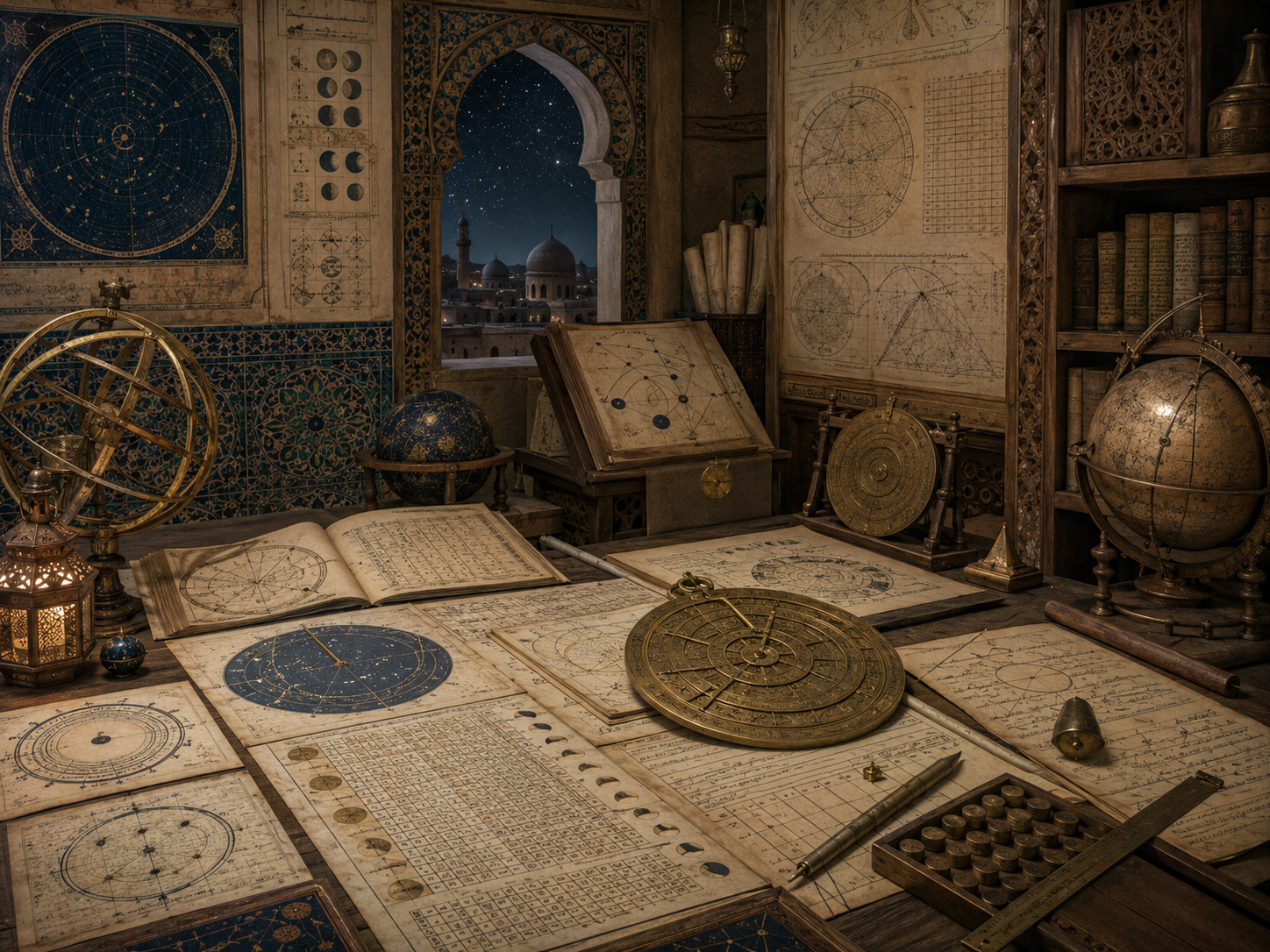
This article introduces astronomical tables, calendars, ephemerides, zīj traditions, planetary models, lunar cycles, solar cycles, observation, interpolation, correction rules, timekeeping, ritual time, agricultural seasons, navigation, prediction, uncertainty, tabular computation, human calculators, manuscript transmission, and institutional uses of astronomical knowledge. It argues that astronomical calculation belongs in algorithmic history because it stores computation, organizes time, applies repeatable rules, and transforms observation into prediction.
Why Astronomical Tables Matter
Astronomical tables matter because they preserve computation for repeated use. Instead of recomputing every planetary position, lunar phase, solar motion, or calendrical quantity from first principles, a user can consult a table and follow a procedure. The table stores values; the rule tells the user how to apply them.
This is a major prehistory of algorithmic prediction. The table is a data structure. The calendar is a rule system. The correction procedure is an algorithm. The observer supplies inputs. The calculator produces outputs. The result guides timekeeping, ritual practice, navigation, agriculture, scholarship, and administration.
| Astronomical object | Historical function | Algorithmic meaning |
|---|---|---|
| Table | Stores computed values for future use. | Precomputed data structure. |
| Calendar | Coordinates cycles, seasons, festivals, and administration. | Rule-governed time system. |
| Observation | Provides empirical input. | Measurement data. |
| Model | Represents celestial motion in computable form. | Predictive structure. |
| Correction rule | Adjusts approximate values. | Error-handling procedure. |
| Prediction | Produces a future-oriented result. | Output under uncertainty. |
Astronomical tables show that computation can be distributed across observation, model, table, procedure, and human interpretation.
Tables as Stored Computation
A table is not passive information. It is computation that has been organized into reusable form. Someone observed, calculated, modeled, corrected, copied, and arranged values so that later users could retrieve them. The table shortens future work by storing past work.
In algorithmic terms, a table can be understood as a lookup structure. It maps inputs to outputs or intermediate values. But historical tables often required more than direct lookup. Users needed rules for choosing the correct entry, adjusting the value, interpolating between entries, converting units, or combining multiple table columns.
| Table feature | Practical use | Computational analogy |
|---|---|---|
| Row | Organizes values by date, degree, argument, or cycle. | Indexed record. |
| Column | Separates quantities, corrections, or derived values. | Field or variable. |
| Entry | Stores a precomputed value. | Lookup result. |
| Argument | Input used to locate the value. | Index or key. |
| Correction | Adjusts approximate or mean value. | Error adjustment. |
| Instruction | Tells the reader how to use the table. | Algorithm over data. |
A table becomes algorithmic when a procedure tells the user how to move from input to result.
Calendars as Rule-Governed Systems
Calendars are rule-governed systems for organizing time. They relate astronomical cycles to social needs: months, years, seasons, festivals, rituals, agricultural periods, taxation, travel, administration, and historical recordkeeping. A calendar must decide how cycles are counted, corrected, coordinated, and remembered.
Calendrical systems are computational because they require rules. When does a month begin? How is a year counted? How are lunar and solar cycles reconciled? How are intercalations handled? How are dates converted? How do observational practices interact with tabular rules? Each question can require procedure.
| Calendar function | Rule question | Algorithmic meaning |
|---|---|---|
| Month | How is the beginning determined? | Boundary condition. |
| Year | How are cycles counted? | Iteration over time. |
| Season | How is astronomical motion related to agriculture or ritual? | Mapping between systems. |
| Intercalation | How are cycles reconciled? | Correction rule. |
| Date conversion | How is one calendar mapped to another? | Coordinate transformation. |
| Recordkeeping | How are events anchored in time? | Temporal data structure. |
Calendars show that time becomes institutional when it is made calculable, repeatable, and publicly coordinated.
Observation, Model, and Procedure
Astronomical prediction depends on a relationship between observation, model, and procedure. Observation supplies evidence. A model organizes motion into a computable structure. A procedure tells the calculator how to generate a result from the model and available data.
This relationship is central to computational reasoning. Prediction is not simply guessing the future. It is the disciplined use of past observation, mathematical structure, and procedural transformation to produce an expected value. When prediction fails, the model, observation, table, or procedure may need revision.
| Layer | Role | Failure mode |
|---|---|---|
| Observation | Provides measured celestial positions or events. | Measurement error. |
| Model | Represents motion in idealized form. | Model mismatch. |
| Table | Stores values derived from model or observation. | Copying or calculation error. |
| Procedure | Transforms inputs into prediction. | Misapplication. |
| Interpretation | Relates result to practice. | Context error. |
| Revision | Updates model, table, or rule. | Slow adaptation. |
Astronomical calculation is algorithmic because it turns observation into repeatable predictive procedure.
Zīj Traditions and Tabular Astronomy
A zīj is an astronomical handbook that typically includes tables and instructions for astronomical calculation. Zīj traditions were central to Islamic-world astronomy and drew on, transformed, criticized, and extended earlier Greek, Indian, Persian, and other astronomical materials. They were not simply collections of numbers; they were working computational systems.
A zīj could include tables for planetary motion, solar and lunar positions, trigonometric values, calendars, chronology, geographic coordinates, eclipses, timekeeping, and observational parameters. It could also include instructions explaining how to use those tables. This makes the zīj an important artifact in algorithmic history: table plus procedure plus model plus transmission.
| Zīj component | Function | Algorithmic significance |
|---|---|---|
| Numerical tables | Store calculated astronomical values. | Reusable computed data. |
| Instructions | Explain how to select and combine values. | Procedure over tables. |
| Parameters | Define model constants and reference values. | Model configuration. |
| Calendar material | Relates astronomical cycles to dates. | Temporal conversion. |
| Geographic data | Links place to calculation. | Spatial input. |
| Transmission | Copies, adapts, and revises earlier work. | Computational tradition. |
The zīj is a powerful example of premodern scientific computing in manuscript form.
Lunar, Solar, and Planetary Cycles
Astronomical prediction depends on cycles, but cycles rarely fit institutional needs perfectly. Lunar months, solar years, planetary periods, seasonal cycles, and ritual calendars can interact in complex ways. Tables and calendars help manage that complexity.
A cycle is algorithmic when it can be counted, repeated, adjusted, and compared. The difficulty is that real motion may not match a simple cycle exactly. Astronomical calculation therefore often involves mean values, corrections, approximations, and periodic adjustment.
| Cycle | Practical importance | Computational issue |
|---|---|---|
| Lunar cycle | Months, visibility, ritual time, calendrical reckoning. | Observation and boundary setting. |
| Solar cycle | Year, seasons, agriculture, solstices, equinoxes. | Annual recurrence and drift. |
| Planetary cycles | Positions, conjunctions, astrological and astronomical interest. | Complex periodic models. |
| Daily rotation | Timekeeping, prayer times, rising and setting. | Local horizon and location. |
| Eclipse cycles | Prediction and verification of celestial events. | Multiple cycles combined. |
| Calendar cycles | Administrative and ritual coordination. | Rule-based conversion. |
Cycles make prediction possible, but correction makes prediction usable.
Interpolation, Correction, and Approximation
Tables usually cannot list every possible value. A user often needs a value between entries. Interpolation supplies a rule for estimating between known values. Corrections adjust a mean value or approximate prediction. Approximation makes calculation practical when exactness is unavailable, unnecessary, or impossible with existing tools.
These procedures are central to algorithmic prediction. Interpolation is not merely a trick. It is a disciplined way to use stored values to infer unlisted values. Correction rules acknowledge that models are approximate and need adjustment.
| Procedure | What it does | Algorithmic role |
|---|---|---|
| Lookup | Finds nearest or exact table entry. | Indexing. |
| Interpolation | Estimates between entries. | Approximation. |
| Correction | Adjusts mean or rough value. | Error reduction. |
| Rounding | Chooses usable precision. | Numerical convention. |
| Comparison | Checks against observation or another table. | Validation. |
| Revision | Updates table or parameter. | Model maintenance. |
Interpolation and correction show that algorithmic prediction often operates between certainty and usefulness.
Timekeeping, Ritual, and Administration
Astronomical prediction became institutionally important because time had social consequences. Calendars shaped festivals, rituals, agricultural work, taxation, legal records, travel, teaching, and governance. In Islamic contexts, astronomical and mathematical knowledge also supported prayer times, qibla calculation, calendar questions, and the coordination of learned and practical timekeeping traditions.
The computational issue is that time must be made public. A prediction has institutional value only when people can rely on it, teach it, contest it, or apply it consistently. Tables, calendars, and instruments helped coordinate time beyond individual observation.
| Timekeeping use | Calculation needed | Institutional effect |
|---|---|---|
| Prayer times | Solar position, shadow, horizon, and local conditions. | Ritual coordination. |
| Calendars | Month, year, cycle, and date rules. | Public timekeeping. |
| Agriculture | Seasonal markers and solar year. | Labor planning. |
| Administration | Tax, record, and event dating. | Governance coordination. |
| Travel and navigation | Stars, direction, time, and location. | Spatial-temporal orientation. |
| Education | Tables and rules for students. | Transmission of procedure. |
Astronomical calculation made time calculable, and calculable time became a form of institutional order.
Prediction and Uncertainty
Prediction always contains uncertainty. A table may be approximate. An observation may be imperfect. A model may drift. A copyist may make an error. A user may choose the wrong entry. A calendar rule may not capture local practice. The history of astronomical prediction is therefore also a history of managing uncertainty.
Algorithmic prediction should not be understood as perfect foresight. It is structured expectation. It uses rule-governed methods to generate a result that is useful, checkable, and revisable. Premodern astronomical tables make this especially clear because prediction depends visibly on tables, rules, and correction.
| Source of uncertainty | Example | Response |
|---|---|---|
| Observation error | Inaccurate measured position. | Repeat observation or compare records. |
| Model error | Idealized cycle differs from actual motion. | Correction or revised parameter. |
| Table error | Incorrect copied value. | Cross-check with another table. |
| Interpolation error | Estimate between values is approximate. | Use finer table or correction rule. |
| Context error | Wrong location, date, or calendar conversion. | Normalize inputs. |
| Interpretation error | Prediction applied beyond its scope. | Clarify limits. |
Astronomical prediction teaches a durable lesson: algorithms produce results under assumptions, and assumptions must be inspected.
Instruments, Tables, and Human Calculators
Astronomical computation was distributed across instruments, tables, manuscripts, and human expertise. An astrolabe-like instrument might help with observation or timekeeping. A table might store values. A handbook might give rules. A trained calculator or astronomer would interpret the procedure.
This distribution matters because no single artifact contains the whole computation. The instrument, table, rule, and user form a system. Modern computational systems also work this way: data, interface, model, procedure, documentation, and trained users interact.
| Component | Role | Computational analogy |
|---|---|---|
| Instrument | Measures, represents, or assists calculation. | Hardware or interface. |
| Table | Stores precomputed values. | Data table. |
| Rule | Explains procedure. | Algorithm. |
| Manuscript | Preserves and transmits method. | Documentation. |
| Human calculator | Selects, applies, and interprets procedure. | Operator and analyst. |
| Institution | Uses results for time, ritual, administration, or teaching. | Deployment context. |
Astronomical computation was a socio-technical system before the term existed.
Manuscripts, Transmission, and Teaching
Astronomical tables survived and changed through manuscripts, copies, corrections, commentaries, translations, regional adaptations, teaching traditions, and institutional use. A table could be recalculated, reformatted, corrected, or adapted for a different location or calendar system.
Teaching was central. A table without instruction is difficult to use. A procedure without examples is fragile. A model without explanation may be misapplied. Manuscript transmission carried not only values, but also methods of use.
| Transmission process | What changes | Algorithmic significance |
|---|---|---|
| Copying | Tables and instructions are reproduced. | Procedure persists. |
| Correction | Errors or outdated values are amended. | Data maintenance. |
| Commentary | Use and meaning are explained. | Documentation grows. |
| Translation | Procedure enters another language. | Algorithm crosses representation. |
| Regional adaptation | Tables are adjusted for place or practice. | Localization. |
| Teaching | Students learn how to apply rules. | Human execution becomes reliable. |
Astronomical prediction became durable because tables were taught, copied, corrected, and adapted.
From Astronomical Tables to Modern Computation
Modern computation still uses tables, calendars, interpolation, correction, modeling, and prediction. Weather models, navigation systems, financial calendars, satellite ephemerides, astronomical software, scheduling systems, and public time standards all continue the deeper pattern: organize observations, store values, apply rules, produce predictions, and revise when necessary.
The continuity should be handled carefully. Premodern astronomical tables are not modern software. But they belong to the long history of computation because they coordinate data, models, procedures, and users. They demonstrate a form of scientific computing before machines: calculation distributed through manuscripts, instruments, tables, and trained people.
| Premodern astronomical practice | Modern computational counterpart | Continuity |
|---|---|---|
| Ephemeris table | Digital ephemeris or astronomical software. | Stored prediction values. |
| Calendar rule | Date conversion libraries and scheduling systems. | Rule-governed time representation. |
| Interpolation | Numerical interpolation routines. | Estimate between known values. |
| Correction table | Model calibration and bias correction. | Adjust approximate predictions. |
| Observation record | Sensor data and time series. | Evidence for model revision. |
| Manuscript instruction | Documentation and user guide. | Procedure must be learnable. |
Astronomical tables remind us that predictive computation has always depended on representation, correction, and use-context.
Origin Stories and Careful Interpretation
Astronomical calculation appears across many ancient and medieval traditions: Babylonian, Greek, Indian, Persian, Islamic-world, Chinese, Latin European, and others. A careful history should not reduce algorithmic prediction to one origin story. Islamic-world astronomy is especially important for this series because it preserved, criticized, transformed, and extended earlier materials while developing influential tables, instruments, observational programs, calendrical work, and mathematical procedures.
Careful interpretation also avoids treating tables as merely derivative. A table can be a serious intellectual artifact. It reflects choices about models, parameters, observation, format, units, precision, audience, and use. The act of making prediction usable is itself mathematical work.
| Oversimplification | Problem | Better framing |
|---|---|---|
| Tables are just lists. | It ignores computation, model, and procedure. | Treat tables as stored calculation plus use-rules. |
| Calendars are only cultural. | It ignores their computational structure. | Study calendars as rule-governed time systems. |
| Prediction means certainty. | It ignores approximation and correction. | Study prediction as structured expectation under assumptions. |
| One culture invented astronomical computation. | It erases multiple lineages. | Trace transmission, adaptation, and revision across traditions. |
| Instruments replace calculation. | It ignores the human-table-rule system. | Study instruments, tables, rules, and users together. |
| Old tables are obsolete trivia. | It misses their computational importance. | Study them as historical scientific computing artifacts. |
Astronomical tables are not only historical curiosities. They are records of how humans made the future calculable.
Examples of Astronomical Prediction as Algorithmic Reasoning
The examples below show how astronomical tables, calendars, and prediction turn observation and cycles into structured procedure.
Table lookup
A user locates a value by date, degree, argument, or cycle and retrieves a precomputed entry.
Calendar conversion
A date is mapped from one calendrical system to another through rule-governed steps.
Lunar visibility estimate
Observation, cycle, local conditions, and rule determine whether a month boundary is expected.
Solar time calculation
The sun’s position is related to timekeeping, shadow, horizon, and local practice.
Planetary ephemeris
A table gives predicted positions that may require correction or interpolation.
Interpolation
A missing value is estimated between two known table entries.
Eclipse prediction
Multiple cycles, positions, and conditions combine to identify a possible event.
Manuscript correction
A copied table is checked against another table, observation, or computational rule.
Across these examples, prediction depends on data, procedure, correction, and interpretation.
Mathematics, Computation, and Modeling
A simple table lookup can be modeled as:
Value = Table[Argument]
\]
Interpretation: A stored table maps an input argument to a precomputed value.
A linear interpolation rule can be represented as:
y = y_0 + \frac{x-x_0}{x_1-x_0}(y_1-y_0)
\]
Interpretation: When a value lies between two table entries, interpolation estimates the missing value.
A correction model can be written as:
Predicted = Mean\ Value + Correction
\]
Interpretation: Astronomical calculation often begins with an approximate or mean value, then applies a correction.
A calendrical cycle can be modeled as:
Date_{n+1} = Date_n + Cycle\ Length + Adjustment
\]
Interpretation: Calendrical systems often combine recurrence with correction or adjustment.
These formulas use modern notation to make the computational structure visible. They are interpretive models, not claims that all historical tables used these exact symbolic forms.
Python Workflow: Astronomical Prediction Table Map
The Python workflow below creates a dependency-light interpretive map of astronomical tables, calendars, and algorithmic prediction. It scores themes by table structure, procedural clarity, predictive function, institutional use, correction awareness, transmission importance, and modern resonance, then writes reproducible CSV and JSON outputs.
# astronomical_tables_calendars_prediction_map.py
# Dependency-light workflow for mapping astronomical tables as algorithmic prediction.

from __future__ import annotations

from dataclasses import asdict, dataclass
from pathlib import Path
from statistics import mean
import csv
import json
from datetime import datetime, timezone

ARTICLE_ROOT = Path(__file__).resolve().parents[1]
TABLES = ARTICLE_ROOT / "outputs" / "tables"
JSON_DIR = ARTICLE_ROOT / "outputs" / "json"


@dataclass(frozen=True)
class AstronomicalPredictionConfig:
    article: str = "astronomical_tables_calendars_and_algorithmic_prediction"
    core_threshold: float = 0.80
    high_predictive_threshold: float = 0.86


def timestamp_utc() -> str:
    return datetime.now(timezone.utc).isoformat()


def write_csv(path: Path, rows: list[dict[str, object]]) -> None:
    path.parent.mkdir(parents=True, exist_ok=True)
    if not rows:
        path.write_text("", encoding="utf-8")
        return
    fieldnames = sorted({key for row in rows for key in row.keys()})
    with path.open("w", newline="", encoding="utf-8") as handle:
        writer = csv.DictWriter(handle, fieldnames=fieldnames, extrasaction="ignore")
        writer.writeheader()
        writer.writerows(rows)


def write_json(path: Path, payload: object) -> None:
    path.parent.mkdir(parents=True, exist_ok=True)
    path.write_text(json.dumps(payload, indent=2, sort_keys=True), encoding="utf-8")


def astronomical_prediction_themes() -> list[dict[str, object]]:
    return [
        {"theme_id": "tables_as_stored_computation", "table_structure": 0.98, "procedural_clarity": 0.90, "predictive_function": 0.92, "institutional_use": 0.86, "correction_awareness": 0.86, "transmission_importance": 0.90, "modern_resonance": 0.94},
        {"theme_id": "calendars_as_rule_systems", "table_structure": 0.86, "procedural_clarity": 0.90, "predictive_function": 0.88, "institutional_use": 0.96, "correction_awareness": 0.88, "transmission_importance": 0.88, "modern_resonance": 0.92},
        {"theme_id": "zij_tabular_astronomy", "table_structure": 0.96, "procedural_clarity": 0.90, "predictive_function": 0.94, "institutional_use": 0.88, "correction_awareness": 0.90, "transmission_importance": 0.94, "modern_resonance": 0.92},
        {"theme_id": "interpolation_and_correction", "table_structure": 0.90, "procedural_clarity": 0.94, "predictive_function": 0.94, "institutional_use": 0.84, "correction_awareness": 0.98, "transmission_importance": 0.86, "modern_resonance": 0.96},
        {"theme_id": "observation_model_procedure", "table_structure": 0.82, "procedural_clarity": 0.88, "predictive_function": 0.92, "institutional_use": 0.86, "correction_awareness": 0.92, "transmission_importance": 0.84, "modern_resonance": 0.94},
        {"theme_id": "timekeeping_ritual_administration", "table_structure": 0.84, "procedural_clarity": 0.86, "predictive_function": 0.88, "institutional_use": 0.98, "correction_awareness": 0.84, "transmission_importance": 0.88, "modern_resonance": 0.90},
        {"theme_id": "instrument_table_human_system", "table_structure": 0.88, "procedural_clarity": 0.86, "predictive_function": 0.88, "institutional_use": 0.88, "correction_awareness": 0.86, "transmission_importance": 0.88, "modern_resonance": 0.92},
    ]


def score_theme(row: dict[str, object], config: AstronomicalPredictionConfig) -> dict[str, object]:
    prediction_score = mean([
        float(row["table_structure"]),
        float(row["procedural_clarity"]),
        float(row["predictive_function"]),
        float(row["institutional_use"]),
        float(row["correction_awareness"]),
        float(row["transmission_importance"]),
        float(row["modern_resonance"]),
    ])

    if prediction_score >= config.core_threshold and float(row["predictive_function"]) >= config.high_predictive_threshold:
        interpretive_status = "core_astronomical_prediction_thread"
    elif prediction_score >= config.core_threshold:
        interpretive_status = "major_astronomical_prediction_thread"
    else:
        interpretive_status = "supporting_astronomical_prediction_thread"

    return {
        "theme_id": row["theme_id"],
        "table_structure": round(float(row["table_structure"]), 6),
        "procedural_clarity": round(float(row["procedural_clarity"]), 6),
        "predictive_function": round(float(row["predictive_function"]), 6),
        "institutional_use": round(float(row["institutional_use"]), 6),
        "correction_awareness": round(float(row["correction_awareness"]), 6),
        "transmission_importance": round(float(row["transmission_importance"]), 6),
        "modern_resonance": round(float(row["modern_resonance"]), 6),
        "prediction_score": round(prediction_score, 6),
        "interpretive_status": interpretive_status,
    }


def interpretation_cautions() -> list[dict[str, str]]:
    return [
        {"caution": "do_not_treat_tables_as_passive_lists", "meaning": "Astronomical tables store computation and require rules of use."},
        {"caution": "do_not_equate_prediction_with_certainty", "meaning": "Prediction is structured expectation under assumptions and correction."},
        {"caution": "do_not_separate_calendar_from_institution", "meaning": "Calendars coordinate ritual, administration, agriculture, and public time."},
        {"caution": "do_not_ignore_copying_and_correction", "meaning": "Manuscript transmission can preserve, alter, or repair computation."},
        {"caution": "do_not_project_modern_software_backward", "meaning": "Premodern astronomical tables are computational artifacts, but not modern software."},
    ]


def main() -> None:
    config = AstronomicalPredictionConfig()
    themes = astronomical_prediction_themes()
    scored = [score_theme(row, config) for row in themes]
    cautions = interpretation_cautions()

    summary = {
        "article": config.article,
        "timestamp_utc": timestamp_utc(),
        "themes_reviewed": len(scored),
        "core_threads": sum(1 for row in scored if row["interpretive_status"] == "core_astronomical_prediction_thread"),
        "major_threads": sum(1 for row in scored if row["interpretive_status"] == "major_astronomical_prediction_thread"),
        "supporting_threads": sum(1 for row in scored if row["interpretive_status"] == "supporting_astronomical_prediction_thread"),
        "mean_prediction_score": round(mean(float(row["prediction_score"]) for row in scored), 6),
        "cautions": len(cautions),
        "interpretation": "Astronomical tables and calendars should be studied as algorithmic prediction systems: stored computation, procedural lookup, correction, interpolation, calendar rules, and institutional timekeeping.",
    }

    write_csv(TABLES / "astronomical_prediction_themes.csv", themes)
    write_csv(TABLES / "astronomical_prediction_map.csv", scored)
    write_csv(TABLES / "interpretation_cautions.csv", cautions)
    write_csv(TABLES / "astronomical_prediction_summary.csv", [summary])

    write_json(JSON_DIR / "astronomical_prediction_config.json", asdict(config))
    write_json(JSON_DIR / "astronomical_prediction_map.json", scored)
    write_json(JSON_DIR / "interpretation_cautions.json", cautions)
    write_json(JSON_DIR / "astronomical_prediction_summary.json", summary)

    print("Astronomical tables, calendars, and algorithmic prediction map complete.")
    print(TABLES / "astronomical_prediction_summary.csv")


if __name__ == "__main__":
    main()
This workflow turns astronomical prediction into a reproducible interpretive artifact: table structure, procedural clarity, predictive function, institutional use, correction awareness, transmission importance, modern resonance, prediction score, and historical caution are documented together.
R Workflow: Astronomical Prediction Diagnostics
The R workflow reads the generated CSV outputs, summarizes astronomical prediction themes, visualizes theme dimensions, and writes an additional diagnostic table.
# astronomical_tables_calendars_prediction_summary.R
args <- commandArgs(trailingOnly = FALSE)
file_arg <- grep("^--file=", args, value = TRUE)

if (length(file_arg) > 0) {
  script_path <- normalizePath(sub("^--file=", "", file_arg[1]), mustWork = TRUE)
  article_root <- normalizePath(file.path(dirname(script_path), ".."), mustWork = TRUE)
} else {
  article_root <- getwd()
}

setwd(article_root)

tables_dir <- file.path(article_root, "outputs", "tables")
figures_dir <- file.path(article_root, "outputs", "figures")
dir.create(tables_dir, recursive = TRUE, showWarnings = FALSE)
dir.create(figures_dir, recursive = TRUE, showWarnings = FALSE)

map_path <- file.path(tables_dir, "astronomical_prediction_map.csv")
summary_path <- file.path(tables_dir, "astronomical_prediction_summary.csv")

if (!file.exists(map_path)) {
  stop(paste("Missing", map_path, "Run the Python workflow first."))
}

prediction_map <- read.csv(map_path, stringsAsFactors = FALSE)
summary <- read.csv(summary_path, stringsAsFactors = FALSE)

png(file.path(figures_dir, "astronomical_prediction_dimensions.png"), width = 1200, height = 850)
score_matrix <- t(as.matrix(prediction_map[, c("table_structure", "procedural_clarity", "predictive_function", "institutional_use", "correction_awareness", "transmission_importance", "modern_resonance")]))
barplot(score_matrix,
        beside = TRUE,
        names.arg = prediction_map$theme_id,
        las = 2,
        ylim = c(0, 1),
        ylab = "Interpretive Score",
        main = "Astronomical Tables, Calendars, and Algorithmic Prediction Dimensions")
legend("bottomright",
       legend = rownames(score_matrix),
       cex = 0.72,
       bty = "n")
grid()
dev.off()

png(file.path(figures_dir, "prediction_score_by_theme.png"), width = 1000, height = 750)
barplot(prediction_map$prediction_score,
        names.arg = prediction_map$theme_id,
        las = 2,
        ylab = "Prediction Score",
        main = "Astronomical Prediction Score by Theme")
grid()
dev.off()

r_summary <- data.frame(
  themes_reviewed = summary$themes_reviewed[1],
  core_threads = summary$core_threads[1],
  major_threads = summary$major_threads[1],
  supporting_threads = summary$supporting_threads[1],
  mean_prediction_score = summary$mean_prediction_score[1],
  cautions = summary$cautions[1],
  diagnostic_note = "Astronomical tables and calendars should be studied as algorithmic prediction systems: stored computation, procedural lookup, correction, interpolation, calendar rules, and institutional timekeeping."
)

write.csv(r_summary, file.path(tables_dir, "r_astronomical_prediction_diagnostic_summary.csv"), row.names = FALSE)
print(r_summary)
The R layer makes the interpretive structure visible: tables, calendars, zīj traditions, interpolation, correction, observation, model, timekeeping, instruments, manuscripts, and caution can be examined as related but distinct dimensions of algorithmic prediction.
GitHub Repository
The companion repository contains reproducible workflows, synthetic interpretive data, outputs, calculators, documentation, and multilingual examples for this article.
Complete Code Repository
Companion article folder with Python, R, Julia, SQL, Haskell, C, C++, Fortran, Rust, Go, Java, TypeScript, Prolog, Racket, notebooks, documentation, synthetic teaching data, generated outputs, schemas, calculators, and Canvas-ready workflow artifacts for astronomical tables, calendars, zīj traditions, algorithmic prediction, ephemerides, interpolation, correction rules, cycles, timekeeping, ritual and administrative calendars, observational records, instruments, manuscript transmission, predictive uncertainty, and stored computation.
A Practical Method for Studying Astronomical Tables
A careful study of astronomical tables should ask how values, rules, observations, and institutions work together. The method below treats tables as computational artifacts rather than passive lists.
| Step | Historical action | Output |
|---|---|---|
| 1 | Identify the table type: calendar, solar, lunar, planetary, trigonometric, geographic, or timekeeping. | Table classification. |
| 2 | Determine the input argument: date, degree, cycle, location, or observed quantity. | Input map. |
| 3 | Identify columns, rows, units, parameters, and reference epoch. | Data structure record. |
| 4 | Extract the rule of use: lookup, correction, interpolation, conversion, or combination. | Procedure sequence. |
| 5 | Track how uncertainty is handled: rounding, correction, comparison, or revision. | Approximation record. |
| 6 | Identify institutional purpose: ritual time, calendar, navigation, administration, teaching, or scholarship. | Use context. |
| 7 | Ask how the table was copied, corrected, translated, or localized. | Transmission map. |
| 8 | Compare with modern computation only after understanding the historical table-procedure system. | Interpretive bridge. |
This method respects astronomical tables as mathematical, material, institutional, and procedural artifacts.
Common Pitfalls
The first pitfall is treating astronomical tables as mere lists rather than stored computation. The second is treating calendars as purely cultural artifacts rather than rule-governed systems. The third is treating prediction as certainty. A fourth is projecting modern software backward too directly.
| Pitfall | Why it matters | Better practice |
|---|---|---|
| Tables are just lists | It erases calculation, model, and use-rules. | Study table structure and procedure together. |
| Calendars are not computational | It ignores rule-governed time systems. | Study cycles, adjustments, conversions, and institutions. |
| Prediction means certainty | It hides approximation and uncertainty. | Track assumptions, corrections, and validation. |
| Copying is passive | It ignores correction and adaptation. | Study manuscript transmission as maintenance. |
| Instruments do everything | It ignores human expertise and tables. | Study instrument, table, rule, and user as a system. |
| Modern computation is completely new | It ignores premodern tabular computing. | Compare continuities and differences carefully. |
Astronomical prediction becomes clearer when tables, calendars, models, procedures, and institutions are studied together.
Why Astronomical Prediction Belongs in Algorithmic Reasoning
Astronomical tables, calendars, and algorithmic prediction belong in algorithmic reasoning because they show how humans made future events calculable before modern computers. A table stores values. A calendar organizes time. A procedure tells the user what to do. A correction rule handles mismatch. A prediction becomes useful when it can be checked, taught, transmitted, and applied.
This history expands the meaning of computation. Computation is not only machine execution. It is also the disciplined organization of data, rules, models, observations, and users. Astronomical tables are among the great historical examples of this organization: they turn cycles, motion, and time into structured procedure.
The lesson for modern systems is direct. Predictive algorithms still depend on data, models, assumptions, correction, documentation, and institutional use. Astronomical tables remind us that prediction is powerful only when its limits are understood. AI belongs in the toolkit, not in control.
Related Articles
- Trade, Inheritance, Surveying, and Practical Calculation
- Computational Mapping, Geography, and Coordinate Reasoning
- Hindu-Arabic Numerals and the Transmission of Positional Calculation
- Al-Khwārizmī, Algorism, and the Procedural Imagination
- Algorithms in Climate, Energy, and Infrastructure
Further Reading
- King, D.A. (1993) Astronomy in the Service of Islam. Aldershot: Variorum.
- King, D.A. (2004) In Synchrony with the Heavens: Studies in Astronomical Timekeeping and Instrumentation in Medieval Islamic Civilization. Leiden: Brill.
- Kennedy, E.S. (1956) ‘A survey of Islamic astronomical tables’, Transactions of the American Philosophical Society, 46(2), pp. 123–177.
- Saliba, G. (1994) A History of Arabic Astronomy: Planetary Theories During the Golden Age of Islam. New York: New York University Press.
- North, J. (2008) Cosmos: An Illustrated History of Astronomy and Cosmology. Chicago: University of Chicago Press.
- Ptolemy (1998) Ptolemy’s Almagest. Translated and annotated by G.J. Toomer. Princeton: Princeton University Press.
- Neugebauer, O. (1975) A History of Ancient Mathematical Astronomy. Berlin: Springer.
References
- Chabás, J. and Goldstein, B.R. (2012) A Survey of European Astronomical Tables in the Late Middle Ages. Leiden: Brill.
- Kennedy, E.S. (1956) ‘A survey of Islamic astronomical tables’, Transactions of the American Philosophical Society, 46(2), pp. 123–177.
- King, D.A. (1993) Astronomy in the Service of Islam. Aldershot: Variorum.
- King, D.A. (2004) In Synchrony with the Heavens: Studies in Astronomical Timekeeping and Instrumentation in Medieval Islamic Civilization. Leiden: Brill.
- Neugebauer, O. (1975) A History of Ancient Mathematical Astronomy. Berlin: Springer.
- North, J. (2008) Cosmos: An Illustrated History of Astronomy and Cosmology. Chicago: University of Chicago Press.
- Ptolemy (1998) Ptolemy’s Almagest. Translated and annotated by G.J. Toomer. Princeton: Princeton University Press.
- Saliba, G. (1994) A History of Arabic Astronomy: Planetary Theories During the Golden Age of Islam. New York: New York University Press.