
This project does not attempt to replace industrial composting infrastructure or laboratory-grade environmental instrumentation. Instead, it demonstrates an important systems principle: sustainable waste management improves when biological processes are measured rather than guessed.
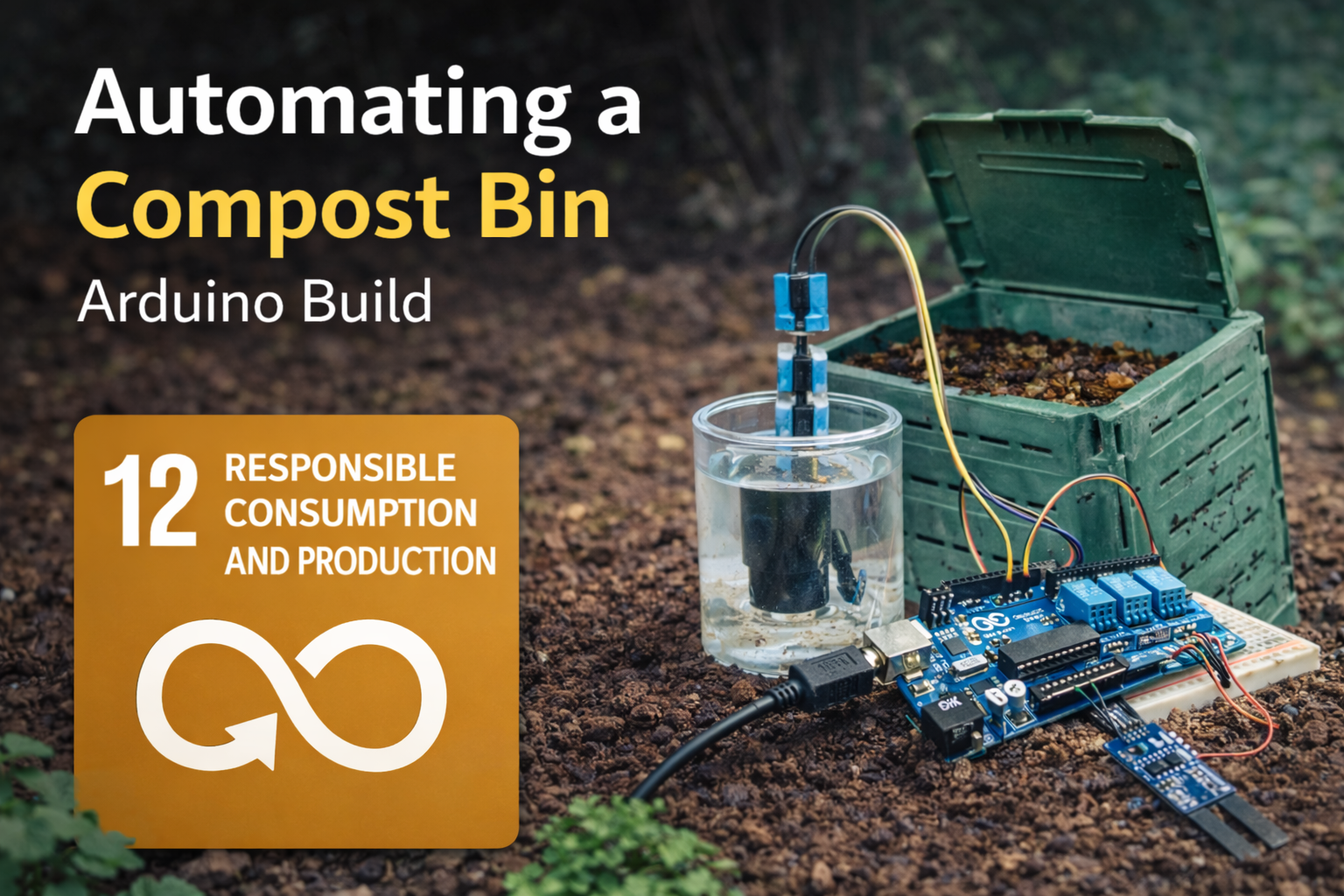
Part of the series: Arduino Projects for Sustainable Development: 10 SDG-Aligned Builds
Table of Contents
- Abstract
- Prototype Repository
- SDG Alignment
- System Architecture
- Why an Arduino Compost Monitoring System Matters
- What This Project Measures
- Bill of Materials
- Measurement Principle: Why Compost Temperature Matters
- Measurement Principle: Moisture and Decomposition
- Design Assumptions and Constraints
- Wiring Overview
- Electrical and Deployment Considerations
- Firmware Design Goals
- Advanced Arduino Code
- Code Review and Engineering Notes
- Interpreting the Readings
- Calibration and Validation
- Suggested Performance Metrics
- Build Steps
- Limitations
- Possible Upgrades
- Why This Matters for Sustainable Development
- Conclusion
Abstract
This project presents a prototype compost monitoring system built around an Arduino microcontroller, a temperature sensor, a moisture-related sensor input, and optional ambient sensing. The system measures conditions inside or near a compost bin and reports those values for interpretation and possible later automation.
From an engineering perspective, the project demonstrates a simple environmental monitoring architecture for biological systems. From a sustainability perspective, it shows how embedded sensing can support waste reduction, compost quality, and circular resource use.
Prototype Repository
This project is published as an open prototype so that engineers, researchers, students, and advanced makers can reproduce and extend the design. All firmware, documentation, wiring notes, and example monitoring data are available in the project repository.
GitHub Repository:
Arduino Compost Monitor – Source Files and Documentation
The repository contains the complete prototype build materials:
- Arduino monitoring firmware (.ino)
- bill of materials
- setup guide
- calibration notes
- deployment notes
- example compost readings
Engineers can clone the repository, fork the design, or download the complete project using GitHub’s Download ZIP feature.
All materials are released under the MIT License to support reuse in research, education, and prototype engineering work.
SDG Alignment
This Arduino compost monitoring system connects most directly to SDG 12: Responsible Consumption and Production, particularly the reduction of waste and the promotion of more circular material systems.
Related themes also appear in:
- SDG 11: Sustainable Cities and Communities — through local waste reduction and community composting systems
- SDG 13: Climate Action — because composting can help reduce methane emissions associated with landfill disposal of organic waste
- SDG 15: Life on Land — through improved soil health and organic matter recovery
Composting sits at the intersection of waste management, ecological cycles, and sustainable infrastructure. Monitoring these systems more effectively can improve both environmental performance and educational value.
System Architecture
The system can be understood as a basic environmental monitoring pipeline:
- Sensor layer: compost temperature sensor, moisture or humidity sensor, optional ambient sensor
- Acquisition layer: Arduino reads analog and digital sensor values
- Processing layer: firmware formats and reports telemetry
- Output layer: readings are displayed through the Serial Monitor and can later be logged, transmitted, or used for control logic
High-level data flow:
Compost Bin → Temperature / Moisture Sensors → Arduino → Telemetry / Logging / Future ControlThis architecture mirrors a broader sustainability pattern: instrument the process, observe conditions, and only then consider automation or optimization.
Why an Arduino Compost Monitoring System Matters
Compost systems often fail for simple reasons: too much water, too little moisture, poor aeration, or inadequate internal heat. Many people manage compost by feel alone, which is intuitive but inconsistent.
A sensor-based system introduces a more systematic approach:
- measure internal compost conditions
- identify whether the system is too dry, too wet, or thermally inactive
- adjust management practices such as turning, watering, or material balance
- observe how the system responds over time
This matters because composting is fundamentally a biological process governed by environmental conditions. Better sensing can support better stewardship of that process.
What This Project Measures
This monitoring system is designed to track several compost-relevant variables:
- Internal temperature — a key indicator of microbial activity
- Moisture-related conditions — whether the compost is too dry or too wet
- Ambient temperature and humidity — optional environmental context
In practical terms, the most important variable is often internal temperature. Compost that is biologically active should generally heat above ambient conditions as microbes break down organic matter.
Bill of Materials
- Arduino Uno or Nano
- DS18B20 waterproof temperature sensor
- DHT22 temperature and humidity sensor (optional ambient sensing)
- Capacitive moisture sensor or equivalent proxy sensor for moisture testing
- 10kΩ resistor for DS18B20 pull-up
- Breadboard
- Jumper wires
- Stable 5V power supply
- Compost bin or compost tumbler
Note: Direct insertion of standard low-cost moisture sensors into active compost can shorten sensor life significantly. For longer-term deployments, more durable probes or indirect moisture estimation methods are preferable.
Measurement Principle: Why Compost Temperature Matters
Temperature is one of the clearest signals of compost activity. During active decomposition, microbial populations generate heat as they metabolize organic material.
That means compost temperature functions as a practical systems indicator:
- Low temperature may indicate insufficient biological activity, overly dry material, poor nitrogen balance, or lack of mass.
- Moderately elevated temperature often indicates healthy decomposition.
- Excessively high temperature may indicate a need for turning or moisture adjustment.
This is not a direct chemical assay. It is an indirect systems measurement—but a very useful one.
Measurement Principle: Moisture and Decomposition
Moisture strongly influences composting because microbial activity depends on water availability. Compost that is too dry decomposes slowly. Compost that is too wet can become anaerobic, leading to odor, poor decomposition, and inefficient breakdown.
Low-cost moisture sensors do not measure compost moisture with laboratory precision. Instead, they provide a rough electrical proxy that may be useful for trend detection and educational purposes.
That distinction matters. In this project, moisture sensing should be interpreted as indicative rather than absolute.
Design Assumptions and Constraints
This prototype assumes:
- a relatively small compost system
- educational or experimental deployment
- stable sensor placement
- low-cost sensors rather than industrial compost probes
- manual compost management decisions rather than full automation
It also assumes that the user is interested in understanding compost dynamics rather than merely creating a “smart bin” for its own sake. The value of the project lies in monitoring a biological process more intelligently.
Wiring Overview
DS18B20 Temperature Sensor
- VCC → 5V
- GND → GND
- DATA → Arduino D2
Add a 10kΩ pull-up resistor between the data line and VCC.
DHT22 Ambient Sensor (Optional)
- VCC → 5V
- GND → GND
- DATA → Arduino D3
Capacitive Moisture Sensor
- VCC → 5V
- GND → GND
- Signal → A0
Electrical and Deployment Considerations
Compost environments are electrically and physically harsh. They are wet, chemically active, and mechanically unstable. Any sensor inserted into the compost body must be protected against corrosion, strain, and contamination.
For better reliability:
- use waterproof temperature probes for internal compost measurement
- avoid leaving fragile breadboards exposed outdoors
- house the Arduino and wiring in a dry enclosure
- use strain relief where cables enter or leave the bin
For a true long-term outdoor system, enclosure design matters almost as much as the firmware.
Firmware Design Goals
The firmware should do more than simply dump sensor readings. A defensible implementation should:
- read internal compost temperature reliably
- measure ambient humidity and temperature when available
- sample moisture input consistently
- report telemetry clearly for interpretation
- handle invalid readings without crashing the system
That makes the system easier to validate and easier to extend later into logging, alerts, or automation.
Advanced Arduino Code
The firmware below reads compost temperature from a DS18B20, ambient temperature and humidity from a DHT22, and a moisture-related analog signal from a capacitive sensor.
#include <OneWire.h>
#include <DallasTemperature.h>
#include <DHT.h>

#define ONE_WIRE_BUS 2
#define DHTPIN 3
#define DHTTYPE DHT22
#define MOISTURE_PIN A0

OneWire oneWire(ONE_WIRE_BUS);
DallasTemperature compostSensors(&oneWire);
DHT dht(DHTPIN, DHTTYPE);

int readMoistureAverage(int samples = 10) {
  long total = 0;

  for (int i = 0; i < samples; i++) {
    total += analogRead(MOISTURE_PIN);
    delay(10);
  }

  return total / samples;
}

void printTelemetry(float compostTemp, float ambientTemp, float humidity, int moistureValue) {
  Serial.print("Compost Temp: ");
  Serial.print(compostTemp);
  Serial.print(" C | Ambient Temp: ");
  Serial.print(ambientTemp);
  Serial.print(" C | Humidity: ");
  Serial.print(humidity);
  Serial.print(" % | Moisture Signal: ");
  Serial.println(moistureValue);
}

void setup() {
  Serial.begin(9600);
  compostSensors.begin();
  dht.begin();

  Serial.println("Arduino Compost Monitoring System Starting");
}

void loop() {
  compostSensors.requestTemperatures();
  float compostTemp = compostSensors.getTempCByIndex(0);

  float humidity = dht.readHumidity();
  float ambientTemp = dht.readTemperature();

  int moistureValue = readMoistureAverage();

  if (compostTemp == DEVICE_DISCONNECTED_C) {
    Serial.println("DS18B20 sensor error: compost probe disconnected.");
    delay(3000);
    return;
  }

  if (isnan(humidity) || isnan(ambientTemp)) {
    Serial.println("DHT22 sensor error: invalid ambient reading.");
    delay(3000);
    return;
  }

  printTelemetry(compostTemp, ambientTemp, humidity, moistureValue);

  delay(5000);
}
Code Review and Engineering Notes
A few implementation details are important:
- Waterproof temperature sensing: the DS18B20 is a practical choice because it is inexpensive and suitable for direct insertion into compost.
- Averaging: the moisture input is averaged across multiple analog reads to reduce short-term noise.
- Error handling: the code checks for invalid sensor states before reporting telemetry.
- Telemetry clarity: environmental readings are formatted consistently for debugging or later logging.
For more advanced deployments, you could add long-term logging, threshold-based alerts, or a simple display module mounted outside the compost bin.
Interpreting the Readings
The raw values do not matter equally.
- Compost temperature is usually the most informative signal.
- Ambient temperature and humidity help interpret whether external weather may be affecting compost performance.
- Moisture signal is useful as a relative indicator rather than an exact moisture measurement.
A healthy compost system often shows internal temperature above ambient conditions when biological activity is strong.
Calibration and Validation
Environmental sensors should always be validated before interpretation.
A practical validation process can include:
- verifying the DS18B20 against a known thermometer
- checking that the ambient DHT22 readings are reasonable
- testing the moisture sensor in clearly wet and clearly dry material
- observing whether compost temperature rises after fresh material is added or the pile is turned
- recording how conditions change over several days
If readings seem implausible, the issue may be sensor placement, weather exposure, poor electrical contact, or unsuitable compost material composition.
Suggested Performance Metrics
For a more rigorous evaluation, the system can be assessed against a few simple metrics:
- temperature responsiveness: whether the compost probe detects meaningful thermal change over time
- moisture differentiation: whether the moisture signal distinguishes obviously dry from obviously wet conditions
- reading stability: whether repeated readings remain reasonably consistent under stable conditions
- telemetry integrity: whether the system avoids malformed or clearly impossible values
Even informal evaluation of these metrics improves the technical credibility of the build.
Build Steps
1. Wire the Sensors
Connect the DS18B20, DHT22, and capacitive moisture sensor according to the wiring map above.
2. Upload the Firmware
Upload the sketch and open the Serial Monitor.
3. Confirm Sensor Readings
Verify that ambient temperature, humidity, compost temperature, and moisture signal values appear reasonable.
4. Insert the Compost Probe
Place the waterproof DS18B20 into the compost mass rather than near the outer wall of the bin.
5. Test Moisture Conditions
Compare the moisture reading under wet and dry compost conditions to establish a baseline range.
6. Observe Changes Over Time
Monitor how compost conditions respond to turning, watering, or adding fresh organic material.
Limitations
This compost monitoring system is a prototype rather than an industrial compost-management platform.
- low-cost moisture sensors degrade quickly in harsh compost environments
- sensor placement strongly affects readings
- biological processes vary widely based on material composition
- temperature alone does not fully describe compost maturity
- data should be interpreted as indicative rather than laboratory-grade
These limitations do not undermine the system. They define the appropriate scope of interpretation and use.
Possible Upgrades
Add Data Logging
An SD card module can store long-term compost telemetry for trend analysis.
Add a Display
An OLED or LCD can provide live compost readings without opening the Serial Monitor.
Add Wireless Monitoring
An ESP32-based version could transmit compost data to a web dashboard.
Add Turning Alerts
Threshold logic could alert the user when compost conditions suggest the pile should be turned or watered.
Move Toward Automation
Later versions could use actuators or reminders to support semi-automated compost management.
Why This Matters for Sustainable Development
Waste systems are infrastructure, even when they operate at household or community scale. Composting is one of the clearest examples of how biological cycles, waste reduction, and circular resource use intersect.
This Arduino compost monitoring system demonstrates the underlying logic at a small scale: measure the process, interpret the conditions, and use that information to manage resources more intelligently.
In that sense, the project reflects a broader sustainability principle: responsible consumption depends not only on reducing waste, but also on building systems capable of recovering value from materials that would otherwise be discarded.
Conclusion
An Arduino compost monitoring system is a practical demonstration of how embedded sensing can support better compost management and more circular material systems.
By measuring temperature, moisture-related signals, and ambient conditions, the system offers a technically credible way to observe compost dynamics rather than relying entirely on guesswork.
For classrooms, makerspaces, gardens, and sustainability labs, this project provides a useful foundation for exploring how low-cost environmental sensing can support waste reduction and sustainable development.