
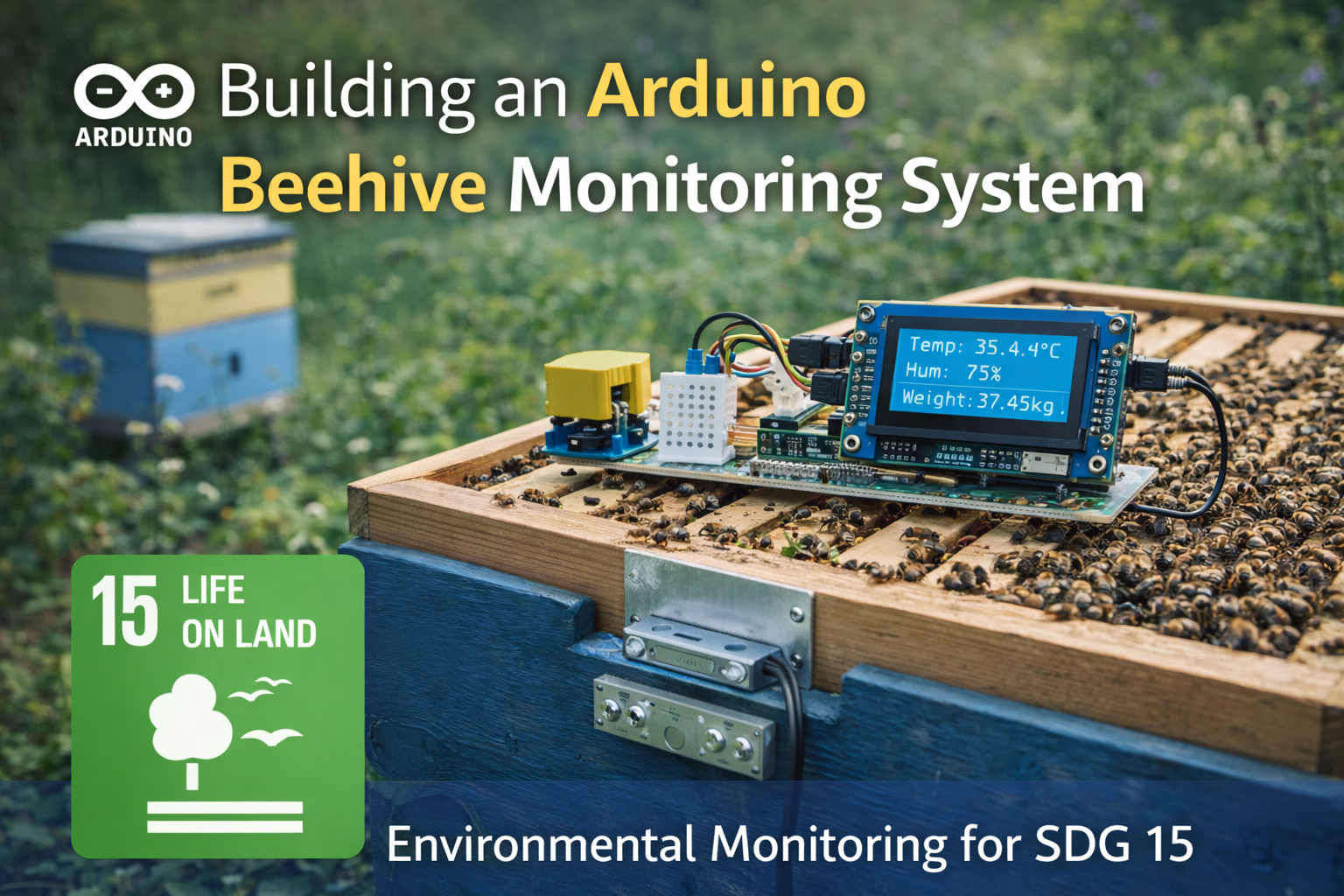
An Arduino beehive monitoring system provides a low-cost way to measure environmental conditions inside a hive and track colony activity over time. By combining sensors with microcontroller-based data collection, it becomes possible to monitor hive temperature, humidity, and weight continuously. These measurements provide valuable insight into colony behavior and productivity.
This project demonstrates how to build a sensor-based monitoring station capable of collecting real-time environmental data from a beehive. While simple, the system reflects an important principle of sustainable environmental monitoring: ecosystems become easier to protect when they can be measured accurately. Systems like this contribute to SDG 15: Life on Land by supporting biodiversity monitoring and pollinator health.
Part of the series: Arduino Projects for Sustainable Development: 10 SDG-Aligned Builds
Table of Contents
- Pollinator Monitoring and Environmental Systems
- System Architecture
- Hardware Components
- Sensor Design Considerations
- System Wiring
- Arduino Code
- Power Management for Field Deployment
- Applications
- Supporting SDG 15: Life on Land
- Conclusion
Pollinator Monitoring and Environmental Systems
Bee colonies regulate their internal environment carefully. Healthy hives maintain internal temperatures between approximately 32–36°C to support brood development. Sudden changes in hive temperature or humidity can indicate colony stress, disease, or environmental disruption.
Hive weight is also a powerful indicator of colony activity. During nectar flows, hive weight increases as bees store honey. Sudden weight loss can signal swarming, colony collapse, or resource scarcity.
By combining temperature, humidity, and hive weight measurements, an embedded monitoring system can provide a reliable overview of colony conditions without disturbing the hive.
System Architecture
The beehive monitoring system operates as a small environmental sensor network built around an Arduino microcontroller.
The system architecture includes four primary layers:
- Sensor Layer – Temperature, humidity, and weight sensors collect environmental data.
- Control Layer – Arduino microcontroller reads sensors and performs basic processing.
- Data Layer – Measurements are logged locally or transmitted wirelessly.
- Power Layer – System operates using low-power electronics suitable for remote deployment.
These layers mirror the architecture used in larger environmental monitoring networks.
Hardware Components
- Arduino Uno or Arduino Nano
- DHT22 temperature and humidity sensor
- HX711 load cell amplifier
- 4x load cells or single heavy-duty load cell
- MicroSD card module (optional for data logging)
- Real-Time Clock module (DS3231)
- Solar panel and battery pack (optional for remote systems)
- Weatherproof enclosure
- Breadboard or PCB
- Jumper wires
These components create a compact system capable of operating continuously in field conditions.
Sensor Design Considerations
Temperature and Humidity Monitoring
The DHT22 sensor measures both temperature and relative humidity. Compared with simpler sensors, it offers improved accuracy and a wider operating range suitable for environmental monitoring.
- Temperature accuracy: ±0.5°C
- Humidity accuracy: ±2–5%
- Operating voltage: 3.3–6V
For hive monitoring, the sensor should be placed inside the hive but shielded from direct contact with bees.
Hive Weight Measurement
Hive weight monitoring is implemented using load cells connected to an HX711 amplifier. Load cells convert mechanical strain into electrical signals, allowing the system to measure the total weight of the hive.
This measurement enables:
- Honey production monitoring
- Nectar flow detection
- Swarming event detection
- Colony collapse indicators
The HX711 provides high-resolution 24-bit analog-to-digital conversion, making it well suited for precision weight measurements.
System Wiring
The sensors connect to the Arduino using both digital and analog interfaces.
- DHT22 VCC → Arduino 5V
- DHT22 GND → Arduino GND
- DHT22 DATA → Arduino pin 2
- HX711 DT → Arduino pin 3
- HX711 SCK → Arduino pin 4
- Load cells → HX711 amplifier
If a MicroSD module is used for logging:
- SD CS → Arduino pin 10
- SD MOSI → pin 11
- SD MISO → pin 12
- SD SCK → pin 13
Arduino Code
#include <DHT.h>
#include <HX711.h>

#define DHTPIN 2
#define DHTTYPE DHT22

#define HX_DT 3
#define HX_SCK 4

DHT dht(DHTPIN, DHTTYPE);
HX711 scale;

float calibration_factor = -7050;

void setup() {

  Serial.begin(9600);

  dht.begin();

  scale.begin(HX_DT, HX_SCK);
  scale.set_scale(calibration_factor);
  scale.tare();

}

void loop() {

  float temperature = dht.readTemperature();
  float humidity = dht.readHumidity();

  float weight = scale.get_units(10);

  Serial.print("Temperature: ");
  Serial.print(temperature);
  Serial.println(" C");

  Serial.print("Humidity: ");
  Serial.print(humidity);
  Serial.println(" %");

  Serial.print("Hive Weight: ");
  Serial.print(weight);
  Serial.println(" kg");

  Serial.println("----------------------");

  delay(5000);

}
Power Management for Field Deployment
Beekeeping sites are often located far from electrical infrastructure. A practical monitoring system should therefore support low-power operation.
Common solutions include:
- Solar panels with lithium battery packs
- Sleep modes to reduce power consumption
- Low-power microcontrollers
- Periodic measurement intervals
Reducing measurement frequency significantly improves battery life in remote monitoring systems.
Applications
A beehive monitoring station can support several research and agricultural applications.
- Monitoring colony health
- Detecting swarming events
- Tracking nectar flow during flowering seasons
- Studying environmental stress factors
- Supporting biodiversity research
Data collected from multiple hives can also contribute to broader ecological monitoring programs.
Supporting SDG 15: Life on Land
Protecting biodiversity requires better measurement of ecosystem health. Pollinators are essential to agricultural productivity and natural ecosystems, yet they remain vulnerable to environmental disruption.
Embedded monitoring systems provide researchers and beekeepers with real-time data that can help detect early warning signs of colony stress. By improving visibility into hive conditions, sensor-based monitoring technologies help support more resilient ecosystems.
Conclusion
Building an Arduino beehive monitoring system demonstrates how accessible electronics can contribute to biodiversity monitoring. By combining environmental sensors with microcontroller-based data collection, the system provides continuous insight into hive conditions.
Although the hardware is simple, the system reflects a powerful idea: environmental stewardship improves when ecosystems can be measured clearly. Embedded monitoring systems like this one make it easier to observe ecological processes and respond to environmental change.