
Last Updated June 24, 2026
International organizations are institutions created by states, peoples, movements, legal communities, technical bodies, humanitarian systems, civil-society networks, professional associations, investigative journalists, medical practitioners, Indigenous peoples, labor movements, anti-war organizers, digital-rights defenders, and public-interest accountability actors to coordinate cooperation, manage conflict, document harm, establish rules, provide technical capacity, and address global challenges that exceed the authority or capability of any single government. From the United Nations and the Bretton Woods institutions to regional organizations, specialized agencies, refugee-protection systems, human-rights documentation groups, South-South institutions, investigative reporting networks, open-source investigators, medical humanitarian organizations, anti-torture networks, migrant-rights organizations, anti-surveillance groups, labor-rights campaigns, Indigenous institutions, and alternative development movements, international organizations form a major part of the institutional architecture of global governance.
This content pillar treats international organizations not simply as neutral platforms for cooperation, but as historically formed institutions shaped by sovereignty, law, diplomacy, bureaucracy, development finance, political bargaining, unequal voting power, institutional expertise, colonial and postcolonial legacies, selective enforcement, donor power, debt dependency, public evidence, coercion, surveillance, humanitarian access, resistance movements, and contested legitimacy. International organizations can help coordinate peace, health systems, trade, development, humanitarian action, labor standards, food systems, education, science, climate response, refugee protection, migrant rights, Indigenous rights, public accountability, and infrastructure. They can also reproduce hierarchy, impose conditionality, obscure accountability, privilege powerful states, or fail communities most exposed to conflict, poverty, debt, displacement, occupation, extraction, detention, surveillance, environmental harm, and ecological stress.
Current Space
Global Governance
Related Topic
International Law
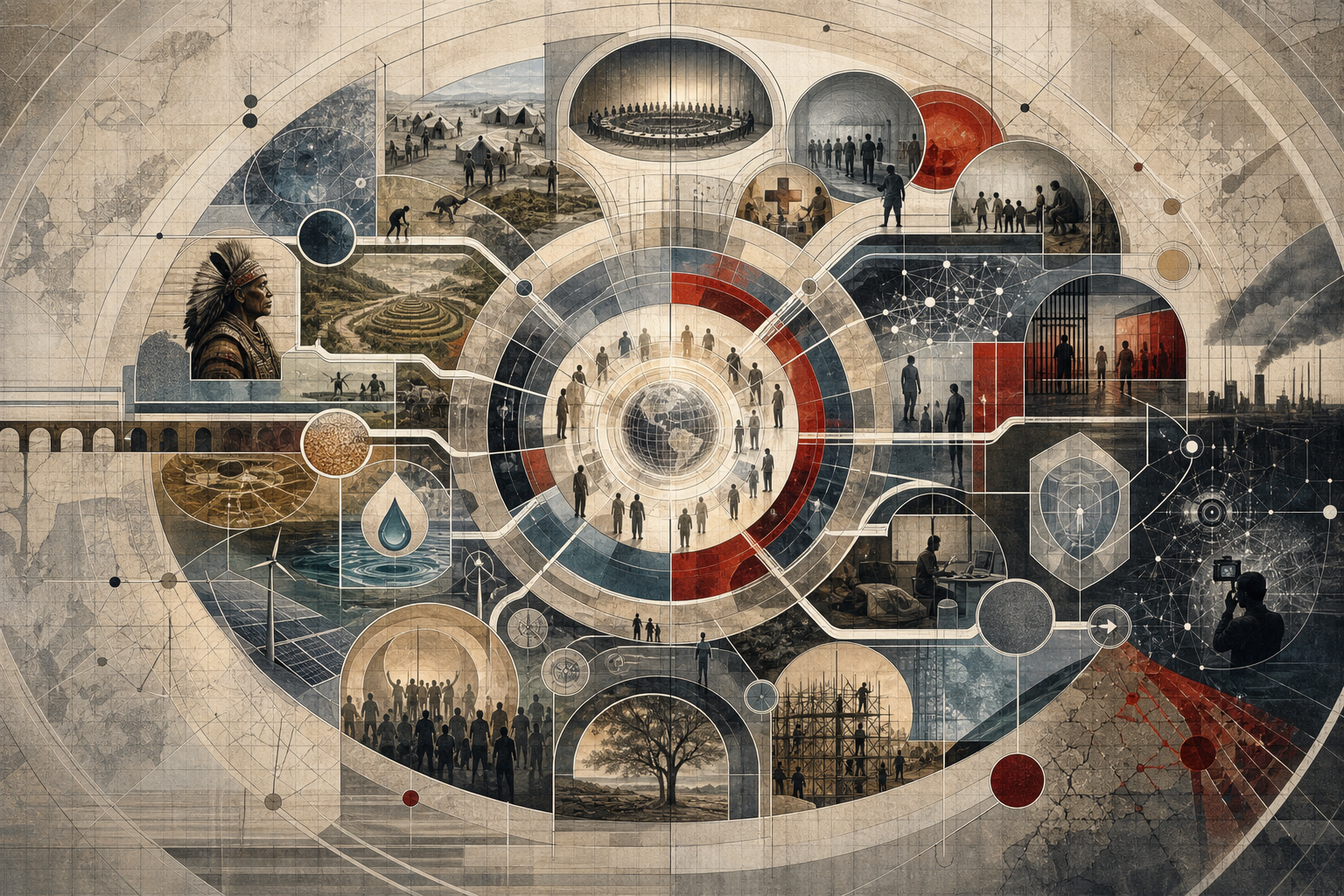
International politics operates within a system where no central world authority governs all states. In this decentralized environment, international organizations provide mechanisms through which states negotiate rules, manage disputes, coordinate policies, pool expertise, monitor compliance, mobilize resources, respond to shared problems, and contest institutional harm. Their authority usually depends on member-state consent, founding treaties, voting structures, financial contributions, institutional mandates, technical credibility, public evidence, professional expertise, field presence, and political legitimacy.
International organizations vary widely in mandate and design. Some are universal membership institutions, such as the United Nations. Some are specialized agencies concerned with health, labor, food, education, culture, aviation, telecommunications, or development. Some are financial institutions, such as the World Bank Group, International Monetary Fund, and regional development banks. Some are trade institutions, security organizations, regional bodies, treaty secretariats, humanitarian agencies, rights organizations, open-source evidence collectives, investigative journalism networks, medical humanitarian organizations, digital-rights institutions, Indigenous forums, labor-rights networks, anti-war movements, or technical standard-setting bodies. Together, they form a dense but uneven institutional system for managing interdependence, documenting abuse, coordinating public goods, contesting global hierarchy, and making public claims against systems of harm.
This pillar approaches international organizations as institutions of coordination and power. It examines how they are created, how they govern, how authority is distributed within them, how they interact with international law, how they support or constrain development, how they respond to crises, how civil society and independent reporting hold states or institutions accountable, and how they can be evaluated in terms of legitimacy, effectiveness, accountability, representation, transparency, responsiveness, and public contestability.
International Organizations Research Repository
The companion repository for this knowledge series supports structured research on international organizations, institutional mandates, membership systems, voting rules, governance bodies, treaty foundations, development finance institutions, specialized agencies, regional organizations, human-rights organizations, South-South institutions, debt and development alternatives, open-source evidence networks, investigative reporting organizations, medical humanitarian institutions, anti-torture and anti-surveillance organizations, migrant-rights networks, Indigenous-rights institutions, labor-rights organizations, peace movements, source hierarchy, article-roadmap planning, and SQL-backed mapping of global governance institutions.
International Organizations as Global Institutions
International organizations are formal and semi-formal institutions through which states, agencies, legal communities, civil-society networks, technical experts, humanitarian systems, professional bodies, social movements, and public-interest investigators attempt to manage the problems of interdependence. They exist because many political, economic, environmental, technological, humanitarian, medical, labor, migration, surveillance, and security problems cannot be solved by isolated national action alone. War, trade, finance, migration, food security, health systems, climate change, labor standards, aviation, communications, human rights, debt, development, occupation, displacement, torture, surveillance, incarceration, sanctions, Indigenous land rights, and public accountability all require some form of coordination beyond the state.
The authority of intergovernmental organizations is usually delegated rather than sovereign. Unlike domestic governments, they do not normally possess general authority over territory or populations. Instead, their powers are defined by charters, treaties, articles of agreement, conventions, institutional mandates, member-state decisions, budgetary arrangements, voting rules, administrative practice, public legitimacy, and political negotiation. Their influence comes from convening authority, expertise, financing, standard-setting, dispute settlement, monitoring, operational capacity, field presence, public documentation, and the ability to organize collective expectations.
International organizations are therefore neither world government nor mere diplomatic meeting rooms. They are institutional systems with legal foundations, bureaucratic cultures, internal politics, technical authority, financial structures, evidentiary practices, and legitimacy problems. They can reduce uncertainty, create cooperation, provide public goods, and preserve public records of harm. They can also become sites of unequal influence, institutional inertia, politicized decision-making, donor control, selective enforcement, conditionality, institutional secrecy, surveillance, and contested accountability.
Global Governance Without World Government
Global governance refers to the rules, institutions, procedures, norms, and practices through which transnational problems are managed without a centralized global sovereign. International organizations are among the most important mechanisms of global governance because they provide durable structures for negotiation, coordination, monitoring, implementation, technical assistance, dispute management, humanitarian response, medical relief, data collection, and public accountability.
This does not mean that international organizations eliminate power politics. In many cases, they channel power through formal procedures. Voting rules, veto powers, weighted finance structures, donor influence, agenda control, headquarters location, staff composition, budget dependence, conditional lending, security alliances, sanctions architecture, intelligence relationships, and informal bargaining all shape institutional outcomes. A universal organization may formally represent all members while still operating within a global order marked by unequal sovereignty, colonial inheritance, debt dependence, technological asymmetry, racial hierarchy, extractive development, and geopolitical rivalry.
International organizations therefore operate in a permanent tension between cooperation and hierarchy. They are needed because global problems require coordination. They are contested because coordination often occurs within systems of unequal power. A serious pillar must therefore study both what international organizations do and how their authority is structured, financed, challenged, documented, and resisted.
International Organizations as Source-Based Institutional Study
The study of international organizations requires disciplined source work. Founding charters, articles of agreement, treaties, institutional rules, annual reports, budgets, voting records, resolutions, evaluation reports, audit documents, dispute settlement records, operational policies, official datasets, human-rights reports, medical documentation, open-source investigations, detention-monitoring reports, environmental-defender records, whistleblower disclosures, labor-rights investigations, and independent journalism all reveal different dimensions of institutional life. Scholarly literature is needed to interpret these materials historically, legally, politically, sociologically, ethically, and economically.
Formal mandates do not always describe institutional practice. An organization may claim neutrality while operating within donor constraints. A development bank may frame lending as technical while shaping policy choices through conditionality, project design, procurement rules, and risk models. A security organization may describe itself as defensive while being perceived differently by outside actors. A humanitarian agency may be guided by principles but constrained by access, funding, state consent, sanctions regimes, or conflict conditions. A rights organization may document violations while facing legal pressure, donor scrutiny, accusations of bias, or attacks on its credibility. A digital-rights organization may expose spyware while operating against secretive state-corporate surveillance systems.
For that reason, this pillar treats research infrastructure as part of the field itself. Article roadmaps, organization metadata, mandate tracking, voting and membership notes, source hierarchy, institutional typologies, governance-body records, rights documentation records, medical-forensic records, open-source evidence methods, investigative reporting networks, labor-rights records, debt-governance records, and SQL-backed mapping can help make international organizations more legible as systems of authority, capacity, coordination, and contestation.
What International Organizations Study
The study of international organizations examines how institutions are created, how they acquire authority, how they make decisions, how they manage membership, how they implement mandates, and how they influence global order. It includes legal foundations, institutional design, international bureaucracy, principal-agent relationships, delegation, expertise, compliance, legitimacy, accountability, financing, public evidence, institutional secrecy, reform, and institutional change.
At the system level, it studies the United Nations, Bretton Woods institutions, World Trade Organization, World Health Organization, International Labour Organization, UNESCO, FAO, UNHCR, UNRWA, regional organizations, development banks, security alliances, treaty secretariats, standard-setting bodies, humanitarian agencies, medical relief organizations, human-rights organizations, anti-torture networks, anti-surveillance institutions, South-South institutions, Indigenous forums, labor-rights organizations, peace movements, and investigative accountability networks. At the process level, it studies diplomacy, rule-making, monitoring, technical assistance, financing, peace operations, development programming, dispute settlement, emergency coordination, operational fieldwork, documentation standards, medical neutrality, digital forensics, public evidence, and investigative accountability.
At the critical level, it studies whose priorities are institutionalized, whose knowledge counts, whose votes carry weight, whose crises receive attention, whose economies are disciplined, whose rights are protected, whose land is taken, whose health systems are defunded, whose debt burdens constrain public life, whose data are surveilled, whose communities are detained, and whose claims are marginalized. International organizations are therefore studied not only as instruments of cooperation, but as institutions that distribute authority across an unequal world.
What This Pillar Covers
This pillar begins with the foundations of international organizations: origins, legal personality, institutional design, delegation, multilateralism, membership, mandates, voting rules, secretariats, budgets, bureaucracy, technical authority, and collective action. It then moves into the United Nations system, including the General Assembly, Security Council, Economic and Social Council, Secretariat, International Court of Justice, specialized agencies, peacekeeping, humanitarian coordination, refugee protection, development programs, and institutional reform.
From there, the pillar expands into major domains of global governance. These include development finance, monetary stability, trade governance, health systems, labor standards, food and agriculture, education and culture, environmental governance, refugee protection, migrant rights, humanitarian systems, regional organizations, security institutions, treaty bodies, technical standard-setting, public-private governance networks, anti-torture institutions, anti-surveillance groups, medical humanitarian organizations, Indigenous-rights networks, anti-war movements, climate justice organizations, and access-to-justice institutions.
The pillar also includes the wider accountability ecosystem around international organizations: human-rights NGOs, open-source investigators, independent journalists, civilian-harm monitors, medical-forensic experts, legal documentation groups, whistleblower protection organizations, anti-corruption investigators, environmental defenders, migrant-rights advocates, and collaborative reporting networks that produce public evidence when official institutions are unwilling, unable, delayed, captured, or politically constrained.
The series gives special attention to institutions formed through decolonization, South-South cooperation, nonalignment, development sovereignty, anti-imperial diplomacy, borrower solidarity, Indigenous self-determination, anti-war organizing, labor struggle, feminist peace work, tax justice, climate justice, and post-capitalist economic imagination. It also examines debt, conditionality, structural adjustment, creditor power, austerity, private capital, surveillance, detention, sanctions, and development models that subordinate public welfare to debt service, extraction, militarization, and external policy discipline.
The pillar therefore treats international organizations as systems of cooperation, authority, expertise, bureaucracy, finance, accountability, evidence, resistance, and contested global power. It asks not only how institutions coordinate action, but whose interests they serve, whose voices they exclude, who funds them, who governs them, who is harmed by them, who documents them, and how affected communities can challenge, reform, resist, or replace institutional systems that fail them.
Authority, Mandates, and Institutional Design
International organizations are structured by mandates. A mandate defines what an organization is authorized to do, what problems it is expected to address, which members it serves, what procedures it follows, and what limits constrain its action. Mandates may be broad, as in the case of the United Nations, or specialized, as in the case of agencies focused on health, labor, agriculture, education, aviation, telecommunications, trade, finance, refugee protection, human rights, torture prevention, humanitarian relief, or digital privacy.
Institutional design matters because it shapes outcomes. Membership rules determine who participates. Voting rules determine how preferences are aggregated. Budgets determine whose priorities can be implemented. Secretariats shape continuity and expertise. Dispute mechanisms create expectations of compliance. Monitoring systems define what counts as progress. Field operations translate mandates into practice. Data systems determine what becomes visible. Inspection systems determine what remains hidden. Institutional design therefore affects both effectiveness and legitimacy.
Design also creates tensions. A powerful state may resist institutional constraint. A small state may rely on organizations for voice and protection. A donor may influence priorities through funding. A secretariat may develop expertise that exceeds member-state preferences. A development institution may frame policy choices as technical when they have distributive consequences. A security institution may normalize militarized responses to political problems. A detention system may be bureaucratically legal while still producing arbitrary or degrading outcomes. Institutions therefore need to be studied as systems of delegated authority and political struggle.
Legitimacy, Accountability, and Unequal Power
International organizations depend on legitimacy because they often lack direct coercive authority. Their decisions are more durable when members and affected communities regard them as lawful, competent, fair, transparent, responsive, inclusive, and accountable. Legitimacy may come from legal mandate, broad membership, technical expertise, procedural fairness, effective performance, public purpose, or the ability to include diverse voices.
Yet legitimacy is fragile. Many international organizations face criticism for unequal representation, donor dominance, opaque decision-making, bureaucratic distance, policy conditionality, selective enforcement, inadequate participation, racialized harm, gendered harm, carceral governance, digital surveillance, or failure to respond effectively to crises. Weighted voting systems may concentrate influence in wealthy states. Security vetoes may block action in severe conflicts. Development programs may be experienced as external discipline rather than partnership. Technical standards may be shaped without sufficient participation from affected communities. Migration institutions may facilitate movement control more effectively than human protection.
For this reason, accountability cannot be treated as a secondary issue. International organizations exercise real influence over development, finance, trade, health systems, security, labor, food systems, education, migration, humanitarian response, climate adaptation, environmental protection, and legal recognition. They should be evaluated not only by whether they coordinate action, but by whether they do so in ways that are legitimate, inclusive, transparent, responsive, and publicly contestable.
Major Domains of International Organizations
International organizations operate across several major domains. Security organizations address conflict prevention, collective security, peacekeeping, peacebuilding, arms control, sanctions, and regional defense. Economic organizations govern development finance, monetary stability, trade rules, debt, investment, procurement, and economic policy coordination. Technical organizations establish standards, share knowledge, build capacity, and coordinate specialized areas such as health systems, labor, food, education, culture, aviation, telecommunications, and scientific cooperation.
Human protection organizations address refugees, migration, humanitarian assistance, children, human rights, labor rights, health systems, food insecurity, torture prevention, detention, and crisis response. UNRWA requires special attention because Palestine refugees have a distinct institutional history, mandate structure, and political context. Human-rights organizations, legal advocacy groups, medical humanitarian organizations, anti-torture groups, digital-rights organizations, and documentation networks also form part of the broader international accountability ecosystem, even when they are not intergovernmental bodies.
Economic governance must also be studied critically. The IMF, World Bank, WTO, development banks, creditor groups, and debt-restructuring processes shape public finance, policy space, social spending, infrastructure, labor markets, and development strategy in poorer and postcolonial states. This pillar therefore examines not only official development institutions, but also South-South cooperation, the Group of 77, UNCTAD, the South Centre, the New Development Bank, cooperatives, commons governance, solidarity economies, public banking, Buen Vivir, degrowth, tax justice, debt justice, and other institutional alternatives to extractive or debt-dependent development.
Accountability now also depends on open-source evidence, investigative journalism, visual forensics, civilian-harm monitoring, whistleblower protection, medical documentation, tax transparency, environmental-defender reporting, and cross-border reporting networks. Bellingcat, Forensic Architecture, Airwars, ICIJ, OCCRP, Lighthouse Reports, Forbidden Stories, ProPublica, Physicians for Human Rights, Privacy International, Citizen Lab, Tax Justice Network, Global Witness, and similar institutions help document war, corruption, surveillance, financial secrecy, environmental harm, institutional abuse, torture, civilian harm, and state violence. These organizations do not replace formal international law or intergovernmental institutions, but they increasingly shape what can be known, verified, contested, and brought into public accountability.
Why International Organizations Matter
International organizations matter because global problems require institutional memory, technical expertise, convening authority, operational capacity, public evidence, and shared rules. They help states communicate, negotiate, coordinate, monitor, and sometimes act collectively. They make cooperation more durable by creating forums, procedures, expectations, administrative systems, and records that outlast a single diplomatic meeting or crisis.
They also matter because they shape the distribution of global resources and authority. Development finance institutions influence infrastructure, poverty reduction, energy systems, education, health, and public-sector reform. Trade institutions shape market access and economic rules. Health organizations coordinate disease surveillance and emergency response. Humanitarian organizations deliver aid in crisis. Labor organizations define standards for decent work. Regional organizations mediate conflicts, coordinate development, and represent regional interests. Human-rights organizations, doctors, journalists, whistleblowers, digital investigators, and community organizations document what states and formal institutions may ignore.
International organizations matter most visibly when they fail. Security paralysis, delayed emergency response, inequitable health access, debt distress, institutional capture, donor-driven priorities, weak accountability, selective enforcement, torture, arbitrary detention, refugee abandonment, medical obstruction, digital repression, food denial, environmental violence, and attacks on independent documentation can expose the limits of global governance. These failures do not make international organizations irrelevant. They make their design, legitimacy, evidence standards, and reform more important.
International Organizations and Global Self-Understanding
International organizations shape how the world imagines collective responsibility. They make it possible to speak of global public goods, international peace and security, human development, food security, public health, labor dignity, educational cooperation, humanitarian protection, refugee protection, migrant rights, financial stability, debt justice, tax justice, climate responsibility, public evidence, and shared environmental responsibility. They also reveal how difficult those ideas are to implement within an unequal international order.
These institutions expose the gap between universal language and institutional reality. The idea of equal membership may coexist with veto power, weighted voting, donor influence, conditional lending, unequal staffing, and unequal agenda-setting. The language of development may coexist with dependency. The language of security may coexist with selective protection. The language of global health may coexist with unequal access to medicines and health infrastructure. The language of accountability may coexist with repression of journalists, human-rights defenders, environmental defenders, Indigenous communities, whistleblowers, and open-source investigators.
International organizations therefore serve as both instruments and mirrors of global order. They organize cooperation, but they also reveal where cooperation is limited by power. They express universal aspiration, but they also show how legitimacy must be earned through fairness, effectiveness, accountability, responsiveness, protection, and credible attention to those most affected by institutional decisions.
International Organizations Pillar Map
The map below organizes the International Organizations knowledge series into conceptual domains, moving from foundations and institutional design toward the UN system, global economic governance, specialized agencies, regional organizations, security institutions, development finance, humanitarian systems, human-rights accountability, medical humanitarianism, migrant rights, Indigenous rights, anti-war movements, anti-torture institutions, anti-surveillance organizations, open-source evidence, independent reporting, debt alternatives, labor rights, tax justice, climate justice, food and water systems, whistleblower protection, cultural restitution, and institutional reform.
Foundations of International Institutional Design
- The Origins of International Organizations (Planned) — A foundational article on how international organizations emerged from diplomacy, empire, war, technical cooperation, the League of Nations, Bretton Woods, decolonization, and the post-1945 search for institutionalized cooperation.
- What Are International Organizations? (Planned) — A core article defining international organizations as formal institutions with members, mandates, legal foundations, procedures, budgets, secretariats, decision-making structures, public claims, and accountability obligations.
- Institutional Design in Global Governance (Planned) — An article on membership, voting rules, mandates, secretariats, funding models, monitoring systems, dispute mechanisms, delegation, accountability, and institutional legitimacy.
- Multilateralism and Collective Action (Planned) — A study of how international organizations reduce coordination problems, manage interdependence, create bargaining forums, and support collective action among states and other actors.
- Legal Personality, Mandates, and Institutional Authority (Planned) — An article on the legal status of international organizations, their powers, immunities, responsibilities, privileges, and authority under international law.
- International Bureaucracy and the Power of Expertise (Planned) — A study of secretariats, expert bodies, administrative cultures, technical authority, agenda-setting, and the influence of international civil servants.
- Membership, Voting, Finance, and Institutional Power (Planned) — A critical article on how membership rules, vetoes, weighted voting, assessed contributions, voluntary funding, donor influence, and agenda control shape institutional outcomes.
The United Nations System
- The United Nations and Global Diplomacy (Planned) — A foundational article on the UN Charter system, principal organs, multilateral diplomacy, sovereign equality, peace and security, development, human rights, and institutional legitimacy.
- The UN General Assembly and the Politics of Universal Membership (Planned) — An article on representation, resolutions, agenda-setting, budget authority, norm development, and the political meaning of one-state-one-vote diplomacy.
- The UN Security Council and International Security (Planned) — A critical article on peace and security, permanent membership, veto power, sanctions, peacekeeping mandates, enforcement authority, and legitimacy debates.
- ECOSOC and the Coordination of Economic and Social Governance (Planned) — A study of the Economic and Social Council, specialized agencies, functional commissions, development coordination, Indigenous forums, civil-society access, and the institutional architecture of social and economic cooperation.
- The UN Secretariat, Secretary-General, and International Public Administration (Planned) — An article on international bureaucracy, administrative neutrality, leadership, agenda-setting, field operations, institutional continuity, and the politics of global administration.
- UN Peacekeeping, Peacebuilding, and the Limits of International Administration (Planned) — A critical article on peace operations, mandates, civilian protection, consent, legitimacy, mission failure, sexual exploitation scandals, and post-conflict governance.
- UN Development Programs and Global Development Governance (Planned) — An article on UNDP, development coordination, human development, capacity building, Sustainable Development Goals, and the institutional politics of development.
Global Economic Governance
- The World Bank and Development Finance (Planned) — An article on the World Bank Group, IBRD, IDA, IFC, MIGA, development lending, infrastructure, poverty reduction, project finance, safeguards, and the politics of development knowledge.
- The International Monetary Fund and Financial Stability (Planned) — A study of IMF surveillance, lending, conditionality, balance-of-payments crises, fiscal governance, capacity development, debt distress, and debates over sovereignty and adjustment.
- The World Trade Organization and Global Trade Governance (Planned) — An article on WTO agreements, negotiation, trade monitoring, dispute settlement, development concerns, intellectual property, and the crisis of multilateral trade governance.
- Regional Development Banks and the Geography of Development Finance (Planned) — A comparative article on the African Development Bank, Asian Development Bank, Inter-American Development Bank, European development institutions, and newer development finance institutions.
- Debt, Conditionality, and the Institutional Politics of Economic Reform (Planned) — A critical article on policy conditionality, structural adjustment, debt distress, fiscal sovereignty, austerity, and the contested legitimacy of international financial institutions.
- Development Knowledge, Indicators, and Institutional Measurement (Planned) — An article on data, rankings, indicators, project evaluation, governance metrics, development expertise, and the politics of measurement.
Specialized Agencies and Technical Cooperation
- The World Health Organization and Global Health Governance (Planned) — An article on WHO authority, disease surveillance, health standards, emergency coordination, financing, public health capacity, and debates over global health equity.
- The International Labour Organization and Global Labor Standards (Planned) — A study of tripartite governance, labor standards, social justice, decent work, workers’ rights, and the institutional politics of global labor protection.
- UNESCO, Education, Science, Culture, and International Cooperation (Planned) — An article on UNESCO’s role in education, science, culture, heritage, communication, knowledge cooperation, and the politics of cultural authority.
- FAO, Food Security, and Global Agricultural Governance (Planned) — An article on food security, agriculture, hunger, rural livelihoods, food systems, resilience, and the institutional governance of agrifood systems.
- ICAO, ITU, and the Technical Governance of Global Infrastructure (Planned) — A comparative article on civil aviation, telecommunications, technical standards, interoperability, and the quiet institutional governance of global systems.
- Science, Standards, and Technical Authority in International Organizations (Planned) — A synthesis article on expert committees, technical standards, evidence review, epistemic authority, and the politics of knowledge in global governance.
Human Protection, Refugees, and Humanitarian Systems
- UNHCR, Refugee Protection, and the Institutional Governance of Displacement (Planned) — An article on refugee protection, asylum systems, non-refoulement, humanitarian coordination, host states, and displacement governance.
- Humanitarian Organizations and the Coordination of Emergency Response (Planned) — A study of humanitarian coordination, neutrality, access, donor funding, operational constraints, sanctions barriers, and the limits of emergency governance.
- Human Rights Treaty Bodies and International Monitoring (Planned) — An article on treaty bodies, reporting, general comments, individual communications, monitoring, and the institutional practice of human rights oversight.
- UNICEF, Children’s Rights, and Global Social Protection (Planned) — An article on children’s rights, emergency response, education, health, nutrition, social protection, family separation, and child-centered institutional mandates.
- Migration Governance and the International Organization for Migration (Planned) — A critical article on migration management, border governance, labor mobility, displacement, development, deportation, and institutional authority over human movement.
Medical Humanitarianism, Health Systems, and Physicians as Accountability Actors
- Médecins Sans Frontières, Medical Neutrality, and Humanitarian Health Care (Planned) — An article on MSF/Doctors Without Borders, emergency medical relief, independence, neutrality, access, conflict medicine, exclusion from health care, and the limits of humanitarian health work under siege, occupation, war, displacement, disease, sanctions, and state collapse.
- Physicians for Human Rights, Forensic Medicine, and the Documentation of Atrocity (Planned) — A focused article on how doctors, forensic experts, public-health specialists, and medical evidence help document torture, mass violence, sexual violence, attacks on civilians, detention abuse, and international crimes.
- International Medical Corps and Health Systems in Conflict, Disaster, and Disease (Planned) — An article on emergency health care, medical training, local capacity building, disaster response, conflict health systems, and the movement from relief toward self-reliance.
- Medical Neutrality, Hospitals, and the Protection of Health Care in Armed Conflict (Planned) — A legal and humanitarian article on attacks on hospitals, ambulances, doctors, nurses, patients, medical ethics, health-care access, and the obligation to respect and protect medical units under international humanitarian law.
- Doctors, Nurses, and Public Health Workers as Witnesses to Institutional Failure (Planned) — A broader article on health workers as frontline observers of famine, displacement, siege, epidemic disease, torture, prison abuse, environmental harm, austerity, sanctions, and the collapse of public systems.
- Medical Aid, Occupation, and the Politics of Health Access (Planned) — An article on medical organizations working under occupation, blockade, military restriction, humanitarian access denial, and fragmented health infrastructure.
Palestine Refugees, UNRWA, and Uneven Humanitarian Protection
- UNRWA, Palestine Refugees, and the Institutional Politics of Humanitarian Protection (Planned) — A focused article on UNRWA’s mandate, Palestine refugee protection, education, health, relief services, humanitarian access, donor politics, contested legitimacy, and the unresolved legal and political questions of displacement, return, and institutional continuity.
- UNHCR, UNRWA, and the Uneven Architecture of Refugee Protection (Planned) — A comparative article on why Palestine refugees have a distinct institutional framework, how UNRWA and UNHCR differ, and what this reveals about mandate design, displacement, international responsibility, historical exception, and protection gaps.
- Humanitarian Access, Donor Power, and the Politics of Relief Institutions (Planned) — An article on humanitarian funding, access restrictions, host-state politics, donor conditionality, neutrality, protection mandates, and the fragile independence of humanitarian organizations.
Migrant Rights, Unlawful Detention, Immigrant Justice, and Marginalized Communities
- Migrant Rights and the Human Rights of People on the Move (Planned) — A foundational article on migrant rights as human rights, covering documented and undocumented migrants, migrant workers, asylum seekers, refugees, stateless persons, border communities, family unity, labor exploitation, access to health care, education, housing, legal identity, and protection from discrimination.
- Immigration Detention, Arbitrary Detention, and the Institutional Politics of Confinement (Planned) — A critical article on immigration detention, administrative detention, offshore detention, privatized detention, detention conditions, legal access, due process, children and families in detention, and the overlap between migration control, incarceration, and state power.
- The Global Detention Project and the Documentation of Immigration Detention (Planned) — A focused article on immigration detention research, country profiles, detention infrastructure, privatized facilities, legal frameworks, detention monitoring, and the importance of documenting how states confine migrants, refugees, and asylum seekers.
- The International Detention Coalition and Alternatives to Immigration Detention (Planned) — An article on civil-society efforts to end immigration detention, promote rights-based alternatives, reduce harm, challenge punitive migration governance, and build systems that do not rely on confinement.
- PICUM, Undocumented Migrants, and the Right to Have Rights (Planned) — An article on undocumented migrants, social exclusion, criminalization, labor rights, access to health care, safe reporting, family life, and the problem of legal status as a gatekeeping mechanism for basic human protection.
- Migrant Forum in Asia and the Rights of Migrant Workers (Planned) — A focused article on migrant labor, recruitment systems, wage theft, debt bondage, domestic work, employer control, remittances, gendered exploitation, transnational advocacy, and the claim that migrant workers’ rights are human rights.
- Asylum Access, Refugee Agency, and Community-Led Protection (Planned) — An article on rights-based refugee advocacy, legal empowerment, refugee agency, movement freedom, access to work and education, and efforts to shift power toward forcibly displaced communities themselves.
- RAICES, Immigrant Legal Defense, and Community-Based Protection (Planned) — An article on immigrant legal services, asylum defense, family protection, detained migrants, children, border communities, and the role of community-rooted legal institutions in resisting deportation and exclusion.
- Unlawful Detention, Deportation, and the Right to Due Process (Planned) — A legal and institutional article on arbitrary detention, deportation systems, removal proceedings, legal representation, secret evidence, expedited procedures, racial profiling, family separation, and the erosion of due process in migration enforcement.
- Marginalized Communities, Minority Rights, and Institutional Exclusion (Planned) — A broader article on ethnic, religious, linguistic, Indigenous, racialized, caste-oppressed, Roma, stateless, disabled, LGBTQ+, and migrant communities whose rights are often weakened by citizenship status, border regimes, social hierarchy, institutional neglect, and unequal access to legal protection.
Human Rights, Accountability, and Civil Society Institutions
- B’Tselem, Human Rights Documentation, and Accountability Under Occupation (Planned) — A focused article on B’Tselem as an Israeli human-rights organization documenting rights violations, occupation, public accountability, apartheid claims, and the politics of human-rights evidence in Israel and Palestine.
- Al-Haq, Palestinian Human Rights Organizations, and International Legal Accountability (Planned) — An article on Al-Haq, Palestinian human-rights documentation, legal advocacy, international accountability, ECOSOC consultative status, and the risks faced by rights organizations challenging state violence and impunity.
- PCHR, Al Mezan, and Human Rights Documentation from Gaza (Planned) — A study of Gaza-based human-rights organizations, legal documentation, field evidence, humanitarian access, civilian protection, and the institutional politics of accountability under siege, occupation, and war.
- Amnesty International, Human Rights Watch, and Transnational Human Rights Advocacy (Planned) — A comparative article on global human-rights organizations, research methods, public reporting, advocacy campaigns, state pressure, accusations of bias, and the role of transnational civil society in global accountability.
- FIDH, the International Commission of Jurists, and Legal Accountability Networks (Planned) — An article on human-rights federations, jurist networks, legal advocacy, rule-of-law expertise, international litigation support, and the connection between civil society and formal international institutions.
- Human Rights NGOs, Evidence, and the Politics of Credibility (Planned) — A methodological article on documentation standards, field reporting, witness testimony, open-source evidence, legal submissions, institutional trust, donor politics, and attacks on human-rights organizations.
Anti-Torture, Detention Monitoring, and Anti-Surveillance Institutions
- Anti-Torture Organizations and the Institutional Struggle Against Cruelty (Planned) — A foundational article on organizations that work to prevent torture, document abuse, support survivors, monitor detention, strengthen legal protections, and hold states accountable for cruel, inhuman, or degrading treatment.
- The Association for the Prevention of Torture, OPCAT, and Detention Monitoring (Planned) — An article on torture prevention, inspection of places of detention, national preventive mechanisms, prison monitoring, police custody, migration detention, psychiatric confinement, and the institutional logic of prevention before abuse occurs.
- OMCT, the SOS-Torture Network, and Global Anti-Torture Advocacy (Planned) — A study of the World Organisation Against Torture, transnational anti-torture networks, protection of human-rights defenders, urgent appeals, survivor advocacy, and the challenge of documenting abuse in restricted environments.
- IRCT, Torture Rehabilitation, and Medical-Legal Care for Survivors (Planned) — An article on the International Rehabilitation Council for Torture Victims, medical and psychological rehabilitation, forensic documentation, trauma care, survivor justice, and the role of doctors, psychologists, and lawyers in anti-torture work.
- Privacy International, Surveillance Law, and the Human Rights of Privacy (Planned) — An article on mass surveillance, communications interception, international human-rights standards, privacy law, intelligence oversight, corporate surveillance, and the role of civil society in contesting digital state power.
- Citizen Lab, Spyware, and the Forensics of Digital Repression (Planned) — A focused article on Citizen Lab, mercenary spyware, targeted surveillance, digital forensics, dissident monitoring, journalist targeting, and the use of technical investigation to expose hidden systems of control.
- Amnesty Security Lab, Mobile Forensics, and the Fight Against Spyware (Planned) — An article on Amnesty’s Security Lab, mobile forensic tools, spyware investigations, civil-society protection, journalist targeting, and the connection between digital surveillance and human-rights abuse.
- Access Now, Digital Security, and Protection for Human-Rights Defenders (Planned) — An article on digital security assistance, emergency response for activists and journalists, internet shutdowns, civil-society protection, and the infrastructure needed to defend vulnerable groups against digital repression.
- Electronic Frontier Foundation and the Civil Liberties Politics of Surveillance (Planned) — A study of digital privacy, encryption, free expression, surveillance self-defense, legal advocacy, and the defense of civil liberties against state and corporate monitoring.
- Torture, Surveillance, and the Architecture of Fear (Planned) — A synthesis article connecting physical coercion, detention abuse, psychological torture, spyware, mass surveillance, blacklists, intimidation, informant systems, and the ways states use visibility, secrecy, and fear to control political life.
Open-Source Evidence, Independent Reporting, and Investigative Accountability
- Open-Source Investigation and the New Architecture of Public Evidence (Planned) — A foundational article on open-source evidence, geolocation, satellite imagery, social media verification, visual forensics, chain of custody, public documentation, and the role of transparent evidence in human-rights and conflict accountability.
- Bellingcat, OSINT, and Civilian Investigation of State Power (Planned) — A focused article on Bellingcat, open-source investigation methods, public verification, conflict documentation, disinformation analysis, war-crimes evidence, and the changing relationship between journalism, intelligence, and accountability.
- Forensic Architecture, Visual Evidence, and Spatial Investigation (Planned) — An article on architectural analysis, spatial reconstruction, visual forensics, environmental violence, border violence, detention, disappearance, and the use of multidisciplinary evidence in public accountability.
- Airwars, Civilian Harm Monitoring, and the Documentation of War (Planned) — A study of civilian casualty monitoring, local-source documentation, witness evidence, social media records, military transparency, harm assessment, and the politics of counting civilian deaths.
- ICIJ, OCCRP, and Cross-Border Investigative Journalism Networks (Planned) — A comparative article on transnational investigative journalism, financial secrecy, corruption, organized crime, leaked documents, collaborative reporting, legal risk, and public-interest accountability across borders.
- Forbidden Stories and the Protection of Threatened Journalists (Planned) — An article on collaborative journalism as protection, continuing investigations after intimidation, imprisonment, or murder, and the institutional defense of public-interest reporting under authoritarian and criminal pressure.
- Lighthouse Reports, Data Journalism, and Transnational Accountability (Planned) — An article on collaborative investigative reporting, public-interest journalism, migration, conflict, corruption, data science, visual forensics, and cross-border reporting partnerships.
- Independent Journalism, Public Evidence, and the Politics of Credibility (Planned) — A methodological article on verification, source protection, donor influence, editorial independence, evidence standards, legal exposure, platform dependence, misinformation, and attacks on journalists and civil society investigators.
- Open-Source Evidence in International Law, Human Rights, and War-Crimes Accountability (Planned) — A bridge article linking open-source evidence to international courts, UN investigations, human-rights reporting, universal jurisdiction, sanctions research, and the evidentiary challenges of digital documentation.
Whistleblowers, Source Protection, and Institutional Secrecy
- Whistleblowers, Leaks, and the Public Interest (Planned) — An article on source protection, classified evidence, institutional secrecy, retaliation, public-interest disclosure, journalism, war-crimes evidence, corruption, surveillance, and the ethics of exposing state or corporate abuse.
- Institutional Secrecy, Classified Power, and Public Accountability (Planned) — A critical article on intelligence secrecy, national security law, official denial, public evidence, investigative reporting, and the limits of oversight.
- Forbidden Stories, Source Protection, and Continuing Silenced Investigations (Planned) — An article on collaborative reporting as protection, continuing investigations after murder or intimidation, and the defense of public-interest journalism against coercion.
- Whistleblower Protection, Retaliation, and the Institutional Cost of Truth-Telling (Planned) — A study of legal defense, employment retaliation, prosecution, exile, public-interest disclosure standards, and the fragile institutional position of whistleblowers.
Anti-War Movements, Peace Organizations, and Demilitarization
- Anti-War Movements and the Institutional Politics of Peace (Planned) — A foundational article on anti-war movements as civil-society institutions that challenge militarism, expose the human costs of war, pressure international organizations, shape public opinion, defend conscientious objection, and contest the legitimacy of state violence.
- The International Peace Bureau and the Long History of Peace Organizing (Planned) — An article on peace organizations, disarmament campaigns, international civil society, peace congresses, demilitarization, and the long institutional history of movements opposing war as a political system.
- Women’s International League for Peace and Freedom and Feminist Peace Politics (Planned) — A study of WILPF, feminist peacebuilding, anti-militarism, women’s organizing, colonial violence, racial justice, economic justice, and the gendered structure of war and security policy.
- War Resisters’ International, Conscientious Objection, and Nonviolent Resistance (Planned) — An article on conscientious objection, refusal of military service, nonviolent resistance, anti-conscription organizing, and the legal and moral politics of refusing participation in war.
- ICAN, Nuclear Abolition, and Treaty-Based Disarmament (Planned) — An article on the International Campaign to Abolish Nuclear Weapons, humanitarian disarmament, civil-society treaty advocacy, the Treaty on the Prohibition of Nuclear Weapons, and the politics of nuclear abolition.
- Veterans, War Testimony, and Anti-War Witness (Planned) — A focused article on veterans’ anti-war movements, testimony, moral injury, civilian harm, whistleblowing, military refusal, and the role of former combatants in challenging official narratives of war.
- Peace Movements, Sanctions, Militarism, and the Political Economy of War (Planned) — A critical article on how anti-war movements contest arms industries, military spending, sanctions regimes, occupation, proxy warfare, security alliances, and the economic systems that profit from permanent conflict.
Indigenous Peoples, Land, and Resource Sovereignty
- Indigenous Peoples, International Institutions, and the Politics of Self-Determination (Planned) — An article on Indigenous rights, land, sovereignty, consultation, free prior and informed consent, cultural survival, environmental protection, and the institutional politics of recognition.
- The UN Permanent Forum on Indigenous Issues and Institutional Voice (Planned) — A focused article on the UNPFII, Indigenous participation within ECOSOC, and the effort to create institutional space for Indigenous peoples in global governance.
- Land, Extraction, Conservation, and Institutional Harm (Planned) — A critical article on how development banks, conservation agencies, states, and corporations can affect Indigenous and local communities through infrastructure, mining, protected areas, displacement, and resource governance.
- Forest Peoples Programme, Cultural Survival, and Indigenous Rights Advocacy (Planned) — A comparative article on Indigenous-rights organizations, land defense, conservation justice, cultural survival, consultation, and institutional accountability.
- Indigenous Environmental Defenders and the Violence of Extraction (Planned) — An article on environmental defenders, land protection, extractive industries, criminalization, violence, and the global institutions that shape resource governance.
Sanctions, Economic Coercion, and Humanitarian Consequences
- Sanctions, Economic Coercion, and the Institutional Politics of Civilian Harm (Planned) — A critical article on UN sanctions, unilateral sanctions, financial restrictions, humanitarian exemptions, overcompliance, medicine access, banking barriers, and the uneven effects of economic pressure on civilian life.
- Humanitarian Exemptions, Overcompliance, and the Bureaucracy of Relief (Planned) — An article on how banks, donors, aid agencies, and states interpret sanctions rules, and how legal caution can block food, medicine, reconstruction, and humanitarian assistance.
- Sanctions, Debt, and the Political Economy of Constraint (Planned) — A study of how sanctions interact with sovereign debt, trade restrictions, financial isolation, inflation, infrastructure decay, and the ability of states to provide public services.
- Collective Punishment, Civilian Suffering, and Economic Warfare (Planned) — A legal and ethical article on when coercive economic systems produce broad civilian harm and how humanitarian law, human rights law, and institutional practice respond.
Corruption, Kleptocracy, Tax Justice, and Financial Secrecy
- Kleptocracy, Offshore Finance, and the Institutional Architecture of Hidden Wealth (Planned) — An article on financial secrecy, shell companies, tax havens, stolen assets, beneficial ownership, capital flight, and the institutions that enable or expose hidden wealth.
- Tax Justice, Public Finance, and Global Inequality (Planned) — A study of tax avoidance, illicit financial flows, corporate profit shifting, debt dependence, public revenue, and the struggle to fund health, education, climate adaptation, and social protection.
- Transparency International, Anti-Corruption Institutions, and the Politics of Accountability (Planned) — An article on corruption measurement, bribery, procurement, public integrity, institutional trust, and the contested politics of anti-corruption work.
- ICIJ, Offshore Leaks, and the Public Evidence of Financial Secrecy (Planned) — A focused article on cross-border investigative journalism, leaked financial records, beneficial ownership, elite impunity, and the role of collaborative reporting in exposing hidden wealth.
Debt, Dependency, and Alternatives to Capitalist Development Governance
- Debt, Conditionality, and the Institutional Politics of Development Constraint (Planned) — A critical article on IMF programs, World Bank lending, structural adjustment, austerity, fiscal surveillance, creditor power, and the ways debt can restrict public investment, policy autonomy, and social protection in developing countries.
- The New International Economic Order and the Demand for Development Sovereignty (Planned) — A historical article on the 1974 UN Declaration on the Establishment of a New International Economic Order, decolonization, resource sovereignty, trade justice, technology transfer, and the struggle to restructure global economic rules.
- UNCTAD, the G77, and the Institutional Voice of Developing Countries (Planned) — An article on UNCTAD, the Group of 77, South-South cooperation, commodity dependence, trade reform, debt, development finance, and efforts to challenge unequal global economic governance.
- South-South Cooperation and Alternatives to Donor Hierarchy (Planned) — An article on UNOSSC, South-South cooperation, triangular cooperation, knowledge exchange, capacity building, and models of development that resist one-way donor-recipient hierarchy.
- The South Centre and Developing-Country Policy Knowledge (Planned) — A study of the South Centre as an intergovernmental policy research institution accountable to developing-country member states, with attention to trade, intellectual property, public health, climate, tax, and development sovereignty.
- BRICS, the New Development Bank, and Alternatives to Bretton Woods Development Finance (Planned) — An article on development finance alternatives, infrastructure lending, multipolar finance, sustainable development, and the limits and possibilities of non-Western development banks.
- Cooperatives, Commons, Solidarity Economies, and Post-Capitalist Institutional Design (Planned) — A conceptual article on cooperative ownership, commons governance, solidarity economies, public banking, community wealth building, participatory budgeting, social provisioning, and institutional alternatives to extractive development models.
- Degrowth, Buen Vivir, and Plural Economic Futures in Global Governance (Planned) — A critical article on alternatives to growth-centered development, ecological limits, Indigenous and Latin American governance traditions, post-development theory, and institutional designs that prioritize sufficiency, reciprocity, and social-ecological repair.
South-South, Decolonial, and Alternative Institutional Orders
- The Group of 77 and the Institutional Voice of the Global South (Planned) — An article on the G77 as a collective negotiating platform for developing countries within the United Nations system, focused on economic interests, development, South-South cooperation, and institutional voice.
- The Non-Aligned Movement, Bandung, and Postcolonial Multilateralism (Planned) — A historical article on Bandung, nonalignment, decolonization, anti-imperial diplomacy, strategic autonomy, and the effort to resist domination by rival power blocs.
- The United Nations Office for South-South Cooperation and Development Beyond Donor Hierarchy (Planned) — An article on UNOSSC, South-South cooperation, triangular cooperation, knowledge exchange, capacity development, and alternatives to one-way donor-recipient hierarchy.
- The South Centre and Developing-Country Policy Knowledge (Planned) — A study of the South Centre as an intergovernmental policy research institution accountable to developing-country member states, with attention to trade, intellectual property, health, tax, climate, and development sovereignty.
- BRICS, the New Development Bank, and the Search for Development Finance Alternatives (Planned) — An article on the New Development Bank, infrastructure finance, sustainable development, emerging economies, and the effort to diversify development finance beyond Bretton Woods institutions.
- The Organisation of Islamic Cooperation and Transregional Institutional Solidarity (Planned) — An article on the OIC as a large intergovernmental organization linking Muslim-majority states around diplomacy, development, humanitarian issues, cultural cooperation, and political solidarity.
- Regionalism After Empire: African, Arab, Asian, Latin American, and Caribbean Institutions (Planned) — A comparative article on regional organizations formed in the context of decolonization, sovereignty, development, external pressure, and the search for collective institutional capacity.
Labor Rights, Supply Chains, and Forced Labor
- Global Labor Rights, Supply Chains, and the Institutions of Worker Protection (Planned) — An article on labor standards, wage theft, forced labor, migrant workers, domestic work, union repression, supply-chain audits, corporate accountability, and the limits of voluntary compliance.
- Forced Labor, Debt Bondage, and the Global Governance of Exploitation (Planned) — A focused article on recruitment debt, coercive contracts, trafficking, employer control, passport confiscation, and institutional failures in protecting vulnerable workers.
- International Trade Unions and the Politics of Worker Power (Planned) — An article on transnational labor federations, collective bargaining, labor rights campaigns, supply-chain pressure, and the institutional struggle over worker voice.
- Domestic Workers, Care Labor, and the Gendered Structure of Global Work (Planned) — A study of migrant domestic work, unpaid and underpaid care labor, labor law exclusion, employer control, and gendered exploitation in global labor systems.
- Anti-Slavery International, Trafficking, and Modern Exploitation (Planned) — An article on forced labor, trafficking, debt bondage, child labor, survivor protection, and the institutional politics of abolition in contemporary global systems.
Women, Gender Justice, Reproductive Rights, and Care Systems
- Women’s Rights, Gender Justice, and International Organizations (Planned) — An article on gender equality institutions, women’s rights organizations, reproductive autonomy, care work, political participation, violence against women, and the gendered structure of development, conflict, and migration.
- Sexual Violence, Conflict, and Institutional Accountability (Planned) — A focused article on documentation, survivor protection, forensic evidence, stigma, impunity, peace processes, and the role of international institutions in addressing sexual violence in conflict.
- UN Women, Gender Institutions, and the Politics of Equality (Planned) — An article on UN Women, gender mainstreaming, institutional reform, development programming, and the limits of global gender governance.
- Reproductive Rights, Bodily Autonomy, and Global Legal Advocacy (Planned) — A study of reproductive health, legal advocacy, maternal health, abortion rights, contraception, coercion, and the politics of bodily autonomy across international institutions.
- Feminist Peacebuilding, Care, and Anti-Militarist Institutional Design (Planned) — A synthesis article connecting feminist peace movements, care systems, demilitarization, social reproduction, and alternatives to security institutions built around coercion.
Climate Justice, Loss and Damage, and Environmental Defenders
- Climate Justice, Loss and Damage, and Institutional Responsibility (Planned) — An article on climate finance, adaptation, loss and damage, historical responsibility, vulnerable states, frontline communities, and the institutional struggle over who pays for climate harm.
- Environmental Defenders, Land Protection, and Violence Against Frontline Communities (Planned) — A focused article on activists, Indigenous defenders, anti-extraction movements, environmental violence, legal harassment, corporate power, and public accountability.
- Global Witness, Environmental Defenders, and the Documentation of Ecological Violence (Planned) — An article on documenting killings, criminalization, corporate abuse, extractive industries, land conflict, and violence against environmental defenders.
- Climate Finance, Adaptation, and the Institutions of Unequal Exposure (Planned) — A study of climate finance institutions, vulnerability, adaptation funding, debt, disaster risk, and the gap between formal commitments and frontline needs.
- Indigenous Environmental Network and Climate Justice from the Frontlines (Planned) — An article on Indigenous climate leadership, fossil fuel resistance, land defense, environmental justice, and alternative understandings of ecological responsibility.
Food, Water, Famine, and Humanitarian Access
- Famine, Food Systems, and the Institutional Politics of Hunger (Planned) — An article on food security, famine warning, humanitarian access, conflict starvation, sanctions, blockade, displacement, and the global institutions responsible for hunger prevention.
- Water, Sanitation, and the Human Right to Basic Services (Planned) — An article on water governance, sanitation, humanitarian infrastructure, public health, development finance, and the institutional consequences of denying basic services.
- The World Food Programme, Emergency Relief, and the Politics of Food Aid (Planned) — A focused article on food assistance, emergency logistics, famine response, donor dependence, operational access, and the politics of humanitarian supply chains.
- FEWS NET, Famine Early Warning, and the Institutional Production of Risk Knowledge (Planned) — An article on famine monitoring, early warning systems, remote sensing, conflict analysis, and the politics of acting or failing to act on risk information.
- Oxfam, WaterAid, and Civil Society in Basic Services Advocacy (Planned) — A comparative article on civil-society advocacy around water, sanitation, food security, inequality, humanitarian access, and public-service obligations.
Prison Abolition, Incarceration, and Carceral Institutions
- Prisons, Detention, and the International Politics of Confinement (Planned) — An article on prisons, detention centers, immigration detention, pretrial detention, political imprisonment, psychiatric confinement, and the institutional systems that normalize confinement as governance.
- Prison Abolition, Carceral Reform, and Global Human Rights (Planned) — A critical article on abolitionist movements, prison reform, restorative justice, racialized incarceration, state violence, and alternatives to punishment-centered institutions.
- Political Prisoners, Prison Monitoring, and the Documentation of Abuse (Planned) — An article on political imprisonment, detention monitoring, torture documentation, prison conditions, family separation, and the public evidence needed to contest carceral secrecy.
Education, Knowledge, Academic Freedom, and Intellectual Repression
- Academic Freedom, Scholars at Risk, and the Protection of Knowledge Communities (Planned) — An article on imprisoned academics, university repression, exile, censorship, knowledge production, and institutions that defend scholars under threat.
- Education in Emergencies and the Institutional Defense of Learning (Planned) — A study of education under war, displacement, occupation, disaster, and poverty, including the role of UNICEF, UNESCO, refugee schools, and community education networks.
- Censorship, Curriculum Politics, and the Institutional Control of Memory (Planned) — A critical article on how states and institutions regulate historical memory, curriculum, archives, public knowledge, and cultural legitimacy.
Cultural Heritage, Museums, Restitution, and Colonial Plunder
- Cultural Heritage, Restitution, and the Institutional Legacy of Colonial Plunder (Planned) — An article on museums, looted artifacts, repatriation, colonial collections, UNESCO conventions, and the contested institutional politics of cultural ownership.
- Heritage Destruction, War, and the Protection of Cultural Memory (Planned) — A study of cultural destruction, armed conflict, occupation, archives, monuments, sacred sites, and the international institutions that seek to protect heritage.
- Museums, Archives, and the Ethics of Possession (Planned) — A critical article on collection history, provenance research, restitution claims, institutional denial, and the ethical transformation of museum governance.
Children, Youth, and Intergenerational Justice
- Children’s Rights, Conflict, and Institutional Protection (Planned) — An article on child protection, education, detention, displacement, recruitment, family separation, health, and international institutions responsible for safeguarding children.
- Youth Movements, Climate Justice, and Intergenerational Responsibility (Planned) — A study of youth-led movements, climate litigation, future generations, ecological inheritance, and institutional accountability to people who cannot yet vote or govern.
- Child Soldiers, Armed Conflict, and the Institutions of Reintegration (Planned) — A focused article on recruitment, demobilization, trauma, reintegration, education, and accountability for the use of children in armed conflict.
Religious Freedom, Persecution, and Minority Protection
- Religious Freedom, Minority Protection, and the Unequal Politics of Recognition (Planned) — A globally framed article on religious persecution, minority communities, state violence, discrimination, legal protection, and the risks of selective or politicized religious-freedom advocacy.
- Minority Rights Group and the Protection of Ethnic, Religious, Linguistic, and Indigenous Communities (Planned) — An article on minority-rights advocacy, Indigenous peoples, language rights, religious minorities, collective protection, discrimination, displacement, and the institutional politics of recognition.
- Roma Rights, Caste Oppression, and Institutionalized Social Exclusion (Planned) — A comparative article on communities marginalized by race, caste, ethnicity, language, legal status, and entrenched social hierarchy.
Legal Aid, Public Defenders, and Access to Justice
- Legal Aid, Public Defense, and the Global Right to Counsel (Planned) — An article on legal representation, detention, deportation, poverty, criminalization, public defense, asylum cases, and the institutional conditions needed for meaningful access to justice.
- Community Legal Empowerment and Grassroots Justice Institutions (Planned) — A study of paralegal networks, legal empowerment, community defense, land rights, labor claims, migrant protection, and bottom-up legal capacity.
- Strategic Litigation, Movement Lawyering, and International Accountability (Planned) — An article on legal advocacy, human-rights litigation, universal jurisdiction, constitutional claims, public-interest law, and lawyers as institutional actors in global accountability.
Regional Organizations and Plural Global Order
- Regional Organizations in Global Governance (Planned) — A comparative article on how regional institutions organize cooperation, security, development, trade, law, and diplomacy within distinct historical and geographic contexts.
- The European Union as a Regional Governance System (Planned) — An article on supranational governance, regulatory power, legal integration, monetary union, external action, and the institutional complexity of the EU.
- The African Union, Sovereignty, Development, and Continental Governance (Planned) — A study of the AU, peace and security architecture, development agendas, regional integration, decolonization, and institutional capacity.
- ASEAN, Regionalism, and Consensus-Based Diplomacy (Planned) — An article on Southeast Asian regionalism, consensus norms, non-interference, economic integration, security dialogue, and institutional flexibility.
- Regional Trade Agreements and Economic Integration (Planned) — A study of regional trade organizations, customs unions, common markets, investment rules, supply chains, and the political economy of integration.
- Security Alliances and Regional Collective Defense Institutions (Planned) — An article on NATO and other security institutions, collective defense, deterrence, interoperability, burden sharing, militarization, and strategic legitimacy.
Institutional Reform, Legitimacy, and Future Governance
- Institutional Reform and the Legitimacy of Global Governance (Planned) — A critical article on representation, voting reform, Security Council reform, financing, accountability, transparency, and the future legitimacy of international organizations.
- Accountability, Transparency, and Oversight in International Organizations (Planned) — An article on inspection panels, ombuds mechanisms, evaluation offices, audits, transparency rules, stakeholder participation, and institutional responsibility.
- Non-State Actors, Civil Society, and Public Participation in International Institutions (Planned) — A study of NGOs, social movements, private actors, expert networks, Indigenous representatives, labor groups, medical experts, journalists, and public participation in global governance.
- International Organizations and the Governance of Climate Risk (Planned) — An article on climate finance, adaptation, loss and damage, environmental treaties, development institutions, and the institutional coordination of planetary risk.
- Digital Governance, AI, Surveillance, and the Future of International Institutional Coordination (Planned) — A future-facing article on data, AI governance, cybersecurity, digital public infrastructure, spyware, surveillance, standards, and the institutional governance of emerging technologies.
- The Future of International Organizations in a Fragmented Global Order (Planned) — A capstone article on multipolarity, institutional fragmentation, geopolitical rivalry, legitimacy crisis, climate stress, debt distress, public evidence, and the future of multilateral cooperation.
GitHub Research Repository
The International Organizations knowledge series is supported by a companion research repository designed for structured institutional research, article planning, organization metadata, mandate tracking, membership and voting-system notes, governance-body records, source hierarchy, human-rights documentation records, South-South institution mapping, debt and development alternatives, open-source evidence methods, investigative reporting networks, medical humanitarian institutions, anti-war organizations, anti-torture groups, anti-surveillance organizations, migrant-rights networks, Indigenous-rights organizations, labor-rights groups, environmental-defender records, tax-justice institutions, and SQL-backed mapping of global governance institutions. Unlike a computational science repository, this project should remain clean and scholarly: SQL, CSV files, documentation, and lightweight Python utilities are sufficient.
The repository can support durable editorial work by tracking organization types, organizations, mandates, founding instruments, governance mechanisms, article status, source records, accountability organizations, institutional domains, public evidence methods, development alternatives, detention-monitoring frameworks, and resistance institutions. It can also help distinguish formal institutional design from actual institutional practice, making the pillar more transparent, auditable, and expandable over time.
Methodological Orientation
This series approaches international organizations as legal institutions, political arenas, bureaucratic systems, technical bodies, development actors, humanitarian systems, rights-documentation networks, medical accountability institutions, public-evidence institutions, social movements, and contested structures of global authority. It uses founding charters, articles of agreement, treaties, official reports, budgets, resolutions, evaluation documents, dispute records, annual reports, institutional datasets, human-rights documentation, medical-forensic evidence, open-source investigations, investigative reporting, detention-monitoring records, tax transparency reports, whistleblower disclosures, scholarly works, and critical analyses carefully and hierarchically.
The series therefore emphasizes source hierarchy, institutional specificity, mandate analysis, historical context, and attention to unequal power. It avoids treating international organizations as either purely benevolent engines of cooperation or merely instruments of domination. They are institutions with real coordinating capacity, real limits, and real distributive consequences.
A serious method must ask: who created the organization, who governs it, how votes are counted, how it is financed, what authority it claims, what expertise it mobilizes, what communities are affected, how accountability works, how public evidence is verified, and how institutional decisions interact with colonial legacies, development inequality, occupation, displacement, debt, sanctions, surveillance, detention, extraction, militarization, geopolitical rivalry, and unequal access to institutional voice.
International Organizations in a Wider Intellectual Context
International organizations sit at the intersection of international law, geopolitics, political economy, public administration, development, diplomacy, sociology, institutional theory, journalism, human-rights documentation, medicine, environmental justice, digital rights, labor struggle, Indigenous rights, feminist organizing, peace movements, and ethics. They are not only instruments of state cooperation. They are also bureaucracies, knowledge systems, rule-making forums, financing mechanisms, operational agencies, public evidence networks, advocacy platforms, and sites where global legitimacy is contested.
In a wider intellectual context, international organizations help explain why global problems are both governable and difficult to govern. Climate change, public health, trade, debt, migration, humanitarian crisis, technological governance, peacebuilding, occupation, displacement, financial secrecy, detention, torture, surveillance, sanctions, cultural restitution, food access, and civilian harm all require coordination and documentation. Yet coordination occurs within a world structured by inequality, sovereignty, institutional fragmentation, political disagreement, donor power, extractive development, coercive security systems, and contested evidence.
The study of international organizations therefore clarifies one of the central questions of global order: how can states, societies, institutions, and public-interest networks build systems capable of managing shared risks while remaining legitimate, accountable, responsive, and fair enough to deserve trust?
Related Reading
- Geopolitics & Global Order
- International Law
- Institutions & Governance
- Sustainable Development
- Human Rights in International Law
- The United Nations and Collective Security
- International Courts and Tribunals
- Systems Thinking
- Political Philosophy and Justice
Further Reading
- Barnett, M. and Finnemore, M. (2004) Rules for the World: International Organizations in Global Politics. Ithaca, NY: Cornell University Press. Available at: https://www.cornellpress.cornell.edu/book/9780801488238/rules-for-the-world/
- Hurd, I. (2020) International Organizations: Politics, Law, Practice. 4th edn. Cambridge: Cambridge University Press. Available at: https://www.cambridge.org/highereducation/books/international-organizations/FC695E8C95A8506053537951CB87BD88
- Keohane, R.O. (1984) After Hegemony: Cooperation and Discord in the World Political Economy. Princeton, NJ: Princeton University Press. Available at: https://press.princeton.edu/books/paperback/9780691122489/after-hegemony
- Rittberger, V., Zangl, B., Kruck, A. and Dijkstra, H. (2019) International Organization. 3rd edn. London: Bloomsbury Academic. Available at: https://www.bloomsbury.com/us/international-organization-9781137610041/
- United Nations (n.d.) Main Bodies. Available at: https://www.un.org/en/about-us/main-bodies
- United Nations Department of Economic and Social Affairs (n.d.) United Nations Permanent Forum on Indigenous Issues. Available at: https://social.desa.un.org/issues/indigenous-peoples/unpfii
- UNRWA (n.d.) What We Do. Available at: https://www.unrwa.org/what-we-do
- Group of 77 (n.d.) About the Group of 77. Available at: https://www.g77.org/doc/
- Médecins Sans Frontières (n.d.) Who We Are. Available at: https://www.msf.org/who-we-are
- Physicians for Human Rights (n.d.) About Us. Available at: https://phr.org/about/
- Bellingcat (n.d.) Who We Are. Available at: https://www.bellingcat.com/about/who-we-are/
- Airwars (n.d.) Casualty Recording. Available at: https://airwars.org/casualty-recording/
- PICUM (n.d.) Home. Available at: https://picum.org/
- Global Detention Project (n.d.) About the Global Detention Project. Available at: https://www.globaldetentionproject.org/about
- Tax Justice Network (n.d.) Tax Justice Network. Available at: https://taxjustice.net/
- Association for the Prevention of Torture (n.d.) Association for the Prevention of Torture. Available at: https://www.apt.ch/
References
- Access Now (n.d.) Access Now. Available at: https://www.accessnow.org/
- Airwars (n.d.) Airwars. Available at: https://airwars.org/
- Al-Haq (n.d.) Al-Haq. Available at: https://www.alhaq.org/
- Amnesty International (n.d.) Security Lab. Available at: https://securitylab.amnesty.org/
- Association for the Prevention of Torture (n.d.) Association for the Prevention of Torture. Available at: https://www.apt.ch/
- B’Tselem (n.d.) The Israeli Information Center for Human Rights in the Occupied Territories. Available at: https://www.btselem.org/
- Bellingcat (n.d.) Who We Are. Available at: https://www.bellingcat.com/about/who-we-are/
- Citizen Lab (n.d.) The Citizen Lab. Available at: https://citizenlab.ca/
- Climate Action Network (n.d.) Climate Action Network. Available at: https://climatenetwork.org/
- Cultural Survival (n.d.) Cultural Survival. Available at: https://www.culturalsurvival.org/
- Electronic Frontier Foundation (n.d.) EFF. Available at: https://www.eff.org/
- Food and Agriculture Organization of the United Nations (n.d.) About FAO. Available at: https://www.fao.org/about/en
- Forensic Architecture (n.d.) Forensic Architecture. Available at: https://forensic-architecture.org/
- Global Detention Project (n.d.) About the Global Detention Project. Available at: https://www.globaldetentionproject.org/about
- Global Witness (n.d.) Global Witness. Available at: https://www.globalwitness.org/en/
- Group of 77 (n.d.) About the Group of 77. Available at: https://www.g77.org/doc/
- International Campaign to Abolish Nuclear Weapons (n.d.) ICAN. Available at: https://www.icanw.org/
- International Consortium of Investigative Journalists (n.d.) About the ICIJ. Available at: https://www.icij.org/about/
- International Detention Coalition (n.d.) International Detention Coalition. Available at: https://idcoalition.org/
- International Labour Organization (n.d.) About the ILO. Available at: https://www.ilo.org/about-ilo
- International Medical Corps (n.d.) Our Mission. Available at: https://internationalmedicalcorps.org/who-we-are/our-mission/
- International Monetary Fund (n.d.) IMF Capacity Development. Available at: https://www.imf.org/en/capacity-development
- International Monetary Fund (n.d.) IMF Lending. Available at: https://www.imf.org/en/about/factsheets/imf-lending
- International Peace Bureau (n.d.) International Peace Bureau. Available at: https://www.ipb.org/
- International Rehabilitation Council for Torture Victims (n.d.) IRCT. Available at: https://irct.org/
- International Trade Union Confederation (n.d.) ITUC. Available at: https://www.ituc-csi.org/
- Médecins Sans Frontières (n.d.) Who We Are. Available at: https://www.msf.org/who-we-are
- Minority Rights Group (n.d.) Minority Rights Group. Available at: https://minorityrights.org/
- Organized Crime and Corruption Reporting Project (n.d.) OCCRP. Available at: https://www.occrp.org/en
- Physicians for Human Rights (n.d.) About Us. Available at: https://phr.org/about/
- PICUM (n.d.) PICUM. Available at: https://picum.org/
- Privacy International (n.d.) Privacy International. Available at: https://privacyinternational.org/
- Tax Justice Network (n.d.) Tax Justice Network. Available at: https://taxjustice.net/
- UNESCO (n.d.) UNESCO in Brief. Available at: https://www.unesco.org/en/brief
- United Nations (1945) Charter of the United Nations: Chapter III, Organs. Available at: https://www.un.org/en/about-us/un-charter/chapter-3
- United Nations (n.d.) Main Bodies. Available at: https://www.un.org/en/about-us/main-bodies
- United Nations Department of Economic and Social Affairs (n.d.) United Nations Permanent Forum on Indigenous Issues. Available at: https://social.desa.un.org/issues/indigenous-peoples/unpfii
- United Nations Office for South-South Cooperation (n.d.) UNOSSC. Available at: https://unsouthsouth.org/
- UNRWA (n.d.) What We Do. Available at: https://www.unrwa.org/what-we-do
- War Resisters’ International (n.d.) War Resisters’ International. Available at: https://wri-irg.org/
- Women’s International League for Peace and Freedom (n.d.) WILPF. Available at: https://www.wilpf.org/
- World Bank Group (n.d.) Member Countries. Available at: https://www.worldbank.org/en/about/leadership/members
- World Bank Group (n.d.) One World Bank Group. Available at: https://www.worldbank.org/en/about/annual-report/one-world-bank-group
- World Food Programme (n.d.) World Food Programme. Available at: https://www.wfp.org/
- World Trade Organization (n.d.) Dispute Settlement. Available at: https://www.wto.org/english/tratop_e/dispu_e/dispu_e.htm