
Last Updated May 10, 2026
AI in education, knowledge work, and learning systems refers to the use of artificial intelligence to support teaching, learning, assessment, research, writing, tutoring, feedback, accessibility, curriculum design, institutional operations, professional development, and workplace knowledge production. These systems can summarize documents, generate practice questions, provide feedback, adapt instruction, support language learning, analyze learning data, recommend resources, automate administrative work, retrieve institutional knowledge, and assist workers in drafting, coding, researching, designing, and deciding. But education and knowledge work are not merely information-processing tasks. They are developmental, social, ethical, cognitive, and institutional processes.
The promise of educational AI is that it can expand access to feedback, personalize practice, reduce administrative burden, support multilingual learners, help teachers design materials, assist learners with disabilities, and make knowledge work more productive. The risk is that it can also create shallow mastery, weaken independent thinking, automate assessment dishonestly, widen inequity, expose student data, standardize imagination, overburden teachers with surveillance tools, and replace learning processes with polished outputs. In education, the central question is not whether AI can produce an answer. The question is whether AI helps people learn, think, create, understand, and act responsibly.
The central argument is that AI in education and knowledge work should be governed as a learning system, not merely as a productivity tool. A system that makes work faster may still weaken learning. A system that improves test scores may still narrow curriculum. A system that helps students draft essays may still obscure whether they can reason independently. A system that helps workers summarize documents may still create hidden errors, privacy risks, and dependency. Responsible educational AI therefore requires human agency, pedagogical purpose, assessment redesign, evidence of learning, transparency, privacy protection, accessibility, equity review, teacher and learner empowerment, monitoring, and institutional accountability.
Main Library
Publications
Article Map
Artificial Intelligence Systems
Related Topic
Data Systems & Analytics
Related Topic
Institutions & Governance
Related Topic
Economic Systems
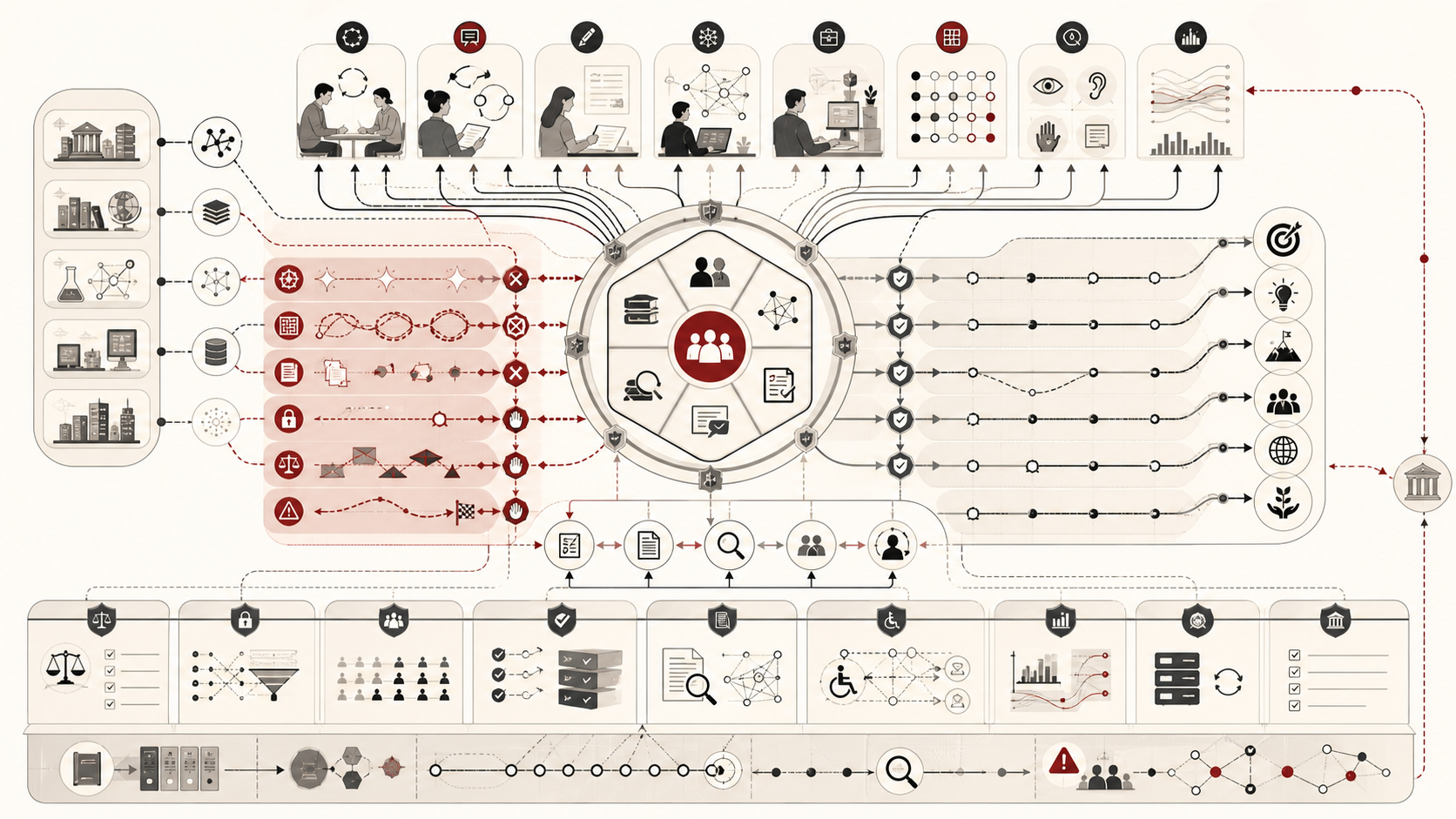
This article develops AI in Education, Knowledge Work, and Learning Systems as an advanced article within the Artificial Intelligence Systems knowledge series. It explains educational AI, tutoring, feedback, assessment integrity, academic honesty, learning analytics, knowledge-work productivity, teacher agency, student agency, AI literacy, accessibility, privacy, equity, institutional governance, and learning-centered evaluation. Selected Python and R examples appear here, while the full GitHub repository contains expanded computational scaffolding for learning-gain analysis, independent-transfer evaluation, feedback-quality review, assessment-risk scoring, privacy review, equity monitoring, learning-analytics governance, SQL schemas, documentation templates, and reproducible notebooks.
Why AI in Education and Knowledge Work Matters
AI matters in education because learning is increasingly mediated by digital systems. Students use search engines, learning management systems, adaptive platforms, writing tools, discussion forums, tutoring tools, coding assistants, note-taking systems, and generative AI. Teachers use digital gradebooks, content platforms, analytics dashboards, curriculum repositories, assessment tools, and administrative systems. Knowledge workers use AI to draft, summarize, analyze, code, plan, translate, brainstorm, and synthesize information.
AI can support learning when it increases high-quality practice, timely feedback, formative assessment, accessibility, language support, conceptual explanation, metacognition, and teacher capacity. It can also support knowledge work when it helps people manage information overload, connect evidence, find patterns, improve drafts, automate routine work, and focus on judgment. In the best cases, AI becomes a scaffold: it helps people do work they could not yet do alone while preserving the cognitive struggle needed for growth.
AI can harm learning when it substitutes for thinking. If a student asks a model to produce an essay, solve a problem, summarize a book, or complete a project without engaging the underlying concepts, the output may look competent while learning remains shallow. If a worker accepts a summary without verifying sources, the organization may move faster while understanding weakens. If a teacher relies on AI-generated materials without review, errors and biases may enter the classroom. Education AI therefore requires a learning-centered standard: does the system strengthen human capability, or does it merely produce artifacts that resemble capability?
This distinction matters because education is not only about output. It is about formation: attention, practice, memory, reasoning, interpretation, creativity, communication, ethical judgment, disciplinary standards, and the ability to transfer learning into new situations. A system that produces better artifacts but weaker learners has failed the educational purpose. A system that helps learners practice, explain, revise, transfer, and reflect can be valuable even when its outputs are imperfect, because it supports the developmental process.
From Output Generation to Learning
Generative AI changes the relationship between assignment, process, and evidence. Historically, a written essay, solved problem, research summary, code submission, or presentation often served as evidence of learning. When AI can produce polished outputs quickly, educators must distinguish between the artifact and the learner’s understanding. The question shifts from “What did the student submit?” to “What did the student understand, practice, explain, revise, transfer, and demonstrate independently?”
This shift does not mean banning AI everywhere. It means redesigning learning environments around process, evidence, reflection, feedback, oral explanation, practical demonstration, version history, in-class work, peer discussion, project defense, authentic tasks, and transparent AI-use policies. AI can be part of the learning process, but its role must be explicit. A student using AI to brainstorm, receive feedback, compare explanations, practice vocabulary, or test understanding is different from a student using AI to replace the intellectual work.
Knowledge work faces a parallel challenge. A professional may use AI to draft a memo, summarize a report, analyze code, or prepare a presentation. The organization must still ask: who verified the facts, who owns the judgment, which sources were used, what assumptions were made, what data were exposed, and what errors could matter? In both education and work, AI assistance should be connected to accountability.
Output \neq Learning
\]
Interpretation: A polished artifact is not necessarily evidence of human understanding, skill, reasoning, or independent transfer.
Learning-centered AI governance therefore begins by separating assisted performance from independent competence. AI may raise immediate performance while reducing the evidence that a learner can reason without it. It may also support learning by making practice more frequent, feedback more available, and reflection more structured. The question is not whether AI is present. The question is whether AI’s role is aligned with the learning objective.
Major Domains of AI in Education and Knowledge Work
AI in learning systems appears across many domains, each with different benefits and risks. The same tool can be constructive or harmful depending on design, context, and governance. A chatbot can be a tutor, shortcut, misinformation source, accessibility aid, writing coach, cheating tool, or research assistant. Educational value depends on how the tool is used, how learning is assessed, and how teachers and learners are supported.
| Domain | AI Function | Potential Value | Primary Risk |
|---|---|---|---|
| Intelligent tutoring | Guided practice, hints, explanations, adaptive sequencing. | More individualized support and practice. | Over-scaffolding, wrong explanations, reduced productive struggle. |
| Writing support | Drafting, revision, feedback, grammar, style, structure. | Improves feedback access and writing confidence. | Authorship ambiguity, dependency, homogenized voice. |
| Assessment support | Question generation, rubric alignment, feedback, grading assistance. | Reduces workload and supports formative assessment. | Bias, unreliable scoring, opacity, academic integrity problems. |
| Learning analytics | Tracks engagement, progress, risk, completion, performance. | Supports early intervention and program improvement. | Surveillance, false risk labels, inequitable intervention. |
| Accessibility | Captioning, translation, alternative formats, reading support. | Expands access for diverse learners. | Quality gaps, privacy issues, unequal access to tools. |
| Teacher support | Lesson planning, differentiation, feedback drafting, material creation. | Reduces administrative burden and supports creativity. | Deskilling, hidden errors, curriculum narrowing. |
| Research support | Literature search, synthesis, summarization, coding, data analysis. | Accelerates knowledge work. | False citations, source errors, privacy and intellectual property risks. |
| Workplace learning | Performance support, knowledge retrieval, onboarding, coaching. | Improves learning in the flow of work. | Opaque recommendations, dependency, organizational knowledge leakage. |
Note: Educational value depends on whether AI strengthens learning, judgment, access, feedback, and transfer rather than merely producing faster artifacts.
Because the same system can play different roles, governance should be contextual. A writing assistant used for brainstorming requires different rules than a writing assistant used for final essay generation. A chatbot used for vocabulary practice differs from a chatbot used to answer assessment questions. A workplace knowledge assistant that retrieves public documentation differs from one that processes confidential personnel records. Use context determines risk.
Learning Systems as Sociotechnical Systems
A learning system includes more than a model. It includes learners, teachers, curriculum, assignments, assessments, institutions, families, employers, policies, platforms, data, incentives, feedback loops, credentials, and social expectations. AI enters this system and changes behavior. Students may change how they study. Teachers may change assignments. Institutions may change policies. Employers may change skill expectations. Assessment may shift from product to process. Knowledge workers may move from drafting to verifying and directing AI systems.
This means AI in education must be evaluated at multiple levels. A tool may improve immediate performance while weakening long-term retention. It may reduce teacher workload while reducing professional agency. It may help high-resource learners more than low-resource learners. It may increase accessibility for some learners while creating new barriers for others. It may support creativity in one setting and standardize output in another.
Responsible learning systems therefore need a full lifecycle view: purpose, design, training data, deployment context, teacher and student roles, evidence of learning, privacy, accessibility, bias, monitoring, incident response, and policy review. AI should serve the learning system; the learning system should not be reorganized around the convenience of AI outputs.
Learning\ System = People + Curriculum + Assessment + Tools + Data + Governance
\]
Interpretation: AI is only one component of a broader learning system that includes human relationships, curriculum, assessment, institutional rules, data practices, and governance.
A sociotechnical view also prevents simplistic debates. The question is not whether AI is good or bad for education in the abstract. The question is how AI is integrated into real learning environments: who controls it, who benefits, who is burdened, what learning evidence remains, what data are collected, what feedback is given, what assessment measures, and what institutional responsibilities follow.
Tutoring, Feedback, and Adaptive Practice
AI tutoring systems can provide explanations, hints, examples, quizzes, practice problems, Socratic prompts, worked examples, and adaptive sequencing. These capabilities can be valuable when learners need immediate support and teachers cannot provide individualized feedback at scale. AI can help learners practice more frequently, compare explanations, receive formative feedback, and identify gaps in understanding.
The educational value of AI tutoring depends on the type of help provided. A good tutor does not simply give the answer. It helps the learner notice what they misunderstand, attempt the next step, explain reasoning, reflect on errors, and build independence. AI tutoring should therefore support productive struggle. It should not collapse every problem into a completed solution.
Responsible tutoring systems should be evaluated for:
- conceptual correctness;
- alignment with curriculum and teacher intent;
- feedback specificity and actionability;
- support for metacognition and self-explanation;
- ability to identify misconceptions;
- accessibility and language quality;
- bias across learner groups;
- retention and independent transfer;
- teacher oversight and intervention routes.
Good\ Tutor \rightarrow Hint + Question + Feedback + Reflection \neq Answer\ Delivery
\]
Interpretation: Tutoring should support reasoning and independence rather than simply delivering completed answers.
Adaptive practice should also avoid over-personalization. If a system narrows content too aggressively, learners may receive efficient practice without broader intellectual exposure. If it moves too quickly past struggle, it may reduce productive difficulty. If it optimizes engagement rather than mastery, it may reward activity over understanding. A learning-centered AI system should support depth, not merely frictionless completion.
Assessment, Academic Integrity, and Authentic Demonstration
Generative AI requires assessment redesign. Traditional take-home essays, summaries, problem sets, coding assignments, and discussion posts may no longer reliably indicate independent performance unless AI use is clearly defined and the assessment design accounts for it. Detection tools are not sufficient as the foundation of academic integrity because AI-generated and AI-assisted work can be difficult to identify reliably, and false accusations can harm students.
Assessment should focus on authentic demonstration. Depending on the learning goal, educators may combine AI-permitted drafts with oral defenses, in-class writing, process logs, annotated bibliographies, version histories, practical demonstrations, project walkthroughs, reflective memos, peer critique, live problem solving, or portfolios. The goal is not to punish tool use. The goal is to preserve meaningful evidence of learning.
A mature AI assessment policy should distinguish among:
- AI prohibited: the task measures unaided performance.
- AI assisted: the learner may use AI for brainstorming, revision, or feedback with disclosure.
- AI integrated: the task explicitly evaluates how well the learner directs, critiques, verifies, and improves AI output.
- AI professionalized: the learner demonstrates responsible AI use as part of disciplinary practice.
- AI audited: the learner provides process evidence, prompts, source checks, reflection, or defense.
Assessment integrity should be reframed around transparency, evidence, process, and authentic learning rather than detection alone.
Assessment\ Integrity = Construct\ Validity + Process\ Evidence + Transparent\ AI\ Policy
\]
Interpretation: Assessment integrity depends on whether the task measures the intended learning, preserves process evidence, and defines AI use clearly.
The deeper challenge is that AI reveals a long-standing weakness in assessment design: artifacts are often treated as proxies for understanding. Generative AI makes that proxy weaker. A serious response should not simply police students. It should redesign assessment so that learning is demonstrated through explanation, revision, transfer, practice, and accountable use of tools.
AI in Knowledge Work, Research, Writing, and Professional Learning
AI in knowledge work extends education into the workplace. Professionals use AI to draft documents, summarize meetings, search knowledge bases, analyze data, generate code, write reports, review contracts, prepare presentations, synthesize research, translate text, and support decision-making. These systems can reduce friction and help workers move from blank page to structured draft more quickly.
But knowledge work depends on judgment. A generated memo may look coherent while missing a critical source. A summary may omit uncertainty. A code assistant may introduce insecure logic. A research assistant may invent citations. A planning assistant may optimize for speed while ignoring governance. A workplace knowledge system may retrieve outdated or unauthorized information. Productivity gains can become organizational risk if verification practices are weak.
Responsible AI-supported knowledge work should include:
- source verification and citation discipline;
- human ownership of final judgment;
- disclosure norms where appropriate;
- data-classification rules for sensitive inputs;
- review workflows for high-impact outputs;
- version control and audit trails;
- training in prompt design, critique, and verification;
- clear boundaries for legal, medical, financial, academic, or personnel decisions.
Knowledge work also has a developmental dimension. Entry-level workers often learn by drafting, researching, summarizing, debugging, cleaning data, preparing memos, and receiving feedback. If AI absorbs these tasks without replacing the learning pathway, organizations may improve short-term throughput while weakening future expertise. Workplace AI should therefore be evaluated not only for productivity, but for learning, mentoring, skill formation, and professional judgment.
Teacher Agency, Student Agency, and AI Literacy
AI should strengthen teacher agency rather than reduce teachers to supervisors of automated systems. Teachers understand classroom context, relationships, motivation, misconceptions, culture, developmental needs, and learning goals. AI can help generate examples, adapt materials, draft feedback, suggest practice, and analyze patterns, but pedagogical judgment must remain human-centered.
Student agency is equally important. Learners need to understand what AI can and cannot do, how to verify outputs, how to protect their data, how to disclose assistance, how to preserve their own voice, and how to use AI without surrendering cognitive responsibility. AI literacy should include technical basics, ethical reasoning, bias awareness, prompt and verification skills, privacy awareness, and reflection on human judgment.
AI literacy is not only a computer science topic. It belongs across disciplines because AI is becoming part of writing, research, design, science, humanities, business, law, medicine, engineering, and civic life. Students should learn not only how to use AI, but how to question it.
Teacher agency and student agency should be designed together. Teachers need time, training, policy clarity, and professional discretion. Students need transparent expectations, equitable access, and opportunities to practice responsible use. Institutions need governance that supports both groups instead of placing the burden of adaptation entirely on individual classrooms.
Privacy, Accessibility, and Student Data Governance
Education AI systems may process sensitive information: student names, writing samples, learning disabilities, grades, behavioral data, attendance, family information, demographic data, accommodations, counseling-related signals, institutional records, and work products. Student data governance must therefore be central to AI deployment.
Privacy risks include prompt logging, vendor data retention, model training on student work, unauthorized retrieval, weak access controls, profiling, surveillance, and unclear consent. Knowledge-work systems raise similar risks around intellectual property, confidential documents, research data, personnel records, and proprietary strategies.
At the same time, AI can improve accessibility. It can generate captions, translate content, simplify language, convert formats, support reading, assist writing, provide speech-to-text, create alternative explanations, and support learners with disabilities. Accessibility benefits should be pursued deliberately while preserving quality, privacy, and human support.
Responsible education data governance should address:
- which data are collected and why;
- who can access student data and AI logs;
- whether student work is used for model training;
- how long data are retained;
- how vendors handle data;
- whether learners can opt out where appropriate;
- how accessibility outputs are reviewed;
- how errors, privacy incidents, or harmful outputs are reported.
Privacy and accessibility should not be treated as competing goals. A learning system can expand access while still limiting unnecessary data collection, preserving consent, restricting retention, and protecting learners from surveillance. The strongest systems make accessibility a design requirement and privacy a governance requirement.
Bias, Equity, Language, and Inclusion
AI in education can either reduce or widen inequity. It may provide tutoring to learners who previously lacked support. It may help multilingual students access content. It may assist learners with disabilities. It may help teachers differentiate instruction. But it may also privilege students with better devices, stronger connectivity, paid tools, more AI-literate families, or more supportive institutions.
Bias can appear in feedback quality, language support, content examples, grading assistance, risk prediction, disciplinary analytics, plagiarism suspicion, recommendation systems, and career guidance. A system may misinterpret dialect, penalize nonstandard language, underrecognize culturally different reasoning, or provide weaker feedback for low-resource languages. AI can also reproduce stereotypes through examples and assumptions embedded in generated content.
Equity review should examine both performance and access. Do all learners receive comparable benefit? Are some students more likely to be flagged as at risk? Are some writing styles more likely to be judged as AI-generated? Are accessibility features available to those who need them? Are teachers in under-resourced schools given training and support? Does the system improve learning for students who have historically been underserved?
Equity_{\mathrm{AI}} = Access + Benefit + Protection + Voice
\]
Interpretation: Equity in educational AI requires access to useful tools, comparable learning benefit, protection from harm, and meaningful voice in governance.
Language is especially important. Education systems are often built around dominant languages and standardized forms of expression. AI systems trained on dominant-language data may provide weaker support for multilingual learners, dialect speakers, Indigenous languages, regional forms of expression, or learners whose communication styles do not match the assumed norm. Inclusion requires testing and governance across real learner contexts, not only average performance.
Evaluation, Monitoring, and Learning Analytics
AI learning systems should be evaluated for educational effectiveness, not merely engagement or usage. More clicks, longer time on platform, faster completion, or higher AI-assisted scores do not necessarily mean deeper learning. Evaluation should ask whether learners retain knowledge, transfer skills, explain reasoning, improve over time, and develop independence.
Monitoring should include:
- learning gain and independent transfer;
- feedback quality and error rates;
- teacher override and edit rates;
- student dependency indicators;
- assessment integrity concerns;
- accessibility effectiveness;
- privacy incidents;
- bias and group differences;
- usage patterns by course, program, learner group, and access context;
- student and teacher reports of harm or benefit;
- model or vendor changes over time.
Learning analytics can support intervention, but analytics must be used carefully. A student labeled “at risk” may need support, not surveillance. A teacher dashboard may help identify gaps, but it can also create pressure to optimize metrics rather than learning. Monitoring should be connected to human care, not automated judgment alone.
Evaluation should also separate assisted performance from independent transfer. A learner may perform better while using AI, but the educational question is whether their capability improves when the support is removed or when they face a new problem. If assisted performance rises while independent transfer stagnates, the system may be producing dependency rather than learning.
Governance, Policy, and Institutional Accountability
Education AI governance should include teachers, students, administrators, instructional designers, librarians, accessibility experts, privacy officers, technology leaders, researchers, parents or guardians where appropriate, and community stakeholders. Policy should be clear enough to guide behavior but flexible enough to support learning across disciplines.
A responsible education AI governance program should document:
- approved and prohibited uses;
- AI disclosure expectations;
- assessment redesign principles;
- student data privacy rules;
- teacher review and professional judgment requirements;
- accessibility and inclusion standards;
- vendor review and procurement criteria;
- model evaluation and monitoring procedures;
- academic integrity processes;
- AI literacy expectations for students and staff;
- incident response and appeal mechanisms;
- review cadence as AI tools and policies evolve.
Governance should avoid two extremes: uncritical adoption and blanket prohibition. The strongest approach is purposeful integration: use AI where it supports learning, restrict it where it undermines learning, disclose it where transparency matters, and redesign assessment so that human understanding remains visible.
Institutional accountability also means evaluating vendors, contracts, data practices, model updates, accessibility claims, privacy commitments, and product changes over time. A school, university, employer, or training provider remains responsible for the learning environment even when AI tools are supplied by external platforms.
Common Failure Modes
AI in education and knowledge work often fails when institutions mistake polished production for learning, engagement metrics for understanding, automation for support, or access to tools for equitable benefit. The following failure modes are especially important.
| Failure Mode | Description | Likely Consequence | Governance Response |
|---|---|---|---|
| Output mistaken for learning | AI-generated artifacts are treated as evidence of student understanding. | Shallow mastery, unreliable assessment, and weakened feedback loops. | Use process evidence, oral defense, independent transfer, reflection, and authentic demonstration. |
| Over-scaffolding | AI gives too much help too quickly. | Reduced productive struggle and weaker independent problem solving. | Design tutoring around hints, questions, metacognition, and graduated support. |
| Assessment substitution | AI can complete the assessed artifact without the learner demonstrating the target skill. | Assessment validity declines. | Redesign tasks around process, in-class performance, revision history, defense, and transparent AI use. |
| Feedback hallucination | AI gives plausible but incorrect tutoring, grading, or writing feedback. | Learners internalize errors or receive unfair evaluation. | Require teacher review, feedback audits, curriculum alignment, and error reporting. |
| Data exposure | Student work, learning records, or workplace documents are exposed through prompts, logs, vendors, or retrieval systems. | Privacy, intellectual property, and trust harms. | Use data classification, vendor controls, retention limits, access controls, and privacy review. |
| Unequal benefit | AI helps already-advantaged learners more than constrained learners. | Achievement gaps and institutional inequity widen. | Monitor access, benefit, feedback quality, accessibility, language support, and group differences. |
| Teacher or worker deskilling | Professional judgment is replaced by automated templates, scores, or recommendations. | Pedagogical and professional agency declines. | Preserve human judgment, professional review, training, and override authority. |
Note: Learning-system failures are not only technical. They arise from the interaction of pedagogy, assessment, incentives, privacy, access, professional agency, and governance.
Limits and Open Problems
AI in education, knowledge work, and learning systems has important limits. A polished essay, summary, solution, or project may not reflect human understanding. AI assistance can create dependency: learners may perform well with AI but struggle when asked to transfer independently. Assessment validity can weaken when traditional artifacts no longer demonstrate the intended construct unless assessment is redesigned.
Feedback can be wrong. AI-generated tutoring, grading, or writing feedback may be plausible but misleading. Detection is not a sufficient integrity strategy. Academic integrity should focus on transparent policy, authentic assessment, process evidence, and fair review rather than relying on uncertain detection tools alone. Privacy risks are substantial because student work, learning records, and workplace documents may be exposed through prompts, logs, vendors, or retrieval systems.
Equity effects are uneven. AI may help learners with strong access and support more than learners in constrained contexts. Teacher and worker agency can erode if institutions treat AI outputs as authority rather than support. Governance must therefore examine how AI changes the structure of learning, not only whether it improves immediate performance.
The hardest open problem is educational purpose. AI can make many tasks faster, but education is not always supposed to be frictionless. Difficulty, uncertainty, revision, failed attempts, peer discussion, and slow reading can be part of learning. A good AI learning system should reduce unnecessary barriers while preserving the kinds of intellectual struggle through which people grow.
The goal is not to reject AI in education or knowledge work. The goal is to make its use pedagogically purposeful, cognitively honest, privacy-preserving, equitable, accessible, and accountable. AI should help people learn more deeply, work more thoughtfully, and participate more fully in knowledge systems. It should not merely produce convincing artifacts that conceal weak understanding.
Mathematical Lens
Learning gain can be represented as the change in demonstrated understanding over time.
\Delta L_i
=
L_{i,t_1}
–
L_{i,t_0}
\]
Interpretation: \(\Delta L_i\) measures the learning gain for learner \(i\) between an initial state \(t_0\) and a later state \(t_1\). The measure \(L\) should represent meaningful understanding, not merely AI-assisted output quality.
AI assistance can be modeled as a scaffold that changes performance.
P_i
=
f(K_i,A_i,E_i,C_i)
\]
Interpretation: Learner performance \(P_i\) depends on prior knowledge \(K_i\), AI assistance \(A_i\), effort \(E_i\), and context \(C_i\). The central challenge is separating genuine learning from assistance-driven output.
A useful learning system should improve independent transfer, not only assisted performance.
T_i
=
P_i^{independent}
–
P_i^{baseline}
\]
Interpretation: Transfer \(T_i\) compares independent performance after learning support with baseline independent performance. This helps distinguish durable learning from temporary AI-assisted productivity.
Feedback quality can be represented as alignment between feedback and learning need.
Q_{fb}
=
\alpha A_{concept}
+
\beta A_{task}
+
\gamma U_{action}
–
\lambda E_{mislead}
\]
Interpretation: Feedback quality \(Q_{fb}\) increases when feedback aligns with concepts, task goals, and actionable next steps, and decreases when feedback misleads the learner.
Assessment validity depends on whether the assessment measures the intended construct.
V_{assess}
=
P(\mathrm{evidence}\mid \mathrm{construct})
–
P(\mathrm{artifact}\mid \mathrm{AI\ substitution})
\]
Interpretation: Assessment validity decreases when submitted artifacts can be produced by AI without demonstrating the intended human knowledge, skill, or judgment.
Equity review compares benefits and harms across learner groups and contexts.
\Delta_g
=
M_g
–
M_{ref}
\]
Interpretation: \(\Delta_g\) measures the difference between a metric \(M_g\) for group \(g\) and a reference group or benchmark. Metrics may include learning gain, access, error rate, feedback quality, alert rate, or assessment impact.
Learning-system governance risk can combine pedagogical, privacy, equity, integrity, and dependency risks.
R_{learn}
=
w_1 S
+
w_2 I
+
w_3 P
+
w_4 Q
+
w_5 D
+
w_6 G
\]
Interpretation: Learning-system risk can combine substitution risk \(S\), integrity risk \(I\), privacy risk \(P\), equity risk \(Q\), dependency risk \(D\), and governance gap \(G\), weighted by institutional priorities.
Variables and Learning-System Interpretation
| Symbol or Term | Meaning | Learning-System Interpretation | Governance Relevance |
|---|---|---|---|
| \(L_i\) | Learner understanding | Demonstrated knowledge, skill, reasoning, transfer, or performance. | Should be measured independently from AI-generated output when appropriate. |
| \(\Delta L_i\) | Learning gain | Change in learner capability over time. | Supports evaluation of educational effectiveness. |
| \(A_i\) | AI assistance | Hints, drafting, feedback, tutoring, retrieval, translation, or automation. | Must be transparent and aligned with learning purpose. |
| \(E_i\) | Effort | Human cognitive work, practice, revision, reflection, and persistence. | AI should scaffold effort rather than eliminate it. |
| \(T_i\) | Transfer | Ability to apply learning independently in new contexts. | Critical for distinguishing mastery from output production. |
| \(Q_{fb}\) | Feedback quality | Usefulness, correctness, specificity, and actionability of feedback. | Low-quality feedback can mislead learners. |
| \(V_{assess}\) | Assessment validity | Whether assessment evidence reflects intended learning. | Threatened when AI can produce artifacts without learning. |
| \(\Delta_g\) | Group difference | Difference in learning benefit, access, or harm across groups. | Supports equity and inclusion review. |
| \(R_{learn}\) | Learning-system risk | Composite risk of AI use in education or knowledge work. | Guides policy, review, monitoring, and intervention. |
Note: AI learning systems should be evaluated by learning gain, independent transfer, feedback quality, assessment validity, privacy, accessibility, equity, and governance—not output quality alone.
Worked Example: A Governed AI Learning Support System
Consider a university deploying an AI learning assistant across writing-intensive courses. The assistant can answer course-content questions, provide feedback on drafts, suggest study plans, generate practice questions, and help students revise. The institution wants to support learning while preserving academic integrity and student privacy.
A governed deployment would include:
- Define intended use: formative learning support, not replacement for student authorship or instructor feedback.
- Restrict the assistant to approved course materials and clearly marked external sources where appropriate.
- Require disclosure when AI is used for substantial drafting, revision, or idea generation.
- Design assignments that include process evidence, reflection, oral explanation, in-class components, or revision histories.
- Evaluate feedback quality against instructor-reviewed examples.
- Monitor whether students improve in independent writing and transfer tasks.
- Protect student work from unauthorized training or retention.
- Review performance for multilingual students, students with disabilities, and different writing backgrounds.
- Train faculty and students in AI literacy, verification, citation, and responsible use.
- Create incident reporting for harmful feedback, privacy concerns, accessibility failures, or academic integrity disputes.
This example shows that education AI is not just a tool rollout. It is curriculum design, assessment design, data governance, professional development, student support, and institutional policy.
The core test is whether the system improves learning rather than only improving surface-level production. If students submit better drafts but cannot explain their arguments, transfer writing skills, evaluate sources, or revise independently, the system has not succeeded educationally. If students receive more feedback, practice more often, become more reflective, and develop stronger independent performance, then AI has served a learning purpose.
Computational Modeling
Computational modeling can make learning-system governance more concrete. A learning-evaluation workflow can compare baseline knowledge, post-learning performance, assisted performance, and independent transfer. A feedback-quality workflow can identify whether AI support is specific, accurate, and useful. A governance-risk workflow can combine dependency risk, privacy risk, assessment-substitution risk, equity gaps, and teacher-integration quality.
The examples below are intentionally educational and synthetic. They do not make student-specific decisions. Their purpose is to show how institutions might evaluate AI learning systems at the program, course, or system level. The goal is not to reduce education to a dashboard, but to make visible whether AI support is improving learning, widening gaps, increasing dependency, or weakening assessment evidence.
A mature evaluation system should combine quantitative indicators with qualitative evidence: student reflections, teacher judgment, classroom observation, accessibility review, privacy review, learner interviews, assessment audits, and independent performance tasks. Educational AI governance should be evidence-informed, not metric-obsessed.
Python Workflow: Learning AI Evaluation and Governance Review
The following Python workflow simulates an AI-supported learning system, estimates learning gain, assisted performance, independent transfer, feedback quality, privacy risk, equity gaps, and governance review status. It is dependency-light so it can be adapted to real learning analytics exports, course evaluations, tutoring logs, assessment reviews, or workplace knowledge-system evaluations.
"""
AI in Education, Knowledge Work, and Learning Systems

Python workflow:
- Simulate AI-supported learning records.
- Evaluate learning gain, assisted performance, independent transfer,
  feedback quality, equity gaps, privacy risk, dependency risk, and governance risk.
- Produce governance-ready summaries.

Educational systems workflow only.
This code does not make student-specific educational decisions.
"""

from __future__ import annotations

from pathlib import Path

import numpy as np
import pandas as pd


ARTICLE_DIR = Path(__file__).resolve().parents[1] if "__file__" in globals() else Path(".")
OUTPUT_DIR = ARTICLE_DIR / "outputs"
OUTPUT_DIR.mkdir(parents=True, exist_ok=True)

RANDOM_SEED = 42
rng = np.random.default_rng(RANDOM_SEED)


def clamp(values: np.ndarray, lower: float = 0.0, upper: float = 1.0) -> np.ndarray:
    """Clamp values to a bounded interval."""
    return np.clip(values, lower, upper)


def simulate_learning_records(n: int = 4000) -> pd.DataFrame:
    """Create synthetic learning-system records for governance review."""
    course_type = rng.choice(
        ["writing", "mathematics", "science", "programming", "professional_learning"],
        size=n,
        p=[0.25, 0.20, 0.20, 0.20, 0.15],
    )

    access_context = rng.choice(
        ["high_access", "moderate_access", "limited_access"],
        size=n,
        p=[0.46, 0.38, 0.16],
    )

    language_context = rng.choice(
        ["dominant_instruction_language", "multilingual_or_language_support"],
        size=n,
        p=[0.78, 0.22],
    )

    accommodation_context = rng.choice(
        ["no_recorded_accommodation", "accessibility_support"],
        size=n,
        p=[0.86, 0.14],
    )

    baseline_knowledge = clamp(rng.normal(0.52, 0.17, n))
    effort = clamp(rng.normal(0.62, 0.18, n))
    ai_usage_intensity = clamp(rng.beta(a=2.2, b=2.5, size=n))
    teacher_integration_quality = clamp(rng.normal(0.68, 0.16, n))

    access_penalty = np.select(
        [
            access_context == "high_access",
            access_context == "moderate_access",
            access_context == "limited_access",
        ],
        [0.00, -0.04, -0.12],
        default=0.0,
    )

    language_support_effect = np.where(
        language_context == "multilingual_or_language_support",
        0.04,
        0.0,
    )

    accessibility_effect = np.where(
        accommodation_context == "accessibility_support",
        0.05,
        0.0,
    )

    # AI can help learning when integrated well and paired with effort.
    learning_support_effect = (
        0.18 * ai_usage_intensity * teacher_integration_quality
        + 0.16 * effort
        + language_support_effect
        + accessibility_effect
        + access_penalty
    )

    # High AI usage with low effort creates dependency risk and weaker transfer.
    dependency_risk = clamp(
        ai_usage_intensity * (1 - effort) * (1 - teacher_integration_quality + 0.25)
    )

    post_learning_score = clamp(
        baseline_knowledge
        + learning_support_effect
        - 0.10 * dependency_risk
        + rng.normal(0, 0.07, n)
    )

    assisted_performance = clamp(
        post_learning_score
        + 0.16 * ai_usage_intensity
        + rng.normal(0, 0.05, n)
    )

    independent_transfer = clamp(
        post_learning_score
        + 0.08 * effort
        - 0.18 * dependency_risk
        + rng.normal(0, 0.06, n)
    )

    feedback_quality = clamp(
        0.35 * teacher_integration_quality
        + 0.25 * baseline_knowledge
        + 0.25 * effort
        + 0.15 * ai_usage_intensity
        + rng.normal(0, 0.08, n)
    )

    privacy_risk = clamp(
        0.12
        + 0.25 * ai_usage_intensity
        + 0.15 * (course_type == "professional_learning").astype(float)
        + 0.10 * (course_type == "writing").astype(float)
        + rng.normal(0, 0.05, n)
    )

    assessment_substitution_risk = clamp(
        0.40 * ai_usage_intensity
        + 0.35 * (1 - effort)
        + 0.20 * np.isin(course_type, ["writing", "programming"]).astype(float)
        - 0.20 * teacher_integration_quality
        + rng.normal(0, 0.05, n)
    )

    return pd.DataFrame(
        {
            "learner_record_id": [f"LEARN-{i:05d}" for i in range(n)],
            "course_type": course_type,
            "access_context": access_context,
            "language_context": language_context,
            "accommodation_context": accommodation_context,
            "baseline_knowledge": baseline_knowledge,
            "post_learning_score": post_learning_score,
            "assisted_performance": assisted_performance,
            "independent_transfer": independent_transfer,
            "effort": effort,
            "ai_usage_intensity": ai_usage_intensity,
            "teacher_integration_quality": teacher_integration_quality,
            "feedback_quality": feedback_quality,
            "dependency_risk": dependency_risk,
            "privacy_risk": privacy_risk,
            "assessment_substitution_risk": assessment_substitution_risk,
        }
    )


def evaluate_learning_system(records: pd.DataFrame) -> pd.DataFrame:
    """Add learning gain, transfer gap, and governance risk measures."""
    evaluated = records.copy()

    evaluated["learning_gain"] = (
        evaluated["post_learning_score"] - evaluated["baseline_knowledge"]
    )

    evaluated["assistance_gap"] = (
        evaluated["assisted_performance"] - evaluated["independent_transfer"]
    )

    evaluated["learning_system_governance_risk"] = clamp(
        0.24 * evaluated["assessment_substitution_risk"]
        + 0.22 * evaluated["privacy_risk"]
        + 0.20 * evaluated["dependency_risk"]
        + 0.16 * (1 - evaluated["feedback_quality"])
        + 0.10 * (evaluated["assistance_gap"] > 0.18).astype(float)
        + 0.08 * (evaluated["teacher_integration_quality"] < 0.50).astype(float) ) evaluated["human_review_recommended"] = ( (evaluated["learning_system_governance_risk"] > 0.42)
        | (evaluated["assessment_substitution_risk"] > 0.55)
        | (evaluated["privacy_risk"] > 0.48)
        | (evaluated["assistance_gap"] > 0.24)
        | (evaluated["feedback_quality"] < 0.35) ) return evaluated def summarize_by_group(records: pd.DataFrame) -> pd.DataFrame:
    """Summarize learning outcomes and risks by group/context."""
    group_columns = [
        "course_type",
        "access_context",
        "language_context",
        "accommodation_context",
    ]

    rows = []

    overall_learning_gain = records["learning_gain"].mean()
    overall_transfer = records["independent_transfer"].mean()
    overall_risk = records["learning_system_governance_risk"].mean()

    for column in group_columns:
        for value, subset in records.groupby(column):
            rows.append(
                {
                    "group_type": column,
                    "group_value": value,
                    "records": len(subset),
                    "mean_learning_gain": subset["learning_gain"].mean(),
                    "mean_independent_transfer": subset["independent_transfer"].mean(),
                    "mean_assisted_performance": subset["assisted_performance"].mean(),
                    "mean_assistance_gap": subset["assistance_gap"].mean(),
                    "mean_feedback_quality": subset["feedback_quality"].mean(),
                    "mean_dependency_risk": subset["dependency_risk"].mean(),
                    "mean_privacy_risk": subset["privacy_risk"].mean(),
                    "mean_assessment_substitution_risk": subset[
                        "assessment_substitution_risk"
                    ].mean(),
                    "mean_governance_risk": subset[
                        "learning_system_governance_risk"
                    ].mean(),
                    "human_review_rate": subset["human_review_recommended"].mean(),
                    "learning_gain_gap_from_overall": (
                        subset["learning_gain"].mean() - overall_learning_gain
                    ),
                    "transfer_gap_from_overall": (
                        subset["independent_transfer"].mean() - overall_transfer
                    ),
                    "risk_gap_from_overall": (
                        subset["learning_system_governance_risk"].mean()
                        - overall_risk
                    ),
                }
            )

    summary = pd.DataFrame(rows)

    summary["review_required"] = (
        (summary["records"] < 100) | (summary["learning_gain_gap_from_overall"].abs() > 0.06)
        | (summary["transfer_gap_from_overall"].abs() > 0.06)
        | (summary["risk_gap_from_overall"] > 0.08)
        | (summary["mean_assistance_gap"] > 0.18)
        | (summary["human_review_rate"] > 0.35)
    )

    return summary.sort_values(
        ["review_required", "mean_governance_risk"],
        ascending=[False, False],
    )


def main() -> None:
    """Run learning AI evaluation and governance review."""
    records = simulate_learning_records()
    evaluated = evaluate_learning_system(records)
    group_summary = summarize_by_group(evaluated)

    governance_summary = pd.DataFrame(
        [
            {
                "records_reviewed": len(evaluated),
                "mean_learning_gain": evaluated["learning_gain"].mean(),
                "mean_independent_transfer": evaluated[
                    "independent_transfer"
                ].mean(),
                "mean_assisted_performance": evaluated[
                    "assisted_performance"
                ].mean(),
                "mean_assistance_gap": evaluated["assistance_gap"].mean(),
                "mean_feedback_quality": evaluated["feedback_quality"].mean(),
                "mean_dependency_risk": evaluated["dependency_risk"].mean(),
                "mean_privacy_risk": evaluated["privacy_risk"].mean(),
                "mean_assessment_substitution_risk": evaluated[
                    "assessment_substitution_risk"
                ].mean(),
                "mean_governance_risk": evaluated[
                    "learning_system_governance_risk"
                ].mean(),
                "human_review_recommended_records": int(
                    evaluated["human_review_recommended"].sum()
                ),
                "groups_requiring_review": int(group_summary["review_required"].sum()),
            }
        ]
    )

    evaluated.to_csv(OUTPUT_DIR / "python_learning_ai_records.csv", index=False)
    group_summary.to_csv(OUTPUT_DIR / "python_learning_ai_group_review.csv", index=False)
    governance_summary.to_csv(
        OUTPUT_DIR / "python_learning_ai_governance_summary.csv",
        index=False,
    )

    memo = f"""# AI Learning System Governance Memo

Records reviewed: {int(governance_summary.loc[0, "records_reviewed"])}
Mean learning gain: {governance_summary.loc[0, "mean_learning_gain"]:.4f}
Mean independent transfer: {governance_summary.loc[0, "mean_independent_transfer"]:.4f}
Mean assisted performance: {governance_summary.loc[0, "mean_assisted_performance"]:.4f}
Mean assistance gap: {governance_summary.loc[0, "mean_assistance_gap"]:.4f}
Mean feedback quality: {governance_summary.loc[0, "mean_feedback_quality"]:.4f}
Mean dependency risk: {governance_summary.loc[0, "mean_dependency_risk"]:.4f}
Mean privacy risk: {governance_summary.loc[0, "mean_privacy_risk"]:.4f}
Mean assessment substitution risk: {governance_summary.loc[0, "mean_assessment_substitution_risk"]:.4f}
Mean governance risk: {governance_summary.loc[0, "mean_governance_risk"]:.4f}
Human-review recommended records: {int(governance_summary.loc[0, "human_review_recommended_records"])}
Groups requiring review: {int(governance_summary.loc[0, "groups_requiring_review"])}

Interpretation:
- AI-supported learning should be evaluated by learning gain and independent transfer, not output quality alone.
- A large assistance gap can indicate dependence on AI-assisted performance rather than durable learning.
- Feedback quality, privacy risk, assessment substitution risk, and equity gaps should be monitored.
- Review should focus on contexts where AI use weakens evidence of learning or creates unequal benefit.
"""

    (OUTPUT_DIR / "python_learning_ai_governance_memo.md").write_text(memo)

    print(governance_summary.T)
    print(group_summary.head(20))
    print(memo)


if __name__ == "__main__":
    main()
This workflow separates assisted performance from independent transfer. That distinction is central for AI learning systems because a learner may produce better work with AI support while not developing durable capability. The governance summary also highlights privacy risk, dependency risk, assessment-substitution risk, and group-level review needs.
R Workflow: AI Learning System Evaluation Summary
The following R workflow simulates AI-supported learning records and summarizes learning gain, independent transfer, assistance gaps, feedback quality, dependency risk, privacy risk, assessment substitution risk, and governance review status.
# AI in Education, Knowledge Work, and Learning Systems
# R workflow: AI learning system evaluation summary.
#
# Educational systems workflow only.
# Does not make student-specific educational decisions.

set.seed(42)

n <- 4000

course_type <- sample(
  c("writing", "mathematics", "science", "programming", "professional_learning"),
  size = n,
  replace = TRUE,
  prob = c(0.25, 0.20, 0.20, 0.20, 0.15)
)

access_context <- sample(
  c("high_access", "moderate_access", "limited_access"),
  size = n,
  replace = TRUE,
  prob = c(0.46, 0.38, 0.16)
)

language_context <- sample(
  c("dominant_instruction_language", "multilingual_or_language_support"),
  size = n,
  replace = TRUE,
  prob = c(0.78, 0.22)
)

accommodation_context <- sample(
  c("no_recorded_accommodation", "accessibility_support"),
  size = n,
  replace = TRUE,
  prob = c(0.86, 0.14)
)

clamp <- function(x, lower = 0, upper = 1) {
  pmin(pmax(x, lower), upper)
}

baseline_knowledge <- clamp(rnorm(n, mean = 0.52, sd = 0.17))
effort <- clamp(rnorm(n, mean = 0.62, sd = 0.18))
ai_usage_intensity <- rbeta(n, shape1 = 2.2, shape2 = 2.5)
teacher_integration_quality <- clamp(rnorm(n, mean = 0.68, sd = 0.16))

access_penalty <- ifelse(
  access_context == "high_access",
  0.00,
  ifelse(access_context == "moderate_access", -0.04, -0.12)
)

language_support_effect <- ifelse(
  language_context == "multilingual_or_language_support",
  0.04,
  0.0
)

accessibility_effect <- ifelse(
  accommodation_context == "accessibility_support",
  0.05,
  0.0
)

learning_support_effect <- 0.18 * ai_usage_intensity * teacher_integration_quality +
  0.16 * effort +
  language_support_effect +
  accessibility_effect +
  access_penalty

dependency_risk <- clamp(
  ai_usage_intensity * (1 - effort) * (1 - teacher_integration_quality + 0.25)
)

post_learning_score <- clamp(
  baseline_knowledge +
    learning_support_effect -
    0.10 * dependency_risk +
    rnorm(n, mean = 0, sd = 0.07)
)

assisted_performance <- clamp(
  post_learning_score +
    0.16 * ai_usage_intensity +
    rnorm(n, mean = 0, sd = 0.05)
)

independent_transfer <- clamp(
  post_learning_score +
    0.08 * effort -
    0.18 * dependency_risk +
    rnorm(n, mean = 0, sd = 0.06)
)

feedback_quality <- clamp(
  0.35 * teacher_integration_quality +
    0.25 * baseline_knowledge +
    0.25 * effort +
    0.15 * ai_usage_intensity +
    rnorm(n, mean = 0, sd = 0.08)
)

privacy_risk <- clamp(
  0.12 +
    0.25 * ai_usage_intensity +
    0.15 * as.numeric(course_type == "professional_learning") +
    0.10 * as.numeric(course_type == "writing") +
    rnorm(n, mean = 0, sd = 0.05)
)

assessment_substitution_risk <- clamp(
  0.40 * ai_usage_intensity +
    0.35 * (1 - effort) +
    0.20 * as.numeric(course_type %in% c("writing", "programming")) -
    0.20 * teacher_integration_quality +
    rnorm(n, mean = 0, sd = 0.05)
)

records <- data.frame(
  learner_record_id = paste0("LEARN-", sprintf("%05d", 1:n)),
  course_type = course_type,
  access_context = access_context,
  language_context = language_context,
  accommodation_context = accommodation_context,
  baseline_knowledge = baseline_knowledge,
  post_learning_score = post_learning_score,
  assisted_performance = assisted_performance,
  independent_transfer = independent_transfer,
  effort = effort,
  ai_usage_intensity = ai_usage_intensity,
  teacher_integration_quality = teacher_integration_quality,
  feedback_quality = feedback_quality,
  dependency_risk = dependency_risk,
  privacy_risk = privacy_risk,
  assessment_substitution_risk = assessment_substitution_risk
)

records$learning_gain <- records$post_learning_score - records$baseline_knowledge
records$assistance_gap <- records$assisted_performance - records$independent_transfer

records$learning_system_governance_risk <- clamp(
  0.24 * records$assessment_substitution_risk +
    0.22 * records$privacy_risk +
    0.20 * records$dependency_risk +
    0.16 * (1 - records$feedback_quality) +
    0.10 * as.numeric(records$assistance_gap > 0.18) +
    0.08 * as.numeric(records$teacher_integration_quality < 0.50)
)

records$human_review_recommended <- records$learning_system_governance_risk > 0.42 |
  records$assessment_substitution_risk > 0.55 |
  records$privacy_risk > 0.48 |
  records$assistance_gap > 0.24 |
  records$feedback_quality < 0.35

summarize_group <- function(data, group_name) {
  split_data <- split(data, data[[group_name]])

  rows <- lapply(names(split_data), function(value) {
    subset <- split_data[[value]]

    data.frame(
      group_type = group_name,
      group_value = value,
      records = nrow(subset),
      mean_learning_gain = mean(subset$learning_gain),
      mean_independent_transfer = mean(subset$independent_transfer),
      mean_assisted_performance = mean(subset$assisted_performance),
      mean_assistance_gap = mean(subset$assistance_gap),
      mean_feedback_quality = mean(subset$feedback_quality),
      mean_dependency_risk = mean(subset$dependency_risk),
      mean_privacy_risk = mean(subset$privacy_risk),
      mean_assessment_substitution_risk = mean(subset$assessment_substitution_risk),
      mean_governance_risk = mean(subset$learning_system_governance_risk),
      human_review_rate = mean(subset$human_review_recommended)
    )
  })

  do.call(rbind, rows)
}

group_summary <- rbind(
  summarize_group(records, "course_type"),
  summarize_group(records, "access_context"),
  summarize_group(records, "language_context"),
  summarize_group(records, "accommodation_context")
)

overall_learning_gain <- mean(records$learning_gain)
overall_transfer <- mean(records$independent_transfer)
overall_risk <- mean(records$learning_system_governance_risk)

group_summary$learning_gain_gap_from_overall <-
  group_summary$mean_learning_gain - overall_learning_gain

group_summary$transfer_gap_from_overall <-
  group_summary$mean_independent_transfer - overall_transfer

group_summary$risk_gap_from_overall <-
  group_summary$mean_governance_risk - overall_risk

group_summary$review_required <- group_summary$records < 100 |
  abs(group_summary$learning_gain_gap_from_overall) > 0.06 |
  abs(group_summary$transfer_gap_from_overall) > 0.06 |
  group_summary$risk_gap_from_overall > 0.08 |
  group_summary$mean_assistance_gap > 0.18 |
  group_summary$human_review_rate > 0.35

governance_summary <- data.frame(
  records_reviewed = nrow(records),
  mean_learning_gain = mean(records$learning_gain),
  mean_independent_transfer = mean(records$independent_transfer),
  mean_assisted_performance = mean(records$assisted_performance),
  mean_assistance_gap = mean(records$assistance_gap),
  mean_feedback_quality = mean(records$feedback_quality),
  mean_dependency_risk = mean(records$dependency_risk),
  mean_privacy_risk = mean(records$privacy_risk),
  mean_assessment_substitution_risk = mean(records$assessment_substitution_risk),
  mean_governance_risk = mean(records$learning_system_governance_risk),
  human_review_recommended_records = sum(records$human_review_recommended),
  groups_requiring_review = sum(group_summary$review_required)
)

dir.create("outputs", recursive = TRUE, showWarnings = FALSE)

write.csv(records, "outputs/r_learning_ai_records.csv", row.names = FALSE)
write.csv(group_summary, "outputs/r_learning_ai_group_review.csv", row.names = FALSE)
write.csv(governance_summary, "outputs/r_learning_ai_governance_summary.csv", row.names = FALSE)

print("Group summary")
print(group_summary)

print("Governance summary")
print(governance_summary)
This R workflow mirrors the Python workflow in a form that can be adapted to course-level, program-level, or institutional evaluation. It emphasizes that governance review should look beyond usage counts and include learning gain, independent transfer, assistance gaps, feedback quality, dependency risk, privacy risk, assessment substitution, and equity review.
GitHub Repository
The article body includes selected computational examples so the conceptual and mathematical argument remains readable. The full repository can hold expanded workflows for learning-gain analysis, independent-transfer evaluation, AI assistance-gap measurement, feedback quality review, assessment-integrity review, privacy risk, accessibility evaluation, bias and equity review, learning analytics monitoring, workplace knowledge-system evaluation, and institutional governance templates.
From Productivity to Learning Infrastructure
AI in education, knowledge work, and learning systems shows why responsible AI cannot be evaluated by productivity alone. A tool that produces faster essays, better summaries, cleaner code, or more polished presentations may still fail if it weakens understanding, reduces independent transfer, obscures authorship, exposes sensitive data, or concentrates advantage among already-supported learners.
The central lesson is that learning systems must be governed around human capability. AI should help people practice, explain, revise, question, verify, collaborate, and transfer knowledge into new contexts. It should support teachers and workers without replacing their judgment. It should expand access without creating surveillance. It should improve feedback without making assessment less meaningful. It should strengthen knowledge work without eroding accountability.
This means institutions should move from tool adoption to learning infrastructure. The relevant question is not merely which AI application to use. It is how assignments, feedback, assessment, privacy, accessibility, equity, teacher agency, student agency, workplace learning, and institutional policy fit together. AI belongs inside that broader architecture.
Within the Artificial Intelligence Systems knowledge series, this article belongs near Large Language Models and Foundation Model Systems, Retrieval-Augmented Generation and AI Knowledge Systems, AI Agents, Tool Use, and Workflow Automation, AI, Expertise, and Human Judgment, AI, Labor, Automation, and the Future of Work, Human Oversight, Contestability, and AI Accountability, and AI Governance and Regulatory Systems. It provides the learning-system layer for understanding how AI should support human development, knowledge production, and institutional responsibility.
Related Articles
- Artificial Intelligence Systems
- Large Language Models and Foundation Model Systems
- Retrieval-Augmented Generation and AI Knowledge Systems
- AI Agents, Tool Use, and Workflow Automation
- AI, Expertise, and Human Judgment
- AI, Labor, Automation, and the Future of Work
- Human Oversight, Contestability, and AI Accountability
- AI Governance and Regulatory Systems
Further Reading
- UNESCO (2023) Guidance for Generative AI in Education and Research. Available at: https://www.unesco.org/en/articles/guidance-generative-ai-education-and-research
- UNESCO (2024) AI Competency Framework for Teachers. Available at: https://www.unesco.org/en/articles/ai-competency-framework-teachers
- UNESCO (2024) AI Competency Framework for Students. Available at: https://www.unesco.org/en/articles/ai-competency-framework-students
- U.S. Department of Education, Office of Educational Technology (2023) Artificial Intelligence and the Future of Teaching and Learning: Insights and Recommendations. Available at: https://www.ed.gov/sites/ed/files/documents/ai-report/ai-report.pdf
- OECD (2026) OECD Digital Education Outlook 2026: Exploring Effective Uses of Generative AI in Education. Available at: https://www.oecd.org/en/publications/oecd-digital-education-outlook-2026_062a7394-en.html
- NIST (2023) Artificial Intelligence Risk Management Framework (AI RMF 1.0). Available at: https://www.nist.gov/publications/artificial-intelligence-risk-management-framework-ai-rmf-10
- EDSAFE AI Alliance (2024) SAFE Benchmarks Framework. Available at: https://www.edsafeai.org/safe
References
- EDSAFE AI Alliance (2024) SAFE Benchmarks Framework. Available at: https://www.edsafeai.org/safe
- EDSAFE AI Alliance (2024) AI+Education Policy Trackers. Available at: https://www.edsafeai.org/policy-trackers
- EDUCAUSE (2025) AI Ethical Guidelines. Available at: https://library.educause.edu/resources/2025/6/ai-ethical-guidelines
- EDUCAUSE (2026) The Impact of AI on Work in Higher Education. Available at: https://www.educause.edu/research/2026/the-impact-of-ai-on-work-in-higher-education
- NIST (2023) Artificial Intelligence Risk Management Framework (AI RMF 1.0). Available at: https://www.nist.gov/publications/artificial-intelligence-risk-management-framework-ai-rmf-10
- OECD (2026) OECD Digital Education Outlook 2026: Exploring Effective Uses of Generative AI in Education. Available at: https://www.oecd.org/en/publications/oecd-digital-education-outlook-2026_062a7394-en.html
- UNESCO (2023) Guidance for Generative AI in Education and Research. Available at: https://www.unesco.org/en/articles/guidance-generative-ai-education-and-research
- UNESCO (2024) AI Competency Framework for Teachers. Available at: https://www.unesco.org/en/articles/ai-competency-framework-teachers
- UNESCO (2024) AI Competency Framework for Students. Available at: https://www.unesco.org/en/articles/ai-competency-framework-students
- U.S. Department of Education, Office of Educational Technology (2023) Artificial Intelligence and the Future of Teaching and Learning: Insights and Recommendations. Available at: https://www.ed.gov/sites/ed/files/documents/ai-report/ai-report.pdf