
Last Updated May 5, 2026
The Five Pillars of Islam name the foundational practices through which Muslim life is oriented toward God: witness, prayer, charity, fasting, and pilgrimage. They are not merely external rituals or identity markers. They form a disciplined pattern of worship, moral responsibility, bodily devotion, social obligation, economic purification, sacred time, and communal belonging. Through the shahadah, salah, zakat, sawm, and hajj, Islam becomes lived submission to the One God through speech, body, wealth, hunger, movement, memory, and community.
Within the Islam sequence, this article follows The Qur’an: Revelation, Recitation, Guidance, and Sacred History, The History of the Prophets in the Qur’anic Tradition, The Prophet Muhammad and the Formation of the Ummah, Hadith and the Preservation of Prophetic Memory, and Sīrah and the Sacred History of Early Islam. Those articles established revelation, prophecy, Muhammad’s mission, transmitted memory, and sacred biography. This article turns to the pillars as the core lived architecture of Muslim practice.
The emphasis remains academically neutral, text-centered, and respectful of Islamic sacred sources. The Five Pillars are described through Qur’an, Hadith, Sunnah, law, worship, ethics, ritual practice, communal formation, and comparative Abrahamic study. The article does not reduce Islam to ritual formalism. Rather, it examines how these practices shape the whole person: belief, speech, time, body, wealth, appetite, social responsibility, pilgrimage, equality, repentance, and remembrance of God.
Current Library
Religious Studies
Article Map
Abrahamic Traditions
Related Topic
Foundations of Religion
Series context: This article is part of the Abrahamic Traditions: Prophecy, Revelation, Law, and Sacred History knowledge series. For the broader category structure, return to the Religious Studies category.
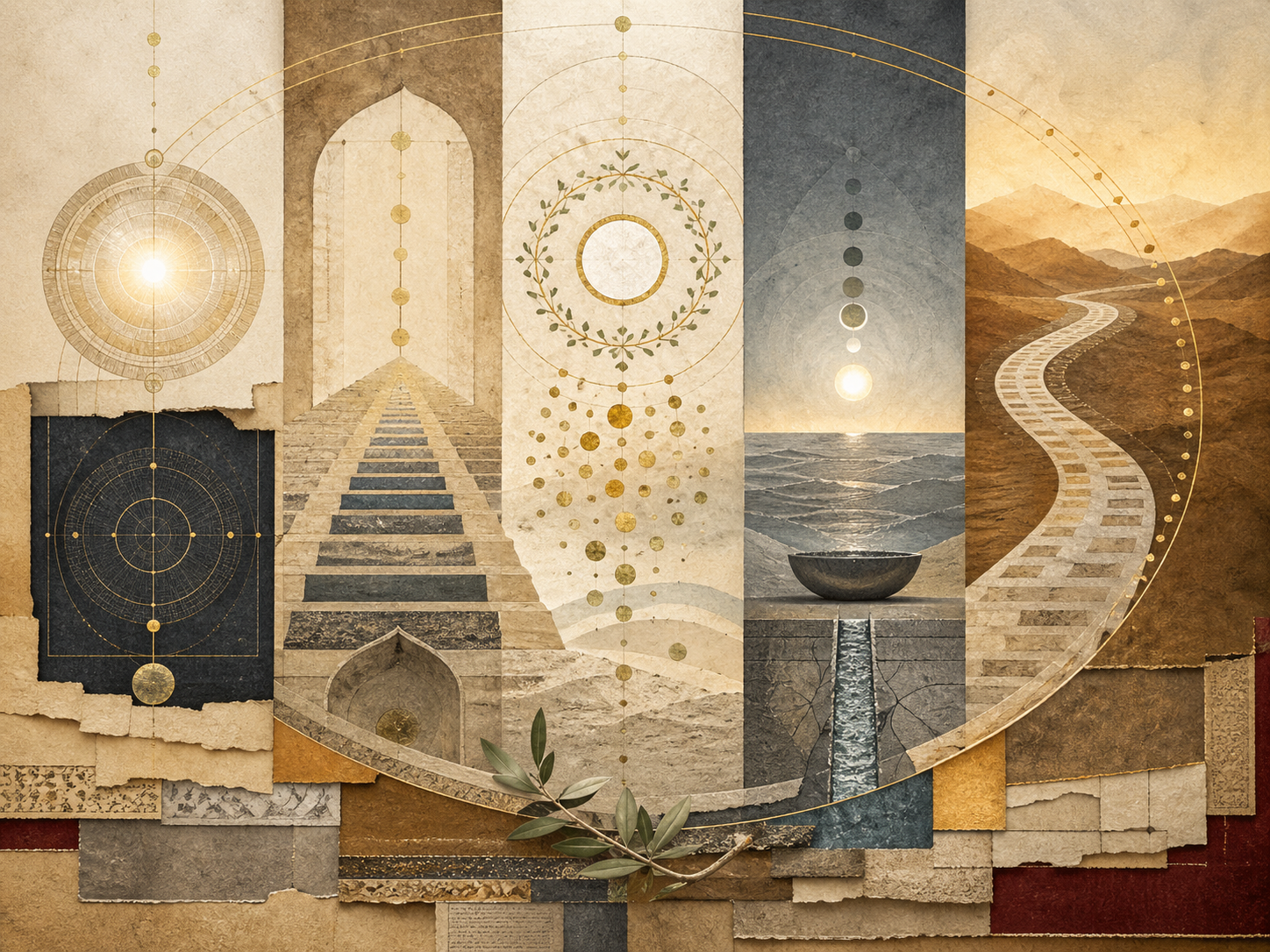
The Five Pillars should be read as a foundation, not as the totality of Islam. Islamic life also includes faith, ihsan, learning, lawful livelihood, family responsibility, ethical speech, neighborly care, mercy, justice, repentance, remembrance, inner struggle, and spiritual refinement. Yet the pillars give Muslim life its visible and repeatable form. They return the believer again and again to the same questions: Who is worthy of worship? How should time be ordered? What is wealth for? How should desire be disciplined? How does the body enter sacred memory? Through these questions, the pillars become a grammar of worship and moral formation.
Why the Five Pillars Matter
The Five Pillars matter because they give Islamic life its foundational rhythm. Islam is not only a set of beliefs about God, prophecy, scripture, and judgment. It is a practiced way of life. The shahadah gives the tongue its witness. Salah gives the day its rhythm. Zakat gives wealth its moral limit. Sawm gives appetite its discipline. Hajj gives the body a sacred journey into Abrahamic memory, repentance, equality, and return.
These practices are often introduced as the basic obligations of Islam, and that is true. Yet calling them “basic” should not make them seem shallow. Each pillar opens into a deep theology of human life. The shahadah is a complete reorientation of loyalty. Prayer is a repeated return to God in time. Zakat transforms wealth from possession into trust. Fasting trains desire, hunger, patience, gratitude, and God-consciousness. Pilgrimage draws the believer into a global body and a sacred geography shaped by Abraham, Hagar, Ishmael, and Muhammad.
The pillars also show that Islam is both inward and outward. A purely inward spirituality without disciplined practice would not be the Qur’anic model. A purely outward ritualism without sincerity, mercy, humility, and justice would also fail the Qur’anic model. The pillars train the whole person: belief, intention, speech, body, time, money, hunger, travel, family, community, and memory.
They also give the ummah a shared structure. Muslims differ by language, culture, ethnicity, school of law, theological tradition, spiritual lineage, and political history. Yet the pillars create recognizable common forms across that diversity. A Muslim in Senegal, Indonesia, Bosnia, Pakistan, Egypt, Turkey, Iran, Nigeria, Britain, Malaysia, Morocco, India, or the United States may pray in different social settings, but the basic orientation toward witness, prayer, charity, fasting, and pilgrimage remains central.
The pillars also resist modern fragmentation. They refuse to separate belief from body, spirituality from economics, devotion from social responsibility, personal faith from community, or sacred memory from movement. They make Islam visible not only in doctrine but in repeated practice: words spoken, bodies bowed, wealth given, hunger endured, and journeys undertaken for God.
“Islam Is Built on Five”: Pillars as Sacred Architecture
The language of the Five Pillars is strongly associated with the famous hadith that Islam is built on five: testifying that there is no god but God and that Muhammad is the Messenger of God, establishing prayer, paying zakat, performing hajj to the House, and fasting Ramadan. This hadith gives the pillars architectural force. Islam is “built” through foundational practices. They support, organize, and stabilize the life of faith.
Hadith Text
بُنِيَ الْإِسْلَامُ عَلَى خَمْسٍ: شَهَادَةِ أَنْ لَا إِلَٰهَ إِلَّا اللَّهُ وَأَنَّ مُحَمَّدًا رَسُولُ اللَّهِ، وَإِقَامِ الصَّلَاةِ، وَإِيتَاءِ الزَّكَاةِ، وَالْحَجِّ، وَصَوْمِ رَمَضَانَIslam is built upon five: bearing witness that there is no god but God and that Muhammad is the Messenger of God, establishing prayer, giving zakat, pilgrimage, and fasting Ramadan.Reported in Sahih al-Bukhari and Sahih Muslim. Arabic text with English rendering.
The hadith gives the pillars their architectural metaphor. They are not decorative practices but foundational supports for Muslim life.
The metaphor of building matters. A building requires foundations, structure, balance, and maintenance. The pillars are not isolated acts performed once and forgotten. They hold up a way of life. Witness must be renewed through truthfulness. Prayer must be established repeatedly. Zakat must be calculated and given responsibly. Ramadan returns each year. Hajj, where possible, marks a life-changing journey. Each pillar returns the believer to dependence on God.
At the same time, the pillars are not the whole of Islam. Islamic life also includes faith, ihsan, ethics, family responsibility, learning, lawful livelihood, remembrance, justice, mercy, neighborly care, inner struggle, and spiritual refinement. The pillars are foundational, not exhaustive. A building has foundations, but it also has rooms, doors, light, shelter, and inhabitants.
For this reason, the pillars should be read together with Qur’anic ethics. The Qur’an repeatedly links prayer with charity, worship with justice, belief with care for the vulnerable, and piety with truthful conduct. The pillars become distorted if separated from mercy, humility, honesty, and social responsibility. They are acts of worship that form a moral life.
The architectural image also prevents a purely individualistic reading. Foundations hold up a structure larger than one person. The pillars form individuals, but they also form a community across generations. They allow Islam to be taught, remembered, transmitted, and recognized. A child learns to pray by seeing prayer. The hungry learn Ramadan through family and community. Zakat requires social obligation. Hajj gathers bodies across geography. The pillars are personal practices, but they build a people.
The First Pillar: Shahadah and Witness to the One God
The shahadah is the foundational witness of Islam: there is no god but God, and Muhammad is the Messenger of God. It is the entry point into Muslim identity and the verbal center of Islamic monotheism. It is simple in wording but immense in meaning. It names the One God as the only ultimate object of worship and recognizes Muhammad as the final messenger through whom the Qur’an was revealed.
The shahadah is not only a formula of belonging. It is a claim on the whole life. To say there is no god but God is to reject idols, false absolutes, ego, tyranny, greed, tribal arrogance, racial superiority, and the worship of power. It is to confess that no created thing deserves ultimate loyalty. The One God alone is absolute.
Qur’anic Text
فَاعْلَمْ أَنَّهُ لَا إِلَٰهَ إِلَّا اللَّهُ وَاسْتَغْفِرْ لِذَنبِكَKnow, then, that there is no god but God, and seek forgiveness for your fault.Qur’an 47:19. Arabic text with English rendering.
The verse joins knowledge of divine oneness with repentance. Tawhid is not merely a statement about reality; it requires moral return.
The second part of the shahadah recognizes Muhammad as Messenger. This does not make Muhammad divine. Islamic monotheism sharply distinguishes the worship of God from reverence for the Prophet. Muhammad is honored as servant, messenger, model, teacher, warner, bearer of good news, and recipient of revelation. His authority is prophetic, not divine.
The shahadah therefore joins theology and guidance. The One God is confessed, and the Messenger is followed. Without tawhid, Islam loses its center. Without Prophetic guidance, the Qur’an’s revealed message would not be embodied in the same way through Sunnah, worship, law, and communal practice. The shahadah is the door through which Muslim life enters disciplined remembrance.
It is also a witness rather than a private feeling alone. To bear witness is to testify, to orient oneself publicly and inwardly, and to live under the claim one has spoken. The shahadah is therefore both confession and responsibility. It asks whether the believer’s speech, wealth, time, desires, loyalties, and treatment of others truly reflect the One God named by the tongue.
Tawhid, Muhammad, and the Meaning of Witness
Tawhid, the oneness of God, is the theological heart of the shahadah. It is more than the statement that only one God exists. It is the reordering of reality around the Creator, Sustainer, Merciful, Judge, and Lord of all worlds. Human beings are not self-sufficient. Wealth is not ultimate. Tribe is not ultimate. Nation is not ultimate. Desire is not ultimate. God alone is worthy of worship.
This makes the shahadah morally demanding. A person may verbally confess tawhid while still living as if wealth, status, anger, resentment, political power, or self-image were ultimate. The witness must therefore be renewed inwardly. It requires sincerity, humility, repentance, and moral struggle. The tongue speaks, but the heart and life must follow.
Witness also has public meaning. Muslims are called to bear witness through prayer, charity, justice, truthful speech, care for the vulnerable, and resistance to falsehood. The shahadah is not a private slogan. It is a covenantal orientation. It tells the believer who God is, who the Prophet is, and what kind of life must follow.
The witness to Muhammad as Messenger connects the believer to Qur’an, Sunnah, hadith, sīrah, and the formation of the ummah. The Prophet is remembered not as an abstract founder but as the human model of life under revelation. The shahadah therefore opens into the rest of the pillars: prayer as obedience, zakat as economic worship, fasting as discipline, and hajj as embodied surrender.
The shahadah also clarifies a major distinction between Islam and Christianity. In Christian theology, Jesus is confessed in relation to incarnation, sonship, and divine mediation. In Islam, Muhammad is not divine and is not worshiped. He is the Messenger through whom final revelation was delivered and embodied. This distinction is not a reduction of reverence; it is the structure of Islamic monotheism. The Prophet’s greatness lies precisely in his servanthood before God.
The Second Pillar: Salah and the Ordering of Time
Salah, the prescribed prayer, orders Muslim life through repeated return to God. Prayer is performed at set times across the day, placing worship inside the rhythm of ordinary life. Work, study, trade, family care, travel, and public affairs are interrupted by remembrance. The day is not owned entirely by human productivity. It is punctuated by standing before God.
The Qur’an repeatedly commands the establishment of prayer. The phrase matters: prayer is not merely performed occasionally but established as a disciplined structure of life. It is individual and communal, inward and outward, bodily and verbal. It includes intention, purification, direction, standing, recitation, bowing, prostration, sitting, supplication, and peace.
Prayer also forms equality. In congregational prayer, rich and poor, ruler and laborer, scholar and beginner, old and young stand in rows before God. Social hierarchy does not disappear from society simply because people pray, but prayer repeatedly contradicts human arrogance. In sujud, prostration, the body becomes low before the One who is high.
Salah also links Muslim life to the Qur’an. Recitation is central to prayer. Al-Fatihah is repeated in every cycle of prayer, making guidance, praise, mercy, worship, and dependence central to daily devotion. The Qur’an is not only studied as text. It is recited as prayer.
The repetition of prayer also disciplines forgetfulness. Human beings forget their dependence, mortality, obligations, and accountability. Salah interrupts that forgetfulness. It restores proportion: God is greater than the task, the market, the anxiety, the quarrel, the ambition, and the self. The believer returns to the same truth several times a day because the human heart repeatedly drifts away from it.
Body, Direction, Recitation, and Humility in Prayer
Islamic prayer is bodily. The believer stands, bows, prostrates, and sits. This bodily structure matters because Islam does not treat worship as a purely mental act. The body participates in submission. The forehead touches the ground. The spine bends. The tongue recites. The ears hear. The hands rise. The whole person is drawn into worship.
Direction also matters. Muslims pray facing the qiblah, toward the Ka‘bah in Makkah. This does not mean God is located in one direction. Rather, the shared direction gives the ummah a bodily unity. Around the world, Muslims orient themselves toward a sacred center associated with Abrahamic memory, Prophetic history, and communal worship.
Purification before prayer also has formative meaning. Wudu, the ritual washing before prayer, trains the believer to approach worship with preparation. The body is not rejected as impure in itself; rather, bodily life is ordered toward reverence. Cleanliness becomes part of sacred discipline.
Prayer also trains humility. To pray regularly is to admit dependence. The believer repeatedly asks for guidance, forgiveness, mercy, and steadfastness. This repetition reshapes the self. Prayer is not only communication with God; it is training against arrogance, heedlessness, despair, and forgetfulness.
The bodily form of prayer is also a communal pedagogy. Children learn by seeing bodies bow and rise. Converts learn by watching rows and movements. Communities remember through repeated gestures. The body becomes an archive of worship. Salah therefore preserves Islam not only through books and speech, but through disciplined movement across generations.
Friday Prayer, Congregation, and Communal Belonging
Friday prayer, or Jumu‘ah, gives salah a special communal intensity. Muslims gather for congregational worship, listen to the khutbah, and pray together. Friday prayer links worship with teaching, public exhortation, and community formation. It gives the ummah a weekly gathering around remembrance of God.
The khutbah is important because Islam’s communal worship includes instruction. The community does not only pray silently; it listens, learns, and is reminded. The themes may include God-consciousness, ethical responsibility, Qur’anic guidance, Prophetic example, social concern, repentance, and communal needs. At its best, the khutbah renews the moral life of the community.
Congregational prayer also trains social recognition. People stand shoulder to shoulder. Differences of wealth, profession, nationality, ethnicity, and status are relativized before God. This does not automatically solve social injustice, but it gives the community a repeated bodily sign of equality and accountability.
The mosque, like the early mosque in Madinah, is more than a prayer hall. It can be a place of teaching, charity, counsel, refuge, conflict resolution, youth formation, mourning, celebration, and communal memory. Prayer therefore builds community not only through ritual performance but through shared sacred space.
Friday prayer also links the local community to the wider ummah. Every congregation gathers in a particular language, neighborhood, and social context, but the practice itself belongs to a global rhythm. The local mosque becomes part of a worldwide pattern of remembrance. The weekly gathering is therefore both immediate and universal: one community in one place, joined to a broader body of worship.
The Third Pillar: Zakat and the Purification of Wealth
Zakat is obligatory charity and one of Islam’s central acts of economic worship. The Arabic root carries the sense of purification, growth, and blessing. Wealth is purified when a portion is given for the sake of God and the welfare of those entitled to receive it. Zakat teaches that wealth is not absolute private possession. It is a trust.
The Qur’an repeatedly pairs prayer and zakat, showing that worship and economic responsibility belong together. A person who prays but neglects the vulnerable has misunderstood the moral structure of revelation. Zakat makes care for others part of the architecture of faith. It is not optional generosity alone; it is obligation.
Zakat also disciplines the ego. Wealth can create illusion: the illusion of self-sufficiency, superiority, security, and control. Giving zakat breaks that illusion. It reminds the believer that provision belongs ultimately to God, that the poor have a claim, and that accumulation without responsibility corrupts the soul.
Classical Islamic law developed detailed rules for zakat: who pays, what kinds of wealth are zakatable, what thresholds apply, when payment is due, and who may receive. These rules vary in legal detail across schools and contexts, but the moral core remains clear: wealth must circulate toward justice, relief, dignity, and communal care.
The spiritual meaning of zakat should not be separated from its institutional meaning. It purifies the giver, but it also feeds, relieves, frees, supports, and stabilizes. It reminds the community that poverty is not merely an individual misfortune but a moral concern of the whole body. The pillar of zakat makes economic life answerable to God.
Zakat, Social Ethics, and the Vulnerable
The Qur’an identifies categories of zakat recipients, including the poor, the needy, those who administer it, those whose hearts are to be reconciled, those in bondage, debtors, those in the path of God, and travelers in need. These categories show that zakat is not merely almsgiving in a narrow sense. It is a structured response to vulnerability, debt, displacement, social fracture, and communal obligation.
Qur’anic Text
إِنَّمَا الصَّدَقَاتُ لِلْفُقَرَاءِ وَالْمَسَاكِينِ وَالْعَامِلِينَ عَلَيْهَا وَالْمُؤَلَّفَةِ قُلُوبُهُمْ وَفِي الرِّقَابِ وَالْغَارِمِينَ وَفِي سَبِيلِ اللَّهِ وَابْنِ السَّبِيلِAlms are only for the poor, the needy, those who administer them, those whose hearts are to be reconciled, those in bondage, those in debt, in the path of God, and the traveler in need.Qur’an 9:60. Arabic text with English rendering.
The verse gives zakat a social architecture. It is directed toward vulnerability, debt, displacement, service, reconciliation, and communal responsibility.
Zakat protects the vulnerable from abandonment. The poor and needy are not treated as invisible. Debtors are not reduced to failure. Travelers in need are not dismissed as strangers. Those trapped in bondage or constrained conditions become part of the moral concern of the community. Zakat is therefore both spiritual and social.
Zakat also challenges the idea that charity is only a matter of personal kindness. Voluntary charity, or sadaqah, remains deeply important, but zakat establishes obligation. It says that the community has a structured duty toward those in need. The vulnerable should not have to depend only on the mood, taste, or emotional generosity of the wealthy.
In modern contexts, zakat raises major questions of institutional ethics. How should zakat be collected? How should recipients be protected from humiliation? How should local and global needs be balanced? How should zakat address poverty, debt, refugee crises, medical need, education, and disaster relief? These questions show that zakat remains a living field of moral reasoning.
The pillar of zakat also exposes the danger of ritual without justice. A community may maintain prayer while tolerating hunger, debt traps, worker exploitation, or social abandonment. Zakat stands as a built-in correction to such imbalance. It insists that worship of God must reach the circulation of wealth and the protection of human dignity.
The Fourth Pillar: Sawm and the Discipline of Ramadan
Sawm, fasting, is most centrally associated with the month of Ramadan. During Ramadan, Muslims abstain from food, drink, and marital relations from dawn until sunset, with exemptions and accommodations in cases such as illness, travel, pregnancy, nursing, menstruation, and other recognized conditions according to legal tradition. Fasting is not meant to destroy the body. It is meant to discipline desire and awaken God-consciousness.
Qur’anic Text
يَا أَيُّهَا الَّذِينَ آمَنُوا كُتِبَ عَلَيْكُمُ الصِّيَامُ كَمَا كُتِبَ عَلَى الَّذِينَ مِن قَبْلِكُمْ لَعَلَّكُمْ تَتَّقُونَO you who believe, fasting is prescribed for you as it was prescribed for those before you, so that you may become God-conscious.Qur’an 2:183. Arabic text with English rendering.
The verse links fasting with earlier religious communities and names its spiritual aim: taqwa, or God-consciousness.
The Qur’an explicitly connects fasting with taqwa, often translated as God-consciousness, reverence, or mindful awareness of God. Hunger becomes a teacher. Thirst becomes a reminder. The ordinary freedom to eat and drink is restrained so that the believer may become more awake, grateful, patient, and merciful.
Fasting is therefore not only abstention. A person may avoid food and drink while still lying, backbiting, raging, exploiting, or neglecting prayer. Such fasting is outwardly incomplete in spirit. The fast must reach speech, eyes, ears, hands, habits, ego, and intention. Ramadan is a school of the self.
Fasting also creates solidarity. Hunger reminds the believer of those who live with hunger involuntarily. The fast should deepen compassion, not pride. It should make charity easier, not harder. It should increase mercy toward the poor, workers, family members, neighbors, refugees, prisoners, and all who suffer need.
The discipline of sawm also reveals Islam’s realism about the human person. Desire is not evil simply because it exists. Food, drink, marital intimacy, and bodily life are gifts. But desire must be governed. Ramadan does not abolish appetite; it teaches appetite its proper place. The believer learns that the self can be trained, that habit can be interrupted, and that hunger can become remembrance.
Ramadan, Qur’anic Revelation, and Sacred Time
Ramadan is the month of fasting, but it is also the month of the Qur’an. The Qur’an identifies Ramadan as the month in which the Qur’an was sent down as guidance for humanity. This connection between fasting and revelation is crucial. Ramadan is not only bodily discipline; it is intensified listening to divine guidance.
Qur’anic Text
شَهْرُ رَمَضَانَ الَّذِي أُنزِلَ فِيهِ الْقُرْآنُ هُدًى لِّلنَّاسِ وَبَيِّنَاتٍ مِّنَ الْهُدَىٰ وَالْفُرْقَانِThe month of Ramadan is the one in which the Qur’an was sent down as guidance for humanity, with clear signs of guidance and discernment.Qur’an 2:185. Arabic text with English rendering.
Ramadan joins bodily discipline to revelation. The fast is not only restraint from food and drink; it is a return to the Qur’an as guidance and discernment.
Muslim communities often increase Qur’anic recitation during Ramadan. Many try to complete the recitation of the Qur’an during the month. Tarawih prayers gather communities at night for extended recitation. Homes, mosques, and public spaces take on a different rhythm of worship, meal, charity, exhaustion, patience, and renewal.
The daily structure of Ramadan transforms time. Suhur before dawn, fasting through the day, iftar at sunset, night prayer, charity, family gatherings, and acts of remembrance create a sacred calendar within ordinary life. The month becomes a recurring annual return to discipline, mercy, scripture, and repentance.
Ramadan also contains Laylat al-Qadr, the Night of Decree or Power, associated with the descent of revelation and immense spiritual significance. The last ten nights of Ramadan are therefore marked by intensified prayer, searching, supplication, and retreat in many communities. Sacred time becomes an opening toward mercy and transformation.
The month also exposes the limits of purely individual spirituality. Ramadan is lived at home, in mosques, through meal preparation, charity campaigns, night prayer, work schedules, fatigue, family care, and communal celebration. The sacred month enters ordinary social life. It trains patience not only in solitude but in traffic, kitchens, workplaces, classrooms, mosques, and families.
Eid al-Fitr and Zakat al-Fitr
Eid al-Fitr marks the completion of Ramadan. It is a day of prayer, gratitude, food, family, communal gathering, mercy, and joy after fasting. Its joy is not a rejection of discipline but its fruit. After a month of hunger, restraint, prayer, and recitation, the community celebrates God’s mercy and the possibility of renewal.
Zakat al-Fitr is closely connected to this transition. It is a required charity associated with the end of Ramadan, traditionally given before the Eid prayer so that those in need may also participate in the joy of Eid. This practice shows that celebration in Islam is not meant to exclude the poor. Communal joy must be made socially responsible.
Eid al-Fitr therefore joins worship and social ethics. The community gathers for prayer, but it also gives. The fast ends, but its moral lesson continues. Hunger should produce generosity. Discipline should produce gratitude. Recitation should produce moral clarity. Celebration should not become forgetfulness.
This article introduces Eid al-Fitr and zakat al-fitr as part of the fasting pillar, but they deserve fuller treatment in a separate article on Ramadan, zakat al-fitr, and Eid al-Fitr. That follow-up article can examine fasting, night prayer, Qur’anic recitation, charity, family, food, mercy, and sacred renewal in greater depth.
The movement from fasting to Eid also reveals a larger rhythm in Islam: restraint and joy belong together. Worship is not joyless severity. Nor is joy detached from discipline. Ramadan teaches hunger, patience, and self-command; Eid teaches gratitude, generosity, and communal gladness. Together, they show that sacred time forms both seriousness and celebration.
The Fifth Pillar: Hajj and the Pilgrimage to the House
Hajj is the pilgrimage to the House in Makkah and is required once in a lifetime for Muslims who are physically and financially able to undertake it. It is one of the most powerful embodied practices in Islam because it gathers worship, movement, equality, repentance, sacrifice, memory, and global community into a concentrated sacred journey.
Hajj is not tourism. It is pilgrimage. The pilgrim leaves home, enters a state of consecration, wears simple garments, moves through sacred rites, stands with others in supplication, remembers Abrahamic history, and returns marked by repentance and renewal. The journey is physical, but its meaning is spiritual and communal.
Qur’anic Text
وَلِلَّهِ عَلَى النَّاسِ حِجُّ الْبَيْتِ مَنِ اسْتَطَاعَ إِلَيْهِ سَبِيلًاPilgrimage to the House is owed to God by people who are able to make a way to it.Qur’an 3:97. Arabic text with English rendering.
The verse grounds Hajj as obligation for those able to undertake it. Capacity is part of the command, reflecting the legal and moral importance of ability.
The requirement of ability matters. Hajj is not imposed on those who cannot undertake it. Islamic law recognizes physical capacity, financial capacity, safety, and responsibility toward dependents. This reflects a broader principle: worship is serious, but God does not require the impossible from those genuinely unable.
Hajj also makes the ummah visible in a dramatic way. Muslims from many lands, languages, ethnicities, and social classes gather in shared rites. The pilgrim’s clothing reduces visible markers of status. The crowd itself becomes a sign: humanity standing before God, stripped of many ordinary distinctions, remembering origin, dependence, and return.
The pilgrimage also teaches that sacred geography is not merely symbolic. Makkah, the Ka‘bah, Safa, Marwah, Mina, Arafat, and Muzdalifah become places where worship, memory, law, and bodily movement converge. Hajj gathers the believer into a geography of remembrance: not only thinking about submission, but walking, standing, circling, waiting, and returning through it.
Hajj, Abrahamic Memory, and Sacred Movement
Hajj is deeply tied to Abrahamic memory. The Ka‘bah is associated in Islamic tradition with Ibrahim and Isma‘il. The rites of pilgrimage recall obedience, trust, sacrifice, prayer, Hagar’s search, divine provision, and the restoration of worship to the One God. Hajj therefore places the Muslim body inside sacred history.
The movement between Safa and Marwah recalls Hagar’s search for water. This memory is especially important because it places a woman’s desperation, courage, and maternal care inside one of Islam’s central rites. Sacred history is not only the history of prophets and public leaders. It also includes vulnerability, survival, water, and divine mercy in the wilderness.
The standing at Arafat is often described as the heart of Hajj. Pilgrims gather in supplication, repentance, and dependence. The scene evokes the Day of Judgment, human equality, and the need for mercy. Hajj compresses the whole human condition: departure, hardship, standing, asking, remembering, sacrifice, and return.
The rites of Hajj are therefore not arbitrary motions. They are embodied theology. The pilgrim learns through walking, standing, circling, waiting, praying, sacrificing, and returning. The body becomes a vehicle of remembrance.
Hajj also joins past and future. It remembers Abrahamic obedience, the Prophet’s final pilgrimage, the global ummah, and the final standing before God. The pilgrim is not only retracing history but rehearsing accountability. Sacred movement becomes moral preparation: to leave home, stand in humility, seek forgiveness, and return changed.
Hajj and Umrah: Pilgrimage, Obligation, and Devotion
Hajj and Umrah are both pilgrimages to Makkah, but they are not identical. Hajj is one of the Five Pillars and occurs during specific days of the Islamic calendar for those able to perform it. Umrah is a lesser pilgrimage that may be performed at other times and does not replace the obligation of Hajj for those upon whom Hajj is required.
Umrah includes rites such as ihram, tawaf around the Ka‘bah, sa‘i between Safa and Marwah, and cutting or shortening the hair. Hajj includes additional rites and days connected to Mina, Arafat, Muzdalifah, sacrifice, and other pilgrimage obligations. Legal details vary by school and by the type of pilgrimage performed.
The distinction between Hajj and Umrah shows that Islamic worship includes both obligatory and voluntary forms. Some practices establish the required structure of the faith, while others deepen devotion. The believer may be drawn again and again toward sacred places, but obligation and capacity remain governed by law and mercy.
In the modern world, pilgrimage also raises questions of crowd management, health, travel systems, visas, environmental stress, economic inequality, and global access. These practical realities do not erase the sacred meaning of pilgrimage. They show that embodied worship always takes place within material conditions requiring care, safety, and justice.
Umrah and Hajj also show that longing for sacred place can take different forms. Some believers make Umrah as an act of devotion, gratitude, repentance, or renewal. Hajj, when obligatory and possible, carries the weight of a pillar. Both practices draw the body toward the House, but they do so within different legal and ritual structures.
The Pillars and the Inner Life
The Five Pillars are outward acts, but they are meant to form the inner life. Shahadah forms sincerity. Salah forms humility and remembrance. Zakat forms generosity and detachment from greed. Sawm forms patience and God-consciousness. Hajj forms repentance, equality, surrender, and return. The outward act is the school of the inward self.
This is why the pillars belong naturally with ihsan, the spiritual excellence of worshiping God as though one sees Him, and knowing that even if one does not see Him, He sees the worshiper. Without ihsan, the pillars can become mechanical. With ihsan, they become pathways of transformation.
The pillars also train jihad al-nafs, the struggle against the lower self. Prayer resists heedlessness. Zakat resists greed. Fasting resists appetite and ego. Hajj resists status and comfort. Shahadah resists every false god of the self. The greater struggle is not separate from the pillars; it is trained through them.
Islamic spirituality repeatedly warns that outward practice without inward sincerity becomes hollow. Yet inward sincerity without disciplined practice can become vague and self-protective. The pillars hold the two together. They make the inner life visible and the outer life accountable.
The inner meaning of the pillars also helps prevent ritual pride. Prayer can become arrogance if it produces contempt for others. Fasting can become vanity if it produces harshness. Charity can become self-display if it humiliates the recipient. Hajj can become status if it is treated as social prestige. The pillars require purification of intention because sacred practice itself can be corrupted by the ego. Their aim is remembrance, not self-congratulation.
The Pillars, Fiqh, and the Ordering of Practice
The Five Pillars are also central to fiqh, the disciplined understanding of Islamic law. Each pillar has legal conditions, obligations, recommended acts, invalidating factors, exemptions, and interpretive debates. How does one pronounce the shahadah? What are the times and conditions of prayer? What wealth is zakatable? Who is exempt from fasting? What makes Hajj obligatory? These are legal as well as devotional questions.
Islamic legal schools developed detailed rulings around purification, prayer, zakat, fasting, pilgrimage, intention, capacity, travel, illness, menstruation, debt, inheritance, and communal responsibility. This legal detail should not be treated as sterile technicality. It reflects the seriousness of worship. If practice matters, then how practice is performed also matters.
At the same time, fiqh must be joined to mercy and wisdom. Legal detail exists to guide worship, not to crush the believer. The Qur’an repeatedly rejects unbearable hardship as the goal of religion. Exemptions for illness, travel, incapacity, and hardship show that Islamic practice is disciplined but not indifferent to human vulnerability.
The pillars therefore reveal a central feature of Islamic life: devotion is structured. Love for God is not left only to mood or impulse. It is given forms, times, amounts, movements, thresholds, and journeys. Structure protects devotion from vagueness and gives the community shared practices across generations.
The legal dimension also protects communal continuity. Without method, every generation could reinvent worship according to preference. Without mercy, method could become oppressive. The fiqh of the pillars seeks to hold these concerns together: continuity and compassion, form and intention, obligation and capacity, discipline and ease.
The Pillars and the Formation of the Ummah
The Five Pillars form individuals, but they also form the ummah. The shahadah gives the community its shared witness. Salah gathers bodies into rows. Zakat redistributes obligation toward the vulnerable. Ramadan synchronizes hunger, recitation, charity, and night prayer across the community. Hajj gathers Muslims from across the world into one sacred movement.
This communal dimension is essential. Islam is not only solitary piety. It is a worshiping, giving, fasting, gathering, traveling, learning, and morally responsible community. The pillars make faith social without reducing it to politics. They create shared time, shared speech, shared direction, shared hunger, shared obligation, and shared pilgrimage.
The pillars also expose communal failure. A community may pray while neglecting the poor. It may fast while exploiting workers. It may perform pilgrimage while ignoring injustice. It may recite the shahadah while worshiping wealth, race, nation, or power in practice. The pillars judge the community as well as sustain it.
At their best, the pillars make the ummah a body of remembrance and responsibility. They form people who witness truth, pray regularly, give justly, fast sincerely, and travel humbly toward God. They are the practical grammar of Islamic belonging.
The pillars also bind local and global life. A neighborhood mosque, a local zakat fund, a family Ramadan table, and a single person’s prayer rug are all local. Yet each participates in a global pattern. The same qiblah, the same Ramadan, the same pilgrimage, and the same witness connect scattered communities into one symbolic and devotional body.
The Five Pillars in Abrahamic Study
The Five Pillars are important for Abrahamic study because they show how Islam embodies revelation in practice. Judaism, Christianity, and Islam all join belief to ritual, calendar, law, prayer, charity, and sacred memory, but they do so through different forms. Comparing them responsibly helps clarify both shared concerns and real differences.
The shahadah can be compared with Jewish and Christian confessional language, but it has its own Islamic structure: tawhid and Muhammad as Messenger. Salah can be compared with Jewish daily prayer and Christian liturgy, but its bodily structure, Arabic recitation, qiblah, and daily rhythm are distinct. Zakat can be compared with tzedakah and Christian almsgiving, but its legal status as a pillar gives it a particular Islamic form.
Ramadan fasting can be compared with Jewish fasts and Christian Lent, but its month-long daily discipline, Qur’anic connection, and Eid conclusion are distinct. Hajj can be compared with pilgrimage traditions in Judaism and Christianity, but its Abrahamic geography, required status for those able, rites around Makkah, and global gathering give it a unique place in Islamic life.
Comparison should therefore clarify without flattening. The Five Pillars are not generic religious practices. They are specifically Islamic forms of witness, prayer, charity, fasting, and pilgrimage. They express Islam’s understanding of God, revelation, Prophethood, body, wealth, time, community, and sacred history.
In Abrahamic perspective, the pillars also show how Islam preserves continuity and difference at once. The One God, prayer, charity, fasting, pilgrimage, law, repentance, and mercy belong to a wider Abrahamic field. Yet Islam orders these practices through Qur’an, Muhammad, Sunnah, Arabic recitation, qiblah, Ramadan, zakat, and Hajj. The result is not a generic monotheism but a distinct lived path within the broader history of revelation.
Why This Article Matters
The Five Pillars matter because they show Islam as a practiced tradition of worship and moral formation. The Qur’an gives revelation. Muhammad embodies guidance. Hadith preserves Prophetic memory. Sīrah narrates sacred biography. The pillars give Muslim life its recurring forms: witness, prayer, charity, fasting, and pilgrimage.
This article also matters because the pillars are often introduced too quickly. They can be listed in a sentence and then forgotten. But each pillar contains a world. Shahadah contains tawhid and Prophethood. Salah contains time, body, recitation, and humility. Zakat contains wealth, justice, and social responsibility. Sawm contains hunger, Qur’an, discipline, and mercy. Hajj contains Abrahamic memory, equality, repentance, and sacred movement.
The pillars also resist modern fragmentation. They refuse to separate spirituality from economics, belief from body, private piety from community, worship from justice, or memory from movement. Islam forms the person through repeated acts that touch every dimension of life.
For the Abrahamic Traditions knowledge series, this article gives the Islam sequence its major lived-practice foundation. The next articles can deepen specific dimensions: Ramadan, Zakat al-Fitr, and Eid al-Fitr; tafsir and Qur’anic interpretation; tajwīd and recitation; fiqh and legal method; sharia and mercy; kalam and theology; Sufism and ihsan; and jihad al-nafs as inner struggle and moral discipline.
The pillars endure because they are both simple and inexhaustible. A child can learn their names. A scholar can spend a lifetime studying their legal, theological, ethical, and spiritual dimensions. A believer can practice them daily and still discover new depths of dependence, sincerity, discipline, generosity, hunger, humility, and return to God.
Related Reading
- Abrahamic Traditions: Prophecy, Revelation, Law, and Sacred History
- The Qur’an: Revelation, Recitation, Guidance, and Sacred History
- The History of the Prophets in the Qur’anic Tradition
- The Prophet Muhammad and the Formation of the Ummah
- Hadith and the Preservation of Prophetic Memory
- Sīrah and the Sacred History of Early Islam
- Ramadan, Zakat al-Fitr, and Eid al-Fitr: Fasting, Charity, and Sacred Renewal
- Tafsir and the Sciences of Qur’anic Interpretation
- Tajwīd, Recitation, and the Oral Life of Revelation
- Fiqh and the Ordering of Muslim Life
- Sharia, Mercy, and Moral Order
- Jihad al-Nafs: Inner Struggle, Moral Discipline, and the Greater Jihad
Further Reading
- Abdel Haleem, M.A.S. (2008) The Qur’an: A New Translation. Oxford: Oxford University Press. Available at: https://global.oup.com/academic/
- Denny, F.M. (2015) An Introduction to Islam. 4th edn. London: Routledge. Available at: https://www.routledge.com/
- Esposito, J.L. (2016) Islam: The Straight Path. 5th edn. Oxford: Oxford University Press. Available at: https://global.oup.com/academic/
- Kamali, M.H. (2008) Shari‘ah Law: An Introduction. Oxford: Oneworld Publications. Available at: https://oneworld-publications.com/
- Mattson, I. (2013) The Story of the Qur’an: Its History and Place in Muslim Life. 2nd edn. Oxford: Wiley-Blackwell. Available at: https://www.wiley.com/
- Murata, S. and Chittick, W.C. (1994) The Vision of Islam. St Paul: Paragon House. Available at: https://www.paragonhouse.com/
- Nasr, S.H. (2002) The Heart of Islam: Enduring Values for Humanity. New York: HarperOne. Available at: https://www.harpercollins.com/
- Nasr, S.H., Dagli, C.K., Dakake, M.M., Lumbard, J.E.B. and Rustom, M. (eds.) (2015) The Study Quran: A New Translation and Commentary. New York: HarperOne. Available at: https://www.harpercollins.com/products/the-study-quran-seyyed-hossein-nasrcaner-k-daglimaria-massi-dakakejoseph-eb-lumbardmohammed-rustom
- Rahman, F. (2009) Major Themes of the Qur’an. 2nd edn. Chicago: University of Chicago Press. Available at: https://press.uchicago.edu/
- Ramadan, T. (2004) Western Muslims and the Future of Islam. Oxford: Oxford University Press. Available at: https://global.oup.com/academic/
- Renard, J. (2011) Islam and Christianity: Theological Themes in Comparative Perspective. Berkeley: University of California Press. Available at: https://www.ucpress.edu/
- Schimmel, A. (1994) Deciphering the Signs of God: A Phenomenological Approach to Islam. Albany: State University of New York Press. Available at: https://sunypress.edu/
References
- Al-Bukhari, M.I. (n.d.) Sahih al-Bukhari. Sunnah.com. Available at: https://sunnah.com/bukhari
- Al-Nawawi, Y.S. (n.d.) Hadith 3, Forty Hadith an-Nawawi. Sunnah.com. Available at: https://sunnah.com/nawawi40:3
- Altafsir.com (n.d.) Qur’anic Commentary and Tafsir Resources. Royal Aal al-Bayt Institute for Islamic Thought. Available at: https://www.altafsir.com/
- Corpus Coranicum (n.d.) Corpus Coranicum. Berlin-Brandenburg Academy of Sciences and Humanities. Available at: https://corpuscoranicum.de/en
- Dukes, K. (n.d.) The Quranic Arabic Corpus. University of Leeds. Available at: https://corpus.quran.com/
- Malik ibn Anas (n.d.) Muwatta Malik. Sunnah.com. Available at: https://sunnah.com/malik
- Muslim ibn al-Hajjaj (n.d.) Sahih Muslim. Sunnah.com. Available at: https://sunnah.com/muslim
- Quran.com (n.d.) Surah Al-Baqarah 2:177. Available at: https://quran.com/2/177
- Quran.com (n.d.) Surah Al-Baqarah 2:183–185. Available at: https://quran.com/2/183-185
- Quran.com (n.d.) Surah Al-Baqarah 2:196–203. Available at: https://quran.com/2/196-203
- Quran.com (n.d.) Surah Āl ‘Imrān 3:97. Available at: https://quran.com/3/97
- Quran.com (n.d.) Surah At-Tawbah 9:60. Available at: https://quran.com/9/60
- Quran.com (n.d.) Surah At-Tawbah 9:103. Available at: https://quran.com/9/103
- Quran.com (n.d.) Surah Al-Hajj 22:27–29. Available at: https://quran.com/22/27-29
- Quran.com (n.d.) Surah Al-Hajj 22:78. Available at: https://quran.com/22/78
- Sunnah.com (n.d.) Hadith of the Prophet Muhammad. Available at: https://sunnah.com/
- Tanzil Project (n.d.) Tanzil Project. Available at: https://tanzil.net/docs/tanzil_project