
Last Updated May 5, 2026
Mishnah, Talmud, and rabbinic civilization mark one of the decisive transformations in Jewish sacred history: the movement from biblical canon and Temple-centered religious life into a vast culture of interpretation, legal reasoning, study, prayer, memory, and communal continuity. The Tanakh provides scripture; Torah gives instruction; prophecy gives judgment, warning, and hope. Rabbinic civilization asks how that scriptural inheritance is to be lived, interpreted, debated, transmitted, and embodied after catastrophe, dispersion, social change, and the loss of earlier institutions. It is not simply a later commentary on biblical religion. It is one of the great intellectual and religious achievements of Jewish history.
Rabbinic Judaism should be approached first through its own Jewish authority, literary structures, historical settings, interpretive practices, and communal functions. The Mishnah, Talmud, midrashic literature, halakhic reasoning, aggadic imagination, liturgical practice, and study culture together form a world in which Torah is not merely preserved as ancient text but lived as ongoing instruction. This is not a marginal development after scripture. It is the formative matrix through which classical and later Judaism became a civilization of learning, law, prayer, memory, argument, and practice.
Rabbinic civilization should therefore not be approached as a footnote to the Bible. Its texts give shape to law, ritual, ethics, domestic life, festival practice, prayer, education, argument, memory, and communal governance. Its methods teach readers how to reason with scripture, tradition, precedent, dissent, uncertainty, and inherited obligation. Its world is not static. It is a civilization of conversation: sages and students, majority and minority opinions, legal rulings and moral stories, precise argument and imaginative expansion, local custom and transregional authority, ancient memory and new circumstance.
Current Library
Religious Studies
Article Map
Abrahamic Traditions
Related Topic
Religion and Law
Series context: This article is part of the Abrahamic Traditions: Prophecy, Revelation, Law, and Sacred History knowledge series. For the broader category structure, return to the Religious Studies category.
From Scripture to Rabbinic Civilization
The transition from biblical Judaism to rabbinic Judaism cannot be reduced to a single event, but the destruction of the Second Temple in 70 CE is one of its central historical markers. Earlier Jewish life had already included multiple forms of interpretation, legal practice, sectarian debate, synagogue worship, scribal tradition, wisdom teaching, apocalyptic hope, priestly authority, and scriptural commentary. Rabbinic Judaism did not emerge from nothing. It developed within a wider Jewish world of Second Temple plurality and then gradually became one of the dominant forms through which Jewish continuity was preserved and ordered.
The loss of the Temple changed the conditions of Jewish life. Sacrifice, priestly service, pilgrimage, and Temple-centered ritual could no longer function in the same way. This did not end Judaism. It required a reconfiguration of religious life around Torah, study, prayer, household practice, communal discipline, legal reasoning, memory, and interpretation. Rabbinic civilization gave that reconfiguration durable form. It made Jewish life portable without making it rootless. It allowed sacred order to be carried through text, teaching, calendar, law, custom, and study.
This transformation was not simply institutional. It was intellectual and spiritual. If prophecy had interpreted history through covenantal judgment, rabbinic literature interpreted scripture and tradition through disciplined debate. If Torah gave commandment, rabbinic law asked how commandment applied in actual life. If exile and destruction threatened continuity, rabbinic memory created forms by which continuity could be sustained. Rabbinic civilization therefore belongs to the history of survival, but also to the history of creativity.
The rabbinic achievement is especially striking because it joins reverence with argument. The texts preserve disagreement rather than erasing it. Minority opinions are often recorded. Questions remain active. Legal reasoning unfolds through cases, analogies, precedents, objections, distinctions, and counterarguments. Sacred authority does not eliminate debate. It generates disciplined debate. In this sense, rabbinic civilization teaches that fidelity to revelation can take the form of sustained interpretive labor.
What Is the Mishnah?
The Mishnah is the first major work of rabbinic literature and one of the foundational texts of postbiblical Judaism. Traditionally associated with Rabbi Judah ha-Nasi around the beginning of the third century CE, it gathers earlier teachings of the tannaim, the rabbinic sages of the first two centuries. The Mishnah is not a commentary on the Bible in the ordinary sense. It is a structured compilation of legal traditions, debates, classifications, cases, principles, and practices. It organizes Jewish law and ritual life into a system that is at once concise, technical, and profoundly generative.
The Mishnah’s Hebrew style is spare and compressed. It often states a case, gives a ruling, records disagreement, and moves on without extended explanation. This brevity is part of its power. The Mishnah is not designed to answer every question on the surface. It invites analysis. It preserves tradition in a form that demands study. Its compactness becomes the seedbed of later commentary. The Gemara will ask why the Mishnah says what it says, what sources it assumes, how its cases relate to other cases, which sages disagree, and how its rulings apply.
The Mishnah does not follow the order of the Torah’s books. Instead, it organizes Jewish life into six orders, each divided into tractates. This structure is one of its major innovations. It arranges inherited teaching by legal and practical domains: agriculture, festivals, family law, civil and criminal matters, sacrificial and Temple-related law, and purity. In doing so, it creates a map of Jewish life as a disciplined whole.
Primary Rabbinic Text
מֹשֶׁה קִבֵּל תּוֹרָה מִסִּינַי וּמְסָרָהּ לִיהוֹשֻׁעַ וִיהוֹשֻׁעַ לִזְקֵנִים וּזְקֵנִים לִנְבִיאִים וּנְבִיאִים מְסָרוּהָ לְאַנְשֵׁי כְנֶסֶת הַגְּדוֹלָהMoses received Torah from Sinai and transmitted it to Joshua; Joshua to the elders; the elders to the prophets; and the prophets transmitted it to the men of the Great Assembly.
Mishnah Avot 1:1, Hebrew text with English rendering.
This opening of Avot expresses the rabbinic imagination of transmission: Torah is received, handed on, interpreted, guarded, and carried across generations.
The Mishnah also shows that rabbinic Judaism is not only a religion of texts but a religion of ordered practice. Food, field, Sabbath, festival, marriage, divorce, vows, damages, courts, sacrifices, purity, prayer, blessings, and daily obligations all become subjects of analysis. The sacred is not limited to synagogue or study hall. It extends across the material, social, ritual, and moral structures of life.
The Six Orders of the Mishnah
The Mishnah is organized into six orders, known in Hebrew as sedarim. These orders are Zera‘im, Mo‘ed, Nashim, Nezikin, Kodashim, and Tohorot. Together they show the scope of rabbinic concern. Rabbinic law is not a narrow legalism. It is a total discipline of life: land, time, household, money, injury, worship, sanctity, body, impurity, and communal order.
Zera‘im, often translated as Seeds, concerns agriculture, blessings, gifts to the poor, tithes, and related obligations. Its inclusion shows how rabbinic law connects land, food, labor, gratitude, and justice. Blessings are especially important because they transform ordinary acts into moments of acknowledgment. Eating, smelling, seeing, and receiving benefit from the world become occasions for disciplined speech before God.
Mo‘ed, or Appointed Time, concerns Sabbath and festivals. It regulates sacred time: Sabbath rest, Passover, Yom Kippur, Sukkot, Rosh Hashanah, Purim, and other observances. Time itself becomes a medium of covenantal memory. Rabbinic civilization does not preserve memory only through narrative; it preserves memory through calendar, repeated practice, recitation, prohibition, celebration, fasting, and communal rhythm.
Nashim, or Women, addresses marriage, divorce, vows, levirate marriage, suspected adultery, and related aspects of family law. Its materials reflect ancient social structures and must be studied with historical care. Yet the order also shows the rabbinic concern to regulate kinship, obligation, consent, contract, sexuality, family continuity, and the legal status of persons within communal life.
Nezikin, or Damages, concerns civil and criminal law, courts, property, injury, liability, testimony, idolatry, ethics, and legal procedure. This order demonstrates the rabbinic interest in justice as practical reasoning. Harm must be assessed. Testimony must be evaluated. Property disputes must be judged. Public order requires institutions, rules, standards, and moral discipline.
Kodashim, or Holy Things, preserves laws concerning sacrifices, offerings, Temple service, slaughter, and sacred property. Even after the destruction of the Temple, these materials remained part of rabbinic study. Their preservation shows that study could become a mode of memory. Laws that could not be fully practiced could still be learned, transmitted, interpreted, and held within the sacred imagination.
Tohorot, or Purities, concerns ritual purity and impurity. Modern readers often find this material difficult, but it reveals the rabbinic interest in embodiment, boundary, sanctity, household life, Temple memory, and the symbolic ordering of human contact. Purity laws are not simple hygiene. They belong to a sacred grammar of body, space, time, and holiness.
Oral Torah, Memory, and Transmission
The concept of Oral Torah is central to rabbinic Judaism. It refers to the tradition of interpretation, explanation, legal reasoning, and transmitted teaching that accompanies the written Torah. Within rabbinic self-understanding, the written text cannot be lived without interpretive tradition. Scripture gives commandment, but life presents cases. What counts as work on Sabbath? How should damages be assessed? What is the proper form of prayer? How are vows interpreted? How are festivals observed when circumstances change? The Oral Torah addresses the living application of divine instruction.
Modern scholarship studies the development of Oral Torah historically, asking how traditions were transmitted, arranged, attributed, edited, and written down. Religious tradition and academic method do not always ask the same questions, but both recognize that rabbinic literature is deeply concerned with continuity. The Mishnah presents itself not as innovation detached from Torah, but as faithful ordering of received instruction.
Memory is crucial here. Rabbinic culture developed in a world where oral transmission, memorization, repetition, teacher-student relationships, and disciplined recitation were central. Writing did not replace memory; writing preserved and reorganized it. The Mishnah’s compact style reflects this oral background. It is structured for learning, repetition, comparison, and commentary.
Oral Torah also means that Jewish sacred authority is not confined to the biblical text as a self-interpreting document. Authority lives in the relation between written scripture and transmitted interpretation. This relation gives rabbinic Judaism its distinctive form. It is neither pure scriptural literalism nor free invention. It is disciplined continuity through interpretation.
What Is the Talmud?
The Talmud is one of the most important works of Jewish civilization. It consists of the Mishnah and Gemara: the Mishnah as foundational rabbinic compilation, and the Gemara as extended commentary, debate, analysis, narrative, and interpretation. The Talmud is not a linear law code. It is a vast textual world. It moves through legal argument, scriptural interpretation, stories of sages, ethical reflections, medical observations, folk traditions, theological speculation, courtroom procedure, ritual detail, and communal memory.
To read the Talmud is to enter a culture of argument. Questions generate distinctions; distinctions generate cases; cases generate objections; objections generate reinterpretations. The Talmud often preserves the process of thinking rather than only the final result. Its pages can move from technical legal reasoning to moral story, from biblical verse to practical ruling, from sharp dispute to theological imagination. This layered form is one reason the Talmud became such a powerful engine of Jewish intellectual life.
The Talmud exists in two principal forms: the Jerusalem Talmud, also called the Palestinian Talmud or Talmud Yerushalmi, and the Babylonian Talmud, or Talmud Bavli. Both are structured around the Mishnah, but they differ in language, style, scope, geography, redaction, and later authority. The Babylonian Talmud became the more widely studied and legally influential of the two, but the Jerusalem Talmud remains indispensable for understanding rabbinic literature, Jewish law, and the intellectual world of late antique Jewish communities in Roman Palestine.
The Talmud’s authority developed over time. It did not function simply as one book among others. It became a central text of study, legal reasoning, commentary, and communal formation. Later halakhic codes, responsa, commentaries, and customs repeatedly return to talmudic discussion as a major source of authority. In rabbinic civilization, the Talmud becomes a study world through which Torah is continually interpreted.
The Jerusalem and Babylonian Talmuds
The Jerusalem Talmud emerged from the rabbinic communities of late antique Roman Palestine. Despite its name, it was not produced simply in Jerusalem, which had undergone severe historical disruptions. It reflects the learning of sages associated with Galilee and other centers. It is often more concise, difficult, and compressed than the Babylonian Talmud. Its language and structure can be challenging, but it preserves invaluable traditions, legal discussions, and interpretive patterns.
The Babylonian Talmud developed in the great Jewish communities of Babylonia, where academies and scholarly networks became increasingly central. Its discussions are often more expansive than those of the Jerusalem Talmud. Over time, the Bavli became the primary Talmud for much of the Jewish world. Its authority shaped legal reasoning, commentary, education, and rabbinic culture across medieval and modern Jewish communities.
The existence of two Talmuds is historically important. Rabbinic Judaism was not formed in one place by one institution. It developed across regions, languages, teachers, academies, political environments, and communal conditions. Local circumstances mattered. So did transregional communication. The two Talmuds preserve related but distinct rabbinic worlds.
The comparison between the Jerusalem and Babylonian Talmuds also shows how textual authority can grow through reception. The Bavli’s later prominence was not simply a matter of its intrinsic content; it was also shaped by historical continuity, scholarly transmission, commentary, legal use, and communal adoption. A text becomes civilizational not only by being written, but by being studied across centuries.
Gemara: Commentary, Debate, and Legal Reasoning
The Gemara is the Talmud’s extended discussion of the Mishnah. It asks why the Mishnah says what it says, what biblical verses support it, what earlier traditions clarify it, how its rulings compare with other teachings, whether apparent contradictions can be resolved, and how legal principles should be applied. Gemara is not commentary in a narrow explanatory sense. It is interpretive reasoning in motion.
Talmudic argument often proceeds through questions. What is the source? What is the case? Who is the author of this opinion? Does another teaching contradict it? Can the contradiction be resolved by distinguishing circumstances? Is the Mishnah speaking generally or only in a specific case? What practical difference follows from the dispute? The method is patient, technical, and analytical. It trains the mind to notice distinctions.
The Gemara also preserves named sages and schools of thought. Tannaim appear through earlier traditions; amoraim debate and interpret them; later anonymous editorial layers shape the discussion. The resulting text is not a simple transcript of live conversation, but a carefully transmitted and edited literary form that preserves the culture of rabbinic reasoning. Its dialogical style gives the impression of a study hall extending across generations.
Rabbinic Principle
אֵלּוּ וָאֵלּוּ דִּבְרֵי אֱלֹהִים חַיִּיםThese and those are the words of the living God.
Babylonian Talmud, Eruvin 13b, Hebrew phrase with English rendering.
The phrase is often cited to express the rabbinic capacity to preserve principled disagreement within a shared sacred framework.
The legal reasoning of the Gemara is often precise, but it is not merely technical. Behind the detail lies a larger religious concern: how should Torah be lived? What does justice require? How should uncertainty be handled? How does one honor inherited tradition while resolving new questions? How should conflicting authorities be weighed? The Talmud’s complexity reflects the complexity of life under commandment.
Halakhah and Aggadah
Rabbinic literature is often described through the distinction between halakhah and aggadah. Halakhah concerns law, practice, obligation, ritual, civil order, and legal decision-making. Aggadah includes narrative, ethical teaching, theology, folklore, parable, biblical expansion, moral reflection, and imaginative interpretation. The distinction is useful, but it should not be overdrawn. In rabbinic texts, law and story often interpret one another.
Halakhah gives shape to Jewish life. It addresses Sabbath, festivals, prayer, food, marriage, divorce, business, damages, courts, purity, charity, mourning, study, blessings, and communal responsibility. It does not function only as command from above. It is a system of disciplined practice through which everyday life becomes ordered by Torah. Halakhah makes sacred obligation visible in time, body, speech, household, market, court, and community.
Aggadah gives moral and imaginative depth to rabbinic civilization. It tells stories of sages, expands biblical narratives, reflects on suffering, explores divine justice, praises humility, warns against arrogance, and gives theological meaning to ordinary life. Aggadah can be playful, severe, mystical, ethical, consoling, or unsettling. It prevents rabbinic literature from being reduced to legal procedure alone.
The interplay between halakhah and aggadah is one of the Talmud’s great strengths. Legal reasoning disciplines action; narrative reflection disciplines imagination. Halakhah asks what must be done. Aggadah asks what kind of person and community are being formed. Together they show rabbinic Judaism as a civilization of practice and meaning.
Midrash and Scriptural Interpretation
Midrash is a major form of Jewish interpretation that reads scripture closely, creatively, and reverently. The word is related to seeking, investigating, or interpreting. Midrashic literature explores biblical words, gaps, repetitions, tensions, and connections. It may clarify legal meaning, expand narrative, draw moral lessons, harmonize passages, or place distant verses in conversation. It treats scripture as dense, layered, and worthy of endless study.
Midrash is not random invention. It has methods, conventions, and disciplined assumptions. A small textual irregularity may invite interpretation. A repeated word may connect passages. A narrative silence may become meaningful. A legal command may require clarification through other verses. Midrash assumes that scripture is not exhausted by surface reading, but it also remains attached to the textual form.
There are legal midrashim and narrative or homiletical midrashim. Legal midrash connects scripture to halakhic reasoning. Aggadic midrash expands stories, explores character, and gives moral or theological interpretation. Collections such as Midrash Rabbah, though diverse in date and composition, became central to Jewish interpretive culture. They preserve a mode of reading in which scripture remains alive through question, expansion, and application.
Midrash also matters because it protects the moral seriousness of biblical interpretation. It asks what the text means for conduct, memory, humility, suffering, justice, and devotion. It allows readers to dwell inside scripture rather than merely summarize it. In rabbinic civilization, interpretation is itself a form of sacred labor.
Rabbinic Authority After the Temple
The rise of rabbinic authority after the destruction of the Second Temple is one of the central developments in Jewish history. Priestly and sacrificial institutions did not disappear from memory, but they could no longer organize Jewish life in the same way. Rabbinic teachers, courts, academies, and interpretive traditions gradually became central to communal continuity. This authority was textual, legal, pedagogical, and practical.
Rabbinic authority rests on the relation between Torah, tradition, interpretation, and communal practice. The sage is not a prophet in the classical biblical sense. The sage studies, reasons, interprets, transmits, and decides. This is a different model of sacred authority. It emphasizes learning, memory, debate, and legal judgment rather than direct prophetic oracle.
This shift does not mean that rabbinic Judaism abandoned biblical religion. It means that biblical religion was carried forward under new historical conditions. Sacrifice was remembered through study and prayer. Temple memory was preserved in law, liturgy, mourning, and hope. Commandment was practiced wherever possible. Study became one of the central forms of religious continuity. The home, synagogue, school, and court became crucial spaces of sacred life.
Rabbinic authority also had limits and internal plurality. Sages disagreed. Communities differed. Customs developed. Later authorities interpreted earlier ones. Legal codes and responsa emerged to guide practice. Rabbinic civilization is therefore not a simple hierarchy of command. It is a layered tradition of authority, argument, and application.
Study as Sacred Practice
One of the defining features of rabbinic civilization is the sanctification of study. Torah study is not merely academic learning, though it can be intellectually demanding. It is a religious act. To study is to participate in the transmission of sacred instruction. The study hall becomes a site of worshipful discipline. Argument becomes a way of honoring the text. Memory becomes devotion.
This is one of the reasons the Talmud is so central. It does not merely provide answers; it trains readers in a way of thinking. It teaches patience, precision, humility before complexity, respect for precedent, awareness of dissent, and willingness to reason through difficulty. Talmud study forms a mind capable of living inside inherited obligation without reducing it to slogans.
Primary Rabbinic Text
אֵלּוּ דְבָרִים שֶׁאֵין לָהֶם שִׁעוּר … וְתַלְמוּד תּוֹרָה כְּנֶגֶד כֻּלָּםThese are things that have no fixed measure … and the study of Torah is equal to them all.
Mishnah Peah 1:1, Hebrew text with English rendering.
The Mishnah places Torah study among the highest practices of Jewish life, not as abstraction, but as the discipline through which memory, law, ethics, and devotion are sustained.
Traditional forms of study often include paired learning, known as chavruta, in which partners read, question, challenge, and refine one another’s understanding. This practice reflects a deep rabbinic insight: interpretation is communal. Understanding is sharpened by dialogue. A text becomes clearer when readers test each other’s assumptions. Sacred learning is not passive reception but active engagement.
Study also democratizes sacred continuity in a particular way. Not everyone can be a priest, king, or prophet. But study can become a path of participation in Torah. Across centuries and geographies, Jewish communities preserved identity through schools, teachers, books, recitation, commentary, and disciplined learning. Rabbinic civilization made scholarship a form of religious life.
Law, Custom, and Communal Life
Rabbinic civilization is not only textual. It is practical. Halakhah shapes prayer, Sabbath, festivals, food, family life, business ethics, charity, mourning, education, communal leadership, and many other aspects of life. Its purpose is not merely to regulate behavior but to order life in relation to Torah. Law becomes a framework for memory, discipline, justice, and identity.
Custom, or minhag, is also important. Jewish communities developed local practices shaped by geography, language, history, authority, and circumstance. Sephardic, Ashkenazic, Mizrahi, Yemenite, Italian, Persian, North African, and other Jewish communities preserved distinctive forms of practice. Rabbinic civilization is therefore not uniform in a simplistic sense. It contains shared structures and local diversity.
Legal decision-making developed through many genres beyond the Mishnah and Talmud: commentaries, codes, responsa, glosses, supercommentaries, and later legal digests. Maimonides’ Mishneh Torah, Jacob ben Asher’s Arba‘ah Turim, Joseph Karo’s Shulchan Arukh, and the glosses of Moses Isserles are among the major landmarks in the later codification of Jewish law. These works do not replace the Talmud as a source of authority, but they organize and transmit halakhic practice for changing communities.
Responsa literature is especially important because it shows law meeting life. Communities ask questions; authorities answer; new circumstances are interpreted through inherited sources. Commerce, medicine, family life, technology, migration, political authority, communal conflict, and religious practice all become subjects of legal reasoning. Rabbinic civilization endures because it contains mechanisms for continuity under changing conditions.
Rabbinic Time, Calendar, and Memory
Rabbinic civilization orders time through prayer, Sabbath, festivals, fasts, mourning, study cycles, and life-cycle rituals. Time is not empty succession. It is structured memory. Passover remembers liberation. Shavuot is associated with revelation. Sukkot recalls wilderness dwelling and divine protection. Yom Kippur concentrates repentance and atonement. Tisha B’Av gathers memories of destruction and catastrophe. Sabbath sanctifies weekly time through rest, prayer, blessing, and household practice.
This ordering of time is one of rabbinic Judaism’s great civilizational achievements. Memory becomes recurring practice. The past is not stored away as information; it is inhabited through ritual. Families, synagogues, schools, and communities enter sacred history through calendar. The year becomes a curriculum of remembrance.
Prayer also becomes central after the loss of sacrificial worship. Rabbinic tradition develops structured prayer as a daily discipline and communal practice. Blessings, the Shema, the Amidah, psalms, festival liturgies, and later poetic additions shape a world in which speech before God becomes regularized without becoming merely mechanical. Prayer gives rhythm to the day; study gives depth to that rhythm; law gives form to conduct.
Rabbinic memory is also honest memory. Destruction is not erased. Exile is not romanticized. Loss remains liturgically present. Yet memory does not become despair. The calendar holds mourning and joy, fasting and feasting, repentance and celebration. This balance is one reason rabbinic civilization could sustain continuity across historical rupture.
Textual Transmission and the Printed Talmud
The transmission of rabbinic literature is itself a major historical story. Mishnah, Talmud, midrash, commentaries, and codes moved through oral teaching, manuscripts, academies, copying, citation, printing, censorship, commentary, and modern digitization. The texts that modern readers encounter are the result of centuries of preservation and editorial labor.
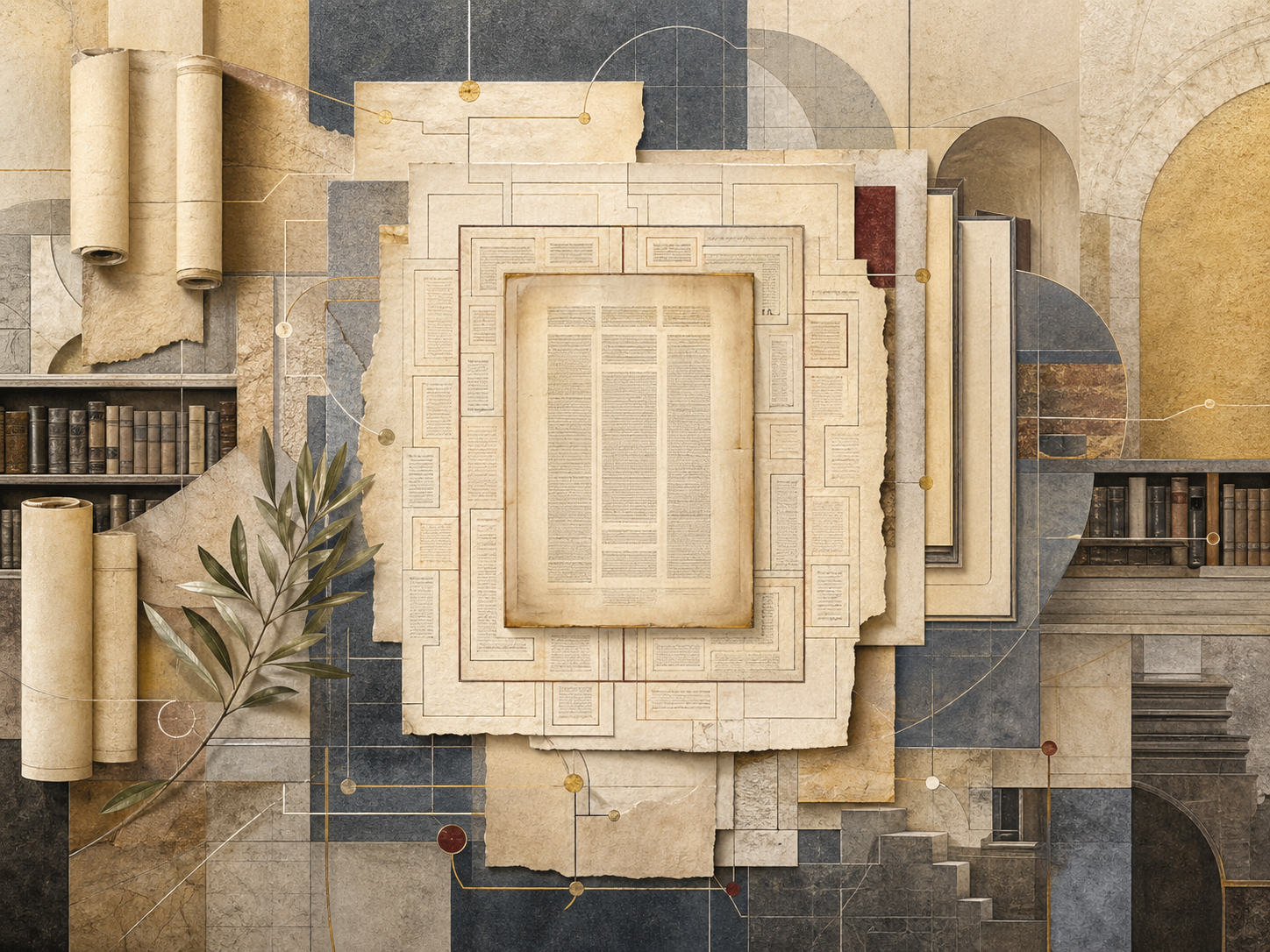
The printed page of the Babylonian Talmud became one of the most recognizable visual forms in Jewish learning. The central talmudic text is surrounded by commentaries, especially Rashi and Tosafot in many traditional editions. This page layout embodies rabbinic civilization visually: text at the center, commentary around it, later voices in conversation with earlier voices, and study as a layered encounter across time.
Printing changed access and standardization. The Bomberg Talmud printed in Venice in the sixteenth century helped establish page layouts and pagination that remain influential. Later editions, especially the Vilna Shas, became central in modern traditional study. Yet printed standardization did not eliminate interpretation. It gave communities a shared textual platform for continuing debate.
Modern digital libraries have again transformed access. Readers can now consult Tanakh, Mishnah, Talmud, midrash, commentaries, codes, and translations online. This increases accessibility, but it also requires care. Digital access can make texts visible without providing the training needed to read them well. Rabbinic literature is best approached with attention to language, genre, historical setting, traditional commentary, and scholarly method.
Scholarly Study of Rabbinic Literature
Modern scholarship studies rabbinic literature through historical, philological, literary, legal, sociological, comparative, and reception-historical methods. Scholars ask how rabbinic texts were composed, transmitted, edited, and received; how rabbinic authority developed; how legal reasoning functions; how stories of sages shape memory; how gender, class, empire, economy, and household life appear in rabbinic sources; and how rabbinic Judaism relates to other Jewish groups and surrounding cultures of late antiquity.
Philology is essential because rabbinic texts use Hebrew, Jewish Palestinian Aramaic, Jewish Babylonian Aramaic, Greek and Persian loanwords, technical terminology, and highly compressed argumentation. Legal analysis is essential because many passages cannot be understood without grasping the structure of halakhic reasoning. Literary analysis is essential because rabbinic stories are crafted, not merely reported. Historical caution is essential because rabbinic texts often preserve later literary shaping of earlier traditions.
Academic study has also emphasized that rabbinic literature is not a transparent record of all Jewish life in antiquity. Rabbinic texts reflect rabbinic circles, concerns, ideals, debates, and constructions of authority. They are invaluable, but they must be read critically. What they prescribe may not always describe what all Jews practiced. What they narrate may be shaped by literary and theological goals. Strong scholarship distinguishes text, history, norm, memory, and reception.
At the same time, scholarship should avoid reducing rabbinic literature to social data. These texts are not only evidence for history. They are works of law, theology, ethics, narrative, interpretation, and religious imagination. Their meaning lies not only behind the text but in the text and in the communities that have lived with it. A mature scholarly approach can study rabbinic literature critically while still recognizing its sacred and civilizational authority within Judaism.
Rabbinic Civilization in Abrahamic Study
Rabbinic civilization is indispensable for Abrahamic studies because it shows how a scriptural tradition becomes an interpretive civilization. Judaism cannot be understood only through the Tanakh, just as Christianity cannot be understood only through isolated New Testament passages and Islam cannot be understood only through translation of the Qur’an. Each tradition develops internal disciplines of interpretation, law, worship, theology, commentary, and communal authority. Rabbinic Judaism is one of the clearest examples of this process.
Its importance also lies in its preservation of Jewish particularity. Abrahamic comparison can be useful, but only if it does not flatten traditions into a generic monotheism. Rabbinic Judaism has its own language, methods, authorities, institutions, and assumptions. Mishnah and Talmud are not merely background to Christianity or Islam. They are central Jewish texts in their own right.
At the same time, rabbinic civilization raises questions that resonate across the Abrahamic world. How does revelation become law? How is scripture interpreted after the founding moment? How do communities preserve authority without prophecy? How does sacred memory survive displacement? How do legal systems adapt to new circumstances? How do commentary and study become forms of devotion? These questions are not identical in Judaism, Christianity, and Islam, but rabbinic literature gives one of the most sophisticated answers in religious history.
For the architecture of this knowledge series, this article completes an important movement: from Tanakh to Torah, from prophecy to exile, and from exile to rabbinic continuity. The next step within the Judaism sequence is naturally halakhah, prayer, and Jewish continuity: the lived forms through which rabbinic civilization enters daily life, communal rhythm, and historical endurance.
Why Mishnah, Talmud, and Rabbinic Civilization Matter
Mishnah, Talmud, and rabbinic civilization matter because they show how a people can survive rupture through interpretation. The destruction of the Temple, dispersion, political vulnerability, and changing historical circumstances did not end Jewish sacred life. They intensified the need for study, law, memory, prayer, and communal discipline. Rabbinic civilization answered that need by turning Torah into a portable, debated, embodied, and endlessly studied way of life.
The Mishnah matters because it gives structure to inherited teaching. The Talmud matters because it preserves the living process of interpretation. Midrash matters because it teaches how scripture can remain inexhaustible. Halakhah matters because it gives sacred form to daily conduct. Aggadah matters because it gives moral, theological, and imaginative depth to law. Study matters because it makes continuity active rather than passive.
Primary Rabbinic Text
כָּל מַחֲלוֹקֶת שֶׁהִיא לְשֵׁם שָׁמַיִם סוֹפָהּ לְהִתְקַיֵּםEvery dispute that is for the sake of Heaven is destined to endure.
Mishnah Avot 5:17, Hebrew text with English rendering.
This rabbinic saying captures one of the tradition’s central intellectual virtues: disagreement can become sacred labor when ordered toward truth, humility, and fidelity.
Rabbinic civilization also matters because it offers a model of intellectual humility and rigor. It preserves disagreement. It records unresolved debates. It trains readers to distinguish cases, question assumptions, and honor complexity. In an age that often rewards speed and simplification, the rabbinic tradition’s patience with argument remains deeply instructive.
For Abrahamic study, rabbinic Judaism is indispensable. It reveals that revelation does not become civilization automatically. It must be interpreted, taught, argued, prayed, practiced, codified, sung, mourned, and renewed. The Mishnah and Talmud are therefore not only texts. They are the architecture of a civilization of sacred learning.
Related Reading
- Abrahamic Traditions: Prophecy, Revelation, Law, and Sacred History
- Tanakh: Torah, Prophets, Writings, and Jewish Sacred Memory
- Torah, Covenant, and Commandment
- Prophecy, Exile, and Sacred Memory
- Religion and Law
- Foundations of Religion
- Comparative Sacred Themes
- Religion and Society
Further Reading
- Alexander, P.S. (2006) ‘The Talmudic Concept of Concluding a Text’, in C.E. Fonrobert and M.S. Jaffee (eds.) The Cambridge Companion to the Talmud and Rabbinic Literature. Cambridge: Cambridge University Press. Available at: https://www.cambridge.org/core/books/cambridge-companion-to-the-talmud-and-rabbinic-literature/A65A702F5D740D64F83752CB33B6E155
- Bokser, B.M. (1984) The Origins of the Seder: The Passover Rite and Early Rabbinic Judaism. Berkeley: University of California Press. Available at: https://www.ucpress.edu/book/9780520050068/the-origins-of-the-seder
- Fonrobert, C.E. and Jaffee, M.S. (eds.) (2006) The Cambridge Companion to the Talmud and Rabbinic Literature. Cambridge: Cambridge University Press. Available at: https://www.cambridge.org/core/books/cambridge-companion-to-the-talmud-and-rabbinic-literature/A65A702F5D740D64F83752CB33B6E155
- Fraade, S.D. (2011) Legal Fictions: Studies of Law and Narrative in the Discursive Worlds of Ancient Jewish Sectarians and Sages. Leiden: Brill. Available at: https://brill.com/display/title/18968
- Hayes, C. (2015) What’s Divine about Divine Law? Early Perspectives. Princeton: Princeton University Press. Available at: https://press.princeton.edu/books/hardcover/9780691165196/whats-divine-about-divine-law
- Kraemer, D. (2019) A History of the Talmud. Cambridge: Cambridge University Press. Available at: https://www.cambridge.org/core/books/history-of-the-talmud/DA64C7A062493F6CF806E9E1378D6683
- Neusner, J. (1981) Judaism: The Evidence of the Mishnah. Chicago: University of Chicago Press. Available at: https://press.uchicago.edu/ucp/books/book/chicago/J/bo5955309.html
- Safrai, S. (ed.) (1987) The Literature of the Sages. Assen: Van Gorcum. Available at: https://brill.com/display/title/1026
- Schäfer, P. (2003) The History of the Jews in the Greco-Roman World. 2nd edn. London: Routledge. Available at: https://www.routledge.com/The-History-of-the-Jews-in-the-Greco-Roman-World/Schafer/p/book/9780415305853
- Strack, H.L. and Stemberger, G. (1996) Introduction to the Talmud and Midrash. 2nd edn. Minneapolis: Fortress Press. Available at: https://www.fortresspress.com/store/product/9780800625245/Introduction-to-the-Talmud-and-Midrash
References
- Cambridge University Press (2006) The Cambridge Companion to the Talmud and Rabbinic Literature. Available at: https://www.cambridge.org/core/books/cambridge-companion-to-the-talmud-and-rabbinic-literature/A65A702F5D740D64F83752CB33B6E155
- Jewish Virtual Library (n.d.) Mishnah. Available at: https://www.jewishvirtuallibrary.org/mishnah
- Jewish Virtual Library (n.d.) The Oral Law: Talmud and Mishna. Available at: https://www.jewishvirtuallibrary.org/the-oral-law-talmud-and-mishna
- Jewish Virtual Library (n.d.) Talmud. Available at: https://www.jewishvirtuallibrary.org/talmud
- Oxford University Press (2025) The Oxford Handbook of Jewish Law. Available at: https://global.oup.com/academic/product/the-oxford-handbook-of-jewish-law-9780197508305
- Sefaria (n.d.) Mishnah. Available at: https://www.sefaria.org/texts/Mishnah
- Sefaria (n.d.) Pirkei Avot. Available at: https://www.sefaria.org/Pirkei_Avot
- Sefaria (n.d.) Talmud Bavli. Available at: https://www.sefaria.org/texts/Talmud/Bavli
- Sefaria (n.d.) Talmud Yerushalmi. Available at: https://www.sefaria.org/texts/Talmud/Yerushalmi
- Sefaria (n.d.) Midrash. Available at: https://www.sefaria.org/texts/Midrash
- Sefaria (n.d.) Midrash Rabbah. Available at: https://www.sefaria.org/texts/Midrash/Aggadah/Midrash%20Rabbah
- Sefaria (n.d.) Mishneh Torah. Available at: https://www.sefaria.org/texts/Halakhah/Mishneh%20Torah
- Sefaria (n.d.) Shulchan Arukh. Available at: https://www.sefaria.org/texts/Halakhah/Shulchan%20Arukh
- Yale University Library (2014) About the Judaic Texts. Available at: https://web.library.yale.edu/cataloging/hebraica/about-judaic-texts