
Last Updated May 5, 2026
Hud stands in Qur’anic sacred history as a prophet of monotheism, warning, moral reform, and civilizational accountability sent to the people of ‘Ad, a powerful ancient Arabian nation remembered for strength, pride, lofty structures, and rejection of divine guidance. His story is one of the Qur’an’s great accounts of a civilization that mistakes material power for moral truth. The people of ‘Ad inherit the earth after Noah’s people, receive extraordinary strength, build with grandeur, and occupy a place of sacred memory in the Arabian landscape. Yet their power does not save them when it becomes arrogance before God.
Unlike Abraham, Moses, David, Solomon, Jonah, Job, Zechariah, John, Jesus, and Muhammad, Hud does not appear as a canonical prophet in the Hebrew Bible or New Testament. He belongs to the Qur’an’s wider sacred geography, where divine guidance is not limited to Israelite history. The Qur’an remembers prophets sent to many peoples, including communities whose names are not preserved in biblical memory. Hud is therefore important because he expands Abrahamic sacred history beyond the familiar biblical corridor and shows that the One God sent warning and mercy to nations outside Israel’s textual record.
In the Qur’an, Hud’s message is simple and uncompromising: worship Allah, the One God; there is no god besides Him. He reminds ‘Ad of the bounties they have received, their succession after Noah, their strength, their gardens and springs, and their responsibility to avoid corruption. His warning is not anti-civilizational. It is not a rejection of building, strength, organization, or culture. It is a warning that civilization becomes spiritually dangerous when it confuses material capacity with moral exemption.
This article reads Hud and the people of ‘Ad through a Qur’an-centered Abrahamic lens. It treats ‘Ad not as a remote curiosity, but as a permanent warning about powerful societies that build monuments, organize wealth, dominate landscapes, and imagine themselves secure from judgment. Hud teaches that strength without gratitude becomes pride, architecture without justice becomes vanity, and civilization without worship becomes fragile before the wind of divine consequence.
Series context: This article is part of the Abrahamic Traditions: Prophecy, Revelation, Law, and Sacred History knowledge series. For the broader category structure, return to the Religious Studies category.
Qur’anic Text
وَإِلَىٰ عَادٍ أَخَاهُمْ هُودًا ۗ قَالَ يَا قَوْمِ اعْبُدُوا اللَّهَ مَا لَكُم مِّنْ إِلَٰهٍ غَيْرُهُ ۚ أَفَلَا تَتَّقُونَAnd to ‘Ad We sent their brother Hud. He said: O my people, worship Allah; you have no god besides Him. Will you not guard yourselves?Qur’an 7:65. Arabic text with English rendering.
Hud’s mission begins with kinship, warning, worship, and moral vigilance before the One God.
Hud as a Qur’anic Prophet
Hud is one of the prophets whose memory is preserved primarily through the Qur’an. He is not a biblical patriarch, Israelite prophet, king, priest, or Gospel figure. He belongs to the Qur’an’s broader map of revelation, where God’s guidance reaches peoples beyond the Hebrew Bible’s narrative frame. This makes Hud especially important for understanding Islam’s universal doctrine of prophecy.
The Qur’an does not present prophecy as the private possession of one nation. It teaches that God sent messengers to many peoples, some named and others unnamed. This principle changes the meaning of sacred history. The Bible preserves one great stream of prophetic memory; the Qur’an insists that the stream is wider. Hud stands inside that wider field.
Hud’s prophetic role is clear: he is sent to ‘Ad as their brother, meaning one of their own people, not a foreign conqueror or distant accuser. This is a major Qur’anic pattern. Prophets arise from within the moral world of the people they address. They know the people’s language, customs, strengths, and failures. They do not come to humiliate a community from outside; they come to reform it from within.
Qur’anic Text
قَالَ يَا قَوْمِ لَيْسَ بِي سَفَاهَةٌ وَلَـٰكِنِّي رَسُولٌ مِّن رَّبِّ الْعَالَمِينَ
أُبَلِّغُكُمْ رِسَالَاتِ رَبِّي وَأَنَا لَكُمْ نَاصِحٌ أَمِينٌHe said: O my people, there is no foolishness in me, but I am a messenger from the Lord of the worlds. I convey to you the messages of my Lord, and I am to you a trustworthy adviser.Qur’an 7:67–68. Arabic text with English rendering.
Hud defines prophecy as truthful counsel: not madness, not ambition, not foreign domination, but faithful warning from the Lord of the worlds.
Hud’s message is the same essential message heard across the prophetic tradition: worship the One God, abandon false worship, remember divine bounties, and stop acting corruptly. His story therefore reinforces the unity of revelation. Adam receives guidance. Noah warns before judgment. Abraham turns from idols. Moses confronts tyranny. Jesus calls the Children of Israel back to God. Muhammad completes prophetic revelation through the Qur’an. Hud belongs to this same moral and theological pattern.
His story also shows that sacred history includes nations whose memory survives as warning rather than as empire. ‘Ad is remembered because it was powerful and because it fell. Hud is remembered because he spoke truth to that power before its collapse.
The People of ‘Ad
The people of ‘Ad are presented in the Qur’an as a powerful ancient nation after Noah. They are remembered for strength, material capacity, lofty construction, and arrogance. They occupy a place in sacred history as a civilization that received divine bounties but failed to translate those bounties into gratitude and obedience.
The Qur’an calls them successors after Noah’s people. This detail is important. They come after a previous history of warning and judgment. Noah’s story should have remained a moral memory. A civilization that rises after catastrophe should know that power is not permanent and that corruption leads to ruin. Yet ‘Ad repeats the pattern of arrogance.
The people of ‘Ad are also associated with exceptional strength. The Qur’an asks readers to consider how powerful they were and how little that power saved them. Their story is not about weakness. It is about strength misread as invulnerability. They are not destroyed because they failed to build. They are destroyed because they built without humility before God.
Qur’anic Text
فَأَمَّا عَادٌ فَاسْتَكْبَرُوا فِي الْأَرْضِ بِغَيْرِ الْحَقِّ وَقَالُوا مَنْ أَشَدُّ مِنَّا قُوَّةً ۖ أَوَلَمْ يَرَوْا أَنَّ اللَّهَ الَّذِي خَلَقَهُمْ هُوَ أَشَدُّ مِنْهُمْ قُوَّةًAs for ‘Ad, they were arrogant in the land without right, and they said: Who is stronger than we are in power? Did they not see that Allah, who created them, is stronger than they are in power?Qur’an 41:15. Arabic text with English rendering.
The Qur’an identifies the spiritual disease of ‘Ad: strength becomes self-worship when a people forgets the Creator who gave it strength.
The Qur’an’s description of ‘Ad refuses the myth that success proves righteousness. A society may be materially advanced, architecturally ambitious, militarily strong, technologically capable, and socially dominant while still being morally corrupt. Its strength may even deepen its blindness because success can be mistaken for divine approval.
‘Ad therefore becomes a civilization-symbol. It is the nation that inherited power, increased in strength, built loftily, and asked who could be stronger — only to discover that no human strength can stand against the Lord of creation.
Al-Ahqaf and the Sacred Geography of Warning
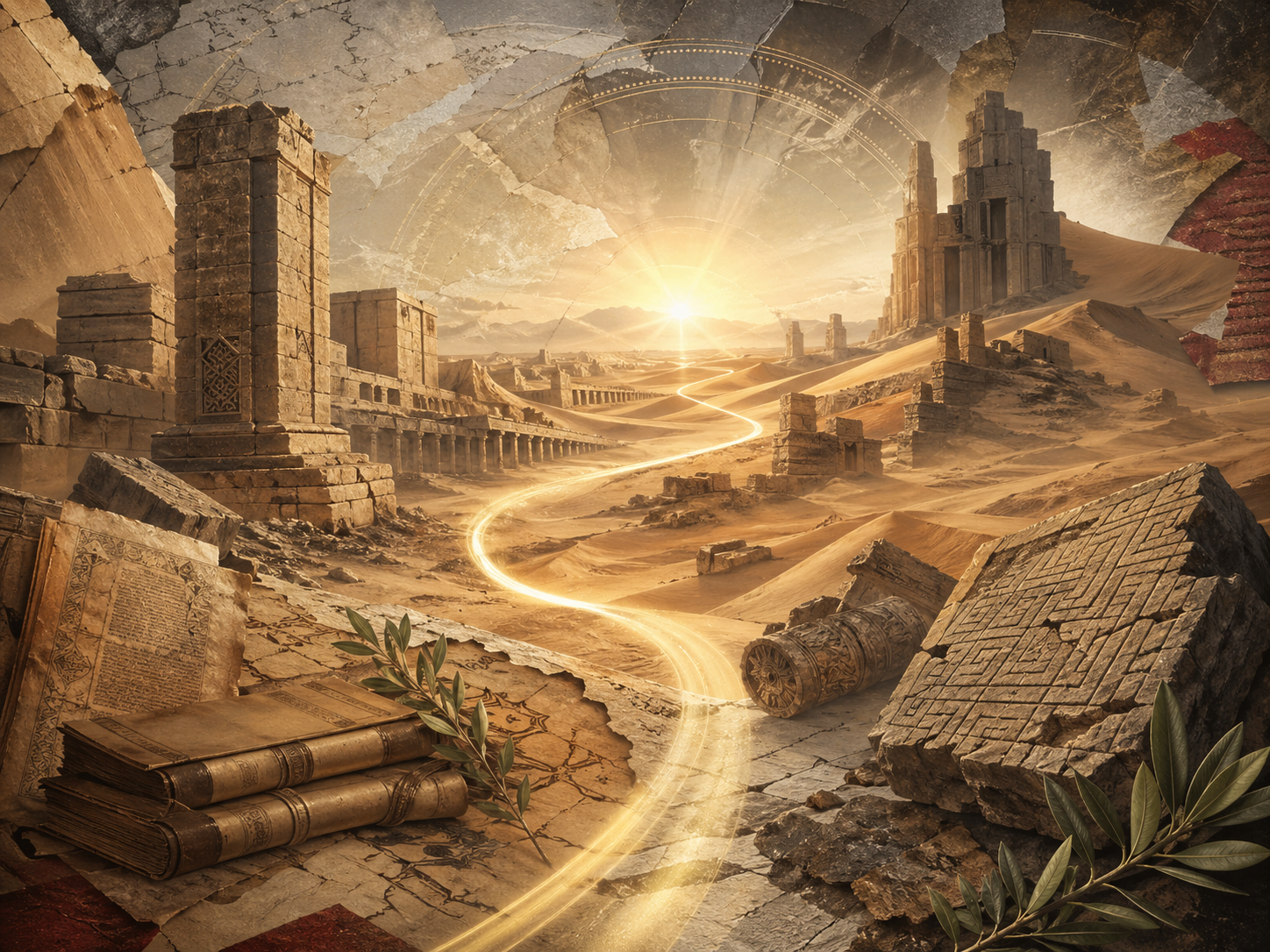
The Qur’an connects Hud’s warning with al-Ahqaf, commonly understood as a region of sand dunes in southern Arabia. This geography matters because it gives Hud’s story an Arabian sacred setting. The prophetic drama is not only in Egypt, Palestine, Sinai, Jerusalem, Babylon, or Galilee. It is also in the deserts and ancient settlements of Arabia.
Al-Ahqaf evokes a landscape of wind, sand, distance, ruin, and memory. A people once powerful can disappear beneath desert silence. Their structures may crumble, their names may become warnings, and their confidence may be preserved only as a lesson. The geography itself becomes moral pedagogy.
The Qur’an repeatedly invites human beings to travel in the earth and see the fate of those before them. Ruins are not merely archaeological remains. They are signs. The broken remains of past civilizations ask whether later peoples will understand what power could not protect.
Qur’anic Text
وَاذْكُرْ أَخَا عَادٍ إِذْ أَنذَرَ قَوْمَهُ بِالْأَحْقَافِ وَقَدْ خَلَتِ النُّذُرُ مِن بَيْنِ يَدَيْهِ وَمِنْ خَلْفِهِ أَلَّا تَعْبُدُوا إِلَّا اللَّهَAnd remember the brother of ‘Ad, when he warned his people in al-Ahqaf, while warners had passed before him and after him: Worship none but Allah.Qur’an 46:21. Arabic text with English rendering.
Al-Ahqaf gives Hud’s warning an Arabian sacred geography. The dunes become a place where memory, warning, and monotheism meet.
This sacred geography also matters for Muhammad’s first audience. The Qur’an speaks to Arabs who know desert, trade routes, tribal memory, ruins, and the danger of assuming that earlier peoples were distant myths. Hud’s story warns the Quraysh and all later societies that rejection of revelation is not new. Powerful peoples before them also rejected warning.
Al-Ahqaf therefore becomes more than a location. It is the place where the desert preserves moral memory. The wind that once destroyed ‘Ad becomes a sign for every society that builds without gratitude.
Iram, the Pillars, and the Memory of Ruin
The Qur’an also remembers ‘Ad in connection with Iram, described as possessing pillars or lofty supports. This passage has generated much interpretation because it suggests grandeur, monumentality, and an urban or architectural memory of unusual scale. Whether Iram is read as a city, a tribe, a monumental civilization, or a symbol of extraordinary built power, the moral point is clear: what seemed unmatched in the land did not survive divine judgment.
The reference to Iram should be handled carefully. It should not be forced into a simplistic archaeological claim or sensationalized as a lost-city mystery. The Qur’an’s purpose is not tourism, speculation, or antiquarian curiosity. Its purpose is warning. Iram matters because it becomes a sign of human grandeur made fragile by arrogance.
Qur’anic Text
أَلَمْ تَرَ كَيْفَ فَعَلَ رَبُّكَ بِعَادٍ
إِرَمَ ذَاتِ الْعِمَادِ
الَّتِي لَمْ يُخْلَقْ مِثْلُهَا فِي الْبِلَادِHave you not seen how your Lord dealt with ‘Ad, Iram of the pillars, the like of which had not been created in the lands?Qur’an 89:6–8. Arabic text with English rendering.
Iram intensifies the Qur’anic memory of ‘Ad: unmatched grandeur becomes a warning when civilization loses humility before God.
Iram therefore belongs with Babel, Pharaoh’s monuments, imperial capitals, and every sacred-text warning against the fantasy that height, stone, and political power can secure permanence. Built grandeur can become beautiful when ordered toward justice, shelter, worship, and public good. But it becomes spiritually dangerous when it teaches a civilization to imagine itself untouchable.
The memory of Iram is therefore not merely about the past. It asks what modern societies do with their towers, engineered landscapes, financial districts, data centers, highways, ports, military installations, and monumental cultural projects. Do they serve life, justice, worship, and stewardship? Or do they teach the builders to believe that nothing can judge them?
Successors After Noah
The Qur’an’s description of ‘Ad as successors after Noah’s people places the story inside a sequence of warning, survival, inheritance, and renewed failure. Noah’s story teaches that divine judgment does not aim at destruction for its own sake, but at the overthrow of injustice, corruption, and organized rejection of truth. The righteous are saved; the stubbornly corrupt are removed.
‘Ad inherits a world after that warning. This inheritance should have produced humility. Instead, it becomes the setting for pride. The people have strength, memory, land, and opportunity, but they do not receive these as trusts. They receive them as possession.
This pattern recurs throughout sacred history. Communities inherit divine mercy, then forget the mercy that made their existence possible. They inherit land, then imagine the land belongs to them absolutely. They inherit strength, then treat strength as proof of superiority. They inherit warning, then treat warning as irrelevant because they are not yet suffering consequence.
Qur’anic Text
وَاذْكُرُوا إِذْ جَعَلَكُمْ خُلَفَاءَ مِن بَعْدِ قَوْمِ نُوحٍ وَزَادَكُمْ فِي الْخَلْقِ بَسْطَةً ۖ فَاذْكُرُوا آلَاءَ اللَّهِ لَعَلَّكُمْ تُفْلِحُونَRemember when He made you successors after the people of Noah and increased you greatly in stature. So remember the bounties of Allah, that you may prosper.Qur’an 7:69. Arabic text with English rendering.
Hud turns inheritance into accountability. ‘Ad’s strength and succession after Noah should produce gratitude, not arrogance.
Hud’s mission therefore turns inheritance into accountability. He reminds ‘Ad that they did not create themselves, did not create their strength, did not create their land, and did not create the conditions that made civilization possible. Their position after Noah is not a license for arrogance. It is a responsibility to remember God.
The deeper lesson is that every generation lives after Noah in some sense. Every civilization inherits the remains of earlier collapses. The question is whether it learns from them.
Strength, Architecture, and Civilizational Pride
The Qur’an remembers ‘Ad through images of strength and construction. They build lofty structures, establish themselves with force, and appear to imagine that their monuments can secure permanence. Their architecture becomes a moral sign: not because building is evil, but because building can become a theater of pride.
Architecture is never neutral in sacred history. It reveals what a society loves, fears, worships, and wishes to preserve. A building can be a sanctuary, shelter, school, court, home, hospital, or public good. It can also be a monument to domination, vanity, exclusion, extraction, or the fantasy of immortality.
The people of ‘Ad seem to use architecture as proof of civilizational greatness. Their structures rise high, but their moral vision sinks low. They build as if stone can answer death, as if towers can refute judgment, as if material endurance can replace worship. This is the spiritual danger of monumentality.
Qur’anic Text
أَتَبْنُونَ بِكُلِّ رِيعٍ آيَةً تَعْبَثُونَ
وَتَتَّخِذُونَ مَصَانِعَ لَعَلَّكُمْ تَخْلُدُونَ
وَإِذَا بَطَشْتُم بَطَشْتُمْ جَبَّارِينَDo you build on every height a sign in vain, and make strongholds as though you would live forever? And when you seize, you seize as tyrants.Qur’an 26:128–130. Arabic text with English rendering.
The critique is not of building itself. It is of architecture joined to vanity, the fantasy of permanence, and violent domination.
The Qur’an’s critique does not require rejecting civilization. Islam is not anti-building, anti-city, anti-technology, or anti-order. The Qur’an’s critique is of arrogance. A society may build beautifully and justly if it remembers God, protects the vulnerable, acts with equity, and treats power as trust. But when building becomes self-worship, it becomes an idol in stone.
‘Ad therefore warns every civilization that confuses height with greatness. A tall structure does not make a society righteous. A strong wall does not protect a corrupt heart. A monument can survive its builders and still testify against them.
Hud’s Message
Hud’s message begins with divine unity: worship Allah; you have no god besides Him. This is the same essential message carried by the prophets across sacred history. Allah, in this context, should not be misunderstood as a narrow sectarian name. It is the Arabic word for God, used by Arabic-speaking Muslims and also by Arabic-speaking Christians and Jews. Hud calls his people to the One God, the Creator and Lord of all.
His message is not abstract theology only. He calls ‘Ad to moral vigilance, gratitude, and reform. He reminds them of their succession after Noah, their increase in strength, and the bounties of God. The memory of blessing is meant to produce humility. Instead, ‘Ad’s blessing has become a ground for pride.
Hud also warns against corruption in the land. This phrase is crucial. Prophetic religion is not only about correct belief in isolation from public life. False worship produces social corruption. When a people forgets God, it often begins to misuse power, exploit the weak, glorify domination, and build systems that appear stable but are morally diseased.
Qur’anic Text
فَاتَّقُوا اللَّهَ وَأَطِيعُونِ
وَاتَّقُوا الَّذِي أَمَدَّكُم بِمَا تَعْلَمُونَ
أَمَدَّكُم بِأَنْعَامٍ وَبَنِينَ
وَجَنَّاتٍ وَعُيُونٍSo guard yourselves before Allah and obey me. Guard yourselves before the One who has supplied you with what you know: He supplied you with cattle and children, gardens and springs.Qur’an 26:131–134. Arabic text with English rendering.
Hud’s warning begins from bounty. The gifts of civilization — food, family, water, settlement, and abundance — should become gratitude, not moral entitlement.
Hud’s warning also has a pastoral quality. He is not merely a judge. He is a faithful adviser. He desires his people’s reform, not their destruction. Like Noah, Abraham, Moses, Elijah, Jonah, and Muhammad, Hud warns so that repentance may become possible before judgment arrives.
The refusal of ‘Ad therefore reveals the tragedy of rejected mercy. The prophet comes before destruction, not after. Warning is itself a form of mercy. A people that rejects warning rejects the path by which it might have been spared.
No Wages and the Prophetic Integrity of Warning
Hud, like other Qur’anic prophets, insists that he asks no reward from his people. His reward is with God. This theme is repeated across prophetic history because it protects the integrity of the messenger. The prophet does not warn for money, status, patronage, political office, or personal gain.
This matters because corrupt societies often assume that every message is interest-driven. If a prophet challenges their idols, they ask what he wants. If he exposes injustice, they suspect ambition. If he calls them to God, they accuse him of seeking power. The prophet’s refusal of wages breaks that logic.
Qur’anic Text
يَا قَوْمِ لَا أَسْأَلُكُمْ عَلَيْهِ أَجْرًا ۖ إِنْ أَجْرِيَ إِلَّا عَلَى الَّذِي فَطَرَنِي ۚ أَفَلَا تَعْقِلُونَO my people, I do not ask you for any wage for this. My reward is only with the One who originated me. Will you not understand?Qur’an 11:51. Arabic text with English rendering.
Hud’s warning is not for profit, office, or social gain. The integrity of prophecy is protected by freedom from wages.
Hud’s warning cannot be dismissed as economic opportunism. He has nothing to gain from confronting the powerful people of ‘Ad except obedience to God. His speech is therefore dangerous precisely because it cannot be bought. A prophet who does not need the approval of the ruling culture cannot be controlled by it.
This also reveals a broader principle of sacred leadership. The credibility of moral warning depends on freedom from exploitation. Religious speech becomes corrupted when it is tied to greed, flattery, or institutional self-interest. Prophetic speech remains free because it answers to God.
Hud’s “no wages” stance therefore belongs to the ethics of revelation. The messenger delivers truth because truth is owed to God and to the people, not because the people pay for it.
The Charge of Madness and the Rejection of Prophets
The people of ‘Ad reject Hud’s warning and accuse him of foolishness, falsehood, or possession by one of their gods. This pattern is common in prophetic history. When a society cannot refute the moral force of a prophet’s message, it attacks the prophet’s sanity, loyalty, intelligence, or motives.
Noah is mocked. Abraham is opposed by idolaters. Moses is called a magician. Elijah faces public religious opposition. Jesus is accused by hostile authorities. Muhammad is called poet, madman, sorcerer, and fabricator by his opponents. Hud belongs to this same pattern of prophetic rejection.
The charge of madness is especially revealing. It suggests that the corrupt society treats its own assumptions as sanity. If everyone worships the idols of power, then the one who refuses appears irrational. If everyone believes strength guarantees security, then the one who warns of judgment appears deluded. If everyone trusts monuments, then the one who speaks of God’s power appears impractical.
Qur’anic Text
قَالُوا يَا هُودُ مَا جِئْتَنَا بِبَيِّنَةٍ وَمَا نَحْنُ بِتَارِكِي آلِهَتِنَا عَن قَوْلِكَ وَمَا نَحْنُ لَكَ بِمُؤْمِنِينَ
إِن نَّقُولُ إِلَّا اعْتَرَاكَ بَعْضُ آلِهَتِنَا بِسُوءٍThey said: O Hud, you have not brought us a clear proof, and we will not abandon our gods because of your word, nor will we believe you. We say only that one of our gods has afflicted you with evil.Qur’an 11:53–54. Arabic text with English rendering.
The rejection of Hud becomes psychological and religious accusation. A society attached to its idols treats prophetic clarity as affliction.
Prophets often appear strange to the societies they are sent to because prophetic truth breaks the spell of normal corruption. Hud is not mad because he rejects ‘Ad’s arrogance. ‘Ad is morally disordered because it treats arrogance as wisdom.
This remains a modern danger. Societies still pathologize voices that warn against injustice, ecological ruin, militarism, greed, cruelty, or idolatrous nationalism. The prophet’s task is not to appear reasonable within a corrupt moral order. It is to speak truth before God.
The Wind as Judgment
The Qur’an remembers the destruction of ‘Ad through a violent wind. The image is powerful because wind is both invisible and irresistible. Human beings can build stone, raise monuments, establish fortifications, and organize armies, but they cannot command the forces of creation when God turns them into judgment.
The wind exposes the fragility of ‘Ad’s confidence. Their strength had made them arrogant. Their structures had made them feel secure. Their civilization had made them imagine permanence. Then the wind came, and what seemed solid was shown to be vulnerable.
This does not mean that every storm or disaster should be simplistically interpreted as divine punishment. Sacred texts must not be used carelessly to accuse victims of catastrophe. The Qur’anic story of ‘Ad is a revealed moral narrative about a specific people, a specific prophet, and a specific rejection of warning. Its lesson is theological and ethical, not a license for cruel speculation about every disaster.
Qur’anic Text
فَلَمَّا رَأَوْهُ عَارِضًا مُّسْتَقْبِلَ أَوْدِيَتِهِمْ قَالُوا هَـٰذَا عَارِضٌ مُّمْطِرُنَا ۚ بَلْ هُوَ مَا اسْتَعْجَلْتُم بِهِ ۖ رِيحٌ فِيهَا عَذَابٌ أَلِيمٌWhen they saw it as a cloud advancing toward their valleys, they said: This is a cloud bringing us rain. Rather, it is what you sought to hasten: a wind in which there is painful punishment.Qur’an 46:24. Arabic text with English rendering.
‘Ad misreads judgment as blessing. The cloud they welcome as rain becomes the wind that exposes the fragility of their confidence.
Still, the symbol of wind remains profound. Wind is creation beyond human control. It can refresh, carry seed, move clouds, and sustain life. It can also uproot, scatter, erode, and destroy. The same created order that human beings treat as background can become the medium through which their illusions collapse.
Qur’anic Text
وَأَمَّا عَادٌ فَأُهْلِكُوا بِرِيحٍ صَرْصَرٍ عَاتِيَةٍ
سَخَّرَهَا عَلَيْهِمْ سَبْعَ لَيَالٍ وَثَمَانِيَةَ أَيَّامٍ حُسُومًاAnd as for ‘Ad, they were destroyed by a furious, roaring wind. He imposed it upon them for seven nights and eight days, devastating.Qur’an 69:6–7. Arabic text with English rendering.
The destruction of ‘Ad reverses their boast of strength. The power they trusted cannot stand before a created force commanded by God.
For ‘Ad, the wind becomes judgment because they refused the warning that would have saved them. The catastrophe is not arbitrary. It follows the rejection of truth, the abuse of power, and the refusal to remember God.
Civilization Without Gratitude
The central moral problem of ‘Ad is civilization without gratitude. They receive strength, land, memory, architecture, and social power, but they do not translate these gifts into worship. Their gifts become proof of their own greatness rather than signs of God’s bounty.
Gratitude is not merely emotional appreciation. In the Qur’anic worldview, gratitude is an entire moral orientation. To be grateful is to recognize the source of blessing, use blessing rightly, restrain arrogance, care for others, and live under accountability. A grateful civilization treats power as trust. An ungrateful civilization treats power as entitlement.
‘Ad is destroyed not because it has buildings, but because its building is unmoored from gratitude. It is not condemned for strength, but for arrogance in strength. It is not warned because it is successful, but because success has become spiritually dangerous.
This makes Hud’s story one of the Qur’an’s most important accounts of civilizational ethics. The question is not only whether individuals pray. The question is what a society does with its collective power. Does it build structures of justice or domination? Does it protect the vulnerable or exalt the strong? Does it remember God or worship itself?
Civilization without gratitude eventually becomes brittle. It may look powerful from outside, but inwardly it is already exposed. The wind only reveals what was spiritually true before it arrived.
The opposite of ‘Ad is not weakness. The opposite of ‘Ad is grateful strength: power that remembers its source, construction that serves life, leadership that restrains domination, and abundance that becomes mercy rather than entitlement.
Hud and the Universality of Prophecy
Hud’s story is essential for understanding the Qur’an’s universal vision of prophecy. If sacred history were limited only to figures preserved in the Bible, then whole peoples and regions would appear outside divine concern. The Qur’an rejects that narrowing. It names prophets not known from the biblical record and insists that God’s guidance reached many nations.
This has major interfaith importance. Islam does not see revelation as a single ethnic archive. It sees revelation as a universal mercy. Some prophets are known by name; others are unknown. Some are preserved in Jewish and Christian scripture; others are preserved only in the Qur’an; still others are known only to God. The principle is that no people is abandoned by the Lord of all worlds.
Qur’anic Text
وَلِكُلِّ أُمَّةٍ رَّسُولٌ ۖ فَإِذَا جَاءَ رَسُولُهُمْ قُضِيَ بَيْنَهُم بِالْقِسْطِ وَهُمْ لَا يُظْلَمُونَFor every community there is a messenger; when their messenger comes, judgment is made between them with justice, and they are not wronged.Qur’an 10:47. Arabic text with English rendering.
Hud’s story belongs to this universal doctrine of prophecy. Divine guidance is not confined to one people’s textual memory.
Hud therefore widens the Abrahamic imagination. He belongs to Arabia, to non-Israelite sacred history, and to the moral memory of nations outside the biblical canon. His story says that God’s warning and mercy are not confined to one textual lineage.
This does not erase the special roles of Israelite prophecy, the Gospel, or the Qur’an. Rather, it places them within a larger divine pattern. The same God who sends Moses to Pharaoh sends Hud to ‘Ad. The same moral law applies: worship God, reject corruption, remember bounties, and heed warning.
The universality of prophecy also creates humility. No community can claim that God’s guidance belongs only to itself. Every people stands under the same divine accountability.
Hud and Muhammad
Hud’s story also speaks directly to the mission of Muhammad. The Qur’an often retells earlier prophetic histories to comfort, warn, and instruct the Prophet and his community. The pattern is clear: a messenger comes with truth; the people reject him; the powerful mock him; warning is dismissed; God vindicates the messenger; opposition eventually fails.
For Muhammad’s Makkan opponents, Hud and ‘Ad would have been an especially relevant warning. ‘Ad was not a distant Israelite example. It belonged to Arabian sacred memory. The message was unmistakable: powerful Arab peoples before Quraysh had rejected warning and fallen. Makkah’s wealth, sanctuary status, tribal prestige, and commercial power would not protect it from accountability.
Hud also prefigures Muhammad in his rejection of wages, his call to pure monotheism, his endurance under accusation, and his warning against idolatry and moral corruption. Yet Muhammad’s mission is final and universal in a way Hud’s mission is not. Hud is sent to ‘Ad; Muhammad is sent with the final revelation for humanity.
The relationship between Hud and Muhammad therefore shows continuity and culmination. Hud belongs to the long chain of warning prophets. Muhammad receives the Qur’an that preserves Hud’s memory and universalizes its lesson.
This is one reason the Qur’an’s retelling of Hud matters. It is not antiquarian history. It is revelation addressing the present through the past. Every society that hears Hud’s story becomes another audience of Hud’s warning.
Hud as Sacred Anthropology
Hud belongs to sacred anthropology because his story reveals the human community under conditions of power, inheritance, monumentality, and denial. Adam reveals humanity as created and guided. Noah reveals warning before collapse. Abraham reveals faith against idolatry. Moses reveals liberation from tyranny. David and Solomon reveal power tested by kingship and splendor. Muhammad reveals final revelation as recited guidance. Hud reveals the human civilization that mistakes strength for exemption from God.
The people of ‘Ad are not ignorant in the simple sense. They have memory, land, capacity, social organization, architecture, and confidence. Their problem is not lack of ability; it is misdirected ability. They can build, dominate, organize, and boast. What they cannot do is turn power into gratitude.
This makes Hud one of the Qur’an’s strongest witnesses to the psychology of civilization. Civilizations do not usually fall into arrogance because they feel weak. They fall into arrogance because they feel strong. Success becomes proof of superiority. Architecture becomes proof of permanence. Wealth becomes proof of favor. Dominance becomes proof of truth.
Hud’s warning breaks that anthropology open. The human being is not made safe by strength. A society is not made righteous by height. A civilization is not made permanent by monuments. The human creature remains dependent, and the human collective remains accountable.
As sacred anthropology, Hud teaches that the deepest danger is not weakness, but strength without worship. A weak person may cry out to God. A strong civilization may forget that it has any need to pray.
Hud also reveals the anthropology of warning. Human beings often receive mercy as interruption. The prophet disrupts the story a society tells about itself. ‘Ad says: we are strong. Hud says: your strength is a gift. ‘Ad says: we are secure. Hud says: you are accountable. ‘Ad says: our monuments prove greatness. Hud says: your monuments may testify against you.
Marginalized Voices: Nonbiblical Memory, Desert Peoples, and the Victims of Arrogant Civilization
Hud is important for foregrounding marginalized voices because he represents a form of sacred memory outside the biblical canon. A comparative Abrahamic project can easily become organized around texts and peoples preserved by dominant scriptural traditions alone. Hud resists that narrowing. He shows that Qur’anic sacred history includes peoples, prophets, landscapes, and moral memories beyond the standard biblical corridor.
This does not mean that Jewish or Christian readers must retroactively insert Hud into their own canon. It means that Islamic sacred history preserves a different and wider map of divine warning. The absence of a prophet from one textual tradition does not mean absence from God’s concern. Hud therefore gives voice to the possibility that forgotten peoples, desert peoples, and non-imperial archives also belong within sacred history.
The people most harmed by arrogant civilizations are often not those who build the monuments, but those used, displaced, disciplined, or erased by them. The Qur’an’s critique of ‘Ad’s tyrannical seizure points toward the victims of civilizational pride: laborers, the poor, the conquered, the socially weak, and the communities treated as raw material for elite grandeur.
Hud’s story also speaks to ecological vulnerability. The wind that destroys ‘Ad is not a decorative miracle. It is the created order becoming the medium of moral consequence. Modern readers should not turn this into simplistic disaster-blaming, but they should hear the warning: societies that dominate landscapes without gratitude, restraint, or stewardship may discover that the earth is not inert matter beneath human ambition.
From the perspective of marginalized voices, Hud’s story matters because powerful societies often control the archive. They build the monuments, write the inscriptions, name the victories, and define public memory. The Qur’an reverses that power. It remembers ‘Ad not as it wished to be remembered, but as revelation remembers it: a strong people warned by a prophet and undone by arrogance.
Hud therefore teaches that sacred memory can preserve the moral truth of those whom empires and monumental societies try to silence. The prophet’s warning survives where the civilization’s boast collapses.
Jewish, Christian, Sunni, Shia, and Ahmadi Perspectives
Jewish and Christian traditions do not preserve Hud as a canonical prophet. This absence should be treated carefully. It does not make Hud insignificant within Islam, nor does it require Jews or Christians to receive him as part of their own scriptural canon. It simply marks a difference in sacred memory. From a comparative perspective, Hud shows that Qur’anic sacred history includes prophets outside the biblical record.
For Jewish and Christian readers, Hud may be approached as an Islamic witness to a universal prophetic principle: God’s moral concern extends beyond one nation, and powerful societies are accountable to divine justice. Even where Hud is not accepted as a biblical prophet, the themes of his story resonate with biblical prophetic critiques of arrogance, empire, false worship, and social corruption.
Sunni Islamic tradition honors Hud as a prophet sent to ‘Ad. His story is read as a warning against shirk, arrogance, rejection of messengers, and confidence in worldly power. The destruction of ‘Ad by wind becomes a Qur’anic sign of divine judgment after warning is rejected.
Shia perspectives also honor Hud as a prophet within the chain of divine guidance. His opposition to a powerful, arrogant people resonates with broader themes of truth against corrupt authority, divine proof against denial, and the vindication of God’s servants against worldly domination.
Lahore Ahmadiyya interpretation emphasizes the Qur’an’s moral purpose in prophetic narratives. The point is not to satisfy curiosity about ancient detail, but to show how prophets establish truth, call people to the One God, and uproot evil. Hud and ‘Ad are therefore read less as legend and more as a moral pattern: power without righteousness collapses, and warning is mercy before judgment.
Across these perspectives, Hud remains especially important because he breaks the assumption that Abrahamic sacred history must be identical with biblical sacred history. In Islamic memory, the One God is not the Lord of one archive only. God sends messengers to nations known and unknown, preserved and forgotten, central and peripheral.
Why Hud and ‘Ad Matter Today
Hud and ‘Ad matter today because modern civilization is haunted by the same illusion that destroyed ‘Ad: the belief that strength can replace righteousness. Contemporary societies build higher, move faster, calculate more, extract more, surveil more, manufacture more, and command more than any ancient people could have imagined. Yet the moral question remains unchanged: what is all this power for?
They matter because architecture and infrastructure still become monuments to pride. Cities, towers, ports, data centers, highways, financial districts, military bases, and digital platforms can serve human dignity, but they can also become signs of domination, vanity, inequality, and ecological disregard. Hud asks whether our building is grateful or arrogant.
They matter because climate and ecological fragility have made the image of wind newly urgent. Sacred texts should not be used crudely to explain disasters as punishments. But ‘Ad’s story does warn that societies are never as separate from creation as they imagine. A civilization that exploits land, air, water, and climate while boasting of its strength may discover that the created order cannot be treated as a passive backdrop forever.
They matter because public arrogance still silences warning. Prophets, reformers, scientists, moral witnesses, and truth-tellers are often dismissed as foolish, extreme, disloyal, pessimistic, or mad when they challenge a dominant system’s self-confidence. ‘Ad’s rejection of Hud shows how civilizations protect their illusions by attacking the messenger.
They matter because memory itself is fragile. ‘Ad was once powerful enough to boast. Now it survives as warning. That is one of sacred history’s most sobering reversals. The civilization that thought itself permanent becomes a lesson recited by others.
The final lesson of Hud and the people of ‘Ad is that civilization is judged by gratitude, justice, and worship, not by height, force, or spectacle. A society may become strong, build greatly, and dominate its landscape, but if it forgets the One God and corrupts the earth, its strength becomes evidence against it. Hud’s warning still stands: remember the bounties of God, abandon arrogance, and do not make corruption in the land.
Comparative Cautions
Several cautions are necessary. First, Hud should be presented as a Qur’anic prophet, not retroactively forced into Jewish or Christian canon. His importance belongs to Islamic sacred history, while his themes can still be compared with wider Abrahamic prophetic concerns.
Second, ‘Ad should not be treated as a sensational lost-civilization mystery. Archaeology, geography, and historical memory are relevant, but the Qur’an’s primary purpose is moral warning, not speculative reconstruction.
Third, the story should not be used to interpret every windstorm, drought, hurricane, or disaster as punishment. The Qur’anic account is a revealed narrative about a specific people who rejected a specific prophet. Modern applications should be ethical and reflective, not accusatory toward victims.
Fourth, the critique of architecture should not become anti-civilizational. The Qur’an does not condemn building as such. It condemns vanity, domination, and the fantasy of permanence when building is severed from gratitude and justice.
Fifth, the people of ‘Ad should not be used as a racialized or civilizational stereotype. They are a sacred-history warning about arrogance, not a tool for contempt toward any modern people.
Sixth, Hud’s nonbiblical status should be framed constructively. His story widens sacred geography and helps show that Qur’anic revelation preserves prophetic memories beyond the Bible.
Seventh, original-language quotations should support close reading. Arabic should be used where it clarifies the Qur’anic argument, not merely as ornament.
Finally, Hud should challenge the reader morally. The question is not only what happened to ‘Ad. The question is where contemporary societies repeat ‘Ad’s pattern: strength without gratitude, building without justice, power without humility, and warning dismissed as madness.
Why This Article Matters
Hud matters because he widens the Abrahamic map. Sacred history does not belong only to the biblical corridor, and divine warning is not limited to the peoples whose records are most familiar to Jewish and Christian readers. The Qur’an remembers Hud because the One God’s mercy and warning extend beyond one archive.
This article matters because ‘Ad is one of the Qur’an’s most powerful civilization-parables. Noah warns before flood. Abraham confronts idols. Moses confronts Pharaoh. Jonah confronts resentment before mercy. Muhammad confronts idolatry and completes revelation. Hud confronts a strong civilization that believes its strength can protect it from God.
For the Abrahamic Traditions knowledge series, this article builds on Noah / Nuh, Judgment, and Survival, Muhammad and the Completion of Prophetic Revelation, Jesus / ‘Isa in Biblical and Qur’anic Sacred History, Job / Ayyub and the Trial of Suffering, Jonah / Yunus, Repentance, and Mercy, and What Is Prophecy in the Abrahamic Traditions?. It prepares later articles on Salih and Thamud, Shu‘ayb and Madyan, Arabian sacred geography, Qur’anic warning narratives, and the moral meaning of destroyed civilizations.
Seen from the perspective of marginalized voices, this article matters because Hud preserves a nonbiblical prophetic memory, gives sacred importance to Arabian landscapes, and warns against civilizations that turn power into domination. The victims of arrogant societies are often forgotten by the monuments those societies build. Revelation remembers differently.
The final value of Hud’s story is that it teaches civilizational humility. Strength is not security. Height is not righteousness. Monuments are not immortality. The people of ‘Ad thought power made them untouchable; Hud taught that power is accountable. That warning still speaks wherever societies build greatly but forget the One God, the vulnerable, and the moral limits of human power.
Related Reading
- Muhammad and the Completion of Prophetic Revelation
- Jesus / ‘Isa in Biblical and Qur’anic Sacred History
- Job / Ayyub and the Trial of Suffering
- Jonah / Yunus, Repentance, and Mercy
- Elijah / Ilyas and the Prophetic Contest
- Noah / Nuh, Judgment, and Survival
- Adam in the Bible and the Qur’an
- What Is Prophecy in the Abrahamic Traditions?
- Monotheism, Revelation, and Sacred History
- The Promise of the Abrahamic Frame: One God, Shared Revelation, and Sacred History
- Abrahamic Traditions: Prophecy, Revelation, Law, and Sacred History
- Foundations of Religion
- Religion and Ecology
- Comparative Sacred Themes
Further Reading
- Ali, M.M. (n.d.) History of the Prophets. Lahore: Ahmadiyya Anjuman Isha‘at Islam. Available at: https://www.alahmadiyya.org/books-islam-ahmadiyya/english-books/history-of-the-prophets/
- Ali, M.M. (2010) English Translation of the Holy Quran with Explanatory Notes. Edited by Zahid Aziz. Wembley: Ahmadiyya Anjuman Lahore Publications. Available at: https://www.ahmadiyya.org/quran/english-quran-with-short-commentary.htm
- Armstrong, K. (1993) A History of God: The 4,000-Year Quest of Judaism, Christianity and Islam. New York: Knopf. Available at: https://www.penguinrandomhouse.com/
- Berkey, J.P. (2003) The Formation of Islam: Religion and Society in the Near East, 600–1800. Cambridge: Cambridge University Press. Available at: https://www.cambridge.org/
- Hoyland, R.G. (2001) Arabia and the Arabs: From the Bronze Age to the Coming of Islam. London: Routledge. Available at: https://www.routledge.com/
- Lecker, M. (1995) Muslims, Jews and Pagans: Studies on Early Islamic Medina. Leiden: Brill. Available at: https://brill.com/
- Nasr, S.H. et al. (eds.) (2015) The Study Quran: A New Translation and Commentary. New York: HarperOne. Available at: https://www.harpercollins.com/
- Neuwirth, A. (2019) The Qur’an and Late Antiquity: A Shared Heritage. Oxford: Oxford University Press. Available at: https://global.oup.com/
- Robin, C.J. (2015) ‘Arabia and Ethiopia’, in Johnson, S.F. (ed.) The Oxford Handbook of Late Antiquity. Oxford: Oxford University Press. Available at: https://global.oup.com/
- Sinai, N. (2017) The Qur’an: A Historical-Critical Introduction. Edinburgh: Edinburgh University Press. Available at: https://edinburghuniversitypress.com/
References
- Ali, M.M. (n.d.) History of the Prophets. Lahore: Ahmadiyya Anjuman Isha‘at Islam. Available at: https://www.alahmadiyya.org/books-islam-ahmadiyya/english-books/history-of-the-prophets/
- Ali, M.M. (2010) English Translation of the Holy Quran with Explanatory Notes. Edited by Zahid Aziz. Wembley: Ahmadiyya Anjuman Lahore Publications. Available at: https://www.ahmadiyya.org/quran/english-quran-with-short-commentary.htm
- Quran.com (n.d.) Surah Al-A‘raf 7:65–72. Available at: https://quran.com/7/65-72
- Quran.com (n.d.) Surah Yunus 10:47. Available at: https://quran.com/10/47
- Quran.com (n.d.) Surah Hud 11:50–60. Available at: https://quran.com/11/50-60
- Quran.com (n.d.) Surah Ash-Shu‘ara 26:123–140. Available at: https://quran.com/26/123-140
- Quran.com (n.d.) Surah Fussilat 41:15–16. Available at: https://quran.com/41/15-16
- Quran.com (n.d.) Surah Al-Ahqaf 46:21–26. Available at: https://quran.com/46/21-26
- Quran.com (n.d.) Surah Adh-Dhariyat 51:41–42. Available at: https://quran.com/51/41-42
- Quran.com (n.d.) Surah An-Najm 53:50. Available at: https://quran.com/53/50
- Quran.com (n.d.) Surah Al-Qamar 54:18–21. Available at: https://quran.com/54/18-21
- Quran.com (n.d.) Surah Al-Haqqah 69:6–8. Available at: https://quran.com/69/6-8
- Quran.com (n.d.) Surah Al-Fajr 89:6–8. Available at: https://quran.com/89/6-8
- Ahmad, H.M.G. (2003) The Ark of Noah. Trinidad and Tobago: Muslim Literary Trust. Available at: https://www.alahmadiyya.org/books-islam-ahmadiyya/english-books/the-ark-of-noah/
- Al-Islam.org (n.d.) Ahlul Bayt Digital Islamic Library Project. Available at: https://www.al-islam.org/
- Sunnah.com (n.d.) Hadith Collections. Available at: https://sunnah.com/
- Sefaria (n.d.) Jewish Texts and Rabbinic Interpretation. Available at: https://www.sefaria.org/texts