
Last Updated May 28, 2026
Moral failure does not always occur because people openly reject morality. Often it occurs because they remain attached to a moral self-image while cognitively restructuring their conduct so that it no longer feels fully wrong. This is the core insight of moral disengagement theory. Albert Bandura’s classic account argues that people can deactivate moral self-sanctions through a set of cognitive mechanisms that make harmful conduct appear acceptable, necessary, deserved, minimized, invisible, or someone else’s responsibility.
This matters because ethical failure is rarely experienced from the inside as simple villainy. More often it is accompanied by justification, euphemism, comparison, responsibility shifting, consequence distortion, victim blaming, dehumanization, or institutional scripts that make wrongdoing feel ordinary. In that sense, moral disengagement helps explain how ordinary persons can participate in harmful systems, harmful organizations, harmful group behavior, and harmful interpersonal acts without experiencing themselves as straightforwardly immoral.
This article argues that moral disengagement is one of the central mechanisms through which ethical self-regulation fails. It does not abolish morality; it reroutes it. People continue to believe in fairness, care, responsibility, dignity, and decency, but the relevant act, victim, consequence, or responsibility is cognitively reframed so that those standards no longer exert their full force. Ethical failure becomes possible not because moral judgment disappears, but because moral attention, moral language, and moral accountability are reorganized around self-protection, group loyalty, institutional pressure, and emotional distance from harm.
Main Library
Publications
Article Map
Moral Psychology
Related Topic
Social Psychology
Related Topic
Organizational Psychology
Related Topic
Ethics & Moral Philosophy
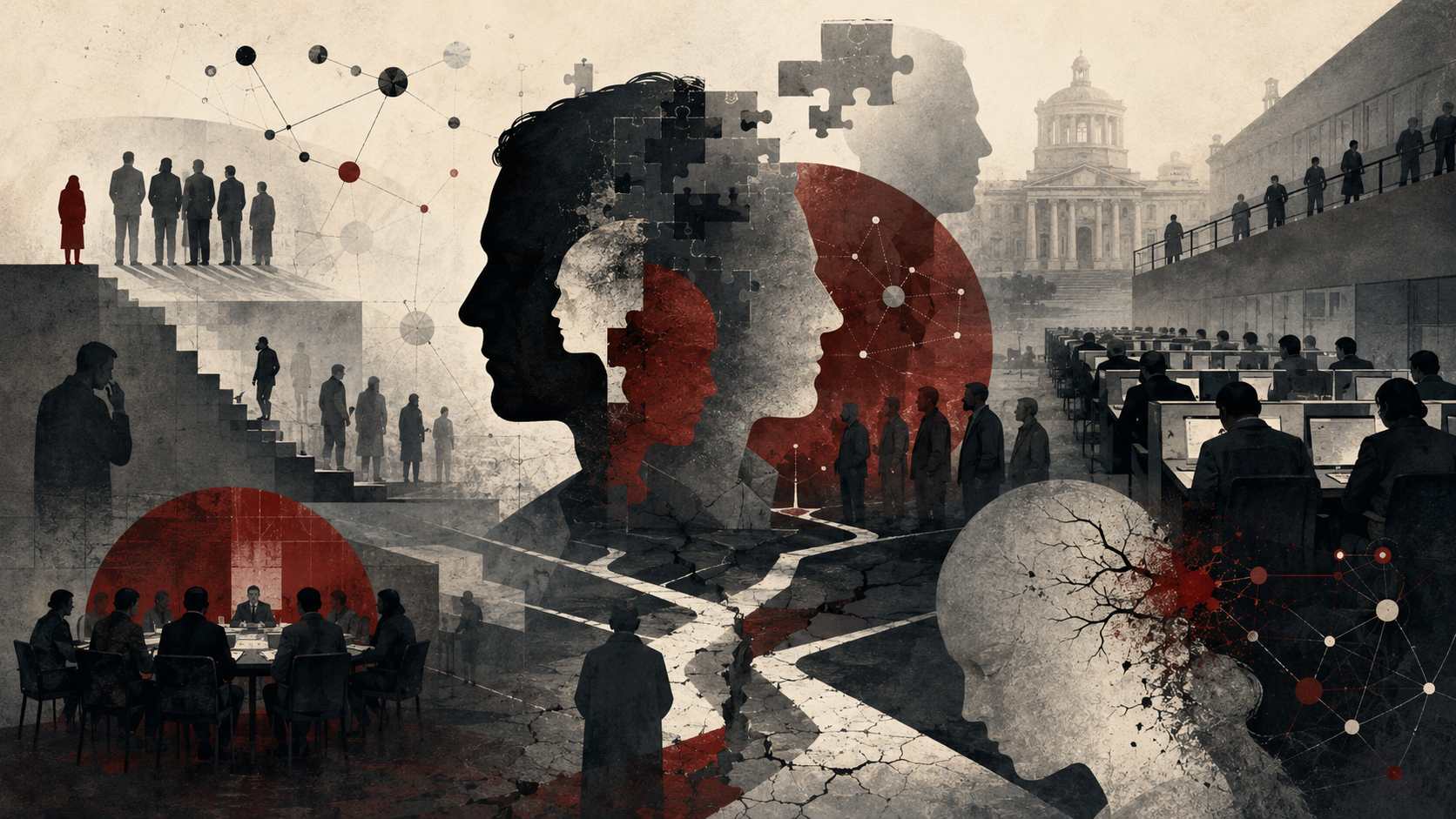
Moral disengagement belongs near the center of moral psychology because it explains a disturbing and common feature of ethical life: people often do wrong while continuing to experience themselves as decent. They may lie while calling it strategic communication, harm others while calling it enforcement, abandon responsibility while calling it policy, punish vulnerable people while calling it order, or participate in cruel systems while telling themselves they are only doing their job. The moral self is not always defeated by temptation; sometimes it is persuaded, bypassed, or anesthetized.
That makes moral disengagement different from a simple lack of morality. The person who morally disengages may still care about morality in the abstract. They may still value fairness, loyalty, care, duty, and respect. What changes is the interpretation of the concrete situation. The act is redescribed, the victim is downgraded, the consequence is minimized, the responsibility is displaced, or the comparison is altered so that the actor’s moral self-sanctions no longer activate with the same force. Ethical failure becomes psychologically livable.
What Moral Disengagement Is
Moral disengagement refers to cognitive mechanisms that decouple internal moral standards from behavior, allowing people to engage in wrongdoing without experiencing the full force of guilt, shame, self-condemnation, or moral alarm. Bandura’s 1999 article remains the foundational statement of the theory, and later review work has summarized moral disengagement as a set of mechanisms through which people disconnect action from moral self-regulation.
The key point is that moral disengagement does not require abandoning morality altogether. Instead, it works by altering how the act, the victim, the consequences, or the agent’s own role are interpreted. A harmful action may be framed as serving a higher purpose. A cruel policy may be described in sanitized language. A damaging decision may be compared to something worse. A victim may be blamed, dehumanized, or rendered invisible. Responsibility may be shifted upward, downward, outward, or into the system.
Ethical failure thus becomes psychologically easier not because people cease caring about morality in the abstract, but because they cognitively rearrange the situation so that moral rules no longer seem to apply in the same way. A person may still think cruelty is wrong, but not see their own act as cruel. They may still think responsibility matters, but not see themselves as responsible. They may still think human dignity matters, but not treat the harmed person as fully entitled to dignity.
Moral disengagement is therefore a theory of moral evasion. It asks how the moral self avoids its own standards without giving them up. It is especially important for understanding ordinary participation in harmful organizations, bureaucracies, markets, political movements, online cultures, institutional routines, and social hierarchies where wrongdoing is shared, normalized, or hidden behind procedure.
| Element | Meaning | Ethical risk |
|---|---|---|
| Moral standard | The actor’s internal sense of what is right, wrong, acceptable, or shameful | Standards may remain abstract while being disabled in concrete cases. |
| Self-sanction | Guilt, shame, self-condemnation, or moral discomfort that restrains wrongdoing | Self-sanctions can be weakened by justification, distance, and responsibility shifting. |
| Cognitive restructuring | Reframing conduct so it appears acceptable, necessary, or minor | Wrongdoing becomes morally tolerable without being named as wrongdoing. |
| Responsibility evasion | Moving agency onto orders, systems, groups, roles, or circumstances | Actors feel like instruments rather than responsible agents. |
| Victim distancing | Reducing the visibility, humanity, credibility, or moral claim of the harmed person | Empathy and restraint weaken when the victim is abstracted or dehumanized. |
Why Ethical Failure Needs Explanation
Ethical failure needs explanation because many harmful acts are carried out by people who still think of themselves as decent. That fact creates a persistent puzzle in moral psychology: how do persons who value fairness, care, honesty, loyalty, responsibility, or dignity participate in cruelty, exploitation, deception, exclusion, or institutional harm without collapsing under self-condemnation? Moral disengagement theory addresses exactly this puzzle by identifying the cognitive routes through which wrongdoing becomes tolerable to the self.
The simplest account of wrongdoing says that bad people do bad things because they lack moral concern. Sometimes that is true. Some persons may be callous, cruel, exploitative, sadistic, or indifferent. But many ethical failures occur among people who do have moral concerns, moral identities, religious commitments, professional codes, institutional values, or public ideals. They do not always experience themselves as enemies of morality. They experience themselves as practical, loyal, pressured, necessary, realistic, strategic, compliant, or justified.
This is one reason the framework has become influential in studies of unethical decision-making, organizational misconduct, aggression, bullying, corruption, harmful collective behavior, and institutional cruelty. It helps explain not only dramatic wrongdoing, but ordinary ethical slippage: cutting corners, rationalizing deception, mistreating outgroups, overlooking harm, participating in exploitative systems, and adapting to structures that diffuse responsibility so effectively that no single actor feels fully accountable.
Moral disengagement also explains why ethical failure can spread. Once a group, profession, workplace, political movement, bureaucracy, or platform normalizes a certain set of justifications, individuals do not need to invent their own rationalizations. They inherit them. The language, comparisons, responsibility shifts, and victim-blaming scripts are already available. Ethical failure becomes culturally supplied.
| Question | Simple answer | Moral disengagement answer |
|---|---|---|
| Why do decent people do harmful things? | They were not really decent. | They may preserve moral self-image by restructuring the meaning of their conduct. |
| Why does guilt fail to stop wrongdoing? | The person lacks guilt. | Self-sanctions may be deactivated before guilt fully appears. |
| Why do organizations normalize harm? | Bad leaders make bad choices. | Language, hierarchy, incentives, and responsibility diffusion can make harm feel procedural. |
| Why do groups excuse their own harms? | They are biased. | Group loyalty supplies moral justification, advantageous comparison, and victim blame. |
| Why does ethical failure persist? | People refuse morality. | They may maintain moral language while disabling its application. |
Bandura’s Core Framework
Bandura’s framework is usually organized around eight mechanisms: moral justification, euphemistic labeling, advantageous comparison, displacement of responsibility, diffusion of responsibility, disregarding or distorting consequences, dehumanization, and attribution of blame to victims. Together they weaken the self-regulatory processes that would otherwise produce guilt, shame, self-condemnation, or restraint.
The structure is important because it shows that ethical failure is not usually the result of one single distortion. Several mechanisms can operate together. A harmful act may be described in sanitized language, framed as necessary for a higher purpose, embedded in a hierarchy that displaces agency, compared favorably to something worse, directed at persons treated as less worthy of concern, and followed by a narrative that blames the victims for provoking what happened. The combined effect is a moral atmosphere in which wrongdoing feels strangely normal.
Bandura’s framework also shows that moral disengagement can occur at several points in the moral action sequence. The act itself can be reconstructed as moral or necessary. The agent’s responsibility can be obscured or displaced. The consequences can be minimized or ignored. The victim can be dehumanized or blamed. The actor does not need to disable every moral pathway. It may be enough to block one or two critical routes by which moral self-sanction would otherwise become unavoidable.
This is why moral disengagement is so useful for understanding complex harm. It does not reduce ethical failure to one cause. It gives a map of multiple cognitive exits from accountability. Each exit protects the actor from fully feeling the contradiction between professed moral standards and harmful conduct.
| Mechanism | How it works | Typical moral effect |
|---|---|---|
| Moral justification | Frames harmful conduct as serving a worthy or necessary purpose | The act appears noble, protective, patriotic, efficient, or morally required. |
| Euphemistic labeling | Uses sanitized language to soften the moral meaning of harm | Injury becomes procedure, coercion becomes compliance, exclusion becomes enforcement. |
| Advantageous comparison | Compares the act with something worse | The wrongdoing seems minor, restrained, or acceptable by contrast. |
| Displacement of responsibility | Attributes action to orders, authority, role, policy, or necessity | The actor feels like an instrument rather than an accountable agent. |
| Diffusion of responsibility | Spreads agency across a group, system, or chain of command | No one feels fully responsible because everyone is only a part. |
| Distorting consequences | Minimizes, hides, delays, or abstracts the harm | The human cost fails to activate moral alarm. |
| Dehumanization | Reduces the victim’s perceived humanity or moral standing | Empathy and restraint weaken. |
| Victim blaming | Attributes responsibility for harm to the harmed person or group | Abuse appears as deserved correction, discipline, or consequence. |
Moral Self-Regulation and Self-Sanctions
Moral disengagement theory depends on a broader picture of moral self-regulation. People do not only behave ethically because they fear external punishment. They often regulate themselves through internal standards, anticipated guilt, shame, pride, self-respect, empathy, and concern for moral identity. A person may refrain from wrongdoing because the act would violate who they believe themselves to be. This internal system is powerful, but it is not automatic or invulnerable.
Self-sanctions work when the actor recognizes the conduct as violating their standards, sees themselves as responsible, perceives the consequences as real, and recognizes the harmed person as morally significant. Moral disengagement interferes with these conditions. If the conduct is framed as necessary, the person is less likely to feel guilt. If responsibility is displaced, the person is less likely to feel answerable. If harm is hidden, the person is less likely to feel remorse. If the victim is dehumanized, the person is less likely to feel compassion.
This means ethical self-regulation depends on perception, interpretation, language, and social context. Moral standards alone are not enough. They must be activated in the concrete case. A person may believe in compassion but fail to perceive a distant victim as a person requiring compassion. A leader may believe in accountability but treat a harmful decision as a system requirement. A professional may believe in honesty but redescribe deception as necessary positioning. Moral disengagement operates in this gap between moral principle and moral activation.
The concept of self-sanction also helps explain why people resist acknowledging wrongdoing. To admit the harm would reactivate the internal sanctions that disengagement had suppressed. That is why moral disengagement often becomes defensive. When victims, whistleblowers, critics, or observers name the harm plainly, they threaten the actor’s moral self-protection. The response may be denial, accusation, minimization, or further disengagement.
| Self-regulatory condition | What it requires | How disengagement weakens it |
|---|---|---|
| Recognizing the act | The actor sees the conduct as harmful or wrong. | The act is morally justified or euphemistically redescribed. |
| Owning responsibility | The actor sees themselves as answerable. | Responsibility is displaced onto authority or diffused across the system. |
| Perceiving consequences | The actor notices the real human cost. | Harm is minimized, hidden, delayed, statistical, or abstract. |
| Recognizing the victim | The harmed person is seen as fully worthy of concern. | The victim is dehumanized, blamed, stigmatized, or made invisible. |
| Feeling self-sanction | Guilt, shame, remorse, or moral discomfort activates restraint. | Cognitive restructuring prevents the moral alarm from forming. |
Moral Justification and Euphemistic Language
Moral justification works by portraying harmful conduct as serving a worthy goal. People tell themselves that the act protects the group, preserves order, advances efficiency, defends security, serves a higher mission, prevents a greater harm, or upholds a necessary standard. The harm is not denied; it is morally reframed. Once the act appears to serve a noble or necessary purpose, self-condemnation weakens.
Euphemistic language softens the act further by redescribing it in sterile, technical, bureaucratic, or elevated terms. Bandura treats both mechanisms as central because they change the moral meaning of conduct before the self fully registers it as wrongdoing. People do not merely act and then justify. Often, language prepares the moral field in advance. If a policy is named “optimization,” “rightsizing,” “security,” “neutralization,” “enhancement,” “discipline,” “compliance,” or “risk management,” the moral imagination is already being guided away from the people harmed.
This mechanism matters especially in institutions, where jargon can turn injury into procedure. Layoffs become “optimization.” Deception becomes “positioning.” Punitive exclusion becomes “enforcement.” Surveillance becomes “safety.” Exploitation becomes “efficiency.” Retaliation becomes “performance management.” The moral stakes do not disappear, but the language no longer forces actors to confront them directly. That is one way ethical failure becomes administratively manageable.
Moral justification and euphemism are not always malicious. Institutions sometimes need technical language. Complex systems require shorthand. But language becomes morally dangerous when it hides agency, human consequence, coercion, vulnerability, or unequal power. Ethical language should clarify what is being done, to whom, by whom, and at what cost. Disengaging language does the opposite.
| Disengaging phrase | Possible moral reality hidden | Ethical corrective |
|---|---|---|
| “Optimization” | Loss of work, income, identity, stability, or community | Name who bears the burden and what alternatives were considered. |
| “Enforcement” | Punitive control, exclusion, surveillance, or unequal discipline | Ask whether the rule is just, proportionate, and equally applied. |
| “Collateral damage” | Human injury, death, displacement, grief, or trauma | Restore the human specificity of the consequences. |
| “Compliance issue” | Ethical harm reduced to formal rule management | Ask what moral value the rule protects or violates. |
| “Difficult decision” | A decision whose burdens may fall asymmetrically on vulnerable people | Ask who decides, who benefits, who is harmed, and who has voice. |
Advantageous Comparison and Harm Minimization
Advantageous comparison works by setting one’s own conduct against something worse. If others are more corrupt, more violent, more deceptive, more exploitative, or more negligent, then one’s own act can seem minor by comparison. Closely related mechanisms minimize harm by treating consequences as trivial, exaggerated by critics, unavoidable, statistically insignificant, or not serious enough to matter.
This is psychologically powerful because people rarely need to believe that an act is good in absolute terms. It may be enough to believe it is not as bad as alternatives, not as severe as critics claim, not as harmful as what others do, or not as important as the goal being pursued. Ethical failure can therefore proceed through comparative shrinking rather than outright denial. The actor does not say, “This is good.” They say, “It could be worse.”
Advantageous comparison is especially common in political, organizational, and group contexts. A party excuses its own corruption because the opposing party is worse. A company excuses harmful labor practices because competitors are worse. A school excuses punitive discipline because other schools are harsher. A state excuses abusive policy because enemies commit greater abuses. A person excuses deception because “everyone does it.” In each case, comparison replaces direct moral evaluation.
Harm minimization works alongside comparison by lowering the perceived seriousness of consequences. Victims are said to be exaggerating, oversensitive, ungrateful, manipulative, or statistically rare. Damage is treated as temporary, incidental, or acceptable. Long-term effects are ignored. Indirect harms are excluded from the moral ledger. Once consequences shrink, the actor’s self-sanction weakens.
| Mechanism | Internal script | Ethical risk |
|---|---|---|
| Advantageous comparison | “At least we are not as bad as them.” | Worse wrongdoing becomes the benchmark for self-excuse. |
| Relative harm framing | “This is minor compared with the alternative.” | Actual victims disappear behind comparison. |
| Statistical minimization | “Only a small number are affected.” | Small percentages can still represent real people and serious harm. |
| Victim dismissal | “They are exaggerating.” | Testimony is discounted before consequences are understood. |
| Normalization | “Everyone does this.” | Common practice is mistaken for ethical acceptability. |
Displacement and Diffusion of Responsibility
Displacement of responsibility occurs when individuals attribute their conduct to orders, rules, leadership, policy, role demands, market pressure, institutional necessity, or system constraints. Diffusion of responsibility occurs when agency is spread across a group, process, committee, hierarchy, algorithm, or chain of command so broadly that no one feels fully answerable. These mechanisms are especially important in modern organizations, where hierarchical structure and bureaucratic distance can make misconduct feel authorized rather than chosen.
This is one reason moral disengagement is so useful for understanding ethical failure at scale. In a group or system, people may sincerely feel that they are only one part of a larger machine. Once that happens, the moral self increasingly treats action as something happening through the system rather than something done by the person. The actor’s internal question changes from “Am I doing harm?” to “Am I following my assigned role?”
Responsibility displacement can be psychologically comforting. Orders came from above. Requirements came from policy. Pressure came from leadership. The market demanded it. The client requested it. The law permitted it. The system generated it. Each statement may contain some truth. But moral responsibility is not erased simply because responsibility is shared or structured. The relevant question becomes: what did the actor know, what power did they have, what alternatives existed, what role did they occupy, and what did they do with their agency?
Responsibility diffusion is especially dangerous because it can make serious harm appear ownerless. A policy is written by one group, approved by another, implemented by another, monitored by another, and experienced by people far away from all decision-makers. Everyone can plausibly say they were only a small part. Moral disengagement thrives where accountability is fragmented enough to feel impersonal.
| Responsibility mechanism | How it sounds | Accountability question |
|---|---|---|
| Displacement upward | “I was following orders.” | Did the actor retain any capacity to refuse, warn, question, document, or mitigate? |
| Displacement into policy | “The rules required it.” | Who made the rule, who interprets it, and whether the rule is ethically defensible? |
| Displacement into necessity | “There was no choice.” | Were alternatives genuinely absent or merely costly? |
| Diffusion across group | “Everyone was involved.” | How should responsibility be mapped across roles, authority, knowledge, and benefit? |
| Diffusion into system | “The process produced the outcome.” | Who designed, maintained, approved, benefited from, or failed to correct the process? |
Distorting or Disregarding Consequences
Another major mechanism is the tendency to ignore, conceal, delay, abstract, or reinterpret the consequences of harmful action. If the victim’s suffering remains distant, statistical, invisible, delayed, or administratively abstract, then the actor’s moral response is weakened. Bandura highlights this mechanism because moral self-sanctions depend partly on perceiving the human impact of one’s behavior.
This helps explain why certain forms of structural harm are morally easier to tolerate than immediate face-to-face cruelty. When consequences are delayed, distributed, or hidden behind policy and procedure, people can continue to think of themselves as ethical while participating in serious harm. Ethical failure is not only a matter of motive, but of perceptual and narrative distance from what one’s actions actually do.
Consequence distortion can happen through deliberate concealment, but it can also happen through system design. A manager may never see the people affected by layoffs. A platform designer may never meet those harmed by harassment, addiction, misinformation, or exclusion. A bureaucrat may never hear from the person denied benefits. A lender may never visit the neighborhood shaped by predatory finance. A public official may see aggregate numbers rather than families, bodies, grief, or abandonment. Distance becomes a moral technology.
Disregarding consequences also allows institutions to maintain moral image. If harm is not measured, it is easier to say it is not happening. If complaints are not collected, they can be treated as isolated. If affected people lack voice, their suffering remains anecdotal. If the data structure excludes certain harms, the institution can claim evidence does not exist. Ethical failure often begins in what systems choose not to see.
| Consequence distortion | How harm becomes hidden | Corrective practice |
|---|---|---|
| Distance | Decision-makers do not encounter those harmed. | Create direct testimony, feedback, and affected-community review. |
| Delay | Consequences appear long after the decision. | Track long-term effects and downstream harms. |
| Aggregation | People become totals, percentages, cases, or risk groups. | Pair quantitative data with human-centered evidence. |
| Nonmeasurement | The system does not collect relevant harm data. | Audit what is excluded from measurement. |
| Reinterpretation | Harm is described as adjustment, friction, cost, or necessary burden. | Restore moral language and name the burden clearly. |
Dehumanization and Blaming the Victim
Dehumanization is among the most dangerous mechanisms because it weakens moral concern by representing others as less worthy of full regard. It can be explicit, as in language that animalizes, demonizes, mechanizes, contaminates, or objectifies persons. It can also be quiet, bureaucratic, and procedural, as when people are reduced to cases, claimants, risks, bodies, costs, users, migrants, inmates, customers, data points, targets, or problems. The reduction of personhood weakens empathy and restraint.
Victim blaming works similarly by shifting moral focus away from the perpetrator and onto the harmed person, who is represented as deserving the treatment, provoking it, inviting it, exaggerating it, failing to prevent it, or being the real cause of the problem. Once victims are cast as dangerous, inferior, irresponsible, manipulative, disloyal, impure, criminal, or morally tainted, wrongdoing can appear as justified correction rather than abuse.
These mechanisms are especially powerful because they change what the actor thinks the victim is owed. If the victim is fully recognized as a person, harm demands explanation. If the victim is morally downgraded, harm becomes easier to rationalize. If the victim is blamed, harm becomes deserved. Moral disengagement therefore does not only protect the actor from guilt; it alters the moral status of the person harmed.
Dehumanization and victim blaming also travel well across groups and institutions. They can be embedded in stereotypes, policy categories, media frames, workplace narratives, punishment systems, border regimes, welfare systems, and organizational gossip. Once a group is narratively established as dangerous, irresponsible, dependent, corrupt, primitive, invasive, or burdensome, harmful treatment can be made to appear reasonable.
| Mechanism | How it works | Moral effect |
|---|---|---|
| Animalization | People are compared to animals, predators, pests, or vermin. | Violence, control, exclusion, and neglect become easier to justify. |
| Mechanization | People are treated as tools, machines, labor units, or processes. | Interior life, vulnerability, and dignity become invisible. |
| Administrative abstraction | People become files, metrics, cases, categories, or risks. | Harm becomes procedural rather than personal. |
| Victim blaming | Responsibility for harm is shifted onto the harmed person. | Abuse is reframed as consequence, discipline, or correction. |
| Moral contamination | Targets are framed as impure, dangerous, corrupting, or contaminating. | Exclusion appears protective rather than cruel. |
Moral Disengagement and Self-Deception
Moral disengagement is closely tied to self-deception because it allows people to preserve a morally decent self-image while participating in conduct that should threaten that image. The process is not always fully conscious. Often it appears as motivated reinterpretation: redescribing the act, narrowing attention to some features and away from others, relying on organizational scripts, or accepting group narratives that make scrutiny feel unnecessary.
This is why ethical failure frequently feels ordinary from the inside. People do not always experience themselves as choosing evil over good. More often they experience themselves as making a necessary adjustment, following policy, protecting the group, obeying leadership, preserving stability, meeting targets, defending order, or doing something regrettable but supposedly acceptable. Moral disengagement provides the cognitive bridge that makes those self-understandings possible.
Self-deception works partly through selective attention. The actor notices the justification more vividly than the harm. They notice the pressure more vividly than the choice. They notice the rule more vividly than the person affected by the rule. They notice the comparison with worse alternatives more vividly than the direct moral question. They notice their own intentions more vividly than the victim’s experience. In this way, moral disengagement rearranges attention before it becomes explicit reasoning.
Self-deception also works socially. Groups provide shared explanations that allow members to remain morally comfortable together. Organizations supply scripts. Professions supply norms. Political movements supply enemy images. Families supply loyalty narratives. Markets supply inevitability language. When many people share the same disengaging frame, it becomes harder for any single person to see it as self-deception. It feels like reality.
| Self-deceptive move | What it protects | What it hides |
|---|---|---|
| “I had no choice.” | The actor’s sense of helplessness or loyalty | Available alternatives, resistance, warning, refusal, or mitigation |
| “It was for a good reason.” | The actor’s moral purpose | The proportionality and reality of harm |
| “It was not that serious.” | The actor’s self-image as decent | Victim experience and long-term consequences |
| “Everyone does it.” | The actor’s desire for normalcy | The difference between common practice and ethical practice |
| “They brought it on themselves.” | The actor’s need to avoid guilt | The agency, vulnerability, and dignity of the person harmed |
Ethical Failure in Organizations
Organizations are fertile environments for moral disengagement because they supply language, hierarchy, performance pressure, role specialization, reward structures, and distributed agency all at once. Detert, Treviño, and Sweitzer’s influential study frames moral disengagement as a set of cognitive mechanisms that deactivate moral self-regulatory processes and help explain unethical decision-making. More recent organizational work continues to treat moral disengagement as central to unethical conduct at work.
This organizational dimension matters because many serious ethical failures are not private lapses but system-supported distortions. If leadership, norms, incentives, workload, career pressure, and reward structures all make moral disengagement easier, then individuals do not need to be exceptionally malevolent for wrongdoing to spread. They only need to adapt to a setting that normalizes the relevant rationalizations.
Organizations can also formalize disengagement. Euphemistic language enters training materials. Responsibility diffusion enters approval workflows. Harm minimization enters reporting dashboards. Dehumanization enters customer, patient, worker, student, user, applicant, or claimant categories. Moral justification enters mission statements and strategic priorities. By the time an individual acts, the moral interpretation of action may already have been structured by the institution.
Ethical failure in organizations often becomes most dangerous when official values and operating incentives diverge. An organization may say it values care, integrity, inclusion, safety, accountability, or dignity while rewarding speed, silence, extraction, loyalty, deniability, risk transfer, or reputational protection. Moral disengagement then becomes the bridge between values and practice. People learn to speak in values while acting according to incentives.
| Organizational condition | Disengagement mechanism supported | Ethical risk |
|---|---|---|
| Hierarchy | Displacement of responsibility | People obey orders or incentives while feeling morally passive. |
| Committee or workflow structure | Diffusion of responsibility | Accountability disappears across many partial decisions. |
| Corporate or bureaucratic jargon | Euphemistic labeling | Harm is sanitized before it is morally examined. |
| Performance pressure | Moral justification and advantageous comparison | Misconduct is framed as necessary to survive, compete, or deliver results. |
| Distance from affected people | Consequence distortion | Decision-makers do not fully perceive the human costs of their decisions. |
| Low voice safety | Self-deception and conformity | People avoid naming harm because dissent is risky. |
Individual Differences and Ethical Risk
People do not disengage morally to the same degree. Some persons are more prone to moral distancing, rationalization, euphemism, responsibility shifting, and dehumanization. Others are more resistant because empathy, anticipated guilt, moral identity, conscientiousness, perspective-taking, or a strong sense of personal responsibility remains active. A 2023 meta-analysis of moral disengagement in youth likewise concluded that the process operates in relation to both personal and environmental moderators rather than identically across individuals.
This suggests that ethical risk is patterned rather than random. Some people are more vulnerable to disengagement because they are dispositionally low in empathy, highly status-oriented, strongly group-protective, highly obedient to authority, conflict-avoidant, reward-sensitive, or practiced in self-justification. Others may be vulnerable because their environment supplies strong pressure and weak accountability. Many people vary depending on role and context.
Individual differences should not be used to reduce ethical failure to personality alone. Moral disengagement is often situational and institutional. A person who resists disengagement in one setting may become more vulnerable in another where language, leadership, incentives, and group norms all support rationalization. Conversely, a person prone to rationalization may behave ethically in settings that make consequences visible, responsibility clear, and voice protected.
The practical implication is that intervention must address both persons and environments. Ethical education can strengthen awareness of disengagement mechanisms. Reflection can strengthen symmetry and responsibility. Empathy and perspective-taking can reduce victim distancing. But organizations must also design systems that make moral reality harder to evade. Individual virtue alone is fragile when institutions reward disengagement.
| Risk factor | Possible effect | Protective factor |
|---|---|---|
| Low empathy | Victim suffering is less likely to activate restraint. | Perspective-taking, testimony, contact, and consequence visibility |
| High obedience pressure | Responsibility is displaced onto authority. | Clear refusal rights, escalation channels, and ethical leadership |
| Strong ingroup loyalty | Harm to outsiders is easier to justify. | Universal standards and cross-group moral comparability |
| Reward sensitivity | Performance incentives override self-sanctions. | Accountability systems aligned with ethical conduct |
| Conflict avoidance | People stay silent rather than confront wrongdoing. | Protected voice, whistleblower safeguards, and psychological safety |
| Moral identity strength | Can protect ethical self-regulation when activated. | Practices that connect identity to concrete responsibility, not mere self-image |
Group Life, Politics, and Collective Disengagement
Moral disengagement is not only individual. Groups can disengage collectively. A family, team, organization, profession, party, nation, religious movement, military unit, online community, or institution can develop shared language that justifies harmful conduct, diffuses responsibility, minimizes consequences, dehumanizes targets, and blames victims. Once disengagement becomes collective, it is reinforced by belonging. To challenge the rationalization is to risk being treated as disloyal.
Politics is especially susceptible to collective disengagement because political identity organizes threat, loyalty, resentment, and moral comparison. A group may frame its own wrongdoing as defensive, necessary, or regrettable while describing opponents’ similar conduct as proof of corruption or evil. Advantageous comparison becomes partisan comparison. Dehumanization becomes enemy construction. Responsibility diffusion becomes “the movement,” “the system,” “the base,” “the administration,” or “the cause.”
Collective disengagement is dangerous because it allows moral language to remain intense while moral restraint weakens. People may become more morally certain, not less, while participating in harm. They may believe they are defending justice, freedom, faith, order, purity, democracy, civilization, safety, or the vulnerable. The problem is not absence of moral emotion. It is moral emotion organized through exclusion, distortion, and self-exemption.
Group-level disengagement also makes correction difficult. Outsiders are dismissed as enemies. Victims are treated as threats or propaganda. Internal dissenters are accused of betrayal. Evidence of harm is reinterpreted as attack. The group’s moral narrative becomes self-sealing. The more harm is named, the more the group intensifies the rationalizations that made the harm possible.
| Collective mechanism | Group-level form | Moral danger |
|---|---|---|
| Moral justification | “Our cause requires this.” | Harm is treated as noble, defensive, or historically necessary. |
| Euphemistic labeling | Shared slogans soften what is being done. | Language hides violence, exclusion, or exploitation. |
| Advantageous comparison | “Our enemies are worse.” | Opponents’ wrongdoing becomes a license for one’s own. |
| Responsibility diffusion | “The group decided.” | Individual agency disappears into collective momentum. |
| Dehumanization | Targets become invaders, parasites, traitors, criminals, or contaminants. | Full moral standing is withdrawn from disfavored persons. |
| Victim blaming | “They forced us to do this.” | Harm becomes the victim’s fault. |
Bureaucracy, Technology, and Ethical Distance
Bureaucracy and technology can intensify moral disengagement by increasing ethical distance. A person harmed by a decision may be several layers removed from the person who designed the rule, approved the workflow, built the model, processed the file, denied the appeal, or reported the result. Each actor may see only a fragment. The person affected becomes a case, score, ticket, metric, exception, user, claimant, applicant, account, or risk category.
This distance does not make the harm less real. It makes the harm less morally vivid to those who produce or maintain it. Ethical distance can weaken self-sanction by separating action from consequence. A designer builds a system. A manager sets a target. A worker follows a script. A model generates a classification. A dashboard reports outcomes. A person is harmed. The system’s structure makes it difficult for any one actor to feel the whole moral weight.
Technology can also supply new forms of disengaging language. Harm becomes optimization error, false positive rate, user friction, model drift, resource allocation, risk tolerance, behavioral signal, policy enforcement, or workflow failure. These terms may be useful in technical analysis, but they become morally dangerous when they replace human interpretation. The affected person does not experience “friction”; they experience denial, exclusion, surveillance, misclassification, loss, humiliation, or abandonment.
A serious ethics of bureaucracy and technology must therefore resist the idea that abstraction is neutrality. Every abstraction includes and excludes. Every metric makes some harms visible and others invisible. Every automated or bureaucratic system assigns responsibility, even when responsibility is not named. Moral disengagement becomes less likely when systems preserve human accountability, appeal, testimony, consequence tracking, and clear ownership of decisions.
| Distance mechanism | How it disengages moral concern | Ethical safeguard |
|---|---|---|
| Case processing | People become files or queues. | Preserve person-centered review and appeal. |
| Metrics | Human consequences become aggregate indicators. | Pair metrics with qualitative testimony and harm review. |
| Automation | Decisions appear to come from systems rather than persons. | Assign human accountability for design, deployment, and correction. |
| Technical language | Harm is redescribed as system behavior. | Translate technical outcomes into human consequences. |
| Fragmented workflow | No actor sees the full consequence chain. | Map responsibility end to end. |
Why Moral Disengagement Is Dangerous
Moral disengagement is dangerous precisely because it preserves functional normalcy. The actor may continue to feel rational, decent, and socially integrated while participating in harm. That makes correction harder, because the usual signals of wrongdoing—guilt, shame, empathy, moral discomfort, and self-questioning—have already been dampened. Moore’s review emphasizes this decoupling function, which is why the concept has become central in business ethics, social psychology, and studies of harmful collective action.
It is also dangerous because it scales. Once these mechanisms are shared socially, they can become part of a group’s common moral language. At that point, wrongdoing is no longer merely justified by isolated individuals; it is stabilized by culture, policy, and institutional routine. A workplace can normalize deception. A state can normalize cruelty. A movement can normalize dehumanization. A platform can normalize harm as engagement. A bureaucracy can normalize abandonment as process.
Moral disengagement is dangerous because it can be intelligent. It does not always appear crude, angry, or irrational. It can appear in polished memos, strategic plans, legal language, professional jargon, policy frameworks, risk dashboards, compliance documents, technical models, and public statements. The more refined the language, the easier it may be to miss the moral evasion inside it.
Finally, moral disengagement is dangerous because it corrupts repair. If wrongdoing has been justified, minimized, displaced, or blamed on victims, then apology, restitution, reform, and accountability become harder. The actor or institution cannot repair what it refuses to see. Moral disengagement protects not only the original harm, but also the refusal to answer for it.
| Danger | Why it matters | Result |
|---|---|---|
| Preserved moral self-image | People feel decent while doing harm. | Guilt and self-correction are weakened. |
| Shared rationalization | Groups and institutions normalize the same excuses. | Wrongdoing becomes culture, not exception. |
| Language sophistication | Disengagement appears professional, technical, or strategic. | Ethical evasion becomes harder to detect. |
| Victim invisibility | Human consequences are hidden or minimized. | Empathy and accountability decline. |
| Repair obstruction | The actor denies or reframes the wrong. | Truth, apology, restitution, and reform are delayed or avoided. |
Countering Moral Disengagement
Countering moral disengagement requires more than telling people to behave better. It requires making consequences vivid, preserving direct moral language, clarifying agency, resisting dehumanizing frames, protecting dissent, and building institutions in which speaking up is possible. Research and review work suggest that empathy, anticipated guilt, and stronger moral awareness can weaken the path from disengagement to unethical behavior.
At the individual level, one corrective is naming the mechanism. People can learn to ask: Am I justifying harm through a higher purpose? Am I using euphemism to avoid moral clarity? Am I comparing my conduct only to worse alternatives? Am I shifting responsibility onto orders, systems, or groups? Am I minimizing consequences because I do not want to face them? Am I blaming the victim? Am I treating some people as less worthy of concern?
At the institutional level, countering disengagement means designing systems that reduce opportunities for responsibility diffusion and euphemistic moral concealment. Ethical cultures do not merely demand compliance; they make moral reality harder to evade. They clarify ownership, protect voice, keep consequences visible, track harm, audit language, distribute authority with answerability, and ensure that affected people can be heard.
Countering moral disengagement also requires restoring the humanity of those affected by decisions. This does not mean replacing analysis with sentiment. It means refusing to let abstraction erase moral standing. People can be represented in data and still be treated as persons. Systems can be efficient and still accountable. Organizations can pursue goals and still name costs honestly. Moral engagement begins when action, responsibility, consequence, and humanity are brought back into the same field of attention.
| Disengagement mechanism | Countermeasure | Practical question |
|---|---|---|
| Moral justification | Proportionality and harm review | Does the claimed good justify the actual burden imposed? |
| Euphemistic language | Plain moral description | What is being done, to whom, by whom, and at what cost? |
| Advantageous comparison | Direct evaluation | Is this action justified on its own terms, not merely compared with worse conduct? |
| Responsibility displacement | Role-specific accountability | What did each actor know, control, authorize, ignore, or benefit from? |
| Responsibility diffusion | End-to-end responsibility mapping | Where does ownership sit across the full decision chain? |
| Consequence distortion | Human impact tracking | What harms appear when affected people can speak and data follow long-term effects? |
| Dehumanization | Humanizing testimony and equal standing safeguards | Whose personhood has been reduced, abstracted, or made conditional? |
| Victim blaming | Responsibility restoration | Who caused, authorized, enabled, or failed to prevent the harm? |
Mathematical Lens: Modeling Moral Disengagement
Moral disengagement can be modeled as a latent process that weakens the link between moral standards and action. Let \(D_i\) represent the level of moral disengagement for person \(i\). A simple formulation is:
D_i = f(J_i, E_i, R_i, H_i)
\]
Interpretation: Moral disengagement is modeled as a function of justificatory restructuring, euphemistic framing, responsibility shifting, and perceived humanness of the target. The lower the target’s perceived moral standing, the easier harmful action becomes to rationalize.
where \(J_i\) is justificatory restructuring, \(E_i\) is euphemistic framing, \(R_i\) is responsibility shifting, and \(H_i\) is perceived humanness of the target. This reflects Bandura’s core mechanisms in abstract form.
We can then model unethical action as:
A_i = \sigma(\alpha D_i – \beta G_i + \gamma P_i + \varepsilon_i)
\]
Interpretation: Unethical action probability rises with moral disengagement and institutional pressure, and falls with anticipated guilt. This captures the decoupling of moral standards from conduct.
where \(\sigma\) is the logistic transformation, \(G_i\) is anticipated guilt, and \(P_i\) is institutional pressure or situational support for misconduct. This captures a central empirical idea in the literature: moral disengagement increases the probability of unethical action partly by lowering self-censure.
A responsibility-diffusion model can also be written as:
D_i = \theta_0 + \theta_1 L_i + \theta_2 B_i + \theta_3 U_i + u_i
\]
Interpretation: Moral disengagement can rise when leadership authorization, bureaucratic distance, and uncertainty about personal agency make the actor feel less directly responsible.
where \(L_i\) is leadership authorization, \(B_i\) is bureaucratic distance, and \(U_i\) is uncertainty about personal agency. This is a theoretical synthesis consistent with organizational accounts of displacement and diffusion of responsibility.
A repair-oriented ethical-risk model can include countervailing forces:
E_i^{*} = \sigma(\alpha D_i + \beta P_i + \gamma B_i – \delta C_i – \lambda V_i – \mu A_i)
\]
Interpretation: Ethical failure risk rises with disengagement, pressure, and bureaucratic distance, but falls when consequences are visible, victims are humanized, and accountability is strong.
where \(E_i^{*}\) is ethical failure risk, \(C_i\) is consequence visibility, \(V_i\) is victim recognition, and \(A_i\) is accountability strength. This model makes the intervention logic visible: moral engagement depends not only on individual virtue, but on institutional structures that keep harm, agency, and responsibility in view.
| Model term | Meaning | Moral interpretation |
|---|---|---|
| \(D_i\) | Moral disengagement | Degree to which moral self-sanctions are cognitively weakened. |
| \(J_i\) | Justificatory restructuring | Framing harmful action as necessary, noble, protective, or justified. |
| \(E_i\) | Euphemistic framing | Sanitized language that reduces the felt moral weight of conduct. |
| \(R_i\) | Responsibility shifting | Displacement or diffusion of agency away from the actor. |
| \(H_i\) | Perceived humanness | The degree to which the target is recognized as fully worthy of concern. |
| \(G_i\) | Anticipated guilt | Expected self-sanction that can restrain unethical action. |
| \(P_i\) | Institutional pressure | Situational or organizational force pushing toward misconduct. |
| \(C_i\) | Consequence visibility | Clarity of the human effects of action. |
| \(V_i\) | Victim recognition | Recognition of the harmed person’s dignity, voice, and moral standing. |
| \(A_i\) | Accountability strength | Degree to which action remains answerable to truth, review, and repair. |
R Workflow: Modeling Moral Disengagement and Ethical Failure
The following R workflow simulates moral justification, euphemistic framing, responsibility shifting, dehumanization, anticipated guilt, institutional pressure, consequence visibility, victim recognition, accountability strength, moral disengagement, and unethical action. The dataset is synthetic and intended for reproducible article support, not empirical claims about real persons, organizations, institutions, workplaces, or communities.
# Moral Disengagement and the Psychology of Ethical Failure
# Synthetic R workflow for modeling moral disengagement and unethical action.
# Educational and reproducible research scaffold only.

suppressPackageStartupMessages({
  library(tidyverse)
  library(broom)
})

set.seed(42)

# ------------------------------------------------------------
# 1. Set up output folders
# ------------------------------------------------------------

dir.create("outputs", showWarnings = FALSE)
dir.create("outputs/tables", recursive = TRUE, showWarnings = FALSE)
dir.create("outputs/figures", recursive = TRUE, showWarnings = FALSE)

# ------------------------------------------------------------
# 2. Simulate moral disengagement structure
# ------------------------------------------------------------

n <- 2400

df <- tibble(
  case_id = 1:n,
  moral_justification = rnorm(n, 0, 1),
  euphemistic_language = rnorm(n, 0, 1),
  responsibility_shifting = rnorm(n, 0, 1),
  dehumanization = rnorm(n, 0, 1),
  anticipated_guilt = rnorm(n, 0, 1),
  institutional_pressure = rnorm(n, 0, 1),
  consequence_visibility = rnorm(n, 0, 1),
  victim_recognition = rnorm(n, 0, 1),
  accountability_strength = rnorm(n, 0, 1)
) %>%
  mutate(
    moral_disengagement =
      0.35 * moral_justification +
      0.30 * euphemistic_language +
      0.35 * responsibility_shifting +
      0.30 * dehumanization -
      0.20 * consequence_visibility -
      0.20 * victim_recognition +
      rnorm(n, 0, 0.8),

    action_latent =
      0.55 * moral_disengagement -
      0.35 * anticipated_guilt +
      0.30 * institutional_pressure -
      0.25 * accountability_strength +
      rnorm(n, 0, 0.8),

    unethical_action_probability = plogis(action_latent),
    unethical_action = if_else(unethical_action_probability >= 0.5, 1, 0)
  )

# ------------------------------------------------------------
# 3. Estimate disengagement model
# ------------------------------------------------------------

model_disengagement <- lm(
  moral_disengagement ~ moral_justification + euphemistic_language +
    responsibility_shifting + dehumanization +
    consequence_visibility + victim_recognition,
  data = df
)

disengagement_summary <- tidy(model_disengagement, conf.int = TRUE)
disengagement_fit <- glance(model_disengagement)

print(disengagement_summary)

# ------------------------------------------------------------
# 4. Estimate unethical action model
# ------------------------------------------------------------

model_action <- glm(
  unethical_action ~ moral_disengagement + anticipated_guilt +
    institutional_pressure + accountability_strength,
  data = df,
  family = binomial()
)

action_summary <- tidy(
  model_action,
  conf.int = TRUE,
  exponentiate = TRUE
)

action_fit <- glance(model_action)

print(action_summary)

# ------------------------------------------------------------
# 5. Summarize by disengagement level
# ------------------------------------------------------------

disengagement_summary_table <- df %>%
  mutate(
    disengagement_group = ntile(moral_disengagement, 4),
    disengagement_group = factor(
      disengagement_group,
      labels = c("Low", "Lower-middle", "Upper-middle", "High")
    )
  ) %>%
  group_by(disengagement_group) %>%
  summarize(
    mean_action_prob = mean(unethical_action_probability),
    action_rate = mean(unethical_action),
    mean_pressure = mean(institutional_pressure),
    mean_guilt = mean(anticipated_guilt),
    mean_accountability = mean(accountability_strength),
    mean_victim_recognition = mean(victim_recognition),
    .groups = "drop"
  )

print(disengagement_summary_table)

# ------------------------------------------------------------
# 6. Prediction grid across disengagement and guilt
# ------------------------------------------------------------

pred_grid <- expand_grid(
  moral_disengagement = seq(-2, 2, length.out = 100),
  anticipated_guilt = c(-1, 0, 1),
  institutional_pressure = 0,
  accountability_strength = 0
)

pred_grid$predicted_action_prob <- predict(
  model_action,
  newdata = pred_grid,
  type = "response"
)

pred_grid <- pred_grid %>%
  mutate(
    guilt_label = case_when(
      anticipated_guilt == -1 ~ "Low anticipated guilt",
      anticipated_guilt == 0 ~ "Average anticipated guilt",
      TRUE ~ "High anticipated guilt"
    )
  )

# ------------------------------------------------------------
# 7. Plot predicted unethical action
# ------------------------------------------------------------

plot_action <- ggplot(
  pred_grid,
  aes(x = moral_disengagement, y = predicted_action_prob)
) +
  geom_line(linewidth = 1) +
  facet_wrap(~ guilt_label) +
  labs(
    title = "Predicted Unethical Action from Moral Disengagement",
    subtitle = "Anticipated guilt reduces, but does not eliminate, the effect",
    x = "Moral disengagement",
    y = "Probability of unethical action"
  ) +
  theme_minimal(base_size = 12)

print(plot_action)

# ------------------------------------------------------------
# 8. Export outputs
# ------------------------------------------------------------

write_csv(df, "outputs/tables/moral_disengagement_simulated_data.csv")
write_csv(disengagement_summary, "outputs/tables/moral_disengagement_structure_model.csv")
write_csv(disengagement_fit, "outputs/tables/moral_disengagement_structure_model_fit.csv")
write_csv(action_summary, "outputs/tables/moral_disengagement_action_model.csv")
write_csv(action_fit, "outputs/tables/moral_disengagement_action_model_fit.csv")
write_csv(disengagement_summary_table, "outputs/tables/moral_disengagement_group_summary.csv")
write_csv(pred_grid, "outputs/tables/moral_disengagement_action_predictions.csv")

ggsave(
  filename = "outputs/figures/predicted_unethical_action_by_disengagement_and_guilt.png",
  plot = plot_action,
  width = 10,
  height = 6,
  dpi = 300
)
This workflow is useful because it models ethical failure as a process of cognitive decoupling rather than as a simple absence of morality. It also allows protective factors—anticipated guilt, accountability, victim recognition, and consequence visibility—to work against disengagement rather than treating unethical action as inevitable once institutional pressure appears.
Python Workflow: Simulating Moral Disengagement Under Institutional Pressure
The Python workflow below simulates how moral justification, euphemistic language, responsibility shifting, dehumanization, anticipated guilt, institutional pressure, consequence visibility, victim recognition, and accountability strength interact to shape unethical action probability. The example uses synthetic data for reproducible demonstration and should not be interpreted as an assessment of real people, organizations, institutions, workplaces, or communities.
# Moral Disengagement and the Psychology of Ethical Failure
# Python workflow for synthetic moral-disengagement modeling.
# Educational and reproducible research scaffold only.

from pathlib import Path

import numpy as np
import pandas as pd

np.random.seed(42)

# ------------------------------------------------------------
# 1. Set up output folders
# ------------------------------------------------------------

output_tables = Path("outputs/tables")
output_tables.mkdir(parents=True, exist_ok=True)

# ------------------------------------------------------------
# 2. Simulate moral disengagement profile
# ------------------------------------------------------------

n = 2600

df = pd.DataFrame({
    "case_id": np.arange(1, n + 1),
    "moral_justification": np.random.normal(0, 1, n),
    "euphemistic_language": np.random.normal(0, 1, n),
    "responsibility_shifting": np.random.normal(0, 1, n),
    "dehumanization": np.random.normal(0, 1, n),
    "anticipated_guilt": np.random.normal(0, 1, n),
    "institutional_pressure": np.random.normal(0, 1, n),
    "consequence_visibility": np.random.normal(0, 1, n),
    "victim_recognition": np.random.normal(0, 1, n),
    "accountability_strength": np.random.normal(0, 1, n)
})

# ------------------------------------------------------------
# 3. Generate disengagement and unethical action
# ------------------------------------------------------------

df["moral_disengagement"] = (
    0.35 * df["moral_justification"] +
    0.30 * df["euphemistic_language"] +
    0.35 * df["responsibility_shifting"] +
    0.30 * df["dehumanization"] -
    0.20 * df["consequence_visibility"] -
    0.20 * df["victim_recognition"] +
    np.random.normal(0, 0.8, n)
)

latent = (
    0.55 * df["moral_disengagement"] -
    0.35 * df["anticipated_guilt"] +
    0.30 * df["institutional_pressure"] -
    0.25 * df["accountability_strength"] +
    np.random.normal(0, 0.8, n)
)

df["unethical_action_probability"] = 1 / (1 + np.exp(-latent))
df["unethical_action"] = (df["unethical_action_probability"] >= 0.5).astype(int)

# ------------------------------------------------------------
# 4. Summarize by disengagement level
# ------------------------------------------------------------

df["disengagement_group"] = pd.qcut(
    df["moral_disengagement"],
    q=4,
    labels=["Low", "Lower-middle", "Upper-middle", "High"]
)

summary = (
    df.groupby("disengagement_group", observed=False)
      .agg(
          mean_action_prob=("unethical_action_probability", "mean"),
          action_rate=("unethical_action", "mean"),
          mean_pressure=("institutional_pressure", "mean"),
          mean_guilt=("anticipated_guilt", "mean"),
          mean_accountability=("accountability_strength", "mean"),
          mean_victim_recognition=("victim_recognition", "mean")
      )
      .reset_index()
)

print(summary)

# ------------------------------------------------------------
# 5. Scenario grid across disengagement and guilt
# ------------------------------------------------------------

scenario_rows = []

for disengagement in np.linspace(-2, 2, 41):
    for guilt in [-1, 0, 1]:
        for pressure in [-1, 0, 1]:
            latent = (
                0.55 * disengagement -
                0.35 * guilt +
                0.30 * pressure -
                0.25 * 0
            )

            prob = 1 / (1 + np.exp(-latent))

            scenario_rows.append({
                "moral_disengagement": disengagement,
                "anticipated_guilt": guilt,
                "institutional_pressure": pressure,
                "predicted_unethical_action_probability": prob
            })

scenario_df = pd.DataFrame(scenario_rows)

print(scenario_df.head(12))

# ------------------------------------------------------------
# 6. Identify high-risk synthetic cases
# ------------------------------------------------------------

high_risk_cases = (
    df.sort_values("unethical_action_probability", ascending=False)
      .head(25)
      .reset_index(drop=True)
)

# ------------------------------------------------------------
# 7. Export outputs
# ------------------------------------------------------------

df.to_csv(output_tables / "moral_disengagement_python.csv", index=False)
summary.to_csv(output_tables / "moral_disengagement_summary.csv", index=False)
scenario_df.to_csv(output_tables / "moral_disengagement_scenarios.csv", index=False)
high_risk_cases.to_csv(
    output_tables / "moral_disengagement_high_risk_cases.csv",
    index=False
)

print("Synthetic moral disengagement outputs written to:", output_tables)
This workflow is useful because it keeps moral disengagement analytically distinct from general pressure while still modeling how the two reinforce one another. It also includes anticipated guilt, accountability strength, victim recognition, and consequence visibility so that the model does not imply ethical failure is only a function of institutional pressure. Ethical risk rises where disengagement and pressure are high, but it can be dampened by moral visibility, self-sanction, and accountability.
In a full article repository, this Python workflow can be extended into notebooks, SQL schema, synthetic datasets, validation notes, organizational-disengagement scenario grids, dehumanization and victim-blaming models, euphemistic-language audits, and additional language examples. R can support statistical modeling and visualization; Python can support simulation and data pipelines; SQL can preserve structured scenario metadata; Julia can support risk simulations; and C, C++, Fortran, Go, and Rust can support reproducible command-line tools, validation utilities, and computational demonstrations.
GitHub Repository
The companion repository for this article provides a reproducible code scaffold for modeling moral justification, euphemistic language, responsibility shifting, dehumanization, anticipated guilt, institutional pressure, consequence visibility, victim recognition, accountability strength, moral disengagement, unethical action probability, and ethical failure risk.
This article’s companion repository includes reproducible workflows, synthetic datasets, model documentation, computational examples, and outputs for exploring how moral disengagement can weaken self-sanction, distance actors from harm, shift responsibility, hide consequences, and increase ethical failure risk under institutional pressure.
The repository structure should support a full research workflow rather than a single script. The article folder can include language-specific examples in python, r, julia, sql, c, cpp, fortran, go, and rust, along with data, docs, notebooks, and outputs. This structure makes the article reproducible, inspectable, and extensible for readers who want to move from conceptual argument to analytical demonstration.
Conclusion
Moral disengagement is one of the most important frameworks for understanding ethical failure because it explains how people can do harm while preserving a workable image of themselves as decent. It identifies the cognitive mechanisms through which wrongdoing is justified, softened, displaced, normalized, hidden, and directed at persons treated as less worthy of concern.
The strongest lesson is not that morality is weak, but that moral self-regulation is vulnerable to reinterpretation. If ethical life is to remain durable, persons and institutions must resist the mechanisms that make wrongdoing feel ordinary: moral justification, euphemistic language, advantageous comparison, responsibility displacement, responsibility diffusion, consequence-blindness, dehumanization, and victim blaming.
This is why moral disengagement belongs at the center of any serious psychology of ethical failure. It shows that ethical breakdown often begins before the visible act. It begins in language, perception, comparison, group loyalty, role distance, and institutional design. It begins when the actor stops seeing the action plainly, stops seeing responsibility clearly, or stops seeing the harmed person fully.
Countering moral disengagement therefore requires moral clarity and institutional design. Harm must be named. Responsibility must be mapped. Consequences must be visible. Victims must be humanized. Euphemism must be challenged. Accountability must be protected. The purpose is not moral perfectionism, but moral contact: the ability to remain connected to the reality of what one is doing, who is affected, and what responsibility demands.
Related articles
- Moral Self-Regulation, Temptation, and Weakness of Will
- Moral Motivation and the Judgment–Action Gap
- Conscience, Guilt, Shame, and Moral Self-Evaluation
- Moral Perception, Salience, and the Psychology of Ethical Attention
- Moral Identity and the Formation of Moral Agency
- Situationism, Moral Character, and the Stability of Virtue
- Personality, Character, and Individual Differences in Moral Life
- Moral Psychology in Organizations and Institutions
- Hypocrisy, Dehumanization, and the Psychology of Moral Failure
Further reading
- Bandura, A. (1999) ‘Moral Disengagement in the Perpetration of Inhumanities’, Personality and Social Psychology Review, 3(3), pp. 193–209. Available at: https://pubmed.ncbi.nlm.nih.gov/15661671/.
- Moore, C. (2015) ‘Moral Disengagement’, Current Opinion in Psychology, 6, pp. 199–204. Available at: https://www.sciencedirect.com/science/article/abs/pii/S2352250X15002122.
- Detert, J.R., Treviño, L.K. and Sweitzer, V.L. (2008) ‘Moral Disengagement in Ethical Decision Making: A Study of Antecedents and Outcomes’, Journal of Applied Psychology, 93(2), pp. 374–391. Summary available at: https://www.researchgate.net/publication/5490027_Moral_Disengagement_in_Ethical_Decision_Making_A_Study_of_Antecedents_and_Outcomes.
- Phillips, B. (2025) ‘Dehumanization’, in The Stanford Encyclopedia of Philosophy. Available at: https://plato.stanford.edu/entries/dehumanization/.
- Luo, A. et al. (2023) ‘Moral Disengagement in Youth: A Meta-Analytic Review’, Aggression and Violent Behavior. Available at: https://www.sciencedirect.com/science/article/pii/S0273229723000370.
References
- Bandura, A. (1999) ‘Moral Disengagement in the Perpetration of Inhumanities’, Personality and Social Psychology Review, 3(3), pp. 193–209. Available at: https://pubmed.ncbi.nlm.nih.gov/15661671/.
- Detert, J.R., Treviño, L.K. and Sweitzer, V.L. (2008) ‘Moral Disengagement in Ethical Decision Making: A Study of Antecedents and Outcomes’, Journal of Applied Psychology, 93(2), pp. 374–391. Summary available at: https://www.researchgate.net/publication/5490027_Moral_Disengagement_in_Ethical_Decision_Making_A_Study_of_Antecedents_and_Outcomes.
- Luo, A. et al. (2023) ‘Moral Disengagement in Youth: A Meta-Analytic Review’, Aggression and Violent Behavior. Available at: https://www.sciencedirect.com/science/article/pii/S0273229723000370.
- Moore, C. (2015) ‘Moral Disengagement’, Current Opinion in Psychology, 6, pp. 199–204. Available at: https://www.sciencedirect.com/science/article/abs/pii/S2352250X15002122.
- Phillips, B. (2025) ‘Dehumanization’, in The Stanford Encyclopedia of Philosophy. Available at: https://plato.stanford.edu/entries/dehumanization/.