
Last Updated May 22, 2026
Personality, creativity, and imagination belong together because imagination is never only an abstract cognitive power. It is lived through enduring differences in curiosity, openness, discipline, affective intensity, risk tolerance, aesthetic sensitivity, independence, and the willingness to depart from habit or convention. Creativity is not one thing, and neither is the creative personality. Scientific creativity, artistic originality, divergent thinking, problem framing, symbolic invention, and everyday imaginative adaptation may overlap, but they do not reduce to one romantic essence.
A serious theory of creativity must therefore ask not only who produces novel and valuable work, but what kinds of personality structures make different forms of imagination more likely, under what conditions, and at what cost. The strongest contemporary view rejects the myth of a singular creative temperament and instead treats creativity as the outcome of interacting traits, motives, skills, identities, social worlds, and cultural forms of recognition.
Main Library
Publications
Article Map
Personality Psychology
Related Topic
Cognitive Psychology
Related Topic
Developmental Psychology
Related Topic
Social Psychology
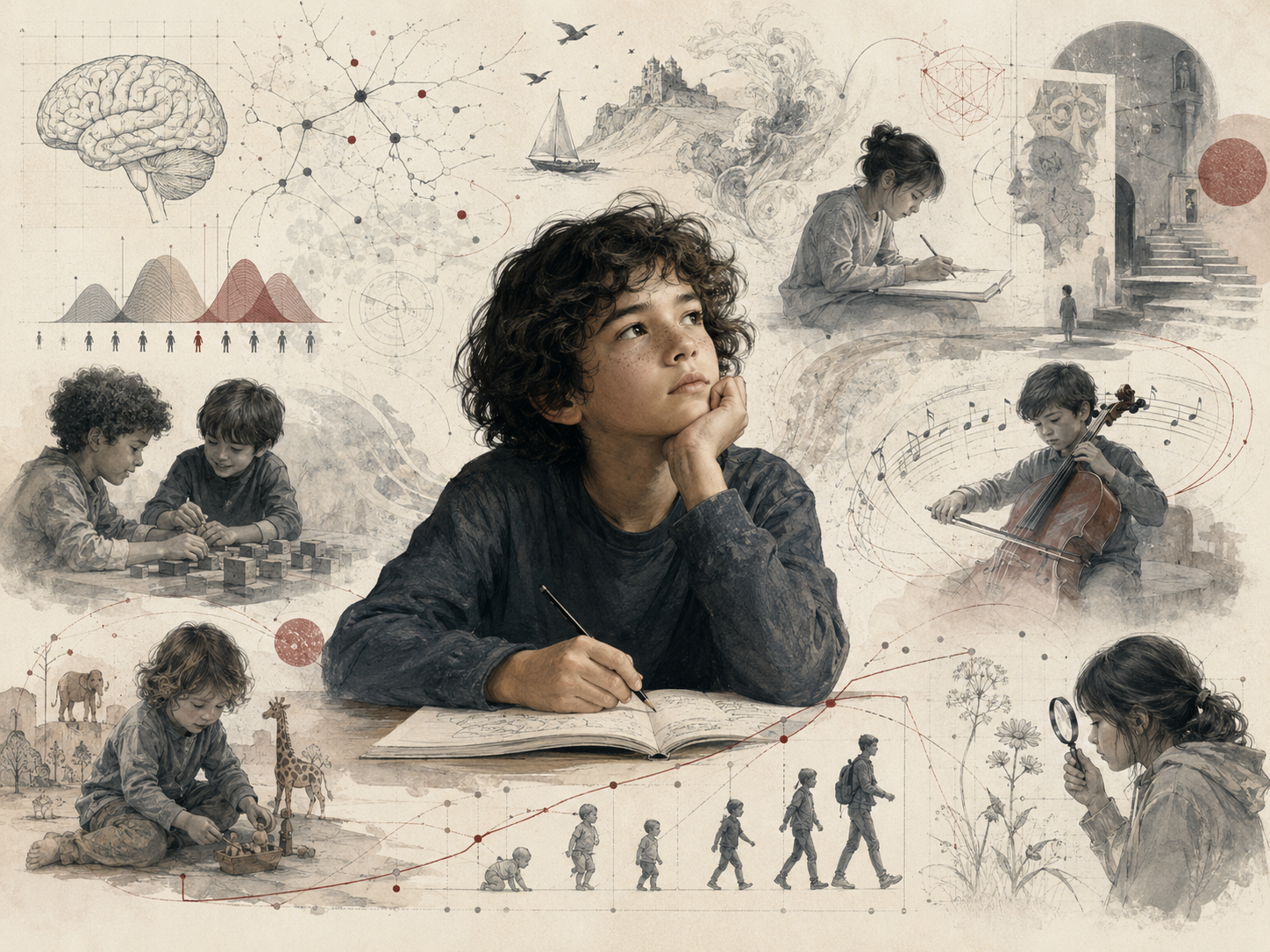
Creativity is often treated as a gift, a talent, or a mysterious eruption of inspiration. Personality psychology gives a more disciplined account. It asks why some people are drawn toward novelty, ambiguity, aesthetic intensity, symbolic play, conceptual risk, or unconventional solutions, while others prefer stability, repetition, clarity, and existing forms. This does not reduce creativity to personality. It places imagination inside the broader structure of human difference.
Why Creativity Needs Personality
Creativity needs personality because originality is not produced by intelligence, training, or technique alone. Novel work also depends on willingness to explore, tolerate ambiguity, sustain attention, take symbolic risks, depart from convention, absorb criticism, and remain committed to an idea before it is socially validated. Personality matters because it helps explain why equally skilled people differ in whether they generate, pursue, revise, defend, and complete imaginative work.
This does not mean personality is the whole explanation of creativity. Domain knowledge, practice, opportunity, collaboration, economic security, education, technology, institutions, and recognition all matter profoundly. A person may have a highly exploratory temperament and still lack the time, training, social permission, or material support needed to produce creative work. Conversely, institutions can cultivate creative performance by giving people protected space for experimentation, access to tools, and norms that allow dissent before premature closure.
Personality psychology contributes by showing that creativity is not psychologically neutral. It is patterned by enduring differences in how people engage novelty, complexity, uncertainty, aesthetic experience, emotion, imagination, and possibility. People differ not only in what they know, but in what they notice, what they find compelling, what kinds of uncertainty they can tolerate, and what forms of risk they are willing to bear.
That is why creativity cannot be understood only as output. It must also be understood as orientation: toward possibility, toward form, toward problems that do not yet have stable answers, and toward experiences that invite transformation rather than simple repetition.
Creativity is not a single capacity
One of the first mistakes in this area is to treat creativity as one unified mental power. The literature distinguishes among divergent thinking, creative achievement, creative professions, scientific creativity, artistic creativity, problem finding, problem solving, symbolic invention, design thinking, innovation, adaptive improvisation, and everyday creativity. These overlap, but they are not identical, and the personality profile associated with one form may not map neatly onto another.
Divergent thinking tasks, for example, often ask people to generate many unusual uses for an object or many possible responses to a prompt. These tasks capture fluency, flexibility, originality, and elaboration. They are useful, but they do not measure the full life of creativity. A person may be excellent at generating possibilities but less skilled at selecting, testing, revising, and implementing them. Another person may be less flamboyantly generative but unusually capable of refining a difficult idea into durable form.
Creative achievement is different again. It is not only an internal capacity but a record of work that has been produced, shared, evaluated, recognized, or used. Achievement depends on persistence, opportunity, social networks, institutional structures, and domain-specific standards. Scientific creativity may require mathematical fluency, methodological discipline, and respect for evidence. Artistic creativity may require aesthetic sensitivity, symbolic depth, technical craft, and a capacity to make private experience publicly resonant. Everyday creativity may involve adaptation, repair, improvisation, and the invention of livable forms under constraint.
The forms of imagination are therefore plural. Some creativity depends on generative fluency, some on refinement, some on conceptual boldness, some on collaboration, some on emotional depth, and some on stubborn long-term craft. A serious account of the creative personality must allow for multiple pathways rather than one archetype.
Openness and the architecture of imagination
Among broad personality traits, openness to experience is the one most consistently associated with creativity. Openness is not merely a preference for novelty in a casual sense. It includes receptivity to unusual ideas, aesthetic sensitivity, imagination, emotional and perceptual richness, intellectual curiosity, tolerance for ambiguity, and willingness to explore alternatives to familiar categories. It is the trait domain most directly connected to the psychological architecture of imaginative life.
This association appears across multiple forms of creativity, including creative thinking, creative hobbies, creative achievement, and creative professions. Openness helps orient the person toward experiences that can become raw material for creative recombination: images, metaphors, patterns, concepts, sensations, contradictions, anomalies, and questions. It does not create finished work by itself, but it increases the likelihood that the person will notice possibilities where others see only ordinary repetition.
Openness is especially important because imagination often begins before conscious problem solving. A highly open person may linger with ambiguity, be drawn to odd connections, remain interested in marginal details, or experience aesthetic and conceptual patterns as unusually salient. Such tendencies can support original thought because they expand the field of what the mind treats as relevant.
Yet openness should not be confused with creativity itself. It is better understood as one of the strongest broad dispositional conditions under which creativity becomes more likely. It provides orientation, sensitivity, and appetite for exploration. It does not automatically provide technique, judgment, discipline, cultural literacy, social recognition, or the ability to complete work. The creative life begins in openness, but it usually requires more than openness to become durable achievement.
Openness, intellect, and creative differences
Recent personality research often distinguishes between openness and intellect rather than treating openness to experience as a fully unitary trait. This distinction is useful because creativity is not the same across domains. Openness, in the narrower sense, is often associated with imagination, aesthetic absorption, perceptual exploration, fantasy, and experiential richness. Intellect is more closely associated with abstract reasoning, intellectual engagement, semantic exploration, and enjoyment of complex ideas.
This matters for understanding why artistic, scientific, technical, and philosophical creativity may share a family resemblance while drawing on somewhat different personality strengths. Artistic imagination may lean more heavily on aesthetic openness, emotional richness, sensory patterning, and symbolic transformation. Scientific or analytic creativity may draw more strongly on intellectual curiosity, abstraction, conceptual manipulation, and the ability to hold complex systems in mind. Many creators require both, but the balance differs by domain.
The distinction also helps avoid simplistic claims about “creative people.” A composer, mathematician, novelist, engineer, experimental physicist, architect, biologist, filmmaker, policy designer, and community builder may all be creative, but the psychological demands of their work differ. Some forms of imagination require immersion in sensory and affective detail. Others require abstraction, formal reasoning, modeling, and systems-level pattern recognition. Still others require social imagination: the ability to understand people, institutions, incentives, values, and possible futures.
Openness/intellect is therefore best understood as a broad field of exploration rather than a single creative essence. It includes multiple routes into novelty: perceptual, aesthetic, intellectual, symbolic, emotional, social, and technical. The creative personality is not one type; it is a family of exploratory dispositions that take different forms under different developmental, cultural, and institutional conditions.
Divergent thinking and the creative personality
Divergent thinking remains one of the best-known laboratory models of creative cognition. It captures the ability to generate multiple possible responses rather than converge immediately on one conventional answer. In research settings, divergent thinking is often measured through tasks that assess fluency, originality, flexibility, and elaboration. These tasks are useful because they make one part of creative cognition observable: the production of varied possibilities.
Personality matters here because divergent thinking is partly shaped by whether a person is willing to move beyond the obvious. A highly open person may be more willing to entertain remote associations, unusual categories, playful reinterpretations, and alternative uses. Extraversion may support expressive fluency in some contexts, while other traits may show weaker, more variable, or domain-dependent associations. The personality-creativity relationship is therefore strongest when personality is linked to the specific creative process being measured.
But divergent thinking should not be mistaken for the whole of creativity. It captures generative flexibility and ideational fluency, not necessarily creative judgment, craft, execution, audience awareness, ethical responsibility, or long-term achievement. Many ideas are novel without being meaningful. Many unusual associations are not yet art, science, design, invention, or insight. They become creative only when they are shaped into something that carries value within a domain, community, problem space, or life situation.
For that reason, divergent thinking is best treated as one component in a larger creative ecology. It is the opening of possibility, not the completion of form. Personality can influence how readily that opening occurs, but the later stages of creativity require selection, development, refinement, and often social negotiation.
Convergent thinking, evaluation, and form
Creativity also requires convergence. The popular contrast between divergent and convergent thinking can be misleading if it implies that creativity belongs only to the divergent side. In practice, creative work usually depends on an iterative movement between expansion and selection. The mind generates possibilities, tests them, rejects weak ones, combines partial ones, revises promising ones, and gradually gives the work structure.
This is why imagination is not the same as fantasy without constraint. A scientific hypothesis must answer to evidence. A poem must find rhythm, compression, voice, and necessity. A design must function in relation to users, materials, cost, safety, and context. A policy proposal must survive institutional complexity. A technological prototype must be debugged, tested, and made usable. In all these cases, creative work depends not only on novelty but on disciplined evaluation.
Personality enters this process in complicated ways. Openness may support the generation of alternatives, but conscientiousness, self-regulation, patience, frustration tolerance, and domain commitment may support the refinement of alternatives into durable form. A creator who cannot tolerate evaluation may remain trapped in endless ideation. A creator who evaluates too quickly may kill possibility before it develops. Creative maturity often involves learning when to open the field and when to narrow it.
The most serious creative lives therefore require a dynamic balance: enough openness to imagine alternatives, enough discipline to test them, enough independence to resist premature conformity, and enough humility to revise when the work demands it. Creativity is not only the willingness to depart from the ordinary. It is the capacity to bring departure into form.
Discipline, persistence, and conscientiousness
The relation between conscientiousness and creativity is more complicated than the relation between openness and creativity. Older research on highly creative individuals often found patterns associated with independence, unconventionality, and lower conformity. In some domains, rigid orderliness may constrain exploration by encouraging premature closure, rule-following, or fear of error. Too much attachment to existing standards can make novelty feel threatening rather than generative.
Yet creative accomplishment also requires discipline. A loose, exploratory mind may be fertile in ideas, but many forms of significant creative achievement require sustained craft, revision, practice, technical mastery, and repeated return to the same difficult problem. The painter must keep painting. The scientist must keep testing. The writer must revise. The engineer must troubleshoot. The composer must hear structure through noise. The scholar must read, compare, document, and clarify.
The key distinction is between different facets of conscientiousness and different phases of creativity. Conventionality and excessive rule-boundness may inhibit originality, while persistence, responsibility to the work, and capacity for long-term effort may support achievement. A person can be low in conformity but high in commitment. A person can resist inherited forms while remaining deeply disciplined in the pursuit of a self-chosen standard.
This is why it is better to distinguish generative originality from creative accomplishment. Originality may require looseness, exploratory cognition, and tolerance for ambiguity. Accomplishment often requires structure, endurance, and repeated refinement. The creative personality is not necessarily undisciplined. It may be disciplined in a different way: less obedient to convention, but highly obedient to the demands of the work itself.
Emotion, vulnerability, and affective intensity
Popular culture often romanticizes creativity as inseparable from suffering, instability, or turmoil. The scientific literature is more careful. Affective intensity, sensitivity, emotional complexity, and introspection may contribute to some forms of imagination, especially in artistic, autobiographical, symbolic, or expressive domains. But this does not mean suffering is the source of creativity in any simple or necessary sense.
The myth of the damaged creative genius is powerful because it contains partial truths in distorted form. Creative people may be unusually sensitive to contradiction, beauty, loss, injustice, absurdity, longing, or emotional nuance. They may notice what others ignore, feel the pressure of unresolved experience, or use symbolic work to transform private difficulty into public meaning. But emotional vulnerability is not identical with creative capacity, and distress can also impair attention, motivation, executive function, and the ability to complete work.
A more responsible account distinguishes emotional depth from pathology. Some forms of creativity may draw on the ability to stay with difficult feeling, but they also require containment, representation, and transformation. Art is not simply pain released. It is pain, joy, memory, perception, rhythm, symbol, structure, and social meaning shaped into communicable form. Scientific and technical creativity also involve emotional life: curiosity, frustration, wonder, disappointment, excitement, stubbornness, and the satisfaction of insight.
The creative personality is therefore not best understood as damaged by definition. It is better understood as unusually engaged with possibility, including emotional possibility. Creativity can involve vulnerability, but it also involves agency: the capacity to make something from experience rather than merely be overwhelmed by it.
Scientific, artistic, and everyday creativity
Scientific and artistic creativity overlap, but they are not psychologically identical. Both may require openness, independence, persistence, and the ability to see beyond habitual categories. But their standards of success differ. Scientific creativity must remain accountable to evidence, method, explanation, and replicable inquiry. Artistic creativity may be accountable to form, resonance, expressive force, aesthetic coherence, cultural meaning, and the transformation of perception.
Scientific creativity often depends on the ability to identify a problem others have not formulated clearly, build a model, design a method, interpret anomalies, and revise theory in light of evidence. It requires imagination, but imagination disciplined by the world. Artistic creativity often depends on the ability to transform perception, feeling, memory, language, sound, gesture, or image into form. It requires discipline, but discipline in service of expressive and symbolic truth.
Everyday creativity adds another layer. Imagination is not limited to great works, elite institutions, or recognized professions. It appears in parenting, teaching, repair, adaptation, humor, conversation, cooking, community life, caregiving, problem solving, and the invention of livable routines. People create not only when they publish, exhibit, patent, or perform, but when they reinterpret constraints and make life more workable, meaningful, or humane.
This broader view matters ethically. If creativity is defined only by public recognition, then it mirrors existing inequalities in education, wealth, race, gender, language, geography, disability, and institutional access. Many forms of imagination are never canonized because the people who practice them lack platforms, credentials, time, patronage, or permission. A serious psychology of creativity must study achievement, but it must not confuse recognition with the whole of human imagination.
Identity, risk, and nonconformity
Creativity often requires some distance from convention. This does not necessarily mean rebellion for its own sake, but it does involve tolerance for being unusual, misunderstood, or initially unsupported. Traits linked to openness, independence of judgment, and willingness to entertain unconventional ideas help explain why some people repeatedly move toward novelty while others remain closer to established scripts.
Nonconformity, however, is not creativity by itself. A claim can be unconventional and still be incoherent, careless, destructive, or empty. Imagination becomes creativity only when novelty takes shape as something meaningful, effective, beautiful, useful, clarifying, or generative. The creative personality may require independence, but independence must eventually meet standards of form, evidence, function, or resonance.
Identity matters because creative work often asks a person to risk something socially. To create is to show judgment before consensus has formed. It may involve exposing taste, values, memory, analysis, ambition, vulnerability, or dissent. People who are strongly dependent on approval may struggle to sustain work that is not immediately understood. People with stronger tolerance for ambiguity and social uncertainty may be more able to remain with the work before recognition arrives.
At the same time, the celebration of nonconformity can hide unequal risk. Some people are granted eccentricity; others are punished for it. Some forms of dissent are interpreted as genius, while others are read as deviance, disrespect, incompetence, or threat. Personality shapes willingness to depart from convention, but social power shapes who is allowed to do so safely.
Social worlds, collaboration, and recognition
Creative work is often socially organized even when it appears solitary. Collaboration, mentorship, gatekeeping, audience formation, peer review, funding, platform access, cultural legitimacy, and institutional support all influence whether imaginative work develops or disappears. Personality helps explain who seeks novelty and who persists, but social worlds determine which forms of imagination are cultivated, funded, shared, and recognized.
This is especially clear in science and technology, where creativity is increasingly collaborative. Modern research often depends on teams, instruments, datasets, laboratories, computing infrastructure, institutional networks, and cross-disciplinary translation. A scientist may possess a creative personality, but whether that personality becomes creative output may depend on team norms, collaborative opportunity, identity safety, leadership, and access to resources.
The same is true in the arts, design, education, and public life. Creative work depends on communities of practice. Writers need languages, genres, publishers, readers, editors, teachers, and traditions to resist or renew. Musicians need instruments, scenes, collaborators, audiences, and inherited forms. Designers need users, constraints, materials, production systems, and feedback. Even solitary creators work within symbolic and institutional worlds that shape what can be imagined, made, and understood.
The creative personality is therefore always partly relational. It is not merely an inner trait profile. It is a pattern of engagement between the person and a world that may invite, suppress, exploit, misunderstand, reward, or transform imagination. Creativity emerges where dispositions meet conditions.
Forms of imagination across life and culture
Imagination is also shaped by development and culture. Openness has been linked to creativity in adolescents as well as adults, but the way imagination is encouraged, disciplined, or translated into valued work differs across educational and cultural settings. The same broad personality tendency may have very different creative futures depending on family environment, schooling, peer culture, economic security, language, technology, and institutional opportunity.
Development matters because imagination changes over the life course. Childhood play may support symbolic flexibility, role-taking, emotional rehearsal, and exploratory cognition. Adolescence may intensify identity experimentation, aesthetic sensitivity, peer comparison, risk, and the search for voice. Adulthood may bring domain knowledge, discipline, professional constraints, collaboration, and greater capacity for sustained projects. Later life may bring integrative imagination, autobiographical depth, wisdom, and new forms of adaptation.
Culture matters because societies differ in what kinds of novelty they reward. Some traditions value individual originality; others emphasize mastery, continuity, communal contribution, or reinterpretation within inherited forms. A person who appears highly creative in one cultural context may be misunderstood in another. Conversely, a form of imagination that seems modest from an individualist perspective may be profoundly creative within a tradition of collective, ritual, ecological, or intergenerational practice.
The forms of imagination are therefore plural not only across domains, but across life stages and cultural worlds. A serious theory of creativity must ask what kinds of novelty a given society rewards, fears, domesticates, appropriates, or ignores. Personality gives one part of the answer, but not the whole of it.
Creativity as developmental and institutional process
Creativity develops through repeated encounters between inner disposition and outer structure. A child with high curiosity may become more imaginative when adults protect play, encourage questions, and provide materials for exploration. The same child may become inhibited if curiosity is treated as disruption, if mistakes are punished, or if schooling rewards only compliance. Personality is not erased by environment, but it is channeled through environment.
Educational institutions play a central role. They can cultivate creativity by teaching students how to ask better questions, tolerate uncertainty, revise work, compare alternatives, collaborate across difference, and connect imagination to evidence. They can also suppress creativity by overvaluing correct answers, speed, narrow assessment, and fear of error. The issue is not whether standards matter. Standards are essential. The issue is whether standards are used to deepen work or to prevent exploration before it begins.
Organizations face a similar challenge. Many institutions claim to value innovation while rewarding conformity, speed, hierarchy, risk avoidance, and short-term metrics. Creative personality may be present in the workforce but remain inactive if the environment punishes dissent, overloads attention, discourages experimentation, or treats failure as reputational danger. Creativity requires more than hiring “creative people.” It requires systems that allow creative dispositions to become creative practice.
This institutional perspective also prevents a common injustice: blaming individuals for the absence of creative output when the conditions for creativity have been denied. Time, safety, tools, mentorship, recognition, and freedom from excessive precarity are not luxuries. They are part of the ecology through which imagination becomes work.
Mathematical lens: traits, imagination, and creative output
Creativity can be modeled as the joint outcome of broad traits, domain skill, execution capacity, and environmental support. Let creative output for person \(i\) be \(C_i\). A simple conceptual model is:
C_i = \alpha + \beta_1 O_i + \beta_2 D_i + \beta_3 E_i + \beta_4 S_i + \varepsilon_i
\]
Interpretation: Creative output is modeled as a function of openness-related disposition \(O_i\), domain knowledge \(D_i\), execution or persistence capacity \(E_i\), social support or opportunity \(S_i\), and unexplained variation \(\varepsilon_i\).
This model expresses one of the article’s main arguments: creativity is not explained by openness alone, even when openness is often the strongest broad trait correlate. A person may be high in openness but low in domain knowledge, opportunity, or execution support. Another person may be moderately open but highly skilled, well-supported, and persistent. Creativity emerges from a configuration rather than a single trait.
Divergent thinking can be modeled separately from creative achievement:
DT_i = \gamma_0 + \gamma_1 O_i + \gamma_2 X_i + u_i
\]
Interpretation: Divergent-thinking performance \(DT_i\) is modeled as a function of openness \(O_i\), additional covariates \(X_i\), and residual variation \(u_i\).
CA_i = \delta_0 + \delta_1 O_i + \delta_2 P_i + \delta_3 K_i + v_i
\]
Interpretation: Creative achievement \(CA_i\) is modeled as a function of openness \(O_i\), persistence \(P_i\), domain-specific knowledge \(K_i\), and residual variation \(v_i\).
This distinction captures the difference between generating possibilities and turning them into recognized work. Divergent thinking may be strongly connected to exploratory cognition, while creative achievement often requires persistence, skill, cultural literacy, and opportunity.
A more nuanced model can separate openness and intellect:
C_i = \eta_0 + \eta_1 Open_i + \eta_2 Intellect_i + \eta_3(Open_i \times Domain_i) + \eta_4(Intellect_i \times Domain_i) + w_i
\]
Interpretation: Creative output is modeled with separate openness and intellect terms, plus interaction effects showing that these traits may matter differently across creative domains.
The interaction terms are important. They express the possibility that openness may be more strongly associated with artistic or aesthetic creativity, while intellect may be more strongly associated with scientific or analytic creativity. The model is not a final theory; it is a way of making the argument explicit enough to test.
R: modeling personality and creative outcomes
The R example below illustrates how a researcher might estimate trait associations with divergent thinking and creative achievement separately. The workflow preserves the conceptual distinction between creative potential and creative accomplishment.
# Personality, creativity, and imagination
# R workflow for exploratory analysis

# Install packages if needed
# install.packages(c("readr", "dplyr", "ggplot2", "broom", "modelsummary"))

library(readr)
library(dplyr)
library(ggplot2)
library(broom)
library(modelsummary)

# Read data
# Expected columns:
# openness, intellect, conscientiousness, extraversion, neuroticism, agreeableness,
# divergent_thinking, creative_achievement, domain, social_support, persistence
data <- read_csv("personality_creativity_imagination.csv")

# Inspect structure
glimpse(data)
summary(data)

# Select variables for descriptive analysis
cor_vars <- data %>%
  select(
    openness,
    intellect,
    conscientiousness,
    extraversion,
    neuroticism,
    agreeableness,
    divergent_thinking,
    creative_achievement,
    persistence,
    social_support
  )

# Correlation matrix
cor_matrix <- cor(cor_vars, use = "pairwise.complete.obs")
print(round(cor_matrix, 2))

# Model 1: divergent thinking as a creative potential outcome
model_dt <- lm(
  divergent_thinking ~ openness + intellect + conscientiousness +
    extraversion + neuroticism + agreeableness,
  data = data
)

# Model 2: creative achievement as a realized-output outcome
model_ca <- lm(
  creative_achievement ~ openness + intellect + conscientiousness +
    extraversion + neuroticism + agreeableness +
    persistence + social_support,
  data = data
)

# Model 3: domain-sensitive creativity model
model_domain <- lm(
  creative_achievement ~ openness * domain + intellect * domain +
    persistence + social_support + conscientiousness,
  data = data
)

# Summaries
summary(model_dt)
summary(model_ca)
summary(model_domain)

# Clean coefficient tables
tidy(model_dt, conf.int = TRUE)
tidy(model_ca, conf.int = TRUE)
tidy(model_domain, conf.int = TRUE)

# Compare models
modelsummary(
  list(
    "Divergent Thinking" = model_dt,
    "Creative Achievement" = model_ca,
    "Domain Interaction" = model_domain
  )
)

# Plot openness and divergent thinking
ggplot(data, aes(x = openness, y = divergent_thinking)) +
  geom_point(alpha = 0.6) +
  geom_smooth(method = "lm", se = TRUE) +
  labs(
    title = "Openness and Divergent Thinking",
    x = "Openness",
    y = "Divergent Thinking"
  )

# Plot openness and creative achievement
ggplot(data, aes(x = openness, y = creative_achievement)) +
  geom_point(alpha = 0.6) +
  geom_smooth(method = "lm", se = TRUE) +
  labs(
    title = "Openness and Creative Achievement",
    x = "Openness",
    y = "Creative Achievement"
  )

# Save processed data
write_csv(data, "personality_creativity_imagination_scored.csv")
This workflow is useful because it treats divergent thinking and creative achievement as related but distinct outcomes. It also allows domain-sensitive analysis, which is crucial for avoiding the assumption that artistic, scientific, technical, and everyday creativity share one identical personality profile.
Python: estimating trait associations with creativity
The Python example below performs a parallel analysis of personality, divergent thinking, and creative achievement. It uses ordinary least squares models to estimate trait associations while keeping the conceptual distinction between ideational generation and recognized output.
# Personality, creativity, and imagination
# Python workflow for exploratory analysis

# Install packages if needed:
# pip install pandas numpy statsmodels matplotlib

import pandas as pd
import numpy as np
import statsmodels.formula.api as smf
import matplotlib.pyplot as plt

# Read data
# Expected columns:
# openness, intellect, conscientiousness, extraversion, neuroticism, agreeableness,
# divergent_thinking, creative_achievement, domain, social_support, persistence
df = pd.read_csv("personality_creativity_imagination.csv")

print(df.head())
print(df.info())
print(df.describe(include="all"))

# Correlations
corr_vars = [
    "openness",
    "intellect",
    "conscientiousness",
    "extraversion",
    "neuroticism",
    "agreeableness",
    "divergent_thinking",
    "creative_achievement",
    "persistence",
    "social_support",
]

corr = df[corr_vars].corr(numeric_only=True)
print(corr.round(2))

# Model 1: divergent thinking as a creative potential outcome
model_dt = smf.ols(
    "divergent_thinking ~ openness + intellect + conscientiousness + "
    "extraversion + neuroticism + agreeableness",
    data=df,
).fit()

# Model 2: creative achievement as realized creative output
model_ca = smf.ols(
    "creative_achievement ~ openness + intellect + conscientiousness + "
    "extraversion + neuroticism + agreeableness + persistence + social_support",
    data=df,
).fit()

# Model 3: domain-sensitive creativity model
model_domain = smf.ols(
    "creative_achievement ~ openness * C(domain) + intellect * C(domain) + "
    "persistence + social_support + conscientiousness",
    data=df,
).fit()

print(model_dt.summary())
print(model_ca.summary())
print(model_domain.summary())

# Plot openness and divergent thinking
plt.figure()
plt.scatter(df["openness"], df["divergent_thinking"], alpha=0.6)
m, b = np.polyfit(df["openness"], df["divergent_thinking"], 1)
plt.plot(df["openness"], m * df["openness"] + b)
plt.title("Openness and Divergent Thinking")
plt.xlabel("Openness")
plt.ylabel("Divergent Thinking")
plt.tight_layout()
plt.savefig("openness_divergent_thinking.png", dpi=300)

# Plot openness and creative achievement
plt.figure()
plt.scatter(df["openness"], df["creative_achievement"], alpha=0.6)
m, b = np.polyfit(df["openness"], df["creative_achievement"], 1)
plt.plot(df["openness"], m * df["openness"] + b)
plt.title("Openness and Creative Achievement")
plt.xlabel("Openness")
plt.ylabel("Creative Achievement")
plt.tight_layout()
plt.savefig("openness_creative_achievement.png", dpi=300)

# Save processed data
df.to_csv("personality_creativity_imagination_scored_python.csv", index=False)
This analysis supports the article’s core methodological point: creativity should not be collapsed into one score without asking what kind of creativity is being measured. Divergent thinking, creative achievement, artistic output, scientific innovation, and everyday adaptation may share some predictors while differing in others.
GitHub Repository
The companion GitHub repository provides reproducible research scaffolding for this article, including synthetic data, code workflows, documentation, validation materials, and multi-language examples for examining personality, openness, divergent thinking, and creative achievement.
Complete Code Repository
Access the full companion repository for this article, including reproducible analysis materials and multi-language code workflows for personality, creativity, imagination, divergent thinking, creative achievement, openness, intellect, persistence, and social support.
Responsible interpretation
Personality-creativity research should be interpreted carefully. It is tempting to turn group-level associations into personal labels: open people are creative, conscientious people are not, emotional people are artists, introverts are solitary creators, extraverts are performers. These claims are too simple. Personality traits are probabilistic tendencies, not destinies. They describe patterns of likelihood, not fixed creative identities.
The same caution applies to measurement. Divergent-thinking scores are informative, but they are not the whole of creativity. Creative achievement scales capture recognized output, but they may reflect unequal access to opportunity. Professional creative status may reflect talent and discipline, but also class, credentialing, networks, institutional bias, and cultural legitimacy. A responsible interpretation asks what the measure includes, what it excludes, and whose imagination may be invisible to it.
There is also an ethical danger in romanticizing creativity as individual exception. Creative work often depends on conditions that are socially produced: time, education, safety, tools, health, mentorship, cultural permission, and freedom from excessive precarity. A person’s creative potential may remain unrealized not because personality is lacking, but because the surrounding ecology is hostile to imaginative development.
The strongest interpretation is therefore neither purely individualist nor purely environmental. Personality matters. So do skill, development, culture, institutions, recognition, and power. Creativity is a person-world relation: an encounter between dispositions and conditions through which possibility becomes form.
Conclusion
Personality, creativity, and the forms of imagination belong together because imagination is shaped not only by ability but by enduring dispositions toward novelty, complexity, risk, discipline, emotion, symbolic exploration, and social possibility. The strongest recurring finding is that openness matters greatly, but the deeper lesson is that no single trait or temperament explains all creativity. Different forms of imagination draw on different combinations of exploration, persistence, emotional sensitivity, identity, skill, culture, and support.
The best account is therefore plural. Creativity is not one faculty, and the creative personality is not one type. Some people create through aesthetic absorption, some through abstract analysis, some through social imagination, some through disciplined craft, some through adaptive improvisation, and some through the long transformation of lived experience into public form.
To understand imagination seriously is to understand how different persons, in different domains and worlds, convert possibility into form. Personality helps explain why some people move toward the possible. Creativity begins when that movement becomes work.
Related articles
- Social-Cognitive Approaches to Personality: Goals, Appraisals, and Self-Regulation
- Traits, Character, and Moral Evaluation
- Personality, Culture, and the Problem of Universality
- Personality, Wellbeing, and Mental Health
- Personality, Work, and Leadership
Further reading
- The Cambridge Handbook of Creativity and Personality Research
- Anna Abraham, “The Science Behind Creativity,” APA Monitor on Psychology
- Kaufman et al., “Openness to Experience and Intellect Differentially Predict Creative Achievement in the Arts and Sciences”
- Gregory J. Feist, “A Meta-Analysis of Personality in Scientific and Artistic Creativity”
- Grajzel, Acar and Singer, “The Big Five and Divergent Thinking: A Meta-Analysis”
- Tang et al., “The Effects of Creative Personality on Scientist Creativity”
- Koutstaal et al., “Beyond Openness: A Variety of Creative Experiences Increases Flexibility and Originality of Visuospatial Divergent Thinking”
- Rawlings et al., “Divergent Thinking is Linked with Convergent Thinking”
References
- Abraham, A. (2022) ‘The science behind creativity’, APA Monitor on Psychology. Available at: https://www.apa.org/monitor/2022/04/cover-science-creativity.
- Batey, M. and Furnham, A. (2006) ‘Creativity, intelligence, and personality: A critical review of the scattered literature’, Genetic, Social, and General Psychology Monographs, 132(4), pp. 355–429.
- DeYoung, C.G., Quilty, L.C., Peterson, J.B. and Gray, J.R. (2014) ‘Openness to experience, intellect, and cognitive ability’, Journal of Personality Assessment, 96(1), pp. 46–52. Available at: https://experts.umn.edu/en/publications/openness-to-experience-intellect-and-cognitive-ability/.
- Feist, G.J. (1998) ‘A meta-analysis of personality in scientific and artistic creativity’, Personality and Social Psychology Review, 2(4), pp. 290–309. Available at: https://pubmed.ncbi.nlm.nih.gov/15647135/.
- Feist, G.J., Reiter-Palmon, R. and Kaufman, J.C. (eds) (2017) The Cambridge Handbook of Creativity and Personality Research. Cambridge: Cambridge University Press. Available at: https://www.cambridge.org/core/books/cambridge-handbook-of-creativity-and-personality-research/FAD51C0730BC0126A35737A7631B1183.
- Grajzel, K., Acar, S. and Singer, G. (2023) ‘The Big Five and divergent thinking: A meta-analysis’, Personality and Individual Differences, 214, 112338. Available at: https://www.sciencedirect.com/science/article/abs/pii/S0191886923002611.
- Kaufman, S.B., Quilty, L.C., Grazioplene, R.G., Hirsh, J.B., Gray, J.R., Peterson, J.B. and DeYoung, C.G. (2016) ‘Openness to experience and intellect differentially predict creative achievement in the arts and sciences’, Journal of Personality, 84(2), pp. 248–258. Available at: https://pmc.ncbi.nlm.nih.gov/articles/PMC4459939/.
- Koutstaal, W., Brown, L., Lu, K. and Posson, K. (2025) ‘Beyond openness: A variety of creative experiences increases flexibility and originality of visuospatial divergent thinking’, Creativity Research Journal, 37(3), pp. 1–21. Available at: https://www.tandfonline.com/doi/abs/10.1080/10400419.2023.2300575.
- Oleynick, V.C., DeYoung, C.G., Hyde, E., Kaufman, S.B., Beaty, R.E. and Silvia, P.J. (2017) ‘Openness/intellect: The core of the creative personality’, in Feist, G.J., Reiter-Palmon, R. and Kaufman, J.C. (eds) The Cambridge Handbook of Creativity and Personality Research. Cambridge: Cambridge University Press, pp. 9–27. Available at: https://www.cambridge.org/core/books/cambridge-handbook-of-creativity-and-personality-research/opennessintellect/5F06D70F0FE4A53C2530522727762A49.
- Rawlings, B.S., Chetwynd-Talbot, D., Husband, E., Nuttall, A., Quinn, E., Taggart, R. and Roome, H.E. (2025) ‘Divergent thinking is linked with convergent thinking: Implications for models of creativity’, Thinking & Reasoning. Available at: https://durham-repository.worktribe.com/output/3746181/divergent-thinking-is-linked-with-convergent-thinking-implications-for-models-of-creativity.
- Tang, C., Xu, J., Mao, Y. and Naumann, S.E. (2024) ‘The effects of creative personality on scientist creativity’, Thinking Skills and Creativity, 52, 101473. Available at: https://www.sciencedirect.com/science/article/abs/pii/S187118712400004X.
- Wang, Y. et al. (2026) ‘Are adolescents with higher openness more creative under stress?’, available via PubMed Central. Available at: https://pmc.ncbi.nlm.nih.gov/articles/PMC12942368/.