
Last Updated May 22, 2026
The history of personality psychology is the history of a difficult intellectual ambition: to describe the enduring organization of the person without reducing human individuality to moral stereotype, bodily typology, clinical anecdote, or statistical abstraction. What began as speculation about character gradually became a more disciplined inquiry into traits, motives, development, identity, culture, and measurement. But the movement from characterology to personality science was never a simple march of progress. It involved repeated arguments over what counts as a person, what counts as evidence, whether behavior is stable, whether character can be measured, and how culture and institutions shape the very traits the field seeks to describe.
The modern science of personality emerged not by abandoning those tensions, but by learning to work through them with greater conceptual precision and methodological discipline. Its history includes moral philosophy, humoral medicine, typology, psychoanalysis, personology, trait theory, psychometrics, factor analysis, social-cognitive theory, narrative identity, behavior genetics, cross-cultural psychology, and contemporary work on development and wellbeing. Each tradition contributed something important. Each also narrowed the person when treated as sufficient by itself.
This article argues that personality psychology became a science not when it stopped asking old questions about character, but when it learned to ask them with better evidence. The field’s progress lies in its movement from moral labeling toward structured description, from fixed types toward continuous dimensions, from impressionistic judgment toward measurement, from trait determinism toward person–situation interaction, and from narrow individualism toward more developmental, cultural, and narrative accounts of personhood.
Main Library
Publications
Article Map
Personality Psychology
Related Topic
Cognitive Psychology
Related Topic
Social Psychology
Related Topic
Developmental Psychology
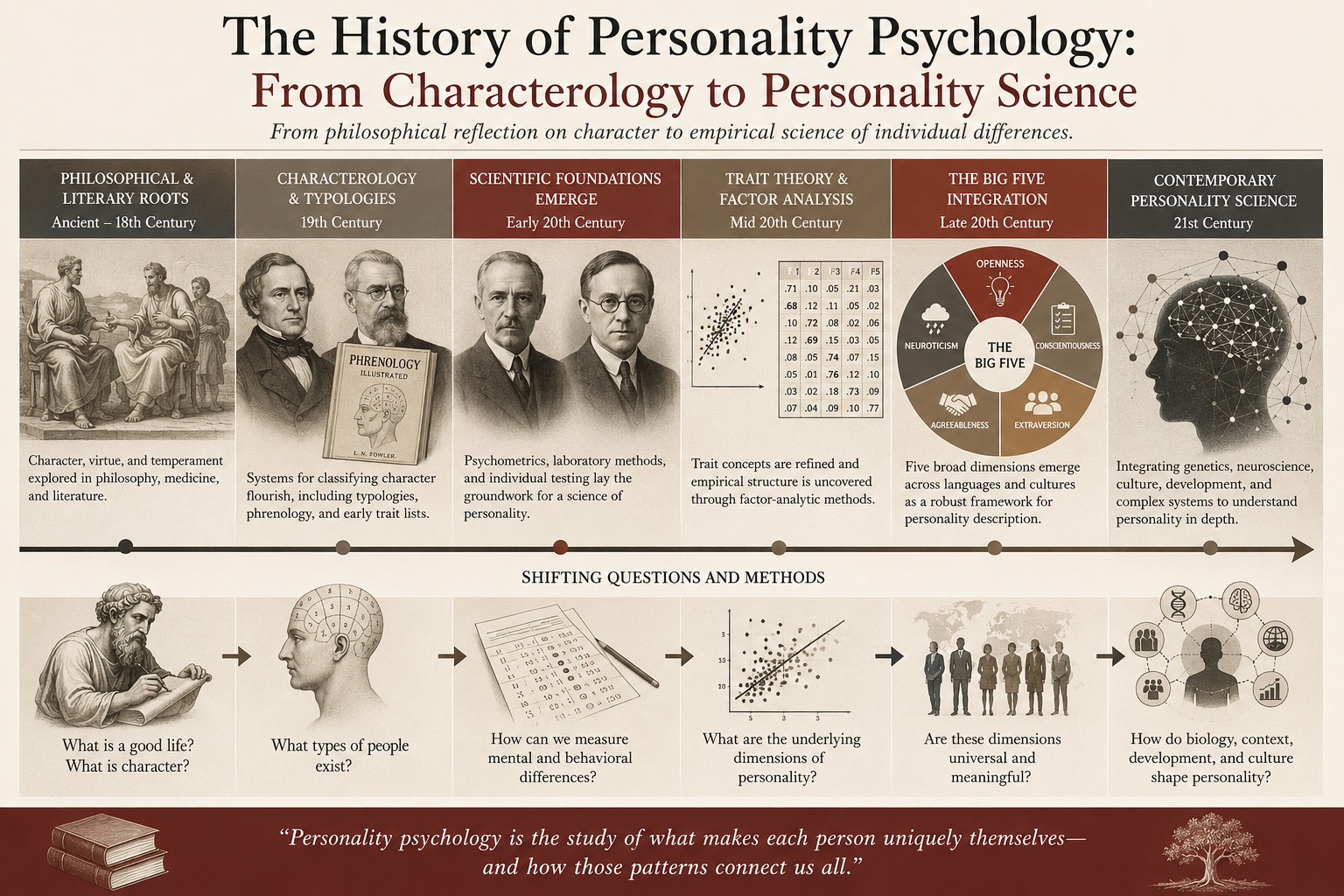
The history of the field matters because personality science still carries traces of its older forms. Traits remain entangled with moral evaluation. Assessment remains entangled with institutional power. Measurement remains entangled with culture and language. The best historical reading therefore does more than celebrate scientific progress. It asks how each new method clarified the person, where it distorted the person, and what later researchers had to recover.
From character to personality
Before personality psychology became a recognizable scientific field, the study of individual difference was usually organized under the older language of character. Character was not simply a neutral description of style or tendency. It was moralized. To speak of character was often to judge the worth, discipline, trustworthiness, self-command, virtue, or danger of a person. In classical, religious, literary, and political traditions, questions about temperament and conduct were tied to larger ethical questions: What kind of person is this? Is this person stable, honorable, self-governing, disordered, weak, dangerous, noble, corrupt, disciplined, or untrustworthy?
That older language still shadows contemporary psychology. Even when modern personality science tries to be descriptive rather than moralizing, it studies categories that institutions continue to evaluate normatively. Conscientiousness is rewarded in schools and workplaces. Emotional instability is penalized in many professional settings. Agreeableness is interpreted differently depending on gender, class, race, culture, role, and power. Extraversion is often rewarded in leadership contexts, even when quiet competence may be equally valuable. Openness can be celebrated as creativity in one institution and punished as deviance in another.
The field’s history therefore matters because personality psychology did not emerge from nowhere. It emerged from older efforts to classify human differences in ways that were ethical, social, theological, political, and literary before they became psychometric. The transition from character to personality did not eliminate value judgment. It changed the language through which judgments could be made, resisted, measured, and criticized.
The older idea of character also contained an insight modern psychology could not simply discard: persons have patterned organization. Human beings are not random collections of acts. Others come to know us through repeated tendencies—our ways of responding to frustration, keeping promises, taking responsibility, interpreting insult, expressing care, managing fear, seeking recognition, or repairing harm. The challenge was to study that pattern without turning it into moral stereotype or fixed essence.
Modern personality psychology inherited this challenge. It sought to transform character from a moral verdict into a field of evidence. The language changed from virtue and vice to traits, motives, adaptations, development, identity, and measurement. But the central problem remained: how can psychology describe enduring individuality without reducing the person to a label?
The field’s deepest historical movement is therefore not simply from “old” to “new.” It is from moralized classification toward disciplined interpretation.
Characterology and early typologies
Early efforts to explain stable differences among persons frequently took typological form. Ancient and medieval traditions linked temperament to bodily humors, assigning recurrent styles of affect and conduct to physiological balance or imbalance. A person might be described as sanguine, melancholic, choleric, or phlegmatic. These categories combined observation, medicine, cosmology, and moral imagination. They were not modern science, but they show that people have long sought stable patterns beneath behavior.
Later European characterology, physiognomy, and phrenology attempted to infer personality from visible form, bodily constitution, or cranial features. These traditions matter historically not because they were scientifically sound in the modern sense, but because they reveal an enduring desire to render individuality legible through classification. They also reveal how easily personality classification can become abusive when scientific-sounding systems attach moral worth, intelligence, criminality, race, class, gender, or social rank to bodily appearance.
The trouble with typology is that it promises too much coherence. It assumes that a person can be placed into a bounded kind, as if individuality were exhausted by a stable type. Typologies can be memorable, narratively powerful, and easy to communicate. But they often impose sharper boundaries than persons actually possess. They mistake convenience for structure.
P \in \{C_1, C_2, \dots, C_K\}
\]
Interpretation: Typological reasoning treats a person \(P\) as belonging to one of several discrete classes \(C_k\). This can simplify description, but it can also flatten continuous and multidimensional human variation into rigid categories.
Actual persons vary continuously, unevenly, and contextually across multiple domains at once. Someone can be emotionally sensitive and disciplined, socially quiet and morally courageous, imaginative and conventional in different settings, warm in intimate relationships and guarded in institutions. The eventual move toward trait theory did not merely replace old categories with new terms. It replaced rigid typological bins with graded dimensions, allowing personality to be described in terms of degree, profile, and probability rather than fixed kind.
The historical lesson is twofold. First, the desire to classify personality is ancient and understandable. People need ways to anticipate trust, conflict, cooperation, danger, care, and reliability. Second, classification becomes dangerous when it hardens into essence, especially when attached to bodies, social groups, or institutional power.
Modern personality science had to inherit the question while rejecting the worst answers.
The twentieth-century turn: personology, depth, and individuality
The early twentieth century marked a major shift. Personality ceased to be only a branch of moral description, literary character study, or body-based classification and became a central problem for psychology itself. This shift unfolded through several competing traditions at once. Psychoanalytic theory brought conflict, repression, defense, desire, fantasy, and unconscious motive to the foreground. Clinical work emphasized biography, childhood experience, symptom formation, and the inner organization of the self. At the same time, emerging psychometrics sought standardized ways of describing individual differences across persons.
This dual development gave the field both depth and tension. One side emphasized the singularity of the person: the importance of motive, fantasy, life history, conflict, and interpretation. The other emphasized comparability: measurement, scales, norms, reliability, and generalization across populations. Personality psychology would spend much of the twentieth century trying to hold those commitments together.
Psychoanalytic and depth traditions insisted that personality could not be reduced to surface behavior. A symptom, habit, or trait-like pattern might express conflict, desire, loss, defense, attachment, or early relational experience. Even where psychoanalytic claims were later challenged or revised, this tradition preserved an important warning: the person is not exhausted by observable conduct or questionnaire responses.
Psychometric traditions pushed in the opposite direction, though not necessarily against depth. They asked how personality could be measured, compared, validated, and studied at scale. Without measurement, personality psychology risked becoming a collection of interpretive portraits. Without interpretation, measurement risked becoming a technically elegant but shallow inventory of scores.
\text{Idiographic focus: } D(P_i)
\qquad
\text{Nomothetic focus: } \{P_1, P_2, \dots, P_n\} \rightarrow \text{general structure}
\]
Interpretation: The idiographic project seeks deep understanding of the individual person \(P_i\). The nomothetic project seeks generalizable structure across many persons. Personality psychology developed through repeated attempts to hold both forms of knowledge together.
This idiographic–nomothetic tension became one of the field’s defining problems. How can psychology preserve the unique organization of a life while building generalizable science? How can it compare persons without erasing the person? How can it recognize individuality without abandoning measurement?
The twentieth-century turn did not solve those questions. It made them unavoidable.
Allport, Murray, and the study of the person
No figure is more important to the disciplinary consolidation of personality psychology than Gordon Allport. In Personality: A Psychological Interpretation, Allport argued that psychology had neglected the concrete individual in favor of abstract processes and impersonal laws. He helped legitimate the study of personality as a distinct field and placed great weight on traits or personal dispositions as key to understanding the consistency of conduct. Yet Allport also preserved a strong concern for individuality, warning against flattening persons into mere aggregates of test scores.
Allport’s trait theory is often remembered as a precursor to modern trait psychology, but his work was not merely statistical. He distinguished different levels of dispositions, emphasized functional autonomy, and insisted that personality must be understood as the dynamic organization of the person. He was interested in common traits, but also in personal dispositions that might have unique meaning in a particular life. This made Allport a bridge figure: committed to scientific personality study, but resistant to reducing personality to impersonal measurement alone.
Henry Murray, in Explorations in Personality, pursued a different but complementary path. His personology emphasized needs, presses, life history, fantasy, conflict, and the dramatic organization of the whole person in context. Where Allport clarified the logic of traits and personal dispositions, Murray widened the field’s imagination by insisting that personality included motive, narrative, thematic interpretation, and situational meaning.
Murray’s work helped keep personality psychology connected to biography and drama. A person is not merely high or low on a trait. A person wants, fears, remembers, defends, imagines, strives, repeats, and interprets. The same observed behavior may mean different things depending on motive, role, conflict, and history. This insight remains important today, especially in narrative identity, clinical formulation, and developmental personality research.
P = T + M + H
\]
Interpretation: This heuristic expression represents the person \(P\) as organized across traits \(T\), motives \(M\), and lived history \(H\). It is not a literal equation, but it captures a central historical insight: personality requires multiple explanatory layers.
Together, Allport and Murray established a crucial early frame for the field: personality was neither only a list of measurable traits nor only a clinical portrait of inner conflict. It was the organized study of the person as a structured whole. Later personality science would sometimes lean too far toward measurement, and sometimes too far toward interpretation. But the Allport–Murray legacy reminds the field that the person is both comparable and singular.
The modern challenge is still their challenge: how to build a science of personality that does not lose the person it studies.
Traits, measurement, and the rise of psychometrics
Mid-century personality psychology increasingly turned toward measurement. Raymond Cattell pursued factor analysis in an effort to uncover underlying trait structure. Hans Eysenck proposed broad supertraits tied to biological dimensions. Lexical researchers later developed the line of work that would culminate in the Big Five tradition, especially through the efforts of Lewis Goldberg and, in a somewhat different framework, Paul Costa and Robert McCrae.
This psychometric turn was transformative. It shifted the field from a largely interpretive language of character and case formulation toward a statistical language of covariance, latent dimensions, reliability, and predictive validity. Personality claims could now be tested more systematically. Items could be scored. Scales could be evaluated. Factor structures could be compared. Test–retest stability could be estimated. Associations with outcomes could be modeled.
Psychometrics did not make personality science automatically true. It made personality claims accountable to evidence in new ways. If a scale claimed to measure conscientiousness, researchers could ask whether its items cohered, whether scores were stable, whether they predicted relevant outcomes, whether they were distinct from other traits, and whether the scale functioned similarly across groups. This was a major advance over informal character judgment.
x_j = \lambda_jF + \delta_j
\]
Interpretation: An observed item \(x_j\) is modeled as partly reflecting a latent factor \(F\), with loading \(\lambda_j\), plus item-specific variance or error \(\delta_j\). This captures a key shift from informal description to formal trait modeling.
Yet this shift came with losses as well as gains. The more the field succeeded in measurement, the more it risked identifying personality with what inventories could conveniently capture. Rich motive, conflict, biography, self-interpretation, culture, and moral meaning sometimes receded behind the elegance of factor models. Measurement can clarify. It can also narrow attention.
This is why the history of personality psychology should not be told as a straight path from confusion to clarity. It is also a history of alternating compression and recovery. Psychometrics compressed personality into measurable constructs. Later work had to recover motivation, development, narrative, culture, and context without abandoning the gains of measurement.
The best reading of the psychometric turn is therefore balanced. It gave personality psychology some of its strongest tools. But tools are not the whole field. Measurement becomes most valuable when joined to conceptual depth, cultural awareness, and careful interpretation.
The lexical and factor-analytic traditions
The lexical hypothesis became one of the most important bridges between ordinary social perception and modern trait structure. Its basic claim is that socially important personality differences tend to become encoded in language. If people repeatedly need to distinguish reliable from unreliable, warm from cold, dominant from submissive, imaginative from conventional, anxious from calm, or honest from deceitful, languages tend to develop descriptors for those differences.
Allport and Odbert’s lexical work made the scale of personality language visible by cataloguing thousands of person-descriptive terms. Later researchers reduced, rated, analyzed, and reorganized such descriptors. The lexical tradition gave trait psychology a non-arbitrary starting point: instead of inventing traits entirely from theory, researchers could begin with the vocabulary people already used to describe one another.
Factor analysis then became the statistical engine that turned lexical abundance into structural models. If many descriptors covaried, they could be reduced to broader latent dimensions. This process helped shape the Big Five tradition, in which personality description became organized around extraversion, agreeableness, conscientiousness, neuroticism or emotional stability, and openness or intellect.
The lexical and factor-analytic traditions were powerful because they allowed personality psychology to move from lists to structure. But they also introduced interpretive problems. Language is not neutral. It reflects social salience, stigma, power, translation, moral judgment, and cultural history. A factor is not a person. A cluster of descriptors is not a complete theory of personality. A statistical dimension still requires interpretation.
The rise of the Big Five and Five-Factor Model gave the field a durable architecture, but it also raised new questions. Are five broad dimensions sufficient? Do facets and aspects provide necessary resolution? Does HEXACO better represent honesty, humility, exploitation, and fairness? Do lexical structures replicate across languages? Do broad factors describe people equally well across cultures and institutions?
The lexical tradition therefore did not close personality science. It made the structural question more precise. It showed that broad trait dimensions can be recovered from language, while also reminding the field that language itself must be examined historically and culturally.
Modern personality psychology still lives with this inheritance: words become data, data become dimensions, dimensions become models, and models must return to the person with caution.
The person–situation critique
In 1968, Walter Mischel’s Personality and Assessment sharply criticized the trait tradition as it was then practiced. Mischel argued that cross-situational consistency had often been overstated and that personality researchers had relied too heavily on global trait inference without sufficient attention to contextual variability. The critique was profoundly disruptive. It cast doubt on the assumption that broad trait labels automatically delivered explanatory depth.
Historically, the importance of Mischel’s intervention lies less in the claim that traits do not matter than in the methodological and theoretical pressure it applied to the field. Personality psychologists were forced to ask more carefully what kind of consistency they expected, how they measured it, and whether persons are better understood as stable averages, conditional response systems, or both.
The critique exposed a weak version of trait thinking: the idea that a person described as aggressive, honest, anxious, or friendly should behave the same way across very different situations. Real people do not behave that way. A person may be assertive with peers but deferential with authority, generous with family but guarded at work, calm in routine settings but reactive under threat. If traits were supposed to imply behavioral uniformity across all contexts, they would indeed be implausible.
But the field’s later response was not simply to abandon traits. Instead, personality psychology became more careful about aggregation, situational specificity, behavioral signatures, and person–situation interaction. Traits came to be understood less as direct predictions of single acts and more as probabilistic tendencies visible across distributions of behavior, repeated contexts, and characteristic patterns of response.
B_{it} = \alpha_i + \beta_iS_t + \varepsilon_{it}
\]
Interpretation: Behavior \(B_{it}\) for person \(i\) in situation \(t\) reflects the person’s average tendency \(\alpha_i\), the effect of the situation \(S_t\), the person’s sensitivity to that situation \(\beta_i\), and residual variation \(\varepsilon_{it}\). Stability may lie in recurring patterns of response, not identical behavior everywhere.
The person–situation debate therefore became one of the field’s most productive crises. It forced trait psychology to become more empirically disciplined and theoretically subtle. It also helped open space for social-cognitive models, interactionism, behavioral signatures, experience sampling, and contemporary work on personality states.
The result was not a victory of persons over situations or situations over persons. The result was a better science of persons in situations.
From crisis to personality science
The later decades of the twentieth century and the early twenty-first century saw the field reassemble itself on stronger foundations. Trait psychology did not disappear after the person–situation critique. It became more careful. Researchers distinguished mean-level change from rank-order stability, state variation from dispositional structure, self-report scores from observer ratings, single behaviors from aggregated patterns, and broad domains from narrower facets.
The Big Five became a dominant descriptive framework not because it answered every question, but because it offered a replicable, cumulative way to organize much of the evidence on enduring individual differences. Extraversion, agreeableness, conscientiousness, neuroticism, and openness provided a shared vocabulary for linking personality to health, work, relationships, education, creativity, wellbeing, risk, and mental health. The model’s strength was architectural: it made personality research more cumulative.
At the same time, the modern field became more plural. Traits remained central, but they were joined by social-cognitive models, attachment theory, narrative identity research, lifespan developmental work, behavior genetics, person-centered methods, and increasing attention to culture and measurement equivalence. The field no longer had to choose between traits and stories, dispositions and situations, biology and culture, stability and change. It could study how these layers interact.
P_t = T_t + A_t + N_t
\]
Interpretation: This heuristic model represents personality at time \(t\) as including dispositional traits \(T_t\), characteristic adaptations \(A_t\), and narrative identity \(N_t\). The time index matters because personality is studied as structured continuity through development, not static substance alone.
One of the most important integrative developments came from models that distinguish dispositional traits, characteristic adaptations, and life narrative. Traits describe broad tendencies. Characteristic adaptations include goals, values, roles, coping strategies, beliefs, attachments, and contextualized plans. Narrative identity concerns the stories people construct to make meaning of their lives. This layered approach helped recover the person from overly narrow trait taxonomies without abandoning trait science.
Modern personality science is therefore not a rejection of earlier trait theory. It is trait theory placed within a broader architecture. The field became stronger when it accepted that personality has multiple levels: biological, dispositional, motivational, developmental, social, cultural, and narrative.
The crisis did not destroy personality psychology. It forced the field to become more mature.
Culture, development, and narrative expansion
Recent personality psychology has expanded beyond the narrowest versions of trait science. Developmental research shows that personality is neither perfectly fixed nor wholly fluid. Some traits show substantial continuity, but persons also change through age, roles, institutions, relationships, stress, illness, migration, education, caregiving, trauma, recovery, and historical circumstance. The developmental turn made it harder to speak of personality as fixed character or as a single score taken at one moment.
Longitudinal research introduced sharper distinctions. Rank-order stability asks whether people maintain relative standing compared with others. Mean-level change asks whether average levels of traits shift across time. Individual change asks how particular persons develop in distinctive ways. These distinctions allowed personality psychology to speak more precisely about stability and change.
Narrative identity research added another crucial layer. People do not merely have traits; they interpret their lives. They tell stories of suffering, agency, rupture, calling, failure, transformation, injustice, loyalty, betrayal, repair, and hope. Narrative does not replace traits, but it explains dimensions of personality that trait scores alone cannot capture: meaning, identity, temporality, moral self-understanding, and the lived interpretation of experience.
Cultural psychology further complicated the field by asking whether trait structures, self-descriptions, and measurement instruments travel cleanly across contexts. The issue is not whether persons differ across cultures—of course they do—but whether the field’s measurement models and conceptual vocabularies are invariant enough to justify confident comparison. Items about assertiveness, modesty, emotional control, trust, imagination, or independence may not carry the same meaning across languages, roles, religions, institutions, or social worlds.
X_g = \lambda_gT + \delta_g
\]
Interpretation: If an observed score \(X_g\) in group \(g\) reflects latent trait \(T\), researchers must ask whether the loading \(\lambda_g\) and error term \(\delta_g\) are comparable across groups. If they differ substantially, observed group differences may partly reflect measurement non-equivalence rather than genuine trait differences.
This is one reason contemporary personality science is more self-critical than older characterology. It recognizes that methods themselves have histories, assumptions, and blind spots. A trait scale is not just a neutral window into the person. It is a cultural and psychometric artifact that must be tested for reliability, validity, translation, fairness, and interpretive scope.
Development, culture, and narrative expansion did not weaken personality psychology. They protected it from becoming too narrow. They reminded the field that personality is not only a structure of traits, but also a life unfolding in time, language, relationship, and institution.
Contemporary personality science
Contemporary personality science is broader, more plural, and more methodologically sophisticated than the early field could have imagined. It includes trait structure, personality development, behavior genetics, social-cognitive processes, personality states, narrative identity, personality pathology, culture, close relationships, work and leadership, health, wellbeing, morality, creativity, and institutional life. The field no longer has a single center, but it has a set of recurring problems that hold it together.
One recurring problem is structure. How should personality be organized? The Big Five remains influential, but HEXACO, facet models, aspect models, maladaptive trait models, circumplexes, and network approaches all complicate the picture. Contemporary science asks which model works best for which question rather than assuming one universal map is always sufficient.
A second problem is development. How stable are traits? When do they change? How do biology, role transitions, culture, trauma, education, illness, relationship, and agency shape personality across the life course? Contemporary work increasingly treats personality as dynamic continuity rather than static possession.
A third problem is mechanism. What explains trait expression? Researchers now study affect regulation, reward sensitivity, executive function, attachment, social learning, genetic influence, environmental selection, person–situation transactions, and state distributions. Traits are no longer treated only as descriptive summaries; they are connected to processes.
A fourth problem is meaning. Narrative identity, values, motives, and moral self-understanding show that a person is not exhausted by trait scores. Two people may have similar trait profiles but live radically different stories. Personality science must therefore explain both patterned disposition and interpreted life.
A fifth problem is justice and context. Personality measures are used in schools, workplaces, clinics, research, coaching, and organizational systems. These applications raise questions of privacy, consent, fairness, cultural validity, disability, group comparison, power, and institutional consequence. The field’s history warns that personality classification can easily become a tool of ranking or exclusion when stripped of caution.
The contemporary field is strongest when it refuses reduction. It can use traits without becoming trait-only. It can use measurement without becoming score-only. It can study biology without becoming biological determinism. It can study narrative without abandoning structure. It can study culture without denying individual difference.
The history of personality psychology therefore leads to a mature pluralism: no single framework is the whole person, but each disciplined framework can reveal part of the person when used carefully.
Professional use and applied boundaries
The history of personality psychology can be professionally useful in research, education, coaching reflection, clinical training, organizational learning, leadership development, psychometric education, and science communication. It helps professionals understand why personality assessment carries both promise and danger. It shows how the field moved from moralized character judgment to more disciplined measurement, and why that movement remains incomplete.
A professional scaffold based on personality history can support legitimate work: teaching the distinction between characterology and personality science, explaining the rise of trait measurement, clarifying the person–situation debate, comparing idiographic and nomothetic traditions, studying factor analysis, interpreting narrative identity, and examining the cultural assumptions embedded in personality vocabularies and instruments.
But historical and psychometric literacy should not be confused with permission for unrestricted assessment use. A synthetic dataset is not evidence about real people. A historical model is not a hiring system. A personality score is not a moral verdict. A trait taxonomy is not a diagnosis. A factor structure is not a complete account of personhood.
Personality-history workflows are appropriate for professional education, research prototyping, psychometric demonstration, consulting support, organizational learning, coaching reflection, and careful professional discussion. They are not appropriate as standalone systems for hiring, promotion, termination, clinical diagnosis, educational placement, legal evaluation, insurance decisions, surveillance, relationship matching, moral labeling, or individual prediction.
Any consequential use involving real people would require validated instruments, qualified interpretation, documented intended use, informed consent where appropriate, privacy protections, measurement-invariance analysis, fairness review, cultural and linguistic evaluation, careful communication of uncertainty, and appropriate ethical and legal oversight. If workplace, student, patient, genetic, disability, clinical, legal, or vulnerable-population data are involved, the governance burden becomes even higher.
The intended professional use is analytic, educational, methodological, historical, and reflective. The purpose is to reason more carefully about personality science—not to convert historical models, trait scores, or assessment methods into unsupported classification, moral labeling, or gatekeeping systems.
Mathematical lens: how the field became scientific
The history of personality psychology can also be told as a history of formalization. The older language of character largely lacked explicit models of measurement. Modern personality science became possible when psychologists began to specify, however imperfectly, how stable individuality could be represented, estimated, and tested. Mathematical notation does not make personality science automatically wise, but it clarifies the claims being made.
1. From types to dimensions
Older typologies treated personality as categorical. Modern trait theory more often treats personality as dimensional. Instead of saying that a person belongs to one pure type, the field models persons as positions on continuous variables:
\mathbf{T}_i = (t_{i1}, t_{i2}, \dots, t_{ik})
\]
Interpretation: Person \(i\) has a profile across \(k\) trait dimensions rather than fixed membership in one character type. This shift from type to profile is one of the core scientific transitions in personality psychology.
2. True score and measurement error
A decisive advance came with the recognition that observed personality scores are noisy:
X = T + E
\]
Interpretation: Observed score \(X\) includes trait-relevant signal \(T\) and error or transient disturbance \(E\). This distinction allowed personality researchers to ask how trustworthy a score is rather than treating every observed score as transparent truth.
3. Reliability
\mathrm{Reliability} = \frac{\mathrm{Var}(T)}{\mathrm{Var}(X)}
\]
Interpretation: Reliability is the proportion of observed-score variance attributable to trait-relevant true-score variance. Personality became more scientific not because it became numerical in a superficial sense, but because it became accountable to error, variance, and replication.
4. Latent trait modeling
x_j = \lambda_{j1}F_1 + \lambda_{j2}F_2 + \cdots + \lambda_{jk}F_k + \delta_j
\]
Interpretation: Item \(x_j\) can be modeled as reflecting multiple latent factors \(F_1, \dots, F_k\), with item-specific variance \(\delta_j\). This is the mathematical core of the movement from long item lists to organized trait structures.
5. Stability through time
T_{i,t+1} = \alpha + \beta T_{it} + \gamma Z_{it} + \varepsilon_{it}
\]
Interpretation: Later trait standing depends partly on earlier trait standing, contextual or developmental influences \(Z_{it}\), and residual change. A high \(\beta\) implies patterned continuity, not immutability.
6. Interaction rather than reduction
B = \alpha + \beta_1P + \beta_2S + \beta_3(P \times S) + \varepsilon
\]
Interpretation: Behavior \(B\) reflects person variables \(P\), situation variables \(S\), and their interaction. This expression captures one of the great historical lessons of the field: neither pure characterology nor pure situationalism is sufficient.
7. Measurement invariance across groups
X_g = \lambda_gT + \delta_g
\]
Interpretation: Observed score \(X_g\) in group \(g\) depends on how the measured indicator loads on the latent trait \(T\). If \(\lambda_g\) differs across groups, apparent differences may partly reflect measurement non-equivalence.
These formal models show why personality psychology became a science through a series of conceptual refinements: from type to dimension, from impression to measurement, from single observation to aggregation, from trait determinism to interaction, and from score comparison to measurement validity.
R: reconstructing trait structure from personality data
The R example below shows how a contemporary researcher might reproduce one of the central moves in the history of personality science: shifting from a large item pool to a smaller set of latent dimensions. It also computes reliability for a putative trait scale, estimates factor structure, creates scale scores, and models rank-order stability across two time points when longitudinal variables are available.
# The History of Personality Psychology
# R workflow for trait structure, reliability, and stability

# Install packages if needed:
# install.packages(c("psych", "readr", "dplyr", "GPArotation", "broom"))

library(psych)
library(readr)
library(dplyr)
library(GPArotation)
library(broom)

# -------------------------------------------------------------------
# Part 1: Read a personality item dataset
# -------------------------------------------------------------------

# Expected structure:
# Each row is a participant.
# item1:item60 represent a broad personality item pool.
# c1:c6 represent a short conscientiousness item set.
# Optional longitudinal variables:
# conscientiousness_t1
# conscientiousness_t2

personality_data <- read_csv("personality_history_items.csv")

str(personality_data)
summary(personality_data)

# -------------------------------------------------------------------
# Part 2: Select a broad item pool
# -------------------------------------------------------------------

item_pool <- personality_data %>%
  select(item1:item60)

# Remove zero-variance items if needed.
item_pool <- item_pool %>%
  select(where(~ sd(.x, na.rm = TRUE) > 0))

# -------------------------------------------------------------------
# Part 3: Examine the correlation matrix
# -------------------------------------------------------------------

cor_matrix <- cor(item_pool, use = "pairwise.complete.obs")

write.csv(
  round(cor_matrix, 3),
  "personality_history_item_correlations_r.csv"
)

print(round(cor_matrix[1:10, 1:10], 2))

# -------------------------------------------------------------------
# Part 4: Estimate dimensionality
# -------------------------------------------------------------------

fa.parallel(
  item_pool,
  fa = "fa",
  n.iter = 100,
  main = "Parallel Analysis for Personality History Item Pool"
)

# -------------------------------------------------------------------
# Part 5: Fit exploratory factor models
# -------------------------------------------------------------------

efa_3 <- fa(
  item_pool,
  nfactors = 3,
  rotate = "oblimin",
  fm = "ml"
)

efa_5 <- fa(
  item_pool,
  nfactors = 5,
  rotate = "oblimin",
  fm = "ml"
)

efa_6 <- fa(
  item_pool,
  nfactors = 6,
  rotate = "oblimin",
  fm = "ml"
)

print(efa_5$loadings, cutoff = 0.30)

fit_comparison <- data.frame(
  model = c("three_factor", "five_factor", "six_factor"),
  nfactors = c(3, 5, 6),
  rmsr = c(efa_3$rms, efa_5$rms, efa_6$rms),
  tli = c(efa_3$TLI, efa_5$TLI, efa_6$TLI),
  rmsea = c(efa_3$RMSEA[1], efa_5$RMSEA[1], efa_6$RMSEA[1]),
  bic = c(efa_3$BIC, efa_5$BIC, efa_6$BIC)
)

print(fit_comparison)

write_csv(
  fit_comparison,
  "personality_history_factor_fit_comparison_r.csv"
)

# -------------------------------------------------------------------
# Part 6: Reliability for a short conscientiousness scale
# -------------------------------------------------------------------

conscientiousness_items <- personality_data %>%
  select(c1, c2, c3, c4, c5, c6)

alpha_result <- psych::alpha(conscientiousness_items)

print(alpha_result)

personality_data <- personality_data %>%
  mutate(
    conscientiousness_score = rowMeans(
      conscientiousness_items,
      na.rm = TRUE
    )
  )

# -------------------------------------------------------------------
# Part 7: Factor scores from the five-factor solution
# -------------------------------------------------------------------

factor_scores <- factor.scores(
  item_pool,
  efa_5,
  method = "tenBerge"
)$scores

factor_scores <- as.data.frame(factor_scores)
names(factor_scores) <- paste0("history_factor_", seq_len(ncol(factor_scores)))

personality_data_scored <- bind_cols(
  personality_data,
  factor_scores
)

# -------------------------------------------------------------------
# Part 8: Stability across two time points
# -------------------------------------------------------------------

if (all(c("conscientiousness_t1", "conscientiousness_t2") %in% names(personality_data_scored))) {
  stability_data <- personality_data_scored %>%
    select(conscientiousness_t1, conscientiousness_t2) %>%
    na.omit()

  stability_correlation <- cor(
    stability_data$conscientiousness_t1,
    stability_data$conscientiousness_t2
  )

  stability_model <- lm(
    conscientiousness_t2 ~ conscientiousness_t1,
    data = stability_data
  )

  print(stability_correlation)
  print(summary(stability_model))

  write_csv(
    tidy(stability_model),
    "personality_history_stability_coefficients_r.csv"
  )

  write_csv(
    glance(stability_model),
    "personality_history_stability_fit_r.csv"
  )
}

# -------------------------------------------------------------------
# Part 9: Save scored data
# -------------------------------------------------------------------

write_csv(
  personality_data_scored,
  "personality_history_items_scored_r.csv"
)
This workflow echoes the historical transition from descriptive inventories of character to analytically structured trait science. The important point is not the software itself. It is the logic: personality claims gain scientific credibility when latent structure, internal consistency, stability, and interpretability are made explicit.
Python: modeling stability and dimensional structure
The Python example below continues the historical logic by demonstrating two tasks that helped transform personality psychology into personality science: estimating underlying dimensions and examining stability over time. It uses principal components as a transparent dimensionality inspection tool, computes reliability without external dependencies, and models rank-order stability when repeated measurement is available.
# The History of Personality Psychology
# Python workflow for dimensional structure, reliability, and stability

# Install packages if needed:
# pip install pandas numpy scikit-learn statsmodels

from pathlib import Path

import numpy as np
import pandas as pd
from sklearn.preprocessing import StandardScaler
from sklearn.decomposition import PCA
import statsmodels.api as sm

# -------------------------------------------------------------------
# Part 1: Reliability helper
# -------------------------------------------------------------------

def cronbach_alpha(frame: pd.DataFrame) -> float:
    """Compute Cronbach's alpha for a set of item columns."""
    clean = frame.dropna()
    n_items = clean.shape[1]

    if n_items <= 1: return np.nan item_variances = clean.var(axis=0, ddof=1) total_score = clean.sum(axis=1) total_variance = total_score.var(ddof=1) if total_variance == 0: return np.nan return float( (n_items / (n_items - 1)) * (1 - item_variances.sum() / total_variance) ) # ------------------------------------------------------------------- # Part 2: Load the dataset # ------------------------------------------------------------------- data_path = Path("personality_history_items.csv") df = pd.read_csv(data_path) print(df.head()) print(df.info()) # ------------------------------------------------------------------- # Part 3: Dimensional structure # ------------------------------------------------------------------- item_columns = [f"item{i}" for i in range(1, 61)] missing_items = [col for col in item_columns if col not in df.columns] if missing_items: raise ValueError(f"Missing expected item columns: {missing_items}") item_data = df[item_columns].dropna().copy() # Remove zero-variance columns. item_data = item_data.loc[:, item_data.std(axis=0, ddof=1) > 0]

scaler = StandardScaler()
item_data_scaled = scaler.fit_transform(item_data)

pca = PCA(n_components=10)
components = pca.fit_transform(item_data_scaled)

explained_variance = pd.DataFrame(
    {
        "component": range(1, 11),
        "explained_variance_ratio": pca.explained_variance_ratio_,
        "cumulative_explained_variance": np.cumsum(
            pca.explained_variance_ratio_
        ),
    }
)

print(explained_variance)

component_df = pd.DataFrame(
    components,
    columns=[f"component_{i}" for i in range(1, 11)],
    index=item_data.index,
)

df = df.join(component_df, how="left")

# -------------------------------------------------------------------
# Part 4: Reliability for a short conscientiousness scale
# -------------------------------------------------------------------

conscientiousness_items = ["c1", "c2", "c3", "c4", "c5", "c6"]

missing_c_items = [
    col for col in conscientiousness_items if col not in df.columns
]

if missing_c_items:
    raise ValueError(
        f"Missing expected conscientiousness items: {missing_c_items}"
    )

c_df = df[conscientiousness_items].copy()

alpha = cronbach_alpha(c_df)
print("Cronbach's alpha:", round(alpha, 3))

df["conscientiousness_score"] = c_df.mean(axis=1)

# -------------------------------------------------------------------
# Part 5: Stability across two time points
# -------------------------------------------------------------------

stability_outputs = {}

if {"conscientiousness_t1", "conscientiousness_t2"}.issubset(df.columns):
    stability_df = df[
        ["conscientiousness_t1", "conscientiousness_t2"]
    ].dropna()

    stability_corr = stability_df.corr().loc[
        "conscientiousness_t1",
        "conscientiousness_t2",
    ]

    X = sm.add_constant(stability_df["conscientiousness_t1"])
    y = stability_df["conscientiousness_t2"]

    model = sm.OLS(y, X).fit()

    print("Stability correlation:", round(stability_corr, 3))
    print(model.summary())

    stability_outputs = {
        "stability_correlation": stability_corr,
        "n": int(model.nobs),
        "r_squared": model.rsquared,
        "intercept": model.params["const"],
        "time_1_coefficient": model.params["conscientiousness_t1"],
    }

# -------------------------------------------------------------------
# Part 6: Person-situation interaction example
# -------------------------------------------------------------------

# Optional expected columns:
# behavior_score
# trait_score
# situation_strength

if {"behavior_score", "trait_score", "situation_strength"}.issubset(df.columns):
    interaction_df = df[
        ["behavior_score", "trait_score", "situation_strength"]
    ].dropna()

    interaction_df["trait_x_situation"] = (
        interaction_df["trait_score"]
        * interaction_df["situation_strength"]
    )

    X = sm.add_constant(
        interaction_df[
            ["trait_score", "situation_strength", "trait_x_situation"]
        ]
    )

    y = interaction_df["behavior_score"]
    interaction_model = sm.OLS(y, X).fit()

    print(interaction_model.summary())

    interaction_model.params.to_csv(
        "personality_history_person_situation_coefficients_python.csv"
    )

# -------------------------------------------------------------------
# Part 7: Save outputs
# -------------------------------------------------------------------

explained_variance.to_csv(
    "personality_history_pca_explained_variance_python.csv",
    index=False,
)

pd.Series(
    {
        "conscientiousness_alpha": alpha,
        **stability_outputs,
    }
).to_csv(
    "personality_history_reliability_stability_summary_python.csv"
)

df.to_csv(
    "personality_history_items_scored_python.csv",
    index=False,
)

print("Personality history workflow complete.")
Historically, the significance of this kind of workflow is that it separates intuition from demonstration. Rather than simply asserting that personality is stable, structured, or measurable, the analyst specifies how those claims are estimated and how much uncertainty remains.
GitHub repository
The companion GitHub repository provides reproducible research scaffolding for this article, including synthetic personality-history item data, documentation, validation materials, and multi-language workflows for examining trait structure, reliability, dimensionality, stability, person–situation interaction, and the historical transition from characterology to modern personality science.
Complete Code Repository
Access the full companion repository for this article, including reproducible analysis materials and multi-language code workflows for personality-history data, trait structure, reliability, factor analysis, stability, person–situation modeling, and the transition from characterology to personality science.
Responsible interpretation
The history of personality psychology requires responsible interpretation because the field has never been only technical. Personality concepts have been used to understand persons, but also to classify, rank, pathologize, manage, discipline, exclude, and predict them. Characterology, typology, physiognomy, phrenology, clinical assessment, trait testing, and workplace personality tools all show that personality language becomes ethically serious whenever it is linked to institutional power.
The first principle is historical humility. Modern personality science is more rigorous than older characterology, but it is not immune to misuse. Measurement can reduce error and improve accountability, but it can also make labels appear more objective than they are. A score is not automatically fair because it is numerical.
The second principle is non-reduction. A person cannot be reduced to a type, trait score, factor loading, case formulation, narrative theme, diagnostic category, temperament profile, or institutional assessment. These tools describe parts of personality under particular assumptions. They do not exhaust identity, biography, culture, moral life, trauma, disability, spirituality, relationships, institutional position, or future possibility.
The third principle is methodological discipline. Personality claims should be supported by reliability, validity, measurement invariance, appropriate sampling, clear intended use, and evidence proportionate to the stakes. Historical reflection helps show why weak evidence becomes dangerous when used for high-stakes decisions.
The fourth principle is cultural and institutional caution. Traits, character, adjustment, maturity, stability, self-control, emotional expression, ambition, deference, and sociability are interpreted through culture and power. A personality label may describe a real pattern, but it may also reflect role expectations, class norms, gendered scripts, racialized judgment, disability exclusion, or institutional convenience.
The fifth principle is proportional use. Personality-history workflows are suitable for professional education, research prototyping, psychometric demonstration, consulting support, organizational learning, coaching reflection, and reproducible workflow development. They are not standalone systems for hiring, promotion, termination, clinical diagnosis, educational placement, legal evaluation, insurance decisions, surveillance, relationship matching, moral labeling, or individual prediction. Any consequential use involving real people would require validated instruments, qualified interpretation, privacy safeguards, documented intended use, informed consent where appropriate, fairness and measurement-invariance analysis, and appropriate ethical and legal oversight.
The field’s history should sharpen personality science, not turn it into a more polished language for old forms of ranking. The best historical lesson is that every model of personality must remain accountable to the person it describes.
Conclusion
The history of personality psychology is not the story of one triumphant theory replacing all others. It is the story of a field repeatedly forced to enlarge its idea of the person. Characterology gave way to more explicit psychological interpretation. Personology and psychoanalysis insisted on motive and depth. Trait psychology brought cumulative measurement. The person–situation critique exposed overstatement and pushed the field toward greater rigor. Modern personality science integrated traits, development, narrative, culture, biology, and method into a more complex architecture.
That history is valuable because it shows what the field still is: a disciplined but unfinished attempt to understand enduring individuality. Personality science is strongest when it remembers the limits of every single framework. The person is more than a type, more than a test score, more than a symptom pattern, more than a trait profile, and more than a single life story.
The field’s progress lies in learning how to use each framework without mistaking it for the whole person. Traits help describe patterned stability. Motives help explain direction. Situations reveal conditional response. Development shows change across time. Culture reveals meaning and measurement limits. Narrative identity shows how persons interpret their lives. No one layer is enough.
The history of personality psychology is therefore the record of psychology learning, again and again, that the person must be studied with both structure and humility.
Related articles
- What Is Personality Psychology? Traits, Identity, Development, and Measurement
- What Is a Trait? Stability, Disposition, and the Logic of Individual Difference
- The Lexical Hypothesis and the Emergence of Trait Structure
- The Five-Factor Model and the Architecture of Personality
- Trait Hierarchies, Facets, and the Architecture of Personality
- Beyond the Big Five: HEXACO, Hierarchies, and Alternative Structural Models
- Personality Stability and Change Across the Life Course
Further reading
- Allport, G.W. (1937) Personality: A Psychological Interpretation. New York: Henry Holt.
- Barenbaum, N.B. and Winter, D.G. (2013) ‘History of modern personality theory and research’, in Weiner, I.B. (ed.) Handbook of Psychology, 2nd edn. Hoboken, NJ: Wiley.
- Funder, D.C. (2001) ‘Personality’, Annual Review of Psychology, 52, pp. 197–221.
- McAdams, D.P. (1997) ‘A conceptual history of personality psychology’, in Hogan, R., Johnson, J. and Briggs, S. (eds.) Handbook of Personality Psychology. San Diego, CA: Academic Press.
- McAdams, D.P. and Pals, J.L. (2006) ‘A new Big Five: Fundamental principles for an integrative science of personality’, American Psychologist, 61(3), pp. 204–217.
- Mischel, W. (1968) Personality and Assessment. New York: Wiley.
- Murray, H.A. (1938) Explorations in Personality. New York: Oxford University Press.
- Roberts, B.W., Yoon, H.J., Magee, C.A., Soto, C.J., Wright, A.G.C. and Briley, D.A. (2022) ‘Personality psychology’, Annual Review of Psychology, 73, pp. 489–516.
- Winter, D.G. and Barenbaum, N.B. (1999) ‘History of modern personality theory and research’, in Pervin, L.A. and John, O.P. (eds.) Handbook of Personality: Theory and Research, 2nd edn. New York: Guilford Press.
References
- Allport, G.W. (1937) Personality: A Psychological Interpretation. New York: Henry Holt. Available at: https://archive.org/details/personalitypsych0000allp.
- American Psychological Association (n.d.) ‘Personality psychology’, APA Dictionary of Psychology. Available at: https://dictionary.apa.org/personality-psychology.
- American Psychological Association (n.d.) ‘Personality trait’, APA Dictionary of Psychology. Available at: https://dictionary.apa.org/personality-trait.
- Costa, P.T. and McCrae, R.R. (1992) ‘An introduction to the five-factor model and its applications’, Journal of Personality, 60(2), pp. 175–215. Available at: https://doi.org/10.1111/j.1467-6494.1992.tb00970.x.
- Funder, D.C. (2001) ‘Personality’, Annual Review of Psychology, 52, pp. 197–221. Available at: https://www.annualreviews.org/content/journals/10.1146/annurev.psych.52.1.197.
- Goldberg, L.R. (1990) ‘An alternative “description of personality”: The big-five factor structure’, Journal of Personality and Social Psychology, 59(6), pp. 1216–1229. Available at: https://doi.org/10.1037/0022-3514.59.6.1216.
- McAdams, D.P. and McLean, K.C. (2013) ‘Narrative identity’, Current Directions in Psychological Science, 22(3), pp. 233–238. Available at: https://journals.sagepub.com/doi/10.1177/0963721413475622.
- McAdams, D.P. and Pals, J.L. (2006) ‘A new Big Five: Fundamental principles for an integrative science of personality’, American Psychologist, 61(3), pp. 204–217. Available at: https://doi.org/10.1037/0003-066X.61.3.204.
- Mischel, W. (1968) Personality and Assessment. New York: Wiley.
- Mischel, W. (2009) ‘From Personality and Assessment (1968) to personality science, 2009’, Journal of Research in Personality, 43(2), pp. 282–290.
- Murray, H.A. (1938) Explorations in Personality. New York: Oxford University Press. Available at: https://archive.org/details/explorationsinpe031973mbp.
- Roberts, B.W. (2009) ‘Back to the future: Personality and Assessment and personality science’, Journal of Research in Personality, 43(2), pp. 137–145. Available at: https://pmc.ncbi.nlm.nih.gov/articles/PMC2711529/.
- Roberts, B.W., Yoon, H.J., Magee, C.A., Soto, C.J., Wright, A.G.C. and Briley, D.A. (2022) ‘Personality psychology’, Annual Review of Psychology, 73, pp. 489–516. Available at: https://doi.org/10.1146/annurev-psych-020821-114927.
- Winter, D.G. and Barenbaum, N.B. (1999) ‘History of modern personality theory and research’, in Pervin, L.A. and John, O.P. (eds.) Handbook of Personality: Theory and Research, 2nd edn. New York: Guilford Press.