
Last Updated May 21, 2026
Cognitive development is the growth of mind as an organized human capacity: the gradual and sometimes transformative emergence of attention, perception, memory, language, reasoning, problem solving, symbolic representation, self-regulation, social understanding, and reflective thought across the lifespan. Developmental psychology has long treated cognition as one of its central domains because the question of how children come to know, think, remember, infer, classify, imagine, and understand the world is inseparable from the larger question of how human beings develop. But cognitive development is not merely the accumulation of information. It is the changing organization of mind itself. It concerns how the organism moves from sensation to representation, from action to abstraction, from immediate perception to concept, from social guidance to internalized strategy, and from dependence on external scaffolding to increasingly self-directed thought.
To study cognitive development is therefore to study the growth of mind as a developmental process shaped by biology, perception, movement, language, care, culture, schooling, disability, neurodivergence, technology, stress, institutions, and unequal opportunity. The mind does not grow outside the world. It develops in bodies, relationships, classrooms, neighborhoods, languages, media environments, and systems of support or constraint. A child’s cognitive pathway is never simply the unfolding of an isolated brain. It is the development of a person thinking, learning, remembering, and acting within a social and material ecology.
Main Library
Publications
Article Map
Developmental Psychology
Related Topic
Cognitive Psychology
Related Topic
Social Psychology
Related Topic
Risk & Resilience
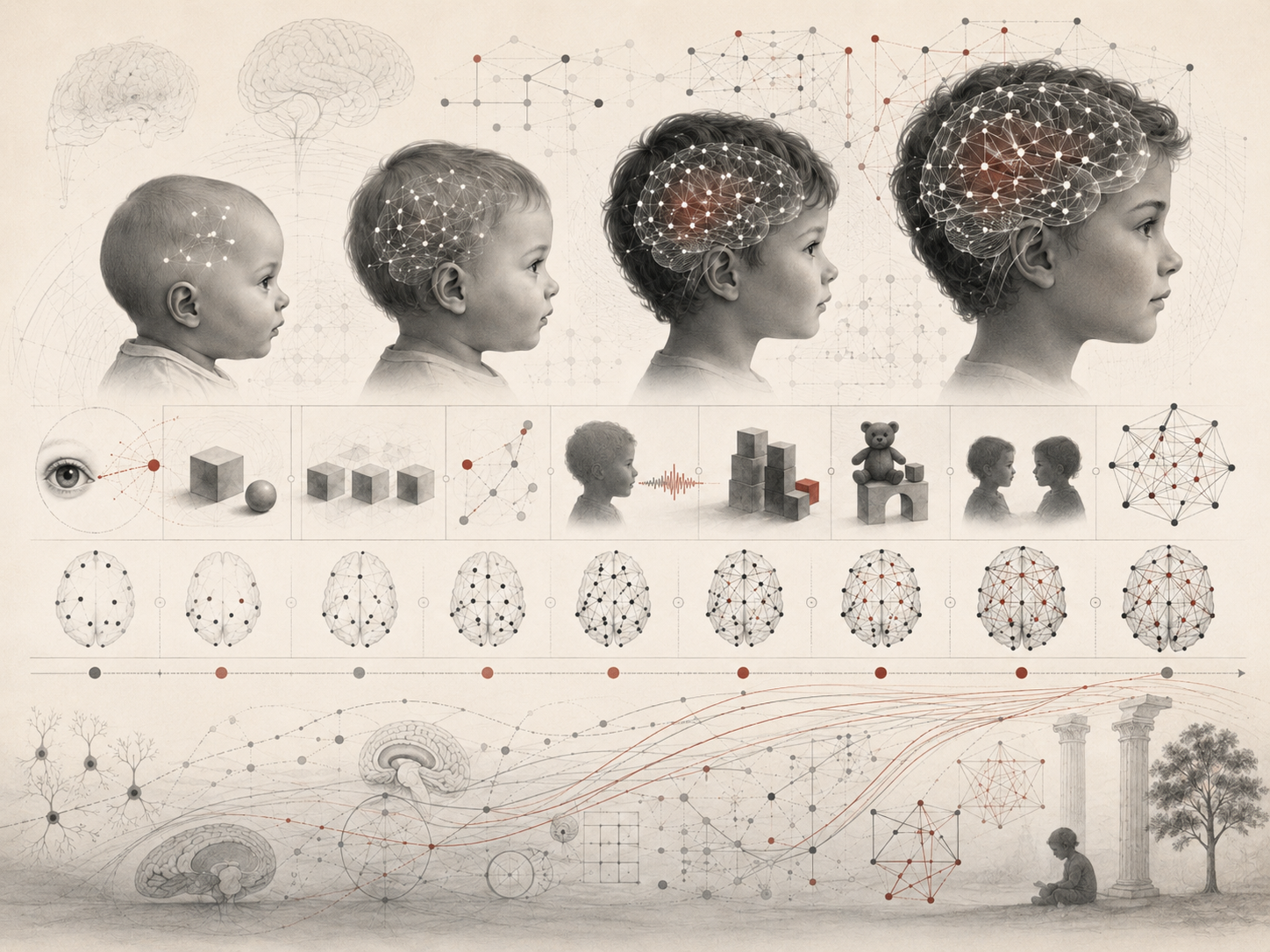
Modern developmental science treats cognition as part of a broader developmental system rather than as a disembodied faculty. The American Psychological Association defines developmental psychology as the study of human growth and change across the lifespan, including cognitive development. The NICHD Child Development and Behavior Branch frames child development research in neurocognitive, psychological, behavioral, and social-emotional terms, while the World Health Organization emphasizes that children and adolescents acquire cognitive and social-emotional skills during periods of rapid brain development. Cognitive development, then, is not only about what children know. It is about how minds are formed through time under conditions that are embodied, relational, institutional, cultural, and historically unequal.
A serious developmental psychology of cognition must therefore move beyond the narrow image of intelligence as a private possession located inside the individual. Cognition includes mental processes, but those processes develop through participation in worlds of language, care, work, play, schooling, technology, measurement, and power. Cognitive development is not reducible to test scores, school readiness, or formal reasoning. It includes the child who learns that an object still exists when hidden, the toddler who imitates a gesture, the preschooler who uses pretend play to represent an absent world, the school-age child who learns to hold multiple rules in mind, the adolescent who reflects on identity and possibility, and the adult who builds expertise, judgment, and adaptive strategy across life.
Why Cognitive Development Matters
Cognitive development matters because it shapes how a person encounters reality. To perceive, remember, classify, plan, inhibit, infer, narrate, symbolize, and imagine is to inhabit the world in a certain cognitive form. Changes in cognition are therefore not merely academic changes. They alter what can be noticed, anticipated, communicated, compared, remembered, and understood. A child who learns to represent absent objects, take another person’s perspective, hold rules in mind, understand cause and effect, or use symbolic language is not only adding new skills. The child is reorganizing the terms of experience.
This is why cognitive development occupies a central place in developmental psychology. It connects directly to learning, schooling, social understanding, emotional regulation, problem solving, moral judgment, creativity, executive function, and later participation in institutions. It also reveals one of the field’s deepest questions: does mental development proceed gradually, through cumulative growth, or discontinuously, through qualitative reorganization? Cognitive development has been one of the primary terrains on which developmental psychology has debated continuity and discontinuity, nature and nurture, stage theory and systems theory, individual difference and cultural mediation.
Cognitive development also matters because it changes the child’s relationship to time. Infants and young children are deeply tied to immediate perception and action, but development gradually expands their ability to remember the past, anticipate the future, imagine alternatives, understand sequence, and plan. This temporal expansion matters enormously. A child who can remember yesterday, imagine tomorrow, and follow steps toward a goal inhabits a wider cognitive world than a child locked into the immediate present.
It matters socially because cognition is not only about objects and facts. Children must also learn to understand people: intentions, desires, beliefs, emotions, deception, cooperation, conflict, and social rules. The growth of mind includes the growth of social understanding. A child who can recognize that another person knows something different, wants something different, or feels something different has gained a major cognitive capacity with moral and relational consequences.
Cognitive development matters ethically because societies often confuse cognitive performance with human worth. Children whose cognitive development differs from dominant timelines may be underestimated, overdisciplined, excluded, or treated as deficient rather than supported. Children whose cultural knowledge, home language, disability, neurodivergence, trauma history, or school environment differs from standardized assumptions may be misread by institutions. A serious account of cognitive development must therefore distinguish capacity from opportunity, difference from deficit, and developmental support from ranking.
Finally, cognitive development matters because it is one of the main ways developmental psychology shows that human beings are not fixed. Minds grow, reorganize, compensate, specialize, adapt, and sometimes recover under changed conditions. Cognitive development is not a guarantee of unlimited malleability, but it is a powerful argument against fatalism. The mind develops through relation, practice, support, challenge, language, and meaningful participation across time.
What Cognitive Development Is
Cognitive development refers to developmental change in the processes through which people perceive, attend, encode, remember, categorize, reason, solve problems, use language, regulate thought, and understand both physical and social worlds. It includes early sensory and perceptual organization, object knowledge, symbolic thinking, language growth, working memory, executive function, concept formation, causal reasoning, metacognition, and abstract thought. It also includes the social organization of cognition: how thinking develops through communication, imitation, instruction, play, shared attention, and participation in culturally structured practices.
This broader definition matters because cognition is often reduced to school-like intelligence or formal reasoning alone. That reduction misses much of what developmental psychology actually studies. Cognitive development begins before literacy and before explicit schooling. It is visible in gaze, habituation, imitation, object permanence, joint attention, early categorization, gesture, pretend play, exploration, and the child’s growing ability to coordinate action and representation. It continues through adolescence and adulthood, where changes in planning, metacognition, expertise, social reasoning, and adaptive judgment remain developmentally significant.
Cognitive development includes both domain-general and domain-specific change. Some processes, such as attention, processing speed, working memory, and inhibitory control, affect many kinds of tasks. Other forms of cognition develop in more specific domains, such as number, language, space, biology, social understanding, music, tool use, navigation, or literacy. This distinction matters because children may be advanced in one domain and still developing in another. A child may reason well spatially but struggle verbally, understand social dynamics but struggle with arithmetic, or show strong memory for stories but weak working memory under classroom pressure.
Cognitive development also includes the growth of strategy. Children do not only remember more; they learn how to remember. They rehearse, group, label, draw, write, ask, compare, repeat, imagine, and use external tools. They do not only solve problems; they learn how to choose strategies, monitor mistakes, seek help, and revise plans. The growth of cognition therefore includes the development of self-directed learning.
It also includes the growth of conceptual systems. Children gradually build categories: living and nonliving things, cause and effect, number and quantity, time and sequence, self and other, appearance and reality, fairness and harm, belief and knowledge. These conceptual systems are not merely memorized labels. They organize how the world appears to the child. Cognitive development is therefore also the development of meaning.
The most complete definition treats cognitive development as the changing organization of mental life across time: perception, action, memory, language, reasoning, representation, regulation, and social understanding developing together in embodied, relational, and cultural context.
Cognition as a Developmental System
Cognition is often imagined as something inside the head, but cognitive development is better understood as a developmental system linking brain, body, action, environment, relationship, symbol, and institution. A child’s thought develops through moving, touching, seeing, hearing, imitating, being spoken to, being guided, playing, practicing, failing, remembering, and participating in shared routines. The brain is central, but it is not an isolated machine. It develops as part of a body acting in a world.
This systems view matters because many cognitive achievements cannot be explained by a single cause. Language growth depends on hearing, perception, memory, social interaction, caregiver responsiveness, gesture, symbolic representation, and cultural practice. Executive function depends on neural maturation, sleep, stress, emotional security, classroom structure, caregiver scaffolding, and practice. Mathematical reasoning depends on symbolic instruction, spatial intuition, working memory, language, cultural tools, and schooling. Cognitive development is therefore multilevel by nature.
A systems view also helps explain why development can be uneven. Children rarely develop all cognitive domains at the same pace. A child may have advanced verbal reasoning but weaker impulse control, strong visual-spatial reasoning but difficulty with classroom language, deep knowledge of a special interest but slower performance on timed tasks, or strong social intuition in familiar environments but difficulty under institutional pressure. Unevenness is not always pathology. It is a normal feature of developing systems.
Cognition also develops through feedback. A child who learns language can use language to learn more. A child who develops memory strategies can remember better and then use better memory to build new knowledge. A child who receives support in school may experience more success, which may increase motivation and engagement. Conversely, chronic failure, stress, sleep deprivation, exclusion, or underestimation can shape cognitive opportunity. Developmental pathways are not merely linear; they can amplify, constrain, and redirect over time.
The systems view is also ethically important. It challenges the idea that cognitive outcomes are simple reflections of innate ability. Some differences reflect biology and disability; others reflect opportunity, stress, discrimination, instruction, language access, nutrition, safety, and institutional fit. A serious developmental psychology must hold these together without reducing one to the other.
To understand cognition as a developmental system is to recognize that the growth of mind is real, structured, and measurable, but also deeply dependent on the worlds in which minds are allowed to grow.
Classical Theories of Cognitive Development
Classical theories of cognitive development remain important because they established the major questions that still organize the field: Do children think differently from adults or merely less efficiently? Does cognition develop through stages, mechanisms, social guidance, or systems of interaction? How do language, culture, schooling, and biology shape thought? What changes when children move from perception to representation, from action to abstraction, or from external guidance to internal self-regulation?
Jean Piaget, Lev Vygotsky, information-processing theorists, and dynamic systems researchers each answered these questions differently. Their frameworks should not be treated as mutually exclusive dogmas. Each illuminates a different level of analysis. Piaget helps explain construction and qualitative reorganization. Vygotsky helps explain social mediation, language, and cultural tools. Information-processing approaches clarify mechanisms such as memory, attention, processing speed, and inhibition. Dynamic systems approaches show how cognition emerges through nonlinear coordination among body, brain, action, environment, and time.
A mature developmental account uses these traditions in combination. The growth of mind is active, social, mechanistic, embodied, and systemic. Children construct knowledge, but they do so with tools and language inherited from others. Cognitive mechanisms matter, but they operate inside cultural and institutional ecologies. Development can be gradual in one process and reorganizing in another. No single classical theory is sufficient, but together they show why cognitive development remains one of the richest areas of developmental psychology.
The sections that follow treat these traditions not as museum pieces, but as living frameworks for interpreting cognitive growth today.
Piaget and the Construction of Mind
Jean Piaget remains foundational because he argued that children actively construct knowledge rather than passively absorb it. Cognitive development, in his account, proceeds through the organization and reorganization of schemas as children assimilate experience and accommodate to novelty. Piaget’s larger contribution was to show that children often think differently, not merely less competently, than adults. Sensorimotor intelligence, preoperational thought, concrete operations, and formal operations described not only more knowledge but different structures of thought.
Piaget’s theory emphasized the child as an active epistemologist. The child explores the world, tests action, discovers regularities, and reorganizes understanding when old schemas no longer fit. A baby who shakes, drops, mouths, reaches, hides, and retrieves is not merely acting randomly. The baby is building sensorimotor knowledge. A preschool child who struggles with conservation is not simply foolish; the child is reasoning within a cognitive structure that gives appearance and transformation particular meanings. A school-age child who begins to understand reversibility and classification is not merely older; the child’s cognitive organization has changed.
The power of Piaget’s theory lies in this insistence on qualitative change. He made developmental psychology ask whether the growth of mind involves structural reorganization, not only faster processing or more information. He also helped show that children’s errors can be meaningful. An error may reveal a developmental logic. When a child says that a taller glass has more water despite equal volume, the response reflects how the child coordinates height, width, appearance, and transformation at that point in development.
Piaget’s weakness lies in the rigidity with which later readers sometimes interpreted his stages. Research showed that children can display greater competence under more familiar, supportive, or simpler task conditions, and that cognitive growth may be more domain-specific and uneven than the classic stage model suggests. Children may understand some forms of causality earlier than Piaget expected, perform better when tasks reduce linguistic burden, or show advanced reasoning in culturally familiar domains while struggling with unfamiliar formal tasks.
Still, Piaget remains central because he forced the field to confront the possibility that the growth of mind is not just accumulation, but reorganization. His legacy is not that every stage boundary must be preserved exactly, but that children’s thinking has developmental structure and should be studied on its own terms.
Vygotsky and the Social Formation of Cognition
Lev Vygotsky transformed cognitive development by showing that mind develops through social interaction, language, and cultural tools. In this perspective, higher mental functions are not simply generated inside the child and then expressed socially. They are formed through participation in socially organized activity and gradually internalized. The zone of proximal development remains one of the most powerful concepts in developmental psychology because it reframes ability in terms of potential under guidance rather than solitary performance alone.
Vygotsky’s view shifts the question from “What can the child do alone?” to “What can the child do with support, and what does that reveal about development?” This is a decisive move. A child may not solve a problem independently but may succeed with hints, modeling, language, scaffolding, or collaboration. That supported performance is not fake competence. It reveals emerging capacity. Development is often visible first in shared activity before it becomes independent mastery.
Vygotsky also made language central. Speech does not merely communicate thought; it helps form thought. Children first receive guidance from others, then use private speech to guide themselves, and eventually internalize forms of speech as inner regulation. A child saying “first this, then that” while solving a puzzle is not simply talking. The child is using language as a tool of cognition. Social speech becomes self-guidance.
His enduring importance lies in making cognition historical and cultural. Thinking develops through symbols, language, instruction, narratives, tools, and shared practices that are culturally inherited. Counting systems, writing, maps, diagrams, classroom routines, religious stories, scientific concepts, musical notation, and digital interfaces are not merely external supports. They are cognitive tools that change what people can think and how they can think.
Vygotsky also helps developmental psychology resist individualism. A child’s cognitive development cannot be fully understood apart from the environments in which children are taught, spoken to, interpreted, and given access to meaningful participation. The growth of mind is also development into a world: a world of language, tools, expectations, and social meanings.
At the same time, Vygotsky’s framework must be extended through attention to power. Cultural tools are not equally distributed. Some languages, dialects, literacies, and forms of knowledge are treated as more valuable than others by institutions. A contemporary Vygotskian account must therefore ask not only how culture forms cognition, but which cultures are recognized, which tools are available, and whose ways of knowing are legitimized.
Information Processing and Cognitive Mechanisms
Information-processing approaches shifted attention toward mechanisms such as attention, working memory, processing speed, inhibitory control, strategy use, encoding, retrieval, and problem-solving procedures. These models often emphasized continuous improvement rather than discrete stage transformation. Their strength lies in analytical precision. They help explain how performance changes as memory capacity expands, attentional control improves, processing becomes faster, or strategies become more efficient.
For example, a child’s difficulty solving a task may not reflect lack of conceptual understanding alone. It may reflect working-memory load, confusing instructions, slow processing, distractibility, weak inhibition, unfamiliar vocabulary, or lack of strategy. Information-processing approaches help separate these components. They ask what mental operations are required, where bottlenecks occur, and how practice or development changes performance.
This framework is especially useful for understanding school learning. Reading requires phonological processing, visual recognition, working memory, vocabulary, attention, and comprehension strategies. Arithmetic requires number sense, symbolic mapping, memory retrieval, procedural knowledge, and inhibition of incorrect strategies. Writing requires planning, language, motor control, memory, and revision. Cognitive development in school is therefore not one skill but a coordination of mechanisms.
Information-processing models also illuminate developmental change in memory. Young children may remember less not only because they have less capacity, but because they use fewer strategies, know less about the domain, encode information less effectively, or have difficulty monitoring what they know. As children develop, they learn to rehearse, group, organize, compare, use external aids, and check their understanding.
The limitation of information-processing approaches is that they can become too narrow when they treat the mind as a computational system abstracted from culture, language, emotion, and social life. Attention and working memory are real, but they are affected by stress, sleep, trauma, nutrition, sensory load, classroom climate, caregiver support, and disability accommodation. Mechanism without context can mislead.
The best use of information-processing theory is therefore complementary. It provides tools for explaining how cognition works while broader developmental theories explain where those mechanisms develop, how they are supported, and why they differ across children and contexts.
Dynamic Systems and Developmental Systems Perspectives
Dynamic and developmental systems approaches complicate older disputes by showing that cognitive development may emerge through nonlinear interactions among body, perception, action, neural development, relationship, and environment. In this view, cognition is not a prewritten program unfolding on schedule. It is an emergent developmental system. Small changes in one part of the system can sometimes produce larger reorganizations, and capacities emerge through coordination rather than from isolated modules alone.
This approach is especially useful for understanding developmental transitions. A child’s ability to walk, gesture, speak, solve problems, or regulate attention may appear suddenly, but the visible breakthrough often rests on many underlying changes: neural maturation, motor control, motivation, practice, caregiver support, environmental affordances, and accumulated experience. Development can look stage-like at the surface while being built through continuous systems-level change.
Dynamic systems theory also helps explain variability. Children do not move smoothly from one stable level to another. They often fluctuate. A child may solve a task one day and fail the next, use a new word and then not use it again for weeks, regulate well in one setting and poorly in another, or show advanced reasoning when calm but not when stressed. Variability is not merely error. It can be a sign of a developing system exploring new organization.
Embodiment is central here. Cognition develops through bodies. Reaching, crawling, walking, handling objects, looking, pointing, drawing, speaking, and manipulating tools all shape thought. A child who can move differently can learn differently because new actions create new cognitive opportunities. Perception and action are coupled. The child learns by doing, and doing changes what can be perceived and understood.
Developmental systems perspectives also push beyond individual cognition toward person-context relations. Cognition develops through reciprocal interactions among child, caregiver, school, culture, technology, and institution. A child’s learning shapes how adults respond; adult response shapes later learning. A school’s expectations shape performance; performance shapes placement and opportunity. Development is recursive.
These perspectives are powerful because they integrate biological reality with social context. They reject the idea that cognition is either innately programmed or environmentally imposed. Instead, cognitive development emerges through organized relations among multiple levels over time.
From Perception to Representation
One of the great achievements of cognitive development is the movement from immediate sensorimotor engagement to representation. Infants begin by coordinating sensation and action in ways that are already structured but not yet fully symbolic. Over time, they become able to represent absent objects, anticipate events, imitate more flexibly, use symbols, understand sequences, and imagine possibilities. This transition matters because representation is what allows language, pretend play, planning, memory organization, and conceptual thought to expand.
Representation should not be imagined as a single switch flipping on. It develops through many smaller processes: perceptual organization, memory stabilization, shared attention, gesture, naming, imitation, social cue use, and repeated interaction with people and things. Developmental psychology is strongest when it shows how these processes build upon each other without collapsing them into one reductive explanation. The child’s growth of mind proceeds through the coupling of body, object world, and social communication.
Perception itself is developmental. Infants do not simply receive the world as adults do. They learn what patterns matter: faces, voices, movement, rhythm, object boundaries, familiar people, emotional tone, and recurring sequences. Habituation and novelty preference reveal that infants detect difference and regularity long before they can speak. They are already learning through attention.
Representation expands this learning because it allows the child to hold something in mind when it is not immediately present. A hidden toy, absent caregiver, remembered event, imagined monster, future snack, or pretend object can become mentally available. This ability reorganizes development. The child can anticipate, search, imitate later, tell a story, pretend, plan, or worry. Representation expands the mind beyond the here and now.
Symbolic representation is especially important because symbols allow one thing to stand for another. A word can stand for an object. A drawing can stand for a person. A block can become a phone in pretend play. A number can stand for quantity. A map can stand for space. A diagram can stand for relation. Symbols make thought portable, shareable, and transformable.
The development from perception to representation is therefore one of cognitive development’s central arcs. It shows how children move from direct engagement with the world toward increasingly flexible, symbolic, and abstract forms of knowing.
Object Permanence, Symbolic Thought, and Play
Object permanence is one of the classic examples of early cognitive development: the understanding that objects continue to exist even when they are not directly perceived. The concept became central through Piaget, but its importance extends beyond a single task. Object permanence marks a broader developmental problem: how does the child come to understand that reality is stable beyond immediate perception?
This matters because stable representation underlies many later capacities. If objects, people, and events can exist beyond the visible moment, then the child can search, wait, remember, expect, miss, anticipate, and plan. The absent caregiver can be remembered. The hidden toy can be searched for. The routine can be expected. The future can begin to matter. Cognitive development expands as the child’s world becomes more stable in mind.
Symbolic thought extends this process. Children gradually learn that words, gestures, drawings, and objects can represent something else. This is visible in language and also in pretend play. A child turning a banana into a telephone or a blanket into a cave is not confused about reality. The child is coordinating reality and representation. This dual awareness—what something is and what it can stand for—is a major cognitive achievement.
Pretend play therefore belongs inside cognitive development. It is not merely emotional or recreational. It shows the growth of symbolic flexibility, narrative organization, role-taking, memory, planning, and social coordination. When children create imaginary worlds, they practice cognitive transformations: one object becomes another, one role becomes another, one scenario can be revised, one rule can define an entire play world. Imagination is not the opposite of cognition. It is one of cognition’s developmental forms.
Symbolic thought also supports later academic learning. Reading, mathematics, science, history, art, and law all depend on symbol systems. A written word, equation, graph, timeline, model, or diagram stands for something beyond itself. The roots of that capacity are visible early in the child’s ability to let one thing mean another.
The movement from object permanence to symbolic play to formal symbol systems shows how cognitive development grows from embodied experience into increasingly abstract worlds of representation. The child who searches for a hidden toy and the student who reasons with an equation are separated by years of development, but both depend on the mind’s capacity to represent what is not immediately present.
Language, Memory, Attention, and Executive Function
Cognitive development cannot be understood without language. Language is not merely a way of expressing thought already formed. It also reorganizes thought. Through words, categories, narrative, dialogue, and internal speech, language expands memory, reasoning, self-guidance, and social understanding. NICHD’s early-learning materials emphasize that research on early learning includes brain and cognitive development, environment, social interaction, learning disabilities, and ways to promote learning. That framing captures an important truth: language development belongs inside cognitive development rather than beside it.
Memory likewise changes developmentally in both capacity and organization. Infants remember differently from older children, and school-age children remember differently from adolescents because memory is shaped by strategy, language, knowledge structure, and attentional control as well as by basic encoding. Children learn not only to remember, but how to remember. They rehearse, group, narrate, label, write down, draw, and connect new information to what they already know.
Attention also develops through interaction between neural maturation and experience. What children notice, how long they can sustain focus, how flexibly they shift attention, and how well they resist distraction are all shaped by both biology and context. This is why cognitive development cannot be cleanly separated from sleep, stress, caregiving, classroom structure, sensory load, trauma, disability, and mental health. Attention is not simply willpower. It is a developing regulatory capacity.
Executive function adds another crucial layer. Inhibitory control, working memory, cognitive flexibility, and planning help organize thought under conditions of distraction, emotion, and competing demand. Executive function is not only an academic skill set. It is part of the developmental architecture of self-directed cognition. A child who can hold instructions in mind, wait, shift strategies, and resist an impulse has new cognitive power available.
These processes interact. Language supports memory by organizing experience into words and stories. Memory supports language by retaining words, rules, and narrative patterns. Attention supports learning by selecting relevant information. Executive function supports problem solving by holding goals in mind and inhibiting distractions. Together, they form a cognitive system rather than separate boxes.
The social environment matters because these capacities are scaffolded. Caregivers remind, label, narrate, sequence, prompt, redirect, and encourage. Teachers model strategies. Peers create challenges and opportunities for flexible thinking. Tools such as calendars, diagrams, notebooks, speech, images, and digital systems extend cognition beyond the individual. The growth of mind is partly the growth of the child’s ability to use supports, then internalize or adapt them.
Social Cognition and Theory of Mind
Cognitive development includes the growth of social cognition: the ability to understand people as agents with intentions, emotions, desires, beliefs, knowledge, ignorance, and perspectives. This is one of the most important expansions of childhood thought. The child gradually learns not only that the physical world has properties, but that other minds have viewpoints. People can want different things, know different things, believe false things, hide feelings, lie, pretend, misunderstand, and change their minds.
Theory of mind is often discussed through children’s developing understanding of belief, especially false belief. But social cognition is broader than any one task. It includes emotion recognition, intention reading, joint attention, imitation, empathy, moral judgment, deception, perspective-taking, and the ability to coordinate one’s own understanding with another person’s. These capacities develop through interaction, language, siblings, play, conversation, conflict, storytelling, and cultural norms.
Social cognition matters because it transforms relationships. A child who understands that another person can have a different belief can explain, persuade, deceive, comfort, joke, and negotiate differently. The child can begin to recognize misunderstanding as misunderstanding rather than simple opposition. This supports friendship, moral reasoning, classroom learning, and family life.
Language is central to this process. Words for thinking, knowing, wanting, remembering, pretending, lying, and feeling give children conceptual tools for understanding minds. Family talk about emotions, causes, mistakes, and perspectives can support social-cognitive growth. Storytelling also matters because stories require children to track characters, motives, beliefs, conflicts, and consequences.
Developmental difference must be interpreted carefully here. Children vary in how they express social understanding. Some autistic children, neurodivergent children, children with language delays, children with trauma histories, or children from different conversational cultures may perform differently on standard social-cognitive tasks. Difference in task performance does not automatically mean absence of social meaning or empathy. A serious account asks how social cognition is expressed, supported, measured, and recognized across different children and communication styles.
Social cognition shows why cognitive development is never purely cold or abstract. The growth of mind includes the growth of understanding other minds, and that growth is deeply tied to language, care, culture, and social participation.
Metacognition and Reflective Thought
Metacognition is cognition about cognition: the ability to monitor, evaluate, and regulate one’s own thinking. It includes knowing whether one understands, choosing a strategy, checking an answer, recognizing confusion, planning how to learn, and reflecting on mistakes. Metacognition is one of the major shifts in later cognitive development because it allows children and adolescents to become more active managers of their own minds.
Young children can show early forms of metacognitive awareness, but these capacities become more explicit and strategic across development. A child may first rely on adults to say, “Try again,” “Look carefully,” or “What do you think happens next?” Later, the child may begin to ask these questions internally. The development of metacognition is therefore connected to language, schooling, executive function, and social guidance.
Metacognition matters for learning because performance improves when learners can monitor their own understanding. A child who knows they do not understand can ask for help. A student who recognizes that rereading passively is not enough may use summarizing, drawing, testing, or explaining to another person. A learner who checks work can catch errors. Reflection turns cognition into an object of cognition.
Metacognition also matters emotionally. Children who can interpret struggle as part of learning rather than as proof of failure are more likely to persist. This depends not only on the child’s internal beliefs but on the climate around learning. Classrooms and families that treat mistakes as information can support reflective thought. Environments that shame mistakes can make metacognition threatening.
Adolescence often brings more sophisticated reflective thought. Young people become better able to think about identity, possibility, contradiction, values, systems, and the future. They can reflect on their own motives and the motives of others, although this growth remains uneven and context-dependent. Abstract reflection is not simply a switch that turns on; it develops through language, education, experience, emotional safety, and cultural tools.
Metacognition is one of the clearest examples of the mind becoming an object to itself. It is not only knowing the world. It is knowing something about one’s own knowing.
Schooling, Social Interaction, and Cultural Mediation
Schooling matters to cognitive development not simply because it adds information, but because it reorganizes the conditions under which cognition is practiced. Schools ask children to classify, compare, generalize, narrate, plan, read symbols, hold abstract rules in mind, explain reasoning, write, calculate, and solve problems under institutional expectations. At the same time, cognitive development begins before school and cannot be reduced to school performance. Families, communities, peer interaction, stories, play, caregiving routines, religious traditions, work, and cultural tools all contribute to how mind develops.
This is why Vygotskian and sociocultural approaches remain so important. Cognitive development is mediated by symbols, practices, and participation. Culture shapes not only what children learn, but what counts as cognitive competence in the first place. A child raised in one linguistic and social environment may develop different forms of memory, classification, spatial reasoning, practical intelligence, storytelling, or social interpretation than a child in another. Developmental psychology is distorted when it assumes that cognition is best measured only through the preferred tasks of formal schooling or dominant institutional culture.
School can expand cognition by giving children access to powerful symbolic systems: literacy, mathematics, scientific models, historical reasoning, maps, diagrams, formal argument, digital tools, and specialized vocabulary. These tools matter because they extend thought beyond immediate experience. A child can reason about ancient history, distant planets, invisible microbes, statistical patterns, or moral principles because institutions make symbolic knowledge available.
But schooling can also misread cognition. A child may be cognitively capable but unfamiliar with school language. A multilingual child may know more than a single-language assessment reveals. A child from a marginalized community may be underestimated because their cultural knowledge is not recognized. A child with disability or neurodivergence may need alternative access, assistive technology, sensory support, or different task conditions. School performance is important, but it is not a pure measure of mind.
Culture also shapes cognitive tools outside school. Storytelling, apprenticeship, music, navigation, caregiving, religious practice, craft, trade, ecological knowledge, cooking, kinship responsibility, and community survival all involve cognitive development. A child who learns to care for siblings, navigate a neighborhood, translate across languages, identify plants, memorize scripture, manage digital tools, or help in family work is developing cognition even if those forms are not always valued by formal schooling.
WHO’s early-childhood-development materials describe early development as foundational for long-term outcomes and emphasize care, support, and enabling environments. This aligns with a broader developmental lesson: cognition grows not in the abstract, but in specific social worlds with specific resources, demands, and values.
Inequality, Disability, Neurodivergence, and Cognitive Difference
Cognitive development is never equally resourced. Language exposure, nutrition, safe housing, healthcare access, preschool opportunity, sleep quality, environmental toxins, disability support, school funding, chronic stress, and institutional expectations all affect the conditions under which the growth of mind proceeds. To compare children cognitively without comparing their developmental ecologies is to mistake unequal opportunity for natural difference.
This has major implications for how developmental psychology interprets delay, difficulty, and difference. Some children experience real cognitive impairments or developmental disorders that require support, accommodation, and specialized intervention. NICHD’s research on intellectual and developmental disabilities makes clear that developmental causes of such conditions and their effects on learning, communication, cognition, and memory are major scientific concerns. At the same time, not all cognitive difference should be reduced to deficit. Neurodivergence, language diversity, cultural variation, and uneven institutional fit complicate any single model of normal cognitive development.
Disability and neurodivergence require careful interpretation. A child with ADHD may struggle with sustained attention in one setting while showing intense focus in another. An autistic child may show deep domain-specific knowledge, pattern recognition, or memory alongside differences in social communication or sensory regulation. A child with dyslexia may reason well but struggle with decoding. A child with intellectual disability may need more time and support but still develop meaningful concepts, relationships, and agency. Cognitive difference is not a single category.
Developmental psychology is strongest when it balances rigor with caution: recognizing genuine developmental need while resisting the conversion of every divergence from dominant norms into pathology. Cognitive development is shaped by mind, brain, support, expectation, and structure together. Diagnosis can be useful when it opens access to support, but harmful when it becomes a ceiling on expectation or a substitute for understanding the child’s actual strengths and needs.
Inequality can also create cognitive load. Poverty, housing instability, discrimination, food insecurity, unsafe environments, medical stress, and family disruption consume attention and emotional resources. Children under chronic stress may appear less attentive, less organized, or less ready to learn, but the issue may be developmental burden rather than lack of ability. Cognitive performance is always situated.
This is why cognitive justice matters. Children need access to language, books, sleep, nutrition, safety, healthcare, accessible classrooms, responsive teaching, assistive technologies, and culturally meaningful learning. They also need institutions that do not confuse difference with inferiority. The growth of mind depends on the conditions under which minds are recognized and supported.
Digital Media, AI, and Cognitive Environments
Digital media and artificial intelligence are increasingly part of the cognitive environments in which children, adolescents, and adults develop. Screens, games, search engines, recommendation systems, educational software, messaging platforms, generative AI tools, and algorithmic feeds shape attention, memory, learning, language, social comparison, and access to information. Developmental psychology cannot treat these environments as external to cognition. They are now part of the ecology in which cognition is practiced.
Digital environments can extend cognition. A child can learn through simulations, language tools, interactive stories, maps, videos, assistive communication devices, captioning, translation tools, and collaborative platforms. Technology can support disability access, multilingual learning, remote connection, creative production, and self-paced exploration. Digital tools can also externalize memory and planning through calendars, reminders, notes, diagrams, and searchable archives.
But digital environments can also fragment attention, intensify comparison, compress patience, commercialize curiosity, and replace slower forms of reflection with rapid feedback loops. Algorithmic systems can shape what children see before they understand how selection works. Platforms can reward speed, outrage, imitation, or performance over sustained inquiry. The developmental question is not whether digital media are simply good or bad. It is what kind of cognition they cultivate under what conditions.
AI tools make this question even sharper. Used well, they can support explanation, tutoring, translation, brainstorming, coding, accessibility, and iterative learning. Used poorly, they can weaken effortful retrieval, reduce tolerance for uncertainty, produce overreliance, or blur the difference between understanding and generated output. Cognitive development depends not merely on access to answers, but on the development of questions, strategies, verification, judgment, and reflective control.
Digital cognition must therefore be studied in terms of agency. Does the tool help the child think, or does it replace thinking? Does it support inquiry, or short-circuit it? Does it deepen language, memory, and reasoning, or merely deliver content? Does it expand participation for children with disabilities and multilingual children, or reproduce exclusion? Does it help learners understand their own thinking, or make them dependent on opaque systems?
A serious developmental psychology of cognition must include these questions. The growth of mind now happens partly in digital environments, and the design of those environments has developmental consequences.
Cognitive Development Across the Lifespan
Cognitive development does not end in childhood. APA’s lifespan framing emphasizes change across the whole life course, and cognition remains developmental well beyond early schooling. Adolescence brings changes in abstract reasoning, perspective coordination, future orientation, identity reflection, social judgment, and metacognition. Adulthood brings expertise, role-based problem solving, specialized knowledge, and often more context-sensitive judgment. Later life may bring both decline in some processes and gains in knowledge, interpretation, and adaptive strategy in others.
This lifespan perspective is crucial because it prevents cognitive development from being reduced to a narrow child-only science. The growth of mind includes emergence, consolidation, reorganization, specialization, compensation, and sometimes decline. A full developmental account must therefore hold together early foundations and later transformations rather than assuming that cognition reaches a finished endpoint once formal schooling is underway.
Adolescence is especially important because cognitive growth becomes tied to identity, risk, planning, peer life, and social meaning. Adolescents may develop stronger abstract reasoning and metacognition while still navigating emotion, social pressure, and uneven executive control. This does not mean adolescents are irrational. It means cognition is developing within a changing social, emotional, and bodily system.
Adulthood brings different forms of cognitive growth. Expertise can transform perception and reasoning within a domain. A skilled teacher, physician, mechanic, artist, engineer, parent, organizer, farmer, or musician sees patterns a novice may miss. Adult cognition is often practical, contextual, and experience-rich. It is not merely the continuation of school-like reasoning.
Later life requires an equally nuanced account. Some cognitive functions, especially processing speed or certain kinds of memory retrieval, may decline. But older adults may also retain or deepen semantic knowledge, judgment, emotional perspective, narrative understanding, and adaptive strategy. Cognitive aging is not a single story of loss. It is a changing profile of strengths, vulnerabilities, compensation, and context.
Lifespan cognitive development therefore reminds us that mind is not static. It grows, specializes, adapts, and changes across the whole life course. Developmental psychology must study cognition as a lifetime process rather than a childhood race toward adult performance.
What Cognitive Development Can and Cannot Explain
Cognitive development can explain a great deal about human growth. It helps explain how children learn, remember, reason, solve problems, regulate attention, understand others, use symbols, develop language, and participate in school and culture. It shows why early experience, support, stress, instruction, disability accommodation, play, and social interaction matter. It also explains why children’s errors are often developmentally meaningful rather than merely wrong.
Cognitive development can also correct harmful simplifications. A child who struggles with a task may not lack intelligence; the task may overload working memory, require unfamiliar language, assume cultural knowledge, trigger anxiety, ignore disability, or measure speed more than understanding. A child who thinks differently may not be deficient. A child who performs poorly in school may still possess rich practical, social, spatial, artistic, linguistic, or ecological knowledge.
But cognitive development cannot explain everything. Not every school problem is cognitive. Not every behavioral problem is executive dysfunction. Not every social difficulty reflects theory-of-mind delay. Not every difference in test performance reflects stable ability. Cognition interacts with emotion, trauma, sleep, health, nutrition, sensory processing, family stress, language access, peer life, racism, poverty, and institutional design. A serious developmental account uses cognition as one layer of explanation, not as a total explanation for the child.
Cognitive development should also not become a tool of ranking detached from care. The aim of studying cognitive development is not to sort children into narrow hierarchies of worth. It is to understand how minds grow, what supports they need, where difficulties arise, and how development can be strengthened under conditions of dignity. Cognitive measurement can be useful, but it must be interpreted with humility.
Finally, cognitive development cannot be separated from justice. Societies decide which forms of cognition are valued, which are measured, which are rewarded, which are ignored, and which are punished. Formal schooling often privileges certain literacies, speeds, languages, and forms of abstraction. A more humane developmental psychology asks how to expand cognitive opportunity and recognition rather than merely compare children within unequal systems.
The growth of mind is one of the deepest human developmental processes. But minds grow in worlds. To understand cognition seriously, developmental psychology must study both the mind and the conditions under which it is allowed to develop.
An Analytical Framework for Cognitive Development
A simple developmental outcome \(Y_{it}\) representing cognitive functioning for individual \(i\) at time \(t\) can be modeled as:
Y_{it} = \alpha_i + \beta_i t + \gamma X_{it} + \delta Z_i + \varepsilon_{it}
\]
Interpretation: \( \alpha_i \) is the individual’s starting point, \( \beta_i \) is the growth rate, \( X_{it} \) captures time-varying factors such as instruction, stress, language exposure, sleep, or support, and \( Z_i \) captures more stable characteristics such as early health status, disability, structural position, or baseline developmental conditions. This expresses a basic developmental insight: cognition changes across time, but it does so under the influence of both immediate and longer-term conditions.
To capture nonlinear growth, we can extend the model:
Y_{it} = \alpha_i + \beta_{1i}t + \beta_{2i}t^2 + \gamma X_{it} + \delta Z_i + \varepsilon_{it}
\]
Interpretation: The quadratic term allows for acceleration or deceleration. This matters because vocabulary, working memory, executive function, and abstract reasoning rarely develop at a perfectly constant pace.
To model threshold-like reorganization, we can write:
Y_{it} = \alpha_i + \beta_i t + \theta_i \mathbf{1}(t \geq \tau_i) + \gamma X_{it} + \varepsilon_{it}
\]
Interpretation: \( \mathbf{1}(t \geq \tau_i) \) turns on once the individual reaches threshold \( \tau_i \), and \( \theta_i \) represents a stage-like or transition effect. This can approximate the emergence of new strategies, symbolic breakthroughs, school transitions, literacy gains, or other reorganizations in cognition.
Because cognitive development is socially and institutionally nested, a multilevel version is often more realistic:
Y_{ijt} = \alpha + u_j + \beta t + \gamma X_{ijt} + \delta Z_i + \varepsilon_{ijt}
\]
Interpretation: \(u_j\) captures classroom, school, family, childcare, neighborhood, clinic, or community context. This matters because differences in instruction, stress load, opportunity, language environment, and disability accommodation can produce significant differences in cognitive pathway.
To represent cognitive development as a system of interacting domains, we can model multiple capacities together:
C_{it} = w_1M_{it} + w_2A_{it} + w_3E_{it} + w_4L_{it} + w_5S_{it}
\]
Interpretation: \(C_{it}\) is a composite cognitive-development index; \(M_{it}\) represents memory, \(A_{it}\) attention, \(E_{it}\) executive function, \(L_{it}\) language-mediated cognition, and \(S_{it}\) social cognition. The weights \(w_1\) through \(w_5\) reflect the fact that cognitive development is multidimensional rather than reducible to one score.
Finally, to capture support and stress together, a dynamic support model can be written as:
Y_{it} = \rho Y_{i,t-1} + \beta_1L_{it} + \beta_2Q_{it} + \beta_3R_{it} – \beta_4S_{it} + \varepsilon_{it}
\]
Interpretation: \(Y_{i,t-1}\) captures prior cognitive functioning, \(L_{it}\) language exposure or linguistic support, \(Q_{it}\) instructional quality, \(R_{it}\) regulatory support, and \(S_{it}\) stress burden. This reflects the developmental claim that cognition is path-dependent but modifiable under changed conditions.
The point of this framework is not to reduce the growth of mind to equations alone. It is to clarify that cognitive development is dynamic, time-structured, context-sensitive, multidimensional, and often nonlinear.
R: Simulating Cognitive Growth, Support, and Developmental Trajectories
The following R example simulates cognitive development across eight waves. It includes baseline cognitive level, language exposure, school support, executive-function support, sleep quality, chronic stress, acute stress, classroom context, and a developmental outcome that can be read as a reasoning-memory-regulation composite. The data are synthetic and intended for methodological demonstration.
# Simulating cognitive growth, support, and developmental trajectories
# -------------------------------------------------------------------
# This synthetic example models cognitive development as a longitudinal
# process shaped by language exposure, school support, executive-function
# support, sleep quality, classroom context, chronic stress, acute stress,
# and prior developmental conditions.

suppressPackageStartupMessages({
  library(dplyr)
  library(tidyr)
  library(lme4)
  library(ggplot2)
})

set.seed(2026)

n_children <- 840
n_waves <- 8
n_classrooms <- 36

children <- data.frame(
  child_id = 1:n_children,
  classroom_id = sample(1:n_classrooms, n_children, replace = TRUE),
  baseline_cognition = rnorm(n_children, mean = 50, sd = 8),
  language_exposure = rnorm(n_children, mean = 0, sd = 1),
  school_support = rnorm(n_children, mean = 0, sd = 1),
  executive_function_support = rnorm(n_children, mean = 0, sd = 1),
  sleep_quality = rnorm(n_children, mean = 0, sd = 1),
  disability_support_need = rbinom(n_children, size = 1, prob = 0.18),
  chronic_stress = rbinom(n_children, size = 1, prob = 0.30)
)

classrooms <- data.frame(
  classroom_id = 1:n_classrooms,
  instructional_quality = rnorm(n_classrooms, mean = 0, sd = 0.6),
  classroom_structure = rnorm(n_classrooms, mean = 0, sd = 0.6),
  cognitive_scaffolding = rnorm(n_classrooms, mean = 0, sd = 0.6),
  accommodation_access = rnorm(n_classrooms, mean = 0, sd = 0.6)
)

panel_data <- children |>
  slice(rep(1:n(), each = n_waves)) |>
  group_by(child_id) |>
  mutate(
    wave = 0:(n_waves - 1),
    current_language = rnorm(n_waves, mean = language_exposure, sd = 0.6),
    current_school_support = rnorm(n_waves, mean = school_support, sd = 0.6),
    current_executive_support = rnorm(n_waves, mean = executive_function_support, sd = 0.6),
    current_sleep = rnorm(n_waves, mean = sleep_quality, sd = 0.5),
    acute_stress = rnorm(n_waves, mean = 0.30 * chronic_stress, sd = 0.8)
  ) |>
  ungroup() |>
  left_join(classrooms, by = "classroom_id") |>
  mutate(
    cognitive_support_context =
      current_language +
      current_school_support +
      current_executive_support +
      current_sleep +
      instructional_quality +
      classroom_structure +
      cognitive_scaffolding +
      accommodation_access * disability_support_need,
    cognition_score =
      baseline_cognition +
      1.70 * wave -
      0.04 * wave^2 +
      1.35 * current_language +
      1.25 * current_school_support +
      1.15 * current_executive_support +
      0.90 * current_sleep +
      0.90 * instructional_quality +
      0.80 * classroom_structure +
      0.85 * cognitive_scaffolding +
      0.80 * accommodation_access * disability_support_need -
      1.45 * acute_stress -
      1.00 * chronic_stress +
      0.25 * cognitive_support_context +
      rnorm(n(), mean = 0, sd = 2.6)
  )

model <- lmer(
  cognition_score ~ wave + I(wave^2) + current_language +
    current_school_support + current_executive_support +
    current_sleep + acute_stress + chronic_stress +
    instructional_quality + classroom_structure +
    cognitive_scaffolding + disability_support_need +
    accommodation_access + disability_support_need:accommodation_access +
    cognitive_support_context +
    (1 + wave | classroom_id/child_id),
  data = panel_data
)

summary(model)

trajectory_summary <- panel_data |>
  group_by(wave, chronic_stress) |>
  summarize(
    mean_cognition = mean(cognition_score),
    standard_error = sd(cognition_score) / sqrt(n()),
    .groups = "drop"
  ) |>
  mutate(
    lower = mean_cognition - 1.96 * standard_error,
    upper = mean_cognition + 1.96 * standard_error,
    stress_group = ifelse(chronic_stress == 1, "Higher chronic stress", "Lower chronic stress")
  )

ggplot(trajectory_summary, aes(x = wave, y = mean_cognition, linetype = stress_group)) +
  geom_line(linewidth = 1) +
  geom_ribbon(aes(ymin = lower, ymax = upper, group = stress_group), alpha = 0.12) +
  labs(
    title = "Simulated Cognitive Development Across Time",
    x = "Wave",
    y = "Cognition score",
    linetype = "Group"
  ) +
  theme_minimal()

context_summary <- panel_data |>
  group_by(wave) |>
  summarize(
    average_language = mean(current_language),
    average_school_support = mean(current_school_support),
    average_executive_support = mean(current_executive_support),
    average_sleep = mean(current_sleep),
    average_stress = mean(acute_stress),
    average_cognitive_support = mean(cognitive_support_context),
    average_cognition = mean(cognition_score),
    .groups = "drop"
  )

ggplot(context_summary, aes(x = wave)) +
  geom_line(aes(y = average_language, linetype = "language exposure"), linewidth = 1) +
  geom_line(aes(y = average_school_support, linetype = "school support"), linewidth = 1) +
  geom_line(aes(y = average_executive_support, linetype = "executive support"), linewidth = 1) +
  geom_line(aes(y = average_sleep, linetype = "sleep quality"), linewidth = 1) +
  geom_line(aes(y = average_stress, linetype = "acute stress"), linewidth = 1) +
  geom_line(aes(y = average_cognitive_support, linetype = "cognitive support context"), linewidth = 1) +
  labs(
    title = "Synthetic Cognitive Support Context Across Waves",
    x = "Wave",
    y = "Average index",
    linetype = "Measure"
  ) +
  theme_minimal()

profile_summary <- panel_data |>
  group_by(chronic_stress, disability_support_need) |>
  summarize(
    children = n_distinct(child_id),
    average_cognition = mean(cognition_score),
    average_cognitive_support = mean(cognitive_support_context),
    average_stress = mean(acute_stress),
    average_sleep = mean(current_sleep),
    .groups = "drop"
  )

print(profile_summary)

# Analysts can extend this model by:
# 1. separating language, memory, attention, and executive function;
# 2. adding nonlinear threshold or strategy-shift terms;
# 3. introducing school, classroom, or neighborhood random effects;
# 4. modeling intervention timing and dosage;
# 5. testing accommodation effects for disability support need;
# 6. modeling cognitive profiles rather than a single score;
# 7. adding digital learning, tutoring, or AI-assisted support variables.
This simulation illustrates a core developmental principle: cognitive growth is shaped not only by time, but by language, school support, sleep, stress, classroom structure, accommodation, and the broader environment in which learning takes place.
Python: Modeling Memory, Learning, and Context Across Time
The following Python example simulates a panel of children with changing cognitive state across ten periods. It includes language exposure, school support, executive-function support, sleep quality, acute stress, chronic stress, classroom quality, disability support need, and state dependence in cognitive functioning. The data are synthetic and intended for conceptual demonstration.
# Modeling memory, learning, and context across time
# --------------------------------------------------
# This synthetic example models cognitive development as a dynamic,
# state-dependent process shaped by language exposure, school support,
# executive-function support, sleep quality, acute stress, chronic stress,
# classroom quality, cognitive scaffolding, disability accommodation,
# and prior cognitive organization.

from __future__ import annotations

import numpy as np
import pandas as pd
import statsmodels.formula.api as smf
import matplotlib.pyplot as plt

np.random.seed(2026)

n_children = 900
n_periods = 10
n_classrooms = 40

children = pd.DataFrame({
    "child_id": np.arange(1, n_children + 1),
    "classroom_id": np.random.choice(np.arange(1, n_classrooms + 1), size=n_children),
    "baseline_cognition": np.random.normal(50, 8, n_children),
    "language_exposure": np.random.normal(0, 1, n_children),
    "school_support": np.random.normal(0, 1, n_children),
    "executive_function_support": np.random.normal(0, 1, n_children),
    "sleep_quality": np.random.normal(0, 1, n_children),
    "disability_support_need": np.random.binomial(1, 0.18, n_children),
    "chronic_stress": np.random.binomial(1, 0.30, n_children)
})

classrooms = pd.DataFrame({
    "classroom_id": np.arange(1, n_classrooms + 1),
    "instructional_quality": np.random.normal(0, 0.6, n_classrooms),
    "classroom_structure": np.random.normal(0, 0.6, n_classrooms),
    "cognitive_scaffolding": np.random.normal(0, 0.6, n_classrooms),
    "accommodation_access": np.random.normal(0, 0.6, n_classrooms)
})

panel = children.loc[children.index.repeat(n_periods)].copy()
panel["time"] = np.tile(np.arange(n_periods), n_children)
panel = panel.merge(classrooms, on="classroom_id", how="left")

panel["current_language"] = np.random.normal(
    loc=panel["language_exposure"],
    scale=0.7,
    size=len(panel)
)

panel["current_school_support"] = np.random.normal(
    loc=panel["school_support"],
    scale=0.7,
    size=len(panel)
)

panel["current_executive_support"] = np.random.normal(
    loc=panel["executive_function_support"],
    scale=0.7,
    size=len(panel)
)

panel["current_sleep"] = np.random.normal(
    loc=panel["sleep_quality"],
    scale=0.5,
    size=len(panel)
)

panel["acute_stress"] = np.random.normal(
    loc=0.30 * panel["chronic_stress"],
    scale=0.8,
    size=len(panel)
)

panel["cognitive_support_context"] = (
    panel["current_language"]
    + panel["current_school_support"]
    + panel["current_executive_support"]
    + panel["current_sleep"]
    + panel["instructional_quality"]
    + panel["classroom_structure"]
    + panel["cognitive_scaffolding"]
    + panel["accommodation_access"] * panel["disability_support_need"]
)

panel = panel.sort_values(["child_id", "time"]).reset_index(drop=True)
panel["cognition_score"] = np.nan

for child in panel["child_id"].unique():
    child_rows = panel["child_id"] == child
    child_data = panel.loc[child_rows].copy()

    previous_score = child_data["baseline_cognition"].iloc[0]

    for idx in child_data.index:
        time = panel.at[idx, "time"]
        language = panel.at[idx, "current_language"]
        school_support = panel.at[idx, "current_school_support"]
        executive_support = panel.at[idx, "current_executive_support"]
        sleep = panel.at[idx, "current_sleep"]
        stress = panel.at[idx, "acute_stress"]
        chronic = panel.at[idx, "chronic_stress"]
        instructional_quality = panel.at[idx, "instructional_quality"]
        classroom_structure = panel.at[idx, "classroom_structure"]
        cognitive_scaffolding = panel.at[idx, "cognitive_scaffolding"]
        accommodation_access = panel.at[idx, "accommodation_access"]
        support_need = panel.at[idx, "disability_support_need"]
        support_context = panel.at[idx, "cognitive_support_context"]

        current_score = (
            0.72 * previous_score
            + 0.90 * time
            - 0.012 * time**2
            + 1.25 * language
            + 1.15 * school_support
            + 1.10 * executive_support
            + 0.85 * sleep
            + 0.85 * instructional_quality
            + 0.80 * classroom_structure
            + 0.85 * cognitive_scaffolding
            + 0.80 * accommodation_access * support_need
            - 1.35 * stress
            - 0.95 * chronic
            + 0.25 * support_context
            + np.random.normal(0, 2.4)
        )

        panel.at[idx, "cognition_score"] = current_score
        previous_score = current_score

panel["lag_score"] = panel.groupby("child_id")["cognition_score"].shift(1)
regression_data = panel.dropna(subset=["lag_score"]).copy()

model = smf.ols(
    formula="""
    cognition_score ~ lag_score + time + I(time ** 2) +
    current_language + current_school_support + current_executive_support +
    current_sleep + acute_stress + chronic_stress +
    instructional_quality + classroom_structure + cognitive_scaffolding +
    disability_support_need + accommodation_access +
    disability_support_need:accommodation_access +
    cognitive_support_context
    """,
    data=regression_data
).fit(cov_type="HC3")

print(model.summary())

trajectory = panel.groupby(["time", "chronic_stress"], as_index=False).agg(
    average_cognition=("cognition_score", "mean"),
    average_language=("current_language", "mean"),
    average_school_support=("current_school_support", "mean"),
    average_executive_support=("current_executive_support", "mean"),
    average_sleep=("current_sleep", "mean"),
    average_stress=("acute_stress", "mean"),
    average_cognitive_support=("cognitive_support_context", "mean"),
    standard_error=("cognition_score", lambda x: x.std() / np.sqrt(len(x)))
)

trajectory["stress_group"] = trajectory["chronic_stress"].map({
    0: "Lower chronic stress",
    1: "Higher chronic stress"
})

plt.figure(figsize=(8, 5))
for group_name, subset in trajectory.groupby("stress_group"):
    plt.plot(
        subset["time"],
        subset["average_cognition"],
        marker="o",
        label=group_name
    )

plt.xlabel("Time")
plt.ylabel("Average cognition score")
plt.title("Simulated Cognitive Development Under Support and Stress")
plt.legend()
plt.tight_layout()
plt.show()

context_summary = panel.groupby("classroom_id", as_index=False).agg(
    instructional_quality=("instructional_quality", "mean"),
    classroom_structure=("classroom_structure", "mean"),
    cognitive_scaffolding=("cognitive_scaffolding", "mean"),
    accommodation_access=("accommodation_access", "mean"),
    average_cognition=("cognition_score", "mean"),
    average_stress=("acute_stress", "mean"),
    average_cognitive_support=("cognitive_support_context", "mean"),
    children=("child_id", "nunique")
)

print(context_summary.sort_values("average_cognition", ascending=False).head())

profile_summary = panel.groupby(
    ["chronic_stress", "disability_support_need"],
    as_index=False
).agg(
    children=("child_id", "nunique"),
    average_cognition=("cognition_score", "mean"),
    average_cognitive_support=("cognitive_support_context", "mean"),
    average_stress=("acute_stress", "mean"),
    average_sleep=("current_sleep", "mean")
)

print(profile_summary)

# Analysts can extend this framework by:
# 1. modeling separate domains such as memory, attention, and executive function;
# 2. introducing nonlinear or threshold effects;
# 3. adding school, family, clinic, or neighborhood clustering;
# 4. simulating intervention effects on learning;
# 5. comparing developmental pathways across contexts;
# 6. adding digital media, tutoring, or AI-assisted learning supports;
# 7. modeling neurodivergent profiles and accommodation access explicitly.
The advantage of a model like this is that it makes the growth of mind analytically explicit: cognition develops through time, but always under conditions of support, stress, language, sleep, instruction, accommodation, prior structure, and opportunity.
GitHub Repository
Complete Code Repository
Access the full companion repository for this article, including reproducible analysis materials and multi-language code workflows for cognitive development, memory, attention, executive function, language exposure, school support, classroom context, sleep, stress, disability accommodation, developmental trajectories, and cognitive support systems across time.
Conclusion
Cognitive development is the growth of mind as a developmental process. It includes perception, memory, language, attention, executive function, symbolic thought, social cognition, reasoning, metacognition, and the expanding ability to act intelligently within social and material worlds. The strongest developmental psychology treats these capacities not as isolated mental modules and not as mere school performance, but as interconnected forms of development emerging through time.
That growth of mind is never purely internal. It is shaped by care, language, schooling, social interaction, brain development, culture, disability, neurodivergence, stress, inequality, digital environments, and institutional opportunity. Cognitive development therefore stands at the center of developmental psychology not because it is the only important domain, but because it helps reveal the field’s deepest insight: human development is the organized emergence of increasingly complex capacities under conditions that are biological, relational, cultural, and unequal all at once.
The mind grows through action and symbol, through memory and language, through guidance and exploration, through challenge and support. It grows in classrooms, homes, playgrounds, clinics, digital environments, communities, and cultures. It grows differently under different conditions. The task of developmental psychology is not merely to rank that growth, but to understand it well enough to support it more justly.
To study cognitive development seriously is to refuse the idea that mind can be separated from world. Human thinking develops in history, in bodies, in relationships, in institutions, and in systems of possibility. The growth of mind is one of the deepest forms of human development, and it is always also a question of care, access, recognition, and justice.
Related Articles
- What Is Developmental Psychology?
- The History of Developmental Psychology: From Child Study to Lifespan Science
- Continuity, Discontinuity, and the Logic of Developmental Change
- Stage Theories of Development: Promise, Power, and Critique
- Brain Development, Plasticity, and the Developing Nervous System
- Language Development and Social Learning
- Temperament and Individual Differences in Development
- Developmental Psychopathology, Risk, Trauma, and Adaptation
- Lifespan Development from Childhood to Aging
- Developmental Psychology knowledge series
Further Reading
- Developmental Psychology knowledge series
- Case, R. (1998) The Mind’s Staircase: Exploring the Conceptual Underpinnings of Children’s Thought and Knowledge. Mahwah, NJ: Lawrence Erlbaum.
- Piaget, J. (1952) The Origins of Intelligence in Children. New York: International Universities Press.
- Rogoff, B. (2003) The Cultural Nature of Human Development. Oxford: Oxford University Press.
- Thelen, E. and Smith, L.B. (1994) A Dynamic Systems Approach to the Development of Cognition and Action. Cambridge, MA: MIT Press. Available at: https://mitpress.mit.edu/9780262700597/a-dynamic-systems-approach-to-the-development-of-cognition-and-action/.
- Vygotsky, L.S. (1978) Mind in Society: The Development of Higher Psychological Processes. Cambridge, MA: Harvard University Press.
- Zelazo, P.D. (ed.) (2013) Oxford Handbook of Developmental Psychology. Oxford: Oxford University Press.
References
- American Psychological Association (n.d.) Developmental Psychology. Available at: https://www.apa.org/education-career/guide/subfields/developmental.
- Centers for Disease Control and Prevention (2026) CDC’s Developmental Milestones. Available at: https://www.cdc.gov/act-early/milestones/index.html.
- Eunice Kennedy Shriver National Institute of Child Health and Human Development (2026) Child Development and Behavior Branch. Available at: https://www.nichd.nih.gov/about/org/der/branches/cdbb.
- Eunice Kennedy Shriver National Institute of Child Health and Human Development (2021) Early Learning Research Information. Available at: https://www.nichd.nih.gov/health/topics/early-learning/researchinfo.
- Eunice Kennedy Shriver National Institute of Child Health and Human Development (n.d.) Intellectual and Developmental Disabilities. Available at: https://www.nichd.nih.gov/health/topics/idds.
- World Health Organization (n.d.) Early childhood development. Available at: https://www.who.int/southeastasia/activities/early-childhood-development.
- World Health Organization (n.d.) Improving the mental and brain health of children and adolescents. Available at: https://www.who.int/activities/improving-the-mental-and-brain-health-of-children-and-adolescents.
- World Health Organization (2020) Improving early childhood development: WHO guideline. Available at: https://www.who.int/publications/i/item/97892400020986.