
Last Updated May 21, 2026
Developmental psychology is the scientific study of how human beings change, persist, adapt, and become over time. At its deepest level, the field is not simply about children moving through age-graded milestones. It is about the formation of mind, emotion, attachment, language, morality, identity, agency, personality, social participation, and meaning across the lifespan. It asks how infants become communicative partners, how children learn to regulate attention and emotion, how adolescents form identity under social pressure, how adults reorganize work and relationships, and how older people adapt to loss, continuity, memory, dependence, purpose, and changing bodily conditions.
Development unfolds through bodies, relationships, institutions, cultural worlds, and unequal material environments. A child does not develop in the abstract. A child develops in a household, neighborhood, language community, school system, health system, peer ecology, media environment, legal order, and political economy. An adult does not simply “finish” development and become static. Adults continue to change through intimacy, work, caregiving, illness, migration, parenthood, unemployment, trauma, aging, grief, learning, and renewed forms of responsibility. For that reason, developmental psychology is not merely a psychology of growth. It is a psychology of timing, plasticity, dependency, learning, vulnerability, resilience, socialization, inequality, and human possibility.
Main Library
Publications
Article Map
Developmental Psychology
Related Topic
Cognitive Psychology
Related Topic
Social Psychology
Related Topic
Risk & Resilience
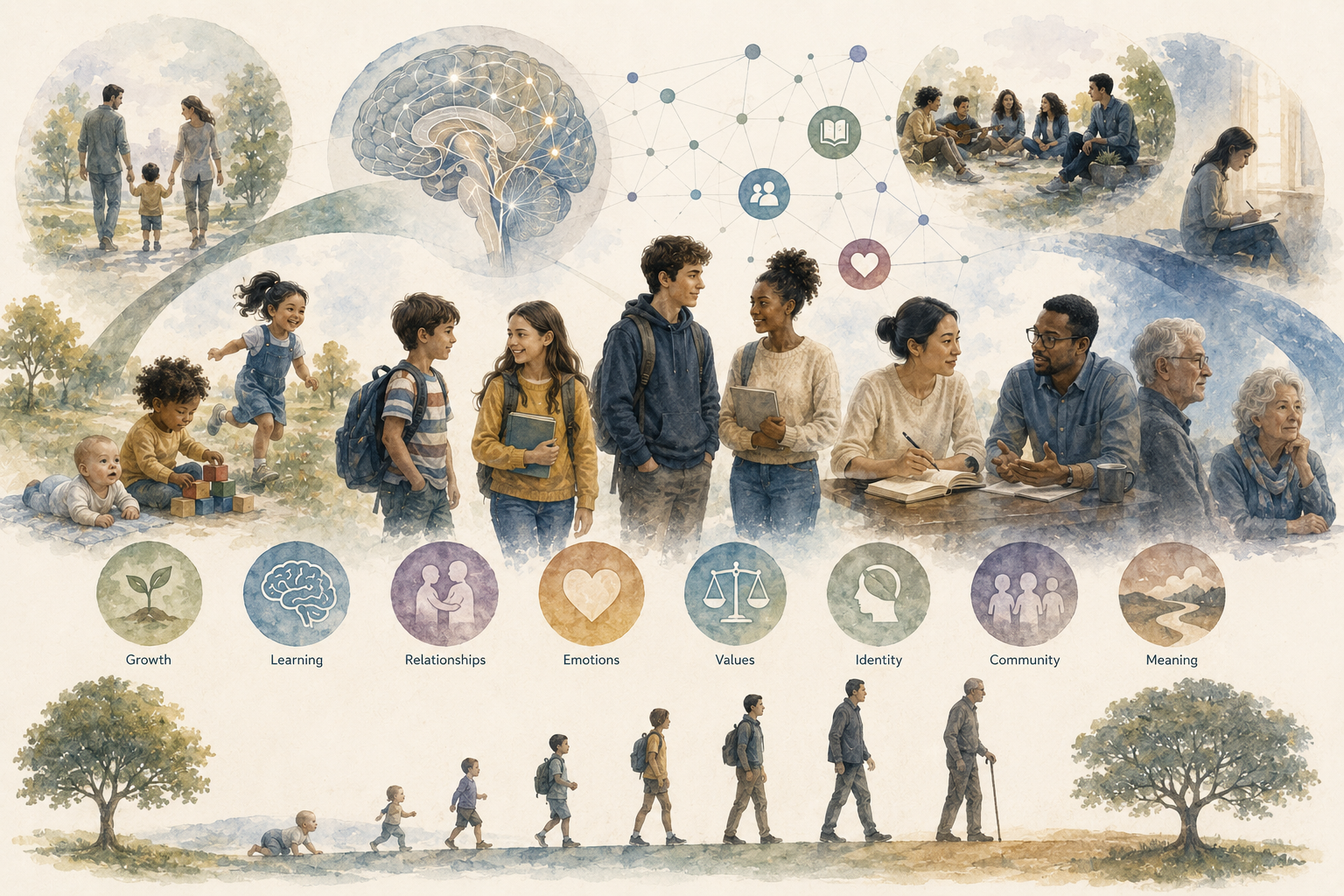
Developmental psychology emerged historically from questions about childhood, maturation, education, learning, and family life, but it has become a far broader science of human change. It investigates cognitive development, socioemotional development, attachment, language, moral reasoning, peer relations, identity formation, neurodevelopment, risk and resilience, developmental psychopathology, culture, disability, trauma, aging, and the long-term effects of family systems, poverty, institutions, public policy, and historical conditions. Its central task is to explain not only what changes, but how change happens, why similar beginnings can produce divergent outcomes, and how developmental pathways are shaped by the interaction of organism, environment, history, and power.
This article introduces developmental psychology as a full lifespan field. It does not treat children as isolated organisms, adults as finished products, or older people as merely declining versions of earlier selves. It treats development as a patterned, relational, embodied, and historically situated process. Human beings develop through biological maturation, but also through language, care, trauma, schooling, culture, friendship, attachment, work, institutions, law, disability access, environmental exposure, public-health infrastructure, and social recognition. The field’s deepest question is therefore not simply “What is normal at this age?” but “What kinds of lives become possible under particular developmental conditions?”
What the Field Studies
Developmental psychology studies patterned change and relative continuity across the lifespan. Its scope includes perceptual growth, motor development, language acquisition, executive function, emotional regulation, attachment, moral judgment, identity formation, peer interaction, personality development, adaptation to schooling, pubertal transition, adult role formation, aging, and the ways developmental pathways are altered by stress, deprivation, trauma, disease, disability, care, and social structure.
The field cannot be reduced to a single image of “normal development.” Development occurs through variation. Some changes are broadly species-typical, such as increasing sensorimotor coordination in infancy, language readiness in early childhood, neuroendocrine shifts in puberty, or changing cognitive and physical capacities in later life. Others depend heavily on language environment, caregiving structure, nutrition, educational opportunity, disability status, trauma exposure, sleep, neighborhood conditions, healthcare access, family stability, public policy, and cultural expectations. Developmental psychology therefore sits at the intersection of biology, learning, family life, institutional design, and social inequality.
This makes the field especially important for any serious understanding of human formation. It informs education, pediatrics, psychiatry, child welfare, developmental neuroscience, disability services, public health, law, juvenile justice, family policy, aging policy, and social intervention. Whether a child is interpreted as delayed, different, traumatized, disabled, resilient, oppositional, gifted, neurodivergent, neglected, culturally misread, or still developing often depends on developmental assumptions that are theory-laden and institutionally consequential.
Developmental psychology also studies continuity. The field is not only interested in change from one age to another. It asks why some patterns persist: temperament, emotional reactivity, attachment expectations, coping strategies, social confidence, stress physiology, academic self-concept, and patterns of trust or mistrust. Continuity does not mean destiny. It means that earlier experiences may become organized into habits, expectations, relational patterns, biological sensitivities, and institutional pathways that shape later development unless altered by new conditions.
At its strongest, developmental psychology is a science of trajectories rather than snapshots. A single test score, behavior, diagnosis, conflict, or milestone rarely explains a person. The field asks how patterns unfold over time, how contexts accumulate, how early conditions are amplified or buffered, how interventions redirect pathways, and how human beings remain open to change even under constraint.
Why Developmental Psychology Matters
Developmental psychology matters because societies make decisions about people based on assumptions about development. Schools decide when children are ready to read, sit still, collaborate, test, specialize, or be disciplined. Courts decide what young people can understand, intend, or be held responsible for. Health systems decide when milestones require attention. Families decide what independence, obedience, maturity, and care should look like. Workplaces and welfare systems decide what adult competence means. Aging systems decide when support, autonomy, dependence, and protection are needed.
These decisions are never purely technical. They are built on ideas about human timing. Developmental psychology influences how institutions interpret infancy, childhood, adolescence, adulthood, and old age. It can support dignity by showing that development is gradual, relational, and context-sensitive. It can also cause harm when used rigidly to classify people, rank children, pathologize difference, universalize narrow norms, or blame individuals for outcomes produced by unequal developmental environments.
The field also matters because it challenges simplistic explanations of behavior. A child’s difficulty with attention may reflect neurodevelopment, sleep disruption, trauma exposure, classroom mismatch, language demands, sensory overload, hunger, disability, anxiety, or chronic stress. An adolescent’s risk-taking may reflect identity exploration, peer ecology, emotional urgency, institutional mistrust, trauma history, or lack of meaningful opportunity. An older adult’s withdrawal may reflect grief, sensory loss, mobility barriers, social isolation, depression, ageism, or neurological change. Developmental psychology asks what history and context make a pattern intelligible.
Developmental thinking also protects against fatalism. Early experience matters, but early experience does not wholly determine the life course. Sensitive periods matter, but plasticity remains. Biology matters, but biology develops in context. Social structure matters, but people are not simply passive products of structure. A mature developmental psychology holds these tensions together. It studies constraint and possibility at the same time.
Finally, developmental psychology matters because it forces ethical attention to dependency. Human beings do not enter the world as autonomous individuals. Infants require care. Children require protection, language, education, play, nutrition, and recognition. Adolescents require dignity, guidance, autonomy, and safe transition. Adults require meaningful roles, relational support, healthcare, and conditions for adaptation. Older people require recognition, access, care, and social value. Developmental psychology reminds us that dependency is not an exception to human life. It is one of its foundations.
Core Questions of Development
Several enduring questions organize developmental psychology. The first is the question of change and continuity: what changes over time, and what remains relatively stable? Development is never pure transformation. Temperament, reactivity, sensory preference, family roles, and aspects of social style may show continuity, while cognition, language, self-concept, regulatory capacity, identity, moral judgment, and social participation often undergo major reorganization.
The second question is whether development is continuous or discontinuous. Some processes look incremental, as when vocabulary expands through repeated exposure, use, and correction. Others appear more stage-like, as when new representational capacities reorganize what the child can understand or do. Modern developmental psychology often treats this as an empirical and domain-specific question rather than a single universal answer. Language, motor skill, moral reasoning, identity, attachment, executive function, and emotional regulation may each show different mixtures of gradual change and qualitative reorganization.
The third question concerns nature and nurture. Contemporary developmental science no longer treats these as separable causes that can simply be weighed against each other. Genes are expressed in environments. Environments are selected, shaped, interpreted, and responded to by organisms. Biological sensitivity may make some people more vulnerable under harsh conditions and more responsive under supportive conditions. The more difficult and more productive question concerns gene-environment interaction, epigenetic sensitivity, developmental timing, and reciprocal person-context relations.
The fourth question concerns timing. When do experiences matter most? Developmental psychologists distinguish between critical periods, sensitive periods, plasticity, cumulative exposure, and later reorganization. The field rejects both extremes: the idea that early experience determines everything forever, and the idea that timing does not matter. Early deprivation can have profound effects, but later support can still redirect pathways. Pubertal timing, school transitions, family disruption, trauma, migration, illness, intervention, and aging transitions may all matter differently depending on when they occur.
The fifth question concerns context. How should development be understood across cultures and unequal social worlds? Much classical theory was built from relatively narrow populations and often universalized historically specific, middle-class, Western developmental assumptions. Contemporary work must ask how development varies under different kinship structures, language environments, religious traditions, migration histories, colonial histories, racialized institutions, disability contexts, ecological conditions, and material constraints.
The sixth question concerns agency. Developmental psychology studies people as shaped by conditions, but not as merely determined by them. Children initiate interaction, select activities, resist expectations, seek care, imitate models, interpret rules, and reorganize experience. Adolescents construct identities, question authority, form peer worlds, and imagine futures. Adults revise commitments, recover from setbacks, and create meaning. Agency itself develops, and it develops unequally depending on recognition, safety, skill, opportunity, and power.
These questions make developmental psychology a foundational field for understanding human life. It is not only about age. It is about how biological, psychological, social, cultural, and institutional processes become organized over time.
Major Theoretical Traditions
Piaget and the Reorganization of Cognition
Jean Piaget remains foundational because he treated the child as an active constructor of knowledge rather than as a passive recipient of information. His framework emphasized that cognition develops through structured interaction with the world and that new knowledge emerges through processes of assimilation and accommodation. Piaget’s lasting contribution is the claim that development involves reorganization in the structure of thought, not just accumulation of facts.
Piaget’s work gave developmental psychology a powerful language for thinking about qualitative change. Children do not merely know less than adults. They often organize experience differently. Their reasoning, classification, symbolic play, perspective-taking, and causal understanding develop through interaction between existing schemas and new experiences. This helped move the field away from a deficit view of childhood and toward a constructive view of cognitive development.
At the same time, Piaget’s stage model has limits. It can understate cultural mediation, domain-specific competence, social scaffolding, and the extent to which task design affects observed ability. Children often demonstrate more competence than classical Piagetian tasks suggested, especially when problems are embedded in familiar or socially meaningful contexts. The strongest contemporary use of Piaget is therefore not rigid stage orthodoxy, but the broader insight that development involves active construction and periodic reorganization.
Vygotsky and Sociocultural Development
Lev Vygotsky shifted the center of explanation from the isolated child to the socially mediated learner. For Vygotsky, development occurs through interaction with more capable others, through language, and through participation in culturally organized activity. The zone of proximal development clarified that ability should not be measured only by independent performance, but also by what a learner can achieve through guided collaboration.
Vygotsky’s power lies in showing that development is inseparable from cultural tools and institutional context. Language, symbols, schooling, dialogue, play, and apprenticeship are not external influences applied to an already formed mind. They are part of development itself. Cognitive growth is mediated by social participation. Children learn not only facts, but ways of attending, remembering, explaining, narrating, classifying, and regulating themselves through culturally organized interaction.
His framework is especially valuable for education because it shows why teaching can reorganize development rather than merely deliver information. Yet sociocultural theory can be weakened when invoked vaguely. Developmental scaffolding is not equally available to all children. Language hierarchy, racism, disability exclusion, school inequality, economic pressure, and cultural misrecognition shape access to guided participation. A serious Vygotskian approach must therefore include power, not only collaboration.
Erikson and Psychosocial Development
Erik Erikson extended developmental theory beyond childhood by framing life as a sequence of psychosocial tensions involving trust, autonomy, initiative, industry, identity, intimacy, generativity, and integrity. His work mattered because it made identity formation, adulthood, and aging central developmental concerns. It helped developmental psychology imagine the life course as psychologically structured rather than ending at adolescence or early adulthood.
Erikson remains useful for thinking about developmental tasks and transitions, especially in adolescence and adulthood. His model recognizes that development is not only cognitive or biological. It is also relational, moral, social, and identity-based. Trust depends on care. Autonomy depends on support and boundaries. Identity depends on recognition and role experimentation. Generativity depends on social contribution and intergenerational responsibility.
The model can become overly normative if treated as a universal script. Lives are nonlinear. The transition to adulthood is not uniform across class, culture, disability, migration status, gender, family obligation, or historical era. Many people revisit developmental tasks under new conditions. Even so, Erikson helped establish one of the field’s central insights: developmental change continues throughout life, and identity is a developmental achievement shaped by social worlds.
Bowlby, Ainsworth, and Attachment
Attachment theory transformed developmental psychology by arguing that early caregiving relationships shape expectations of safety, support, and emotional regulation. John Bowlby highlighted the evolutionary and relational significance of attachment, while Mary Ainsworth provided observational methods for studying differences in caregiver-child interaction and patterns of security.
The strongest version of attachment theory is not a sentimental celebration of bonding. It is a theory of how protection, responsiveness, separation, reunion, fear, exploration, and care become psychologically organized. Secure attachment is not produced by perfect parenting. It emerges through patterns of reliable responsiveness that allow the child to use the caregiver as a source of safety while exploring the world.
Attachment theory’s public influence has also created risks. It is often oversimplified into deterministic parenting advice, mother-blame, or universalized assumptions about caregiving that do not account for cultural variation, communal care, sibling caregiving, co-sleeping, extended kin systems, foster care, economic stress, and institutional support. Attachment remains essential, but it must be understood within family ecology rather than reduced to one dyadic ideal.
Bronfenbrenner and Ecological Systems
Urie Bronfenbrenner’s ecological systems theory remains indispensable because it insists that development takes place within nested systems: family, school, peer group, neighborhood, institutions, political economy, culture, and historical time. Development is shaped not only by dyadic relationships but also by housing, labor conditions, school quality, health systems, racism, media environments, food security, parental leave policy, environmental toxins, transportation, neighborhood safety, and legal structures.
Bronfenbrenner’s importance is methodological as well as conceptual. He pushed developmental psychology to recognize that many apparently individual outcomes are structured by exosystemic and macrosystemic forces. A child’s self-regulation may be shaped by sleep, caregiver stress, housing insecurity, school climate, sensory environment, food access, and trauma exposure. These are not background conditions. They are developmental conditions.
Ecological thinking also prevents narrow blame. It becomes harder to interpret developmental difficulty as simply personal failure when the child is embedded in systems that may support or undermine growth. A developmental psychology that ignores schools, neighborhoods, work policy, racism, disability access, and healthcare is not simply incomplete. It mislocates causation.
Bandura, Social Learning, and Self-Efficacy
Albert Bandura emphasized modeling, observational learning, reciprocal causation, and self-efficacy. Children do not simply respond to reinforcement schedules; they learn by watching, anticipating, interpreting, imitating, and evaluating. Social learning theory remains crucial for understanding aggression, gendered scripts, prosocial conduct, educational aspiration, risk behavior, media influence, and confidence under conditions of repeated success or discouragement.
Bandura’s notion of self-efficacy is especially important because it links environment and agency. Children and adolescents do not merely acquire skills. They form beliefs about whether they can act effectively in the world. Those beliefs are developmental outcomes. Institutions that repeatedly humiliate, exclude, stereotype, punish, or under-resource young people do more than reduce opportunity. They alter developmental expectation itself.
This tradition remains valuable because it shows that development is reciprocal. People are shaped by environments, but they also act back upon them. Children select models, imitate selectively, test effects, and build expectations from social feedback. Development is neither passive conditioning nor pure self-direction. It is reciprocal participation in social worlds.
Kohlberg, Gilligan, and Moral Development
Lawrence Kohlberg framed moral development as increasingly sophisticated reasoning about rules, authority, reciprocity, rights, and justice. His work offered a structured model of moral judgment, but it also drew criticism for privileging abstract reasoning and historically specific liberal forms of moral discourse. The critique was not that justice is unimportant. It was that moral life cannot be reduced to abstract justice reasoning alone.
Carol Gilligan’s critique mattered because it argued that care, relationship, responsibility, dependency, and responsiveness are not lower moral residues waiting to be transcended by abstract justice. This widened developmental psychology’s moral imagination. It exposed the risk of treating one style of reasoning as universally superior and helped reopen questions about gender, voice, relationality, and moral authority.
Moral development is now better understood as involving justice, care, identity, socialization, emotion, culture, institution, religion, peer life, family obligation, and power. Children and adolescents learn morality not only by reasoning about dilemmas, but by living in systems that model fairness or hypocrisy, care or neglect, dignity or humiliation. Moral development is cognitive, relational, cultural, and political.
Dynamic Systems, Information Processing, and Developmental Systems Theory
Later approaches complicated classical stage models. Information-processing frameworks focused on attention, memory, processing speed, inhibitory control, executive function, and problem-solving strategies. These approaches helped explain developmental change in terms of mechanisms that can be measured and modeled more precisely.
Dynamic systems theory emphasized nonlinear emergence, coordination across multiple systems, and the possibility that small differences in early conditions can generate divergent developmental patterns. Motor development, emotional regulation, language, attention, and social behavior can emerge through repeated coordination among body, perception, environment, and task demands. Development is not always a ladder. It can be a shifting system seeking stability under changing constraints.
Developmental systems theory broadened this further by rejecting simple one-way causation and emphasizing reciprocal, multilevel interaction between genes, bodies, relationships, culture, and history. These traditions are especially valuable because they move the field away from static trait thinking. Development is not a line of prewritten unfolding. It is a temporally structured, probabilistic process shaped by feedback, timing, support, and constraint.
Development Across the Lifespan
Infancy and Early Childhood
Infancy is a period of extraordinary dependence and extraordinary developmental intensity. Perception becomes more organized, motor coordination expands rapidly, emotional signaling becomes increasingly differentiated, and early caregiver interaction shapes regulation and expectation. Language begins long before fluent speech through joint attention, turn-taking, prosody, gesture, imitation, and the social organization of communication.
Early childhood then brings rapid growth in symbolic representation, vocabulary, pretend play, self-control, memory, attachment organization, and participation in rule-governed social worlds. Children begin to narrate themselves, understand others as intentional beings, negotiate with peers, internalize family routines, and enter institutional settings such as preschool, childcare, clinic, library, or early school environments.
Yet early development must not be romanticized or simplified. Developmental milestones can be clinically useful, but they are not complete descriptions of the child. Children develop at variable rates, and observational benchmarks must be interpreted carefully, especially across multilingual, disabled, neurodivergent, culturally diverse, or socially marginalized populations. Milestones should support care, not become rigid measures of human worth.
Middle Childhood
Middle childhood often receives less theoretical attention than infancy or adolescence, but it is a major period of consolidation. Schooling becomes central. Children develop more complex working memory, rule use, perspective-taking, peer comparison, self-evaluation, moral awareness, academic identity, and domain-specific competence. They become more deeply embedded in institutional expectations around attention, literacy, numeracy, compliance, friendship, and performance.
This is also a period when inequality becomes increasingly visible. Differences in school resources, family stress, healthcare access, nutrition, housing stability, environmental safety, disability support, language access, and exposure to enrichment can accumulate into visible gaps in vocabulary, self-regulation, academic achievement, social trust, and confidence. Developmental differences here are often wrongly treated as purely individual ability differences when they are also products of unequal developmental ecologies.
Middle childhood also brings a more explicit social self. Children compare themselves to peers, understand competence in specific domains, experience shame and pride around performance, and begin to occupy roles within classrooms and peer groups. These roles can support confidence or intensify exclusion. A child labeled disruptive, slow, gifted, shy, athletic, difficult, kind, weird, popular, or disabled may begin to internalize institutional and peer interpretations. Developmental psychology must therefore study not only children’s abilities, but the social meanings attached to those abilities.
Adolescence
Adolescence is not simply a problem to be managed or a bridge to adulthood. It is a distinct developmental period marked by rapid physical, cognitive, emotional, and social reorganization. Puberty changes embodiment. Identity becomes more explicit. Peer relations intensify. Self-consciousness and future orientation expand. Risk-taking may change, but so do creativity, political awareness, intimacy, moral reflection, and the capacity to imagine alternative lives.
Adolescence should not be framed only through pathology. It is a period of plasticity and social learning, but also a period highly sensitive to humiliation, exclusion, violence, instability, discrimination, adultification, digital exposure, school failure, family conflict, and institutional distrust. Developmental outcomes in adolescence are powerfully shaped by schools, labor markets, policing, family stress, mental-health support systems, social media environments, and opportunities for meaningful participation.
Identity formation is one of adolescence’s central developmental tasks. Adolescents ask who they are, what groups they belong to, how they are seen, what future is possible, what they believe, what body they inhabit, and what kind of person they can become. These are not private questions alone. They are shaped by race, class, gender, sexuality, disability, culture, family, school, religion, peer group, digital life, and political climate. Adolescence reveals that selfhood develops through recognition as much as introspection.
Adulthood and Aging
Development does not end when formal schooling ends. Adulthood involves continuing changes in identity, relationships, work, intimacy, caregiving, responsibility, stress regulation, health behavior, citizenship, and meaning-making. Lifespan approaches have shown that adulthood includes both gains and losses, as do later life stages. People continue to learn, adapt, reorganize priorities, form new attachments, revise narratives, and respond to changing social roles.
Aging brings not only decline in some domains, but also adaptation, expertise, perspective-taking, emotional selectivity, wisdom, intergenerational contribution, and altered motivational structure. Later life may involve memory change, physical limitation, bereavement, retirement, caregiving reversal, disability, social isolation, renewed community, spiritual reflection, and the need for institutional support. A developmental psychology that treats aging only as deterioration misses the adaptive and relational complexity of later life.
A full developmental psychology must therefore reject the assumption that maturity is the endpoint and everything after is maintenance. Human development remains open across the life course, though in changing forms and under changing constraints. The life course is not a single ascent followed by decline. It is a sequence of reorganizations shaped by body, relationship, institution, culture, and history.
Biology, Brain, and Embodiment
Developmental psychology is deeply concerned with biology, but not with biology as destiny. Bodies develop. Brains develop. Stress systems develop. Sensory systems, sleep rhythms, motor capacities, hormonal processes, immune responses, and neural circuits all change over time. The field studies these processes because psychological development is embodied. Mind does not develop outside the body.
At the same time, biological development is not sealed off from experience. Nutrition, sleep, caregiving, environmental toxins, infection, physical activity, stress, trauma, language exposure, schooling, disability accommodation, and medical care all shape developmental conditions. A child’s brain is not simply a genetic program unfolding in isolation. It develops in relation to sensation, movement, emotion, language, care, threat, learning, and social participation.
Developmental neuroscience has contributed important insights into early plasticity, executive function, emotional regulation, adolescent brain development, stress physiology, language development, and aging. It has also introduced risks. Brain-based explanations can appear more definitive than they are. Complex social problems can be reframed as individual neural deficits. A developmental account must therefore integrate neuroscience without reducing human beings to brain images or biomarkers.
Embodiment also includes the lived meaning of the body. Puberty, disability, chronic illness, pain, sensory difference, race, gender, sexuality, body size, aging, pregnancy, and physical limitation all affect how people inhabit themselves and how they are treated by others. Developmental psychology needs an embodied account because bodies are not merely biological systems. They are socially interpreted and institutionally managed.
A rigorous developmental psychology therefore treats biology as real, powerful, and context-sensitive. It asks how biological processes are shaped by experience, how experience becomes embodied, and how bodies become developmentally meaningful within social worlds.
Family, Culture, and Institutional Context
Development is relational before it is individual. Family systems shape attention, regulation, trust, language, expectation, emotion, role formation, and moral life. But family itself is not a single universal form. Children are raised in nuclear households, extended kin systems, multigenerational homes, communal arrangements, foster systems, adoptive families, migrant families, same-sex households, blended families, sibling-led caregiving systems, and contexts of separation, loss, displacement, incarceration, illness, or social violence. Developmental psychology is strongest when it treats these not as deviations from a narrow norm but as real developmental worlds.
Families do not operate in isolation. Parental behavior is shaped by work schedules, housing, wages, healthcare, transportation, social support, neighborhood safety, disability access, immigration status, racial discrimination, and public policy. A stressed caregiver is not simply a deficient caregiver. A family under economic strain is developing within constrained conditions. Developmental psychology must therefore distinguish relational processes from moralized blame.
Culture matters not as a decorative add-on but as a structuring medium of development. It shapes what counts as competence, autonomy, obedience, maturity, emotional expression, family responsibility, gender role performance, religious formation, disability meaning, elder respect, and educational success. Cross-cultural developmental research has repeatedly shown that assumptions about independence, attachment, discipline, language exposure, play, and self-expression are historically situated rather than self-evidently universal.
Institutions also shape development profoundly. Schools classify, sort, encourage, punish, and recognize. Healthcare systems detect or fail to detect developmental difference. Welfare systems support or destabilize families. Housing policy, transit, environmental exposure, policing, incarceration, and labor precarity all affect the developmental conditions of children and adolescents. Developmental psychology cannot be adequately practiced if these institutional structures remain invisible.
The field’s ecological challenge is therefore to explain development without flattening it into either family choice or social structure alone. Children develop through families, but families develop within social conditions. Individuals develop through culture, but culture is not static. Institutions shape pathways, but people also resist, reinterpret, and reorganize institutional meanings. Developmental psychology is the study of this relational complexity across time.
Risk, Resilience, Inequality, and Developmental Difference
Risk and resilience are central concepts in modern developmental science, but both can be misunderstood. Risk does not mean inevitable failure, and resilience does not mean invulnerability. Risk refers to conditions that raise the probability of adverse developmental outcomes, including poverty, violence, neglect, chronic stress, discrimination, displacement, food insecurity, unstable housing, disability exclusion, environmental toxins, family separation, and unresponsive institutions.
Resilience refers not to heroic individual toughness, but to adaptation under strain, often enabled by relationships, routines, material support, community resources, cultural belonging, disability accommodation, and institutional protection. A child who persists under adversity may be drawing on a grandparent, teacher, sibling, faith community, peer group, mentor, school program, safe routine, public benefit, language community, or internalized sense of purpose. Resilience is often relational infrastructure made visible under pressure.
This matters because developmental discourse can become morally distorted. Children who survive harsh conditions may be praised as resilient while the structural causes of harm remain unaddressed. Conversely, developmental difficulties are too often attributed to personal or family failure when they are inseparable from housing insecurity, food instability, underfunded schools, racism, untreated trauma, disability exclusion, or chronic institutional distrust.
Developmental psychology must therefore treat inequality as developmental, not merely social background. Inequality changes exposure, timing, interpretation, and opportunity. It determines whether stress is chronic or temporary, whether delay receives support or punishment, whether disability receives accommodation or stigma, whether adolescent identity receives recognition or surveillance, and whether families are given help or blame.
Risk and resilience also unfold over time. Early risk can accumulate, but protective experiences can interrupt accumulation. A supportive school may buffer family stress. A stable caregiver may buffer community violence. A disability accommodation may transform school participation. A trusted adult may alter adolescent identity and future orientation. Developmental psychology’s contribution is to show that pathways are probabilistic, not fixed, and that social conditions can either compound harm or redirect possibility.
Disability, Neurodivergence, and Developmental Variation
Developmental psychology must make room for disability and neurodivergence as developmental realities rather than as simple deficits from a standardized path. Neurodevelopmental variation, sensory difference, communication difference, mobility difference, chronic illness, intellectual disability, learning disability, autism, ADHD, dyslexia, and other developmental differences require frameworks that balance clinical support with respect for human variation. The task is not to deny impairment where it exists, but to refuse a developmental science that collapses all difference into deficiency.
Disability also reveals that development is relational and institutional. Whether a difference becomes disabling depends partly on environment: classroom design, communication access, assistive technology, sensory conditions, transportation, healthcare, stigma, family resources, peer acceptance, and legal protections. A child may be impaired by a condition but disabled further by inaccessible institutions. Developmental psychology must therefore examine both bodies and systems.
Neurodivergence also challenges narrow assumptions about milestones and competence. A child may develop unevenly across domains: advanced in one area, delayed in another, sensitive to sensory input, highly focused, socially unconventional, linguistically atypical, or dependent on supports that traditional measures overlook. Uneven development should not automatically be read as failure. It may require support, accommodation, and different expectations for participation.
At the same time, developmental dignity does not require pretending that all differences are easy. Families may need services. Children and adults may need therapies, communication supports, adaptive technologies, medical care, sensory accommodations, or protection from exploitation and exclusion. A serious developmental psychology can hold both truths: disability may involve real support needs, and disabled people should not be reduced to deficits.
Including disability and neurodivergence strengthens the field. It forces developmental psychology to ask what counts as communication, learning, independence, social participation, maturity, autonomy, and flourishing. It expands the field beyond one standardized developmental script and toward a more humane account of varied human becoming.
Culture, Power, and Developmental Norms
Developmental psychology has often relied on norms: milestone norms, age norms, school-readiness norms, intelligence norms, attachment norms, moral-development norms, and adulthood norms. Norms can be useful. They help identify support needs, guide pediatric care, structure educational expectations, and detect developmental concerns. But norms can also become instruments of power when they universalize narrow samples, pathologize cultural variation, or convert social inequality into individual deficit.
A developmental norm is not simply a fact about nature. It is often a statistical pattern drawn from a particular population under particular historical conditions. If the reference population is narrow, the norm may reproduce that narrowness. If the measure privileges one language, one schooling style, one family model, one form of independence, or one theory of intelligence, it may misread other developmental pathways.
Culture shapes developmental meaning. Some communities emphasize early autonomy; others emphasize interdependence. Some emphasize verbal self-expression; others emphasize observation and participation. Some organize care around a primary caregiver; others use extended kin or sibling care. Some treat adolescence as prolonged preparation; others expect earlier responsibility. Some value elder authority; others valorize youth independence. Developmental psychology must distinguish variation from deficiency.
Power also shapes who is observed, measured, diagnosed, disciplined, protected, and believed. Racialized children may be adultified or punished more harshly. Disabled children may be underestimated. Poor families may be surveilled rather than supported. Immigrant families may be misread through language and cultural bias. Gender-nonconforming adolescents may be pathologized. Older adults may be infantilized. These are developmental issues because they shape recognition, opportunity, stress, and self-understanding.
A responsible developmental psychology therefore asks not only what the average trajectory is, but whose average is being used, whose life is treated as the norm, and what institutional consequences follow. Developmental science becomes more accurate when it becomes more accountable to culture, power, and historical difference.
How Developmental Psychologists Study Change
Developmental psychology depends heavily on method because development is about time, sequence, timing, and process. Cross-sectional studies compare different age groups at one moment, but they can confuse age effects with cohort effects. A comparison between today’s 20-year-olds and 70-year-olds may reflect aging, but it may also reflect different schooling systems, economic histories, technologies, health conditions, nutrition, discrimination, and cultural expectations.
Longitudinal studies follow the same individuals over time and are indispensable for identifying trajectories, transitions, and long-term consequences of early conditions. They allow researchers to ask whether early differences persist, disappear, reverse, or intensify. They can identify patterns of continuity and change, but they are expensive, time-consuming, and vulnerable to attrition. The people who remain in a long study may differ from those who leave.
Sequential and cohort designs attempt to disentangle developmental change from historical timing. They are especially important in lifespan research because age is always entangled with cohort, period, and historical exposure. The experience of adolescence in 1960, 1990, 2020, and 2040 is not identical. Developmental psychology must study time at multiple levels: individual time, family time, historical time, and institutional time.
The field also draws on observation, experiment, ethnography, interview, psychometrics, developmental neuroscience, classroom study, clinical assessment, community-based research, and large-scale population data. Each method sees some aspects of development clearly and others poorly. Laboratory tasks may isolate mechanism but flatten context. Survey designs may capture broad patterns but miss developmental meaning. Neuroimaging may detect correlates of change without resolving the social conditions that produced them. Ethnography may capture meaning and practice but may not estimate population prevalence.
A mature developmental psychology therefore requires methodological pluralism. Development is too complex to be seen adequately through one lens alone. The field needs experiments and ethnography, longitudinal panels and community studies, biological measures and lived experience, quantitative modeling and historical interpretation. Method should follow the developmental question, not the other way around.
What Developmental Psychology Can and Cannot Do
Developmental psychology can clarify how people change over time, how contexts shape trajectories, how timing matters, how risk accumulates, how support buffers adversity, and how development remains open to intervention. It can help schools design age-appropriate instruction, clinicians interpret developmental concerns, families support transitions, policymakers understand early childhood, adolescents, disability, aging, and public health, and researchers study change with greater precision.
It can also correct harmful simplifications. It can show that adolescence is not merely hormones, that aging is not merely decline, that disability is not simply delay, that poverty is not poor parenting, that trauma is not bad behavior, and that early experience is important without being destiny. Developmental psychology can make human life more intelligible and more humane.
But the field cannot provide a single universal script for every human life. It cannot reduce a person to an age, stage, score, diagnosis, milestone, or risk category. It cannot ignore culture and still claim universality. It cannot use biology as destiny or environment as excuse. It cannot ethically transform developmental data into ranking systems that punish the people most shaped by unequal conditions.
The field is strongest when it remains probabilistic, contextual, and humble. It can identify patterns without pretending that averages are destinies. It can support intervention without turning every difference into pathology. It can study risk without blaming individuals for structural harm. It can name developmental needs without denying agency, dignity, or cultural variation.
Developmental psychology’s task is not to police the boundaries of normal human life. Its deeper task is to understand human change well enough to support flourishing, reduce preventable harm, and widen the conditions under which people can develop with dignity.
An Analytical Framework for Developmental Change
A useful way to formalize developmental change is to treat an observed developmental outcome \(Y_{it}\) for person \(i\) at time \(t\) as the product of baseline status, rate of change, contextual input, and accumulated feedback:
Y_{it} = \alpha_i + \beta_i t + \gamma X_{it} + \delta Z_i + \varepsilon_{it}
\]
Interpretation: \( \alpha_i \) is an individual-specific starting point, \( \beta_i \) is the person-specific growth rate, \( X_{it} \) captures time-varying influences such as stress, support, schooling, disability accommodation, caregiving, or intervention, and \( Z_i \) captures time-invariant or slowly changing characteristics such as birth cohort, early health conditions, or structural position.
This simple longitudinal form can be extended to reflect nonlinear development:
Y_{it} = \alpha_i + \beta_{1i} t + \beta_{2i} t^2 + \gamma X_{it} + \delta Z_i + \varepsilon_{it}
\]
Interpretation: The quadratic term allows for acceleration or deceleration, which is often developmentally realistic. Language growth, self-regulation, identity formation, symptom emergence, skill acquisition, and aging-related change may not proceed linearly across time.
Where development includes threshold-like transitions, a logistic form may be more appropriate:
P(S_{it}=1) = \frac{1}{1 + e^{-(\theta_0 + \theta_1 t + \theta_2 X_{it} + \theta_3 Z_i)}}
\]
Interpretation: \(S_{it}\) may represent entering a developmental state such as school readiness, secure participation, clinically significant distress, successful transition to a later developmental role, or reaching a functional threshold.
To model persistence and state dependence, we can add lagged structure:
Y_{it} = \rho Y_{i,t-1} + \beta_i t + \gamma X_{it} + \delta Z_i + \varepsilon_{it}
\]
Interpretation: When \( \rho \) is large, prior developmental status strongly conditions later status. This captures a central developmental insight: early advantage and early disadvantage can compound through feedback rather than acting once and disappearing.
A multilevel developmental model can also recognize that individuals are nested in families, classrooms, schools, neighborhoods, clinics, or communities:
Y_{ijt} = \alpha + u_j + v_{ij} + \beta t + \gamma X_{ijt} + \varepsilon_{ijt}
\]
Interpretation: \(u_j\) is a group-level effect such as school, neighborhood, clinic, peer ecology, or institutional context, and \(v_{ij}\) is an individual-level random effect. This is especially important because developmental outcomes are never purely inside the person. They are structured by institutions and ecologies.
The analytical point is not to mathematize development for its own sake. It is to clarify that developmental psychology studies trajectories, timing, interaction effects, context dependence, feedback, and multilevel structure across time. The field is inherently longitudinal and relational, and its mathematics should reflect that.
R: Simulating Longitudinal Developmental Trajectories
The following R example simulates developmental trajectories for children observed across eight waves. It models baseline skill, family support, chronic adversity, school quality, disability accommodation, intervention exposure, and individual variation in growth. It then estimates a multilevel growth model. The data are synthetic and intended for methodological demonstration.
# Simulating longitudinal developmental trajectories
# --------------------------------------------------
# This synthetic example models developmental change across repeated waves.
# It includes baseline skill, family support, chronic adversity, school quality,
# disability accommodation, time-varying stress, and intervention exposure.

suppressPackageStartupMessages({
  library(dplyr)
  library(tidyr)
  library(lme4)
  library(ggplot2)
})

set.seed(2026)

n_children <- 720
n_waves <- 8
n_schools <- 30

children <- data.frame(
  child_id = 1:n_children,
  school_id = sample(1:n_schools, n_children, replace = TRUE),
  baseline_skill = rnorm(n_children, mean = 50, sd = 10),
  family_support = rnorm(n_children, mean = 0, sd = 1),
  chronic_adversity = rbinom(n_children, size = 1, prob = 0.30),
  disability_support_need = rbinom(n_children, size = 1, prob = 0.18),
  school_quality = rnorm(n_children, mean = 0, sd = 1)
)

schools <- data.frame(
  school_id = 1:n_schools,
  school_climate = rnorm(n_schools, mean = 0, sd = 0.6),
  disability_accommodation = rnorm(n_schools, mean = 0, sd = 0.6),
  counseling_access = rnorm(n_schools, mean = 0, sd = 0.5)
)

children <- children |>
  left_join(schools, by = "school_id") |>
  mutate(
    growth_rate =
      2.2 +
      0.9 * family_support -
      1.1 * chronic_adversity +
      0.7 * school_quality +
      0.6 * school_climate +
      0.8 * disability_accommodation * disability_support_need +
      0.4 * counseling_access +
      rnorm(n_children, mean = 0, sd = 0.8)
  )

panel_data <- children |>
  slice(rep(1:n(), each = n_waves)) |>
  group_by(child_id) |>
  mutate(
    wave = 0:(n_waves - 1),
    time_varying_stress = rnorm(
      n_waves,
      mean = 0.2 * chronic_adversity - 0.15 * family_support,
      sd = 0.8
    ),
    intervention = ifelse(wave >= 4 & runif(n_waves) < 0.35, 1, 0), current_support = rnorm( n_waves, mean = family_support + school_climate + counseling_access, sd = 0.5 ) ) |>
  ungroup()

panel_data <- panel_data |>
  mutate(
    outcome_score =
      baseline_skill +
      growth_rate * wave +
      1.8 * family_support -
      3.5 * chronic_adversity +
      1.5 * school_quality +
      1.2 * school_climate +
      1.1 * disability_accommodation * disability_support_need +
      0.9 * counseling_access -
      1.7 * time_varying_stress +
      2.0 * intervention +
      0.8 * current_support +
      rnorm(n(), mean = 0, sd = 3)
  )

growth_model <- lmer(
  outcome_score ~ wave + family_support + chronic_adversity +
    school_quality + school_climate + disability_support_need +
    disability_accommodation + counseling_access +
    time_varying_stress + intervention + current_support +
    (1 + wave | school_id/child_id),
  data = panel_data
)

summary(growth_model)

trajectory_summary <- panel_data |>
  group_by(wave, chronic_adversity) |>
  summarize(
    mean_score = mean(outcome_score),
    standard_error = sd(outcome_score) / sqrt(n()),
    .groups = "drop"
  ) |>
  mutate(
    lower = mean_score - 1.96 * standard_error,
    upper = mean_score + 1.96 * standard_error,
    adversity_group = ifelse(chronic_adversity == 1, "Chronic adversity", "Lower adversity")
  )

ggplot(trajectory_summary, aes(x = wave, y = mean_score, linetype = adversity_group)) +
  geom_line(linewidth = 1) +
  geom_ribbon(aes(ymin = lower, ymax = upper, group = adversity_group), alpha = 0.12) +
  labs(
    title = "Simulated Developmental Trajectories Across Time",
    x = "Wave",
    y = "Outcome score",
    linetype = "Group"
  ) +
  theme_minimal()

support_summary <- panel_data |>
  group_by(wave) |>
  summarize(
    average_stress = mean(time_varying_stress),
    average_support = mean(current_support),
    average_intervention = mean(intervention),
    average_outcome = mean(outcome_score),
    .groups = "drop"
  )

ggplot(support_summary, aes(x = wave)) +
  geom_line(aes(y = average_stress, linetype = "stress"), linewidth = 1) +
  geom_line(aes(y = average_support, linetype = "support"), linewidth = 1) +
  geom_line(aes(y = average_intervention, linetype = "intervention"), linewidth = 1) +
  labs(
    title = "Synthetic Developmental Context Across Waves",
    x = "Wave",
    y = "Average index",
    linetype = "Measure"
  ) +
  theme_minimal()

# Analysts can extend this model by:
# 1. adding nonlinear growth with wave^2;
# 2. including classroom, clinic, or neighborhood random effects;
# 3. modeling treatment timing more explicitly;
# 4. separating cognitive, socioemotional, and health outcomes;
# 5. estimating latent growth models;
# 6. adding disability access, language access, or trauma-informed supports.
This simulation illustrates a core developmental principle: trajectories are shaped both by starting points and by environments that accumulate, buffer, or amplify inequality over time.
Python: Modeling Risk, Support, and Development Over Time
The following Python example simulates developmental change in a panel of children over ten periods. It models state dependence, adversity, caregiver support, school support, disability accommodation, acute stress, and intervention exposure. The example then compares average trajectories by risk group. The data are synthetic and intended for methodological demonstration.
# Modeling risk, support, and development over time
# -------------------------------------------------
# This synthetic example models developmental change as a dynamic,
# state-dependent process shaped by caregiver support, school support,
# disability accommodation, structural risk, acute stress, and intervention.

from __future__ import annotations

import numpy as np
import pandas as pd
import statsmodels.formula.api as smf
import matplotlib.pyplot as plt

np.random.seed(2026)

n_children = 850
n_periods = 10
n_schools = 35

children = pd.DataFrame({
    "child_id": np.arange(1, n_children + 1),
    "school_id": np.random.choice(np.arange(1, n_schools + 1), size=n_children),
    "baseline_regulation": np.random.normal(loc=50, scale=8, size=n_children),
    "caregiver_support": np.random.normal(loc=0, scale=1, size=n_children),
    "school_support": np.random.normal(loc=0, scale=1, size=n_children),
    "disability_support_need": np.random.binomial(n=1, p=0.18, size=n_children),
    "structural_risk": np.random.binomial(n=1, p=0.35, size=n_children)
})

schools = pd.DataFrame({
    "school_id": np.arange(1, n_schools + 1),
    "school_climate": np.random.normal(0, 0.6, n_schools),
    "disability_accommodation": np.random.normal(0, 0.6, n_schools),
    "counseling_access": np.random.normal(0, 0.5, n_schools)
})

panel = children.loc[children.index.repeat(n_periods)].copy()
panel["time"] = np.tile(np.arange(n_periods), n_children)
panel = panel.merge(schools, on="school_id", how="left")

panel["acute_stress"] = np.random.normal(
    loc=0.3 * panel["structural_risk"] - 0.15 * panel["caregiver_support"],
    scale=0.9,
    size=len(panel)
)

panel["current_support"] = np.random.normal(
    loc=panel["caregiver_support"] + panel["school_support"] +
    panel["school_climate"] + panel["counseling_access"],
    scale=0.6,
    size=len(panel)
)

panel["intervention"] = (
    (panel["time"] >= 5) &
    (np.random.uniform(size=len(panel)) < 0.30)
).astype(int)

panel = panel.sort_values(["child_id", "time"]).reset_index(drop=True)
panel["development_score"] = np.nan

for child in panel["child_id"].unique():
    child_rows = panel["child_id"] == child
    child_data = panel.loc[child_rows].copy()

    previous_score = child_data["baseline_regulation"].iloc[0]

    for idx in child_data.index:
        caregiver_support = panel.at[idx, "caregiver_support"]
        school_support = panel.at[idx, "school_support"]
        school_climate = panel.at[idx, "school_climate"]
        disability_need = panel.at[idx, "disability_support_need"]
        disability_accommodation = panel.at[idx, "disability_accommodation"]
        counseling_access = panel.at[idx, "counseling_access"]
        structural_risk = panel.at[idx, "structural_risk"]
        acute_stress = panel.at[idx, "acute_stress"]
        current_support = panel.at[idx, "current_support"]
        intervention = panel.at[idx, "intervention"]
        time = panel.at[idx, "time"]

        current_score = (
            0.72 * previous_score +
            1.10 * caregiver_support +
            0.85 * school_support +
            0.75 * school_climate +
            0.90 * disability_accommodation * disability_need +
            0.65 * counseling_access -
            2.40 * structural_risk -
            1.50 * acute_stress +
            1.80 * intervention +
            0.70 * current_support +
            0.90 * time +
            np.random.normal(loc=0, scale=2.5)
        )

        panel.at[idx, "development_score"] = current_score
        previous_score = current_score

panel["lag_score"] = panel.groupby("child_id")["development_score"].shift(1)

regression_data = panel.dropna(subset=["lag_score"]).copy()

model = smf.ols(
    formula="""
    development_score ~ lag_score + time + caregiver_support + school_support +
    school_climate + disability_support_need + disability_accommodation +
    counseling_access + structural_risk + acute_stress +
    current_support + intervention
    """,
    data=regression_data
).fit(cov_type="HC3")

print(model.summary())

trajectory = panel.groupby(["time", "structural_risk"], as_index=False).agg(
    average_development=("development_score", "mean"),
    average_support=("current_support", "mean"),
    average_stress=("acute_stress", "mean"),
    standard_error=("development_score", lambda x: x.std() / np.sqrt(len(x)))
)

trajectory["risk_group"] = trajectory["structural_risk"].map({
    0: "Lower structural risk",
    1: "Higher structural risk"
})

trajectory["lower"] = trajectory["average_development"] - 1.96 * trajectory["standard_error"]
trajectory["upper"] = trajectory["average_development"] + 1.96 * trajectory["standard_error"]

plt.figure(figsize=(8, 5))
for group_name, subset in trajectory.groupby("risk_group"):
    plt.plot(subset["time"], subset["average_development"], marker="o", label=group_name)

plt.xlabel("Time")
plt.ylabel("Average development score")
plt.title("Simulated Developmental Trajectories by Structural Risk")
plt.legend()
plt.tight_layout()
plt.show()

school_summary = panel.groupby("school_id", as_index=False).agg(
    school_climate=("school_climate", "mean"),
    disability_accommodation=("disability_accommodation", "mean"),
    counseling_access=("counseling_access", "mean"),
    average_development=("development_score", "mean"),
    average_support=("current_support", "mean"),
    average_stress=("acute_stress", "mean")
)

print(school_summary.sort_values("average_development", ascending=False).head())

# This framework can be extended to:
# - latent classes of development;
# - nonlinear growth;
# - school, clinic, or neighborhood clustering;
# - intervention targeting;
# - cognitive, socioemotional, health, and identity subdomains;
# - adolescent mental health outcomes;
# - disability access and language access;
# - trauma-informed developmental supports.
The analytical value of code like this is that it makes developmental reasoning explicit. It allows researchers, students, and practitioners to think in terms of trajectories, feedback, risk accumulation, differential support, and institutional context rather than static snapshots of “normal” versus “abnormal” development.
GitHub Repository
Complete Code Repository
Access the full companion repository for this article, including reproducible analysis materials and multi-language code workflows for developmental psychology, lifespan development, longitudinal trajectories, risk and resilience, caregiver support, school context, disability accommodation, structural risk, intervention timing, and developmental systems modeling.
Conclusion
Developmental psychology is the study of human becoming under conditions of time, relationship, embodiment, and structure. Its real object is not the isolated child, nor the abstract individual at a single moment, but the unfolding person situated within bodies, attachments, languages, institutions, cultures, and histories. The field matters because it explains how capacities emerge, how pathways diverge, how adversity becomes embodied and relational, and how support can alter developmental direction.
At its best, developmental psychology resists both biological reductionism and shallow environmentalism. It recognizes that development is neither fixed destiny nor limitless plasticity. It is structured, probabilistic, unequal, and open. Biology matters, but it develops in context. Early experience matters, but it does not close the future. Social structure matters, but people remain active participants in their own development. Risk matters, but so do support, recognition, timing, and institutional design.
The field’s deepest contribution is the insistence that human life must be understood across time. A person is never only what can be measured at one moment. A child, adolescent, adult, or older person is a history, a set of relationships, a body in development, a participant in culture, and a life moving through conditions that either constrain or widen possibility. That is why developmental psychology remains indispensable not only to psychology, but also to education, health, public policy, disability justice, aging studies, and any serious account of what human flourishing requires.
Related Articles
- Developmental Psychology knowledge series
- Attachment and Early Relational Development
- Cognitive Development from Infancy Through Adolescence
- Language Development and Social Learning
- Identity Formation in Adolescence
- Moral Development, Care, Justice, and Socialization
- Developmental Psychopathology, Risk, Trauma, and Adaptation
- Lifespan Development from Childhood to Aging
Further Reading
- Developmental Psychology knowledge series
- Berk, L.E. (2023) Development Through the Lifespan. 8th edn. New York: Pearson.
- Bronfenbrenner, U. and Morris, P.A. (2006) ‘The bioecological model of human development’, in Damon, W. and Lerner, R.M. (eds.) Handbook of Child Psychology. 6th edn. Hoboken, NJ: Wiley.
- Lerner, R.M. (2018) Concepts and Theories of Human Development. 4th edn. New York: Routledge.
- Overton, W.F. (2015) ‘Processes, relations, and relational-developmental-systems’, in Lerner, R.M. (ed.) Handbook of Child Psychology and Developmental Science. Hoboken, NJ: Wiley.
- Sameroff, A. (2010) ‘A unified theory of development: A dialectic integration of nature and nurture’, Child Development, 81(1), pp. 6–22.
- Shonkoff, J.P. and Phillips, D.A. (eds.) (2000) From Neurons to Neighborhoods: The Science of Early Childhood Development. Washington, DC: National Academies Press. Available at: https://nap.nationalacademies.org/catalog/9824/from-neurons-to-neighborhoods-the-science-of-early-childhood-development.
References
- American Psychological Association (n.d.) Life Span Development. Available at: https://www.apa.org/ed/precollege/topss/lessons/life-development.pdf.
- Bowlby, J. (1969) Attachment and Loss, Vol. 1: Attachment. New York: Basic Books.
- Bronfenbrenner, U. and Morris, P.A. (2006) ‘The bioecological model of human development’, in Damon, W. and Lerner, R.M. (eds.) Handbook of Child Psychology. 6th edn. Hoboken, NJ: Wiley.
- Centers for Disease Control and Prevention (2026) CDC’s Developmental Milestones. Available at: https://www.cdc.gov/act-early/milestones/index.html.
- Eunice Kennedy Shriver National Institute of Child Health and Human Development (2026) Child Development and Behavior Branch. Available at: https://www.nichd.nih.gov/about/org/der/branches/cdbb.
- Erikson, E.H. (1968) Identity: Youth and Crisis. New York: Norton.
- Gilligan, C. (1982) In a Different Voice. Cambridge, MA: Harvard University Press.
- Kohlberg, L. (1984) Essays on Moral Development, Vol. 2: The Psychology of Moral Development. San Francisco: Harper & Row.
- Piaget, J. (1952) The Origins of Intelligence in Children. New York: International Universities Press.
- Vygotsky, L.S. (1978) Mind in Society: The Development of Higher Psychological Processes. Cambridge, MA: Harvard University Press.
- World Health Organization (n.d.) Adolescent Health. Available at: https://www.who.int/health-topics/adolescent-health.
- World Health Organization (n.d.) Improving the Mental and Brain Health of Children and Adolescents. Available at: https://www.who.int/activities/improving-the-mental-and-brain-health-of-children-and-adolescents.