
Last Updated August 5, 2026
Work is one of the central organizing realities of economic life because human beings do not merely consume economic systems; they sustain them through labor, care, skill, maintenance, coordination, knowledge, and time. Through labor, societies produce goods and services, reproduce institutions, maintain infrastructures, educate future generations, care for the young and old, repair systems, transmit tacit knowledge, and organize the everyday conditions of collective life. But labor is never only a technical input into production. It is also a social relation shaped by bargaining power, law, culture, technology, ownership, public policy, gender, race, class, migration, and the wider institutional structure of the economy.
Wages, productivity, and work itself therefore cannot be understood adequately through simple supply-and-demand diagrams alone. Wages matter because they are one of the principal ways income is distributed across society and one of the main bridges between production and household life. Productivity matters because it shapes what economies can produce, how living standards may rise, and how the gains from technology, coordination, and institutional capacity might be shared. Yet the relationship between wages and productivity is neither automatic nor morally neutral. Higher productivity does not guarantee fair compensation, secure employment, humane working conditions, or a stable social order.
The social organization of labor determines who benefits from rising output, who bears risk, who remains replaceable, whose work is recognized, whose work is hidden, and whether work supports stable households, social reproduction, public legitimacy, and durable collective welfare. A society may become more efficient in narrow output terms while making work more precarious, households more strained, care systems more fragile, and the conditions of everyday life less sustainable.
Main Library
Publications
Article Map
Economic Systems
Related Topic
Sustainable Development
Related Topic
Institutions & Governance
Related Topic
Risk & Resilience
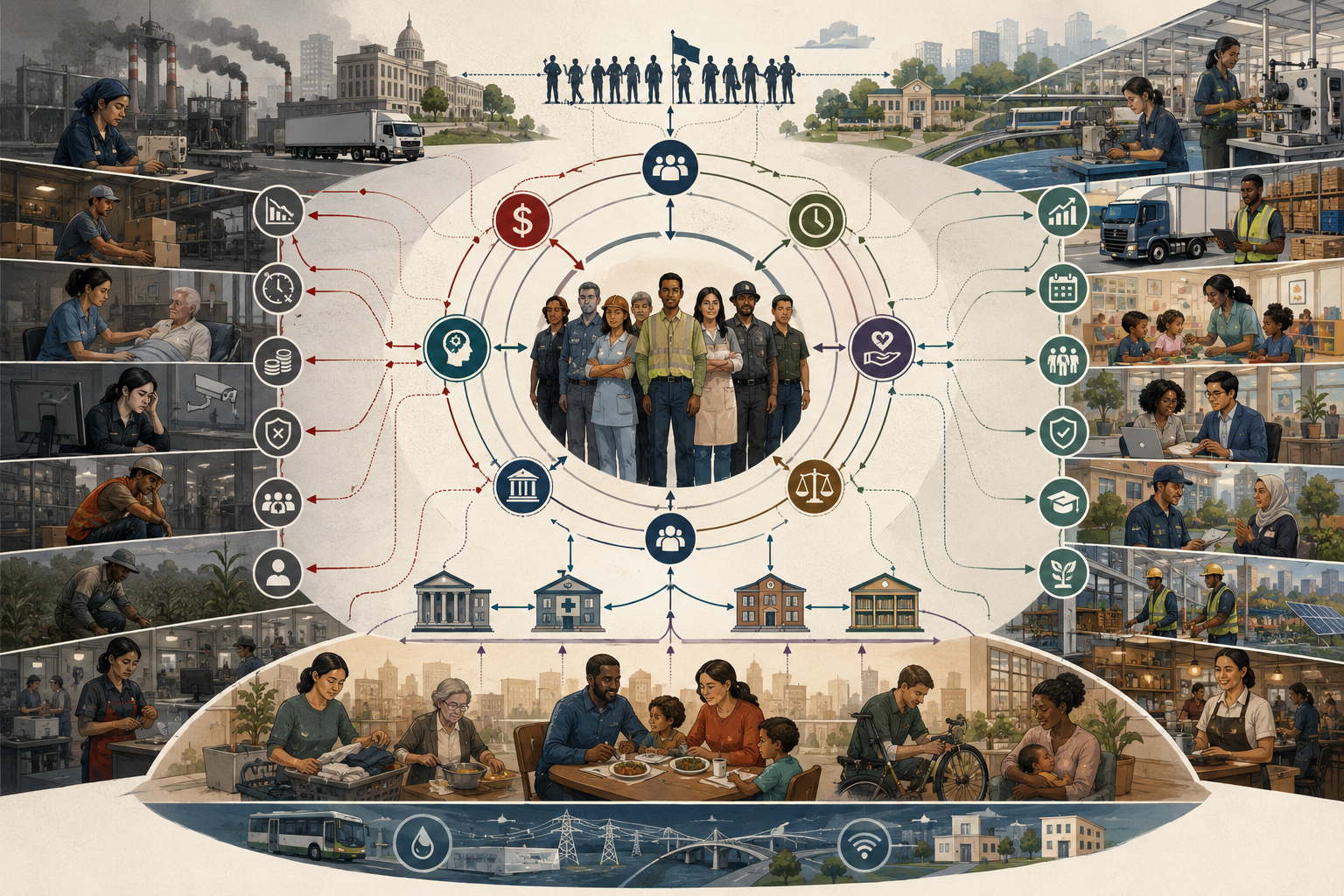
Within a sustainable systems framework, labor, wages, and productivity become even more significant. The relevant question is not simply how to maximize output per hour, but how work is organized, what forms of value are recognized or ignored, how risks are distributed, and whether productive systems remain compatible with household stability, care, social reproduction, ecological viability, and long-term resilience. The serious study of labor must therefore connect productivity to justice, time, institutions, bargaining power, social care, and the purposes for which production is organized.
Why This Topic Matters
Labor, wages, productivity, and the organization of work matter because economic systems are sustained through human effort organized under institutions. Production does not occur in the abstract. It occurs through workers with skills, bodies, time limits, obligations, aspirations, vulnerabilities, and varying degrees of bargaining power. The structure of work therefore shapes not only output, but health, security, family life, social trust, civic participation, and the distribution of power throughout society.
This matters analytically because labor is often treated too narrowly, either as a simple factor of production or as a price-responsive input like any other. But labor is different. Human beings who work are not merely inputs; they are also citizens, caregivers, household members, learners, parents, neighbors, and participants in political and social life. The institutions that govern wages, working time, safety, autonomy, employment security, and collective bargaining affect far more than firm costs. They affect the shape of everyday life itself.
These issues also matter historically. The organization of labor has changed across agrarian systems, factories, mines, workshops, welfare states, service economies, public sectors, logistics networks, platform markets, care systems, and digitally mediated forms of work. Each configuration alters how time is controlled, how output is measured, how wages are determined, how work is supervised, how risk is shifted, and how much dignity or insecurity is built into ordinary survival.
Labor is also the study of value. What kinds of work are recognized, protected, and compensated? Which forms are invisibilized, feminized, informalized, racialized, treated as secondary, or assumed to be naturally available without adequate pay or institutional support? These questions reveal that the organization of work is inseparable from the moral and political ordering of the economy.
At a deeper level, labor questions reveal what an economy is ultimately for. If work is organized only as a means of extracting output at the lowest possible cost, then households, care systems, civic life, and human development become residual concerns. If work is organized as part of a broader social order, then wages, time, capability, dignity, security, and democratic voice become central design questions rather than afterthoughts.
What Labor Is
Labor is the purposeful expenditure of human effort in the production, maintenance, and reproduction of economic and social life. In the narrowest sense, it refers to paid work performed in exchange for wages, salaries, fees, or other compensation. In a broader and more serious sense, labor includes physical effort, mental effort, emotional labor, care work, coordination, maintenance, supervision, repair, planning, learning, and forms of tacit knowledge without which complex systems could not function.
This broader definition matters because economies depend on much more than what appears in payroll records. Households reproduce labor power through cooking, cleaning, caregiving, education, transport, scheduling, recovery, and emotional support. Communities sustain trust, safety, norms, mutual aid, and social infrastructure. Workers bring tacit judgment and cooperative intelligence that often exceed what formal job descriptions capture. Public institutions preserve the health, education, infrastructure, and legal order that make work possible. The economy rests on this wider field of labor even when official accounts measure only part of it.
Labor is therefore not just a commodity exchanged in a market. It is a socially embedded activity carried by human beings with needs, limits, histories, and responsibilities. This is why the governance of labor always raises questions of dignity, coercion, freedom, dependence, recognition, and legitimacy as well as efficiency.
Labor also has a temporal dimension. Work draws on energy, attention, health, and life time. What appears in economics as labor input is, in lived terms, part of a finite human existence. A labor system organizes not only output, but human hours, bodily strain, family rhythms, rest, aging, learning, and recovery. This is one reason the organization of work cannot be reduced to price alone. It is always also an allocation of human time under institutional conditions of greater or lesser freedom.
A serious labor framework must therefore distinguish labor as a productive input from workers as persons. The first can be modeled. The second must be treated as the moral and institutional reality that gives labor economics its deeper importance.
Wages as Income and Social Institution
Wages are often described as the price of labor, but that description is incomplete. Wages are also a social institution through which societies distribute purchasing power, define standards of livelihood, mediate the relation between work and survival, and express which forms of labor are valued. A wage is not merely a number attached to a job. It is one of the principal links between production and household life.
This matters because wages do more than compensate effort. They determine whether housing is affordable, whether food and utilities can be paid for, whether health needs can be met, whether children can be supported, whether debt can be avoided, whether savings can be accumulated, and whether workers possess any buffer against shock. Low wages do not simply reduce consumer purchasing power. They alter the entire structure of household vulnerability.
Wages are also institutional outcomes. They are shaped by productivity, bargaining power, labor law, union strength, minimum standards, public benefits, employer strategy, social norms, immigration rules, discrimination, market concentration, unemployment, and macroeconomic conditions. The idea that wages are determined solely by impersonal market forces obscures the extent to which wage-setting is governed, contested, and historically variable.
This is why wage analysis must remain connected to public policy and political economy. The question is not only what wage clears a market, but what wage regime a society permits, legitimizes, tolerates, contests, or redesigns. A low wage may reflect low productivity, but it may also reflect weak bargaining power, monopsony, occupational segregation, undervalued care work, policy neglect, or a social order that treats some workers as replaceable.
Wages also perform a cultural and political function. They express what kinds of work a society claims to value. Persistent underpayment of care, education, maintenance, sanitation, food service, logistics, or public service often indicates not low social importance, but deep institutional asymmetry in how necessary work is recognized and rewarded.
Productivity and Its Meanings
Productivity is usually understood as output produced per unit of input, often output per hour of labor. This is an important measure because it helps explain how economies generate more goods and services with the same or fewer resources. Rising productivity can support higher wages, shorter work time, stronger public revenues, lower prices, improved services, and greater material possibility.
But productivity has several meanings that should not be collapsed into one. At the firm level, productivity may reflect workflow design, technology, worker skill, organizational culture, logistics, management, capital intensity, and economies of scale. At the national level, productivity may reflect education systems, infrastructure, public health, energy systems, transportation, technological capability, macroeconomic stability, research systems, and institutional quality. In social terms, productivity also raises normative questions: productive for whom, toward what ends, under whose control, and at what human or ecological cost?
This matters because not all productivity gains are equivalent. Some arise from genuine innovation, better coordination, skill development, and improved tools. Others arise from intensification of labor, speed-up, surveillance, weakened rest, cost-cutting that degrades resilience, or the offloading of hidden burdens onto households, suppliers, workers, communities, or ecosystems. A narrow productivity metric may therefore conceal as much as it reveals if it is severed from broader institutional and social context.
Productivity also depends on conditions outside the workplace proper. Reliable transport, public health, electricity, childcare, education, communications infrastructure, safe housing, and social stability all shape how productive labor can be. Productivity is therefore not simply a property of workers or firms. It is partly the expression of a whole social system’s capacity to organize capability well.
This is why blaming workers for low productivity often misses the point. Productivity depends on the systems workers are placed within: tools, management, training, infrastructure, health, scheduling, supply chains, public services, and institutional support. The most productive labor systems are often those that invest in people, coordination, and long-term capability rather than merely extracting more effort from less secure workers.
The Relationship Between Wages and Productivity
Economic discussion often assumes that wages and productivity move together. In principle, if workers produce more value per hour, wages might rise accordingly. Sometimes they do. But the relationship is mediated by institutions, market structure, bargaining power, ownership, macroeconomic policy, social norms, labor law, firm strategy, and distributional conflict. Productivity growth creates a larger economic possibility; it does not determine automatically how that possibility is divided.
This distinction is crucial. A society can experience rising productivity while wage growth stagnates if gains are captured through profits, rents, executive compensation, financial returns, intellectual property, monopoly power, or shareholder distributions rather than shared broadly through labor income. Conversely, wages can be supported by strong institutions even in sectors where productivity measurement is difficult or structurally different, as in many forms of care, education, and public service.
The productivity-wage relationship is therefore political as well as technical. It depends on labor institutions, wage norms, unemployment levels, union density, sectoral bargaining, public investment, minimum standards, employer concentration, and the macroeconomic stance of the state. To ask whether workers “deserve” higher wages because productivity has risen is already to concede too much to a framework that treats distribution as automatic when it is in fact institutional.
The deeper issue is how societies decide to distribute the gains of coordination, technology, and collective capability. Productivity creates the possibility of higher wages, better public services, shorter work hours, and greater security; institutions determine whether that possibility becomes reality.
This also means that productivity can become socially destabilizing if its gains are captured narrowly. Rising output combined with stagnant pay weakens trust in institutions, reduces the legitimacy of economic growth claims, and can intensify household precarity despite technological advance. The social meaning of productivity depends on distribution.
Labor Markets and Bargaining Power
Labor markets are often modeled as competitive arenas in which workers and employers meet to exchange labor for wages. But actual labor markets are rarely frictionless or fully competitive. Workers differ in mobility, savings, skills, health, immigration status, family responsibilities, geography, credential access, information, discrimination exposure, and access to alternatives. Employers differ in market power, financial capacity, legal support, data access, control over scheduling, and control over local employment opportunity. The result is that wage-setting and work conditions are strongly shaped by bargaining power.
Bargaining power matters because workers do not negotiate from equal positions. A worker with no savings, weak legal protection, and urgent household obligations faces the labor market differently from a firm with liquidity, legal counsel, management systems, data, and multiple applicants. This asymmetry can suppress wages, intensify discipline, weaken voice, and make formally voluntary contracts substantively coercive.
This is one reason labor-market institutions matter so much. Unions, sectoral bargaining, minimum wages, employment protections, unemployment insurance, social insurance, public employment, anti-discrimination law, wage theft enforcement, health care access, childcare, and social safety nets all alter the bargaining terrain on which wages and conditions are determined. They change the fallback position of workers and therefore the meaning of “market” itself.
Labor markets are therefore not simply price-setting mechanisms. They are structured environments in which power, insecurity, legal rules, and institutional support shape the terms of exchange. A labor contract may be formally voluntary while still reflecting deep asymmetries in necessity, mobility, information, and voice.
Geography matters as well. In regions dominated by a small number of employers, labor markets may function less like competitive exchanges and more like local power structures. Mobility constraints, family ties, housing costs, transportation limits, licensing rules, immigration status, and credential barriers all shape how free workers really are to refuse bad terms.
Skills, Human Capital, and the Organization of Capability
Skills matter for both wages and productivity, but the language of human capital can sometimes oversimplify how capability is actually formed. Workers do not simply invest in themselves as isolated individuals. Capability depends on education systems, apprenticeships, firm training, public health, nutrition, transportation, digital access, workplace culture, managerial systems, technology, professional standards, and opportunities to practice and apply knowledge in real organizational settings.
This matters because skills are socially produced. A productive workforce reflects long-run investment in schooling, health, care, infrastructure, technical standards, public institutions, and organizational learning. The individual worker may possess the skill, but the conditions under which that skill becomes possible and valuable are often collective.
It also matters because the market reward to skill is not purely technical. Some forms of socially essential work, including teaching, care, sanitation, emergency response, maintenance, and public service, may require high skill while receiving relatively weak compensation because of institutional norms, public-finance constraints, weak bargaining power, gendered undervaluation, racialized labor hierarchies, or market structures that fail to reward social necessity.
A serious account of labor must therefore distinguish between the production of skill, the valuation of skill, and the institutional conditions that connect or disconnect the two. Human capability is not simply a private investment asset; it is a public and social achievement.
Capability is also organizational. Workers become more effective not only by learning individually, but by participating in systems that preserve tacit knowledge, cooperation, mentoring, workflow design, standards, trust, and institutional memory. Productivity is often higher where institutions support collective learning rather than merely sorting individuals by credential.
Technology, Automation, and Work Reorganization
Technology alters labor by changing what workers do, what firms measure, how workflows are organized, which tasks become codified, which skills become valuable, and which forms of judgment are displaced or intensified. Automation can raise productivity, reduce drudgery, improve safety, expand capability, and free human effort for more complex or humane work. But it can also deskill jobs, intensify surveillance, fragment tasks, weaken bargaining power, displace workers, and concentrate gains among owners of capital and intellectual property.
This is why the effects of technology are not automatic. They depend on ownership, workplace governance, training, sectoral structure, public policy, labor institutions, transition support, and how the gains from productivity are distributed. The same technology can augment workers in one context and subordinate them in another. What matters is not merely the machine, software, platform, or algorithm itself, but the labor regime into which it is introduced.
Automation is therefore not just a technical substitution of capital for labor. It is a reorganization of control, skill, pace, bargaining position, and institutional power. A society serious about productivity must ask whether technological change is being directed toward shared prosperity and humane work or toward extraction, precarity, surveillance, and intensified asymmetry.
Within sustainable systems, this question becomes sharper still. Technology should be judged not only by cost reduction, but by whether it supports resilient institutions, reduces harmful labor burdens, widens socially necessary capability, lowers ecological pressure, and protects worker dignity and security during transition.
Digital systems also make measurement itself a site of power. As work becomes datafied, firms can monitor pace, output, errors, location, downtime, customer ratings, and response time in real time. This may improve coordination, but it can also shift control decisively toward management, narrow worker discretion, and intensify labor under the language of efficiency.
Care Work, Reproductive Labor, and the Hidden Economy
One of the deepest limits of conventional labor analysis is that it often centers paid employment while overlooking the reproductive labor that makes paid work possible. Care work, household labor, childrearing, elder support, emotional coordination, cooking, cleaning, scheduling, transport, health management, and daily maintenance of life all sustain the labor force and the wider social order. Yet much of this work remains unpaid, underpaid, undervalued, or treated as external to “the economy.”
This matters because the economy depends on this hidden labor continuously. Workers arrive at jobs through infrastructures of care, education, nourishment, scheduling, transport, health, and recovery that someone must organize. When care systems weaken, households absorb the strain, often through gendered and unequal labor that remains economically indispensable even when statistically invisible.
A research-grade treatment of labor must therefore expand beyond wage labor alone. The social organization of work includes both paid and unpaid labor, both market-facing production and the reproductive systems that allow production to continue. Without this wider frame, the analysis of wages and productivity remains incomplete and socially misleading.
This wider frame also changes how sustainability is understood. If productive systems rely on exhausting invisible care labor, then what looks efficient at the point of production may be deeply unsustainable at the level of household and social reproduction. A society can record growth while depleting the people, relationships, and care systems that make growth possible.
Care work also challenges narrow productivity concepts. Its value often lies in attention, relationship, trust, continuity, and human presence—qualities that are difficult to compress into output per hour without distorting the work itself. Treating care as low-productivity simply because it cannot be accelerated like manufacturing misunderstands its social function.
Work Time, Security, and the Quality of Employment
The quality of work cannot be captured by wage level alone. Work time, scheduling predictability, job security, workplace autonomy, physical safety, emotional burden, benefits, paid leave, voice, promotion pathways, training, and respect all shape whether employment supports a stable and livable life. A job may be formally available and yet incompatible with household well-being if it is too unstable, exhausting, dangerous, underpaid, or insecure.
This matters because labor-market success is often overstated when analysis focuses only on employment counts. A society may generate jobs while also generating pervasive unpredictability, time poverty, burnout, workplace injury, emotional strain, and chronic insecurity. Under such conditions, the social organization of work becomes a source of stress rather than stability.
Security is especially important. Workers facing layoffs, irregular hours, weak protections, or precarious contracts are less able to plan, save, care for dependents, invest in education, participate in community life, or make long-horizon decisions. Productivity measured narrowly at the firm level may rise while the overall social system becomes less stable because employment quality has deteriorated.
The serious question is therefore not only how much labor is employed, but under what conditions time, security, and dignity are organized. Employment policy should not stop at job creation. It should ask whether work supports durable life.
Time itself is distributive. Some workers are paid well precisely because they can command control over time, while others bear fragmented schedules, unpaid waiting, unpredictable shifts, split shifts, on-call expectations, long commutes, or digital availability that erodes rest. The organization of work time is therefore part of the distribution of power and life chance.
Institutions, Law, and the Governance of Work
Work is governed through institutions: labor law, contract rules, occupational safety standards, collective bargaining arrangements, immigration systems, wage enforcement, social insurance, public education, tax policy, industrial policy, unemployment insurance, health systems, pension systems, and the macroeconomic stance of the state. These institutions shape who can bargain, how much insecurity is tolerated, what counts as acceptable employment, and whether workers can refuse bad terms without facing destitution.
This matters because labor is not organized spontaneously. Every labor market rests on legal definitions of employment, enforceable contracts, rights of association, liability rules, minimum standards, anti-discrimination protections, payroll systems, and public decisions about welfare, training, and income support. Even a supposedly deregulated labor market remains a governed system; it is simply governed in ways that may favor some actors over others.
The governance of work also affects productivity itself. Secure workers may invest more in training, cooperation, and institutional knowledge. Public health, childcare, transportation, education, and housing stability can improve capability and reduce costly instability. A society that underinvests in the institutional foundations of labor may depress both welfare and productive potential.
For this reason, labor institutions should not be treated merely as constraints on efficiency. They are part of the productive architecture of the economy. They shape the quality of cooperation, the stability of skill formation, the distribution of gains, and the degree to which work supports social reproduction.
Macroeconomic governance matters here too. Tight labor markets, fiscal capacity, public employment, industrial policy, social investment, and monetary conditions all affect bargaining conditions. Labor outcomes are shaped not only at the workplace, but by the broader economic stance within which work is organized.
Productivity, Distribution, and Political Economy
Productivity growth always raises a distributive question: who receives the gains? Those gains may be distributed through higher wages, lower prices, shorter work time, improved public goods, stronger profits, executive pay, dividends, asset appreciation, or financial returns. There is no purely technical answer to how they should be allocated. Distribution depends on institutional bargaining, macroeconomic conditions, ownership structure, market power, tax systems, and political choice.
This matters because productivity can coexist with inequality. A society may become more technologically capable while concentrating gains among owners, executives, dominant firms, intellectual-property holders, or asset owners. Workers may become more productive without experiencing greater security, higher wages, or greater control over time. In such cases, productivity becomes a source of tension rather than shared advancement.
The political economy of labor therefore concerns not only production itself, but the distribution of the surplus generated by coordinated work. Wage regimes, union power, tax systems, public services, industrial policy, competition policy, corporate governance, and labor protections all influence whether productivity translates into broadly shared social improvement or narrow private capture.
A serious labor article must therefore resist the temptation to treat productivity as self-justifying. Productive capacity matters profoundly, but the purposes and distribution of that capacity matter just as much.
This is one reason labor remains central to democratic legitimacy. When workers are told that the economy is stronger while their own wages, schedules, benefits, and security deteriorate, the meaning of growth itself is called into question. Distribution is not a side issue to productivity; it is part of how productivity is socially interpreted.
Labor Time, Power, and Social Order
Labor is also a system of time discipline. Modern economies organize not only what people do, but when, how long, at what pace, under whose authority, and with what degree of predictability. This includes shift schedules, deadlines, logistical synchronization, performance metrics, commuting patterns, customer-demand systems, digital notifications, and the constant coordination required to align households with workplaces. The social organization of work is therefore also an organization of collective time.
This matters because control over time is a form of power. Employers often seek flexibility from workers while workers seek predictability from employers. Firms may externalize scheduling volatility onto households. Digital systems may collapse boundaries between work time and nonwork time. Productivity can rise while rest, recovery, family life, education, care, and civic participation deteriorate.
A research-grade treatment of labor must therefore recognize that the organization of work helps structure the wider social order. It shapes whether people can care for others, participate in public life, pursue education, recover from illness, build friendships, maintain households, and sustain the basic rhythms through which communities remain stable. The economics of labor is also an economics of time sovereignty.
Time pressure is also unequal. Professional workers may experience long hours but possess more autonomy and compensation. Low-wage workers may face unpredictable schedules, unpaid waiting, unpaid commuting, and little control over hours. Caregivers may experience a second shift that conventional labor statistics do not fully recognize. Time scarcity is therefore a distributive problem, not merely a personal-management problem.
A labor system should be judged not only by how much time it extracts, but by whether it leaves enough time for life.
Labor, Wages, and Sustainable Systems
Within sustainable systems, labor must be understood as part of a wider social and ecological metabolism. Work organizes not only output, but energy use, care burdens, logistics, maintenance, repair, adaptation, public services, and the reproduction of everyday life. The relevant question is not simply whether labor produces more, but whether systems of work are compatible with long-term social reproduction, public health, ecological viability, institutional trust, and resilient communities.
This changes how productivity is evaluated. A production system that appears efficient while exhausting workers, degrading care systems, underfunding maintenance, intensifying insecurity, and externalizing ecological cost is not sustainable in any serious sense. It may maximize throughput while undermining the very foundations on which future work depends.
Sustainable systems therefore require labor arrangements that support security, capability, care, and long-run resilience. Wages must be sufficient for stable household life. Work time must allow reproduction rather than permanent depletion. Productivity gains must be interpreted in relation to institutional and ecological context, not just immediate output ratios. Technology must be judged by whether it strengthens shared capability or simply concentrates control.
In this sense, labor analysis becomes a bridge between economics, ethics, and systems design. It reveals whether a society organizes work as a means of durable flourishing or as a mechanism of extraction that consumes workers, households, public institutions, and shared infrastructures faster than they can be renewed.
This also implies that green or technological transition cannot be judged successful if it reproduces labor precarity under a new vocabulary. Sustainable transformation requires work regimes that are not only lower-carbon or more efficient, but also more secure, more just, more democratic, and more supportive of the social foundations of life.
How Labor Systems Should Be Judged
Labor systems should not be judged only by employment counts, output growth, or aggregate productivity. A broader economic systems framework asks whether work supports dignity, security, capability, social reproduction, fair distribution, democratic voice, and long-run resilience.
| Dimension | Narrow Question | Systems Question |
|---|---|---|
| Labor | How much labor is employed? | Under what conditions are human effort, skill, time, dignity, and autonomy organized? |
| Wages | What is the market wage? | Do wages support stable household life, reduce vulnerability, and fairly share productive gains? |
| Productivity | How much output is produced per hour? | Does productivity reflect genuine capability or hidden extraction, care depletion, and ecological cost shifting? |
| Bargaining Power | Do workers accept available terms? | Do workers have real alternatives, voice, legal protection, and institutional support? |
| Care Work | Is work paid? | What unpaid or underpaid labor sustains households, workers, communities, and social reproduction? |
| Work Time | How many hours are worked? | Does the organization of time leave room for care, rest, education, recovery, and civic life? |
| Technology | Does automation raise output? | Does technological change augment workers, share gains, and reduce burden, or intensify control and insecurity? |
| Sustainability | Is production efficient today? | Can the labor system reproduce people, skills, care, institutions, and ecological foundations over time? |
This framework prevents a common mistake: treating work as successful whenever employment is high or output is rising. A labor system can employ many people while still producing insecurity, time poverty, wage inadequacy, burnout, and weak social reproduction. Conversely, a humane and productive labor system must be judged by the quality of work, the distribution of gains, and whether human life is strengthened rather than depleted by the way production is organized.
The central question is therefore not simply whether work produces output. The deeper question is whether the organization of work sustains the people and institutions on which economic life depends.
Employment Status and the Boundaries of the Firm
The organization of work depends partly on who is legally treated as an employee, an independent contractor, an agency worker, a franchisee, a dependent contractor, a temporary worker, or an informal worker. These classifications determine access to minimum wages, collective bargaining, social insurance, occupational safety protections, paid leave, dismissal procedures, and employer responsibility.
Contract language should not decide status by itself. The analysis should examine who controls price, schedule, task assignment, performance standards, equipment, customer access, discipline, and the opportunity for profit or loss. Economic dependence and integration into the enterprise may matter even where nominal flexibility exists.
Fragmented contracting can distribute functions across lead firms, labor intermediaries, subcontractors, platforms, and nominally independent workers. Responsibility should be mapped across recruitment, supervision, payment, data, safety, and termination rather than assumed to end at the formal contract boundary.
Misclassification is not merely a tax or paperwork issue. It changes bargaining power and transfers business risk to workers who may lack the autonomy or market position associated with genuine entrepreneurship.
Informality and the Unprotected Economy
Informal work includes employment and self-employment that fall outside effective legal, tax, social-protection, or administrative systems. It can provide livelihoods and flexibility, but it often leaves workers exposed to low pay, unsafe conditions, arbitrary dismissal, weak bargaining power, and limited income security.
Informality can arise from weak enforcement, high compliance costs, fragmented firms, migration status, rural and household production, limited state capacity, or business models designed to avoid responsibility. It should not be treated as a cultural residue that disappears automatically with growth.
Formalization requires more than penalties. Registration, social insurance, simplified taxation, access to finance, public procurement, worker organization, portable benefits, and enforceable rights can make transition viable. Where formalization raises costs without improving protection or capability, workers and firms may remain outside the system.
Policy should distinguish survival activity from profitable evasion. The objective is not to eliminate livelihoods but to extend rights, security, productivity support, and institutional visibility without destroying access to work.
Minimum Wages, Living Wages, and Wage-Setting Institutions
Minimum wages establish a legal floor. Living-wage frameworks ask what compensation is required for a decent standard of living for workers and their families in a particular place and time. Collective bargaining establishes negotiated standards within firms, sectors, or occupations.
These institutions serve different functions. A statutory floor protects against severe underpayment. Bargaining can connect wages to productivity, skills, sector conditions, and worker voice. Living-wage estimates provide a benchmark for adequacy but require transparent assumptions about household size, hours, prices, public services, and social support.
Wage-setting should consider employment, productivity, inflation, informality, compliance, and distribution without assuming that the lowest possible labor cost is socially optimal. Enforcement matters as much as the nominal rate: unpaid overtime, misclassification, deductions, and wage theft can defeat formal standards.
The ILO’s living-wage work emphasizes reliable data, social dialogue, collective bargaining, and national ownership rather than a universal number detached from institutions.
Monopsony, Noncompetes, and Labor-Market Concentration
Workers may face a small number of employers, high search costs, licensing barriers, commuting limits, family obligations, immigration restrictions, or employer coordination. Under these conditions, firms can possess wage-setting power even where many workers are technically free to leave.
Monopsony can suppress wages, reduce hiring, worsen conditions, and weaken the link between productivity and compensation. Noncompete clauses, no-poach agreements, training-repayment provisions, opaque pay, and restrictions on portable credentials can intensify dependence.
Competition policy, wage transparency, portable benefits, public employment services, transport, housing, credential recognition, and collective bargaining can expand worker alternatives. Enforcement should also examine mergers and contracting structures that concentrate employment opportunity locally or within specialized occupations.
The central question is whether workers possess credible exit and voice. A labor market should not be described as competitive merely because contracts are formally voluntary.
Labor Share, Profits, Rents, and Productivity Gains
Productivity growth creates a larger pool of output, but distribution depends on wage-setting, ownership, market power, taxation, prices, and corporate governance. Gains can flow to labor compensation, lower consumer prices, profits, rents, executive pay, dividends, retained earnings, or public revenue.
Labor share measures compensation relative to value added. It is informative but imperfect. Self-employment income must be allocated between labor and capital, sector shifts can alter aggregates, and nonwage benefits may be measured inconsistently.
Productivity\ Dividend = Wage\ Growth + Time\ Reduction + Public\ Gain + Consumer\ Gain
\]
Interpretation: Productivity can improve life through several channels, not wages alone, but each channel should be measured rather than assumed.
Where productivity rises but wages, hours, benefits, and public services do not improve, analysis should examine concentration, bargaining institutions, financial extraction, outsourcing, and the ownership of technology and intellectual property.
Job Quality and the Multidimensional Employment Relationship
Job quality includes earnings, stability, predictable time, safety, autonomy, voice, learning, social support, purpose, benefits, and compatibility with life outside work. Employment counts alone cannot show whether work is sustainable.
Dimensions can conflict. A high-paying job may involve extreme hours or injury risk. Flexible work may provide autonomy while creating income volatility. Secure work can still offer little voice or advancement.
| Dimension | Indicator | Hidden failure |
|---|---|---|
| Earnings | Hourly and annual compensation. | Unpaid time, expenses, or volatile hours. |
| Security | Contract duration and dismissal protection. | Scheduling and income instability. |
| Autonomy | Control over task and pace. | Nominal flexibility under algorithmic discipline. |
| Voice | Representation and grievance rights. | Retaliation or inaccessible review. |
| Health | Injury, illness, workload, psychosocial risk. | Underreporting and outsourced harm. |
Job-quality analysis should be disaggregated because average conditions can conceal severe risks among temporary, migrant, disabled, young, older, racialized, or low-wage workers.
Occupational Safety, Health, and Psychosocial Risk
Safe and healthy work is a fundamental principle and right. Occupational safety includes physical hazards, chemicals, heat, noise, ergonomics, infectious disease, violence, fatigue, and the organization of work itself.
Psychosocial risks arise from excessive workload, low control, insecurity, harassment, isolation, unpredictable scheduling, surveillance, emotional demands, and conflict between work and care. These risks can produce injury, burnout, sleep disruption, depression, and turnover even when the workplace appears physically safe.
Prevention should follow the hierarchy of controls: eliminate hazards where possible, substitute safer processes, redesign engineering and workflow, apply administrative controls, and use personal protective equipment as a final layer.
Digitalization can improve hazard detection and remove workers from dangerous tasks. It can also intensify pace, blur working time, and create new ergonomic and mental-health risks. The ILO’s 2025 safety report emphasizes adaptive risk assessment, worker participation, and prevention as technology changes.
Working Time, Scheduling, and the Right to Disconnect
Working time includes paid hours, overtime, unpaid preparation, waiting, travel between tasks, commuting, on-call periods, and digital availability. A narrow payroll record can understate the time extracted by work.
Predictability is a distinct dimension of quality. Workers need sufficient notice to arrange care, transport, health, education, and rest. Last-minute changes shift coordination costs from firms to households.
Shorter work time can distribute productivity gains, improve health, and expand employment in some contexts, but outcomes depend on staffing, work intensity, wage protection, and sector conditions. A nominal four-day week that compresses the same workload can increase strain.
Right-to-disconnect policies establish boundaries around electronic communication and availability. They are most effective when workload, staffing, performance metrics, and management expectations are aligned with the formal right.
Occupational Segregation, Discrimination, and Pay Equity
Labor-market inequality is produced through hiring, pay, promotion, occupation, industry, hours, care responsibility, education, geography, disability access, migration status, and exposure to unemployment or informality.
Equal pay analysis should distinguish unequal pay for the same or equivalent work from broader occupational segregation. A workplace can comply with formal equal-pay rules while women, racialized groups, migrants, or disabled workers remain concentrated in lower-paid jobs and excluded from advancement.
Pay audits should examine base pay, bonuses, overtime, stock, benefits, starting salary, progression, hours, and job classification. Statistical adjustment can help identify patterns but should not erase structural discrimination by treating occupation or seniority as neutral where those outcomes were themselves shaped by exclusion.
Equity requires accessible recruitment, anti-harassment systems, accommodation, care infrastructure, transparent progression, and enforceable remedy—not diversity statements alone.
Migration, Recruitment, and Tied Status
Migrant workers often fill essential roles in care, agriculture, construction, logistics, hospitality, health, and domestic work. Their bargaining position can be weakened by recruitment debt, tied visas, language barriers, housing dependence, discrimination, and fear of retaliation or deportation.
Fair recruitment requires transparent contracts, prohibition of worker-paid recruitment fees, access to documents, freedom to change employer where possible, safe housing, wage protection, and effective complaints.
Temporary migration programs should not create a permanently disposable labor tier. Rights should follow the worker and remain enforceable after termination or return. Bilateral agreements and lead firms should address recruitment chains rather than place responsibility only on the direct employer.
Migrant status can interact with race, gender, occupation, and informality. Data and enforcement should be designed to reveal rather than conceal these compounded vulnerabilities.
Platform Work and Algorithmic Management
Digital labor platforms organize work through software that can set prices, allocate tasks, monitor location, rank performance, determine access to customers, and deactivate accounts. Workers may be called independent while remaining subject to intensive operational control.
Algorithmic management also extends beyond platforms into warehouses, call centers, hospitals, offices, retail, and professional work. Automated systems can schedule, score, recommend discipline, and optimize staffing.
Governance should include notice, data minimization, explanation, human review, safety assessment, worker consultation, and limits on surveillance. Significant decisions affecting pay, schedule, discipline, or termination should be contestable.
The EU Platform Work Directive entered into force in 2024 and must be transposed by December 2026. It addresses employment status, transparency, human oversight, safety, accountability, and personal-data protections in platform work. Its rules should be described accurately as EU law, not as a global labor standard.
Artificial Intelligence, Job Exposure, and Work Transformation
AI exposure measures estimate the extent to which current tasks may be performed or supported by AI. Exposure is not the same as automation, adoption, job loss, productivity gain, or wage change.
The ILO’s 2025 index found that one in four jobs worldwide had some degree of generative-AI exposure, while transformation was more likely than complete replacement for most occupations. Its 2026 guidance warns that exposure indicators are early signals, not forecasts.
Actual outcomes depend on cost, reliability, workflow redesign, regulation, customer preference, skill systems, bargaining power, and whether technology complements or displaces worker judgment.
Evaluation should occur at task and process level. AI can automate documentation while increasing review burden, improve access while creating error risk, or raise output while narrowing autonomy. Distribution matters because productivity gains may accrue to workers, consumers, firms, or technology owners.
Worker Data, Surveillance, and Privacy
Workplaces collect data on location, keystrokes, communication, biometrics, productivity, customer ratings, health, and behavior. Data can support safety and coordination, but it can also create continuous surveillance and asymmetric power.
Collection should be necessary, proportionate, purpose-limited, secure, and disclosed. Workers should know what is collected, how long it is retained, who receives it, and which decisions it influences.
Consent is weak where refusing monitoring threatens employment. Governance should therefore rely on law, collective bargaining, impact assessment, and independent oversight rather than individual acceptance alone.
Inference is especially sensitive. Systems should not infer protected characteristics, emotional state, organizing activity, or health without a lawful and compelling basis. Data gathered for safety should not be repurposed for discipline casually.
Skills, Lifelong Learning, and the Training Bargain
Technological and ecological transition requires continuous learning, but training costs and benefits are distributed unevenly. Firms may underinvest when workers can leave, while workers may lack time, money, or information to train independently.
A training bargain should define who pays, whether learning occurs during paid time, which credentials are portable, how workers are selected, and whether training leads to advancement rather than merely additional responsibility.
Apprenticeships, sectoral funds, public colleges, unions, professional bodies, and employers can share responsibility. Training should include foundational, technical, digital, managerial, safety, and transition skills.
Reskilling claims should remain realistic. Not every displaced worker can move immediately into a high-skill occupation, and local labor demand may be limited. Income support, placement, relocation assistance, and regional development are often as important as coursework.
Worker Voice, Collective Bargaining, and Codetermination
Worker voice provides information and countervailing power. Workers often possess practical knowledge about safety, workflow, customers, maintenance, and technology that management systems overlook.
Collective bargaining can set wages, hours, staffing, benefits, training, data rights, and technology procedures. Sectoral bargaining can reduce incentives for firms to compete through low labor standards. Works councils and codetermination can create continuing participation in organizational change.
Voice requires protection against retaliation, access to information, representative capacity, and enforceable agreements. Consultation after a decision is effectively complete is not meaningful participation.
ILO case studies published in 2025 show social dialogue shaping AI adoption across sectors and regions, with stronger outcomes where worker representation and institutional support are durable.
Care-Economy Investment and Professionalization
Care systems depend on both unpaid and paid labor. Low wages, understaffing, weak training, fragmented schedules, and high emotional burden can produce turnover and poor continuity even where demand is rising.
Investment in childcare, elder care, disability support, health, and community services can create employment, expand labor-force participation, reduce household strain, and improve wellbeing. The ILO’s 2025 care-economy work emphasizes employment-intensive investment, infrastructure, professionalization, fair wages, and social protection.
Professionalization should not erase relational knowledge or community practice. It should improve training, pay, staffing, safety, career pathways, and public accountability while preserving person-centered care.
Productivity measurement must be cautious. Reducing time per patient or child can raise measured throughput while degrading care. Quality, continuity, prevention, and recipient outcomes belong in the productivity account.
Supply Chains, Lead Firms, and Labor Responsibility
Lead firms can influence wages and conditions far beyond their direct payroll through price, delivery time, quality requirements, purchasing practices, audit systems, and sourcing decisions.
Supplier codes are insufficient when commercial terms make compliance impossible. Last-minute orders, price compression, and volatile demand can produce overtime, subcontracting, unsafe pace, and unpaid wages.
Responsible purchasing should align contracts with labor standards, disclose suppliers, support remediation, protect worker voice, and avoid abrupt exit that leaves workers without remedy. Grievance systems should reach workers directly and protect against retaliation.
Supply-chain analysis should also include logistics, data work, content moderation, mineral extraction, and AI value chains. Digital products depend on physical and human labor that can be obscured by the final service.
Industrial Policy, Public Investment, and Good Jobs
Industrial policy shapes employment through procurement, subsidies, infrastructure, trade, research, finance, and regional development. The labor question is not only how many jobs are created, but their quality, accessibility, durability, and connection to local capability.
Good-jobs conditions can include wage floors, apprenticeship, neutrality toward organizing, domestic or regional capability, safety, reporting, and community benefits. Conditions should be enforceable and matched to firm size and sector reality.
Social dialogue can improve targeting and implementation by reducing information asymmetry and connecting investment to workforce capability. ILO research in 2025 highlighted the role of durable dialogue in modern industrial policy.
Public support should avoid socializing risk while privatizing gains. Clawbacks, profit-sharing, equity stakes, open technology, and performance conditions can preserve public value where subsidies are substantial.
Just Transition, Climate Work, and Regional Restructuring
Climate policy changes employment across energy, transport, buildings, agriculture, manufacturing, and land management. Some jobs will grow, others will transform, and some regions will face concentrated loss.
A just transition includes early planning, worker and community participation, income protection, pensions, training, relocation support, regional investment, remediation, and creation of durable replacement employment.
Green jobs should meet decent-work standards. Low-carbon production is not socially sustainable if it relies on unsafe mining, precarious construction, underpaid care, or excluded communities.
Transition policy should map skills and supply chains before closure or rapid expansion. The objective is not to preserve every existing job indefinitely, but to prevent workers and places from carrying an unequal share of adjustment.
Worker Ownership, Profit Sharing, and Democratic Enterprise
Ownership influences how productivity gains, risk, information, and decision rights are distributed. Worker cooperatives, employee ownership, profit-sharing, gain-sharing, and pension ownership create different forms of participation.
Financial participation can align interests and build wealth, but it should not substitute for secure wages or diversify away all worker savings into the employer. Workers already bear employment risk and may need protection from concentrated ownership risk.
Democratic enterprise requires information, voting rights, education, and governance capacity. Nominal ownership without meaningful voice can become a compensation device rather than workplace democracy.
Profit-sharing formulas should be transparent and should account for accounting choices, capital investment, and long-term resilience. Gain-sharing can reward operational improvements while recognizing collective rather than individual productivity.
Public-Sector Productivity and Social Value
Public services produce outcomes that are difficult to value through market revenue. Schools, courts, inspections, health systems, transit, emergency response, and administration create capability, rights, prevention, and trust.
Output measures such as cases closed, students taught, or patients seen can be useful but may reward speed over quality. Outcomes may appear years later and depend on factors outside the agency.
Public-sector productivity should connect resources to service quality, accessibility, prevention, equity, and resilience. Digital systems can simplify administration, but poor design can create exclusion, error, and additional work for staff and citizens.
Understaffing can produce apparent short-run efficiency while increasing backlog, turnover, legal risk, and crisis costs. Productivity analysis should include maintenance of institutional capability.
The 2024–2026 World-of-Work Context
The ILO’s Global Wage Report 2024–25 records renewed real-wage growth alongside persistent inequality and incomplete recovery from the cost-of-living crisis in many economies.
The ILO’s Employment and Social Trends 2026 describes stable headline labor-market conditions but stalled progress in job quality and widening inequalities. Its June 2026 work on inequalities emphasizes sectoral segmentation, formality, and unequal opportunity.
ILO research in 2025 and 2026 treats AI exposure as a signal of possible job transformation rather than a forecast of job destruction. Current work also emphasizes social dialogue, worker participation, occupational safety, and the institutional conditions of technology adoption.
The EU Platform Work Directive requires member-state transposition by 2 December 2026 and establishes rules concerning employment status and algorithmic management in platform work.
These developments reinforce a common conclusion: technology and productivity do not determine labor outcomes automatically. Institutions shape whether change produces better work, wider insecurity, or a mixture of both.
Worked Diagnostic: AI-Assisted Scheduling in a Regional Hospital System
Consider a fictional hospital network that introduces an AI scheduling system to reduce overtime and vacancy costs. The system predicts demand, assigns shifts, ranks workers by availability, and recommends disciplinary review for repeated declines.
Step 1: Define the problem and claimed benefit
Specify staffing shortages, overtime, patient need, turnover, and the expected productivity or safety improvement.
Step 2: Map the employment and bargaining context
Identify worker categories, contracts, union coverage, care responsibilities, disability needs, and existing scheduling rights.
Step 3: Audit data and model objectives
Examine training data, proxies, error, optimization targets, and whether cost reduction conflicts with continuity or fairness.
Step 4: Assess work-time and health effects
Measure notice, rest, fatigue, commuting, split shifts, overtime, mental health, and staffing ratios.
Step 5: Test distribution and discrimination
Compare outcomes by occupation, gender, race, age, disability, family status, and employment form.
Step 6: Establish worker voice and human review
Define consultation, explanation, correction, appeal, override, and limits on automated discipline.
Step 7: Evaluate patient and organizational outcomes
Measure continuity, safety, waiting, absenteeism, turnover, training, and actual cost rather than schedule fill alone.
Step 8: Set release gates and monitoring
Require threshold performance, independent audit, phased deployment, rollback, and collective review before expansion.
| Design | Immediate attraction | Systems risk |
|---|---|---|
| Cost-only optimization | Reduces vacancies and overtime on paper. | Can intensify fatigue, turnover, and hidden care burdens. |
| Human override without governance | Adds apparent accountability. | Managers may rubber-stamp recommendations or apply them inconsistently. |
| Jointly governed scheduling | Connects staffing, safety, fairness, worker voice, and patient outcomes. | Requires time, data access, and institutional capacity. |
The diagnostic shows why labor technology should be judged as an institutional intervention, not a software purchase.
A Practical Method for Labor-System Analysis
1. Define the work and service
Identify what is produced or maintained, for whom, and through which paid and unpaid labor.
2. Map employment relationships
Record employers, intermediaries, contractors, platforms, ownership, and responsibility.
3. Measure compensation and adequacy
Include wages, hours, expenses, benefits, volatility, household costs, and social support.
4. Measure productivity carefully
Distinguish output, quality, intensity, capital, technology, public infrastructure, and hidden costs.
5. Assess bargaining power and voice
Examine exit, representation, concentration, legal protection, and retaliation risk.
6. Evaluate job quality
Assess security, schedule, autonomy, safety, learning, dignity, and work-life compatibility.
7. Trace care and social reproduction
Identify unpaid labor, time pressure, family effects, and public-service dependence.
8. Audit technology and data
Review objectives, surveillance, error, explanation, human review, and worker participation.
9. Test distribution
Disaggregate by occupation, gender, race, migration, disability, age, location, and contract.
10. Evaluate transition and capability
Plan training, income support, placement, regional investment, and knowledge retention.
11. Define governance and remedy
Assign authority, bargaining, inspection, grievance, audit, enforcement, and correction.
12. Monitor shared outcomes
Track wages, hours, injuries, turnover, productivity, quality, care burden, and distribution over time.
Common Pitfalls in Labor and Productivity Analysis
- Treating labor as a commodity only: Workers are people with rights, care obligations, health, and finite time.
- Assuming wages follow productivity automatically: Institutions and ownership determine distribution.
- Using employment counts as job-quality evidence: Work can be precarious, unsafe, or incompatible with life.
- Ignoring unpaid labor: Household and care work sustain the measured economy.
- Blaming workers for low productivity: Tools, management, infrastructure, staffing, and demand shape output.
- Accepting contractor labels: Actual control and dependence determine the economic relationship.
- Treating flexibility as autonomy: Volatility can be imposed rather than chosen.
- Equating AI exposure with job loss: Exposure, adoption, transformation, and displacement are different.
- Using worker data without governance: Surveillance can create error, chilling effects, and power imbalance.
- Offering training without transition support: Skills alone do not create jobs, income, or mobility.
- Calling a job green without decent work: Environmental benefit does not excuse unsafe or precarious labor.
- Ending analysis at firm output: Household stability, public capacity, care, and ecology are part of productivity.
The central failure is to separate productivity from the people, institutions, and social systems that make production possible.
Mathematical Lens
Mathematics can clarify labor, wages, productivity, and the social organization of work by making relationships among output, hours, compensation, bargaining power, social reproduction, and time burden explicit. These equations do not determine what counts as just or humane work, but they help reveal the structure of the problem.
1. Labor Productivity
LP = \frac{Y}{L}
\]
Interpretation: Labor productivity \(LP\) equals output \(Y\) divided by labor input \(L\), often measured in hours worked. This is useful as a first approximation, but it does not by itself explain how productivity gains are distributed or whether output depends on hidden social or ecological costs.
2. Wage Share
WS = \frac{W}{Y}
\]
Interpretation: Wage share \(WS\) equals total labor compensation \(W\) divided by total output or value added \(Y\). This helps clarify that rising productivity does not guarantee labor captures a stable or rising portion of what is produced.
3. Unit Labor Cost
ULC = \frac{w}{LP}
\]
Interpretation: Unit labor cost \(ULC\) equals average wage \(w\) divided by labor productivity \(LP\). This connects wages and productivity more directly and is often used in discussions of cost structure, competitiveness, pricing pressure, and distribution.
4. Wage Bargaining
w = f(LP, B, I)
\]
Interpretation: Wages \(w\) can be represented as a function of labor productivity \(LP\), bargaining power \(B\), and institutional support \(I\), such as labor law, union strength, minimum standards, social insurance, and public services. This makes explicit that wage outcomes depend on more than technical productivity alone.
5. Wage-Productivity Divergence
D_t = LP_t – w_t
\]
Interpretation: Wage-productivity divergence \(D_t\) captures the gap between productivity growth and wage growth over time. A widening gap suggests that productivity gains are being distributed away from wages or that compensation is failing to keep pace with output per worker.
6. Social Reproduction Constraint
w + S \geq C_h + C_r
\]
Interpretation: Wage income \(w\) plus social support \(S\) must be sufficient to cover household cost of living \(C_h\) and the cost of social reproduction \(C_r\), including care burdens and everyday maintenance. Labor systems are socially unsustainable when wages and supports are insufficient to reproduce the households and care structures on which work depends.
7. Work-Time Allocation
24 = T_w + T_c + T_h + T_r
\]
Interpretation: A day contains paid work time \(T_w\), care time \(T_c\), household and commuting time \(T_h\), and rest, recovery, and discretionary time \(T_r\). This makes visible that the labor problem is not only about wages and output, but about whether work leaves enough time for care, recovery, and human life.
8. Practical Interpretation
The mathematical lens clarifies several structural points. Productivity measures output per labor unit, not justice or dignity. Wage outcomes depend on distribution as well as production. Unit labor cost links pay and output efficiency, but not broader welfare. Bargaining power and institutions shape how gains are shared. Labor systems must reproduce households and care structures to remain viable. Time allocation is a central constraint in the social organization of work.
Formalization helps reveal structure, but it does not determine what a society should regard as fair compensation, good work, or sustainable labor organization. Those questions remain institutional, historical, ethical, and political.
Python Workflow: Labor, Wages, and Productivity
Python is useful for turning labor, wage, productivity, and social-reproduction concepts into reproducible analysis. The following compact workflow models productivity, wage share, unit labor cost, wage-productivity divergence, wage adequacy, and time poverty.
from dataclasses import dataclass

@dataclass
class LaborSystem:
    productivity_growth: float
    wage_growth: float
    job_quality: float
    worker_voice: float
    safety: float
    time_adequacy: float
    care_compatibility: float
    technology_governance: float

    def shared_productivity_score(self) -> float:
        distribution = min(1.0, self.wage_growth / max(self.productivity_growth, 1e-9))
        return (
            0.22 * distribution
            + 0.16 * self.job_quality
            + 0.14 * self.worker_voice
            + 0.14 * self.safety
            + 0.12 * self.time_adequacy
            + 0.12 * self.care_compatibility
            + 0.10 * self.technology_governance
        )

system = LaborSystem(
    productivity_growth=0.18,
    wage_growth=0.11,
    job_quality=0.68,
    worker_voice=0.61,
    safety=0.79,
    time_adequacy=0.58,
    care_compatibility=0.52,
    technology_governance=0.66,
)

print('Shared productivity score:', round(system.shared_productivity_score(), 3))
This workflow is useful because it links output, wages, and labor cost to the broader question of whether work actually supports viable household and care reproduction. It also makes time burden visible as part of labor analysis rather than treating time as a neutral background constraint.
The full GitHub repository expands this example into sector-level labor scenarios, wage-productivity divergence, wage-share analysis, social-reproduction adequacy, time-poverty indicators, bargaining-power scenarios, automation-shock models, SQL queries, R and Stata replication workflows, Julia simulations, and article-ready figures.
R Workflow: Labor, Wages, and Productivity
R is useful for labor-market summaries, wage-productivity analysis, social-reproduction checks, and publication-ready graphics. The following compact workflow performs the same productivity, wage-share, unit-labor-cost, wage-adequacy, and time-burden calculations in R.
shared_productivity_score <- function(
  productivity_growth,
  wage_growth,
  job_quality,
  worker_voice,
  safety,
  time_adequacy,
  care_compatibility,
  technology_governance
) {
  distribution <- min(1, wage_growth / max(productivity_growth, 1e-9))
  (
    0.22 * distribution +
    0.16 * job_quality +
    0.14 * worker_voice +
    0.14 * safety +
    0.12 * time_adequacy +
    0.12 * care_compatibility +
    0.10 * technology_governance
  )
}

score <- shared_productivity_score(
  productivity_growth = 0.18,
  wage_growth = 0.11,
  job_quality = 0.68,
  worker_voice = 0.61,
  safety = 0.79,
  time_adequacy = 0.58,
  care_compatibility = 0.52,
  technology_governance = 0.66
)

cat('Shared productivity score:', round(score, 3), '\n')
This R workflow is deliberately compact for article readability. In the full repository, R reads structured sector, household, time-use, bargaining, and automation scenarios; calculates productivity, wage share, unit labor cost, wage-productivity divergence, wage adequacy, time-poverty risk, and employment-quality indicators; and visualizes how work organization differs across institutional conditions.
Future Economic Systems articles can extend this foundation with labor-force surveys, national accounts, time-use data, union-density trends, wage records, cost-of-living data, automation exposure measures, worker safety data, and sector-level productivity datasets.
Go Workflow: Shared-Productivity Gate
The Go workflow provides a dependency-free implementation of distribution, job-quality, safety, time, care, voice, and technology-governance checks.
package main

import "fmt"

type LaborSystem struct {
	ProductivityGrowth   float64
	WageGrowth           float64
	JobQuality           float64
	WorkerVoice          float64
	Safety               float64
	TimeAdequacy         float64
	CareCompatibility    float64
	TechnologyGovernance float64
}

func min(a, b float64) float64 {
	if a < b { return a }
	return b
}

func (s LaborSystem) SharedProductivityScore() float64 {
	distribution := min(1.0, s.WageGrowth/s.ProductivityGrowth)
	return 0.22*distribution +
		0.16*s.JobQuality +
		0.14*s.WorkerVoice +
		0.14*s.Safety +
		0.12*s.TimeAdequacy +
		0.12*s.CareCompatibility +
		0.10*s.TechnologyGovernance
}

func main() {
	s := LaborSystem{0.18, 0.11, 0.68, 0.61, 0.79, 0.58, 0.52, 0.66}
	fmt.Printf("Shared productivity score: %.3f\n", s.SharedProductivityScore())
}
Structured Research and Scenario-Analysis Companion
The companion build models labor systems as combinations of productivity, wage distribution, employment security, worker voice, safety, time, care compatibility, skills, technology governance, equity, and transition readiness.
| Output | Purpose | Safeguard |
|---|---|---|
| Synthetic labor-system diagnostics | Compare fictional sectors and work arrangements. | No profile represents a real employer or workforce. |
| Intervention comparison | Compare bargaining, wage, safety, scheduling, training, and technology controls. | Scores do not create legal rights or workplace authority. |
| Stress scenarios | Test automation, demand shocks, labor shortages, and institutional reform. | Results remain conditional on synthetic assumptions. |
| Uncertainty ensemble | Show how weak evidence broadens labor-risk estimates. | Quantification does not replace worker testimony or inspection. |
| Validation and checksums | Preserve reproducibility and file integrity. | Technical validity is not a workplace determination. |
Python, R, and Go workflows are included in the bundle. They must not be used to classify a real worker, set wages, discipline employees, predict layoffs, deny accommodation, or replace collective bargaining, legal review, or occupational-safety expertise.
GitHub Repository
The article body includes selected computational examples so the conceptual, institutional, and mathematical argument remains readable. The full repository contains the expanded research infrastructure: Python labor-productivity and wage-share analysis, R work-time and wage-adequacy summaries, Stata applied labor-economics replication workflows, SQL labor and household tables, Julia wage-bargaining simulations, wage-productivity divergence, social-reproduction adequacy, time-poverty indicators, care-burden metrics, automation-shock scenarios, documentation, reproducible sample data, and article-ready figures and tables.
The full code distribution for this article, including selected article examples and advanced research-style computational scaffolding for labor productivity, wage share, unit labor cost, wage-productivity divergence, bargaining power, labor institutions, care burdens, social reproduction, time poverty, automation shocks, employment quality, reproducibility documentation, and cross-language economic analysis, is available on GitHub.
Conclusion
Labor, wages, productivity, and the social organization of work are central to economic analysis because they show how production is carried by human effort under institutions that shape distribution, time, security, dignity, and power. Work is not merely an input. It is a social relation through which households survive, firms produce, states stabilize, care systems reproduce life, and societies renew themselves across generations.
To understand an economic system seriously, one must therefore ask not only how much output labor generates, but how work is organized, how productivity gains are distributed, what forms of labor remain invisible or undervalued, and whether wage systems support stable and dignified life. These questions reveal whether an economy is using work to sustain durable collective welfare or merely extracting effort while shifting its social costs elsewhere.
Productivity matters, but it is not enough. Wages matter, but wage levels alone do not capture security, time, autonomy, health, or care. Employment matters, but a job can still be precarious, exhausting, or incompatible with household stability. Technology matters, but its consequences depend on ownership, institutional design, and the distribution of gains. A serious labor framework must therefore hold output, compensation, bargaining power, care, time, and social reproduction together.
In a sustainable economic system, work should not consume the people and institutions that make work possible. It should support capability, dignity, resilience, care, and shared prosperity. The future of economic life depends not only on what societies produce, but on whether the organization of work sustains the human beings who do the producing.
Related Reading
- Economic Systems
- Households, Firms, Markets, and States
- Consumer Choice, Household Welfare, and Everyday Economic Life
- Firms, Costs, Competition, and Market Structure
- Behavioral Economics and Bounded Rationality
- Information, Uncertainty, and Imperfect Markets
- Externalities, Public Goods, and Collective Provision
- Public Finance, State Capacity, and Collective Goods
- Sustainable Development
Further Reading
- European Union (2024) Directive (EU) 2024/2831 on improving working conditions in platform work. Available at: https://eur-lex.europa.eu/legal-content/EN/TXT/?uri=CELEX%3A32024L2831
- International Labour Organization (2025) Employment-intensive investments for advancing decent work in the care economy. Available at: https://www.ilo.org/publications/employment-intensive-investments-advancing-decent-work-care-economy
- International Labour Organization (2025) Global case studies of social dialogue on AI and algorithmic management. Available at: https://www.ilo.org/publications/global-case-studies-social-dialogue-ai-and-algorithmic-management
- International Labour Organization (2025) Revolutionizing health and safety: The role of AI and digitalization at work. Available at: https://www.ilo.org/publications/revolutionizing-health-and-safety-role-ai-and-digitalization-work
- International Labour Organization (2026) Workers’ exposure to AI: What indicators tell us – and what they don’t. Available at: https://www.ilo.org/publications/workers%E2%80%99-exposure-ai-what-indicators-tell-us-%E2%80%93-and-what-they-don%E2%80%99t
- International Labour Organization (2025) Generative AI and jobs: A 2025 update. Available at: https://www.ilo.org/publications/generative-ai-and-jobs-2025-update
- International Labour Organization (2026) Inequalities in the world of work. Available at: https://www.ilo.org/publications/inequalities-world-work
- International Labour Organization (2026) Employment and Social Trends 2026. Available at: https://www.ilo.org/publications/flagship-reports/employment-and-social-trends-2026
- International Labour Organization (2024) Global Wage Report 2024–25: Is wage inequality decreasing globally?. Available at: https://www.ilo.org/publications/flagship-reports/global-wage-report-2024-25-wage-inequality-decreasing-globally
- International Labour Organization (ILO) (n.d.). Statistics on Wages. Available at: https://ilostat.ilo.org/topics/wages/
- International Labour Organization (ILO) (n.d.). Statistics on Labour Productivity. Available at: https://ilostat.ilo.org/topics/labour-productivity/
- International Labour Organization (ILO) (n.d.). Working Time and Work Organization. Available at: https://www.ilo.org/topics/working-time-and-work-organization
- International Monetary Fund (IMF) (n.d.). Labor Market Dynamics. Available at: https://www.imf.org/en/Topics/labor-markets
- Organisation for Economic Co-operation and Development (OECD) (n.d.). Labour Market Statistics. Available at: https://www.oecd.org/en/topics/labour-statistics.html
- Organisation for Economic Co-operation and Development (OECD) (n.d.). Employment Policies and Data. Available at: https://www.oecd.org/en/topics/employment.html
- World Bank (2019). World Development Report 2019: The Changing Nature of Work. Available at: https://www.worldbank.org/en/publication/wdr2019
References
- International Labour Organization (ILO) (n.d.). Statistics on Labour Productivity. Available at: https://ilostat.ilo.org/topics/labour-productivity/
- International Labour Organization (ILO) (n.d.). Statistics on Wages. Available at: https://ilostat.ilo.org/topics/wages/
- International Labour Organization (ILO) (n.d.). Working Time and Work Organization. Available at: https://www.ilo.org/topics/working-time-and-work-organization
- International Monetary Fund (IMF) (n.d.). Labor Market Dynamics. Available at: https://www.imf.org/en/Topics/labor-markets
- Organisation for Economic Co-operation and Development (OECD) (n.d.). Labour Market Statistics. Available at: https://www.oecd.org/en/topics/labour-statistics.html
- Organisation for Economic Co-operation and Development (OECD) (n.d.). Employment Policies and Data. Available at: https://www.oecd.org/en/topics/employment.html
- World Bank (2019). World Development Report 2019: The Changing Nature of Work. Washington, DC: World Bank. Available at: https://www.worldbank.org/en/publication/wdr2019