
Last Updated May 9, 2026
Planetary stewardship begins from a simple but demanding recognition: human societies no longer act upon a passive background of nature, but within an Earth system whose stability is increasingly shaped by the scale, speed, and cumulative effects of human activity. Climate change, biodiversity loss, freshwater disruption, land-system transformation, pollution, ocean stress, and wider forms of ecological overshoot are not isolated environmental problems. They are symptoms of a deeper civilizational condition in which technological power, economic scale, institutional fragmentation, and short political time horizons have outrun the capacities required for long-term responsibility.
To speak of planetary stewardship is therefore not merely to advocate environmental concern. It is to ask whether humanity is willing and able to govern itself as a force with Earth-system consequences. Modern civilization has become powerful enough to destabilize the climate, reorganize landscapes, alter biogeochemical cycles, reduce biodiversity, transform oceans, and move risk across borders and generations. That power creates a moral obligation equal to its scale.
The language of civilizational responsibility sharpens this question further. Responsibility at this scale is not reducible to personal virtue, corporate compliance, national environmental management, or isolated conservation policy. It concerns how institutions, infrastructures, energy systems, financial systems, consumption patterns, technologies, and models of development are organized across planetary space and historical time. It asks whether the dominant forms of modern power remain compatible with the conditions that make complex human life possible.
Planetary stewardship is therefore not an optional ethical supplement to modern civilization. It is a test of whether civilization can become durable, self-limiting, just, and accountable to the Earth system that sustains it.
Main Library
Publications
Article Map
Stewardship & Ethics
Related Topic
Sustainable Development
Related Topic
Planetary Boundaries
Related Topic
Institutions & Governance
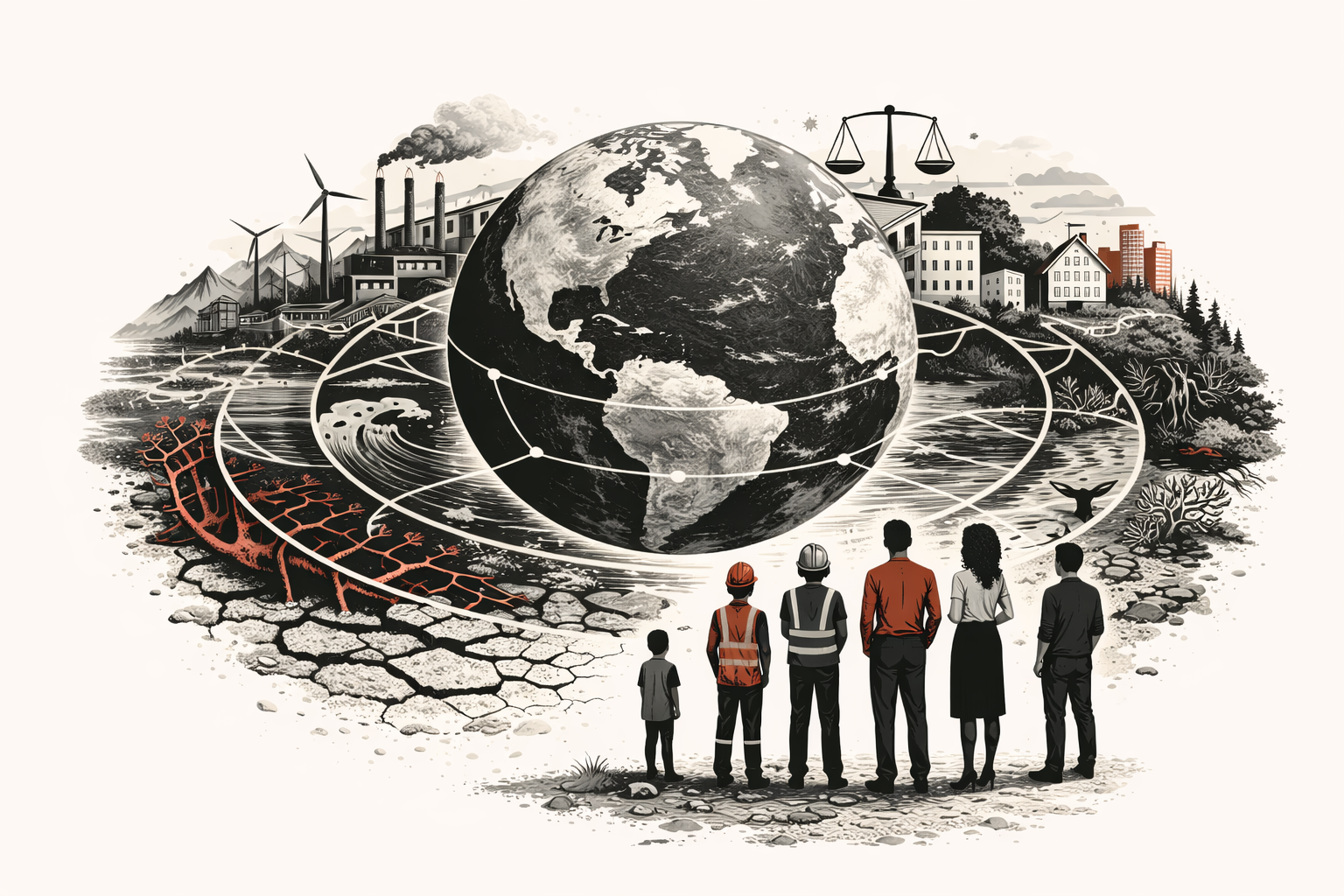
This article argues that planetary stewardship and civilizational responsibility should be understood together because ecological crisis is not only environmental. It is also developmental, constitutional, institutional, technological, and moral. It examines the shift from environmental management to planetary stewardship, explains why the Earth system has become a moral context for political action, explores civilization as organized power with planetary consequences, considers the relation between planetary boundaries and justice, analyzes why short institutional time horizons deepen intergenerational risk, shows why planetary risk is systemic, and asks what forms of cooperation, capacity, restraint, and common responsibility are required if modern civilization is to become compatible with the conditions of life it depends upon.
Why This Belongs in Stewardship & Ethics
Planetary stewardship belongs in Stewardship & Ethics because the ecological crisis is not only a technical problem of emissions, land use, biodiversity, pollution, or resource management. It is a moral problem about power, responsibility, restraint, justice, and the future conditions of life.
A purely managerial approach asks how societies can reduce environmental damage while continuing familiar patterns of development. A stewardship approach asks a deeper question: what obligations arise when human systems become powerful enough to destabilize the conditions that sustain life across the planet?
That question cannot be answered by technology alone. Nor can it be answered by individual lifestyle change, corporate reporting, or national policy instruments in isolation. Planetary risk is produced by interlocking systems: energy, finance, infrastructure, agriculture, trade, consumption, urbanization, extraction, technology, law, and global inequality. Stewardship must therefore operate at the level of systems.
This article also belongs in Stewardship & Ethics because planetary responsibility is inseparable from justice. Ecological degradation is not distributed evenly. Communities that contributed least to climate change and ecological overshoot often face the greatest exposure to heat, flooding, drought, crop failure, displacement, disease, and infrastructure fragility. Future generations inherit risks they did not choose. Nonhuman life bears the consequences of decisions made inside human political and economic systems.
To speak of civilizational responsibility is to refuse the fantasy that modern societies can continue expanding power without expanding accountability. It asks whether civilization can become ethically mature enough to govern its own scale.
From Environmental Management to Planetary Stewardship
Traditional environmental management often treats problems as bounded: a river to clean, an emissions source to regulate, a species to protect, a forest to monitor, a pollutant to reduce, or a development project to assess. These interventions matter. Many have saved ecosystems, protected public health, improved air and water quality, and created legal standards for accountability.
But they are not sufficient for the present condition.
Planetary stewardship differs because it begins from interdependence. It recognizes that climate, oceans, forests, soils, biodiversity, freshwater cycles, ice sheets, atmospheric chemistry, and biogeochemical processes are not discrete policy sectors. They are interwoven components of a single Earth system. Human societies are embedded within that system, not external managers standing above it.
This shift matters ethically because management can remain instrumental while stewardship is inherently relational. Management may ask how to optimize resource use without disrupting growth. Stewardship asks what obligations arise when societies possess the power to destabilize the conditions of life for others, including future generations and distant communities with little control over present trajectories.
Stewardship therefore moves beyond efficiency. It asks about restraint, care, responsibility, reciprocity, limits, and public purpose. It asks whether modern institutions can be redesigned once ecological stability itself becomes a condition of legitimate governance.
That shift changes the scale of the question. The issue is no longer merely how to regulate environmental externalities within otherwise familiar institutions. It is how to redesign those institutions when ecological stability, social justice, and long-term habitability become core tests of civilization.
Planetary stewardship asks not only what must be protected, but what forms of civilization can remain compatible with that protection.
The Earth System as a Moral Context
Planetary stewardship requires more than scientific description. It requires understanding the Earth system as a moral context for political, economic, technological, and institutional action.
A stable climate, functioning hydrological cycles, living oceans, resilient ecosystems, healthy soils, viable pollinator systems, and tolerable levels of environmental risk are not luxuries. They are background conditions for health, food security, social order, economic life, cultural continuity, migration stability, and political legitimacy. When those conditions are undermined, the consequences are not evenly distributed.
This is why Earth-system governance cannot be separated from justice. Vulnerable populations, fragile regions, small island states, Indigenous communities, low-income households, children, workers exposed to heat, and societies with limited fiscal capacity often bear the greatest burden despite having contributed least to many of the underlying drivers.
A moral account of the Earth system must therefore ask several questions at once:
- Who has benefited most from ecological destabilization?
- Who has contributed most to cumulative harm?
- Who is most exposed to present and future risk?
- Who has the capacity to adapt, relocate, insure, rebuild, or protect themselves?
- Who is excluded from decisions about the systems that shape their vulnerability?
The Earth system becomes a moral context at precisely the point where it can no longer be treated as passive background. Once it is clear that large-scale human activity alters the conditions of future life, responsibility must expand accordingly.
Politics is no longer only about managing society within nature. It is about governing civilization within a destabilized Earth system.
Civilization as Power with Consequences
Civilizations have always transformed landscapes, waters, species, and social worlds. What is distinctive about the contemporary condition is the scale, speed, and integration of those transformations.
Industrial energy systems, fossil-fuel dependence, global logistics, digital infrastructure, large-scale extraction, industrial agriculture, financial acceleration, mass consumption, military systems, and rapid urbanization have produced unprecedented capacities to reorganize material life. They have also produced forms of exposure and fragility that now rebound against the social order that created them.
To speak of civilizational responsibility is therefore to recognize that humanity’s problem is not simply one of isolated bad choices. It is institutional and structural. Entire systems of production, mobility, housing, agriculture, finance, security, consumption, and development have been organized around assumptions of abundance, externalization, cheap energy, and delayed consequence.
A civilizational ethic asks whether those assumptions can still be defended when their cumulative effects destabilize the conditions upon which civilization depends.
Responsibility at this level means more than mitigating particular harms. It means revising the architectures of power that make those harms ordinary. Fossil-fuel dependence is not only an energy problem. It is an infrastructure problem, a finance problem, a geopolitical problem, a labor problem, a development problem, and a moral problem. Biodiversity loss is not only a conservation problem. It is a food-system problem, a land-use problem, a legal problem, a trade problem, and a cultural problem.
The language of civilization is useful because it makes clear that ecological crisis is not an environmental side issue attached to an otherwise intact order. It reveals the degree to which the material organization of modern life is implicated in the crisis itself.
Civilizational responsibility therefore concerns not only better behavior within existing systems, but the redesign of systems whose ordinary functioning has become ecologically destructive.
Planetary Boundaries, Justice, and Limits
The language of planetary boundaries has been influential because it offers a way of thinking about Earth-system limits in systemic rather than fragmented terms. It identifies the biophysical processes that help regulate the stability and resilience of the Earth system, including climate change, biosphere integrity, land-system change, freshwater change, biogeochemical flows, ocean acidification, atmospheric aerosol loading, stratospheric ozone depletion, and novel entities.
But one of the most important developments in this field has been the move from safe boundaries alone toward safe and just boundaries. This shift acknowledges that ecological overshoot and social injustice are linked. It is not enough to say that the planet has limits. One must also ask who has consumed ecological space, who bears the costs of overshoot, and how transitions can occur without imposing new forms of sacrifice on people already exposed to deprivation.
This makes the politics of limits more demanding than a simple call for restraint.
Wealthy societies, high-consuming sectors, and historically advantaged institutions cannot invoke planetary limits as though all actors contributed equally to current conditions. Nor can justice be reduced to permitting continued overshoot until development gaps somehow disappear. The ethical challenge is to hold both realities together: the planet cannot absorb indefinite expansion, and human beings cannot be asked to accept deprivation as the price of ecological order.
Planetary stewardship must therefore be distributive as well as ecological. It must ask how limits can be governed fairly.
A just approach to planetary boundaries must address:
- historical responsibility for cumulative emissions and extraction;
- unequal consumption between and within countries;
- development needs in low-income and vulnerable societies;
- technology transfer and climate finance;
- adaptation support and loss-and-damage responsibilities;
- protection for communities exposed to transition costs;
- the rights and agency of Indigenous peoples and frontline communities;
- the need to reduce ecological pressure without deepening poverty.
Limits without justice become austerity for the vulnerable. Justice without limits can become ecological denial. Planetary stewardship requires both: a safe Earth system and a fair distribution of responsibility within it.
Time Horizons and Intergenerational Obligation
One of the deepest failures of modern institutions is temporal. Markets, electoral cycles, quarterly reporting, crisis-driven governance, and short budget windows all favor near-term returns. Yet Earth-system processes unfold across decades, centuries, and sometimes millennia. Many harms become difficult or impossible to reverse once thresholds are crossed.
This creates a structural asymmetry between the time in which damage accumulates and the time in which political systems usually operate. Planetary stewardship is, in part, an effort to correct that asymmetry.
Intergenerational responsibility enters here not as abstraction but as institutional design. Future generations cannot vote, lobby, sue, negotiate, or protest on equal terms with the living. If their interests are to matter, present institutions must represent them through precaution, long-term planning, ecological restoration, resilient infrastructure, fiscal responsibility, legal guardianship, and governance arrangements capable of preserving options rather than foreclosing them.
Civilizational responsibility means refusing to define success in ways that depend on transferring instability, debt, depletion, contamination, extinction risk, and irreversible loss into the future.
This temporal dimension is what makes stewardship more demanding than environmental concern alone. It asks whether present institutions can be redesigned to treat future vulnerability as morally relevant before damage becomes politically irreversible.
Some reforms point in this direction:
- future generations commissioners and guardianship institutions;
- constitutional environmental rights;
- public trust doctrines and duties of care;
- long-term climate budgets and carbon budgets;
- infrastructure planning that accounts for future climate conditions;
- ecological restoration commitments extending beyond election cycles;
- intergenerational impact assessments for major public decisions.
A civilization that measures success only in near-term terms will continue to liquidate long-term stability while mistaking that liquidation for progress. Stewardship requires institutions that can remember forward.
Planetary Risk as Systemic Risk
A central lesson of recent scientific and policy work is that planetary risks are systemic. Climate risk intensifies food insecurity, displacement, health pressures, conflict exposure, infrastructure stress, fiscal instability, and insurance retreat. Biodiversity loss weakens pollination, soil health, fisheries, disease regulation, genetic diversity, and ecosystem resilience. Water stress alters agriculture, industry, urban life, energy systems, and regional politics.
These are not parallel lines of risk. They interact, compound one another, and move through trade, finance, migration, insurance, supply chains, public health systems, and governance institutions.
This systemic character is ethically significant because it challenges the illusion that environmental harms can be cleanly externalized. In a tightly coupled world, instability reverberates. Yet those reverberations remain unequal. Some actors enjoy the benefits of high-consumption systems while others absorb disproportionate risk.
Planetary stewardship therefore requires governance that is attentive not only to total risk, but to how risk is distributed, amplified, and politically managed.
Systemic planetary risk has several defining features:
- Interdependence: ecological, economic, social, and political systems affect one another.
- Cascading effects: disruption in one domain can spread through infrastructure, finance, food, health, migration, and security systems.
- Nonlinearity: gradual pressure can produce sudden shifts when thresholds are crossed.
- Unequal exposure: risk is distributed through class, geography, race, colonial history, gender, age, disability, and state capacity.
- Delayed consequences: harms may accumulate long before they become visible or politically unavoidable.
- Institutional mismatch: governance systems often remain organized by sectors while risks operate across systems.
A systems view changes the meaning of responsibility. It is not enough to reduce one indicator while worsening another. It is not enough to shift emissions, extraction, waste, or exposure elsewhere. It is not enough to protect wealthy regions while leaving poorer communities to absorb instability.
Stewardship requires collaboration, transformation, and dignified transitions rather than narrow sectoral fixes.
Institutions, Capacity, and the Governance Gap
The scientific case for planetary stewardship has advanced faster than the institutional capacity to enact it. Global governance remains fragmented across treaties, ministries, sectors, jurisdictions, markets, and enforcement systems. Responsibilities are diffused. Incentives often reward short-term extraction, geopolitical competition, or delayed adjustment.
The result is a widening gap between what is known about systemic risk and what institutions are presently capable of coordinating in response.
This governance gap is not merely technical. It is ethical. It reveals a mismatch between the scale of human power and the forms of responsibility through which that power is governed. Civilizational responsibility means recognizing that fragmented institutions can themselves become sources of harm when they cannot respond adequately to systemic threats.
Stewardship therefore requires institution-building:
- stronger science-policy interfaces;
- longer planning horizons in public institutions;
- better representation of vulnerable societies and communities;
- legal systems capable of recognizing ecological harm and future risk;
- financial architectures that discourage destructive investment;
- coordination across climate, biodiversity, food, water, health, finance, and infrastructure systems;
- public accountability for delayed action;
- institutional mechanisms that align authority with the scale of risk.
The problem is not that institutions know nothing. It is that knowledge often remains compartmentalized while power remains organized for other purposes. Governance fails not only through ignorance, but through fragmentation, delay, capture, and the inability to align authority with the scale of the threat.
Stewardship begins where that mismatch is treated as a design problem rather than an unfortunate backdrop.
Planetary Commons and Shared Obligation
The idea of the planetary commons has become increasingly important because it reframes Earth-system processes as something more than a collection of national environmental assets. Climate regulation, biodiversity integrity, atmospheric stability, ocean health, cryosphere stability, forests, and other Earth-regulating systems do not belong neatly to single states or market actors. They are shared conditions of life.
This is a significant development because it moves beyond the older habit of treating global environmental governance as an optional layer above sovereign self-interest.
To think in terms of planetary commons is to recognize that some goods are so foundational that their degradation becomes a question of common responsibility, even where political authority remains plural and unequal. This does not erase national sovereignty, but it does place sovereignty within a wider ethical frame. States, firms, institutions, and individuals remain accountable for how their actions affect shared Earth-system conditions.
Civilizational responsibility thus becomes partly a matter of learning how to govern common dependence without assuming either a single world state or a morally adequate fragmentation into isolated self-interest.
The planetary commons frame also raises difficult questions:
- Who has authority to define and protect Earth-regulating systems?
- How should responsibilities be distributed across unequal states and economies?
- How can common goods be protected without reproducing colonial control over land and resources?
- How should Indigenous sovereignty and local knowledge be recognized in planetary governance?
- How can planetary responsibility avoid becoming a technocratic project detached from democracy and justice?
These questions matter because the commons language can be used well or badly. It can support shared responsibility, or it can become a justification for powerful actors to manage vulnerable regions in the name of global necessity. Stewardship requires the first path and must guard against the second.
Planetary commons governance must therefore be built around justice, consent, representation, sovereignty, accountability, and care for both people and the Earth-regulating systems on which they depend.
Technology, Development, and Stewardship
Planetary stewardship is not anti-technology. Innovation can support decarbonization, adaptation, ecological monitoring, public health, resilient infrastructure, precision agriculture, circular materials, clean energy, and disaster preparedness. Satellites can monitor deforestation. Sensors can detect environmental stress. Artificial intelligence can help identify risk patterns. Renewable technologies can reduce fossil-fuel dependence. Public health systems can use data to anticipate climate-sensitive disease risk.
But technology does not govern itself. It can support stewardship or intensify extraction depending on the institutions, incentives, ownership structures, and political values around it.
Technology can accelerate demand, centralize power, expand surveillance, increase resource extraction, create new waste streams, and deepen inequality if governed within the same expansive and externalizing logic that produced present crises. The question is not whether societies should innovate. The question is whether innovation is ordered toward regenerative and just futures or toward preserving unsustainable systems through new means.
This is especially important for development. Poorer societies still require energy access, infrastructure, health systems, mobility, housing, food security, climate adaptation, and expanded capabilities. Planetary stewardship cannot mean freezing inequality in place under the language of limits. It must support pathways of development that expand human flourishing without repeating ecologically destructive trajectories.
Civilizational responsibility therefore includes:
- technology transfer;
- climate finance;
- adaptation support;
- public-interest infrastructure;
- fair access to clean energy;
- protection against extractive green supply chains;
- support for locally appropriate development pathways;
- institutional cooperation that widens just transition possibilities.
Stewardship requires refusing both ecological indifference and developmental paternalism. It must ask how capabilities can be expanded under conditions that remain just, low-carbon, democratic, and institutionally inclusive.
A serious civilizational ethic treats technology as a question of governance and distribution, not merely innovation.
From Awareness to Stewardship
Environmental awareness alone is insufficient. Civilization already possesses abundant evidence of planetary stress. Scientific reports, climate models, biodiversity assessments, pollution monitoring, satellite imagery, public health data, and disaster records have made the scale of risk unmistakable.
The question is why knowledge so often fails to become transformation.
One reason is that awareness can remain external to institutions. It may change rhetoric without changing infrastructure, investment, law, accountability, or public purpose. A government may acknowledge climate risk while approving new fossil infrastructure. A corporation may disclose environmental risk while continuing destructive supply-chain practices. A financial institution may recognize systemic risk while funding the systems that deepen it. A society may speak about future generations while organizing public life around short-term returns.
Stewardship is more demanding because it requires knowledge to become governing form. It asks what responsibilities follow once systemic risk is known, once injustice is visible, and once delayed action can no longer plausibly be described as ignorance.
For that reason, planetary stewardship is not a sentiment. It is a practical ethic of institution-building, power-limiting, restoration, resilience, and long-horizon governance. It asks whether modern societies can move from awareness of planetary condition to forms of life and coordination adequate to that condition.
The real divide is therefore not between awareness and denial alone. It is between awareness that remains rhetorical and awareness that becomes constitutional, developmental, legal, financial, infrastructural, and cultural.
Stewardship names that second threshold.
Toward a Civilizational Ethic
An adequate civilizational ethic begins with humility about power. Human beings are capable of extraordinary technical coordination, creativity, and repair. They are also capable of destabilizing the systems on which they depend. That combination requires restraint, precaution, and an expanded sense of obligation across borders, classes, species, and generations.
A civilizational ethic must reject the view that prosperity can remain legitimate if built upon irreversible ecological degradation or the systematic transfer of risk onto the vulnerable. It must also reject the fantasy that planetary crisis can be solved through managerial adjustment alone while leaving deeper structures of power untouched.
Such an ethic would include several commitments:
- Restraint: the willingness to limit destructive forms of power before harm becomes irreversible.
- Justice: the fair distribution of responsibility, transition burdens, and access to development.
- Precaution: action under uncertainty when delay increases the risk of severe or irreversible harm.
- Repair: restoration of damaged ecosystems, communities, and institutional trust.
- Representation: inclusion of vulnerable communities, future generations, and marginalized voices in decisions about shared risk.
- Accountability: mechanisms that connect ecological damage to legal, financial, political, and moral responsibility.
- Transformation: redesign of systems whose normal operation produces overshoot.
At the same time, a civilizational ethic must avoid despair. Stewardship is possible precisely because institutions can change, priorities can be reordered, and infrastructures can be redesigned. Scientific work on resilience, justice, and Earth-system boundaries exists not to announce fate, but to clarify the conditions under which viable futures remain achievable.
Responsibility begins where inevitability is refused.
A civilizational ethic is therefore not only environmental. It is constitutional, developmental, technological, institutional, and distributive. It concerns what kind of civilization can endure without making its own conditions of life progressively less stable, less just, and less governable.
A civilizational ethic is an ethic of self-limitation in the service of shared endurance.
Civilizational Responsibility Diagnostic Table
| Question | Conventional frame | Stewardship & Ethics frame |
|---|---|---|
| What is the ecological crisis? | A set of environmental problems requiring better management. | A civilizational condition in which human systems destabilize the Earth-system foundations of life. |
| What is nature? | A resource base, external environment, or background condition for development. | The living Earth system within which human societies are embedded and dependent. |
| What is responsibility? | Compliance with regulations, disclosure rules, or national policy targets. | A moral, institutional, and intergenerational obligation proportional to planetary-scale power. |
| What is development? | Growth, infrastructure, income, productivity, and modernization. | The expansion of capability within ecological limits and just conditions of life. |
| What are planetary boundaries? | Scientific thresholds or environmental risk indicators. | Ethical limits requiring fair distribution of ecological space, responsibility, and transition burdens. |
| What is the governance problem? | Better coordination among environmental agencies and policy instruments. | A mismatch between Earth-system risk and institutions organized around short-term, fragmented, and unequal power. |
| What is systemic risk? | A technical problem of cascading disruption. | A moral and institutional problem of unequal exposure, interdependence, and delayed accountability. |
| What is technology’s role? | Innovation to solve environmental and development challenges. | Tools that must be governed toward justice, resilience, repair, and low-carbon capability. |
| What is intergenerational responsibility? | Long-term planning where politically feasible. | A binding ethical obligation to preserve options, stability, and ecological conditions for future life. |
| What is planetary stewardship? | Environmental concern at global scale. | The disciplined governance of civilizational power in service of justice, restraint, resilience, and Earth-system continuity. |
Conclusion: Planetary Stewardship and Civilizational Responsibility
Planetary stewardship and civilizational responsibility belong together because they address the same question from different angles: how should a species with Earth-system power govern itself justly and durably?
Stewardship names the obligation to care for and preserve the conditions of life. Civilizational responsibility names the scale at which that obligation now operates. Together they reveal that the ecological crisis is not only environmental. It is constitutional, institutional, developmental, technological, and moral.
The decisive issue is no longer whether human activity affects the planet. It does. The issue is whether the institutions that organize human activity can be transformed in ways consistent with justice, resilience, and long-term Earth-system stability. A civilization that cannot govern its own power will continue to convert intelligence into instability. A civilization that accepts stewardship as a defining responsibility may yet become capable of endurance worthy of the world it inhabits.
This does not require abandoning development, technology, or human aspiration. It requires reordering them. Development must expand capability without destroying the ecological foundations of capability. Technology must serve repair rather than extraction. Institutions must lengthen their time horizons. Finance must stop treating ecological breakdown as someone else’s liability. Law must learn to represent future generations, vulnerable communities, and living systems more seriously. Politics must become capable of governing the consequences of civilizational power.
Planetary stewardship is therefore not a retreat from modern responsibility. It is the expansion of responsibility to match modern power.
The future will not be judged only by whether human societies became more productive, more intelligent, or more technologically advanced. It will be judged by whether they became wise enough to protect the conditions of life, just enough to share the burdens of transition fairly, and humble enough to recognize that civilization does not stand above the Earth system.
It lives within it.
Related Reading
- Responsibility in the Anthropocene
- Sustainable Development Goals Within Planetary Boundaries
- Safe Operating Space and the Conditions of Long-Run Development
- Finance, Disclosure, and Systemic Environmental Risk
- Risk Governance in Complex Societies
Further Reading
- Earth Commission (2024) ‘Paths to prosperity exist for planet and people if Earth’s critical resources are better shared’. Available at: https://earthcommission.org/new-research-reveals-paths-to-prosperity-for-planet-and-people-if-earths-critical-resources-are-better-shared/
- Intergovernmental Panel on Climate Change (IPCC) (2023) Climate Change 2023: Synthesis Report. Geneva: IPCC. Available at: https://www.ipcc.ch/report/ar6/syr/
- Rockström, J. et al. (2023) ‘Safe and just Earth system boundaries’, Nature, 619, pp. 102–111. Available at: https://www.nature.com/articles/s41586-023-06083-8
- Rockström, J. et al. (2024) ‘The planetary commons: A new paradigm for safeguarding Earth-regulating systems in the Anthropocene’, Proceedings of the National Academy of Sciences, 121(5). Available at: https://www.pnas.org/doi/10.1073/pnas.2301531121
- Stockholm Resilience Centre (2024) The Planetary Commons: A New Paradigm for Safeguarding Earth-Regulating Systems in the Anthropocene. Available at: https://www.stockholmresilience.org/publications/publications/2024-10-09-the-planetary-commons-a-new-paradigm-for-safeguarding-earth-regulating-systems-in-the-anthropocene.html
- Stockholm Resilience Centre (n.d.) Stewardship and Transformative Futures. Available at: https://www.stockholmresilience.org/research/research-themes/stewardship-transformation.html
- United Nations Environment Programme (UNEP) (2025) Global Environment Outlook 7: A Future We Choose. Nairobi: UNEP. Available at: https://www.unep.org/resources/global-environment-outlook-7
- United Nations Environment Programme (UNEP) (n.d.) Climate Action. Available at: https://www.unep.org/topics/climate-action
References
- Earth Commission (2024) ‘Paths to prosperity exist for planet and people if Earth’s critical resources are better shared’. Available at: https://earthcommission.org/new-research-reveals-paths-to-prosperity-for-planet-and-people-if-earths-critical-resources-are-better-shared/
- Intergovernmental Panel on Climate Change (IPCC) (2022) Climate Change 2022: Impacts, Adaptation and Vulnerability – Summary for Policymakers. Available at: https://www.ipcc.ch/report/ar6/wg2/chapter/summary-for-policymakers/
- Intergovernmental Panel on Climate Change (IPCC) (2023) Climate Change 2023: Synthesis Report. Geneva: IPCC. Available at: https://www.ipcc.ch/report/ar6/syr/
- Rockström, J. et al. (2023) ‘Safe and just Earth system boundaries’, Nature, 619, pp. 102–111. Available at: https://www.nature.com/articles/s41586-023-06083-8
- Rockström, J. et al. (2024) ‘The planetary commons: A new paradigm for safeguarding Earth-regulating systems in the Anthropocene’, Proceedings of the National Academy of Sciences, 121(5). Available at: https://www.pnas.org/doi/10.1073/pnas.2301531121
- Stockholm Resilience Centre (2024) The Planetary Commons: A New Paradigm for Safeguarding Earth-Regulating Systems in the Anthropocene. Available at: https://www.stockholmresilience.org/publications/publications/2024-10-09-the-planetary-commons-a-new-paradigm-for-safeguarding-earth-regulating-systems-in-the-anthropocene.html
- Stockholm Resilience Centre (n.d.) Stewardship and Transformative Futures. Available at: https://www.stockholmresilience.org/research/research-themes/stewardship-transformation.html
- United Nations Environment Programme (UNEP) (2025) Global Environment Outlook 7: A Future We Choose. Nairobi: UNEP. Available at: https://www.unep.org/resources/global-environment-outlook-7
- United Nations Environment Programme (UNEP) (n.d.) Climate Action. Available at: https://www.unep.org/topics/climate-action