
Last Updated May 9, 2026
Responsibility in the Anthropocene matters for sustainable systems because it asks what obligations arise when human activity becomes powerful enough to alter climate, biodiversity, biogeochemical cycles, landscapes, oceans, infrastructures, and the long-term conditions of life at planetary scale. The Anthropocene is often invoked to describe an era in which human influence is no longer local, incidental, or marginal to Earth-system dynamics. Whether treated as a contested geological proposal, an environmental humanities concept, or a moral and political diagnosis, it raises a deeper ethical question: what does responsibility mean when the cumulative effects of production, extraction, energy use, land conversion, technological power, and institutional delay reshape the systems on which human and nonhuman futures depend?
The deeper reason this issue belongs in Stewardship & Ethics is that Anthropocene responsibility cannot be reduced to individual virtue alone, abstract guilt, or generalized rhetoric about “humanity” as though all people contributed equally or possess equal power to respond. Contemporary climate and environmental justice make clear that responsibility must be interpreted through agency, causation, benefit, capacity, vulnerability, history, and institutional control. The polluter-pays principle, beneficiary-pays reasoning, capacity-based responsibility, and differentiated responsibility all show that planetary responsibility is unevenly distributed.
The Anthropocene should therefore not be treated merely as a dramatic label for environmental crisis. It is also a challenge to inherited moral frameworks. Traditional ethics often assumed clearer separations between local action and distant consequence, present conduct and long-term planetary effects, human society and the nonhuman background against which it unfolds. Anthropocene thinking disrupts those separations. It reveals cumulative causation, delayed harm, systemic feedbacks, global interdependence, more-than-human consequence, and the possibility that ordinary economic and technological systems can generate harms larger than the institutions that authorize them are prepared to acknowledge.
Responsibility in the Anthropocene asks whether human power can become answerable to the scale of its effects. It asks whether societies can move beyond denial, abstraction, and symbolic sustainability toward institutions capable of confronting planetary consequence, differentiating responsibility justly, protecting vulnerable communities, preserving future options, and recognizing obligations to ecological systems that cannot speak in human institutions but can be deeply harmed by them.
A society that has become powerful enough to alter Earth systems cannot remain ethically immature about the consequences of that power.
Main Library
Publications
Article Map
Stewardship & Ethics
Related Topic
Sustainable Development
Related Topic
Planetary Boundaries
Related Topic
Risk & Resilience
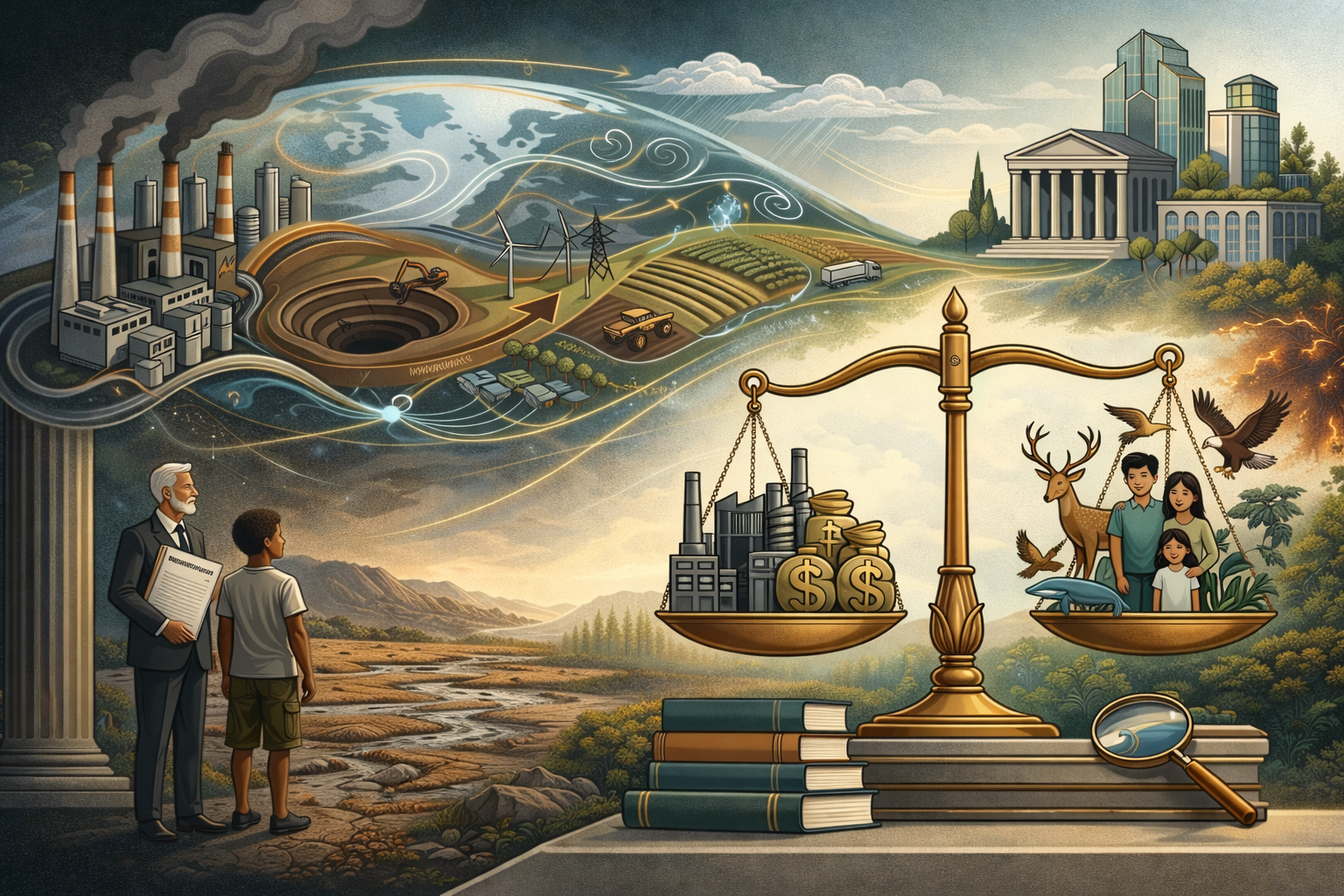
This article argues that responsibility in the Anthropocene should be understood as a problem of scale, causation, justice, governance, and moral imagination. It examines what the Anthropocene means, why responsibility becomes ethically difficult under conditions of cumulative and distributed harm, how historical emissions and unequal benefit complicate appeals to shared human responsibility, why future generations and ecological systems intensify the moral burden of present action, how institutions must assume obligations commensurate with their planetary reach, why transformative change belongs within an ethics of responsibility, and why sustainable systems require more than better management of the same structures that produced planetary instability.
Why This Belongs in Stewardship & Ethics
Responsibility in the Anthropocene belongs in Stewardship & Ethics because stewardship asks how power should be exercised when it affects shared conditions of life. The Anthropocene intensifies that question by expanding the scale of consequence. Human systems now influence atmospheric composition, climate risk, biodiversity, land systems, oceans, biogeochemical cycles, public health, infrastructure, and the conditions that future generations and more-than-human communities will inherit.
This is not only a scientific claim. It is an ethical challenge. If human activity has become powerful enough to alter Earth systems, then human institutions must become serious enough to govern that power responsibly.
The issue belongs here because stewardship is not simply private care, environmental appreciation, or sustainable management. It is a discipline of responsibility under conditions of dependence. Human beings depend on systems they do not fully control, did not create, and cannot fully replace: stable climate, functioning ecosystems, freshwater cycles, soil fertility, biodiversity, public institutions, and social trust. To degrade these systems while denying responsibility for the consequences is a failure of stewardship.
Responsibility in the Anthropocene also requires justice. The language of “humanity” can be illuminating, but it can also erase inequality. Industrialized economies, fossil-fuel systems, imperial and colonial extraction, high-consuming classes, major corporations, and powerful states have contributed differently to planetary disruption and retain different capacities to respond. Vulnerable communities, Indigenous peoples, low-emitting societies, future generations, and nonhuman life often bear consequences far out of proportion to their role in producing them.
Stewardship & Ethics therefore asks whether responsibility can be scaled up without becoming vague. It asks whether the answer to planetary crisis is not a generalized moral fog but a clearer account of differentiated obligation: who caused harm, who benefited, who has capacity, who controls the systems, who is exposed, and what forms of repair, restraint, and transformation are owed.
What Responsibility in the Anthropocene Means
Responsibility in the Anthropocene refers to the moral, political, and institutional obligations that arise when human action alters Earth systems at large scale. The term “Anthropocene” remains contested in geology and stratigraphy. The formal proposal to add an Anthropocene Epoch to the Geologic Time Scale did not receive approval. Yet as an ethical, cultural, and socio-ecological diagnosis, the concept remains influential because it names a condition in which anthropogenic influence has become planetary in reach and long in duration.
This distinction matters. Responsibility does not depend on final geological ratification. Even if the Anthropocene remains contested as a formal epoch, the underlying ethical reality persists: human systems are changing the conditions of life in ways that exceed the scale of many inherited institutions and moral habits.
Responsibility changes under these conditions because harms are often cumulative, mediated, distributed, and delayed. In more ordinary moral settings, one may identify a clearer actor, nearer victim, and immediate consequence. Anthropocene responsibility is more complex. Emissions accumulate across decades and jurisdictions. Biodiversity loss emerges through thousands of land-use, trade, investment, and consumption decisions. Climate impacts interact with inequality, infrastructure, health, governance, and ecological fragility. Plastic pollution, chemical exposure, deforestation, and ocean degradation move through systems rather than through single isolated acts.
To ask what responsibility means here is therefore to ask how moral judgment should adapt to a world of distributed causation, unequal power, and planetary consequence.
Responsibility in the Anthropocene includes several dimensions:
- causal responsibility: who contributed to the harm;
- beneficiary responsibility: who gained from systems that produced the harm;
- capacity responsibility: who has the resources and institutions to respond;
- control responsibility: who controls the systems that continue to generate risk;
- repair responsibility: who owes support to those already harmed or exposed;
- stewardship responsibility: who must preserve shared conditions for future and more-than-human life.
The question is not whether responsibility survives under Anthropocene conditions. It is how responsibility must be reformulated so that it remains serious enough for the scale of the problem.
Why the Anthropocene Changes the Question of Responsibility
The Anthropocene changes the question of responsibility because it destabilizes the background assumptions of ordinary moral and political life. Human beings have always transformed environments, but contemporary industrial, extractive, agricultural, financial, and technological systems do so with a magnitude and persistence that alter atmospheric composition, hydrological cycles, biodiversity patterns, land systems, ocean chemistry, and climate risks across generations.
This matters because traditional moral categories can become strained under such conditions. The scale of harm may exceed the horizon of the individual actor. The victims may be geographically distant, temporally delayed, or more-than-human. The causal chain may run through markets, infrastructures, laws, technologies, supply systems, and institutional routines rather than discrete acts of malice. The Anthropocene therefore exposes a gap between the size of human power and the narrowness of many inherited moral habits.
Responsibility in this context becomes less a matter of isolated blame alone and more a matter of whether social systems, institutions, and governing frameworks are willing to recognize the consequences they authorize. It asks whether ordinary operations can become ethically abnormal once their cumulative effects are understood.
A fossil-fuel system may look ordinary from inside energy markets. A supply chain may look ordinary from inside procurement. A highway expansion may look ordinary from inside transport planning. A commodity frontier may look ordinary from inside development policy. But Anthropocene ethics asks what these ordinary systems become when their aggregated consequences produce climate disruption, ecological simplification, displacement, and intergenerational burden.
The Anthropocene changes responsibility by making scale morally visible.
It asks whether institutions can move from narrow compliance to systemic answerability, from local permission to planetary consequence, and from short-term benefit to long-term obligation. Sustainable systems depend on closing that gap between power and accountability.
Humanity, Agency, and the Problem of an Undifferentiated “We”
One of the first difficulties in Anthropocene ethics is the language of “humanity.” The term can be illuminating because it highlights shared planetary embeddedness and the aggregate force of human systems. It reminds us that human activity, taken collectively, has become Earth-shaping. But it can also be misleading because it obscures asymmetry.
Not all people have contributed equally to emissions, extraction, habitat destruction, industrial power, financial gain, or technological control. Nor do all people possess equal institutional capacity to respond. Climate justice theory therefore insists that responsibility must be differentiated by contribution, benefit, capacity, vulnerability, and control rather than assigned to an abstract human whole.
This matters because an undifferentiated “we” can become morally evasive. It can flatten colonial histories, class structures, corporate power, state responsibility, racialized exposure, and global inequality into a vague species-level narrative that distributes burden without regard to agency. Such flattening is especially dangerous in sustainability discourse because those least responsible for planetary disruption often remain among those most exposed to its effects.
A low-emitting rural community facing climate-driven drought does not occupy the same moral position as a high-emitting industrial sector defending fossil infrastructure. An Indigenous community protecting forests does not occupy the same moral position as a corporation profiting from land conversion. A child born into a climate-damaged future does not occupy the same moral position as institutions that delayed action while warnings were clear.
Responsibility in the Anthropocene therefore requires a double recognition. There is a real sense in which human systems collectively shape planetary conditions. There is also a decisive sense in which this collective condition is structured by unequal agency, unequal power, unequal benefit, and unequal vulnerability.
Ethical seriousness depends on holding both truths together rather than sacrificing one to rhetorical simplicity.
Causation, Cumulative Harm, and Moral Distance
Anthropocene responsibility is difficult because many of the most important harms are cumulative rather than singular. No single emission alone causes climate disruption in a simple sense. No single land conversion decision fully explains biodiversity decline. No single actor exhausts the process by which ecological thresholds are approached or crossed. Yet cumulative causation does not eliminate responsibility. It enlarges the need for frameworks capable of assigning it across contributions, systems, and institutions.
This matters because modern life frequently creates moral distance between action and consequence. Consumers, investors, planners, engineers, legislators, firms, and governments may participate in systems that generate large harms without direct contact with those harmed. The result can be a diffusion of responsibility in which many actors participate and few feel answerable.
That diffusion is one of the core ethical challenges of the Anthropocene.
Moral distance appears in several forms:
- spatial distance: harms occur far from where benefits are consumed;
- temporal distance: consequences unfold years or generations later;
- institutional distance: decisions are mediated by markets, laws, agencies, and supply chains;
- causal distance: each individual contribution appears small compared with the total harm;
- epistemic distance: the people benefiting may not see the systems through which harm is produced.
The problem is therefore not only blame allocation. It is moral perception. A society that normalizes cumulative harm as background economic activity will struggle to recognize responsibility even where evidence of systemic consequence is strong.
Anthropocene ethics asks whether institutions can learn to see aggregate causation as morally intelligible rather than as an excuse for inaction. The fact that harm is distributed does not mean responsibility disappears. It means responsibility must be organized at the same scale as the systems producing harm.
Historical Responsibility, Benefit, and Capacity
Responsibility in the Anthropocene is inseparable from history. Those who contributed most to atmospheric loading, fossil-fueled industrialization, land conversion, extraction, and ecological simplification cannot be treated as morally identical to those whose contributions were minimal and whose vulnerabilities are high. The polluter-pays principle remains a major framework here, but debates also extend to beneficiary-pays and capacity-based responsibility. These approaches reflect different ways of linking obligation to causation, advantage, and ability to act.
This matters because exclusive reliance on one metric can obscure the moral field. Historical emitters may deny direct liability across time. Current beneficiaries may claim innocence despite inherited advantage. High-capacity actors may evade obligation by appealing to formal equality among states or persons. Powerful institutions may reduce responsibility to voluntary commitments while retaining control over systems that continue to generate risk.
A richer account of Anthropocene responsibility therefore considers multiple dimensions at once:
- historical contribution: accumulated emissions, extraction, and ecological damage;
- benefit: wealth, infrastructure, geopolitical power, and institutional advantage gained from harmful systems;
- capacity: ability to finance mitigation, adaptation, restoration, and just transition;
- control: authority over energy systems, finance, land use, corporate strategy, and policy;
- vulnerability: exposure of communities and ecosystems least able to absorb or repair harm.
This multidimensional view is especially important for sustainable systems because institutions allocate both benefits and burdens across generations and territories. Responsibility cannot be coherent if it ignores who gained from the structures that produced crisis and who retains the greatest capacity to alter course.
A just account of Anthropocene responsibility does not say that only the historically powerful must act. It says they cannot claim the same level of obligation as those who have contributed least and suffered most.
Future Generations and Long-Horizon Obligation
The Anthropocene intensifies intergenerational ethics because many of its harms unfold slowly, persistently, and irreversibly. Emissions remain in the atmosphere. Species extinctions cannot be undone. Cryosphere loss, habitat fragmentation, deep soil degradation, ocean warming, and long-lived contamination alter future options long after present actors have passed from the scene.
This means responsibility cannot be interpreted only within the moral horizon of currently existing populations. It must also account for those who will inherit the altered Earth systems produced by present action.
This matters because modern institutions are poor at representing absent interests. Electoral systems privilege the present. Markets discount the future. Infrastructure neglect is easy to postpone. Long-horizon harms often appear abstract until thresholds are crossed. Responsibility in the Anthropocene therefore requires institutions capable of resisting the systematic devaluation of future life.
Future generations inherit more than atmospheric concentrations or economic accounts. They inherit:
- climate conditions shaped by present emissions;
- biodiversity protected or eliminated by present land-use decisions;
- infrastructure maintained, neglected, or maladapted now;
- public institutions strengthened or corroded now;
- technologies deployed now and made difficult to reverse later;
- adaptation burdens intensified or reduced by present policy.
This concern links directly to the broader ethics of stewardship. A society that calls itself sustainable while treating future generations as a sink for present cost is not acting responsibly at planetary scale.
Anthropocene responsibility demands a deeper temporal conscience than many existing systems are designed to sustain. It asks whether present institutions can act for those who cannot yet appear before them but whose futures are already being shaped.
Ecological Systems, More-Than-Human Worlds, and Responsibility
Responsibility in the Anthropocene is not only responsibility to other humans. It also raises the question of what is owed to the more-than-human world. If human systems now affect biodiversity, habitats, species interactions, climate conditions, oceans, forests, rivers, soils, and ecosystem processes at planetary scale, then responsibility cannot be framed solely in terms of human welfare without remainder.
Environmental ethics increasingly insists that moral concern must extend to ecological systems, nonhuman beings, and the conditions of life they sustain.
This matters because many Anthropocene narratives risk recentering humanity at the very moment they are supposed to critique human dominance. If the Anthropocene is understood only as the age in which humans became the dominant Earth-shaping force, then responsibility may be interpreted as more enlightened management of everything else. A stronger ethical response asks whether human power itself must be morally restrained by the claims of ecological integrity, biodiversity, and more-than-human life.
The more-than-human world matters in multiple ways:
- as a life-supporting condition for human societies;
- as a community of beings with moral significance beyond utility;
- as an evolutionary inheritance not created by human systems;
- as a field of ecological relationships that cannot be fully replaced once destroyed;
- as a source of cultural, spiritual, scientific, and relational meaning.
Responsibility in the Anthropocene therefore extends the logic of environmental ethics and the land ethic. It asks whether planetary-scale influence should produce not a new confidence in human management but a deeper humility before the systems being altered.
The ethical response to human Earth-shaping power is not mastery. It is answerability, restraint, repair, and care.
Institutions, Governance, and Planetary-Scale Obligation
Anthropocene responsibility is institutional as much as personal. Individuals matter, but the most consequential drivers of planetary disruption are embedded in infrastructures, corporations, states, financial systems, trade regimes, land-use systems, food systems, transport networks, energy arrangements, and technological platforms. Climate action, biodiversity protection, adaptation, and restoration depend on enabling conditions, coordinated governance, and systemic transformation rather than isolated personal morality alone.
This matters because responsibility becomes hollow if it is moralized downward while structural power is left intact. Citizens may be told to consume differently while extraction regimes, fossil-fuel systems, deforestation incentives, weak regulatory institutions, and destructive financial incentives remain in place. Personal responsibility has value, but it cannot substitute for institutional responsibility where systems produce harm at scale.
A serious account of Anthropocene responsibility therefore includes public authority, corporate governance, disclosure, accountability, risk oversight, legal duties, infrastructure planning, land-use reform, climate finance, and cross-scalar coordination.
Institutions must be judged by questions such as:
- Do they reduce or intensify planetary risk?
- Do they make cumulative harm visible or hide it through accounting systems?
- Do they distribute burdens fairly or shift them onto vulnerable communities?
- Do they act before irreversible harm occurs?
- Do they preserve future options or lock in risk?
- Do they remain accountable for impacts beyond their formal boundaries?
Sustainable systems require institutions capable of assuming obligation commensurate with their reach. Where institutions structure risk at planetary scale, their responsibilities cannot be interpreted through narrow internal performance metrics alone. They must also be judged by what they preserve, what they endanger, and how honestly they confront the consequences of their own operations.
Finance, Industry, and the Allocation of Planetary Risk
Finance and industry deserve special attention because they allocate the material pathways through which Anthropocene risk expands or contracts. Capital decisions shape energy systems, mining, infrastructure, agriculture, technology, logistics, housing, transport, and land use. Industrial systems determine what is extracted, burned, manufactured, transported, discarded, subsidized, and normalized. These decisions do not merely respond to environmental risk. They help produce it.
This matters because planetary disruption is not caused only by bad choices at the margins. It is built into large systems of investment, production, consumption, governance, and value extraction. A financial system that rewards short-term return while underpricing ecological damage becomes part of the machinery of Anthropocene harm. An industrial system that treats land, water, atmosphere, workers, and communities as external to profit becomes a system for displacing costs into the future and onto the vulnerable.
Responsibility therefore cannot be limited to individual consumer ethics. It must include the institutional actors that finance, insure, permit, regulate, design, and profit from risk-producing systems.
Finance and industry should be evaluated through several ethical lenses:
- material contribution: how activities affect emissions, land, water, biodiversity, health, and ecological resilience;
- disclosure: whether risks and impacts are made visible to publics, investors, regulators, and affected communities;
- transition: whether capital supports real decarbonization, restoration, and resilience rather than symbolic commitments;
- justice: whether burdens are shifted onto workers, frontline communities, Indigenous peoples, or future generations;
- accountability: whether institutions are answerable for downstream and cumulative effects.
Anthropocene responsibility asks whether finance and industry can be redesigned as systems of stewardship rather than engines of delayed harm. It asks whether capital allocation can become accountable to the living conditions it helps make or unmake.
Transformative Change and the Ethics of Systemic Response
Responsibility in the Anthropocene is not satisfied by acknowledging harm. It also requires response adequate to the scale of disruption. Contemporary biodiversity and climate literature increasingly speaks of transformative change: systemic shifts in production, governance, valuation, consumption, infrastructure, finance, and institutional coordination that address the drivers of ecological crisis rather than merely its symptoms.
This matters because the ethics of responsibility is incomplete if it remains backward-looking alone. Responsibility is not only about attributing fault for past harm. It is also about the willingness to undertake the forms of change demanded by present knowledge and foreseeable risk. In the Anthropocene, that often means confronting entrenched interests, path dependencies, political inertia, and morally convenient narratives of impossibility.
Transformative change is ethically demanding because it asks societies to alter the systems through which benefit has been organized. It asks not only for cleaner technology, but for different assumptions about value, growth, extraction, care, repair, participation, and interdependence. It asks whether institutions can stop treating planetary disruption as a manageable side effect and begin treating it as evidence that system design itself must change.
This does not mean all change must be abrupt, coercive, or careless. Transformation can be democratic, participatory, staged, and accountable. But it must be real enough to address the causes of crisis rather than merely reorganizing appearances.
The call for transformative change therefore belongs within an ethics of responsibility rather than outside it. Once the scale of planetary disruption is recognized, adequate response itself becomes part of what responsibility requires.
A response that knowingly remains too small for the harm it recognizes is not responsible. It is managed denial.
The Anthropocene as Geological Term and Moral Diagnosis
The Anthropocene is significant because it operates across more than one register. In geology, it concerns formal stratigraphic classification, boundary markers, and chronostratigraphic procedure. In ethics, environmental humanities, and political thought, it functions as a diagnosis of a world in which human systems have become geophysical agents.
These registers should not be confused, but neither should they be separated too sharply.
The rejection of the formal Anthropocene Epoch proposal by geological authorities matters because it clarifies that the term does not currently function as an officially ratified unit of the Geologic Time Scale. But that does not settle the ethical question. A term can fail as a formal stratigraphic unit and still remain powerful as a moral, historical, and political concept. The underlying condition remains: human systems have altered climate, ecosystems, landscapes, materials, and life-support systems in ways that demand a deeper account of responsibility.
This distinction allows the concept to be used carefully. It avoids overstating geological status while preserving ethical force.
Used carelessly, the Anthropocene can become a triumphalist story of human planetary mastery or a vague claim that all humanity is equally responsible. Used carefully, it becomes a warning about power without adequate accountability. It asks whether the very systems that made human beings geophysical agents can become morally and institutionally answerable for what they have done.
The Anthropocene is most useful when it names not mastery, but obligation.
It is less a declaration that humanity rules the planet than a reminder that power at planetary scale requires responsibility at planetary scale.
Anthropocene Responsibility and Sustainable Systems
Responsibility in the Anthropocene belongs at the center of sustainable systems because sustainability cannot be reduced to improving the efficiency of systems that continue to externalize planetary harm. A system cannot plausibly call itself sustainable if it preserves present comfort by degrading future climate, biodiversity, public health, ecological resilience, and social stability.
This matters because sustainability language can become thin if it focuses on continuity without asking what is being continued and at whose expense. A fossil-dependent economy may seek to sustain growth. An extractive supply chain may seek to sustain production. A financial system may seek to sustain returns. But if these systems require climate destabilization, habitat destruction, toxic exposure, displacement, or intergenerational burden, then sustainability has been emptied of moral content.
Anthropocene responsibility asks whether systems remain worthy of continuation.
A responsible sustainable system should:
- reduce material drivers of climate and biodiversity crisis;
- treat ecological limits as real constraints rather than communications challenges;
- protect vulnerable communities from risk produced elsewhere;
- preserve future options rather than lock in long-term harm;
- make cumulative impacts visible in governance and finance;
- distribute transition costs justly;
- recognize more-than-human life as morally significant;
- build institutions capable of long-horizon accountability.
Sustainable systems therefore require responsibility adequate to scale. They require societies to govern not only immediate outcomes but also the long chains of consequence through which present systems shape future life.
In the Anthropocene, sustainability without responsibility becomes a branding vocabulary. Responsibility gives sustainability its moral seriousness.
Why Responsibility in the Anthropocene Remains Contested
Responsibility in the Anthropocene remains contested because it lies at the intersection of science, justice, politics, history, economics, law, and moral philosophy. Disagreements persist over the meaning of the Anthropocene, the grounds of liability, the balance between backward-looking and forward-looking obligations, the role of the state versus the individual, the responsibilities of firms and investors, the priority of mitigation versus adaptation, and the extent to which responsibility should include more-than-human worlds.
This matters because the contest is not a sign that responsibility is empty. It is a sign that the problem is real.
Anthropocene responsibility asks ethics to operate across cumulative causation, temporal asymmetry, institutional complexity, and profound inequality. No simple formula can capture all of those dimensions at once. But the failure of simplicity does not absolve actors from judgment. It makes judgment more necessary.
The concept is also contested because it can be misused. It can flatten responsibility into a generalized species guilt. It can justify technocratic planetary management. It can ignore colonial and racial histories. It can convert ecological crisis into a narrative of human grandeur. It can become so abstract that no institution feels directly accountable.
A serious ethics of Anthropocene responsibility must therefore remain precise. It must name systems, actors, histories, benefits, capacities, vulnerabilities, and obligations. It must distinguish shared planetary condition from equal responsibility. It must refuse both fatalism and innocence.
The task is not to abandon responsibility because the problem is complex. It is to develop concepts, institutions, and forms of governance capable of bearing that complexity without retreating into denial, abstraction, or symbolic care.
Anthropocene Responsibility Diagnostic Table
| Ethical question | Thin Anthropocene frame | Stewardship & Ethics frame |
|---|---|---|
| What is the Anthropocene? | A proposed geological epoch of human influence. | A contested geological proposal and powerful ethical diagnosis of human systems altering planetary conditions. |
| What is responsibility? | General human concern for environmental impact. | Differentiated obligation shaped by causation, benefit, capacity, control, vulnerability, and history. |
| Who is responsible? | Humanity as a whole. | Human systems collectively, but specific actors unequally according to contribution, benefit, institutional power, and capacity to respond. |
| What is causation? | Direct individual action causing identifiable harm. | Cumulative, distributed, mediated, and systemic harm across infrastructures, markets, states, firms, and generations. |
| What is moral distance? | Difficulty seeing consequences far away. | A structural feature of modern systems that can hide harm across space, time, supply chains, and institutions. |
| What is historical responsibility? | Past emissions or past extraction. | Accumulated contribution, inherited benefit, continuing advantage, and present capacity created by historical systems. |
| What is future obligation? | Concern for posterity. | Duty to preserve livable, just, and resilient conditions for those who will inherit present decisions. |
| What is responsibility to nature? | Managing ecosystems for human wellbeing. | Restraining human power in recognition of ecological integrity, biodiversity, more-than-human life, and relational value. |
| What is transformative change? | Large-scale sustainability reform. | A responsibility to change systems that produce crisis rather than merely managing symptoms or refining appearances. |
| What is the ethical test? | Whether humanity can manage planetary change. | Whether institutions can become answerable for planetary consequences and govern power through justice, restraint, repair, and long-horizon responsibility. |
Conclusion: Responsibility in the Anthropocene
Responsibility in the Anthropocene matters because it asks whether human beings and human institutions are prepared to become answerable for the planetary consequences of the systems they have built. The Anthropocene is not only a description of human influence. It is a test of moral seriousness. It asks whether societies can recognize cumulative harm, differentiate responsibility justly, protect future generations, account for ecological systems beyond the human, and build institutions capable of responding at the scale the crisis demands.
This is why the topic belongs at the center of sustainable systems thinking. Sustainability cannot be reduced to better management of the same structures that produced planetary instability if those structures remain insulated from moral accountability. Responsibility requires more than awareness. It requires transformation in how power is interpreted, how burdens are allocated, how institutions are judged, and how the future is represented in present decision-making.
To take responsibility in the Anthropocene seriously is therefore to reject the comforting fiction that planetary disruption is nobody’s responsibility because it is everybody’s problem. Scale does not erase obligation. It enlarges it.
The deeper ethical task is to make responsibility commensurate with consequence. That means distinguishing shared planetary embeddedness from equal guilt. It means naming the institutions, industries, states, investments, histories, and consumption systems that have produced disproportionate harm. It means protecting those most exposed, repairing what can still be repaired, and restraining systems whose ordinary operation damages the conditions of life.
The Anthropocene is most ethically useful when it humbles human power rather than glorifying it. It asks not whether humanity has become master of the Earth, but whether human systems can become worthy of the power they now exercise.
A responsible society does not respond to planetary influence with pride alone.
It responds with accountability.
Related Reading
- What Is Stewardship & Ethics?
- Stewardship Versus Ownership, Use, and Control
- Intergenerational Justice and Long-Term Obligation
- Precaution, Prudence, and Irreversible Harm
- Stewardship and the Ethics of Climate Change
- Biodiversity Loss, Extinction, and Moral Responsibility
- Environmental Ethics and the Moral Status of Nature
- The Land Ethic and the Expansion of Moral Community
Further Reading
- Caney, S. (2020) ‘Climate Justice’, Stanford Encyclopedia of Philosophy. Available at: https://plato.stanford.edu/entries/justice-climate/
- Gardiner, S.M. (2011) A Perfect Moral Storm: The Ethical Tragedy of Climate Change. Oxford: Oxford University Press.
- Intergovernmental Panel on Climate Change (IPCC) (2021) ‘Chapter 1: Framing, Context and Methods’, in Climate Change 2021: The Physical Science Basis. Available at: https://www.ipcc.ch/report/ar6/wg1/chapter/chapter-1/
- Intergovernmental Panel on Climate Change (IPCC) (2021) ‘Chapter 3: Human Influence on the Climate System’, in Climate Change 2021: The Physical Science Basis. Available at: https://www.ipcc.ch/report/ar6/wg1/chapter/chapter-3/
- Intergovernmental Panel on Climate Change (IPCC) (2022) ‘Chapter 18: Climate Resilient Development Pathways’, in Climate Change 2022: Impacts, Adaptation and Vulnerability. Available at: https://www.ipcc.ch/report/ar6/wg2/chapter/chapter-18/
- Intergovernmental Science-Policy Platform on Biodiversity and Ecosystem Services (IPBES) (2025) Transformative Change Assessment: Summary for Policymakers. Bonn: IPBES. Available at: https://files.ipbes.net/ipbes-web-prod-public-files/2025-04/IPBES_Transformative_SPM_ILK_FinalForWeb.pdf
- Leopold, A. (1949) A Sand County Almanac and Sketches Here and There. Oxford: Oxford University Press.
- Pascual, U. et al. (2023) ‘Governing for Transformative Change across the Biodiversity–Climate–Society Nexus’, BioScience, 73(1), pp. 45–57. Available at: https://academic.oup.com/bioscience/article/73/1/45/6767375
- Piccolo, J.J. et al. (2022) ‘Nature’s contributions to people and people’s moral obligations to nature’, Biological Conservation, 270, 109572. Available at: https://www.sciencedirect.com/science/article/pii/S0006320722001718
- Subcommission on Quaternary Stratigraphy (2024) Working Group on the “Anthropocene”. Available at: https://quaternary.stratigraphy.org/working-groups/anthropocene
- UNESCO (2017) Declaration of Ethical Principles in relation to Climate Change. Available at: https://www.unesco.org/en/legal-affairs/declaration-ethical-principles-relation-climate-change
References
- Caney, S. (2020) ‘Climate Justice’, Stanford Encyclopedia of Philosophy. Available at: https://plato.stanford.edu/entries/justice-climate/
- Gardiner, S.M. (2011) A Perfect Moral Storm: The Ethical Tragedy of Climate Change. Oxford: Oxford University Press.
- Intergovernmental Panel on Climate Change (IPCC) (2021) ‘Chapter 1: Framing, Context and Methods’, in Climate Change 2021: The Physical Science Basis. Available at: https://www.ipcc.ch/report/ar6/wg1/chapter/chapter-1/
- Intergovernmental Panel on Climate Change (IPCC) (2021) ‘Chapter 3: Human Influence on the Climate System’, in Climate Change 2021: The Physical Science Basis. Available at: https://www.ipcc.ch/report/ar6/wg1/chapter/chapter-3/
- Intergovernmental Panel on Climate Change (IPCC) (2022) ‘Chapter 13: National and Sub-national Policies and Institutions’, in Climate Change 2022: Mitigation of Climate Change. Available at: https://www.ipcc.ch/report/ar6/wg3/chapter/chapter-13/
- Intergovernmental Panel on Climate Change (IPCC) (2022) ‘Chapter 18: Climate Resilient Development Pathways’, in Climate Change 2022: Impacts, Adaptation and Vulnerability. Available at: https://www.ipcc.ch/report/ar6/wg2/chapter/chapter-18/
- Intergovernmental Science-Policy Platform on Biodiversity and Ecosystem Services (IPBES) (2021) Biodiversity and Climate Change: Scientific Outcome. Available at: https://www.ipbes.net/sites/default/files/2021-06/2021_IPCC-IPBES_scientific_outcome_20210612.pdf
- Intergovernmental Science-Policy Platform on Biodiversity and Ecosystem Services (IPBES) (2025) Transformative Change Assessment: Summary for Policymakers. Bonn: IPBES. Available at: https://files.ipbes.net/ipbes-web-prod-public-files/2025-04/IPBES_Transformative_SPM_ILK_FinalForWeb.pdf
- Leopold, A. (1949) A Sand County Almanac and Sketches Here and There. Oxford: Oxford University Press.
- Pascual, U. et al. (2023) ‘Governing for Transformative Change across the Biodiversity–Climate–Society Nexus’, BioScience, 73(1), pp. 45–57. Available at: https://academic.oup.com/bioscience/article/73/1/45/6767375
- Piccolo, J.J. et al. (2022) ‘Nature’s contributions to people and people’s moral obligations to nature’, Biological Conservation, 270, 109572. Available at: https://www.sciencedirect.com/science/article/pii/S0006320722001718
- Subcommission on Quaternary Stratigraphy (2024) Working Group on the “Anthropocene”. Available at: https://quaternary.stratigraphy.org/working-groups/anthropocene
- UNESCO (2017) Declaration of Ethical Principles in relation to Climate Change. Available at: https://www.unesco.org/en/legal-affairs/declaration-ethical-principles-relation-climate-change