
Last Updated May 3, 2026
Mesopotamian mythology constitutes one of the great mythic archives of the ancient world, preserving a vast narrative field in which creation, divine plurality, sacred kingship, city life, flood memory, underworld descent, heroic striving, scribal transmission, ecological danger, and cosmic instability converge. The archive is not contained in a single canonical scripture. Instead, it survives across Sumerian and Akkadian literary texts, hymns, laments, royal inscriptions, ritual compositions, lexical traditions, omen literature, temple archives, palace libraries, school tablets, and the cuneiform cultures that transmitted myth across millennia. Mesopotamian mythology is therefore best understood not as a closed anthology of stories about gods, but as an evolving religious, literary, political, ecological, and scribal tradition in which myth, ritual, kingship, water, urbanism, and textual transmission are deeply entangled.
The principal textual witnesses include Sumerian literary compositions such as Inanna’s Descent to the Netherworld, Inanna and Enki, Enki and Ninmah, Gilgamesh, Enkidu and the Netherworld, and related heroic and divine narratives, together with Akkadian works such as the Epic of Gilgamesh, Atrahasis, the Enūma Eliš, the myth of Adapa, the myth of Etana, and the story of Anzu. These texts preserve myths of origins, divine conflict, civilization, kingship, mortality, flood, desire, labor, loss, and the fragile maintenance of order. Modern scholarship approaches the archive as historically layered: Sumerian, Old Babylonian, Middle Babylonian, Neo-Assyrian, Neo-Babylonian, and later textual traditions preserve overlapping motifs while continually reshaping them through scribal transmission, political theology, local cult, and changing imperial contexts.
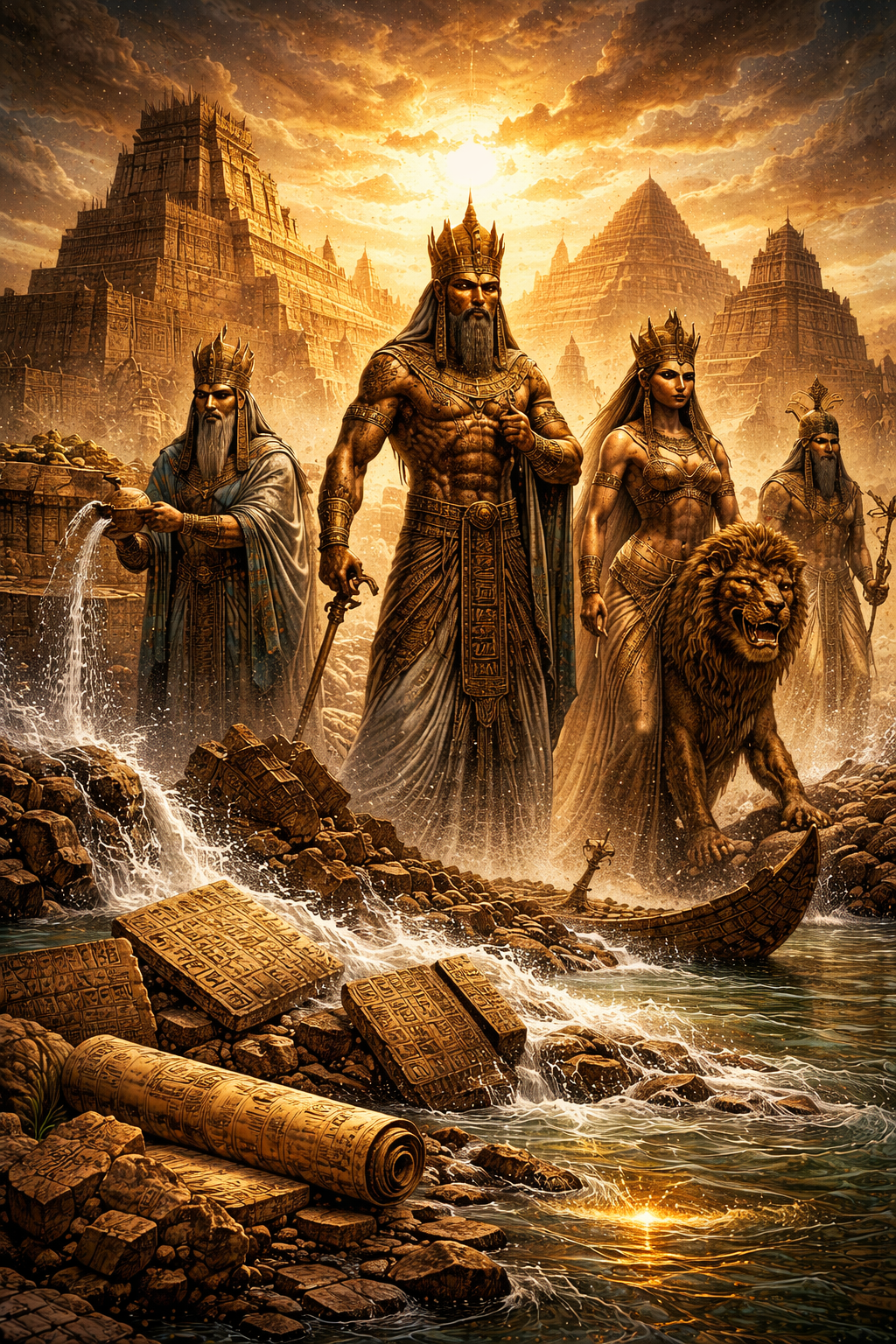
Any serious treatment of Mesopotamian mythology must therefore attend to transmission. These myths survive not as timeless abstractions but as cuneiform texts copied, excerpted, translated, adapted, catalogued, studied, and preserved in schools, temples, libraries, and palatial archives. The mythic archive is inseparable from the history of writing itself. To study Mesopotamian mythology is also to study clay tablets, stylus marks, scribal learning, bilingual culture, manuscript fragmentation, royal collecting, temple scholarship, and the modern reconstruction of ancient literature through Assyriology.
Mesopotamian mythology also matters because it preserves one of the most intellectually consequential religious imaginations in human history. It is a world of city gods and cosmic waters, of human labor under divine authority, of flood and survival, of descent and return, of erotic force and political danger, of kingship and divine unpredictability. Myths of Inanna, Ishtar, Enki/Ea, Enlil, Anu, Marduk, Ninhursag, Shamash, Ereshkigal, Tiamat, Atrahasis, Utnapishtim, Adapa, Etana, Dumuzi, and Gilgamesh illuminate not only the symbolic life of ancient Mesopotamia, but also broader questions of mortality, justice, civilization, ecological vulnerability, urban power, and the limits of human ambition.
This pillar approaches Mesopotamian mythology as a layered cultural system. It asks how creation becomes political theology, how city gods organize sacred geography, how flood stories remember ecological catastrophe, how underworld descent dramatizes death and return, how the Gilgamesh tradition confronts mortality, how divine gifts and the me imagine civilization, how scribal culture preserves and reshapes myth, and how later Near Eastern, Mediterranean, and biblical traditions received, transformed, or echoed Mesopotamian narrative forms.
Why This Field Matters
Mesopotamian mythology matters because it preserves some of the earliest surviving literary reflections on creation, mortality, kingship, catastrophe, divine plurality, human labor, urban civilization, and the fragile maintenance of order. The flood stories, the descent of Inanna/Ishtar, the quest of Gilgamesh, the creation drama of the Enūma Eliš, and myths of Enki, Marduk, Adapa, Etana, Atrahasis, and Dumuzi are not merely “early versions” of later stories. They are major works in their own right, embedded in one of the deepest surviving literary traditions in the world.
The field also matters because Mesopotamian mythology is inseparable from the rise of writing, cities, temples, law, kingship, administration, and organized scholarly transmission. Myth in this world belongs to the same broad civilization that produced cuneiform literacy, temple economies, royal inscriptions, omen scholarship, lexical lists, mathematical texts, legal codes, astronomical observation, and monumental urban life. The mythic archive is therefore not a decorative supplement to civilization. It is one of the ways civilization explained its own burdens.
Mesopotamian mythology is also important because it thinks ecological vulnerability with unusual force. Rivers, irrigation, marshes, drought, flood, storm, soil, walls, canals, and city foundations shape its symbolic imagination. Creation often begins with waters; catastrophe arrives as flood; sacred cities depend on water management; divine anger may undo human order; civilization is repeatedly imagined as labor under conditions of instability. Few ancient mythic traditions make the fragility of human settlement so visible.
Finally, this field matters because Mesopotamian mythology confronts mortality without easy consolation. Gilgamesh seeks immortality and fails to possess it. Inanna descends and cannot return without substitution. Atrahasis survives flood but not the larger human condition. Adapa receives wisdom but loses immortality. These myths preserve a powerful anthropology of limit: human beings may build cities, love friends, learn crafts, speak to gods, and preserve names in writing, yet they remain mortal and dependent within a cosmos they do not control.
The Problem of the Archive
A research-grade account must begin with the archive itself. Mesopotamian mythology does not survive in a single canonical book, theological handbook, or stable mythographic collection. It survives across clay tablets, fragments, school copies, palace libraries, temple collections, bilingual traditions, partial manuscripts, royal inscriptions, ritual texts, and later scholarly recensions. Modern readers encounter the archive through recovery, transliteration, translation, reconstruction, and comparison.
This means that Mesopotamian mythology must be read through textual plurality. A myth may survive in Sumerian and Akkadian forms; a story may be preserved in Old Babylonian, Assyrian, or later recensions; a composition may be fragmentary in one place and fuller in another; a text copied in first-millennium Assyria may preserve far older Babylonian or Sumerian traditions. The archive is continuous, but it is not simple.
The Epic of Gilgamesh offers the clearest example. The standardized Akkadian epic known from first-millennium manuscripts is built upon earlier Sumerian heroic traditions and Old Babylonian materials. The figure of Gilgamesh moves from heroic memory into literary meditation on kingship, friendship, grief, and death. What appears to modern readers as a single “epic” is actually the result of long scribal and literary development.
The same is true more broadly. Atrahasis, the Enūma Eliš, the myths of Inanna/Ishtar, and the flood tradition all survive through historical layers. Interpretation must therefore ask not only what a myth says, but when it is attested, in what language, in what manuscript tradition, in what institutional context, and with what theological or political emphasis.
Myth Without a Single Canon
Mesopotamian mythology is best approached as a plural and historically adaptive archive rather than as a single fixed canon. Sumerian, Akkadian, Babylonian, Assyrian, and later traditions share deities, motifs, stories, and symbolic structures, but they do not organize them in one final system. Divine names may shift across languages; local gods may rise in political importance; older myths may be reinterpreted under new imperial conditions; scribal schools may preserve materials no longer tied to their original cultic settings.
This plurality is not a sign of incoherence. It is one of the defining features of Mesopotamian mythic thought. Enki in Sumerian tradition and Ea in Akkadian tradition are related but mediated through different linguistic and theological registers. Inanna and Ishtar share major domains of love, war, sexuality, and power, yet their roles shift across texts and historical settings. Marduk’s prominence in the Enūma Eliš reflects Babylonian political theology as well as cosmological myth.
The absence of one canon also means that myth must be studied through genre. A hymn praises a deity differently from a narrative myth; a lament remembers city destruction differently from a royal inscription; a school tablet preserves literature differently from a ritual composition; a library collection organizes tradition differently from oral performance. Each medium changes the myth’s function.
Mesopotamian mythology therefore requires an interpretive method attentive to circulation. Stories move among temple, school, palace, library, and later museum. The mythic archive is not a fixed monument. It is a living scribal inheritance made durable through copying and transformation.
Sumerian and Akkadian Transmission
The relationship between Sumerian and Akkadian is central to the study of Mesopotamian mythology. Sumerian, a language isolate, became one of the great literary and scholarly languages of southern Mesopotamia. Akkadian, a Semitic language, became the dominant spoken and administrative language in many periods while also producing a rich literary tradition of its own. Mesopotamian mythic transmission therefore often occurs across languages.
Sumerian compositions preserve some of the richest early materials: narratives of Inanna, Enki, Ninmah, Dumuzi, Gilgamesh, Enkidu, city laments, hymns, and divine journeys. Akkadian compositions such as the Epic of Gilgamesh, Atrahasis, the Enūma Eliš, Adapa, Etana, and Anzu reshape mythic materials in new literary, theological, and political contexts. Translation here is not mechanical. It is transformation.
This linguistic layering matters because divine identity itself can be transformed through translation. Inanna becomes Ishtar; Enki becomes Ea; Utu becomes Shamash; Nanna becomes Sin. These equivalences are real, but not always simple. Each name carries local, linguistic, cultic, and literary histories. A deity’s meaning may change when brought into another language, genre, city, or imperial setting.
The Sumerian-Akkadian relationship also shows that ancient Mesopotamian culture preserved memory through learned bilingualism. Scribes copied, interpreted, and studied earlier materials, sometimes long after Sumerian had ceased to function as a spoken language in ordinary life. Myth survived because scribal education made ancient language itself a medium of cultural memory.
Cuneiform, Scribal Culture, and the Life of Texts
Mesopotamian mythology is inseparable from cuneiform culture. Clay tablets are not merely containers for mythic content. They are part of the historical meaning of the archive. Myths survived because scribes learned to copy signs, master languages, preserve compositions, excerpt passages, transmit variants, and collect texts in institutional settings.
Scribal schools were central to literary preservation. Students copied lexical lists, proverbs, model contracts, hymns, myths, and literary compositions. Mythic texts could therefore function as training in language, style, tradition, and cultural authority. The survival of a story may depend on its place within education as much as on its ritual or religious use.
Palace and temple libraries add another dimension. The library of Ashurbanipal at Nineveh preserves some of the most important witnesses to Mesopotamian literature, including tablets of the Epic of Gilgamesh. Such collections were not neutral repositories. They represented royal power, learned prestige, and the ambition to gather and preserve the inherited knowledge of the ancient world.
Modern Assyriology continues this chain of transmission under new conditions. Fragmentary tablets must be identified, joined, transliterated, translated, contextualized, and compared. The mythic archive therefore remains partly reconstructed. Its modern life depends on archaeological recovery, philological labor, museum stewardship, digital corpora, and scholarly caution.
Creation, Waters, and Cosmic Order
Mesopotamian creation myths frequently imagine beginnings through waters, differentiation, divine conflict, and the establishment of ordered space. Primordial waters are not merely physical. They represent generative possibility, danger, depth, and the unstable condition before organized cosmos. The Enūma Eliš gives one of the most famous expressions of this structure through Apsu, Tiamat, divine conflict, and Marduk’s establishment of cosmic order.
Creation in this tradition is often inseparable from sovereignty. The world is ordered when divine power is organized, enemies are defeated, roles are assigned, spaces are structured, and kingship among the gods is established. Cosmogony is therefore political theology. To narrate creation is also to narrate authority.
The Enūma Eliš is especially important because it elevates Marduk as king of the gods and gives Babylon a cosmic position within the mythic imagination. The defeat of Tiamat and the structuring of the world from her body dramatize creation as violent ordering. The cosmos is made from conflict; order is built from the defeat and transformation of primordial threat.
Yet Mesopotamian creation traditions are not limited to the Enūma Eliš. Myths of Enki, Ninmah, human creation, divine labor, and the distribution of powers offer other ways of thinking origins. The beginning of the world is not only a cosmic event. It is also the beginning of labor, cities, temples, roles, speech, and human dependency.
Gods, Cities, and Sacred Sovereignty
Mesopotamian deities are deeply tied to cities, temples, landscapes, and political order. Enlil belongs especially to Nippur; Enki/Ea to Eridu and the deep waters of wisdom; Inanna/Ishtar to Uruk and other cult centers; Marduk to Babylon; Ashur to Assyria; Shamash to Sippar and Larsa; Nanna/Sin to Ur and Harran. Mythic identity is often urban and cultic as well as theological.
This city-centered sacred geography is essential. Mesopotamian mythology is not only about cosmic gods in abstract space. It is about deities whose presence is anchored in temples, whose cult sustains cities, whose favor legitimates kings, and whose anger may destroy political order. The city is a mythic form.
Temple life is equally central. Temples were houses of gods, economic centers, ritual institutions, and symbolic centers of urban order. Myths of divine presence, offerings, festivals, sacred marriage, lament, and city destruction all depend on the idea that the god’s relationship to the city is existential. If a god abandons a city, catastrophe follows.
In this sense, Mesopotamian mythology preserves a religious imagination of civilization as dependent. Cities are magnificent, but not self-sufficient. Walls, canals, temples, and kingship endure only through fragile alignment with divine power and ecological order.
Human Beings, Labor, and the Burden of Civilization
One of the most striking features of Mesopotamian mythology is its treatment of human beings as laboring creatures. In several creation traditions, humans are created to relieve the gods of work, maintain cult, produce offerings, and sustain the ordered world. Human life is therefore dignified and burdened at once: humanity participates in civilization, but under conditions of dependency.
The Atrahasis epic is especially important here. It links divine labor, human creation, population, divine irritation, plague, famine, and flood. Human beings are necessary, but they also become troublesome to the divine order. The myth does not idealize human existence. It presents civilization as fragile, noisy, productive, and vulnerable to divine judgment.
Labor in Mesopotamian myth includes agriculture, irrigation, craft, building, temple service, kingship, writing, and social organization. Civilization is not imagined as effortless progress. It is work imposed within a cosmic hierarchy. The human condition is bound to fields, canals, bricks, offerings, and institutions.
This gives Mesopotamian mythology one of its deepest anthropological insights. Human beings seek fame, love, cities, friendship, and permanence, but they remain mortal laborers in a world structured by divine power, ecological risk, and political instability.
Flood, Catastrophe, and Survival
Flood narratives are among the most consequential strands of Mesopotamian mythology. The flood appears in Atrahasis and in Tablet XI of the Epic of Gilgamesh, where Utnapishtim tells Gilgamesh of catastrophe, divine decision, survival, and the limits of human destiny. These traditions reveal how Mesopotamian myth connects ecological danger, divine conflict, human vulnerability, and the precariousness of civilization.
The flood is not merely a natural disaster. It is mythic catastrophe: the undoing of settlement, the collapse of ordinary order, the overwhelming of human institutions by water. In a civilization dependent on rivers, irrigation, canals, and seasonal management, water is both life and threat. Flood myth gives symbolic form to this double condition.
In Atrahasis, the flood is part of a broader pattern of divine attempts to limit human disturbance. The story connects population, noise, plague, famine, divine frustration, and catastrophe. It asks why human life is vulnerable and how survival is possible under divine power. In Gilgamesh, the flood becomes part of the hero’s failed search for immortality. Utnapishtim survives, but his exceptional status only intensifies Gilgamesh’s recognition that he cannot escape death.
Flood memory therefore operates on several levels: ecological, theological, political, and existential. It remembers catastrophe while asking what survival means when mortality remains unavoidable.
Underworld Descent and the Logic of Death
Mesopotamian myths of descent preserve one of the ancient world’s most powerful symbolic accounts of death, return, and substitution. Inanna’s Descent to the Netherworld is central to this field. Inanna descends through gates, is stripped of powers, confronts Ereshkigal, dies or is rendered powerless, and returns only through substitution. The myth links sovereignty, sexuality, death, power, vulnerability, and the terrible cost of return.
The Mesopotamian underworld is not usually a place of blissful immortality. It is a shadowed realm of the dead, governed by its own order and powers. Descent into it is dangerous because it is not easily reversible. The living may cross thresholds, but return requires payment. The underworld has law.
Dumuzi’s role intensifies the mythic pattern. His substitution, mourning, seasonal absence, and relation to Inanna connect death to fertility, erotic bond, social lament, and cyclical loss. Return is never simple restoration. It is structured by exchange, mourning, and periodic absence.
Descent myths therefore reveal a central Mesopotamian intuition: death is a domain of power, not merely negation. It has rulers, gates, rules, messengers, substitutions, and ritual consequences. Myth makes death narratable, but not easily overcome.
Gilgamesh, Heroic Memory, and the Problem of Mortality
The Gilgamesh tradition stands at the center of Mesopotamian mythology because it gives literary form to kingship, friendship, fame, grief, heroic excess, and the impossibility of escaping death. Gilgamesh begins as a powerful but oppressive king; Enkidu becomes his companion and moral counterpart; their friendship redirects heroic energy outward; Enkidu’s death forces Gilgamesh into a crisis that no victory can solve.
The epic is one of the world’s great meditations on mortality. Gilgamesh seeks Utnapishtim in search of life beyond death, but his quest ends in recognition rather than possession. He cannot become immortal. He returns to Uruk, where the city walls become the visible sign of human achievement under mortal limits. Civilization replaces immortality, but it does not erase grief.
Enkidu is crucial because he humanizes heroic power. His movement from wildness to civilization, from animal companionship to friendship with Gilgamesh, gives the epic a profound anthropology. He embodies the cost and gift of becoming human: desire, speech, food, clothing, social relation, friendship, and death.
The Gilgamesh tradition therefore preserves a complex vision of human greatness. To be human is to build, love, grieve, seek, fail, and remember. The epic does not promise immortality, but it does preserve the name.
Civilization, Craft, and Divine Gifts
Mesopotamian mythology repeatedly asks how civilization is constituted. Myths of Enki, Inanna, Ninmah, the me, craft, writing, kingship, sexuality, law, music, lament, and temple service all show civilization as a collection of divine gifts, powers, offices, skills, and dangerous capacities. Culture is not simply human invention. It is mythically distributed and contested.
Inanna and Enki is especially important because it presents the transfer of the me, the powers or offices associated with civilization. These include institutions, arts, crafts, powers, and social forms. The myth imagines civilization as a set of charged capacities that can be moved, desired, acquired, and politically reorganized.
Enki and Ninmah offers another major reflection on creation, human dependency, bodily difference, labor, and divine responsibility. It asks what kind of beings humans are and how social roles are assigned. The myth’s attention to disability, weakness, and function complicates simple accounts of human creation.
Enki/Ea is central because he often appears as a figure of wisdom, water, craft, trickery, and ambiguous help. He assists humanity in flood narratives, gives counsel, participates in creation, and mediates dangerous divine structures. Civilization in these myths is dependent on cunning as well as order.
Gender, Desire, and Divine Ambiguity
Figures such as Inanna/Ishtar stand at the center of love, war, sexuality, kingship, desire, violence, beauty, and political force. Mesopotamian myth does not separate erotic power from danger or fertility from conflict. Divine femininity can be generative, seductive, sovereign, destructive, protective, and destabilizing at once.
Inanna’s mythic role is unusually expansive. She descends to the underworld, acquires the me, participates in sacred kingship, appears in love poetry, threatens enemies, and embodies both erotic and martial force. Ishtar in the Epic of Gilgamesh is rejected by the hero, and the result is catastrophic: the Bull of Heaven episode reveals how desire, insult, divine anger, and heroic violence interact.
Dumuzi’s relation to Inanna opens another field: love, marriage, lamentation, seasonal absence, substitution, and death. Gendered power in Mesopotamian myth is therefore not reducible to domestic roles. It is cosmic, political, erotic, and funerary.
These myths are important because they reveal divine ambiguity. The gods are powerful, but not always stable; desirable, but dangerous; protective, but unpredictable. Mesopotamian mythology preserves a world in which desire itself can become a force of political and cosmic consequence.
Kingship, Empire, and Political Theology
Mesopotamian mythology is deeply concerned with kingship. Kings build temples, defend cities, receive divine favor, maintain order, wage war, issue justice, and seek lasting fame. Yet kingship is also fragile. Cities fall, gods withdraw, enemies invade, floods destroy, and rulers die. Myth gives political authority sacred meaning while reminding readers of its vulnerability.
The Enūma Eliš offers one of the clearest examples of political theology. Marduk’s victory over Tiamat establishes cosmic order and divine kingship, while also reflecting Babylon’s elevated theological status. Creation myth becomes a way of imagining political supremacy. The rise of a city and the rise of its god become mutually reinforcing.
Gilgamesh presents another model. He is heroic, royal, excessive, corrective, grieving, and ultimately mortal. His kingship is judged not simply by strength but by the city he builds and the wisdom he gains through loss. The epic turns kingship into existential reflection.
Royal inscriptions, laments, and city myths further reveal that political order depends on divine presence. When gods abandon cities, destruction follows. When kings restore temples, they restore cosmic and civic relation. Mesopotamian political theology is therefore urban, ritual, and deeply vulnerable to catastrophe.
Sacred Geography, Ecology, and Urban Life
Mesopotamian mythology is inseparable from geography and ecology. The Tigris and Euphrates, marshlands, irrigation systems, canals, deserts, city walls, temple platforms, sacred cities, and cultivated fields all shape the mythic imagination. This is a mythology of riverine civilization, where order must be engineered, ritually maintained, and defended against flood, drought, invasion, and divine abandonment.
Cities such as Uruk, Eridu, Nippur, Babylon, Ur, and Nineveh are not merely political sites. They are mythic places. Uruk is central to Gilgamesh and Inanna/Ishtar; Eridu is linked to Enki/Ea and primordial wisdom; Nippur is associated with Enlil and sacred authority; Babylon becomes cosmically central through Marduk; Ur carries major lunar associations; Nineveh preserves texts through imperial collecting.
The sacred city is one of Mesopotamian mythology’s defining forms. It is the place where temples house gods, scribes preserve tradition, kings claim legitimacy, festivals renew order, and walls mark the boundary between civilization and danger. The city is both achievement and exposure.
This geography also makes Mesopotamian myth ecological. Water is never neutral. It is life, labor, threat, abundance, flood, canal, deep wisdom, and primordial force. To study Mesopotamian mythology is to study how a civilization imagined survival in a landscape where human order depended on fragile environmental management.
Magic, Omens, and Effective Speech
Mesopotamian religion and mythology are closely connected to divination, incantation, omen interpretation, ritual speech, and protective practices. The gods communicate through signs; specialists interpret celestial, terrestrial, bodily, and ritual phenomena; incantations address demons, illness, danger, impurity, and divine anger. Myth belongs to a broader world in which knowledge and speech have practical force.
Effective speech is central. Hymns praise; laments mourn cities and gods; incantations protect; royal inscriptions monumentalize power; ritual words participate in restoring order. Mesopotamian mythic culture is therefore deeply verbal and scribal. Words are not merely records of belief. They are instruments of relation with divine and dangerous powers.
Omen literature also matters because it reveals a world in which events are legible. The cosmos is filled with signs, but those signs require learned interpretation. The scribe, diviner, exorcist, and scholar occupy crucial positions in the mediation between human communities and divine intention.
Magic and divination should not be treated as marginal to mythology. They show how mythic assumptions became practice: the world is populated by gods, demons, warnings, patterns, dangers, and hidden meanings. Knowledge is survival.
Reception, Comparison, and Long Afterlives
Mesopotamian mythology did not vanish with the decline of cuneiform literacy. Its motifs and structures continued to reverberate through later Near Eastern, Mediterranean, and biblical traditions, especially in relation to flood narrative, primeval history, divine council imagery, heroic striving, cosmic waters, city destruction, and the relation between mortality and wisdom. These afterlives require careful comparison rather than simplistic borrowing claims.
The flood traditions are the best-known example. Mesopotamian flood stories and later biblical flood traditions share striking narrative structures, but they belong to distinct theological worlds. Comparative study is valuable precisely when it preserves both relation and difference. Mesopotamian texts should not be treated merely as background to later traditions; they deserve interpretation on their own terms.
Modern reception has also transformed the field. The rediscovery and translation of cuneiform texts changed modern understanding of ancient literature, biblical studies, comparative mythology, and world literary history. Gilgamesh, once lost to most later readers, has become a central work in global literature.
The long afterlife of Mesopotamian mythology therefore includes ancient textual transmission, later cultural echoes, archaeological rediscovery, museum collections, scholarly reconstruction, modern translations, and contemporary literary adaptation. Myth survives not only because it was ancient, but because it continues to be read, translated, debated, and reimagined.
Major Questions of Interpretation
This pillar is organized around several major questions. How should Mesopotamian mythology be studied when its archive is distributed across Sumerian and Akkadian texts, scribal schools, palace libraries, temple traditions, royal inscriptions, laments, rituals, and fragmentary cuneiform tablets? What does it mean to study mythology without a single canon? How do creation myths, city gods, flood stories, descent narratives, and heroic quests preserve different kinds of cultural memory?
The pillar also asks how writing itself shapes myth. How does cuneiform transmission change the relation between myth, memory, and authority? How do Sumerian and Akkadian traditions preserve continuity while transforming divine identities and narrative structures? How do myths reflect riverine ecology, irrigation, urban fragility, divine sovereignty, and the burden of human labor?
These questions keep the category from becoming a simple catalogue of gods and stories. They open Mesopotamian mythology as a field of textual, religious, ecological, urban, political, scribal, heroic, and comparative inquiry. The tradition is not only a collection of ancient narratives. It is one of the earliest surviving symbolic systems through which human beings imagined civilization under the pressure of water, death, work, divine power, and time.
Expanded Article Architecture
The following structure gathers the pillar into a long-range architecture suitable for a major mythology knowledge series. It is designed to support foundational source studies, Sumerian and Akkadian transmission, cuneiform literacy, cosmogony, flood narratives, underworld descent, heroic legend, sacred geography, divine plurality, city religion, political theology, ecological interpretation, and later afterlives. All entries below should be treated as planned unless already completed elsewhere on the site.
Foundations and Source Problems
- What Is Mesopotamian Mythology? (planned)
- The Problem of Sources in Mesopotamian Mythology (planned)
- Mesopotamian Mythology Without a Single Canon (planned)
- Text, Ritual, City, and Tablet in Mesopotamian Mythic Memory (planned)
- How to Read Mesopotamian Myth Across Languages and Periods (planned)
- Myth, Religion, Kingship, and Cultural Memory in the Ancient Near East (planned)
Cuneiform and Scribal Transmission
- Cuneiform, Scribal Culture, and the Survival of Myth (planned)
- Sumerian and Akkadian Myth: Continuity, Translation, and Change (planned)
- Temples, Libraries, and the Tablet Archive of the Ancient Near East (planned)
- Scribal Schools and the Literary Preservation of Myth (planned)
- Fragment, Recension, and Reconstruction in Mesopotamian Mythology (planned)
- Ashurbanipal’s Library and the Imperial Collection of Ancient Knowledge (planned)
- Clay Tablets, Museum Collections, and the Modern Recovery of Myth (planned)
Creation, Primordial Waters, and Cosmic Order
- Creation, Waters, and the First Orders of the Cosmos (planned)
- Apsu, Tiamat, and the Primordial Deep (planned)
- The Enūma Eliš and the Political Theology of Creation (planned)
- Marduk, Kingship, and the Ordering of the World (planned)
- Cosmic Conflict and the Establishment of Divine Rule (planned)
- Creation from Conflict in Mesopotamian Myth (planned)
- The Deep, the Waters, and the Symbolic Ecology of Beginnings (planned)
Human Beings, Labor, and Civilization
- Human Beings, Labor, and the Burden of Civilization in Mesopotamian Myth (planned)
- Human Creation and Divine Work in Atrahasis (planned)
- Enki and Ninmah: Creation, Disability, and Human Dependency (planned)
- Civilization as Divine Gift and Human Burden (planned)
- Noise, Labor, Population, and Divine Irritation in Mesopotamian Myth (planned)
- Why Humanity Was Created in Mesopotamian Mythology (planned)
- Agriculture, Irrigation, and the Work of Ordered Life (planned)
Divine Order, Major Gods, and Sacred Power
- Anu, Enlil, and the Architecture of Divine Rule (planned)
- Enki/Ea: Wisdom, Water, Craft, and the Ambiguity of Help (planned)
- Inanna/Ishtar: Love, War, and the Politics of Divine Power (planned)
- Ninhursag, Birth, and the Maternal Divine (planned)
- Shamash, Justice, and Solar Authority (planned)
- Ereshkigal and the Sovereignty of the Netherworld (planned)
- Sin/Nanna, Lunar Time, and the Sacred Calendar (planned)
- Nergal, Plague, War, and Underworld Power (planned)
Divine Gifts, Craft, and the Powers of Civilization
- Inanna and Enki: Civilization, Power, and the Transfer of the me (planned)
- The me and the Mythic Structure of Social Order (planned)
- Wisdom, Craft, and Divine Technology in Mesopotamian Myth (planned)
- Writing, Lament, Music, and the Sacred Arts of Civilization (planned)
- Sexuality, Kingship, and Ritual Power in the Gift of Culture (planned)
- How Mesopotamian Myth Imagined the Origins of Institutions (planned)
Flood, Catastrophe, and Survival
- The Atrahasis Epic and the Meaning of Catastrophe (planned)
- Flood Narratives in Mesopotamian Tradition (planned)
- Utnapishtim and the Flood in Tablet XI (planned)
- Divine Anger, Ecological Danger, and the Fragility of Civilization (planned)
- Flood, Survival, and the Limits of Human Destiny (planned)
- Mesopotamian Flood Memory and Later Near Eastern Traditions (planned)
- Water as Life and Threat in Mesopotamian Mythology (planned)
Underworld, Descent, and Mortality
- Inanna’s Descent to the Netherworld (planned)
- Ishtar’s Descent and Akkadian Underworld Tradition (planned)
- Dumuzi, Loss, and the Seasonal Imagination of Absence (planned)
- The Underworld in Mesopotamian Myth and Ritual Thought (planned)
- Ereshkigal, Gates, and the Law of the Dead (planned)
- Substitution, Return, and the Cost of Crossing Death (planned)
- Lamentation and the Ritual Memory of Loss (planned)
Gilgamesh, Heroic Legend, and Mortal Limit
- Gilgamesh Before the Epic: Sumerian Narratives and Heroic Memory (planned)
- The Epic of Gilgamesh and the Search for Immortality (planned)
- Enkidu, Friendship, and the Humanizing of Heroic Power (planned)
- Ishtar, Rejection, and the Bull of Heaven (planned)
- Gilgamesh, Grief, and the Failure to Escape Death (planned)
- Uruk’s Walls and the Meaning of Human Achievement (planned)
- Heroism, Kingship, and Mortal Wisdom in Gilgamesh (planned)
- Gilgamesh, Enkidu and the Netherworld (planned)
Wisdom, Ascent, and Lost Immortality
- Adapa, Wisdom, and the Loss of Immortality (planned)
- Etana, Kingship, and the Ascent to Heaven (planned)
- Anzu, Divine Theft, and the Crisis of Authority (planned)
- Wisdom Without Immortality in Mesopotamian Myth (planned)
- Heavenly Ascent and the Limits of Royal Ambition (planned)
- Divine Secrets, Human Error, and Mythic Knowledge (planned)
Sacred Cities and Mythic Geography
- Sacred Cities, Patron Gods, and Mesopotamian Mythic Geography (planned)
- Babylon, Uruk, Eridu, and Nippur in Mythic Memory (planned)
- Temple Worlds, Cult, and the Presence of the Gods (planned)
- Ur, Nineveh, Sippar, and the Sacred Geography of Divine Power (planned)
- Walls, Canals, Temples, and the Mythic Structure of Urban Life (planned)
- City Gods and the Religious Imagination of Place (planned)
- Divine Abandonment and the Mythic Fear of City Destruction (planned)
Laments, Ruin, and Political Memory
- Laments, Ruin, and the Mythic Language of City Destruction (planned)
- The Lament for Ur and the Theology of Catastrophe (planned)
- Divine Withdrawal and the Collapse of Civic Order (planned)
- War, Invasion, and the Mythic Memory of Ruined Cities (planned)
- Ritual Lamentation and the Reconstitution of Community (planned)
- How Mesopotamian Literature Remembered Political Disaster (planned)
Animals, Hybrids, Storms, and Symbolic Beings
- Animals, Hybrids, and Symbolic Beings in Mesopotamian Myth (planned)
- Serpents, Storms, and the Ecology of Divine Danger (planned)
- The Bull of Heaven and the Politics of Divine Violence (planned)
- Scorpion-Beings, Monsters, and the Boundary of the Known World (planned)
- Lions, Bulls, Dragons, and the Iconography of Power (planned)
- Hybrid Beings and Protective Imagery in Mesopotamian Religion (planned)
Magic, Omens, and Effective Words
- Magic, Incantation, and the Effective Word in Mesopotamian Religion (planned)
- Omen Literature and the Mythic Logic of Signs (planned)
- Dreams, Divination, and Divine Communication (planned)
- Demons, Illness, and Protective Ritual in Mesopotamian Thought (planned)
- Laments, Hymns, and the Power of Ritual Speech (planned)
- Scribes, Exorcists, and the Scholarly Mediation of Divine Knowledge (planned)
Empire, Theology, and Political Adaptation
- Empire, Theology, and Political Adaptation in Mesopotamian Myth (planned)
- Babylon and the Elevation of Marduk (planned)
- Assyria, Ashur, and Imperial Reinterpretation of Divine Rule (planned)
- Royal Inscriptions and the Mythic Language of Conquest (planned)
- City, Empire, and the Reorganization of Sacred Memory (planned)
- Political Theology from Sumer to Babylon and Assyria (planned)
Reception, Comparison, and Afterlives
- Mesopotamian Mythology in Comparative Perspective (planned)
- Mesopotamian Myth and Biblical Afterlives (planned)
- Flood Traditions from Mesopotamia to Later Near Eastern Memory (planned)
- Gilgamesh in Modern World Literature (planned)
- Cuneiform Rediscovery and the Modern Reinvention of Mesopotamian Myth (planned)
- Why Mesopotamian Mythology Still Matters (planned)
- Ancient Near Eastern Myth in Museums, Translation, and Popular Culture (planned)
Closing Perspective
Mesopotamian mythology reveals one of the great long-duration symbolic archives of world culture. It preserves creation from waters, divine conflict, city-centered sacred power, human labor, flood catastrophe, underworld descent, heroic grief, lost immortality, divine gifts, scribal transmission, and the fragile maintenance of civilization. Its power lies not in a single fixed canon, but in a layered continuity of tablet, school, temple, city, library, translation, and rediscovery.
This is what makes the category so important within Mythology. Mesopotamian mythic culture shows how mythology can be literary and ritual, urban and ecological, Sumerian and Akkadian, royal and scribal, catastrophic and reflective, ancient and newly recovered. It also shows why mythology must be studied through writing, material transmission, sacred geography, institutional life, and environmental vulnerability, not only through story summary.
The strongest reason to study this field is that Mesopotamian mythology clarifies how early human civilizations imagined the burden of living inside fragile order. These traditions do not belong only to the ancient past. They continue to shape how later cultures think about flood, mortality, writing, kingship, labor, cities, divine power, ecological danger, and the longing to leave a name behind when life itself cannot be made permanent.
Related Reading
- Mythology
- Egyptian Mythology
- Greek and Roman Mythology
- Arabian and Levantine Myth, Folklore, and Sacred Narrative
- Comparative Sacred Themes
- Foundations of Religion
- Religion and Society
- Religion and Ecology
Primary Sources
Sumerian Literary Texts
- Electronic Text Corpus of Sumerian Literature (ETCSL). A major open corpus of Sumerian literary texts with transliterations, English prose translations, and bibliographic information: https://etcsl.orinst.ox.ac.uk/
- Gilgamesh, Enkidu and the Netherworld. ETCSL translation: https://etcsl.orinst.ox.ac.uk/section1/tr1814.htm
- Inanna’s Descent to the Netherworld, Inanna and Enki, Enki and Ninmah, and related compositions are available through ETCSL’s Sumerian literary catalogues and translations: https://etcsl.orinst.ox.ac.uk/
- ETCSL consolidated bibliography of Sumerian literature. Useful for locating scholarship on Sumerian mythic compositions and their transmission: https://etcsl.orinst.ox.ac.uk/bibliography.htm
Akkadian and Babylonian Mythic Texts
- Epic of Gilgamesh, Tablet VI. British Museum tablet record K.231, preserving the Ishtar and Bull of Heaven episode: https://www.britishmuseum.org/collection/object/W_K-231
- Epic of Gilgamesh, Tablet XI, the Flood Tablet. British Museum object K.3375: https://www.britishmuseum.org/collection/object/W_K-3375
- Atrahasis flood tradition. British Museum object 78943, part of the Babylonian flood story: https://www.britishmuseum.org/collection/object/W_1889-0426-236
- Copy of the Atrahasis myth in Neo-Assyrian context. British Museum object DT.42: https://www.britishmuseum.org/collection/object/W_DT-42
Research Platforms and Text Environments
- ORACC, Open Richly Annotated Cuneiform Corpus. A major research environment for cuneiform texts, transliterations, translations, annotations, and corpora across Mesopotamian textual traditions: https://oracc.museum.upenn.edu/
- CDLI, Cuneiform Digital Library Initiative. A major digital resource for cuneiform tablets, metadata, images, editions, and archaeological manuscript context: https://cdli.ucla.edu/
- British Museum collection database. Useful for object-level access to tablets central to the Gilgamesh and flood traditions: https://www.britishmuseum.org/collection
Further Reading
- Electronic Text Corpus of Sumerian Literature (n.d.) ETCSL. Essential for open access to Sumerian literary compositions in transliteration and translation. https://etcsl.orinst.ox.ac.uk/
- ORACC (n.d.) Open Richly Annotated Cuneiform Corpus. Valuable for transliteration, translation, annotation, and broader cuneiform textual environments. https://oracc.museum.upenn.edu/
- CDLI (n.d.) Cuneiform Digital Library Initiative. Useful for the archaeological, object, and manuscript context of tablets central to mythic transmission. https://cdli.ucla.edu/
- British Museum (n.d.) collection records for Gilgamesh and flood tablets. Useful for object-level access to major mythic witnesses. https://www.britishmuseum.org/collection
- George, A.R. (2003) The Babylonian Gilgamesh Epic: Introduction, Critical Edition and Cuneiform Texts. Oxford: Oxford University Press.
- George, A.R. (1999) The Epic of Gilgamesh: A New Translation. London: Penguin Classics.
- Dalley, S. (2000) Myths from Mesopotamia: Creation, the Flood, Gilgamesh, and Others, revised edn. Oxford: Oxford University Press.
- Jacobsen, T. (1976) The Treasures of Darkness: A History of Mesopotamian Religion. New Haven, CT: Yale University Press.
- Black, J. and Green, A. (1992) Gods, Demons and Symbols of Ancient Mesopotamia: An Illustrated Dictionary. London: British Museum Press.
- Foster, B.R. (2005) Before the Muses: An Anthology of Akkadian Literature, 3rd edn. Bethesda, MD: CDL Press.
- Lambert, W.G. (2013) Babylonian Creation Myths. Winona Lake, IN: Eisenbrauns.
- Abusch, T. (2015) The Magical Ceremony Maqlû: A Critical Edition. Leiden: Brill.
- Bottéro, J. (2001) Religion in Ancient Mesopotamia. Chicago: University of Chicago Press.
- Van De Mieroop, M. (2016) A History of the Ancient Near East ca. 3000–323 BC, 3rd edn. Malden, MA: Wiley Blackwell.
- Hallo, W.W. and Younger, K.L. (eds.) (1997–2002) The Context of Scripture. Leiden: Brill.
References
- Abusch, T. (2015) The Magical Ceremony Maqlû: A Critical Edition. Leiden: Brill.
- Black, J. and Green, A. (1992) Gods, Demons and Symbols of Ancient Mesopotamia: An Illustrated Dictionary. London: British Museum Press.
- Bottéro, J. (2001) Religion in Ancient Mesopotamia. Chicago: University of Chicago Press.
- British Museum (n.d.) ‘Tablet K.231’. Available at: https://www.britishmuseum.org/collection/object/W_K-231
- British Museum (n.d.) ‘Tablet K.3375’. Available at: https://www.britishmuseum.org/collection/object/W_K-3375
- British Museum (n.d.) ‘Tablet 78943’. Available at: https://www.britishmuseum.org/collection/object/W_1889-0426-236
- British Museum (n.d.) ‘Tablet DT.42’. Available at: https://www.britishmuseum.org/collection/object/W_DT-42
- CDLI (n.d.) ‘Cuneiform Digital Library Initiative’. Available at: https://cdli.ucla.edu/
- Dalley, S. (2000) Myths from Mesopotamia: Creation, the Flood, Gilgamesh, and Others, revised edn. Oxford: Oxford University Press.
- Electronic Text Corpus of Sumerian Literature (n.d.) ‘ETCSL’. Available at: https://etcsl.orinst.ox.ac.uk/
- Electronic Text Corpus of Sumerian Literature (n.d.) ‘Gilgamesh, Enkidu and the nether world: translation’. Available at: https://etcsl.orinst.ox.ac.uk/section1/tr1814.htm
- Electronic Text Corpus of Sumerian Literature (n.d.) ‘Consolidated bibliography of Sumerian literature’. Available at: https://etcsl.orinst.ox.ac.uk/bibliography.htm
- Foster, B.R. (2005) Before the Muses: An Anthology of Akkadian Literature, 3rd edn. Bethesda, MD: CDL Press.
- George, A.R. (1999) The Epic of Gilgamesh: A New Translation. London: Penguin Classics.
- George, A.R. (2003) The Babylonian Gilgamesh Epic: Introduction, Critical Edition and Cuneiform Texts. Oxford: Oxford University Press.
- Hallo, W.W. and Younger, K.L. (eds.) (1997–2002) The Context of Scripture. Leiden: Brill.
- Jacobsen, T. (1976) The Treasures of Darkness: A History of Mesopotamian Religion. New Haven, CT: Yale University Press.
- Lambert, W.G. (2013) Babylonian Creation Myths. Winona Lake, IN: Eisenbrauns.
- ORACC (n.d.) ‘Open Richly Annotated Cuneiform Corpus’. Available at: https://oracc.museum.upenn.edu/
- Van De Mieroop, M. (2016) A History of the Ancient Near East ca. 3000–323 BC, 3rd edn. Malden, MA: Wiley Blackwell.