
Last Updated April 4, 2026
Norse mythology constitutes one of the major mythic archives of medieval northern Europe, preserving a narrative world in which cosmogony, divine conflict, heroic memory, sacred speech, fate, kingship, monstrous alterity, and apocalyptic imagination converge. The archive is not preserved in a single canonical scripture. Instead, it survives across Eddic poetry, Snorri Sturluson’s mythographic and poetic handbook, skaldic verse, fornaldarsögur, kings’ sagas, legendary prose, place-memory, and the manuscript cultures that transmitted Old Norse literature into the Christian Middle Ages. Norse myth is therefore best understood not as a fixed pagan system preserved intact from pre-Christian antiquity, but as a layered literary and cultural archive in which oral tradition, poetic form, antiquarian memory, and medieval textualization interact.
The principal textual witnesses are the poems of the Poetic Edda, especially those preserved in the Codex Regius of the Poetic Edda, and Snorri Sturluson’s Prose Edda, composed in the thirteenth century as a handbook for skaldic poetry that also preserves extensive mythological narrative. These works are supplemented by saga literature, skaldic poems, Saxo Grammaticus’ Gesta Danorum, and scattered references in chronicles, law codes, place-names, and archaeological interpretation. The result is a field that requires reconstruction rather than simple inheritance. Norse mythology survives through medieval Christian manuscripts that preserve older mythic materials while also reshaping them through literary framing, euhemerism, learned prose, and the priorities of later textual culture.
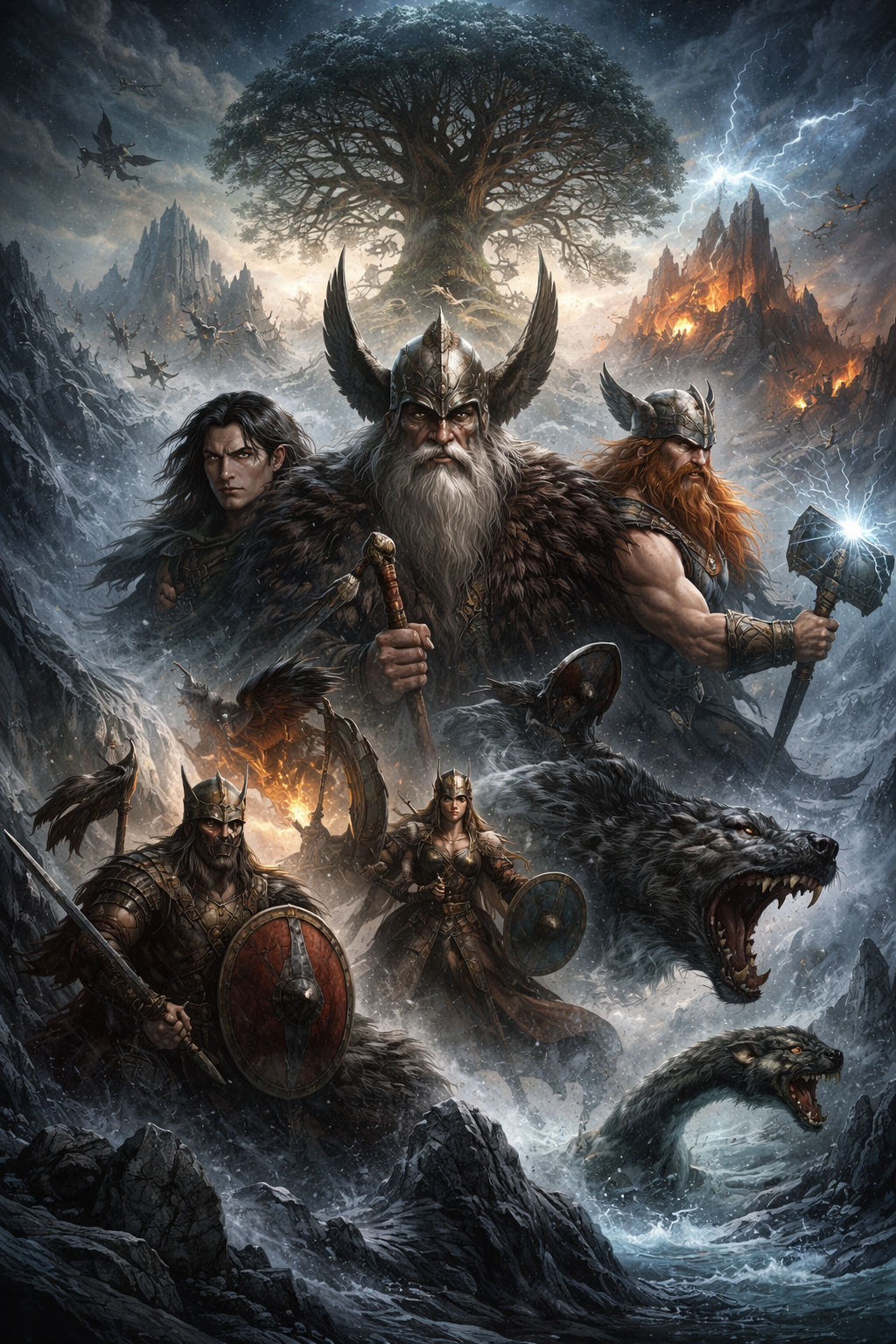
Any serious treatment of the subject must therefore attend to transmission. The surviving texts are not transparent windows onto pre-Christian Scandinavian belief. They are medieval witnesses, copied and preserved in manuscript cultures that were already Christian, literate, and historically self-aware. Yet these same texts remain indispensable. Without them, the stories of Odin, Thor, Loki, Baldr, Freyja, Yggdrasil, Ragnarök, and the heroic cycles of the Volsungs would survive only in fragments. The field thus belongs as much to manuscript studies, literary history, and the history of religion as to mythology in any narrow sense.
Norse mythology also matters because of its extraordinary symbolic density. It preserves one of the most powerful mythic visions of cosmic fragility in world literature: a world made from violence, structured by oath and doom, inhabited by gods who know that destruction is coming, and framed by a deep concern with wisdom, memory, reciprocity, honor, and inevitable loss. The myths therefore illuminate not only Scandinavian religious imagination, but also medieval northern ideas of order, law, kinship, landscape, fate, and the limits of power.
Scope and Orientation
Norse mythology is best approached as an interconnected archive rather than as a closed list of gods and stories. The subject includes cosmogony, divine genealogy, wisdom poetry, apocalyptic vision, heroic legend, ritual memory, kingship, monster lore, fate, burial and afterlife imagery, sacred trees and animals, mythic geography, and the long afterlives of northern myth in literature, art, nationalism, fantasy, and modern media. Such breadth is necessary because Old Norse myth survives across genres rather than within a single scriptural canon.
The field also requires methodological caution. The major witnesses to Norse mythology were written down in medieval Iceland, often centuries after Scandinavia’s conversion to Christianity. The archive is therefore mediated, literary, and retrospective. The Poetic Edda preserves mythological and heroic poems in verse, while Snorri’s Prose Edda organizes myth in prose partly to explain skaldic diction. Neither can be treated as a simple transcript of pagan belief. At the same time, both are indispensable sources for reconstructing the symbolic and narrative worlds of pre-Christian Scandinavia.
The surviving archive is also plural. Norse mythology is not reducible to a single “Viking religion,” still less to a later romantic stereotype of it. Icelandic, Norwegian, Danish, and broader Scandinavian materials overlap without collapsing into uniformity. The legendary traditions preserved in saga literature, the mythographic ordering of Snorri, the poetic density of Eddic verse, and the learned adaptation of northern materials in Latin authors such as Saxo all represent different modes of preserving and reshaping mythic memory.
Material culture matters as well. Mythic imagination appears not only in literary texts but in picture stones, carvings, jewelry, burial contexts, and the visual language of the Viking world. The evidence is often indirect, but it helps situate myth within a broader culture of symbols and sacred power. The world of Odin, Thor, Freyr, and other figures was also a world of ships, animals, weapons, feasting halls, law assemblies, poetry, and harsh environmental conditions. Myth in this sense belongs to social life as well as to literary tradition.
Finally, Norse mythology remains culturally powerful because it preserves a mythic world at once heroic and tragic. It is a world ordered by law and threatened by chaos, enriched by wisdom and shadowed by doom, animated by wit and violence, and haunted by the knowledge that even the gods are not permanent. Few mythic archives hold together cosmology, heroism, fatalism, and symbolic intensity with comparable force.
Major Lines of Inquiry
Cosmogony and the shaping of the world. Norse myth begins with elemental contrast, primordial emptiness, and the violent making of the world from the body of the giant Ymir. Creation is not peaceful emergence but ordered structure wrested from primal force.
The gods and the instability of order. Odin, Thor, Frigg, Freyja, Baldr, Tyr, Heimdall, and others occupy a divine world marked by rivalry, wisdom, oath, desire, and fragile equilibrium. Divine order is real, but never secure.
Poetry, wisdom, and sacred speech. Norse mythology is inseparable from verse. Wisdom contests, prophetic speech, skaldic diction, and mythic memory all point to the extraordinary cultural status of poetry as a medium of knowledge and power.
Loki, trickery, and the logic of disruption. Loki occupies a destabilizing position within the mythic order, moving between usefulness and catastrophe, wit and betrayal, intimacy and threat. He is central to understanding how Norse myth imagines disorder from within.
Fate, prophecy, and Ragnarök. Few mythological systems are as preoccupied with foreknowledge and doom. The gods act under the shadow of prophecy, and the apocalypse of Ragnarök gives Norse myth its distinctive tragic horizon.
Giants, dwarfs, elves, and monstrous beings. Norse myth includes a vast ecology of nonhuman presences. Jötnar, dwarfs, valkyries, wolves, serpents, and other beings complicate any simple division between order and chaos.
Heroic legend and mythic memory. The Volsung cycle, the Nibelung material, and other heroic traditions reveal the overlap between myth, legend, and cultural memory. They also connect the divine world to histories of kinship, violence, oath, and ruin.
Manuscripts, memory, and medieval preservation. The study of Norse mythology is inseparable from the manuscript tradition. Codex Regius, Codex Wormianus, and the wider Arnamagnæan collection are not just containers of myth but historical conditions of its survival.
Landscape, law, and sacred imagination. Norse myth emerges from a world of assemblies, halls, seas, winters, voyages, and exposed landscapes. Sacred imagination is deeply tied to place, ecology, movement, and social order.
Reception and reinvention. Norse mythology has had a long afterlife in antiquarianism, nationalism, Wagnerian opera, modern fantasy, popular media, and political misuse. A serious treatment must distinguish the medieval archive from its later appropriations.
Articles in This Series
- What Is Norse Mythology?
- The Problem of Sources in Norse Mythology
- The Poetic Edda and the Survival of Mythic Verse
- Codex Regius and the Manuscript Life of Eddic Poetry
- Snorri Sturluson’s Prose Edda and the Mythographic Ordering of the North
- Saxo Grammaticus and the Latin Recasting of Northern Myth
- Manuscripts, Memory, and the Arnamagnæan Archive
- Ginnungagap, Ymir, and the Origins of the Cosmos
- Odin, Vili, and Vé: World-Making and Divine Order
- Ask and Embla: Human Origins in Norse Myth
- Yggdrasil and the Structure of the Nine Worlds
- The Well of Urd, the Norns, and the Logic of Fate
- Odin: Kingship, Wisdom, Sacrifice, and Poetic Power
- Thor: Protection, Force, and the Defense of Order
- Frigg, Freyja, and the Power of Female Divinity
- Tyr, Heimdall, and the Edges of the Divine Order
- Baldr, Loss, and the Fragility of the Gods
- Loki and the Mythic Logic of Disruption
- The Mead of Poetry and the Sacred Status of Verse
- Runes, Knowledge, and the Symbolic Force of Writing
- Wisdom Contests, Prophecy, and Mythic Speech
- Völuspá and the Poetics of Revelation
- Jötnar and the Problem of Cosmic Otherness
- Dwarfs, Smithcraft, and the Making of Divine Objects
- Elves, Land-spirits, and the Unstable Supernatural
- Fenrir, Jörmungandr, and the Monstrous Horizon of Ragnarök
- Valkyries, Battle, and the Politics of the Chosen Dead
- Hel, the Dead, and the Geography of the Afterlife
- Ragnarök and the Apocalyptic Imagination of Norse Myth
- Death, Renewal, and the World After the End
- The Volsungs, Sigurd, and the Heroic Archive of the North
- Brynhild, Oath, and Catastrophe in Heroic Legend
- Gudrun and the Tragic Logic of Kinship
- The Nibelung Tradition Between Norse and Continental Memory
- The Heroic Poems of the Edda and the Fall of Houses
- Kingship, Law, and Assembly in the Norse Mythic Imagination
- Ships, Seas, and the Mythic Geography of Movement
- Animals, Ravens, Wolves, and Sacred Ecology in Norse Myth
- Mythic Landscape and Sacred Place in the Viking World
- Myth in Picture Stones, Carving, and Viking Visual Culture
- Codex Wormianus, AM 242 fol., and the Scholarly Afterlife of Eddic Myth
- Norse Mythology in Comparative Perspective
- Norse Myth in Romanticism, Nationalism, and Fantasy
- Why Norse Mythology Still Matter
Primary Sources
Eddic and Mythographic Texts
- Codex Regius of the Poetic Edda (GKS 2365 4to). The principal medieval manuscript witness for much of the mythological and heroic poetry now known as the Poetic Edda. Manuscript record at Handrit: https://handrit.is/manuscript/view/is/GKS04-2365
- Electronic edition of the Codex Regius of the Poetic Edda. Diplomatic transcription, images, morphosyntactic analysis, and concordance provided by the Árni Magnússon Institute: https://www.arnastofnun.is/en/news/new-electronic-edition-codex-regius-poetic-edda
- Poetic Edda translation archive. Readable English translation hosted at Sacred Texts: https://www.sacred-texts.com/neu/poe/poe.htm
- Snorri Sturluson’s Prose Edda, preserved in major manuscripts including Codex Wormianus and AM 242 fol. Overview of Codex Wormianus at the University of Copenhagen manuscript site: https://manuscript.ku.dk/motm/codex_wormianus/
- AM 242 fol. (Snorra Edda with additions). Manuscript record at Handrit: https://handrit.is/manuscript/view/en/AM02-0242
Fragments and Supplementary Witnesses
- AM 748 I a 4to. An important fragment from around 1300 containing five mythological poems from the Elder Edda, including Baldrs draumar, and useful for understanding the fragmentary survival of the archive.
- University of Copenhagen fragments guide. Overview of Eddic fragments and manuscript types: https://manuscript.ku.dk/manuscript_types/fragments/
Archive and Manuscript Context
- The Árni Magnússon Collection. Institutional overview of one of the major repositories for Icelandic and Old Norse manuscripts: https://www.arnastofnun.is/en/arni-magnusson-collection
- UNESCO Memory of the World documentation for the Arnamagnæan Manuscript Collection. Useful for the cultural and archival significance of the corpus: https://media.unesco.org/sites/default/files/webform/mow001/arnamagnaean.pdf
Further Reading
- The Metropolitan Museum of Art, “Eastern Europe and Scandinavia, 500–1000 A.D.” Useful for Norse religious imagery, symbolic culture, and the place of Odin, Thor, and Freyr within the Viking world.
- The Metropolitan Museum of Art, “The Vikings (780–1100).” Helpful for the broader social and cultural setting in which Norse myth circulated.
- University of Copenhagen manuscript site, “Codex Wormianus.” Valuable for understanding the manuscript life of Snorri’s Edda and the preservation of myth in medieval book culture.
- Árni Magnússon Institute, electronic edition materials for the Codex Regius of the Poetic Edda. Essential for research on the manuscript basis of Eddic myth.
- Handrit manuscript records. Useful for codicological and archival detail on key Norse mythological manuscripts.
References
- Árni Magnússon Institute for Icelandic Studies (2024) ‘New Electronic Edition of the Codex Regius of the Poetic Edda’. Available at: https://www.arnastofnun.is/en/news/new-electronic-edition-codex-regius-poetic-edda
- Árni Magnússon Institute for Icelandic Studies (n.d.) ‘The Árni Magnússon Collection’. Available at: https://www.arnastofnun.is/en/arni-magnusson-collection
- Handrit (n.d.) ‘GKS 2365 4to’. Available at: https://handrit.is/manuscript/view/is/GKS04-2365
- Handrit (n.d.) ‘AM 242 fol.’ Available at: https://handrit.is/manuscript/view/en/AM02-0242
- Sacred Texts (n.d.) ‘The Poetic Edda’. Available at: https://www.sacred-texts.com/neu/poe/poe.htm
- University of Copenhagen (2015) ‘Codex Wormianus – Nordic mythology’. Available at: https://manuscript.ku.dk/motm/codex_wormianus/
- University of Copenhagen (n.d.) ‘Digitised manuscripts’. Available at: https://manuscript.ku.dk/about/digitised_manuscripts/
- University of Copenhagen (n.d.) ‘Fragments’. Available at: https://manuscript.ku.dk/manuscript_types/fragments/
- UNESCO (2008) Memory of the World Register: The Arnamagnæan Manuscript Collection. Available at: https://media.unesco.org/sites/default/files/webform/mow001/arnamagnaean.pdf
- Metropolitan Museum of Art (2001) ‘Eastern Europe and Scandinavia, 500–1000 A.D.’ Available at: https://www.metmuseum.org/toah/ht/06/eue.html
- Metropolitan Museum of Art (2002) ‘The Vikings (780–1100)’. Available at: https://www.metmuseum.org/essays/the-vikings-780-1100
- Heimskringla.no (n.d.) ‘Main Page’. Available at: https://heimskringla.no/wiki/Main_Page