
Last Updated May 10, 2026
Artificial intelligence in decision support systems integrates statistical inference, machine learning, causal reasoning, optimization, simulation, and human judgment to improve decision-making under uncertainty in complex environments. Rather than replacing decision-makers, AI-enabled decision support systems function as computational layers that transform data into probabilistic forecasts, structured recommendations, scenario analyses, risk estimates, and decision options. Their value depends not only on predictive accuracy, but also on how well predictions are translated into accountable, contextual, and institutionally responsible choices.
The central argument of this article is that AI decision support should be understood as a form of governed judgment infrastructure. A decision support system is not merely a model, dashboard, ranking engine, or automated recommendation tool. It is a socio-technical system that shapes how institutions perceive uncertainty, define options, assign value, allocate resources, escalate risk, and justify action. The quality of an AI-supported decision depends on the alignment among data, models, objectives, constraints, interfaces, human review, institutional authority, and accountability.
Decision support is therefore not the same as prediction. A model can forecast demand, estimate risk, classify cases, rank options, or recommend actions, but the final decision still depends on goals, costs, constraints, uncertainty, ethics, incentives, institutional authority, and responsibility. AI decision support systems sit at the intersection of machine learning, decision theory, causal inference, systems modeling, human-computer interaction, organizational governance, and risk management.
Main Library
Publications
Article Map
Artificial Intelligence Systems
Related Topic
Data Systems & Analytics
Related Topic
Institutions & Governance
Related Topic
Risk & Resilience
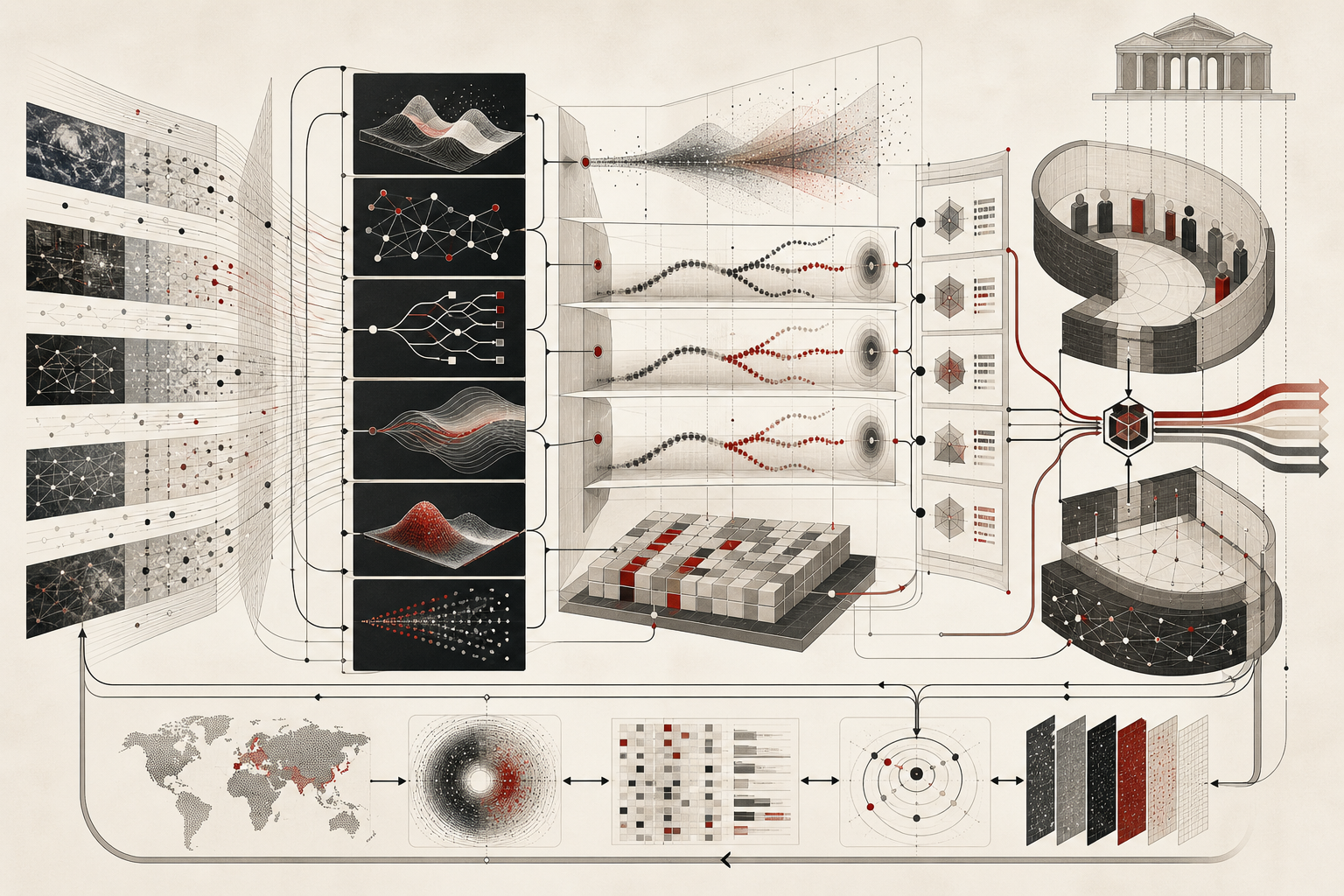
This article develops Artificial Intelligence in Decision Support Systems as an advanced article within the Artificial Intelligence Systems knowledge series. It explains decision support architecture, prediction as a decision input, Bayesian decision theory, expected utility, causal inference, counterfactual reasoning, optimization, reinforcement learning, robust decision-making, human-AI collaboration, complex systems, institutional governance, evaluation, contestability, and accountability. Selected Python and R examples appear here, while the full GitHub repository contains expanded computational scaffolding for decision scoring, scenario modeling, causal review, optimization, governance schemas, API monitoring, dashboards, validation tools, reproducibility assets, and audit documentation.
Why AI Decision Support Matters
AI decision support matters because institutions increasingly make consequential decisions under conditions of uncertainty, complexity, time pressure, and incomplete information. Hospitals must prioritize patients. Infrastructure agencies must allocate inspection crews. Energy operators must balance reliability, cost, demand, and weather risk. Public agencies must distribute limited resources. Businesses must forecast demand, manage supply chains, and assess operational risk. Environmental managers must decide where to intervene before damage becomes irreversible.
Decision support systems are no longer only dashboards, reports, or business intelligence tools. Modern AI-driven systems increasingly embed predictive models, causal inference frameworks, simulation engines, optimization routines, reinforcement learning policies, uncertainty estimates, and human review workflows into operational decision processes. They help organizations and institutions decide what to prioritize, where to allocate resources, which risks to escalate, which scenarios to prepare for, and which interventions are most likely to produce desired outcomes.
The stakes are high because AI-supported decisions do not merely describe the world. They change it. A risk score can alter who receives attention. A ranking can reshape institutional priorities. A recommendation can shift resources. A threshold can determine who is reviewed, treated, inspected, denied, approved, protected, or ignored. Decision support systems therefore require a broader standard than model performance. They must be judged by whether they improve decision quality while preserving transparency, contestability, proportionality, fairness, resilience, and accountability.
Prediction \neq Decision
\]
Interpretation: A model can estimate what may happen, but a decision requires goals, values, constraints, authority, uncertainty review, and responsibility.
| Decision Context | Why Human Judgment Alone May Be Insufficient | AI Contribution | Governance Concern |
|---|---|---|---|
| Healthcare | Clinical teams face uncertainty, time pressure, and complex patient histories. | Risk scoring, triage support, deterioration forecasting, treatment comparison. | Automation bias, patient safety, accountability, and clinical context. |
| Infrastructure | Agencies manage many assets under budget, climate, and service constraints. | Predictive maintenance, scenario analysis, resource prioritization. | Unequal service, data gaps, cascading risk, and public accountability. |
| Public administration | Decisions affect benefits, inspections, services, enforcement, and eligibility. | Case prioritization, fraud detection, workload management, policy simulation. | Due process, contestability, bias, and institutional legitimacy. |
| Business and operations | Organizations face uncertain demand, supply-chain disruption, and capacity limits. | Forecasting, optimization, pricing, scheduling, logistics planning. | Misaligned objectives, hidden tradeoffs, and feedback loops. |
| Environmental management | Hazards, exposure, ecological stress, and intervention effects are uncertain. | Early warning, risk mapping, scenario modeling, intervention prioritization. | Uncertainty, environmental justice, and public trust. |
Note: AI decision support becomes most important when uncertainty, consequence, resource limits, and institutional responsibility are connected.
Decision Support Systems and the Structure of Decision-Making
A decision support system is designed to help decision-makers choose among alternatives when information is incomplete, outcomes are uncertain, and tradeoffs are unavoidable. The decision-maker may be an individual, organization, public agency, clinical team, infrastructure operator, policy body, or automated system supervised by humans. The decision may involve resource allocation, risk classification, scheduling, diagnosis, investment, routing, maintenance, hiring, emergency response, environmental management, or strategic planning.
At a basic level, a decision involves selecting an action from a set of alternatives. The best action depends on the state of the world, the probability of possible outcomes, and the value or utility assigned to those outcomes. AI expands decision support by improving the estimation of uncertain states, simulating possible futures, and searching across large action spaces.
The movement from traditional DSS to AI-enabled DSS involves four major changes:
- from description to prediction: systems move beyond reporting what happened toward estimating what is likely to happen;
- from prediction to prescription: systems recommend actions based on objectives and constraints;
- from static analysis to adaptive systems: decision systems update as new data arrives;
- from individual decisions to institutional workflows: decisions become embedded in governance, review, audit, and accountability structures.
This evolution gives AI decision support systems real influence. They shape what options are visible, what risks are emphasized, what tradeoffs are considered, and what decisions appear rational. That influence requires careful design.
Decision = Action + Uncertainty + Consequence + Responsibility
\]
Interpretation: A decision is not only a selection among options. It is an accountable choice made under uncertainty, with real consequences for systems, people, institutions, or environments.
| Decision Element | Meaning | AI Role | Governance Question |
|---|---|---|---|
| Action space | The set of possible options or interventions. | Search, rank, filter, or recommend feasible actions. | Who defines which options are available? |
| State uncertainty | Unknown or partially observed conditions. | Estimate risks, states, probabilities, and trends. | Is uncertainty visible to users? |
| Utility or value | The objective used to judge outcomes. | Translate predictions into decision scores. | Whose values are encoded in the objective? |
| Constraints | Limits imposed by law, capacity, safety, equity, cost, or ethics. | Filter or optimize actions within boundaries. | Are constraints complete and reviewable? |
| Authority | The role empowered to approve, override, or contest action. | Route recommendations to users or escalation paths. | Who remains responsible for the decision? |
Note: AI decision support should make action spaces, uncertainty, values, constraints, and authority explicit.
Architecture of an AI-Enabled Decision Support System
An AI-enabled decision support system is best understood as a layered architecture rather than a single model. A prediction model is only one component. The full system includes data, models, rules, optimization logic, interfaces, workflows, monitoring, and governance.
| Layer | Function | Decision-Support Role | Risk if Weak |
|---|---|---|---|
| Data layer | Collects and organizes observations. | Provides evidence for prediction and analysis. | Missing, biased, stale, or poorly measured data. |
| Prediction layer | Estimates outcomes, risks, demand, or states. | Transforms data into probabilistic forecasts. | Overconfident or poorly calibrated predictions. |
| Causal layer | Estimates effects of interventions. | Distinguishes what may happen from what actions cause. | Correlation mistaken for intervention logic. |
| Simulation layer | Evaluates scenarios and possible futures. | Supports planning under uncertainty. | False confidence in narrow scenarios. |
| Optimization layer | Ranks or selects actions. | Connects objectives, constraints, and choices. | Misaligned or hidden objective functions. |
| Human interface | Presents options, uncertainty, and explanations. | Supports interpretation and judgment. | Automation bias or cognitive overload. |
| Governance layer | Defines authority, review, and accountability. | Ensures decisions remain contestable and auditable. | Diffused responsibility and unreviewable automation. |
Note: Decision quality depends on alignment among the architecture layers, not on model performance alone.
The architecture matters because decision quality depends on the alignment among these layers. A highly accurate model can still produce poor decisions if the objective function is wrong, the constraints are incomplete, the interface encourages overtrust, or the governance process fails to assign responsibility.
Model\ Accuracy + Bad\ Objective \rightarrow Bad\ Decision
\]
Interpretation: A model can predict accurately while supporting poor decisions if the system optimizes the wrong goal, excludes important constraints, or hides institutional responsibility.
Prediction as a Decision Input
Prediction is often the most visible part of AI decision support. A model may estimate the probability of default, the risk of equipment failure, the likelihood of readmission, expected demand, project delay, flood risk, fraud probability, student dropout risk, customer churn, or supply-chain disruption. These predictions give decision-makers information they did not previously have or help them process information at greater scale.
However, prediction is only an input to decision-making. A risk score does not automatically determine an action. A high predicted risk may call for intervention, review, delay, resource allocation, denial, escalation, or no action depending on the domain, cost, uncertainty, ethical constraints, and institutional purpose.
Several problems arise when prediction is confused with decision:
- threshold ambiguity: the model estimates probability, but the institution must decide what risk threshold triggers action;
- cost asymmetry: false positives and false negatives may have very different consequences;
- distribution shift: predictions may fail when conditions change;
- feedback loops: decisions based on predictions can change future data;
- proxy objectives: the prediction target may not represent the true institutional goal;
- unequal effects: model errors may be unevenly distributed across groups, regions, or contexts.
Good DSS design keeps prediction and decision logically separate. The model estimates what may happen. The decision framework defines what should be done.
| Prediction Output | Possible Decision Use | Additional Information Needed | Risk if Treated as Decision |
|---|---|---|---|
| Risk score | Prioritize review or intervention. | Thresholds, uncertainty, cost of error, affected population. | High score becomes automatic action without context. |
| Demand forecast | Plan capacity, staffing, inventory, or infrastructure. | Scenario range, forecast horizon, constraints, downside risk. | Single forecast hides uncertainty. |
| Classification | Route cases, flag anomalies, or organize workflows. | Confidence, error patterns, override rules. | Labels are treated as facts rather than estimates. |
| Ranking | Prioritize limited resources. | Fairness review, tie-breaking rules, governance criteria. | Ranking becomes invisible policy. |
| Recommendation | Suggest action to a human decision-maker. | Explanation, alternatives, tradeoffs, escalation path. | Human oversight becomes symbolic. |
Note: Prediction supports decision-making only when connected to thresholds, consequences, alternatives, uncertainty, and review authority.
Risk\ Score \neq Required\ Action
\]
Interpretation: A risk score may inform action, but the appropriate response depends on uncertainty, costs, rights, constraints, domain context, and institutional responsibility.
Bayesian Decision Theory and Expected Utility
Bayesian decision theory provides a formal structure for reasoning under uncertainty. It begins with uncertainty about the state of the world, updates beliefs with evidence, and chooses actions according to expected utility. This makes it especially useful for AI decision support, where models often generate probabilistic forecasts.
Bayesian reasoning matters because decisions rarely occur under certainty. A medical team does not know with certainty whether a patient will deteriorate. An infrastructure operator does not know exactly when an asset will fail. A public agency does not know which intervention will produce the greatest benefit. A business does not know future demand. Decision support systems help structure these uncertainties.
The expected utility framework also clarifies why better prediction does not automatically produce better decisions. If utility is misspecified, constraints are incomplete, or probabilities are poorly calibrated, the selected action may be harmful even when the model appears accurate.
A decision support system should document:
- what outcome probabilities are estimated;
- how probabilities are calibrated;
- what utility function or objective is used;
- what constraints limit possible actions;
- who approves thresholds and tradeoffs;
- how uncertainty is communicated to human users.
P(H \mid D) =
\frac{P(D \mid H)P(H)}{P(D)}
\]
Interpretation: Bayesian updating revises the probability of a hypothesis or state \(H\) after observing data \(D\). This supports decision-making when beliefs must change as evidence arrives.
| Requirement | Decision Function | Evidence Needed | Failure Mode |
|---|---|---|---|
| Prior assumptions | Define baseline beliefs before new evidence. | Historical data, domain knowledge, expert assumptions. | Hidden priors shape decisions without review. |
| Likelihood model | Connect evidence to possible states. | Validated statistical or machine learning model. | Evidence is interpreted incorrectly. |
| Posterior probability | Updates belief after evidence. | Calibrated probability estimates. | Overconfident forecasts mislead users. |
| Utility function | Defines value of outcomes. | Documented objectives and tradeoffs. | System optimizes an unreviewed value judgment. |
| Decision threshold | Determines when action is triggered. | Error costs, capacity, rights, safety, and domain stakes. | Arbitrary thresholds become institutional policy. |
Note: Bayesian decision support makes uncertainty explicit, but value judgments still require institutional review.
Causal Inference and Counterfactual Reasoning
Decision-making requires causal reasoning because decisions are interventions. Prediction asks what is likely to happen. Decision-making asks what will happen if we act. A model trained on observational data may correctly identify patterns without correctly estimating intervention effects.
For example, a hospital readmission model may identify patients who are likely to return to the hospital. But a decision support system must ask which intervention would reduce that risk. Additional follow-up, transportation support, medication reconciliation, housing support, or remote monitoring may have different causal effects. A prediction model can rank risk; a causal model helps estimate what action changes the outcome.
Counterfactual reasoning extends this logic by asking what would have happened under a different action. This is essential for policy evaluation, clinical decision support, operational planning, and institutional accountability. A DSS that cannot distinguish correlation from intervention may recommend actions that reflect historical patterns rather than effective change.
Causal decision support should include:
- clearly defined interventions;
- identification of confounders;
- counterfactual assumptions;
- sensitivity analysis;
- experimental or quasi-experimental validation where possible;
- distinction between risk prediction and treatment effect estimation.
P(y \mid do(a)) \neq P(y \mid a)
\]
Interpretation: The effect of taking action \(a\) is not the same as observing that action in historical data. Decision support systems must distinguish intervention from correlation.
| Decision Question | Predictive Version | Causal Version | Governance Risk |
|---|---|---|---|
| Healthcare intervention | Who is likely to be readmitted? | Which intervention reduces readmission risk? | High-risk patients may be flagged without effective support. |
| Infrastructure maintenance | Which asset is likely to fail? | Which inspection or repair reduces failure probability? | Resources may go to visible risk rather than effective prevention. |
| Public services | Which cases are likely to become costly? | Which support changes the outcome? | Prediction may justify surveillance rather than assistance. |
| Education | Which students are likely to disengage? | Which intervention improves retention or learning? | Risk labeling may replace supportive action. |
| Environmental management | Where is risk increasing? | Which action reduces exposure or ecological harm? | Monitoring may not translate into protection. |
Note: Decision support should distinguish who is at risk from what action will reduce risk.
Optimization and Prescriptive Analytics
Prescriptive analytics extends prediction by recommending actions. Given predicted outcomes, objectives, and constraints, an optimization system identifies actions that improve expected performance. This is common in scheduling, logistics, staffing, maintenance, pricing, routing, portfolio allocation, supply-chain planning, infrastructure management, energy dispatch, and public resource allocation.
Optimization is powerful because it can search across more options than humans can manually compare. It is risky because it makes objectives operational. Whatever the objective function rewards, the system will tend to pursue. If the objective is narrow, hidden, or misaligned, optimization can produce decisions that appear efficient while damaging broader institutional goals.
Common optimization failures include:
- narrow objectives: optimizing cost while ignoring safety, quality, fairness, resilience, or environmental impact;
- constraint gaps: failing to encode legal, ethical, operational, or human constraints;
- local optimization: improving one part of a system while harming the whole;
- gaming: users or institutions adapt behavior to exploit the metric;
- brittleness: optimal solutions fail under real-world uncertainty.
Good decision support systems make objectives explicit. They allow decision-makers to inspect tradeoffs, test scenarios, and override recommendations when context demands it.
| Optimization Element | Decision Role | Example | Governance Concern |
|---|---|---|---|
| Objective function | Defines what the system tries to maximize or minimize. | Utility, cost, delay, risk, benefit, service quality. | Hidden objectives encode hidden values. |
| Constraints | Define what actions are allowed. | Budget, capacity, safety, law, fairness, environmental limits. | Missing constraints permit harmful recommendations. |
| Feasible action space | Limits options to implementable choices. | Available crews, equipment, interventions, schedules. | Excluded options may reflect institutional blind spots. |
| Tradeoff analysis | Shows what is gained and sacrificed. | Efficiency versus resilience, cost versus equity. | Tradeoffs become invisible to decision-makers. |
| Override rules | Permit human judgment to constrain or revise output. | Escalation, exception handling, review boards. | Optimization becomes unchallengeable. |
Note: Optimization should make institutional values and constraints visible rather than hiding them inside the model.
Optimization\ Without\ Governance \rightarrow Misaligned\ Action
\]
Interpretation: Optimization can improve decisions only when objectives, constraints, tradeoffs, and override authority are explicit and reviewable.
Sequential Decisions and Reinforcement Learning
Many decisions are sequential. A decision today changes the information, state, and options available tomorrow. Reinforcement learning provides a framework for learning policies in such environments. It is especially relevant for dynamic pricing, recommendation systems, adaptive resource allocation, robotics, energy management, traffic control, inventory management, and autonomous operations.
In decision support settings, reinforcement learning should be treated carefully. A policy that performs well in simulation may fail in the real world if the environment is misspecified. A reward function may encode the wrong goal. Exploration may be unsafe when actions affect people, infrastructure, or public services. Long-term effects may be difficult to measure.
For high-stakes DSS, reinforcement learning requires:
- safe exploration or offline learning;
- validated simulation environments;
- reward functions aligned with institutional goals;
- human override and monitoring;
- stress testing under rare scenarios;
- clear limits on autonomous action.
Sequential decision systems are not only technical systems. They create feedback loops between model behavior and the world being modeled.
\pi^{*} = \arg\max_{\pi} \mathbb{E}
\left[
\sum_{t=0}^{T} \gamma^{t} r(s_t,a_t)
\right]
\]
Interpretation: A policy \(\pi\) maps states to actions over time. Reinforcement learning seeks a policy that maximizes cumulative discounted reward, but reward design must reflect the actual decision objective.
| Application | Sequential Structure | RL Contribution | Safety Requirement |
|---|---|---|---|
| Energy management | Dispatch, storage, demand, and reliability change over time. | Learn adaptive control policies. | Constrain actions by grid safety and critical-load protection. |
| Traffic control | Signal timing affects future congestion. | Optimize policies across time and network state. | Prevent burden shifting and unsafe exploration. |
| Resource allocation | Current allocation changes future demand and need. | Learn dynamic prioritization policies. | Protect equity, contestability, and human review. |
| Recommendation systems | Recommendations shape future user behavior. | Adapt policies based on feedback. | Avoid manipulation, addiction loops, and metric gaming. |
| Inventory and logistics | Actions affect future stock, cost, and disruption exposure. | Optimize sequential planning under uncertainty. | Stress test rare disruption and supply-chain fragility. |
Note: Sequential decision support requires attention to feedback loops, long-term consequences, and safe learning.
Uncertainty, Risk, and Robust Decision-Making
Decision support systems must represent uncertainty rather than hiding it. Uncertainty can arise from noisy data, incomplete information, model error, changing conditions, unknown causal mechanisms, ambiguous objectives, or disagreement among stakeholders. A decision made under false certainty may be more dangerous than one made with transparent uncertainty.
AI-enabled DSS can use several methods to reason under uncertainty:
- Monte Carlo simulation: sampling many possible futures;
- scenario analysis: comparing structured alternative futures;
- sensitivity analysis: testing how decisions change when assumptions vary;
- robust optimization: choosing actions that perform acceptably under adverse conditions;
- Bayesian updating: revising beliefs as evidence arrives;
- confidence or prediction intervals: representing uncertainty around estimates;
- stress testing: evaluating performance under extreme conditions.
Uncertainty communication is a human-interface problem as much as a mathematical problem. Users must understand what the system knows, what it does not know, and when uncertainty should trigger caution, escalation, or delay.
a^{*} =
\arg\max_{a \in \mathcal{A}}
\min_{\omega \in \Omega} U(a,\omega)
\]
Interpretation: A robust decision chooses the action with the best worst-case performance across uncertain scenarios \(\omega\). This is useful when decision-makers care about resilience, safety, and downside risk rather than only average expected value.
| Uncertainty Type | Meaning | DSS Response | Governance Concern |
|---|---|---|---|
| Data uncertainty | Measurements are incomplete, noisy, biased, or stale. | Data-quality flags, provenance, confidence intervals. | Poor data becomes hidden authority. |
| Model uncertainty | The model may be wrong or misspecified. | Ensembles, calibration, validation, monitoring. | Model confidence is mistaken for truth. |
| Scenario uncertainty | Future conditions may differ from expected conditions. | Scenario analysis and stress testing. | Planning becomes fragile under disruption. |
| Causal uncertainty | Intervention effects are uncertain. | Experimental design, causal review, sensitivity analysis. | Actions may not change the outcome as expected. |
| Value uncertainty | Stakeholders disagree about what should be optimized. | Multi-criteria decision analysis and public review. | Hidden values masquerade as technical outputs. |
Note: Responsible decision support makes uncertainty visible and actionable rather than hiding it behind a single recommendation.
Human-AI Collaboration and Cognitive Integration
Effective DSS integrate human judgment with AI outputs. Humans provide context, values, moral reasoning, legal interpretation, institutional memory, domain expertise, and responsibility. AI contributes scale, consistency, pattern detection, simulation, and probabilistic analysis. The strongest decision systems combine both.
Human-AI collaboration can fail in several ways. Users may overtrust AI recommendations, ignore uncertainty, defer to automated rankings, or assume that a model is objective. Conversely, users may undertrust useful models, especially if explanations are poor or prior systems have failed. Decision support design must therefore account for cognitive behavior.
A responsible interface should show:
- the recommendation;
- the uncertainty or confidence level;
- the main drivers of the recommendation;
- possible alternatives;
- expected tradeoffs;
- constraints and assumptions;
- when human review is required;
- how to override or contest the recommendation.
The goal is not to make humans rubber-stamp machine output. The goal is to support better judgment.
Human\ Review \neq Human\ Rubber\ Stamp
\]
Interpretation: Human oversight is meaningful only when people have the authority, information, time, training, and institutional support to question or override recommendations.
| Collaboration Need | AI Contribution | Human Contribution | Failure Mode |
|---|---|---|---|
| Pattern detection | Finds signals across large datasets. | Interprets whether the signal matters. | Spurious patterns become institutional priorities. |
| Uncertainty review | Quantifies confidence or scenario range. | Decides when uncertainty requires caution. | Uncertainty is displayed but ignored. |
| Tradeoff judgment | Calculates costs, benefits, and rankings. | Evaluates values, rights, duties, and context. | Technical ranking replaces moral judgment. |
| Exception handling | Flags unusual or high-risk cases. | Applies domain expertise and institutional memory. | Edge cases are forced into automated categories. |
| Accountability | Logs evidence, recommendations, and model state. | Accepts responsibility for decision and correction. | Responsibility diffuses behind the system. |
Note: Human-AI decision support should augment judgment, not conceal responsibility.
Decision Support in Complex Systems and Infrastructure
AI decision support systems often operate inside complex systems: supply chains, hospitals, energy grids, transportation systems, financial markets, public agencies, ecological systems, organizations, and digital platforms. These systems contain feedback loops, nonlinear effects, delays, adaptation, incentives, constraints, and multiple stakeholders.
In complex systems, an action can create unintended consequences. A traffic routing system may reduce average travel time while increasing traffic through residential streets. A predictive maintenance system may prioritize assets with better data rather than greater need. A staffing optimizer may reduce costs while increasing burnout. A fraud detection system may reduce loss while increasing false accusations. A public benefits system may improve processing speed while making contestation harder.
Systems-aware DSS design asks:
- What feedback loops will the decision create?
- Who benefits and who bears risk?
- What metric is being optimized?
- What values are excluded from the model?
- What happens if users adapt to the system?
- Where can decisions be contested?
- How will the system be monitored after deployment?
AI decision support is most valuable when it helps decision-makers see system structure, not merely individual recommendations.
| Complex System Feature | Decision-Support Challenge | AI Opportunity | Governance Risk |
|---|---|---|---|
| Feedback loops | Decisions change future data and behavior. | Simulate dynamic effects and monitor drift. | Self-reinforcing errors or unequal outcomes. |
| Interdependence | Actions in one system affect another. | Model cascading effects and shared constraints. | Local optimization creates system harm. |
| Nonlinearity | Small actions can produce large effects. | Stress test thresholds and extreme cases. | Average-case reasoning misses breakdown risk. |
| Adaptation | People change behavior in response to the system. | Monitor gaming, compliance, and behavioral response. | Metrics become targets and lose meaning. |
| Multiple stakeholders | Benefits and burdens are distributed unevenly. | Evaluate tradeoffs across groups and places. | Optimization hides political and ethical choices. |
Note: Systems-aware decision support evaluates consequences across time, networks, institutions, and affected communities.
Local\ Decision + System\ Feedback = Long\text{-}Run\ Consequence
\]
Interpretation: In complex systems, a recommendation must be evaluated not only by its immediate effect, but by the feedback loops and downstream consequences it creates.
Evaluation, Reliability, and Decision Quality
Evaluating AI decision support systems requires more than measuring model accuracy. A DSS should be evaluated according to the quality of decisions it supports. This includes whether decisions are better calibrated, more timely, more equitable, more robust, more transparent, more contestable, and more aligned with institutional goals.
| Evaluation Dimension | Question | Example Measure | Decision Relevance |
|---|---|---|---|
| Predictive performance | Are forecasts accurate and calibrated? | Calibration error, Brier score, RMSE, AUC. | Supports trustworthy estimates. |
| Decision utility | Do recommendations improve outcomes? | Expected utility, net benefit, cost-benefit analysis. | Tests whether predictions improve decisions. |
| Robustness | Do decisions hold under uncertainty? | Scenario performance, stress tests. | Protects against brittle recommendations. |
| Fairness and equity | Are harms and benefits distributed appropriately? | Group error rates, allocation review, exposure analysis. | Prevents unequal decision impacts. |
| Human usability | Can users understand and use the system correctly? | User testing, override analysis, error review. | Reduces automation bias and misuse. |
| Contestability | Can affected people or teams challenge decisions? | Appeals, audit trails, explanation records. | Supports due process and accountability. |
| Governance | Are roles, thresholds, and accountability defined? | Decision logs, approvals, review cadence. | Prevents responsibility from dissolving into automation. |
Note: AI decision support should be evaluated by decision quality, not only by model quality.
A DSS can improve one dimension while harming another. For example, it may increase efficiency but reduce transparency. It may improve average outcomes but worsen outcomes for a subgroup. It may reduce human workload but increase automation bias. Evaluation must therefore be multidimensional.
Model\ Quality \neq Decision\ Quality
\]
Interpretation: A technically strong model can still support poor decisions if the system’s objectives, constraints, interface, governance, or institutional context are flawed.
Governance, Accountability, and Institutional Design
AI decision support systems influence institutional behavior. They shape priorities, resource allocation, risk perception, and responsibility. Governance must therefore define who designs the system, who approves it, who uses it, who can override it, who is accountable for decisions, and how harms are reviewed.
Governance should specify:
- approved uses and prohibited uses;
- decision thresholds and escalation rules;
- human review requirements;
- documentation and audit logs;
- model validation and monitoring cadence;
- data lineage and provenance requirements;
- appeal or contestation pathways;
- incident response procedures;
- responsible parties for each decision stage.
Decision support systems should be designed so that responsibility is not hidden behind the model. If an institution uses AI to support a decision, the institution remains responsible for the decision process.
| Governance Area | Question | Evidence Needed | Failure if Ignored |
|---|---|---|---|
| Use approval | What decisions may the system support? | Use-case documentation and risk classification. | System expands into unreviewed contexts. |
| Threshold governance | Who approves action thresholds? | Threshold logs, error-cost review, stakeholder input. | Technical thresholds become hidden policy. |
| Human authority | Who can override, pause, or escalate? | Role definitions, override logs, escalation rules. | Oversight becomes symbolic. |
| Auditability | Can a decision be reconstructed later? | Data, model version, recommendation, user action, explanation. | Decisions become untraceable. |
| Contestability | Can affected parties challenge decisions? | Appeal paths, explanation records, review procedures. | AI-supported decisions become unchallengeable. |
Note: Governance turns decision support from a technical recommendation engine into an accountable institutional process.
Institutional\ Use \Rightarrow Institutional\ Responsibility
\]
Interpretation: When an institution uses AI to support decisions, responsibility remains with the institution—not with the model, vendor, dashboard, or algorithm alone.
Failure Modes: Bias, Overfitting, Automation Risk, and Misaligned Objectives
AI decision support systems can fail in ways that are more institutional than technical.
First, historical data may encode bias. Decision support models can learn from unequal treatment, under-measurement, under-service, selective enforcement, or institutional neglect. If those histories are not reviewed, the system may reproduce them as rational recommendations.
Second, models may overfit the past. A decision support system may perform well on historical data but fail under changing conditions, new policies, crisis environments, distributional shift, or adversarial behavior.
Third, automation bias can weaken judgment. Users may defer to recommendations even when context suggests caution. A system that appears precise can make uncertainty harder to notice.
Fourth, objectives may be misaligned. The system may optimize a measurable proxy rather than the true goal. Cost, speed, throughput, or risk reduction may be easier to measure than dignity, equity, trust, resilience, care, or public value.
Fifth, hidden value judgments can become technical defaults. Utility functions, thresholds, weights, and constraints encode priorities. If these are not reviewed, the system embeds institutional values without institutional accountability.
Sixth, feedback loops can distort future data. Decisions influenced by the model may change behavior, measurement, access, enforcement, or service patterns, altering the future data used to train or evaluate the system.
Seventh, accountability can become diffuse. Responsibility may be spread across model developers, vendors, managers, analysts, frontline users, and executives until no one clearly owns the decision.
Eighth, contestability can disappear. Affected people may have no meaningful way to challenge AI-supported decisions, especially when explanations, records, or appeal pathways are weak.
These failures show why AI decision support must be governed as a socio-technical system. A DSS is not trustworthy merely because it uses advanced models. It is trustworthy when it supports better decisions under clear authority, transparent assumptions, monitored performance, contestable outcomes, and accountable institutional design.
Advanced\ Model \neq Trustworthy\ Decision\ System
\]
Interpretation: Trustworthy decision support requires governance, transparency, validation, contestability, monitoring, and accountability—not only sophisticated modeling.
Mathematical Lens: Expected Utility, Causality, Optimization, and Policy
Decision support can be formalized by defining possible actions, uncertain states, outcomes, utilities, and constraints. A decision-maker chooses an action \(a\) from a set of feasible actions \(\mathcal{A}\).
a^{*} = \arg\max_{a \in \mathcal{A}} \sum_{s \in \mathcal{S}} P(s \mid x) U(a,s)
\]
Interpretation: The best action \(a^{*}\) maximizes expected utility across uncertain states \(s\), given data \(x\). The model estimates \(P(s \mid x)\), while the decision framework defines the utility \(U(a,s)\).
Prediction provides a probability distribution over possible outcomes.
P(y \mid x)
\]
Interpretation: A predictive model estimates the probability of outcome \(y\) given observed features \(x\). Prediction informs decisions, but does not by itself determine what should be done.
Decision-making often requires causal reasoning because actions change the world.
P(y \mid do(a)) \neq P(y \mid a)
\]
Interpretation: The effect of taking action \(a\) is not the same as observing that action in historical data. Decision support systems must distinguish intervention from correlation.
Optimization turns objectives and constraints into recommended actions.
\max_{a \in \mathcal{A}} \; U(a)
\quad \text{subject to} \quad
g_i(a) \leq b_i
\]
Interpretation: A prescriptive decision system selects an action that maximizes utility while satisfying constraints. Constraints may represent budgets, capacity, safety, law, fairness, operational feasibility, or environmental limits.
Sequential decisions require policies rather than one-time choices.
\pi^{*} = \arg\max_{\pi} \mathbb{E}
\left[
\sum_{t=0}^{T} \gamma^{t} r(s_t,a_t)
\right]
\]
Interpretation: A policy \(\pi\) maps states to actions over time. Reinforcement learning seeks a policy that maximizes cumulative discounted reward, but reward design must reflect the actual decision objective.
Robust decision-making asks which action performs acceptably across uncertain futures.
a^{*} =
\arg\max_{a \in \mathcal{A}}
\min_{\omega \in \Omega} U(a,\omega)
\]
Interpretation: A robust decision chooses the action with the best worst-case performance across uncertain scenarios \(\omega\). This is useful when decision-makers care about resilience, safety, and downside risk rather than only average expected value.
A governance-aware decision score can combine expected benefit, cost, uncertainty, equity priority, capacity, and risk tolerance.
DecisionScore(a) =
\alpha B(a) –
\beta C(a) –
\lambda U_{risk}(a) +
\eta E(a) –
\rho K(a)
\]
Interpretation: A decision score for action \(a\) may combine expected benefit \(B(a)\), cost \(C(a)\), uncertainty or risk penalty \(U_{risk}(a)\), equity priority \(E(a)\), and capacity burden \(K(a)\). The weights should be documented, justified, and reviewed.
Variables and System Interpretation
| Symbol or Term | Meaning | Decision-Support Interpretation | AI System Relevance |
|---|---|---|---|
| \(a\) | Action | Decision option, recommendation, intervention, or allocation. | Output that may affect the real world. |
| \(\mathcal{A}\) | Action space | Set of feasible choices. | Defines what the system can recommend. |
| \(s\) | State of the world | Unknown condition affecting outcomes. | Estimated through data and models. |
| \(\mathcal{S}\) | State space | Possible conditions or scenarios. | Used in uncertainty and scenario analysis. |
| \(x\) | Observed data | Features, measurements, records, signals, or context. | Input to predictive models. |
| \(y\) | Outcome | Event, cost, benefit, risk, demand, failure, or result. | Prediction target or evaluation measure. |
| \(P(s \mid x)\) | Posterior probability | Probability of a state given evidence. | Connects data to uncertainty. |
| \(U(a,s)\) | Utility function | Value of action \(a\) in state \(s\). | Defines what “good decision” means. |
| \(do(a)\) | Intervention | Actively taking action \(a\). | Distinguishes causal effects from association. |
| \(\pi\) | Policy | Rule mapping states to actions. | Used in sequential decision systems. |
| \(\gamma\) | Discount factor | Weight given to future rewards. | Important in reinforcement learning and planning. |
| \(\omega\) | Scenario | Possible future condition. | Used in robust planning and stress testing. |
Note: Decision-support variables should be interpreted as institutional and governance variables, not only mathematical abstractions.
Worked Example: AI for Resource Allocation Under Uncertainty
Consider a public agency deciding how to allocate inspection teams across infrastructure assets. Each asset has a predicted failure probability, service population, inspection cost, historical maintenance status, environmental exposure, and uncertainty score. The agency cannot inspect every asset immediately, so it needs a decision support system to prioritize.
A weak DSS would simply rank assets by predicted failure probability. A stronger DSS would combine:
- failure probability;
- uncertainty;
- service population;
- criticality in the network;
- equity priority;
- inspection cost;
- legal or safety constraints;
- human review requirements.
The recommendation might identify a ranked set of assets for inspection, but the decision should remain reviewable. If a high-risk asset has poor data quality, it may require field verification. If a lower-risk asset serves a highly vulnerable population, it may deserve earlier review. If the model is uncertain, the system should communicate that uncertainty rather than hiding it behind a single score.
This example shows why decision support requires more than model ranking. It requires explicit values, transparent tradeoffs, uncertainty communication, and governance.
| Output Field | Meaning | Why It Matters | Review Question |
|---|---|---|---|
| Predicted risk | Estimated probability of failure, harm, or need. | Supports prioritization. | Is the prediction calibrated for this context? |
| Uncertainty score | How uncertain the model is. | Identifies cases requiring caution. | Should this case be escalated to human review? |
| Service population | People or systems affected by the decision. | Connects action to public consequence. | Who benefits and who bears risk? |
| Equity priority | Indicator of vulnerability, under-service, or historical neglect. | Prevents optimization from reproducing unequal patterns. | Does the decision correct or reinforce inequality? |
| Capacity required | Resources needed to execute the action. | Connects recommendations to feasibility. | Can the institution implement this decision responsibly? |
Note: A governance-ready decision output should preserve risk, uncertainty, consequence, equity, feasibility, and review status.
Decision\ Priority \neq Predicted\ Risk\ Alone
\]
Interpretation: A responsible priority score should consider risk, uncertainty, capacity, consequences, equity, constraints, and human review—not only the highest predicted probability.
Computational Modeling
Computational modeling for AI decision support should produce artifacts that help decision-makers evaluate options, uncertainty, constraints, and governance obligations. A useful workflow should not merely output a ranked list. It should preserve the decision options, prediction inputs, utility assumptions, uncertainty scores, scenario outputs, selected actions, human-review flags, and governance summaries.
A practical AI decision support workflow should answer several questions:
- Which options were available to the system?
- Which predictions were used?
- How were benefits, costs, uncertainty, and equity weighted?
- Which constraints limited the selected actions?
- Which cases require human review?
- How do recommendations change under optimistic, baseline, and pessimistic scenarios?
- Can the decision be reconstructed after action is taken?
- Who is accountable for approving or overriding the recommendation?
| Artifact | Purpose | Governance Value |
|---|---|---|
| Decision option table | Documents available actions, features, costs, benefits, and constraints. | Supports transparency about what the system considered. |
| Prediction table | Records model estimates and uncertainty. | Supports calibration review and uncertainty communication. |
| Utility score table | Combines benefits, costs, risk, equity, and capacity. | Makes decision logic inspectable. |
| Scenario summary | Compares outcomes under alternative futures. | Supports robustness and stress testing. |
| Human-review list | Flags high-risk, high-uncertainty, or equity-sensitive cases. | Preserves meaningful oversight. |
| Governance memo | Summarizes assumptions, selected options, limits, and review obligations. | Supports audit, accountability, and institutional learning. |
Note: Decision support workflows should generate evidence for review, not only recommendations for action.
Python Workflow: Decision Support Under Uncertainty
The following Python workflow creates a synthetic decision support scenario. It estimates risk, utility, uncertainty, and robust scenario performance for a set of candidate actions. The goal is to show how prediction, uncertainty, and decision utility can be combined in a transparent workflow.
"""
Artificial Intelligence in Decision Support Systems
Python workflow: decision support under uncertainty.

This example creates synthetic decision options, estimates expected utility,
evaluates uncertainty, and identifies candidates requiring human review.
"""

from __future__ import annotations

from pathlib import Path

import numpy as np
import pandas as pd


RANDOM_SEED = 42
rng = np.random.default_rng(RANDOM_SEED)

OUTPUT_DIR = Path("outputs")
OUTPUT_DIR.mkdir(exist_ok=True)


def create_decision_options(n: int = 120) -> pd.DataFrame:
    """
    Create synthetic decision options for resource allocation.

    In real systems, these options could represent assets to inspect,
    cases to review, interventions to fund, patients to triage, or
    operational actions to schedule.
    """
    options = pd.DataFrame(
        {
            "option_id": [f"A{i:03d}" for i in range(n)],
            "predicted_risk": rng.beta(2.5, 4.0, n),
            "benefit_if_successful": rng.normal(100, 25, n).clip(10),
            "cost": rng.normal(35, 10, n).clip(5),
            "uncertainty": rng.uniform(0.05, 0.45, n),
            "service_population": rng.integers(100, 10000, n),
            "equity_priority": rng.choice([0, 1], size=n, p=[0.75, 0.25]),
            "capacity_required": rng.integers(1, 6, n),
        }
    )

    return options


def evaluate_options(options: pd.DataFrame, total_capacity: int = 120) -> pd.DataFrame:
    """
    Estimate expected utility, robust utility, and review priority.

    This separates prediction, value, uncertainty, equity, and capacity
    so decision-makers can inspect the recommendation logic.
    """
    scored = options.copy()

    scored["expected_benefit"] = (
        scored["predicted_risk"] * scored["benefit_if_successful"]
    )

    scored["population_weight"] = (
        scored["service_population"] / scored["service_population"].max()
    )

    scored["expected_utility"] = (
        scored["expected_benefit"]
        - scored["cost"]
        + 15 * scored["population_weight"]
        + 10 * scored["equity_priority"]
        - 8 * scored["uncertainty"]
    )

    scored["robust_utility"] = (
        scored["expected_utility"]
        - 20 * scored["uncertainty"]
    )

    scored["human_review_required"] = (
        (scored["uncertainty"] > 0.30)
        | (scored["equity_priority"] == 1)
        | (scored["predicted_risk"] > 0.70)
    )

    scored = scored.sort_values("robust_utility", ascending=False).reset_index(drop=True)

    selected = []
    used_capacity = 0

    for _, row in scored.iterrows():
        if used_capacity + row["capacity_required"] <= total_capacity:
            selected.append(True)
            used_capacity += row["capacity_required"]
        else:
            selected.append(False)

    scored["selected_under_capacity"] = selected

    return scored


def create_governance_summary(scored: pd.DataFrame) -> pd.DataFrame:
    """Create governance summary for the decision support workflow."""
    selected = scored[scored["selected_under_capacity"]]

    return pd.DataFrame(
        [
            {
                "options_reviewed": len(scored),
                "options_selected": int(scored["selected_under_capacity"].sum()),
                "mean_selected_risk": selected["predicted_risk"].mean(),
                "mean_selected_uncertainty": selected["uncertainty"].mean(),
                "selected_equity_priority_options": int(selected["equity_priority"].sum()),
                "human_review_required": int(scored["human_review_required"].sum()),
                "total_expected_utility": selected["expected_utility"].sum(),
                "total_robust_utility": selected["robust_utility"].sum(),
            }
        ]
    )


def main() -> None:
    """Run the decision support workflow and save governance artifacts."""
    options = create_decision_options()
    scored = evaluate_options(options)
    summary = create_governance_summary(scored)

    options.to_csv(OUTPUT_DIR / "python_decision_options.csv", index=False)
    scored.to_csv(OUTPUT_DIR / "python_decision_support_scored_options.csv", index=False)
    summary.to_csv(OUTPUT_DIR / "python_decision_support_governance_summary.csv", index=False)

    top_review = scored[
        [
            "option_id",
            "predicted_risk",
            "expected_utility",
            "robust_utility",
            "uncertainty",
            "service_population",
            "equity_priority",
            "capacity_required",
            "human_review_required",
            "selected_under_capacity",
        ]
    ].head(15)

    top_review.to_csv(OUTPUT_DIR / "python_top_decision_options.csv", index=False)

    memo = f"""# Decision Support Governance Memo

## Summary

Options reviewed: {int(summary.loc[0, "options_reviewed"])}
Options selected: {int(summary.loc[0, "options_selected"])}
Human review required: {int(summary.loc[0, "human_review_required"])}
Selected equity-priority options: {int(summary.loc[0, "selected_equity_priority_options"])}
Total expected utility: {summary.loc[0, "total_expected_utility"]:.2f}
Total robust utility: {summary.loc[0, "total_robust_utility"]:.2f}

## Interpretation

- Selected actions maximize robust utility under a capacity constraint.
- High-uncertainty and equity-priority decisions require human review.
- The system separates prediction, utility, constraints, and governance.
- Decision-makers should review thresholds, weights, and constraints before adoption.
- The output should be treated as decision support, not automatic decision authority.
"""

    (OUTPUT_DIR / "python_decision_support_governance_memo.md").write_text(memo)

    print("Top decision options")
    print(top_review)

    print("\nGovernance summary")
    print(summary.T)

    print("\nGovernance memo")
    print(memo)


if __name__ == "__main__":
    main()
This workflow treats decision support as an auditable process. It preserves option data, utility assumptions, uncertainty penalties, capacity constraints, equity flags, selected actions, and human-review requirements so that recommendations can be reviewed rather than accepted blindly.
R Workflow: Decision Quality and Scenario Review
The following R workflow supports scenario review. It compares decision options across optimistic, baseline, and pessimistic conditions, then produces a decision-quality table for governance review.
# Artificial Intelligence in Decision Support Systems
# R workflow: decision quality and scenario review.

set.seed(42)

if (!dir.exists("outputs")) {
  dir.create("outputs")
}

n <- 120

options <- data.frame(
  option_id = paste0("A", sprintf("%03d", 1:n)),
  predicted_risk = rbeta(n, shape1 = 2.5, shape2 = 4.0),
  benefit_if_successful = pmax(rnorm(n, mean = 100, sd = 25), 10),
  cost = pmax(rnorm(n, mean = 35, sd = 10), 5),
  uncertainty = runif(n, min = 0.05, max = 0.45),
  service_population = sample(100:10000, size = n, replace = TRUE),
  equity_priority = sample(c(0, 1), size = n, replace = TRUE, prob = c(0.75, 0.25)),
  capacity_required = sample(1:5, size = n, replace = TRUE)
)

options$population_weight <- options$service_population / max(options$service_population)

options$expected_benefit <- options$predicted_risk * options$benefit_if_successful

options$baseline_utility <- options$expected_benefit -
  options$cost +
  15 * options$population_weight +
  10 * options$equity_priority -
  8 * options$uncertainty

options$optimistic_utility <- options$baseline_utility + 15 * options$uncertainty
options$pessimistic_utility <- options$baseline_utility - 20 * options$uncertainty

options$robust_score <- pmin(
  options$baseline_utility,
  options$optimistic_utility,
  options$pessimistic_utility
)

options$human_review_required <- options$uncertainty > 0.30 |
  options$equity_priority == 1 |
  options$predicted_risk > 0.70

priority_table <- options[order(-options$robust_score), ]

scenario_summary <- data.frame(
  scenario = c("optimistic", "baseline", "pessimistic"),
  mean_utility = c(
    mean(options$optimistic_utility),
    mean(options$baseline_utility),
    mean(options$pessimistic_utility)
  ),
  best_utility = c(
    max(options$optimistic_utility),
    max(options$baseline_utility),
    max(options$pessimistic_utility)
  ),
  worst_utility = c(
    min(options$optimistic_utility),
    min(options$baseline_utility),
    min(options$pessimistic_utility)
  )
)

governance_summary <- data.frame(
  options_reviewed = nrow(options),
  human_review_required = sum(options$human_review_required),
  equity_priority_options = sum(options$equity_priority),
  mean_uncertainty = mean(options$uncertainty),
  mean_baseline_utility = mean(options$baseline_utility),
  mean_robust_score = mean(options$robust_score)
)

write.csv(priority_table, "outputs/r_decision_priority_table.csv", row.names = FALSE)
write.csv(scenario_summary, "outputs/r_scenario_summary.csv", row.names = FALSE)
write.csv(governance_summary, "outputs/r_decision_governance_summary.csv", row.names = FALSE)

memo <- paste0(
  "# Decision Quality and Scenario Review Memo\n\n",
  "Options reviewed: ", nrow(options), "\n",
  "Human review required: ", sum(options$human_review_required), "\n",
  "Equity-priority options: ", sum(options$equity_priority), "\n",
  "Mean uncertainty: ", round(mean(options$uncertainty), 3), "\n",
  "Mean baseline utility: ", round(mean(options$baseline_utility), 3), "\n",
  "Mean robust score: ", round(mean(options$robust_score), 3), "\n\n",
  "Interpretation:\n",
  "- Scenario review compares optimistic, baseline, and pessimistic assumptions.\n",
  "- Robust scores identify options that remain useful under downside conditions.\n",
  "- Human review should examine high-uncertainty, high-risk, or equity-sensitive decisions.\n",
  "- Governance teams should inspect whether objectives, constraints, and weights reflect institutional responsibility.\n"
)

writeLines(memo, "outputs/r_decision_quality_scenario_review_memo.md")

print("Top decision options")
print(head(priority_table, 10))

print("Scenario summary")
print(scenario_summary)

print("Governance summary")
print(governance_summary)

cat(memo)
This R workflow is useful for governance review because it makes scenario assumptions visible. Instead of presenting one ranked list as definitive, it compares optimistic, baseline, and pessimistic decision conditions while preserving human-review and equity-priority flags.
GitHub Repository
The article body includes selected computational examples so the decision-science argument remains readable. The full repository can hold richer workflows for decision scoring, scenario modeling, causal review, optimization, governance schemas, API monitoring, dashboards, validation tools, and reproducibility assets.
Complete Code Repository
The full code distribution for this article includes Python, R, SQL, Rust, Go, Julia, TypeScript, C++, documentation templates, governance schemas, scenario modeling, decision scoring, causal review, optimization examples, dashboards, validation tools, and advanced notebooks for studying artificial intelligence in decision support systems.
From Decision Support to Governed Judgment
Artificial intelligence in decision support systems shows that intelligence is not only prediction, classification, optimization, or automation. It is the structured support of judgment under uncertainty. AI systems can expand what decision-makers can see, compare, simulate, and evaluate. They can process large datasets, estimate probabilities, model scenarios, and surface options that would otherwise remain invisible.
But decisions are not made by evidence alone. They require values, constraints, authority, explanation, proportionality, context, and responsibility. A prediction may be technically sound while the decision framework is ethically weak. An optimization may improve efficiency while eroding equity or resilience. A recommendation may be useful in general but wrong for a particular case. A dashboard may improve visibility while obscuring accountability.
The future of AI decision support will likely depend on hybrid systems that combine machine learning, causal inference, decision theory, simulation, optimization, human-centered design, audit trails, and governance. The strongest systems will not simply recommend actions. They will make uncertainty, tradeoffs, constraints, alternatives, assumptions, and responsibility more visible.
Within the Artificial Intelligence Systems knowledge series, this article connects closely to Causal Inference and Experimental Design in AI Systems, Model Validation, Benchmarking, and Generalization Theory, AI Safety and System Reliability, Explainable AI and Model Interpretability, Systemic Risk, Feedback Loops, and Cascading Failures in AI Systems, AI Systems for Infrastructure and Smart Networks, and Artificial Intelligence in Environmental Monitoring. It provides the decision-science layer for understanding how AI systems become part of institutional judgment.
The final point is institutional. AI-supported decisions remain human and organizational decisions. When an institution uses AI to prioritize, recommend, allocate, classify, or escalate, it cannot transfer responsibility to the model. The purpose of AI decision support should be to improve judgment, not replace accountability.
Related Articles
- Decision Science
- Model Training, Optimization, and Evaluation
- Causal Inference and Experimental Design in AI Systems
- Model Validation, Benchmarking, and Generalization Theory
- AI Safety and System Reliability
- Explainable AI and Model Interpretability
- Systemic Risk, Feedback Loops, and Cascading Failures in AI Systems
- Scenario Modeling for Complex Systems
Further Reading
- Berger, J.O. (1985) Statistical Decision Theory and Bayesian Analysis. Springer. Available at: https://link.springer.com/book/10.1007/978-1-4757-4286-2
- Pearl, J. (2009) Causality: Models, Reasoning, and Inference. Cambridge University Press. Available at: https://www.cambridge.org/core/books/causality/
- Sutton, R.S. and Barto, A.G. (2018) Reinforcement Learning: An Introduction. MIT Press. Available at: https://incompleteideas.net/book/the-book-2nd.html
- Kahneman, D. (2011) Thinking, Fast and Slow. Farrar, Straus and Giroux. Available at: https://www.penguinrandomhouse.com/books/89308/thinking-fast-and-slow-by-daniel-kahneman/
- National Institute of Standards and Technology (2023) Artificial Intelligence Risk Management Framework (AI RMF 1.0). Available at: https://www.nist.gov/itl/ai-risk-management-framework
References
- Berger, J.O. (1985) Statistical Decision Theory and Bayesian Analysis. Springer. Available at: https://link.springer.com/book/10.1007/978-1-4757-4286-2
- European Union (2024) Regulation (EU) 2024/1689 laying down harmonised rules on artificial intelligence. Available at: https://eur-lex.europa.eu/eli/reg/2024/1689/oj/eng
- Kahneman, D. (2011) Thinking, Fast and Slow. Farrar, Straus and Giroux. Available at: https://www.penguinrandomhouse.com/books/89308/thinking-fast-and-slow-by-daniel-kahneman/
- National Institute of Standards and Technology (2023) Artificial Intelligence Risk Management Framework (AI RMF 1.0). Available at: https://www.nist.gov/itl/ai-risk-management-framework
- Pearl, J. (2009) Causality: Models, Reasoning, and Inference. Cambridge University Press. Available at: https://www.cambridge.org/core/books/causality/
- Sutton, R.S. and Barto, A.G. (2018) Reinforcement Learning: An Introduction. MIT Press. Available at: https://incompleteideas.net/book/the-book-2nd.html