
Last Updated May 23, 2026
Learning organizations are institutions that convert experience into durable collective intelligence. In serious organizational psychology, they are not simply workplaces that encourage employee development or celebrate curiosity in the abstract. They are organizations structured to generate, interpret, preserve, circulate, and apply knowledge in ways that improve judgment, adaptation, coordination, and institutional survival over time. A learning organization is therefore not defined by the presence of training programs alone, but by whether it possesses the systems, routines, cultures, and governance structures required to transform feedback into meaningful organizational change.
This distinction matters because many organizations gather information without truly learning from it. They collect metrics but do not revise assumptions. They conduct reviews but fail to alter routines. They reward performance while neglecting reflection. Under conditions of rapid technological change, regulatory complexity, strategic uncertainty, and shifting public expectations, such failures can be costly. Institutions that cannot learn systematically often misread their environment, repeat avoidable errors, preserve obsolete structures, and mistake procedural activity for adaptive capacity. By contrast, learning organizations develop the ability not only to solve immediate problems, but to re-examine the frameworks through which they define problems in the first place.
At its deepest level, the learning organization is a theory of institutional intelligence. It asks whether an organization can perceive reality accurately, make sense of ambiguous signals, preserve memory across turnover, allow dissenting knowledge to surface, and redesign its practices when evidence shows that old assumptions no longer hold. It also asks whether knowledge is treated as a shared institutional resource or as fragmented property distributed unevenly across silos, status groups, platforms, and informal networks. Learning is not merely a human resources concern. It is a condition of adaptation, resilience, ethical governance, and long-term organizational competence.
Main Library
Publications
Article Map
Organizational Psychology
Related Topic
Cognitive Psychology
Related Topic
Social Psychology
Related Topic
Institutional Psychology
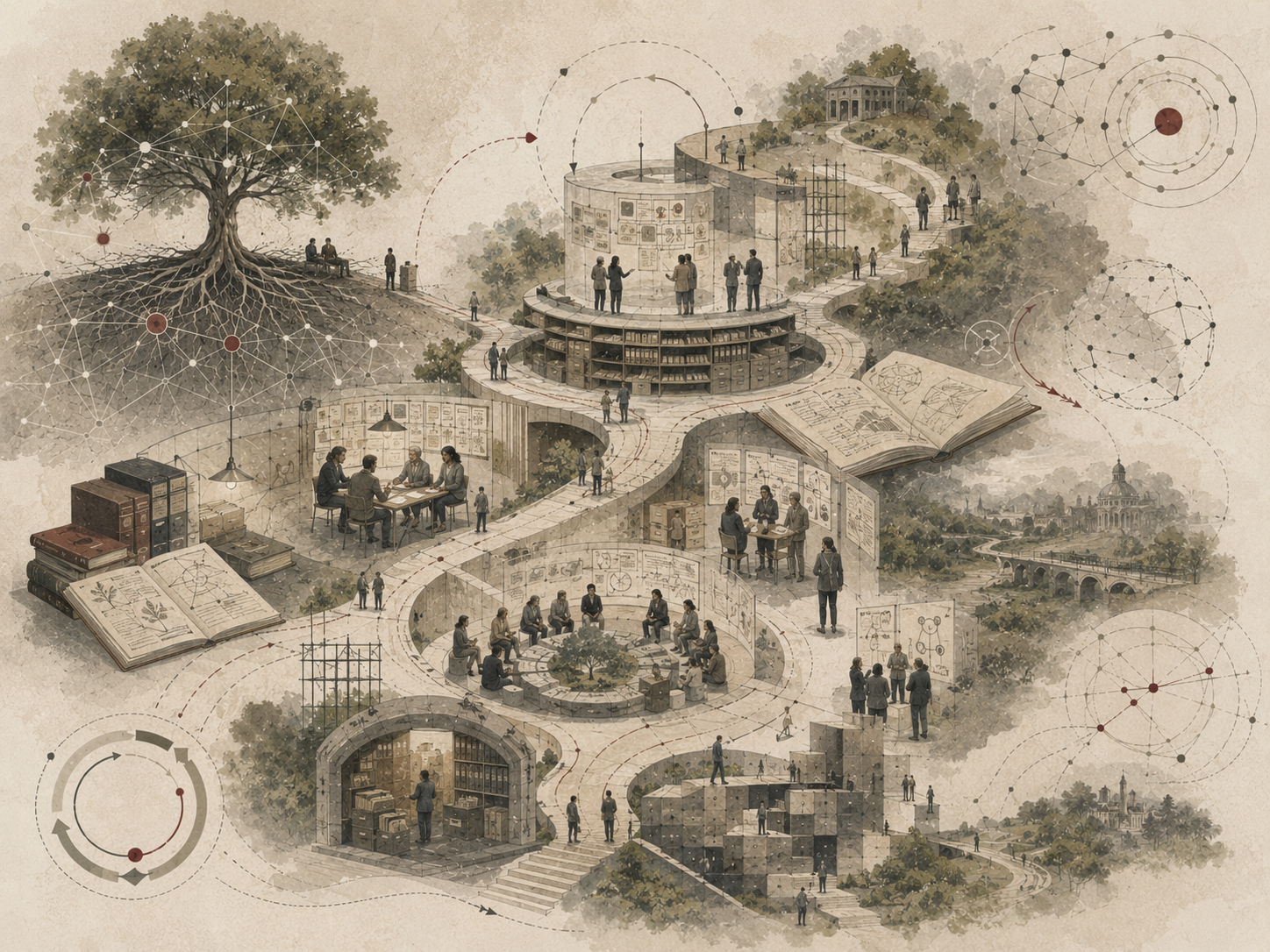
Learning organizations convert experience into institutional knowledge through systems that support creation, interpretation, storage, sharing, and application across the organization.
What a Learning Organization Really Is
A learning organization is an institution designed to improve its own capacity for perception, interpretation, and adaptation. This means more than absorbing information. It means developing the institutional ability to distinguish signal from noise, revise routines in light of evidence, and embed new understanding into decision systems, workflows, governance arrangements, and collective norms. Learning in this sense is not a private mental act occurring inside individual employees. It is a social and structural process through which organizations change what they know, how they know it, and what they are able to do because of it.
Many organizations use the language of learning loosely. They equate learning with training volume, access to development resources, or a general ethos of improvement. Those things may matter, but they do not by themselves create a learning organization. A true learning organization institutionalizes feedback. It creates recurring mechanisms through which experience is examined, assumptions are tested, errors are surfaced, expertise is shared, and operating models are revised. It is less concerned with the symbolic performance of innovation than with the more demanding task of making adaptation routine, cumulative, and accountable.
This is why the learning organization occupies such an important place in organizational psychology. It brings together questions of cognition, power, communication, trust, structure, motivation, and institutional design. It asks whether organizations merely react to events or whether they develop the reflexive capacity to understand why events unfolded as they did. It asks whether knowledge remains trapped in silos or becomes part of the organization’s distributed intelligence. At its strongest, the concept points toward a model of institutional maturity in which learning is not episodic but constitutive.
The study of learning organizations also connects directly with other themes in this series, including Adaptive Organizations: Institutional Change and Strategic Transformation, Information Flow and Organizational Communication, Cognitive Bias in Institutional Decisions, Organizational Resilience in Complex Systems, and Decision-Making in Organizations. Together these topics illuminate how institutions interpret reality, distribute knowledge, challenge error, and redesign themselves in response to consequence.
Learning organizations should also be distinguished from organizations that merely produce large volumes of knowledge artifacts. A company can have dashboards, repositories, training systems, certification programs, and internal communications platforms while still failing to learn. The decisive question is whether knowledge changes institutional behavior. Does evidence reshape practice? Do errors alter routines? Do overlooked perspectives become visible? Does institutional memory survive leadership change? Do decision-makers revise assumptions when reality contradicts them? A learning organization is not defined by the existence of knowledge infrastructure alone, but by the relationship between knowledge infrastructure, institutional interpretation, and organizational action.
Organizational Learning as a Collective Process
Organizational learning differs from individual learning in both mechanism and consequence. Individuals may acquire skills, insights, or judgments through study and experience, but an organization learns only when those insights become embedded in shared systems. If a frontline employee discovers a recurring failure pattern but the institution does not capture, circulate, and operationalize that knowledge, the organization has not learned in any durable sense. Personal insight becomes organizational knowledge only when it enters routines, standards, relationships, technologies, or decision structures.
This means that organizational learning depends on translation. Experience must be interpreted, documented, communicated, legitimized, and made actionable. That translation process is difficult because organizations are composed of multiple groups with different incentives, vocabularies, time horizons, and definitions of evidence. Engineers, finance leaders, HR teams, executives, legal staff, operations managers, and frontline workers often see the same event through different institutional lenses. A learning organization must therefore do more than collect data; it must integrate interpretation across boundaries.
Collective learning also depends on retention. Institutions experience turnover, restructuring, mergers, leadership change, and strategic drift. Without mechanisms of institutional memory, lessons disappear with the people who learned them. Learning organizations counteract this erosion by preserving knowledge in documentation, technical systems, decision logs, communities of practice, review protocols, and cultural narratives that sustain continuity over time.
Learning as institutional rather than merely informational change
The strongest test of organizational learning is not whether new information exists, but whether the institution behaves differently because of it. Learning is real when governance shifts, procedures change, coordination improves, incentive systems are revised, or strategic assumptions are reformulated. In this sense, organizational learning is inseparable from institutional change.
Collective learning also requires that the organization possess mechanisms for distinguishing isolated experience from patterned evidence. A single complaint, incident, delay, or failed project may appear anecdotal when viewed locally. But across time, such events may reveal deeper problems in staffing design, workflow logic, communication structure, incentive systems, or leadership interpretation. Learning organizations are able to connect local signals to systemic diagnosis. They ask not only “what happened?” but “what does this reveal about how the organization works?”
This makes organizational learning both psychological and institutional. It involves attention, interpretation, memory, motivation, and judgment, but these psychological processes are shaped by hierarchy, culture, technology, reporting systems, norms, and power. The learning organization is therefore not merely a collection of curious individuals. It is an institution that makes curiosity operationally consequential.
| Level of learning | Primary mechanism | Organizational requirement | Failure mode |
|---|---|---|---|
| Individual learning | Skill acquisition, reflection, experience, professional development | Time, support, coaching, meaningful work, feedback | Knowledge remains private and disappears with turnover |
| Team learning | Shared reflection, coordination, mutual correction, collective problem-solving | Psychological safety, role clarity, communication routines | Teams improvise locally but lessons remain trapped within the group |
| Organizational learning | Institutional memory, revised routines, governance review, knowledge systems | Documentation, cross-boundary circulation, decision authority, accountability | Information is collected but does not change institutional behavior |
| Institutional learning | Deep revision of assumptions, metrics, incentives, authority, and purpose | Double-loop inquiry, ethical review, leadership openness, structural redesign | The organization improves execution while preserving flawed premises |
These levels are connected, but they are not interchangeable. An organization can invest heavily in individual development while failing to learn collectively. It can have smart teams that compensate for poor institutional systems. It can generate impressive documentation while preserving old assumptions. The learning organization exists only when insight moves from individual and local experience into durable organizational capability.
Single-Loop, Double-Loop, and Deeper Institutional Learning
One of the most important contributions to the field came from Chris Argyris and Donald Schön, who distinguished between single-loop and double-loop learning. In single-loop learning, organizations detect and correct deviations while leaving the governing framework intact. A process underperforms, so it is adjusted. A target is missed, so implementation is tightened. Error is corrected without challenging the assumptions that produced the error environment.
Double-loop learning is more demanding. Here, organizations examine the governing variables themselves: the assumptions, policies, metrics, norms, and strategic beliefs that shape action. A sales team may not simply revise tactics, but ask whether the incentive structure is producing counterproductive behavior. A hospital may not merely improve throughput, but question whether the performance system is undermining care quality. A university may not just improve communication, but examine whether its governance structure is preventing knowledge from moving across departments. Double-loop learning therefore expands learning from operational correction to institutional self-examination.
There is also reason to speak more broadly of deeper or more reflexive forms of learning in which institutions do not simply revise strategy, but develop the capability to reflect on how they learn. This includes questioning who is permitted to define problems, what evidence is treated as legitimate, which voices are structurally ignored, and how culture influences organizational interpretation. At that point, learning becomes not just a matter of feedback but of epistemic design.
Why double-loop learning is difficult
Double-loop learning threatens settled arrangements. It can challenge authority, expose hidden incentives, and reveal that apparently rational structures are reproducing error. For this reason, many organizations remain competent at single-loop correction but weak at deeper institutional revision. They improve execution while preserving the assumptions that make strategic failure likely.
The distinction can be seen in everyday organizational life. A customer complaint may lead to a revised script, a staffing problem may lead to a new scheduling rule, or a quality problem may lead to an additional checklist. These may be useful single-loop corrections. But deeper learning asks whether the service model, staffing assumptions, incentive structure, leadership priorities, technology platform, or governance process made the problem predictable. Double-loop learning does not reject operational correction. It asks whether correction is reaching the right level of causation.
| Learning type | Core question | Typical organizational action | Risk if overused alone |
|---|---|---|---|
| Single-loop learning | How do we correct this error? | Adjust procedure, retrain staff, tighten execution, revise a checklist | Symptoms are corrected while root assumptions remain intact |
| Double-loop learning | Why did our assumptions, metrics, incentives, or policies make this error likely? | Revise governance, incentives, authority, performance systems, or strategy | Can become threatening if not supported by psychological safety and legitimate process |
| Reflexive institutional learning | How do we decide what counts as knowledge, whose knowledge counts, and how learning occurs? | Redesign knowledge systems, review power relations, broaden participation, examine epistemic blind spots | Can become abstract if not connected back to operational practice |
Learning organizations need all three levels. Single-loop learning keeps operations responsive. Double-loop learning prevents the organization from becoming trapped in obsolete assumptions. Reflexive learning helps institutions examine the deeper conditions under which they interpret evidence, recognize harm, and decide who has authority to define reality.
Knowledge Systems and Institutional Memory
Learning organizations depend on knowledge systems that allow experience to become durable, transmissible, and usable across time and structure. These systems include formal mechanisms such as repositories, operating manuals, review archives, project retrospectives, analytics environments, and structured documentation. They also include informal mechanisms such as mentorship, communities of practice, cross-functional dialogue, and shared interpretive norms that determine whether knowledge actually moves through the organization.
A robust knowledge system typically involves several interlocking functions:
- Knowledge creation through inquiry, experimentation, problem-solving, and external scanning.
- Knowledge interpretation through sensemaking, comparison, and contextual analysis.
- Knowledge storage through archives, documentation, repositories, and institutional memory systems.
- Knowledge sharing through communication networks, cross-functional collaboration, and social learning structures.
- Knowledge application through policy revision, redesign of routines, strategic decisions, and operational change.
The weakness of many organizations lies not in knowledge generation but in knowledge integration. Important lessons may be known somewhere in the system yet remain unavailable where decisions are made. Expertise may exist but not circulate. Information may be stored but not retrieved. Documentation may be technically complete while practically useless. For this reason, a learning organization must be concerned not only with knowledge quantity but with epistemic accessibility and institutional usability.
These issues connect closely with Information Flow and Organizational Communication, because communication systems determine whether knowledge remains local, becomes shared, or disappears into procedural noise.
Institutional memory is especially important because organizations are historically layered. Decisions made years earlier may shape present constraints, yet the people who understand those decisions may have left. A platform may have been selected for reasons no one remembers. A policy may preserve a compromise that has outlived its context. A workaround may become routine without anyone documenting why it exists. Without memory, organizations repeatedly rediscover what they once knew, misinterpret inherited structures, and make avoidable mistakes under the illusion of novelty.
Strong institutional memory requires more than storage. It requires retrieval, interpretation, and use. A knowledge base that no one consults does not function as memory. A retrospective archive that is never connected to future planning does not function as learning. A dashboard that measures activity but not meaning does not preserve judgment. Learning organizations build memory systems that are searchable, contextual, governed, trusted, and integrated into actual work.
| Knowledge function | Organizational practice | Learning contribution | Common weakness |
|---|---|---|---|
| Creation | Experimentation, research, incident review, external scanning | Produces new information and insight | Novel information is generated but not legitimized |
| Interpretation | Sensemaking forums, cross-functional review, analytic discussion | Turns data and experience into meaning | Different groups interpret the same evidence in incompatible ways |
| Storage | Documentation, archives, repositories, decision logs | Preserves lessons beyond turnover and restructuring | Material is stored without context, quality control, or retrieval pathways |
| Sharing | Communities of practice, communication networks, mentoring | Moves knowledge across boundaries | Knowledge remains local because silos or status barriers block circulation |
| Application | Policy revision, workflow redesign, governance review, training update | Converts knowledge into changed practice | Learning remains symbolic because no authority or incentive supports change |
A serious learning organization therefore treats knowledge systems as institutional infrastructure. They are not merely tools for convenience. They shape what the organization can remember, what it can know, who can participate in interpretation, and whether insight can become action.
Knowledge Management, Sensemaking, and Institutional Usability
Knowledge management is often approached as a technical problem: how to store documents, organize repositories, tag information, manage access, and maintain searchable systems. These are important tasks, but they are not sufficient. Learning organizations require knowledge systems that are not only technically functional but institutionally usable. Information must appear in forms that decision-makers, teams, and communities of practice can interpret and apply.
Sensemaking is central here. Organizations do not respond directly to raw reality. They respond to interpreted reality: reports, narratives, metrics, categories, risk models, stories, assumptions, and institutional memories. A delay may be interpreted as an execution problem, a staffing problem, a vendor problem, a design problem, or a strategic problem. Each interpretation leads to different action. Learning organizations do not merely accumulate facts; they improve the quality of collective sensemaking.
Institutional usability also means that knowledge must meet people where work actually happens. A repository that requires excessive searching, uses unclear language, contains outdated documents, or lacks ownership will not support learning. A dashboard that displays indicators without explanation may create false confidence. A postmortem that identifies lessons but has no pathway into governance or workflow redesign may become performative. The usable knowledge system connects evidence to interpretation, responsibility, and action.
This has implications for artificial intelligence, analytics, and automated knowledge tools. These systems may help summarize documents, identify patterns, support search, and generate recommendations. But they can also reproduce bias, obscure context, accelerate misinformation, or create an illusion of understanding. A learning organization should use such tools within governance structures that preserve human judgment, transparency, accountability, and domain expertise.
Knowledge management becomes organizational learning only when it changes the institution’s capacity to perceive, reason, coordinate, and adapt. The difference is not cosmetic. Knowledge management asks whether information is available. Organizational learning asks whether information becomes institutionally consequential.
Senge and the Learning Organization Tradition
The concept of the learning organization gained much of its wider influence through Peter Senge’s The Fifth Discipline, which framed learning organizations as institutions capable of sustained collective reflection and improvement. Senge’s approach is especially important because it resisted purely technical views of knowledge management. He argued that learning organizations require a set of disciplines that shape how individuals and groups perceive systems, develop competence, question assumptions, and align around shared purpose.
Senge identified five core disciplines:
- Systems thinking, which emphasizes interdependence, feedback, delay, and unintended consequence.
- Personal mastery, which concerns disciplined individual growth and reflective competence.
- Mental models, which require examining the assumptions that structure perception and action.
- Shared vision, which aligns collective effort around meaningful institutional purpose.
- Team learning, which develops collaborative inquiry and collective intelligence.
These disciplines remain valuable not because they offer a universal recipe, but because they show that organizational learning is simultaneously cognitive, relational, structural, and strategic. Systems thinking prevents the organization from treating isolated symptoms as self-contained problems. Mental models draw attention to hidden assumptions. Team learning emphasizes that knowledge must become collective to matter institutionally. Shared vision connects learning to legitimacy and direction rather than mere adaptation for its own sake.
At the same time, Senge’s framework should be read alongside more critical traditions in organizational psychology. Learning does not occur in a power vacuum. Shared vision can be genuine, but it can also become ideological if dissent is suppressed. Team learning can be productive, but only where authority structures permit real challenge. Serious analysis therefore benefits from combining Senge’s constructive model with more rigorous attention to bias, hierarchy, and governance.
Systems thinking is particularly important for the learning organization because many organizational failures arise from delayed consequences and feedback loops. An institution may cut staffing to improve short-term efficiency, only to increase burnout, turnover, quality problems, and future costs. A department may optimize its own metrics while degrading performance elsewhere in the system. A leadership team may interpret low reporting as evidence of stability when it actually reflects fear or silence. Systems thinking helps organizations avoid the illusion that local metrics represent whole-system health.
| Senge discipline | Organizational psychology interpretation | Learning organization contribution |
|---|---|---|
| Systems thinking | Attention to interdependence, feedback, delay, and unintended consequence | Prevents narrow fixes that shift problems elsewhere |
| Personal mastery | Disciplined professional development and reflective competence | Supports individual growth that can contribute to collective capability |
| Mental models | Examination of hidden assumptions, cognitive frames, and interpretive habits | Enables deeper revision rather than surface correction |
| Shared vision | Collective orientation around legitimate and meaningful purpose | Connects learning to institutional direction and motivation |
| Team learning | Collaborative inquiry, dialogue, and distributed intelligence | Turns knowledge into coordinated practice |
Senge’s tradition remains influential because it insists that organizations must learn as wholes. Yet the framework is strongest when paired with attention to power, psychological safety, and institutional accountability. Shared vision without dissent can become conformity. Team learning without authority to change systems can become frustration. Systems thinking without governance can become analysis without action. The mature learning organization integrates these disciplines into a wider institutional architecture of review, memory, voice, and redesign.
Barriers to Organizational Learning
Despite the appeal of the learning organization, many institutions fail to learn well. Some of the most common barriers are structural. Departmental silos isolate expertise. Complex hierarchies filter weak signals before they reach formal authority. Fragmented technology systems trap knowledge in incompatible platforms. Short planning cycles privilege immediate output over reflection. High turnover erodes institutional memory before it can be consolidated.
Other barriers are cultural and political. Employees may fear the interpersonal or career cost of raising concerns. Leaders may interpret challenge as disloyalty. Incentive systems may reward visible success while punishing candid disclosure of failure. Metrics may narrow attention so aggressively that only what is measurable is treated as real. In such environments, organizations become capable of reporting activity without learning from it. They create information but not institutional intelligence.
Cognitive barriers matter as well. Institutions are vulnerable to confirmation bias, escalation of commitment, status quo bias, and defensive reasoning. Once a strategic narrative becomes established, contradictory evidence may be reinterpreted, minimized, or ignored. That is why learning organizations must also be understood in relation to Cognitive Bias in Institutional Decisions and Organizational Culture and Shared Norms. Learning is blocked not only by missing information, but by the inability or unwillingness to reinterpret what is already visible.
When success becomes a barrier
Success can inhibit learning as effectively as failure. Organizations that have performed well under previous conditions may infer that their routines are inherently sound. Past success can harden into doctrinal confidence, making adaptation more difficult precisely when environmental conditions begin to change. Learning organizations guard against this by institutionalizing review even during periods of apparent stability.
Another barrier is the separation of learning from authority. Employees may generate accurate diagnoses, teams may conduct thoughtful retrospectives, and analysts may identify significant patterns, but if those insights do not reach people with authority to change priorities, incentives, staffing, systems, or governance, learning remains incomplete. Many organizations have local intelligence without institutional conversion. They know more than they can act on.
There is also the problem of performative learning. Organizations may hold listening sessions, write lessons-learned reports, launch improvement initiatives, and announce cultural commitments while leaving the underlying system unchanged. This can be worse than no learning at all because it teaches people that candor has little consequence. Over time, employees become less likely to report problems, participate in reviews, or trust institutional language about improvement.
| Barrier | How it blocks learning | Typical symptom | Possible institutional response |
|---|---|---|---|
| Silos | Knowledge remains trapped in departments, platforms, or professional groups | Multiple teams rediscover the same problem independently | Cross-functional review, shared repositories, communities of practice |
| Fear and low psychological safety | Errors, dissent, and uncertainty do not surface | Leaders hear good news until failure becomes undeniable | Protected reporting, nonpunitive review, visible response to concerns |
| Metric fixation | Measured targets displace broader judgment | Teams optimize numbers while system quality deteriorates | Balanced scorecards, qualitative review, governance attention to unintended consequences |
| Turnover and memory loss | Knowledge leaves before it is codified or transferred | New teams repeat old mistakes | Decision logs, mentoring, transition protocols, institutional archives |
| Defensive leadership | Challenge is treated as threat rather than evidence | Bad news is softened, delayed, or reframed upward | Leadership development, review norms, independent escalation channels |
| Symbolic review | Lessons are documented but not implemented | Recurring failures produce similar reports | Action tracking, ownership, follow-up audits, governance review |
The learning organization must therefore be designed against its own tendency toward avoidance. Institutions naturally protect status, reputation, and routine. Learning requires structures that make reality harder to ignore and responsible adaptation easier to carry out.
Power, Voice, and Who Gets to Define Knowledge
A serious account of learning organizations must ask whose knowledge becomes organizational knowledge. Institutions are not neutral containers of information. They are structured by hierarchy, professional status, race, gender, class, geography, credentialing, contract status, language, disability, and proximity to formal authority. These structures shape whose observations are believed, whose warnings are ignored, whose expertise is recognized, and whose experience is treated as anecdotal rather than evidentiary.
Many organizational failures are failures of epistemic justice as much as technical coordination. Frontline workers may see risk before executives do. Administrative staff may understand process breakdowns that leadership dashboards miss. Marginalized employees may identify cultural harms that dominant groups normalize. Contractors, caregivers, service workers, junior staff, and community-facing employees may possess forms of knowledge that are institutionally inconvenient but operationally vital. A learning organization must create pathways for these forms of knowledge to enter decision systems without requiring people to carry excessive personal risk.
This does not mean that all claims are equally accurate or that organizations should abandon standards of evidence. It means that evidence systems must be designed with awareness of power. If the organization only recognizes knowledge that arrives through high-status channels, it will systematically blind itself. If it treats dissent as attitude rather than information, it will misread warning signals. If it preserves polished reports while excluding lived operational experience, it will confuse formal knowledge with complete knowledge.
Voice is therefore a structural issue. Suggestion boxes, surveys, and listening sessions may help, but they are insufficient if employees believe nothing will change or if raising concerns invites retaliation. Learning organizations must demonstrate that voice has institutional consequence. They need transparent review mechanisms, feedback loops, protections against retaliation, credible follow-through, and governance structures that treat marginalized knowledge as part of institutional intelligence rather than as a reputational inconvenience.
Power also shapes problem definition. The way an organization names a problem determines what solutions become thinkable. A high turnover rate may be defined as a recruiting challenge, a compensation problem, a management failure, a workload issue, a cultural problem, or a symptom of structural inequity. Each frame leads to different action. Learning organizations examine not only the problem but the politics of problem framing.
Learning, Innovation, and Dynamic Capabilities
Organizational learning is closely related to innovation, but the relationship is more complex than a simple equation of “more learning equals more creativity.” Learning matters because it improves sensing, interpretation, and reconfiguration. Institutions with strong learning capabilities are better able to detect changes in technology, regulation, stakeholder expectations, and competitive structure. They can identify emerging threats earlier, interpret anomalies more seriously, and redesign resources and routines more effectively.
This is why the concept of dynamic capabilities has been so influential. Dynamic capabilities theory emphasizes the organizational ability to sense environmental change, seize opportunities, and reconfigure internal assets. These processes are unthinkable without learning. Sensing requires scanning and interpretation. Seizing requires judgment and prioritization. Reconfiguring requires institutional willingness to revise established arrangements. Learning organizations therefore provide the epistemic foundation on which dynamic capabilities operate.
Yet learning should not be romanticized. Not every adaptation is wise, and not every innovation improves institutional quality. Organizations must distinguish between learning that strengthens legitimacy, competence, and resilience, and learning that merely accelerates opportunistic or destabilizing behavior. This is one reason why learning should remain connected to questions of governance, ethics, and long-term organizational purpose rather than being treated as an unqualified good.
The relationship between learning and adaptation also links this topic directly to Organizational Resilience in Complex Systems and Adaptive Organizations: Institutional Change and Strategic Transformation.
Innovation without learning can become novelty-seeking. Learning without authority can become frustration. Adaptation without ethical orientation can become institutional drift. The learning organization must therefore connect experimentation to governance. It should ask what is being tested, who bears the risk, what evidence will be considered, how success will be judged, what harms might occur, and how lessons will be incorporated into future practice.
Dynamic capabilities also depend on timing. Organizations that learn too slowly may miss environmental shifts. Organizations that change too quickly without sensemaking may destabilize themselves. Adaptive competence lies in the ability to regulate the pace and depth of change. Learning organizations maintain enough continuity to preserve identity and enough flexibility to revise inherited structures when conditions require it.
A Semi-Formal Model of Organizational Learning Capacity
Learning organizations cannot be reduced fully to equations, but semi-formal models can clarify the conditions under which institutional learning becomes more or less likely. One useful expression is to define organizational learning capacity as a function of information quality, interpretive openness, memory retention, cross-boundary communication, psychological safety, and governance support, moderated by complexity, fragmentation, and incentive distortion.
We can express this as:
L = \frac{(I \cdot O \cdot M \cdot C \cdot S \cdot G)}{(K + F + D)}
\]
Interpretation: Organizational learning capacity increases when information quality, interpretive openness, institutional memory, communication, psychological safety, and governance support reinforce one another. It decreases when complexity, fragmentation, and incentive distortion prevent knowledge from becoming usable institutional intelligence.
where:
- L = organizational learning capacity
- I = information quality and relevance
- O = interpretive openness to challenge and revision
- M = institutional memory retention
- C = cross-boundary communication and knowledge flow
- S = psychological safety for dissent, candor, and error reporting
- G = governance support for reflection and redesign
- K = environmental and task complexity
- F = organizational fragmentation and silo intensity
- D = incentive distortion that suppresses learning
This model highlights an essential point: learning degrades not only when information is weak, but when communication is blocked, safety is low, incentives are distorted, or institutional memory is thin. More data alone does not produce learning if the surrounding organization is not structured to absorb it.
We can also model knowledge retention over time:
M_{t+1} = M_t + \alpha K_t + \beta R_t – \gamma T_t
\]
Interpretation: Institutional memory grows through codified knowledge and reflective review, but it erodes when turnover, neglect, or fragmentation remove the people, systems, and context that preserve what the organization has learned.
where M is institutional memory, K is newly codified knowledge, R is reflective review intensity, and T is turnover or memory loss. This captures a recurring organizational challenge: knowledge grows through codification and reflection, but decays when turnover, neglect, or system fragmentation erase what the institution once knew.
A related dynamic can be written for adaptive performance:
A_{t+1} = A_t + \lambda L_t – \mu B_t
\]
Interpretation: Adaptive performance improves when effective learning is stronger than accumulated bias, defensive reasoning, and institutional resistance. Organizations improve when they learn faster than their blind spots harden.
where A is adaptive performance, L is effective learning, and B is cumulative bias or defensive reasoning. This expresses a familiar truth in organizational psychology: institutions improve when they learn faster than their biases harden.
These expressions should be read as conceptual scaffolds rather than predictive laws. Their purpose is to discipline thinking. They make clear that learning is not a simple function of data volume, employee intelligence, or leadership rhetoric. It depends on the configuration of systems that allow information to be interpreted, remembered, challenged, circulated, and acted upon.
Governance, Culture, and the Conditions of Real Learning
Whether organizations learn depends heavily on governance and culture. Governance matters because it determines who has authority to question routines, how evidence is escalated, and whether reflection has procedural standing rather than depending on goodwill alone. Organizations that treat review as optional, marginal, or politically dangerous usually learn unevenly. Institutions that formalize review, documentation, challenge, and redesign are more likely to convert feedback into institutional change.
Culture matters because it shapes what can be spoken and what must remain unspoken. A culture of defensiveness turns learning into reputational risk. A culture of performative optimism treats concern as negativity. A culture of blame may produce surface accountability while discouraging the deeper inquiry needed for structural improvement. By contrast, cultures that value candor, disciplined review, and serious interpretation are more likely to preserve epistemic integrity.
Psychological safety is especially important here, though it should not be reduced to comfort or informality. In the context of learning organizations, psychological safety functions as an epistemic condition: it increases the probability that uncertainty, error, anomaly, and dissent will enter the system before they become catastrophic. Institutions cannot learn from information that never becomes speakable.
This is why the learning organization is not a purely technical model of knowledge management. It is an institutional model of how organizations create the conditions under which truth can move, memory can endure, and revision can occur without collapse of legitimacy or coordination.
Governance also determines whether learning has consequences. A review process without authority is easily ignored. A survey without accountability becomes ritual. A knowledge repository without ownership decays. A lesson-learned report without follow-up becomes documentation theater. Learning organizations build procedural links between reflection and decision. They define who is responsible for acting on findings, what resources are required, how changes will be evaluated, and when the organization will revisit whether the learning has actually taken hold.
Culture determines whether these governance systems are lived sincerely or performed superficially. The same after-action review can produce real learning in one organization and defensive justification in another. The difference lies in whether people believe evidence matters, whether leaders tolerate discomfort, whether dissent is protected, and whether the organization values truth over reputation management.
| Condition | Learning function | Institutional design question |
|---|---|---|
| Psychological safety | Allows error, dissent, and uncertainty to surface | Can people raise problems without retaliation or ridicule? |
| Governance support | Connects reflection to authority and resource allocation | Who has responsibility to act on what the organization learns? |
| Documentation quality | Preserves knowledge across time and turnover | Is knowledge recorded in ways that are usable, contextual, and maintained? |
| Cross-boundary communication | Moves knowledge across silos and status groups | Where does knowledge get stuck, filtered, or translated poorly? |
| Incentive alignment | Supports candor and long-term improvement | Are people rewarded for learning or only for appearing successful? |
| Leadership interpretation | Frames evidence as threat, noise, or institutional intelligence | Do leaders treat uncomfortable information as a resource? |
The conditions of real learning are therefore practical and moral at the same time. They involve workflow, documentation, and governance, but they also involve courage, legitimacy, trust, and institutional humility.
Measurement, Diagnosis, and Learning Reviews
Because organizational learning is often intangible, institutions may struggle to evaluate it. They may count training hours, course completions, knowledge-base entries, meeting attendance, or survey scores. These measures may provide useful signals, but they are not sufficient. A learning organization must assess whether knowledge changes behavior, whether memory persists, whether feedback reaches authority, and whether revised assumptions improve institutional action.
Useful diagnostic indicators include after-action review quality, implementation of lessons learned, cross-functional knowledge sharing, time to update procedures after incidents, documentation use, psychological safety, error reporting rates, knowledge-base maintenance, turnover-related knowledge loss, and the degree to which governance systems respond to evidence. Yet each indicator must be interpreted carefully. High reporting may signal dysfunction or transparency. Low reporting may signal stability or silence. Frequent documentation updates may indicate learning or disorder. Measurement requires qualitative interpretation.
| Learning diagnosis area | Possible evidence | Interpretive caution |
|---|---|---|
| Feedback capture | Incident reviews, customer feedback, employee voice, operational logs | Captured feedback may still exclude low-status or marginalized voices |
| Interpretive quality | Root-cause analysis, cross-functional review, dissent records | Formal analysis can still preserve politically safe explanations |
| Memory retention | Decision logs, documentation, transition plans, repository usage | Stored information may not be retrievable or trusted |
| Knowledge circulation | Communities of practice, network analysis, communication audits | High communication volume does not necessarily mean meaningful learning |
| Action conversion | Policy changes, workflow redesign, resource allocation, governance decisions | Action may be symbolic if it does not alter underlying conditions |
| Learning durability | Follow-up review, recurrence reduction, sustained practice change | Short-term compliance may fade after attention shifts |
A serious learning review should therefore combine quantitative and qualitative evidence. Data can reveal patterns, but interviews, focus groups, document review, and observation can explain meaning. In many organizations, the most important learning signals exist in the gap between formal reporting and lived practice. Workers may know which procedures are unrealistic, which dashboards mislead, which handoffs are fragile, and which recurring failures have been normalized. A learning organization must be able to hear that knowledge.
Measurement should also be ethically bounded. Learning analytics should not become surveillance. Knowledge systems should not be used to monitor individual compliance in ways that chill candor or punish dissent. The purpose of learning diagnosis is institutional improvement, not individual control. If people believe learning systems are being used against them, they will rationally withhold the very knowledge the organization needs.
R: Modeling Learning Capacity Across Organizational Units
The following R workflow models organizational learning capacity across units by combining information quality, interpretive openness, memory retention, communication flow, psychological safety, governance support, fragmentation, and incentive distortion. It also estimates which variables are associated with adaptive improvement over time.
library(dplyr)
library(ggplot2)
library(lme4)
library(scales)
library(broom.mixed)

set.seed(321)

n_units <- 28
n_periods <- 18

learning_data <- expand.grid(
  unit_id = factor(paste0("Unit_", seq_len(n_units))),
  period = seq_len(n_periods)
) %>%
  arrange(unit_id, period) %>%
  mutate(
    information_quality = pmin(pmax(rnorm(n(), 71, 10), 25), 95),
    interpretive_openness = pmin(pmax(rnorm(n(), 63, 12), 15), 95),
    memory_retention = pmin(pmax(rnorm(n(), 66, 11), 20), 95),
    communication_flow = pmin(pmax(rnorm(n(), 68, 12), 20), 95),
    psychological_safety = pmin(pmax(rnorm(n(), 65, 13), 15), 95),
    governance_support = pmin(pmax(rnorm(n(), 61, 14), 10), 95),
    complexity_load = pmin(pmax(rnorm(n(), 58, 14), 10), 98),
    silo_intensity = pmin(pmax(rnorm(n(), 50, 16), 5), 95),
    incentive_distortion = pmin(pmax(rnorm(n(), 47, 15), 5), 95),
    leadership_change = rbinom(n(), 1, 0.14)
  ) %>%
  group_by(unit_id) %>%
  mutate(unit_effect = rnorm(1, 0, 4)) %>%
  ungroup() %>%
  mutate(
    learning_capacity =
      0.18 * information_quality +
      0.18 * interpretive_openness +
      0.16 * memory_retention +
      0.16 * communication_flow +
      0.13 * psychological_safety +
      0.11 * governance_support -
      0.10 * complexity_load -
      0.12 * silo_intensity -
      0.13 * incentive_distortion -
      3.8  * leadership_change +
      unit_effect +
      rnorm(n(), 0, 4.5),
    learning_capacity = pmin(pmax(learning_capacity, 0), 100),
    adaptive_improvement_prob =
      plogis(
        -2.0 +
        0.040 * learning_capacity +
        0.020 * interpretive_openness +
        0.015 * governance_support -
        0.018 * silo_intensity -
        0.020 * incentive_distortion
      ),
    adaptive_improvement = rbinom(n(), 1, adaptive_improvement_prob)
  )

learning_model <- lmer(
  learning_capacity ~
    information_quality +
    interpretive_openness +
    memory_retention +
    communication_flow +
    psychological_safety +
    governance_support +
    complexity_load +
    silo_intensity +
    incentive_distortion +
    leadership_change +
    (1 | unit_id),
  data = learning_data
)

summary(learning_model)

adaptation_model <- glm(
  adaptive_improvement ~
    learning_capacity +
    interpretive_openness +
    governance_support +
    silo_intensity +
    incentive_distortion,
  family = binomial(),
  data = learning_data
)

summary(adaptation_model)
exp(coef(adaptation_model))

unit_dashboard <- learning_data %>%
  group_by(unit_id) %>%
  summarise(
    avg_learning_capacity = mean(learning_capacity),
    avg_memory_retention = mean(memory_retention),
    avg_communication_flow = mean(communication_flow),
    avg_psychological_safety = mean(psychological_safety),
    avg_silo_intensity = mean(silo_intensity),
    adaptive_improvement_rate = mean(adaptive_improvement),
    .groups = "drop"
  ) %>%
  mutate(
    learning_risk_index = rescale(
      (100 - avg_learning_capacity) * 0.35 +
      avg_silo_intensity * 0.20 +
      (100 - avg_psychological_safety) * 0.15 +
      (100 - avg_memory_retention) * 0.15 +
      (1 - adaptive_improvement_rate) * 100 * 0.15,
      to = c(0, 100)
    )
  ) %>%
  arrange(desc(learning_risk_index))

print(unit_dashboard)

ggplot(unit_dashboard, aes(x = reorder(unit_id, learning_risk_index), y = learning_risk_index)) +
  geom_col() +
  coord_flip() +
  labs(
    title = "Learning Risk by Organizational Unit",
    x = "Unit",
    y = "Risk Index (0-100)"
  ) +
  theme_minimal()

ggplot(learning_data, aes(x = interpretive_openness, y = learning_capacity)) +
  geom_point(alpha = 0.45) +
  geom_smooth(method = "lm", se = TRUE) +
  labs(
    title = "Interpretive Openness and Learning Capacity",
    x = "Interpretive Openness",
    y = "Learning Capacity"
  ) +
  theme_minimal()

review_table <- learning_data %>%
  mutate(
    review_priority = case_when(
      learning_capacity < 45 ~ "Immediate Review",
      learning_capacity < 60 ~ "Structured Review",
      TRUE ~ "Routine Monitoring"
    )
  ) %>%
  select(
    unit_id,
    period,
    learning_capacity,
    information_quality,
    interpretive_openness,
    memory_retention,
    communication_flow,
    psychological_safety,
    governance_support,
    silo_intensity,
    incentive_distortion,
    adaptive_improvement,
    review_priority
  ) %>%
  arrange(learning_capacity)

head(review_table, 20)
This analytic structure is useful because it operationalizes learning as an institutional capability rather than a vague aspiration. In practice, these measures could be informed by employee surveys, knowledge-base use data, after-action review quality, cross-functional communication audits, governance documentation, and retention of critical process knowledge.
The workflow is also useful because it keeps the unit of analysis at the organizational or departmental level. It does not attempt to score individual workers. It asks instead where knowledge conditions appear stronger or weaker, where fragmentation may be blocking adaptive improvement, and where governance support may be needed. Used responsibly, such modeling can support institutional review, not personnel judgment.
Mixed-effects modeling is appropriate here because organizational units differ in baseline conditions. A unit may have stronger knowledge practices because of its history, leadership, staffing stability, professional norms, or technological environment. Ignoring these unit-level differences can produce misleading conclusions. A learning organization must understand both system-wide patterns and local conditions.
Python: Simulating Learning, Adaptation, and Knowledge Loss
The following Python example simulates how organizations with different levels of communication quality, interpretive openness, institutional memory, safety, and silo intensity perform over time. It estimates the probability of adaptive improvement and models the erosion of learning under turnover and fragmentation.
import numpy as np
import pandas as pd
from sklearn.linear_model import LogisticRegression
from sklearn.model_selection import train_test_split
from sklearn.metrics import classification_report, roc_auc_score

np.random.seed(321)

n_orgs = 2200

df = pd.DataFrame({
    "information_quality": np.clip(np.random.normal(0.72, 0.11, n_orgs), 0.15, 0.98),
    "interpretive_openness": np.clip(np.random.normal(0.64, 0.14, n_orgs), 0.05, 0.98),
    "memory_retention": np.clip(np.random.normal(0.67, 0.13, n_orgs), 0.05, 0.98),
    "communication_flow": np.clip(np.random.normal(0.69, 0.12, n_orgs), 0.05, 0.98),
    "psychological_safety": np.clip(np.random.normal(0.65, 0.15, n_orgs), 0.05, 0.98),
    "governance_support": np.clip(np.random.normal(0.61, 0.15, n_orgs), 0.05, 0.98),
    "complexity_load": np.clip(np.random.normal(0.58, 0.15, n_orgs), 0.05, 0.99),
    "silo_intensity": np.clip(np.random.normal(0.49, 0.18, n_orgs), 0.01, 0.99),
    "incentive_distortion": np.clip(np.random.normal(0.45, 0.17, n_orgs), 0.01, 0.99),
    "turnover_pressure": np.clip(np.random.normal(0.37, 0.18, n_orgs), 0.00, 0.95)
})

df["learning_capacity"] = (
    2.0 * df["information_quality"] +
    1.8 * df["interpretive_openness"] +
    1.5 * df["memory_retention"] +
    1.6 * df["communication_flow"] +
    1.3 * df["psychological_safety"] +
    1.1 * df["governance_support"] -
    1.0 * df["complexity_load"] -
    1.4 * df["silo_intensity"] -
    1.3 * df["incentive_distortion"] -
    0.8 * df["turnover_pressure"] +
    np.random.normal(0, 0.30, n_orgs)
)

df["adaptive_improvement_score"] = (
    1.2 * df["learning_capacity"] +
    0.6 * df["interpretive_openness"] +
    0.5 * df["governance_support"] -
    0.9 * df["incentive_distortion"] -
    0.7 * df["silo_intensity"] +
    np.random.normal(0, 0.35, n_orgs)
)

df["adaptive_improvement"] = (df["adaptive_improvement_score"] > 1.10).astype(int)

df["knowledge_decay_risk"] = (
    0.32 * (1 - df["memory_retention"]) +
    0.18 * df["turnover_pressure"] +
    0.16 * df["silo_intensity"] +
    0.12 * (1 - df["communication_flow"]) +
    0.10 * (1 - df["governance_support"]) +
    0.12 * df["incentive_distortion"]
)

features = [
    "information_quality",
    "interpretive_openness",
    "memory_retention",
    "communication_flow",
    "psychological_safety",
    "governance_support",
    "complexity_load",
    "silo_intensity",
    "incentive_distortion",
    "turnover_pressure"
]

X = df[features]
y = df["adaptive_improvement"]

X_train, X_test, y_train, y_test = train_test_split(
    X,
    y,
    test_size=0.25,
    random_state=321,
    stratify=y
)

model = LogisticRegression(max_iter=3000)
model.fit(X_train, y_train)

pred = model.predict(X_test)
proba = model.predict_proba(X_test)[:, 1]

print("AUC:", roc_auc_score(y_test, proba))
print(classification_report(y_test, pred))

coef_table = pd.DataFrame({
    "feature": features,
    "coefficient": model.coef_[0]
}).sort_values("coefficient", ascending=False)

print(coef_table)

# Scenario comparison
scenarios = pd.DataFrame([
    {
        "information_quality": 0.83,
        "interpretive_openness": 0.81,
        "memory_retention": 0.80,
        "communication_flow": 0.84,
        "psychological_safety": 0.82,
        "governance_support": 0.74,
        "complexity_load": 0.52,
        "silo_intensity": 0.18,
        "incentive_distortion": 0.16,
        "turnover_pressure": 0.20
    },
    {
        "information_quality": 0.58,
        "interpretive_openness": 0.39,
        "memory_retention": 0.42,
        "communication_flow": 0.46,
        "psychological_safety": 0.37,
        "governance_support": 0.41,
        "complexity_load": 0.67,
        "silo_intensity": 0.73,
        "incentive_distortion": 0.61,
        "turnover_pressure": 0.55
    }
])

scenario_probs = model.predict_proba(scenarios[features])[:, 1]
scenarios["predicted_adaptive_improvement_probability"] = scenario_probs

scenarios["knowledge_decay_risk"] = (
    0.32 * (1 - scenarios["memory_retention"]) +
    0.18 * scenarios["turnover_pressure"] +
    0.16 * scenarios["silo_intensity"] +
    0.12 * (1 - scenarios["communication_flow"]) +
    0.10 * (1 - scenarios["governance_support"]) +
    0.12 * scenarios["incentive_distortion"]
)

print(scenarios)

risk_summary = df.groupby(pd.qcut(df["knowledge_decay_risk"], 5)).agg(
    mean_adaptive_improvement=("adaptive_improvement", "mean"),
    avg_learning_capacity=("learning_capacity", "mean"),
    avg_psychological_safety=("psychological_safety", "mean"),
    avg_memory_retention=("memory_retention", "mean")
)

print(risk_summary)
This simulation is useful for people analytics, organizational diagnostics, knowledge-governance design, and scenario testing. It also reinforces a central insight of the field: organizations do not become adaptive merely by hiring smart people. They become adaptive when they preserve the institutional conditions under which knowledge can move, accumulate, and alter coordinated action.
The scenario comparison is particularly useful. Two organizations may possess similar technical talent but differ dramatically in interpretive openness, psychological safety, memory retention, and silo intensity. The model shows that learning is not simply a function of individual competence. It is a function of the organizational environment that determines whether competence becomes collective intelligence.
The knowledge-decay component is equally important. Organizations often assume that knowledge, once created, remains available. In practice, knowledge decays through turnover, platform fragmentation, undocumented workarounds, abandoned repositories, and loss of context. Modeling decay risk helps make visible one of the most overlooked problems in organizational learning: the institution can forget even when no one intends it to forget.
These examples should be used only for synthetic-data research, methods demonstration, institutional learning, and reproducible workflows. They should not be used for employee screening, employment selection, hiring, promotion, compensation, discipline, termination, workplace surveillance, individual performance management, or psychological assessment. The appropriate use is to support institutional reflection about systems, not to label or score individual workers.
GitHub Repository
The companion repository for this article organizes the computational materials for this topic, including synthetic datasets, reproducible workflows, documentation, validation notes, and responsible-use guidance for organizational psychology research.
Complete Code Repository
Access the full companion repository for this article, including reproducible analysis materials, synthetic datasets, R and Python workflows, multi-language examples, documentation, validation notes, and responsible interpretation materials.
Interpretive Cautions and Limits
The language of learning organizations can become superficial if not handled carefully. First, learning is not always virtuous in itself. Institutions can learn how to optimize extraction, intensify surveillance, or refine harmful practices. Learning must therefore be evaluated in relation to purpose, legitimacy, ethics, and long-term consequence.
Second, not every form of knowledge can be codified. Some organizational understanding remains tacit, relational, and context-bound. Excessive faith in documentation systems can obscure the role of mentorship, judgment, and situated expertise. Strong learning organizations preserve both explicit and tacit forms of institutional knowledge.
Third, learning requires slack, time, and procedural legitimacy. Organizations that are chronically overloaded may valorize learning rhetorically while structurally preventing it. Continuous pressure can crowd out reflection, review, and experimentation. In such settings, the absence of learning is often a design outcome rather than a motivational failure.
Finally, not all change reflects learning. Organizations sometimes change because of coercion, imitation, panic, or symbolic compliance. Serious analysis must distinguish adaptive learning from movement for its own sake. The relevant question is not simply whether the organization changed, but whether it learned in a way that improved its capacity for intelligent action.
A further caution concerns the misuse of learning analytics. Knowledge systems and organizational diagnostics can support institutional understanding, but they can also become instruments of surveillance if poorly governed. If employees believe that learning tools are used to monitor, rank, or punish them, the organization will damage the trust required for real learning. Responsible learning systems protect candor, privacy, and institutional purpose.
Learning organizations must also avoid the managerial fantasy that all knowledge can be made frictionless. Some forms of knowledge require conflict, dialogue, translation, and time. Some lessons are uncomfortable because they reveal failures of leadership, governance, equity, or ethics. A mature organization does not treat discomfort as evidence that learning has gone wrong. Often, discomfort is the sign that learning has reached the level where institutional change becomes possible.
Finally, learning must be connected to justice and legitimacy. An organization that learns only from dominant voices may become more efficient while remaining unequal. An organization that learns only what improves performance metrics may become more capable while becoming less humane. The deepest learning organizations ask not only how to improve, but what improvement means, who benefits, who bears the cost, and what forms of knowledge have been excluded from institutional memory.
Conclusion
Learning organizations are institutions that convert experience into durable, collective, and actionable knowledge. They do so by building structures through which information is interpreted, memory is preserved, communication flows across boundaries, assumptions are questioned, and feedback alters institutional behavior. In this sense, organizational learning is not a secondary support function. It is one of the central capacities through which institutions remain competent, adaptive, and legitimate under changing conditions.
The concept remains powerful because it reveals that adaptation depends not only on intelligence at the individual level, but on the design of systems that allow knowledge to become collective and consequential. Learning organizations do not merely gather insight; they institutionalize the conditions under which insight can survive turnover, challenge bias, reshape decisions, and improve coordinated action across time.
At their strongest, learning organizations are not simply better at training people or storing information. They are better at preserving truthfulness under pressure. They are better at detecting weak signals, hearing marginalized knowledge, revising flawed assumptions, and linking reflection to authority. They understand that institutional intelligence depends on culture, governance, memory, communication, psychological safety, and the ethical use of evidence.
The study of learning organizations therefore reveals a central theme of organizational psychology: institutions think through systems. They remember through structures. They perceive through culture. They adapt through governance. They learn only when knowledge becomes shared, interpreted, and consequential enough to change how the institution acts.
Return to the Organizational Psychology knowledge series
Related Articles
- Adaptive Organizations: Institutional Change and Strategic Transformation
- Information Flow and Organizational Communication
- Cognitive Bias in Institutional Decisions
- Organizational Resilience in Complex Systems
- Organizational Culture and Shared Norms
- Decision-Making in Organizations
- Psychological Safety in High-Performing Teams
- Leadership Styles and Organizational Performance
Further Reading
- Argyris, C. and Schön, D.A. (1996) Organizational Learning II: Theory, Method, and Practice. Reading, MA: Addison-Wesley. Available at: https://search.worldcat.org/title/35831782.
- Easterby-Smith, M. and Lyles, M.A. (eds.) (2011) Handbook of Organizational Learning and Knowledge Management, 2nd edn. Chichester: Wiley. Available at: https://onlinelibrary.wiley.com/doi/book/10.1002/9781119207245.
- Garvin, D.A. (1993) ‘Building a learning organization’, Harvard Business Review, 71(4), pp. 78–91. Available at: https://hbr.org/1993/07/building-a-learning-organization.
- Garvin, D.A., Edmondson, A.C. and Gino, F. (2008) ‘Is yours a learning organization?’, Harvard Business Review, 86(3), pp. 109–116. Available at: https://hbr.org/2008/03/is-yours-a-learning-organization.
- Senge, P.M. (2006) The Fifth Discipline: The Art and Practice of the Learning Organization, rev. edn. New York: Doubleday. Available at: https://www.penguinrandomhouse.com/books/16001/the-fifth-discipline-by-peter-m-senge/.
- Teece, D.J. (2007) ‘Explicating dynamic capabilities: The nature and microfoundations of (sustainable) enterprise performance’, Strategic Management Journal, 28(13), pp. 1319–1350. Available at: https://doi.org/10.1002/smj.640.
- Tsoukas, H. and Chia, R. (2002) ‘On organizational becoming: Rethinking organizational change’, Organization Science, 13(5), pp. 567–582. Available at: https://doi.org/10.1287/orsc.13.5.567.7810.
- Weick, K.E. (1995) Sensemaking in Organizations. Thousand Oaks, CA: Sage. Available at: https://us.sagepub.com/en-us/nam/sensemaking-in-organizations/book4985.
References
- Argyris, C. and Schön, D.A. (1978) Organizational Learning: A Theory of Action Perspective. Reading, MA: Addison-Wesley. Available at: https://openlibrary.org/books/OL4726192M/Organizational_learning.
- Argyris, C. and Schön, D.A. (1996) Organizational Learning II: Theory, Method, and Practice. Reading, MA: Addison-Wesley. Available at: https://search.worldcat.org/title/35831782.
- Crossan, M.M., Lane, H.W. and White, R.E. (1999) ‘An organizational learning framework: From intuition to institution’, Academy of Management Review, 24(3), pp. 522–537. Available at: https://doi.org/10.5465/amr.1999.2202135.
- Fiol, C.M. and Lyles, M.A. (1985) ‘Organizational learning’, Academy of Management Review, 10(4), pp. 803–813. Available at: https://journals.aom.org/doi/abs/10.5465/amr.1985.4279103.
- Garvin, D.A. (1993) ‘Building a learning organization’, Harvard Business Review, 71(4), pp. 78–91. Available at: https://hbr.org/1993/07/building-a-learning-organization.
- Garvin, D.A., Edmondson, A.C. and Gino, F. (2008) ‘Is yours a learning organization?’, Harvard Business Review, 86(3), pp. 109–116. Available at: https://hbr.org/2008/03/is-yours-a-learning-organization.
- Levitt, B. and March, J.G. (1988) ‘Organizational learning’, Annual Review of Sociology, 14, pp. 319–340. Available at: https://doi.org/10.1146/annurev.so.14.080188.001535.
- Nonaka, I. (1994) ‘A dynamic theory of organizational knowledge creation’, Organization Science, 5(1), pp. 14–37. Available at: https://doi.org/10.1287/orsc.5.1.14.
- Senge, P.M. (1990) The Fifth Discipline: The Art and Practice of the Learning Organization. New York: Doubleday. Available at: https://www.penguinrandomhouse.com/books/16001/the-fifth-discipline-by-peter-m-senge/.
- Teece, D.J. (2007) ‘Explicating dynamic capabilities: The nature and microfoundations of (sustainable) enterprise performance’, Strategic Management Journal, 28(13), pp. 1319–1350. Available at: https://doi.org/10.1002/smj.640.
- Weick, K.E. (1995) Sensemaking in Organizations. Thousand Oaks, CA: Sage. Available at: https://us.sagepub.com/en-us/nam/sensemaking-in-organizations/book4985.