
Last Updated July 6, 2026
Reproducible linear algebra workflows with notebooks and documentation explain how matrix-based analysis can be rerun, reviewed, validated, extended, and trusted. In systems modeling, reproducibility is not only about saving code. It is about preserving the full chain from mathematical question to matrix construction, computation, diagnostics, interpretation, figures, outputs, metadata, and governance review.
This article closes Part VIII of the Linear Algebra for Systems Modeling series by connecting notebooks, scripts, documentation, data provenance, environment files, package versions, random seeds, matrix schemas, validation checks, unit tests, diagnostic reports, generated outputs, version control, workflow automation, reproducible figures, computational narratives, audit trails, and responsible interpretation.
The central modeling question is not only “Can this notebook run once?” It is “Can another person understand, rerun, inspect, test, verify, and responsibly interpret the linear algebra workflow after the original analysis is complete?”
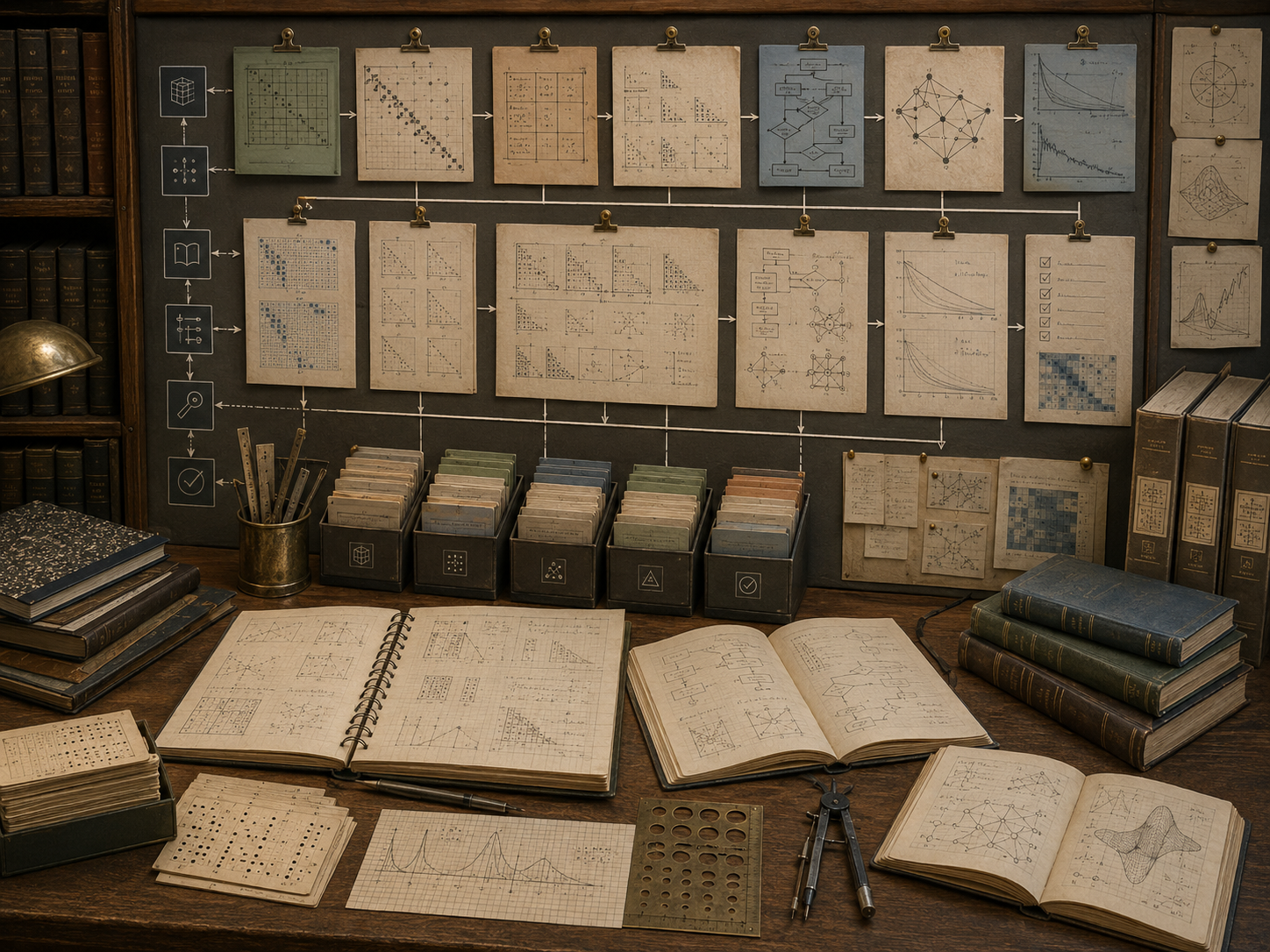
Linear algebra workflows often begin in exploration. A notebook is opened. A matrix is loaded. A solver is called. A figure is generated. A result is interpreted. But exploration is not the same as reproducibility. A notebook that runs only on one machine, depends on hidden data, omits package versions, overwrites outputs, lacks tests, and leaves assumptions undocumented is not a durable scientific workflow.
Reproducibility turns matrix analysis into a reviewable object. It makes clear how data became matrices, how operations were chosen, which diagnostics were computed, which outputs were generated, which environment was used, which assumptions were made, and what the results can and cannot support.
Why Reproducibility Matters
Reproducibility matters because linear algebra workflows often produce results that are later cited, reused, scaled, challenged, visualized, or built into larger systems. If the workflow cannot be rerun or inspected, the result becomes difficult to trust even when the mathematics is sound.
A matrix result may depend on many hidden choices: data cleaning, column ordering, unit conversion, scaling, missing-value handling, package versions, random seeds, solver tolerances, sparse storage formats, rank thresholds, and plotting decisions. Reproducibility makes those choices visible.
| Reproducibility risk | What can go wrong | Workflow response |
|---|---|---|
| Hidden data transformation | Matrix values cannot be traced to source data. | Document data provenance, schemas, and transformation steps. |
| Uncontrolled environment | Notebook produces different output on another machine. | Record package versions, numerical backend, and environment files. |
| Unclear execution order | Notebook state depends on cells run out of order. | Test clean execution from top to bottom. |
| Missing diagnostics | Final outputs lack residuals, conditioning, validation, or uncertainty. | Generate diagnostic artifacts as standard outputs. |
| Manual copy-paste reporting | Figures and tables drift from code outputs. | Generate reports directly from reproducible scripts. |
| No audit trail | Changes to assumptions or code cannot be reviewed. | Use version control, metadata, logs, and changelogs. |
Reproducibility is not bureaucracy. It is how computational work remains useful after the first successful run.
Notebooks as Computational Narratives
Notebooks are powerful because they combine prose, code, equations, tables, figures, and interpretation in one place. For linear algebra, this is especially useful: a notebook can introduce the matrix, show its construction, compute diagnostics, visualize structure, explain results, and link output to modeling purpose.
But notebooks can also create reproducibility problems. They may contain hidden state, stale outputs, manual edits, uncontrolled dependencies, large embedded data, or conclusions that no longer match the code. A good notebook is both exploratory and disciplined.
| Notebook strength | Notebook risk | Reproducible practice |
|---|---|---|
| Combines code and explanation. | Prose can drift from code. | Regenerate outputs and review narrative after changes. |
| Shows intermediate steps. | Execution order may be unclear. | Run from a clean kernel before publishing. |
| Supports visualization. | Figures may be manually modified or stale. | Generate figures from versioned code and data. |
| Encourages exploration. | Exploration can hide failed attempts and assumptions. | Separate exploratory notebooks from production workflows. |
| Readable for teaching. | May not scale to automation. | Move reusable logic into scripts or modules. |
The best notebooks are not isolated artifacts. They sit inside a documented repository with scripts, tests, data dictionaries, environment files, outputs, and review notes.
Notebooks, Scripts, and Repositories
Reproducible linear algebra workflows usually need more than a notebook. Notebooks are useful for explanation and exploration. Scripts are useful for automation. Repositories are useful for structure, versioning, collaboration, and review.
| Artifact | Best role | Risk if used alone |
|---|---|---|
| Notebook | Narrative computation, teaching, exploration, figures. | Can hide state, dependencies, and execution order. |
| Script | Repeatable command-line execution. | Can be opaque without documentation. |
| Module | Reusable tested functions. | Can detach computation from modeling context. |
| README | Purpose, structure, setup, commands, outputs. | Can become stale if not maintained. |
| Repository | Versioned workflow with code, data, docs, outputs, tests. | Can become cluttered without conventions. |
| Report | Generated summary of results and diagnostics. | Can overstate certainty if diagnostics are omitted. |
A mature workflow often uses notebooks for explanation, scripts for execution, modules for reusable logic, tests for reliability, and documentation for interpretation.
Documenting Matrix Construction
Matrix construction is the foundation of reproducible linear algebra. A matrix is not just an array of numbers. It is a representation of a system: rows, columns, values, zeros, units, missingness, scaling, weights, thresholds, and assumptions.
\text{source data} \longrightarrow \text{processing rules} \longrightarrow A,\mathbf{x},\mathbf{b}
\]
Interpretation: Reproducibility requires preserving how raw or processed data become the matrices and vectors used in computation.
| Matrix documentation item | Question answered | Example |
|---|---|---|
| Row definition | What does each row represent? | Node, sector, observation, constraint, document, region. |
| Column definition | What does each column represent? | Variable, feature, flow, time period, parameter. |
| Value definition | What do entries mean? | Weight, probability, coefficient, count, distance, similarity. |
| Zero semantics | Does zero mean none, missing, impossible, or unobserved? | No edge, no flow, unreported value, structural absence. |
| Units and scaling | How are magnitudes and units handled? | Dollars, tons, rates, standardized features, normalized rows. |
| Construction code | Can the matrix be rebuilt from source data? | Script or notebook cell that generates \(A\), \(\mathbf{x}\), and \(\mathbf{b}\). |
Without matrix construction documentation, reproducibility is only partial. A solver can be rerun, but the meaning of the input may remain unclear.
Data Provenance and Metadata
Data provenance records where data came from, when it was accessed, how it was processed, and how it was transformed. Metadata records the structure and meaning of files, fields, matrices, outputs, and workflows.
In linear algebra workflows, provenance and metadata are especially important because small changes in data processing can change matrix rank, conditioning, sparsity, singular values, eigenvalues, least-squares fits, or state trajectories.
| Metadata layer | What it records | Why it matters |
|---|---|---|
| Dataset metadata | Source, date, license, schema, access method. | Allows reviewers to identify data origin. |
| Matrix metadata | Shape, row meaning, column meaning, units, sparsity. | Preserves mathematical interpretation. |
| Computation metadata | Solver, tolerance, precision, package version, backend. | Supports numerical reproducibility. |
| Output metadata | File path, generation command, timestamp, input hash. | Connects results to exact workflow runs. |
| Interpretation metadata | Assumptions, limitations, uncertainty, review status. | Prevents overclaiming and supports governance. |
Metadata makes linear algebra workflows legible across time, teams, tools, and review contexts.
Environment Control and Dependencies
A notebook or script may depend on programming language versions, packages, numerical libraries, BLAS or LAPACK backends, sparse solvers, operating systems, hardware, random seeds, and file paths. If these dependencies are not controlled, reruns may fail or produce different outputs.
| Environment artifact | Workflow role | Example |
|---|---|---|
| Requirements file | Lists Python packages. | requirements.txt or pyproject.toml. |
| R lockfile | Records R package versions. | renv.lock. |
| Conda environment | Captures cross-language scientific stack. | environment.yml. |
| Container file | Defines operating system and dependencies. | Dockerfile. |
| Runtime metadata | Records actual versions during a run. | Generated JSON or log file. |
| Backend record | Documents numerical library implementation. | BLAS, LAPACK, OpenBLAS, MKL, Accelerate. |
Environment control does not guarantee substantive validity, but it is essential for computational reruns and debugging.
Randomness, Determinism, and Seeds
Some linear algebra workflows are deterministic. Others use randomness: randomized SVD, sampling, stochastic optimization, train-test splits, Monte Carlo simulation, bootstrap uncertainty, randomized projections, and approximate algorithms.
When randomness is used, reproducibility requires recording seeds, generators, sampling methods, data order, parallel settings, and nondeterministic hardware behavior where relevant.
| Randomness source | Example | Reproducible practice |
|---|---|---|
| Randomized decomposition | Randomized SVD or sketching. | Record seed, oversampling, iterations, and tolerance. |
| Sampling | Train-test split, bootstrap, subsampling. | Record seed and sampling frame. |
| Simulation | Monte Carlo state trajectories. | Record generator, seed, run count, and scenario settings. |
| Parallel execution | Operations run in different orders. | Record thread settings and nondeterminism warnings. |
| Approximate algorithms | Fast low-rank or nearest-neighbor methods. | Report approximation error and stability tests. |
A reproducible workflow can include randomness, but the randomness must be controlled and disclosed.
Validation, Tests, and Reference Cases
Reproducibility and correctness are related but different. A workflow can be reproducible and wrong. Testing checks whether code behaves as expected. Validation checks whether the workflow is meaningful for the system being modeled.
| Review type | Question answered | Linear algebra example |
|---|---|---|
| Unit test | Does a function behave correctly on a known case? | Matrix-vector product returns expected output. |
| Shape test | Are dimensions compatible? | \(A\mathbf{x}\) has the expected length. |
| Residual test | Does a computed solution satisfy the equation? | \(\|\mathbf{b}-A\hat{\mathbf{x}}\|\) is below tolerance. |
| Reconstruction test | Do factors reproduce the matrix? | \(\|A-U\Sigma V^T\|\) is small. |
| Edge-case test | Does the workflow handle difficult inputs? | Singular, near-singular, sparse, badly scaled, or rank-deficient matrix. |
| System validation | Does output match domain evidence or expectations? | Flow conservation, probability conservation, known benchmark behavior. |
Testing makes code reviewable. Validation makes the computational result meaningful for systems analysis.
Diagnostic Outputs and Reports
A reproducible workflow should produce more than final answers. It should produce diagnostic outputs that show whether the computation can be trusted: residuals, condition numbers, singular values, rank estimates, reconstruction errors, convergence histories, runtime metrics, memory summaries, warnings, and validation checks.
| Diagnostic artifact | What it shows | Recommended format |
|---|---|---|
| Residual table | Solver accuracy and equation satisfaction. | CSV and JSON. |
| Conditioning report | Sensitivity and numerical risk. | Markdown, JSON, figure. |
| Singular value summary | Rank, approximation, and low-dimensional structure. | CSV, figure, notebook cell. |
| Convergence log | Iterative solver behavior. | CSV and plain text log. |
| Validation report | Reference cases and domain checks. | Markdown or HTML report. |
| Run manifest | Inputs, outputs, environment, timestamp, command. | JSON manifest. |
Diagnostics should be generated automatically and saved with the workflow. They should not depend on memory or informal notes.
Version Control and Audit Trails
Version control records how code, documentation, and workflow artifacts change over time. For reproducible linear algebra, version control is not only a software practice. It is part of the scientific record.
Audit trails should show what changed, why it changed, who changed it, when it changed, and how the change affected outputs. This is especially important when matrix computations support institutional reports, policy analysis, infrastructure planning, model governance, or public-interest research.
| Audit element | What it records | Why it matters |
|---|---|---|
| Commit history | Code and documentation changes. | Shows workflow evolution. |
| Output manifest | Generated files and commands. | Connects results to runs. |
| Data version | Dataset release or hash. | Prevents silent data drift. |
| Parameter record | Tolerances, ranks, seeds, thresholds. | Preserves modeling assumptions. |
| Review note | Interpretation warnings and validation status. | Supports responsible use. |
Version control cannot make a bad model good, but it can make model development inspectable.
Reproducible Figures and Tables
Figures and tables are often the public face of linear algebra workflows. They summarize residuals, trajectories, singular values, feature projections, network structure, uncertainty, model outputs, and performance. If figures and tables are manually copied or edited, reproducibility weakens.
A reproducible workflow generates figures and tables directly from versioned inputs and scripts. It also records the commands used to generate them and saves the underlying data used for plotting.
| Output type | Reproducible requirement | Governance warning |
|---|---|---|
| Table | Generated from code and saved with schema. | Manual edits can break traceability. |
| Figure | Generated from saved data and plotting script. | Visual choices can reshape interpretation. |
| Report | Generated from current outputs and metadata. | Static prose can drift from computed results. |
| Dashboard | Connected to documented data and refresh logic. | Live updates can obscure historical reproducibility. |
| Notebook output | Recomputed from a clean run. | Stale outputs can mislead readers. |
Reproducible figures and tables preserve the connection between evidence, computation, and interpretation.
Workflow Automation and Continuous Review
Automation helps reproducibility by reducing manual steps. A workflow can define commands for data preparation, matrix construction, testing, diagnostics, figures, reports, and cleanup. Continuous review can run tests automatically when code changes.
| Automation layer | Purpose | Example |
|---|---|---|
| Makefile | Defines repeatable commands. | make test, make figures, make report. |
| Command-line interface | Runs workflows with explicit arguments. | python workflow.py --input data.csv --output outputs/. |
| Notebook execution tool | Runs notebooks from a clean state. | Notebook execution in CI or build scripts. |
| Continuous integration | Runs tests after changes. | Shape checks, residual checks, linting, schema validation. |
| Report generation | Builds documents from outputs. | Markdown, HTML, PDF, or site-ready summaries. |
Automation should make the workflow easier to audit. It should not hide assumptions or make failure states invisible.
Documentation Layers
Good documentation works at multiple levels. A README explains how to run the workflow. A data dictionary explains input meaning. Code comments clarify local logic. Mathematical notes explain formulas and assumptions. A report summarizes diagnostics and interpretation boundaries.
| Documentation layer | Audience | Purpose |
|---|---|---|
| README | New user or reviewer. | Explain purpose, setup, commands, folder structure, outputs. |
| Data dictionary | Analyst or domain reviewer. | Define rows, columns, units, missingness, transformations. |
| Mathematical notes | Technical reviewer. | Explain equations, solvers, diagnostics, assumptions, limitations. |
| Notebook prose | Reader following the analysis. | Connect computation to explanation and interpretation. |
| API or function docs | Developer or maintainer. | Explain reusable functions, parameters, return values, errors. |
| Governance report | Decision-maker or auditor. | Summarize assumptions, validation, uncertainty, and responsible use. |
Documentation should help someone else understand not only what the workflow does, but why it was designed that way.
Responsible Reproducibility
Reproducibility is necessary but not sufficient. A reproducible workflow can reproduce a biased dataset, a poor model, a misleading visualization, an invalid assumption, or an inappropriate interpretation. Responsible reproducibility pairs rerunnable computation with validation, uncertainty disclosure, domain review, and interpretation boundaries.
| Reproducible but insufficient | Why it is insufficient | Responsible addition |
|---|---|---|
| Code runs successfully. | Running does not prove correctness. | Tests, diagnostics, and validation. |
| Notebook outputs match. | Matching outputs may still reflect weak assumptions. | Assumption review and sensitivity analysis. |
| Data can be reloaded. | Data may be biased, incomplete, or outdated. | Provenance, limitations, and domain review. |
| Figures regenerate. | Visual encoding may distort uncertainty or scale. | Visualization governance and diagnostic context. |
| Environment is captured. | Environment control does not guarantee model validity. | System validation and interpretation boundaries. |
Responsible reproducibility preserves the workflow and explains the limits of what that workflow can support.
Mathematical Deepening
This section adds a more formal layer. Reproducible linear algebra workflows connect mathematical representation, matrix construction, numerical diagnostics, environment control, execution order, deterministic and randomized algorithms, validation, documentation, provenance, generated outputs, and governance review.
Workflow Structure Review
Repository Structure
A reproducible workflow should separate code, data, notebooks, outputs, schemas, tests, documentation, and reports.
Execution Path
The workflow should define how to run the analysis from a clean state.
Generated Artifacts
Tables, figures, reports, logs, and JSON files should be produced by scripts or notebooks, not manual reconstruction.
Review Trail
Inputs, parameters, commands, outputs, and diagnostics should be traceable through manifests and version control.
Notebook Review
Clean Execution
Notebooks should run from top to bottom without hidden state.
Narrative Alignment
Notebook prose should match the current code, outputs, diagnostics, and assumptions.
Reusable Logic
Core functions should move into tested scripts or modules when the workflow matures.
Output Control
Notebook outputs should be regenerated intentionally and connected to saved artifacts.
Validation Review
Reference Cases
Known small cases should verify matrix operations, solvers, decompositions, and diagnostics.
Edge Cases
Singular, near-singular, sparse, badly scaled, missing, and rank-deficient cases should be tested.
Diagnostic Thresholds
Residual, rank, conditioning, convergence, and reconstruction thresholds should be documented.
Domain Checks
Model outputs should be compared against system knowledge, not only numerical success.
Governance Review
Provenance
Data source, processing steps, matrix construction, and output generation should be traceable.
Environment
Package versions, numerical backends, seeds, hardware notes, and runtime metadata should be recorded.
Interpretation Limits
Reproducibility should be paired with uncertainty, assumptions, validation, and responsible-use notes.
Maintenance
Reproducible workflows require updates when data, dependencies, assumptions, or outputs change.
Examples from Systems Modeling
Reproducible linear algebra workflows appear wherever matrix computations support system analysis, public-interest research, institutional review, or technical decision-making.
Infrastructure Network Analysis
A reproducible workflow documents network data, adjacency or incidence matrices, sparse storage, flow solvers, residuals, failure scenarios, and generated vulnerability reports.
Economic Input-Output Modeling
Technical coefficient matrices, sector definitions, Leontief calculations, sensitivity tests, and multiplier tables must be traceable to source data and assumptions.
Machine Learning Feature Pipelines
Feature matrices, scaling choices, train-test splits, SVD diagnostics, regularization settings, validation outputs, and model cards require reproducible documentation.
Climate and Energy Simulation
Large state vectors, sparse operators, time-step settings, solver tolerances, ensemble seeds, generated figures, and uncertainty reports require workflow control.
Public Health Projection Models
Transition matrices, contact assumptions, reporting data, scenario parameters, validation checks, uncertainty intervals, and interpretation warnings must be reviewable.
Knowledge Retrieval Systems
Document-term matrices, embeddings, normalization, similarity metrics, corpus versions, retrieval diagnostics, and ranking outputs require reproducible audit trails.
Across these examples, reproducibility helps preserve the relationship between matrix computation, system evidence, and responsible interpretation.
Computation and Reproducible Workflows
Computational workflows for reproducible linear algebra should document matrix source, row meaning, column meaning, value meaning, units, scaling, preprocessing, missingness, storage format, data type, solver, tolerance, rank threshold, random seed, package versions, numerical backend, runtime environment, commands, generated outputs, diagnostic artifacts, tests, validation results, and interpretation warnings.
The companion repository treats reproducibility as a first-class scientific-computing layer. Python, R, Julia, SQL, Haskell, C, C++, Fortran, Rust, Go, notebooks, schemas, generated outputs, Canvas artifacts, advanced reports, and calculators each support a different layer of workflow design, documentation, validation, metadata, and responsible interpretation.
For this article, the computational examples focus on generating a reproducibility audit, documenting notebook status, environment metadata, matrix construction, residual diagnostics, output manifests, validation checks, and governance notes.
Python Workflow: Reproducibility Audit
The Python workflow below creates a compact reproducibility audit for a linear algebra notebook and documentation workflow. It records matrix metadata, execution status, dependency notes, validation checks, residual diagnostics, generated artifacts, and interpretation warnings.
from __future__ import annotations

from dataclasses import asdict, dataclass
from pathlib import Path
import csv
import json
import math
import platform
import sys


@dataclass(frozen=True)
class ReproducibleLinearAlgebraAudit:
    workflow_name: str
    notebook_status: str
    documentation_status: str
    matrix_shape: str
    matrix_meaning: str
    data_provenance_status: str
    environment_status: str
    random_seed_status: str
    validation_status: str
    generated_outputs_status: str
    residual_norm: float
    relative_residual: float
    reproducibility_score: int
    python_version: str
    platform_summary: str
    interpretation_warning: str


def matvec(A: list[list[float]], x: list[float]) -> list[float]:
    return [sum(row[j] * x[j] for j in range(len(x))) for row in A]


def norm2(x: list[float]) -> float:
    return math.sqrt(sum(value * value for value in x))


def solve2(A: list[list[float]], b: list[float]) -> list[float]:
    determinant = A[0][0] * A[1][1] - A[0][1] * A[1][0]
    if abs(determinant) < 1e-12:
        raise ValueError("Reference matrix is singular or too close to singular.")

    return [
        (b[0] * A[1][1] - A[0][1] * b[1]) / determinant,
        (A[0][0] * b[1] - b[0] * A[1][0]) / determinant,
    ]


def build_audit() -> ReproducibleLinearAlgebraAudit:
    A = [
        [3.0, 1.0],
        [1.0, 2.0],
    ]
    b = [5.0, 5.0]
    solution = solve2(A, b)
    residual = [bi - ai for bi, ai in zip(b, matvec(A, solution))]
    residual_norm = norm2(residual)
    relative_residual = residual_norm / max(norm2(b), 1e-15)

    checklist = {
        "notebook_clean_run": True,
        "readme_present": True,
        "data_dictionary_present": True,
        "environment_recorded": True,
        "random_seed_recorded_or_not_applicable": True,
        "validation_case_present": True,
        "diagnostic_outputs_saved": True,
        "interpretation_warning_present": True,
    }

    reproducibility_score = int(100 * sum(checklist.values()) / len(checklist))

    return ReproducibleLinearAlgebraAudit(
        workflow_name="reproducible_linear_algebra_workflow_audit",
        notebook_status="clean_execution_required_and_documented",
        documentation_status="readme_data_dictionary_method_notes_and_governance_report_required",
        matrix_shape="2x2",
        matrix_meaning="synthetic_reference_system_for_reproducibility_validation",
        data_provenance_status="synthetic_data_documented_in_workflow",
        environment_status="runtime_metadata_recorded",
        random_seed_status="not_applicable_for_deterministic_reference_case",
        validation_status="reference_solution_and_residual_check_passed",
        generated_outputs_status="tables_json_and_reports_written_by_workflow",
        residual_norm=round(residual_norm, 12),
        relative_residual=round(relative_residual, 12),
        reproducibility_score=reproducibility_score,
        python_version=sys.version.split()[0],
        platform_summary=platform.platform(),
        interpretation_warning=(
            "Reproducibility means the workflow can be rerun and reviewed, not that the model is automatically valid. "
            "Matrix construction, diagnostics, assumptions, uncertainty, and domain validation still require review."
        ),
    )


def write_outputs(output_dir: Path) -> None:
    (output_dir / "tables").mkdir(parents=True, exist_ok=True)
    (output_dir / "json").mkdir(parents=True, exist_ok=True)
    (output_dir / "reports").mkdir(parents=True, exist_ok=True)

    audit = build_audit()
    row = asdict(audit)

    with (output_dir / "tables" / "reproducible_linear_algebra_audit.csv").open(
        "w", newline="", encoding="utf-8"
    ) as handle:
        writer = csv.DictWriter(handle, fieldnames=list(row.keys()))
        writer.writeheader()
        writer.writerow(row)

    (output_dir / "json" / "reproducible_linear_algebra_audit.json").write_text(
        json.dumps(row, indent=2, sort_keys=True),
        encoding="utf-8",
    )

    report = [
        "# Reproducible Linear Algebra Workflow Audit",
        "",
        f"- Workflow: {audit.workflow_name}",
        f"- Notebook status: {audit.notebook_status}",
        f"- Documentation status: {audit.documentation_status}",
        f"- Validation status: {audit.validation_status}",
        f"- Reproducibility score: {audit.reproducibility_score}",
        f"- Residual norm: {audit.residual_norm}",
        "",
        audit.interpretation_warning,
    ]
    (output_dir / "reports" / "reproducibility_audit_report.md").write_text(
        "\\n".join(report) + "\\n",
        encoding="utf-8",
    )


if __name__ == "__main__":
    write_outputs(Path("outputs"))
    print("Reproducible linear algebra workflow audit complete.")
This workflow treats reproducibility as an auditable object rather than an informal promise.
R Workflow: Notebook and Documentation Audit
R can support the same audit by recording matrix metadata, residual checks, reproducibility checklist items, runtime details, and generated outputs.
A <- matrix(
  c(
    3.0, 1.0,
    1.0, 2.0
  ),
  nrow = 2,
  byrow = TRUE
)

b <- c(5.0, 5.0)
solution <- solve(A, b)
residual <- b - A %*% solution
residual_norm <- sqrt(sum(residual^2))
relative_residual <- residual_norm / max(sqrt(sum(b^2)), 1e-15)

checklist <- c(
  notebook_clean_run = TRUE,
  readme_present = TRUE,
  data_dictionary_present = TRUE,
  environment_recorded = TRUE,
  random_seed_recorded_or_not_applicable = TRUE,
  validation_case_present = TRUE,
  diagnostic_outputs_saved = TRUE,
  interpretation_warning_present = TRUE
)

reproducibility_score <- as.integer(100 * sum(checklist) / length(checklist))

audit_record <- data.frame(
  workflow_name = "reproducible_linear_algebra_workflow_audit",
  notebook_status = "clean_execution_required_and_documented",
  documentation_status = "readme_data_dictionary_method_notes_and_governance_report_required",
  matrix_shape = paste(dim(A), collapse = "x"),
  matrix_meaning = "synthetic_reference_system_for_reproducibility_validation",
  data_provenance_status = "synthetic_data_documented_in_workflow",
  environment_status = "runtime_metadata_recorded",
  random_seed_status = "not_applicable_for_deterministic_reference_case",
  validation_status = "reference_solution_and_residual_check_passed",
  generated_outputs_status = "tables_json_and_reports_written_by_workflow",
  residual_norm = residual_norm,
  relative_residual = relative_residual,
  reproducibility_score = reproducibility_score,
  r_version = paste(R.version$major, R.version$minor, sep = "."),
  interpretation_warning = paste(
    "Reproducibility means the workflow can be rerun and reviewed,",
    "not that the model is automatically valid. Matrix construction, diagnostics,",
    "assumptions, uncertainty, and domain validation still require review."
  )
)

dir.create("outputs/tables", recursive = TRUE, showWarnings = FALSE)
write.csv(
  audit_record,
  "outputs/tables/r_reproducible_linear_algebra_audit.csv",
  row.names = FALSE
)

print(audit_record)
This R workflow makes notebook status, documentation status, validation, residuals, and interpretation warnings explicit.
Haskell Workflow: Typed Reproducibility Records
Haskell can represent reproducibility requirements as typed records, keeping workflow status, documentation status, validation, residuals, reproducibility score, and interpretation warning attached to the result.
module Main where

data ReproducibleLinearAlgebraAudit = ReproducibleLinearAlgebraAudit
  { workflowName :: String
  , notebookStatus :: String
  , documentationStatus :: String
  , matrixShape :: String
  , matrixMeaning :: String
  , dataProvenanceStatus :: String
  , environmentStatus :: String
  , randomSeedStatus :: String
  , validationStatus :: String
  , generatedOutputsStatus :: String
  , residualNorm :: Double
  , relativeResidual :: Double
  , reproducibilityScore :: Int
  , interpretationWarning :: String
  } deriving (Show)

buildAudit :: ReproducibleLinearAlgebraAudit
buildAudit =
  ReproducibleLinearAlgebraAudit
    "reproducible_linear_algebra_workflow_audit"
    "clean_execution_required_and_documented"
    "readme_data_dictionary_method_notes_and_governance_report_required"
    "2x2"
    "synthetic_reference_system_for_reproducibility_validation"
    "synthetic_data_documented_in_workflow"
    "runtime_metadata_recorded"
    "not_applicable_for_deterministic_reference_case"
    "reference_solution_and_residual_check_passed"
    "tables_json_and_reports_written_by_workflow"
    0.0
    0.0
    100
    "Reproducibility means the workflow can be rerun and reviewed, not that the model is automatically valid. Matrix construction, diagnostics, assumptions, uncertainty, and domain validation still require review."

main :: IO ()
main =
  print buildAudit
The typed record makes reproducibility part of the data model rather than an informal note.
SQL Workflow: Reproducibility Governance Registry
SQL can document reproducibility assumptions when notebooks, scripts, repositories, outputs, and reports support institutional workflows or public-interest systems analysis.
CREATE TABLE reproducible_linear_algebra_governance_registry (
    assumption_key TEXT PRIMARY KEY,
    assumption_name TEXT NOT NULL,
    workflow_role TEXT NOT NULL,
    documentation_role TEXT NOT NULL,
    review_warning TEXT NOT NULL
);

INSERT INTO reproducible_linear_algebra_governance_registry VALUES
(
  'matrix_construction',
  'Matrix construction',
  'Defines how source data become matrices and vectors.',
  'Documents row meaning, column meaning, value meaning, units, zeros, missingness, and transformations.',
  'A notebook is not reproducible if the matrix cannot be reconstructed from documented inputs.'
);

INSERT INTO reproducible_linear_algebra_governance_registry VALUES
(
  'notebook_execution',
  'Notebook execution',
  'Defines whether the notebook can run from a clean state.',
  'Records execution order, required inputs, generated outputs, and stale-output controls.',
  'A notebook that depends on hidden state is not a reliable reproducible artifact.'
);

INSERT INTO reproducible_linear_algebra_governance_registry VALUES
(
  'environment_control',
  'Environment control',
  'Defines language versions, packages, numerical backends, and runtime settings.',
  'Supports reruns across machines and future maintenance.',
  'Environment capture supports computation but does not guarantee model validity.'
);

INSERT INTO reproducible_linear_algebra_governance_registry VALUES
(
  'randomness_control',
  'Randomness control',
  'Defines random seeds, generators, sampling methods, and nondeterminism warnings.',
  'Supports reruns for randomized algorithms, simulations, and sampling workflows.',
  'Randomness must be controlled and disclosed when it affects outputs.'
);

INSERT INTO reproducible_linear_algebra_governance_registry VALUES
(
  'validation_tests',
  'Validation tests',
  'Defines reference cases, residual checks, edge cases, and domain checks.',
  'Shows whether code and model outputs are credible under review.',
  'Reproducibility without validation can reproduce the same error repeatedly.'
);

INSERT INTO reproducible_linear_algebra_governance_registry VALUES
(
  'generated_outputs',
  'Generated outputs',
  'Defines tables, figures, logs, JSON files, reports, and manifests created by the workflow.',
  'Connects results to commands, inputs, code, and metadata.',
  'Manually edited outputs weaken traceability.'
);

INSERT INTO reproducible_linear_algebra_governance_registry VALUES
(
  'version_control',
  'Version control',
  'Defines how code, documentation, assumptions, and outputs change over time.',
  'Supports audit trails, review, rollback, and collaboration.',
  'Version control records change but does not replace interpretation review.'
);

INSERT INTO reproducible_linear_algebra_governance_registry VALUES
(
  'responsible_interpretation',
  'Responsible interpretation',
  'Defines how assumptions, uncertainty, validation status, and model limits are communicated.',
  'Prevents reproducible computation from being mistaken for complete truth.',
  'A reproducible workflow still requires judgment about what the results mean.'
);

SELECT
    assumption_name,
    workflow_role,
    documentation_role,
    review_warning
FROM reproducible_linear_algebra_governance_registry
ORDER BY assumption_key;
This registry keeps reproducibility tied to matrix construction, notebook execution, environment control, randomness, validation, generated outputs, version control, and responsible interpretation.
GitHub Repository
The companion repository for this article is designed as a reproducible mathematical-modeling workspace. It supports notebook documentation audits, matrix construction records, environment metadata, residual checks, validation reports, output manifests, governance tables, generated artifacts, advanced mathematical audit reports, and reusable calculator scripts.
Complete Code Repository
Companion article folder with Python, R, Julia, SQL, Haskell, C, C++, Fortran, Rust, Go, notebooks, documentation, synthetic teaching data, generated outputs, schemas, Canvas-ready workflow artifacts, and reusable calculator scripts for reproducible linear algebra workflows, notebooks, documentation, matrix construction, data provenance, environment control, random seeds, validation checks, residual diagnostics, generated reports, output manifests, version control, workflow automation, reproducible figures, audit trails, governance, and responsible systems modeling.
Interpretive Limits and Responsible Use
Reproducible workflows are powerful because they preserve the path from mathematical question to computational result. They allow others to rerun notebooks, inspect scripts, review matrix construction, check diagnostics, compare outputs, validate assumptions, and extend the analysis.
Their limits are equally important. Reproducibility is not the same as truth. A reproducible workflow can preserve a flawed assumption, biased data source, inappropriate model, misleading figure, weak validation strategy, or overconfident interpretation. A notebook can run cleanly and still answer the wrong question. A repository can be well organized and still contain poor modeling judgment.
Responsible use requires pairing reproducibility with validation, uncertainty disclosure, domain knowledge, numerical diagnostics, sensitivity analysis, provenance review, documentation maintenance, and interpretation boundaries. The goal is not merely to make computation repeatable. The goal is to make matrix-based systems analysis inspectable, accountable, and honest about what its evidence can support.
Related Articles
- What Is Linear Algebra for Systems Modeling?
- Scientific Computing Workflows for Linear Algebra
- Decomposition Workflows for Systems Analysis
- Numerical Stability and Conditioning
- Visualization of Vectors, Transformations, and State Spaces
- Matrix Operations Across Modeling Languages
- Large-Scale Matrix Computation
- Sparse Matrices and Computational Efficiency
- Simulation of High-Dimensional Systems
- Singular Value Decomposition
- Principal Component Analysis
- Dimensionality Reduction Techniques
- Machine Learning and Linear Algebra
- Representation Choices and Model Assumptions
- Linear Algebra for Systems Modeling
- Scientific Computing for Systems Modeling
- Systems Modeling
Further Reading
- Barba, L.A. (2019) ‘Praxis of reproducible computational science’, Computing in Science & Engineering, 21(1), pp. 73–78. Available at: https://doi.org/10.1109/MCSE.2018.2881905.
- Gentleman, R. and Temple Lang, D. (2007) ‘Statistical analyses and reproducible research’, Journal of Computational and Graphical Statistics, 16(1), pp. 1–23. Available at: https://doi.org/10.1198/106186007X178663.
- Jupyter Project (n.d.) Project Jupyter Documentation. Available at: https://docs.jupyter.org/.
- Kluyver, T. et al. (2016) ‘Jupyter Notebooks – a publishing format for reproducible computational workflows’, in Loizides, F. and Schmidt, B. (eds.) Positioning and Power in Academic Publishing: Players, Agents and Agendas. Amsterdam: IOS Press, pp. 87–90. Available at: https://doi.org/10.3233/978-1-61499-649-1-87.
- Peng, R.D. (2011) ‘Reproducible research in computational science’, Science, 334(6060), pp. 1226–1227. Available at: https://doi.org/10.1126/science.1213847.
- Sandve, G.K. et al. (2013) ‘Ten simple rules for reproducible computational research’, PLOS Computational Biology, 9(10), e1003285. Available at: https://doi.org/10.1371/journal.pcbi.1003285.
- Stodden, V., Leisch, F. and Peng, R.D. (eds.) (2014) Implementing Reproducible Research. Boca Raton, FL: CRC Press. Available at: https://doi.org/10.1201/b16868.
- The Turing Way Community (2022) The Turing Way: A Handbook for Reproducible, Ethical and Collaborative Research. Available at: https://the-turing-way.netlify.app/.
- Wilson, G. et al. (2017) ‘Good enough practices in scientific computing’, PLOS Computational Biology, 13(6), e1005510. Available at: https://doi.org/10.1371/journal.pcbi.1005510.
- Wilkinson, M.D. et al. (2016) ‘The FAIR Guiding Principles for scientific data management and stewardship’, Scientific Data, 3, 160018. Available at: https://doi.org/10.1038/sdata.2016.18.
References
- Barba, L.A. (2019) ‘Praxis of reproducible computational science’, Computing in Science & Engineering, 21(1), pp. 73–78. Available at: https://doi.org/10.1109/MCSE.2018.2881905.
- Gentleman, R. and Temple Lang, D. (2007) ‘Statistical analyses and reproducible research’, Journal of Computational and Graphical Statistics, 16(1), pp. 1–23. Available at: https://doi.org/10.1198/106186007X178663.
- Jupyter Project (n.d.) Project Jupyter Documentation. Available at: https://docs.jupyter.org/.
- Kluyver, T. et al. (2016) ‘Jupyter Notebooks – a publishing format for reproducible computational workflows’, in Loizides, F. and Schmidt, B. (eds.) Positioning and Power in Academic Publishing: Players, Agents and Agendas. Amsterdam: IOS Press, pp. 87–90. Available at: https://doi.org/10.3233/978-1-61499-649-1-87.
- Peng, R.D. (2011) ‘Reproducible research in computational science’, Science, 334(6060), pp. 1226–1227. Available at: https://doi.org/10.1126/science.1213847.
- Sandve, G.K. et al. (2013) ‘Ten simple rules for reproducible computational research’, PLOS Computational Biology, 9(10), e1003285. Available at: https://doi.org/10.1371/journal.pcbi.1003285.
- Stodden, V., Leisch, F. and Peng, R.D. (eds.) (2014) Implementing Reproducible Research. Boca Raton, FL: CRC Press. Available at: https://doi.org/10.1201/b16868.
- The Turing Way Community (2022) The Turing Way: A Handbook for Reproducible, Ethical and Collaborative Research. Available at: https://the-turing-way.netlify.app/.
- Wilson, G. et al. (2017) ‘Good enough practices in scientific computing’, PLOS Computational Biology, 13(6), e1005510. Available at: https://doi.org/10.1371/journal.pcbi.1005510.
- Wilkinson, M.D. et al. (2016) ‘The FAIR Guiding Principles for scientific data management and stewardship’, Scientific Data, 3, 160018. Available at: https://doi.org/10.1038/sdata.2016.18.