
Last Updated June 22, 2026
Al-Kindī, Frequency Analysis, and the Birth of Cryptanalysis examines a decisive moment in the history of algorithmic reasoning: the recognition that hidden messages could be attacked by counting patterns in language. In the Islamic-world history of mathematics, language, and computation, al-Kindī’s work on deciphering encrypted messages stands out because it connects textual analysis, probability-like reasoning, linguistic regularity, and procedural codebreaking.
This article treats frequency analysis as an early form of statistical algorithmic inference. The basic insight is simple but profound: languages do not use letters evenly. Some letters appear more often than others. If a substitution cipher replaces each plaintext letter with a cipher symbol, the cipher symbols inherit the statistical pattern of the original language. A cryptanalyst can therefore count symbols, compare frequencies, propose substitutions, test hypotheses, and revise the solution.
The importance of al-Kindī’s cryptanalytic work is that it shows algorithmic reasoning moving beyond arithmetic, algebra, astronomy, and mapping into linguistic evidence. The hidden message becomes a dataset. The alphabet becomes a distribution. Repeated symbols become clues. Frequency becomes inference. Deciphering becomes a disciplined procedure rather than guesswork.
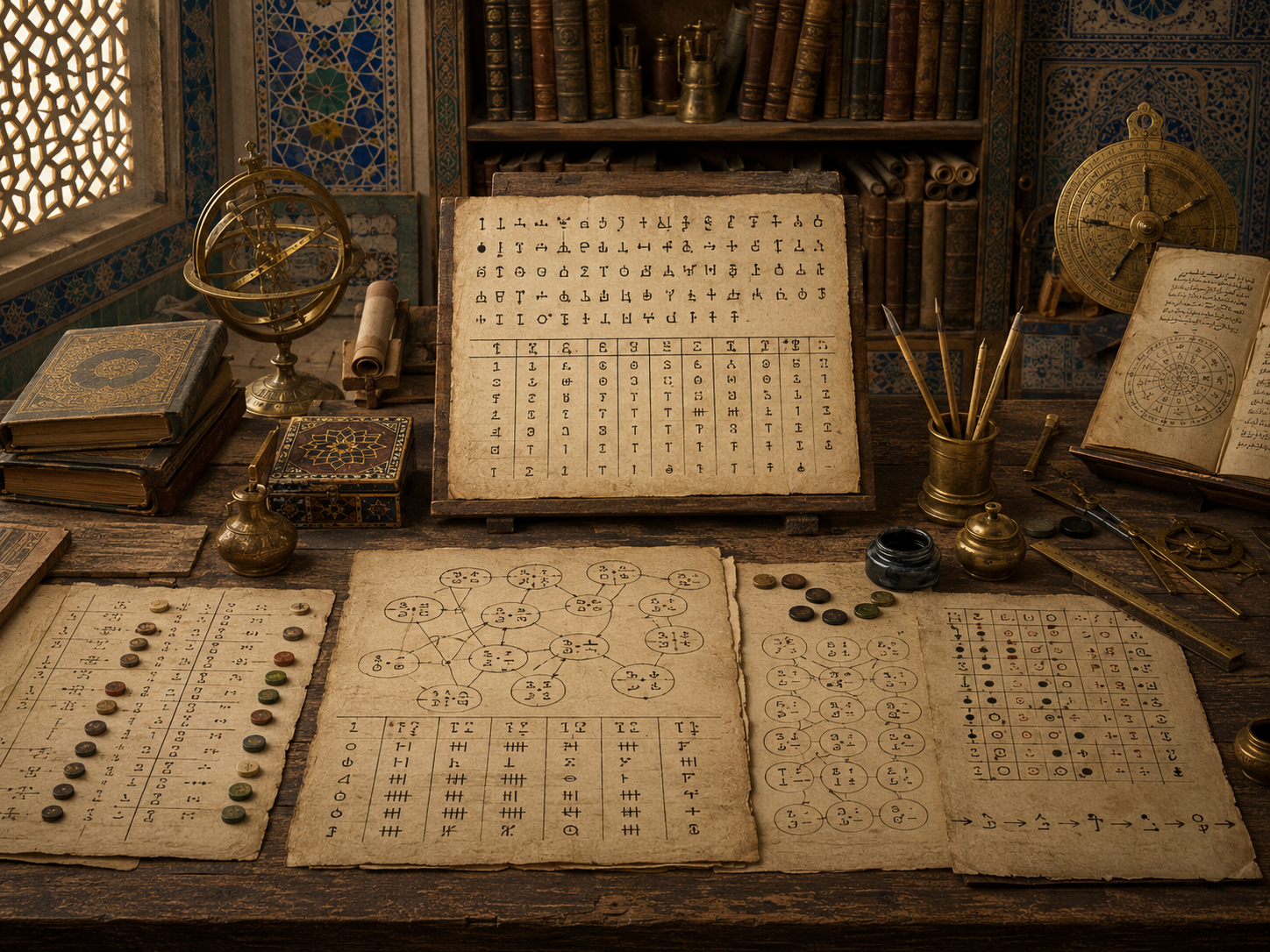
This article introduces al-Kindī, frequency analysis, classical cryptanalysis, substitution ciphers, letter counting, Arabic linguistic statistics, cipher symbols, plaintext comparison, hypothesis testing, pattern recognition, manuscript cryptology, linguistic regularity, early statistical inference, codebreaking procedure, and the broader history of algorithmic reasoning. It argues that cryptanalysis belongs in this series because it reveals an early union of language, data, probability-like judgment, and procedural inference.
Why Al-Kindī Matters
Al-Kindī matters because his cryptanalytic work gives one of the clearest early examples of inference from data. A message is hidden. The method does not simply try possible meanings at random. It counts, compares, ranks, hypothesizes, and tests. This is computational reasoning applied to language.
The historical importance is not that al-Kindī invented secrecy, writing, ciphers, or all forms of codebreaking. Many earlier cultures used secret writing, substitution, transposition, diplomatic concealment, and scribal techniques. The importance is narrower and more powerful: his treatise is associated with the earliest known surviving description of frequency-analysis cryptanalysis, a method that uses statistical regularities of language to attack substitution ciphers.
| Historical element | Why it matters | Algorithmic meaning |
|---|---|---|
| Al-Kindī’s treatise | Gives a procedural account of decipherment. | Documented cryptanalytic method. |
| Letter counting | Turns language into numerical evidence. | Feature extraction. |
| Frequency ranking | Orders symbols by observed occurrence. | Statistical comparison. |
| Substitution hypothesis | Guesses which cipher symbol corresponds to which letter. | Candidate mapping. |
| Testing | Checks whether proposed substitutions produce meaningful language. | Hypothesis validation. |
| Revision | Updates guesses when evidence conflicts. | Iterative inference. |
Al-Kindī’s method is important because it shows that hidden meaning can be approached through pattern, evidence, and procedure.
Cryptography and Cryptanalysis
Cryptography and cryptanalysis are related but different. Cryptography concerns the making of systems that conceal messages. Cryptanalysis concerns the study and attack of those systems. A cipher hides meaning through transformation. A cryptanalytic method tries to recover meaning without ordinary access to the key.
In the history of algorithmic reasoning, this distinction matters. Encryption is one kind of procedure. Decryption by intended recipient is another. Cryptanalysis is adversarial inference: it tries to exploit patterns, errors, regularities, weaknesses, or constraints in the system.
| Term | Meaning | Algorithmic role |
|---|---|---|
| Plaintext | The original readable message. | Hidden source. |
| Ciphertext | The transformed message. | Observed data. |
| Key | The rule or secret needed for intended decryption. | Transformation parameter. |
| Encryption | Procedure that hides plaintext. | Forward transformation. |
| Decryption | Procedure that recovers plaintext with the key. | Authorized reverse transformation. |
| Cryptanalysis | Procedure that attacks or studies the cipher without ordinary key access. | Adversarial inference. |
Cryptanalysis is algorithmic because it turns limited evidence into a structured search for hidden structure.
Frequency Analysis as Algorithmic Inference
Frequency analysis begins with a pattern: letters in a language occur with different regularities. Some are common, some rare, and some appear in characteristic combinations. If a substitution cipher preserves one-to-one replacement, those patterns often survive beneath the disguise. The symbols change, but the distribution remains informative.
This is algorithmic inference because the method proceeds step by step. Count the cipher symbols. Rank them by frequency. Compare the ranking to a reference text in the same language. Propose likely substitutions. Test whether the resulting fragments form plausible words. Revise as needed.
| Step | Action | Inference function |
|---|---|---|
| 1 | Identify the language or likely language family. | Select reference distribution. |
| 2 | Count cipher symbols. | Extract observed frequencies. |
| 3 | Rank symbols by occurrence. | Order evidence. |
| 4 | Compare with plaintext letter frequencies. | Generate candidate mappings. |
| 5 | Apply substitutions tentatively. | Produce partial plaintext. |
| 6 | Check words, syntax, and patterns. | Validate or reject hypothesis. |
| 7 | Revise mappings and repeat. | Iterative improvement. |
The method is not guaranteed, but it is disciplined: evidence narrows the search space.
Language as Statistical Evidence
Frequency analysis depends on the idea that language has measurable regularities. Letters, sounds, word endings, prefixes, common particles, repeated phrases, and syntactic patterns do not appear randomly. A text carries statistical traces of its language even after some transformations.
This insight turns language into evidence. The cryptanalyst does not need to understand the message immediately. The first task is to measure it. Count symbols. Identify repeated pairs. Look for one-letter words, common endings, repeated clusters, or impossible combinations. The cipher is treated as data.
| Linguistic feature | Cryptanalytic use | Computational analogy |
|---|---|---|
| Letter frequency | Identifies likely substitutions. | Univariate feature count. |
| Bigram pattern | Finds common letter pairs. | Sequence feature. |
| Word length | Constrains possible words. | Structural feature. |
| Repeated clusters | Signals repeated words or endings. | Pattern detection. |
| Rare symbols | Suggests rare letters or special positions. | Outlier clue. |
| Contextual plausibility | Tests whether partial decoding makes sense. | Model validation. |
Language becomes computational when its regularities can be counted, compared, and used for inference.
Substitution Ciphers and Pattern Preservation
Frequency analysis works especially well against simple monoalphabetic substitution ciphers because these systems preserve many statistical properties of the plaintext. If the same plaintext letter always becomes the same cipher symbol, frequency patterns remain visible. The disguise changes names, not distribution.
This is a crucial algorithmic lesson: transformations can hide content while preserving structure. Cryptanalysis exploits preserved structure. A system is vulnerable when the information it leaks is enough to infer the hidden mapping.
| Cipher property | What it preserves | Cryptanalytic consequence |
|---|---|---|
| One-to-one substitution | Relative symbol frequencies. | Frequency ranking remains useful. |
| Repeated plaintext letter | Repeated cipher symbol. | Patterns can be recognized. |
| Word spacing preserved | Word length and boundaries. | Dictionary-like reasoning improves. |
| Common endings preserved | Repeated final patterns. | Morphology becomes evidence. |
| No randomization | Deterministic mapping. | Repeated observations strengthen inference. |
| Longer ciphertext | More samples from distribution. | Frequency estimates improve. |
A weak cipher hides symbols but leaks patterns.
Counting Letters and Ranking Symbols
Counting is the bridge between language and inference. The cryptanalyst counts each symbol in the ciphertext and then ranks symbols by frequency. The most common cipher symbol may correspond to the most common letter in the plaintext language, but the method does not stop there. Single counts must be checked against words, context, repeated patterns, and neighboring symbols.
The key is that counting reduces disorder. A page of cipher symbols can feel opaque. A frequency table gives structure. It makes some hypotheses more plausible than others and turns decipherment into a process of evidence-weighted search.
| Counting operation | Purpose | Algorithmic meaning |
|---|---|---|
| Total symbol count | Measures sample size. | Data volume. |
| Frequency count | Counts each symbol. | Feature extraction. |
| Relative frequency | Divides count by total. | Normalization. |
| Ranking | Orders symbols by occurrence. | Priority list. |
| Comparison | Matches cipher ranking to language ranking. | Similarity search. |
| Residual check | Finds mismatches and anomalies. | Error diagnosis. |
Frequency analysis begins with a humble computational act: count the signs.
Hypothesis Testing and Revision
Frequency analysis is not a mechanical one-pass recipe. The most frequent cipher symbol does not always correspond cleanly to the most frequent plaintext letter. Short messages distort frequencies. Topics affect vocabulary. Scribes make mistakes. Cipher designers may add tricks. Languages vary by genre and period. Therefore the cryptanalyst must treat each substitution as a hypothesis.
A proposed mapping is tested by applying it to the ciphertext and asking whether the emerging plaintext is plausible. If fragments make sense, the hypothesis gains support. If they produce impossible forms, the mapping is revised. This cycle of hypothesis and revision makes cryptanalysis an early example of iterative inference.
| Inference stage | Question | Possible response |
|---|---|---|
| Candidate choice | Which plaintext letter might this cipher symbol represent? | Use frequency ranking. |
| Partial substitution | What words begin to appear? | Check linguistic plausibility. |
| Conflict detection | Does the mapping produce contradictions? | Reject or revise. |
| Pattern search | Do repeated clusters suggest common words? | Add constraints. |
| Context check | Does the partial message fit expected genre? | Use domain knowledge. |
| Iteration | Does each new mapping improve the whole solution? | Repeat until coherent. |
Cryptanalysis is not only counting. It is counting guided by judgment.
Arabic Textual Culture and Linguistic Analysis
Al-Kindī’s cryptanalytic method emerged in a rich textual culture. Arabic scholarship included grammar, lexicography, Qur’anic study, poetry, logic, mathematics, translation, philosophy, and administrative writing. Letter counting and attention to linguistic form made sense in a world where textual analysis was highly developed.
This background matters because frequency analysis depends on language knowledge. To compare cipher symbols with plaintext letters, one must know or estimate the distribution of letters in the target language. To test partial decryptions, one must recognize plausible words and forms. Cryptanalysis is therefore both mathematical and philological.
| Textual practice | Cryptanalytic relevance | Algorithmic role |
|---|---|---|
| Grammar | Identifies plausible forms and structures. | Constraint model. |
| Lexicography | Supports word recognition. | Dictionary knowledge. |
| Qur’anic and literary study | Encourages close attention to letters and forms. | Textual feature awareness. |
| Administration | Creates practical need for secure and deciphered communication. | Institutional context. |
| Mathematics | Supports counting, comparison, and structured procedure. | Quantitative method. |
| Translation movement | Encourages cross-disciplinary reasoning. | Knowledge synthesis. |
Frequency analysis sits where mathematics, language, and institutions meet.
Cryptanalysis Before Modern Statistics
Modern statistics had not yet taken its later formal shape, but frequency analysis uses a recognizable statistical intuition: observed counts can reveal hidden structure. A ciphertext sample is not treated as a meaningless surface. It is treated as evidence generated by an underlying process.
This is why al-Kindī’s method matters for the history of computational reasoning. It anticipates later forms of data analysis without being identical to them. It uses relative frequency, comparison, ranking, sample size, and inference under uncertainty. It is an early example of quantitative reasoning over language.
| Modern statistical idea | Early cryptanalytic analogue | Careful interpretation |
|---|---|---|
| Sample | Observed ciphertext. | A text supplies data, but not a modern dataset in the full sense. |
| Frequency | Counts of symbols or letters. | Counting is explicit and central. |
| Distribution | Language-specific letter pattern. | Implicit distributional reasoning. |
| Hypothesis | Proposed symbol-letter mapping. | Tested through partial reading. |
| Error | Mismatch between mapping and readable language. | Corrected through revision. |
| Inference | Hidden plaintext recovered from observed pattern. | Pattern-based reasoning, not modern probability theory. |
Cryptanalysis is one of the earliest places where counting language became a tool of inference.
Procedure, Not Magic
Codebreaking is often portrayed as genius, secrecy, or sudden revelation. Al-Kindī’s method shows something more durable: procedure. The hidden message is approached through steps that others can learn. Count. Rank. Compare. Substitute. Test. Revise. Verify.
This procedural structure is what makes cryptanalysis part of algorithmic history. The method is teachable and repeatable. It can fail, improve, and adapt. It depends on evidence rather than intuition alone. It also shows the limits of procedure: without enough text, good reference knowledge, or appropriate assumptions, frequency analysis may mislead.
| Myth of codebreaking | Procedural reality | Algorithmic lesson |
|---|---|---|
| Instant insight | Slow counting and comparison. | Evidence matters. |
| Pure genius | Learnable method. | Procedures transmit expertise. |
| Single answer | Competing hypotheses. | Inference is iterative. |
| Perfect certainty | Partial, revisable evidence. | Uncertainty must be managed. |
| Hidden magic | Observable pattern. | Structure leaks information. |
| Tool alone | Tool plus linguistic judgment. | Human interpretation remains central. |
Cryptanalysis is disciplined reasoning under partial information.
Limits, Countermeasures, and Adaptation
Frequency analysis is powerful against simple substitution, but it has limits. Short ciphertexts may not reflect normal letter frequencies. Homophonic substitution can flatten frequencies by using multiple symbols for common letters. Polyalphabetic methods can vary the substitution across positions. Removing spaces, inserting null symbols, changing spelling, or using codebooks can complicate analysis.
This adversarial cycle matters. Cryptanalysis improves ciphers, and improved ciphers force new cryptanalytic methods. The relationship is recursive: defense creates challenge, attack finds weakness, defense adapts. This is another reason cryptanalysis belongs in algorithmic reasoning: it is a history of procedure under opposition.
| Limit or countermeasure | Effect | Algorithmic lesson |
|---|---|---|
| Short message | Frequencies are unstable. | Sample size matters. |
| Homophonic substitution | Common letters may use multiple symbols. | Distribution can be flattened. |
| Polyalphabetic substitution | Mapping changes by position. | Single frequency table may fail. |
| Null symbols | Meaningless symbols add noise. | Noise complicates inference. |
| No spaces | Word boundaries disappear. | Structural features are removed. |
| Codebook | Words or phrases replace letters. | Feature level changes. |
Every cryptanalytic method teaches both how to attack and how to defend.
From Manuscript Codebreaking to Modern Security
Modern cryptography is mathematically far more complex than classical substitution ciphers, and frequency analysis alone does not break well-designed modern encryption. Still, the historical lesson remains relevant: systems leak information through patterns, assumptions, side channels, reused structures, weak randomness, implementation errors, and human practice.
The continuity is methodological rather than technical. Modern security analysis still asks: what information is observable? What pattern survives transformation? What assumptions does the defender rely on? What evidence can an analyst gather? What hypothesis explains the observed data? What test can distinguish one hypothesis from another?
| Early cryptanalysis | Modern security analysis | Continuity |
|---|---|---|
| Letter frequency | Statistical pattern analysis. | Observed distributions reveal structure. |
| Substitution mapping | Hidden parameter or key relation. | Infer hidden transformation. |
| Ciphertext sample | Observable data or trace. | Evidence constrains hypotheses. |
| Countermeasure | Protocol hardening. | Defense adapts to attack. |
| Manual testing | Automated validation and formal analysis. | Hypotheses must be checked. |
| Linguistic judgment | Domain expertise and threat modeling. | Human interpretation remains important. |
The modern lesson is not “use frequency analysis on modern encryption.” The lesson is that security depends on what structure remains visible.
Origin Stories and Careful Interpretation
The phrase “birth of cryptanalysis” should be used carefully. Secret writing, ciphering, and code systems existed long before al-Kindī. What al-Kindī represents is more specific: a foundational surviving account of systematic, frequency-based cryptanalysis. This is the birth of documented statistical codebreaking in the record available to historians, not the invention of secrecy itself.
Careful interpretation also avoids isolating al-Kindī from his intellectual environment. His work makes sense within Arabic textual culture, mathematics, administration, linguistic study, translation, and broader Islamic-world scholarship. It also connects to later cryptologic traditions that adapted and expanded codebreaking methods.
| Oversimplification | Problem | Better framing |
|---|---|---|
| Al-Kindī invented all cryptography. | It confuses secrecy with cryptanalysis. | Frame him as central to surviving systematic frequency-analysis cryptanalysis. |
| Frequency analysis is pure statistics in the modern sense. | It projects later formalism backward. | Call it early statistical or quantitative inference over language. |
| Codebreaking is magic. | It hides method and evidence. | Show counting, comparison, hypothesis, and revision. |
| Language is incidental. | It ignores the method’s dependence on linguistic regularity. | Study grammar, letter frequency, word patterns, and textual culture. |
| Old cryptanalysis is obsolete trivia. | It misses the general reasoning pattern. | Connect it to data, leakage, inference, and security analysis. |
| Attack methods are value-neutral. | They can support defense, surveillance, war, diplomacy, and abuse. | Study use, ethics, and institutional context. |
Al-Kindī’s cryptanalysis should be read as a milestone in procedural inference, not as a simplified origin myth.
Examples of Frequency Analysis as Algorithmic Reasoning
The examples below show how al-Kindī’s cryptanalytic logic connects language, counting, and inference.
Letter counting
A ciphertext is converted into a table of symbol counts.
Frequency ranking
Symbols are ordered from most common to least common.
Reference comparison
Cipher-symbol frequencies are compared with known letter frequencies in the target language.
Substitution hypothesis
A likely mapping is proposed between cipher symbol and plaintext letter.
Partial plaintext
Tentative substitutions reveal fragments that may or may not form plausible language.
Repeated pattern
A recurring cipher cluster suggests a repeated word, phrase, ending, or grammatical pattern.
Conflict revision
A candidate mapping is rejected when it produces impossible or incoherent text.
Security adaptation
A cipher designer changes the system to reduce statistical leakage.
Across these examples, cryptanalysis operates as evidence-guided search through possible meanings.
Mathematics, Computation, and Modeling
A simple frequency count can be represented as:
count(s) = \sum_{i=1}^{n} \mathbf{1}(x_i=s)
\]
Interpretation: Count how many times each symbol appears in the ciphertext.
Relative frequency can be represented as:
freq(s) = \frac{count(s)}{n}
\]
Interpretation: Normalize counts by the total number of observed symbols.
A substitution mapping can be represented as:
CipherSymbol \rightarrow PlainLetter
\]
Interpretation: Cryptanalysis proposes a mapping from observed cipher symbols to hidden plaintext letters.
A basic inference loop can be modeled as:
Count \rightarrow Rank \rightarrow Compare \rightarrow Substitute \rightarrow Test \rightarrow Revise
\]
Interpretation: Frequency analysis is an iterative procedure, not a single calculation.
These formulas use modern notation to make the computational structure visible. They are interpretive models, not claims that al-Kindī wrote in this exact symbolic form.
Python Workflow: Frequency Analysis and Cryptanalysis Map
The Python workflow below creates a dependency-light interpretive map of al-Kindī, frequency analysis, and cryptanalysis. It scores themes by linguistic evidence, counting procedure, inferential structure, cryptanalytic relevance, historical significance, ethical caution, and modern resonance, then writes reproducible CSV and JSON outputs.
# al_kindi_frequency_analysis_cryptanalysis_map.py
# Dependency-light workflow for mapping frequency analysis as early cryptanalytic inference.

from __future__ import annotations

from dataclasses import asdict, dataclass
from pathlib import Path
from statistics import mean
from collections import Counter
import csv
import json
from datetime import datetime, timezone

ARTICLE_ROOT = Path(__file__).resolve().parents[1]
TABLES = ARTICLE_ROOT / "outputs" / "tables"
JSON_DIR = ARTICLE_ROOT / "outputs" / "json"


@dataclass(frozen=True)
class CryptanalysisConfig:
    article: str = "al_kindi_frequency_analysis_and_the_birth_of_cryptanalysis"
    core_threshold: float = 0.80
    high_inference_threshold: float = 0.86


def timestamp_utc() -> str:
    return datetime.now(timezone.utc).isoformat()


def write_csv(path: Path, rows: list[dict[str, object]]) -> None:
    path.parent.mkdir(parents=True, exist_ok=True)
    if not rows:
        path.write_text("", encoding="utf-8")
        return
    fieldnames = sorted({key for row in rows for key in row.keys()})
    with path.open("w", newline="", encoding="utf-8") as handle:
        writer = csv.DictWriter(handle, fieldnames=fieldnames, extrasaction="ignore")
        writer.writeheader()
        writer.writerows(rows)


def write_json(path: Path, payload: object) -> None:
    path.parent.mkdir(parents=True, exist_ok=True)
    path.write_text(json.dumps(payload, indent=2, sort_keys=True), encoding="utf-8")


def frequency_table(text: str) -> list[dict[str, object]]:
    symbols = [ch.lower() for ch in text if ch.isalpha()]
    total = len(symbols)
    counts = Counter(symbols)
    rows = []
    for symbol, count in counts.most_common():
        rows.append({
            "symbol": symbol,
            "count": count,
            "relative_frequency": round(count / total, 6) if total else 0.0,
            "rank": len(rows) + 1,
        })
    return rows


def cryptanalysis_themes() -> list[dict[str, object]]:
    return [
        {"theme_id": "letter_counting_as_feature_extraction", "linguistic_evidence": 0.96, "counting_procedure": 0.98, "inferential_structure": 0.90, "cryptanalytic_relevance": 0.94, "historical_significance": 0.94, "ethical_caution": 0.82, "modern_resonance": 0.94},
        {"theme_id": "frequency_ranking_and_comparison", "linguistic_evidence": 0.98, "counting_procedure": 0.96, "inferential_structure": 0.94, "cryptanalytic_relevance": 0.96, "historical_significance": 0.94, "ethical_caution": 0.82, "modern_resonance": 0.96},
        {"theme_id": "substitution_mapping_hypothesis", "linguistic_evidence": 0.90, "counting_procedure": 0.86, "inferential_structure": 0.96, "cryptanalytic_relevance": 0.98, "historical_significance": 0.92, "ethical_caution": 0.84, "modern_resonance": 0.94},
        {"theme_id": "testing_and_revision", "linguistic_evidence": 0.88, "counting_procedure": 0.84, "inferential_structure": 0.98, "cryptanalytic_relevance": 0.94, "historical_significance": 0.90, "ethical_caution": 0.86, "modern_resonance": 0.96},
        {"theme_id": "arabic_textual_culture", "linguistic_evidence": 0.94, "counting_procedure": 0.86, "inferential_structure": 0.88, "cryptanalytic_relevance": 0.88, "historical_significance": 0.96, "ethical_caution": 0.82, "modern_resonance": 0.88},
        {"theme_id": "limits_and_countermeasures", "linguistic_evidence": 0.86, "counting_procedure": 0.88, "inferential_structure": 0.92, "cryptanalytic_relevance": 0.94, "historical_significance": 0.88, "ethical_caution": 0.94, "modern_resonance": 0.96},
        {"theme_id": "early_statistical_inference", "linguistic_evidence": 0.94, "counting_procedure": 0.96, "inferential_structure": 0.96, "cryptanalytic_relevance": 0.92, "historical_significance": 0.96, "ethical_caution": 0.84, "modern_resonance": 0.98},
    ]


def score_theme(row: dict[str, object], config: CryptanalysisConfig) -> dict[str, object]:
    cryptanalysis_score = mean([
        float(row["linguistic_evidence"]),
        float(row["counting_procedure"]),
        float(row["inferential_structure"]),
        float(row["cryptanalytic_relevance"]),
        float(row["historical_significance"]),
        float(row["ethical_caution"]),
        float(row["modern_resonance"]),
    ])

    if cryptanalysis_score >= config.core_threshold and float(row["inferential_structure"]) >= config.high_inference_threshold:
        interpretive_status = "core_cryptanalysis_thread"
    elif cryptanalysis_score >= config.core_threshold:
        interpretive_status = "major_cryptanalysis_thread"
    else:
        interpretive_status = "supporting_cryptanalysis_thread"

    return {
        "theme_id": row["theme_id"],
        "linguistic_evidence": round(float(row["linguistic_evidence"]), 6),
        "counting_procedure": round(float(row["counting_procedure"]), 6),
        "inferential_structure": round(float(row["inferential_structure"]), 6),
        "cryptanalytic_relevance": round(float(row["cryptanalytic_relevance"]), 6),
        "historical_significance": round(float(row["historical_significance"]), 6),
        "ethical_caution": round(float(row["ethical_caution"]), 6),
        "modern_resonance": round(float(row["modern_resonance"]), 6),
        "cryptanalysis_score": round(cryptanalysis_score, 6),
        "interpretive_status": interpretive_status,
    }


def interpretation_cautions() -> list[dict[str, str]]:
    return [
        {"caution": "do_not_claim_al_kindi_invented_all_cryptography", "meaning": "Al-Kindī is central to surviving systematic frequency-analysis cryptanalysis, not all secrecy or ciphering."},
        {"caution": "do_not_treat_frequency_analysis_as_magic", "meaning": "The method depends on counting, comparison, hypothesis testing, and revision."},
        {"caution": "do_not_project_modern_statistics_backward", "meaning": "The method anticipates statistical inference without being modern formal statistics."},
        {"caution": "do_not_ignore_language_context", "meaning": "Cryptanalysis depends on linguistic regularity, genre, spelling, and textual knowledge."},
        {"caution": "do_not_turn_attack_methods_into_unbounded_security_advice", "meaning": "Use examples for historical and educational analysis, not unauthorized access."},
    ]


def main() -> None:
    config = CryptanalysisConfig()
    sample_ciphertext = "XLMW MW E WLSVX IHYGERXMSREP WEQTPI JSV JVIUYIRGC EREP]WMW"
    freq_rows = frequency_table(sample_ciphertext)
    themes = cryptanalysis_themes()
    scored = [score_theme(row, config) for row in themes]
    cautions = interpretation_cautions()

    summary = {
        "article": config.article,
        "timestamp_utc": timestamp_utc(),
        "sample_symbols_reviewed": sum(int(row["count"]) for row in freq_rows),
        "themes_reviewed": len(scored),
        "core_threads": sum(1 for row in scored if row["interpretive_status"] == "core_cryptanalysis_thread"),
        "major_threads": sum(1 for row in scored if row["interpretive_status"] == "major_cryptanalysis_thread"),
        "supporting_threads": sum(1 for row in scored if row["interpretive_status"] == "supporting_cryptanalysis_thread"),
        "mean_cryptanalysis_score": round(mean(float(row["cryptanalysis_score"]) for row in scored), 6),
        "cautions": len(cautions),
        "interpretation": "Al-Kindī’s frequency-analysis method should be studied as early algorithmic inference over language: count, rank, compare, hypothesize, test, revise, and interpret.",
    }

    write_csv(TABLES / "sample_frequency_table.csv", freq_rows)
    write_csv(TABLES / "cryptanalysis_themes.csv", themes)
    write_csv(TABLES / "cryptanalysis_map.csv", scored)
    write_csv(TABLES / "interpretation_cautions.csv", cautions)
    write_csv(TABLES / "cryptanalysis_summary.csv", [summary])

    write_json(JSON_DIR / "cryptanalysis_config.json", asdict(config))
    write_json(JSON_DIR / "sample_frequency_table.json", freq_rows)
    write_json(JSON_DIR / "cryptanalysis_map.json", scored)
    write_json(JSON_DIR / "interpretation_cautions.json", cautions)
    write_json(JSON_DIR / "cryptanalysis_summary.json", summary)

    print("Al-Kindī, frequency analysis, and cryptanalysis map complete.")
    print(TABLES / "cryptanalysis_summary.csv")


if __name__ == "__main__":
    main()
This workflow turns cryptanalysis into a reproducible interpretive artifact: letter counts, relative frequencies, theme scores, inference structure, historical significance, ethical caution, modern resonance, and interpretive warnings are documented together.
R Workflow: Cryptanalysis Diagnostics
The R workflow reads the generated CSV outputs, summarizes cryptanalysis themes, visualizes theme dimensions, and writes an additional diagnostic table.
# al_kindi_frequency_analysis_cryptanalysis_summary.R
args <- commandArgs(trailingOnly = FALSE)
file_arg <- grep("^--file=", args, value = TRUE)

if (length(file_arg) > 0) {
  script_path <- normalizePath(sub("^--file=", "", file_arg[1]), mustWork = TRUE)
  article_root <- normalizePath(file.path(dirname(script_path), ".."), mustWork = TRUE)
} else {
  article_root <- getwd()
}

setwd(article_root)

tables_dir <- file.path(article_root, "outputs", "tables")
figures_dir <- file.path(article_root, "outputs", "figures")
dir.create(tables_dir, recursive = TRUE, showWarnings = FALSE)
dir.create(figures_dir, recursive = TRUE, showWarnings = FALSE)

map_path <- file.path(tables_dir, "cryptanalysis_map.csv")
freq_path <- file.path(tables_dir, "sample_frequency_table.csv")
summary_path <- file.path(tables_dir, "cryptanalysis_summary.csv")

if (!file.exists(map_path)) {
  stop(paste("Missing", map_path, "Run the Python workflow first."))
}

cryptanalysis_map <- read.csv(map_path, stringsAsFactors = FALSE)
frequency_table <- read.csv(freq_path, stringsAsFactors = FALSE)
summary <- read.csv(summary_path, stringsAsFactors = FALSE)

png(file.path(figures_dir, "cryptanalysis_dimensions.png"), width = 1200, height = 850)
score_matrix <- t(as.matrix(cryptanalysis_map[, c("linguistic_evidence", "counting_procedure", "inferential_structure", "cryptanalytic_relevance", "historical_significance", "ethical_caution", "modern_resonance")]))
barplot(score_matrix,
        beside = TRUE,
        names.arg = cryptanalysis_map$theme_id,
        las = 2,
        ylim = c(0, 1),
        ylab = "Interpretive Score",
        main = "Al-Kindī, Frequency Analysis, and Cryptanalysis Dimensions")
legend("bottomright",
       legend = rownames(score_matrix),
       cex = 0.72,
       bty = "n")
grid()
dev.off()

png(file.path(figures_dir, "sample_symbol_frequency.png"), width = 1000, height = 750)
barplot(frequency_table$relative_frequency,
        names.arg = frequency_table$symbol,
        ylab = "Relative Frequency",
        main = "Sample Cipher Symbol Frequencies")
grid()
dev.off()

r_summary <- data.frame(
  themes_reviewed = summary$themes_reviewed[1],
  core_threads = summary$core_threads[1],
  major_threads = summary$major_threads[1],
  supporting_threads = summary$supporting_threads[1],
  mean_cryptanalysis_score = summary$mean_cryptanalysis_score[1],
  sample_symbols_reviewed = summary$sample_symbols_reviewed[1],
  cautions = summary$cautions[1],
  diagnostic_note = "Al-Kindī’s frequency-analysis method should be studied as early algorithmic inference over language: count, rank, compare, hypothesize, test, revise, and interpret."
)

write.csv(r_summary, file.path(tables_dir, "r_cryptanalysis_diagnostic_summary.csv"), row.names = FALSE)
print(r_summary)
The R layer makes the interpretive structure visible: letter counting, frequency ranking, substitution hypotheses, testing, revision, Arabic textual culture, early statistical inference, countermeasures, and caution can be examined as related but distinct dimensions of cryptanalytic reasoning.
GitHub Repository
The companion repository contains reproducible workflows, synthetic interpretive data, outputs, calculators, documentation, and multilingual examples for this article.
Complete Code Repository
Companion article folder with Python, R, Julia, SQL, Haskell, C, C++, Fortran, Rust, Go, Java, TypeScript, Prolog, Racket, notebooks, documentation, synthetic teaching data, generated outputs, schemas, calculators, and Canvas-ready workflow artifacts for al-Kindī, frequency analysis, cryptanalysis, substitution ciphers, letter counting, relative frequency, symbol ranking, hypothesis testing, linguistic regularity, early statistical inference, cryptanalytic caution, classical cipher limits, and algorithmic reasoning over language.
A Practical Method for Studying Early Cryptanalysis
A careful study of early cryptanalysis should focus on procedure, language, evidence, and ethical context. The method below treats frequency analysis as a historical algorithmic method without turning it into unbounded security advice.
| Step | Historical action | Output |
|---|---|---|
| 1 | Identify the cipher type and whether a simple substitution assumption is plausible. | Cipher-context record. |
| 2 | Identify the likely language, genre, and writing conventions. | Reference language model. |
| 3 | Count symbols in the ciphertext. | Observed frequency table. |
| 4 | Rank symbols and compare them with expected plaintext frequencies. | Candidate substitution list. |
| 5 | Test substitutions by producing partial plaintext. | Hypothesis check. |
| 6 | Use repeated patterns, word lengths, and linguistic constraints to refine guesses. | Constraint map. |
| 7 | Revise when evidence conflicts. | Improved mapping. |
| 8 | Ask how the method is used, taught, limited, and ethically bounded. | Historical interpretation. |
This method keeps al-Kindī’s work in view as disciplined inference: count, compare, hypothesize, test, revise, and interpret.
Common Pitfalls
The first pitfall is saying that al-Kindī invented all cryptography. The second is treating frequency analysis as magic rather than procedure. The third is projecting modern probability theory or modern cybersecurity backward too directly. The fourth is ignoring the ethical context of attack methods.
| Pitfall | Why it matters | Better practice |
|---|---|---|
| Al-Kindī invented all cryptography | It confuses cipher-making with systematic cryptanalysis. | Frame him as central to surviving frequency-analysis cryptanalysis. |
| Frequency analysis is magic | It hides counting, comparison, and revision. | Show the procedure step by step. |
| Modern statistics already existed | It projects later formalism backward. | Use “early statistical inference” carefully. |
| Language does not matter | The method depends on linguistic regularity. | Study genre, spelling, grammar, and textual culture. |
| Classical methods apply directly to modern encryption | It misleads readers about security. | Distinguish classical ciphers from modern cryptography. |
| Attack methods are neutral | Cryptanalysis has ethical and institutional consequences. | Discuss defense, permission, law, and context. |
Cryptanalysis should be taught as historical reasoning, not as mystique or irresponsible attack culture.
Why Cryptanalysis Belongs in Algorithmic Reasoning
Al-Kindī, frequency analysis, and the birth of cryptanalysis belong in algorithmic reasoning because they show how hidden structure can be inferred from observable data. The message is concealed, but the language leaves traces. The cipher changes symbols, but patterns survive. The cryptanalyst counts, ranks, compares, hypothesizes, tests, and revises.
This history expands the meaning of computation. Computation is not only numerical arithmetic, algebra, astronomy, mapping, or machine execution. It is also structured inference over language. Al-Kindī’s method shows that symbols can be treated as data and that data can reveal a hidden process.
The lesson for modern systems is direct. Any algorithmic system may leak patterns. Security, privacy, and interpretation depend on what structure remains visible after transformation. Frequency analysis is historically specific, but the larger lesson is enduring: evidence, pattern, and procedure can turn the obscure into the intelligible. AI belongs in the toolkit, not in control.
Related Articles
- Geography, Coordinates, and Computational Mapping in the Islamic World
- Banū Mūsā, Mechanical Devices, and Procedural Engineering
- Al-Khwārizmī, Algorism, and the Procedural Imagination
- Hindu-Arabic Numerals and the Transmission of Positional Calculation
- Algorithmic Risk Management and AI Governance
Further Reading
- Broemeling, L.D. (2011) ‘An account of early statistical inference in Arab cryptology’, The American Statistician, 65(4), pp. 255–257.
- Kahn, D. (1996) The Codebreakers: The Comprehensive History of Secret Communication from Ancient Times to the Internet. Rev. edn. New York: Scribner.
- Singh, S. (1999) The Code Book: The Science of Secrecy from Ancient Egypt to Quantum Cryptography. New York: Doubleday.
- Ycart, B. (2012) ‘Letter counting: a stem cell for cryptology, quantitative linguistics, and statistics’. arXiv preprint.
- Mrayati, M., Alam, Y. and al-Tayyan, M.H. (2003) Ilm al-Taʿmiyah wa Istikhrāj al-Muʿammā ʿinda al-ʿArab. Damascus: Arab Academy of Damascus.
- 1001 Inventions (n.d.) ‘Code Breaking a Thousand Years Ago’.
- MacTutor History of Mathematics (n.d.) ‘Al-Kindī’. University of St Andrews.
References
- Broemeling, L.D. (2011) ‘An account of early statistical inference in Arab cryptology’, The American Statistician, 65(4), pp. 255–257. Available at: https://www.jstor.org/stable/23339552.
- Kahn, D. (1996) The Codebreakers: The Comprehensive History of Secret Communication from Ancient Times to the Internet. Rev. edn. New York: Scribner.
- MacTutor History of Mathematics (n.d.) ‘Al-Kindī’. University of St Andrews. Available at: https://mathshistory.st-andrews.ac.uk/Biographies/Al-Kindi/.
- Mrayati, M., Alam, Y. and al-Tayyan, M.H. (2003) Ilm al-Taʿmiyah wa Istikhrāj al-Muʿammā ʿinda al-ʿArab. Damascus: Arab Academy of Damascus.
- Singh, S. (1999) The Code Book: The Science of Secrecy from Ancient Egypt to Quantum Cryptography. New York: Doubleday.
- 1001 Inventions (n.d.) ‘Code Breaking a Thousand Years Ago’. Available at: https://www.1001inventions.com/code-breaking/.
- Ycart, B. (2012) ‘Letter counting: a stem cell for cryptology, quantitative linguistics, and statistics’. arXiv preprint. Available at: https://arxiv.org/abs/1211.6847.