
Last Updated June 22, 2026
Al-Jabr wa’l-Muqābalah examines algebra as rule-governed problem solving before modern symbolic notation. The phrase is closely associated with Muḥammad ibn Mūsā al-Khwārizmī’s ninth-century algebraic treatise, commonly known in English as The Compendious Book on Calculation by Completion and Balancing. Its historical importance is not only that it helped give algebra its name. It also shows how mathematical problems could be classified, transformed, balanced, demonstrated, and solved through teachable procedures.
This article treats algebra as part of the history of algorithmic reasoning. Before algebra became a symbolic language of variables, functions, rings, fields, matrices, and abstractions, it was also a disciplined practice of solving problems. A problem could be stated in words. An unknown could be represented verbally. Terms could be restored and balanced. A case could be classified. A solution could be reached by a sequence of valid operations. A result could be checked.
Al-jabr and al-muqābalah matter because they show a central feature of computational reasoning: a problem becomes solvable when it can be transformed by rule. Algebraic thinking is not only about symbols. It is about controlled transformation. The procedural imagination of algebra turns uncertainty into a structured path from problem to solution.
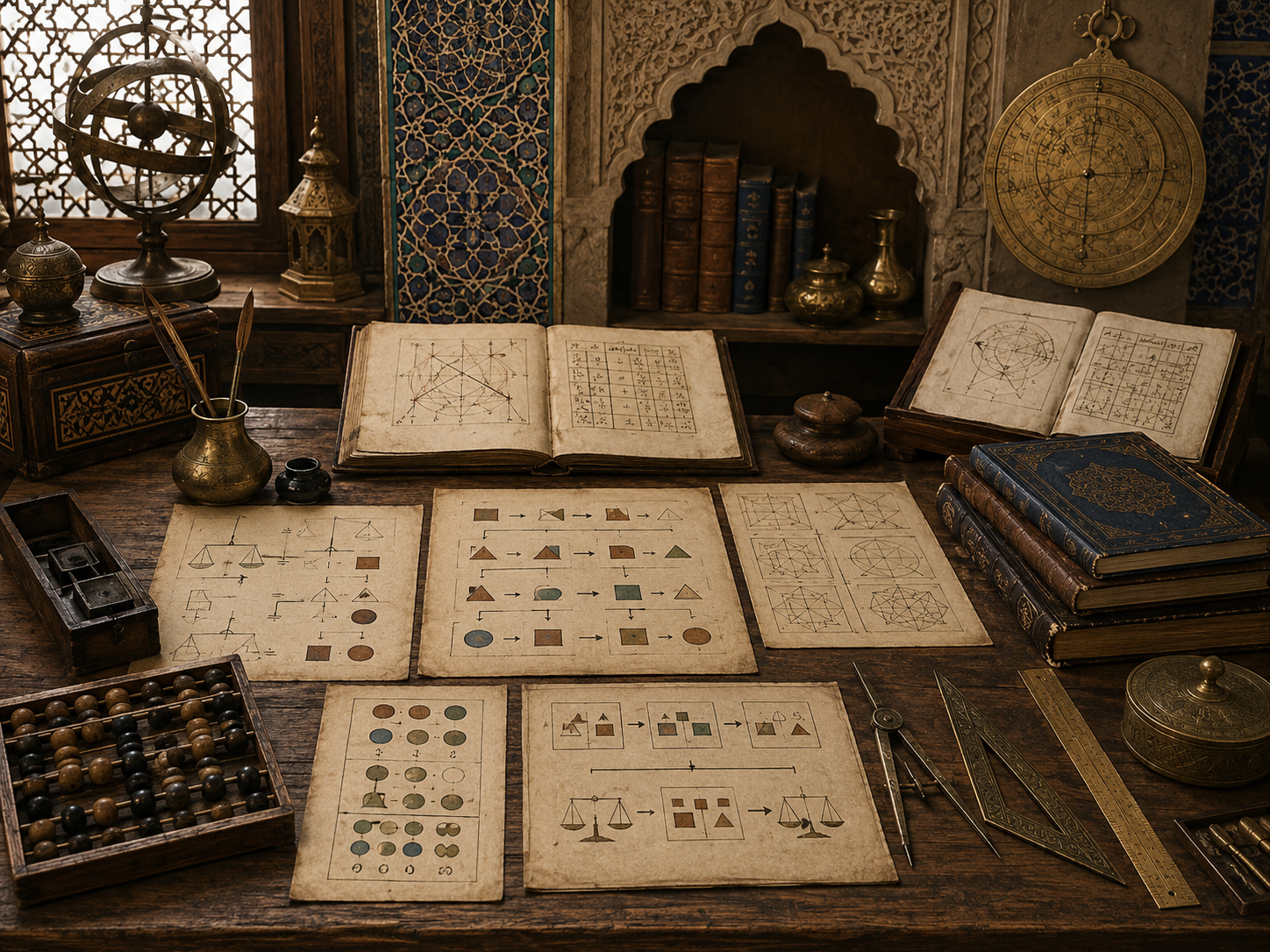
This article introduces al-jabr wa’l-muqābalah, early algebraic procedure, restoration, balancing, classification of equation types, verbal algebra, unknown quantities, practical word problems, geometric demonstration, completing the square, algebraic transformation, procedural correctness, and the relationship between early algebra and modern computational reasoning. It emphasizes that early algebra should not be read as modern notation in disguise. Its importance lies in how it made mathematical procedure teachable, repeatable, and transmissible.
Why Al-Jabr wa’l-Muqābalah Matters
Al-jabr wa’l-muqābalah matters because it shows algebra as a procedural discipline. In al-Khwārizmī’s algebraic tradition, problems are classified, transformed, balanced, and solved through methods that can be taught. This is one of the deepest historical links between algebra and algorithmic reasoning.
Modern readers often encounter algebra as symbolic manipulation. Early algebra was often rhetorical: written in words, examples, and geometric demonstrations. Yet the reasoning was still systematic. A problem had a type. An unknown could be introduced. Terms could be restored or balanced. A sequence of operations could produce a solution. The procedure could be repeated on similar cases.
| Why it matters | Historical meaning | Algorithmic meaning |
|---|---|---|
| Name of algebra | Al-jabr helped give algebra its later name. | Mathematical language preserves procedural history. |
| Problem classification | Equations were grouped into solvable cases. | Case analysis selects method. |
| Restoration | Deficient or subtracted terms were moved or completed. | Normalization transforms the problem. |
| Balancing | Terms were compared, reduced, or equalized. | Equivalent transformations preserve structure. |
| Worked examples | Methods were taught through concrete problems. | Examples function like test cases. |
| Geometric proof | Solutions were justified through visual-spatial reasoning. | Correctness requires more than output. |
Al-jabr wa’l-muqābalah reveals algebra as a way of making problems executable by rule.
The Title and Its Procedural Meaning
The title al-jabr wa’l-muqābalah is usually associated with operations often rendered as completion or restoration and balancing or comparison. The exact historical vocabulary requires care, but the procedural significance is clear: algebraic problem solving depends on transforming expressions while preserving what makes the solution valid.
Al-jabr can be understood as a restoring or completing operation: moving a missing, deficient, or negative component into a more usable form. Al-muqābalah can be understood as balancing or reducing comparable terms. Together, these operations show algebra as controlled transformation rather than mere answer hunting.
| Term | Procedural sense | Computational analogy |
|---|---|---|
| Al-jabr | Restoration, completion, or moving a deficient term into usable form. | Normalization or completion step. |
| Al-muqābalah | Balancing, comparison, or cancellation of comparable terms. | Reduction of equivalent structure. |
| Equation type | A recognized form of problem. | Pattern or case class. |
| Unknown | A quantity to be found through operations. | Variable-like state representation. |
| Worked problem | A demonstration of method. | Executable example. |
| Proof or demonstration | Justification that the method is valid. | Correctness argument. |
The title is not merely a label. It points to the procedural heart of early algebra: transform the problem while preserving the relation.
Algebra Before Modern Symbolism
Early algebra did not require modern symbolic notation. Problems could be stated in prose. Unknown quantities could be described verbally. Operations could be narrated. Examples could teach the general case. This form of algebra is sometimes called rhetorical algebra because it uses ordinary language rather than compact symbolic notation.
This matters for algorithmic reasoning because it shows that procedure is deeper than notation. A method can be algorithmic if it defines a repeatable sequence of operations, even if those operations are written in words. The absence of symbols does not mean the absence of structure.
| Modern expectation | Early algebraic form | Computational lesson |
|---|---|---|
| Symbols such as x | Unknowns described as things, roots, squares, or quantities. | Abstraction can be verbal before symbolic. |
| Equations written compactly | Relations stated in prose. | Formal relation can be expressed linguistically. |
| Algorithm written as code | Procedure written as instruction. | Algorithms can be pre-programmatic. |
| General formula | Rule taught through cases and examples. | Examples can encode a general method. |
| Symbolic proof | Geometric or verbal demonstration. | Correctness has multiple forms. |
| Automated execution | Human calculators execute the method. | Human procedure is part of computational history. |
Algebra before symbolism is still algebra when it represents unknowns and transforms relations by rule.
Restoration and Balancing
Restoration and balancing are powerful because they make equivalence operational. A problem is not solved by guessing. It is transformed. A term may be moved to remove deficiency. Like terms may be reduced. A relation may be preserved while its expression changes. This is the essence of algebraic procedure.
In modern notation, we might say that applying the same valid transformation to both sides preserves equality. Early algebra did not always express this symbolically, but it worked through controlled operations that transformed the problem into a solvable form.
| Operation | Purpose | Algorithmic role |
|---|---|---|
| Restore | Remove deficiency or make a term positive/usable. | Normalize the problem state. |
| Balance | Reduce matching or comparable terms. | Simplify while preserving relation. |
| Complete | Transform a partial form into a full solvable structure. | Create a known pattern. |
| Compare | Match quantities across the relation. | Identify equivalent structure. |
| Reduce | Eliminate redundant terms or relations. | Shorten the path to solution. |
| Check | Test the answer against the original problem. | Verify correctness. |
Restoration and balancing are not decorative historical terms. They are examples of state transformation in mathematical reasoning.
Classification of Equation Types
Al-Khwārizmī’s algebraic method is organized around classes of equations. Classification matters because it turns a problem into an instance of a known type. Once the type is recognized, a procedure can be selected.
This is one of the clearest links between early algebra and algorithmic reasoning. Classification precedes execution. A program chooses branches based on conditions. A solver chooses methods based on equation form. A mathematical student learns not only how to calculate, but how to recognize which calculation applies.
| Problem-recognition step | Procedural effect | Modern analogy |
|---|---|---|
| Identify quantities | Separate knowns and unknowns. | Input parsing. |
| Recognize relation | Understand how quantities are connected. | Problem representation. |
| Classify equation type | Group problem into a solvable form. | Case selection. |
| Choose operation | Select restoration, balancing, completion, or reduction. | Algorithm branch. |
| Execute method | Transform the problem step by step. | Procedure execution. |
| Verify result | Return to original problem and check. | Output validation. |
Classification is what lets a mathematical method become general rather than merely ad hoc.
The Unknown as a Computational Object
The unknown is one of algebra’s great conceptual inventions. A problem becomes algebraic when a missing quantity can be named, related to known quantities, transformed, and eventually determined. Before modern symbols, unknowns could still function as objects of calculation.
In computational terms, the unknown is a placeholder for a value not yet available. It allows the problem to be represented before the answer is known. That is a profound shift. The solver can operate on relations, not only on numbers already given.
| Role of the unknown | Algebraic significance | Computational significance |
|---|---|---|
| Names what is missing | The target of solution becomes explicit. | Defines output objective. |
| Connects to known quantities | The problem becomes relational. | Builds dependency structure. |
| Can be transformed | Operations act on relations involving the unknown. | State can be updated. |
| Can be classified | Its powers or forms define equation type. | Selects solver strategy. |
| Can be found | Solution determines the missing quantity. | Procedure returns output. |
| Can be checked | Substitution verifies the answer. | Correctness can be tested. |
The unknown becomes computational when it can be represented and transformed before it is known.
Word Problems and Practical Mathematics
Algebraic procedure was not isolated from practical life. Problems of inheritance, commerce, land measurement, partnership, profit, debt, and allocation encouraged rule-governed calculation. Word problems matter because they show how everyday situations can be translated into mathematical structure.
The act of translation is itself algorithmic. A verbal situation becomes a mathematical relation. Known and unknown quantities are identified. A case is classified. Operations are applied. A solution is interpreted back in the practical setting.
| Practical domain | Algebraic need | Algorithmic significance |
|---|---|---|
| Inheritance | Distribute shares under rules. | Procedure supports legal allocation. |
| Commerce | Calculate prices, profit, debt, exchange, and partnership. | Procedure supports market coordination. |
| Surveying | Measure land, area, distance, and boundaries. | Procedure supports spatial administration. |
| Taxation | Assess obligations and quantities. | Procedure supports state administration. |
| Construction | Use proportions and geometric relations. | Procedure supports design and craft. |
| Education | Teach generalized methods through examples. | Procedure becomes curriculum. |
Practical word problems show algebra as a bridge between social life and rule-governed reasoning.
Completing the Square
Completing the square is one of the most famous procedures associated with quadratic solving. It transforms a quadratic relation into a square form that can be solved. The technique is procedural and geometric: complete a missing part so that the whole becomes recognizable.
This matters because completing the square is not only a formula. It is a method for changing a problem’s form. The solver creates a known structure, then uses that structure to find the unknown.
| Step | Procedural meaning | Computational analogy |
|---|---|---|
| Identify quadratic form | Recognize a second-degree problem. | Classify input. |
| Isolate relevant terms | Prepare expression for transformation. | Normalize state. |
| Add completing term | Create a perfect-square structure. | Transform into known pattern. |
| Take square root | Move from square relation to linear relation. | Reduce complexity. |
| Solve for unknown | Determine the missing value. | Return output. |
| Verify | Check in original problem. | Test correctness. |
Completing the square shows algebra as constructive transformation, not just symbolic manipulation.
Geometric Demonstration and Correctness
Early algebra often used geometric reasoning to justify procedures. Geometric demonstrations helped show why a procedure works, not merely that it produces an answer. For quadratic problems, areas, squares, and rectangles could make the transformation visible.
This is important for computational reasoning because algorithms require correctness arguments. It is not enough to produce a result. A method must be valid for the class of cases it claims to solve. Geometric demonstration is one historical form of correctness reasoning.
| Demonstration feature | Historical role | Computational lesson |
|---|---|---|
| Square | Represents a squared quantity. | Structure can be visualized. |
| Rectangle | Represents product or mixed term. | Relations can be decomposed. |
| Completion | Missing area makes a full square. | Transformation creates a solvable form. |
| Equivalence | Area relation is preserved. | Invariant supports correctness. |
| Construction | Steps are shown spatially. | Procedure becomes inspectable. |
| General case | Diagram supports more than one example. | Proof supports reuse. |
Geometric demonstration reminds us that early algebra was not merely computational; it also sought reasons.
Algebra as Algorithmic Transformation
Algebra is algorithmic when it defines a repeatable path from problem to solution. In al-jabr wa’l-muqābalah, that path involves recognizing the problem, transforming it by valid operations, preserving equivalence, reaching a solvable form, and checking the result.
This is not the same as modern programming, but it is part of the long history of algorithmic reasoning. The core idea is transformation under rules.
| Algorithmic concept | Algebraic counterpart | Historical example |
|---|---|---|
| Input | Problem statement with knowns and unknowns. | Word problem or equation type. |
| Parsing | Identify quantities and relations. | Translate prose into algebraic structure. |
| Branching | Select method by equation class. | Linear or quadratic case. |
| State transformation | Restore, balance, complete, reduce. | Al-jabr and al-muqābalah. |
| Invariant | Equality or relation remains valid. | Equivalent transformation. |
| Output and verification | Find and check the unknown. | Solution with correctness check. |
Algebraic transformation is one of the oldest and clearest models for algorithmic thought.
What Modern Algebra Inherits and Changes
Modern algebra is far broader than early equation solving. It includes abstract structures, symbolic systems, polynomials, groups, rings, fields, vector spaces, linear transformations, matrices, modules, categories, and computational algebra systems. Yet it inherits a procedural core from earlier algebraic practice: transform expressions according to rules.
The difference is that modern algebra uses more formal notation, abstraction, proof systems, and general structures. Early algebra often used words, examples, geometry, and practical problems. The continuity is not identity. It is a family resemblance around controlled transformation.
| Early algebra | Modern algebra | Continuity |
|---|---|---|
| Verbal unknowns | Symbolic variables. | Missing quantities become representable. |
| Equation types | General equation classes and structures. | Problem form guides method. |
| Restoration and balancing | Symbolic manipulation and equivalence transformations. | Rules transform expressions. |
| Geometric justification | Formal proof and algebraic derivation. | Correctness remains necessary. |
| Practical problems | Abstract and applied systems. | Algebra connects representation and solution. |
| Manual procedure | Computational algebra systems. | Algebra becomes executable at scale. |
Modern algebra changes the language and scope, but the procedural imagination remains central.
Transmission and the Name Algebra
The word algebra is historically tied to al-jabr. This connection makes the title of al-Khwārizmī’s treatise one of the most important naming moments in mathematical history. But naming is only part of the story. The treatise mattered because it organized methods in a way that could be translated, taught, and reused.
Transmission moved algebra across languages and institutions. Arabic mathematical traditions influenced Latin mathematical culture through translation and reception. Later algebra developed in many directions, but the name continued to carry the memory of rule-governed problem solving.
| Transmission layer | What moved | Algorithmic significance |
|---|---|---|
| Arabic treatise | Problem types, procedures, examples, and demonstrations. | Method becomes textual knowledge. |
| Translation | Terms and methods entered Latin contexts. | Procedure crosses linguistic boundaries. |
| Teaching | Examples and rules became instructional material. | Algorithms become curriculum. |
| Commercial and practical use | Algebraic methods supported applied calculation. | Procedure enters institutions. |
| Symbolic development | Later notation made manipulation more compact. | Representation changes scale and abstraction. |
| Modern computation | Algebraic rules can be automated. | Symbolic computation extends procedural algebra. |
The name algebra preserves a history of procedures moving through language, teaching, and use.
Origin Stories and Careful Interpretation
Al-jabr wa’l-muqābalah is central to algebra’s history, but it should not be turned into a simplistic origin story. Algebraic reasoning has multiple roots in Babylonian, Greek, Indian, Islamic-world, Chinese, and later European traditions. Al-Khwārizmī’s importance lies in systematization, naming, teaching, transmission, and procedural clarity.
Careful interpretation honors the contribution more fully. It avoids two errors: minimizing Islamic-world scholarship as passive preservation, and exaggerating it as a single isolated beginning. The better account is richer: scholars inherited methods, transformed them, organized them, demonstrated them, taught them, and transmitted them.
| Oversimplification | Problem | Better interpretation |
|---|---|---|
| Algebra began in one book. | It ignores older and parallel traditions. | The treatise is a major systematizing and naming moment. |
| Al-jabr is just a word origin. | It ignores procedural content. | The term points to transformation and problem solving. |
| Early algebra was primitive modern algebra. | It projects modern symbolism backward. | Early algebra should be understood on its own terms. |
| Islamic-world mathematics merely preserved knowledge. | It ignores creativity and synthesis. | Scholars translated, extended, organized, and taught methods. |
| Procedure equals programming. | It collapses historical difference. | Pre-computer procedure is algorithmic without being code. |
| Names explain everything. | It reduces history to etymology. | Names, methods, texts, and institutions all matter. |
Good history explains continuity without erasing difference.
Examples of Rule-Governed Algebraic Reasoning
The examples below show how al-jabr wa’l-muqābalah connects algebraic procedure with computational reasoning.
Restoring a deficient term
A problem is transformed so that missing or subtracted terms become usable in the equation.
Balancing comparable terms
Like quantities are reduced or matched so the relation becomes simpler.
Classifying equation forms
The solver identifies the problem type before selecting a method.
Completing the square
A quadratic problem is transformed into a recognizable square structure.
Representing the unknown
A missing quantity becomes an object that can be related, transformed, and found.
Solving word problems
Practical situations are translated into mathematical relations and solved by procedure.
Using geometric demonstration
Area diagrams justify why algebraic procedures work.
Teaching through examples
Worked cases show how a general procedure applies to a class of problems.
Across these examples, algebra appears as structured transformation under rule.
Mathematics, Computation, and Modeling
A simple model of algebraic transformation is:
Problem\ State \xrightarrow{Valid\ Operation} New\ Problem\ State
\]
Interpretation: Algebraic procedure changes the form of a problem while preserving what makes the solution valid.
Balancing can be represented in modern notation as:
A = B \quad \Rightarrow \quad A + C = B + C
\]
Interpretation: Adding the same quantity to both sides preserves equality.
Reduction of common terms can be represented as:
A + C = B + C \quad \Rightarrow \quad A = B
\]
Interpretation: Matching terms can be removed when the relation is preserved.
Completing the square can be modeled as:
x^2 + bx = c \quad \Rightarrow \quad \left(x + \frac{b}{2}\right)^2 = c + \left(\frac{b}{2}\right)^2
\]
Interpretation: A quadratic expression is transformed into a square form that can be solved.
These formulas use modern notation to make the procedural structure visible. They are interpretive translations, not claims about the exact notation of early algebra.
Python Workflow: Rule-Governed Algebraic Procedure Map
The Python workflow below creates a dependency-light interpretive map of algebra as rule-governed problem solving. It scores themes by classification, transformation, representation, demonstration, practical use, transmission, and modern resonance, then writes reproducible CSV and JSON outputs.
# al_jabr_wal_muqabalah_rule_governed_algebra_map.py
# Dependency-light workflow for mapping algebra as rule-governed problem solving.

from __future__ import annotations

from dataclasses import asdict, dataclass
from pathlib import Path
from statistics import mean
import csv
import json
from datetime import datetime, timezone

ARTICLE_ROOT = Path(__file__).resolve().parents[1]
TABLES = ARTICLE_ROOT / "outputs" / "tables"
JSON_DIR = ARTICLE_ROOT / "outputs" / "json"


@dataclass(frozen=True)
class AlgebraProcedureConfig:
    article: str = "al_jabr_wal_muqabalah_algebra_as_rule_governed_problem_solving"
    core_threshold: float = 0.80
    high_transformation_threshold: float = 0.85


def timestamp_utc() -> str:
    return datetime.now(timezone.utc).isoformat()


def write_csv(path: Path, rows: list[dict[str, object]]) -> None:
    path.parent.mkdir(parents=True, exist_ok=True)
    if not rows:
        path.write_text("", encoding="utf-8")
        return
    fieldnames = sorted({key for row in rows for key in row.keys()})
    with path.open("w", newline="", encoding="utf-8") as handle:
        writer = csv.DictWriter(handle, fieldnames=fieldnames, extrasaction="ignore")
        writer.writeheader()
        writer.writerows(rows)


def write_json(path: Path, payload: object) -> None:
    path.parent.mkdir(parents=True, exist_ok=True)
    path.write_text(json.dumps(payload, indent=2, sort_keys=True), encoding="utf-8")


def algebraic_themes() -> list[dict[str, object]]:
    return [
        {"theme_id": "restoration_al_jabr", "classification": 0.82, "transformation": 0.94, "representation": 0.84, "demonstration": 0.78, "practical_use": 0.84, "transmission": 0.90, "modern_resonance": 0.92},
        {"theme_id": "balancing_al_muqabalah", "classification": 0.84, "transformation": 0.92, "representation": 0.84, "demonstration": 0.80, "practical_use": 0.82, "transmission": 0.88, "modern_resonance": 0.92},
        {"theme_id": "equation_type_classification", "classification": 0.96, "transformation": 0.86, "representation": 0.82, "demonstration": 0.78, "practical_use": 0.84, "transmission": 0.86, "modern_resonance": 0.90},
        {"theme_id": "unknown_quantity", "classification": 0.84, "transformation": 0.86, "representation": 0.92, "demonstration": 0.78, "practical_use": 0.82, "transmission": 0.86, "modern_resonance": 0.94},
        {"theme_id": "completing_the_square", "classification": 0.86, "transformation": 0.96, "representation": 0.90, "demonstration": 0.92, "practical_use": 0.78, "transmission": 0.84, "modern_resonance": 0.92},
        {"theme_id": "verbal_algebra", "classification": 0.80, "transformation": 0.84, "representation": 0.88, "demonstration": 0.76, "practical_use": 0.82, "transmission": 0.86, "modern_resonance": 0.84},
        {"theme_id": "practical_word_problems", "classification": 0.82, "transformation": 0.82, "representation": 0.80, "demonstration": 0.74, "practical_use": 0.94, "transmission": 0.82, "modern_resonance": 0.84},
    ]


def score_theme(row: dict[str, object], config: AlgebraProcedureConfig) -> dict[str, object]:
    procedure_score = mean([
        float(row["classification"]),
        float(row["transformation"]),
        float(row["representation"]),
        float(row["demonstration"]),
        float(row["practical_use"]),
        float(row["transmission"]),
        float(row["modern_resonance"]),
    ])

    if procedure_score >= config.core_threshold and float(row["transformation"]) >= config.high_transformation_threshold:
        interpretive_status = "core_rule_governed_algebra_thread"
    elif procedure_score >= config.core_threshold:
        interpretive_status = "major_rule_governed_algebra_thread"
    else:
        interpretive_status = "supporting_rule_governed_algebra_thread"

    return {
        "theme_id": row["theme_id"],
        "classification": round(float(row["classification"]), 6),
        "transformation": round(float(row["transformation"]), 6),
        "representation": round(float(row["representation"]), 6),
        "demonstration": round(float(row["demonstration"]), 6),
        "practical_use": round(float(row["practical_use"]), 6),
        "transmission": round(float(row["transmission"]), 6),
        "modern_resonance": round(float(row["modern_resonance"]), 6),
        "procedure_score": round(procedure_score, 6),
        "interpretive_status": interpretive_status,
    }


def interpretation_cautions() -> list[dict[str, str]]:
    return [
        {"caution": "do_not_project_symbolic_notation_backward", "meaning": "Early algebra often used verbal procedure rather than modern symbolic notation."},
        {"caution": "do_not_reduce_algebra_to_word_origin", "meaning": "Al-jabr matters as procedure, not only as etymology."},
        {"caution": "do_not_claim_single_origin", "meaning": "Algebraic reasoning has multiple ancient and medieval roots."},
        {"caution": "do_not_separate_procedure_from_proof", "meaning": "Geometric demonstration and correctness reasoning matter."},
        {"caution": "do_not_ignore_practical_context", "meaning": "Inheritance, commerce, surveying, and education shaped algebraic use."},
    ]


def main() -> None:
    config = AlgebraProcedureConfig()
    themes = algebraic_themes()
    scored = [score_theme(row, config) for row in themes]
    cautions = interpretation_cautions()

    summary = {
        "article": config.article,
        "timestamp_utc": timestamp_utc(),
        "themes_reviewed": len(scored),
        "core_threads": sum(1 for row in scored if row["interpretive_status"] == "core_rule_governed_algebra_thread"),
        "major_threads": sum(1 for row in scored if row["interpretive_status"] == "major_rule_governed_algebra_thread"),
        "supporting_threads": sum(1 for row in scored if row["interpretive_status"] == "supporting_rule_governed_algebra_thread"),
        "mean_procedure_score": round(mean(float(row["procedure_score"]) for row in scored), 6),
        "cautions": len(cautions),
        "interpretation": "Al-jabr wa'l-muqabalah should be studied as rule-governed algebraic procedure: classification, restoration, balancing, representation, demonstration, practical use, and transmission.",
    }

    write_csv(TABLES / "algebraic_procedure_themes.csv", themes)
    write_csv(TABLES / "rule_governed_algebra_map.csv", scored)
    write_csv(TABLES / "interpretation_cautions.csv", cautions)
    write_csv(TABLES / "algebraic_procedure_summary.csv", [summary])

    write_json(JSON_DIR / "algebra_procedure_config.json", asdict(config))
    write_json(JSON_DIR / "rule_governed_algebra_map.json", scored)
    write_json(JSON_DIR / "interpretation_cautions.json", cautions)
    write_json(JSON_DIR / "algebraic_procedure_summary.json", summary)

    print("Al-jabr wa'l-muqabalah rule-governed algebra map complete.")
    print(TABLES / "algebraic_procedure_summary.csv")


if __name__ == "__main__":
    main()
This workflow turns algebraic procedure into a reproducible interpretive artifact: classification, transformation, representation, demonstration, practical use, transmission, modern resonance, procedure score, and historical caution are documented together.
R Workflow: Algebraic Procedure Diagnostics
The R workflow reads the generated CSV outputs, summarizes algebraic procedure themes, visualizes theme dimensions, and writes an additional diagnostic table.
# al_jabr_wal_muqabalah_rule_governed_algebra_summary.R
args <- commandArgs(trailingOnly = FALSE)
file_arg <- grep("^--file=", args, value = TRUE)

if (length(file_arg) > 0) {
  script_path <- normalizePath(sub("^--file=", "", file_arg[1]), mustWork = TRUE)
  article_root <- normalizePath(file.path(dirname(script_path), ".."), mustWork = TRUE)
} else {
  article_root <- getwd()
}

setwd(article_root)

tables_dir <- file.path(article_root, "outputs", "tables")
figures_dir <- file.path(article_root, "outputs", "figures")
dir.create(tables_dir, recursive = TRUE, showWarnings = FALSE)
dir.create(figures_dir, recursive = TRUE, showWarnings = FALSE)

map_path <- file.path(tables_dir, "rule_governed_algebra_map.csv")
summary_path <- file.path(tables_dir, "algebraic_procedure_summary.csv")

if (!file.exists(map_path)) {
  stop(paste("Missing", map_path, "Run the Python workflow first."))
}

procedure_map <- read.csv(map_path, stringsAsFactors = FALSE)
summary <- read.csv(summary_path, stringsAsFactors = FALSE)

png(file.path(figures_dir, "algebraic_procedure_dimensions.png"), width = 1200, height = 850)
score_matrix <- t(as.matrix(procedure_map[, c("classification", "transformation", "representation", "demonstration", "practical_use", "modern_resonance")]))
barplot(score_matrix,
        beside = TRUE,
        names.arg = procedure_map$theme_id,
        las = 2,
        ylim = c(0, 1),
        ylab = "Interpretive Score",
        main = "Al-Jabr wa'l-Muqābalah: Algebraic Procedure Dimensions")
legend("bottomright",
       legend = rownames(score_matrix),
       cex = 0.72,
       bty = "n")
grid()
dev.off()

png(file.path(figures_dir, "algebraic_procedure_score_by_theme.png"), width = 1000, height = 750)
barplot(procedure_map$procedure_score,
        names.arg = procedure_map$theme_id,
        las = 2,
        ylab = "Procedure Score",
        main = "Rule-Governed Algebraic Procedure Score by Theme")
grid()
dev.off()

r_summary <- data.frame(
  themes_reviewed = summary$themes_reviewed[1],
  core_threads = summary$core_threads[1],
  major_threads = summary$major_threads[1],
  supporting_threads = summary$supporting_threads[1],
  mean_procedure_score = summary$mean_procedure_score[1],
  cautions = summary$cautions[1],
  diagnostic_note = "Al-jabr wa'l-muqabalah should be studied as rule-governed algebraic procedure: classification, restoration, balancing, representation, demonstration, practical use, and transmission."
)

write.csv(r_summary, file.path(tables_dir, "r_algebraic_procedure_diagnostic_summary.csv"), row.names = FALSE)
print(r_summary)
The R layer makes the interpretive structure visible: restoration, balancing, equation classification, unknown quantity, completing the square, verbal algebra, practical problems, transmission, and caution can be examined as related but distinct dimensions of rule-governed algebraic reasoning.
GitHub Repository
The companion repository contains reproducible workflows, synthetic interpretive data, outputs, calculators, documentation, and multilingual examples for this article.
Complete Code Repository
Companion article folder with Python, R, Julia, SQL, Haskell, C, C++, Fortran, Rust, Go, Java, TypeScript, Prolog, Racket, notebooks, documentation, synthetic teaching data, generated outputs, schemas, calculators, and Canvas-ready workflow artifacts for al-jabr wa’l-muqābalah, algebra as rule-governed problem solving, restoration, balancing, equation classification, unknown quantities, verbal algebra, completing the square, geometric demonstration, practical word problems, algebraic transformation, transmission, origin-story cautions, and computational reasoning.
A Practical Method for Studying Algebra Procedurally
A procedural study of al-jabr wa’l-muqābalah should ask how a problem becomes solvable by rule. The goal is not to translate every early algebraic sentence into modern notation too quickly. The goal is to understand how the method works in its own historical form.
| Step | Historical action | Output |
|---|---|---|
| 1 | Identify the problem statement and practical context. | Problem record. |
| 2 | Determine known quantities, unknown quantities, and relations. | Representation map. |
| 3 | Classify the equation or problem type. | Case classification. |
| 4 | Identify restoration, balancing, completion, reduction, or comparison operations. | Procedure map. |
| 5 | Track what remains invariant through transformation. | Correctness basis. |
| 6 | Examine geometric, verbal, or numerical demonstration. | Justification record. |
| 7 | Check how examples teach the general method. | Pedagogical pattern. |
| 8 | Connect the procedure to modern computational reasoning without projecting modern symbols backward. | Historical-computational interpretation. |
This method treats algebra as a disciplined pathway from representation to transformation to solution.
Common Pitfalls
Al-jabr wa’l-muqābalah is easy to oversimplify. Some accounts treat it only as the word origin of algebra. Others treat it as modern algebra in older clothing. Others describe early algebra as incomplete because it lacks current notation. These readings miss the procedural sophistication of the tradition.
| Pitfall | Why it matters | Better practice |
|---|---|---|
| Reducing al-jabr to etymology | It ignores the procedural content. | Explain restoration, balancing, and transformation. |
| Projecting modern symbols backward | It distorts rhetorical algebra. | Study verbal procedure on its own terms. |
| Ignoring classification | It misses how methods were selected. | Track equation types and case structure. |
| Ignoring proof | It treats procedure as mechanical answer-getting. | Include geometric and verbal demonstration. |
| Ignoring practical contexts | It separates algebra from institutions. | Include commerce, inheritance, surveying, and education. |
| Single-origin myth | It erases broader algebraic traditions. | Frame al-Khwārizmī as a major systematizer and transmitter. |
The stronger account sees al-jabr wa’l-muqābalah as both historical and procedural.
Why Al-Jabr wa’l-Muqābalah Belongs in Algorithmic Reasoning
Al-jabr wa’l-muqābalah belongs in algorithmic reasoning because it shows algebra as a disciplined method for transforming problems. A question becomes solvable when it can be represented, classified, restored, balanced, completed, demonstrated, solved, and checked.
This procedural structure is one of the long roots of computational thought. It predates modern notation and computers, but it already contains important algorithmic ideas: input representation, case classification, valid operation, invariant preservation, transformation sequence, stopping condition, and output verification.
The lesson is not that early algebra was modern programming. The lesson is deeper: computational reasoning grows from the human ability to make procedures explicit. Al-jabr wa’l-muqābalah is one of the great historical examples of that ability. AI belongs in the toolkit, not in control.
Related Articles
- Al-Khwārizmī, Algorism, and the Procedural Imagination
- Hindu-Arabic Numerals and the Transmission of Positional Calculation
- Algorithms Before Code: Verbal Procedures and Written Reckoning
- Formal Languages and Symbolic Representation
- Proof, Correctness, and Algorithmic Verification
Further Reading
- Berggren, J.L. (1986) Episodes in the Mathematics of Medieval Islam. New York: Springer.
- Rashed, R. (2009) Al-Khwārizmī: The Beginnings of Algebra. London: Saqi Books.
- Oaks, J.A. (2009) ‘Polynomials and equations in Arabic algebra’, Archive for History of Exact Sciences, 63(2), pp. 169–203.
- Oaks, J.A. (2007) ‘Medieval Arabic algebra as an artificial language’, Journal of the American Oriental Society, 127(3), pp. 285–304.
- O’Connor, J.J. and Robertson, E.F. (1999) ‘Abu Ja’far Muhammad ibn Musa Al-Khwarizmi’. MacTutor History of Mathematics Archive, University of St Andrews.
- Britannica (2026) ‘Al-Khwārizmī’. Encyclopaedia Britannica.
- Katz, V.J. (1998) A History of Mathematics: An Introduction. 2nd edn. Reading, MA: Addison-Wesley.
References
- Berggren, J.L. (1986) Episodes in the Mathematics of Medieval Islam. New York: Springer.
- Britannica (2026) ‘Al-Khwārizmī’. Encyclopaedia Britannica. Available at: https://www.britannica.com/biography/al-Khwarizmi.
- Britannica (2026) ‘Algorithm’. Encyclopaedia Britannica. Available at: https://www.britannica.com/science/algorithm.
- Katz, V.J. (1998) A History of Mathematics: An Introduction. 2nd edn. Reading, MA: Addison-Wesley.
- Oaks, J.A. (2007) ‘Medieval Arabic algebra as an artificial language’, Journal of the American Oriental Society, 127(3), pp. 285–304.
- Oaks, J.A. (2009) ‘Polynomials and equations in Arabic algebra’, Archive for History of Exact Sciences, 63(2), pp. 169–203.
- O’Connor, J.J. and Robertson, E.F. (1999) ‘Abu Ja’far Muhammad ibn Musa Al-Khwarizmi’. MacTutor History of Mathematics Archive, University of St Andrews. Available at: https://mathshistory.st-andrews.ac.uk/Biographies/Al-Khwarizmi/.
- Rashed, R. (2009) Al-Khwārizmī: The Beginnings of Algebra. London: Saqi Books.