
Last Updated June 23, 2026
Knowledge graphs organize information as entities, relationships, attributes, categories, and meanings. Semantic retrieval uses those structures to find information by concept, context, relationship, and inference rather than by keywords alone.
A keyword search may find documents that contain the words “database,” “retrieval,” or “algorithm.” A semantic retrieval system asks a richer question: which entities are involved, how are they related, what concepts do they instantiate, which sources support those relationships, what neighboring ideas matter, what paths connect them, and which evidence can be traced?
This matters because many knowledge systems are not just collections of documents. They are networks of people, places, topics, sources, citations, institutions, datasets, decisions, concepts, events, claims, workflows, and provenance records. A knowledge graph can represent those relationships explicitly. Semantic retrieval can then search across meaning, not only strings.
Knowledge graphs and semantic retrieval are especially important for research libraries, AI retrieval systems, legal archives, scientific databases, enterprise knowledge bases, public records, citation networks, digital humanities projects, medical knowledge systems, and responsible computational governance.
This article introduces knowledge graphs and semantic retrieval as foundations for computational knowledge systems that need relationship-aware discovery, traceability, explanation, and responsible interpretation.
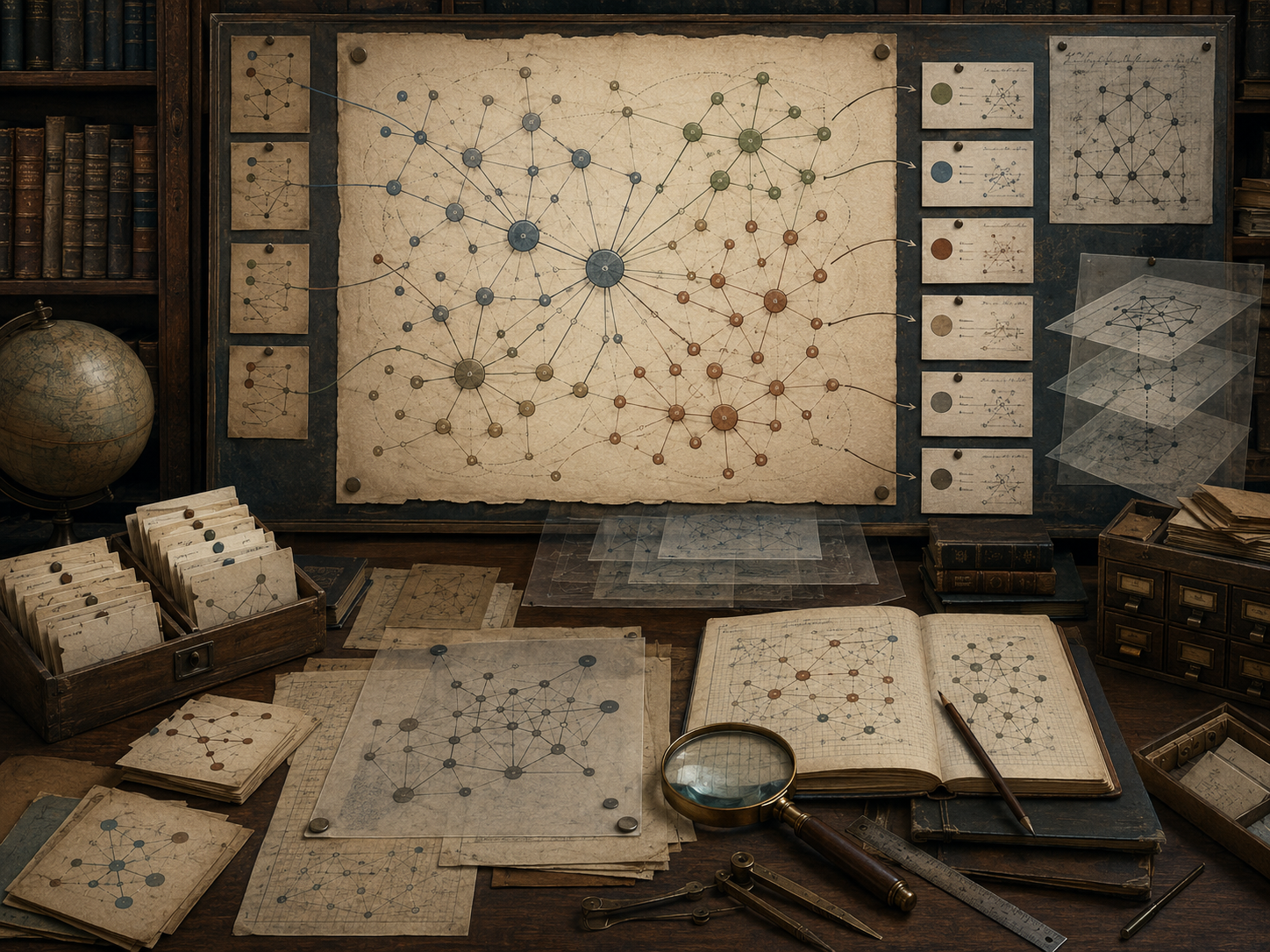
This article explains how knowledge graphs support semantic retrieval. It introduces entities, relationships, triples, graph schemas, ontologies, taxonomies, controlled vocabularies, linked data, RDF-style representation, graph databases, property graphs, semantic search, entity resolution, graph traversal, neighborhood retrieval, path-based retrieval, hybrid graph-vector search, retrieval-augmented AI, provenance, explainability, evaluation, and governance. It emphasizes that semantic retrieval is not simply “smarter search.” It is a design discipline for representing meaning, relationships, source evidence, and interpretive limits.
Why Knowledge Graphs Matter
Knowledge graphs matter because many important questions are relational. Users do not only ask whether a document contains a term. They ask how topics connect, which sources support a claim, which people contributed to a field, which regulations apply to a decision, which articles belong to a pathway, which datasets measure a variable, which concepts are broader or narrower, which systems depend on one another, and which evidence links a result to a source.
Ordinary keyword search can retrieve documents that mention related words. A knowledge graph can represent the relationships themselves.
| Retrieval need | Keyword search asks | Knowledge graph retrieval asks |
|---|---|---|
| Concept discovery | Which documents contain this term? | Which concepts, synonyms, and related topics connect to this idea? |
| Source tracing | Which pages mention this source? | Which claims, articles, datasets, and decisions rely on this source? |
| Pathway navigation | Which articles mention this phrase? | Where does this topic sit in a structured learning sequence? |
| Entity search | Which documents contain this name? | Which entity is meant, and what relationships define it? |
| Governance review | Which records contain “audit”? | Which decisions lack source evidence, review status, or correction paths? |
| AI retrieval | Which passages are similar to the prompt? | Which evidence-bearing entities and relationships support an answer? |
Knowledge graphs make relationships searchable. They turn information retrieval into relationship-aware knowledge discovery.
What a Knowledge Graph Is
A knowledge graph is a structured representation of entities and relationships. Entities may be people, organizations, documents, datasets, topics, concepts, places, events, articles, claims, decisions, code repositories, images, sources, or methods. Relationships connect those entities: cites, authored by, part of, belongs to, broader than, narrower than, supports, contradicts, depends on, derived from, updated by, located in, or governed by.
A knowledge graph can be simple or sophisticated. It may be a small graph linking articles and tags, a large enterprise graph linking documents and business processes, a scientific graph linking genes and diseases, or a public linked-data graph using semantic web standards.
| Graph element | Meaning | Example |
|---|---|---|
| Entity | A thing represented in the graph. | Article, concept, author, source, dataset. |
| Relationship | A typed connection between entities. | Article cites source. |
| Attribute | A property of an entity or relationship. | Publication date, status, confidence, source URL. |
| Class or type | A category an entity belongs to. | Article, Topic, Repository, Reference. |
| Schema | Rules for allowed types and relationships. | Article may cite Reference. |
| Ontology | Formal conceptual model of a domain. | Topic hierarchy and relation meanings. |
| Provenance | Evidence for where a fact came from. | Relationship extracted from citation metadata. |
A knowledge graph is not only a network diagram. It is a computational representation of meaning and evidence.
What Semantic Retrieval Means
Semantic retrieval finds information by meaning, context, and relationship. It goes beyond exact string matching. A semantic retrieval system may match synonyms, traverse relationships, use ontologies, infer broader or narrower concepts, retrieve related entities, combine graph paths with vector similarity, or rank results by source evidence and provenance.
Semantic retrieval does not mean abandoning keywords. Strong retrieval often combines lexical search, metadata filters, graph relationships, embeddings, and ranking models.
| Retrieval mode | How it works | Example |
|---|---|---|
| Keyword retrieval | Matches terms in documents. | Find pages containing “semantic retrieval.” |
| Entity retrieval | Finds records linked to a recognized entity. | Find articles about a specific concept. |
| Relationship retrieval | Finds connected entities. | Find articles that cite a source and belong to a series. |
| Path retrieval | Finds paths through a graph. | Connect topic to method to article to code repository. |
| Ontology-aware retrieval | Uses broader, narrower, or equivalent concepts. | Search “search architecture” and include “information retrieval.” |
| Vector retrieval | Finds semantically similar text or entities. | Retrieve conceptually related passages. |
| Hybrid retrieval | Combines lexical, graph, metadata, and vector signals. | Find authoritative, semantically related, source-backed results. |
Semantic retrieval asks what the query means in a represented knowledge environment, not only which words it contains.
Entities, Relationships, and Attributes
A knowledge graph begins by identifying entities, relationships, and attributes. This step is interpretive. A system must decide what counts as an entity, which relationships matter, what attributes should be preserved, and how uncertainty or provenance should be represented.
For a research library, entities might include article maps, articles, images, references, tags, categories, code repositories, authors, concepts, and workflows. Relationships might include belongs to series, cites source, has image, has code repository, precedes, follows, related topic, generated by workflow, and supports concept.
| Entity type | Possible relationships | Retrieval benefit |
|---|---|---|
| Article | belongs to series, cites source, links repository, precedes article | Supports pathway and source-aware retrieval. |
| Topic | broader than, narrower than, related to, explained by | Supports conceptual navigation. |
| Reference | cited by article, authored by, published in | Supports source tracing. |
| Repository | implements article, contains workflow, generates output | Connects conceptual article to executable code. |
| Image | illustrates article, has caption, has alt text | Improves visual content discovery and accessibility. |
| Dataset | used by workflow, derived from source, supports analysis | Supports reproducibility and provenance. |
| Decision | uses evidence, reviewed by, affects entity | Supports governance and accountability. |
Graph design begins with a representational question: what relationships must the system be able to remember, retrieve, and explain?
Triples, Property Graphs, and Graph Representation
Knowledge graphs are often represented using triples or property graphs. A triple has a subject, predicate, and object: article cites source; topic broader than subtopic; repository implements workflow. Property graphs use nodes and edges with labels and properties.
Both approaches represent relationships explicitly, but they emphasize different tooling and standards.
| Representation | Structure | Example |
|---|---|---|
| Triple | Subject, predicate, object. | Article → cites → Source. |
| RDF graph | Standardized triples with URIs. | Resource identified by persistent web identifier. |
| Property graph | Nodes and relationships with properties. | Article node connected to Source node by CITES edge. |
| Typed graph | Entities have classes or labels. | Article, Topic, Repository, Reference. |
| Attributed edge | Relationship has metadata. | CITES edge includes confidence and extraction source. |
| Named graph | Group of triples with context or provenance. | Facts extracted from one article version. |
Graph representation determines how meaning, context, and evidence can be queried.
Ontologies, Taxonomies, and Controlled Vocabularies
A knowledge graph is more useful when its terms and relationships are governed. Taxonomies organize topics hierarchically. Controlled vocabularies standardize labels. Ontologies define entity types, relationship meanings, constraints, equivalences, and inference rules.
Without semantic governance, graphs can become messy networks of inconsistent labels and ambiguous relationships. One record may use “AI,” another “artificial intelligence,” another “machine learning,” and another “algorithmic systems.” A controlled vocabulary or ontology can clarify relationships among these terms.
| Semantic structure | Purpose | Example |
|---|---|---|
| Controlled vocabulary | Standardizes terms. | Use “Information Retrieval” rather than many variants. |
| Taxonomy | Organizes broader and narrower topics. | Algorithms → Search → Semantic Retrieval. |
| Ontology | Defines entities, relationships, constraints, and meanings. | Article cites Reference; Repository implements Article. |
| Synonym map | Connects equivalent or related labels. | IR ↔ information retrieval. |
| Relationship vocabulary | Defines allowed edge types. | cites, supports, contradicts, precedes, implements. |
| Shape or constraint | Checks graph quality. | Every Article must have title, slug, and series. |
Semantic retrieval depends on semantic discipline: terms, classes, relationships, and constraints must be intentionally designed.
Entity Resolution and Identity
Entity resolution determines whether two mentions refer to the same entity. This is one of the hardest and most important parts of knowledge graph construction. “Turing,” “Alan Turing,” “A.M. Turing,” and a database identifier may all refer to the same person. But similar names may refer to different people.
Entity resolution matters for retrieval because search quality depends on identity. If the graph merges different entities incorrectly, retrieval becomes misleading. If it fails to merge identical entities, evidence becomes fragmented.
| Identity issue | Example | Risk |
|---|---|---|
| Synonymy | Different labels refer to the same concept. | Relevant results are split across labels. |
| Homonymy | Same label refers to different entities. | Unrelated results are mixed together. |
| Versioning | Same article changes over time. | Source evidence may become unclear. |
| Duplicate records | Same source appears in multiple formats. | Citation counts or relationships may be inflated. |
| Ambiguous acronyms | One acronym has multiple meanings. | Semantic retrieval may overgeneralize. |
| Partial metadata | Records lack enough identifying fields. | Matching becomes uncertain. |
Entity resolution should preserve confidence, source evidence, and correction paths. Identity errors propagate through graph retrieval.
Semantic Indexing and Graph Search
Semantic indexing makes graph structures retrievable. The system may index entity names, aliases, labels, relationships, properties, paths, embeddings, ontology classes, source references, and provenance fields.
Graph search can then answer relationship-aware questions: which articles cite sources about information retrieval? Which concepts are narrower than semantic search? Which repositories implement workflows for ranking models? Which images illustrate graph retrieval? Which claims lack source evidence?
| Indexed element | Retrieval use | Example |
|---|---|---|
| Entity label | Find named things. | Search for “knowledge graphs.” |
| Alias | Match alternate names. | “IR” finds information retrieval. |
| Relationship type | Find specific kinds of connections. | Articles that cite a source. |
| Ontology class | Find entities of a type. | All Article nodes in Algorithms. |
| Path pattern | Find structured relationship chains. | Topic → article → repository → output. |
| Provenance field | Find evidence-bearing relationships. | Edges supported by references. |
| Embedding | Find semantically similar entities or passages. | Related concepts by vector similarity. |
Semantic indexing makes relationships computationally accessible, not merely visually connected.
Graph Traversal and Path-Based Retrieval
Graph traversal retrieves information by following edges. It can answer direct questions and multi-hop questions. A direct query may ask which sources an article cites. A multi-hop query may ask which article maps contain articles that cite sources related to information retrieval and include code repositories.
Path-based retrieval is powerful because it can explain why a result was returned. A result can be supported by a path: Query concept → related topic → article → citation → source → repository.
| Traversal type | Question | Example |
|---|---|---|
| One-hop retrieval | What is directly connected? | Article cites Source. |
| Two-hop retrieval | What is connected through an intermediate node? | Topic explained by Article that links Repository. |
| Path retrieval | What relationship chain connects two entities? | Concept → Article → Reference → Author. |
| Neighborhood retrieval | What is near this entity? | Related articles, sources, tags, and repositories. |
| Constraint traversal | Which paths satisfy conditions? | Only reviewed articles with source-backed claims. |
| Evidence traversal | Which paths preserve provenance? | Result supported by citation and audit record. |
Graph traversal supports explainable retrieval because the path can become part of the answer.
Graph Embeddings and Vector Retrieval
Graph embeddings represent nodes, edges, or subgraphs as vectors. They can support similarity search, link prediction, entity recommendation, semantic clustering, and hybrid retrieval. A graph embedding may encode structural similarity: two topics are close because they connect to similar articles, sources, methods, or categories.
Vector retrieval can complement graph traversal. Traversal is explicit and explainable. Embeddings can discover latent similarity. The strongest systems often combine both.
| Embedding use | Benefit | Risk |
|---|---|---|
| Node similarity | Find related entities. | Similarity may be hard to explain. |
| Link prediction | Suggest missing relationships. | Predicted links may be plausible but unsupported. |
| Semantic clustering | Group related topics or documents. | Clusters may reflect representation bias. |
| Hybrid search | Combine graph paths and vector similarity. | Requires careful ranking and evaluation. |
| Recommendation | Suggest related articles or sources. | Can reinforce existing graph density. |
| RAG retrieval | Retrieve evidence for AI answers. | Vector similarity alone may not preserve provenance. |
Graph embeddings expand semantic retrieval, but inferred similarity should not be confused with source-backed knowledge.
Hybrid Graph-Vector Retrieval
Hybrid graph-vector retrieval combines explicit relationships with semantic similarity. A system might retrieve candidate passages using embeddings, then expand through graph neighbors, filter by ontology class, rerank by provenance, and show the evidence path.
This approach is especially useful when users ask conceptual questions. The vector system can find related language. The graph system can preserve structure, source, and context.
| Hybrid stage | Purpose | Governance concern |
|---|---|---|
| Lexical retrieval | Find exact or near-exact matches. | Preserves visible term evidence. |
| Vector retrieval | Find semantically similar passages. | Similarity may be opaque. |
| Entity linking | Connect passages to graph entities. | Identity errors can distort retrieval. |
| Graph expansion | Retrieve related entities and evidence. | Expansion can drift away from the query. |
| Provenance filtering | Favor source-backed relationships. | Unsupported edges should not be overtrusted. |
| Reranking | Combine semantic, graph, and evidence signals. | Weighting should be documented and evaluated. |
| Explanation | Show why result was returned. | Paths, sources, and confidence should be visible. |
Hybrid retrieval works best when vector similarity expands recall and graph structure preserves meaning, evidence, and explanation.
Knowledge Graphs in AI Retrieval Systems
Knowledge graphs can strengthen retrieval-augmented AI systems by improving grounding, provenance, source selection, entity consistency, relationship awareness, and answer explanation. Instead of retrieving only similar passages, an AI system can retrieve structured evidence: entities, relationships, citations, provenance paths, definitions, constraints, and neighboring concepts.
This can help reduce unsupported answers and improve traceability. However, a knowledge graph does not automatically make AI reliable. The graph itself must be accurate, current, governed, and evaluated.
| AI retrieval function | Graph contribution | Risk |
|---|---|---|
| Entity grounding | Links prompts to known entities. | Wrong entity linking can mislead the answer. |
| Evidence retrieval | Retrieves source-backed relationships. | Unsupported graph edges may appear authoritative. |
| Context expansion | Adds related concepts and sources. | Expansion can introduce irrelevant context. |
| Constraint retrieval | Retrieves rules, definitions, and boundaries. | Outdated constraints can distort reasoning. |
| Citation support | Connects generated claims to sources. | Citation mapping must be exact enough. |
| Answer explanation | Shows relationship paths behind retrieval. | Explanations may oversimplify uncertainty. |
Graph-based retrieval can make AI systems more grounded, but only when evidence, uncertainty, and graph quality are visible.
Provenance, Source Evidence, and Traceability
A responsible knowledge graph should record where relationships come from. Provenance answers: who asserted this relationship, when was it added, which source supports it, how confident is it, what extraction method produced it, and has it been reviewed?
Provenance is especially important for semantic retrieval because graph results may feel authoritative. If a graph says Article A supports Concept B, users need to know whether that relationship came from a citation, editor, automated extraction, user tag, model prediction, or inference rule.
| Provenance field | Question answered | Example |
|---|---|---|
| Source record | Where did this fact come from? | Reference, article section, dataset, audit log. |
| Assertion method | How was this relationship created? | Manual curation, extraction, inference, model prediction. |
| Timestamp | When was it added or updated? | Created and modified dates. |
| Confidence | How reliable is the relationship? | High, medium, low, or numeric score. |
| Reviewer | Who validated it? | Editorial or governance reviewer. |
| Version | Which version of the source supports it? | Article version or dataset release. |
| Status | Is it active, deprecated, disputed, or archived? | Current relation or historical relation. |
Semantic retrieval is strongest when every important relationship can be traced back to evidence.
Semantic Retrieval Evaluation
Semantic retrieval must be evaluated differently from simple keyword retrieval. A result may be relevant because it shares a concept, path, entity, ontology class, or provenance chain, not because it repeats terms. Evaluation must therefore consider conceptual relevance, relationship correctness, entity accuracy, path usefulness, source support, and user task success.
Metrics such as precision and recall still matter, but they should be supplemented with graph-specific review.
| Evaluation concern | Question | Evidence |
|---|---|---|
| Entity accuracy | Did the system identify the right entity? | Entity linking test set. |
| Relationship correctness | Are retrieved edges true and meaningful? | Curated relationship judgments. |
| Path usefulness | Does the graph path explain relevance? | Human evaluation of retrieval paths. |
| Conceptual recall | Did related concepts appear? | Ontology-aware relevance judgments. |
| Source support | Are retrieved relationships evidence-backed? | Provenance audit. |
| Result diversity | Are multiple relevant neighborhoods represented? | Coverage evaluation. |
| Task success | Did users find what they needed? | User testing and task completion. |
Semantic retrieval evaluation must test meaning, relationship quality, evidence, and usefulness.
Governance and Responsible Semantic Search
Responsible semantic search requires governance over schema design, ontology terms, entity resolution, relationship quality, source evidence, inferred links, embedding behavior, update processes, access permissions, and user-facing explanations.
A graph can make a knowledge system more powerful, but also more misleading if relationships are poorly defined, stale, unsupported, or overinterpreted.
| Governance concern | Review question | Evidence |
|---|---|---|
| Schema governance | Are entity and relationship types clearly defined? | Schema documentation. |
| Ontology governance | Who controls terms, classes, and equivalences? | Ontology change log. |
| Entity resolution | How are duplicate and ambiguous entities handled? | Identity matching audit. |
| Relationship quality | Are graph edges accurate and meaningful? | Edge validation review. |
| Provenance | Can important relationships be traced to sources? | Evidence and source metadata. |
| Inference | Which relationships are inferred rather than observed? | Inference rules and confidence notes. |
| Access control | Who can see which entities and edges? | Permission and privacy review. |
| Correction | Can users report graph errors? | Feedback and remediation workflow. |
Responsible semantic retrieval treats meaning as something to govern, not merely something to compute.
Representation Risk
Representation risk appears when a knowledge graph is mistaken for the world it represents. A graph is a model. It includes some entities, relationships, categories, and sources while excluding others. It may reflect editorial choices, data availability, institutional priorities, historical bias, extraction errors, and ontology assumptions.
Semantic retrieval can make these choices feel natural. If a relationship appears in the graph, users may treat it as authoritative. If a relationship is absent, users may assume no connection exists. Both assumptions can be wrong.
| Representation risk | How it appears in graph retrieval | Review response |
|---|---|---|
| False connection | Graph links entities that should not be linked. | Review edge evidence and confidence. |
| Missing connection | Relevant relationship is absent. | Audit coverage and source gaps. |
| Ontology rigidity | Categories force ambiguous concepts into narrow boxes. | Allow multiple classifications and notes. |
| Authority illusion | Graph structure makes weak claims look formal. | Display provenance and review status. |
| Inference overreach | Derived relationships are treated as observed facts. | Separate asserted, inferred, and predicted edges. |
| Identity error | Entities are merged or split incorrectly. | Maintain identity confidence and correction workflow. |
| Dense-node bias | Well-connected entities dominate retrieval. | Evaluate coverage and diversity. |
Knowledge graphs can clarify relationships, but only when their limits are visible.
Examples Across Computational Systems
The examples below show how knowledge graphs and semantic retrieval appear across research libraries, AI systems, archives, governance platforms, and scientific infrastructures.
Research library knowledge graph
Articles, article maps, tags, references, images, repositories, datasets, and workflows are connected into a navigable knowledge structure.
AI retrieval graph
An AI system retrieves source-backed entities, relationship paths, definitions, and citations before generating an answer.
Legal knowledge graph
Cases, statutes, jurisdictions, judges, citations, procedures, and legal concepts are linked for relationship-aware retrieval.
Scientific discovery graph
Datasets, variables, instruments, papers, authors, methods, and findings are connected for reproducible research.
Public records graph
Hearings, permits, agencies, documents, decisions, locations, timelines, and appeals are represented as connected records.
Enterprise knowledge graph
Policies, teams, systems, tickets, owners, workflows, dependencies, and documents are linked for organizational memory.
Digital humanities graph
Texts, authors, places, themes, translations, editions, archives, and historical events become searchable relationships.
Governance graph audit
Unsupported edges, stale entities, missing provenance, duplicate identities, and inferred relationships are reviewed.
Across these examples, graph retrieval turns knowledge discovery into relationship-aware reasoning.
Mathematics, Computation, and Modeling
A graph can be represented as a set of nodes and edges:
G = (V, E)
\]
Interpretation: A graph \(G\) contains vertices \(V\) and edges \(E\).
A directed typed relationship can be represented as a triple:
(s, p, o)
\]
Interpretation: A semantic triple has a subject \(s\), predicate \(p\), and object \(o\).
A path from one entity to another can be represented as:
v_0 \rightarrow v_1 \rightarrow \cdots \rightarrow v_k
\]
Interpretation: A path retrieves entities connected through a sequence of relationships.
A neighborhood of radius \(r\) around node \(v\) can be represented as:
N_r(v) = \{u \in V : dist(u,v) \le r\}
\]
Interpretation: Semantic retrieval can expand from a node to nearby entities within a graph distance.
A hybrid retrieval score can be represented as:
S(q,d)=\alpha L(q,d)+\beta V(q,d)+\gamma G(q,d)+\delta P(d)
\]
Interpretation: A hybrid score can combine lexical evidence \(L\), vector similarity \(V\), graph relevance \(G\), and provenance quality \(P\).
A provenance-weighted relationship score can be represented as:
R(e)=c(e)\cdot p(e)\cdot r(e)
\]
Interpretation: Relationship confidence can combine confidence \(c\), provenance strength \(p\), and review status \(r\).
These formulas show that semantic retrieval is both graph-theoretic and evidentiary. It ranks not only text, but relationships and paths.
Python Workflow: Knowledge Graph Retrieval Audit
The Python workflow below creates a dependency-light audit for knowledge graphs and semantic retrieval. It scores graph schema clarity, entity resolution, relationship quality, ontology discipline, semantic indexing, path retrieval, hybrid retrieval, provenance support, evaluation discipline, governance, explainability, and communication clarity.
# knowledge_graph_retrieval_audit.py
# Dependency-light workflow for auditing knowledge graphs and semantic retrieval.

from __future__ import annotations

from dataclasses import asdict, dataclass
from pathlib import Path
from collections import defaultdict, deque
import csv
import json
from statistics import mean

ARTICLE_ROOT = Path(__file__).resolve().parents[1]
TABLES = ARTICLE_ROOT / "outputs" / "tables"
JSON_DIR = ARTICLE_ROOT / "outputs" / "json"


@dataclass(frozen=True)
class KnowledgeGraphCase:
    case_name: str
    system_context: str
    retrieval_goal: str
    graph_schema_clarity: float
    entity_resolution: float
    relationship_quality: float
    ontology_discipline: float
    semantic_indexing: float
    path_retrieval: float
    hybrid_retrieval: float
    provenance_support: float
    evaluation_discipline: float
    governance_process: float
    explainability: float
    communication_clarity: float


def clamp(value: float, low: float = 0.0, high: float = 100.0) -> float:
    return max(low, min(high, value))


def knowledge_graph_score(case: KnowledgeGraphCase) -> float:
    return clamp(
        100.0 * (
            0.10 * case.graph_schema_clarity
            + 0.09 * case.entity_resolution
            + 0.10 * case.relationship_quality
            + 0.09 * case.ontology_discipline
            + 0.08 * case.semantic_indexing
            + 0.08 * case.path_retrieval
            + 0.08 * case.hybrid_retrieval
            + 0.10 * case.provenance_support
            + 0.09 * case.evaluation_discipline
            + 0.08 * case.governance_process
            + 0.06 * case.explainability
            + 0.05 * case.communication_clarity
        )
    )


def semantic_retrieval_risk(case: KnowledgeGraphCase) -> float:
    weak_points = [
        1.0 - case.graph_schema_clarity,
        1.0 - case.entity_resolution,
        1.0 - case.relationship_quality,
        1.0 - case.ontology_discipline,
        1.0 - case.provenance_support,
        1.0 - case.evaluation_discipline,
        1.0 - case.governance_process,
        1.0 - case.explainability,
        1.0 - case.communication_clarity,
    ]
    return clamp(100.0 * mean(weak_points))


def diagnose(score: float, risk: float) -> str:
    if score >= 84 and risk <= 20:
        return "strong knowledge graph retrieval discipline"
    if score >= 70 and risk <= 35:
        return "usable semantic retrieval with review needs"
    if risk >= 55:
        return "high risk; graph retrieval may hide weak identity, unsupported edges, ontology drift, or poor provenance"
    return "partial discipline; strengthen schema, identity, relationships, ontology, provenance, evaluation, and explanation"


def build_cases() -> list[KnowledgeGraphCase]:
    return [
        KnowledgeGraphCase(
            case_name="Research library knowledge graph",
            system_context="Articles, maps, references, images, repositories, tags, datasets, and workflows are connected for semantic discovery.",
            retrieval_goal="support relationship-aware discovery, source tracing, code navigation, and learning pathways",
            graph_schema_clarity=0.88,
            entity_resolution=0.82,
            relationship_quality=0.86,
            ontology_discipline=0.84,
            semantic_indexing=0.82,
            path_retrieval=0.84,
            hybrid_retrieval=0.76,
            provenance_support=0.88,
            evaluation_discipline=0.76,
            governance_process=0.82,
            explainability=0.84,
            communication_clarity=0.82,
        ),
        KnowledgeGraphCase(
            case_name="AI retrieval knowledge graph",
            system_context="Entities, passages, sources, citations, definitions, and graph paths support retrieval-augmented generation.",
            retrieval_goal="retrieve source-backed context for AI answers",
            graph_schema_clarity=0.78,
            entity_resolution=0.76,
            relationship_quality=0.74,
            ontology_discipline=0.72,
            semantic_indexing=0.82,
            path_retrieval=0.78,
            hybrid_retrieval=0.86,
            provenance_support=0.76,
            evaluation_discipline=0.70,
            governance_process=0.68,
            explainability=0.70,
            communication_clarity=0.72,
        ),
        KnowledgeGraphCase(
            case_name="Legal semantic retrieval graph",
            system_context="Cases, statutes, courts, jurisdictions, topics, citations, procedures, and authorities are linked.",
            retrieval_goal="support relationship-aware legal research and source tracing",
            graph_schema_clarity=0.86,
            entity_resolution=0.84,
            relationship_quality=0.88,
            ontology_discipline=0.86,
            semantic_indexing=0.80,
            path_retrieval=0.84,
            hybrid_retrieval=0.72,
            provenance_support=0.92,
            evaluation_discipline=0.82,
            governance_process=0.84,
            explainability=0.82,
            communication_clarity=0.80,
        ),
        KnowledgeGraphCase(
            case_name="Opaque entity network",
            system_context="Documents and topics are connected by automatically extracted links without clear schema, provenance, or review.",
            retrieval_goal="show related content",
            graph_schema_clarity=0.28,
            entity_resolution=0.30,
            relationship_quality=0.24,
            ontology_discipline=0.22,
            semantic_indexing=0.42,
            path_retrieval=0.36,
            hybrid_retrieval=0.38,
            provenance_support=0.20,
            evaluation_discipline=0.18,
            governance_process=0.22,
            explainability=0.24,
            communication_clarity=0.26,
        ),
    ]


def sample_edges() -> list[tuple[str, str, str]]:
    return [
        ("Information Retrieval", "related_to", "Search Architecture"),
        ("Search Architecture", "uses", "Inverted Index"),
        ("Search Architecture", "uses", "Ranking Signals"),
        ("Ranking Signals", "related_to", "Relevance Models"),
        ("Knowledge Graphs", "supports", "Semantic Retrieval"),
        ("Semantic Retrieval", "uses", "Entity Resolution"),
        ("Semantic Retrieval", "uses", "Graph Traversal"),
        ("Semantic Retrieval", "uses", "Vector Retrieval"),
        ("Knowledge Graphs", "requires", "Ontology Governance"),
        ("Knowledge Graphs", "requires", "Provenance"),
        ("Provenance", "supports", "Traceability"),
        ("Graph Traversal", "supports", "Path Explanation"),
    ]


def build_adjacency(edges: list[tuple[str, str, str]]) -> dict[str, list[tuple[str, str]]]:
    graph: dict[str, list[tuple[str, str]]] = defaultdict(list)
    for subject, predicate, obj in edges:
        graph[subject].append((predicate, obj))
    return dict(graph)


def shortest_path(edges: list[tuple[str, str, str]], start: str, goal: str) -> list[str]:
    graph = build_adjacency(edges)
    queue: deque[tuple[str, list[str]]] = deque([(start, [start])])
    visited = {start}

    while queue:
        node, path = queue.popleft()
        if node == goal:
            return path

        for _, neighbor in graph.get(node, []):
            if neighbor not in visited:
                visited.add(neighbor)
                queue.append((neighbor, path + [neighbor]))

    return []


def neighborhood(edges: list[tuple[str, str, str]], node: str, radius: int = 1) -> list[dict[str, str]]:
    graph = build_adjacency(edges)
    rows: list[dict[str, str]] = []
    queue: deque[tuple[str, int]] = deque([(node, 0)])
    visited = {node}

    while queue:
        current, depth = queue.popleft()
        if depth == radius:
            continue

        for predicate, neighbor in graph.get(current, []):
            rows.append({
                "source": current,
                "relationship": predicate,
                "target": neighbor,
                "depth": str(depth + 1),
            })
            if neighbor not in visited:
                visited.add(neighbor)
                queue.append((neighbor, depth + 1))

    return rows


def hybrid_score(lexical: float, vector: float, graph: float, provenance: float) -> dict[str, float]:
    score = 100.0 * (0.25 * lexical + 0.25 * vector + 0.25 * graph + 0.25 * provenance)
    return {
        "lexical": lexical,
        "vector": vector,
        "graph": graph,
        "provenance": provenance,
        "hybrid_score": round(score, 3),
    }


def run_audit() -> list[dict[str, object]]:
    rows: list[dict[str, object]] = []

    for case in build_cases():
        score = knowledge_graph_score(case)
        risk = semantic_retrieval_risk(case)
        rows.append({
            **asdict(case),
            "knowledge_graph_score": round(score, 3),
            "semantic_retrieval_risk": round(risk, 3),
            "diagnostic": diagnose(score, risk),
        })

    return rows


def graph_examples() -> list[dict[str, str]]:
    edges = sample_edges()
    path = shortest_path(edges, "Knowledge Graphs", "Traceability")
    return [
        {"example": "shortest_path", "path": " -> ".join(path)},
        {"example": "neighborhood_size_radius_2", "path": str(len(neighborhood(edges, "Semantic Retrieval", radius=2)))},
    ]


def hybrid_examples() -> list[dict[str, float]]:
    return [
        hybrid_score(0.82, 0.78, 0.88, 0.90),
        hybrid_score(0.60, 0.86, 0.42, 0.30),
    ]


def write_csv(path: Path, rows: list[dict[str, object]]) -> None:
    path.parent.mkdir(parents=True, exist_ok=True)

    with path.open("w", newline="", encoding="utf-8") as handle:
        writer = csv.DictWriter(handle, fieldnames=list(rows[0].keys()))
        writer.writeheader()
        writer.writerows(rows)


def write_json(path: Path, payload: object) -> None:
    path.parent.mkdir(parents=True, exist_ok=True)
    path.write_text(json.dumps(payload, indent=2, sort_keys=True), encoding="utf-8")


def summarize(rows: list[dict[str, object]]) -> dict[str, object]:
    return {
        "case_count": len(rows),
        "average_knowledge_graph_score": round(mean(float(row["knowledge_graph_score"]) for row in rows), 3),
        "average_semantic_retrieval_risk": round(mean(float(row["semantic_retrieval_risk"]) for row in rows), 3),
        "highest_score_case": max(rows, key=lambda row: float(row["knowledge_graph_score"]))["case_name"],
        "highest_risk_case": max(rows, key=lambda row: float(row["semantic_retrieval_risk"]))["case_name"],
        "interpretation": "Knowledge graph retrieval quality depends on schema clarity, entity resolution, relationship quality, ontology discipline, semantic indexing, path retrieval, hybrid retrieval, provenance, evaluation, governance, explainability, and communication."
    }


def main() -> None:
    audit_rows = run_audit()
    summary = summarize(audit_rows)
    edges = sample_edges()

    write_csv(TABLES / "knowledge_graph_retrieval_audit.csv", audit_rows)
    write_csv(TABLES / "knowledge_graph_retrieval_audit_summary.csv", [summary])
    write_csv(TABLES / "graph_edges.csv", [
        {"subject": s, "predicate": p, "object": o}
        for s, p, o in edges
    ])
    write_csv(TABLES / "graph_examples.csv", graph_examples())
    write_csv(TABLES / "hybrid_retrieval_examples.csv", hybrid_examples())

    write_json(JSON_DIR / "knowledge_graph_retrieval_audit.json", audit_rows)
    write_json(JSON_DIR / "knowledge_graph_retrieval_audit_summary.json", summary)
    write_json(JSON_DIR / "graph_adjacency.json", build_adjacency(edges))
    write_json(JSON_DIR / "graph_examples.json", graph_examples())
    write_json(JSON_DIR / "hybrid_retrieval_examples.json", hybrid_examples())

    print("Knowledge graph retrieval audit complete.")
    print(TABLES / "knowledge_graph_retrieval_audit.csv")


if __name__ == "__main__":
    main()
This workflow treats semantic retrieval as an auditable graph system: schema, identity, relationships, ontology, indexing, paths, hybrid retrieval, provenance, evaluation, governance, explanation, and communication.
R Workflow: Semantic Retrieval Summary
The R workflow reads the Python-generated audit table and creates summary outputs and visualizations using base R. It compares knowledge graph score and semantic retrieval risk across synthetic graph systems.
# knowledge_graph_retrieval_summary.R
# Base R workflow for summarizing knowledge graphs and semantic retrieval.

args <- commandArgs(trailingOnly = FALSE)
file_arg <- grep("^--file=", args, value = TRUE)

if (length(file_arg) > 0) {
  script_path <- normalizePath(sub("^--file=", "", file_arg[1]), mustWork = TRUE)
  article_root <- normalizePath(file.path(dirname(script_path), ".."), mustWork = TRUE)
} else {
  article_root <- getwd()
}

setwd(article_root)

tables_dir <- file.path(article_root, "outputs", "tables")
figures_dir <- file.path(article_root, "outputs", "figures")

if (!dir.exists(tables_dir)) {
  dir.create(tables_dir, recursive = TRUE)
}

if (!dir.exists(figures_dir)) {
  dir.create(figures_dir, recursive = TRUE)
}

audit_path <- file.path(tables_dir, "knowledge_graph_retrieval_audit.csv")

if (!file.exists(audit_path)) {
  stop(paste("Missing", audit_path, "Run the Python workflow first."))
}

data <- read.csv(audit_path, stringsAsFactors = FALSE)

summary_table <- data.frame(
  case_count = nrow(data),
  average_knowledge_graph_score = mean(data$knowledge_graph_score),
  average_semantic_retrieval_risk = mean(data$semantic_retrieval_risk),
  highest_score_case = data$case_name[which.max(data$knowledge_graph_score)],
  highest_risk_case = data$case_name[which.max(data$semantic_retrieval_risk)]
)

write.csv(
  summary_table,
  file.path(tables_dir, "r_knowledge_graph_retrieval_summary.csv"),
  row.names = FALSE
)

comparison_matrix <- rbind(
  data$knowledge_graph_score,
  data$semantic_retrieval_risk
)

colnames(comparison_matrix) <- data$case_name
rownames(comparison_matrix) <- c(
  "Knowledge graph score",
  "Semantic retrieval risk"
)

png(
  file.path(figures_dir, "knowledge_graph_score_vs_risk.png"),
  width = 1500,
  height = 850
)

barplot(
  comparison_matrix,
  beside = TRUE,
  las = 2,
  ylim = c(0, 100),
  ylab = "Score",
  main = "Knowledge Graph Score vs. Semantic Retrieval Risk"
)

legend(
  "topleft",
  legend = rownames(comparison_matrix),
  pch = 15,
  bty = "n"
)

grid()
dev.off()

print(summary_table)
This workflow helps compare semantic retrieval systems by schema clarity, entity resolution, relationship quality, ontology discipline, semantic indexing, path retrieval, hybrid retrieval, provenance, evaluation discipline, governance process, explainability, and communication clarity.
GitHub Repository
The companion repository for this article will provide reproducible code, synthetic datasets, workflow documentation, generated outputs, knowledge-graph calculators, graph traversal examples, hybrid retrieval examples, semantic retrieval audit summaries, visualizations, and governance artifacts that extend the article into executable examples.
Complete Code Repository
Companion article folder with Python, R, Julia, SQL, Haskell, C, C++, Fortran, Rust, Go, Java, TypeScript, Prolog, Racket, notebooks, documentation, synthetic teaching data, generated outputs, schemas, and Canvas-ready workflow artifacts for knowledge graphs, semantic retrieval, entity resolution, relationship modeling, ontologies, graph traversal, path-based retrieval, graph embeddings, hybrid graph-vector search, provenance, traceability, evaluation, explainability, and responsible semantic search design.
articles/knowledge-graphs-and-semantic-retrieval/
├── python/
│   ├── knowledge_graph_retrieval_audit.py
│   ├── graph_traversal_examples.py
│   ├── entity_resolution_examples.py
│   ├── hybrid_graph_vector_retrieval.py
│   ├── provenance_path_examples.py
│   ├── semantic_retrieval_evaluation.py
│   ├── calculators/
│   │   ├── graph_path_score_calculator.py
│   │   └── hybrid_retrieval_score_calculator.py
│   └── tests/
├── r/
│   ├── knowledge_graph_retrieval_summary.R
│   ├── semantic_retrieval_visualization.R
│   └── graph_governance_report.R
├── julia/
│   ├── graph_path_examples.jl
│   └── hybrid_retrieval_examples.jl
├── sql/
│   ├── schema_knowledge_graph_cases.sql
│   ├── schema_graph_edges.sql
│   └── semantic_retrieval_queries.sql
├── haskell/
│   ├── KnowledgeGraphs.hs
│   ├── SemanticRetrieval.hs
│   └── Main.hs
├── rust/
│   └── src/
├── go/
│   └── main.go
├── c/
│   └── graph_path_metrics.c
├── cpp/
│   └── graph_path_metrics.cpp
├── fortran/
│   └── hybrid_score_model.f90
├── java/
│   └── src/main/java/org/contentcatalyst/algorithms/
├── typescript/
│   └── src/
├── prolog/
│   └── knowledge_graph_rules.pl
├── racket/
│   └── graph_retrieval_checker.rkt
├── docs/
│   ├── methodology.md
│   ├── article-notes.md
│   ├── knowledge-graphs-and-semantic-retrieval.md
│   ├── governance-notes.md
│   └── responsible-use.md
├── data/
│   └── synthetic_knowledge_graph_cases.csv
├── outputs/
│   ├── tables/
│   ├── figures/
│   ├── json/
│   ├── logs/
│   └── reports/
├── notebooks/
│   └── knowledge_graphs_and_semantic_retrieval_walkthrough.ipynb
├── canvas/
│   ├── canvas_manifest.json
│   ├── canvas_cards.json
│   └── canvas_index.md
└── shared/
    ├── schemas/
    ├── templates/
    ├── taxonomies/
    ├── benchmarks/
└── governance/A Practical Method for Reviewing Knowledge Graph Retrieval
A practical review of knowledge graph retrieval begins with the question: what relationships does the system represent, how were they created, and what evidence supports them?
| Step | Question | Output |
|---|---|---|
| 1. Define graph purpose. | What should graph retrieval help users find? | Retrieval purpose statement. |
| 2. Inventory entities. | What types of things are represented? | Entity type catalog. |
| 3. Define relationships. | Which edge types are allowed and what do they mean? | Relationship vocabulary. |
| 4. Review identity resolution. | How are duplicates, aliases, and ambiguous names handled? | Entity resolution audit. |
| 5. Review ontology discipline. | Are terms, classes, and hierarchies governed? | Ontology and taxonomy review. |
| 6. Test retrieval paths. | Do graph paths explain why results appear? | Path-based retrieval evaluation. |
| 7. Audit provenance. | Can important edges be traced to source evidence? | Provenance coverage report. |
| 8. Separate asserted and inferred edges. | Which relationships are observed, inferred, or predicted? | Edge status and confidence report. |
| 9. Evaluate semantic retrieval. | Are entity, path, relationship, and concept results useful? | Semantic retrieval test set. |
| 10. Communicate limits. | What does the graph not know? | User-facing limitation and correction note. |
Graph retrieval review turns semantic search into an accountable representation practice.
Common Pitfalls
A common pitfall is assuming that a knowledge graph is automatically more accurate because it is structured. Structure can clarify meaning, but it can also formalize mistakes.
Common pitfalls include:
- entity confusion: merging different entities or splitting the same entity across records;
- unsupported edges: representing relationships without source evidence;
- ontology drift: letting terms and relationship meanings change without governance;
- semantic overreach: treating inferred or predicted links as established facts;
- dense-node bias: over-ranking well-connected entities because they have more graph structure;
- path mystique: assuming a graph path explains relevance when the path is weak or accidental;
- vector opacity: combining embeddings with graph retrieval without explaining why results appeared;
- stale graph state: retrieving relationships that no longer reflect current sources;
- schema rigidity: forcing complex concepts into narrow categories;
- graph without correction: providing no process to fix relationship, identity, or provenance errors.
The remedy is to treat knowledge graphs as governed models: useful, powerful, incomplete, and always dependent on evidence.
Why Knowledge Graphs Shape Computational Judgment
Knowledge graphs and semantic retrieval shape computational judgment because they determine how systems represent meaning. They decide which entities exist, which relationships matter, which categories organize interpretation, which sources support claims, which paths explain relevance, and which concepts are treated as related.
This is powerful. A graph can help users find relationships that keyword search misses. It can connect articles to sources, topics to methods, claims to evidence, datasets to workflows, and AI answers to provenance paths. It can make search more conceptual, navigable, and explainable.
But a graph is not reality. It is a representation. It must be designed, evaluated, governed, corrected, and interpreted. Responsible semantic retrieval makes graph assumptions visible: schema, identity, ontology, provenance, inference, uncertainty, freshness, and access.
The next article turns to ontologies, linked data, and semantic web standards, where the series examines how shared vocabularies, formal schemas, RDF, OWL, SPARQL, SHACL, and linked data practices can make semantic knowledge systems more interoperable and governable.
Related Articles
- Ranking Signals and Relevance Models
- Information Retrieval and Search Architecture
- Vectors, Embeddings, and Computational Meaning
- Graphs, Networks, and Computational Relationships
- Metadata, Provenance, and Computational Traceability
- Databases as Computational Knowledge Systems
- Relational Thinking and Query Logic
- Hashing, Indexing, and Retrieval
Further Reading
- Allemang, D. and Hendler, J. (2020) Semantic Web for the Working Ontologist. 3rd edn. Cambridge, MA: Morgan Kaufmann.
- Antoniou, G. and van Harmelen, F. (2008) A Semantic Web Primer. 2nd edn. Cambridge, MA: MIT Press.
- Berners-Lee, T., Hendler, J. and Lassila, O. (2001) ‘The Semantic Web’, Scientific American, 284(5), pp. 34–43.
- Ehrlinger, L. and Wöß, W. (2016) ‘Towards a definition of knowledge graphs’, SEMANTiCS 2016.
- Hogan, A. et al. (2021) ‘Knowledge graphs’, ACM Computing Surveys, 54(4), pp. 1–37.
- Noy, N.F. and McGuinness, D.L. (2001) Ontology Development 101: A Guide to Creating Your First Ontology. Stanford Knowledge Systems Laboratory.
- Nickel, M., Murphy, K., Tresp, V. and Gabrilovich, E. (2016) ‘A review of relational machine learning for knowledge graphs’, Proceedings of the IEEE, 104(1), pp. 11–33.
- W3C (2014) RDF 1.1 Concepts and Abstract Syntax. World Wide Web Consortium Recommendation.
- W3C (2013) SPARQL 1.1 Query Language. World Wide Web Consortium Recommendation.
- W3C (2012) OWL 2 Web Ontology Language Document Overview. World Wide Web Consortium Recommendation.
- W3C (2017) Shapes Constraint Language (SHACL). World Wide Web Consortium Recommendation.
References
- Allemang, D. and Hendler, J. (2020) Semantic Web for the Working Ontologist. 3rd edn. Cambridge, MA: Morgan Kaufmann.
- Antoniou, G. and van Harmelen, F. (2008) A Semantic Web Primer. 2nd edn. Cambridge, MA: MIT Press.
- Berners-Lee, T., Hendler, J. and Lassila, O. (2001) ‘The Semantic Web’, Scientific American, 284(5), pp. 34–43.
- Ehrlinger, L. and Wöß, W. (2016) ‘Towards a definition of knowledge graphs’, SEMANTiCS 2016.
- Hogan, A., Blomqvist, E., Cochez, M., d’Amato, C., de Melo, G., Gutierrez, C., Kirrane, S., Gayo, J.E.L., Navigli, R., Neumaier, S., Ngomo, A.C.N., Polleres, A., Rashid, S.M., Rula, A., Schmelzeisen, L., Sequeda, J., Staab, S. and Zimmermann, A. (2021) ‘Knowledge graphs’, ACM Computing Surveys, 54(4), pp. 1–37.
- Noy, N.F. and McGuinness, D.L. (2001) Ontology Development 101: A Guide to Creating Your First Ontology. Stanford Knowledge Systems Laboratory.
- Nickel, M., Murphy, K., Tresp, V. and Gabrilovich, E. (2016) ‘A review of relational machine learning for knowledge graphs’, Proceedings of the IEEE, 104(1), pp. 11–33.
- W3C (2012) OWL 2 Web Ontology Language Document Overview. World Wide Web Consortium Recommendation.
- W3C (2013) SPARQL 1.1 Query Language. World Wide Web Consortium Recommendation.
- W3C (2014) RDF 1.1 Concepts and Abstract Syntax. World Wide Web Consortium Recommendation.
- W3C (2017) Shapes Constraint Language (SHACL). World Wide Web Consortium Recommendation.