
Last Updated June 17, 2026
Formal languages give computation a way to represent structure precisely. A computer cannot work directly with vague intention. It works with symbols, strings, tokens, rules, expressions, encodings, grammars, syntax trees, schemas, instructions, and formally interpretable patterns. Formal languages make those structures explicit.
This matters because computation is not only about numbers. It is also about representation. Programs, mathematical expressions, database queries, markup, regular expressions, logic formulas, type declarations, configuration files, data schemas, proofs, protocols, and machine instructions all depend on symbolic forms that can be parsed, checked, transformed, interpreted, or executed.
Formal languages help explain how symbolic expression becomes computational action. A language defines what counts as a valid expression. A grammar defines how expressions are built. A parser checks and organizes those expressions. An interpreter, compiler, solver, theorem prover, database engine, or runtime system gives them operational meaning. Symbolic representation is the bridge between human-readable structure and machine-processable procedure.
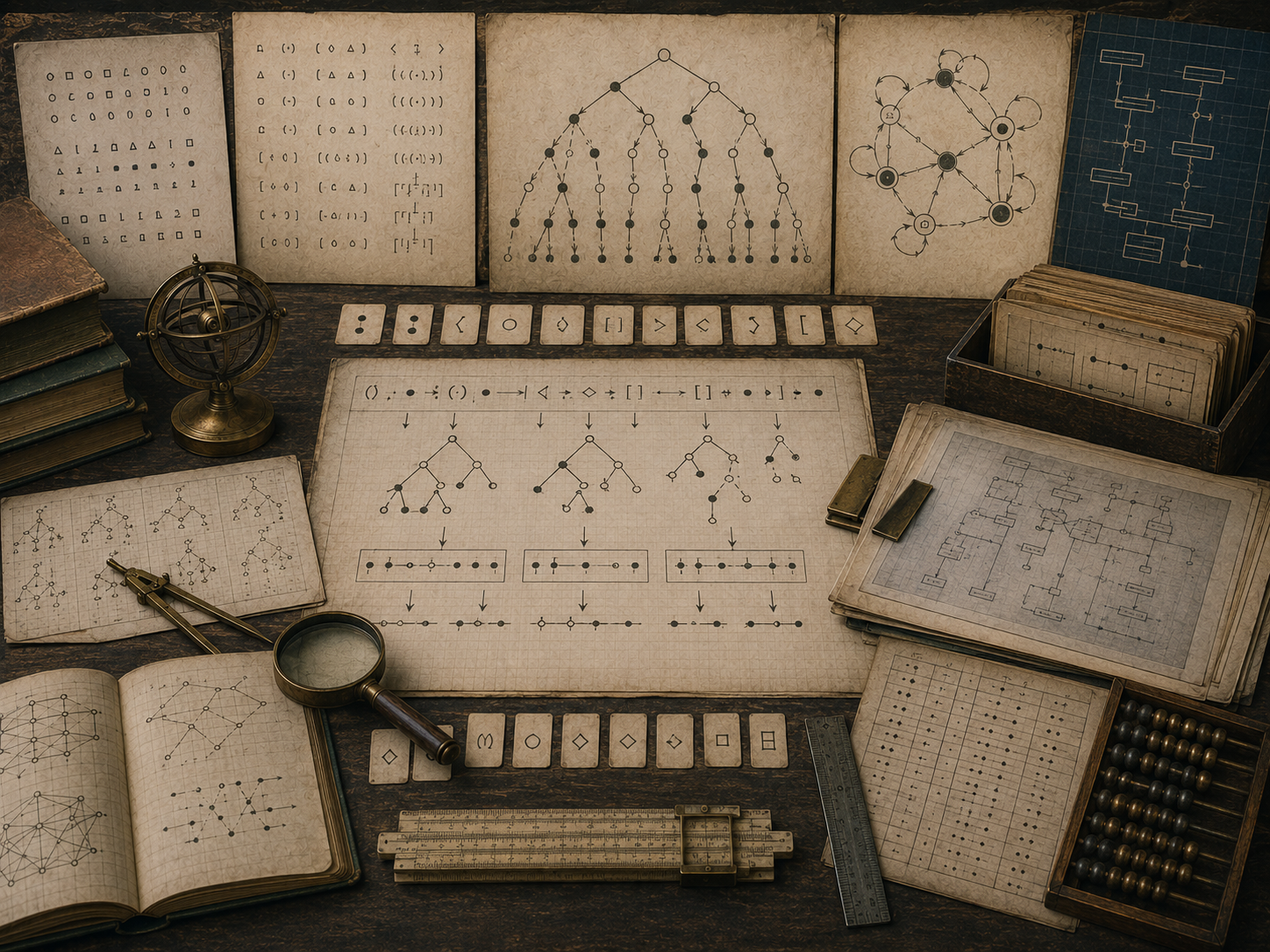
This article explains formal languages and symbolic representation as foundations of computational reasoning. It introduces alphabets, symbols, strings, languages, grammars, syntax, semantics, tokens, parsing, regular languages, context-free languages, syntax trees, compilers, interpreters, data formats, markup, schemas, logic formulas, and programming languages. It also explains why symbolic representation is not merely technical notation. The way symbols are defined, structured, interpreted, and governed shapes what computational systems can express, check, automate, and explain.
Why Formal Languages Matter
Formal languages matter because computation needs unambiguous structure. Human language is rich, flexible, contextual, metaphorical, and often ambiguous. Computation requires symbols arranged according to rules that can be checked and processed. A formal language defines which symbolic expressions are allowed and how they are structured.
This is why formal languages appear everywhere in computational systems. Programming languages define valid programs. Query languages define valid database requests. Markup languages define structured documents. Logic languages define valid formulas. Configuration languages define system settings. Data formats define how information is serialized. Protocols define valid message exchanges.
| Computational domain | Formal-language role | Example |
|---|---|---|
| Programming | Defines valid program structure. | Variables, functions, expressions, statements, types. |
| Databases | Defines valid queries and constraints. | SQL statements, relational predicates, schema rules. |
| Markup | Defines document structure. | HTML elements, XML tags, Markdown patterns. |
| Data exchange | Defines serialized representation. | JSON, CSV, YAML, protocol buffers. |
| Logic | Defines valid formulas and inference structures. | Predicates, quantifiers, connectives, proof rules. |
| Compilers | Transforms symbolic input into executable form. | Lexing, parsing, syntax trees, code generation. |
Formal languages allow computational systems to reject malformed input, parse valid expressions, preserve structure, transform representations, and attach operational meaning to symbols.
What Is a Formal Language?
A formal language is a set of strings built from an alphabet according to specified rules. The alphabet defines the symbols available. The rules define which combinations of symbols belong to the language.
Unlike natural languages, formal languages are designed for precise recognition and manipulation. They do not depend on ordinary context in the same way human speech does. A string either belongs to the formal language or it does not, at least under a particular grammar or recognition rule.
L \subseteq \Sigma^*
\]
Interpretation: A formal language \(L\) is a subset of all finite strings \(\Sigma^*\) that can be formed from an alphabet \(\Sigma\).
| Term | Meaning | Computational example |
|---|---|---|
| Alphabet | A finite set of allowed symbols. | Letters, digits, operators, delimiters, tokens. |
| String | A finite sequence of symbols. | x + 3, SELECT *, {"id": 1}. |
| Language | A set of valid strings. | All valid Python programs, SQL queries, or JSON documents. |
| Grammar | Rules for generating valid strings. | Expression grammar, programming-language grammar. |
| Recognizer | A system that checks membership. | Parser, validator, automaton, compiler front end. |
| Interpreter | A system that gives operational meaning. | Runtime, query engine, rule engine, theorem prover. |
A formal language is therefore both restrictive and enabling. It restricts what counts as valid, and that restriction makes reliable computational processing possible.
Symbols, Alphabets, and Strings
Symbols are the basic units of formal representation. An alphabet is the set of symbols available for forming strings. A string is a finite sequence of symbols. These simple ideas support programming languages, data formats, expressions, protocols, and symbolic reasoning systems.
In practice, symbols often appear as tokens rather than raw characters. A programming language may treat while, identifier, number, +, and ; as tokens. A parser then reasons over these tokens rather than individual characters.
w = a_1a_2\cdots a_n,\quad a_i \in \Sigma
\]
Interpretation: A string \(w\) is a finite sequence of symbols drawn from an alphabet \(\Sigma\).
| Representation level | Unit | Example |
|---|---|---|
| Character level | Individual character. | {, a, 3, +. |
| Token level | Recognized lexical unit. | NUMBER, IDENTIFIER, KEYWORD. |
| Expression level | Structured combination of tokens. | x + 3, price > 100. |
| Statement level | Complete instruction or claim. | return result, SELECT ... WHERE .... |
| Document level | Structured file or artifact. | Program, JSON document, HTML page, proof script. |
| System level | Set of interacting symbolic artifacts. | Application code, schemas, queries, tests, configuration. |
Symbolic representation becomes powerful when levels are connected carefully. A system that confuses characters, tokens, expressions, statements, and documents can misread input or misinterpret meaning.
Grammars and Rules
A grammar defines how strings in a language can be generated or recognized. It describes the structure of valid expressions. In computational practice, grammars are used to define programming languages, query languages, markup languages, command languages, data formats, and domain-specific languages.
A grammar usually includes terminal symbols, nonterminal symbols, production rules, and a start symbol. Terminals are the symbols that appear in final strings. Nonterminals represent abstract categories. Production rules define how categories expand into symbols or other categories. The start symbol identifies where generation begins.
G = (V, \Sigma, R, S)
\]
Interpretation: A grammar \(G\) can be defined by nonterminals \(V\), terminal alphabet \(\Sigma\), production rules \(R\), and start symbol \(S\).
A simple expression grammar might look like this:
Expression → Term
Expression → Expression + Term
Term       → Number
Term       → Identifier
Term       → ( Expression )
This grammar defines valid expression structures. It can produce strings such as x, 3, x + 3, or (x + 3). A parser can use the grammar to check whether an input string is valid and to build a syntax tree.
| Grammar component | Role | Example |
|---|---|---|
| Terminal | Symbol that appears in the final string. | +, number, identifier. |
| Nonterminal | Abstract syntactic category. | Expression, Term, Statement. |
| Production rule | Defines how one category expands. | Expression → Expression + Term. |
| Start symbol | Where generation begins. | Program, Query, Expression. |
| Derivation | Sequence of rule applications. | How a valid string is produced. |
| Parse tree | Tree representation of structure. | Nested expression or program structure. |
Grammars make symbolic structure visible. They show not only which strings are valid, but how valid strings are built.
Syntax, Semantics, and Interpretation
Syntax concerns form. Semantics concerns meaning. A string can be syntactically valid while semantically invalid, ambiguous, unsafe, or inappropriate. This distinction is central to computational reasoning.
For example, a program may have valid syntax but still divide by zero. A SQL query may be syntactically valid but return the wrong rows. A JSON document may be well-formed but fail a schema requirement. A logical formula may be well-formed but false under a particular interpretation.
| Layer | Question | Example |
|---|---|---|
| Lexical form | Are characters grouped into valid tokens? | 123 is a number token. |
| Syntax | Are tokens arranged according to grammar? | x + 3 is a valid expression. |
| Static semantics | Does the expression satisfy type or scope rules? | x must be defined before use. |
| Dynamic semantics | What happens when it is executed? | The expression evaluates to a value. |
| Domain meaning | What does the output mean in context? | A score may represent risk, priority, similarity, or uncertainty. |
| Responsible interpretation | How should the result be used? | A recommendation may require review rather than automatic action. |
Formal languages help with syntax and structure, but semantics requires interpretation. Some semantics can be formalized. Some meaning depends on domain context, institutional rules, human judgment, and responsible use.
Tokens, Parsing, and Structure
Parsing is the process of analyzing a string according to a grammar. A parser takes a sequence of symbols or tokens and determines whether it belongs to a language. If the string is valid, the parser may produce a parse tree or abstract syntax tree that captures structure.
This process appears in compilers, interpreters, query engines, template systems, markup processors, command-line tools, expression evaluators, and data validators.
source text
   ↓
lexical analysis
   ↓
tokens
   ↓
parsing
   ↓
syntax tree
   ↓
semantic analysis
   ↓
interpretation, transformation, or execution| Stage | Purpose | Common failure |
|---|---|---|
| Lexing | Group characters into tokens. | Unrecognized character or malformed token. |
| Parsing | Check grammatical structure. | Unexpected token or missing delimiter. |
| Syntax tree construction | Represent hierarchical structure. | Ambiguous or incorrect parse. |
| Semantic analysis | Check types, scope, references, and constraints. | Undefined variable, type mismatch, invalid reference. |
| Transformation | Rewrite or compile representation. | Incorrect optimization or translation. |
| Execution or interpretation | Give operational meaning. | Runtime error, wrong result, unsafe behavior. |
Parsing shows why symbolic representation matters. A computational system must not only receive symbols. It must recognize their structure.
Regular and Context-Free Languages
Formal language theory classifies languages according to the kinds of rules and recognizers needed to define them. Two especially important classes are regular languages and context-free languages.
Regular languages can be recognized by finite automata and described by regular expressions. They are useful for tokenization, pattern matching, simple validation, and search. Context-free languages can describe nested structures and are often used for programming-language syntax, arithmetic expressions, markup, and parsed documents.
| Language class | Recognizer | Common use |
|---|---|---|
| Regular language | Finite automaton. | Token patterns, simple validation, lexical analysis. |
| Context-free language | Pushdown automaton or parser. | Nested expressions, program syntax, parse trees. |
| Context-sensitive language | More powerful bounded-memory recognition. | Some formal constraints beyond context-free syntax. |
| Recursively enumerable language | Turing machine recognition. | General computation and computability theory. |
Regular expressions are powerful for certain tasks, but they are not suitable for every structured language. Nested structures often require grammars and parsers. A common computational mistake is trying to process a complex hierarchical language with a flat pattern-matching tool.
\text{regular} \subset \text{context-free} \subset \text{context-sensitive} \subset \text{recursively enumerable}
\]
Interpretation: Formal language classes can be organized by expressive power, with each broader class able to describe more complex structures.
Symbolic Representation in Programming
Programming languages are formal languages with operational meaning. Their syntax defines valid programs. Their semantics defines how programs behave. Their type systems, module systems, runtimes, compilers, and interpreters determine how symbolic expressions become computation.
A program is not merely text. It is a structured symbolic artifact. Its characters become tokens. Its tokens become syntax trees. Its syntax trees become typed structures, intermediate representations, bytecode, machine code, or interpreted actions.
| Programming-language feature | Symbolic role | Computational purpose |
|---|---|---|
| Identifier | Name for a value, function, type, or module. | Supports reference, reuse, and abstraction. |
| Expression | Symbolic form that evaluates to a value. | Computes results from values and operations. |
| Statement | Instruction or control structure. | Changes state, directs flow, or invokes action. |
| Type declaration | Constraint on values. | Prevents invalid operations and clarifies contracts. |
| Function definition | Named transformation. | Supports modularity and reusable procedure. |
| Module | Organized symbolic boundary. | Supports maintainability and separation of concerns. |
Symbolic representation also shapes how people think about programs. Names, indentation, syntax, modules, types, and comments influence whether code can be understood, reviewed, tested, and maintained.
Data Formats, Markup, and Schemas
Formal languages are not limited to programming languages. Data formats and markup languages are also formal or semi-formal systems for symbolic representation. They define how information is structured so that systems can exchange, validate, transform, and display it.
JSON, XML, HTML, CSV, YAML, RDF, SQL DDL, protocol buffers, and schema languages all represent information in structured symbolic form. The structure matters because downstream systems depend on it.
| Format or language | Representation purpose | Common risk |
|---|---|---|
| JSON | Structured data exchange. | Missing fields, wrong types, inconsistent nesting. |
| XML | Hierarchical document and data representation. | Overcomplex schemas or ambiguous interpretation. |
| HTML | Structured web documents. | Invalid nesting, accessibility gaps, semantic misuse. |
| CSV | Tabular data exchange. | Ambiguous delimiters, missing headers, type ambiguity. |
| YAML | Human-readable configuration. | Indentation errors and implicit type surprises. |
| Schema language | Validation of structured data. | Rules may be incomplete or out of date. |
Schemas are especially important because they define constraints on symbolic representation. A schema can specify required fields, allowed values, nested structures, data types, relationships, and validation rules. Without schemas, downstream systems may interpret the same symbols differently.
Logic, Proof, and Symbolic Reasoning
Formal languages are central to logic and proof. A logical language defines valid formulas. A proof system defines valid transformations from premises to conclusions. A theorem prover, proof assistant, or model checker can then operate over symbolic structures.
This is one of the deepest links between symbolic representation and computation. A proof can be treated as a structured symbolic artifact. A program can be checked against a specification. A type system can prevent invalid expressions. A solver can search for assignments satisfying constraints. A model checker can explore possible states.
\Gamma \vdash \varphi
\]
Interpretation: A proof system derives statement \(\varphi\) from premises \(\Gamma\) using formal rules.
| Symbolic reasoning system | Formal-language role | Computational use |
|---|---|---|
| Logical formula language | Defines valid claims. | Rules, predicates, assertions, constraints. |
| Proof language | Defines valid proof steps. | Theorem proving and proof assistants. |
| Specification language | Defines required system behavior. | Verification and model checking. |
| Query language | Defines questions over structured data. | Databases and knowledge graphs. |
| Rule language | Defines conditions and consequences. | Expert systems and decision workflows. |
| Constraint language | Defines allowable assignments. | Solvers, planners, schedulers, configuration tools. |
Symbolic reasoning depends on disciplined representation. If the language is unclear, the reasoning built on it becomes fragile.
Limits of Symbolic Representation
Symbolic representation is powerful, but it has limits. Not everything meaningful is easy to formalize. Human categories may be ambiguous. Institutional rules may conflict. Natural language may carry context, tone, implication, and history. Ethical judgment may not reduce cleanly to a grammar, schema, or predicate.
Formal representation always selects. It decides what symbols exist, what structures count, what distinctions matter, and what gets ignored. This makes symbolic representation both useful and risky. It can clarify, but it can also oversimplify.
| Limit | Why it matters | Responsible response |
|---|---|---|
| Ambiguity | Some concepts do not have crisp boundaries. | Document definitions and unresolved cases. |
| Context loss | Symbols may omit social, historical, or institutional meaning. | Record scope and interpretation limits. |
| Overformalization | A formal structure can appear more complete than it is. | Distinguish validity from adequacy. |
| Schema rigidity | Real cases may not fit existing categories. | Allow review, exceptions, and schema evolution. |
| Hidden assumptions | Representation choices can encode values invisibly. | Make assumptions inspectable and revisable. |
| Interpretive drift | Meaning can change as context changes. | Version representations and schedule review. |
Formal languages should not be treated as replacements for judgment. They are tools for making structure explicit so it can be processed, questioned, tested, and governed.
Examples Across Computational Systems
The examples below show how formal languages and symbolic representation appear across computational practice.
Programming languages
A program is a symbolic artifact governed by lexical rules, grammar, type rules, and operational semantics.
Regular expressions
A regular expression defines a pattern language used for search, tokenization, validation, and text processing.
Compilers
A compiler transforms source code from one symbolic representation into another, often through tokens, syntax trees, and intermediate representations.
Database queries
A query language represents questions over structured relations using formal conditions, joins, constraints, and projections.
Markup languages
Markup represents document structure using tags, nesting, attributes, and formal or semi-formal validation rules.
Data schemas
Schemas define what counts as a valid data object, including required fields, types, ranges, relationships, and constraints.
Logic languages
Formal logic languages represent propositions, predicates, quantifiers, connectives, proofs, and inference rules.
Knowledge systems
Ontologies, taxonomies, and knowledge graphs use symbolic representation to define entities, relationships, categories, and constraints.
Across these examples, formal languages make symbolic structure computable.
Mathematics, Computation, and Modeling
Formal languages can be described through alphabets, strings, grammars, and recognition functions.
An alphabet defines possible symbols:
\Sigma = \{a_1, a_2, \ldots, a_k\}
\]
Interpretation: An alphabet \(\Sigma\) is a finite set of symbols.
The set of all finite strings over an alphabet is written:
\Sigma^*
\]
Interpretation: \(\Sigma^*\) contains every finite string that can be formed from symbols in \(\Sigma\), including the empty string.
A language is a subset of possible strings:
L \subseteq \Sigma^*
\]
Interpretation: A formal language \(L\) contains the strings considered valid under a given definition.
A grammar defines how valid strings are generated:
G = (V, \Sigma, R, S)
\]
Interpretation: A grammar consists of nonterminals \(V\), terminals \(\Sigma\), production rules \(R\), and start symbol \(S\).
A recognizer can be represented as a function:
\text{Recognize}(w) =
\begin{cases}
\text{accept}, & w \in L \\
\text{reject}, & w \notin L
\end{cases}
\]
Interpretation: A recognizer accepts a string if it belongs to the language and rejects it otherwise.
These ideas connect formal language theory to real computational tools: lexers, parsers, validators, compilers, interpreters, schemas, solvers, and proof systems.
Python Workflow: Formal Language Structure Audit
The Python workflow below creates a simple synthetic audit for symbolic representation cases. It scores alphabet clarity, grammar explicitness, syntax validation, semantic clarity, parser readiness, schema support, error reporting, testability, interoperability, and governance readiness.
# formal_language_audit.py
# Dependency-light workflow for evaluating formal-language and symbolic-representation quality.

from __future__ import annotations

from dataclasses import asdict, dataclass
from pathlib import Path
import csv
import json
from statistics import mean

ARTICLE_ROOT = Path(__file__).resolve().parents[1]
TABLES = ARTICLE_ROOT / "outputs" / "tables"
JSON_DIR = ARTICLE_ROOT / "outputs" / "json"


@dataclass(frozen=True)
class FormalLanguageCase:
    case_name: str
    representation_context: str
    symbolic_structure: str
    alphabet_clarity: float
    grammar_explicitness: float
    syntax_validation: float
    semantic_clarity: float
    parser_readiness: float
    schema_support: float
    error_reporting: float
    testability: float
    interoperability: float
    governance_readiness: float


def clamp(value: float, low: float = 0.0, high: float = 100.0) -> float:
    return max(low, min(high, value))


def representation_quality(case: FormalLanguageCase) -> float:
    return clamp(
        100.0 * (
            0.10 * case.alphabet_clarity
            + 0.12 * case.grammar_explicitness
            + 0.12 * case.syntax_validation
            + 0.12 * case.semantic_clarity
            + 0.10 * case.parser_readiness
            + 0.10 * case.schema_support
            + 0.10 * case.error_reporting
            + 0.08 * case.testability
            + 0.08 * case.interoperability
            + 0.08 * case.governance_readiness
        )
    )


def representation_risk(case: FormalLanguageCase) -> float:
    weak_points = [
        1.0 - case.alphabet_clarity,
        1.0 - case.grammar_explicitness,
        1.0 - case.syntax_validation,
        1.0 - case.semantic_clarity,
        1.0 - case.parser_readiness,
        1.0 - case.schema_support,
        1.0 - case.error_reporting,
        1.0 - case.interoperability,
    ]
    return clamp(100.0 * mean(weak_points))


def diagnose(quality: float, risk: float) -> str:
    if quality >= 80 and risk <= 25:
        return "strong symbolic representation with clear grammar, validation, and interpretation"
    if quality >= 65 and risk <= 40:
        return "usable symbolic representation with review needs"
    if risk >= 55:
        return "high representation risk; language, grammar, schema, or semantics may be unclear"
    return "partial symbolic representation; improve grammar, semantics, validation, or governance"


def build_cases() -> list[FormalLanguageCase]:
    return [
        FormalLanguageCase(
            case_name="Expression grammar",
            representation_context="Arithmetic expression evaluator.",
            symbolic_structure="Tokens, grammar rules, parse trees, and evaluation semantics.",
            alphabet_clarity=0.82,
            grammar_explicitness=0.86,
            syntax_validation=0.84,
            semantic_clarity=0.78,
            parser_readiness=0.82,
            schema_support=0.62,
            error_reporting=0.74,
            testability=0.82,
            interoperability=0.68,
            governance_readiness=0.64,
        ),
        FormalLanguageCase(
            case_name="JSON configuration schema",
            representation_context="Application configuration file.",
            symbolic_structure="Keys, values, nested objects, schema validation, and defaults.",
            alphabet_clarity=0.76,
            grammar_explicitness=0.78,
            syntax_validation=0.84,
            semantic_clarity=0.72,
            parser_readiness=0.80,
            schema_support=0.86,
            error_reporting=0.72,
            testability=0.78,
            interoperability=0.82,
            governance_readiness=0.70,
        ),
        FormalLanguageCase(
            case_name="SQL query layer",
            representation_context="Relational data retrieval workflow.",
            symbolic_structure="Query syntax, predicates, joins, constraints, and result schemas.",
            alphabet_clarity=0.74,
            grammar_explicitness=0.76,
            syntax_validation=0.78,
            semantic_clarity=0.70,
            parser_readiness=0.74,
            schema_support=0.82,
            error_reporting=0.68,
            testability=0.74,
            interoperability=0.78,
            governance_readiness=0.72,
        ),
        FormalLanguageCase(
            case_name="Rule-language workflow",
            representation_context="Institutional decision-routing rules.",
            symbolic_structure="If-then rules, predicates, exceptions, review states, and traceable outputs.",
            alphabet_clarity=0.70,
            grammar_explicitness=0.68,
            syntax_validation=0.66,
            semantic_clarity=0.64,
            parser_readiness=0.60,
            schema_support=0.70,
            error_reporting=0.66,
            testability=0.72,
            interoperability=0.62,
            governance_readiness=0.80,
        ),
    ]


def run_audit() -> list[dict[str, object]]:
    rows: list[dict[str, object]] = []
    for case in build_cases():
        quality = representation_quality(case)
        risk = representation_risk(case)
        rows.append({
            **asdict(case),
            "representation_quality": round(quality, 3),
            "representation_risk": round(risk, 3),
            "diagnostic": diagnose(quality, risk),
        })
    return rows


def write_csv(path: Path, rows: list[dict[str, object]]) -> None:
    path.parent.mkdir(parents=True, exist_ok=True)
    with path.open("w", newline="", encoding="utf-8") as handle:
        writer = csv.DictWriter(handle, fieldnames=list(rows[0].keys()))
        writer.writeheader()
        writer.writerows(rows)


def write_json(path: Path, payload: object) -> None:
    path.parent.mkdir(parents=True, exist_ok=True)
    path.write_text(json.dumps(payload, indent=2, sort_keys=True), encoding="utf-8")


def summarize(rows: list[dict[str, object]]) -> dict[str, object]:
    return {
        "case_count": len(rows),
        "average_representation_quality": round(mean(float(row["representation_quality"]) for row in rows), 3),
        "average_representation_risk": round(mean(float(row["representation_risk"]) for row in rows), 3),
        "highest_quality_case": max(rows, key=lambda row: float(row["representation_quality"]))["case_name"],
        "highest_risk_case": max(rows, key=lambda row: float(row["representation_risk"]))["case_name"],
        "interpretation": "Symbolic representation quality depends on alphabet clarity, grammar explicitness, syntax validation, semantic clarity, parser readiness, schema support, error reporting, testability, interoperability, and governance."
    }


def main() -> None:
    rows = run_audit()
    summary = summarize(rows)

    write_csv(TABLES / "formal_language_audit.csv", rows)
    write_csv(TABLES / "formal_language_audit_summary.csv", [summary])
    write_json(JSON_DIR / "formal_language_audit.json", rows)
    write_json(JSON_DIR / "formal_language_audit_summary.json", summary)

    print("Formal language structure audit complete.")
    print(TABLES / "formal_language_audit.csv")


if __name__ == "__main__":
    main()
This workflow treats symbolic representation as something that can be reviewed. It asks whether the language is well-defined enough to parse, validate, interpret, test, exchange, and govern.
R Workflow: Symbolic Representation Summary
The R workflow reads the Python-generated audit table and creates summary outputs and visualizations using base R. It compares representation quality and representation risk across synthetic cases.
# formal_language_summary.R
# Base R workflow for summarizing symbolic representation quality and risk.

args <- commandArgs(trailingOnly = FALSE)
file_arg <- grep("^--file=", args, value = TRUE)

if (length(file_arg) > 0) {
  script_path <- normalizePath(sub("^--file=", "", file_arg[1]), mustWork = TRUE)
  article_root <- normalizePath(file.path(dirname(script_path), ".."), mustWork = TRUE)
} else {
  article_root <- getwd()
}

setwd(article_root)

tables_dir <- file.path(article_root, "outputs", "tables")
figures_dir <- file.path(article_root, "outputs", "figures")

if (!dir.exists(tables_dir)) {
  dir.create(tables_dir, recursive = TRUE)
}

if (!dir.exists(figures_dir)) {
  dir.create(figures_dir, recursive = TRUE)
}

input_path <- file.path(tables_dir, "formal_language_audit.csv")

if (!file.exists(input_path)) {
  stop(paste("Missing", input_path, "Run the Python workflow first."))
}

data <- read.csv(input_path, stringsAsFactors = FALSE)

summary_table <- data.frame(
  case_count = nrow(data),
  average_representation_quality = mean(data$representation_quality),
  average_representation_risk = mean(data$representation_risk),
  highest_quality_case = data$case_name[which.max(data$representation_quality)],
  highest_risk_case = data$case_name[which.max(data$representation_risk)]
)

write.csv(
  summary_table,
  file.path(tables_dir, "r_formal_language_summary.csv"),
  row.names = FALSE
)

comparison_matrix <- rbind(
  data$representation_quality,
  data$representation_risk
)

colnames(comparison_matrix) <- data$case_name
rownames(comparison_matrix) <- c("Representation quality", "Representation risk")

png(
  file.path(figures_dir, "representation_quality_vs_risk.png"),
  width = 1400,
  height = 800
)

barplot(
  comparison_matrix,
  beside = TRUE,
  las = 2,
  ylim = c(0, 100),
  ylab = "Score",
  main = "Symbolic Representation Quality vs. Risk"
)

legend(
  "topleft",
  legend = rownames(comparison_matrix),
  pch = 15,
  bty = "n"
)

grid()
dev.off()

png(
  file.path(figures_dir, "formal_language_dimensions.png"),
  width = 1400,
  height = 800
)

dimension_means <- colMeans(data[, c(
  "alphabet_clarity",
  "grammar_explicitness",
  "syntax_validation",
  "semantic_clarity",
  "parser_readiness",
  "schema_support",
  "error_reporting",
  "testability",
  "interoperability",
  "governance_readiness"
)]) * 100

barplot(
  dimension_means,
  las = 2,
  ylim = c(0, 100),
  ylab = "Average score",
  main = "Average Formal Language Quality by Dimension"
)

grid()
dev.off()

print(summary_table)
This workflow helps compare symbolic representation systems across clarity, validation, semantics, schemas, interoperability, and governance.
GitHub Repository
The companion repository for this article will provide reproducible code, synthetic datasets, workflow documentation, generated outputs, and symbolic-representation diagnostics that extend the article into executable examples.
Complete Code Repository
Companion article folder with Python, R, Julia, SQL, Haskell, C, C++, Fortran, Rust, Go, Java, TypeScript, Prolog, Racket, notebooks, documentation, synthetic teaching data, generated outputs, schemas, and Canvas-ready workflow artifacts for formal languages, symbolic representation, alphabets, strings, grammars, parsing, syntax trees, regular languages, context-free languages, schemas, logic formulas, compilers, interpreters, validators, and responsible representation design.
articles/formal-languages-and-symbolic-representation/
├── python/
│   ├── formal_language_audit.py
│   ├── tokenization_examples.py
│   ├── grammar_parser_examples.py
│   ├── syntax_tree_examples.py
│   ├── schema_validation_examples.py
│   ├── calculators/
│   │   ├── representation_quality_calculator.py
│   │   └── grammar_risk_calculator.py
│   └── tests/
├── r/
│   ├── formal_language_summary.R
│   ├── symbolic_representation_visualization.R
│   └── grammar_quality_report.R
├── julia/
│   ├── grammar_simulation.jl
│   └── automata_examples.jl
├── sql/
│   ├── schema_formal_language_cases.sql
│   ├── schema_symbolic_representations.sql
│   └── formal_language_queries.sql
├── haskell/
│   ├── GrammarTypes.hs
│   ├── SymbolicRepresentation.hs
│   └── Main.hs
├── rust/
│   └── src/
├── go/
│   └── main.go
├── c/
│   └── formal_language_audit.c
├── cpp/
│   └── formal_language_audit.cpp
├── fortran/
│   └── representation_quality_model.f90
├── java/
│   └── src/main/java/org/contentcatalyst/algorithms/
├── typescript/
│   └── src/
├── prolog/
│   └── formal_language_rules.pl
├── racket/
│   └── grammar_interpreter.rkt
├── docs/
│   ├── methodology.md
│   ├── article-notes.md
│   ├── formal-languages-and-symbolic-representation.md
│   ├── governance-notes.md
│   └── responsible-use.md
├── data/
│   └── synthetic_formal_language_cases.csv
├── outputs/
│   ├── tables/
│   ├── figures/
│   ├── json/
│   ├── logs/
│   └── reports/
├── notebooks/
│   └── formal_languages_and_symbolic_representation_walkthrough.ipynb
├── canvas/
│   ├── canvas_manifest.json
│   ├── canvas_cards.json
│   └── canvas_index.md
└── shared/
    ├── schemas/
    ├── templates/
    ├── taxonomies/
    ├── benchmarks/
└── governance/A Practical Method for Working with Formal Languages
A practical method for working with formal languages begins by asking what needs to be represented, what symbols are allowed, how valid structures are built, how invalid structures are rejected, and how valid structures are interpreted.
| Step | Question | Output |
|---|---|---|
| 1. Define the representation purpose. | What does the language need to express? | Scope statement and use cases. |
| 2. Define the alphabet or token set. | What symbols or tokens are allowed? | Token list, lexical rules, or data dictionary. |
| 3. Define valid structure. | How can symbols be combined? | Grammar, schema, or syntax rules. |
| 4. Define meaning. | What does each valid structure mean? | Semantics, interpretation rules, or execution model. |
| 5. Build validation. | How will malformed input be rejected? | Parser, validator, schema, or recognizer. |
| 6. Provide error feedback. | How will users know what failed? | Error messages, diagnostics, line numbers, examples. |
| 7. Test ordinary and edge cases. | Which strings should be accepted or rejected? | Positive tests, negative tests, ambiguity tests. |
| 8. Document examples. | How should people learn and use the language? | Reference guide, examples, README, tutorial. |
| 9. Govern changes. | How will the language evolve? | Versioning, compatibility rules, migration notes. |
| 10. Review consequences. | What happens when the representation is used in real systems? | Responsible-use note and review process. |
This method applies to programming languages, domain-specific languages, schemas, data formats, markup systems, configuration files, rule languages, and computational knowledge systems.
Common Pitfalls
A common pitfall is treating symbolic representation as neutral. Representation choices decide what can be expressed, what must be omitted, what is easy to validate, what is hard to notice, and what downstream systems will assume. A schema, grammar, or symbolic language is never merely technical plumbing.
Another pitfall is confusing valid syntax with meaningful interpretation. A string may parse correctly while still being semantically wrong, misleading, incomplete, unsafe, or out of scope. Formal validity is not the same as responsible use.
Common pitfalls include:
- unclear alphabet: failing to define allowed symbols, tokens, encodings, or characters;
- implicit grammar: relying on examples instead of explicit rules;
- ambiguous syntax: allowing the same string to have multiple unintended structures;
- weak semantics: defining valid form without defining meaning;
- poor error reporting: rejecting input without useful diagnostics;
- schema drift: changing data structures without updating validators and documentation;
- overusing regular expressions: applying flat pattern tools to nested or context-sensitive structures;
- hidden assumptions: encoding domain judgments without documenting them;
- context loss: reducing rich meaning to symbols without review conditions;
- governance gaps: allowing symbolic systems to evolve without versioning, testing, or accountability.
The remedy is disciplined representation: define symbols, specify grammar, validate structure, explain meaning, test examples, document limits, and govern change.
Why Symbolic Representation Matters
Formal languages and symbolic representation matter because computation depends on structured symbols. Programs, queries, schemas, proofs, rules, protocols, markup, data files, and configuration systems are all symbolic artifacts. They become computationally useful because their structure can be recognized, checked, transformed, interpreted, and executed.
Formal languages make representation precise. Grammars make valid structure explicit. Parsers turn strings into trees. Schemas validate data. Type systems restrict invalid use. Logic languages support inference. Compilers and interpreters turn symbolic expressions into action.
But symbolic representation also requires judgment. Every formal language selects what matters, what counts, what can be expressed, and what remains outside the system. Used well, formal languages make computation more understandable, testable, interoperable, and governable. Used poorly, they hide assumptions behind technical form. Computational reasoning requires seeing both sides.
Related Articles
- What Is Algorithms & Computational Reasoning?
- Algorithmic Thinking vs. Computational Reasoning
- Problems, Procedures, and Formalization
- Abstraction in Computational Reasoning
- Inputs, Outputs, States, and Stopping Conditions
- From Pseudocode to Programs
- Debugging as Computational Reasoning
- Logic and Computation
- Proof, Correctness, and Algorithmic Verification
Further Reading
- Aho, A.V., Lam, M.S., Sethi, R. and Ullman, J.D. (2006) Compilers: Principles, Techniques, and Tools. 2nd edn. Boston, MA: Addison-Wesley. Publisher information available at: Pearson.
- Backus, J.W. (1959) ‘The syntax and semantics of the proposed international algebraic language of the Zurich ACM-GAMM Conference’, Proceedings of the International Conference on Information Processing. Available through ACM bibliographic records at: ACM Digital Library.
- Chomsky, N. (1956) ‘Three models for the description of language’, IRE Transactions on Information Theory, 2(3), pp. 113–124. Available at: IEEE Xplore.
- Chomsky, N. (1959) ‘On certain formal properties of grammars’, Information and Control, 2(2), pp. 137–167. Available at: ScienceDirect.
- Grune, D. and Jacobs, C.J.H. (2008) Parsing Techniques: A Practical Guide. 2nd edn. New York: Springer. Available at: SpringerLink.
- Hopcroft, J.E., Motwani, R. and Ullman, J.D. (2006) Introduction to Automata Theory, Languages, and Computation. 3rd edn. Boston, MA: Addison-Wesley. Publisher information available at: Pearson.
- Knuth, D.E. (1965) ‘On the translation of languages from left to right’, Information and Control, 8(6), pp. 607–639. Available at: ScienceDirect.
- Lewis, H.R. and Papadimitriou, C.H. (1998) Elements of the Theory of Computation. 2nd edn. Upper Saddle River, NJ: Prentice Hall. Publisher information available at: Pearson.
- Louden, K.C. and Lambert, K.A. (2011) Programming Languages: Principles and Practices. 3rd edn. Boston, MA: Cengage Learning. Publisher information available at: Cengage.
- Naur, P. et al. (1960) ‘Report on the algorithmic language ALGOL 60’, Communications of the ACM, 3(5), pp. 299–314. Available at: ACM Digital Library.
- Pierce, B.C. (2002) Types and Programming Languages. Cambridge, MA: MIT Press. Available at: MIT Press.
- Scott, M.L. (2015) Programming Language Pragmatics. 4th edn. Cambridge, MA: Morgan Kaufmann. Publisher information available at: Elsevier.
- Sipser, M. (2012) Introduction to the Theory of Computation. 3rd edn. Boston, MA: Cengage Learning. Author information available at: MIT Mathematics.
- Wirth, N. (1976) Algorithms + Data Structures = Programs. Englewood Cliffs, NJ: Prentice-Hall. Author archive available at: ETH Zürich.
References
- Aho, A.V., Lam, M.S., Sethi, R. and Ullman, J.D. (2006) Compilers: Principles, Techniques, and Tools. 2nd edn. Boston, MA: Addison-Wesley. Publisher information available at: https://www.pearson.com/en-us/subject-catalog/p/compilers-principles-techniques-and-tools/P200000003363.
- Backus, J.W. (1959) ‘The syntax and semantics of the proposed international algebraic language of the Zurich ACM-GAMM Conference’, Proceedings of the International Conference on Information Processing. Bibliographic records available through: https://dl.acm.org/.
- Chomsky, N. (1956) ‘Three models for the description of language’, IRE Transactions on Information Theory, 2(3), pp. 113–124. Available at: https://ieeexplore.ieee.org/document/1056813.
- Chomsky, N. (1959) ‘On certain formal properties of grammars’, Information and Control, 2(2), pp. 137–167. Available at: https://www.sciencedirect.com/science/article/pii/S0019995859903626.
- Grune, D. and Jacobs, C.J.H. (2008) Parsing Techniques: A Practical Guide. 2nd edn. New York: Springer. Available at: https://link.springer.com/book/10.1007/978-0-387-68954-8.
- Hopcroft, J.E., Motwani, R. and Ullman, J.D. (2006) Introduction to Automata Theory, Languages, and Computation. 3rd edn. Boston, MA: Addison-Wesley. Publisher information available at: https://www.pearson.com/en-us/subject-catalog/p/introduction-to-automata-theory-languages-and-computation/P200000003398.
- Knuth, D.E. (1965) ‘On the translation of languages from left to right’, Information and Control, 8(6), pp. 607–639. Available at: https://www.sciencedirect.com/science/article/pii/S0019995865904262.
- Lewis, H.R. and Papadimitriou, C.H. (1998) Elements of the Theory of Computation. 2nd edn. Upper Saddle River, NJ: Prentice Hall. Publisher information available at: https://www.pearson.com/en-us/subject-catalog/p/elements-of-the-theory-of-computation/P200000003430.
- Louden, K.C. and Lambert, K.A. (2011) Programming Languages: Principles and Practices. 3rd edn. Boston, MA: Cengage Learning. Publisher information available at: https://www.cengage.com/c/programming-languages-principles-and-practices-3e-louden/.
- Naur, P. et al. (1960) ‘Report on the algorithmic language ALGOL 60’, Communications of the ACM, 3(5), pp. 299–314. doi: 10.1145/367236.367262.
- Pierce, B.C. (2002) Types and Programming Languages. Cambridge, MA: MIT Press. Available at: https://mitpress.mit.edu/9780262162098/types-and-programming-languages/.
- Scott, M.L. (2015) Programming Language Pragmatics. 4th edn. Cambridge, MA: Morgan Kaufmann. Publisher information available at: https://www.elsevier.com/books/programming-language-pragmatics/scott/978-0-12-410409-9.
- Sipser, M. (2012) Introduction to the Theory of Computation. 3rd edn. Boston, MA: Cengage Learning. Author information available at: https://math.mit.edu/~sipser/book.html.
- Wirth, N. (1976) Algorithms + Data Structures = Programs. Englewood Cliffs, NJ: Prentice-Hall. Author archive available at: https://people.inf.ethz.ch/wirth/.