
Last Updated June 16, 2026
Predator-Prey Systems shows how calculus turns interaction, feedback, oscillation, and stability into a structured systems model. Predator-prey models examine how one population grows while another depends on it, how interaction terms create coupled dynamics, and how equilibrium, instability, cycles, thresholds, harvesting, stochasticity, and spatial structure shape ecological and applied systems.
This case study builds on population dynamics by moving from a single changing population to a coupled system of differential equations. The goal is not to treat the classic Lotka-Volterra equations as a complete account of ecology. It is to show how predator-prey systems help explain interaction effects, nonlinear feedback, phase-plane reasoning, model assumptions, parameter interpretation, numerical simulation, and responsible mathematical modeling.
The article introduces prey growth, predator mortality, encounter rates, conversion efficiency, nullclines, equilibria, local stability, oscillation, functional responses, logistic prey limits, harvesting, stochastic variation, spatial movement, calibration, identifiability, uncertainty, and reproducible workflows for predator-prey systems modeling.
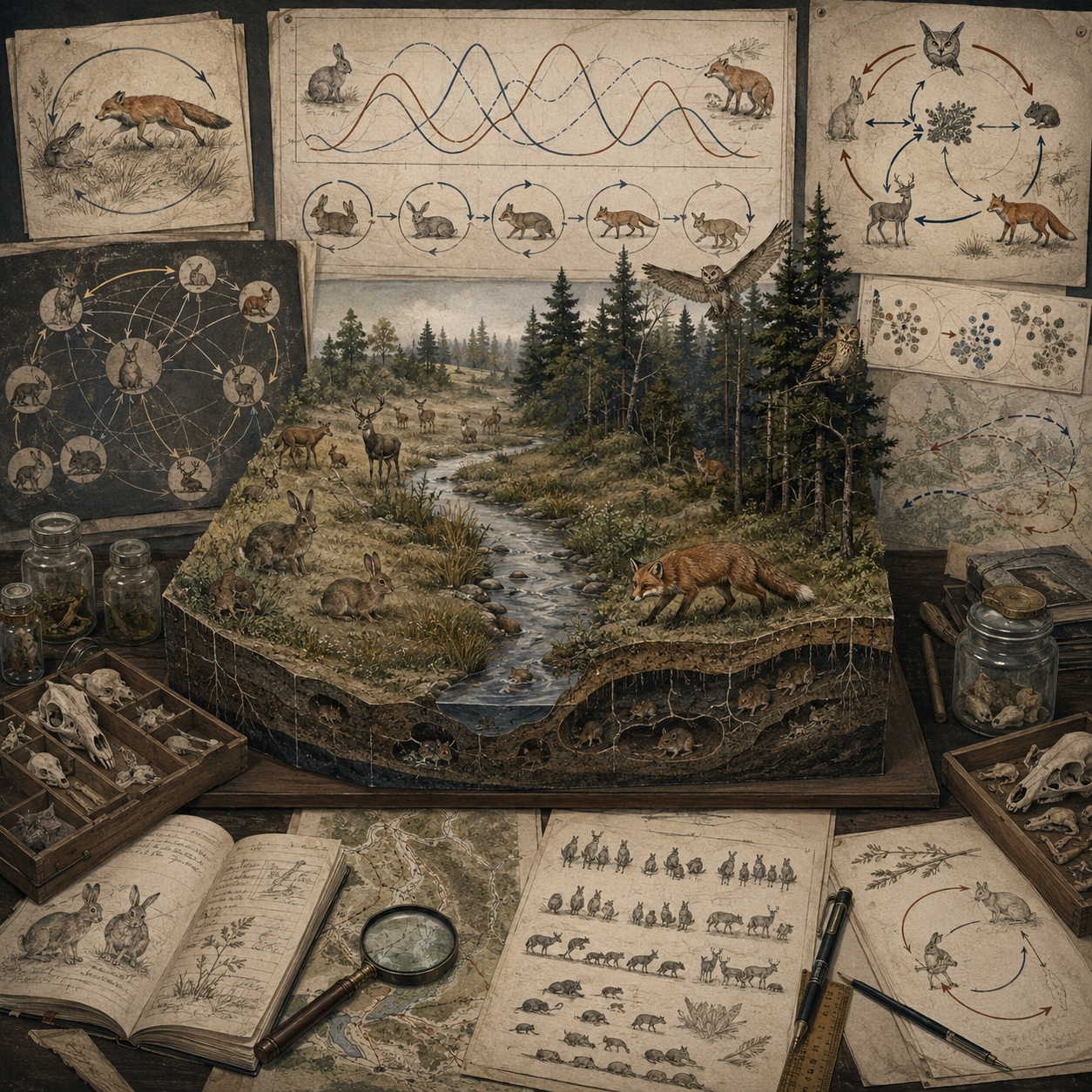
Predator-prey systems are important because they show that population change often depends on interaction, not just internal growth. Prey growth affects predator survival. Predator abundance affects prey mortality. The resulting feedback can produce oscillations, phase shifts, equilibrium, instability, collapse, or persistence depending on model structure and parameters.
The central question is not simply “Do predator and prey cycles occur?” It is “What interaction process is being modeled, what assumptions define the encounter term, what evidence supports the parameters, what dynamics appear in the phase plane, and what claims can the model responsibly support?”
Why Predator-Prey Systems Are a Useful Case Study
Predator-prey systems are useful because they show how interaction changes dynamics. In a one-population model, growth may depend on the population itself. In a predator-prey model, the rate of change of each population depends on the other population as well.
\frac{dx}{dt}=f(x,y),\qquad \frac{dy}{dt}=g(x,y)
\]
Coupled system: Prey \(x(t)\) and predator \(y(t)\) change together through interacting rate laws.
This makes predator-prey modeling a natural bridge from single-variable calculus to systems of differential equations. The model no longer asks only how one quantity changes. It asks how two changing quantities shape each other over time.
| Modeling question | Calculus concept | Systems interpretation |
|---|---|---|
| How does prey abundance affect predator growth? | Coupled differential equation. | Predator survival depends on prey availability. |
| How does predator abundance affect prey decline? | Interaction term. | Prey mortality depends on encounters. |
| Where do both populations stop changing? | Equilibrium. | Steady coexistence or extinction states. |
| Are equilibria stable? | Local stability and eigenvalues. | Small perturbations may fade, persist, or grow. |
| Why do cycles appear? | Nonlinear feedback. | Predator and prey responses lag each other. |
| Which parameters matter most? | Sensitivity analysis. | Interaction rates, mortality, conversion, and growth shape outcomes. |
Predator-prey systems make feedback visible.
From One Population to Two
Let \(x(t)\) represent prey population and \(y(t)\) represent predator population. A one-population model might say that prey grows at a rate proportional to its current size. A predator-prey model adds a second population and an interaction term.
x=x(t),\qquad y=y(t)
\]
State variables: \(x(t)\) and \(y(t)\) represent prey and predator populations over time.
The meaning of these variables must be documented. They may represent individuals, biomass, density, abundance index, sampled counts, or synthetic teaching values. Predator and prey may also be structured by age, spatial location, behavior, season, or resource availability.
| State-variable issue | Example | Why it matters |
|---|---|---|
| Count versus biomass. | Individuals or total mass. | Changes interpretation of interaction rates. |
| Density versus absolute population. | Animals per square kilometer. | Changes spatial scaling and encounter assumptions. |
| Closed versus open system. | Migration included or excluded. | Boundary assumptions affect persistence. |
| Time scale. | Days, seasons, years, generations. | Rate parameters depend on units. |
| Measurement source. | Field counts, traps, sensors, estimates. | Data quality affects calibration and uncertainty. |
Before interpreting the equations, the populations and measurement units must be clear.
The Classic Lotka-Volterra Model
The classic Lotka-Volterra predator-prey model describes prey growth, predator mortality, and predator-prey encounters using a coupled system of differential equations.
\frac{dx}{dt}=\alpha x-\beta xy
\]
Prey equation: Prey grow at rate \(\alpha x\) and are removed through predator-prey encounters \(\beta xy\).
\frac{dy}{dt}=\delta xy-\gamma y
\]
Predator equation: Predators grow through prey conversion \(\delta xy\) and decline through mortality \(\gamma y\).
The model is elegant because it captures interaction feedback with few terms. But each term carries assumptions. Prey growth is exponential in the absence of predators. Predator mortality is exponential in the absence of prey. Encounters are proportional to \(xy\). Conversion from prey consumption to predator growth is represented by \(\delta\).
| Parameter | Meaning | Interpretive warning |
|---|---|---|
| \(\alpha\) | Prey intrinsic growth rate. | Assumes prey grow exponentially without predators. |
| \(\beta\) | Predation encounter or attack coefficient. | Assumes encounters scale with \(xy\). |
| \(\gamma\) | Predator mortality rate. | Assumes predator decline without prey follows a simple rate law. |
| \(\delta\) | Conversion efficiency. | Assumes prey consumption converts to predator growth in a fixed way. |
The Lotka-Volterra model is best read as a baseline interaction model, not as a complete ecological description.
Interpreting the Interaction Term
The product term \(xy\) is the heart of the classic model. It says that encounters increase when prey are abundant and predators are abundant. This is mathematically simple and often useful, but it is also a strong assumption.
\text{encounter term}=\beta xy
\]
Mass-action interaction: The classic model assumes interaction frequency is proportional to the product of prey and predator abundance.
This assumption may be reasonable in some well-mixed systems. It may be inappropriate when predators saturate, prey hide, habitats are spatially structured, movement is constrained, behavior changes, or encounter rates depend on season, age, or environment.
| Interaction assumption | Model implication | Potential limitation |
|---|---|---|
| Well-mixed population. | All predators and prey can encounter each other. | Spatial structure and habitat barriers are ignored. |
| Linear encounter scaling. | Doubling prey doubles encounters, all else equal. | Predator handling time or satiation may limit predation. |
| No prey refuge. | All prey are equally exposed. | Behavior, shelter, or spatial refuge may reduce predation. |
| Fixed attack coefficient. | \(\beta\) does not change over time. | Season, learning, age, and environment may change attack rates. |
| Fixed conversion efficiency. | \(\delta\) converts encounters to predator growth. | Nutrition, age structure, and reproduction delays are omitted. |
The interaction term should be interpreted as a modeling choice, not as a universal law of ecological encounters.
Nullclines and Phase-Plane Reasoning
Predator-prey systems are often interpreted in the phase plane. Instead of plotting each population against time, the phase plane plots predator abundance against prey abundance. This reveals trajectories, nullclines, equilibria, and cycles.
\frac{dx}{dt}=0,\qquad \frac{dy}{dt}=0
\]
Nullclines: A nullcline is where one population’s rate of change is zero.
For the classic Lotka-Volterra model, the prey nullcline and predator nullcline identify where prey and predator populations stop changing instantaneously.
\frac{dx}{dt}=0 \Rightarrow x=0 \ \text{or}\ y=\frac{\alpha}{\beta}
\]
Prey nullcline: Prey stop changing when there are no prey or predator abundance equals \(\alpha/\beta\).
\frac{dy}{dt}=0 \Rightarrow y=0 \ \text{or}\ x=\frac{\gamma}{\delta}
\]
Predator nullcline: Predators stop changing when there are no predators or prey abundance equals \(\gamma/\delta\).
Nullclines divide the phase plane into regions where populations increase or decrease. This makes them valuable for qualitative reasoning even before numerical simulation.
| Region | Prey behavior | Predator behavior |
|---|---|---|
| Predator below prey nullcline. | Prey increase. | Depends on prey abundance. |
| Predator above prey nullcline. | Prey decrease. | Depends on prey abundance. |
| Prey below predator nullcline. | Depends on predator abundance. | Predators decrease. |
| Prey above predator nullcline. | Depends on predator abundance. | Predators increase. |
Phase-plane reasoning helps explain why predator-prey systems can cycle.
Equilibrium and Local Stability
Equilibria occur where both derivatives are zero. In the classic Lotka-Volterra system, one equilibrium is extinction of both populations. Another is coexistence.
(x^*,y^*)=\left(\frac{\gamma}{\delta},\frac{\alpha}{\beta}\right)
\]
Coexistence equilibrium: In the classic model, coexistence occurs where prey support predator replacement and predators balance prey growth.
Local stability examines what happens near an equilibrium. For nonlinear systems, this often involves the Jacobian matrix.
J(x,y)=
\begin{bmatrix}
\alpha-\beta y & -\beta x\\
\delta y & \delta x-\gamma
\end{bmatrix}
\]
Jacobian matrix: The Jacobian summarizes local interaction effects near a point in the phase plane.
In the classic model, the coexistence equilibrium has neutral-cycle behavior under ideal assumptions. In more realistic extensions, adding prey carrying capacity, predator saturation, harvesting, stochasticity, or delay can change stability substantially.
| Model feature | Effect on equilibrium interpretation | Responsible warning |
|---|---|---|
| Classic Lotka-Volterra. | Idealized neutral cycles. | Cycles depend on strong assumptions. |
| Logistic prey growth. | Resource limitation changes stability. | Prey cannot grow without bound. |
| Functional response. | Predation saturates. | Encounter terms may not scale linearly. |
| Harvesting. | Equilibria shift or disappear. | Management terms affect collapse risk. |
| Stochasticity. | Persistence becomes probabilistic. | One trajectory is not enough. |
Equilibrium is a starting point for interpretation, not a complete conclusion.
Cycles, Oscillation, and Phase Lag
Predator-prey models are famous for cycles. In a simplified interpretation, prey increase first, predators increase after prey become abundant, predation then reduces prey, and predator decline follows prey decline. This creates a phase lag between the two populations.
\text{prey increase}\rightarrow\text{predator increase}\rightarrow\text{prey decline}\rightarrow\text{predator decline}
\]
Feedback cycle: Predator response often lags prey abundance, producing oscillatory behavior.
Cycles in models should be interpreted carefully. Some cycles are structural consequences of model assumptions. Some are produced by delays, seasonality, stochastic forcing, age structure, or external drivers. Some apparent cycles in data may reflect measurement artifacts or short observation windows.
| Cycle source | How it appears | Interpretive caution |
|---|---|---|
| Interaction feedback. | Predator and prey influence each other. | Requires credible interaction mechanism. |
| Phase lag. | Predator peaks after prey peaks. | Lag may depend on reproduction and response time. |
| Seasonality. | Cycles align with environmental periods. | External forcing may dominate interaction dynamics. |
| Age structure. | Delayed population response. | Single-stock models may hide demographic timing. |
| Noise. | Irregular oscillations. | Stochastic effects should be modeled as uncertainty. |
Oscillation is meaningful only when the model structure and data support that interpretation.
Beyond Lotka-Volterra
The classic Lotka-Volterra model is useful, but applied predator-prey modeling often requires richer structure. Prey may have carrying capacity. Predators may saturate when prey are abundant. Predation may depend on handling time. Populations may be harvested, forced by seasons, disturbed by shocks, structured by age, or distributed across space.
\frac{dx}{dt}=rx\left(1-\frac{x}{K}\right)-\beta xy
\]
Logistic prey extension: Prey growth is limited by carrying capacity rather than growing exponentially without predators.
Adding logistic prey growth changes the model’s interpretation. It recognizes that prey are constrained by resources or habitat even when predators are absent.
\frac{dx}{dt}=rx\left(1-\frac{x}{K}\right)-\frac{axy}{1+ahx}
\]
Saturating predation: A functional response can limit predation when handling time or satiation matters.
These extensions are not decorative. They reflect different mechanisms. Each added term should correspond to a process that is plausible, documented, and relevant to the model’s purpose.
| Extension | What it adds | Why it matters |
|---|---|---|
| Logistic prey growth. | Resource limitation. | Prey cannot grow indefinitely without predators. |
| Functional response. | Predator saturation or handling time. | Predation may not increase linearly with prey abundance. |
| Harvesting. | External removal. | Human or environmental pressure can shift equilibria. |
| Delay. | Reproduction or response lag. | Delayed feedback can change stability. |
| Stochasticity. | Random variation. | Persistence and extinction become probabilistic. |
| Space. | Movement and patch structure. | Local collapse can coexist with regional persistence. |
Advanced predator-prey modeling begins by asking which mechanisms must be represented for the claim being made.
Functional Responses and Saturation
A functional response describes how predator consumption changes with prey abundance. The classic Lotka-Volterra interaction uses a linear response. More realistic models often use saturating forms.
F(x)=ax
\]
Type I response: Consumption increases linearly with prey abundance.
F(x)=\frac{ax}{1+ahx}
\]
Type II response: Consumption saturates as prey abundance rises because of handling time or satiation.
F(x)=\frac{ax^2}{1+ahx^2}
\]
Type III response: Consumption is low at low prey density, then increases and saturates.
Functional responses affect stability, persistence, and extinction risk. They also change the meaning of parameters. Attack rate, handling time, prey refuge, predator learning, and prey switching can all matter.
| Functional response | Mechanism | Modeling caution |
|---|---|---|
| Type I. | Linear encounter and consumption. | Often too simple for predators with handling limits. |
| Type II. | Handling time and saturation. | Can destabilize prey-predator systems under some conditions. |
| Type III. | Refuge, learning, switching, or low-density protection. | Requires evidence for nonlinear response at low prey density. |
The functional response is one of the most important modeling choices in predator-prey systems.
Harvesting, Control, and Management
Predator-prey systems often become decision models when harvesting, removal, stocking, conservation, habitat restoration, or control policies are introduced. These terms are not merely mathematical additions. They represent intervention assumptions.
\frac{dx}{dt}=\alpha x-\beta xy-H_x
\]
Prey harvesting: \(H_x\) represents removal from the prey population.
\frac{dy}{dt}=\delta xy-\gamma y-H_y
\]
Predator removal: \(H_y\) represents removal from the predator population.
Harvesting can move equilibria, destabilize systems, or trigger collapse. Constant harvesting, proportional harvesting, threshold-based harvesting, and adaptive management rules all imply different governance structures.
| Control term | Interpretation | Governance question |
|---|---|---|
| Constant harvest. | Fixed removal per unit time. | Can removal continue safely at low population? |
| Proportional harvest. | Removal scales with population size. | How is population measured and updated? |
| Threshold harvest. | Removal occurs only above a threshold. | Who sets the threshold and why? |
| Adaptive control. | Policy changes with observed system state. | How are uncertainty and delays handled? |
Management terms should be interpreted as policy assumptions, not neutral model mechanics.
Stochastic, Spatial, and Structured Extensions
Real predator-prey systems are often stochastic, spatial, and structured. Random environmental variation, patch movement, age structure, seasonal reproduction, and local extinction can dominate the system’s behavior.
dx=f(x,y)dt+\sigma_x x\,dW_x,\qquad dy=g(x,y)dt+\sigma_y y\,dW_y
\]
Stochastic predator-prey model: Noise terms represent environmental or demographic variability.
\frac{\partial x}{\partial t}=D_x\nabla^2x+f(x,y),\qquad
\frac{\partial y}{\partial t}=D_y\nabla^2y+g(x,y)
\]
Spatial predator-prey model: Diffusion terms represent movement through space.
Spatial structure matters when refuges, habitat patches, migration corridors, barriers, or local resource differences influence encounters. Stochasticity matters when persistence depends on rare events or variability rather than average behavior. Structure matters when juveniles, adults, or reproductive classes respond differently.
| Extension | Modeling role | Interpretive warning |
|---|---|---|
| Stochastic dynamics. | Represents random variation. | Use ensembles, not single paths. |
| Spatial dynamics. | Represents movement and patch structure. | Average abundance may hide local collapse. |
| Age or stage structure. | Represents demographic composition. | Total population can hide reproductive capacity. |
| Seasonal forcing. | Represents periodic environment. | Cycles may be externally driven. |
| Network structure. | Represents habitat or food-web connections. | Pairwise predator-prey models may be too narrow. |
Advanced predator-prey modeling should add complexity only when it clarifies the process and claim.
Parameter Interpretation
Predator-prey parameters encode biological, ecological, behavioral, and measurement assumptions. They should be documented with units, sources, uncertainty, and interpretation.
(\alpha,\beta,\gamma,\delta,K,a,h,\sigma,D)
\]
Extended parameter set: Predator-prey models may include prey growth, attack rate, predator mortality, conversion efficiency, carrying capacity, handling time, noise, and movement.
| Parameter | Meaning | Review question |
|---|---|---|
| \(\alpha\) | Prey growth rate. | Is growth density-independent or resource-limited? |
| \(\beta\) | Encounter or attack coefficient. | Does interaction scale with \(xy\)? |
| \(\gamma\) | Predator mortality rate. | Does mortality vary by age, season, or environment? |
| \(\delta\) | Conversion efficiency. | How does prey consumption translate into predator growth? |
| \(K\) | Prey carrying capacity. | What resource constraint does \(K\) represent? |
| \(a\) | Attack rate in functional response. | Is attack rate measured, estimated, or assumed? |
| \(h\) | Handling time. | Is predator saturation supported by data? |
| \(\sigma\) | Noise intensity. | What variability does the stochastic term represent? |
| \(D\) | Movement or diffusion coefficient. | Does movement behave like diffusion, migration, or network flow? |
Parameter records turn predator-prey equations into reviewable model claims.
Data, Calibration, and Identifiability
Predator-prey models are often difficult to calibrate because both populations are changing, observations may be sparse, and multiple parameter combinations can produce similar trajectories. A model may fit observed cycles while still misrepresenting the underlying mechanism.
\min_{\theta}\sum_i\left(x_{\text{obs}}(t_i)-x_{\text{model}}(t_i;\theta)\right)^2+
\sum_i\left(y_{\text{obs}}(t_i)-y_{\text{model}}(t_i;\theta)\right)^2
\]
Calibration objective: Predator-prey calibration often fits both prey and predator time series simultaneously.
Identifiability matters because attack rate, conversion efficiency, mortality, and carrying capacity may trade off against each other. Short time series may not distinguish true interaction dynamics from seasonal forcing, measurement noise, or external drivers.
| Calibration issue | How it appears | Responsible response |
|---|---|---|
| Short time series. | Only part of a cycle is observed. | Avoid strong claims about oscillatory mechanism. |
| Measurement error. | Population counts are noisy or biased. | Document sampling method and uncertainty. |
| Parameter tradeoff. | Different \(\beta,\delta,\gamma\) values fit similarly. | Use identifiability diagnostics and parameter profiles. |
| Missing forcing. | Seasonal or climate effects drive cycles. | Compare forced and unforced models. |
| Model misspecification. | Functional response is wrong. | Compare Type I, Type II, and Type III responses. |
| Overfitting. | Model fits observed cycles but fails elsewhere. | Validate across time, space, or independent observations. |
A fitted predator-prey model should be interpreted in relation to data quality, mechanism evidence, identifiability, and scope.
Sensitivity and Uncertainty
Predator-prey outcomes can be highly sensitive to interaction parameters, mortality, conversion efficiency, carrying capacity, functional response, harvesting, and initial conditions. Sensitivity analysis helps identify which assumptions shape persistence, collapse, cycle amplitude, and timing.
S_{\beta}=\frac{\partial x(t)}{\partial \beta},\qquad S_{\gamma}=\frac{\partial y(t)}{\partial \gamma}
\]
Sensitivity question: How do prey and predator trajectories change when attack rate or predator mortality changes?
Uncertainty should be reported because predator-prey systems often inform conservation, resource management, disease ecology, pest control, food-web analysis, and environmental policy. A single trajectory can hide fragile dependence on parameters and structure.
| Uncertainty source | Predator-prey example | Responsible output |
|---|---|---|
| Initial condition uncertainty. | Starting abundance is estimated. | Scenario range for \(x_0,y_0\). |
| Interaction uncertainty. | Attack rate is uncertain. | Sensitivity of cycles and persistence to \(\beta\). |
| Mortality uncertainty. | Predator loss rate varies. | Range or distribution for \(\gamma\). |
| Functional-response uncertainty. | Type I, II, or III response unclear. | Model comparison. |
| Stochastic uncertainty. | Environmental variability affects both populations. | Ensemble simulations and quantiles. |
| Spatial uncertainty. | Patch movement or refuge unknown. | Spatial scenarios and boundary records. |
Responsible predator-prey modeling makes uncertainty and parameter dependence visible.
When Predator-Prey Models Mislead
Predator-prey models mislead when their elegant oscillations are mistaken for complete ecological explanation. A model may produce cycles because of its assumptions, not because the real system cycles for the same reason.
\text{modeled cycle}\neq\text{confirmed ecological mechanism}
\]
Interpretive warning: A predator-prey model can generate plausible dynamics without proving that the modeled mechanism caused observed behavior.
| Misleading pattern | How it appears | Governance response |
|---|---|---|
| Cycle overinterpretation. | Modeled oscillations treated as observed mechanism. | Compare against data and alternative drivers. |
| Mass-action overreach. | \(\beta xy\) assumed without encounter evidence. | Document interaction mechanism and spatial assumptions. |
| Missing carrying capacity. | Prey grow exponentially without predators. | Test logistic prey extension. |
| Wrong functional response. | Linear predation used despite saturation. | Compare Type I, II, and III responses. |
| Ignored stochasticity. | One deterministic cycle hides extinction risk. | Use ensembles and risk distributions. |
| Ignored spatial refuge. | All prey treated as equally exposed. | Consider patch, refuge, or diffusion models. |
| Policy overclaiming. | Harvesting recommendations exceed evidence. | Use uncertainty, validation, and governance review. |
Predator-prey models should be used as disciplined approximations, not as automatic explanations of ecological complexity.
Systems Modeling Interpretation
Predator-prey systems show why calculus is central to systems modeling. Derivatives represent changing populations. Interaction terms represent feedback. Nullclines organize qualitative reasoning. Equilibria reveal possible steady states. Jacobians support local stability analysis. Simulations reveal trajectories. Sensitivity analysis exposes parameter dependence.
This case study also shows why responsible modeling matters. A predator-prey model can clarify interaction, oscillation, and feedback. It can also mislead if it hides functional-response assumptions, spatial structure, stochastic risk, calibration uncertainty, or claim boundaries.
The stronger standard is not “the model produces cycles.” It is: “the model’s variables, interaction terms, parameters, functional response, data status, uncertainty, validation scope, and claim boundaries are clear enough that its interpretation can be reviewed responsibly.”
Mathematical Deepening
This section adds a more formal layer for mathematically advanced readers. Predator-prey systems connect nonlinear differential equations, coupled state variables, phase-plane analysis, nullclines, equilibrium, Jacobians, eigenvalues, stability, functional responses, bifurcation, harvesting control, stochastic differential equations, spatial PDEs, calibration, identifiability, and model governance.
Predator-Prey Modeling Building Blocks
State Variables
Define prey \(x(t)\), predator \(y(t)\), units, measurement status, spatial boundary, and time scale.
Interaction Term
Specify whether predation is mass-action, saturating, refuge-limited, seasonal, spatial, or behavior-dependent.
Phase-Plane Record
Document nullclines, equilibria, trajectory behavior, cycle interpretation, and stability diagnostics.
Claim Boundary
Define whether the model supports teaching, exploration, mechanism, prediction, management, or decision support.
Predator-Prey Review Protocol
Define Populations
Clarify what predator and prey variables represent, how they are measured, and what boundaries apply.
Choose Interaction Structure
Select a functional response and prey growth law that match the modeled process and evidence.
Analyze Dynamics
Use nullclines, equilibria, stability, numerical simulation, sensitivity analysis, and uncertainty review.
Interpret Responsibly
State omitted mechanisms, calibration limits, identifiability concerns, and claim boundaries.
Predator-Prey Governance
Teaching Use
Clarifies coupling, feedback, phase planes, and cycles without claiming empirical prediction.
Exploratory Use
Compares functional responses, initial conditions, harvesting policies, stochastic effects, and spatial assumptions.
Mechanistic Use
Requires evidence for encounter processes, mortality, conversion, carrying capacity, and functional response.
Decision-Support Use
Requires uncertainty, validation, stakeholder-aware communication, and management governance.
Examples from Systems Modeling
Predator-prey systems appear across ecology and beyond ecology wherever one process feeds on, constrains, depends on, or responds to another.
Ecological Food Webs
Predators, prey, competitors, and resources interact through nonlinear feedback, spatial structure, and stochastic disturbance.
Fisheries and Harvesting
Predator-prey dynamics can inform harvest scenarios, but management terms require uncertainty, ethics, and governance review.
Invasive Species
Predator introduction, prey refuge, habitat fragmentation, and control strategies can be modeled as coupled dynamic processes.
Disease Ecology
Host-pathogen and immune-response models often use predator-prey-like interaction structures with different interpretation.
Cybersecurity Dynamics
Attackers and defenders can be modeled as interacting populations, but metaphorical use requires careful claim boundaries.
Attention and Platform Systems
Competing content, moderation, and user attention can resemble interaction dynamics, but social systems require additional assumptions.
Across these examples, predator-prey reasoning is useful when interaction terms are interpreted with care.
Computation and Reproducible Workflows
Computational workflows for predator-prey systems should preserve model purpose, state-variable definitions, interaction assumptions, parameter records, nullcline records, equilibrium calculations, solver settings, calibration notes, identifiability diagnostics, sensitivity checks, stochastic scenarios, spatial assumptions, validation scope, and claim boundaries.
The companion repository for this article uses a multi-language scaffold to show how predator-prey dynamics can be documented, simulated, audited, and governed through Python, R, Haskell, SQL, Canvas artifacts, advanced audit reports, and reusable calculator scripts.
Python Workflow: Predator-Prey Dynamics Audit
The Python workflow below simulates classic Lotka-Volterra dynamics, logistic-prey extensions, functional-response scenarios, harvesting scenarios, stochastic paths, and phase-plane records.
from __future__ import annotations

from dataclasses import asdict, dataclass
from pathlib import Path
import csv
import json
import math
import random


@dataclass(frozen=True)
class PredatorPreyParameterRecord:
    parameter_name: str
    value: float
    unit: str
    interpretation: str
    warning: str


@dataclass(frozen=True)
class PredatorPreyScenarioRecord:
    scenario_name: str
    model_type: str
    final_time: float
    final_prey: float
    final_predator: float
    interpretation: str


def lotka_volterra_derivative(alpha: float, beta: float, gamma: float, delta: float):
    def derivative(x: float, y: float) -> tuple[float, float]:
        return alpha * x - beta * x * y, delta * x * y - gamma * y
    return derivative


def logistic_prey_derivative(r: float, k: float, beta: float, gamma: float, delta: float):
    def derivative(x: float, y: float) -> tuple[float, float]:
        return r * x * (1 - x / k) - beta * x * y, delta * x * y - gamma * y
    return derivative


def type_ii_derivative(r: float, k: float, a: float, h: float, gamma: float, delta: float):
    def derivative(x: float, y: float) -> tuple[float, float]:
        predation = (a * x * y) / (1 + a * h * x)
        return r * x * (1 - x / k) - predation, delta * predation - gamma * y
    return derivative


def harvesting_derivative(alpha: float, beta: float, gamma: float, delta: float, hx: float, hy: float):
    def derivative(x: float, y: float) -> tuple[float, float]:
        return alpha * x - beta * x * y - hx, delta * x * y - gamma * y - hy
    return derivative


def simulate_pair(
    x0: float,
    y0: float,
    derivative,
    dt: float,
    steps: int
) -> tuple[float, float]:
    x, y = x0, y0
    for _ in range(steps):
        dx, dy = derivative(x, y)
        x = max(0.0, x + dt * dx)
        y = max(0.0, y + dt * dy)
    return x, y


def stochastic_pair(
    x0: float,
    y0: float,
    derivative,
    sigma_x: float,
    sigma_y: float,
    dt: float,
    steps: int,
    seed: int = 11
) -> tuple[float, float]:
    rng = random.Random(seed)
    x, y = x0, y0
    for _ in range(steps):
        dx, dy = derivative(x, y)
        x = max(0.0, x + dt * dx + sigma_x * x * math.sqrt(dt) * rng.gauss(0, 1))
        y = max(0.0, y + dt * dy + sigma_y * y * math.sqrt(dt) * rng.gauss(0, 1))
    return x, y


def build_parameter_records() -> list[PredatorPreyParameterRecord]:
    return [
        PredatorPreyParameterRecord("alpha", 0.6, "per year", "prey intrinsic growth rate", "Prey growth may be resource-limited rather than exponential."),
        PredatorPreyParameterRecord("beta", 0.02, "encounter coefficient", "predation interaction coefficient", "Mass-action encounters may overstate interaction in spatial systems."),
        PredatorPreyParameterRecord("gamma", 0.5, "per year", "predator mortality rate", "Mortality may vary by age, season, or environment."),
        PredatorPreyParameterRecord("delta", 0.01, "conversion coefficient", "conversion from prey encounters to predator growth", "Conversion efficiency should not be treated as mechanism without evidence."),
        PredatorPreyParameterRecord("K", 500.0, "prey units", "prey carrying capacity", "Carrying capacity is assumption-bearing and may change over time."),
        PredatorPreyParameterRecord("h", 0.08, "time per prey", "handling time", "Saturation claims require evidence for functional response."),
    ]


def build_scenarios() -> list[PredatorPreyScenarioRecord]:
    x0, y0 = 40.0, 9.0
    dt = 0.02
    t = 80.0
    steps = int(t / dt)

    scenarios = []

    x, y = simulate_pair(
        x0,
        y0,
        lotka_volterra_derivative(0.6, 0.02, 0.5, 0.01),
        dt,
        steps
    )
    scenarios.append(PredatorPreyScenarioRecord(
        "classic_lotka_volterra",
        "lotka_volterra",
        t,
        x,
        y,
        "baseline mass-action predator-prey interaction"
    ))

    x, y = simulate_pair(
        x0,
        y0,
        logistic_prey_derivative(0.6, 500.0, 0.02, 0.5, 0.01),
        dt,
        steps
    )
    scenarios.append(PredatorPreyScenarioRecord(
        "logistic_prey_limit",
        "logistic_prey",
        t,
        x,
        y,
        "prey growth limited by carrying capacity"
    ))

    x, y = simulate_pair(
        x0,
        y0,
        type_ii_derivative(0.6, 500.0, 0.04, 0.08, 0.5, 0.4),
        dt,
        steps
    )
    scenarios.append(PredatorPreyScenarioRecord(
        "type_ii_functional_response",
        "saturating_predation",
        t,
        x,
        y,
        "predation saturates due to handling time"
    ))

    x, y = simulate_pair(
        x0,
        y0,
        harvesting_derivative(0.6, 0.02, 0.5, 0.01, 1.0, 0.05),
        dt,
        steps
    )
    scenarios.append(PredatorPreyScenarioRecord(
        "harvesting_pressure",
        "harvesting",
        t,
        x,
        y,
        "external removal shifts dynamics and risk"
    ))

    x, y = stochastic_pair(
        x0,
        y0,
        lotka_volterra_derivative(0.6, 0.02, 0.5, 0.01),
        0.08,
        0.08,
        dt,
        steps
    )
    scenarios.append(PredatorPreyScenarioRecord(
        "stochastic_lotka_volterra_path",
        "stochastic",
        t,
        x,
        y,
        "one stochastic path under environmental variability"
    ))

    return scenarios


def write_csv(path: Path, records: list) -> None:
    rows = [asdict(record) for record in records]
    with path.open("w", newline="", encoding="utf-8") as handle:
        writer = csv.DictWriter(handle, fieldnames=list(rows[0].keys()))
        writer.writeheader()
        writer.writerows(rows)


output_dir = Path("outputs")
(output_dir / "tables").mkdir(parents=True, exist_ok=True)
(output_dir / "json").mkdir(parents=True, exist_ok=True)
(output_dir / "reports").mkdir(parents=True, exist_ok=True)

parameters = build_parameter_records()
scenarios = build_scenarios()

write_csv(output_dir / "tables" / "predator_prey_parameter_records.csv", parameters)
write_csv(output_dir / "tables" / "predator_prey_scenario_records.csv", scenarios)

audit = {
    "parameter_records": [asdict(record) for record in parameters],
    "scenario_records": [asdict(record) for record in scenarios],
    "interpretation_warning": "Predator-prey model outputs depend on interaction assumptions, functional response, parameter evidence, stochasticity, spatial structure, and claim boundaries."
}

(output_dir / "json" / "predator_prey_dynamics_audit.json").write_text(
    json.dumps(audit, indent=2),
    encoding="utf-8"
)

report_lines = ["# Predator-Prey Dynamics Model Audit", "", "## Scenario Records"]

for record in scenarios:
    report_lines.append(
        f"- **{record.scenario_name}** ({record.model_type}): prey={record.final_prey:.2f}, predator={record.final_predator:.2f}. {record.interpretation}."
    )

report_lines.append("")
report_lines.append("Predator-prey model outputs depend on interaction assumptions, functional response, parameter evidence, stochasticity, spatial structure, and claim boundaries.")

(output_dir / "reports" / "predator_prey_dynamics_audit.md").write_text(
    "\n".join(report_lines) + "\n",
    encoding="utf-8"
)

print("Wrote predator-prey dynamics audit outputs.")
This workflow treats predator-prey trajectories as conditional scenario records rather than detached predictions.
R Workflow: Coupled Dynamics Scenarios
The R workflow below compares classic Lotka-Volterra dynamics, logistic-prey dynamics, harvesting, and stochastic variation.
simulate_pair <- function(x0, y0, derivative, dt, steps) {
  x <- x0
  y <- y0

  for (i in seq_len(steps)) {
    d <- derivative(x, y)
    x <- max(0, x + dt * d[1])
    y <- max(0, y + dt * d[2])
  }

  c(x = x, y = y)
}

lotka_volterra <- function(alpha, beta, gamma, delta) {
  function(x, y) {
    c(
      alpha * x - beta * x * y,
      delta * x * y - gamma * y
    )
  }
}

logistic_prey <- function(r, k, beta, gamma, delta) {
  function(x, y) {
    c(
      r * x * (1 - x / k) - beta * x * y,
      delta * x * y - gamma * y
    )
  }
}

harvesting_model <- function(alpha, beta, gamma, delta, hx, hy) {
  function(x, y) {
    c(
      alpha * x - beta * x * y - hx,
      delta * x * y - gamma * y - hy
    )
  }
}

x0 <- 40
y0 <- 9
dt <- 0.02
steps <- 4000

classic <- simulate_pair(
  x0,
  y0,
  lotka_volterra(0.6, 0.02, 0.5, 0.01),
  dt,
  steps
)

limited <- simulate_pair(
  x0,
  y0,
  logistic_prey(0.6, 500, 0.02, 0.5, 0.01),
  dt,
  steps
)

harvested <- simulate_pair(
  x0,
  y0,
  harvesting_model(0.6, 0.02, 0.5, 0.01, 1.0, 0.05),
  dt,
  steps
)

scenario_records <- data.frame(
  scenario_name = c(
    "classic_lotka_volterra",
    "logistic_prey_limit",
    "harvesting_pressure"
  ),
  model_type = c(
    "lotka_volterra",
    "logistic_prey",
    "harvesting"
  ),
  final_prey = c(classic["x"], limited["x"], harvested["x"]),
  final_predator = c(classic["y"], limited["y"], harvested["y"]),
  warning = c(
    "mass-action baseline",
    "prey capacity included",
    "management term changes dynamics"
  )
)

dir.create("outputs/tables", recursive = TRUE, showWarnings = FALSE)

write.csv(
  scenario_records,
  "outputs/tables/r_predator_prey_scenarios.csv",
  row.names = FALSE
)

print(scenario_records)
This workflow compares interaction assumptions across predator-prey scenarios.
Haskell Workflow: Typed Interaction Records
Haskell can represent predator-prey parameters, interaction assumptions, and scenario records as typed structures.
module Main where

data InteractionModel
  = LotkaVolterra
  | LogisticPrey
  | TypeIIResponse
  | Harvesting
  | Stochastic
  | Spatial
  deriving (Show, Eq)

data ParameterRecord = ParameterRecord
  { parameterName :: String
  , parameterValue :: Double
  , parameterUnit :: String
  , interpretation :: String
  , warning :: String
  } deriving (Show, Eq)

data ScenarioRecord = ScenarioRecord
  { scenarioName :: String
  , interactionModel :: InteractionModel
  , finalTime :: Double
  , finalPrey :: Double
  , finalPredator :: Double
  , scenarioWarning :: String
  } deriving (Show, Eq)

parameterRecords :: [ParameterRecord]
parameterRecords =
  [ ParameterRecord
      "alpha"
      0.6
      "per year"
      "prey intrinsic growth rate"
      "Prey growth may be resource-limited rather than exponential."
  , ParameterRecord
      "beta"
      0.02
      "encounter coefficient"
      "predation interaction coefficient"
      "Mass-action encounters may overstate interaction in spatial systems."
  , ParameterRecord
      "gamma"
      0.5
      "per year"
      "predator mortality rate"
      "Mortality may vary by age, season, or environment."
  , ParameterRecord
      "delta"
      0.01
      "conversion coefficient"
      "conversion from prey encounters to predator growth"
      "Conversion efficiency should not be treated as mechanism without evidence."
  ]

scenarioRecords :: [ScenarioRecord]
scenarioRecords =
  [ ScenarioRecord
      "classic_lotka_volterra"
      LotkaVolterra
      80.0
      40.0
      9.0
      "Baseline mass-action model."
  , ScenarioRecord
      "logistic_prey_limit"
      LogisticPrey
      80.0
      40.0
      9.0
      "Prey carrying capacity included."
  , ScenarioRecord
      "type_ii_functional_response"
      TypeIIResponse
      80.0
      40.0
      9.0
      "Predation saturates through handling time."
  ]

main :: IO ()
main = do
  putStrLn "Parameter records:"
  mapM_ print parameterRecords
  putStrLn ""
  putStrLn "Scenario records:"
  mapM_ print scenarioRecords
The typed workflow helps keep interaction assumptions attached to model outputs.
SQL Workflow: Predator-Prey Governance Registry
SQL can preserve predator-prey model assumptions, parameters, interaction structures, calibration notes, and claim-boundary warnings.
CREATE TABLE predator_prey_governance_registry (
    registry_key TEXT PRIMARY KEY,
    registry_name TEXT NOT NULL,
    analytical_role TEXT NOT NULL,
    systems_modeling_role TEXT NOT NULL,
    review_warning TEXT NOT NULL
);

INSERT INTO predator_prey_governance_registry VALUES
(
  'state_variables',
  'State variables',
  'Defines prey and predator populations, units, boundaries, and measurement status.',
  'Makes the coupled system interpretable.',
  'Predator-prey equations cannot be interpreted responsibly if population definitions are unclear.'
);

INSERT INTO predator_prey_governance_registry VALUES
(
  'interaction_term',
  'Interaction term',
  'Documents whether predation is mass-action, saturating, spatial, seasonal, or behavior-dependent.',
  'Connects mathematical coupling to mechanism.',
  'The product xy is an assumption, not universal evidence of encounter dynamics.'
);

INSERT INTO predator_prey_governance_registry VALUES
(
  'functional_response',
  'Functional response',
  'Documents Type I, Type II, Type III, or other predation response structure.',
  'Determines how predation changes with prey abundance.',
  'The wrong functional response can change stability and persistence conclusions.'
);

INSERT INTO predator_prey_governance_registry VALUES
(
  'equilibrium_record',
  'Equilibrium record',
  'Documents coexistence, extinction, nullclines, Jacobian, and local stability.',
  'Connects phase-plane analysis to interpretation.',
  'Equilibrium is a mathematical condition, not a full ecological conclusion.'
);

INSERT INTO predator_prey_governance_registry VALUES
(
  'calibration_record',
  'Calibration record',
  'Documents data source, fitting method, uncertainty, identifiability, and validation status.',
  'Separates curve fit from mechanism.',
  'A fitted cycle does not automatically prove predator-prey causality.'
);

INSERT INTO predator_prey_governance_registry VALUES
(
  'claim_boundary',
  'Claim boundary',
  'Defines whether the predator-prey model supports teaching, exploration, mechanism, prediction, management, or decision support.',
  'Prevents overclaiming and scope drift.',
  'Predator-prey conclusions should not exceed evidence, assumptions, and tested scope.'
);

SELECT
    registry_name,
    analytical_role,
    systems_modeling_role,
    review_warning
FROM predator_prey_governance_registry
ORDER BY registry_key;
This registry connects state variables, interaction assumptions, functional response, equilibrium analysis, calibration, and claim boundaries to governance review.
GitHub Repository
The companion repository for this case study is designed as a reproducible mathematical-modeling workspace. It supports predator-prey parameter records, Lotka-Volterra scenarios, logistic-prey extensions, functional-response scenarios, harvesting scenarios, stochastic simulations, phase-plane records, nullcline notes, equilibrium and Jacobian calculations, calibration records, identifiability warnings, sensitivity checks, SQL governance tables, Haskell typed records, generated reports, advanced audit logic, Canvas artifacts, and reusable calculator scripts.
Complete Code Repository
Companion article folder with Python, R, Julia, SQL, Haskell, C, C++, Fortran, Rust, Go, notebooks, documentation, synthetic teaching data, generated outputs, schemas, Canvas-ready workflow artifacts, and reusable calculator scripts for Predator-Prey Systems, Lotka-Volterra dynamics, logistic-prey extensions, functional responses, harvesting, stochastic scenarios, phase planes, nullclines, equilibrium, stability, calibration, identifiability, governance queues, and responsible mathematical modeling.
Interpretive Limits and Responsible Use
Predator-prey systems are among the most important examples of coupled nonlinear dynamics. They show how interaction terms produce feedback, how phase-plane reasoning reveals structure, how equilibria depend on parameters, and how cycles can emerge from simple assumptions. But their elegance is also their risk.
Responsible use requires documentation. Preserve population definitions, interaction assumptions, time units, parameter sources, functional-response choice, carrying-capacity assumptions, harvesting assumptions, stochastic terms, spatial structure, data quality, calibration status, identifiability, uncertainty, sensitivity, omitted mechanisms, and claim boundaries. Treat predator-prey trajectories as conditional outputs of assumptions, not as automatic explanations of ecological systems.
The central question is not only “Does the model produce predator-prey cycles?” It is “What interaction process is being modeled, what evidence supports that structure, what dynamics follow from the assumptions, and what claims can be responsibly supported?”
Related Articles
- Calculus for Systems Modeling
- Case Study: Modeling Population Dynamics
- Climate Feedback Models
- Continuous-Time Epidemiological Models
- Differential Equations and Dynamic Systems
- Systems of Differential Equations
- Nonlinear Differential Equations
- Phase Lines, Phase Planes, and Phase Portraits
- Equilibrium, Stability, and Local Dynamics
- Sensitivity, Robustness, and Parameter Dependence
Further Reading
- Lotka, A.J. (1925) Elements of Physical Biology. Baltimore, MD: Williams & Wilkins. Link
- Volterra, V. (1926) ‘Fluctuations in the abundance of a species considered mathematically’, Nature, 118, pp. 558–560. Link
- Rosenzweig, M.L. and MacArthur, R.H. (1963) ‘Graphical representation and stability conditions of predator-prey interactions’, The American Naturalist, 97(895), pp. 209–223. Link
- Holling, C.S. (1959) ‘Some characteristics of simple types of predation and parasitism’, The Canadian Entomologist, 91(7), pp. 385–398. Link
- May, R.M. (1973) Stability and Complexity in Model Ecosystems. Princeton, NJ: Princeton University Press. Link
- May, R.M. (1976) ‘Simple mathematical models with very complicated dynamics’, Nature, 261, pp. 459–467. Link
- Murray, J.D. (2002) Mathematical Biology I: An Introduction. 3rd edn. New York: Springer. Link
- Edelstein-Keshet, L. (2005) Mathematical Models in Biology. Philadelphia, PA: SIAM. Link
- Otto, S.P. and Day, T. (2007) A Biologist’s Guide to Mathematical Modeling in Ecology and Evolution. Princeton, NJ: Princeton University Press. Link
- Gotelli, N.J. (2008) A Primer of Ecology. 4th edn. Sunderland, MA: Sinauer Associates. Link
- Turchin, P. (2003) Complex Population Dynamics: A Theoretical/Empirical Synthesis. Princeton, NJ: Princeton University Press. Link
- Hastings, A. (1997) Population Biology: Concepts and Models. New York: Springer. Link
- de Vries, G., Hillen, T., Lewis, M., Müller, J. and Schönfisch, B. (2006) A Course in Mathematical Biology: Quantitative Modeling with Mathematical and Computational Methods. Philadelphia, PA: SIAM. Link
- Strogatz, S.H. (2018) Nonlinear Dynamics and Chaos: With Applications to Physics, Biology, Chemistry, and Engineering. 2nd edn. Boca Raton, FL: CRC Press. Link
References
- de Vries, G., Hillen, T., Lewis, M., Müller, J. and Schönfisch, B. (2006) A Course in Mathematical Biology: Quantitative Modeling with Mathematical and Computational Methods. Philadelphia, PA: SIAM. Link
- Edelstein-Keshet, L. (2005) Mathematical Models in Biology. Philadelphia, PA: SIAM. Link
- Gotelli, N.J. (2008) A Primer of Ecology. 4th edn. Sunderland, MA: Sinauer Associates. Link
- Hastings, A. (1997) Population Biology: Concepts and Models. New York: Springer. Link
- Holling, C.S. (1959) ‘Some characteristics of simple types of predation and parasitism’, The Canadian Entomologist, 91(7), pp. 385–398. Link
- Lotka, A.J. (1925) Elements of Physical Biology. Baltimore, MD: Williams & Wilkins. Link
- May, R.M. (1973) Stability and Complexity in Model Ecosystems. Princeton, NJ: Princeton University Press. Link
- May, R.M. (1976) ‘Simple mathematical models with very complicated dynamics’, Nature, 261, pp. 459–467. Link
- Murray, J.D. (2002) Mathematical Biology I: An Introduction. 3rd edn. New York: Springer. Link
- Otto, S.P. and Day, T. (2007) A Biologist’s Guide to Mathematical Modeling in Ecology and Evolution. Princeton, NJ: Princeton University Press. Link
- Rosenzweig, M.L. and MacArthur, R.H. (1963) ‘Graphical representation and stability conditions of predator-prey interactions’, The American Naturalist, 97(895), pp. 209–223. Link
- Strogatz, S.H. (2018) Nonlinear Dynamics and Chaos: With Applications to Physics, Biology, Chemistry, and Engineering. 2nd edn. Boca Raton, FL: CRC Press. Link
- Turchin, P. (2003) Complex Population Dynamics: A Theoretical/Empirical Synthesis. Princeton, NJ: Princeton University Press. Link
- Volterra, V. (1926) ‘Fluctuations in the abundance of a species considered mathematically’, Nature, 118, pp. 558–560. Link