
Last Updated June 6, 2026
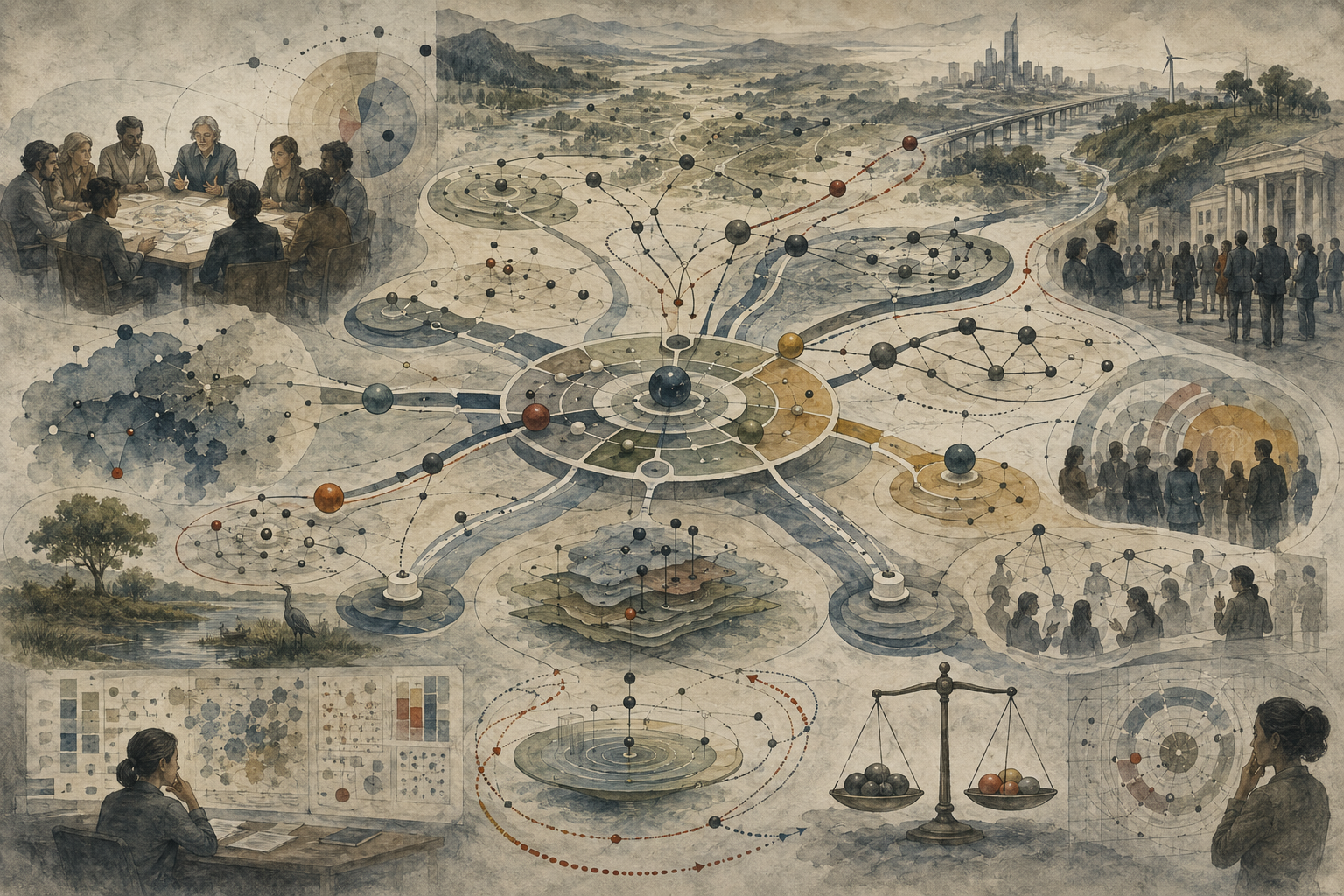
Future Directions in Decision Science examines how decision science is evolving as institutions face deeper uncertainty, artificial intelligence, democratic legitimacy challenges, complex systems, climate risk, infrastructure fragility, algorithmic governance, geopolitical instability, organizational accountability, and long-term public consequences. Decision science is no longer only a field of decision trees, expected value, utility theory, probability, behavioral bias, and structured judgment. It is becoming an applied architecture for governing choices across human judgment, models, institutions, publics, technologies, and adaptive systems.
The future of decision science will be shaped by a central tension: decisions are becoming more data-rich, computational, automated, and model-assisted, while the most important choices remain value-laden, uncertain, contested, institutional, and political. Artificial intelligence can help generate options, synthesize evidence, forecast outcomes, detect risk, and monitor decisions. But AI does not remove responsibility. It makes judgment, governance, transparency, accountability, and contestability more important.
The central argument of this article is that future decision science must move beyond narrow optimization. It must integrate human judgment, artificial intelligence, uncertainty analysis, ethical reasoning, public legitimacy, systems thinking, adaptive governance, reproducible workflows, participatory methods, and institutional accountability. The next generation of decision science will not simply ask, “Which option scores highest?” It will ask, “Which decision system can reason well, remain accountable, adapt over time, and justify its choices to the people and systems it affects?”
Why Future Directions in Decision Science Matter
Future directions in decision science matter because the environments in which decisions are made are becoming more complex, faster moving, more interconnected, more automated, and more publicly contested. Organizations, governments, communities, and institutions must make decisions under conditions where evidence is partial, systems are interdependent, technologies change quickly, public trust is fragile, and consequences can cascade across sectors.
Traditional decision tools remain important. Expected value, decision trees, Bayesian updating, sensitivity analysis, forecasting, utility theory, risk analysis, and multi-criteria decision analysis continue to provide essential structure. But future decision problems increasingly require broader architectures: AI-assisted evidence synthesis, real-time monitoring, public legitimacy, adaptive pathways, scenario intelligence, systems modeling, decision records, governance review, and institutional learning.
The challenge is not simply that decisions are harder. The challenge is that decisions now operate inside dense systems of feedback, automation, institutional incentives, legal scrutiny, stakeholder pressure, misinformation, infrastructure dependency, ecological constraint, and long-term uncertainty. Decision science must therefore become more institutional, participatory, computational, ethical, and adaptive.
| Future pressure | Decision-science response | Accountability concern |
|---|---|---|
| Artificial intelligence | AI-assisted evidence, prediction, monitoring, and decision support. | Overreliance, opacity, bias, automation drift, and responsibility gaps. |
| Deep uncertainty | Robust, adaptive, scenario-based, and exploratory methods. | False precision and premature closure. |
| Complex systems | Feedback modeling, cascading-risk analysis, network reasoning, and resilience metrics. | Hidden interdependencies and unintended consequences. |
| Public legitimacy | Participatory, transparent, contestable, and democratic decision processes. | Technocracy, exclusion, symbolic engagement, and public distrust. |
| Institutional accountability | Decision rights, records, review triggers, monitoring, and auditability. | Responsibility diffusion and weak corrective authority. |
| Rapid environmental change | Adaptive pathways, thresholds, long-term monitoring, and revision rules. | Irreversibility, stranded assets, and intergenerational burden. |
The future of decision science is not a replacement of judgment by models. It is the design of better human-machine-institutional judgment systems.
From Individual Choice to Decision Systems
Decision science has often been taught through the language of individual choice: a decision-maker faces alternatives, uncertain states, probabilities, outcomes, utilities, and trade-offs. This frame is still useful, but it is incomplete for many real-world decisions. Modern decisions are made inside systems of roles, organizations, technologies, stakeholders, data pipelines, legal rules, public expectations, and implementation constraints.
A future-ready view treats decisions as systems. A decision system includes who frames the problem, which evidence is collected, which models are used, who reviews uncertainty, which values are encoded, how stakeholders participate, who has authority, how decisions are recorded, how outcomes are monitored, and how learning changes future decisions. The decision is not only the selected option. It is the process by which institutional judgment is formed and revised.
This shift matters because many failures do not come from one bad calculation. They come from weak framing, missing stakeholders, hidden assumptions, poor implementation, unmonitored drift, unclear authority, and lack of correction. Future decision science must study the entire decision lifecycle.
| Traditional focus | Future direction |
|---|---|
| Individual decision-maker | Institutional decision system. |
| Single decision point | Decision lifecycle from framing to revision. |
| Static alternatives | Adaptive options and pathway-dependent choices. |
| Known probability structure | Deep uncertainty, ambiguity, contested evidence, and scenario exploration. |
| Optimization | Robustness, legitimacy, learning, accountability, and resilience. |
| Decision output | Decision record, monitoring plan, review trigger, and corrective authority. |
The next stage of decision science will treat decision-making as an institutional capability, not only an analytic exercise.
AI, Decision Intelligence, and Human Judgment
Artificial intelligence will shape the future of decision science more than any single technology. AI systems can summarize evidence, generate alternatives, identify patterns, forecast outcomes, support scenario analysis, rank options, detect anomalies, monitor implementation, and draft decision records. These capabilities can improve decision quality when they expand human understanding and reduce cognitive burden.
But AI decision support also raises major risks. It can create automation bias, hide uncertainty, obscure evidence provenance, amplify historical bias, generate plausible but unsupported explanations, narrow attention, and diffuse accountability. AI can make decisions faster without making them wiser. Future decision science must therefore focus on appropriate reliance: when to use AI, how much weight to give it, when to require human review, and how to monitor its influence over time.
Decision intelligence should not mean turning decisions over to machines. It should mean designing systems where AI, human judgment, institutional governance, and stakeholder accountability each play defined roles. The important question is not whether AI can produce an answer. The important question is whether the answer can be inspected, justified, challenged, corrected, and learned from.
| AI capability | Future decision-science use | Required safeguard |
|---|---|---|
| Evidence synthesis | Summarize research, public comments, reports, and prior decisions. | Source verification, omission review, and human interpretation. |
| Prediction | Forecast demand, risk, failure, behavior, or system outcomes. | Calibration, validation, drift monitoring, and uncertainty disclosure. |
| Recommendation | Suggest actions, prioritization, or intervention pathways. | Human oversight, contestability, and override documentation. |
| Scenario generation | Expand possible futures and stress-test assumptions. | Expert review, plausibility testing, and avoidance of narrative overconfidence. |
| Anomaly detection | Identify drift, failure signals, fraud, emerging risk, or implementation gaps. | False-positive review, human escalation, and alert governance. |
| Decision-record drafting | Help document rationale, evidence, assumptions, and review triggers. | Human approval and preservation of dissent, uncertainty, and final authority. |
The strongest future for AI in decision science is not autonomous decision-making everywhere. It is accountable decision support that improves human and institutional judgment.
Decision Governance and Accountability Infrastructure
The future of decision science will require stronger governance infrastructure. As decisions become more complex and technologically mediated, institutions need clearer decision rights, evidence standards, review processes, decision records, monitoring systems, audit trails, and corrective authority. Without this infrastructure, advanced decision tools can produce impressive outputs without accountability.
Decision governance turns decision science into institutional practice. It defines who may decide, who reviews, what evidence is required, how uncertainty is disclosed, when decisions are escalated, how public or stakeholder input is incorporated, and who is responsible after implementation. Future decision science will increasingly include governance design as part of the decision method itself.
Accountability infrastructure will also become more computational. Decision records may become structured, searchable, versioned, and linked to data sources, model outputs, approvals, implementation metrics, complaints, incidents, and review triggers. The future decision record will be less like a static memo and more like a living institutional artifact.
| Governance infrastructure | Future role in decision science |
|---|---|
| Decision rights | Clarify recommendation, review, approval, implementation, monitoring, revision, and stop authority. |
| Evidence standards | Define validation, provenance, uncertainty, stakeholder evidence, and model-use requirements. |
| Decision records | Preserve rationale, assumptions, dissent, trade-offs, authority, and review triggers. |
| Review and challenge | Test assumptions, model outputs, risk, ethics, legality, feasibility, and stakeholder consequences. |
| Monitoring systems | Track outcomes, drift, harms, complaints, implementation gaps, and changing conditions. |
| Corrective authority | Enable decisions to be revised, paused, reversed, repaired, or escalated. |
Future decision science will be judged not only by whether it helps institutions decide, but by whether it helps institutions remain answerable for what they decide.
Adaptive and Robust Decision Systems
Many future decisions will be made under deep uncertainty, where probabilities are disputed, models disagree, values are contested, and future conditions may differ sharply from historical patterns. Climate change, technological disruption, geopolitical instability, infrastructure transition, migration, public health, AI governance, and economic volatility all challenge traditional optimization.
Adaptive and robust decision systems do not assume that a single forecast will be correct. They ask which choices perform reasonably across many plausible futures, which options preserve flexibility, which thresholds should trigger revision, and which investments create resilience. Instead of committing to one fixed plan, adaptive decision science designs pathways that can change as evidence changes.
This future direction will make methods such as robust decision-making, dynamic adaptive policy pathways, scenario planning, real-options reasoning, stress testing, early-warning indicators, and resilience modeling more central to decision science. The goal is not to predict the future perfectly. The goal is to make decisions that remain defensible as the future changes.
| Adaptive principle | Decision-science implication |
|---|---|
| Do not optimize for one forecast | Test choices across multiple plausible futures. |
| Preserve option value | Avoid irreversible commitments when uncertainty is high. |
| Use thresholds | Define evidence signals that trigger review, escalation, or pathway change. |
| Monitor continuously | Track indicators that show when assumptions are failing. |
| Design for reversibility | Prefer decisions that can be revised without catastrophic loss. |
| Learn institutionally | Convert outcomes, errors, and signals into governance revision. |
Adaptive decision science is future-oriented because it treats uncertainty not as a weakness to hide, but as a condition to design around.
Participatory and Democratic Decision Science
Decision science is likely to become more participatory because many important decisions require legitimacy, not only analysis. Climate adaptation, infrastructure siting, public health, AI deployment, resource allocation, emergency management, environmental regulation, urban planning, and public budgeting all involve affected communities, public trust, and disagreement about values.
Future decision science will need stronger methods for connecting technical analysis to public reasoning. This includes stakeholder mapping, participatory modeling, deliberative processes, public decision records, values elicitation, distributional analysis, response-to-input documentation, and contestability mechanisms. Public participation should not be treated as an afterthought. It should shape problem framing, criteria, alternatives, assumptions, and review.
This does not mean every decision becomes a public referendum. It means the level and form of participation should match the decision’s stakes, public consequences, affected groups, uncertainty, and legitimacy needs. Democratic decision science asks how evidence, expertise, values, and public authority can be structured together.
| Participatory direction | Future decision-science function |
|---|---|
| Participatory modeling | Lets stakeholders examine assumptions, system boundaries, and consequences. |
| Deliberative decision support | Structures civic discussion around evidence, values, uncertainty, and trade-offs. |
| Public decision records | Shows how evidence and public input shaped the final decision. |
| Values elicitation | Makes competing public values explicit before scoring or ranking options. |
| Contestability pathways | Allows affected people to challenge evidence, assumptions, process, or outcomes. |
| Distributional monitoring | Tracks who benefits, who bears burdens, and who receives remedy. |
The democratic future of decision science will depend on whether structured methods make public choices more legitimate rather than merely more technical.
Complex Systems and Cascading Risk
Future decision science will increasingly overlap with systems thinking. Many decisions are embedded in systems with feedback loops, delays, thresholds, path dependence, network effects, and cascading failure. A decision in one domain can create consequences in another: energy decisions affect water systems, infrastructure decisions affect housing and equity, AI decisions affect labor and public trust, climate decisions affect insurance, migration, health, and finance.
Traditional decision analysis often simplifies systems into option-outcome structures. Future decision science will need richer representations of interdependence. This includes systems mapping, network modeling, agent-based modeling, system dynamics, resilience analysis, vulnerability mapping, feedback-loop analysis, and cascading-risk simulation.
Complex systems also require humility. Interventions can produce unintended consequences. Short-term success can create long-term fragility. Local optimization can undermine system resilience. Future decision science must ask not only whether a decision solves the immediate problem, but how it changes incentives, dependencies, feedback, and future capacity to adapt.
| Systems feature | Decision-science implication |
|---|---|
| Feedback loops | Decisions change the conditions that shape future decisions. |
| Delays | Consequences may appear long after approval. |
| Thresholds | Small changes can trigger sudden shifts or failures. |
| Network dependence | Failures can propagate through connected systems. |
| Path dependence | Early choices can lock institutions into future constraints. |
| Emergent behavior | System outcomes may not be predictable from individual components alone. |
The future of decision science will be more systemic because the consequences of decisions are increasingly networked, delayed, and interdependent.
Digital Twins, Simulation, and Scenario Intelligence
Simulation will become a larger part of decision science. Digital twins, scenario platforms, synthetic environments, agent-based models, infrastructure simulations, climate-risk tools, and policy sandboxes can help institutions explore possible consequences before acting in the real world. These tools can expand imagination, test stress conditions, and reveal nonlinear effects.
But simulation also creates risks. A digital twin can appear more complete than it is. A scenario platform can privilege the variables that are easiest to measure. A synthetic environment can omit social legitimacy, political behavior, local knowledge, informal systems, or unequal burdens. Future decision science must treat simulation as disciplined imagination, not as prophecy.
Scenario intelligence will likely combine human foresight, computational modeling, AI-assisted evidence synthesis, participatory input, and monitoring data. The best systems will not simply generate scenarios. They will connect scenarios to decisions, thresholds, contingencies, and institutional learning.
| Simulation tool | Future use | Risk |
|---|---|---|
| Digital twin | Represent infrastructure, cities, supply chains, or operations for testing interventions. | False confidence if boundaries, assumptions, or data are weak. |
| Agent-based model | Explore emergent behavior from heterogeneous actors. | Sensitive to behavioral assumptions and calibration limits. |
| System dynamics model | Analyze feedback, accumulation, delay, and policy resistance. | Can hide value choices in structure and parameterization. |
| Scenario platform | Compare decisions across alternative futures. | Can make imaginative futures appear more precise than evidence supports. |
| Policy sandbox | Test rules, interventions, or technologies before wider implementation. | May not capture real political, ethical, or institutional constraints. |
The future value of simulation in decision science will depend on how clearly institutions document assumptions, uncertainty, boundaries, and appropriate use.
Reproducible and Computational Decision Science
Decision science will become more reproducible. As decisions depend on data, models, scripts, algorithms, dashboards, and automated workflows, institutions will need decision analyses that can be rerun, audited, updated, and inspected. Reproducibility is not only a research norm. It is an accountability requirement.
Future decision workflows may include versioned datasets, open assumptions, code notebooks, decision records, validation tests, model cards, data sheets, audit logs, uncertainty outputs, scenario files, and generated reports. These workflows can help institutions explain why a decision looked reasonable at a given time and how new evidence changes the conclusion.
Computational decision science also democratizes technical reasoning when designed well. Reusable workflows can help students, analysts, public agencies, nonprofit institutions, and civic groups understand the logic behind decisions. But code can also obscure judgment if it becomes inaccessible or undocumented. Reproducibility requires clarity, not just automation.
| Reproducible element | Decision-science value |
|---|---|
| Versioned data | Shows which evidence supported a decision at a specific time. |
| Runnable code | Allows analysis to be rerun, tested, and updated. |
| Documented assumptions | Makes hidden judgment visible. |
| Generated outputs | Connects analysis to tables, figures, decision records, and monitoring reports. |
| Validation checks | Tests whether workflows produce expected results. |
| Audit trail | Preserves who changed what, when, and why. |
Future decision science will require institutions to show not only conclusions, but the workflows that produced them.
Ethics, Equity, and Power
Future decision science must face ethics, equity, and power directly. Decisions are not neutral simply because they use structured methods. Criteria, weights, datasets, models, objectives, thresholds, and implementation rules all encode values. Institutions can use decision science to make those values visible, or they can use it to hide contested choices behind technical language.
Equity will become a central test of decision quality. A decision can improve aggregate performance while worsening outcomes for vulnerable groups. A system can reduce average risk while concentrating severe harm. A model can increase efficiency while making appeals harder. A policy can optimize public value while excluding people who lack voice, time, access, or trust.
Power shapes decision science through problem framing, evidence selection, model design, stakeholder access, authority, funding, and interpretation. Future decision science must ask who defines the decision, whose evidence counts, who can challenge, who bears risk, who benefits, and who is responsible for remedy.
| Ethical issue | Future decision-science question |
|---|---|
| Value encoding | Which values are hidden inside criteria, weights, objectives, or thresholds? |
| Distributional impact | Who benefits, who bears burdens, and who has capacity to adapt? |
| Stakeholder standing | Who has voice, who has influence, and who is affected without power? |
| Accountability | Who must explain, correct, compensate, or revise when decisions cause harm? |
| Contestability | Can people challenge assumptions, evidence, procedures, and outcomes? |
| Remedy | What happens when decision systems fail vulnerable groups? |
The future of decision science will be judged ethically by whether it clarifies power or disguises it.
Uncertainty Communication and Epistemic Humility
Uncertainty communication will become a defining skill for future decision science. In many domains, decision-makers cannot wait for certainty. They must act while evidence is incomplete, models disagree, and conditions change. The quality of decision-making depends on whether uncertainty is honestly understood and communicated.
Epistemic humility does not mean indecision. It means knowing what the analysis can and cannot support. It means distinguishing data from interpretation, forecast from scenario, model output from reality, and confidence from authority. It means creating review triggers so that decisions can change without appearing arbitrary.
Future decision science will need better public and institutional language for uncertainty. Decision-makers need to explain what is known, what is uncertain, what assumptions matter, what could change the decision, what indicators are being monitored, and why a decision remains reasonable despite uncertainty.
| Uncertainty practice | Future value |
|---|---|
| Scenario ranges | Shows that multiple futures remain plausible. |
| Sensitivity analysis | Identifies assumptions that drive conclusions. |
| Confidence language | Prevents weak evidence from sounding stronger than it is. |
| Review triggers | Defines when evidence should reopen a decision. |
| Assumption logs | Preserve what the institution believed at the time of decision. |
| Public monitoring | Allows stakeholders to see whether conditions are changing. |
Future decision science must help institutions act under uncertainty without pretending uncertainty has disappeared.
Applications Across Future Decision Contexts
Future decision science will be applied wherever uncertainty, complexity, technology, governance, and public consequences intersect.
| Context | Future decision-science direction | Central challenge |
|---|---|---|
| AI governance | Risk classification, model monitoring, decision records, human oversight, and contestability. | Preventing automation bias, opacity, and accountability gaps. |
| Climate adaptation | Adaptive pathways, scenario planning, resilience metrics, and public trade-off reasoning. | Acting under deep uncertainty with long-term consequences. |
| Infrastructure systems | Digital twins, lifecycle risk, predictive maintenance, and cascading-failure analysis. | Managing interdependence, aging assets, climate stress, and public-service continuity. |
| Public health | Uncertainty communication, triage governance, surveillance ethics, and adaptive thresholds. | Balancing safety, liberty, equity, and trust. |
| Strategic management | Decision records, portfolio logic, scenario intelligence, and learning loops. | Avoiding overconfidence, lock-in, and strategy theater. |
| Democratic governance | Participatory decision support, public evidence records, deliberation, and contestability. | Strengthening legitimacy without reducing public judgment to metrics. |
| Global risk | Systems modeling, early-warning indicators, robust decision-making, and institutional coordination. | Making decisions across borders, time horizons, and competing values. |
Across these contexts, decision science will increasingly function as a bridge between evidence, technology, institutions, and public responsibility.
Limitations and Challenges
The future of decision science is promising, but it is not without risk. More sophisticated tools can create more sophisticated forms of false confidence. AI can generate plausible analysis at scale. Dashboards can create the appearance of control. Simulation can make uncertain futures feel precise. Decision records can become bureaucratic artifacts. Participatory processes can become symbolic. Governance frameworks can become compliance theater.
There is also a danger of method accumulation. Institutions may add AI, scenarios, public engagement, dashboards, risk registers, decision records, and audit controls without improving actual judgment. Future decision science should avoid becoming a toolkit without discipline. Methods should be chosen because they fit the decision problem, not because they are fashionable.
Another challenge is capacity. Many organizations lack the time, expertise, data infrastructure, governance maturity, public trust, or legal clarity to implement advanced decision systems responsibly. Future decision science must therefore remain practical, teachable, and scalable. It should support better judgment in real institutions, not only ideal ones.
| Future risk | Why it matters | Better direction |
|---|---|---|
| False sophistication | Advanced tools make weak assumptions look authoritative. | Require assumption logs, sensitivity tests, uncertainty disclosure, and peer review. |
| Automation theater | AI is adopted without meaningful oversight or accountability. | Define AI role, human authority, monitoring, and corrective action. |
| Governance overload | Too much process causes friction, avoidance, and symbolic compliance. | Use risk-tiered governance proportional to stakes. |
| Participation theater | Stakeholders are consulted without influence. | Connect participation to framing, criteria, alternatives, and revision. |
| Reproducibility without understanding | Code runs but reasoning remains opaque. | Document logic, assumptions, limitations, and interpretation. |
| Ethics as add-on | Values and equity are considered only after technical analysis. | Integrate ethics, power, and distribution into the decision design. |
Future decision science must avoid mistaking better tools for better judgment. The goal is wiser, more accountable decision systems.
Summary Table: Future Directions in Decision Science
The table below summarizes the major future directions shaping decision science.
| Future direction | Core development | Decision-science implication |
|---|---|---|
| AI-assisted decision support | AI helps synthesize evidence, forecast outcomes, generate options, and monitor decisions. | Requires human oversight, uncertainty communication, validation, and accountability. |
| Decision systems | Decision-making is treated as a lifecycle of framing, evidence, judgment, implementation, and review. | Moves decision science beyond isolated choice models. |
| Adaptive pathways | Decisions are designed to change as evidence and conditions change. | Improves robustness under deep uncertainty. |
| Participatory decision science | Stakeholders and publics shape framing, values, criteria, alternatives, and review. | Connects decision science to legitimacy and public trust. |
| Systems modeling | Feedback, networks, delays, cascading risks, and resilience become central. | Helps anticipate unintended consequences and interdependence. |
| Reproducible workflows | Code, data, assumptions, outputs, and records become inspectable and rerunnable. | Strengthens auditability, learning, and institutional memory. |
| Ethical accountability | Values, equity, power, contestability, and remedy are built into decision design. | Prevents technical methods from hiding political or moral choices. |
| Uncertainty literacy | Institutions communicate uncertainty, thresholds, scenarios, and review triggers more clearly. | Supports trust and adaptive judgment. |
The future of decision science is an integrated practice of analysis, governance, ethics, participation, computation, and learning.
Examples Across Future Decision Systems
Future decision science becomes concrete when institutions combine structured judgment with AI support, public accountability, adaptive monitoring, and reproducible workflows.
AI-governed public service decision
A public agency uses AI to triage cases, but preserves human review, appeal rights, model records, drift monitoring, equity review, and correction authority.
Climate adaptation pathway
A coastal region uses scenarios, thresholds, public deliberation, and adaptive infrastructure planning to revise decisions as climate risk evolves.
Infrastructure digital twin
An agency tests maintenance, climate stress, redundancy, and cascading failure while documenting assumptions, uncertainty, and public-service implications.
Strategic decision record system
An organization links major strategy decisions to evidence, assumptions, dissent, implementation metrics, and post-decision learning reviews.
Participatory AI governance
A civic institution uses public input, technical review, risk classification, and contestability mechanisms before deploying AI in high-impact services.
Reproducible policy analysis
A policy team publishes data, scripts, sensitivity tests, decision records, and monitoring indicators so future reviewers can inspect how conclusions changed.
These examples show that future decision science is less about one method and more about accountable decision architecture.
Mathematical Lens: Adaptive, Accountable Decision Systems
A future-ready decision system can be represented as selecting not only an action, but a decision architecture that balances expected value, robustness, legitimacy, accountability, adaptability, and learning:
s^\star = \arg\max_{s \in S} \left[ EV(s)+R(s)+L(s)+A(s)+D(s)+G(s)-C(s)-H(s) \right]
\]
Decision system choice: Select decision system \(s\) by considering expected value \(EV\), robustness \(R\), legitimacy \(L\), accountability \(A\), adaptability \(D\), governance learning \(G\), process cost \(C\), and harm \(H\).
Future decision quality can be represented as a function of analytic quality, human judgment, AI support, uncertainty visibility, stakeholder legitimacy, and accountability:
Q_D = f(Q_a, Q_h, Q_{AI}, U_v, L_s, A_i)
\]
Future decision quality: Decision quality \(Q_D\) depends on analytic quality \(Q_a\), human judgment \(Q_h\), AI support quality \(Q_{AI}\), uncertainty visibility \(U_v\), stakeholder legitimacy \(L_s\), and institutional accountability \(A_i\).
Adaptive decisions require review triggers that respond to changing evidence, risk, legitimacy, and performance:
\text{Review}(t)=
\begin{cases}
1, & R_t \geq \tau_R \lor U_t \geq \tau_U \lor L_t \leq \tau_L \lor P_t \leq \tau_P \\
0, & \text{otherwise}
\end{cases}
\]
Adaptive review trigger: Reopen review when risk \(R_t\) or uncertainty \(U_t\) rises too high, legitimacy \(L_t\) falls too low, or performance \(P_t\) falls below threshold.
AI reliance should be calibrated to evidence quality, model validity, human oversight, and decision risk:
w_{AI} = f(V_m, C_m, O_h, R_d^{-1}, U_m^{-1})
\]
AI reliance weight: Reliance on AI \(w_{AI}\) should increase with model validity \(V_m\), calibration \(C_m\), and human oversight \(O_h\), but decrease as decision risk \(R_d\) and model uncertainty \(U_m\) rise.
Institutional learning can be modeled as a change in future decision capacity after outcomes are observed:
K_{t+1}=K_t+\alpha F_t+\beta E_t+\gamma M_t-\delta I_t
\]
Learning capacity: Institutional decision capacity \(K\) improves with feedback \(F_t\), evidence updates \(E_t\), and monitoring \(M_t\), but declines when inertia \(I_t\) prevents change.
| Mathematical object | Meaning | Future decision-science interpretation |
|---|---|---|
| \(s\) | Decision system. | The architecture of roles, evidence, models, values, review, monitoring, and learning. |
| \(R(s)\) | Robustness. | How well the decision performs across plausible futures. |
| \(L(s)\) | Legitimacy. | Whether the decision process is publicly or institutionally defensible. |
| \(A(s)\) | Accountability. | Ability to explain, inspect, challenge, correct, and learn. |
| \(D(s)\) | Adaptability. | Capacity to revise decisions when evidence changes. |
| \(w_{AI}\) | AI reliance weight. | How much practical influence AI output should have. |
| \(K_t\) | Institutional learning capacity. | Ability of the organization or public system to improve decision quality over time. |
The mathematical lesson is that the future of decision science is not simply better scoring. It is the design of adaptive decision systems that combine value, robustness, legitimacy, accountability, and learning.
R Workflow: Comparing Future Decision Science Pathways
The R workflow below uses base R to compare future decision science pathways across AI readiness, governance maturity, uncertainty capability, participatory legitimacy, reproducibility, systems modeling, ethical accountability, adaptive capacity, process burden, and failure risk. It avoids external package dependencies so it can run in a lightweight repository environment.
# future_directions_decision_science_workflow.R
# Base R workflow for comparing future decision science pathways:
# AI readiness, governance, uncertainty capability, participation, reproducibility,
# systems modeling, ethics, adaptive capacity, burden, and failure risk.

args <- commandArgs(trailingOnly = FALSE)
file_arg <- grep("^--file=", args, value = TRUE)

if (length(file_arg) > 0) {
  script_path <- normalizePath(sub("^--file=", "", file_arg[1]), mustWork = TRUE)
  article_root <- normalizePath(file.path(dirname(script_path), ".."), mustWork = TRUE)
} else {
  article_root <- getwd()
}

setwd(article_root)

tables_dir <- file.path(article_root, "outputs", "tables")
figures_dir <- file.path(article_root, "outputs", "figures")
dir.create(tables_dir, recursive = TRUE, showWarnings = FALSE)
dir.create(figures_dir, recursive = TRUE, showWarnings = FALSE)

pathways <- data.frame(
  pathway = c(
    "Traditional Analytic Decision Support",
    "AI-Enhanced Decision Support",
    "Governed Decision Intelligence",
    "Adaptive Robust Decision System",
    "Participatory Public Decision System",
    "Integrated Future Decision Science"
  ),
  ai_readiness = c(0.20, 0.78, 0.82, 0.66, 0.52, 0.86),
  governance_maturity = c(0.46, 0.54, 0.86, 0.78, 0.76, 0.90),
  uncertainty_capability = c(0.58, 0.62, 0.74, 0.90, 0.72, 0.88),
  participatory_legitimacy = c(0.32, 0.40, 0.62, 0.66, 0.88, 0.84),
  reproducibility = c(0.48, 0.62, 0.78, 0.74, 0.68, 0.88),
  systems_modeling = c(0.42, 0.56, 0.68, 0.84, 0.62, 0.86),
  ethical_accountability = c(0.44, 0.50, 0.82, 0.76, 0.84, 0.90),
  adaptive_capacity = c(0.40, 0.54, 0.74, 0.90, 0.76, 0.88),
  process_burden = c(0.32, 0.54, 0.66, 0.72, 0.76, 0.80),
  failure_risk = c(0.62, 0.56, 0.34, 0.30, 0.36, 0.24),
  stringsAsFactors = FALSE
)

pathways$future_decision_score <- (
  0.12 * pathways$ai_readiness +
    0.14 * pathways$governance_maturity +
    0.14 * pathways$uncertainty_capability +
    0.12 * pathways$participatory_legitimacy +
    0.12 * pathways$reproducibility +
    0.12 * pathways$systems_modeling +
    0.14 * pathways$ethical_accountability +
    0.14 * pathways$adaptive_capacity -
    0.04 * pathways$process_burden -
    0.12 * pathways$failure_risk
)

pathways$review_flag <- ifelse(
  pathways$governance_maturity < 0.60 |
    pathways$uncertainty_capability < 0.60 |
    pathways$ethical_accountability < 0.60 |
    pathways$adaptive_capacity < 0.60 |
    pathways$failure_risk > 0.55,
  "review",
  "acceptable"
)

pathways$rank <- rank(-pathways$future_decision_score, ties.method = "min")
results <- pathways[order(pathways$rank), ]

write.csv(results, file.path(tables_dir, "future_decision_science_pathways.csv"), row.names = FALSE)

png(file.path(figures_dir, "future_decision_science_scores.png"), width = 1200, height = 800)
barplot(
  results$future_decision_score,
  names.arg = results$pathway,
  las = 2,
  main = "Future Decision Science Pathway Scores",
  ylab = "Future decision score"
)
grid()
dev.off()

png(file.path(figures_dir, "future_decision_failure_risk.png"), width = 1200, height = 800)
barplot(
  results$failure_risk,
  names.arg = results$pathway,
  las = 2,
  main = "Failure Risk by Future Decision Pathway",
  ylab = "Failure risk"
)
grid()
dev.off()

print(results)
This workflow shows why the strongest future direction is not simply AI adoption. The most mature pathway combines AI readiness with governance, uncertainty capability, participatory legitimacy, reproducibility, systems modeling, ethical accountability, adaptive capacity, and lower failure risk.
Python Workflow: Simulating Future Decision System Maturity
The Python workflow below uses only the standard library. It simulates decision-system maturity over time across AI support quality, governance strength, uncertainty capability, stakeholder legitimacy, reproducibility, systems awareness, ethical accountability, adaptive capacity, failure risk, and review triggers.
# future_decision_science_simulation.py
# Standard-library workflow for Future Directions in Decision Science:
# AI support, governance maturity, uncertainty capability, stakeholder legitimacy,
# reproducibility, systems awareness, ethical accountability, adaptive capacity,
# failure risk, and review triggers.

from __future__ import annotations

from pathlib import Path
import csv
import json
import random
from statistics import mean

ARTICLE_ROOT = Path(__file__).resolve().parents[1]
TABLES = ARTICLE_ROOT / "outputs" / "tables"
RECORDS = ARTICLE_ROOT / "outputs" / "decision_records"

RANDOM_SEED = 42
TIME_STEPS = 48

GOVERNANCE_TRIGGER = 0.58
UNCERTAINTY_TRIGGER = 0.58
ETHICS_TRIGGER = 0.58
ADAPTIVE_TRIGGER = 0.58
FAILURE_RISK_TRIGGER = 0.62

DECISION_SYSTEMS = {
    "Traditional Analytic Decision Support": {
        "ai_support": 0.20,
        "governance": 0.46,
        "uncertainty": 0.58,
        "legitimacy": 0.32,
        "reproducibility": 0.48,
        "systems_awareness": 0.42,
        "ethics": 0.44,
        "adaptive_capacity": 0.40,
        "failure_risk": 0.62,
        "learning_capacity": 0.46,
    },
    "AI-Enhanced Decision Support": {
        "ai_support": 0.78,
        "governance": 0.54,
        "uncertainty": 0.62,
        "legitimacy": 0.40,
        "reproducibility": 0.62,
        "systems_awareness": 0.56,
        "ethics": 0.50,
        "adaptive_capacity": 0.54,
        "failure_risk": 0.56,
        "learning_capacity": 0.58,
    },
    "Adaptive Robust Decision System": {
        "ai_support": 0.66,
        "governance": 0.78,
        "uncertainty": 0.90,
        "legitimacy": 0.66,
        "reproducibility": 0.74,
        "systems_awareness": 0.84,
        "ethics": 0.76,
        "adaptive_capacity": 0.90,
        "failure_risk": 0.30,
        "learning_capacity": 0.86,
    },
    "Integrated Future Decision Science": {
        "ai_support": 0.86,
        "governance": 0.90,
        "uncertainty": 0.88,
        "legitimacy": 0.84,
        "reproducibility": 0.88,
        "systems_awareness": 0.86,
        "ethics": 0.90,
        "adaptive_capacity": 0.88,
        "failure_risk": 0.24,
        "learning_capacity": 0.92,
    },
}


def simulate_system(name: str, config: dict[str, float]) -> list[dict[str, object]]:
    ai_support = config["ai_support"]
    governance = config["governance"]
    uncertainty = config["uncertainty"]
    legitimacy = config["legitimacy"]
    reproducibility = config["reproducibility"]
    systems_awareness = config["systems_awareness"]
    ethics = config["ethics"]
    adaptive_capacity = config["adaptive_capacity"]
    failure_risk = config["failure_risk"]
    learning = config["learning_capacity"]
    rows: list[dict[str, object]] = []

    for time in range(1, TIME_STEPS + 1):
        disruption_event = random.random() < 0.18
        disruption = random.uniform(0.08, 0.30) if disruption_event else random.uniform(0.00, 0.05)

        ai_support = max(0.0, min(1.0, ai_support + 0.010 * learning - 0.012 * disruption + random.gauss(0.0, 0.012)))
        governance = max(0.0, min(1.0, governance + 0.012 * learning + 0.006 * reproducibility - 0.014 * disruption + random.gauss(0.0, 0.012)))
        uncertainty = max(0.0, min(1.0, uncertainty + 0.014 * learning + 0.006 * systems_awareness - 0.010 * disruption + random.gauss(0.0, 0.012)))
        reproducibility = max(0.0, min(1.0, reproducibility + 0.012 * learning + 0.006 * governance - 0.010 * disruption + random.gauss(0.0, 0.012)))
        systems_awareness = max(0.0, min(1.0, systems_awareness + 0.012 * learning + 0.006 * uncertainty - 0.012 * disruption + random.gauss(0.0, 0.012)))
        ethics = max(0.0, min(1.0, ethics + 0.010 * governance + 0.008 * legitimacy - 0.012 * disruption + random.gauss(0.0, 0.012)))
        adaptive_capacity = max(0.0, min(1.0, adaptive_capacity + 0.014 * learning + 0.008 * uncertainty - 0.014 * disruption + random.gauss(0.0, 0.012)))

        legitimacy = max(
            0.0,
            min(
                1.0,
                legitimacy
                + 0.010 * governance
                + 0.010 * ethics
                + 0.008 * reproducibility
                - 0.014 * disruption
                - 0.018 * failure_risk
                + random.gauss(0.0, 0.012),
            ),
        )

        failure_risk = max(
            0.0,
            min(
                1.0,
                failure_risk
                + 0.080 * disruption
                + 0.060 * max(0.0, GOVERNANCE_TRIGGER - governance)
                + 0.060 * max(0.0, UNCERTAINTY_TRIGGER - uncertainty)
                + 0.060 * max(0.0, ETHICS_TRIGGER - ethics)
                + 0.060 * max(0.0, ADAPTIVE_TRIGGER - adaptive_capacity)
                - 0.060 * governance
                - 0.050 * adaptive_capacity
                - 0.040 * reproducibility
                + random.gauss(0.0, 0.014),
            ),
        )

        future_decision_maturity = (
            0.12 * ai_support
            + 0.14 * governance
            + 0.14 * uncertainty
            + 0.12 * legitimacy
            + 0.12 * reproducibility
            + 0.12 * systems_awareness
            + 0.14 * ethics
            + 0.14 * adaptive_capacity
            - 0.14 * failure_risk
        )

        review_required = (
            governance <= GOVERNANCE_TRIGGER
            or uncertainty <= UNCERTAINTY_TRIGGER
            or ethics <= ETHICS_TRIGGER
            or adaptive_capacity <= ADAPTIVE_TRIGGER
            or failure_risk >= FAILURE_RISK_TRIGGER
        )

        if review_required:
            governance = min(1.0, governance + 0.035)
            uncertainty = min(1.0, uncertainty + 0.030)
            reproducibility = min(1.0, reproducibility + 0.030)
            ethics = min(1.0, ethics + 0.035)
            adaptive_capacity = min(1.0, adaptive_capacity + 0.035)
            failure_risk = max(0.0, failure_risk - 0.045 * learning)

        rows.append({
            "decision_system": name,
            "time": time,
            "ai_support": round(ai_support, 6),
            "governance": round(governance, 6),
            "uncertainty_capability": round(uncertainty, 6),
            "stakeholder_legitimacy": round(legitimacy, 6),
            "reproducibility": round(reproducibility, 6),
            "systems_awareness": round(systems_awareness, 6),
            "ethical_accountability": round(ethics, 6),
            "adaptive_capacity": round(adaptive_capacity, 6),
            "failure_risk": round(failure_risk, 6),
            "future_decision_maturity": round(future_decision_maturity, 6),
            "disruption_event": disruption_event,
            "disruption_severity": round(disruption, 6),
            "review_required": review_required,
        })

    return rows


def simulate_all() -> list[dict[str, object]]:
    random.seed(RANDOM_SEED)
    rows: list[dict[str, object]] = []

    for name, config in DECISION_SYSTEMS.items():
        rows.extend(simulate_system(name, config))

    return rows


def summarize(rows: list[dict[str, object]]) -> list[dict[str, object]]:
    systems = sorted({str(row["decision_system"]) for row in rows})
    summary: list[dict[str, object]] = []

    for system in systems:
        system_rows = [row for row in rows if row["decision_system"] == system]
        maturity = [float(row["future_decision_maturity"]) for row in system_rows]
        governance = [float(row["governance"]) for row in system_rows]
        uncertainty = [float(row["uncertainty_capability"]) for row in system_rows]
        ethics = [float(row["ethical_accountability"]) for row in system_rows]
        adaptive = [float(row["adaptive_capacity"]) for row in system_rows]
        failure = [float(row["failure_risk"]) for row in system_rows]
        review_count = sum(1 for row in system_rows if bool(row["review_required"]))

        summary.append({
            "decision_system": system,
            "average_future_decision_maturity": round(mean(maturity), 6),
            "minimum_governance": round(min(governance), 6),
            "minimum_uncertainty_capability": round(min(uncertainty), 6),
            "minimum_ethical_accountability": round(min(ethics), 6),
            "minimum_adaptive_capacity": round(min(adaptive), 6),
            "maximum_failure_risk": round(max(failure), 6),
            "review_required_count": review_count,
            "review_flag": "review" if review_count > 0 else "acceptable",
        })

    summary.sort(key=lambda row: float(row["average_future_decision_maturity"]), reverse=True)
    return summary


def write_csv(path: Path, rows: list[dict[str, object]]) -> None:
    path.parent.mkdir(parents=True, exist_ok=True)
    if not rows:
        raise ValueError(f"No rows to write: {path}")
    with path.open("w", encoding="utf-8", newline="") as handle:
        writer = csv.DictWriter(handle, fieldnames=list(rows[0].keys()))
        writer.writeheader()
        writer.writerows(rows)


def write_json(path: Path, payload: dict[str, object]) -> None:
    path.parent.mkdir(parents=True, exist_ok=True)
    path.write_text(json.dumps(payload, indent=2), encoding="utf-8")


def main() -> None:
    rows = simulate_all()
    summary_rows = summarize(rows)

    write_csv(TABLES / "future_decision_science_timeseries.csv", rows)
    write_csv(TABLES / "future_decision_science_summary.csv", summary_rows)

    write_json(
        RECORDS / "future_decision_science_record.json",
        {
            "article": "Future Directions in Decision Science",
            "decision_context": "Simulating AI support, governance, uncertainty capability, legitimacy, reproducibility, systems awareness, ethical accountability, adaptive capacity, failure risk, and review triggers.",
            "random_seed": RANDOM_SEED,
            "time_steps": TIME_STEPS,
            "review_triggers": {
                "governance_trigger": GOVERNANCE_TRIGGER,
                "uncertainty_trigger": UNCERTAINTY_TRIGGER,
                "ethics_trigger": ETHICS_TRIGGER,
                "adaptive_trigger": ADAPTIVE_TRIGGER,
                "failure_risk_trigger": FAILURE_RISK_TRIGGER
            },
            "summary_metrics": summary_rows,
            "modeling_principles": [
                "Future decision science should integrate AI support with human judgment and institutional accountability.",
                "Decision systems should be adaptive, reproducible, participatory, and ethically accountable.",
                "Robustness and legitimacy matter alongside optimization.",
                "Review triggers should activate when governance, uncertainty capability, ethics, adaptive capacity, or failure risk crosses thresholds.",
                "Institutional learning should improve decision capacity over time."
            ],
        },
    )

    print("Future decision science simulation complete.")
    print(TABLES / "future_decision_science_timeseries.csv")
    print(TABLES / "future_decision_science_summary.csv")
    print(RECORDS / "future_decision_science_record.json")


if __name__ == "__main__":
    main()
This workflow illustrates the article’s core claim: future decision science is not only about stronger analytics. It is about mature decision systems that combine AI support, governance, uncertainty capability, legitimacy, reproducibility, systems awareness, ethical accountability, adaptive capacity, and learning.
GitHub Repository
The companion repository for this article supports reproducible exploration of future decision-science pathways, AI decision support, governance maturity, uncertainty capability, participatory legitimacy, reproducibility, systems modeling, ethical accountability, adaptive capacity, failure risk, decision records, and review-trigger documentation.
Complete Code Repository
The companion code includes Python, R, Julia, SQL, Rust, Go, C, C++, and Fortran workflows, supported by documentation, synthetic datasets, generated outputs, and notebook-ready project scaffolds for applied future decision science workflows.
articles/future-directions-in-decision-science/
├── python/
│   ├── future_decision_science_simulation.py
│   ├── future_maturity_model.py
│   ├── ai_reliance_model.py
│   ├── adaptive_review_model.py
│   ├── future_pathway_comparison.py
│   ├── decision_record_exporter.py
│   └── run_all_future_decision_science_workflows.py
├── r/
│   ├── future_directions_decision_science_workflow.R
│   ├── future_pathway_profiles.R
│   ├── failure_risk_review.R
│   ├── adaptive_capacity_review.R
│   ├── future_decision_science_summary.R
│   └── run_all_future_decision_science_workflows.R
├── julia/
│   ├── high_performance_future_decision_scan.jl
│   ├── future_maturity_model.jl
│   └── adaptive_review_model.jl
├── sql/
│   ├── schema_future_decision_science.sql
│   ├── future_pathways.sql
│   ├── pathway_scores.sql
│   ├── maturity_records.sql
│   ├── review_triggers.sql
│   ├── decision_records.sql
│   └── sample_queries.sql
├── rust/
│   └── future_decision_cli.rs
├── go/
│   └── future_decision_runner.go
├── c/
│   └── future_decision_core.c
├── cpp/
│   ├── future_maturity_core.cpp
│   └── adaptive_review_core.cpp
├── fortran/
│   └── numerical_future_decision_model.f90
├── docs/
│   ├── article_notes.md
│   ├── modeling_principles.md
│   ├── ai_and_decision_intelligence.md
│   ├── adaptive_and_robust_decision_systems.md
│   ├── democratic_and_participatory_decision_science.md
│   ├── complex_systems_and_cascading_risk.md
│   ├── reproducible_decision_science.md
│   ├── ethics_equity_and_power.md
│   ├── responsible_use.md
│   └── assumptions_and_limitations.md
├── data/
│   ├── synthetic_future_pathways.csv
│   ├── synthetic_maturity_records.csv
│   ├── synthetic_review_triggers.csv
│   ├── synthetic_thresholds.csv
│   ├── synthetic_system_parameters.csv
│   └── synthetic_decision_records.csv
├── outputs/
│   ├── README.md
│   ├── figures/
│   ├── tables/
│   └── decision_records/
└── notebooks/
    ├── python_future_decision_science_walkthrough.ipynb
    └── r_future_decision_science_placeholder.ipynb
This repository structure reflects the article’s central argument: future decision science becomes stronger when AI support, governance, uncertainty, participation, reproducibility, systems awareness, ethics, adaptive capacity, and institutional learning are explicit enough to inspect, rerun, challenge, and revise.
A Practical Method for Future-Ready Decision Science
The following method translates future decision science into a practical workflow for organizations, public agencies, research institutions, AI governance teams, infrastructure planners, civic institutions, sustainability programs, crisis teams, and strategic decision-makers.
1. Treat the decision as a system
Map the full lifecycle: framing, evidence, modeling, participation, authority, implementation, monitoring, review, correction, and learning.
2. Classify stakes and uncertainty
Assess consequence severity, reversibility, time horizon, affected groups, uncertainty, public visibility, and system interdependence.
3. Define AI’s appropriate role
Specify whether AI supports evidence retrieval, summarization, prediction, scenario generation, monitoring, recommendation, or automation.
4. Build governance before scale
Define decision rights, evidence standards, review authority, decision records, auditability, escalation paths, and corrective authority.
5. Design for uncertainty
Use scenarios, sensitivity analysis, adaptive pathways, robust options, thresholds, and monitoring rather than relying on one forecast.
6. Include affected knowledge
Use stakeholder mapping, participatory modeling, deliberation, public evidence records, and contestability mechanisms where legitimacy matters.
7. Make analysis reproducible
Preserve data, code, assumptions, model versions, outputs, validation checks, and decision records so the reasoning can be inspected and rerun.
8. Integrate ethics and power
Document values, equity impacts, stakeholder standing, distributional burdens, rights constraints, dissent, remedy, and accountability.
9. Monitor outcomes and drift
Track performance, harms, stakeholder feedback, model drift, implementation gaps, system effects, and legitimacy signals after the decision.
10. Revise the decision system
Use outcomes, audits, complaints, incidents, new evidence, and after-action review to improve future decision rights, methods, and governance.
Common Pitfalls
Future decision science fails when it adopts advanced tools without improving judgment, accountability, or learning.
| Pitfall | Why it weakens future decision science | Better practice |
|---|---|---|
| Equating AI with intelligence | AI output is treated as judgment rather than decision support. | Define AI’s role, human authority, uncertainty, and accountability. |
| Optimizing under deep uncertainty | One forecast is treated as if it can control the future. | Use robust, adaptive, scenario-based, and threshold-based approaches. |
| Creating dashboards without governance | Indicators exist but no one has authority to act on them. | Assign monitoring owners, review triggers, and corrective authority. |
| Adding participation too late | Stakeholders react to predetermined options. | Include participation in framing, alternatives, criteria, and review. |
| Making workflows reproducible but unreadable | Code can be rerun but the decision logic remains opaque. | Document assumptions, interpretation, limitations, and decision relevance. |
| Treating ethics as compliance | Values, power, and equity are handled after the main decision is made. | Build ethics, equity, stakeholder standing, and remedy into the decision design. |
| Failing to learn | Institutions repeat decision failures despite having data and records. | Connect feedback to governance revision, training, incentives, and method improvement. |
The core pitfall is mistaking future-facing language for future-ready practice. Future decision science requires disciplined design, not just newer tools.
Why Future Directions in Decision Science Matter
Future Directions in Decision Science matters because the field is moving from structured choice methods toward accountable decision systems. The next generation of decision science will still use probability, decision trees, expected value, utility, sensitivity analysis, forecasting, risk analysis, and multi-criteria comparison. But these methods will increasingly be embedded in AI-assisted workflows, institutional governance, democratic reasoning, complex-systems modeling, adaptive pathways, reproducible code, and ethical accountability.
The future is not simply more automation. It is better judgment under conditions where automation, uncertainty, public values, institutional responsibility, and system interdependence collide. Decision science will need to help institutions know when to rely on models, when to slow down, when to include publics, when to preserve flexibility, when to escalate, when to revise, and when to admit that uncertainty remains.
The deeper contribution is a new definition of decision quality. A good future decision is not only analytically strong. It is robust across futures, accountable to people, transparent about uncertainty, reproducible enough to inspect, adaptive enough to revise, ethical enough to defend, and governed well enough to learn from its consequences.
Related Articles
- Decision Science
- Decision Science and Democratic Public Reasoning
- AI-Assisted Decision Support and Human Judgment
- Decision Governance and Institutional Accountability
- Ethics of Decision Science
- Adaptive Decision Pathways
- Robust Decision-Making
- Decision-Making Under Deep Uncertainty
- Cascading Risk and Systemic Decision Failure
- Decision Records and Accountable Judgment
- Systems Thinking
- Futures Thinking
Further Reading
- National Institute of Standards and Technology (2023) Artificial Intelligence Risk Management Framework (AI RMF 1.0). Available at: NIST.
- National Institute of Standards and Technology (2024) Artificial Intelligence Risk Management Framework: Generative Artificial Intelligence Profile. Available at: NIST.
- International Organization for Standardization (2023) ISO/IEC 42001:2023 Artificial intelligence — Management system. Available at: ISO.
- OECD (2024) OECD AI Principles. Available at: OECD.
- OECD (2024) Anticipatory Governance of Emerging Technologies. Available at: OECD.
- European Commission (2024) AI Act: Regulation (EU) 2024/1689. Available at: European Commission.
- National Academies of Sciences, Engineering, and Medicine (2013) Decision Making Under Uncertainty: Theory and Application. Washington, DC: National Academies Press.
- Lempert, R.J., Popper, S.W. and Bankes, S.C. (2003) Shaping the Next One Hundred Years: New Methods for Quantitative, Long-Term Policy Analysis. Santa Monica: RAND Corporation.
- Marchau, V.A.W.J. et al. (eds.) (2019) Decision Making under Deep Uncertainty: From Theory to Practice. Cham: Springer.
- Kahneman, D., Sibony, O. and Sunstein, C.R. (2021) Noise: A Flaw in Human Judgment. New York: Little, Brown Spark.
- Ostrom, E. (1990) Governing the Commons: The Evolution of Institutions for Collective Action. Cambridge: Cambridge University Press.
- Meadows, D.H. (2008) Thinking in Systems: A Primer. White River Junction: Chelsea Green.
References
- European Commission (2024) AI Act: Regulation (EU) 2024/1689 laying down harmonised rules on artificial intelligence. Available at: European Commission.
- International Organization for Standardization (2023) ISO/IEC 42001:2023 Artificial intelligence — Management system. Available at: ISO.
- Kahneman, D., Sibony, O. and Sunstein, C.R. (2021) Noise: A Flaw in Human Judgment. New York: Little, Brown Spark.
- Lempert, R.J., Popper, S.W. and Bankes, S.C. (2003) Shaping the Next One Hundred Years: New Methods for Quantitative, Long-Term Policy Analysis. Santa Monica: RAND Corporation.
- Marchau, V.A.W.J. et al. (eds.) (2019) Decision Making under Deep Uncertainty: From Theory to Practice. Cham: Springer.
- Meadows, D.H. (2008) Thinking in Systems: A Primer. White River Junction: Chelsea Green.
- National Institute of Standards and Technology (2023) Artificial Intelligence Risk Management Framework (AI RMF 1.0). Available at: NIST.
- National Institute of Standards and Technology (2024) Artificial Intelligence Risk Management Framework: Generative Artificial Intelligence Profile. Available at: NIST.
- OECD (2024) OECD AI Principles. Available at: OECD.
- OECD (2024) Anticipatory Governance of Emerging Technologies. Available at: OECD.
- Ostrom, E. (1990) Governing the Commons: The Evolution of Institutions for Collective Action. Cambridge: Cambridge University Press.