
Last Updated June 5, 2026
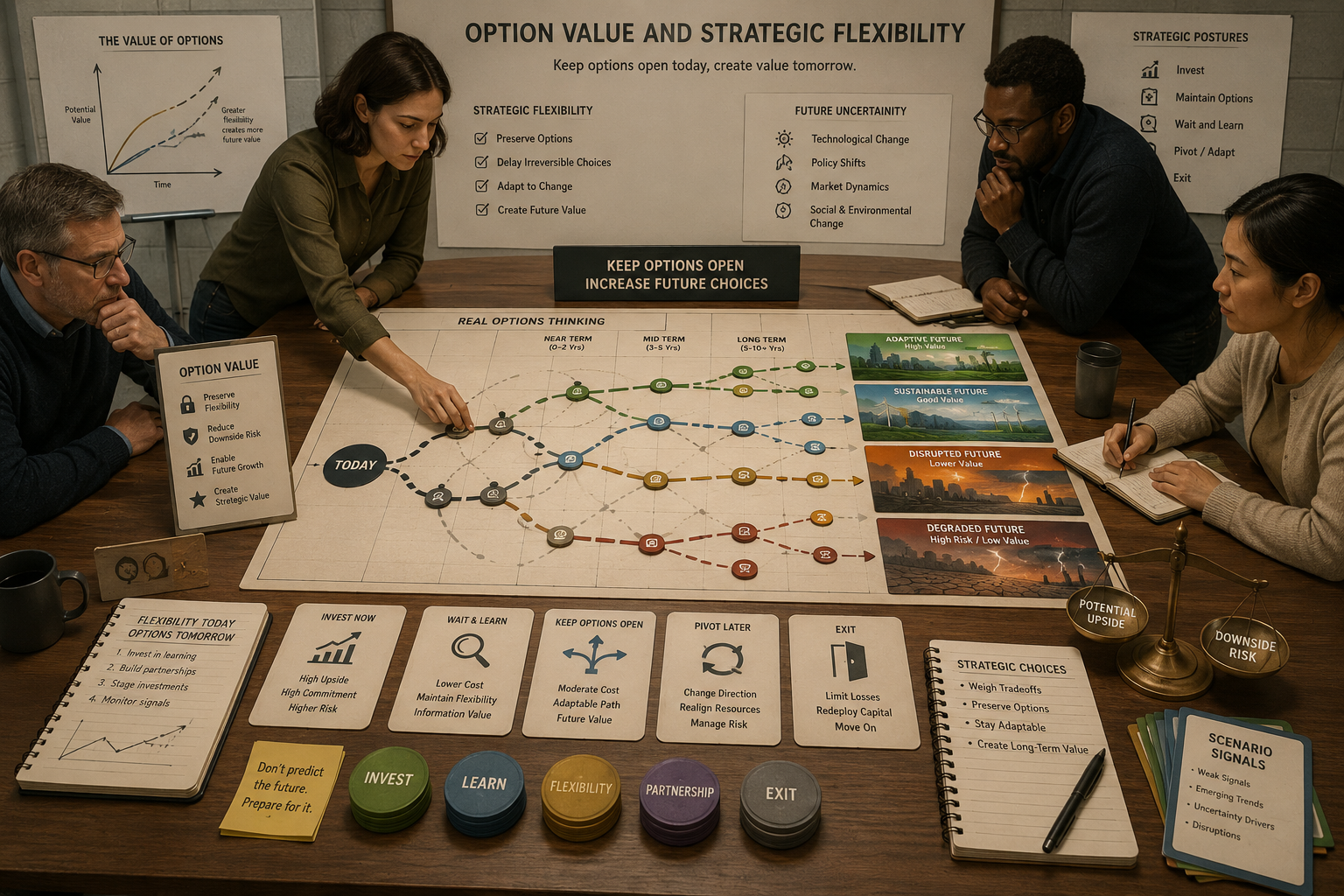
Option value and strategic flexibility concern the value of keeping future choices open when uncertainty is high, information is incomplete, and premature commitment could create unnecessary lock-in. In strategic ideation, a choice is not valuable only because of its immediate payoff. It may also be valuable because it preserves the ability to learn, adapt, expand, pause, abandon, sequence, or redirect action as conditions change. Strategic flexibility is therefore not indecision. It is the disciplined design of choices that remain responsive to uncertainty.
This matters because many strategic decisions are made before decision-makers know enough to commit fully. Markets shift. Technologies mature unevenly. regulations change. users adapt. stakeholders respond. institutions learn. In these environments, the best strategy is often not the one that maximizes a single forecast. It is the one that protects the organization from premature closure while creating pathways for action as better information becomes available.
Option value helps explain why flexibility can be strategically valuable even when it appears inefficient in the short term. A pilot program, modular architecture, staged investment, reversible policy, experimental partnership, platform prototype, or adaptive implementation pathway may not maximize immediate return. But it can preserve future choice, reduce downside exposure, and create learning that improves later decisions. The value lies not only in what the option does now, but in what it makes possible later.
At its deepest level, option value changes how strategists think about commitment. Instead of asking only “Which option has the highest expected payoff?” it asks “Which option preserves the most valuable future choices under uncertainty?” Instead of treating delay, experimentation, redundancy, and flexibility as waste, it asks whether they create strategic room to learn before locking in. The point is not to avoid commitment forever. The point is to commit at the right scale, at the right time, with the right evidence, and with enough flexibility to adapt when the world changes.
This article examines option value and strategic flexibility as core practices in strategic ideation. It explores real options logic, irreversibility, uncertainty, staged commitment, experimentation, modularity, reversibility, abandonment, expansion, switching, adaptive pathways, governance, ethics, and practical methods for designing strategies that preserve future choice without becoming vague, hesitant, or directionless.
Main Library
Publications
Article Map
Strategic Ideation
Related Topic
Decision Science
Related Topic
Futures Thinking
Related Topic
Systems Thinking
Why Option Value Matters in Strategy
Option value matters because strategic decisions are often made before the future is clear. A rigid strategy may perform well if the preferred forecast occurs, but fail badly if assumptions change. A flexible strategy may sacrifice some immediate efficiency while preserving the ability to respond, learn, and redirect. This difference becomes especially important when uncertainty is high, when early choices create lock-in, and when later information will be more valuable than information available now.
In ordinary decision language, an option is simply one available choice among many. In strategic option logic, an option is a structured right, pathway, or capability that allows future action without requiring full commitment immediately. A pilot creates the option to scale. A modular system creates the option to replace parts without redesigning the whole. A partnership creates the option to deepen collaboration. A reversible policy creates the option to adjust if unintended consequences appear. A staged investment creates the option to stop, expand, or redirect after evidence improves.
This means that some strategic investments should be evaluated not only by their direct return, but by the future choices they preserve. An initiative may look modest through a short-term performance lens but highly valuable through an option-value lens because it creates learning, access, relationships, technical capability, legitimacy, or decision rights that matter later.
| Conventional evaluation | Option-value evaluation | Strategic implication |
|---|---|---|
| What is the immediate return? | What future choices does this preserve? | Learning and flexibility may justify modest initial payoff. |
| How efficient is the current design? | How adaptable is the design if conditions change? | Some slack and modularity may be strategically valuable. |
| Should we commit now or not? | Can we stage commitment as evidence improves? | Commitment can be sequenced rather than binary. |
| What is the best forecast? | Which pathway remains viable across multiple futures? | Robustness may matter more than forecast optimization. |
| What does this cost today? | What future lock-in or opportunity loss does this avoid? | Flexibility can reduce hidden future cost. |
Option value matters because the future is not only something to predict. It is something strategy must remain capable of entering.
Strategic Flexibility Is Not Indecision
Strategic flexibility is often misunderstood as hesitation, vagueness, or unwillingness to commit. That is a mistake. Flexibility is valuable only when it is disciplined. It requires clear decision rights, explicit triggers, learning objectives, monitoring systems, review cadence, and criteria for expanding, pausing, abandoning, or redirecting action. Without those structures, flexibility becomes drift. With them, flexibility becomes adaptive capacity.
The difference between disciplined flexibility and indecision lies in design. Indecision avoids choice. Strategic flexibility makes a choice about how much to commit now, what information to seek next, which options to preserve, what thresholds will trigger action, and how the organization will revise its path as evidence changes. It is not the absence of strategy. It is strategy under uncertainty.
| Undisciplined indecision | Disciplined strategic flexibility | Practical difference |
|---|---|---|
| Delays commitment without a learning plan. | Stages commitment around specific evidence thresholds. | Time is used to learn, not merely to postpone. |
| Keeps options open vaguely. | Defines which options are being preserved and why. | Flexibility is intentional rather than rhetorical. |
| Avoids accountability. | Assigns owners, triggers, and review cadence. | Adaptation has governance. |
| Changes direction reactively. | Uses predefined signals to revise strategy. | Adaptation is evidence-sensitive. |
| Confuses openness with lack of priority. | Protects priority while preserving adaptive pathways. | Direction and flexibility coexist. |
Flexibility is strategic when it has a structure for learning and a discipline for commitment.
Real Options Logic
Real options logic extends the intuition of financial options into strategic decisions involving real assets, programs, capabilities, policies, technologies, partnerships, and organizational commitments. A real option gives decision-makers the ability, but not the obligation, to take a future action after uncertainty has changed or new information has become available.
The value of real options comes from uncertainty, flexibility, and timing. If the future is perfectly predictable, flexibility has little extra value. If a decision is fully reversible and costless to change, option value is less important. But when uncertainty is high, commitments are costly, and future information will matter, preserving the right to act later can be valuable.
Real options thinking is especially useful in strategic ideation because it helps teams avoid all-or-nothing choices. Instead of deciding between full commitment and abandonment, teams can design options: a pilot before scale, a prototype before infrastructure, a partnership before acquisition, a modular design before lock-in, a policy trial before permanent legislation, or a phased investment before irreversible commitment.
| Real options idea | Strategic interpretation | Example |
|---|---|---|
| Option to defer | Wait before committing while preserving future access. | Delay full rollout until regulatory uncertainty clears. |
| Option to expand | Start small and scale if evidence supports growth. | Pilot a product in one market before national launch. |
| Option to abandon | Exit if assumptions fail or losses exceed thresholds. | Stop a program after predefined evidence review. |
| Option to switch | Maintain ability to shift suppliers, technologies, or pathways. | Use modular architecture to avoid platform lock-in. |
| Option to stage | Break commitment into sequenced investments. | Fund discovery, prototype, pilot, and scale separately. |
| Option to learn | Invest in information that improves later decisions. | Run experiments to test demand, feasibility, or legitimacy. |
Real options logic reframes uncertainty from a reason for paralysis into a reason to design better pathways for action.
Uncertainty, Irreversibility, and the Cost of Lock-In
Option value becomes most important when uncertainty and irreversibility combine. Uncertainty means that outcomes, probabilities, system responses, stakeholder reactions, or future conditions are not fully known. Irreversibility means that once a commitment is made, it is costly or impossible to reverse. When both are present, premature commitment can create strategic lock-in before the organization has learned enough.
Lock-in can take many forms. A technology platform may become difficult to leave because data, workflows, integrations, training, and contracts accumulate around it. A policy may create constituencies that resist revision. An infrastructure choice may shape land use for decades. An organizational design may embed incentives that later become hard to change. A brand position may constrain future credibility. A partnership may create dependency even before formal ownership changes.
This is why reversibility should be treated as a strategic variable. The more irreversible the decision, the more valuable it may be to preserve options, stage investment, test assumptions, maintain exit paths, and define revision triggers. High commitment is not inherently wrong. But high commitment under deep uncertainty requires stronger evidence, stronger governance, and clearer accountability.
| Lock-in source | How it constrains strategy | Flexibility response |
|---|---|---|
| Capital investment | Creates sunk cost and pressure to continue. | Stage investment and define exit gates. |
| Technical architecture | Limits future interoperability and switching. | Use modular design and open interfaces. |
| Contracts | Restrict renegotiation or exit. | Include review, renewal, and termination clauses. |
| Institutional routines | Make alternatives harder to imagine or implement. | Maintain learning reviews and periodic redesign. |
| Stakeholder expectations | Create reputational cost for changing direction. | Communicate uncertainty and revision conditions early. |
| Regulatory or policy design | Creates durable obligations and political commitments. | Use sunset clauses, pilots, and evaluation periods. |
The central question is not whether commitment is necessary. It is whether the scale of commitment matches the quality of evidence and the reversibility of the path.
Types of Strategic Options
Strategic flexibility can be designed through different types of options. Each option type preserves a different kind of future choice. Some protect the ability to wait. Others protect the ability to grow, switch, abandon, learn, pause, partner, or redesign. A sophisticated strategy may combine several option types rather than relying on a single flexible move.
| Option type | What it preserves | Strategic use |
|---|---|---|
| Deferral option | The ability to wait before committing fully. | Useful when near-term information will clarify the decision. |
| Expansion option | The ability to scale if evidence is favorable. | Useful for pilots, market tests, and emerging opportunities. |
| Abandonment option | The ability to stop if assumptions fail. | Useful when downside exposure must be limited. |
| Switching option | The ability to change inputs, partners, platforms, or pathways. | Useful when supply, technology, or stakeholder conditions may shift. |
| Learning option | The ability to generate evidence before larger commitment. | Useful under uncertainty, ambiguity, and contested assumptions. |
| Modularity option | The ability to change part of a system without replacing the whole. | Useful in technology, infrastructure, and organizational design. |
| Sequencing option | The ability to order commitments over time. | Useful when dependencies and readiness vary across phases. |
| Partnership option | The ability to deepen, revise, or exit collaboration. | Useful when capabilities, legitimacy, or access depend on others. |
Option value is not one thing. It is a family of future-choice protections that can be designed into strategy.
Staged Commitment and Decision Gates
Staged commitment is one of the most practical ways to create strategic flexibility. Instead of treating a strategic decision as a single irreversible leap, the organization divides commitment into phases. Each phase has a purpose, evidence standard, budget, owner, risk limit, and decision gate. At each gate, the organization can continue, expand, modify, pause, or stop.
This approach is especially useful when decision-makers need to act before full certainty is available. Staging allows action and learning to proceed together. It avoids both reckless commitment and endless analysis. The key is that each stage must produce information relevant to the next decision. A stage without learning is merely delay. A gate without consequences is merely theater.
| Stage | Purpose | Decision gate |
|---|---|---|
| Discovery | Clarify the problem, assumptions, stakeholders, and uncertainty. | Is the opportunity real enough to test? |
| Prototype | Explore feasibility, usability, and basic viability. | Does the concept work in a limited form? |
| Pilot | Test performance, legitimacy, operational fit, and risk. | Is there enough evidence to expand? |
| Scale preparation | Build capabilities, governance, safeguards, and measurement. | Can the system absorb larger commitment? |
| Expansion | Commit more resources under monitored conditions. | Are results robust enough to continue? |
| Institutionalization | Embed the strategy into routines, roles, budgets, and governance. | What review cycle prevents stale lock-in? |
Staged commitment allows organizations to move without pretending they know more than they do.
Experimentation and Learning Value
Some options are valuable because they generate information. A prototype, pilot, simulation, small-market test, shadow process, policy trial, stakeholder workshop, or phased rollout may be valuable even if it does not immediately produce large returns. Its value lies in what it reveals: demand, feasibility, cost, risk, legitimacy, implementation friction, stakeholder response, or system effects.
Learning value is not automatic. An experiment creates option value only when it is designed around a decision-relevant question. A vague pilot may produce activity without useful evidence. A strong pilot identifies the assumptions being tested, the evidence needed, the threshold for continuation, the conditions for stopping, and the implications for scale.
| Weak experiment | Strong learning option | Strategic benefit |
|---|---|---|
| Tests whether people like the idea. | Tests specific assumptions about demand, feasibility, risk, and legitimacy. | Improves later commitment quality. |
| Measures activity. | Measures decision-relevant evidence. | Reduces uncertainty that matters. |
| Has no stopping rule. | Defines continue, revise, scale, or abandon thresholds. | Limits drift and sunk-cost escalation. |
| Runs in an artificial context. | Tests under conditions similar enough to inform scale. | Improves transferability. |
| Creates findings but no decision. | Connects learning directly to the next gate. | Turns evidence into action. |
Experimentation creates option value when it converts uncertainty into usable decision evidence.
Modularity, Switching, and Adaptive Architecture
Modularity is a structural source of flexibility. A modular strategy, system, platform, policy, or organization can change parts without replacing the whole. This reduces switching cost, limits failure propagation, and allows learning in one area without destabilizing everything else. In uncertain environments, modularity can create option value by making future adaptation less expensive.
Switching options are closely related. They preserve the ability to change suppliers, technologies, partners, channels, locations, policies, or implementation pathways if conditions change. A strategy that depends on a single vendor, platform, pathway, funding source, political coalition, or technical architecture may perform well in stable conditions but become fragile when circumstances shift.
| Flexibility design | What it protects against | Example |
|---|---|---|
| Modular architecture | Whole-system replacement when one part fails. | Composable technology stack or modular infrastructure. |
| Open interfaces | Vendor or platform lock-in. | Interoperable data and integration standards. |
| Multiple suppliers | Supply disruption and bargaining dependency. | Dual sourcing for critical inputs. |
| Policy sunset clauses | Permanent commitment to untested rules. | Temporary regulation with scheduled evaluation. |
| Adaptive governance | Rigid rules that cannot respond to learning. | Review boards with defined revision authority. |
| Scenario-contingent pathways | Single-plan failure under alternative futures. | Different action paths tied to trigger conditions. |
Modularity turns flexibility from an aspiration into an architecture.
Abandonment, Exit, and Responsible Retrenchment
The option to abandon is one of the most important but least celebrated forms of strategic flexibility. Organizations often design paths to start, expand, and celebrate initiatives, but not to stop them responsibly. As a result, weak strategies continue because of sunk cost, political embarrassment, stakeholder expectation, internal identity, or fear of admitting failure.
Abandonment options are not anti-strategic. They protect the organization from compounding losses when assumptions fail. They also protect stakeholders from being trapped in programs, platforms, or policies that no longer serve their purpose. The key is to design exit conditions before the organization becomes emotionally or politically committed to continuation.
| Exit design element | Purpose | Strategic value |
|---|---|---|
| Stopping thresholds | Define evidence that should halt continuation. | Prevents sunk-cost escalation. |
| Transition plan | Protect affected stakeholders during exit. | Reduces harm and reputational damage. |
| Knowledge capture | Preserve learning from failed or abandoned paths. | Turns exit into institutional learning. |
| Resource release plan | Redeploy people, budget, and attention. | Restores strategic capacity. |
| Communication plan | Explain why stopping is responsible. | Protects trust and legitimacy. |
| Review governance | Ensure exit is not arbitrary or politically hidden. | Supports accountability. |
A strategy that cannot stop may not be committed. It may be trapped.
Expansion, Scaling, and Timing
Expansion options allow organizations to begin with limited exposure and scale when evidence supports larger commitment. This is often superior to launching at full scale before assumptions have been tested. However, expansion must also be timed carefully. Scaling too early can amplify flaws. Scaling too late can miss windows of opportunity, lose legitimacy, or allow competitors and conditions to move past the organization.
The challenge is to define scaling triggers that are neither purely financial nor purely enthusiastic. Strong scaling decisions integrate feasibility, demand, operational capacity, stakeholder legitimacy, governance readiness, risk exposure, and system effects. The question is not simply “Did the pilot succeed?” but “Did it succeed in ways that are likely to survive scale?”
| Scaling question | Why it matters | Evidence to review |
|---|---|---|
| Is demand real? | Early enthusiasm may not represent durable adoption. | Usage, retention, willingness to pay, stakeholder need. |
| Is delivery feasible? | Small-scale success may depend on unusual attention or talent. | Capacity, process reliability, staffing, training. |
| Is legitimacy strong enough? | Expansion may provoke resistance if stakeholders feel excluded. | Trust, participation, complaints, public response. |
| Are risks controlled? | Scale can multiply harm, cost, and exposure. | Risk indicators, safeguards, incident reports. |
| Are governance structures ready? | Scaling without oversight creates drift. | Decision rights, monitoring, accountability, escalation paths. |
| Will the model survive context shift? | What worked in one setting may not generalize. | Scenario tests, transferability analysis, local adaptation needs. |
The option to expand is valuable only when expansion is tied to evidence that can survive beyond the pilot context.
Option Value and Portfolio Logic
Individual options matter, but strategic flexibility is often best designed at the portfolio level. A portfolio can contain low-risk improvements, exploratory experiments, resilience investments, high-upside bets, participatory initiatives, and staged commitments. The value of the portfolio is not simply the sum of individual projects. It is the pattern of exposure, learning, flexibility, and future pathways created across the whole set.
Portfolio thinking prevents organizations from forcing every idea into the same evaluation logic. A high-learning experiment should not be judged by the same criteria as a mature operational investment. A resilience option should not be dismissed because it underperforms a growth option during stable periods. A high-upside bet should not dominate the portfolio unless its exposure is bounded and its assumptions are actively tested.
| Portfolio role | Primary value | Evaluation question |
|---|---|---|
| Core improvement | Reliable near-term performance. | Does it improve current operations without hidden fragility? |
| Exploratory option | Learning under uncertainty. | What decision-relevant evidence will it produce? |
| Resilience option | Shock absorption and continuity. | What failure modes does it protect against? |
| Growth option | Upside if conditions are favorable. | How is downside exposure bounded? |
| Switching option | Future adaptability. | What dependencies does it reduce? |
| Legitimacy option | Trust, participation, and social permission. | Who gains voice, and how does that change risk? |
Strategic flexibility is often less about one perfect option than about a portfolio that preserves multiple forms of future choice.
Strategic Foresight and Flexible Pathways
Strategic foresight and option value reinforce one another. Foresight explores multiple plausible futures, weak signals, disruptions, scenarios, and long-term pathways. Option value asks how present choices can preserve the ability to act across those futures. Together, they move strategy away from single-forecast planning and toward adaptive readiness.
Scenario planning is especially useful for option design. A strategy can be tested against different futures to identify which options remain valuable, which become fragile, and which trigger conditions should activate alternative pathways. Instead of asking which future will happen, the organization asks which commitments are robust, which options should be kept alive, and which decisions should wait for stronger signals.
| Foresight practice | Option-value connection | Strategic output |
|---|---|---|
| Horizon scanning | Identifies signals that may change option value. | Trigger indicators. |
| Scenario planning | Tests which options remain viable across futures. | Robustness and fragility map. |
| Backcasting | Clarifies pathways from desired futures to present commitments. | Staged pathway design. |
| Stress testing | Reveals where strategies fail under disruption. | Contingency and adaptation plans. |
| Adaptive pathways | Links decisions to changing conditions over time. | Decision gates and trigger-based strategy. |
Foresight shows why flexibility is needed; option design shows how flexibility becomes actionable.
Core Dimensions of Option Value and Strategic Flexibility
Option value and strategic flexibility can be evaluated through several core dimensions. These dimensions help teams distinguish serious adaptive strategy from vague optionality language, hesitant decision-making, or flexibility that lacks governance.
1. Uncertainty
Option value increases when future conditions, probabilities, stakeholder responses, technical feasibility, costs, or system effects are not yet clear. The more uncertainty matters, the more valuable it may be to preserve future choice.
2. Irreversibility
Options are especially valuable when commitment is difficult to reverse. Irreversibility raises the burden of evidence and increases the importance of staged investment, exit paths, and review triggers.
3. Learning Value
A strategic option is stronger when it produces decision-relevant information. Learning value depends on whether the option tests important assumptions and improves the next decision.
4. Flexibility
Flexibility includes the ability to expand, contract, switch, pause, abandon, partner, redesign, or sequence action as conditions change. It should be specific rather than rhetorical.
5. Modularity
Modularity reduces the cost of adaptation by allowing parts of a system to change without replacing the whole. It is one of the most practical design principles for strategic flexibility.
6. Timing
The value of an option depends on when it can be exercised. Waiting can be valuable when information improves, but waiting can also destroy value if the opportunity window closes.
7. Governance
Flexible strategy needs decision rights, evidence standards, review cadence, trigger conditions, accountability, and documentation. Without governance, flexibility becomes drift.
8. Ethics and Burden
Flexibility for one actor may create uncertainty for others. Responsible option design asks who bears delay, ambiguity, experimentation, exit, or shifting commitments.
| Dimension | Diagnostic question | Useful output |
|---|---|---|
| Uncertainty | What do we not yet know that could change the decision? | Uncertainty map. |
| Irreversibility | How hard is this commitment to reverse? | Lock-in review. |
| Learning value | What decision-relevant evidence will this option generate? | Learning agenda. |
| Flexibility | What future moves are preserved? | Option inventory. |
| Modularity | Can parts change without replacing the whole? | Adaptive architecture review. |
| Timing | When should the option be exercised, expanded, paused, or abandoned? | Trigger map. |
| Governance | Who decides when evidence changes? | Decision-gate protocol. |
| Ethics and burden | Who bears the cost of flexibility? | Burden and accountability review. |
Option value becomes useful when it connects uncertainty, commitment, learning, timing, design, governance, and responsibility.
Ethics, Power, and Flexibility
Strategic flexibility is not ethically neutral. Flexibility for one actor can become instability for another. A corporation may preserve the option to exit a market, but workers, suppliers, communities, and users may bear the consequences. A government may preserve policy flexibility, but affected communities may live with uncertainty. A platform may keep rules adaptable, but developers and creators may experience unpredictability. A funder may stage commitments, but recipients may struggle to plan.
This means that option value must be evaluated alongside burden distribution. Who benefits from keeping options open? Who pays the cost of waiting? Who is exposed to changing commitments? Who has voice in deciding whether an option is expanded, revised, or abandoned? Who receives transition support if the strategy changes?
| Ethical issue | Why it matters | Responsible design question |
|---|---|---|
| Delay burden | Waiting may impose cost on affected groups. | Who pays for uncertainty while we learn? |
| Exit burden | Abandonment may harm stakeholders dependent on the initiative. | What transition support is required? |
| Experimentation burden | Pilots may expose some groups to risk for others’ learning. | Who is being experimented on, and with what consent? |
| Asymmetric flexibility | Powerful actors may preserve options while others are locked in. | Does flexibility exist for all affected parties? |
| Information asymmetry | Decision-makers may know uncertainty that stakeholders do not. | What uncertainty should be disclosed? |
| Governance exclusion | Those affected may lack voice in exercising the option. | Who participates in decision gates? |
Responsible flexibility asks not only what options are preserved, but whose options are preserved.
The Limits of Flexibility
Flexibility is valuable, but it is not always the best strategic posture. Some situations require commitment, clarity, and speed. Excessive optionality can fragment attention, delay action, confuse stakeholders, weaken accountability, and prevent the organization from building the capabilities needed to execute. Keeping every option open can be as damaging as locking in too early.
The limits of flexibility are especially important in high-trust, high-coordination, or high-consequence environments. Partners need to know whether commitments are real. Employees need direction. Stakeholders need clarity. Infrastructure requires durable planning. Public policy cannot always remain provisional. A strategy that stays flexible forever may fail because it never becomes concrete enough to coordinate action.
| Flexibility failure | How it appears | Corrective practice |
|---|---|---|
| Option overload | Too many pathways dilute attention and resources. | Use portfolio discipline and option pruning. |
| Perpetual pilot | Experiments continue without scaling or stopping. | Define decision gates and thresholds. |
| Ambiguous commitment | Stakeholders cannot tell what the organization stands behind. | Communicate commitment level clearly. |
| Delayed capability building | The organization waits too long to invest in execution capacity. | Stage capability investment alongside learning. |
| Governance drift | Flexibility becomes ad hoc revision. | Assign decision rights and review cadence. |
| Window loss | Waiting causes the opportunity to disappear. | Use trigger indicators and option expiration review. |
The goal is not maximum flexibility. The goal is the right flexibility for the uncertainty, stakes, timing, and commitment structure of the decision.
A Practical Option Value Audit
An option value audit helps teams determine whether a strategic idea preserves meaningful future choice or merely delays commitment. It is useful for investments, policy design, platform strategy, organizational reform, sustainability transitions, product development, partnerships, and high-uncertainty implementation pathways.
1. Define the Decision and Commitment Level
Clarify what decision is being made now, what is being deferred, what resources are committed, and what future decision rights are being preserved.
2. Map the Uncertainty
Identify what is unknown, what could change, what evidence is missing, and which uncertainties materially affect the decision.
3. Review Irreversibility and Lock-In
Assess switching costs, contractual constraints, technical dependencies, stakeholder expectations, sunk cost, and political commitment.
4. Identify the Options Being Preserved
Name the specific options: defer, expand, abandon, switch, stage, learn, partner, redesign, modularize, or exit.
5. Define the Learning Agenda
Specify which assumptions must be tested, what evidence matters, how it will be collected, and how it changes the next decision.
6. Establish Triggers and Decision Gates
Define the evidence thresholds for continuing, scaling, revising, pausing, or abandoning the option.
7. Evaluate the Cost of Keeping the Option Open
Flexibility has cost. Review budget, time, attention, delay, stakeholder uncertainty, and opportunity cost.
8. Review Option Expiration
Some options lose value over time. Identify windows of opportunity, competitor movement, stakeholder patience, regulatory timing, and capability decay.
9. Assign Governance and Accountability
Clarify who monitors signals, who owns each decision gate, who can revise the pathway, and how decisions are documented.
10. Review Ethics and Burden
Ask who bears the cost of flexibility, delay, experimentation, exit, uncertainty, or shifting commitment.
| Audit step | Core question | Useful output |
|---|---|---|
| Decision and commitment | What is being committed now, and what remains open? | Commitment map. |
| Uncertainty | What unknowns make flexibility valuable? | Uncertainty register. |
| Irreversibility | What lock-in risks exist? | Lock-in review. |
| Option inventory | Which future choices are preserved? | Option map. |
| Learning agenda | What evidence will improve the next decision? | Assumption test plan. |
| Triggers and gates | When do we expand, revise, pause, or stop? | Decision-gate protocol. |
| Cost of flexibility | What does keeping the option open cost? | Option carrying-cost review. |
| Expiration | When does the option lose value? | Timing and window analysis. |
| Governance | Who owns monitoring and action? | Accountability map. |
| Ethics and burden | Who pays for flexibility? | Burden review. |
A serious option value audit should leave behind more than a claim that flexibility is useful. It should specify which future choices are preserved, what they cost, when they expire, who governs them, and what evidence activates them.
Mathematical Lens: Option Value, Flexibility, and Lock-In
A simple way to express option value is to compare the value of committing now with the value of preserving the right to act later:
OV = E[V_{future} \mid I_{new}] – C_{option}
\]
Interpretation: \(OV\) is option value, \(E[V_{future} \mid I_{new}]\) is the expected value of future action after new information arrives, and \(C_{option}\) is the cost of keeping the option open. Flexibility is valuable when future choice under better information is worth more than its carrying cost.
Lock-in can be represented as a combination of irreversibility, switching cost, dependence, and lost flexibility:
L = I + S + D – F
\]
Interpretation: \(L\) is lock-in, \(I\) is irreversibility, \(S\) is switching cost, \(D\) is dependence on a pathway, platform, partner, or institution, and \(F\) is retained flexibility. High lock-in raises the burden of evidence before full commitment.
A staged commitment rule can be written as:
Commit_{t+1} =
\begin{cases}
Expand, & E_t \geq \theta_{scale} \\
Revise, & \theta_{revise} \leq E_t < \theta_{scale} \\
Stop, & E_t < \theta_{stop}
\end{cases}
\]
Interpretation: \(E_t\) is the evidence observed at time \(t\), and the thresholds determine whether the organization expands, revises, or stops. This formalizes disciplined flexibility: adaptation is tied to evidence, not mood or politics.
Scenario robustness can be expressed as:
R_k = \min_{s \in S} V_{ks}
\]
Interpretation: \(R_k\) is the worst-case viability of option \(k\) across scenarios \(S\). Flexible strategies often become attractive when they preserve acceptable performance across more than one plausible future.
The mathematical lens clarifies that option value is not free. It depends on uncertainty, timing, cost, lock-in, evidence, and the value of future action.
Advanced R Workflow: Comparing Strategic Option Profiles
The R workflow below compares stylized strategic options across learning value, flexibility, reversibility, scalability, modularity, lock-in exposure, carrying cost, and governance readiness. It is designed as an evergreen illustration of how option value can be evaluated across multiple dimensions rather than reduced to a single financial estimate.
# Install packages if needed.
# install.packages(c("tidyverse"))

library(tidyverse)

# ------------------------------------------------------------
# R Workflow: Comparing Strategic Option Profiles
# Purpose:
#   Compare option-value profiles across learning value,
#   flexibility, reversibility, scalability, modularity,
#   lock-in exposure, carrying cost, and governance readiness.
# ------------------------------------------------------------

options <- tibble(
  option = c(
    "Pilot Before Scale",
    "Modular Platform Pathway",
    "Full Commitment Now",
    "Staged Partnership Option",
    "Adaptive Policy Trial"
  ),
  learning_value = c(0.82, 0.66, 0.30, 0.74, 0.78),
  flexibility = c(0.78, 0.88, 0.28, 0.76, 0.82),
  reversibility = c(0.74, 0.72, 0.22, 0.68, 0.76),
  scalability = c(0.70, 0.84, 0.80, 0.72, 0.62),
  modularity = c(0.64, 0.90, 0.24, 0.70, 0.68),
  lock_in_exposure = c(0.32, 0.28, 0.82, 0.42, 0.36),
  carrying_cost = c(0.46, 0.58, 0.34, 0.44, 0.40),
  governance_readiness = c(0.70, 0.76, 0.48, 0.68, 0.72)
)

options <- options %>%
  mutate(
    option_value_score =
      0.18 * learning_value +
      0.18 * flexibility +
      0.14 * reversibility +
      0.14 * scalability +
      0.14 * modularity -
      0.14 * lock_in_exposure -
      0.08 * carrying_cost +
      0.14 * governance_readiness,
    lock_in_warning =
      0.34 * lock_in_exposure +
      0.22 * (1 - reversibility) +
      0.18 * (1 - modularity) +
      0.14 * (1 - flexibility) +
      0.12 * (1 - governance_readiness)
  )

print(options)

options_long <- options %>%
  pivot_longer(
    cols = c(
      learning_value,
      flexibility,
      reversibility,
      scalability,
      modularity,
      lock_in_exposure,
      carrying_cost,
      governance_readiness
    ),
    names_to = "dimension",
    values_to = "value"
  )

ggplot(options_long, aes(x = dimension, y = value, fill = option)) +
  geom_col(position = "dodge") +
  labs(
    title = "Strategic Option Value Dimensions",
    x = "Dimension",
    y = "Value",
    fill = "Option"
  ) +
  theme_minimal(base_size = 12) +
  coord_flip()

ggplot(options, aes(x = reorder(option, option_value_score), y = option_value_score)) +
  geom_col() +
  coord_flip() +
  labs(
    title = "Strategic Option Value Score",
    x = "Option",
    y = "Score"
  ) +
  theme_minimal(base_size = 12)

ggplot(options, aes(x = reorder(option, lock_in_warning), y = lock_in_warning)) +
  geom_col() +
  coord_flip() +
  labs(
    title = "Lock-In Warning",
    x = "Option",
    y = "Warning"
  ) +
  theme_minimal(base_size = 12)

write_csv(options, "strategic_option_value_profiles.csv")
This workflow is not a universal valuation model. Its value is methodological: it helps teams compare options by making learning, flexibility, reversibility, modularity, scalability, lock-in, carrying cost, and governance visible together.
Advanced Python Workflow: Simulating Option Value and Strategic Flexibility
The Python workflow below simulates stylized strategic pathways over time. It illustrates how flexible options may underperform full commitment in stable early conditions but outperform rigid strategies after uncertainty, disruption, or new information appears.
# Install packages if needed:
# pip install pandas numpy matplotlib

import numpy as np
import pandas as pd
import matplotlib.pyplot as plt

# ------------------------------------------------------------
# Python Workflow: Simulating Option Value and Strategic Flexibility
# Purpose:
#   Compare strategic options under stable and disrupted conditions
#   using flexibility, learning value, reversibility, scalability,
#   lock-in exposure, and governance readiness.
# ------------------------------------------------------------

time_steps = np.arange(1, 41)

def simulate_option(
    initial_return,
    learning_value,
    flexibility,
    reversibility,
    scalability,
    lock_in,
    governance,
    carrying_cost,
    initial_state=1.0
):
    state = np.zeros(len(time_steps))
    option_capacity = np.zeros(len(time_steps))

    state[0] = initial_state
    option_capacity[0] = flexibility

    for t in range(1, len(time_steps)):
        if t < 18:
            shock = 0.03
            gain = 0.16 * initial_return + 0.05 * scalability - 0.04 * carrying_cost
        else:
            shock = 0.15
            learning_gain = 0.10 * learning_value + 0.08 * governance
            adaptation_gain = 0.14 * flexibility + 0.10 * reversibility
            lock_in_penalty = 0.16 * lock_in
            gain = learning_gain + adaptation_gain + 0.06 * option_capacity[t - 1] - lock_in_penalty

        option_capacity[t] = option_capacity[t - 1] + (
            0.04 * learning_value +
            0.04 * governance +
            0.03 * modularity_proxy(flexibility, reversibility) -
            0.05 * lock_in -
            0.03 * carrying_cost
        )
        option_capacity[t] = np.clip(option_capacity[t], 0, 1.2)

        state[t] = state[t - 1] + gain / 4 - shock / 5
        state[t] = np.clip(state[t], 0, 1.8)

    return state, option_capacity

def modularity_proxy(flexibility, reversibility):
    return (flexibility + reversibility) / 2

options = {
    "Pilot Before Scale": {
        "initial_return": 0.58,
        "learning_value": 0.82,
        "flexibility": 0.78,
        "reversibility": 0.74,
        "scalability": 0.70,
        "lock_in": 0.32,
        "governance": 0.70,
        "carrying_cost": 0.46
    },
    "Modular Platform Pathway": {
        "initial_return": 0.62,
        "learning_value": 0.66,
        "flexibility": 0.88,
        "reversibility": 0.72,
        "scalability": 0.84,
        "lock_in": 0.28,
        "governance": 0.76,
        "carrying_cost": 0.58
    },
    "Full Commitment Now": {
        "initial_return": 0.86,
        "learning_value": 0.30,
        "flexibility": 0.28,
        "reversibility": 0.22,
        "scalability": 0.80,
        "lock_in": 0.82,
        "governance": 0.48,
        "carrying_cost": 0.34
    },
    "Staged Partnership Option": {
        "initial_return": 0.64,
        "learning_value": 0.74,
        "flexibility": 0.76,
        "reversibility": 0.68,
        "scalability": 0.72,
        "lock_in": 0.42,
        "governance": 0.68,
        "carrying_cost": 0.44
    },
    "Adaptive Policy Trial": {
        "initial_return": 0.52,
        "learning_value": 0.78,
        "flexibility": 0.82,
        "reversibility": 0.76,
        "scalability": 0.62,
        "lock_in": 0.36,
        "governance": 0.72,
        "carrying_cost": 0.40
    }
}

df = pd.DataFrame({"time": time_steps})
capacity_df = pd.DataFrame({"time": time_steps})

for name, params in options.items():
    viability, option_capacity = simulate_option(**params)
    df[name] = viability
    capacity_df[name] = option_capacity

print(df.head())

plt.figure(figsize=(10, 6))
for col in df.columns[1:]:
    plt.plot(df["time"], df[col], label=col)

plt.xlabel("Time Step")
plt.ylabel("Strategic Viability")
plt.title("Option Value and Strategic Flexibility")
plt.legend()
plt.tight_layout()
plt.show()

summary = df.drop(columns=["time"]).iloc[-1].sort_values(ascending=False)
print(summary)

df.to_csv("option_value_strategic_flexibility_simulation.csv", index=False)
capacity_df.to_csv("option_capacity_pathways.csv", index=False)
This simulation is intentionally stylized. Its value is conceptual: rigid commitment can look attractive early, while flexible pathways may become more valuable as uncertainty resolves, shocks appear, and learning accumulates.
GitHub Repository
The companion repository for this article will provide advanced strategist-facing workflows for option-value diagnostics, strategic flexibility scoring, learning-value analysis, staged-commitment review, lock-in and reversibility assessment, modularity and switching analysis, scenario stress testing, option-expiration review, governance trigger design, ethical burden analysis, and decision-memory documentation.
Complete Code Repository
The companion code includes Python, R, Julia, SQL, Rust, Go, C++, Fortran, C, documentation, synthetic datasets, outputs, and notebook placeholders for applied option value and strategic flexibility analysis.
The repository structure is designed to support professional strategic analysis rather than generic coding demonstrations. The python/ folder can model option value, flexibility, learning, lock-in, reversibility, scenario performance, staged commitment, and decision triggers. The r/ folder can compare option profiles and visualize flexibility tradeoffs. The julia/ folder can support sensitivity analysis for uncertainty, timing, carrying cost, and option exercise thresholds. The sql/ folder can define schemas for options, assumptions, uncertainty, lock-in, experiments, triggers, governance, ethics, and learning memory.
Additional folders can support command-line diagnostics, lower-level scoring utilities, and reproducible documentation. The rust/ folder can provide a command-line option-value diagnostics scaffold. The go/ folder can provide strategic flexibility comparison utilities. The cpp, fortran, and c folders can provide efficient scoring examples and low-level utilities. The docs, data, outputs, and notebooks folders can support article notes, modeling principles, synthetic datasets, generated outputs, and notebook placeholders.
This code should be understood as a transparent learning and modeling scaffold. It is intended for synthetic-data research, methods demonstration, institutional learning, strategic analysis, and reproducible workflow development. It is not a substitute for executive judgment, stakeholder engagement, ethical review, domain expertise, legal review, accountable governance, or responsible implementation.
Conclusion
Option value and strategic flexibility help explain why the best strategy under uncertainty is not always the strategy that appears most efficient, decisive, or profitable in the immediate term. When uncertainty is high and commitment is difficult to reverse, the ability to learn, stage, switch, expand, pause, abandon, or redesign can have strategic value of its own.
Used well, option value thinking protects organizations from premature lock-in. It encourages staged commitment, better experiments, modular design, adaptive pathways, explicit triggers, and decision memory. It helps teams move without pretending they know everything, and it helps them commit without closing off future learning unnecessarily.
Used poorly, flexibility can become a language of avoidance. Organizations can hide indecision behind optionality, run pilots without decisions, keep too many pathways open, or shift the burden of uncertainty onto less powerful stakeholders. Strategic flexibility therefore requires governance, ethics, evidence, and timing discipline.
Better strategy does not keep every option open forever. It preserves the right options long enough to learn, then commits with evidence, accountability, and the capacity to adapt.
Related Articles
- Strategic Ideation
- Risk, Tradeoffs, and Strategic Choices
- Portfolio Thinking in Strategic Ideation
- Decision Matrices and Their Limits
- Decision-Making Under Uncertainty
- Strategic Foresight and Long-Term Thinking
- Scenario Planning and Futures Thinking
- Adaptive Strategy and Iteration
- Decision Science
- Futures Thinking
Further Reading
- Amram, M. and Kulatilaka, N. (1999) Real Options: Managing Strategic Investment in an Uncertain World. Boston, MA: Harvard Business School Press.
- Dixit, A.K. and Pindyck, R.S. (1994) Investment under Uncertainty. Princeton, NJ: Princeton University Press. Available at: JSTOR.
- Organisation for Economic Co-operation and Development (OECD) (2025) Foresight Toolkit for Resilient Public Policy. Paris: OECD Publishing. Available at: OECD.
- Steele, K. (2015) ‘Decision theory’, in Stanford Encyclopedia of Philosophy. Available at: Stanford Encyclopedia of Philosophy.
- Trigeorgis, L. (1996) Real Options: Managerial Flexibility and Strategy in Resource Allocation. Cambridge, MA: MIT Press.
- Trigeorgis, L. (ed.) (1995) Real Options and Investment under Uncertainty: Classical Readings and Recent Contributions. Cambridge, MA: MIT Press. Available at: MIT Press.
References
- Amram, M. and Kulatilaka, N. (1999) Real Options: Managing Strategic Investment in an Uncertain World. Boston, MA: Harvard Business School Press.
- Briggs, R.A. (2019) ‘Normative theories of rational choice: Expected utility’, in Stanford Encyclopedia of Philosophy. Available at: Stanford Encyclopedia of Philosophy.
- Dixit, A.K. and Pindyck, R.S. (1994) Investment under Uncertainty. Princeton, NJ: Princeton University Press. Available at: JSTOR.
- Kogut, B. and Kulatilaka, N. (2001) ‘Capabilities as real options’, Organization Science, 12(6), pp. 744–758.
- Organisation for Economic Co-operation and Development (OECD) (2023) Supporting Decision Making with Strategic Foresight: An Emerging Framework for Proactive and Prospective Governments. Paris: OECD Publishing. Available at: OECD.
- Organisation for Economic Co-operation and Development (OECD) (2025) Foresight Toolkit for Resilient Public Policy. Paris: OECD Publishing. Available at: OECD.
- Steele, K. (2015) ‘Decision theory’, in Stanford Encyclopedia of Philosophy. Available at: Stanford Encyclopedia of Philosophy.
- Trigeorgis, L. (1996) Real Options: Managerial Flexibility and Strategy in Resource Allocation. Cambridge, MA: MIT Press.
- Trigeorgis, L. (ed.) (1995) Real Options and Investment under Uncertainty: Classical Readings and Recent Contributions. Cambridge, MA: MIT Press. Available at: MIT Press.