
Last Updated June 3, 2026
Energy transition futures concern the long-term transformation of how societies produce, distribute, store, govern, finance, and use energy under conditions of climate risk, technological change, geopolitical instability, ecological constraint, and uneven development. The energy transition is not simply a shift from fossil fuels to renewable electricity. It is a structural transformation of power systems, fuels, grids, buildings, transport, industry, labor markets, public finance, land use, minerals, supply chains, infrastructure, energy security, and political authority.
Energy is foundational infrastructure. It shapes economic production, household life, agriculture, transportation, water systems, health systems, digital platforms, defense, manufacturing, public services, and everyday dignity. Because energy systems are deeply embedded in land, capital, labor, geopolitics, technology, and institutions, transition pathways are not merely technical optimization problems. They are contested social choices about who pays, who benefits, who bears risk, which regions are transformed, which workers are protected, which ecosystems are disturbed, and which communities gain or lose power.
The central futures question is not whether the energy system will change. It already is changing. The deeper question is whether energy transition will become a just, resilient, democratic, ecologically grounded transformation—or whether it will reproduce extractive development, unequal access, green enclosure, geopolitical dependency, infrastructure fragility, and new forms of sacrifice-zone politics under cleaner technological language.
This article examines energy transition futures as a systems-foresight problem. It connects renewable energy, electrification, grids, storage, demand flexibility, fossil fuel phase-down, critical minerals, industrial decarbonization, energy justice, public investment, labor transition, climate resilience, governance, geopolitical risk, and long-term institutional strategy. It treats the transition not as a single pathway, but as a set of possible futures shaped by technology, finance, policy, infrastructure, public legitimacy, ecological limits, and power.
Main Library
Publications
Article Map
Futures Thinking
Related Topic
Energy Systems
Related Topic
Climate Change & Earth Systems
Related Topic
Economic Systems
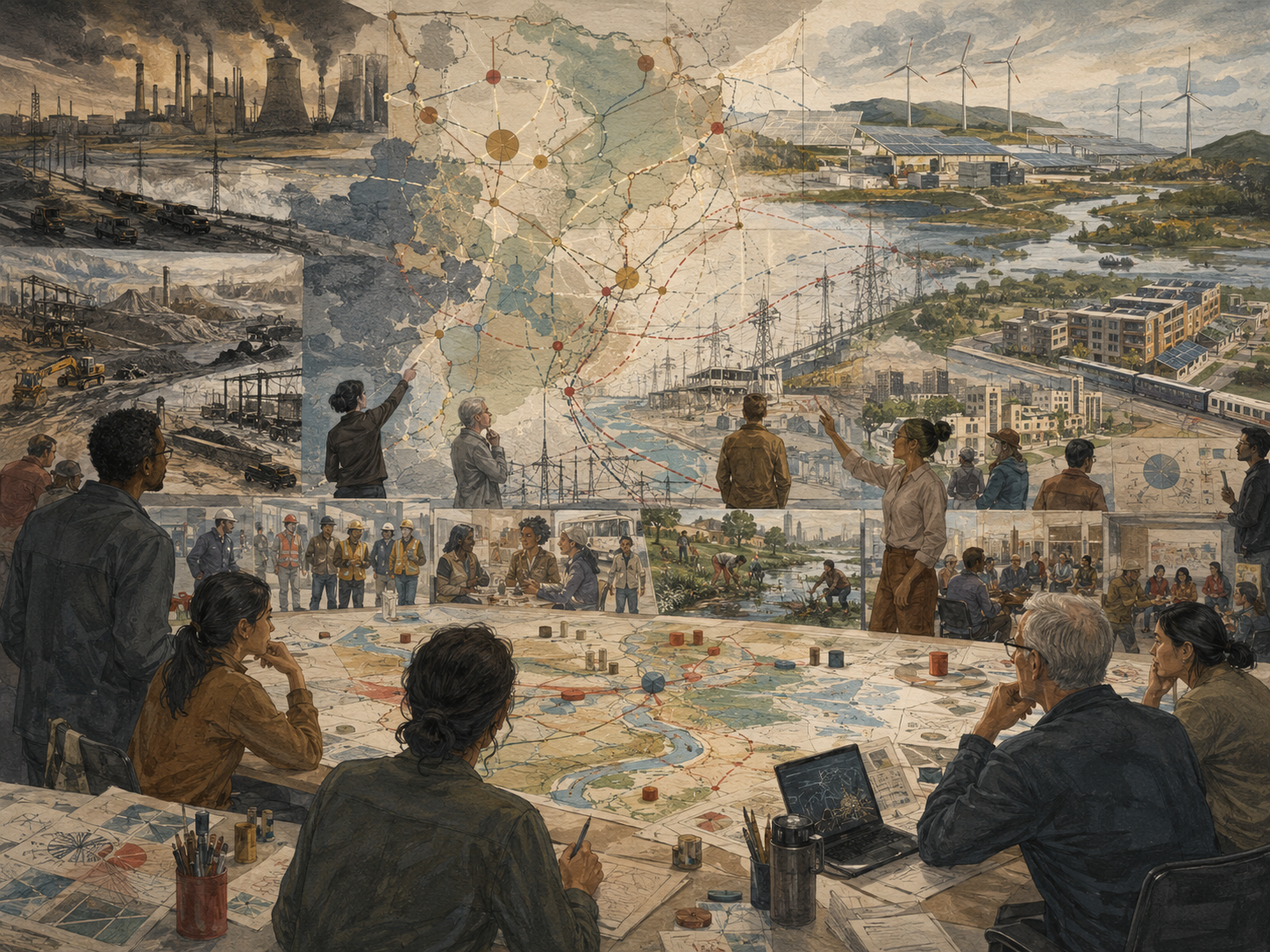
What Are Energy Transition Futures?
Energy transition futures examine how energy systems may evolve as societies reduce greenhouse-gas emissions, expand low-carbon energy, transform infrastructure, manage demand, protect energy access, and govern the social consequences of system change. They include technological futures, but also political, economic, ecological, and institutional futures.
The term “energy transition” can sound singular, as if there is one global pathway from fossil fuels to clean energy. In reality, there are many transitions unfolding at different speeds, in different regions, across different sectors. Electricity systems may decarbonize faster than aviation, shipping, steel, cement, or chemicals. Wealthy regions may deploy solar, wind, batteries, electric vehicles, and heat pumps more rapidly than countries facing high capital costs, debt burdens, weak grids, or fossil-fuel export dependence. Some communities may receive cleaner air and new jobs; others may face mining expansion, rising electricity prices, transmission conflict, or industrial decline.
Energy transition futures therefore require more than technology forecasting. They require systems analysis: energy supply, energy demand, infrastructure bottlenecks, institutional capacity, social legitimacy, land conflict, material constraints, grid reliability, industrial policy, public finance, justice, and geopolitical strategy.
| Transition Dimension | Core Question | Why It Matters |
|---|---|---|
| Decarbonization | How quickly can fossil-fuel combustion and process emissions decline? | Determines whether energy systems align with climate-stabilization goals. |
| Electrification | Which end uses shift from direct fossil fuels to electricity? | Changes demand, grid planning, consumer infrastructure, and industrial design. |
| Grid transformation | Can transmission, distribution, storage, and flexibility scale fast enough? | Low-carbon power depends on reliable, expanded, flexible electricity networks. |
| Energy justice | Who receives clean energy benefits and who bears transition burdens? | Public legitimacy depends on fairness, affordability, participation, and repair. |
| Critical minerals | How are lithium, copper, nickel, cobalt, graphite, rare earths, and other materials sourced? | Clean technologies can reproduce extractive harm without material justice. |
| Labor transition | How are fossil-fuel workers, regions, and dependent communities protected? | Transition without worker security creates backlash and real social harm. |
| Energy security | How do countries reduce vulnerability to fuel, technology, mineral, and infrastructure shocks? | Transition changes geopolitical dependency rather than eliminating it automatically. |
| Public investment | Who finances infrastructure, innovation, affordability, and resilience? | Market signals alone may underbuild public goods and overburden households. |
Energy transition futures are not only about replacing energy technologies. They are about redesigning the institutions, infrastructures, and political economies that make energy systems possible.
Why Energy Transition Is a Futures Thinking Problem
Energy transition requires futures thinking because energy systems are long-lived, capital-intensive, politically contested, and path dependent. Power plants, grids, pipelines, refineries, industrial facilities, mines, buildings, roads, ports, and heating systems can last decades. Decisions made now shape future emissions, costs, reliability, employment, land use, geopolitical dependency, and public trust.
Futures thinking is also necessary because the transition is uncertain. Solar and wind costs may fall further, but grid bottlenecks can slow deployment. Electric vehicles may scale rapidly, but charging infrastructure, battery supply chains, affordability, and grid integration may constrain adoption. Hydrogen may become important in some industrial uses, but hype may exceed practical value in others. Nuclear power may expand in some regions and stall in others. Carbon capture may help some industrial processes while enabling fossil-fuel delay elsewhere. Critical minerals may become supply bottlenecks or be eased by recycling, substitution, and new chemistries. Public support may grow when benefits are visible, or erode when burdens are unfair.
Energy transition is therefore a scenario problem. Institutions need to prepare for multiple plausible futures rather than betting on one pathway. A responsible transition strategy should ask what happens if grid buildout lags, if fossil-fuel prices spike, if mineral supply chains fragment, if public opposition slows transmission, if clean-energy manufacturing concentrates geopolitically, if extreme weather disrupts power systems, if low-income households face affordability pressure, or if fossil-dependent regions are abandoned.
| Uncertainty | Transition Relevance | Example |
|---|---|---|
| Technology cost | Determines deployment speed, consumer adoption, and investment strategy. | Solar, batteries, heat pumps, electrolyzers, advanced nuclear, carbon capture. |
| Infrastructure buildout | Determines whether clean generation can connect to demand. | Transmission lines, distribution upgrades, interconnection queues, storage. |
| Public legitimacy | Determines whether projects receive durable political and community support. | Transmission siting, wind development, mining, rate impacts, land use. |
| Geopolitical disruption | Can affect fuel, mineral, technology, shipping, and manufacturing supply chains. | Oil and gas shocks, battery materials, solar supply chains, grid equipment. |
| Industrial transition | Determines decarbonization of steel, cement, chemicals, aviation, shipping, and heavy transport. | Hydrogen, electrification, carbon capture, circular materials, demand reduction. |
| Climate impacts | Energy infrastructure must operate under heat, drought, wildfire, storms, and flooding. | Grid reliability, hydro variability, cooling water, wildfire risk, peak demand. |
| Distributional effects | Transition can reduce or intensify inequality depending on design. | Energy bills, retrofit access, job loss, mining impacts, air-quality benefits. |
Energy transition is a futures problem because the pathway is not fixed, the stakes are infrastructural, and the consequences are distributed across generations.
Core Dimensions of Energy Transition Futures
Energy transition futures have several interacting dimensions. These should not be treated as separate policy silos. Renewable deployment depends on grid expansion. Electrification depends on affordable equipment and reliable power. Industrial decarbonization depends on clean electricity, hydrogen, carbon management, public procurement, and supply chains. Energy justice depends on affordability, participation, air-quality improvement, labor transition, and protection against new extraction burdens. Energy security depends on both reduced fossil-fuel dependence and reduced vulnerability to clean-technology bottlenecks.
1. Clean Power Expansion
Clean power expansion includes solar, wind, geothermal, hydropower, nuclear, storage, demand flexibility, and other low-carbon electricity sources. It is central because electrification only reduces emissions if electricity becomes cleaner over time. But clean power must be connected, balanced, governed, financed, and socially accepted.
2. Grid Modernization
Grid modernization includes transmission expansion, distribution upgrades, interconnection reform, storage, digital controls, demand response, microgrids, resilience investments, and planning reform. Without grids, clean generation becomes stranded, electrification stalls, and reliability risks rise.
3. End-Use Electrification
Electrification shifts buildings, vehicles, industrial processes, and some heating systems from direct fossil fuels to electricity. It can reduce emissions, improve air quality, and increase efficiency, but it requires equipment affordability, workforce capacity, consumer trust, charging networks, building upgrades, and rate design.
4. Fossil Fuel Phase-Down
Fossil phase-down involves reducing coal, oil, and gas use in ways that protect reliability, workers, communities, public revenue, and energy access. It also includes managing stranded assets, methane emissions, decommissioning, environmental remediation, and political resistance from incumbent industries.
5. Industrial Decarbonization
Heavy industry requires sector-specific strategies: electrification, efficiency, hydrogen, carbon capture, alternative materials, circular economy, process innovation, public procurement, and demand-side material efficiency. Industrial transition is slower and more capital-intensive than many consumer-facing energy changes.
6. Critical Minerals and Materials
Clean-energy technologies require material systems: lithium, copper, nickel, cobalt, graphite, manganese, rare earths, silicon, steel, aluminum, concrete, and grid equipment. Material futures require mining governance, recycling, substitution, circularity, Indigenous rights, labor standards, and ecological protection.
7. Energy Justice
Energy justice asks whether the transition improves affordability, health, participation, ownership, reliability, and dignity for those historically harmed by energy systems. It also asks whether new clean-energy infrastructure reproduces old patterns of extraction, displacement, pollution, and exclusion.
8. Climate Resilience and Reliability
Energy systems must operate under more extreme climate conditions: heat waves, storms, wildfire, flooding, drought, cold snaps, and changing demand patterns. Transition planning must therefore integrate decarbonization with reliability, redundancy, emergency preparedness, distributed resources, and infrastructure hardening.
| Dimension | Primary Promise | Primary Risk |
|---|---|---|
| Clean power | Low-carbon electricity, cleaner air, reduced fossil dependence. | Grid bottlenecks, land conflict, uneven benefits, curtailment. |
| Grid modernization | Reliability, flexibility, integration of renewables and electrified demand. | Underinvestment, siting conflict, cybersecurity, rate impacts. |
| Electrification | Lower emissions, efficiency, healthier buildings and transport. | Affordability barriers, unequal access, grid stress, retrofit bottlenecks. |
| Fossil phase-down | Climate alignment, reduced pollution, reduced fuel-price exposure. | Worker displacement, regional decline, stranded assets, political backlash. |
| Industrial transition | Cleaner materials, lower embodied emissions, innovation. | Cost, competitiveness, technology uncertainty, infrastructure needs. |
| Critical minerals | Enables batteries, grids, renewables, electric vehicles, and electronics. | Mining harm, supply concentration, labor abuse, Indigenous rights violations. |
| Energy justice | Cleaner, more affordable, participatory, reliable energy systems. | Green inequality, procedural exclusion, displacement, regressive costs. |
| Resilience | Energy systems withstand climate shocks and cascading failures. | Hardening without justice, unequal reliability, disaster vulnerability. |
The energy transition is a system-of-systems transformation: generation, grids, demand, materials, labor, finance, land, justice, and governance must move together.
Renewable Energy and Electricity System Transformation
Renewable energy is central to most energy transition futures because electricity is becoming the backbone of decarbonization. Solar, wind, hydropower, geothermal, sustainable bioenergy, storage, demand response, and other low-carbon resources can reduce emissions from power generation while enabling electrification of buildings, transport, and parts of industry.
The rapid growth of solar and wind changes the structure of power systems. Traditional systems were built around dispatchable centralized generation following demand. High-renewable systems require more flexibility: storage, transmission, demand response, forecasting, grid-forming inverters, flexible loads, regional coordination, and market rules that reward reliability services. The issue is not simply installing more megawatts. It is redesigning electricity systems around variable generation, distributed resources, and flexible demand.
Renewable power also changes land and community politics. Utility-scale solar and wind require siting, permits, interconnection, transmission, land agreements, environmental review, community engagement, and sometimes conflict over landscapes, habitats, cultural sites, agriculture, or property values. Distributed solar can expand household and community control, but only if renters, low-income households, and marginalized communities can access benefits.
| Renewable System Element | Transition Role | Governance Concern |
|---|---|---|
| Utility-scale solar | Rapidly deployable low-cost electricity in many regions. | Land use, interconnection, supply chains, community benefit, grid integration. |
| Onshore wind | Large-scale clean generation with strong regional potential. | Siting, community acceptance, wildlife, transmission access, permitting. |
| Offshore wind | High-capacity renewable resource near coastal demand centers. | Marine ecosystems, fishing communities, ports, transmission, costs. |
| Distributed solar | Household, community, and commercial generation closer to demand. | Equitable access, rate design, renter access, grid hosting capacity. |
| Geothermal | Firm low-carbon heat and power where resources allow. | Exploration risk, induced seismicity, permitting, financing. |
| Hydropower | Dispatchable renewable power and storage in some systems. | Ecosystem damage, drought vulnerability, Indigenous rights, river governance. |
| Sustainable bioenergy | Potential role in dispatchable power, fuels, and industrial heat. | Land competition, food systems, biodiversity, carbon accounting. |
Renewable energy expansion is necessary but not sufficient. The transition depends on whether clean power becomes reliable, affordable, connected, justly sited, materially responsible, and integrated into broader systems of demand and governance.
Grids, Storage, and Flexibility
Grids are the central infrastructure of the energy transition. Without transmission and distribution upgrades, clean generation cannot reach demand, electrification cannot scale reliably, and storage cannot deliver its full value. Grid constraints can delay projects, raise costs, increase curtailment, and create reliability risks. In many regions, grid planning is now one of the most important bottlenecks in the transition.
Storage and flexibility are equally important. Batteries can shift solar generation into evening peaks, support frequency response, reduce curtailment, and provide resilience. Long-duration storage may be needed for multi-day or seasonal balancing in high-renewable systems. Demand response can shift flexible loads such as electric vehicles, water heating, industrial processes, cooling, and appliances. Distributed energy resources can support resilience if coordinated well. But flexibility requires markets, controls, standards, consumer protections, cybersecurity, and utility business models that reward system value.
Transmission is often politically difficult because benefits are regional or national while land-use burdens are local. Distribution upgrades are less visible but crucial: neighborhood transformers, feeders, substations, metering, and local capacity must support electric vehicles, heat pumps, rooftop solar, storage, and electrified buildings. The future grid is not only bigger. It is more digital, more bidirectional, more flexible, more exposed to cyber risk, and more central to everyday life.
| Grid and Flexibility Element | Transition Function | Risk if Neglected |
|---|---|---|
| Transmission expansion | Connects clean generation to load centers and balances regions. | Renewable curtailment, project delays, congestion, reliability stress. |
| Distribution upgrades | Supports electrified homes, vehicles, businesses, and distributed generation. | Local overloads, inequitable service quality, slow electrification. |
| Battery storage | Provides short-duration balancing, peak shifting, and grid services. | Renewable variability becomes harder to manage. |
| Long-duration storage | Supports multi-day, seasonal, or low-renewable periods. | Reliability gaps in high-renewable systems. |
| Demand response | Shifts flexible demand to match clean power availability. | Higher peak demand, higher grid costs, more backup fossil generation. |
| Grid digitalization | Improves monitoring, forecasting, control, and distributed coordination. | Cybersecurity exposure, vendor lock-in, data governance concerns. |
| Microgrids and resilience hubs | Provide local backup, emergency power, and community resilience. | Unequal resilience if only wealthy communities can access them. |
Energy transition futures increasingly depend on grid futures. The cleanest generation resource has limited value if the system cannot connect, balance, protect, and govern it.
Electrification of Buildings, Transport, and Industry
Electrification is one of the most powerful transition strategies because electric technologies are often more efficient than combustion-based alternatives and can become cleaner as the power system decarbonizes. Electric vehicles can reduce oil demand and local air pollution. Heat pumps can provide efficient heating and cooling. Electric cooking can reduce indoor combustion exposure. Industrial electrification can reduce direct fossil fuel use in selected processes. But electrification is not automatic. It requires affordability, infrastructure, consumer trust, workforce skills, financing, and system planning.
Buildings are a major transition frontier. Many households rely on fossil fuels for space heating, water heating, cooking, or backup systems. Retrofitting buildings requires equipment, insulation, electrical panel upgrades, contractor capacity, financing, tenant protections, and public support for low-income households. Without careful policy, wealthier households may capture rebates and savings first, while renters and low-income families remain locked into inefficient, expensive, or unhealthy energy systems.
Transport electrification raises similar questions. Electric vehicles can reduce emissions, but adoption depends on charging infrastructure, vehicle affordability, grid readiness, battery supply chains, public transit investment, urban planning, and whether the transition reduces car dependence or simply electrifies it. A transition focused only on private electric cars can miss broader mobility justice: buses, trains, walkability, freight logistics, and accessible transportation.
| Electrification Domain | Transition Opportunity | Justice and Infrastructure Challenge |
|---|---|---|
| Light-duty vehicles | Reduces oil demand, tailpipe pollution, and operating emissions. | Affordability, charging access, battery supply chains, used-vehicle markets. |
| Public transit | Reduces emissions while improving mobility access. | Capital funding, service frequency, labor, charging depots, route planning. |
| Freight and logistics | Electrifies delivery vans, ports, warehouses, trucks, and rail where feasible. | Charging infrastructure, grid capacity, labor impacts, logistics redesign. |
| Space heating | Heat pumps reduce fossil combustion and improve efficiency. | Retrofit costs, contractor capacity, cold-climate performance, tenant access. |
| Water heating | Heat-pump water heaters can reduce energy use and provide flexible load. | Upfront costs, installation constraints, consumer awareness. |
| Cooking | Induction and electric cooking reduce indoor combustion exposure. | Affordability, electrical upgrades, cultural cooking needs, renter protections. |
| Industrial heat | Electrification can support low- and medium-temperature processes. | High-temperature needs, power prices, reliability, industrial competitiveness. |
Electrification is not only a technology swap. It is a household, workforce, grid, affordability, health, and infrastructure transformation.
Fossil Fuel Phase-Down and Stranded Assets
Fossil fuel phase-down is politically and economically difficult because coal, oil, and gas are embedded in jobs, tax bases, national budgets, export earnings, industrial systems, electricity markets, household heating, transportation, pensions, infrastructure, and geopolitical strategy. A transition that only builds clean energy without managing fossil decline can leave emissions high, workers exposed, communities abandoned, and assets stranded.
Stranded assets occur when fossil-fuel infrastructure, reserves, facilities, or business models lose value before the end of their expected economic life. This can affect coal plants, gas pipelines, oil refineries, LNG terminals, internal-combustion supply chains, fossil-fuel vehicles, petrochemical assets, and public revenue systems. Stranded assets are not only financial risks. They are political risks because powerful incumbents may resist transition to protect asset value.
Phase-down also requires attention to methane emissions, environmental remediation, abandoned wells, mine reclamation, utility cost recovery, pension security, regional economic diversification, and public revenue replacement. Fossil-dependent regions need transition planning before collapse, not after. Workers need real pathways, not symbolic retraining promises. Communities need public investment, infrastructure, and democratic control over economic redevelopment.
| Fossil Phase-Down Issue | Transition Risk | Governance Response |
|---|---|---|
| Coal plant retirement | Reliability concerns, worker displacement, local tax-base loss. | Managed retirement, grid replacement planning, worker guarantees, community investment. |
| Oil demand decline | Refinery closures, transport-sector shifts, export revenue pressure. | Industrial diversification, fiscal planning, labor transition, environmental cleanup. |
| Gas infrastructure | Lock-in risk, stranded pipelines, affordability conflicts, methane leakage. | Careful planning, leak control, targeted use, avoided overbuild, decommissioning strategy. |
| Fossil-fuel revenue dependence | Public budgets become vulnerable to transition and price volatility. | Revenue diversification, sovereign funds, fiscal transition planning. |
| Abandoned wells and mines | Pollution, methane emissions, safety risks, local environmental harm. | Remediation funds, responsible closure, public accountability. |
| Incumbent resistance | Delay, misinformation, policy capture, and regulatory obstruction. | Transparency, democratic oversight, anti-corruption rules, public-interest planning. |
A real energy transition must include fossil-fuel decline, not only clean-energy growth.
Critical Minerals, Supply Chains, and Material Justice
Clean-energy systems require material foundations. Batteries, electric vehicles, transmission lines, wind turbines, solar panels, inverters, transformers, electrolyzers, motors, and electronics depend on minerals, metals, manufacturing capacity, and global supply chains. The transition away from fossil fuels reduces fuel combustion, but it increases attention to extraction, processing, recycling, and material governance.
Critical minerals include lithium, copper, nickel, cobalt, graphite, manganese, rare earth elements, and other materials. But the issue is broader than minerals. It includes steel, aluminum, concrete, silicon, glass, grid equipment, power electronics, semiconductors, shipping, refining, and manufacturing. Supply-chain concentration can create geopolitical vulnerability. Mining can create land conflict, water stress, pollution, labor exploitation, Indigenous rights violations, and biodiversity harm.
Material justice asks whether the transition reproduces extractive sacrifice zones under green language. Clean-energy technologies should not depend on hidden ecological and social harm. Responsible material futures require stronger mining standards, community consent, Indigenous sovereignty, worker protections, circular design, recycling, substitution, battery chemistry innovation, reduced material intensity, repairability, and demand-side strategies such as public transit and efficiency.
| Material System | Transition Role | Justice and Governance Concern |
|---|---|---|
| Lithium | Batteries for electric vehicles and grid storage. | Water use, land rights, Indigenous sovereignty, processing concentration. |
| Copper | Transmission, distribution, motors, wiring, electrification. | Mining expansion, environmental harm, supply constraints. |
| Cobalt | Some battery chemistries and industrial uses. | Labor abuse, conflict risk, supply concentration, substitution needs. |
| Nickel | High-energy battery chemistries and alloys. | Mining impacts, processing emissions, biodiversity harm. |
| Rare earth elements | Wind turbines, motors, electronics, defense technologies. | Processing concentration, toxic waste, geopolitical leverage. |
| Graphite | Battery anodes and industrial applications. | Processing capacity, pollution, supply concentration. |
| Steel, aluminum, concrete | Transmission towers, wind turbines, solar structures, infrastructure. | Industrial emissions, embodied carbon, circular material demand. |
A clean-energy future cannot be just if its material foundations are built on dispossession, unsafe labor, polluted waters, or invisible extraction.
Energy Security and Geopolitics
Energy transition changes energy security. It reduces some vulnerabilities associated with fossil fuels: price shocks, supply disruptions, chokepoints, import dependence, and exposure to oil and gas geopolitics. But it creates or intensifies other dependencies: critical minerals, clean-technology manufacturing, grid equipment, power electronics, battery supply chains, nuclear fuel services, hydrogen infrastructure, cybersecurity, and digital control systems.
Energy security in transition is not only about domestic production. It includes diversification, resilience, affordability, reliability, strategic reserves, manufacturing capacity, interconnection, demand reduction, public transit, efficiency, distributed resources, and emergency preparedness. A country with abundant renewable resources may still be vulnerable if it lacks grid equipment, storage, skilled labor, financing, or supply-chain diversity.
Geopolitically, the transition may shift power from fossil-fuel exporters toward countries and firms that control minerals, manufacturing, intellectual property, finance, grid technology, batteries, solar supply chains, and digital energy platforms. It may also create new opportunities for energy self-reliance, regional cooperation, public investment, and reduced exposure to volatile fuel markets.
| Energy Security Dimension | Transition Opportunity | New Vulnerability |
|---|---|---|
| Reduced fossil imports | Less exposure to oil and gas price shocks and supply disruptions. | Transition speed may create short-term reliability and affordability risks. |
| Domestic renewables | Local generation reduces fuel dependence and long-term operating costs. | Weather variability and grid adequacy require system planning. |
| Critical minerals | Supports clean-energy manufacturing and technology deployment. | Supply concentration, mining conflict, trade disruption. |
| Clean manufacturing | Creates industrial capacity, jobs, and strategic resilience. | Industrial policy conflict, subsidy races, uneven development. |
| Digitalized grids | Improves control, efficiency, and flexibility. | Cybersecurity, vendor lock-in, data governance, systemic failure. |
| Regional interconnection | Balances variable renewables and increases reliability. | Cross-border coordination, market rules, political trust. |
Energy transition does not eliminate energy geopolitics. It changes what energy security means and where strategic dependencies appear.
Energy Justice and Public Legitimacy
Energy justice is central to transition futures because energy systems have never been socially neutral. Fossil-fuel systems have produced unequal burdens: pollution, respiratory illness, extraction damage, land dispossession, utility shutoffs, unaffordable bills, energy poverty, hazardous work, and sacrifice zones. Clean-energy systems can reduce many harms, but only if they are designed with justice rather than assuming justice will follow from cleaner technology.
Energy justice has several dimensions. Distributional justice asks who receives benefits and burdens. Procedural justice asks who participates in decision-making. Recognition justice asks whether communities, workers, Indigenous peoples, renters, low-income households, and historically marginalized groups are seen as rights-bearing participants rather than obstacles or afterthoughts. Restorative justice asks how past harms are repaired. Intergenerational justice asks whether today’s energy choices protect future people and ecosystems.
Public legitimacy matters because energy infrastructure is visible, material, and place-based. Transmission lines, wind farms, solar arrays, mines, battery factories, hydrogen hubs, pipelines, industrial retrofits, and grid upgrades affect communities. When institutions ignore local knowledge, impose burdens, hide costs, or distribute benefits unfairly, public resistance grows. When communities receive transparent information, meaningful participation, local benefits, ownership opportunities, health improvements, and real consent processes, transition can become more durable.
| Energy Justice Dimension | Question | Transition Example |
|---|---|---|
| Distributional justice | Who receives benefits and who bears burdens? | Clean-air benefits, bill impacts, mining burdens, job gains and losses. |
| Procedural justice | Who has voice in decisions? | Transmission siting, renewable projects, utility planning, mining permits. |
| Recognition justice | Whose knowledge, rights, and histories are respected? | Indigenous sovereignty, environmental justice communities, fossil workers. |
| Restorative justice | How are past harms repaired? | Pollution cleanup, abandoned wells, mine reclamation, community reinvestment. |
| Energy affordability | Can households access reliable energy without hardship? | Rate design, efficiency upgrades, weatherization, bill assistance. |
| Ownership and control | Who owns energy assets and captures value? | Community solar, public power, cooperatives, local benefit agreements. |
| Intergenerational justice | Do present choices protect future people and ecosystems? | Climate mitigation, durable infrastructure, ecological restoration. |
A transition that is technically clean but socially unjust will be fragile, contested, and morally incomplete.
Labor, Regions, and Just Transition
Energy transition changes work. It creates jobs in renewable energy, grid construction, manufacturing, building retrofits, public transit, battery production, environmental remediation, energy efficiency, engineering, planning, and operations. It also threatens jobs in fossil-fuel extraction, refining, power generation, pipeline construction, combustion-engine supply chains, and regions dependent on fossil revenue.
A just transition is not simply retraining. Workers cannot be expected to absorb structural change through short courses while losing wages, pensions, identity, community, and bargaining power. A serious just transition includes wage guarantees, pension protection, union rights, apprenticeship pipelines, local hiring, regional economic diversification, public investment, remediation work, community ownership, industrial strategy, and worker participation in planning.
Regions matter because energy economies are geographically concentrated. Coal regions, oil and gas basins, refinery towns, port communities, industrial corridors, mining regions, rural renewable-energy zones, and transmission corridors experience transition differently. Some may gain new investment; others may lose tax base and employment. National averages can hide local disruption.
| Labor and Regional Issue | Transition Risk | Just Transition Response |
|---|---|---|
| Fossil worker displacement | Job loss, wage loss, pension insecurity, identity disruption. | Wage insurance, pension guarantees, union pathways, redeployment, public jobs. |
| Regional tax-base decline | Loss of public revenue for schools, services, and infrastructure. | Fiscal transition funds, regional development, public investment. |
| Skill mismatch | New jobs may not match existing skills, locations, or pay levels. | Apprenticeships, targeted training, local hiring, credential recognition. |
| Low-road clean-energy jobs | Clean sectors may create precarious or unsafe work if labor standards are weak. | Prevailing wages, project labor agreements, safety rules, union rights. |
| Community abandonment | Regions are left with pollution, unemployment, and weak redevelopment. | Remediation, infrastructure, economic diversification, democratic planning. |
| New extraction regions | Mineral and clean-tech supply chains create new labor and ecological burdens. | Labor standards, Indigenous rights, environmental review, benefit sharing. |
A just transition must be planned before disruption, funded at real scale, and governed with workers and communities rather than imposed on them.
Industrial Decarbonization and Hard-to-Abate Sectors
Industrial decarbonization is one of the hardest parts of energy transition. Steel, cement, chemicals, fertilizers, refining, aviation, shipping, and heavy transport often require high-temperature heat, carbon-intensive chemical reactions, dense fuels, or globally traded commodities. Some emissions are not only from fuel combustion but from industrial processes themselves, such as cement calcination.
There is no single solution for industry. Strategies include energy efficiency, electrification, green hydrogen where appropriate, carbon capture for selected process emissions, alternative chemistries, low-carbon fuels, circular materials, recycling, material efficiency, product substitution, demand reduction, and public procurement. Governments can create early markets for low-carbon steel, cement, fertilizers, and fuels through procurement standards, contracts for difference, border adjustment mechanisms, industrial clusters, infrastructure investment, and research support.
Hard-to-abate sectors are also hard-to-govern sectors. They are capital-intensive, trade-exposed, regionally concentrated, and often politically influential. If decarbonization policy is weak, firms may delay investment. If policy is poorly designed, production may shift to regions with weaker standards rather than reduce emissions. If communities are excluded, industrial hubs may reproduce pollution burdens under new technology labels.
| Sector | Transition Options | Key Constraint |
|---|---|---|
| Steel | Electric arc furnaces, green hydrogen direct reduction, recycling, efficiency. | Clean power, hydrogen cost, scrap availability, capital investment. |
| Cement | Clinker substitution, efficiency, carbon capture, alternative materials. | Process emissions, standards, construction demand, cost. |
| Chemicals | Electrification, green hydrogen, bio-based feedstocks, circularity, carbon management. | Feedstock dependence, complexity, global competition. |
| Fertilizer | Green ammonia, efficiency, nutrient management, alternative agriculture practices. | Hydrogen supply, food-system dependence, farmer economics. |
| Aviation | Efficiency, sustainable fuels, synthetic fuels, demand management. | Energy density, cost, feedstock limits, equity of air travel demand. |
| Shipping | Efficiency, ammonia, methanol, electrification for short routes, wind assistance. | Fuel standards, ports, safety, global coordination. |
| Heavy transport | Battery electric, hydrogen fuel cells, rail, logistics optimization. | Infrastructure, duty cycles, cost, grid capacity. |
Industrial decarbonization requires more than clean power. It requires public industrial strategy, infrastructure coordination, standards, procurement, material efficiency, and justice for industrial communities.
Public Finance, Markets, and Investment
Energy transition requires massive investment in generation, grids, storage, buildings, transport, industry, public transit, manufacturing, adaptation, workforce development, and community transition. But investment is not only a quantity problem. It is a governance problem. What is financed, who pays, who owns assets, who receives returns, who bears risk, and who is protected from affordability shocks all shape transition legitimacy.
Markets can mobilize capital and reward innovation, but many transition needs are public goods: transmission, distribution resilience, low-income retrofits, public transit, research, worker transition, community resilience, environmental remediation, and early-stage industrial decarbonization. Public finance can reduce risk, lower capital costs, set conditions, create markets, build capacity, and direct investment toward justice and resilience.
Capital costs matter greatly. Renewable-energy projects have high upfront costs and low operating costs. Countries or communities facing high interest rates may pay much more for clean energy even when resource potential is strong. This creates global energy inequality: the places that need investment may face the most expensive capital. International finance, public development banks, debt reform, guarantees, concessional finance, and climate finance are therefore central to global transition futures.
| Finance Issue | Transition Role | Governance Question |
|---|---|---|
| Clean power investment | Builds renewable generation, storage, and low-carbon resources. | Are projects affordable, connected, and community-benefiting? |
| Grid investment | Enables electrification, reliability, and renewable integration. | Who pays for upgrades, and how are benefits distributed? |
| Building retrofits | Reduces household energy use, emissions, and health harms. | Do low-income households and renters receive access? |
| Industrial policy | Creates markets for low-carbon materials and manufacturing. | Are labor, community, and ecological standards attached? |
| Public transit and mobility | Reduces oil dependence and expands mobility access. | Is the transition only about private vehicles or broader mobility justice? |
| Climate finance | Supports transition in countries with high capital costs and development needs. | Are financing terms fair, grant-based where needed, and non-extractive? |
| Just transition funds | Protect workers and regions through structural change. | Are funds large, durable, democratic, and locally governed? |
Energy transition finance is not neutral. It determines whether the transition becomes a public-good project, a private asset boom, or another unequal development model.
Climate Resilience and Energy Infrastructure
Energy systems must decarbonize while becoming more resilient to climate impacts already underway. Heat waves increase cooling demand and stress power plants, transformers, workers, and transmission systems. Drought can reduce hydropower and cooling water. Wildfire threatens transmission corridors. Storms and flooding damage substations, distribution lines, ports, refineries, fuel terminals, and offshore infrastructure. Cold snaps can create peak heating demand and fuel constraints. Climate change alters both supply and demand.
A transition that builds low-carbon infrastructure without climate resilience can create fragile systems. Solar farms, wind turbines, transmission lines, substations, battery facilities, charging networks, and distributed resources must be designed for future conditions, not historical averages. Energy resilience also has a justice dimension: low-income households, medically vulnerable people, elderly residents, rural communities, and under-resourced municipalities often face the greatest harm from outages and extreme temperatures.
Resilient energy futures require redundancy, distributed resources, microgrids, weatherized infrastructure, emergency planning, vegetation management, flood protection, cybersecurity, community resilience hubs, and affordability protections. Reliability should not be used as an excuse to delay decarbonization, but decarbonization should not ignore reliability either. The future energy system must be both clean and durable.
| Climate Hazard | Energy System Impact | Resilience Response |
|---|---|---|
| Heat waves | Peak electricity demand, transformer stress, worker safety risk. | Demand response, cooling access, grid upgrades, heat-resilient equipment. |
| Drought | Reduced hydropower, cooling water constraints, wildfire risk. | Diversified resources, water-aware planning, storage, regional balancing. |
| Wildfire | Transmission damage, shutoffs, public safety risks. | Grid hardening, undergrounding where appropriate, vegetation management, microgrids. |
| Storms and flooding | Substation damage, outages, fuel disruption, infrastructure loss. | Flood protection, relocation, distributed backup, emergency response. |
| Cold snaps | Heating demand spikes, fuel constraints, generation outages. | Weatherization, winterization, demand response, diverse resources. |
| Cyber and compound shocks | Digital grid systems face coordinated or cascading risks. | Cybersecurity, redundancy, incident response, manual fallback capacity. |
The future energy system must be designed for the climate it is helping to prevent, not only the climate in which older infrastructure was built.
Future Scenarios for Energy Transition
Energy transition futures are uncertain because technology, finance, policy, public trust, climate impacts, geopolitics, and infrastructure interact. Scenario planning helps institutions avoid single-path assumptions and prepare for different transition conditions.
| Scenario | Description | Key Risk | Strategic Opportunity |
|---|---|---|---|
| Managed Just Transition | Clean power, electrification, grid buildout, labor protection, and public investment advance together. | Requires sustained political capacity and coordinated institutions. | Align decarbonization with affordability, worker security, public health, and resilience. |
| Renewables Without Grids | Clean generation grows but transmission, distribution, storage, and flexibility lag behind. | Curtailment, reliability stress, interconnection delays, public frustration. | Prioritize grid planning, storage, demand flexibility, and permitting reform. |
| Green Extraction Boom | Clean technologies scale rapidly while mineral extraction and land conflict intensify. | New sacrifice zones, Indigenous rights violations, ecological harm, supply-chain backlash. | Build circularity, consent, recycling, substitution, and material justice into transition planning. |
| Fossil Lock-In and Delay | Clean-energy growth coexists with expanded fossil infrastructure and slow demand reduction. | Emissions remain high, assets become stranded, transition credibility weakens. | Use phase-down planning, methane control, avoided overbuild, and public accountability. |
| Energy Security Nationalism | Countries race to localize energy technology, minerals, manufacturing, and supply chains. | Trade conflict, fragmented standards, unequal access, and geopolitical tension. | Build resilient, diversified, cooperative supply chains with labor and environmental standards. |
| Affordability Backlash | Households experience bill pressure, retrofit costs, or uneven transition benefits. | Public opposition, political rollback, and distributional conflict. | Design rate reform, public finance, low-income retrofits, and visible community benefits. |
| Resilient Distributed Energy Future | Distributed resources, microgrids, storage, efficiency, and public infrastructure strengthen local resilience. | Unequal access if only wealthy users can participate. | Use public investment, community ownership, resilience hubs, and equity-first deployment. |
The energy transition will not succeed simply because clean technologies improve. It will succeed if institutions coordinate infrastructure, justice, finance, labor, resilience, and public legitimacy at the same time.
Strategic Questions for Institutions
Governments, utilities, firms, investors, communities, unions, regulators, planners, and public agencies need stronger strategic questions for energy transition. The right question is not only “How much clean energy can we build?” It is “What system are we building, who controls it, who benefits, and what happens under stress?”
| Strategic Question | What It Reveals | Why It Matters |
|---|---|---|
| What infrastructure is the binding constraint? | Whether grids, storage, permitting, labor, finance, or supply chains limit transition speed. | Solving the wrong bottleneck wastes time and money. |
| Who pays and who benefits? | Distribution of costs, savings, ownership, jobs, and health benefits. | Fairness determines legitimacy. |
| What happens to fossil-dependent workers and regions? | Employment, tax base, identity, and regional economic exposure. | Transition without security creates social harm and backlash. |
| How resilient is the energy system under climate stress? | Exposure to heat, wildfire, storms, drought, flooding, cyber risk, and compound shocks. | Clean infrastructure must remain reliable under future conditions. |
| What new dependencies are being created? | Minerals, manufacturing, software, equipment, finance, and geopolitical supply chains. | Energy security changes form during transition. |
| Are communities meaningfully participating? | Procedural legitimacy and local knowledge. | Participation reduces conflict and improves outcomes when it has real power. |
| Does the strategy reduce demand where appropriate? | Efficiency, public transit, material efficiency, building performance, and circularity. | Supply expansion alone can miss cheaper, cleaner, fairer pathways. |
Energy transition strategy should begin with system diagnosis: emissions, reliability, affordability, justice, resilience, and power must be evaluated together.
Limits and Failure Modes
Energy transition analysis can fail in several ways. It can become technology-first, assuming deployment alone solves political and social problems. It can become growth-first, building clean supply while ignoring demand reduction, sufficiency, public transit, efficiency, and material limits. It can become market-first, assuming private investment will build public goods without public direction. It can become justice-light, treating equity as a communications problem rather than a structural requirement.
Another failure mode is carbon tunnel vision. Emissions reduction is essential, but energy systems also involve land, water, labor, public health, Indigenous sovereignty, biodiversity, affordability, ownership, and geopolitical dependency. A narrow carbon metric can justify harmful projects if broader impacts are ignored. Conversely, local opposition can be misread as anti-transition when communities are actually resisting exclusion, unfair burden, or weak benefit sharing.
Energy transition can also fail through delay disguised as realism. Incumbent actors may overstate technical uncertainty to justify fossil lock-in, or promote future technologies as substitutes for near-term emissions reductions. Responsible foresight must distinguish genuine uncertainty from strategic delay.
| Failure Mode | Problem | Corrective Practice |
|---|---|---|
| Technology determinism | Assumes better technologies automatically create better futures. | Analyze institutions, ownership, justice, finance, and governance. |
| Grid neglect | Builds clean generation plans without transmission, distribution, storage, or flexibility. | Plan infrastructure as the backbone of transition. |
| Justice as afterthought | Adds equity language without shifting costs, benefits, voice, or ownership. | Use enforceable justice metrics, community governance, and benefit sharing. |
| Green extraction | Expands clean technology through harmful mining and supply chains. | Use material justice, recycling, substitution, consent, and demand reduction. |
| Fossil lock-in | Builds new long-lived fossil infrastructure under reliability or transition claims. | Use phase-down planning, avoided overbuild, and stranded-asset risk analysis. |
| Affordability blind spot | Transition costs fall heavily on households with limited resources. | Use public finance, progressive rate design, retrofits, and direct support. |
| Hype-dependent planning | Relies on uncertain future technologies to avoid near-term action. | Distinguish proven, emerging, and speculative pathways. |
The energy transition can fail by moving too slowly, but it can also fail by moving in ways that are unjust, brittle, extractive, or politically illegitimate.
Mathematical Lens: Transition Readiness, Reliability, and Justice
A transition readiness score can be represented as:
T_r = \alpha C + \beta G + \gamma F + \delta L + \epsilon J
\]
Interpretation: \(T_r\) is transition readiness, \(C\) is clean-technology capacity, \(G\) is grid readiness, \(F\) is finance capacity, \(L\) is labor and institutional capacity, and \(J\) is justice and public legitimacy. A region can have strong renewable resources but weak transition readiness if grids, finance, labor, or legitimacy are inadequate.
A clean-energy reliability profile can be represented as:
R_e = D + S + X + F_l + M – V
\]
Interpretation: \(R_e\) is energy-system reliability, \(D\) is dispatchable low-carbon capacity, \(S\) is storage, \(X\) is transmission exchange capacity, \(F_l\) is flexible load, \(M\) is system monitoring and control, and \(V\) is unmanaged variability or vulnerability. Reliability depends on system design, not only generation capacity.
A fossil lock-in risk score can be represented as:
L_f = A \times H \times (1 – P)
\]
Interpretation: \(L_f\) is fossil lock-in risk, \(A\) is asset lifetime, \(H\) is utilization or dependency, and \(P\) is credible phase-down policy. Long-lived infrastructure with high dependency and weak phase-down planning creates lock-in risk.
An energy justice score can be represented as:
J_e = B + V + A + R + O – H
\]
Interpretation: \(J_e\) is energy justice, \(B\) is equitable benefit distribution, \(V\) is community voice, \(A\) is affordability, \(R\) is restorative repair, \(O\) is local ownership or control, and \(H\) is harm concentration. A transition can reduce emissions while still scoring poorly on justice.
A material risk profile can be represented as:
M_r = S_c + E_x + G_c – R_c – U_s
\]
Interpretation: \(M_r\) is material risk, \(S_c\) is supply concentration, \(E_x\) is extraction harm, \(G_c\) is geopolitical concentration, \(R_c\) is recycling capacity, and \(U_s\) is substitution or material-efficiency capacity. Critical mineral risk can be reduced through circularity, substitution, standards, and demand strategy.
These equations are not forecasts. They are tools for making energy transition assumptions visible: readiness, reliability, lock-in, justice, and material risk must be analyzed together.
Computational Modeling for Energy Transition Futures
Computational modeling can help compare energy transition pathways by making assumptions explicit. The goal is not to pretend that complex energy futures can be predicted with precision. The goal is to make tradeoffs visible: emissions, reliability, affordability, grid readiness, labor transition, material risk, public legitimacy, and justice.
A professional energy transition futures workflow may include:
- Technology register: solar, wind, storage, transmission, heat pumps, electric vehicles, hydrogen, nuclear, geothermal, carbon capture, industrial electrification, and efficiency.
- Infrastructure indicators: grid capacity, interconnection delays, storage duration, demand flexibility, distribution readiness, and resilience.
- Demand indicators: building energy use, transport demand, industrial heat, efficiency potential, peak load, and flexible load.
- Justice indicators: affordability, community voice, pollution reduction, ownership, worker protection, regional reinvestment, and harm concentration.
- Material indicators: mineral supply concentration, recycling capacity, substitution, labor standards, Indigenous rights, and ecological exposure.
- Scenario profiles: managed just transition, renewables without grids, green extraction boom, fossil lock-in, affordability backlash, energy-security nationalism, and resilient distributed energy.
- Strategy testing: public investment, grid acceleration, low-income retrofits, labor guarantees, community ownership, critical-mineral governance, demand reduction, and resilience planning.
Energy transition modeling is useful when it supports transparent public choices, not when it hides social and ecological assumptions behind optimization outputs.
Advanced R Workflow: Comparing Energy Transition Futures
The R workflow below compares stylized energy transition futures across clean-power expansion, grid readiness, storage, electrification, fossil phase-down, justice, labor transition, material responsibility, and resilience.
# ------------------------------------------------------------
# R Workflow: Comparing Energy Transition Futures
# Purpose:
#   Compare energy transition futures across clean power,
#   grids, storage, electrification, fossil phase-down,
#   justice, labor transition, material responsibility,
#   and resilience.
#
# Optional dependency:
#   install.packages(c("tidyverse"))
# ------------------------------------------------------------

library(tidyverse)

energy_futures <- tibble(
  future_type = c(
    "Managed Just Transition",
    "Renewables Without Grids",
    "Green Extraction Boom",
    "Fossil Lock-In and Delay",
    "Energy Security Nationalism",
    "Affordability Backlash",
    "Resilient Distributed Energy Future"
  ),
  clean_power_expansion = c(0.82, 0.84, 0.86, 0.48, 0.72, 0.62, 0.76),
  grid_readiness = c(0.78, 0.34, 0.52, 0.46, 0.58, 0.50, 0.72),
  storage_flexibility = c(0.74, 0.38, 0.56, 0.42, 0.60, 0.48, 0.80),
  electrification_capacity = c(0.76, 0.54, 0.68, 0.42, 0.62, 0.46, 0.72),
  fossil_phase_down = c(0.78, 0.56, 0.62, 0.24, 0.50, 0.44, 0.68),
  energy_justice = c(0.84, 0.44, 0.28, 0.34, 0.42, 0.30, 0.82),
  labor_transition = c(0.82, 0.42, 0.36, 0.30, 0.46, 0.34, 0.74),
  material_responsibility = c(0.76, 0.48, 0.24, 0.40, 0.44, 0.42, 0.72),
  climate_resilience = c(0.80, 0.46, 0.50, 0.38, 0.54, 0.36, 0.86)
)

energy_futures <- energy_futures %>%
  mutate(
    transition_readiness =
      0.14 * clean_power_expansion +
      0.14 * grid_readiness +
      0.12 * storage_flexibility +
      0.12 * electrification_capacity +
      0.12 * fossil_phase_down +
      0.12 * energy_justice +
      0.10 * labor_transition +
      0.08 * material_responsibility +
      0.06 * climate_resilience,

    transition_risk_pressure =
      0.18 * (1 - grid_readiness) +
      0.16 * (1 - storage_flexibility) +
      0.16 * (1 - fossil_phase_down) +
      0.14 * (1 - energy_justice) +
      0.12 * (1 - labor_transition) +
      0.12 * (1 - material_responsibility) +
      0.12 * (1 - climate_resilience),

    justice_resilience_score =
      0.24 * energy_justice +
      0.20 * labor_transition +
      0.18 * climate_resilience +
      0.16 * material_responsibility +
      0.12 * fossil_phase_down +
      0.10 * grid_readiness,

    scenario_class = case_when(
      transition_readiness >= 0.75 & justice_resilience_score >= 0.75 ~ "High readiness and justice capacity",
      transition_risk_pressure >= 0.55 ~ "High transition risk pressure",
      TRUE ~ "Contested transition pathway"
    )
  ) %>%
  arrange(desc(transition_readiness))

print(energy_futures)

energy_futures_long <- energy_futures %>%
  select(
    future_type,
    clean_power_expansion,
    grid_readiness,
    storage_flexibility,
    electrification_capacity,
    fossil_phase_down,
    energy_justice,
    labor_transition,
    material_responsibility,
    climate_resilience
  ) %>%
  pivot_longer(
    cols = -future_type,
    names_to = "dimension",
    values_to = "value"
  )

ggplot(energy_futures_long, aes(x = dimension, y = value, fill = future_type)) +
  geom_col(position = "dodge") +
  coord_flip() +
  labs(
    title = "Energy Transition Futures: Scenario Dimensions",
    x = "Dimension",
    y = "Value",
    fill = "Future Type"
  ) +
  theme_minimal(base_size = 12)

ggplot(energy_futures, aes(x = reorder(future_type, transition_readiness), y = transition_readiness)) +
  geom_col() +
  coord_flip() +
  labs(
    title = "Transition Readiness by Energy Future",
    x = "Future Type",
    y = "Transition Readiness"
  ) +
  theme_minimal(base_size = 12)

dir.create("outputs", showWarnings = FALSE)
write_csv(energy_futures, "outputs/energy_transition_future_profiles.csv")
This workflow shows why energy transition futures should be evaluated across grid readiness, justice, labor transition, material responsibility, and climate resilience—not clean-generation deployment alone.
Advanced Python Workflow: Simulating Energy Transition Pathways
The Python workflow below simulates energy transition pathways under different assumptions about clean power, grid readiness, storage, electrification, fossil phase-down, energy justice, labor transition, material responsibility, and climate resilience.
# ------------------------------------------------------------
# Python Workflow: Simulating Energy Transition Pathways
# Purpose:
#   Compare stylized energy transition pathways under clean
#   power expansion, grid readiness, storage, electrification,
#   fossil phase-down, justice, labor transition, material
#   responsibility, and climate resilience.
#
# Optional dependencies:
#   pip install pandas numpy matplotlib
# ------------------------------------------------------------

from pathlib import Path

import numpy as np
import pandas as pd
import matplotlib.pyplot as plt

OUTPUT_DIR = Path("outputs")
OUTPUT_DIR.mkdir(exist_ok=True)

time_steps = np.arange(1, 41)

pathways = [
    {
        "pathway": "Managed Just Transition",
        "clean_power": 0.82,
        "grid": 0.78,
        "storage": 0.74,
        "electrification": 0.76,
        "fossil_phase_down": 0.78,
        "justice": 0.84,
        "labor": 0.82,
        "materials": 0.76,
        "resilience": 0.80,
        "initial_transition_capacity": 0.72
    },
    {
        "pathway": "Renewables Without Grids",
        "clean_power": 0.84,
        "grid": 0.34,
        "storage": 0.38,
        "electrification": 0.54,
        "fossil_phase_down": 0.56,
        "justice": 0.44,
        "labor": 0.42,
        "materials": 0.48,
        "resilience": 0.46,
        "initial_transition_capacity": 0.58
    },
    {
        "pathway": "Green Extraction Boom",
        "clean_power": 0.86,
        "grid": 0.52,
        "storage": 0.56,
        "electrification": 0.68,
        "fossil_phase_down": 0.62,
        "justice": 0.28,
        "labor": 0.36,
        "materials": 0.24,
        "resilience": 0.50,
        "initial_transition_capacity": 0.56
    },
    {
        "pathway": "Fossil Lock-In and Delay",
        "clean_power": 0.48,
        "grid": 0.46,
        "storage": 0.42,
        "electrification": 0.42,
        "fossil_phase_down": 0.24,
        "justice": 0.34,
        "labor": 0.30,
        "materials": 0.40,
        "resilience": 0.38,
        "initial_transition_capacity": 0.42
    },
    {
        "pathway": "Resilient Distributed Energy Future",
        "clean_power": 0.76,
        "grid": 0.72,
        "storage": 0.80,
        "electrification": 0.72,
        "fossil_phase_down": 0.68,
        "justice": 0.82,
        "labor": 0.74,
        "materials": 0.72,
        "resilience": 0.86,
        "initial_transition_capacity": 0.70
    }
]

def simulate_energy_pathway(
    clean_power,
    grid,
    storage,
    electrification,
    fossil_phase_down,
    justice,
    labor,
    materials,
    resilience,
    initial_transition_capacity
):
    transition_capacity = np.zeros(len(time_steps))
    emissions_pressure = np.zeros(len(time_steps))
    justice_resilience = np.zeros(len(time_steps))

    transition_capacity[0] = initial_transition_capacity
    emissions_pressure[0] = 0.90 - 0.22 * clean_power - 0.18 * fossil_phase_down
    justice_resilience[0] = 0.50 * justice + 0.25 * labor + 0.25 * resilience

    for t in range(1, len(time_steps)):
        disruption = 0.09 if (t + 1) % 10 == 0 else 0.03

        infrastructure_force = (
            0.22 * clean_power +
            0.20 * grid +
            0.16 * storage +
            0.16 * electrification +
            0.12 * resilience
        )

        social_force = (
            0.18 * justice +
            0.16 * labor +
            0.12 * materials +
            0.10 * fossil_phase_down
        )

        risk_pressure = (
            0.18 * (1 - grid) +
            0.16 * (1 - storage) +
            0.16 * (1 - fossil_phase_down) +
            0.14 * (1 - justice) +
            0.12 * (1 - labor) +
            0.12 * (1 - materials) +
            0.12 * (1 - resilience) +
            disruption
        )

        justice_resilience[t] = np.clip(
            justice_resilience[t - 1]
            + 0.04 * justice
            + 0.03 * labor
            + 0.03 * resilience
            + 0.02 * materials
            - 0.04 * risk_pressure,
            0,
            1.5
        )

        emissions_pressure[t] = np.clip(
            emissions_pressure[t - 1] * 0.92
            + 0.08 * (1 - fossil_phase_down)
            + 0.05 * (1 - electrification)
            - 0.08 * clean_power
            - 0.06 * grid,
            0,
            1.5
        )

        transition_capacity[t] = np.clip(
            transition_capacity[t - 1]
            + infrastructure_force / 5
            + social_force / 6
            + 0.04 * justice_resilience[t]
            - 0.08 * risk_pressure
            - 0.03 * emissions_pressure[t],
            0,
            1.8
        )

    return transition_capacity, emissions_pressure, justice_resilience

rows = []

for pathway in pathways:
    capacity, emissions, justice_resilience = simulate_energy_pathway(
        clean_power=pathway["clean_power"],
        grid=pathway["grid"],
        storage=pathway["storage"],
        electrification=pathway["electrification"],
        fossil_phase_down=pathway["fossil_phase_down"],
        justice=pathway["justice"],
        labor=pathway["labor"],
        materials=pathway["materials"],
        resilience=pathway["resilience"],
        initial_transition_capacity=pathway["initial_transition_capacity"]
    )

    for t, c, e, j in zip(time_steps, capacity, emissions, justice_resilience):
        rows.append({
            "pathway": pathway["pathway"],
            "time": t,
            "transition_capacity": c,
            "emissions_pressure": e,
            "justice_resilience_score": j
        })

df = pd.DataFrame(rows)

summary = (
    df.groupby("pathway")
    .agg(
        final_transition_capacity=("transition_capacity", "last"),
        mean_emissions_pressure=("emissions_pressure", "mean"),
        final_justice_resilience_score=("justice_resilience_score", "last")
    )
    .reset_index()
    .sort_values("final_transition_capacity", ascending=False)
)

print(summary)

plt.figure(figsize=(10, 6))
for pathway in df["pathway"].unique():
    subset = df[df["pathway"] == pathway]
    plt.plot(subset["time"], subset["transition_capacity"], label=pathway)

plt.xlabel("Time Step")
plt.ylabel("Transition Capacity")
plt.title("Energy Transition Capacity Across Futures")
plt.legend()
plt.tight_layout()
plt.savefig(OUTPUT_DIR / "energy_transition_capacity_paths.png", dpi=150)
plt.close()

plt.figure(figsize=(10, 6))
for pathway in df["pathway"].unique():
    subset = df[df["pathway"] == pathway]
    plt.plot(subset["time"], subset["emissions_pressure"], label=pathway)

plt.xlabel("Time Step")
plt.ylabel("Emissions Pressure")
plt.title("Emissions Pressure Across Energy Transition Futures")
plt.legend()
plt.tight_layout()
plt.savefig(OUTPUT_DIR / "energy_emissions_pressure_paths.png", dpi=150)
plt.close()

df.to_csv(OUTPUT_DIR / "energy_transition_pathways.csv", index=False)
summary.to_csv(OUTPUT_DIR / "energy_transition_pathway_summary.csv", index=False)
This workflow illustrates a central energy-transition insight: clean power alone does not determine transition success. Grid readiness, storage, electrification, fossil phase-down, justice, labor protection, material responsibility, and resilience shape whether transition capacity grows or stalls.
GitHub Repository
The companion repository for this article contains computational examples for transition readiness, grid constraints, storage and flexibility, electrification, fossil phase-down, energy justice, labor transition, material risk, climate resilience, emissions pressure, and reproducible energy transition futures workflows.
Complete Code Repository
The companion code includes Python, R, Julia, SQL, Rust, Go, C++, Fortran, C, documentation, synthetic datasets, outputs, and notebook placeholders for applied energy transition futures workflows.
Why This Matters
Energy transition futures matter because energy systems sit beneath nearly every other system: health, housing, transportation, food, water, industry, communication, public services, national security, and everyday life. A failed transition would deepen climate risk, pollution, fuel insecurity, geopolitical conflict, and infrastructure fragility. An unjust transition would reduce emissions while reproducing inequality, extraction, displacement, and public distrust. A delayed transition would lock in avoidable harm.
The promise is real. Clean energy can reduce air pollution, improve public health, cut fossil-fuel dependence, stabilize long-term energy costs, create new industries, strengthen resilience, and support more democratic energy systems. But none of this is automatic. Solar panels, wind turbines, batteries, heat pumps, electric vehicles, grids, and clean fuels are embedded in institutions, markets, land, labor, minerals, and politics.
Futures thinking is essential because the energy transition is not a single destination. It is a contested set of pathways. Some pathways lead toward resilience, justice, and public value. Others lead toward green extraction, private enclosure, geopolitical dependency, infrastructure bottlenecks, fossil delay, and affordability backlash.
A responsible energy transition future is not simply one in which emissions fall. It is one in which clean energy systems are reliable, affordable, publicly legitimate, materially responsible, worker-protecting, ecologically grounded, democratically governed, and built for the generations that will inherit them.
Related Articles
- Futures Thinking
- Digital Platform Futures
- Global Health Futures
- Climate Futures and Planetary Boundaries
- Food System Futures
- Water Futures and Resource Security
- Urban Futures and Infrastructure
- Technology Foresight
- Energy Systems
- Climate Change & Earth Systems
- Economic Systems
- Risk & Resilience
Further Reading
- International Energy Agency (IEA) (2025) World Energy Outlook 2025. Paris: IEA. Available at: https://www.iea.org/reports/world-energy-outlook-2025.
- International Energy Agency (IEA) (2025) Renewables 2025. Paris: IEA. Available at: https://www.iea.org/reports/renewables-2025.
- International Energy Agency (IEA) (2025) World Energy Investment 2025. Paris: IEA. Available at: https://www.iea.org/reports/world-energy-investment-2025/executive-summary.
- Intergovernmental Panel on Climate Change (IPCC) (2022) Climate Change 2022: Mitigation of Climate Change, Chapter 6: Energy Systems. Geneva: IPCC. Available at: https://www.ipcc.ch/report/ar6/wg3/chapter/chapter-6/.
- Intergovernmental Panel on Climate Change (IPCC) (2023) Climate Change 2023: Synthesis Report. Geneva: IPCC. Available at: https://www.ipcc.ch/report/ar6/syr/.
- International Renewable Energy Agency (IRENA) (2024) World Energy Transitions Outlook 2024: 1.5°C Pathway. Abu Dhabi: IRENA. Available at: https://www.irena.org/-/media/Files/IRENA/Agency/Publication/2024/Nov/IRENA_World_energy_transitions_outlook_2024.pdf.
- Sovacool, B.K. (2016) ‘How long will it take? Conceptualizing the temporal dynamics of energy transitions’, Energy Research & Social Science, 13, pp. 202–215.
- Bridge, G., Bouzarovski, S., Bradshaw, M. and Eyre, N. (2013) ‘Geographies of energy transition: Space, place and the low-carbon economy’, Energy Policy, 53, pp. 331–340.
- Jenkins, K., McCauley, D., Heffron, R., Stephan, H. and Rehner, R. (2016) ‘Energy justice: A conceptual review’, Energy Research & Social Science, 11, pp. 174–182.
- Newell, P. and Mulvaney, D. (2013) ‘The political economy of the just transition’, The Geographical Journal, 179(2), pp. 132–140.
References
- Bridge, G., Bouzarovski, S., Bradshaw, M. and Eyre, N. (2013) ‘Geographies of energy transition: Space, place and the low-carbon economy’, Energy Policy, 53, pp. 331–340.
- International Energy Agency (IEA) (2025) World Energy Outlook 2025. Paris: IEA. Available at: https://www.iea.org/reports/world-energy-outlook-2025.
- International Energy Agency (IEA) (2025) Renewables 2025. Paris: IEA. Available at: https://www.iea.org/reports/renewables-2025.
- International Energy Agency (IEA) (2025) Renewable Electricity: Renewables 2025. Paris: IEA. Available at: https://www.iea.org/reports/renewables-2025/renewable-electricity.
- International Energy Agency (IEA) (2025) World Energy Investment 2025: Executive Summary. Paris: IEA. Available at: https://www.iea.org/reports/world-energy-investment-2025/executive-summary.
- International Energy Agency (IEA) (2025) Global Energy Review 2025. Paris: IEA. Available at: https://www.iea.org/reports/global-energy-review-2025.
- International Renewable Energy Agency (IRENA) (2024) World Energy Transitions Outlook 2024: 1.5°C Pathway. Abu Dhabi: IRENA. Available at: https://www.irena.org/-/media/Files/IRENA/Agency/Publication/2024/Nov/IRENA_World_energy_transitions_outlook_2024.pdf.
- Intergovernmental Panel on Climate Change (IPCC) (2022) Climate Change 2022: Mitigation of Climate Change, Chapter 6: Energy Systems. Geneva: IPCC. Available at: https://www.ipcc.ch/report/ar6/wg3/chapter/chapter-6/.
- Intergovernmental Panel on Climate Change (IPCC) (2022) Climate Change 2022: Mitigation of Climate Change, Summary for Policymakers. Geneva: IPCC. Available at: https://www.ipcc.ch/report/ar6/wg3/chapter/summary-for-policymakers/.
- Intergovernmental Panel on Climate Change (IPCC) (2023) Climate Change 2023: Synthesis Report. Geneva: IPCC. Available at: https://www.ipcc.ch/report/ar6/syr/.
- Jenkins, K., McCauley, D., Heffron, R., Stephan, H. and Rehner, R. (2016) ‘Energy justice: A conceptual review’, Energy Research & Social Science, 11, pp. 174–182.
- Newell, P. and Mulvaney, D. (2013) ‘The political economy of the just transition’, The Geographical Journal, 179(2), pp. 132–140.
- Sovacool, B.K. (2016) ‘How long will it take? Conceptualizing the temporal dynamics of energy transitions’, Energy Research & Social Science, 13, pp. 202–215.