
Last Updated June 1, 2026
The tragedy of the commons is one of the most important system archetypes for understanding shared resource systems. It describes a recurring pattern in which individual actors gain short-term benefit from using a shared resource, while the costs of overuse are distributed across the whole system. Each actor may behave rationally from a narrow perspective, yet the combined result is depletion, degradation, congestion, distrust, collapse, or loss of shared capacity.
The commons is not limited to pastures, fisheries, forests, or water. Shared resources also include the atmosphere, public trust, infrastructure capacity, social attention, antimicrobial effectiveness, institutional legitimacy, digital information environments, workplace capacity, shared knowledge systems, democratic norms, soil health, biodiversity, and the ecological conditions that make human life possible. A commons can be material, ecological, social, institutional, informational, or technological. The archetype matters because many modern systems fail not through a lack of intelligence, but through a failure to govern shared conditions responsibly.
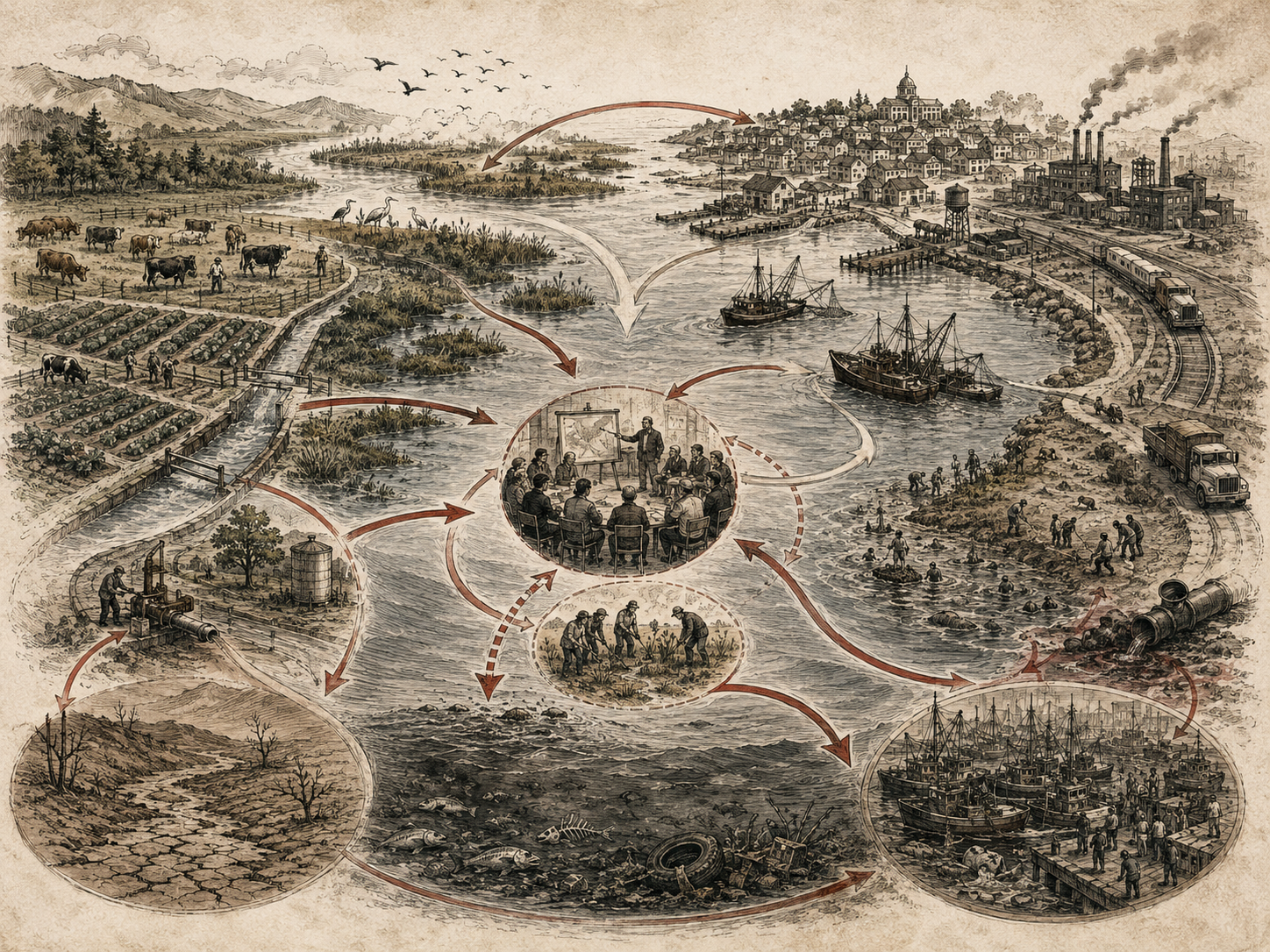
This article examines the tragedy of the commons as a systems archetype and as a problem of shared resource governance. It explains how commons depletion occurs, why individual incentives can conflict with collective sustainability, why unmanaged access is not the same as shared stewardship, and how governance institutions can protect shared resources without reducing the problem to either private ownership or centralized control. It also examines the ethical stakes of commons systems: who benefits from extraction, who bears depletion, who has authority to make rules, and how shared resources can be governed with justice, accountability, and care for future generations.
Why the Tragedy of the Commons Matters
The tragedy of the commons matters because shared resources make collective life possible. No person, household, firm, city, institution, or nation exists outside the systems it depends on. We depend on clean air, water, soil, climate stability, public health, transport networks, trustworthy information, democratic legitimacy, social cooperation, biodiversity, public infrastructure, and institutional capacity. These shared resources are often taken for granted until they begin to fail.
Commons problems emerge when the benefits of use are concentrated while the costs of overuse are diffused. One actor gains from extracting more, emitting more, consuming more, occupying more attention, adding more load, or shifting more burden. The cost is spread across the shared system. Because each actor receives the full benefit of their own use but only a fraction of the total cost, overuse becomes individually attractive. When many actors follow the same logic, the shared resource degrades.
This pattern is visible in ecological systems, but it also appears in social and institutional systems. Public trust can be depleted when institutions use misleading communication, avoid accountability, or shift burden to the public. Shared attention can be depleted when platforms reward engagement regardless of informational quality. Workplace capacity can be depleted when every team draws more from the same limited human energy. Institutional legitimacy can be depleted when actors exploit procedural loopholes for short-term advantage. The commons is often invisible until the shared stock begins to collapse.
| Shared resource | Individual incentive | Collective risk |
|---|---|---|
| Fishery | Catch more before others do. | Stock depletion, livelihood collapse, ecological damage. |
| Atmosphere | Emit greenhouse gases while externalizing climate cost. | Climate instability, extreme weather, ecological disruption. |
| Public trust | Spin, deny, obscure, or delay accountability. | Distrust, noncooperation, legitimacy loss. |
| Shared attention | Capture more engagement through outrage, novelty, or noise. | Information overload, polarization, cognitive exhaustion. |
| Infrastructure capacity | Use shared systems without paying full lifecycle cost. | Congestion, backlog, failure, deferred maintenance. |
| Workforce capacity | Draw more effort from the same people. | Burnout, turnover, error, institutional memory loss. |
The tragedy of the commons is not inevitable. Shared resources can be governed. Communities, institutions, and societies can create rules, monitoring systems, norms, sanctions, restoration practices, participation structures, and rights that protect the commons. The tragedy occurs when shared use is not matched by shared responsibility.
What the Archetype Means
The tragedy-of-the-commons archetype describes a feedback structure. Multiple users draw from a shared stock. Each user receives a direct benefit from use. The negative effect of overuse is distributed across the shared resource and often delayed. Because the cost is shared, no single user feels the full consequence of their own additional use. The system therefore encourages overuse even when every user depends on the resource remaining healthy.
The archetype has four basic elements: a shared stock, multiple users, individual benefit from use, and collective cost from depletion. When governance is weak, each user faces an incentive to take more, use more, emit more, exploit more, or shift more cost. The shared stock declines. As the stock declines, future users face scarcity, instability, conflict, or collapse.
\text{Individual Use}_i \rightarrow \text{Private Benefit}_i
\]
\[
\sum_i \text{Individual Use}_i \rightarrow \text{Shared Resource Depletion}
\]
\[
\text{Shared Resource Depletion} \rightarrow \text{Collective Harm}
\]
Interpretation: Each user benefits from individual use, but the cumulative use of all actors depletes the shared resource and produces harm for the whole system.
The tragedy occurs because the feedback from depletion is weaker, slower, or less concentrated than the feedback from use. The user experiences immediate benefit. The system experiences distributed cost. That asymmetry drives the archetype.
Common features include:
- a resource that is shared or difficult to exclude users from;
- benefits that accrue directly to individual users;
- costs that are delayed, diffused, or externalized;
- weak monitoring or weak accountability;
- incentives to increase use before others do;
- declining resource quality or availability;
- conflict over access, responsibility, and rules;
- eventual need for governance, restoration, or restriction.
The archetype should not be used to claim that people are naturally selfish or incapable of cooperation. That is too simplistic. Commons problems are often governance problems. People can and do cooperate when rules are legitimate, monitoring is credible, benefits and costs are fair, trust exists, and users have meaningful participation in governing the resource.
The systems question is therefore not “Why are people greedy?” It is “What structure makes depletion likely, and what governance structure would make stewardship possible?”
What Counts as a Commons?
A commons is a shared resource system that multiple users depend on and that requires governance to avoid depletion, degradation, congestion, exclusion, or conflict. A commons is not simply a thing. It is a resource plus a community of users plus rules, norms, institutions, monitoring, and responsibilities. Without governance, a shared resource may become open access. With governance, it can become a protected commons.
Traditional examples include pastures, fisheries, forests, irrigation systems, groundwater, and grazing lands. These are important, but modern systems thinking expands the concept. Shared resource systems also include public infrastructure, data ecosystems, institutional trust, democratic norms, scientific credibility, software commons, digital knowledge repositories, open-source communities, antimicrobial effectiveness, public health capacity, and the atmosphere.
Different commons have different properties. Some are subtractable: one user’s use reduces what remains for others. Fish, water, land, budget, time, and attention can be subtractable. Some are congestible: too much use reduces quality for everyone. Roads, networks, public services, and digital attention systems can become congested. Some are degradable: overuse reduces the stock’s future capacity. Soil, trust, climate stability, and workforce capacity can degrade. Some are knowledge commons: use does not necessarily deplete the resource, but governance is still needed to maintain quality, access, credibility, and contribution.
| Commons type | Examples | Primary risk |
|---|---|---|
| Ecological commons | Atmosphere, fisheries, forests, groundwater, wetlands, biodiversity. | Depletion, pollution, habitat loss, climate disruption. |
| Infrastructure commons | Roads, bridges, transit, water systems, electric grids, public facilities. | Congestion, deferred maintenance, overload, failure. |
| Social commons | Trust, cooperation, legitimacy, civic norms, public safety. | Erosion, distrust, polarization, noncooperation. |
| Information commons | Scientific knowledge, public discourse, digital repositories, media ecosystems. | Misinformation, noise, attention depletion, credibility loss. |
| Organizational commons | Shared staff capacity, institutional memory, psychological safety, learning time. | Burnout, knowledge loss, overload, reduced learning. |
| Technological commons | Open-source software, standards, shared data infrastructure, cybersecurity hygiene. | Under-maintenance, exploitation, dependency, security risk. |
Recognizing a commons requires asking what shared stock supports the system. What must remain healthy for everyone to benefit? What is being used faster than it is replenished? What costs are being externalized? What rules protect the resource? Who participates in rule-making? Who monitors use? Who restores what is depleted?
A commons is not just a resource. It is a relationship of mutual dependence.
Private Gain and Shared Cost
The tragedy of the commons is driven by a mismatch between private gain and shared cost. A user receives a direct benefit from additional use, but the cost of that additional use is spread across all users or across the wider system. This creates a structural incentive for overuse.
For example, one additional vehicle may benefit the driver, but it contributes a small amount to congestion, emissions, road wear, and public health burden. One actor’s misleading communication may protect that actor’s reputation temporarily, but it contributes to the erosion of public trust. One organization’s overuse of staff capacity may meet its deadline, but it contributes to burnout, turnover, and loss of shared institutional knowledge. One firm’s emissions may increase profit, while climate costs are distributed globally and across generations.
The problem is not that the private benefit is imaginary. It is real. The problem is that the decision-maker does not experience the full system cost. The accounting boundary is too narrow. The user sees benefit, not depletion.
\text{Net Private Benefit}_i = B_i – C_i
\]
\[
\text{Net System Benefit} = \sum_i B_i – C_{\text{shared}}
\]
Interpretation: Individual actors may see a positive private benefit because they count only their direct cost \(C_i\), while the system as a whole bears the shared cost \(C_{\text{shared}}\).
This mismatch can be strengthened by competition. If users believe others will exploit the resource, they have an incentive to use more before the resource declines. This creates a race to extract, occupy, emit, consume, or capture value. Fear of restraint can become self-defeating: if no one trusts others to conserve, everyone has a reason to overuse.
Private-gain/shared-cost dynamics appear in many forms:
- pollution externalized to air, water, or climate systems;
- attention captured through manipulative design while social trust declines;
- institutional burden shifted onto applicants, patients, or families;
- road use expanded without full lifecycle maintenance funding;
- scientific credibility exploited through low-quality information;
- open-source software used without contribution to maintenance;
- workforce capacity treated as endlessly available;
- public trust spent for short-term political advantage.
Commons governance must change this incentive structure. It must make shared costs visible, align use with regeneration, distribute responsibility fairly, and create rules that protect the stock from depletion.
Feedback, Delay, and Depletion
Feedback delay makes commons depletion difficult to manage. The benefit of use is often immediate, while the cost of depletion appears slowly. A fishery may seem productive until reproduction fails. A climate system may absorb emissions for decades before the full consequences become visible. Public trust may erode gradually until cooperation collapses. Workforce capacity may appear stable until burnout and turnover accelerate. Infrastructure may function until deferred maintenance produces sudden failure.
Delayed feedback encourages overuse because users do not immediately experience the consequences of their actions. The shared stock declines quietly. By the time the problem becomes visible, recovery may be slower, more expensive, or impossible within the same time horizon.
R_{t+1} = R_t + A_t – \sum_i U_{i,t}
\]
Interpretation: The shared resource stock \(R\) changes through replenishment or regeneration \(A_t\) minus the total use of all actors \(\sum_i U_{i,t}\).
If total use exceeds regeneration, the stock declines:
\sum_i U_{i,t} > A_t \Rightarrow R_{t+1} < R_t
\]
Interpretation: When total use exceeds the resource’s replenishment or recovery rate, the shared stock is depleted.
Feedback delay also creates false confidence. Users may believe the resource can tolerate current use because collapse has not yet occurred. Institutions may assume that trust, infrastructure, ecological resilience, or attention can absorb continued pressure because the shared stock has not yet failed. This is a dangerous interpretation. Many commons have buffers, and buffers can hide depletion until they are weakened.
Early warning indicators matter. Depending on the commons, these may include declining stock levels, rising extraction effort, worsening quality, increased conflict, rising maintenance backlog, public distrust, reduced cooperation, higher error rates, lower resilience, ecological stress, or increased burden on vulnerable users.
A commons is most vulnerable when feedback is delayed, monitoring is weak, and short-term incentives remain strong. The longer the delay, the more important governance becomes.
Free Riding, Rationality, and System Failure
Free riding occurs when an actor benefits from a shared resource without contributing fairly to its maintenance, restoration, or governance. In commons systems, free riding is not always a moral failing by isolated individuals. It is often a predictable result of weak rules, weak monitoring, low trust, unequal power, or incentives that reward extraction over stewardship.
If one actor restrains use while others continue exploiting the resource, the restrained actor may lose short-term advantage while the resource still degrades. This creates a collective-action problem. Cooperation requires confidence that others will also cooperate, that rules will be enforced fairly, and that benefits and costs will be distributed legitimately.
The tragedy of the commons is often described as a problem of rational individual behavior producing irrational collective outcomes. That framing is useful but incomplete. It can imply that users are trapped by selfishness. In reality, many communities have successfully governed commons through shared norms, participatory rules, graduated sanctions, monitoring, conflict-resolution processes, and locally adapted institutions.
U_i^{\text{overuse}} > U_i^{\text{restraint}}
\quad \text{when others are expected to overuse}
\]
Interpretation: If users expect others to overuse the commons, individual restraint may appear disadvantageous, making collective depletion more likely.
The systems question is not whether people are rational or irrational. It is what the system makes rational. If the system rewards overuse, hides shared costs, fails to monitor depletion, and does not protect cooperators, overuse becomes predictable. If the system rewards stewardship, makes depletion visible, protects fair use, and builds trust, cooperation becomes more feasible.
Free riding can also occur at institutional scale. Firms may profit while externalizing pollution. Wealthy communities may draw more public infrastructure while resisting shared funding. Platforms may benefit from public knowledge while contributing little to information quality. Organizations may use open-source software without supporting maintainers. Political actors may spend public trust while expecting others to preserve legitimacy.
The tragedy is not only that individuals may overuse a shared resource. It is that systems can make exploitation easier than stewardship.
Governing the Commons
Commons problems require governance. Governance does not always mean centralized state control, and it does not always mean privatization. Commons governance can take many forms: community rules, public regulation, cooperative management, nested institutions, monitoring systems, participatory decision-making, legal rights, stewardship obligations, restoration funds, user associations, standards, sanctions, and adaptive learning.
A major lesson of commons research is that shared resources are not doomed when users have legitimate ways to govern them. Many commons have been sustained through institutions that fit local conditions, define boundaries, monitor use, resolve conflict, sanction violations, and allow users to participate in rule-making.
Effective commons governance often includes:
- clear boundaries around the resource and user community;
- rules matched to local ecological, social, and institutional conditions;
- participation by users affected by the rules;
- monitoring of resource condition and user behavior;
- graduated sanctions for rule violations;
- low-cost conflict resolution;
- recognition of users’ rights to organize;
- nested governance for larger, multi-level systems;
- restoration mechanisms when the shared stock is depleted;
- attention to fairness, power, and historical harm.
| Governance function | Systems purpose | Example |
|---|---|---|
| Boundary definition | Clarifies what resource is protected and who has rights and duties. | Watershed boundaries, fishery zones, data commons membership. |
| Use rules | Aligns use with regeneration or carrying capacity. | Catch limits, emissions caps, road pricing, API rate limits. |
| Monitoring | Makes depletion visible before collapse. | Stock assessments, air monitoring, infrastructure condition audits. |
| Sanctions | Protects cooperators from free riding. | Graduated penalties, access restrictions, restoration obligations. |
| Participation | Improves legitimacy and local knowledge. | User councils, community boards, participatory watershed governance. |
| Restoration | Rebuilds depleted shared stocks. | Habitat restoration, trust repair, maintenance funds, capacity rebuilding. |
The right governance structure depends on the resource. Climate systems require global coordination and national policy. Local fisheries may require community-based management and scientific monitoring. Digital knowledge commons may require contribution norms, moderation, licensing, and maintenance support. Public trust requires accountability, transparency, reliable service, and repair. Workforce capacity requires workload governance, staffing, recovery, and institutional learning.
The key is that shared use must be matched by shared responsibility. Without governance, the commons becomes vulnerable to depletion by those best positioned to extract from it.
Commons Are Not the Same as Open Access
A common mistake is treating the commons as if it means open access without rules. This is misleading. A commons is a governed shared resource. Open access is a situation in which users can use a resource without effective boundaries, rules, monitoring, or accountability. Many tragedies attributed to “the commons” are actually tragedies of unmanaged open access, weak governance, or imposed disruption of existing commons institutions.
This distinction matters politically and ethically. If commons are misunderstood as inherently doomed, the proposed solutions often become privatization or centralized control. But many commons have been managed successfully when users have legitimate governance rights and institutions. The failure is not sharing itself. The failure is unmanaged extraction, unequal power, weak accountability, or destruction of local governance.
| Open access | Governed commons |
|---|---|
| Weak or absent rules. | Rules define fair use, responsibilities, and limits. |
| Unclear users or boundaries. | Resource and user boundaries are recognized. |
| Little monitoring. | Resource condition and use are monitored. |
| Free riding is easy. | Cooperators are protected by accountability mechanisms. |
| Conflict may escalate. | Conflict-resolution processes exist. |
| Depletion is likely when demand grows. | Use can be adapted to regeneration and shared goals. |
In modern policy debates, the distinction is crucial. Open-source software is not merely free code; it depends on maintainers, licenses, norms, contribution practices, funding, and governance. Scientific knowledge is not merely available information; it depends on institutions, peer review, replication, public funding, archives, and credibility. Public trust is not an endless reservoir; it depends on reliable conduct, transparency, accountability, and repair.
Calling every shared resource a tragedy can become a way to justify enclosing, privatizing, or controlling resources without asking whether democratic commons governance is possible. Systems thinking should resist that simplification. The question is not whether resources are shared. The question is how sharing is governed.
A commons fails when shared dependence is not matched by shared rules, shared responsibility, and shared care.
Trust, Rules, Monitoring, and Sanctions
Commons governance depends on trust, but trust alone is not enough. Rules, monitoring, and sanctions also matter. A system that relies only on voluntary restraint may fail when users face strong incentives to overuse or when trust is low. A system that relies only on punishment may fail when rules are illegitimate, unequal, or disconnected from local knowledge. Durable commons governance often requires a combination of trust, fair rules, credible monitoring, graduated sanctions, and participatory adaptation.
Trust helps users believe that restraint will not be exploited by others. Rules clarify what fair use means. Monitoring makes resource condition and user behavior visible. Sanctions protect cooperators from free riding. Participation improves legitimacy and fit. Conflict-resolution processes prevent disputes from destroying cooperation.
\text{Sustainable Commons} = f(\text{Trust}, \text{Rules}, \text{Monitoring}, \text{Sanctions}, \text{Participation}, \text{Restoration})
\]
Interpretation: Commons sustainability depends on multiple governance functions working together. Trust without rules may be fragile; rules without legitimacy may produce resistance.
The design of sanctions matters. Harsh punishment may create fear, concealment, or conflict. No sanctions may invite free riding. Graduated sanctions allow the system to respond proportionately: warnings, small penalties, stronger restrictions, and eventual exclusion if necessary. The goal is not punishment for its own sake. The goal is to protect the shared resource and the cooperators who depend on it.
Monitoring must also be trusted. If monitoring is captured by powerful users, manipulated by extractive actors, or inaccessible to affected communities, it may fail to support stewardship. Good monitoring should track both resource condition and distributional effects: who uses the resource, who benefits, who bears depletion, and whether restoration is working.
For social commons such as public trust or information quality, monitoring is harder but still necessary. Institutions can track complaint patterns, participation, misinformation spread, appeal burdens, public confidence, service reliability, and accountability outcomes. For organizational commons such as workforce capacity, monitoring can include workload, overtime, turnover, recovery time, error rates, and psychological safety.
Commons governance is a feedback system. It must sense depletion, interpret signals, adjust rules, protect fairness, and restore the shared stock before collapse.
Ethics: Who Owns, Uses, Protects, and Pays?
The tragedy of the commons has deep ethical stakes because shared resources are rarely used or depleted equally. Some actors benefit more from extraction. Others bear more of the cost. Some have the power to make rules. Others are governed by rules they did not create. Some are protected from depletion. Others live closest to the damage. Future generations inherit the consequences of decisions made before they had a voice.
Commons ethics asks who has rights, who has duties, who has voice, and who is exposed to harm. A shared resource can be depleted through unequal power as much as through uncoordinated individual use. Large firms, wealthy users, powerful states, or dominant institutions may extract far more than small users while framing the problem as collective overuse. Ethical analysis must distinguish subsistence use from profit-driven extraction, survival use from luxury consumption, and historical responsibility from present vulnerability.
For example, climate change is not caused equally by all people. Emissions, benefits, vulnerability, and adaptive capacity are distributed unequally. Public infrastructure is not used equally by all actors. Some users impose heavier loads while resisting taxation or maintenance responsibility. Digital information environments are not shaped equally by ordinary users and large platforms. Public trust is not depleted equally by those with little power and those who repeatedly violate public responsibility.
Ethical commons analysis asks:
- Who benefits from use of the shared resource?
- Who bears the cost of depletion?
- Who has the authority to define the rules?
- Who is excluded from governance?
- Are historical harms included in responsibility?
- Are vulnerable users protected?
- Are future generations represented?
- Is restoration required from those who depleted the resource?
- Does governance protect the commons or merely protect powerful claims?
Ethical commons governance should not simply impose restraint on those with the least power. It should identify disproportionate use, unequal benefit, historical extraction, and unequal exposure. It should protect basic needs, recognize Indigenous and local stewardship where relevant, include affected communities, and require those who profit from depletion to participate in repair.
The tragedy of the commons is not only that shared resources can be depleted. It is that depletion is often made to look collective while responsibility remains unequal.
Examples Across Systems
The tragedy of the commons appears across ecological, social, institutional, technological, and organizational systems. The examples below show how the archetype changes diagnosis.
Public health
Antimicrobial effectiveness is a commons. Antibiotics benefit individual patients and institutions, but overuse contributes to antimicrobial resistance, reducing effectiveness for everyone. Public health capacity is also a commons. If hospitals, agencies, and communities draw down capacity without investing in prevention, workforce support, surveillance, and trust, the whole system becomes less resilient. Governance requires stewardship, monitoring, access, prevention, and appropriate use.
Infrastructure
Roads, bridges, transit systems, water systems, and public facilities are shared resource systems. Individual users benefit from access, but underpriced use, deferred maintenance, and fragmented responsibility can deplete infrastructure condition. Congestion is also a commons problem: each user adds a small burden to shared capacity. Governance requires maintenance funding, demand management, fair pricing, public investment, and long-term asset stewardship.
Organizations
Workforce capacity is a commons inside organizations. Every project, department, and leader may benefit from drawing more time, attention, and effort from shared staff. But cumulative overuse produces burnout, turnover, error, and loss of institutional memory. The organization may treat each request as reasonable while the shared human capacity declines. Governance requires workload visibility, prioritization, staffing, recovery time, and authority to say no.
Education
Teacher attention, student trust, classroom climate, and institutional learning capacity are shared resources. If systems overload teachers, narrow curriculum, overuse testing, or impose competing initiatives, they deplete the shared conditions of learning. Students and teachers experience the consequences as stress, disengagement, turnover, and reduced educational quality. Governance requires protecting learning time, teacher capacity, belonging, and developmental conditions.
Artificial intelligence systems
Data ecosystems, public trust in automated systems, open-source infrastructure, and information quality are commons in AI systems. Firms may benefit from using shared data, open-source software, public content, and user attention while contributing insufficiently to maintenance, consent, quality, accountability, or repair. If trust and information quality decline, the whole ecosystem suffers. Governance requires data rights, model accountability, open-source sustainability, auditability, and responsible deployment.
Climate and ecology
The atmosphere, oceans, forests, wetlands, biodiversity, and soil systems are ecological commons. Individual actors benefit from extraction, emissions, or land conversion, while costs are distributed across communities, species, ecosystems, and generations. Climate change is one of the largest commons problems because the resource boundary is planetary and the feedback delay is long. Governance requires emission reduction, adaptation, restoration, justice, and international coordination.
Economics
Economic systems depend on shared public goods and commons: legal systems, monetary trust, infrastructure, educated populations, ecological stability, care work, scientific knowledge, and institutional legitimacy. Firms and households may benefit from drawing on these systems without paying full maintenance costs. A political economy that privatizes gains while socializing losses creates commons depletion. Governance requires taxation, regulation, public investment, labor protection, and ecological accounting.
Public administration
Public trust, administrative capacity, and legitimacy are commons. Each agency, politician, contractor, or institution may benefit from avoiding accountability, shifting burden, or optimizing narrow metrics. But cumulative behavior can erode public trust in the whole system. Once trust declines, cooperation becomes harder and governance becomes more expensive. Protecting public trust requires reliability, fairness, burden reduction, accountability, and repair after harm.
Across these domains, the tragedy of the commons reveals a recurring structure: shared conditions are depleted when users receive private benefit without bearing full responsibility for maintaining the resource they depend on.
Mathematics, Computation, and Modeling
The tragedy of the commons can be modeled using stock-flow equations, game theory, agent-based models, network models, scenario analysis, and resource-regeneration models. The purpose of modeling is to show how individual use, shared depletion, regeneration, governance rules, and distributional outcomes interact over time.
A basic shared resource stock can be represented as:
R_{t+1} = R_t + A_t – \sum_{i=1}^{N} U_{i,t}
\]
Interpretation: The shared resource \(R\) increases through regeneration or replenishment \(A_t\) and decreases through the total use of all \(N\) users.
A sustainable-use condition can be written as:
\sum_{i=1}^{N} U_{i,t} \leq A_t
\]
Interpretation: Use is sustainable when total use does not exceed the resource’s replenishment or regeneration rate.
If regeneration depends on the remaining stock, it can be modeled as:
A_t = rR_t\left(1 – \frac{R_t}{K}\right)
\]
Interpretation: Regeneration can follow a logistic pattern, where growth depends on the current stock \(R_t\), intrinsic regeneration rate \(r\), and carrying capacity \(K\).
Individual user benefit can be represented as:
B_i = pU_i – c_iU_i
\]
Interpretation: A user’s private benefit rises with use \(U_i\), price or value \(p\), and private cost \(c_i\). Shared depletion costs may be missing from this private calculation.
A system-level welfare measure can include shared depletion:
W = \sum_{i=1}^{N} B_i – \lambda \max\left(0, \sum_{i=1}^{N} U_i – A_t\right)
\]
Interpretation: System welfare declines when total use exceeds regeneration, with \(\lambda\) representing the cost of depletion or ecological damage.
A governance rule can be represented as a quota or limit:
U_{i,t} \leq q_i
\qquad
\sum_{i=1}^{N} q_i \leq A_t
\]
Interpretation: Governance can limit each user’s allowable use \(q_i\) so that total permitted use remains within the resource’s replenishment capacity.
| Modeling task | Commons question | Example output |
|---|---|---|
| Stock-flow simulation | Is total use exceeding regeneration? | Shared resource stock trajectory. |
| Scenario comparison | How do different governance rules affect depletion? | Open-access, quota, cooperative, and restoration scenarios. |
| Agent-based modeling | How do user strategies interact over time? | Cooperation, free riding, collapse, or stable governance patterns. |
| Distributional analysis | Who benefits from use and who bears depletion? | User-group benefit, burden, and exposure tables. |
| Sensitivity analysis | Which assumptions determine sustainability? | Regeneration rate, use intensity, monitoring effectiveness, sanction strength. |
| Network analysis | How does resource use spread through connected systems? | Dependency networks, shared infrastructure load, cascading commons risk. |
| Restoration modeling | How long does recovery take after depletion? | Restoration timelines under different repair investments. |
Modeling commons systems should include governance, distribution, and restoration. A model that tracks only aggregate use may miss unequal responsibility. A model that tracks only user behavior may miss rule legitimacy. A model that tracks only depletion may miss the possibility of cooperative stewardship. Commons modeling should ask not only how collapse occurs, but what institutional designs make shared care possible.
Python Workflow: Commons Stock, Use Pressure, Governance, Restoration, and Distributional Diagnostics
The Python workflow below turns commons analysis into a small reproducible systems model. It compares four scenarios: open access depletion, weak rule compliance, governed commons transition, and participatory stewardship and restoration. It also includes one-at-a-time sensitivity analysis for the stewardship scenario. The script uses only the Python standard library, writes CSV outputs relative to the article folder, and is designed as a clear starting point for companion repository work.
# tragedy_of_commons_workflow.py
# Dependency-light workflow for shared resource systems:
# resource-stock dynamics, open-access overuse, governance rules,
# monitoring, sanctions, restoration, and distributional burden.
# Writes outputs relative to the article root.

from __future__ import annotations

from dataclasses import dataclass, replace
from pathlib import Path
import csv
from statistics import mean

ARTICLE_ROOT = Path(__file__).resolve().parents[1]
TABLES = ARTICLE_ROOT / "outputs" / "tables"


@dataclass
class CommonsScenario:
    name: str
    initial_resource_stock: float
    user_pressure: float
    private_gain_incentive: float
    regeneration_rate: float
    monitoring_quality: float
    rule_legitimacy: float
    sanction_strength: float
    participation: float
    restoration_investment: float
    unequal_power: float
    distributional_protection: float
    future_generation_weight: float


def clamp(value: float, low: float = 0.0, high: float = 140.0) -> float:
    return max(low, min(high, value))


def run_scenario(scenario: CommonsScenario, periods: int = 70) -> list[dict[str, object]]:
    resource_stock = scenario.initial_resource_stock
    user_trust = 40.0 + scenario.rule_legitimacy * 22.0 + scenario.participation * 12.0
    governance_capacity = 36.0 + scenario.monitoring_quality * 20.0 + scenario.participation * 14.0
    restoration_stock = 28.0 + scenario.restoration_investment * 24.0
    vulnerable_group_burden = 28.0 + scenario.unequal_power * 18.0
    compliance_norm = 34.0 + scenario.rule_legitimacy * 20.0
    rows: list[dict[str, object]] = []

    for period in range(periods + 1):
        regeneration_flow = clamp(
            scenario.regeneration_rate * resource_stock * (1.0 - resource_stock / 120.0)
            + scenario.restoration_investment * 8.0
            + restoration_stock * 0.04,
            0.0,
            80.0,
        )

        monitoring_effect = clamp(
            scenario.monitoring_quality * 14.0
            + governance_capacity * 0.10
            + scenario.participation * 5.0,
            0.0,
            80.0,
        )

        legitimacy_effect = clamp(
            scenario.rule_legitimacy * 14.0
            + scenario.participation * 10.0
            + user_trust * 0.08
            - scenario.unequal_power * 5.0,
            0.0,
            80.0,
        )

        overuse_incentive = clamp(
            scenario.user_pressure * 18.0
            + scenario.private_gain_incentive * 16.0
            + scenario.unequal_power * 10.0
            + max(0.0, 55.0 - compliance_norm) * 0.10
            - monitoring_effect * 0.16
            - legitimacy_effect * 0.14
            - scenario.sanction_strength * 6.0,
            0.0,
            100.0,
        )

        permitted_use = clamp(
            scenario.user_pressure * 11.0
            + scenario.private_gain_incentive * 5.0
            - scenario.future_generation_weight * 5.0
            - scenario.distributional_protection * 4.0,
            0.0,
            80.0,
        )

        illicit_or_excess_use = clamp(
            overuse_incentive
            - scenario.sanction_strength * 5.0
            - monitoring_effect * 0.12
            - compliance_norm * 0.08,
            0.0,
            80.0,
        )

        total_use = clamp(
            permitted_use
            + illicit_or_excess_use
            + scenario.unequal_power * 5.0,
            0.0,
            120.0,
        )

        restoration_flow = clamp(
            scenario.restoration_investment * 16.0
            + scenario.future_generation_weight * 8.0
            + scenario.distributional_protection * 6.0
            + governance_capacity * 0.05,
            0.0,
            100.0,
        )

        depletion_pressure = clamp(
            max(0.0, total_use - regeneration_flow)
            + max(0.0, 55.0 - resource_stock) * 0.10
            + scenario.unequal_power * 4.0,
            0.0,
            100.0,
        )

        resource_stock = clamp(
            resource_stock
            + regeneration_flow * 0.14
            + restoration_flow * 0.08
            - total_use * 0.16
            - scenario.unequal_power * 0.6,
            0.0,
            120.0,
        )

        governance_capacity = clamp(
            governance_capacity
            + scenario.monitoring_quality * 1.1
            + scenario.participation * 1.0
            + scenario.rule_legitimacy * 0.9
            - scenario.unequal_power * 0.8
            - max(0.0, 45.0 - user_trust) * 0.04,
            0.0,
            100.0,
        )

        restoration_stock = clamp(
            restoration_stock
            + restoration_flow * 0.11
            - depletion_pressure * 0.08
            - scenario.user_pressure * 0.5,
            0.0,
            120.0,
        )

        compliance_norm = clamp(
            compliance_norm
            + legitimacy_effect * 0.08
            + scenario.sanction_strength * 0.6
            + scenario.participation * 0.8
            - illicit_or_excess_use * 0.08
            - scenario.unequal_power * 0.7,
            0.0,
            100.0,
        )

        user_trust = clamp(
            user_trust
            + scenario.rule_legitimacy * 1.2
            + scenario.participation * 1.0
            + scenario.distributional_protection * 0.8
            + max(0.0, resource_stock - 50.0) * 0.025
            - vulnerable_group_burden * 0.035
            - scenario.unequal_power * 0.9,
            0.0,
            100.0,
        )

        vulnerable_group_burden = clamp(
            vulnerable_group_burden
            + depletion_pressure * 0.08
            + scenario.unequal_power * 1.4
            + max(0.0, 55.0 - resource_stock) * 0.06
            - scenario.distributional_protection * 1.7
            - scenario.participation * 0.8,
            0.0,
            100.0,
        )

        commons_fragility_index = clamp(
            max(0.0, 65.0 - resource_stock) * 0.24
            + total_use * 0.14
            + illicit_or_excess_use * 0.18
            + vulnerable_group_burden * 0.18
            + scenario.unequal_power * 12.0
            - governance_capacity * 0.10
            - user_trust * 0.08
            - restoration_stock * 0.08,
            0.0,
            100.0,
        )

        stewardship_score = clamp(
            resource_stock * 0.18
            + governance_capacity * 0.16
            + user_trust * 0.16
            + compliance_norm * 0.14
            + restoration_stock * 0.14
            + scenario.distributional_protection * 10.0
            + scenario.future_generation_weight * 10.0
            - commons_fragility_index * 0.16
            - vulnerable_group_burden * 0.16,
            0.0,
            100.0,
        )

        rows.append({
            "period": period,
            "scenario": scenario.name,
            "resource_stock": round(resource_stock, 3),
            "user_trust": round(user_trust, 3),
            "governance_capacity": round(governance_capacity, 3),
            "restoration_stock": round(restoration_stock, 3),
            "compliance_norm": round(compliance_norm, 3),
            "vulnerable_group_burden": round(vulnerable_group_burden, 3),
            "regeneration_flow": round(regeneration_flow, 3),
            "permitted_use": round(permitted_use, 3),
            "illicit_or_excess_use": round(illicit_or_excess_use, 3),
            "total_use": round(total_use, 3),
            "restoration_flow": round(restoration_flow, 3),
            "depletion_pressure": round(depletion_pressure, 3),
            "commons_fragility_index": round(commons_fragility_index, 3),
            "stewardship_score": round(stewardship_score, 3),
        })

    return rows


def summarize(rows: list[dict[str, object]]) -> list[dict[str, object]]:
    output: list[dict[str, object]] = []
    for scenario_name in sorted({row["scenario"] for row in rows}):
        subset = [row for row in rows if row["scenario"] == scenario_name]
        final = subset[-1]
        avg_resource = mean(float(row["resource_stock"]) for row in subset)
        avg_use = mean(float(row["total_use"]) for row in subset)
        avg_regeneration = mean(float(row["regeneration_flow"]) for row in subset)
        avg_fragility = mean(float(row["commons_fragility_index"]) for row in subset)
        avg_burden = mean(float(row["vulnerable_group_burden"]) for row in subset)
        avg_score = mean(float(row["stewardship_score"]) for row in subset)

        if float(final["stewardship_score"]) >= 65 and float(final["resource_stock"]) >= 60:
            diagnostic = "commons governance supports stewardship and regeneration"
        elif avg_use > avg_regeneration and avg_fragility >= 55:
            diagnostic = "use pressure exceeds regeneration and commons depletion dominates"
        elif avg_burden >= 55:
            diagnostic = "commons depletion is creating unequal burden"
        elif avg_fragility >= 55:
            diagnostic = "shared resource remains fragile under current governance"
        elif avg_score >= 55:
            diagnostic = "partial governance with remaining depletion risk"
        else:
            diagnostic = "weak evidence of durable commons stewardship"

        output.append({
            "scenario": scenario_name,
            "final_stewardship_score": final["stewardship_score"],
            "final_commons_fragility_index": final["commons_fragility_index"],
            "final_resource_stock": final["resource_stock"],
            "final_governance_capacity": final["governance_capacity"],
            "final_user_trust": final["user_trust"],
            "final_vulnerable_group_burden": final["vulnerable_group_burden"],
            "average_resource_stock": round(avg_resource, 3),
            "average_total_use": round(avg_use, 3),
            "average_regeneration_flow": round(avg_regeneration, 3),
            "average_commons_fragility_index": round(avg_fragility, 3),
            "average_vulnerable_group_burden": round(avg_burden, 3),
            "average_stewardship_score": round(avg_score, 3),
            "diagnostic": diagnostic,
        })

    return output


def one_at_a_time(base: CommonsScenario, delta: float = 0.10) -> list[dict[str, object]]:
    base_score = float(run_scenario(base)[-1]["stewardship_score"])
    parameters = [
        "user_pressure",
        "private_gain_incentive",
        "regeneration_rate",
        "monitoring_quality",
        "rule_legitimacy",
        "sanction_strength",
        "participation",
        "restoration_investment",
        "unequal_power",
        "distributional_protection",
        "future_generation_weight",
    ]

    rows: list[dict[str, object]] = []
    for parameter in parameters:
        for direction in (-1, 1):
            current = getattr(base, parameter)
            revised_value = max(0.0, min(1.0, current + direction * delta))
            revised = replace(base, name=f"{base.name} {parameter} {direction * delta:+.2f}", **{parameter: revised_value})
            revised_score = float(run_scenario(revised)[-1]["stewardship_score"])
            rows.append({
                "parameter": parameter,
                "delta": direction * delta,
                "base_value": current,
                "revised_value": revised_value,
                "base_final_stewardship_score": round(base_score, 3),
                "revised_final_stewardship_score": round(revised_score, 3),
                "score_change": round(revised_score - base_score, 3),
                "absolute_score_change": round(abs(revised_score - base_score), 3),
            })

    return sorted(rows, key=lambda row: float(row["absolute_score_change"]), reverse=True)


def write_csv(path: Path, rows: list[dict[str, object]]) -> None:
    path.parent.mkdir(parents=True, exist_ok=True)
    if not rows:
        raise ValueError(f"No rows to write: {path}")
    with path.open("w", newline="", encoding="utf-8") as handle:
        writer = csv.DictWriter(handle, fieldnames=list(rows[0].keys()))
        writer.writeheader()
        writer.writerows(rows)


def main() -> None:
    scenarios = [
        CommonsScenario("Open access depletion", 84.0, 0.76, 0.82, 0.34, 0.22, 0.24, 0.18, 0.20, 0.18, 0.64, 0.20, 0.18),
        CommonsScenario("Weak rule compliance", 84.0, 0.66, 0.68, 0.42, 0.42, 0.38, 0.34, 0.36, 0.34, 0.52, 0.34, 0.30),
        CommonsScenario("Governed commons transition", 84.0, 0.54, 0.52, 0.62, 0.68, 0.66, 0.62, 0.70, 0.64, 0.34, 0.66, 0.62),
        CommonsScenario("Participatory stewardship and restoration", 84.0, 0.42, 0.38, 0.74, 0.84, 0.84, 0.76, 0.86, 0.82, 0.22, 0.86, 0.84),
    ]

    rows: list[dict[str, object]] = []
    for scenario in scenarios:
        rows.extend(run_scenario(scenario))

    write_csv(TABLES / "commons_timeseries.csv", rows)
    write_csv(TABLES / "commons_summary.csv", summarize(rows))
    write_csv(TABLES / "commons_sensitivity_analysis.csv", one_at_a_time(scenarios[-1]))

    print("Commons systems workflow complete.")
    print(TABLES / "commons_timeseries.csv")


if __name__ == "__main__":
    main()
The workflow is intentionally simple enough to inspect. It shows how resource stock, regeneration, total use, governance capacity, rule legitimacy, monitoring, sanctions, restoration, unequal power, vulnerable-group burden, and future-generation weighting interact over time. It also shows why commons analysis should not stop at aggregate depletion: distribution, legitimacy, participation, and restoration shape whether shared stewardship is possible. The model is synthetic and illustrative; it supports disciplined inquiry rather than replacing domain expertise, stakeholder evidence, or ethical judgment.
R Workflow: Commons Summary and Governance-Scenario Visualization
The R workflow reads the Python-generated time-series and sensitivity outputs, creates scenario summaries, and exports base R plots for resource stock, total use, regeneration, governance capacity, commons fragility, and stewardship score. It uses only base R so it remains portable across simple local environments.
# tragedy_of_commons_diagnostics.R
# Base R workflow for commons summary and governance-scenario visualization.

args <- commandArgs(trailingOnly = FALSE)
file_arg <- grep("^--file=", args, value = TRUE)

if (length(file_arg) > 0) {
  script_path <- normalizePath(sub("^--file=", "", file_arg[1]), mustWork = TRUE)
  article_root <- normalizePath(file.path(dirname(script_path), ".."), mustWork = TRUE)
} else {
  article_root <- getwd()
}

setwd(article_root)

tables_dir <- file.path(article_root, "outputs", "tables")
figures_dir <- file.path(article_root, "outputs", "figures")

if (!dir.exists(tables_dir)) {
  dir.create(tables_dir, recursive = TRUE)
}

if (!dir.exists(figures_dir)) {
  dir.create(figures_dir, recursive = TRUE)
}

timeseries_path <- file.path(tables_dir, "commons_timeseries.csv")
sensitivity_path <- file.path(tables_dir, "commons_sensitivity_analysis.csv")

if (!file.exists(timeseries_path)) {
  stop(paste("Missing", timeseries_path, "Run the Python workflow first."))
}

data <- read.csv(timeseries_path, stringsAsFactors = FALSE)

last_by_scenario <- do.call(
  rbind,
  lapply(split(data, data$scenario), function(df) df[nrow(df), ])
)

avg_resource <- aggregate(resource_stock ~ scenario, data = data, FUN = mean)
avg_use <- aggregate(total_use ~ scenario, data = data, FUN = mean)
avg_regeneration <- aggregate(regeneration_flow ~ scenario, data = data, FUN = mean)
avg_fragility <- aggregate(commons_fragility_index ~ scenario, data = data, FUN = mean)
avg_burden <- aggregate(vulnerable_group_burden ~ scenario, data = data, FUN = mean)
avg_score <- aggregate(stewardship_score ~ scenario, data = data, FUN = mean)

names(avg_resource)[2] <- "average_resource_stock"
names(avg_use)[2] <- "average_total_use"
names(avg_regeneration)[2] <- "average_regeneration_flow"
names(avg_fragility)[2] <- "average_commons_fragility_index"
names(avg_burden)[2] <- "average_vulnerable_group_burden"
names(avg_score)[2] <- "average_stewardship_score"

final_fields <- last_by_scenario[, c(
  "scenario",
  "stewardship_score",
  "commons_fragility_index",
  "resource_stock",
  "governance_capacity",
  "user_trust",
  "vulnerable_group_burden"
)]

names(final_fields) <- c(
  "scenario",
  "final_stewardship_score",
  "final_commons_fragility_index",
  "final_resource_stock",
  "final_governance_capacity",
  "final_user_trust",
  "final_vulnerable_group_burden"
)

summary_table <- Reduce(
  function(x, y) merge(x, y, by = "scenario"),
  list(avg_resource, avg_use, avg_regeneration, avg_fragility, avg_burden, avg_score, final_fields)
)

summary_table$diagnostic <- ifelse(
  summary_table$final_stewardship_score >= 65 &
    summary_table$final_resource_stock >= 60,
  "commons governance supports stewardship and regeneration",
  ifelse(
    summary_table$average_total_use > summary_table$average_regeneration_flow &
      summary_table$average_commons_fragility_index >= 55,
    "use pressure exceeds regeneration and commons depletion dominates",
    ifelse(
      summary_table$average_vulnerable_group_burden >= 55,
      "commons depletion is creating unequal burden",
      ifelse(
        summary_table$average_commons_fragility_index >= 55,
        "shared resource remains fragile under current governance",
        ifelse(
          summary_table$average_stewardship_score >= 55,
          "partial governance with remaining depletion risk",
          "weak evidence of durable commons stewardship"
        )
      )
    )
  )
)

summary_table <- summary_table[order(summary_table$final_stewardship_score, decreasing = TRUE), ]

write.csv(
  summary_table,
  file.path(tables_dir, "commons_r_summary.csv"),
  row.names = FALSE
)

if (file.exists(sensitivity_path)) {
  sensitivity <- read.csv(sensitivity_path, stringsAsFactors = FALSE)
  sensitivity_ranked <- sensitivity[order(sensitivity$absolute_score_change, decreasing = TRUE), ]
  write.csv(
    sensitivity_ranked,
    file.path(tables_dir, "commons_sensitivity_ranked_r.csv"),
    row.names = FALSE
  )
}

plot_metric <- function(metric, label, file_name) {
  png(file.path(figures_dir, file_name), width = 1200, height = 700)
  scenarios <- unique(data$scenario)
  plot(
    NA,
    xlim = range(data$period),
    ylim = range(data[[metric]], na.rm = TRUE),
    xlab = "Period",
    ylab = label,
    main = paste(label, "by Commons Scenario")
  )
  for (scenario_name in scenarios) {
    subset_data <- data[data$scenario == scenario_name, ]
    lines(subset_data$period, subset_data[[metric]], lwd = 2)
  }
  legend("topleft", legend = scenarios, lwd = 2, cex = 0.8, bty = "n")
  grid()
  dev.off()
}

plot_metric("resource_stock", "Resource stock", "resource_stock_trajectories.png")
plot_metric("total_use", "Total use", "total_use_trajectories.png")
plot_metric("regeneration_flow", "Regeneration flow", "regeneration_flow_trajectories.png")
plot_metric("governance_capacity", "Governance capacity", "governance_capacity_trajectories.png")
plot_metric("commons_fragility_index", "Commons fragility index", "commons_fragility_trajectories.png")
plot_metric("stewardship_score", "Stewardship score", "stewardship_score_trajectories.png")

png(file.path(figures_dir, "final_stewardship_scores.png"), width = 1200, height = 700)
barplot(
  summary_table$final_stewardship_score,
  names.arg = summary_table$scenario,
  las = 2,
  ylab = "Final stewardship score",
  main = "Final Stewardship Score by Commons Scenario"
)
grid()
dev.off()

print(summary_table)
This workflow supports the article’s central methodological claim: shared resources should be analyzed through use, regeneration, governance, monitoring, restoration, and distributional responsibility. The R outputs help readers compare open-access depletion with more legitimate, participatory, and restorative governance pathways.
GitHub Repository
The companion repository for this article should help readers model shared resource systems through resource-stock dynamics, open-access use, governance rules, quotas, monitoring, restoration, free-riding scenarios, distributional burden, and commons sustainability using synthetic datasets and reproducible workflows.
Complete Code Repository
Companion repository for the article, including tragedy-of-the-commons simulations, shared resource stock-flow models, governance scenario comparisons, quota and monitoring examples, restoration models, distributional commons analysis, synthetic datasets, documentation assets, and multi-language scaffolds for systems analysis.
articles/tragedy-of-the-commons-and-shared-resource-systems/
├── python/
│   ├── tragedy_of_commons_workflow.py
│   ├── commons_stock_flow_model.py
│   ├── open_access_depletion_simulation.py
│   ├── quota_governance_scenarios.py
│   ├── free_riding_and_cooperation.py
│   ├── restoration_pathways.py
│   ├── distributional_commons_analysis.py
│   ├── commons_sensitivity_workflow.py
│   ├── validation_checks.py
│   └── run_all_commons_workflows.py
├── r/
│   ├── tragedy_of_commons_diagnostics.R
│   ├── commons_stock_plots.R
│   ├── open_access_vs_governance.R
│   ├── quota_scenario_tables.R
│   ├── restoration_visualization.R
│   ├── distributional_commons_summary.R
│   └── run_all_commons_workflows.R
├── julia/
│   ├── nonlinear_commons_dynamics.jl
│   ├── agent_based_commons_model.jl
│   └── resource_regeneration_scenarios.jl
├── sql/
│   ├── schema_shared_resources.sql
│   ├── schema_resource_users.sql
│   ├── schema_use_events.sql
│   ├── schema_governance_rules.sql
│   ├── schema_monitoring_indicators.sql
│   ├── schema_restoration_actions.sql
│   ├── schema_distributional_impacts.sql
│   ├── schema_model_runs.sql
│   └── schema_outputs.sql
├── rust/
│   └── commons_diagnostics_cli.rs
├── go/
│   └── commons_scenario_runner.go
├── cpp/
│   ├── efficient_resource_depletion_scan.cpp
│   └── quota_allocation_solver.cpp
├── fortran/
│   └── recurrence_commons_model.f90
├── c/
│   └── low_level_commons_stock_engine.c
├── docs/
│   ├── modeling_principles.md
│   ├── article_notes.md
│   ├── commons_governance_framework.md
│   ├── diagnostic_questions.md
│   ├── ethics_and_distribution_notes.md
│   ├── assumptions_and_limitations.md
│   └── responsible_use.md
├── data/
│   ├── synthetic_shared_resources.csv
│   ├── synthetic_resource_users.csv
│   ├── synthetic_use_events.csv
│   ├── synthetic_governance_rules.csv
│   ├── synthetic_monitoring_indicators.csv
│   ├── synthetic_restoration_actions.csv
│   ├── synthetic_distributional_impacts.csv
│   ├── synthetic_model_runs.csv
│   └── synthetic_outputs.csv
├── outputs/
│   ├── README.md
│   ├── figures/
│   └── tables/
└── notebooks/
    ├── python_commons_systems_walkthrough.ipynb
    └── r_commons_visualization_placeholder.ipynb
This repository structure supports the article’s central argument: shared resource systems require governance, monitoring, fair use rules, restoration, and distributional analysis. The data/ folder separates shared resources, users, use events, governance rules, monitoring indicators, restoration actions, distributional impacts, model runs, and outputs. The python/ and r/ folders support stock-flow modeling, open-access depletion, governance scenario comparison, free-riding and cooperation examples, restoration pathways, distributional commons analysis, and sensitivity workflows. The julia folder supports nonlinear commons dynamics and agent-based examples. The sql folder defines schemas for resources, users, use, governance, monitoring, restoration, impacts, and outputs. The lower-level language folders provide scaffolds for diagnostics, resource-depletion scans, quota allocation, recurrence modeling, and low-level stock simulation.
A Practical Method for Diagnosing Shared Resource Systems
Diagnosing a commons problem requires identifying the shared stock, the users, the incentives, the depletion pathway, the governance structure, and the distribution of benefits and costs. The goal is not merely to blame overuse. The goal is to understand what kind of governance can protect the shared resource fairly and effectively.
1. Identify the shared resource
Name the commons clearly. Is it water, air, soil, fish, infrastructure capacity, public trust, attention, workforce capacity, knowledge, software, institutional legitimacy, or ecological resilience?
2. Define the user community
Identify who uses the resource, who depends on it, who has rights, who has duties, and who is excluded from governance.
3. Map private benefits
Ask how individual actors benefit from using the resource. What does additional use provide: profit, convenience, output, speed, influence, visibility, security, or reduced cost?
4. Map shared costs
Ask what happens when many actors use the resource in the same way. What stock is depleted? What quality declines? What burden grows?
5. Identify feedback delays
Determine whether depletion is visible immediately or delayed. What early warning indicators should be tracked?
6. Examine governance
Identify existing rules, monitoring systems, sanctions, rights, conflict-resolution mechanisms, and restoration obligations.
7. Distinguish commons from open access
Ask whether the resource is truly governed as a commons or merely used without effective rules and accountability.
8. Analyze distribution
Ask who benefits most from use and who bears the most harm from depletion. Include historical responsibility and future generations where relevant.
9. Design stewardship mechanisms
Develop fair-use rules, monitoring, participation, graduated sanctions, restoration actions, and adaptive governance.
10. Monitor recovery and legitimacy
Track whether the shared stock is recovering, whether rules are trusted, whether users comply, and whether burdens are fairly distributed.
This method helps systems thinkers move beyond the claim that shared resources are doomed. The question is whether the commons has the governance needed to sustain shared life.
Common Pitfalls
Tragedy-of-the-commons analysis can be misused if it becomes fatalistic, simplistic, or blind to power. Several pitfalls are common.
- Confusing commons with open access: A commons is a governed shared resource. Many so-called commons tragedies are failures of unmanaged access, weak governance, or destroyed local institutions.
- Assuming privatization is the only solution: Private ownership can sometimes reduce overuse, but it can also exclude users, concentrate power, ignore ecological relationships, or shift costs elsewhere. Many commons require collective governance rather than enclosure.
- Assuming centralized control is always sufficient: Central rules may fail when they lack local knowledge, legitimacy, monitoring capacity, or trust. Large-scale commons often require nested governance across levels.
- Ignoring unequal responsibility: Not all users contribute equally to depletion. Ethical analysis must distinguish subsistence use from large-scale extraction and historical responsibility from present vulnerability.
- Ignoring restoration: Restricting use may not be enough if the shared stock has already been depleted. Repair, regeneration, and restitution may be required.
- Measuring use but not governance legitimacy: Rules that are technically efficient may fail if users view them as unfair, imposed, corrupt, or disconnected from lived conditions.
- Ignoring social and institutional commons: Trust, attention, legitimacy, workforce capacity, and knowledge systems can also be depleted. Commons thinking is not only ecological.
- Using commons language to blame ordinary users: Powerful actors may frame depletion as everyone’s fault while avoiding accountability for disproportionate extraction or harm.
The central pitfall is treating the tragedy of the commons as proof that shared resources cannot be managed. Systems thinking asks what governance would make stewardship possible and what power relations prevent it.
Why Commons Thinking Matters
Commons thinking matters because shared resources are the hidden foundations of social, ecological, technological, and institutional life. Clean air, stable climate, public trust, infrastructure, knowledge, attention, legitimacy, biodiversity, public health, and human capacity are not infinite. They must be protected, governed, restored, and shared with care.
The tragedy of the commons does not teach that people are incapable of cooperation. It teaches that shared resources are vulnerable when private benefit is disconnected from shared cost, when feedback is delayed, when governance is weak, when power is unequal, and when restoration is ignored. The solution is not simply less sharing. The solution is better governance of shared dependence.
In systems thinking, the commons is not an abstraction. It is the condition that makes individual and collective life possible. Every system draws from shared stocks. Every institution depends on resources it did not create alone. Every society must decide whether it will treat those stocks as extractable reserves or as living foundations.
The tragedy begins when shared resources are used without shared responsibility. The alternative is stewardship: rules, trust, monitoring, participation, restraint, repair, and justice organized around the knowledge that no system can consume the commons it depends on and remain whole.
Related Articles
- Shifting the Burden
- Fixes That Fail
- Limits to Growth
- System Archetypes and Recurring Patterns
- Success to the Successful and Systemic Advantage
- Stocks, Flows, and the Architecture of Change
- Leverage Points and Places to Intervene in a System
- Dynamic Complexity and Policy Resistance
Further Reading
- Ostrom, Elinor. Governing the Commons: The Evolution of Institutions for Collective Action. Cambridge University Press.
- Ostrom, Elinor. Understanding Institutional Diversity. Princeton University Press.
- Hardin, Garrett. “The Tragedy of the Commons.” Science.
- Dietz, Thomas, Ostrom, Elinor, and Stern, Paul C. “The Struggle to Govern the Commons.” Science.
- National Research Council. The Drama of the Commons. National Academies Press.
- Meadows, Donella H. Thinking in Systems: A Primer. Chelsea Green Publishing.
- Senge, Peter M. The Fifth Discipline: The Art and Practice of the Learning Organization. Doubleday/Currency.
- Sterman, John D. Business Dynamics: Systems Thinking and Modeling for a Complex World. Irwin/McGraw-Hill.
- Hess, Charlotte and Ostrom, Elinor, eds. Understanding Knowledge as a Commons: From Theory to Practice. MIT Press.
References
- Dietz, T., Ostrom, E. and Stern, P.C. (2003) “The Struggle to Govern the Commons.” Science, 302(5652), pp. 1907–1912. Available at: https://www.science.org/doi/10.1126/science.1091015
- Hardin, G. (1968) “The Tragedy of the Commons.” Science, 162(3859), pp. 1243–1248. Available at: https://www.science.org/doi/10.1126/science.162.3859.1243
- Hess, C. and Ostrom, E. (eds.) (2007) Understanding Knowledge as a Commons: From Theory to Practice. Cambridge, MA: MIT Press. Available at: https://mitpress.mit.edu/9780262083577/understanding-knowledge-as-a-commons/
- Meadows, D.H. (2008) Thinking in Systems: A Primer. White River Junction, VT: Chelsea Green Publishing. Available at: https://www.chelseagreen.com/product/thinking-in-systems/
- National Research Council (2002) The Drama of the Commons. Washington, DC: National Academies Press. Available at: https://nap.nationalacademies.org/catalog/10287/the-drama-of-the-commons
- Ostrom, E. (1990) Governing the Commons: The Evolution of Institutions for Collective Action. Cambridge: Cambridge University Press.
- Ostrom, E. (2005) Understanding Institutional Diversity. Princeton, NJ: Princeton University Press.
- Senge, P.M. (1990) The Fifth Discipline: The Art and Practice of the Learning Organization. New York: Doubleday/Currency.
- Sterman, J.D. (2000) Business Dynamics: Systems Thinking and Modeling for a Complex World. Boston: Irwin/McGraw-Hill.