
Last Updated August 4, 2026
Leverage points are places in a system where intervention can change not only an immediate outcome, but the relationships that keep producing that outcome. They are frequently less visible than the symptoms that attract attention. A queue, flood, budget gap, failed model, public-health emergency, or collapse in trust may reveal where harm appears, yet the strongest leverage may lie elsewhere: in the rates that govern accumulation, the feedback that reinforces behavior, the rules that distribute authority, the information that reaches decision-makers, or the purpose the system has learned to serve.
Leverage-point thinking is therefore a claim about causation. It asks what generates the behavior over time, which structures are capable of changing that behavior, and what countervailing responses may neutralize an intervention. A highly visible action can have little leverage. A modest institutional change can have wide effects. A technically powerful intervention can also be politically infeasible, ethically illegitimate, or vulnerable to capture. Depth, feasibility, durability, and justice must be evaluated together.
Systems thinking changes the meaning of intervention. Problems such as backlog, burnout, distrust, ecological degradation, inequality, infrastructure failure, public-health vulnerability, algorithmic harm, and policy resistance are rarely produced by one variable. They emerge from interacting stocks, flows, feedback loops, delays, rules, incentives, expectations, histories, and boundary choices. Pushing harder on a symptom may provide necessary relief, but it may also intensify the structure that produced the symptom.
Leverage-point analysis asks a more demanding question: what must change so that the system no longer reproduces the same pattern? It treats intervention as a sequence of diagnosis, design, experimentation, governance, evaluation, and correction. It also asks who has the authority to intervene, whose knowledge defines the problem, who bears transition costs, and whether the change expands the system’s capacity to learn and repair harm.
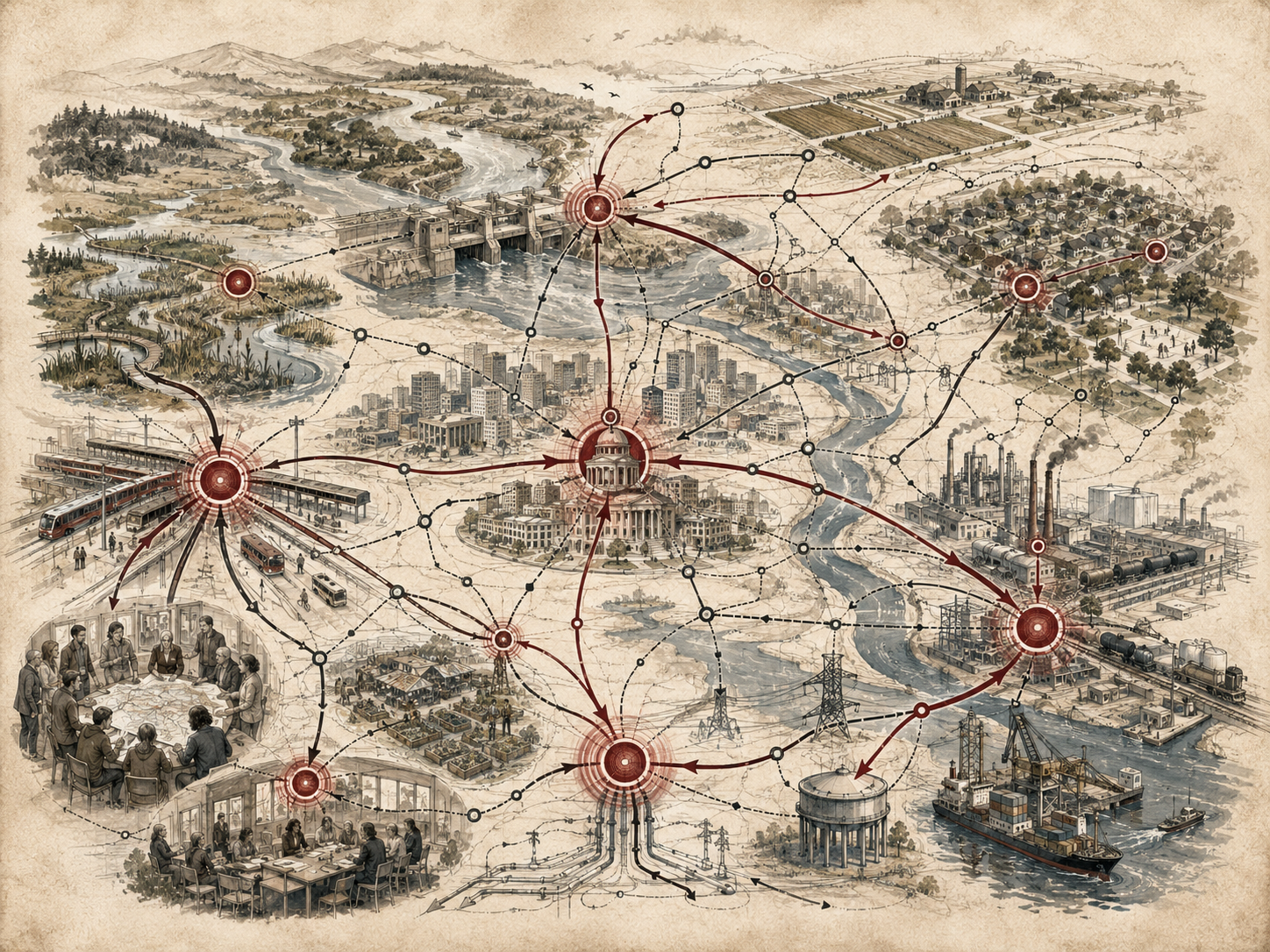
This article develops leverage points as a practical, analytical, and ethical framework for changing complex systems. It begins with Donella Meadows’s twelve-point hierarchy and later research that groups leverage into parameters, feedbacks, system design, and system intent. It then examines symptoms and structures, stocks and flows, buffers, delays, information, rules, incentives, self-organization, goals, paradigms, boundary choices, intervention portfolios, sequencing, path dependence, evaluation, and power.
The central argument is that leverage is not a synonym for force. It is the capacity to alter the processes through which a system reproduces behavior. That capacity may arise from changing a rate, repairing a stock, weakening a reinforcing loop, strengthening a balancing loop, redirecting information, revising a rule, enabling self-organization, changing a goal, or questioning the paradigm that makes the system appear inevitable. The deeper the intervention, however, the greater the need for legitimacy, safeguards, plural knowledge, and reversible learning.
The article therefore asks two questions at once: Where can the system be changed? and Under what authority, evidence, and ethical conditions should it be changed? A technically powerful intervention is not automatically wise or just. Systems work must examine who defines the problem, who benefits, who bears risk, who can contest the intervention, what capacities are strengthened or depleted, and whether the change repairs structural harm or merely makes an unjust system more efficient.
Why Leverage Points Matter
Leverage points matter because systems often resist direct pressure. A policy may push harder on enforcement while the underlying incentive remains unchanged. An organization may add productivity targets while workload, staffing, trust, and rework loops continue to produce burnout. A city may expand roads while land use and induced demand recreate congestion. A school may add tutoring while housing instability, exclusion, stress, and teacher turnover continue to drain learning. A public agency may improve communication while administrative burden and service failure continue to deplete trust.
In each case, the visible intervention may be real, expensive, and sincere. But if it does not change the structure producing behavior, the old pattern may return. Leverage-point thinking helps distinguish activity from structural change. It asks whether the intervention changes a parameter, a flow, a feedback loop, a rule, a goal, or a paradigm.
Not every intervention point has equal power. Adjusting a number may matter, but changing a feedback loop may matter more. Adding information may matter, but changing who receives information and who can act on it may matter more. Changing a rule may matter, but changing the purpose that gives the rule meaning may matter more. Systems thinkers look for intervention points where change can alter the pattern rather than merely treat the latest event.
Research on sustainability transformations has repeatedly noted a practical bias toward shallow leverage points. Parameters and technical adjustments are easier to specify, fund, model, and evaluate than changes to institutions, knowledge systems, values, or goals. They may also be less threatening to incumbent power. The result can be a portfolio of active interventions that leaves system design and intent largely intact. A leverage perspective helps make that bias visible without dismissing the real value of near-term or enabling actions (Abson et al., 2017; Dorninger et al., 2020).
| Intervention focus | Typical effect | Systems question |
|---|---|---|
| Events | Responds to immediate symptoms. | What happened, and how do we contain it? |
| Patterns | Recognizes recurrence over time. | Why does this keep happening? |
| Structures | Changes the relationships that generate behavior. | What system design produces this pattern? |
| Goals | Changes what the system optimizes. | What is the system actually trying to achieve? |
| Paradigms | Changes the worldview that defines the system. | What assumptions make this system seem natural or necessary? |
Leverage-point analysis is not only a technical method. It is also a discipline of restraint. It asks where intervention should occur, where it should not occur, and what harm could follow from acting at the wrong level. A powerful intervention can create damage if it ignores power, distribution, history, or ecological limits. Leverage is not automatically wisdom.
What a Leverage Point Is
A leverage point is a place in a system where a change can produce disproportionate effects on system behavior. The change may be small in scale but large in consequence because it alters feedback, information, incentives, rules, goals, or the system’s deeper logic. A leverage point is not simply a place where people want change. It is a place where system behavior can actually be redirected.
Leverage points can be shallow or deep. Shallow leverage points change numbers, resources, rates, or visible settings. They can matter, especially when a system is under-resourced. But they often leave deeper structure intact. Deep leverage points change the rules, goals, information flows, power relationships, or paradigms that determine how the system behaves.
For example, increasing the budget for a public agency may be necessary. But if the agency’s procedures still create administrative burden, if performance metrics reward speed over dignity, if applicants have no meaningful appeal pathway, and if public trust remains depleted, budget alone may not change the system pattern. A deeper intervention might redesign access rules, reduce burden, improve accountability, change measures of success, and create feedback from affected people.
\text{System Behavior} = f(\text{Structure}, \text{Feedback}, \text{Rules}, \text{Goals}, \text{Paradigms})
\]
Interpretation: Leverage points matter because system behavior is generated by deeper structure, not only by immediate inputs or visible events.
A leverage point should be evaluated by the behavior it changes. Does it reduce recurrence? Does it alter feedback? Does it repair a depleted stock? Does it prevent harm from accumulating? Does it change who receives information? Does it change incentives? Does it redistribute authority? Does it shift the system goal? Does it open the possibility of self-correction?
Leverage points are often counterintuitive because people tend to look where symptoms are loudest. Systems thinking asks where the pattern is produced.
A candidate leverage point should be assessed along at least four dimensions:
- Depth: how far does the intervention reach into the structures that generate behavior?
- Direction: does it weaken a harmful process or accidentally strengthen it?
- Feasibility: are authority, capacity, legitimacy, resources, and implementation conditions present?
- Durability: will the system adapt, compensate, reverse, or capture the change?
These dimensions prevent leverage from being reduced to a single claim about magnitude. An intervention can be deep but infeasible, feasible but shallow, powerful but unjust, or beneficial initially but unstable over time.
Meadows’s Twelve Leverage Points
Donella Meadows organized twelve places to intervene in a system from comparatively shallow to comparatively deep. The ordering is not a mechanical scoring formula and should not be treated as a universal recipe. It is a heuristic for asking why some interventions alter visible settings while others change the system’s capacity, architecture, purpose, or worldview. Meadows also emphasized that people often push leverage points in the wrong direction: institutions may intensify growth, centralization, extraction, surveillance, or throughput precisely where a reversal would be needed.
Later sustainability research condensed the twelve points into four broad realms: parameters, feedbacks, system design, and system intent. This simplification helps compare interventions, but the twelve-point formulation remains useful because it distinguishes different kinds of structural change that can otherwise be collapsed together.
| Relative depth | Place to intervene | Diagnostic question | Illustrative intervention |
|---|---|---|---|
| 12 | Constants, parameters, and numbers | Which numerical setting constrains behavior? | Change a tax rate, staffing level, threshold, cap, subsidy, or service hour. |
| 11 | Sizes of buffers relative to flows | Does the system have enough slack to absorb stress? | Build reserves, redundancy, ecological diversity, surge capacity, or recovery time. |
| 10 | Physical and material stock-flow structures | What infrastructure or accumulation pattern channels behavior? | Redesign transport networks, maintenance systems, supply chains, housing stock, or data architecture. |
| 9 | Delays relative to the rate of system change | Does feedback arrive in time to support correction? | Shorten detection, decision, implementation, or repair delays; preserve deliberative delays where necessary. |
| 8 | Strength of balancing feedback loops | Can the system detect and correct deviation from a legitimate goal? | Improve inspection, appeals, adaptive management, safety controls, or ecological thresholds. |
| 7 | Gain around reinforcing feedback loops | What process amplifies growth, decline, concentration, or collapse? | Interrupt debt spirals, burnout loops, misinformation cascades, or extraction incentives; reinforce trust and learning loops. |
| 6 | Structure of information flows | Who knows what, when, and with what ability to act? | Expose hidden harms, provide early warning, create public reporting, or route frontline knowledge to decision authority. |
| 5 | Rules of the system | What is permitted, required, rewarded, punished, or protected? | Change eligibility rules, procurement standards, platform policies, property rights, metrics, or accountability procedures. |
| 4 | Power to add, change, or self-organize system structure | Can the system generate new responses rather than repeat inherited ones? | Enable local experimentation, modular redesign, institutional learning, community governance, or new organizational forms. |
| 3 | Goals of the system | What outcome is the system actually organized to optimize? | Shift from throughput to durable outcomes, from extraction to regeneration, or from engagement to safety and agency. |
| 2 | Paradigms from which goals and structures arise | What assumptions define value, possibility, legitimacy, and common sense? | Reframe people as rights-holders, resilience as capacity, nature as living system, or technology as institutionally embedded. |
| 1 | Capacity to hold and transcend paradigms | Can actors recognize that every model and worldview is partial? | Create reflexive institutions capable of revising assumptions, learning across knowledge systems, and resisting ideological closure. |
The hierarchy should not be read as “deeper is always better.” A parameter change may prevent immediate harm. A buffer may be the decisive constraint. A rule change may fail because implementation capacity is absent. A paradigm shift may remain rhetorical if it does not change budgets, authority, infrastructure, or incentives. Effective systems change often combines interventions at several depths.
The hierarchy is most useful when it changes the questions analysts ask. Instead of choosing the deepest-sounding intervention, they can examine whether the proposed action changes the mechanism producing the pattern, whether the system will compensate, whether the intervention can be implemented and governed, and whether affected people have meaningful authority in its design.
Symptoms, Structures, and Places to Intervene
Systems problems usually appear first as symptoms. A queue grows. A bridge fails. A community protests. A workforce burns out. A platform spreads harmful content. A school shows widening learning gaps. A river floods. A public agency faces distrust. These symptoms are real and often urgent. But they are not always the best places to intervene.
A symptom is evidence. It tells us that something is happening in the system. But if intervention stays at the symptom level, the system may reproduce the problem. For example, an agency may reduce a backlog through overtime. The backlog falls briefly, but fatigue, error, and turnover increase. Rework grows. Capacity falls. The backlog returns. The symptom was treated; the structure remained.
Structural intervention asks what produces the symptom. It looks for stocks, flows, feedback loops, delays, rules, incentives, information gaps, boundary errors, and goals. If the symptom is backlog, the structure may include rising demand, low capacity, complex rules, rework, appeals, staff turnover, digital exclusion, and public distrust. If the symptom is flooding, the structure may include land-use change, impervious surface, wetland loss, underfunded drainage, climate stress, and unequal exposure.
| Symptom | Likely shallow intervention | Possible structural intervention |
|---|---|---|
| Backlog | Increase processing pressure. | Reduce demand drivers, simplify rules, increase capacity, prevent rework, repair trust. |
| Burnout | Offer wellness programming. | Redesign workload, staffing, authority, recovery, goals, and incentives. |
| Congestion | Expand road capacity. | Change land use, transit access, pricing, demand, and mobility goals. |
| Public distrust | Increase messaging. | Change institutional behavior, accountability, access, repair, and participation. |
| Ecological degradation | Clean up visible damage. | Reduce harmful flows, restore buffers, change extraction rules, protect regeneration. |
Intervention at the symptom level is sometimes necessary. People need relief. Harm must be contained. Emergencies require response. But if the response does not lead to structural learning, the system may continue producing emergencies. Leverage-point thinking connects immediate response to deeper redesign.
Low-Leverage Interventions: Parameters and Surface Fixes
Parameters are numbers that can be adjusted: tax rates, subsidy levels, staffing levels, budget amounts, processing targets, interest rates, service hours, speed limits, emissions caps, inspection frequency, eligibility thresholds, or performance benchmarks. Parameter changes can matter. They are often politically visible and administratively accessible. But in many systems, they are lower-leverage than changes to feedback, information, rules, goals, or paradigms.
A budget increase can help if underfunding is the main constraint. A staffing increase can help if capacity is the bottleneck. A lower emissions cap can help if enforcement and transition capacity exist. A benefit increase can help if access barriers are low. Parameter changes are not trivial. The mistake is assuming that parameter adjustment alone changes system behavior when deeper structure remains unchanged.
For example, increasing the number of caseworkers may not reduce burden if eligibility rules remain complex, technology systems fail, appeals increase, and performance metrics reward speed over accuracy. Raising a fine may not change behavior if enforcement is unequal, incentives remain strong, or legitimacy is low. Increasing road capacity may not reduce congestion if land use and induced demand respond. Increasing school hours may not improve learning if belonging, stability, teacher capacity, and health are depleted.
x_{t+1} = x_t + p
\]
Interpretation: A parameter \(p\) can change a system variable, but if deeper feedback and structure remain unchanged, the system may adapt and reproduce the original pattern.
Parameter interventions should be assessed with three questions:
- Is the parameter actually constraining the system?
- Will changing it alter a stock, flow, feedback loop, or incentive?
- Will the system compensate in ways that offset the change?
Low leverage does not mean useless. It means limited if used alone. In many cases, parameter changes are necessary support for deeper intervention. More funding may be required to change capacity. Higher wages may be required to reduce turnover. Greater maintenance spending may be required to reduce backlog. But the parameter should be connected to structural change.
Parameters can also have enabling leverage. A temporary budget increase may fund the staff, data infrastructure, participation, or transition support needed to change rules later. A threshold can protect a vulnerable stock while a deeper redesign is negotiated. A subsidy can accelerate adoption long enough for learning and network effects to change the system. The question is whether the parameter opens a pathway toward structural change or becomes a substitute for it.
Parameter choices are also political. The amount of a benefit, the level of an emissions cap, the staffing ratio in a hospital, and the value assigned to a statistical life may distribute risk and opportunity even when they do not change the system’s architecture. Calling an intervention shallow should never be used to minimize its material consequences.
Stocks, Flows, and Buffers
Stocks, flows, and buffers are important leverage points because systems change through accumulation. If the wrong stock is accumulating or a vital stock is depleting, intervention must address the inflows and outflows that change that stock. A policy that acts only on visible activity may fail because it does not repair the accumulated condition.
For example, trust is a stock. Communication is a flow that may contribute to trust, but only if it is matched by reliable service, accountability, and repair. A public agency cannot rebuild trust through messaging if delay, exclusion, and harm continue to drain the stock. Workforce capacity is a stock. Hiring is an inflow, but turnover, burnout, and knowledge loss are outflows. A hiring campaign will fail if the outflows remain larger.
S_{t+1} = S_t + I_t – O_t
\]
Interpretation: A stock changes when inflows and outflows change. Stock-flow leverage requires identifying what is accumulating or depleting and changing the rates that govern it.
Buffers are stocks that protect systems from stress. They include savings, staffing reserves, ecological diversity, maintenance capacity, public trust, social cohesion, spare parts, water storage, soil health, redundancy, institutional memory, and recovery time. Buffers can look inefficient under normal conditions because they are not always used. But they provide resilience when conditions change.
Changing buffers can be a leverage point. A hospital with no surge capacity may be efficient until crisis. A supply chain with no redundancy may be cheap until disruption. A public agency with no staffing buffer may look lean until demand rises. A community with weak social infrastructure may be fragile under stress. Protecting and rebuilding buffers can prevent collapse.
| Stock or buffer | Leverage question | Possible intervention |
|---|---|---|
| Public trust | Are repair flows greater than harm flows? | Accountability, reliable service, participation, burden reduction. |
| Workforce capacity | Are hiring and learning exceeding burnout and turnover? | Retention, workload redesign, onboarding, recovery time. |
| Maintenance backlog | Is repair exceeding deterioration? | Preventive maintenance, asset renewal, climate adaptation. |
| Ecological resilience | Is regeneration exceeding degradation? | Habitat protection, restoration, pollution reduction, ecological buffers. |
| Household security | Are income and support exceeding cost burden and debt? | Income support, housing stability, debt relief, care infrastructure. |
Stock-flow leverage is often slower than symptom relief, but it is more durable. It asks what the system must stop depleting and what it must begin rebuilding.
Buffers involve trade-offs. Too little buffer creates fragility, but a buffer can also preserve an unjust or obsolete system by absorbing pressure for change. Financial reserves can support resilience or entrench incumbents. Ecological buffers can protect communities, but only if access and risk are distributed fairly. Inventory can protect supply, but it can also conceal waste. The leverage question is not simply whether a buffer is larger, but what function it serves, whose risk it absorbs, and whether it supports adaptation or delays necessary transition.
Feedback Loops as Leverage Points
Feedback loops are among the most powerful places to intervene in a system. A feedback loop connects consequences back to causes. It can amplify change, stabilize behavior, create resistance, produce oscillation, or drive collapse. If a recurring problem is generated by feedback, intervention must address the loop.
A reinforcing loop can be constructive or destructive. Trust can build cooperation, cooperation can improve performance, and performance can build trust. But distrust can reduce cooperation, weaken performance, and deepen distrust. Workload can increase stress, stress can increase errors, errors can increase rework, and rework can increase workload. Debt can increase interest burden, interest burden can reduce savings, and reduced savings can increase reliance on debt.
Intervening in a reinforcing loop may require weakening harmful amplification or strengthening beneficial reinforcement. To reduce burnout, an organization may need to break the loop between workload, stress, error, rework, and turnover. To build public trust, an institution may need to strengthen the loop between reliable service, cooperation, performance, and legitimacy.
R: A \xrightarrow{+} B \xrightarrow{+} C \xrightarrow{+} A
\]
Interpretation: A reinforcing loop amplifies change. Leverage may come from interrupting harmful reinforcement or strengthening beneficial reinforcement.
Balancing loops are also leverage points. They regulate behavior around goals, limits, or desired states. A balancing loop can maintain safety, stabilize resources, control risk, and correct drift. But it can also preserve harmful equilibrium. An institution may respond to criticism by protecting reputation rather than repairing harm. A political system may absorb protest without changing the policy that generated it. A workplace may normalize overwork after each temporary relief effort.
B: X \xrightarrow{+} \text{Correction Pressure} \xrightarrow{+} \text{Corrective Action} \xrightarrow{-} X
\]
Interpretation: A balancing loop counteracts change. Leverage may come from improving the accuracy, speed, legitimacy, or goal of correction.
Feedback-loop leverage asks:
- Which loop is driving the pattern?
- Is the loop reinforcing or balancing?
- Is the loop beneficial, harmful, or mixed?
- What strengthens the loop?
- What weakens the loop?
- Where does information enter the loop?
- Where does delay distort the loop?
- Who can act on the feedback?
Changing feedback is often more powerful than changing outputs because feedback shapes future behavior. It changes how the system learns, responds, adapts, and reproduces itself.
Feedback also explains policy resistance. An intervention changes conditions, actors respond, and those responses partially or fully offset the intended effect. Price controls may change supply. efficiency gains may increase total use. enforcement may push activity into less visible channels. performance pressure may increase gaming. A leverage analysis should therefore map not only the first-order effect of an intervention, but the responses of households, organizations, markets, ecosystems, and political coalitions.
Several recurring system archetypes can help:
- Fixes that fail: a rapid remedy relieves the symptom but produces delayed consequences that recreate it.
- Shifting the burden: symptomatic relief weakens investment in the fundamental solution.
- Limits to growth: a reinforcing process eventually activates a constraint that slows or reverses progress.
- Success to the successful: early advantage attracts more resources and widens inequality.
- Escalation: actors respond to each other in a reinforcing competition that raises cost or risk.
Archetypes are prompts, not diagnoses. They should be tested against evidence and context rather than imposed on every system.
Delays, Timing, and Responsiveness
Delays are major leverage points because timing shapes behavior. A system may fail not because it lacks feedback, but because feedback arrives too late, is interpreted too slowly, or triggers action after damage has accumulated. Reducing delay can stabilize a system. Increasing delay can produce oscillation, overshoot, and policy resistance.
In a workforce system, hiring delays can cause repeated overload. Workload rises, leaders approve hiring, recruitment begins, onboarding takes time, and effective capacity arrives after burnout and turnover have already increased. The system responds, but too late. A leverage point may be faster hiring, better workforce planning, retention, workload control, or early-warning indicators.
In climate systems, emissions create delayed effects. The full consequences of today’s emissions unfold over long time horizons. If policy waits for visible harm, the system may already have accumulated risk. A leverage point may be early intervention, precautionary thresholds, adaptive monitoring, or institutional commitments that do not depend on short-term political cycles.
y_t = f(x_{t-d})
\]
Interpretation: A delayed response means current outcomes depend on past system conditions. Leverage may come from reducing delay, improving early warning, or acting before lagging indicators confirm harm.
Delays can be changed in several ways:
- shorten information delay through better monitoring;
- shorten decision delay through clearer authority;
- shorten implementation delay through capacity and preparation;
- shorten repair delay through preventive maintenance and early response;
- reduce perception delay by tracking leading indicators;
- reduce political delay by institutionalizing long-term responsibility.
But not every delay should be eliminated. Some delays protect deliberation, due process, ecological recovery, learning, consent, and safety. The goal is not speed for its own sake. The goal is appropriate timing. Systems thinking asks whether delay is producing harm, preventing overreaction, protecting rights, or enabling learning.
Timing is a leverage point because the same intervention can have different effects depending on when it occurs. Prevention before collapse is different from repair after collapse. Trust repair before crisis is different from messaging after legitimacy has failed. Maintenance before failure is different from emergency response after failure. Timing changes leverage.
Delays interact with thresholds. A system may appear stable while a stock approaches a critical level; by the time a lagging indicator changes, reversal may be expensive or impossible. Groundwater depletion, species loss, infrastructure corrosion, institutional knowledge loss, and legitimacy decline can all accumulate before crisis becomes visible. Leading indicators and precautionary triggers are therefore important where consequences are nonlinear or irreversible.
At the same time, shortening every delay can make a system unstable. Rapid automated decisions can amplify noise. Immediate performance feedback can encourage short-term gaming. Political reaction to each new signal can create oscillation. Appropriate leverage may require slowing action, averaging noisy data, protecting deliberation, or separating emergency authority from permanent rule change.
Information Flows, Transparency, and Learning
Information flows are powerful leverage points because systems act on what they can perceive. If information is delayed, distorted, hidden, inaccessible, or disconnected from authority, the system cannot learn effectively. Changing who receives information, when they receive it, how it is interpreted, and whether they can act on it can transform system behavior.
Information is not neutral. Many systems hide costs from those with power while imposing them on those with less power. A public agency may track completed cases but not discouraged applicants. A company may track productivity but not fatigue. A city may track development revenue but not displacement. A platform may track engagement but not social harm. A climate policy may track annual emissions but not cumulative vulnerability. What is measured becomes visible; what is not measured can be depleted without accountability.
Changing information flows can reveal hidden stocks, externalized costs, and feedback loops. If residents can see flood-risk maps, maintenance budgets, and development impacts, public decision-making changes. If workers can report overload without punishment, burnout loops become visible. If applicants can track benefit delays, administrative burden becomes accountable. If communities can monitor pollution exposure, environmental injustice becomes harder to hide.
\text{Better Information} \rightarrow \text{Better Feedback} \rightarrow \text{Better Correction}
\]
Interpretation: Information-flow leverage works when improved information reaches actors who have authority, capacity, and legitimacy to act on it.
Information-flow leverage should ask:
- What information is missing?
- Who has information but lacks power?
- Who has power but lacks information?
- What costs are hidden outside the official boundary?
- What early warning signals are ignored?
- What measures distort behavior?
- What feedback from affected people reaches decision-makers?
- Can people act on the information they receive?
Transparency alone is not enough. Information must be connected to accountability. A dashboard that shows harm but changes no authority may normalize failure. A report that documents inequity without changing rules may become symbolic. Information becomes leverage when it changes feedback, incentives, participation, and decision-making.
Information can also create harm. Greater visibility may enable surveillance, punishment, market manipulation, discrimination, or the targeting of vulnerable groups. Data collection can transfer knowledge from communities to institutions without returning authority. A high-leverage information intervention therefore needs purpose limitation, access controls, data minimization, interpretability, correction rights, and governance over who may act on the information.
Quality matters as much as access. Biased categories, missing populations, incompatible definitions, and unstable measurement can create false feedback. Information systems should preserve provenance, uncertainty, version history, and the distinction between observed data, modeled estimates, assumptions, and judgments.
Rules, Incentives, and Power
Rules define what is allowed, required, rewarded, punished, measured, funded, ignored, and protected. They are among the strongest leverage points because they shape behavior repeatedly. Rules include laws, regulations, eligibility criteria, budgets, procurement systems, performance metrics, professional standards, platform policies, property rights, institutional procedures, and informal norms.
Incentives are closely related. A system gets more of what it rewards and less of what it punishes, but incentives can produce unintended behavior. If a school is rewarded only for test scores, teaching may narrow. If an agency is rewarded only for speed, accuracy and dignity may decline. If a platform is rewarded for engagement, harmful amplification may increase. If a city is rewarded for development revenue, displacement and ecological strain may be discounted.
Power determines who makes the rules and who lives with the consequences. A rule may look efficient from the institution’s perspective while creating burden for the public. A metric may look objective while reflecting the priorities of powerful actors. A market rule may appear neutral while reproducing historical advantage. Leverage-point thinking must therefore ask whose incentives are being changed and whose agency is being constrained.
| Rule or incentive | Behavior it may produce | Leverage question |
|---|---|---|
| Processing quotas | Speed, but possibly errors and rework. | Does the metric reward real service quality? |
| Eligibility verification | Error control, but possibly exclusion and burden. | Does burden fall on people least able to absorb it? |
| Engagement-based platform ranking | Attention capture and amplification. | Does the rule reward harm, outrage, or misinformation? |
| Deferred maintenance budgeting | Short-term savings. | Does the rule shift risk to the future? |
| Growth-oriented development incentives | Expansion and revenue. | Are ecological and social costs included? |
Changing rules can change the system’s recurring behavior. A public benefits system can shift from suspicion-based verification to accessible enrollment with accountable audit. A workplace can shift from output pressure to sustainable capacity. A city can shift from car throughput to accessibility and resilience. A platform can shift from engagement maximization to safety, trust, and user agency.
Rules are deep leverage because they shape future flows without requiring constant intervention. But rule changes must be designed carefully. A poorly designed rule can create gaming, exclusion, policy resistance, or burden shifting. Rule change should be paired with feedback, monitoring, participation, and repair.
Rules also operate in layers. A formal policy may be overridden by budget rules, procurement constraints, professional norms, software defaults, staffing realities, or informal discretion. Changing one written rule may have little effect if adjacent rules still reward the old behavior. Analysts should distinguish:
- rules as written;
- rules as encoded in technology and forms;
- rules as funded and staffed;
- rules as interpreted by frontline workers;
- rules as experienced by affected people; and
- rules as enforced against powerful and less powerful actors.
A credible rule-change intervention includes implementation resources, conflict resolution, monitoring for unequal burden, and the authority to revise the rule when it produces unintended effects.
Self-Organization and the Capacity to Evolve
Self-organization is the capacity of a system to create, revise, combine, or retire its own structures. It includes the ability to learn, experiment, form new relationships, develop new institutions, diversify responses, and adapt without waiting for a single central authority. In Meadows’s hierarchy, this capacity is deeper than changing an existing rule because it changes who can generate rules and structures in the future.
A self-organizing system does not merely execute a fixed design more efficiently. It can produce new designs. Ecosystems self-organize through variation, selection, succession, migration, and adaptation. Scientific communities self-organize through inquiry, replication, criticism, and the formation of new fields. Communities may create mutual-aid networks, cooperatives, watershed councils, neighborhood institutions, or open-source tools when established systems do not meet emerging needs. Organizations can build self-organization through modular teams, protected experimentation, distributed decision rights, learning routines, and the ability to retire obsolete procedures.
| Capacity | What it enables | What can suppress it | Leverage intervention |
|---|---|---|---|
| Variation | Multiple approaches can be tested. | Rigid standardization, punitive failure, monopoly control. | Protected pilots, modular design, plural methods, local discretion. |
| Selection | Useful practices can be distinguished from harmful ones. | Weak evidence, political favoritism, distorted metrics. | Transparent evaluation, peer review, stakeholder-defined criteria. |
| Retention | Learning survives turnover and crisis. | Knowledge loss, short funding cycles, undocumented decisions. | Institutional memory, open documentation, stable stewardship. |
| Recombination | Ideas and capabilities can be connected in new ways. | Silos, proprietary barriers, incompatible standards. | Interoperability, boundary-spanning roles, shared infrastructure. |
| Exit and retirement | Failed or harmful structures can be removed. | Sunk-cost defense, lock-in, incumbent power. | Sunset clauses, decommissioning plans, appeal and review pathways. |
Self-organization is not automatically democratic or beneficial. Harmful markets, extremist networks, corruption, misinformation, and extractive institutions can also self-organize. The leverage question is not simply whether a system adapts, but what forms of adaptation it permits, who can participate, what values guide selection, and what safeguards prevent domination.
Designing for constructive self-organization therefore requires a tension between freedom and constraint. Too little freedom prevents learning. Too little constraint permits capture, exclusion, unsafe experimentation, or burden shifting. High-leverage design creates bounded spaces for adaptation: clear rights and responsibilities, transparent evidence, distributed initiative, shared standards, meaningful review, and the ability to correct or stop harmful change.
Goals, Paradigms, and Deep Leverage
The deepest leverage points concern system goals and paradigms. Later leverage-point scholarship often groups these deeper interventions under system intent, distinguishing them from parameters, feedbacks, and system design (Abson et al., 2017; Fischer and Riechers, 2019). A system’s goal defines what it is organized to achieve. A paradigm defines what the system assumes to be true, valuable, possible, natural, or legitimate. If the goal is wrong, many interventions will merely help the system do the wrong thing more efficiently.
Goals can be explicit or implicit. A public agency may state that its goal is access, but its metrics may reveal that it optimizes fraud avoidance or processing speed. A company may state that it values wellbeing, but its incentives may optimize output and availability. A city may state that it values sustainability, but its budgeting may optimize short-term development revenue. A platform may state that it values community, but its design may optimize engagement.
Changing goals can transform behavior because goals organize feedback. If a system’s goal is throughput, it will measure and reward throughput. If the goal becomes dignity, access, and durable outcome, the system must change what it measures and how it acts. If the goal shifts from growth to resilience, maintenance and buffers become central. If the goal shifts from control to learning, feedback from affected people becomes valuable rather than inconvenient.
\text{Goal} \rightarrow \text{Metrics} \rightarrow \text{Feedback} \rightarrow \text{Behavior}
\]
Interpretation: Goals shape what the system measures, what feedback matters, and what behavior is reinforced.
Paradigms sit even deeper. They include assumptions such as:
- growth is always good;
- efficiency is more important than resilience;
- people are primarily risks to control;
- technology is neutral;
- nature is an external resource;
- unpaid care is not real economic value;
- public burden is acceptable if institutional cost falls;
- future generations can absorb present damage.
Changing a paradigm is difficult because paradigms define what counts as common sense. But paradigm shifts can unlock changes that were previously unimaginable. If a city sees water as a living watershed rather than a drainage problem, policy changes. If a workplace sees recovery as capacity rather than laziness, management changes. If a public agency sees applicants as rights-holders rather than risks, administrative design changes. If an economy sees ecological limits as real constraints rather than externalities, planning changes.
Deep leverage is powerful because it changes the meaning of the system. It changes not only what the system does, but what the system believes it is for.
System intent is revealed less by mission statements than by recurring allocation. Budgets, incentives, defaults, infrastructure, risk tolerance, and whose complaints trigger action often expose the operative goal. A platform may say it values healthy communities while optimizing watch time. An agency may say it values access while investing more heavily in verification than service. A city may say it values resilience while deferring maintenance and permitting development in high-risk areas.
Paradigm change becomes operational when it changes these material commitments. A rights-based paradigm should alter burden of proof, appeal, access, data practice, and accountability. A regenerative paradigm should alter extraction limits, ownership, investment, and measures of success. Without institutional translation, deep language can become a shield for shallow continuity.
Boundaries, Externalities, and Problem Framing
Every leverage analysis begins by drawing a boundary. The boundary determines which actors, stocks, flows, histories, costs, and consequences are visible. It also determines what is treated as an externality. A system can appear efficient, stable, or successful when burdens have been moved outside the frame.
A delivery platform may optimize speed while excluding driver risk, warehouse injury, packaging waste, municipal congestion, and household labor from its performance model. A public agency may report rapid case closure while excluding discouraged applicants, wrongful denials, repeated appeals, and the unpaid work required to navigate the process. A city may report development growth while excluding displacement, heat exposure, infrastructure liabilities, and watershed degradation. Boundary choice is therefore not a neutral preliminary step. It is itself a leverage point because it shapes what the system can perceive and what decision-makers are required to value.
| Boundary choice | What becomes visible | What may remain hidden | Corrective question |
|---|---|---|---|
| Organizational boundary | Internal costs, outputs, and responsibilities. | Supply-chain harm, community burden, public subsidy. | Which costs are displaced beyond the institution? |
| Temporal boundary | Near-term results and current performance. | Maintenance debt, cumulative exposure, future generations. | What accumulates after the reporting period ends? |
| Geographic boundary | Impacts inside the official jurisdiction. | Upstream extraction, downstream pollution, cross-border effects. | Where do material and risk flows actually travel? |
| Population boundary | Average or officially enrolled participants. | Excluded groups, informal workers, non-users, discouraged applicants. | Who is affected without appearing in the dataset? |
| Problem boundary | The issue as defined by the commissioning institution. | Alternative diagnoses, historical causes, contested values. | Who has the authority to define the problem? |
Problem framing works with boundary choice. The same pattern can be framed as an individual failure, a service-design problem, a market failure, a governance failure, a historical injustice, or an ecological overshoot. Each frame directs attention toward different causes and interventions. Framing burnout as a resilience deficit produces training and wellness programs. Framing it as a workload, authority, staffing, and incentive problem produces structural redesign. Framing flood damage as a drainage problem produces larger pipes. Framing it as a watershed, land-use, climate, housing, and justice problem opens different leverage points.
A rigorous analysis should therefore compare multiple plausible boundaries and frames. It should document what each includes and excludes, how the choice changes the diagnosis, whose knowledge supports the frame, and which interests benefit from keeping the boundary narrow. Expanding a boundary indefinitely is not practical, but leaving boundary decisions implicit allows power to hide inside the model.
Intervention Portfolios, Sequencing, and Path Dependence
Complex systems are rarely transformed by one lever. Whether an intervention becomes transformative also depends on context, timing, and the conjunction of enabling conditions (Linnér and Wibeck, 2021). Deep change more often emerges from a portfolio of interventions that operate at different depths and reinforce one another over time. Parameter changes can create room for structural redesign. Information reforms can expose hidden harm. Rule changes can redirect incentives. New institutions can protect self-organization. Goal and paradigm shifts can align these changes around a different purpose.
The order matters. Research on interacting policy and norm shifts similarly suggests that transformation depends on combinations of mutually reinforcing changes rather than isolated actions (Chapin et al., 2022). An ambitious rule introduced before implementation capacity exists may collapse and discredit the reform. Participation without access to information may become symbolic. Transparency without authority may normalize failure. A new goal without changed metrics may be absorbed by the old system. Conversely, a well-sequenced portfolio can create reinforcing change: early relief builds legitimacy, improved information strengthens learning, new rules alter incentives, successful pilots demonstrate alternatives, and institutionalization makes reversal more difficult.
| Sequence stage | Primary task | Typical leverage points | Failure risk |
|---|---|---|---|
| 1. Stabilize | Contain immediate harm and restore minimum capacity. | Parameters, buffers, emergency flows. | Temporary relief becomes the permanent strategy. |
| 2. Reveal | Make the pattern, burden, and feedback structure visible. | Information flows, measurement, boundary expansion. | Data collection substitutes for authority or action. |
| 3. Reconfigure | Change recurring relationships and incentives. | Rules, feedback loops, stock-flow architecture, delays. | Incumbents redirect or capture the reform. |
| 4. Enable | Build capacity to experiment, adapt, and generate alternatives. | Self-organization, distributed authority, learning infrastructure. | Experimentation shifts risk onto vulnerable groups. |
| 5. Reorient | Align goals, metrics, and narratives around a new purpose. | Goals, paradigms, legitimacy, public meaning. | Symbolic reframing leaves material structures intact. |
| 6. Institutionalize | Protect gains, preserve learning, and enable correction. | Law, budgets, standards, review, stewardship, sunset rules. | Lock-in prevents adaptation when conditions change. |
Path dependence complicates sequencing. Earlier investments, standards, skills, property arrangements, and expectations constrain what can happen later. A city built around automobile access cannot instantly shift to multimodal mobility. A benefits system built around fraud suspicion cannot become rights-centered through a new mission statement alone. A platform optimized for engagement cannot become safe through content moderation while ranking incentives remain unchanged. Existing paths create material and political constituencies that defend the system.
Intervention portfolios should therefore be judged not only by their immediate effect, but by the future options they create or foreclose. A good early intervention may be valuable because it builds capacity, trust, data, legal authority, or institutional imagination needed for deeper change. A harmful early intervention may harden infrastructure, increase dependence, concentrate power, or make alternatives more expensive. Leverage includes the power to shape the next decision.
Ethics: Leverage for Whom?
Leverage-point thinking must be ethical because powerful intervention can produce powerful harm. A leverage point is not automatically good. An authoritarian system can use leverage to control. A corporation can use leverage to extract. A platform can use leverage to manipulate attention. A government can use leverage to exclude people more efficiently. A system can become more effective at unjust goals.
The ethical question is not only “Where can we intervene?” It is “Who defines the problem, who chooses the intervention, who benefits, who bears risk, who can contest the change, and what values guide the system?” Leverage without justice can intensify structural harm.
For example, changing information flows can empower communities, but it can also increase surveillance. Changing rules can reduce burden, but it can also restrict access. Changing incentives can improve quality, but it can also create gaming. Changing goals can support dignity, but it can also reframe people as optimization targets. Deep intervention requires accountability.
Ethical leverage-point analysis asks:
- Who has authority to intervene?
- Who experiences the consequences?
- Who helped define the problem?
- Whose knowledge is included?
- Which stocks are repaired?
- Which harms are reduced?
- What burdens are shifted?
- What safeguards are needed?
- What feedback can affected people provide?
- How can the system correct harm after intervention?
Leverage should be connected to repair, dignity, ecological responsibility, and democratic accountability. A powerful intervention that does not allow affected people to challenge, revise, or stop harm may become another form of domination. Systems thinking should make power more visible, not hide it behind technical language.
Ethical analysis should distinguish several dimensions:
- Distributive justice: how benefits, burdens, risks, resources, and transition costs are allocated.
- Procedural justice: who participates, who decides, what reasons are given, and how decisions can be challenged.
- Recognition: whose identity, history, knowledge, rights, and experience are treated as legitimate.
- Corrective justice: what repair, compensation, restoration, or redress follows harm.
- Intergenerational justice: whether present gains depend on depleted future capacity or irreversible damage.
- Ecological responsibility: whether nonhuman life, ecological integrity, and planetary limits are treated as constraints rather than residual values.
The deeper the leverage point, the greater the ethical responsibility.
Participation, Power, and Legitimate Authority
Leverage analysis often identifies actors who can alter rules, flows, or goals. That does not establish that they have legitimate authority to do so. Influence, capacity, legal power, expertise, and democratic legitimacy are different properties. A company may have technical capacity but no right to impose social costs. A government may have legal authority but weak public legitimacy. A community may have direct knowledge and moral standing but little formal power. An expert may understand the model but not the lived consequences.
Participation should therefore be designed as part of the intervention mechanism, not added as a ceremonial consultation step. This is especially important in technology governance, where a leverage-point perspective can reveal institutional, organizational, and individual zones of responsibility that accuracy-centered approaches miss (Nabavi and Browne, 2023). Affected people may hold knowledge about hidden burdens, informal workarounds, historical harm, local thresholds, and implementation failure that is absent from official data. They may also identify unacceptable trade-offs that an aggregate model would treat as efficient.
| Dimension | Weak form | Stronger form | Leverage implication |
|---|---|---|---|
| Information | People are informed after decisions are made. | People receive accessible evidence before choices are fixed. | Changes what knowledge enters the decision loop. |
| Voice | Comments are collected without response obligations. | Institutions must explain how input changed or did not change the design. | Connects participation to accountability. |
| Representation | Convenient or already powerful stakeholders dominate. | Affected and excluded groups have supported representation. | Changes whose interests shape the intervention. |
| Decision authority | Participation is advisory only. | Shared governance, consent, veto, appeal, or delegated authority is available where appropriate. | Redistributes rule-making power. |
| Correction | Harm is documented after implementation. | People can trigger review, pause, redress, or redesign. | Creates a balancing feedback loop against institutional harm. |
Legitimate authority is contextual. Emergency response may require temporary centralized action. Long-term land-use change may require deliberation across generations and jurisdictions. Community data governance may require consent and collective control. Technical safety standards may require specialist judgment, but their goals and distributional effects remain public questions. The appropriate design depends on the type of harm, reversibility, uncertainty, affected rights, and concentration of power.
A practical authority assessment should ask:
- Who has legal authority, technical capacity, lived knowledge, and moral standing?
- Which actors can block, capture, dilute, or reverse the intervention?
- Who is affected but not formally represented?
- What decisions require consent, co-design, public justification, or independent review?
- What appeal, redress, and stopping mechanisms exist?
- How will authority change if evidence shows harm?
The aim is not to make every decision unanimous. It is to prevent technical language from converting contested political and ethical choices into apparently neutral optimization problems.
Examples Across Systems
Leverage points appear across social, ecological, technical, and institutional systems. The examples below show how systems thinking shifts attention from surface fixes to structural intervention.
Public health
A shallow intervention may increase public-health messaging. A deeper intervention may rebuild trust, improve access, reduce cost barriers, support community health workers, change service delivery, and include affected communities in design. If the system’s problem is not lack of information but lack of trust and access, messaging alone has limited leverage.
Infrastructure
A shallow intervention may repair the latest failure. A deeper intervention may change maintenance budgeting, asset monitoring, climate adaptation, land-use rules, emergency response, and public accountability. The leverage point may not be the broken pipe or bridge alone, but the funding and governance structure that allowed backlog to accumulate.
Organizations
A shallow intervention may offer wellness resources after burnout appears. A deeper intervention may change workload design, staffing ratios, recovery time, decision authority, performance metrics, meeting culture, and leadership accountability. The leverage point is not individual resilience alone, but the system that depletes people.
Education
A shallow intervention may add test preparation. A deeper intervention may strengthen belonging, teacher capacity, family support, stable housing, mental health, curriculum relevance, and anti-exclusionary practice. If learning is a stock built by many flows, a single instructional flow may not be enough.
Artificial intelligence systems
A shallow intervention may improve model accuracy. A deeper intervention may change deployment rules, appeal rights, data governance, human oversight, auditability, procurement standards, institutional accountability, and the goals of automation. If the system optimizes efficiency without accountability, accuracy alone is insufficient leverage.
Climate and ecology
A shallow intervention may clean up damage after an event. A deeper intervention may reduce harmful flows, restore ecosystems, change land use, protect buffers, shift incentives, redesign infrastructure, and change the goal from extraction to regeneration. Ecological leverage often lies in changing the rules that govern resource use.
Economic systems
A shallow intervention may provide temporary relief. A deeper intervention may change debt structures, housing markets, labor protections, public investment, wealth-building flows, tax rules, and the treatment of ecological externalities. If inequality is an accumulated stock, leverage requires changing the flows that reproduce it.
Public administration
A shallow intervention may add another service channel. A deeper intervention may reduce administrative burden, redesign eligibility rules, change performance metrics, improve appeal access, fund implementation capacity, and create feedback from applicants. The leverage point may be the rule that creates burden, not the help desk that explains it.
Across these domains, leverage-point thinking asks whether the intervention changes the structure that generates behavior. It is not enough to act. The intervention must act at the right level.
Worked Diagnostic: A Public-Benefits Backlog
Consider a public-benefits agency with a growing application backlog. The visible problem is a queue. The immediate response may be overtime, processing quotas, temporary contractors, or automated triage. These actions can reduce waiting time, and in an emergency they may be necessary. But they do not reveal whether the backlog is primarily a capacity shortage, a demand surge, a rule-complexity problem, a technology failure, a rework loop, an appeals problem, or a trust and access problem.
A behavior-over-time view may show a repeated cycle. Demand rises. Processing pressure increases. Staff work faster. Error rates rise. Incorrect denials and incomplete files generate appeals and repeat contacts. Rework increases workload. Burnout and turnover reduce experienced capacity. Applicants submit duplicate documents because status information is poor. The backlog briefly falls and then returns at a higher level.
ext{Backlog}_{t+1}
=
ext{Backlog}_{t}
+
ext{New Applications}_{t}
+
ext{Rework}_{t}
–
ext{Correct Completions}_{t}
\]
Interpretation: Processing more cases does not necessarily reduce backlog if error, rework, repeat contact, and turnover increase at the same time.
The central reinforcing loop can be represented as:
ext{Backlog}ightarrow
ext{Processing Pressure}
ightarrow
ext{Error and Fatigue}
ightarrow
ext{Rework and Turnover}
ightarrow
ext{Lower Effective Capacity}
ightarrow
ext{Backlog}
\]
Interpretation: A pressure-based intervention can strengthen the loop it is intended to weaken.
A leverage portfolio might include:
| Intervention depth | Action | Expected mechanism | Evidence to monitor |
|---|---|---|---|
| Parameter | Add temporary staffing and extend service capacity. | Prevents immediate queue growth and creates room for redesign. | Wait time, staff hours, cost, abandonment. |
| Stock and flow | Protect experienced staff, improve onboarding, and reduce avoidable rework. | Rebuilds effective capacity and slows knowledge loss. | Turnover, error rate, repeat contacts, time to proficiency. |
| Delay | Provide real-time status and early missing-document alerts. | Reduces duplicate submissions, uncertainty, and late correction. | Document completeness, repeat calls, processing delay. |
| Information | Publish denial, appeal, and burden measures disaggregated by group and channel. | Makes hidden failure and unequal burden visible. | Wrongful denial, appeal success, digital exclusion, language access. |
| Rule | Simplify verification, permit trusted data reuse, and redesign performance metrics. | Reduces burden and stops rewarding speed at the expense of accuracy. | Steps per application, evidence requests, accuracy, dignity measures. |
| Self-organization | Create frontline and applicant design councils with authority to test process changes. | Builds local learning and adaptation into the system. | Implemented proposals, cycle time, stakeholder trust, reversal of harmful pilots. |
| Goal | Shift from cases processed to timely, correct, accessible, and durable benefit delivery. | Changes what performance management reinforces. | Correct receipt, continuity, exclusion, long-term outcome. |
| Paradigm | Treat applicants as rights-holders rather than presumptive risks. | Changes the logic of access, evidence, discretion, and accountability. | Burden distribution, appeal access, procedural fairness, public trust. |
The example illustrates why intervention depth and intervention sequence must be considered together. Temporary staffing can be high-value if it creates the capacity to simplify rules and repair feedback. The same staffing increase can become low-value if it merely feeds a quota system that produces more errors. Status information can reduce uncertainty, but it cannot compensate for exclusionary eligibility rules. A new rights-centered goal can guide redesign, but it must be translated into budgets, measures, authority, technology, and review.
The ethical evaluation also changes the diagnosis. Aggregate backlog reduction may conceal higher denial rates for applicants using a particular language, disability accommodation, neighborhood office, or digital channel. A technically effective intervention that shifts burden toward people least able to absorb it should not be classified as successful. The unit of analysis must include distribution, procedure, and the capacity to contest error.
Mathematics, Computation, and Modeling
Leverage points can be studied through causal-loop diagrams, stock-flow models, scenario analysis, sensitivity analysis, network analysis, intervention testing, and simulation. Computational models can help identify which variables, flows, feedback loops, delays, or rules have strong effects on system behavior. But modeling should support judgment, not replace it.
A simple intervention model can be represented as:
x_{t+1} = F(x_t, u_t, \theta)
\]
Interpretation: The future system state depends on the current state \(x_t\), intervention \(u_t\), and structural assumptions \(\theta\). Leverage analysis asks which intervention changes the system trajectory most meaningfully.
A leverage effect can be represented as the change in outcome produced by intervention:
L(u) = Y_{\text{with intervention}} – Y_{\text{baseline}}
\]
Interpretation: The leverage of intervention \(u\) can be approximated by comparing the system outcome under intervention with the baseline trajectory.
A stock-flow intervention can be represented as:
S_{t+1} = S_t + I(u_t,t) – O(u_t,t)
\]
Interpretation: An intervention has stock-flow leverage when it changes the inflows or outflows that govern accumulation.
A feedback-loop intervention can be represented as a change in loop strength:
x_{t+1} = x_t + \alpha f(x_t)
\]
Interpretation: Changing the feedback strength \(\alpha\) can alter whether a loop amplifies, stabilizes, or destabilizes system behavior.
A delay intervention can be represented as:
y_t = f(x_{t-d})
\]
Interpretation: Reducing delay \(d\) can improve system responsiveness, prevent overcorrection, and reduce overshoot when feedback arrives too late.
A rule or goal change may require structural model comparison:
F_{\text{old}}(x_t) \neq F_{\text{new}}(x_t)
\]
Interpretation: Deep leverage changes the system’s governing structure, not only parameter values. The old and new models may generate different behavior from the same initial condition.
A portfolio of interventions can be represented as a time-indexed sequence:
x_{t+1}
=
F\!\left(
x_t,
u^{(1)}_{t},
u^{(2)}_{t},
\ldots,
u^{(k)}_{t},
\theta
\right)
\]
Interpretation: Outcomes depend on how multiple interventions interact and when they are introduced, not only on the isolated effect of one action.
Because leverage claims are uncertain, analysis should compare interventions across plausible structural assumptions:
R(u)
=
\min_{\theta \in \Theta}
\left[
B(u,\theta)
–
H(u,\theta)
\right]
\]
Interpretation: A robust intervention performs acceptably across a set of plausible assumptions \(\Theta\), balancing expected benefit \(B\) against harm \(H\) rather than maximizing one forecast.
Distributional constraints can be included explicitly:
\max_{u} \; W(u)
\quad
\text{subject to}
\quad
H_g(u) \leq \tau_g
\;\; \forall g
\]
Interpretation: Aggregate welfare \(W\) should not be optimized by allowing harm to exceed an acceptable threshold \(\tau_g\) for any affected group \(g\).
These formulations do not make the ethical choices objective. They make assumptions inspectable. Analysts must still explain how benefits and harms are defined, why a threshold is legitimate, whose outcomes are disaggregated, what uncertainties are excluded, and who has authority to choose among trade-offs.
| Modeling task | Leverage question | Example output |
|---|---|---|
| Baseline simulation | What happens if current structure continues? | Behavior-over-time trajectory. |
| Intervention comparison | Which intervention changes the trajectory most? | Policy comparison table. |
| Sensitivity analysis | Which assumptions or parameters drive outcomes? | Leverage ranking by sensitivity. |
| Feedback-loop analysis | Which loops amplify or stabilize the behavior? | Reinforcing and balancing loop diagnostics. |
| Delay testing | Does reducing delay improve stability? | Oscillation and overshoot comparison. |
| Structural comparison | Does changing rules or goals change the system mode? | Old-structure versus new-structure scenarios. |
| Distributional analysis | Who benefits from the leverage point? | Group-level outcome and burden comparison. |
| Portfolio sequencing | Which order creates capacity for deeper change? | Phase-based intervention pathway and dependency map. |
| Uncertainty ensemble | Does the intervention remain acceptable under different assumptions? | Robustness range, regret score, and failure conditions. |
| Governance stress test | How could capture, weak implementation, or unequal authority alter results? | Institutional failure scenarios and safeguard requirements. |
Computational leverage analysis should remain transparent. The model should document assumptions, boundaries, intervention definitions, outcome measures, and distributional effects. A model may identify a high-leverage point technically, but the intervention still requires ethical evaluation. High leverage is not the same as legitimate authority.
Python Workflow: Leverage Diagnostics, Intervention Comparison, and Distributional Analysis
The Python workflow below turns leverage-point analysis into a small reproducible systems model. It compares four intervention levels: parameter adjustment, stock and flow repair, feedback and information redesign, and rules, goals, and stakeholder power. It also includes one-at-a-time sensitivity analysis for the deepest intervention. The script uses only the Python standard library, writes CSV outputs relative to the article folder, and is designed as a clear starting point for companion repository work.
# leverage_points_intervention_workflow.py
# Transparent, dependency-light workflow for leverage-point diagnostics,
# intervention comparison, feedback, stocks and flows, delays, governance,
# distributional outcomes, and sensitivity analysis.

from __future__ import annotations

from dataclasses import dataclass, replace
from pathlib import Path
import csv
from statistics import mean

ARTICLE_ROOT = Path(__file__).resolve().parents[1]
TABLES = ARTICLE_ROOT / "outputs" / "tables"


@dataclass(frozen=True)
class LeverageIntervention:
    name: str
    parameter_change: float
    stock_repair: float
    harmful_flow_reduction: float
    beneficial_flow_increase: float
    feedback_redesign: float
    delay_reduction: float
    information_access: float
    rule_change: float
    goal_shift: float
    affected_stakeholder_power: float
    implementation_capacity: float
    distributional_safeguard: float


def clamp(value: float, low: float = 0.0, high: float = 100.0) -> float:
    return max(low, min(high, value))


def information_access_score(intervention: LeverageIntervention) -> float:
    return clamp(
        intervention.information_access * 55.0
        + intervention.affected_stakeholder_power * 25.0
        + intervention.delay_reduction * 20.0
    )


def simulate(
    intervention: LeverageIntervention,
    periods: int = 60,
) -> list[dict[str, object]]:
    # Synthetic starting conditions. These are not empirical estimates.
    trust_stock = 42.0
    capacity_stock = 44.0
    burden_stock = 58.0
    harm_stock = 52.0
    policy_learning = 32.0
    legitimacy = 40.0
    vulnerable_group_burden = 48.0
    rows: list[dict[str, object]] = []

    for period in range(periods + 1):
        surface_relief = clamp(
            10.0
            + intervention.parameter_change * 45.0
            + intervention.implementation_capacity * 15.0
            - burden_stock * 0.05
            - harm_stock * 0.04
        )

        repair_inflow = clamp(
            8.0
            + intervention.stock_repair * 25.0
            + intervention.beneficial_flow_increase * 18.0
            + intervention.affected_stakeholder_power * 10.0
            + intervention.distributional_safeguard * 8.0
            + legitimacy * 0.05
        )

        harm_outflow_reduction = clamp(
            5.0
            + intervention.harmful_flow_reduction * 30.0
            + intervention.rule_change * 18.0
            + intervention.goal_shift * 12.0
            + intervention.distributional_safeguard * 10.0
        )

        feedback_gain = clamp(
            5.0
            + intervention.feedback_redesign * 26.0
            + intervention.information_access * 18.0
            + intervention.delay_reduction * 14.0
            + intervention.affected_stakeholder_power * 10.0
            + intervention.rule_change * 8.0
        )

        governance_shift = clamp(
            4.0
            + intervention.rule_change * 20.0
            + intervention.goal_shift * 20.0
            + intervention.affected_stakeholder_power * 14.0
            + intervention.information_access * 8.0
            + intervention.distributional_safeguard * 8.0
        )

        implementation_friction = clamp(
            25.0
            + max(0.0, 55.0 - capacity_stock) * 0.25
            + max(0.0, 55.0 - legitimacy) * 0.18
            + max(0.0, burden_stock - 50.0) * 0.08
            - intervention.implementation_capacity * 12.0
            - intervention.affected_stakeholder_power * 6.0
        )

        burden_pressure = (
            3.6
            + max(0.0, 55.0 - capacity_stock) * 0.025
            + implementation_friction * 0.018
            + max(
                0.0,
                55.0 - information_access_score(intervention),
            )
            * 0.010
        )
        burden_relief = (
            surface_relief * 0.035
            + harm_outflow_reduction * 0.055
            + feedback_gain * 0.030
            + intervention.rule_change * 0.70
            + intervention.distributional_safeguard * 0.35
        )
        burden_stock = clamp(
            burden_stock + (burden_pressure - burden_relief) * 0.35
        )

        harm_pressure = (
            3.2
            + max(0.0, burden_stock - 45.0) * 0.025
            + max(0.0, vulnerable_group_burden - 45.0) * 0.020
        )
        harm_relief = (
            repair_inflow * 0.055
            + governance_shift * 0.045
            + intervention.harmful_flow_reduction * 0.50
            + intervention.goal_shift * 0.35
        )
        harm_stock = clamp(
            harm_stock + (harm_pressure - harm_relief) * 0.32
        )

        trust_gain = (
            repair_inflow * 0.040
            + governance_shift * 0.030
            + intervention.affected_stakeholder_power * 0.50
            + intervention.distributional_safeguard * 0.35
        )
        trust_loss = harm_stock * 0.018 + burden_stock * 0.015
        trust_stock = clamp(
            trust_stock + (trust_gain - trust_loss) * 0.28
        )

        capacity_gain = (
            intervention.implementation_capacity * 1.10
            + intervention.stock_repair * 0.70
            + feedback_gain * 0.025
        )
        capacity_loss = (
            burden_stock * 0.020 + implementation_friction * 0.018
        )
        capacity_stock = clamp(
            capacity_stock + (capacity_gain - capacity_loss) * 0.30
        )

        vulnerable_pressure = (
            burden_stock * 0.018 + harm_stock * 0.016 + 0.50
        )
        vulnerable_relief = (
            intervention.distributional_safeguard * 0.90
            + intervention.affected_stakeholder_power * 0.70
            + intervention.rule_change * 0.45
        )
        vulnerable_group_burden = clamp(
            vulnerable_group_burden
            + (vulnerable_pressure - vulnerable_relief) * 0.35
        )

        learning_gain = (
            feedback_gain * 0.035
            + intervention.information_access * 0.70
            + intervention.delay_reduction * 0.55
            + intervention.affected_stakeholder_power * 0.50
        )
        learning_loss = implementation_friction * 0.020 + 0.25
        policy_learning = clamp(
            policy_learning + (learning_gain - learning_loss) * 0.30
        )

        legitimacy_gain = (
            trust_stock * 0.025
            + governance_shift * 0.035
            + intervention.distributional_safeguard * 0.55
        )
        legitimacy_loss = (
            vulnerable_group_burden * 0.018
            + harm_stock * 0.015
            + 0.25
        )
        legitimacy = clamp(
            legitimacy + (legitimacy_gain - legitimacy_loss) * 0.28
        )

        leverage_depth_score = clamp(
            intervention.parameter_change * 4.0
            + intervention.stock_repair * 10.0
            + intervention.harmful_flow_reduction * 10.0
            + intervention.beneficial_flow_increase * 8.0
            + intervention.feedback_redesign * 12.0
            + intervention.delay_reduction * 8.0
            + intervention.information_access * 10.0
            + intervention.rule_change * 14.0
            + intervention.goal_shift * 16.0
            + intervention.affected_stakeholder_power * 12.0
        )

        ethical_leverage_score = clamp(
            15.0
            + trust_stock * 0.16
            + capacity_stock * 0.12
            + policy_learning * 0.14
            + legitimacy * 0.16
            + leverage_depth_score * 0.16
            + intervention.distributional_safeguard * 10.0
            - burden_stock * 0.10
            - harm_stock * 0.11
            - vulnerable_group_burden * 0.14
            - implementation_friction * 0.05
        )

        rows.append({
            "period": period,
            "intervention": intervention.name,
            "surface_relief": round(surface_relief, 3),
            "repair_inflow": round(repair_inflow, 3),
            "harm_outflow_reduction": round(harm_outflow_reduction, 3),
            "feedback_gain": round(feedback_gain, 3),
            "governance_shift": round(governance_shift, 3),
            "implementation_friction": round(implementation_friction, 3),
            "trust_stock": round(trust_stock, 3),
            "capacity_stock": round(capacity_stock, 3),
            "burden_stock": round(burden_stock, 3),
            "harm_stock": round(harm_stock, 3),
            "vulnerable_group_burden": round(vulnerable_group_burden, 3),
            "policy_learning": round(policy_learning, 3),
            "legitimacy": round(legitimacy, 3),
            "leverage_depth_score": round(leverage_depth_score, 3),
            "ethical_leverage_score": round(ethical_leverage_score, 3),
        })

    return rows


def summarize(
    rows: list[dict[str, object]],
) -> list[dict[str, object]]:
    output: list[dict[str, object]] = []

    for intervention_name in sorted(
        {str(row["intervention"]) for row in rows}
    ):
        subset = [
            row
            for row in rows
            if row["intervention"] == intervention_name
        ]
        final = subset[-1]
        average_surface = mean(
            float(row["surface_relief"]) for row in subset
        )
        average_depth = mean(
            float(row["leverage_depth_score"]) for row in subset
        )
        average_ethical = mean(
            float(row["ethical_leverage_score"]) for row in subset
        )
        average_vulnerable_burden = mean(
            float(row["vulnerable_group_burden"]) for row in subset
        )

        if (
            float(final["ethical_leverage_score"]) >= 70.0
            and float(final["vulnerable_group_burden"]) <= 45.0
        ):
            diagnostic = (
                "deep leverage with distributional safeguards"
            )
        elif (
            average_depth >= 65.0
            and average_vulnerable_burden >= 60.0
        ):
            diagnostic = (
                "powerful intervention with unacceptable "
                "distributional risk"
            )
        elif (
            average_surface >= 45.0
            and average_depth < 45.0
        ):
            diagnostic = (
                "visible relief without structural leverage"
            )
        elif average_ethical >= 50.0:
            diagnostic = (
                "partial leverage with remaining repair obligations"
            )
        else:
            diagnostic = "weak leverage under modeled conditions"

        output.append({
            "intervention": intervention_name,
            "final_ethical_leverage_score": final[
                "ethical_leverage_score"
            ],
            "final_leverage_depth_score": final[
                "leverage_depth_score"
            ],
            "final_trust_stock": final["trust_stock"],
            "final_burden_stock": final["burden_stock"],
            "final_harm_stock": final["harm_stock"],
            "final_vulnerable_group_burden": final[
                "vulnerable_group_burden"
            ],
            "average_surface_relief": round(average_surface, 3),
            "average_leverage_depth_score": round(
                average_depth,
                3,
            ),
            "average_ethical_leverage_score": round(
                average_ethical,
                3,
            ),
            "average_vulnerable_group_burden": round(
                average_vulnerable_burden,
                3,
            ),
            "diagnostic": diagnostic,
        })

    return output


def one_at_a_time(
    base: LeverageIntervention,
    delta: float = 0.10,
) -> list[dict[str, object]]:
    base_final = float(
        simulate(base)[-1]["ethical_leverage_score"]
    )
    parameters = [
        "parameter_change",
        "stock_repair",
        "harmful_flow_reduction",
        "beneficial_flow_increase",
        "feedback_redesign",
        "delay_reduction",
        "information_access",
        "rule_change",
        "goal_shift",
        "affected_stakeholder_power",
        "implementation_capacity",
        "distributional_safeguard",
    ]
    rows: list[dict[str, object]] = []

    for parameter in parameters:
        for direction in (-1, 1):
            current = float(getattr(base, parameter))
            revised_value = max(
                0.0,
                min(1.0, current + direction * delta),
            )
            revised = replace(
                base,
                name=(
                    f"{base.name} {parameter} "
                    f"{direction * delta:+.2f}"
                ),
                **{parameter: revised_value},
            )
            revised_final = float(
                simulate(revised)[-1][
                    "ethical_leverage_score"
                ]
            )
            rows.append({
                "parameter": parameter,
                "delta": direction * delta,
                "base_value": current,
                "revised_value": revised_value,
                "base_final_ethical_leverage_score": round(
                    base_final,
                    3,
                ),
                "revised_final_ethical_leverage_score": round(
                    revised_final,
                    3,
                ),
                "score_change": round(
                    revised_final - base_final,
                    3,
                ),
                "absolute_score_change": round(
                    abs(revised_final - base_final),
                    3,
                ),
            })

    return sorted(
        rows,
        key=lambda row: float(
            row["absolute_score_change"]
        ),
        reverse=True,
    )


def write_csv(
    path: Path,
    rows: list[dict[str, object]],
) -> None:
    path.parent.mkdir(parents=True, exist_ok=True)
    if not rows:
        raise ValueError(f"No rows to write: {path}")
    with path.open(
        "w",
        newline="",
        encoding="utf-8",
    ) as handle:
        writer = csv.DictWriter(
            handle,
            fieldnames=list(rows[0].keys()),
        )
        writer.writeheader()
        writer.writerows(rows)


def main() -> None:
    interventions = [
        LeverageIntervention(
            "parameter adjustment",
            0.82, 0.24, 0.22, 0.30,
            0.20, 0.22, 0.28, 0.24,
            0.18, 0.20, 0.56, 0.24,
        ),
        LeverageIntervention(
            "stock and flow repair",
            0.48, 0.72, 0.72, 0.66,
            0.48, 0.42, 0.48, 0.50,
            0.34, 0.52, 0.64, 0.60,
        ),
        LeverageIntervention(
            "feedback and information redesign",
            0.42, 0.58, 0.58, 0.54,
            0.78, 0.72, 0.82, 0.62,
            0.46, 0.74, 0.66, 0.70,
        ),
        LeverageIntervention(
            "rules goals and stakeholder power",
            0.36, 0.70, 0.74, 0.66,
            0.78, 0.64, 0.84, 0.86,
            0.86, 0.88, 0.72, 0.88,
        ),
    ]

    rows: list[dict[str, object]] = []
    for intervention in interventions:
        rows.extend(simulate(intervention))

    write_csv(
        TABLES / "leverage_intervention_timeseries.csv",
        rows,
    )
    write_csv(
        TABLES / "leverage_intervention_summary.csv",
        summarize(rows),
    )
    write_csv(
        TABLES / "leverage_sensitivity_analysis.csv",
        one_at_a_time(interventions[-1]),
    )

    print("Leverage-point intervention workflow complete.")
    print(
        TABLES / "leverage_intervention_timeseries.csv"
    )


if __name__ == "__main__":
    main()
The workflow is intentionally simple enough to inspect. It shows why shallow relief can leave structure intact, why stock-flow repair can improve durable conditions, why information and feedback redesign can strengthen learning, and why deep leverage must be evaluated ethically through distributional safeguards and affected-stakeholder power. The model is synthetic and illustrative; it supports disciplined inquiry rather than replacing domain expertise, stakeholder evidence, causal identification, or ethical judgment.
Uncertainty Extension: Robustness Rather Than One Forecast
A leverage ranking should not depend on one exact set of synthetic assumptions. The extension below perturbs the intervention dimensions, reruns the model as an ensemble, and reports the median, lower and upper quantiles, and probability of failing an ethical-leverage threshold. It imports the transparent base model rather than duplicating it.
# leverage_points_uncertainty_ensemble.py
# Dependency-light robustness analysis for the base leverage workflow.

from __future__ import annotations

from dataclasses import fields, replace
from pathlib import Path
import csv
import random
from statistics import median

from leverage_points_intervention_workflow import (
    LeverageIntervention,
    simulate,
)

ARTICLE_ROOT = Path(__file__).resolve().parents[1]
TABLES = ARTICLE_ROOT / "outputs" / "tables"

INTERVENTIONS = [
    LeverageIntervention("parameter adjustment", 0.82, 0.24, 0.22, 0.30, 0.20, 0.22, 0.28, 0.24, 0.18, 0.20, 0.56, 0.24),
    LeverageIntervention("stock and flow repair", 0.48, 0.72, 0.72, 0.66, 0.48, 0.42, 0.48, 0.50, 0.34, 0.52, 0.64, 0.60),
    LeverageIntervention("feedback and information redesign", 0.42, 0.58, 0.58, 0.54, 0.78, 0.72, 0.82, 0.62, 0.46, 0.74, 0.66, 0.70),
    LeverageIntervention("rules goals and stakeholder power", 0.36, 0.70, 0.74, 0.66, 0.78, 0.64, 0.84, 0.86, 0.86, 0.88, 0.72, 0.88),
]

NUMERIC_FIELDS = [
    item.name
    for item in fields(LeverageIntervention)
    if item.name != "name"
]


def clamp01(value: float) -> float:
    return max(0.0, min(1.0, value))


def perturb(
    intervention: LeverageIntervention,
    rng: random.Random,
    spread: float = 0.12,
) -> LeverageIntervention:
    changes = {}
    for field_name in NUMERIC_FIELDS:
        base_value = float(getattr(intervention, field_name))
        changes[field_name] = clamp01(
            base_value + rng.uniform(-spread, spread)
        )
    return replace(intervention, **changes)


def quantile(values: list[float], probability: float) -> float:
    ordered = sorted(values)
    if not ordered:
        raise ValueError("Cannot calculate a quantile from no values.")
    index = (len(ordered) - 1) * probability
    lower = int(index)
    upper = min(lower + 1, len(ordered) - 1)
    weight = index - lower
    return ordered[lower] * (1.0 - weight) + ordered[upper] * weight


def run_ensemble(
    intervention: LeverageIntervention,
    trials: int = 500,
    seed: int = 20260804,
    failure_threshold: float = 50.0,
) -> dict[str, object]:
    rng = random.Random(seed)
    ethical_scores: list[float] = []
    vulnerable_burdens: list[float] = []
    trust_scores: list[float] = []

    for _ in range(trials):
        revised = perturb(intervention, rng)
        final = simulate(revised)[-1]
        ethical_scores.append(float(final["ethical_leverage_score"]))
        vulnerable_burdens.append(float(final["vulnerable_group_burden"]))
        trust_scores.append(float(final["trust_stock"]))

    failures = sum(score < failure_threshold for score in ethical_scores)

    return {
        "intervention": intervention.name,
        "trials": trials,
        "ethical_p10": round(quantile(ethical_scores, 0.10), 3),
        "ethical_median": round(median(ethical_scores), 3),
        "ethical_p90": round(quantile(ethical_scores, 0.90), 3),
        "failure_probability": round(failures / trials, 4),
        "vulnerable_burden_median": round(median(vulnerable_burdens), 3),
        "trust_median": round(median(trust_scores), 3),
    }


def write_csv(path: Path, rows: list[dict[str, object]]) -> None:
    path.parent.mkdir(parents=True, exist_ok=True)
    with path.open("w", newline="", encoding="utf-8") as handle:
        writer = csv.DictWriter(handle, fieldnames=list(rows[0].keys()))
        writer.writeheader()
        writer.writerows(rows)


def main() -> None:
    rows = [
        run_ensemble(intervention, seed=20260804 + index)
        for index, intervention in enumerate(INTERVENTIONS)
    ]
    rows.sort(
        key=lambda row: (
            float(row["failure_probability"]),
            -float(row["ethical_p10"]),
        )
    )
    write_csv(TABLES / "leverage_uncertainty_ensemble.csv", rows)

    print("Leverage uncertainty ensemble complete.")
    for row in rows:
        print(row)


if __name__ == "__main__":
    main()
The ensemble does not convert a synthetic model into empirical evidence. Its purpose is narrower: to reveal whether a conclusion is fragile, which intervention remains acceptable across plausible variation, and where additional evidence or safeguards are needed before action.
R Workflow: Leverage Ranking and Intervention Visualization
The R workflow reads the Python-generated time-series and sensitivity outputs, creates leverage-ranking summaries, and exports base R plots for ethical leverage score, leverage depth, trust, burden, harm, and vulnerable-group burden. It uses only base R so it remains portable across simple local environments.
# leverage_points_intervention_diagnostics.R
# Base R workflow for leverage ranking, robustness, and intervention visualization.

args <- commandArgs(trailingOnly = FALSE)
file_arg <- grep("^--file=", args, value = TRUE)

if (length(file_arg) > 0) {
  script_path <- normalizePath(sub("^--file=", "", file_arg[1]), mustWork = TRUE)
  article_root <- normalizePath(file.path(dirname(script_path), ".."), mustWork = TRUE)
} else {
  article_root <- getwd()
}

setwd(article_root)

tables_dir <- file.path(article_root, "outputs", "tables")
figures_dir <- file.path(article_root, "outputs", "figures")

if (!dir.exists(tables_dir)) {
  dir.create(tables_dir, recursive = TRUE)
}

if (!dir.exists(figures_dir)) {
  dir.create(figures_dir, recursive = TRUE)
}

timeseries_path <- file.path(tables_dir, "leverage_intervention_timeseries.csv")
sensitivity_path <- file.path(tables_dir, "leverage_sensitivity_analysis.csv")
ensemble_path <- file.path(tables_dir, "leverage_uncertainty_ensemble.csv")

if (!file.exists(timeseries_path)) {
  stop(paste("Missing", timeseries_path, "Run the Python workflow first."))
}

data <- read.csv(timeseries_path, stringsAsFactors = FALSE)

last_by_intervention <- do.call(
  rbind,
  lapply(split(data, data$intervention), function(df) df[nrow(df), ])
)

avg_surface <- aggregate(surface_relief ~ intervention, data = data, FUN = mean)
avg_depth <- aggregate(leverage_depth_score ~ intervention, data = data, FUN = mean)
avg_ethical <- aggregate(ethical_leverage_score ~ intervention, data = data, FUN = mean)
avg_vulnerable <- aggregate(vulnerable_group_burden ~ intervention, data = data, FUN = mean)

names(avg_surface)[2] <- "average_surface_relief"
names(avg_depth)[2] <- "average_leverage_depth_score"
names(avg_ethical)[2] <- "average_ethical_leverage_score"
names(avg_vulnerable)[2] <- "average_vulnerable_group_burden"

final_fields <- last_by_intervention[, c(
  "intervention",
  "ethical_leverage_score",
  "leverage_depth_score",
  "trust_stock",
  "burden_stock",
  "harm_stock",
  "vulnerable_group_burden"
)]

names(final_fields) <- c(
  "intervention",
  "final_ethical_leverage_score",
  "final_leverage_depth_score",
  "final_trust_stock",
  "final_burden_stock",
  "final_harm_stock",
  "final_vulnerable_group_burden"
)

summary_table <- Reduce(
  function(x, y) merge(x, y, by = "intervention"),
  list(avg_surface, avg_depth, avg_ethical, avg_vulnerable, final_fields)
)

summary_table$diagnostic <- ifelse(
  summary_table$final_ethical_leverage_score >= 70 &
    summary_table$final_vulnerable_group_burden <= 45,
  "deep leverage with distributional safeguards",
  ifelse(
    summary_table$average_leverage_depth_score >= 65 &
      summary_table$average_vulnerable_group_burden >= 55,
    "powerful intervention with unacceptable distributional risk",
    ifelse(
      summary_table$average_surface_relief >= 55 &
        summary_table$average_leverage_depth_score < 45,
      "visible relief without structural leverage",
      ifelse(
        summary_table$average_ethical_leverage_score >= 55,
        "partial leverage with remaining repair obligations",
        "weak leverage under modeled conditions"
      )
    )
  )
)

summary_table <- summary_table[order(summary_table$final_ethical_leverage_score, decreasing = TRUE), ]

write.csv(
  summary_table,
  file.path(tables_dir, "leverage_intervention_r_summary.csv"),
  row.names = FALSE
)

if (file.exists(sensitivity_path)) {
  sensitivity <- read.csv(sensitivity_path, stringsAsFactors = FALSE)
  sensitivity_ranked <- sensitivity[order(sensitivity$absolute_score_change, decreasing = TRUE), ]
  write.csv(
    sensitivity_ranked,
    file.path(tables_dir, "leverage_sensitivity_ranked_r.csv"),
    row.names = FALSE
  )
}

if (file.exists(ensemble_path)) {
  ensemble <- read.csv(ensemble_path, stringsAsFactors = FALSE)
  ensemble <- ensemble[order(ensemble$ethical_median, decreasing = TRUE), ]
  write.csv(
    ensemble,
    file.path(tables_dir, "leverage_uncertainty_ranked_r.csv"),
    row.names = FALSE
  )

  png(file.path(figures_dir, "ethical_leverage_uncertainty.png"), width = 1200, height = 750)
  y_positions <- seq_len(nrow(ensemble))
  plot(
    ensemble$ethical_median,
    y_positions,
    xlim = range(c(ensemble$ethical_p10, ensemble$ethical_p90)),
    ylim = c(0.5, nrow(ensemble) + 0.5),
    yaxt = "n",
    xlab = "Ethical leverage score",
    ylab = "",
    main = "Robustness of Ethical Leverage Across Uncertainty"
  )
  axis(2, at = y_positions, labels = ensemble$intervention, las = 2)
  segments(
    ensemble$ethical_p10,
    y_positions,
    ensemble$ethical_p90,
    y_positions,
    lwd = 2
  )
  points(ensemble$ethical_median, y_positions, pch = 19)
  grid()
  dev.off()
}

plot_metric <- function(metric, label, file_name) {
  png(file.path(figures_dir, file_name), width = 1200, height = 700)
  interventions <- unique(data$intervention)
  plot(
    NA,
    xlim = range(data$period),
    ylim = range(data[[metric]], na.rm = TRUE),
    xlab = "Period",
    ylab = label,
    main = paste(label, "by Leverage Intervention")
  )
  for (intervention_name in interventions) {
    subset_data <- data[data$intervention == intervention_name, ]
    lines(subset_data$period, subset_data[[metric]], lwd = 2)
  }
  legend("topleft", legend = interventions, lwd = 2, cex = 0.8, bty = "n")
  grid()
  dev.off()
}

plot_metric("ethical_leverage_score", "Ethical leverage score", "ethical_leverage_score_trajectories.png")
plot_metric("leverage_depth_score", "Leverage depth score", "leverage_depth_score_trajectories.png")
plot_metric("trust_stock", "Trust stock", "trust_stock_trajectories.png")
plot_metric("burden_stock", "Burden stock", "burden_stock_trajectories.png")
plot_metric("harm_stock", "Harm stock", "harm_stock_trajectories.png")
plot_metric("vulnerable_group_burden", "Vulnerable group burden", "vulnerable_group_burden_trajectories.png")

png(file.path(figures_dir, "final_leverage_scores.png"), width = 1200, height = 700)
barplot(
  summary_table$final_ethical_leverage_score,
  names.arg = summary_table$intervention,
  las = 2,
  ylab = "Final ethical leverage score",
  main = "Final Ethical Leverage Score by Intervention"
)
grid()
dev.off()

print(summary_table)
This workflow supports the article’s central methodological claim: leverage is not only the ability to move a system, but the responsibility to ask whether the movement repairs or redistributes harm. The R outputs help readers compare visible relief, structural leverage, and ethical risk across intervention designs.
GitHub Repository
The companion repository for this article should help readers identify and compare leverage points through causal-loop analysis, stock-flow intervention testing, feedback-loop diagnostics, delay reduction, rule-change scenarios, boundary and framing registers, intervention sequencing, uncertainty ensembles, sensitivity ranking, authority mapping, and distributional outcome comparison using synthetic datasets and reproducible workflows.
Complete Code Repository
Companion repository for the article, including leverage-point diagnostics, intervention comparison workflows, feedback-loop analysis, stock-flow intervention models, delay testing, rule-change scenarios, intervention portfolios, uncertainty ensembles, boundary registers, authority and distribution matrices, synthetic datasets, documentation assets, and multi-language scaffolds for systems analysis.
articles/leverage-points-and-places-to-intervene-in-a-system/
├── python/
│   ├── leverage_points_intervention_workflow.py
│   ├── leverage_points_uncertainty_ensemble.py
│   ├── leverage_point_diagnostics.py
│   ├── intervention_comparison.py
│   ├── intervention_portfolio_sequence.py
│   ├── feedback_loop_leverage.py
│   ├── stock_flow_intervention_model.py
│   ├── delay_reduction_testing.py
│   ├── rule_change_scenarios.py
│   ├── boundary_and_framing_register.py
│   ├── stakeholder_authority_matrix.py
│   ├── distributional_leverage_analysis.py
│   ├── causal_assumption_registry.py
│   ├── validation_checks.py
│   └── run_all_leverage_workflows.py
├── r/
│   ├── leverage_points_intervention_diagnostics.R
│   ├── leverage_ranking_tables.R
│   ├── intervention_comparison_plots.R
│   ├── ethical_leverage_uncertainty.R
│   ├── feedback_loop_summary.R
│   ├── delay_sensitivity_visualization.R
│   ├── distributional_outcome_summary.R
│   └── run_all_leverage_workflows.R
├── julia/
│   ├── nonlinear_leverage_dynamics.jl
│   ├── structural_intervention_simulation.jl
│   └── feedback_strength_scan.jl
├── sql/
│   ├── schema_system_variables.sql
│   ├── schema_leverage_points.sql
│   ├── schema_interventions.sql
│   ├── schema_intervention_sequences.sql
│   ├── schema_feedback_loops.sql
│   ├── schema_authority_and_distribution.sql
│   ├── schema_distributional_outcomes.sql
│   └── schema_model_runs.sql
├── schemas/
│   ├── leverage_point.schema.json
│   ├── intervention_portfolio.schema.json
│   ├── causal_assumption.schema.json
│   └── evaluation_plan.schema.json
├── rust/
│   └── leverage_diagnostics_cli.rs
├── go/
│   └── intervention_pathway_runner.go
├── cpp/
│   ├── efficient_leverage_scan.cpp
│   └── feedback_intervention_solver.cpp
├── fortran/
│   └── recurrence_leverage_model.f90
├── c/
│   └── low_level_intervention_engine.c
├── docs/
│   ├── modeling_principles.md
│   ├── article_notes.md
│   ├── leverage_point_framework.md
│   ├── boundary_and_problem_framing.md
│   ├── intervention_portfolio_and_sequence.md
│   ├── authority_distribution_and_participation.md
│   ├── evidence_and_evaluation_protocol.md
│   ├── intervention_ethics_notes.md
│   ├── assumptions_and_limitations.md
│   └── responsible_use.md
├── data/
│   ├── synthetic_system_variables.csv
│   ├── synthetic_leverage_points.csv
│   ├── synthetic_interventions.csv
│   ├── synthetic_intervention_sequences.csv
│   ├── synthetic_feedback_loops.csv
│   ├── synthetic_authority_and_distribution.csv
│   ├── synthetic_distributional_outcomes.csv
│   ├── synthetic_uncertainty_assumptions.csv
│   └── synthetic_model_runs.csv
├── outputs/
│   ├── README.md
│   ├── figures/
│   └── tables/
└── notebooks/
    ├── python_leverage_points_walkthrough.ipynb
    ├── intervention_portfolio_walkthrough.ipynb
    └── r_leverage_visualization_placeholder.ipynb
This repository structure supports the article’s central argument: effective intervention requires finding where system structure can be changed and documenting how the claim will be tested and governed. The data/ folder separates system variables, leverage points, interventions, sequences, feedback loops, authority and distribution, uncertainty assumptions, outcomes, and model runs. The python/ and r/ folders support leverage-point diagnostics, intervention comparison, uncertainty ensembles, feedback-loop analysis, stock-flow intervention testing, delay sensitivity, rule-change scenarios, boundary analysis, authority mapping, and distributional evaluation. The schemas/ folder makes intervention portfolios, causal assumptions, and evaluation plans machine-readable. The julia folder supports nonlinear leverage and structural intervention examples. The sql folder defines persistent schemas for variables, interventions, sequences, authority, outcomes, and runs. The lower-level language folders provide scaffolds for diagnostics, pathway execution, recurrence modeling, efficient scans, and low-level simulation.
A Practical Method for Finding Leverage Points
Leverage-point analysis becomes practical when it is treated as a disciplined inquiry rather than an intuition about where change seems possible. The method below moves from behavior and structure to authority, portfolios, evidence, and correction.
1. Define the behavior over time
Start with a pattern, not only an event. Is the system producing growth, decline, oscillation, overshoot, backlog, burnout, distrust, concentration, exclusion, or unequal accumulation? Identify the time horizon and the point at which the behavior becomes harmful.
2. Compare boundaries and problem frames
Document what is inside and outside the analysis. Test whether organizational, temporal, geographic, population, or data boundaries hide costs, histories, or affected people. Compare at least two plausible framings of the problem.
3. Identify the principal stocks
Name what accumulates or depletes: trust, capacity, debt, backlog, fatigue, emissions, biodiversity, legitimacy, burden, maintenance, knowledge, or resilience. Distinguish the stock from the activities that influence it.
4. Map inflows, outflows, and buffers
Ask what builds and drains each stock. Identify buffers that absorb stress and determine whether they are large enough relative to the flows acting on them.
5. Map reinforcing and balancing feedback
Identify loops that amplify the pattern and loops that attempt to correct it. Ask whether a balancing loop is too weak, too slow, aimed at the wrong goal, or protecting a harmful equilibrium.
6. Locate delays and thresholds
Find information, perception, decision, implementation, repair, ecological, and political delays. Identify thresholds, tipping behavior, and points at which the system may become difficult to reverse.
7. Trace information and measurement
Ask who knows what, when they know it, how uncertainty is represented, and whether they can act. Identify missing measures, distorted metrics, hidden costs, and feedback that never reaches decision authority.
8. Analyze rules, incentives, and enforcement
Identify formal and informal rules, eligibility criteria, standards, budgets, property arrangements, metrics, sanctions, rewards, and discretion. Examine how rules are implemented in practice, not only how they are written.
9. Assess self-organization and adaptive capacity
Determine who can experiment, revise procedures, create institutions, preserve learning, and stop harmful practices. Identify where monopoly, rigidity, fear of failure, or knowledge loss prevents constructive adaptation.
10. Examine goals, paradigms, and narratives
Ask what the system actually optimizes and what worldview makes that goal seem reasonable. Compare stated purpose with budgets, metrics, infrastructure, and recurring decisions.
11. Map power, authority, and distribution
Identify who has legal power, technical capacity, lived knowledge, moral standing, veto power, and exposure to harm. Ask who can define the problem, who can contest the intervention, and who bears transition costs.
12. Design and test an intervention portfolio
Combine immediate relief, structural redesign, capacity building, and institutional safeguards. Specify sequence, dependencies, expected mechanisms, evidence, distributional thresholds, review points, and conditions for pausing or reversal.
| Required output | Purpose |
|---|---|
| Behavior-over-time statement | Prevents the analysis from collapsing into the latest event. |
| Boundary and framing register | Makes exclusions, externalities, and contested diagnoses visible. |
| Stock-flow and feedback map | States the proposed causal structure. |
| Leverage inventory | Lists candidate interventions at multiple depths. |
| Authority and distribution matrix | Shows who decides, benefits, bears risk, and can contest. |
| Portfolio and sequence plan | Connects short-term relief to deeper change. |
| Evidence and learning plan | Defines indicators, uncertainty, review, redress, and stopping rules. |
This method does not guarantee that the highest-leverage intervention will be obvious. Its purpose is to make the reasoning inspectable, expose competing diagnoses, prevent shallow activity from being mistaken for structural change, and connect system redesign to legitimate authority and evidence.
Evidence, Causal Uncertainty, and Evaluation
A leverage-point hypothesis is not the same as a demonstrated causal effect. A causal-loop diagram may be plausible but incomplete. A simulation may reproduce a pattern while using the wrong mechanism. A pilot may succeed because of unusual leadership or temporary resources. A deep intervention may take longer than the evaluation window. A visible improvement may reflect displacement rather than repair. Evaluation must therefore test both the intervention and the theory of how it is expected to work. Operational research on leverage points emphasizes the need to translate abstract leverage categories into empirically observable processes, actors, and outcomes (Riechers et al., 2022).
A strong evaluation plan begins before implementation. It specifies the behavior to change, the hypothesized mechanism, the expected sequence of intermediate effects, plausible countervailing feedback, distributional outcomes, and conditions under which the theory would be rejected or revised. It distinguishes leading indicators from lagging outcomes and measures implementation fidelity without assuming that fidelity to a flawed design is success.
| Evaluation layer | Core question | Illustrative evidence |
|---|---|---|
| Implementation | Was the intervention delivered, accessed, and governed as designed? | Participation, coverage, timing, resource use, deviations, complaints. |
| Mechanism | Did the targeted stock, flow, loop, delay, rule, or information pathway change? | Rework rate, feedback speed, rule compliance, burden steps, network structure. |
| Outcome | Did behavior over time improve? | Trajectory, recurrence, stability, recovery, cumulative harm. |
| Distribution | Who benefited, who lost, and who absorbed transition costs? | Disaggregated outcomes, exposure, access, burden, redress. |
| Adaptation | Did the system compensate, resist, game, or redirect the intervention? | Workarounds, rebound effects, substitution, capture, unintended loops. |
| Legitimacy | Was the process understandable, contestable, and accountable? | Trust, procedural fairness, appeal use, public reasons, stakeholder assessment. |
| Durability | Does the effect persist after special support ends? | Post-pilot performance, budget continuity, staff retention, institutionalization. |
No single method is sufficient for every leverage claim. Time-series analysis can reveal changes in trajectory but may not identify the cause. Experiments can isolate effects but may narrow the system or exclude political dynamics. Comparative case studies can show how context changes outcomes. Participatory inquiry can reveal hidden mechanisms and values. Process tracing can examine whether the expected causal sequence occurred. Simulation can test implications of assumptions and identify failure conditions. Qualitative and quantitative evidence should be triangulated where possible.
Uncertainty should be reported in several forms:
- Structural uncertainty: the causal map may omit important relationships or represent them incorrectly.
- Parameter uncertainty: rates, thresholds, elasticities, and delays may be poorly estimated.
- Behavioral uncertainty: actors may learn, resist, coordinate, or game the intervention.
- Political uncertainty: coalitions, legitimacy, authority, and implementation support may change.
- Normative uncertainty: people may reasonably disagree about goals, thresholds, rights, and acceptable trade-offs.
- Deep uncertainty: analysts may be unable to assign reliable probabilities to important futures.
Evaluation should support correction rather than merely produce a final verdict. The intervention needs review intervals, public reporting, independent challenge, appeal and redress, and pre-defined conditions for adaptation, pause, or termination. A system that cannot acknowledge failure is not operating at a deep leverage point; it is defending a paradigm.
Common Pitfalls
Leverage-point thinking can become misleading when it is used as a vocabulary of depth without causal discipline, political realism, or accountability.
- Confusing visibility with leverage: The most visible symptom is not necessarily the mechanism producing it. A backlog may be visible while rules, rework, trust, capacity, and delay have greater leverage.
- Treating the hierarchy as a universal ranking: A deeper category is not automatically more appropriate. The binding constraint may be a parameter, buffer, or infrastructure bottleneck.
- Romanticizing paradigm change: Deep language can conceal weak implementation. A new narrative that leaves budgets, rules, authority, and material flows unchanged may have little practical leverage.
- Assuming one lever is sufficient: Complex change often requires interacting interventions across parameters, feedback, design, self-organization, goals, and institutions.
- Ignoring sequence and readiness: A reform can fail because information, capacity, legitimacy, legal authority, or implementation infrastructure was not established first.
- Ignoring feedback compensation: Road expansion may induce demand. Processing pressure may create errors and rework. Efficiency may lower cost and increase total consumption.
- Changing information without changing authority: Transparency can document harm without creating any duty or capacity to correct it.
- Changing rules without studying implementation: Written rules may be reinterpreted, underfunded, selectively enforced, or translated into new burdens.
- Using participation as legitimation: Consultation without representation, response obligations, decision rights, or redress can reinforce rather than redistribute power.
- Ignoring system boundaries: An intervention may improve the official metric by moving cost, labor, risk, or pollution outside the frame.
- Optimizing averages: Aggregate improvement can conceal severe harm to particular groups, places, or generations.
- Substituting the model for the system: A model is a proposition about structure, not a complete representation of reality. Good fit does not prove the mechanism is correct.
- Underestimating capture: Incumbent actors may absorb, redirect, weaken, or profit from reforms that threaten existing power.
- Locking in the intervention: Institutionalization can protect beneficial change, but it can also make an outdated or harmful design difficult to revise.
- Using leverage to control rather than repair: Powerful interventions can intensify surveillance, exclusion, manipulation, extraction, or domination.
The central pitfall is treating leverage as a purely technical property. In social, ecological, technological, and institutional systems, leverage is also a claim about knowledge, authority, distribution, history, and responsibility.
Why Leverage-Point Thinking Changes Intervention
Leverage-point thinking changes intervention because it asks where system behavior is generated, not only where harm becomes visible. It shifts attention from events to patterns, from patterns to structure, and from structure to the goals, assumptions, and distributions of power that organize the system. It helps explain why intense effort can leave a recurring problem intact and why a less visible change can redirect an entire trajectory.
No leverage point should be treated as universally superior. Parameters may be essential during crisis. Buffers may create the capacity required for experimentation. Information may expose a hidden burden. Rule changes may stabilize a new practice. Self-organization may allow alternatives to emerge. Goals and paradigms may align the system around a different purpose. The practical question is not simply which lever ranks highest, but which portfolio of changes is appropriate to this system, at this time, under these constraints.
Leverage also has a temporal dimension. Some interventions create immediate relief but little durability. Others build capacity slowly and alter future options. Sequencing matters because one intervention can enable, block, or delegitimize another. Evaluation must therefore track mechanisms, adaptation, distributional effects, and institutional learning over time rather than reducing success to a single endpoint.
The ethical question remains inseparable from the technical one. A system can be made more efficient at exclusion, extraction, surveillance, or ecological damage. Deep intervention increases responsibility because it changes not only outcomes but the conditions under which future choices are made. Legitimate leverage requires evidence, participation, contestability, safeguards, and the ability to correct harm.
To intervene wisely is not simply to push harder. It is to understand where the system accumulates, learns, compensates, hides costs, distributes authority, and defines its purpose. The most valuable leverage point is the one that changes the recurring pattern while expanding the capacity of affected people and institutions to learn, adapt, and repair what follows.
Related Articles
- Sensitivity Analysis for System Interventions
- Scenario Modeling in Systems Thinking
- System Dynamics and Simulation Modeling
- Stocks, Flows, and the Architecture of Change
- Stock-Flow Thinking in Social Systems
- Dynamic Complexity and Policy Resistance
- Delayed Feedback and Policy Timing
- Paradigms, Goals, and Deep System Change
Further Reading
- Meadows, Donella H. Thinking in Systems: A Primer. A foundational introduction to stocks, flows, feedback, resilience, self-organization, and leverage.
- Meadows, Donella H. “Leverage Points: Places to Intervene in a System.” The original twelve-point hierarchy, ordered from parameters to the capacity to transcend paradigms.
- Abson, David J. et al. “Leverage Points for Sustainability Transformation.” A widely used synthesis that groups leverage into parameters, feedbacks, system design, and system intent.
- Dorninger, Christian et al. “Leverage Points for Sustainability Transformation: A Review on Interventions in Food and Energy Systems.” A review of where sustainability interventions tend to concentrate and which deeper changes receive less attention.
- Riechers, Maraja et al. “Operationalising the Leverage Points Perspective for Empirical Research.” Guidance for turning leverage-point concepts into researchable questions, processes, and observations.
- Sterman, John D. Business Dynamics: Systems Thinking and Modeling for a Complex World. A comprehensive treatment of dynamic complexity, policy resistance, causal modeling, simulation, and model testing.
- Ostrom, Elinor. Understanding Institutional Diversity. A framework for analyzing rules, institutions, collective action, and polycentric governance.
- Holling, C.S. “Resilience and Stability of Ecological Systems.” A foundational account of ecological resilience, stability, and regime change.
- Chapin, F. Stuart III et al. “Earth Stewardship: Shaping a Sustainable Future through Interacting Policy and Norm Shifts.” An account of how interacting interventions can reinforce systemic transformation.
- Nabavi, Ehsan and Browne, Catherine. “Leverage Zones in Responsible AI.” An application of leverage-point thinking to institutional, organizational, and individual responsibility in artificial-intelligence systems.
References
- Abson, D.J., Fischer, J., Leventon, J., Newig, J., Schomerus, T., Vilsmaier, U., von Wehrden, H., Abernethy, P., Ives, C.D., Jager, N.W. and Lang, D.J. (2017) “Leverage Points for Sustainability Transformation.” Ambio, 46(1), pp. 30–39. DOI: 10.1007/s13280-016-0800-y.
- Chapin, F.S. III, Weber, E.U., Bennett, E.M., Biggs, R., van den Bergh, J., Adger, W.N. and de Zeeuw, A. (2022) “Earth Stewardship: Shaping a Sustainable Future through Interacting Policy and Norm Shifts.” Ambio, 51, pp. 1907–1920. DOI: 10.1007/s13280-022-01721-3.
- Dorninger, C., Abson, D.J., Apetrei, C.I., Derwort, P., Ives, C.D., Klaniecki, K., Lam, D.P.M., Langsenlehner, M., Riechers, M., Spittler, N. and von Wehrden, H. (2020) “Leverage Points for Sustainability Transformation: A Review on Interventions in Food and Energy Systems.” Ecological Economics, 171, 106570. DOI: 10.1016/j.ecolecon.2019.106570.
- Fischer, J. and Riechers, M. (2019) “A Leverage Points Perspective on Sustainability.” People and Nature, 1(1), pp. 115–120. DOI: 10.1002/pan3.13.
- Forrester, J.W. (1961) Industrial Dynamics. Cambridge, MA: MIT Press.
- Holling, C.S. (1973) “Resilience and Stability of Ecological Systems.” Annual Review of Ecology and Systematics, 4, pp. 1–23. DOI: 10.1146/annurev.es.04.110173.000245.
- Linnér, B.-O. and Wibeck, V. (2021) “Drivers of Sustainability Transformations: Leverage Points, Contexts and Conjunctures.” Sustainability Science, 16, pp. 889–900. DOI: 10.1007/s11625-021-00957-4.
- Meadows, D.H. (1999) “Leverage Points: Places to Intervene in a System.” The Sustainability Institute. Available at: Donella Meadows Archive.
- Meadows, D.H. (2008) Thinking in Systems: A Primer. White River Junction, VT: Chelsea Green Publishing.
- Nabavi, E. and Browne, C. (2023) “Leverage Zones in Responsible AI: Towards a Systems Thinking Conceptualization.” Humanities and Social Sciences Communications, 10, 82. DOI: 10.1057/s41599-023-01579-0.
- Ostrom, E. (2005) Understanding Institutional Diversity. Princeton, NJ: Princeton University Press.
- Riechers, M., Fischer, J., Manlosa, A.O., Ortiz-Przychodzka, S. and Sala, J.E. (2022) “Operationalising the Leverage Points Perspective for Empirical Research.” Current Opinion in Environmental Sustainability, 57, 101206. DOI: 10.1016/j.cosust.2022.101206.
- Senge, P.M. (1990) The Fifth Discipline: The Art and Practice of the Learning Organization. New York: Doubleday/Currency.
- Sterman, J.D. (2000) Business Dynamics: Systems Thinking and Modeling for a Complex World. Boston: Irwin/McGraw-Hill.
- Walker, B. and Salt, D. (2006) Resilience Thinking: Sustaining Ecosystems and People in a Changing World. Washington, DC: Island Press.