
Last Updated June 1, 2026
Stock-flow thinking is one of the most important tools for understanding social systems because social life is shaped by accumulation. Trust accumulates through repeated reliability and drains through harm, betrayal, exclusion, and neglect. Wealth accumulates through income, assets, inheritance, investment, and institutional advantage. Administrative burden accumulates through forms, delays, verification, fear of error, and procedural complexity. Public legitimacy accumulates through fairness, responsiveness, transparency, accountability, and repair. Social harm accumulates through exposure, deprivation, exclusion, displacement, and repeated institutional failure.
Social systems are not only made of events, decisions, policies, and behaviors. They are made of stocks: accumulated conditions that carry history into the present. A social crisis may appear sudden, but it often reflects years of accumulated distrust, underinvestment, debt, trauma, exclusion, institutional erosion, or ecological exposure. A social improvement may appear slow, but that may be because the relevant stock—trust, capability, social cohesion, public health, educational confidence, or community resilience—takes time to rebuild. Stock-flow thinking helps explain why social change is often slow, why harm can compound, why repair requires sustained effort, and why policy activity is not the same as durable transformation.
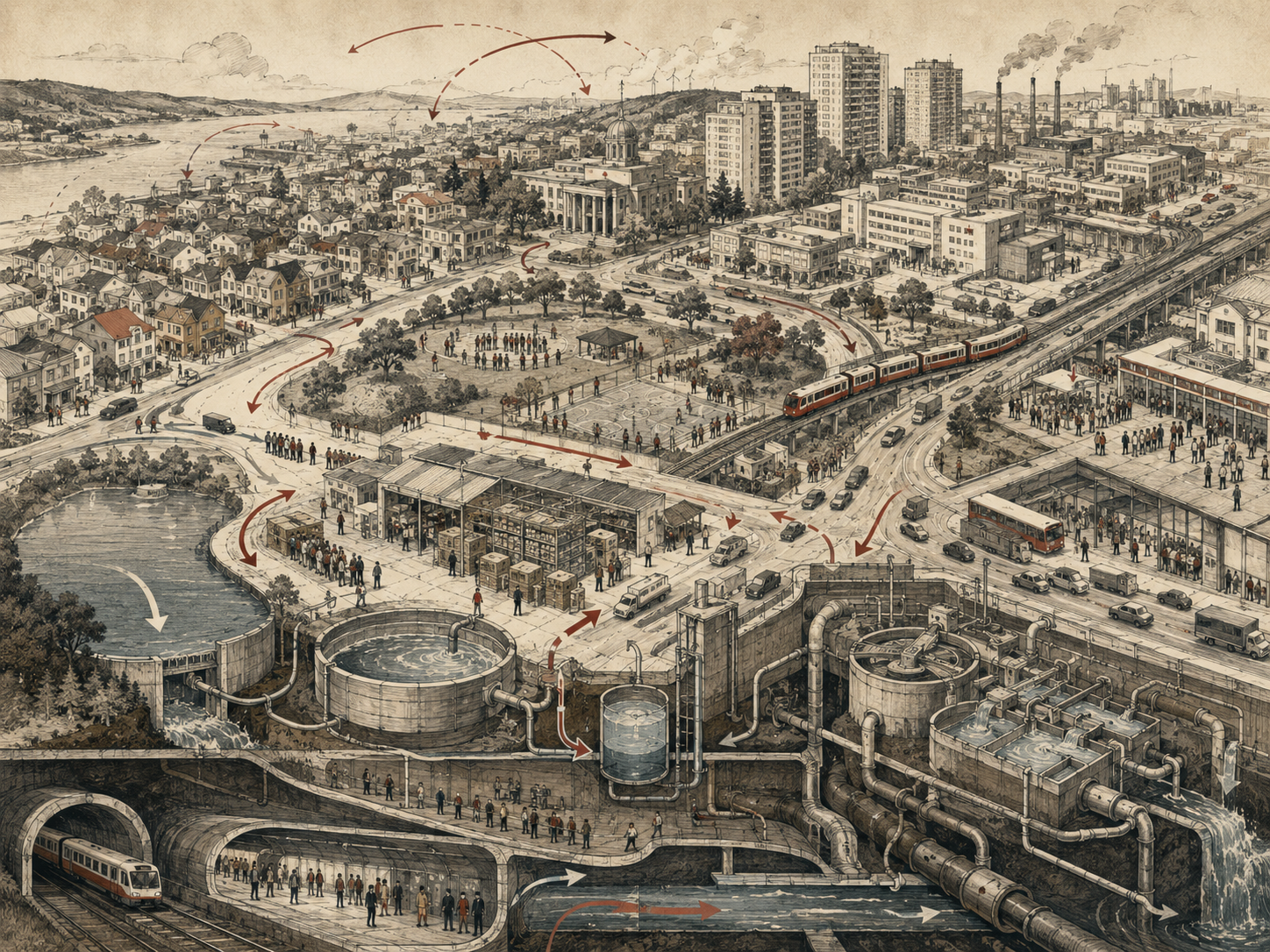
This article examines stock-flow thinking in social systems. It explains how social stocks accumulate and deplete, how flows produce unequal trajectories, how feedback loops compound advantage and disadvantage, and why repair requires changing the rates that build or drain social conditions. It also examines the ethical stakes of social accumulation: who inherits advantage, who inherits burden, whose accumulated harm remains invisible, and what responsibilities follow when social systems repeatedly store damage in some communities while storing opportunity in others.
Why Stock-Flow Thinking Matters in Social Systems
Stock-flow thinking matters in social systems because social outcomes are rarely produced only by present choices. They are shaped by accumulated conditions. A household’s present financial position reflects income, debt, assets, inheritance, labor-market access, housing costs, healthcare costs, discrimination, education, policy, family obligations, and historical opportunity. A community’s present health reflects exposure, investment, public services, housing, food access, employment, environmental risk, care infrastructure, and social trust accumulated over time. An institution’s present legitimacy reflects a history of fairness, responsiveness, transparency, exclusion, broken promises, and repair.
Social systems often mislead analysts because flows are easier to see than stocks. A program may count services delivered, messages sent, applications processed, students enrolled, staff hired, units built, grants awarded, or policies passed. These are flows. They matter, but they do not automatically tell us whether the relevant social stock has changed. Has trust increased? Has burden decreased? Has capability grown? Has debt fallen? Has resilience improved? Has exclusion been repaired? Has public legitimacy been rebuilt?
Without stock-flow thinking, social analysis becomes event-centered and activity-centered. A protest is treated as a sudden event rather than a signal of accumulated grievance. A public-health crisis is treated as a current service problem rather than an accumulation of exposure and underinvestment. A school outcome is treated as a student-level result rather than an accumulated stock of opportunity, belonging, support, and stress. A workforce crisis is treated as a hiring problem rather than an accumulated depletion of capacity, trust, recovery, and institutional memory.
| Social question | Stock-flow interpretation | Why it matters |
|---|---|---|
| Why did trust collapse? | Trust had been depleting through repeated institutional failure. | The visible crisis is a late signal of accumulated distrust. |
| Why does poverty persist? | Debt, exclusion, low assets, weak safety nets, and unstable income compound over time. | One-time assistance may not rebuild the depleted stock of security. |
| Why did reform fail? | The policy changed a visible flow but left deeper stocks unchanged. | Activity does not equal structural change. |
| Why is recovery slow? | Social stocks such as trust, health, capacity, and belonging take time to rebuild. | Evaluation windows must match the time scale of repair. |
| Why does inequality compound? | Advantage and disadvantage are stocks affected by reinforcing flows. | Unequal inflows and outflows reproduce social hierarchy. |
Stock-flow thinking helps social analysis become more historically serious. It shows that the past is not merely background. The past is stored in present stocks: wealth, trauma, infrastructure, trust, debt, institutional memory, exposure, health, education, and public legitimacy. Social change requires changing what systems continue to store.
Social Stocks: What Accumulates?
A social stock is an accumulated social condition. It may be tangible, such as wealth, housing, debt, infrastructure, or population. It may be less tangible but still real, such as trust, legitimacy, capability, burden, knowledge, trauma, fear, belonging, stigma, resilience, institutional memory, or social cohesion. These stocks shape how people, institutions, and communities are able to act in the present.
Social stocks are powerful because they persist. A stock remains after the flow that created it has passed. A debt stock remains after borrowing. A trust stock remains after repeated experience. A trauma stock may remain after exposure to violence, displacement, humiliation, or institutional harm. A knowledge stock remains after learning, unless it drains through forgetting, turnover, exclusion, or obsolescence. A wealth stock remains after income is earned, unless it drains through cost, loss, extraction, or debt service.
S_t = S_0 + \sum_{i=1}^{t}(I_i – O_i)
\]
Interpretation: A social stock \(S_t\) at time \(t\) reflects its initial condition plus the accumulated difference between inflows and outflows over time.
Social stocks can exist at multiple levels. Individuals accumulate skills, health, debt, confidence, stress, and social ties. Households accumulate assets, obligations, care burdens, housing stability, and financial risk. Communities accumulate trust, safety, infrastructure, environmental exposure, social cohesion, and institutional access. Institutions accumulate legitimacy, capacity, knowledge, reputation, backlog, and procedural burden. Societies accumulate law, infrastructure, inequality, ecological damage, democratic legitimacy, and shared memory.
| Social stock | What it stores | Why it matters |
|---|---|---|
| Trust | Accumulated experience of reliability, fairness, care, and repair. | Shapes cooperation, legitimacy, participation, and compliance. |
| Wealth | Accumulated assets, savings, property, inheritance, and investment returns. | Shapes security, mobility, bargaining power, and future opportunity. |
| Debt | Accumulated obligation, interest burden, and future payment claims. | Constrains choice and can compound vulnerability. |
| Administrative burden | Accumulated friction, paperwork, delay, fear, and procedural complexity. | Reduces access, increases stress, and shifts work onto the public. |
| Institutional capacity | Staff, knowledge, systems, authority, legitimacy, and operational ability. | Determines whether policy can be implemented in practice. |
| Social cohesion | Accumulated relationships, mutual recognition, shared trust, and civic connection. | Supports resilience, cooperation, and collective action. |
| Public legitimacy | Accumulated belief that institutions act fairly, lawfully, and responsively. | Shapes consent, contestation, and governance stability. |
| Capability | Accumulated ability to act, learn, participate, choose, and flourish. | Connects social systems to dignity, development, and freedom. |
The most important social stocks are often undermeasured. A government may track spending but not trust. A school may track attendance but not belonging. A workplace may track output but not fatigue. A public agency may track completed cases but not burden. A platform may track engagement but not accumulated harm. A city may track development but not displacement. Stock-flow thinking asks what the system is storing beneath the official dashboard.
Social Flows: What Builds or Drains the Stock?
Social flows are the processes that increase or decrease social stocks. They are rates of change: income, spending, repayment, displacement, enrollment, graduation, hiring, turnover, participation, exclusion, investment, disinvestment, learning, forgetting, repair, harm, exposure, reporting, enforcement, and institutional response. Social flows explain how accumulated conditions are created, maintained, or depleted.
Trust, for example, is increased by reliable service, fair treatment, transparency, accountability, fulfilled promises, and repair after harm. It is drained by exclusion, secrecy, disrespect, delay, procedural injustice, broken promises, and repeated institutional failure. Wealth is increased by income, investment returns, inheritance, public support, stable housing, and asset appreciation. It is drained by debt service, medical costs, rent burden, unemployment, predatory extraction, and crisis expense.
\Delta S = I – O
\]
Interpretation: A social stock changes according to the difference between inflows \(I\) that build it and outflows \(O\) that drain it.
This basic relation is often ignored in social policy. Institutions may increase one inflow while leaving outflows untouched. A workforce policy may hire more people but fail to reduce burnout and turnover. An education policy may add tutoring but fail to reduce chronic stress, exclusion, hunger, or housing instability. A public agency may improve communication but fail to reduce administrative burden. A community development policy may build new housing but fail to prevent displacement.
| Social stock | Inflows that build it | Outflows that drain it |
|---|---|---|
| Trust | Reliability, fairness, repair, transparency, responsiveness. | Harm, secrecy, delay, exclusion, broken promises. |
| Capability | Education, health, safety, support, access, autonomy. | Deprivation, illness, exclusion, instability, discrimination. |
| Household security | Income, savings, benefits, stable housing, care support. | Debt, rent burden, medical costs, job loss, crisis expense. |
| Institutional capacity | Hiring, training, retention, knowledge sharing, funding. | Turnover, austerity, burnout, outsourcing, technical debt. |
| Social cohesion | Public spaces, shared institutions, mutual aid, civic participation. | Segregation, displacement, mistrust, fear, polarization. |
| Administrative burden | Forms, delays, verification, confusing rules, appeals, fear of penalty. | Simplification, assistance, automation with accountability, trusted support. |
Social flows are shaped by institutions. Laws, markets, budgets, rules, eligibility criteria, platform designs, housing systems, schools, policing, healthcare systems, and labor markets determine which flows are easy, difficult, rewarded, punished, visible, or hidden. Stock-flow thinking therefore connects social outcomes to system design. It asks which flows are producing the accumulated condition and who has the power to change them.
History as Accumulation
Stock-flow thinking treats history as active. Social systems do not reset each day. They carry accumulated advantage, accumulated harm, accumulated infrastructure, accumulated exclusion, accumulated legitimacy, and accumulated vulnerability. This is why historical injustice cannot be understood as merely past. It is present in the stocks that past flows created.
Segregated housing, unequal schooling, exclusion from credit, discriminatory labor markets, environmental exposure, colonial extraction, displacement, disenfranchisement, and uneven public investment produce accumulated differences. Those differences shape present health, wealth, trust, opportunity, exposure, political power, and institutional access. A stock-flow view asks what has accumulated, how it accumulated, and what flows continue to reproduce it.
This is also why social repair cannot be limited to symbolic acknowledgment. If the accumulated stock has been depleted or damaged, repair requires flows that rebuild it. If wealth has been extracted, investment and restitution may be needed. If trust has been depleted, repeated accountable action is needed. If land, health, language, culture, or public capacity has been harmed, repair requires more than apology. It requires changing the flows that continue to drain the stock and creating flows that restore it.
S_{\text{present}} = S_{\text{past}} + \int_{\text{past}}^{\text{present}} (I(t) – O(t))\,dt
\]
Interpretation: The present condition of a social stock reflects historical inflows and outflows accumulated over time. History remains active through present stocks.
Historical accumulation is often hidden by event-level analysis. A school outcome is treated as the result of individual effort. A health disparity is treated as behavior. A wealth gap is treated as financial literacy. A trust gap is treated as communication failure. Stock-flow thinking asks what has been accumulated through policy, institutions, and repeated experience.
Social systems are path dependent. Where a system begins matters because stocks influence future flows. Wealth produces access to better housing, education, healthcare, networks, legal help, and investment returns. Debt produces interest burden, stress, risk, and constrained choices. Trust produces cooperation and information sharing. Distrust produces avoidance, conflict, and monitoring cost. Institutional capacity produces better service, which can build legitimacy. Institutional depletion produces delay and error, which can reduce legitimacy further.
To analyze social systems seriously is to analyze accumulation. History is not an explanatory footnote. It is stored in the system.
Trust, Legitimacy, and Repair
Trust and legitimacy are among the most important social stocks. They accumulate slowly and can drain quickly. They shape whether people cooperate with institutions, seek services, accept guidance, share information, participate in public life, comply voluntarily, and believe that rules are fair. Without trust and legitimacy, institutions often compensate through enforcement, surveillance, paperwork, or coercion, which can further erode trust.
Trust is built by repeated experience. It is not created by messaging alone. A public agency builds trust when it provides reliable service, treats people with dignity, corrects errors, explains decisions, reduces burden, and repairs harm. A health institution builds trust through access, competence, cultural respect, transparency, and accountability. A workplace builds trust through fair expectations, psychological safety, follow-through, and respect for human limits.
Trust drains through repeated friction. Delay, disrespect, opacity, arbitrary decision-making, surveillance, exclusion, broken promises, and uncorrected harm all create outflows. The drain may be slow at first. Then a crisis can reveal how depleted the stock has become.
T_{t+1} = T_t + R_t – H_t
\]
Interpretation: Trust \(T\) changes through repair and reliability \(R_t\) minus harm, exclusion, or betrayal \(H_t\). A communication campaign cannot rebuild trust if harm continues to exceed repair.
Legitimacy is related but broader. It is the accumulated belief that an institution has rightful authority and operates according to acceptable standards of fairness, accountability, and public purpose. Legitimacy is built through lawfulness, responsiveness, transparency, participation, competence, and justice. It is drained through corruption, hypocrisy, exclusion, arbitrary power, unequal enforcement, and failure to repair harm.
Repair requires changing flows. If trust is depleted, the system must increase trust-building inflows and reduce trust-draining outflows. This may require redesigning procedures, reducing administrative burden, creating appeal pathways, acknowledging past harm, shifting authority, improving service, increasing transparency, and changing incentives. Repair is not a speech act alone. It is a sustained change in system behavior.
Trust and legitimacy also have feedback effects. Higher trust can increase cooperation, which improves performance, which builds more trust. Lower trust can reduce cooperation, increase conflict, increase administrative cost, and reduce performance, which deepens distrust. This is why trust is a stock and a feedback variable: it stores the past and shapes the future.
Wealth, Debt, and Inequality
Wealth and debt are social stocks that powerfully shape inequality. Wealth accumulates through income, saving, investment returns, property ownership, inheritance, favorable tax treatment, stable employment, access to credit, and public investment. Debt accumulates through borrowing, interest, medical costs, rent burden, education costs, emergency expenses, predatory lending, fines, fees, and income instability.
The difference between wealth and income is essential. Income is a flow. Wealth is a stock. A household with wealth can absorb shocks, invest, move, access education, take risks, and pass advantage to the next generation. A household with income but no wealth may remain vulnerable to illness, job loss, rent increases, or emergency expense. A household with debt faces outflows that reduce future capacity.
W_{t+1} = W_t + Y_t + R_t – C_t – D_t
\]
Interpretation: Wealth \(W\) changes through income \(Y_t\), returns \(R_t\), consumption or costs \(C_t\), and debt-related outflows \(D_t\). The stock of wealth reflects both current flows and accumulated history.
Inequality compounds when stock advantages create favorable flows. Wealth generates investment returns, access to better neighborhoods, better schools, legal protection, healthcare, networks, and political influence. These flows increase future wealth and opportunity. Debt generates interest, stress, constrained choices, poor credit access, and vulnerability to crisis. These flows can increase future debt and reduce opportunity.
Stock-flow thinking makes clear why equal treatment at a single moment may not produce equal outcomes. If people begin with unequal stocks, the same flow can have different effects. A subsidy may help households with savings more than households facing eviction. A tax incentive may benefit those who own assets more than those without assets. A school-choice policy may help families with transportation and information more than those without them. A training program may help workers with stability more than those managing care burdens, housing insecurity, or debt.
| Inequality stock | Advantage-reinforcing flow | Disadvantage-reinforcing flow |
|---|---|---|
| Wealth | Asset appreciation, investment returns, inheritance. | Rent burden, debt service, emergency expenses. |
| Education | Stable housing, tutoring, safe schools, enrichment. | Disruption, exclusion, underfunding, stress, absenteeism. |
| Health | Preventive care, safe environment, nutrition, rest. | Exposure, stress, untreated illness, cost barriers. |
| Political influence | Networks, donations, representation, institutional access. | Disenfranchisement, distrust, time poverty, exclusion. |
Stock-flow analysis does not reduce inequality to arithmetic. It helps show how social arrangements reproduce unequal accumulation. It asks which flows build advantage, which flows drain capability, and what structural repair would be required to change the trajectory.
Administrative Burden as a Social Stock
Administrative burden is often treated as a set of isolated hassles: a form, a wait, a documentation request, a portal failure, a phone call, a confusing notice, an appeal, a verification deadline. Stock-flow thinking shows that burden can accumulate. Each friction adds to the stock of difficulty, stress, fear, confusion, distrust, and time cost experienced by people interacting with institutions.
Administrative burden is a social stock because past interactions shape future behavior. A person who has repeatedly been denied, delayed, humiliated, or confused may avoid applying for help. A family that has spent hours navigating contradictory requirements may distrust the agency. A worker who has repeatedly submitted documents without response may stop trying. A community that has experienced years of procedural exclusion may interpret new programs through the stock of accumulated burden.
Burden accumulates through flows such as paperwork, eligibility verification, documentation requirements, waiting time, digital barriers, language barriers, transportation requirements, fear of penalty, appeal complexity, and opaque decision-making. It drains through simplification, trusted assistance, automatic enrollment, clear communication, appeal support, language access, casework capacity, and procedural justice.
B_{t+1} = B_t + F_t – S_t
\]
Interpretation: Administrative burden \(B\) increases through friction \(F_t\) and decreases through simplification, support, and procedural repair \(S_t\).
Administrative burden often shifts work from institutions onto the public. A policy may appear efficient because the agency spends less, but households, caregivers, frontline workers, community organizations, and applicants absorb the hidden labor. The system reduces internal costs by increasing externalized burden.
This is why administrative burden is not only a design issue. It is a governance issue. Burden determines who can access rights, benefits, services, and protections. If the burden is distributed unequally, the system can formally offer access while practically excluding those with less time, literacy, transportation, digital access, disability accommodation, language access, or institutional trust.
Stock-flow thinking asks:
- How much burden has accumulated for the user?
- How many steps, delays, and uncertainties are required?
- What burden is hidden because it falls outside agency metrics?
- Who has the capacity to absorb the burden?
- Who exits the process before being counted?
- What flows would reduce the burden stock?
- Does the institution measure burden as a core outcome?
Administrative burden is where policy often hides exclusion. Stock-flow thinking makes that exclusion visible as accumulation.
Capability, Learning, and Social Development
Capability is a social stock. It refers to the accumulated ability of people and communities to act, learn, participate, choose, adapt, and flourish. Capability is built through education, health, safety, housing, income security, social support, public services, rights, mobility, care, voice, and belonging. It is drained by deprivation, exclusion, trauma, illness, instability, discrimination, violence, administrative burden, and ecological harm.
Stock-flow thinking helps clarify why capability development takes time. A training program is a flow. Education is a flow. Healthcare access is a flow. Stable housing is a flow into security. But capability as a stock grows through repeated, reliable, mutually reinforcing conditions. One intervention can help, but durable capability often requires aligned flows across multiple systems.
For a student, learning is not built only by classroom hours. It is built by sleep, nutrition, belonging, safety, teacher support, family stability, health, practice, feedback, confidence, and access to materials. It drains through stress, hunger, absence, exclusion, instability, discrimination, trauma, illness, and discouragement. A school policy that increases instructional time but ignores outflows may produce limited stock improvement.
C_{t+1} = C_t + L_t + H_t + S_t – E_t
\]
Interpretation: Capability \(C\) may grow through learning \(L_t\), health support \(H_t\), stability \(S_t\), and other enabling flows, while being drained by exclusion, exposure, or stress \(E_t\).
Capability is also collective. Communities accumulate social infrastructure: libraries, schools, clinics, public spaces, transit, community organizations, local knowledge, mutual aid, civic relationships, and ecological support. These stocks enable people to act together. Disinvestment drains collective capability even when individual effort remains high.
Capability-based stock-flow analysis asks whether policy builds the conditions that allow people to live with dignity and agency. It does not measure success only by service delivery or short-term output. It asks whether people and communities are accumulating the real capacity to choose, participate, learn, adapt, and shape their lives.
This matters for sustainability because capability and ecological conditions are linked. Communities cannot flourish if environmental stocks are depleted, if climate risk accumulates, if public infrastructure erodes, or if care systems collapse. Social development requires protecting the stocks that make life possible.
Feedback, Path Dependence, and Compounding Effects
Social stocks often participate in feedback loops. The stock affects the flows that later change the stock. This creates path dependence: where the system is today influences where it can go tomorrow. Advantage and disadvantage can both compound.
Trust is a simple example. Higher trust increases cooperation. Cooperation improves service performance. Better performance builds more trust. Low trust can produce the opposite: reduced cooperation, more conflict, weaker performance, and deeper distrust. The initial stock affects future flows.
Wealth also creates feedback. Wealth increases access to investment, education, housing stability, healthcare, legal support, and political influence. These flows increase future wealth and security. Debt creates another feedback. Debt increases interest burden and financial stress, which reduce capacity to save, invest, or absorb shocks, increasing future debt risk.
I_t = f(S_t), \qquad O_t = g(S_t)
\]
Interpretation: Feedback occurs when the current stock \(S_t\) influences the inflows and outflows that determine its future value.
Path dependence does not mean destiny. It means that history changes the cost, difficulty, and likelihood of future change. A community with strong social infrastructure may recover more quickly from crisis. A community with depleted trust and underfunded services may face greater difficulty under the same stress. A school with stable staffing and strong relationships can absorb disruption better than one with turnover and underinvestment. A public agency with legitimacy can implement reform more effectively than one facing deep distrust.
Compounding effects are especially important for inequality. If advantage creates flows that generate more advantage, and disadvantage creates flows that generate more disadvantage, the system will not self-correct through equal treatment alone. Structural intervention must alter the flows and feedback loops that reproduce the stock difference.
| Feedback pattern | Reinforcing advantage | Reinforcing disadvantage |
|---|---|---|
| Education | Resources support learning, confidence, and access. | Instability drains attendance, belonging, and learning. |
| Health | Preventive care protects capacity and income. | Untreated illness increases cost, stress, and lost opportunity. |
| Housing | Stability supports school, work, health, and social ties. | Displacement disrupts care, employment, learning, and trust. |
| Public trust | Cooperation improves service, building more trust. | Distrust reduces cooperation and increases system friction. |
| Institutional capacity | Good service builds legitimacy and support. | Depleted capacity creates delay, error, and further distrust. |
Stock-flow thinking reveals that social systems often reproduce themselves through feedback. Durable change requires changing the loops, not merely adding isolated programs.
Policy, Repair, and Structural Change
Policy often fails in social systems because it changes a flow without repairing the stock or changing the feedback structure. A temporary grant may increase services but not build institutional capacity. A communication campaign may increase awareness but not rebuild trust. A hiring push may increase staff count but not reduce burnout or turnover. A benefit program may provide income but create administrative burden that drains access and trust.
Stock-flow thinking asks what stock the policy is meant to change. If the goal is to reduce poverty, which stock must change: income security, wealth, debt, housing stability, health, capability, care capacity, or political power? If the goal is to improve education, which stock must change: learning, belonging, teacher capacity, family stability, school trust, or community support? If the goal is institutional legitimacy, which stock must change: public trust, accountability, transparency, fairness, or repair capacity?
Repair requires sustained flows. If harm accumulated over years, repair usually cannot happen through a one-time intervention. A depleted stock needs ongoing inflows that exceed ongoing outflows. Trust repair requires reliable performance and reduced harm. Wealth repair requires asset-building and reduced extraction. Health repair requires treatment, prevention, environmental protection, and reduced exposure. Institutional repair requires capacity, accountability, and changed behavior.
\text{Repair} \Rightarrow I_{\text{repair}} > O_{\text{harm}}
\]
Interpretation: A depleted social stock can recover only when repair inflows exceed ongoing harm or depletion outflows over time.
Structural change also requires attention to feedback. If the system keeps producing the same outflows, repair is undermined. A school cannot build belonging if exclusionary practices continue draining it. A public agency cannot rebuild trust if procedural harm continues. A workplace cannot rebuild capacity if workload remains unsustainable. A climate adaptation plan cannot build community resilience if development continues increasing exposure.
Stock-flow policy design should include:
- identification of the stock that must change;
- measurement of both inflows and outflows;
- time horizon appropriate to stock repair;
- feedback analysis to identify reinforcing harm or repair;
- distributional analysis to identify who accumulates benefit or burden;
- burden reduction, not only service expansion;
- long-term maintenance of repair flows;
- accountability for ongoing depletion.
Policy should not be evaluated only by what it does. It should be evaluated by what it changes, what it accumulates, what it drains, and whether the new stock trajectory is just and durable.
Ethics, Power, and Unequal Accumulation
Stock-flow thinking has ethical force because it shows that inequality is not only a distribution of outcomes. It is a distribution of accumulated conditions. Some groups inherit wealth, infrastructure, clean environments, institutional trust, political access, and social protection. Others inherit debt, exposure, burden, distrust, displacement, underinvestment, surveillance, and depleted public systems. These stocks shape future flows.
Power determines which accumulations are visible. Financial capital is measured carefully. Care burden is often invisible. Property values are tracked, while displacement trauma may not be. Agency workloads are measured, while public administrative burden is not. Economic output is measured, while ecological depletion and unpaid labor are discounted. If a stock is not measured, it can be depleted without accountability.
Power also determines which flows are treated as legitimate. Interest, rent, extraction, fines, fees, and compliance demands may be treated as normal flows. Mutual aid, unpaid care, community knowledge, ecological stewardship, and informal support may be undervalued. A stock-flow view asks whose flows build the system and whose flows drain life from it.
Ethical stock-flow analysis asks:
- Who accumulates advantage?
- Who accumulates harm?
- Who controls the inflows?
- Who is exposed to the outflows?
- Which stocks are measured?
- Which stocks are ignored?
- What historical flows created the present stock distribution?
- What repair flows are required?
- Who has authority to redesign the flows?
- What future generations will inherit from current stock changes?
This ethical lens is especially important for social systems because harm can be normalized as background. A community’s distrust may be treated as attitude rather than accumulated experience. A household’s debt may be treated as irresponsibility rather than structural extraction. A worker’s burnout may be treated as resilience failure rather than accumulated overload. A student’s disengagement may be treated as motivation rather than accumulated exclusion.
Stock-flow thinking challenges these reductions. It asks what the system has been storing in people, institutions, communities, and environments. It also asks what responsibility follows once accumulation is visible.
Examples Across Social Systems
Stock-flow thinking applies across social systems because social outcomes are produced through accumulation and depletion. The examples below show how the method changes interpretation by asking what the system has been building, draining, hiding, and passing forward.
Public benefits and administrative systems
A public benefits system may track applications processed as a flow. But the deeper stocks include unmet need, public trust, administrative burden, staff capacity, appeal backlog, and household security. A policy that adds verification may reduce one type of error while increasing burden, delay, distrust, and nonparticipation. Stock-flow analysis asks whether the system is increasing security or accumulating exclusion.
Education systems
Learning is a stock built by instruction, practice, feedback, belonging, safety, health, family stability, and teacher capacity. It is drained by absence, stress, exclusion, instability, hunger, illness, discrimination, and discouragement. A reform that adds instructional time but ignores belonging, health, and stability may produce limited change. Education policy must ask whether students are accumulating capability.
Public health
Public health is shaped by accumulated exposure, chronic disease burden, trust, healthcare access, housing stability, environmental conditions, and community capacity. Services delivered are flows, but health is a stock. A vaccination campaign, clinic program, or information effort may fail if trust, access, and exposure are not addressed. Public health requires changing the stock trajectory of risk and resilience.
Housing and displacement
Housing stability is a stock. It is built by affordability, tenant protection, income security, supply, public investment, and community ties. It is drained by rent burden, eviction, speculation, displacement, discrimination, and housing loss. A city can build new units while still depleting affordability if the outflows exceed the inflows. Stock-flow thinking asks whether housing security is actually increasing for the people most at risk.
Work and organizations
Workforce capacity is a stock built by hiring, learning, retention, rest, trust, documentation, and institutional memory. It is drained by burnout, turnover, overload, low autonomy, poor management, and underinvestment. A hiring campaign may fail if turnover continues. A wellness program may fail if workload remains excessive. Organizational repair requires changing the flows that build and drain capacity.
Criminal justice and public safety
Public safety involves stocks such as trust, legitimacy, violence exposure, social cohesion, trauma, institutional capacity, and economic opportunity. Enforcement is a flow, but it can build or drain legitimacy depending on fairness, accountability, and harm. A system that increases enforcement while depleting trust may reduce some visible incidents while increasing long-term instability. Stock-flow thinking asks what conditions are accumulating beneath the crime statistics.
Digital platforms and social trust
Digital platforms shape stocks such as attention, trust, misinformation exposure, social cohesion, polarization, user dependency, and moderation capacity. Engagement is a flow. Content recommendation can create reinforcing loops that accumulate attention and exposure. If harmful content flows exceed governance and repair capacity, the platform may accumulate social risk while appearing successful by engagement metrics.
Climate justice and social vulnerability
Climate vulnerability is a stock shaped by housing, infrastructure, health, wealth, insurance, public services, ecological buffers, and political power. Climate hazards are not experienced equally because communities begin with different stocks of resilience and exposure. Adaptation policy must ask not only where hazards occur, but where vulnerability has accumulated and where repair flows are needed.
Across these examples, stock-flow thinking shifts attention from isolated events to accumulated conditions. It asks what the system has been building, draining, hiding, and passing forward.
Mathematics, Computation, and Modeling
Social stock-flow models can be qualitative, quantitative, computational, or mixed-method. They can use simple equations, stock-flow diagrams, simulation models, network models, administrative data, survey data, interviews, participatory mapping, and scenario analysis. The purpose is not to reduce social life to numbers. The purpose is to clarify accumulation, depletion, timing, feedback, and distribution.
The basic discrete model is:
S_{t+1} = S_t + I_t – O_t
\]
Interpretation: A social stock changes through inflows that build it and outflows that drain it.
A social stock with feedback can be represented as:
S_{t+1} = S_t + I(S_t, X_t) – O(S_t, X_t)
\]
Interpretation: The current stock \(S_t\) and social conditions \(X_t\) can influence the future inflows and outflows that change the stock.
Unequal accumulation across groups can be represented as:
S_{g,t+1} = S_{g,t} + I_{g,t} – O_{g,t}
\]
Interpretation: The stock for group \(g\) changes through group-specific inflows and outflows. Distributional analysis asks whether social stocks are accumulating differently across groups.
A repair model can be represented as:
S_{t+1}^{\text{repair}} = S_t + R_t – H_t
\]
Interpretation: Repair requires restoration flows \(R_t\) to exceed ongoing harm or depletion flows \(H_t\).
A burden model can be represented as:
B_{t+1} = B_t + P_t + D_t + U_t – A_t
\]
Interpretation: Administrative burden \(B\) may increase through procedural requirements \(P_t\), delay \(D_t\), uncertainty \(U_t\), and decrease through assistance, simplification, or access support \(A_t\).
A scenario model can compare policy pathways:
S^{(s)}_{g,t+1} = S^{(s)}_{g,t} + I^{(s)}_{g,t} – O^{(s)}_{g,t}
\]
Interpretation: Scenario \(s\) shows how different policy choices change group-specific stock trajectories over time.
| Modeling task | Social stock-flow question | Example output |
|---|---|---|
| Stock identification | What accumulated social condition matters? | Trust, burden, wealth, debt, capability, legitimacy, capacity. |
| Flow mapping | What builds or drains the stock? | Inflows and outflows for trust, capacity, burden, or security. |
| Distributional modeling | Who accumulates benefit or harm? | Group-level stock trajectories over time. |
| Feedback analysis | Does the stock influence its own future flows? | Compounding advantage, distrust cycles, debt spirals. |
| Repair scenario testing | What level of repair flow is needed to reverse depletion? | Policy scenarios for trust repair, burden reduction, or capacity rebuilding. |
| Boundary analysis | What costs are outside the official metric? | Hidden burden, unpaid labor, ecological exposure, future costs. |
Social modeling requires caution. Many social stocks are hard to measure directly. Quantitative proxies may be useful but incomplete. Trust, burden, legitimacy, and capability require qualitative evidence, participatory knowledge, historical context, and ethical interpretation. A model can clarify the logic of accumulation, but it should not pretend that every meaningful social condition is fully captured by a metric.
Python Workflow: Social Stocks, Burden, Trust Repair, Inequality, and Policy Scenarios
The Python workflow below turns social stock-flow analysis into a small reproducible model. It compares four scenarios: service activity without repair, inflow-focused assistance, burden reduction and capability repair, and accountable long-term social repair. The script uses only the Python standard library, writes CSV outputs relative to the article folder, and is designed as a clear starting point for companion repository work.
# social_stock_flow_systems_workflow.py
# Dependency-light workflow for social stocks, trust repair,
# administrative burden, inequality accumulation, capability development,
# and policy repair scenarios.
# Writes outputs relative to the article root.

from __future__ import annotations

from dataclasses import dataclass
from pathlib import Path
import csv
from statistics import mean

ARTICLE_ROOT = Path(__file__).resolve().parents[1]
TABLES = ARTICLE_ROOT / "outputs" / "tables"


@dataclass
class SocialScenario:
    name: str
    initial_trust: float
    initial_burden: float
    initial_capability: float
    initial_security: float
    reliability_flow: float
    harm_flow: float
    burden_creation: float
    burden_reduction: float
    capability_investment: float
    exclusion_pressure: float
    repair_accountability: float
    inequality_pressure: float
    time_horizon_support: float


def clamp(value: float, low: float = 0.0, high: float = 120.0) -> float:
    return max(low, min(high, value))


def run_scenario(scenario: SocialScenario, periods: int = 60) -> list[dict[str, object]]:
    trust = scenario.initial_trust
    administrative_burden = scenario.initial_burden
    capability = scenario.initial_capability
    household_security = scenario.initial_security
    institutional_capacity = 38.0 + scenario.repair_accountability * 26.0
    inequality_stock = 42.0 + scenario.inequality_pressure * 28.0
    rows: list[dict[str, object]] = []

    for period in range(periods + 1):
        trust_inflow = clamp(
            scenario.reliability_flow * 16.0
            + scenario.repair_accountability * 14.0
            + institutional_capacity * 0.08
            + scenario.time_horizon_support * 5.0,
            0.0,
            100.0
        )

        trust_outflow = clamp(
            scenario.harm_flow * 16.0
            + scenario.exclusion_pressure * 9.0
            + administrative_burden * 0.10
            + max(0.0, 55.0 - household_security) * 0.08,
            0.0,
            100.0
        )

        burden_inflow = clamp(
            scenario.burden_creation * 18.0
            + scenario.exclusion_pressure * 10.0
            + max(0.0, 50.0 - institutional_capacity) * 0.12
            + max(0.0, 45.0 - trust) * 0.06,
            0.0,
            100.0
        )

        burden_outflow = clamp(
            scenario.burden_reduction * 18.0
            + scenario.repair_accountability * 8.0
            + institutional_capacity * 0.08
            + trust * 0.04,
            0.0,
            100.0
        )

        capability_inflow = clamp(
            scenario.capability_investment * 18.0
            + household_security * 0.10
            + trust * 0.07
            + scenario.time_horizon_support * 8.0,
            0.0,
            100.0
        )

        capability_outflow = clamp(
            scenario.exclusion_pressure * 14.0
            + administrative_burden * 0.09
            + max(0.0, inequality_stock - 55.0) * 0.08
            + scenario.harm_flow * 7.0,
            0.0,
            100.0
        )

        security_inflow = clamp(
            scenario.capability_investment * 8.0
            + capability * 0.10
            + institutional_capacity * 0.06
            + scenario.time_horizon_support * 5.0,
            0.0,
            100.0
        )

        security_outflow = clamp(
            scenario.inequality_pressure * 14.0
            + administrative_burden * 0.08
            + scenario.exclusion_pressure * 8.0
            + max(0.0, 45.0 - capability) * 0.08,
            0.0,
            100.0
        )

        trust = clamp(trust + (trust_inflow - trust_outflow) * 0.12, 0.0, 100.0)
        administrative_burden = clamp(
            administrative_burden + (burden_inflow - burden_outflow) * 0.13,
            0.0,
            100.0,
        )
        capability = clamp(capability + (capability_inflow - capability_outflow) * 0.12, 0.0, 100.0)
        household_security = clamp(household_security + (security_inflow - security_outflow) * 0.12, 0.0, 100.0)

        institutional_capacity = clamp(
            institutional_capacity
            + scenario.repair_accountability * 1.5
            + scenario.time_horizon_support * 1.1
            - administrative_burden * 0.035
            - scenario.harm_flow * 0.8,
            0.0,
            100.0,
        )

        inequality_stock = clamp(
            inequality_stock
            + scenario.inequality_pressure * 1.8
            + max(0.0, 50.0 - household_security) * 0.05
            + max(0.0, 50.0 - capability) * 0.05
            - scenario.capability_investment * 1.0
            - scenario.repair_accountability * 1.1,
            0.0,
            100.0,
        )

        repair_balance = (trust_inflow + burden_outflow + capability_inflow + security_inflow) - (
            trust_outflow + burden_inflow + capability_outflow + security_outflow
        )

        durable_repair_score = clamp(
            trust * 0.22
            + capability * 0.22
            + household_security * 0.18
            + institutional_capacity * 0.18
            + scenario.repair_accountability * 10.0
            - administrative_burden * 0.16
            - inequality_stock * 0.14,
            0.0,
            100.0,
        )

        rows.append({
            "period": period,
            "scenario": scenario.name,
            "trust": round(trust, 3),
            "administrative_burden": round(administrative_burden, 3),
            "capability": round(capability, 3),
            "household_security": round(household_security, 3),
            "institutional_capacity": round(institutional_capacity, 3),
            "inequality_stock": round(inequality_stock, 3),
            "trust_inflow": round(trust_inflow, 3),
            "trust_outflow": round(trust_outflow, 3),
            "burden_inflow": round(burden_inflow, 3),
            "burden_outflow": round(burden_outflow, 3),
            "capability_inflow": round(capability_inflow, 3),
            "capability_outflow": round(capability_outflow, 3),
            "repair_balance": round(repair_balance, 3),
            "durable_repair_score": round(durable_repair_score, 3),
        })

    return rows


def write_csv(path: Path, rows: list[dict[str, object]]) -> None:
    path.parent.mkdir(parents=True, exist_ok=True)
    if not rows:
        raise ValueError(f"No rows to write: {path}")
    with path.open("w", newline="", encoding="utf-8") as handle:
        writer = csv.DictWriter(handle, fieldnames=list(rows[0].keys()))
        writer.writeheader()
        writer.writerows(rows)


def summarize(rows: list[dict[str, object]]) -> list[dict[str, object]]:
    output: list[dict[str, object]] = []
    for scenario_name in sorted({row["scenario"] for row in rows}):
        subset = [row for row in rows if row["scenario"] == scenario_name]
        final = subset[-1]
        avg_repair_balance = mean(float(row["repair_balance"]) for row in subset)
        avg_burden = mean(float(row["administrative_burden"]) for row in subset)
        avg_inequality = mean(float(row["inequality_stock"]) for row in subset)
        avg_score = mean(float(row["durable_repair_score"]) for row in subset)

        if float(final["durable_repair_score"]) >= 65 and float(final["administrative_burden"]) <= 35:
            diagnostic = "repair flows exceed harm and durable social stocks improve"
        elif avg_burden >= 60:
            diagnostic = "administrative burden continues to accumulate"
        elif avg_inequality >= 65:
            diagnostic = "inequality stock dominates social trajectory"
        elif avg_repair_balance < 0:
            diagnostic = "harm and depletion flows exceed repair flows"
        elif avg_score >= 55:
            diagnostic = "partial social repair with remaining unequal accumulation risk"
        else:
            diagnostic = "social stock-flow structure remains weak"

        output.append({
            "scenario": scenario_name,
            "final_durable_repair_score": final["durable_repair_score"],
            "final_trust": final["trust"],
            "final_administrative_burden": final["administrative_burden"],
            "final_capability": final["capability"],
            "final_household_security": final["household_security"],
            "final_inequality_stock": final["inequality_stock"],
            "average_repair_balance": round(avg_repair_balance, 3),
            "average_administrative_burden": round(avg_burden, 3),
            "average_inequality_stock": round(avg_inequality, 3),
            "average_durable_repair_score": round(avg_score, 3),
            "diagnostic": diagnostic,
        })

    return output


def main() -> None:
    scenarios = [
        SocialScenario("Service activity without repair", 42.0, 64.0, 44.0, 42.0, 0.34, 0.62, 0.70, 0.22, 0.34, 0.66, 0.24, 0.68, 0.26),
        SocialScenario("Inflow-focused assistance", 44.0, 58.0, 46.0, 44.0, 0.48, 0.52, 0.56, 0.38, 0.52, 0.50, 0.42, 0.56, 0.42),
        SocialScenario("Burden reduction and capability repair", 48.0, 52.0, 50.0, 48.0, 0.64, 0.38, 0.34, 0.70, 0.72, 0.34, 0.66, 0.38, 0.68),
        SocialScenario("Accountable long-term social repair", 52.0, 46.0, 54.0, 50.0, 0.78, 0.24, 0.22, 0.84, 0.84, 0.24, 0.84, 0.26, 0.84),
    ]

    rows: list[dict[str, object]] = []
    for scenario in scenarios:
        rows.extend(run_scenario(scenario))

    write_csv(TABLES / "social_stock_flow_timeseries.csv", rows)
    write_csv(TABLES / "social_stock_flow_summary.csv", summarize(rows))

    print("Social stock-flow workflow complete.")
    print(TABLES / "social_stock_flow_timeseries.csv")


if __name__ == "__main__":
    main()
The workflow is intentionally simple enough to inspect. It shows how trust, administrative burden, capability, household security, institutional capacity, and inequality can accumulate or deplete over time. It also shows why services delivered are not the same as repair: durable improvement requires repair flows to exceed ongoing harm, exclusion, and burden. The model is synthetic and illustrative; it supports disciplined inquiry rather than replacing domain expertise, stakeholder evidence, or ethical judgment.
R Workflow: Social Stock-Flow Summary and Trajectory Visualization
The R workflow reads the Python-generated time-series output, creates social stock-flow summaries, and exports base R plots for trust, administrative burden, capability, household security, inequality stock, and durable repair. It uses only base R so it remains portable across simple local environments.
# social_stock_flow_systems_diagnostics.R
# Base R workflow for social stock-flow summary and trajectory visualization.

args <- commandArgs(trailingOnly = FALSE)
file_arg <- grep("^--file=", args, value = TRUE)

if (length(file_arg) > 0) {
  script_path <- normalizePath(sub("^--file=", "", file_arg[1]), mustWork = TRUE)
  article_root <- normalizePath(file.path(dirname(script_path), ".."), mustWork = TRUE)
} else {
  article_root <- getwd()
}

setwd(article_root)

tables_dir <- file.path(article_root, "outputs", "tables")
figures_dir <- file.path(article_root, "outputs", "figures")

if (!dir.exists(tables_dir)) {
  dir.create(tables_dir, recursive = TRUE)
}

if (!dir.exists(figures_dir)) {
  dir.create(figures_dir, recursive = TRUE)
}

timeseries_path <- file.path(tables_dir, "social_stock_flow_timeseries.csv")

if (!file.exists(timeseries_path)) {
  stop(paste("Missing", timeseries_path, "Run the Python workflow first."))
}

data <- read.csv(timeseries_path, stringsAsFactors = FALSE)

last_by_scenario <- do.call(
  rbind,
  lapply(split(data, data$scenario), function(df) df[nrow(df), ])
)

avg_repair <- aggregate(repair_balance ~ scenario, data = data, FUN = mean)
avg_burden <- aggregate(administrative_burden ~ scenario, data = data, FUN = mean)
avg_inequality <- aggregate(inequality_stock ~ scenario, data = data, FUN = mean)
avg_score <- aggregate(durable_repair_score ~ scenario, data = data, FUN = mean)

names(avg_repair)[2] <- "average_repair_balance"
names(avg_burden)[2] <- "average_administrative_burden"
names(avg_inequality)[2] <- "average_inequality_stock"
names(avg_score)[2] <- "average_durable_repair_score"

final_fields <- last_by_scenario[, c(
  "scenario",
  "durable_repair_score",
  "trust",
  "administrative_burden",
  "capability",
  "household_security",
  "inequality_stock"
)]

names(final_fields) <- c(
  "scenario",
  "final_durable_repair_score",
  "final_trust",
  "final_administrative_burden",
  "final_capability",
  "final_household_security",
  "final_inequality_stock"
)

summary_table <- Reduce(
  function(x, y) merge(x, y, by = "scenario"),
  list(avg_repair, avg_burden, avg_inequality, avg_score, final_fields)
)

summary_table$diagnostic <- ifelse(
  summary_table$final_durable_repair_score >= 65 &
    summary_table$final_administrative_burden <= 35,
  "repair flows exceed harm and durable social stocks improve",
  ifelse(
    summary_table$average_administrative_burden >= 60,
    "administrative burden continues to accumulate",
    ifelse(
      summary_table$average_inequality_stock >= 65,
      "inequality stock dominates social trajectory",
      ifelse(
        summary_table$average_repair_balance < 0,
        "harm and depletion flows exceed repair flows",
        ifelse(
          summary_table$average_durable_repair_score >= 55,
          "partial social repair with remaining unequal accumulation risk",
          "social stock-flow structure remains weak"
        )
      )
    )
  )
)

write.csv(
  summary_table,
  file.path(tables_dir, "social_stock_flow_r_summary.csv"),
  row.names = FALSE
)

plot_metric <- function(metric, label, file_name) {
  png(file.path(figures_dir, file_name), width = 1200, height = 700)
  scenarios <- unique(data$scenario)
  plot(
    NA,
    xlim = range(data$period),
    ylim = range(data[[metric]], na.rm = TRUE),
    xlab = "Period",
    ylab = label,
    main = paste(label, "by Social Stock-Flow Scenario")
  )
  for (scenario_name in scenarios) {
    subset_data <- data[data$scenario == scenario_name, ]
    lines(subset_data$period, subset_data[[metric]], lwd = 2)
  }
  legend("topleft", legend = scenarios, lwd = 2, cex = 0.8, bty = "n")
  grid()
  dev.off()
}

plot_metric("trust", "Trust", "trust_trajectories.png")
plot_metric("administrative_burden", "Administrative burden", "administrative_burden_trajectories.png")
plot_metric("capability", "Capability", "capability_trajectories.png")
plot_metric("household_security", "Household security", "household_security_trajectories.png")
plot_metric("inequality_stock", "Inequality stock", "inequality_stock_trajectories.png")
plot_metric("durable_repair_score", "Durable repair score", "durable_repair_score_trajectories.png")

print(summary_table)
This workflow supports the article’s central methodological claim: social repair should be evaluated by accumulated conditions, not only by program activity. The R outputs help readers compare whether social stocks are being repaired, depleted, or hidden by visible service flows.
GitHub Repository
The companion repository for this article should help readers model social stocks, social flows, unequal accumulation, administrative burden, trust repair, capability development, institutional capacity, and policy scenarios using synthetic datasets and reproducible workflows.
Complete Code Repository
Companion repository for the article, including social stock-flow simulations, trust and legitimacy models, administrative burden diagnostics, inequality accumulation examples, repair scenario workflows, synthetic datasets, documentation assets, and multi-language scaffolds for systems analysis.
articles/stock-flow-thinking-in-social-systems/
├── python/
│   ├── social_stock_flow_systems_workflow.py
│   ├── social_stock_flow_model.py
│   ├── trust_legitimacy_repair.py
│   ├── administrative_burden_diagnostics.py
│   ├── inequality_accumulation_model.py
│   ├── capability_development_scenarios.py
│   ├── policy_repair_scenario_comparison.py
│   ├── validation_checks.py
│   └── run_all_social_stock_flow_workflows.py
├── r/
│   ├── social_stock_flow_systems_diagnostics.R
│   ├── social_stock_flow_plots.R
│   ├── trust_repair_visualization.R
│   ├── burden_accumulation_tables.R
│   ├── inequality_trajectory_summary.R
│   ├── scenario_comparison.R
│   └── run_all_social_stock_flow_workflows.R
├── julia/
│   ├── nonlinear_social_accumulation.jl
│   ├── trust_feedback_dynamics.jl
│   └── repair_threshold_model.jl
├── sql/
│   ├── schema_social_stocks.sql
│   ├── schema_social_flows.sql
│   ├── schema_group_trajectories.sql
│   ├── schema_policy_scenarios.sql
│   ├── schema_burden_indicators.sql
│   └── schema_model_runs.sql
├── rust/
│   └── social_stock_flow_diagnostics_cli.rs
├── go/
│   └── social_flow_pathway_utility.go
├── cpp/
│   ├── efficient_social_stock_simulation.cpp
│   └── inequality_trajectory_scan.cpp
├── fortran/
│   └── recurrence_social_stock_model.f90
├── c/
│   └── low_level_social_stock_flow_simulation.c
├── docs/
│   ├── modeling_principles.md
│   ├── article_notes.md
│   ├── social_stock_flow_framework.md
│   ├── measurement_notes.md
│   ├── assumptions_and_limitations.md
│   └── responsible_use.md
├── data/
│   ├── synthetic_social_stocks.csv
│   ├── synthetic_social_flows.csv
│   ├── synthetic_group_trajectories.csv
│   ├── synthetic_policy_scenarios.csv
│   ├── synthetic_burden_indicators.csv
│   └── synthetic_trust_repair_observations.csv
├── outputs/
│   ├── figures/
│   └── tables/
└── notebooks/
    ├── python_social_stock_flow_walkthrough.ipynb
    └── r_social_trajectory_visualization_placeholder.ipynb
This repository structure supports the article’s central argument: social systems store history through accumulated stocks. The data/ folder separates social stocks, social flows, group trajectories, policy scenarios, burden indicators, and trust repair observations. The python/ and r/ folders support social stock-flow simulation, trust and legitimacy repair, administrative burden diagnostics, inequality accumulation, capability scenarios, and policy repair comparison. The julia folder supports nonlinear social accumulation and feedback examples. The sql folder defines schemas for stocks, flows, group trajectories, scenarios, burden indicators, and model runs. The lower-level language folders provide scaffolds for diagnostics, pathway tracing, recurrence modeling, trajectory scanning, and low-level simulation.
A Practical Method for Social Stock-Flow Analysis
Social stock-flow analysis can become practical through a disciplined sequence of questions. The goal is to identify what social condition has accumulated, what flows built or drained it, and what structural repair would change its trajectory.
1. Name the social behavior or problem
Begin with a pattern: declining trust, persistent poverty, rising burden, educational inequality, health disparity, institutional failure, workforce burnout, displacement, low participation, or social fragmentation.
2. Identify the key social stock
Ask what accumulated condition explains the behavior. The stock may be trust, wealth, debt, burden, capability, legitimacy, institutional capacity, social cohesion, trauma, exposure, or resilience.
3. Identify inflows that build the stock
Name the processes that increase the stock. For trust, this may include reliability, fairness, accountability, and repair. For capability, it may include education, health, stability, and support.
4. Identify outflows that drain the stock
Name the processes that reduce the stock. For trust, this may include delay, exclusion, harm, and opacity. For wealth, this may include debt service, rent burden, medical costs, and extraction.
5. Compare inflows and outflows
Ask whether the stock is growing, shrinking, or stable. Do not judge by one flow alone. A system can increase support while harm continues to exceed repair.
6. Examine distribution
Ask who holds the stock and who lacks it. Analyze differences by group, place, institution, generation, and exposure.
7. Map feedback loops
Ask whether the stock affects its own future flows. Does trust increase cooperation? Does wealth produce more wealth? Does burden reduce access and deepen distrust?
8. Identify historical accumulation
Ask how the current stock was produced over time. Which past policies, institutional behaviors, market structures, or exclusions shaped the present condition?
9. Design repair flows
Ask what sustained flows would rebuild the depleted stock or slow harmful accumulation. Repair must exceed ongoing harm.
10. Evaluate stock change over time
Track whether the accumulated condition changes. Do not mistake program activity for social repair.
This method helps social analysis move from symptoms to accumulation, from activity to repair, and from individual blame to structural explanation.
Common Pitfalls
Stock-flow thinking in social systems can be misused if the analyst treats social stocks too narrowly or measures activity instead of accumulated change. Several pitfalls are common.
- Confusing services delivered with social stock improvement: Services are flows. They matter, but they should be evaluated by whether they improve the relevant stock: security, health, trust, capability, access, or resilience.
- Ignoring outflows: A policy may increase support while ongoing harm drains the stock faster. Repair requires reducing harm as well as increasing support.
- Treating distrust as attitude rather than accumulated experience: Distrust often reflects repeated institutional behavior. Communication alone cannot repair it if the underlying outflows continue.
- Using aggregate averages: A stock may improve on average while worsening for specific groups or places. Social stock-flow analysis should be distributional.
- Ignoring historical accumulation: Present inequality often reflects accumulated past flows. Analysis that begins only in the present can misidentify causes.
- Assuming equal flows produce equal outcomes: If groups begin with different stocks, the same intervention may have unequal effects. Stock differences shape flow effectiveness.
- Overquantifying invisible stocks: Trust, legitimacy, burden, trauma, and capability require qualitative interpretation and stakeholder knowledge. Metrics can help but should not dominate.
- Failing to ask who controls the flows: Social stocks are shaped by institutions, markets, policies, and power. Analysis should identify who can change the inflows and outflows.
The central pitfall is treating social problems as isolated events rather than accumulated conditions. Stock-flow thinking restores time, history, and responsibility to social analysis.
Why Stock-Flow Thinking Changes Social Analysis
Stock-flow thinking changes social analysis because it shows that society stores history. Trust, wealth, debt, burden, capability, trauma, legitimacy, health, knowledge, and resilience are not momentary conditions. They are accumulated through repeated flows over time. Social systems remember what they have done, even when official narratives treat each event as separate.
This perspective helps explain why social change is difficult. A depleted stock cannot be rebuilt through one announcement, one program, one campaign, or one budget cycle. Repair requires sustained flows, reduced harm, changed feedback, and enough time for the stock to recover. It also helps explain why inequality persists: advantage and disadvantage are often reinforced through stock-dependent flows.
Stock-flow thinking is also ethically powerful. It asks who accumulates benefit, who accumulates harm, whose burden is measured, whose labor is hidden, whose history is ignored, and what future generations will inherit. It makes visible the slow accumulation of injustice and the slow work of repair.
To understand social systems, we must ask not only what happened, but what has been building, what has been draining, and what the system continues to store in people, institutions, communities, and places.
Related Articles
- Stocks, Flows, and the Architecture of Change
- System Dynamics and Simulation Modeling
- Causal Loop Diagrams and the Logic of Interaction
- Feedback Loop Polarity and Causal Signs
- Dynamic Complexity and Policy Resistance
- Overshoot, Collapse, and Correction
- Scenario Modeling in Systems Thinking
- Leverage Points and Structural Intervention
Further Reading
- Meadows, Donella H. Thinking in Systems: A Primer. Chelsea Green Publishing.
- Sterman, John D. Business Dynamics: Systems Thinking and Modeling for a Complex World. Irwin/McGraw-Hill.
- Forrester, Jay W. Urban Dynamics. MIT Press.
- Sen, Amartya. Development as Freedom. Oxford University Press.
- Nussbaum, Martha C. Creating Capabilities: The Human Development Approach. Harvard University Press.
- Herd, Pamela and Moynihan, Donald. Administrative Burden: Policymaking by Other Means. Russell Sage Foundation.
- Ostrom, Elinor. Understanding Institutional Diversity. Princeton University Press.
- Putnam, Robert D. Bowling Alone: The Collapse and Revival of American Community. Simon & Schuster.
- Bourdieu, Pierre. “The Forms of Capital.” In Handbook of Theory and Research for the Sociology of Education.
References
- Bourdieu, P. (1986) “The Forms of Capital.” In Richardson, J. (ed.) Handbook of Theory and Research for the Sociology of Education. New York: Greenwood Press, pp. 241–258.
- Forrester, J.W. (1969) Urban Dynamics. Cambridge, MA: MIT Press.
- Herd, P. and Moynihan, D.P. (2018) Administrative Burden: Policymaking by Other Means. New York: Russell Sage Foundation.
- Meadows, D.H. (2008) Thinking in Systems: A Primer. White River Junction, VT: Chelsea Green Publishing. Available at: https://www.chelseagreen.com/product/thinking-in-systems/
- MIT OpenCourseWare (2013) Introduction to System Dynamics. Massachusetts Institute of Technology. Available at: https://ocw.mit.edu/courses/15-871-introduction-to-system-dynamics-fall-2013/
- Nussbaum, M.C. (2011) Creating Capabilities: The Human Development Approach. Cambridge, MA: Harvard University Press.
- Ostrom, E. (2005) Understanding Institutional Diversity. Princeton, NJ: Princeton University Press.
- Putnam, R.D. (2000) Bowling Alone: The Collapse and Revival of American Community. New York: Simon & Schuster.
- Sen, A. (1999) Development as Freedom. Oxford: Oxford University Press.
- Sterman, J.D. (2000) Business Dynamics: Systems Thinking and Modeling for a Complex World. Boston: Irwin/McGraw-Hill.