
Last Updated May 27, 2026
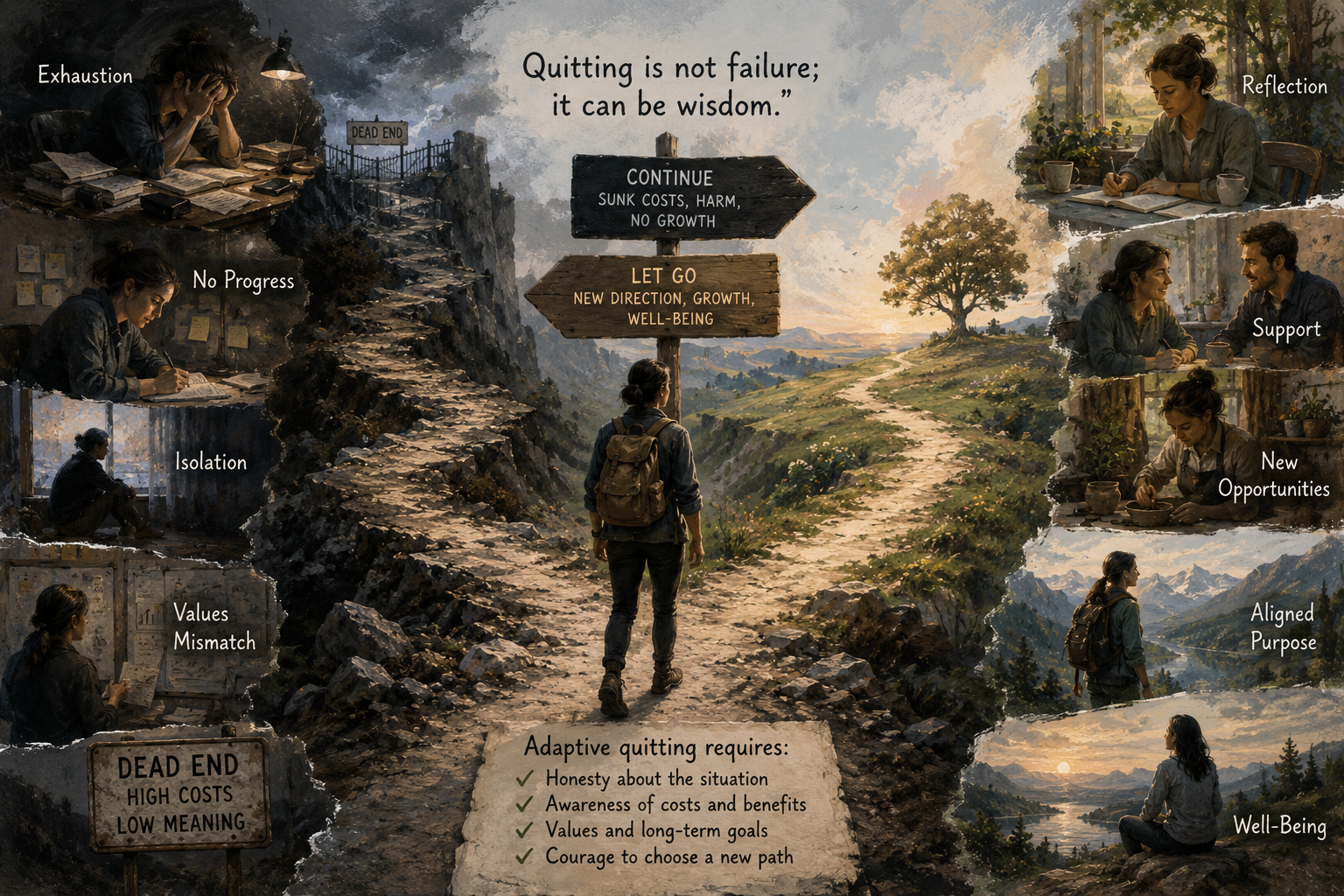
Quitting is usually treated as the opposite of grit. In everyday achievement culture, grit is often reduced to a simple command: keep going. But human development is more complicated than that. Some goals deserve perseverance. Some strategies deserve revision. Some paths deserve a pause. Some commitments deserve to be released. A mature account of grit must therefore ask not only when to persist, but when quitting is adaptive.
Adaptive quitting is not impulsive avoidance, fear of difficulty, or giving up at the first sign of discomfort. It is the thoughtful disengagement from a goal, plan, role, institution, relationship, or strategy when continued effort no longer serves learning, health, dignity, purpose, ethics, or future possibility. It is not the rejection of persistence; it is the protection of deeper persistence from being trapped in the wrong object.
This article examines when quitting is adaptive in the Grit knowledge series. It explains the difference between quitting from avoidance and quitting from judgment, why goal disengagement can be part of healthy self-regulation, how sunk cost and identity pressure can trap people in failing paths, and why adaptive quitting often preserves deeper purpose. The central claim is simple: grit should be loyal to goals worth sustaining, not to every past decision.
Main Library
Publications
Article Map
Grit
Related Topic
Positive Psychology
Related Topic
Personality Psychology
Related Topic
Cognitive Psychology
Overview
Grit is valuable because many worthwhile goals require sustained effort. People do not master difficult skills, build meaningful institutions, repair relationships, complete demanding education, conduct research, create serious art, or serve communities without persistence. Difficulty alone is not a reason to quit.
But persistence is not automatically wise. People can remain attached to goals that no longer fit their values, roles that damage health, institutions that exploit their commitment, strategies that repeatedly fail, or identities that leave no room for growth. In those cases, the problem is not insufficient grit. The problem may be misdirected grit.
Adaptive quitting belongs inside a mature theory of grit because long-term development requires selection. Human energy is limited. Time is limited. Attention is limited. Health is limited. A person who refuses to quit anything may eventually be unable to sustain the things that matter most.
The central distinction is between quitting as escape from difficulty and quitting as intelligent redirection. Avoidant quitting withdraws from challenge without reflection. Adaptive quitting responds to evidence, values, health, opportunity, and purpose. It does not ask, “How do I avoid discomfort?” It asks, “Where should my finite effort go now?”
| Concept | Meaning | Relationship to grit | Main caution |
|---|---|---|---|
| Grit | Sustained effort and interest toward long-term goals. | Supports commitment through difficulty. | Can become harmful when detached from feedback, recovery, and purpose. |
| Adaptive quitting | Thoughtful disengagement from a goal, strategy, role, or institution when continuing no longer serves deeper purpose. | Protects effort for goals worth sustaining. | Can be confused with avoidance or failure. |
| Goal disengagement | Reducing commitment and effort toward an unattainable, harmful, or misaligned goal. | Prevents wasted effort and psychological entrapment. | Requires discernment, not impulse. |
| Goal reengagement | Investing effort in a meaningful alternative goal. | Preserves agency, purpose, and future orientation. | May require support and time after loss. |
| Overpersistence | Continuing despite clear evidence of harm, futility, or misalignment. | Can look like grit from the outside. | May lead to burnout, sunk cost, and identity rigidity. |
What adaptive quitting means
Adaptive quitting is the deliberate release of a commitment when continuing would no longer be wise. It may involve quitting a tactic, a project, a course, a major, a job, an institution, a relationship, a public identity, a creative direction, or a long-standing ambition. The key is not the visible act of stopping. The key is the judgment behind it.
A person quits adaptively when they have gathered enough evidence to know that continued effort is unlikely to produce meaningful progress, or that the cost of continuing is too high relative to the value of the goal. The evidence may involve health, ethics, repeated feedback, structural barriers, loss of meaning, opportunity cost, changing circumstances, or a better alternative path.
Adaptive quitting can be painful because goals carry identity. To quit a goal may require grief. It may mean accepting that effort did not lead where one hoped. It may involve disappointing others, revising a story, or facing uncertainty. But pain does not make a decision wrong.
At its best, adaptive quitting is a form of stewardship. It protects the person’s finite life from being consumed by goals that no longer deserve it.
| Adaptive quitting asks | Why the question matters |
|---|---|
| Is this goal still meaningful? | Persistence should serve purpose, not habit alone. |
| Is this strategy working? | Effort should remain responsive to evidence. |
| What is the cost of continuing? | Health, relationships, time, money, and dignity matter. |
| What is the cost of stopping? | Quitting can also create loss, risk, and responsibility. |
| What deeper purpose might remain? | Leaving one path may preserve a higher-level commitment. |
| What alternative goal is available? | Disengagement is healthier when paired with reengagement. |
Quitting versus avoidance
Not all quitting is adaptive. Sometimes quitting is avoidance: the person withdraws because the task is uncomfortable, feedback is threatening, progress is slow, or effort is boring. Avoidance can protect short-term emotion while undermining long-term growth.
Adaptive quitting differs because it is reflective, evidence-based, and values-aware. It does not happen merely because something is difficult. It happens because continued effort has been evaluated against purpose, feasibility, cost, opportunity, feedback, health, and context.
The distinction is especially important because difficult goals often feel bad before they become meaningful. A student may want to quit a course after one poor grade. A writer may want to quit after a harsh critique. An athlete may want to quit during rehabilitation. A founder may want to quit during ordinary uncertainty. In those cases, immediate discomfort is not enough evidence.
But the opposite mistake is also dangerous. A person may continue through chronic harm because they fear that quitting would mean weakness. In that case, persistence has become avoidance of a different kind: avoidance of grief, identity change, disappointment, or honest reassessment.
| Question | Avoidant quitting | Adaptive quitting |
|---|---|---|
| Primary motive | Escape immediate discomfort. | Protect long-term health, purpose, learning, or integrity. |
| Relationship to evidence | Little evidence is gathered. | Feedback and repeated patterns are examined. |
| Relationship to emotion | Emotion controls the decision. | Emotion is acknowledged but not treated as the only data. |
| Relationship to purpose | The deeper goal may be abandoned without reflection. | The deeper purpose is clarified and often preserved. |
| Relationship to alternatives | No meaningful reengagement is considered. | Energy is redirected toward a better goal or path. |
| Long-term effect | May narrow growth and reinforce avoidance. | May restore agency, sustainability, and purpose. |
Goal disengagement and goal reengagement
Goal disengagement is the process of reducing effort and commitment toward a goal that is unattainable, harmful, or no longer worth pursuing. Goal reengagement is the process of investing effort in alternative goals that remain meaningful. Together, they help explain why quitting can be adaptive.
Disengagement alone may feel like loss. A person releases a goal and may experience grief, emptiness, uncertainty, or identity disruption. Reengagement helps restore direction. The person does not merely stop; they begin to invest in something else. The alternative may be closely related to the old goal or entirely different.
For example, a student who leaves a pre-med path may reengage with public health, social work, research, education, or policy. A founder who closes one business may reengage with a more viable problem. An athlete who stops competing may reengage with coaching, rehabilitation science, or another form of embodied practice.
Healthy self-regulation requires both capacities: the ability to let go and the ability to begin again.
| Process | Definition | Healthy function | Risk if absent |
|---|---|---|---|
| Goal disengagement | Reducing effort and commitment toward a goal. | Frees resources from unattainable or harmful aims. | Overpersistence, rumination, burnout, and sunk cost. |
| Goal reengagement | Investing energy in meaningful alternative goals. | Restores direction, hope, and agency. | Drift, emptiness, and loss of future orientation. |
| Goal revision | Changing the path while preserving a deeper commitment. | Supports flexible grit. | Rigid attachment to outdated plans. |
| Goal hierarchy | Distinguishing higher-level purpose from lower-level tactics. | Clarifies what should be preserved. | Confusing one route with the whole purpose. |
| Recovery interval | Time between release and reengagement. | Allows grief, rest, learning, and identity repair. | Premature replacement or avoidance of loss. |
Goal hierarchy: quitting the path, not the purpose
Many decisions about quitting become clearer when goals are arranged hierarchically. Lower-level goals are specific tactics or pathways. Higher-level goals are broader purposes, values, or identities. Adaptive quitting often means releasing a lower-level goal in order to preserve a higher-level one.
A person may quit a job without quitting the vocation. They may leave an institution without abandoning the field. They may change a major without abandoning learning. They may stop one project without abandoning the mission. They may leave a relationship without abandoning love, dignity, or care.
This distinction protects grit from rigidity. When one path fails, the person does not have to interpret the failure as the collapse of purpose. They can ask what higher-level commitment remains alive and what lower-level form should change.
Goal hierarchy also clarifies when quitting is not adaptive. If a person repeatedly abandons lower-level tasks that are necessary for a deeply held purpose, they may be avoiding difficulty. But if a lower-level path has become destructive, ineffective, or misaligned, quitting it may be the only way to remain faithful to the deeper goal.
| Lower-level goal | Higher-level purpose | Adaptive quitting example |
|---|---|---|
| Finish a specific major. | Contribute to health, knowledge, justice, or service. | Changing majors while preserving the broader vocation. |
| Stay in a specific organization. | Do meaningful work in the field. | Leaving an exploitative workplace to continue the vocation elsewhere. |
| Complete a specific project. | Build useful knowledge or create public value. | Ending a weak project and redirecting resources to a stronger one. |
| Maintain a specific identity. | Live with integrity and development. | Revising the self-story when life changes. |
| Use a specific strategy. | Learn, improve, or solve the problem. | Abandoning a failing tactic while continuing the larger effort. |
Sunk cost and escalation of commitment
Sunk cost is one of the strongest barriers to adaptive quitting. The more someone has invested in a goal, the harder it becomes to leave. Time, money, reputation, emotion, identity, social expectation, and sacrifice can all create pressure to continue.
The sunk-cost problem is that past investment cannot be recovered by future overinvestment. The relevant question is not “How much have I already given?” but “What is the best use of my remaining resources?” A person may honor past effort without being imprisoned by it.
Escalation of commitment occurs when people respond to negative outcomes by investing even more in the failing course of action. They may hope that one more push will redeem the past. They may fear admitting failure. They may want to prove that the original decision was right. In the language of grit, this can look like admirable perseverance, but it may be decision entrapment.
Adaptive quitting requires the courage to let past cost remain past cost. The question becomes future-oriented: What does the evidence justify now?
| Sunk-cost thought | Why it traps persistence | Adaptive reframing |
|---|---|---|
| “I have already spent too much time.” | Past time controls future action. | What is the best use of the time ahead? |
| “If I quit, everything was wasted.” | Learning is treated as worthless unless the original goal succeeds. | What can I carry forward from this path? |
| “I need this to prove I was right.” | Self-justification replaces evidence. | What would I choose if I had no need to defend the past? |
| “People will think I failed.” | Social image overrides judgment. | What decision protects truth, dignity, and future capacity? |
| “I cannot start over.” | The future is imagined as closed. | What partial transition, bridge, or adjacent path is possible? |
Identity pressure and the fear of changing direction
Quitting is difficult because goals are not merely tasks. They are often identities. A person may not only be pursuing medicine, teaching, entrepreneurship, scholarship, art, law, athletics, ministry, caregiving, or activism. They may be narrating themselves as the kind of person who belongs to that path.
Identity pressure appears when quitting a goal feels like losing the self. The person may ask: Who am I if I leave? What will people think? What happens to the story I have told about my life? How do I explain this change to family, peers, mentors, or myself?
This pressure is not trivial. Identity gives persistence meaning. But identity can become too narrow. A person may confuse one role with the whole self, one path with the whole purpose, or one public image with the whole life.
Adaptive quitting often requires identity revision. The person does not erase the old self. They integrate it. They recognize what the old path taught, what it cost, what it revealed, and what deeper commitment can still continue.
| Identity pressure | Possible risk | Adaptive response |
|---|---|---|
| “This is who I am.” | The role becomes too rigid. | Ask what value or purpose beneath the role remains alive. |
| “Everyone expects this from me.” | Social expectation overrides self-knowledge. | Separate external approval from internal commitment. |
| “I cannot disappoint my family.” | Loyalty becomes self-erasure. | Honor relationships while clarifying one’s own path. |
| “If I leave, I failed.” | Change is reduced to defeat. | Interpret change as evidence-based revision. |
| “I do not know who I am without this.” | Identity collapse creates paralysis. | Allow a transition period and build a broader self-story. |
Burnout as a signal to pause, revise, or exit
Burnout does not automatically mean quitting is necessary. Sometimes burnout means the person needs rest, reduced workload, better support, clearer feedback, medical care, therapy, boundaries, or a temporary pause. But burnout is always a signal that the current pattern of persistence is unsustainable.
When burnout persists despite recovery attempts, the decision question changes. The issue may no longer be whether the person can keep going for another week or semester or project cycle. The issue may be whether the path, role, institution, or goal structure is compatible with health and dignity.
Burnout is especially relevant to adaptive quitting because people often stay too long in contexts that damage them. They may tell themselves that leaving would prove they lacked grit. But in some cases, staying proves only that they have been trained to ignore their own warning signals.
Quitting can be adaptive when it interrupts chronic depletion and opens the possibility of recovery, agency, and renewed contribution elsewhere.
| Burnout signal | First response | When quitting may become adaptive |
|---|---|---|
| Chronic exhaustion | Rest, workload reduction, medical care, sleep repair. | When the role structurally prevents recovery. |
| Cynicism or detachment | Purpose review, relational repair, support. | When meaning and trust cannot be restored in the setting. |
| Reduced efficacy | Feedback, training, realistic goals, support. | When effort repeatedly cannot produce meaningful progress. |
| Health deterioration | Care, accommodation, pacing, reduced demand. | When continued participation causes continuing harm. |
| Loss of agency | Boundary-setting and negotiation. | When the institution or relationship denies autonomy and dignity. |
Feedback, evidence, and decision quality
Adaptive quitting requires evidence. A person should not quit merely because a goal becomes difficult, but they should also not continue merely because they have already started. The decision should be informed by feedback, patterns, costs, alternatives, and values.
Feedback can come from performance data, trusted mentors, health signals, emotional patterns, financial reality, repeated failed attempts, institutional responses, relational evidence, or the absence of progress despite serious revision. No single data point should usually decide a major life change. Patterns matter.
Good feedback separates the goal from the strategy. The evidence may show that the purpose remains worthy but the method is weak. Or it may show that the method is fine but the environment is harmful. Or it may show that the goal itself is no longer aligned with the person’s values.
The better the evidence, the less quitting feels like surrender. It becomes decision-making.
| Evidence type | What it can reveal | Decision implication |
|---|---|---|
| Performance feedback | Whether the current strategy is working. | Revise tactics before quitting the larger goal. |
| Health feedback | Whether the path is sustainable. | Pause, reduce demand, redesign, or exit if harm persists. |
| Value feedback | Whether the goal still matters. | Recommit, revise, or release based on alignment. |
| Opportunity feedback | Whether another path better serves the purpose. | Compare alternatives honestly. |
| Institutional feedback | Whether the system can respond fairly. | Leave if the institution repeatedly refuses repair. |
| Relational feedback | Whether trust, reciprocity, and dignity are present. | Repair, set boundaries, or exit harmful dynamics. |
Adaptive quitting in education
Education often frames quitting negatively. Dropping a course, changing a major, transferring schools, leaving a program, or pausing enrollment may be interpreted as lack of persistence. Sometimes that interpretation is accurate. A student may withdraw too quickly from productive challenge. But sometimes educational quitting is adaptive.
A student may change majors because a field no longer fits their values or strengths. They may leave a program because the institution is unsafe, inaccessible, financially impossible, or poorly aligned. They may pause school to care for health or family. They may drop a course because the timing is wrong and retaking it later is wiser.
Educational systems should distinguish between avoidant withdrawal and strategic redirection. The goal is not to shame students into staying no matter what. The goal is to help them make informed decisions that preserve learning, dignity, and future possibility.
Advising should therefore ask: What is the student quitting? A course? A tactic? A major? An institution? An identity? Or only the belief that there is one acceptable path?
| Educational decision | Possibly avoidant form | Possibly adaptive form |
|---|---|---|
| Dropping a course | Leaving after first difficulty without seeking feedback. | Withdrawing to protect health, sequence learning, or avoid damaging overload. |
| Changing a major | Avoiding a challenge before understanding the field. | Choosing a better fit after reflection, advising, and evidence. |
| Leaving a program | Reacting impulsively to temporary frustration. | Leaving an unsupportive, inaccessible, or misaligned institution. |
| Pausing enrollment | Drifting without a plan or support. | Taking structured time for health, finances, caregiving, or purpose review. |
| Changing career goal | Abandoning effort because the path is demanding. | Preserving deeper purpose through a more realistic or meaningful route. |
Adaptive quitting at work
Work is one of the most important places to understand adaptive quitting. People often remain in jobs, roles, organizations, or career paths because they fear instability, judgment, lost identity, financial consequences, or wasted effort. Sometimes staying is wise. Sometimes staying is overpersistence.
Adaptive quitting at work may mean leaving a toxic organization, stepping away from a role that damages health, changing industries, ending a failing venture, refusing chronic overload, or abandoning a career story that no longer fits. It can also mean quitting a project while remaining committed to the organization’s broader mission.
Work decisions are complicated because quitting has real consequences. Income, insurance, family needs, immigration status, professional reputation, and local labor markets all shape the freedom to leave. Adaptive quitting does not mean romantic spontaneity. It means realistic, values-aware transition planning.
The mature question is not “Should I quit whenever I am unhappy?” It is: “Is staying still a meaningful, sustainable, and dignified use of my finite effort?”
| Work situation | Adaptive quitting signal | Possible next step |
|---|---|---|
| Chronic overload | Workload remains unsustainable after negotiation. | Redesign role, reduce scope, or plan exit. |
| Toxic leadership | Patterns of disrespect, retaliation, or dishonesty persist. | Document, seek support, set boundaries, or leave. |
| Mission drift | The work no longer aligns with values or contribution. | Clarify purpose and explore adjacent roles. |
| Failing venture | Evidence shows the model is not viable. | Pivot, close, or preserve learning for a new project. |
| Career identity strain | The role requires self-betrayal or chronic depletion. | Plan transition while preserving transferable skills. |
Relationships, institutions, and ethical exit
Adaptive quitting does not apply only to personal goals. It can also apply to relationships, communities, institutions, and public commitments. People may need to leave settings where reciprocity, trust, dignity, safety, or ethical alignment has broken down.
Ethical exit is not the same as abandoning responsibility. In some cases, leaving requires communication, repair attempts, transition planning, care for affected people, or accountability for one’s own role in the problem. In other cases, especially where harm, coercion, or abuse is present, safety may require leaving without extended negotiation.
Institutions often depend on the loyalty of committed people. That loyalty can be honorable. But loyalty should not mean indefinite tolerance of harm. A school, workplace, religious body, nonprofit, movement, or profession that repeatedly violates its own stated values may no longer deserve the person’s commitment.
Adaptive quitting asks whether continued participation supports integrity or compromises it.
| Context | Possible reason to stay | Possible reason to leave |
|---|---|---|
| Relationship | Repair is possible and mutual responsibility exists. | Harm, coercion, or repeated betrayal persists. |
| Workplace | The organization responds to feedback and supports change. | The organization extracts sacrifice while refusing accountability. |
| Community | Conflict can be repaired and belonging remains real. | The community requires silence, self-erasure, or complicity. |
| Institution | The mission remains credible and practices can improve. | The institution repeatedly violates its own mission. |
| Movement | The cause remains just and methods are accountable. | The movement normalizes harm in the name of purpose. |
Unequal freedom to quit
Quitting is not equally available to everyone. People with savings, social networks, healthcare, legal security, family support, professional credentials, and flexible time can leave harmful or misaligned paths more easily. People facing poverty, debt, caregiving responsibilities, discrimination, immigration constraints, disability barriers, or local job scarcity may have less freedom to quit.
This matters because advice about adaptive quitting can become privileged if it ignores material conditions. Telling someone to leave a bad job is easier when the person has another way to pay rent. Telling a student to change paths is easier when they can afford extra semesters. Telling a caregiver to rest is easier when someone else can share the care.
A just account of adaptive quitting recognizes constraint. Sometimes the immediate decision is not “quit or stay,” but “build enough safety to make quitting possible.” That may involve saving money, finding allies, documenting harm, seeking legal advice, building skills, applying elsewhere, arranging care, or creating a transition plan.
Freedom to quit is part of human dignity. When people cannot leave harmful conditions, the problem is not merely personal. It is structural.
| Constraint | Effect on quitting | Possible support |
|---|---|---|
| Financial insecurity | Makes exit risky or impossible. | Emergency funds, aid, transition planning, fair wages. |
| Healthcare dependence | Ties people to jobs or institutions. | Portable care, benefits planning, public support. |
| Caregiving responsibility | Limits time, mobility, and recovery. | Shared care, respite, flexible systems. |
| Discrimination | Reduces safe alternatives and increases risk. | Accountability, legal support, inclusive pathways. |
| Debt or credential lock-in | Increases sunk-cost pressure. | Advising, restructuring, bridge pathways. |
| Social isolation | Makes leaving emotionally and practically harder. | Mentors, peer support, community networks. |
A decision framework for adaptive quitting
Adaptive quitting benefits from a structured decision process. The goal is not to create a formula that can decide for the person. The goal is to slow down shame, fear, sunk cost, and impulsivity long enough to ask better questions.
The first step is diagnosis. What exactly is failing: the goal, the strategy, the environment, the timing, the support system, the person’s health, or the meaning of the goal? The second step is revision. What has been tried? What could change? What feedback has been ignored? The third step is cost analysis. What is continuing costing, and what would stopping cost? The fourth step is purpose review. What deeper commitment remains? The fifth step is transition design. How can disengagement and reengagement be handled responsibly?
The decision should also include trusted perspective. People trapped in shame or sunk cost often need someone outside the loop to help interpret evidence. A mentor, therapist, advisor, friend, physician, coach, spiritual guide, or peer can help distinguish discomfort from danger, and difficulty from misalignment.
| Step | Question | Possible outcome |
|---|---|---|
| 1. Diagnose | What exactly is not working? | Clarifies whether the issue is goal, method, context, or capacity. |
| 2. Revise | What changes have already been tried? | Prevents premature quitting and blind repetition. |
| 3. Evaluate cost | What does continuing cost, and what does stopping cost? | Creates realistic comparison. |
| 4. Review purpose | What deeper purpose or value remains? | Separates path from purpose. |
| 5. Seek perspective | Who can help interpret the evidence honestly? | Reduces shame, fear, and sunk-cost distortion. |
| 6. Design transition | How can disengagement and reengagement happen responsibly? | Turns quitting into redirection. |
Measurement and interpretation
Quitting is difficult to measure because the visible behavior does not reveal its meaning. Two people may leave the same program. One may be avoiding challenge; the other may be making a wise transition. Two people may stay in the same job. One may be showing healthy commitment; the other may be trapped by fear and financial precarity.
Grit scores alone cannot determine whether quitting is adaptive. A person high in grit may overpersist in a harmful goal. A person lower in grit may quit impulsively, but they may also disengage wisely from an unattainable aim. Measurement must include context, motive, evidence, health, support, alternatives, and goal hierarchy.
Researchers and institutions should be especially careful with retention data. Retention is often treated as success, but staying is not always healthy. Departure is often treated as failure, but leaving may reflect better fit, safety, health, or opportunity elsewhere.
Responsible interpretation asks not merely whether someone stayed or left, but whether the decision preserved agency, learning, dignity, purpose, and future possibility.
| Measure | What it can show | What it can miss |
|---|---|---|
| Grit scale | Self-reported perseverance and consistency of interests. | Whether persistence is adaptive or overpersistent. |
| Retention data | Who remains in a program, job, or institution. | Whether staying is healthy, forced, or meaningful. |
| Exit data | Who leaves a goal or pathway. | Whether leaving is avoidant, strategic, coerced, or protective. |
| Burnout measures | Exhaustion, cynicism, and reduced efficacy. | Specific causes, constraints, and institutional responsibility. |
| Qualitative interviews | Meaning, motive, identity, and decision process. | May be shaped by shame, audience, and power. |
A mathematical lens on adaptive quitting
A simple decision model can compare the expected value of continuing with the expected value of disengaging and reengaging:
Q_i = (C_i + H_i + M_i + O_i) – (V_i + L_i + P_i)
\]
Interpretation: \(Q_i\) represents quitting pressure for person \(i\). \(C_i\) is cumulative cost, \(H_i\) is health risk, \(M_i\) is misalignment, \(O_i\) is opportunity cost, \(V_i\) is expected future value of continuing, \(L_i\) is learning potential, and \(P_i\) is purpose alignment. When quitting pressure becomes high, revision or disengagement deserves serious consideration.
Adaptive quitting can also be modeled as a threshold decision:
\text{Disengage if } Q_i > \tau_i
\]
Interpretation: \(\tau_i\) is the decision threshold. A person’s threshold may be shaped by risk tolerance, financial security, identity pressure, social support, and available alternatives.
Goal reengagement can be represented as the expected value of alternative pathways:
A_i = w_M M_i + w_F F_i + w_S S_i + w_R R_i – w_K K_i
\]
Interpretation: \(A_i\) represents the attractiveness of an alternative goal, \(M_i\) is meaning, \(F_i\) is feasibility, \(S_i\) is support, \(R_i\) is recovery potential, \(K_i\) is transition cost, and the weights represent their relative importance.
A sustainable grit model can include both persistence and disengagement capacity:
G^*_i = f(P_i, D_i, R_i, F_i, S_i)
\]
Interpretation: mature grit \(G^*_i\) is a function of persistence \(P_i\), disengagement capacity \(D_i\), reengagement capacity \(R_i\), feedback responsiveness \(F_i\), and support \(S_i\). This emphasizes that mature grit includes knowing when to redirect effort.
The mathematical lesson is that quitting should not be treated as a simple failure state. It can be part of an adaptive decision system when costs, health risks, misalignment, and opportunity costs outweigh the future value of continuing.
Responsible use of quitting language
Quitting language can wound people when used carelessly. Calling someone a quitter may flatten a complex decision into a moral judgment. It may ignore health, trauma, financial pressure, institutional failure, discrimination, caregiving responsibility, or ethical refusal.
Responsible use of quitting language distinguishes between avoidant withdrawal and adaptive disengagement. It asks what the person is leaving, why they are leaving, what they tried before leaving, what conditions shaped the decision, and what they may be moving toward.
Responsible use also avoids romanticizing quitting. Not every exit is wise. Some goals require persistence through boredom, discomfort, and slow growth. Some people quit before they have given themselves enough time, feedback, support, or practice. Adaptive quitting requires judgment, not slogans.
The best language is honest and developmental: persist where persistence serves purpose; revise where revision is needed; recover where capacity is depleted; leave where staying becomes harmful, futile, or misaligned.
| Responsible language | Problematic language |
|---|---|
| “What evidence led to this decision?” | “You just gave up.” |
| “What deeper purpose are you preserving?” | “Winners never quit.” |
| “What support or alternative path is available?” | “You should have pushed harder.” |
| “Was this goal still healthy and aligned?” | “Quitting means failure.” |
| “What can be carried forward?” | “Everything was wasted.” |
Python workflow: modeling adaptive quitting and redirection
The following Python workflow uses synthetic data to model adaptive quitting as a decision process involving grit, goal cost, health risk, misalignment, opportunity cost, future value, learning potential, purpose alignment, support, sunk cost, identity pressure, and alternative-goal value.
# Python workflow: When quitting is adaptive
# Synthetic data for article support and research-method demonstration only.
# Do not use this workflow to evaluate, rank, hire, admit, discipline, or assess real people.

import numpy as np
import pandas as pd
import statsmodels.api as sm

rng = np.random.default_rng(42)
n = 1000

# Grit facets
perseverance_effort = rng.normal(0, 1, n)
consistency_interests = rng.normal(0, 1, n)
grit = 0.60 * perseverance_effort + 0.40 * consistency_interests

# Costs and risks of continuing
cumulative_cost = rng.normal(0, 1, n)
health_risk = rng.normal(0, 1, n)
goal_misalignment = rng.normal(0, 1, n)
opportunity_cost = rng.normal(0, 1, n)

# Benefits of continuing
future_value = rng.normal(0, 1, n)
learning_potential = rng.normal(0, 1, n)
purpose_alignment = rng.normal(0, 1, n)

# Decision-context variables
social_support = rng.normal(0, 1, n)
financial_security = rng.normal(0, 1, n)
feedback_responsiveness = rng.normal(0, 1, n)
sunk_cost = rng.normal(0, 1, n)
identity_pressure = rng.normal(0, 1, n)

# Value of alternative goal or pathway
alternative_meaning = rng.normal(0, 1, n)
alternative_feasibility = rng.normal(0, 1, n)
alternative_support = rng.normal(0, 1, n)
transition_cost = rng.normal(0, 1, n)

alternative_goal_value = (
    0.30 * alternative_meaning
    + 0.28 * alternative_feasibility
    + 0.24 * alternative_support
    - 0.18 * transition_cost
)

# Pressure to quit or revise current path
quitting_pressure = (
    0.24 * cumulative_cost
    + 0.26 * health_risk
    + 0.24 * goal_misalignment
    + 0.20 * opportunity_cost
    - 0.24 * future_value
    - 0.20 * learning_potential
    - 0.24 * purpose_alignment
)

# Overpersistence risk: high grit plus sunk cost and identity pressure,
# especially when feedback responsiveness and goal fit are low.
overpersistence_risk = (
    0.18 * grit
    + 0.24 * sunk_cost
    + 0.24 * identity_pressure
    - 0.24 * feedback_responsiveness
    - 0.22 * purpose_alignment
    + rng.normal(0, 1, n)
)

# Adaptive quitting readiness: evidence-based pressure to quit,
# presence of meaningful alternatives, support, and enough security to transition.
adaptive_quitting_readiness = (
    0.28 * quitting_pressure
    + 0.26 * alternative_goal_value
    + 0.18 * social_support
    + 0.16 * financial_security
    + 0.16 * feedback_responsiveness
    - 0.20 * overpersistence_risk
    + rng.normal(0, 1, n)
)

# Sustainable persistence: continuing is healthier when purpose, future value,
# learning, feedback, and support are high and quitting pressure is low.
sustainable_persistence = (
    0.20 * grit
    + 0.26 * purpose_alignment
    + 0.22 * future_value
    + 0.20 * learning_potential
    + 0.18 * feedback_responsiveness
    + 0.16 * social_support
    - 0.26 * quitting_pressure
    - 0.18 * health_risk
    + rng.normal(0, 1, n)
)

df = pd.DataFrame({
    "perseverance_effort": perseverance_effort,
    "consistency_interests": consistency_interests,
    "grit": grit,
    "cumulative_cost": cumulative_cost,
    "health_risk": health_risk,
    "goal_misalignment": goal_misalignment,
    "opportunity_cost": opportunity_cost,
    "future_value": future_value,
    "learning_potential": learning_potential,
    "purpose_alignment": purpose_alignment,
    "social_support": social_support,
    "financial_security": financial_security,
    "feedback_responsiveness": feedback_responsiveness,
    "sunk_cost": sunk_cost,
    "identity_pressure": identity_pressure,
    "alternative_meaning": alternative_meaning,
    "alternative_feasibility": alternative_feasibility,
    "alternative_support": alternative_support,
    "transition_cost": transition_cost,
    "alternative_goal_value": alternative_goal_value,
    "quitting_pressure": quitting_pressure,
    "overpersistence_risk": overpersistence_risk,
    "adaptive_quitting_readiness": adaptive_quitting_readiness,
    "sustainable_persistence": sustainable_persistence
})

print("Correlation matrix:")
print(df[[
    "grit",
    "quitting_pressure",
    "alternative_goal_value",
    "overpersistence_risk",
    "purpose_alignment",
    "feedback_responsiveness",
    "health_risk",
    "adaptive_quitting_readiness",
    "sustainable_persistence"
]].corr().round(3))

# Model 1: grit only
model_grit_only = sm.OLS(
    df["adaptive_quitting_readiness"],
    sm.add_constant(df[["grit"]])
).fit()

# Model 2: quitting pressure and alternatives
model_decision = sm.OLS(
    df["adaptive_quitting_readiness"],
    sm.add_constant(df[[
        "quitting_pressure",
        "alternative_goal_value",
        "social_support",
        "financial_security"
    ]])
).fit()

# Model 3: overpersistence risk
model_overpersistence = sm.OLS(
    df["overpersistence_risk"],
    sm.add_constant(df[[
        "grit",
        "sunk_cost",
        "identity_pressure",
        "feedback_responsiveness",
        "purpose_alignment"
    ]])
).fit()

# Model 4: sustainable persistence
model_sustainable = sm.OLS(
    df["sustainable_persistence"],
    sm.add_constant(df[[
        "grit",
        "purpose_alignment",
        "future_value",
        "learning_potential",
        "feedback_responsiveness",
        "social_support",
        "quitting_pressure",
        "health_risk"
    ]])
).fit()

comparison = pd.DataFrame({
    "model": [
        "grit_only_adaptive_quitting",
        "decision_context_adaptive_quitting",
        "overpersistence_risk_model",
        "sustainable_persistence_model"
    ],
    "r_squared": [
        model_grit_only.rsquared,
        model_decision.rsquared,
        model_overpersistence.rsquared,
        model_sustainable.rsquared
    ],
    "adjusted_r_squared": [
        model_grit_only.rsquared_adj,
        model_decision.rsquared_adj,
        model_overpersistence.rsquared_adj,
        model_sustainable.rsquared_adj
    ]
})

print("\nModel comparison:")
print(comparison.round(4))

print("\nAdaptive quitting model coefficients:")
print(model_decision.params.round(4))

print("\nOverpersistence model coefficients:")
print(model_overpersistence.params.round(4))

print("\nSustainable persistence model coefficients:")
print(model_sustainable.params.round(4))

print("\nInterpretation:")
print(
    "Adaptive quitting is better modeled as a decision process than as low grit. "
    "Quitting can become adaptive when continuing carries high cost, health risk, "
    "misalignment, and opportunity cost, especially when meaningful alternatives "
    "and transition support are available. Sustainable persistence remains stronger "
    "when purpose alignment, feedback, learning potential, and support are high."
)
This workflow demonstrates the article’s central point: quitting is not simply the absence of grit. It can be a form of adaptive self-regulation when evidence shows that continued effort has become harmful, futile, or misaligned.
R workflow: goal disengagement, reengagement, and sustainable persistence
The following R workflow uses synthetic data to compare adaptive quitting readiness, overpersistence risk, and sustainable persistence. It is intended for research-method demonstration only.
# R workflow: When quitting is adaptive
# Synthetic data for article support and research-method demonstration only.
# Do not use this workflow to evaluate, rank, hire, admit, discipline, or assess real people.

set.seed(42)

n <- 1000

# Grit facets
perseverance_effort <- rnorm(n)
consistency_interests <- rnorm(n)
grit <- 0.60 * perseverance_effort + 0.40 * consistency_interests

# Costs and risks of continuing
cumulative_cost <- rnorm(n)
health_risk <- rnorm(n)
goal_misalignment <- rnorm(n)
opportunity_cost <- rnorm(n)

# Benefits of continuing
future_value <- rnorm(n)
learning_potential <- rnorm(n)
purpose_alignment <- rnorm(n)

# Decision-context variables
social_support <- rnorm(n)
financial_security <- rnorm(n)
feedback_responsiveness <- rnorm(n)
sunk_cost <- rnorm(n)
identity_pressure <- rnorm(n)

# Alternative-goal variables
alternative_meaning <- rnorm(n)
alternative_feasibility <- rnorm(n)
alternative_support <- rnorm(n)
transition_cost <- rnorm(n)

alternative_goal_value <- (
  0.30 * alternative_meaning +
  0.28 * alternative_feasibility +
  0.24 * alternative_support -
  0.18 * transition_cost
)

quitting_pressure <- (
  0.24 * cumulative_cost +
  0.26 * health_risk +
  0.24 * goal_misalignment +
  0.20 * opportunity_cost -
  0.24 * future_value -
  0.20 * learning_potential -
  0.24 * purpose_alignment
)

overpersistence_risk <- (
  0.18 * grit +
  0.24 * sunk_cost +
  0.24 * identity_pressure -
  0.24 * feedback_responsiveness -
  0.22 * purpose_alignment +
  rnorm(n)
)

adaptive_quitting_readiness <- (
  0.28 * quitting_pressure +
  0.26 * alternative_goal_value +
  0.18 * social_support +
  0.16 * financial_security +
  0.16 * feedback_responsiveness -
  0.20 * overpersistence_risk +
  rnorm(n)
)

sustainable_persistence <- (
  0.20 * grit +
  0.26 * purpose_alignment +
  0.22 * future_value +
  0.20 * learning_potential +
  0.18 * feedback_responsiveness +
  0.16 * social_support -
  0.26 * quitting_pressure -
  0.18 * health_risk +
  rnorm(n)
)

df <- data.frame(
  perseverance_effort,
  consistency_interests,
  grit,
  cumulative_cost,
  health_risk,
  goal_misalignment,
  opportunity_cost,
  future_value,
  learning_potential,
  purpose_alignment,
  social_support,
  financial_security,
  feedback_responsiveness,
  sunk_cost,
  identity_pressure,
  alternative_meaning,
  alternative_feasibility,
  alternative_support,
  transition_cost,
  alternative_goal_value,
  quitting_pressure,
  overpersistence_risk,
  adaptive_quitting_readiness,
  sustainable_persistence
)

# Broad profile groups using median splits.
# These are for demonstration only, not diagnosis.
pressure_median <- median(df$quitting_pressure)
alternative_median <- median(df$alternative_goal_value)

df$profile <- ifelse( df$quitting_pressure >= pressure_median & df$alternative_goal_value >= alternative_median,
  "high_pressure_high_alternative",
  ifelse(
    df$quitting_pressure >= pressure_median & df$alternative_goal_value < alternative_median,
    "high_pressure_low_alternative",
    ifelse(
      df$quitting_pressure < pressure_median & df$alternative_goal_value >= alternative_median,
      "low_pressure_high_alternative",
      "low_pressure_low_alternative"
    )
  )
)

profile_summary <- aggregate(
  cbind(
    adaptive_quitting_readiness,
    sustainable_persistence,
    overpersistence_risk,
    grit,
    quitting_pressure,
    alternative_goal_value,
    purpose_alignment,
    health_risk,
    feedback_responsiveness,
    social_support
  ) ~ profile,
  data = df,
  FUN = mean
)

print(round(profile_summary, 3))

print(round(cor(df[, c(
  "grit",
  "quitting_pressure",
  "alternative_goal_value",
  "overpersistence_risk",
  "purpose_alignment",
  "feedback_responsiveness",
  "health_risk",
  "adaptive_quitting_readiness",
  "sustainable_persistence"
)]), 3))

model_grit_only <- lm(adaptive_quitting_readiness ~ grit, data = df)

model_decision <- lm(
  adaptive_quitting_readiness ~ quitting_pressure + alternative_goal_value +
    social_support + financial_security,
  data = df
)

model_overpersistence <- lm(
  overpersistence_risk ~ grit + sunk_cost + identity_pressure +
    feedback_responsiveness + purpose_alignment,
  data = df
)

model_sustainable <- lm(
  sustainable_persistence ~ grit + purpose_alignment + future_value +
    learning_potential + feedback_responsiveness + social_support +
    quitting_pressure + health_risk,
  data = df
)

comparison <- data.frame(
  model = c(
    "grit_only_adaptive_quitting",
    "decision_context_adaptive_quitting",
    "overpersistence_risk_model",
    "sustainable_persistence_model"
  ),
  r_squared = c(
    summary(model_grit_only)$r.squared,
    summary(model_decision)$r.squared,
    summary(model_overpersistence)$r.squared,
    summary(model_sustainable)$r.squared
  ),
  adjusted_r_squared = c(
    summary(model_grit_only)$adj.r.squared,
    summary(model_decision)$adj.r.squared,
    summary(model_overpersistence)$adj.r.squared,
    summary(model_sustainable)$adj.r.squared
  )
)

print(round(comparison, 4))
print(round(summary(model_decision)$coefficients, 4))
print(round(summary(model_overpersistence)$coefficients, 4))
print(round(summary(model_sustainable)$coefficients, 4))

cat("
Interpretation:
This synthetic workflow treats adaptive quitting as goal disengagement plus
possible reengagement. It distinguishes quitting pressure, meaningful
alternative goals, overpersistence risk, and sustainable persistence. The model
shows why quitting cannot be interpreted responsibly from grit alone.
")
This workflow reinforces the central claim: adaptive quitting is not the collapse of grit. It is a decision process that protects finite effort from being trapped in goals, strategies, or institutions that no longer deserve it.
GitHub Repository
The companion GitHub repository provides a reproducible research-code structure for the Grit knowledge series, including article-specific workflows, synthetic data examples, documentation, and multi-language modeling assets.
Complete Code Repository
This repository supports the article’s computational examples and provides a broader research scaffold for studying adaptive quitting, goal disengagement, goal reengagement, overpersistence risk, sunk cost, identity pressure, purpose alignment, feedback responsiveness, health risk, alternative-goal value, sustainable persistence, and responsible interpretation.
Conclusion
Quitting is not always the opposite of grit. Sometimes it is the condition that allows grit to remain intelligent. When a goal is unattainable, harmful, misaligned, exploitative, or no longer connected to purpose, continued effort may become overpersistence. In those cases, quitting can protect health, dignity, agency, and future contribution.
The mature question is not “Should I always keep going?” or “Should I quit when things get hard?” The mature question is: “What does the evidence show, what does the goal still mean, what is continuing costing, what alternatives exist, and what deeper purpose should my effort serve now?”
Adaptive quitting often involves grief. It may require releasing an identity, disappointing others, accepting sunk cost, or entering uncertainty. But it can also make room for reengagement, recovery, new learning, and a more truthful path.
Grit should be loyal to purpose, not pride. It should preserve meaningful effort, not trap people in every past decision. When quitting is adaptive, it is not failure. It is redirection with judgment.
Related articles
- What Is Grit?
- Angela Duckworth and the Modern Science of Grit
- Perseverance and Passion for Long-Term Goals
- Grit in Positive Psychology
- Grit and Purpose
- Grit and Narrative Identity
- Grit, Setbacks, and Recovery
- Grit, Burnout, and the Risks of Overpersistence
- Grit and Long-Term Achievement
- What the Meta-Analyses Say About Grit
Further reading
- Duckworth, A.L. (2016) Grit: The Power of Passion and Perseverance. New York: Scribner.
- Wrosch, C., Scheier, M.F., Miller, G.E., Schulz, R. and Carver, C.S. (2003) ‘Adaptive self-regulation of unattainable goals: Goal disengagement, goal reengagement, and subjective well-being’, Personality and Social Psychology Bulletin, 29(12), pp. 1494–1508. Available at: https://doi.org/10.1177/0146167203256921
- Brandstätter, V. and Herrmann, M. (2016) ‘Goal disengagement in emerging adulthood: The adaptive potential of action crises’, International Journal of Behavioral Development, 40(2), pp. 117–125. Available at: https://doi.org/10.1177/0165025415597550
- Staw, B.M. (1976) ‘Knee-deep in the big muddy: A study of escalating commitment to a chosen course of action’, Organizational Behavior and Human Performance, 16(1), pp. 27–44. Available at: https://doi.org/10.1016/0030-5073(76)90005-2
- Carver, C.S. and Scheier, M.F. (1998) On the Self-Regulation of Behavior. Cambridge: Cambridge University Press.
- Heckhausen, J., Wrosch, C. and Schulz, R. (2010) ‘A motivational theory of life-span development’, Psychological Review, 117(1), pp. 32–60. Available at: https://doi.org/10.1037/a0017668
References
- Brandstätter, V. and Schüler, J. (2013) ‘Action crisis and cost–benefit thinking: A cognitive analysis of a goal-disengagement phase’, Journal of Experimental Social Psychology, 49(3), pp. 543–553. Available at: https://doi.org/10.1016/j.jesp.2012.10.004
- Brandstätter, V. and Herrmann, M. (2016) ‘Goal disengagement in emerging adulthood: The adaptive potential of action crises’, International Journal of Behavioral Development, 40(2), pp. 117–125. Available at: https://doi.org/10.1177/0165025415597550
- Carver, C.S. and Scheier, M.F. (1998) On the Self-Regulation of Behavior. Cambridge: Cambridge University Press.
- Credé, M., Tynan, M.C. and Harms, P.D. (2017) ‘Much ado about grit: A meta-analytic synthesis of the grit literature’, Journal of Personality and Social Psychology, 113(3), pp. 492–511. Available at: https://doi.org/10.1037/pspp0000102
- Duckworth, A.L. and Gross, J.J. (2014) ‘Self-control and grit: Related but separable determinants of success’, Current Directions in Psychological Science, 23(5), pp. 319–325. Available at: https://doi.org/10.1177/0963721414541462
- Duckworth, A.L., Peterson, C., Matthews, M.D. and Kelly, D.R. (2007) ‘Grit: Perseverance and passion for long-term goals’, Journal of Personality and Social Psychology, 92(6), pp. 1087–1101. Available at: https://doi.org/10.1037/0022-3514.92.6.1087
- Heckhausen, J., Wrosch, C. and Schulz, R. (2010) ‘A motivational theory of life-span development’, Psychological Review, 117(1), pp. 32–60. Available at: https://doi.org/10.1037/a0017668
- Kappes, C., Wrosch, C. and Oettingen, G. (2022) ‘Advances in understanding goal disengagement’, Current Opinion in Psychology, 46, 101356. Available at: https://doi.org/10.1016/j.copsyc.2022.101356
- Staw, B.M. (1976) ‘Knee-deep in the big muddy: A study of escalating commitment to a chosen course of action’, Organizational Behavior and Human Performance, 16(1), pp. 27–44. Available at: https://doi.org/10.1016/0030-5073(76)90005-2
- Staw, B.M. (1981) ‘The escalation of commitment to a course of action’, Academy of Management Review, 6(4), pp. 577–587. Available at: https://doi.org/10.5465/amr.1981.4285694
- Wrosch, C., Scheier, M.F., Miller, G.E., Schulz, R. and Carver, C.S. (2003) ‘Adaptive self-regulation of unattainable goals: Goal disengagement, goal reengagement, and subjective well-being’, Personality and Social Psychology Bulletin, 29(12), pp. 1494–1508. Available at: https://doi.org/10.1177/0146167203256921
- Wrosch, C., Scheier, M.F., Carver, C.S. and Schulz, R. (2003) ‘The importance of goal disengagement in adaptive self-regulation: When giving up is beneficial’, Self and Identity, 2(1), pp. 1–20. Available at: https://doi.org/10.1080/15298860309021