
This project demonstrates how to build a Raspberry Pi–based smart irrigation controller capable of reading soil conditions, processing environmental data, and activating irrigation systems when needed. While simple, the design reflects a broader sustainability principle: agricultural systems become more resilient when water decisions are driven by measurement rather than fixed schedules.
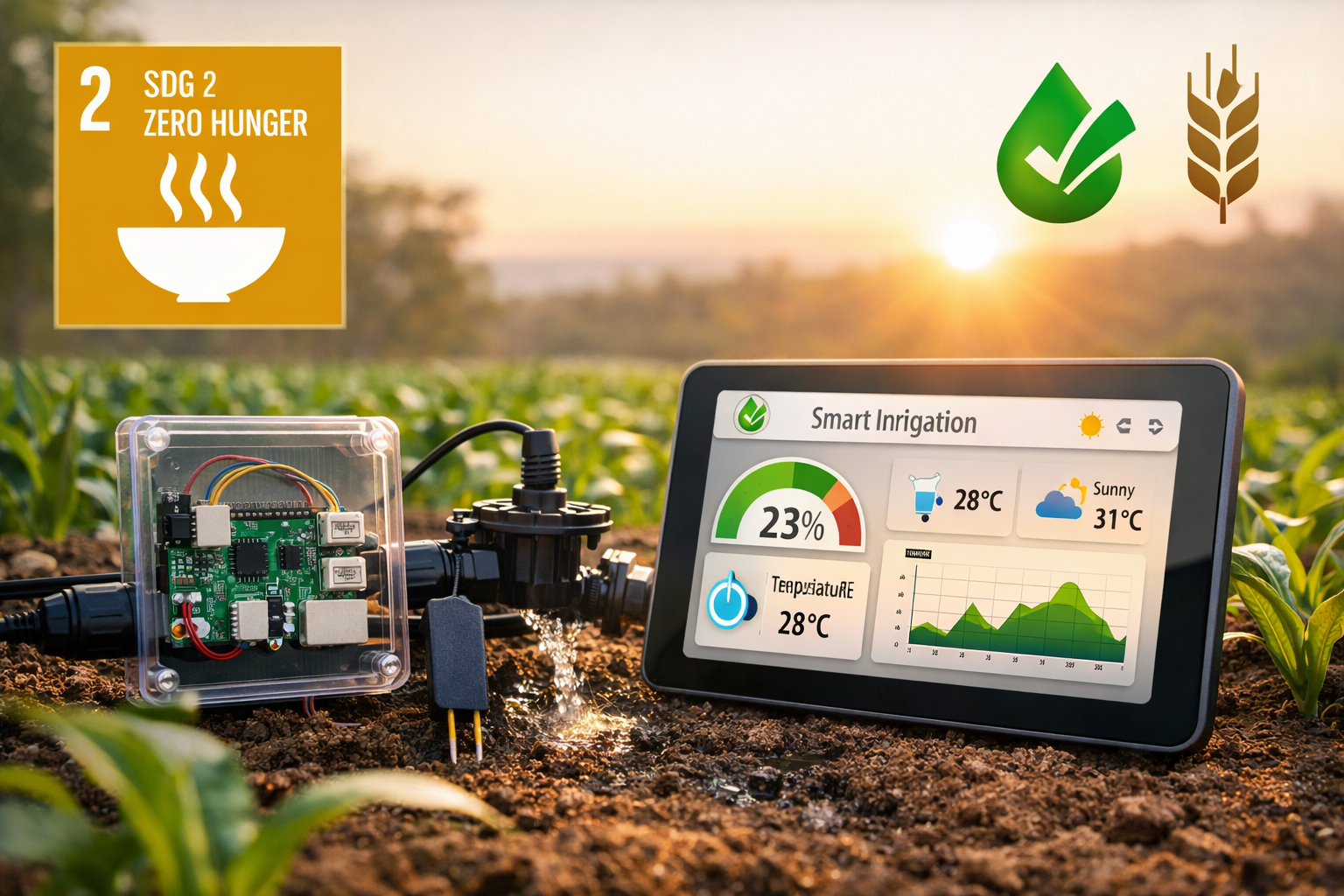
Table of Contents
- Abstract
- Prototype Repository
- SDG Alignment
- Food Security and the Water Challenge of SDG 2
- Precision Agriculture and Data-Driven Irrigation
- System Architecture
- System Architecture Overview
- Bill of Materials
- Engineering Specifications
- Connecting the Soil Moisture Sensor
- Python Code for Soil Moisture Monitoring
- Automated Irrigation Control
- Weather-Aware Irrigation Scheduling
- Extending the System with AI and Predictive Agriculture
- Smart Irrigation and Climate Resilience
- Engineering Notes
- Validation and Testing
- Suggested Performance Metrics
- The Future of Precision Agriculture
- Reproducibility
- Conclusion
Abstract
This project presents a prototype Raspberry Pi smart irrigation controller built around soil moisture sensing, environmental telemetry, relay-based irrigation control, and local data processing. The system reads soil conditions through an analog-to-digital converter, applies threshold-based irrigation logic, and can be extended with weather forecasting and predictive analytics.
From an engineering perspective, the platform demonstrates a compact agricultural control system with sensing, computation, actuation, and data logging layers. From a sustainability perspective, it illustrates how data-driven irrigation can improve water efficiency, agricultural resilience, and food-system sustainability.
Prototype Repository
This project is published as an open prototype so that engineers, researchers, students, and advanced makers can reproduce and extend the design. All code, documentation, setup notes, and example monitoring data are available in the project repository.
GitHub Repository:
Raspberry Pi Smart Irrigation Controller – Source Files and Documentation
The repository contains the complete prototype build materials:
- Python monitoring and control scripts
- sensor setup documentation
- relay-control examples
- deployment notes
- example irrigation datasets
- weather API integration examples
Engineers can clone the repository, fork the design, or download the complete project using GitHub’s Download ZIP feature.
All materials are released under the MIT License to support reuse in research, education, and prototype engineering work.
Repository Structure
raspberry-pi-smart-irrigation-controller/

README.md
LICENSE
requirements.txt

src/
  read_soil_moisture.py
  control_irrigation.py
  weather_schedule.py
  log_irrigation.py

docs/
  setup_guide.md
  deployment_notes.md
  sensor_notes.md

data/
  example_irrigation_readings.csv

hardware/
SDG Alignment
This project aligns most directly with SDG 2: Zero Hunger because it supports more efficient and resilient agricultural water management.
It also connects to:
- SDG 6: Clean Water and Sanitation — through reduced unnecessary water use
- SDG 13: Climate Action — through improved adaptation to drought and climate variability
- SDG 9: Industry, Innovation and Infrastructure — through smart agricultural control systems
Sensor-driven irrigation systems help farmers and researchers apply water more precisely, reduce waste, and improve crop resilience under increasingly variable climate conditions.
Food Security and the Water Challenge of SDG 2
Food security is deeply connected to water availability. Crops require consistent soil moisture levels to grow effectively, but irrigation practices must also avoid overwatering that can lead to nutrient loss, soil erosion, and unnecessary water consumption.
SDG 2 focuses on several agricultural priorities including:
- increasing agricultural productivity
- improving resilience to climate variability
- promoting sustainable land and water management
Smart irrigation systems contribute to these goals by enabling farmers to monitor soil conditions in real time and adjust irrigation accordingly. Rather than irrigating based on fixed schedules, sensor-driven systems deliver water only when soil moisture levels fall below meaningful thresholds.
Precision Agriculture and Data-Driven Irrigation
Modern agricultural systems increasingly rely on precision agriculture techniques that use environmental sensors, remote sensing, and data analytics to optimize crop production.
Precision irrigation systems typically monitor:
- soil moisture levels
- ambient temperature
- humidity
- solar radiation
- weather forecasts
These measurements allow irrigation systems to respond dynamically to environmental conditions rather than relying on fixed watering schedules.
A Raspberry Pi controller can serve as the computational center of such a system, collecting sensor data, analyzing environmental conditions, and activating irrigation valves when necessary. More advanced systems may also incorporate evapotranspiration estimates, anomaly detection, and predictive scheduling.
System Architecture
A Raspberry Pi smart irrigation system integrates several components:
Sensor Layer
- soil moisture sensors
- temperature and humidity sensors
- optional rainfall sensors
Control Layer
- Raspberry Pi computing platform
- relay module for valve control
- GPIO interface for sensor communication
Data Layer
- local database for environmental observations
- optional cloud integration
- visualization dashboard
Typical architecture:
Soil Sensors → Raspberry Pi → Irrigation Valve Control → Data Storage → Dashboard
This architecture allows irrigation decisions to be made based on real environmental measurements instead of fixed assumptions.
System Architecture Overview
The irrigation controller can be understood as a small environmental decision system in which sensor inputs are translated into automated control actions.
Typical data flow:
Soil Moisture Sensors → ADS1115 Analog-to-Digital Converter → Raspberry Pi Data Processing → Irrigation Control Logic → Relay Module → Water Valve or Pump → Environmental Data Logging
This structure makes the project more than a single-purpose watering device. It becomes a compact agricultural data system capable of collecting environmental observations, making irrigation decisions, and storing operational history for later analysis.
Bill of Materials
- Raspberry Pi 4 or Raspberry Pi Zero 2 W
- capacitive soil moisture sensor
- DHT22 temperature and humidity sensor
- ADS1115 analog-to-digital converter
- relay module
- solenoid irrigation valve
- water pump or irrigation system
- microSD card
- power supply
Capacitive soil moisture sensors are often preferred because they are more resistant to corrosion than resistive sensors. The ADS1115 is useful because Raspberry Pi GPIO pins do not support direct analog input.
Engineering Specifications
| Parameter | Specification |
|---|---|
| Compute platform | Raspberry Pi 4 or Raspberry Pi Zero 2 W |
| Primary sensor | Capacitive soil moisture sensor |
| Environmental sensor | DHT22 temperature and humidity sensor |
| ADC interface | ADS1115 over I2C |
| Actuation | Relay-controlled solenoid valve or pump |
| Storage options | CSV, SQLite, or lightweight dashboard logging |
| Control mode | Threshold-based irrigation with optional forecast integration |
| Target scope | Educational, prototype, and experimental precision irrigation |
Connecting the Soil Moisture Sensor
The soil moisture sensor typically connects through an analog-to-digital converter such as the ADS1115 because Raspberry Pi GPIO pins do not support analog input directly.
Typical wiring:
- soil sensor → ADS1115 analog input
- ADS1115 → Raspberry Pi I2C interface
- relay module → GPIO output
This configuration allows the Raspberry Pi to read soil moisture values and control irrigation valves. It also makes the system easier to extend later with multiple soil zones or additional environmental sensors.
Python Code for Soil Moisture Monitoring
The following Python example reads raw soil moisture values through an ADS1115.
import time
import board
import busio
from adafruit_ads1x15.ads1115 import ADS1115
from adafruit_ads1x15.analog_in import AnalogIn

i2c = busio.I2C(board.SCL, board.SDA)
ads = ADS1115(i2c)

soil_channel = AnalogIn(ads, ADS1115.P0)

while True:
    moisture_level = soil_channel.value
    print("Soil Moisture:", moisture_level)
    time.sleep(10)
This basic script reads raw soil moisture values every ten seconds. In a more robust deployment, these readings would be calibrated against real soil conditions and logged for trend analysis.
Automated Irrigation Control
The Raspberry Pi can activate irrigation valves using a relay module connected to a GPIO pin.
import time
import RPi.GPIO as GPIO

VALVE_PIN = 17

GPIO.setmode(GPIO.BCM)
GPIO.setup(VALVE_PIN, GPIO.OUT)

def irrigate():
    GPIO.output(VALVE_PIN, GPIO.HIGH)
    time.sleep(30)
    GPIO.output(VALVE_PIN, GPIO.LOW)
The irrigation system can be triggered automatically when soil moisture falls below a defined threshold. More advanced control logic can also integrate time delays, lockout periods, safety checks, and calibration based on soil type, crop type, and seasonal conditions.
Weather-Aware Irrigation Scheduling
More advanced irrigation controllers incorporate weather data to avoid unnecessary watering during rainfall events.
Weather APIs such as:
- OpenWeatherMap
- NOAA weather services
can provide forecasts that allow irrigation systems to delay watering when rain is expected. When combined with soil moisture sensing, forecast-aware irrigation becomes much more resilient than schedule-based watering because it responds to both current conditions and expected environmental changes.
Extending the System with AI and Predictive Agriculture
Machine learning models can extend irrigation systems by analyzing historical environmental data and predicting crop water requirements.
Possible applications include:
- predicting irrigation demand
- detecting soil moisture anomalies
- optimizing irrigation timing
- analyzing crop growth conditions
Lightweight machine learning frameworks such as TensorFlow Lite can run on Raspberry Pi devices and provide predictive capabilities directly at the edge. This moves the system from reactive irrigation toward anticipatory agricultural management.
Smart Irrigation and Climate Resilience
As climate variability increases, agricultural systems must become more resilient to drought and shifting weather patterns.
Sensor-driven irrigation systems provide farmers with the ability to monitor environmental conditions continuously and respond to water stress more effectively.
This approach supports the objectives of:
- SDG 2 – Zero Hunger by improving agricultural productivity
- SDG 6 – Clean Water and Sanitation by reducing unnecessary water consumption
In practice, irrigation systems like this also support broader adaptation strategies by helping agricultural systems respond more intelligently to local climate stress.
Engineering Notes
A few technical considerations are especially important in this build:
- ADC dependency: the Raspberry Pi requires an external ADC such as the ADS1115 for analog soil sensing.
- relay safety: irrigation control systems must avoid unintended switching on boot or fault conditions.
- threshold calibration: soil moisture values are only meaningful when interpreted against real soil conditions.
- field deployment: enclosures, connectors, and power systems matter as much as code in agricultural environments.
- decision quality: better irrigation decisions come from combining current sensing with context such as weather and historical data.
These constraints make the project more than a sensor demo. It becomes a prototype agricultural control system.
Validation and Testing
To bring this project closer to engineering-grade documentation, validation should include:
- verify I2C communication with the ADS1115
- confirm that soil moisture readings change plausibly between wet and dry conditions
- test relay control safely without the irrigation load first
- validate DHT22 readings against expected ambient conditions
- verify that threshold-based irrigation triggers only under intended conditions
- test forecast-aware scheduling logic if weather integration is used
If the system irrigates inconsistently, the issue may be related to sensor placement, threshold calibration, relay behavior, power stability, or environmental assumptions rather than to the control concept itself.
Suggested Performance Metrics
For a more rigorous evaluation, the controller can be assessed using several simple metrics:
- sensor stability: consistency of soil moisture readings under unchanged conditions
- trigger reliability: whether irrigation occurs only when intended
- water-use efficiency: whether the system reduces unnecessary irrigation compared with fixed scheduling
- logging reliability: whether observations and events are stored without loss
- system uptime: how consistently the controller operates without intervention
Even simple tracking of these metrics improves the project’s value as a precision agriculture prototype.
The Future of Precision Agriculture
Precision agriculture technologies are increasingly combining:
- sensor networks
- satellite imagery
- machine learning models
- automated farm equipment
Platforms such as Raspberry Pi make it possible for researchers, students, and agricultural innovators to prototype these systems at relatively low cost. Projects like this demonstrate how accessible computing technologies can support the development of more sustainable agricultural systems.
Reproducibility
All code, documentation, and supporting build materials necessary to reproduce the prototype are included in the project repository. The design intentionally relies on widely available Raspberry Pi hardware, open-source Python libraries, and common agricultural sensing components so that it can be rebuilt in classrooms, labs, and independent field projects.
The system is intended as a reference implementation rather than a field-hardened commercial irrigation controller. Engineers adapting it for long-term deployment should validate enclosures, power systems, valve safety, sensor calibration, and weather integration under local operating conditions.
Conclusion
Building a Raspberry Pi smart irrigation controller demonstrates how embedded sensing and edge computing can support sustainable agriculture. By combining soil moisture monitoring, environmental telemetry, and automated valve control, the system creates a flexible platform for water-aware agricultural management.
Although compact, the design reflects a broader sustainability principle: agricultural resilience depends on environmental visibility. When water conditions can be measured clearly and irrigation decisions can respond dynamically, food systems become more efficient and better adapted to climate stress.