
Last Updated June 16, 2026
Reproducible calculus workflows make mathematical modeling transparent, inspectable, reusable, and easier to govern. A model should not only produce a result. It should preserve the equations, parameters, data, assumptions, code, diagnostics, outputs, visualizations, and interpretation notes that made the result possible.
In calculus-based systems modeling, reproducibility matters because continuous models often depend on rates, accumulation, differential equations, numerical approximations, solver settings, calibration choices, sensitivity ranges, initial conditions, and assumptions about scale. A trajectory, derivative estimate, integral, optimization result, or simulation output can look precise while hiding fragile choices.
This article introduces reproducible calculus workflows in R Markdown, Jupyter, and multi-language repositories, including literate notebooks, parameter records, executable documentation, versioned outputs, environment notes, CSV/JSON exports, SQL registries, Haskell typed records, multi-language scaffolds, repository structure, calculator scripts, audit trails, and responsible interpretation.
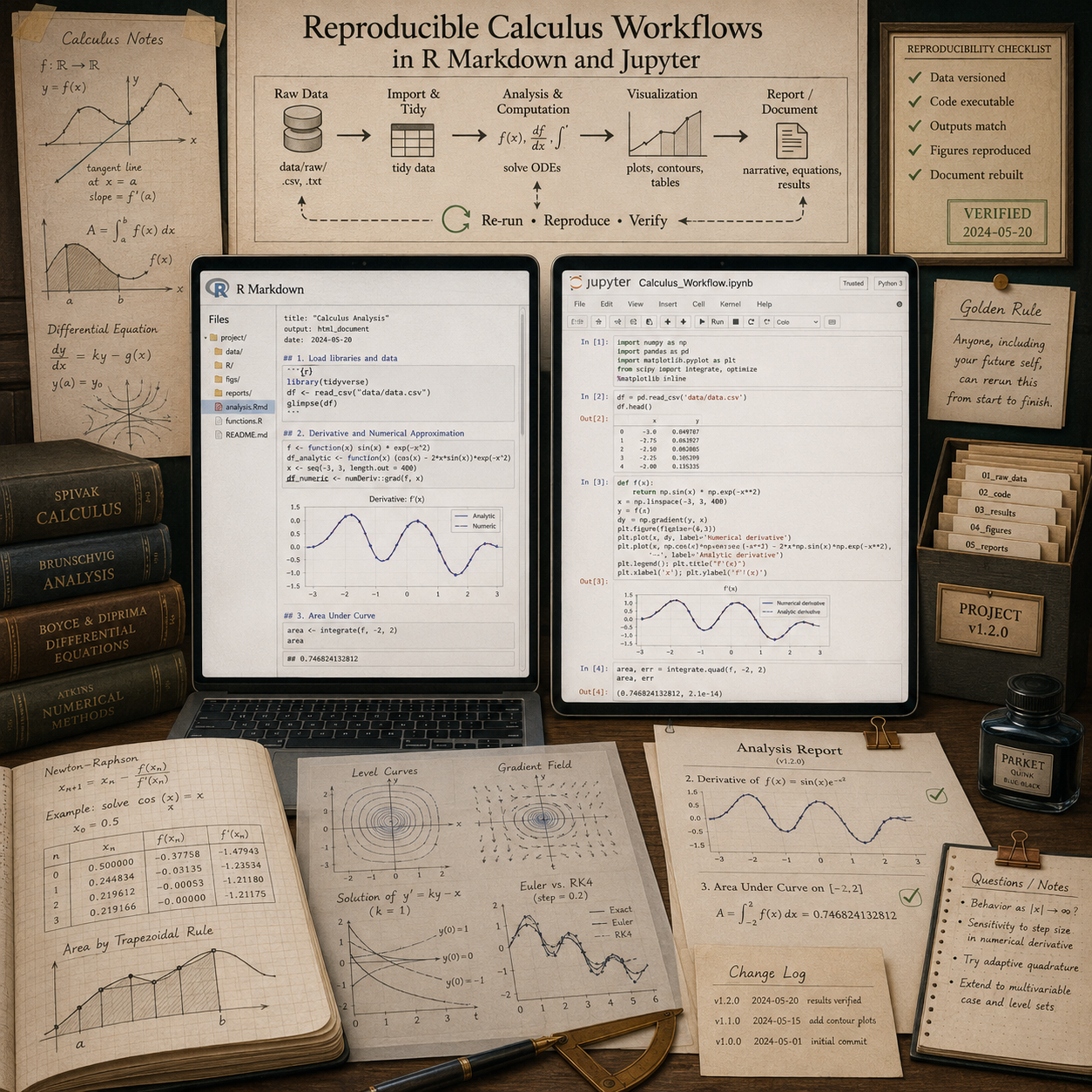
A reproducible workflow is not just code that runs once. It is a documented path from model question to mathematical representation, from representation to computation, from computation to outputs, and from outputs to interpretation. R Markdown and Jupyter support executable explanation. Multi-language repositories support broader inspection, testing, translation, comparison, and governance.
The central question is not only “Can someone rerun this?” It is “Can someone understand what was run, why it was run, what assumptions were used, what diagnostics were produced, and what conclusions are justified?”
Why Reproducibility Matters
Reproducibility matters because mathematical modeling can become opaque even when equations look clear. A result may depend on a data-cleaning step, parameter value, numerical method, solver tolerance, time grid, random seed, unit conversion, scaling choice, calibration range, or plotting transformation. If those choices are not recorded, the result cannot be responsibly reviewed.
\text{Result}=f(\text{model},\text{data},\text{parameters},\text{solver},\text{assumptions})
\]
Interpretation: A result should remain linked to the model, data, parameter records, solver configuration, and assumptions that produced it.
| Reproducibility risk | What can go wrong | Workflow response |
|---|---|---|
| Hidden parameter choices. | Results depend on values that are not documented. | Export parameter records and assumption notes. |
| Notebook drift. | Cells are run out of order or outputs no longer match code. | Use clean reruns, execution logs, and output checks. |
| Solver opacity. | Numerical settings affect trajectories or convergence. | Record method, tolerances, step sizes, and warnings. |
| Untracked outputs. | Figures and tables cannot be traced to code. | Generate outputs from scripts and store metadata. |
| Environment mismatch. | Different software versions produce different behavior. | Document dependencies, versions, and runtime assumptions. |
Reproducibility is a mathematical practice, a computational practice, and a governance practice.
What a Reproducible Calculus Workflow Is
A reproducible calculus workflow is a structured sequence that connects mathematical definitions, computation, outputs, diagnostics, and interpretation. It should preserve enough information for another reviewer, future maintainer, or later version of the project to understand how results were produced.
\text{Question}\rightarrow \text{Model}\rightarrow \text{Code}\rightarrow \text{Output}\rightarrow \text{Diagnostic}\rightarrow \text{Interpretation}
\]
Interpretation: Reproducibility keeps each stage of the modeling chain visible.
| Workflow component | Record to preserve | Review purpose |
|---|---|---|
| Mathematical representation. | Equations, variables, domains, assumptions. | Clarifies what is being modeled. |
| Input data. | Source, synthetic status, preprocessing, exclusions. | Clarifies evidence and limits. |
| Parameter set. | Names, values, units, ranges, sources. | Clarifies model configuration. |
| Computation. | Language, script, notebook, solver, environment. | Supports rerun and review. |
| Output artifact. | CSV, JSON, figure, report, diagnostic table. | Preserves evidence behind interpretation. |
| Interpretation. | Claim, warning, scope, uncertainty, review status. | Prevents overextension. |
A workflow is reproducible when its evidence chain is visible enough to be rerun, audited, and interpreted responsibly.
R Markdown for Executable Analysis
R Markdown is useful for reproducible analysis because it combines narrative explanation, equations, code, tables, figures, and output in one executable document. This makes it well suited for statistical summaries, sensitivity reports, calibration notes, parameter sweeps, and analytical appendices.
| R Markdown feature | Modeling use | Governance value |
|---|---|---|
| Executable code chunks. | Run data preparation, analysis, and plotting. | Connects output to code. |
| Markdown narrative. | Explain assumptions, equations, and results. | Keeps interpretation near computation. |
| Inline values. | Insert computed metrics into prose. | Reduces manual copy errors. |
| Parameterized reports. | Run the same report for multiple scenarios. | Supports scenario governance. |
| HTML/PDF/Word outputs. | Render analysis for different review settings. | Improves communication and archiving. |
R Markdown is strongest when outputs are regenerated from source, figures are not manually pasted, and code chunks are organized around a clear analytical path.
Jupyter for Exploratory Computation
Jupyter notebooks are valuable for exploratory computation, numerical experiments, visualization, teaching, and interactive model inspection. They can show how a derivative estimate, integral approximation, differential equation solver, response surface, or sensitivity analysis develops step by step.
| Jupyter strength | Modeling use | Reproducibility caution |
|---|---|---|
| Interactive exploration. | Test equations, parameters, plots, and diagnostics. | Notebook state can drift from saved code. |
| Visual inspection. | Plot trajectories, surfaces, residuals, and fields. | Figures need source data and metadata. |
| Teaching clarity. | Explain steps with code and narrative together. | Examples should mark synthetic data clearly. |
| Computational experimentation. | Compare methods, tolerances, or parameter settings. | Execution order and random seeds must be controlled. |
| Notebook exports. | Share HTML, PDF, or static reports. | Rendered output should match a clean rerun. |
Jupyter is powerful, but notebooks should be supported by scripts, tests, output exports, and clean-run checks when used in a serious modeling repository.
Multi-Language Repositories
Multi-language repositories support reproducibility by separating concerns. Python may handle workflow automation and data export. R may handle statistical reporting. Julia may handle numerical computing. SQL may preserve registries and governance tables. Haskell may define typed model records. C, C++, Fortran, Rust, and Go may support compiled examples, solver kernels, validation checks, or performance-oriented workflows.
| Language or layer | Typical role | Reproducibility value |
|---|---|---|
| Python. | Workflow orchestration, data export, tests, CLI tools. | Creates reproducible outputs and automation. |
| R. | Statistical summaries, R Markdown, tables, reporting. | Supports analytical reporting and review. |
| Julia. | Numerical experiments and scientific computing. | Supports high-level numerical expression. |
| SQL. | Registries, assumptions, metadata, audit tables. | Preserves structured governance records. |
| Haskell. | Typed records, pure functions, validation logic. | Clarifies model structure and transformations. |
| C, C++, Fortran, Rust, Go. | Compiled kernels, reference implementations, CLI checks. | Supports performance, portability, and cross-language comparison. |
A multi-language repository should not be a pile of unrelated scripts. It should be a coordinated workspace with shared data, documented outputs, common schemas, and consistent governance rules.
Parameter Records and Assumption Logs
Parameter records and assumption logs are central to reproducible calculus workflows. They connect mathematical results to the values, units, ranges, and assumptions used to produce them.
\theta = (\theta_1,\theta_2,\ldots,\theta_p)
\]
Interpretation: A parameter vector should be represented with named fields, units, sources, and validity notes.
| Record field | Example | Why it matters |
|---|---|---|
| Parameter name. | growth_rate, carrying_capacity, diffusion_coefficient. | Prevents anonymous value passing. |
| Value. | 0.35, 100, 1.2e-5. | Specifies the model configuration. |
| Unit. | per year, persons, square meters per second. | Prevents unit confusion. |
| Source. | synthetic, estimated, literature, calibrated. | Clarifies evidence status. |
| Range. | 0.2 to 0.5. | Supports sensitivity and robustness review. |
| Assumption note. | constant over time, homogeneous mixing, closed system. | Connects values to model scope. |
Parameter records make it easier to ask whether results depend on plausible, documented, and reviewable assumptions.
Outputs, Exports, and Versioned Evidence
Reproducible workflows should export evidence in durable formats. A chart is useful, but the table behind the chart is usually more important for review. A notebook is useful, but a generated CSV, JSON, or Markdown report makes the result easier to inspect outside the notebook environment.
| Output type | Purpose | Review value |
|---|---|---|
| CSV table. | Human-readable tabular data. | Easy to inspect, diff, and reuse. |
| JSON file. | Structured nested records. | Preserves model metadata and hierarchical records. |
| Markdown report. | Readable summary with warnings. | Supports governance and review queues. |
| Notebook export. | Rendered explanatory workflow. | Shows analysis path and output together. |
| SQLite database. | Structured registry and query layer. | Supports assumption and governance audits. |
| Figure metadata. | Records axes, units, transformations, and source data. | Prevents decorative or decontextualized visualization. |
Outputs should be generated, traceable, and versioned. Manual copying weakens reproducibility unless the copied artifact is clearly derived and documented.
Testing, Diagnostics, and Governance
Reproducible calculus workflows should include tests and diagnostics. Tests check whether code behaves as expected. Diagnostics record whether model outputs are numerically and interpretively reliable. Governance records connect warnings to review actions.
| Check type | Example | Governance role |
|---|---|---|
| Unit test. | Derivative function returns expected value for a known case. | Protects code behavior. |
| Smoke test. | Workflow runs and writes expected outputs. | Confirms executable scaffold. |
| Numerical diagnostic. | Step-size refinement, residual, convergence, or stability note. | Checks computational reliability. |
| Parameter validation. | Bounds, units, missing fields, and range checks. | Checks model configuration. |
| Governance queue. | Warnings requiring human review. | Prevents unresolved issues from being hidden. |
A reproducible workflow should not merely produce outputs. It should produce evidence about whether those outputs are ready to interpret.
Workflow Architecture
A strong repository architecture separates source code, data, documentation, schemas, notebooks, generated outputs, tests, and governance artifacts. This separation makes it easier to rerun workflows, inspect outputs, and understand what is source material versus generated evidence.
Repository Architecture
Source Code
Keep reusable scripts, packages, and CLI tools in language-specific folders.
Data and Schemas
Separate synthetic teaching data, schemas, and input records from generated outputs.
Outputs
Export tables, JSON files, reports, logs, and figures into predictable output folders.
Governance
Preserve warnings, assumptions, validation checks, and review queues as first-class artifacts.
Good architecture makes reproducibility easier by default. Poor architecture makes it depend on memory, guesswork, and informal convention.
Systems Modeling Interpretation
In systems modeling, reproducibility is part of interpretation. A model output is not only a number, trajectory, surface, or graph. It is the result of choices about structure, parameters, data, numerical methods, and assumptions. A reproducible workflow preserves those choices so the output can be interpreted in context.
This is especially important for calculus-based models because numerical results can look authoritative. A smooth curve, stable equilibrium, optimized value, or calibrated trajectory may hide assumptions that should be visible. Reproducibility helps separate computational evidence from rhetorical polish.
The stronger interpretive standard is not “the notebook exists.” It is: “the repository preserves executable workflows, source records, generated evidence, diagnostics, and claim boundaries.”
Mathematical Deepening
This section adds a more formal layer for mathematically advanced readers. Reproducible calculus workflows connect mathematical specification, executable documentation, deterministic functions, numerical methods, dependency control, versioned artifacts, typed records, sensitivity diagnostics, validation checks, literate programming, scientific reporting, and model governance.
Workflow Building Blocks
Specification
State equations, variables, domains, assumptions, and output metrics before computation.
Execution
Run scripts, notebooks, tests, and solver workflows from documented commands.
Evidence
Export CSV, JSON, figures, reports, logs, and diagnostics in durable formats.
Review
Use warnings, governance queues, validation records, and interpretation boundaries.
Reproducibility Review Protocol
Rerun Cleanly
Confirm outputs can be regenerated from a fresh or documented environment.
Trace Outputs
Verify figures and tables can be traced back to source scripts and data records.
Validate Records
Check parameter records, unit notes, solver settings, and assumption logs.
Limit Claims
Align interpretation with tested ranges, diagnostics, and documented assumptions.
Workflow Governance
Source Record
Documents whether data are synthetic, observed, estimated, calibrated, or benchmarked.
Run Record
Stores command, timestamp, software notes, output paths, and status.
Diagnostic Record
Captures warnings, errors, convergence notes, residuals, and validation checks.
Claim Record
Defines what the workflow output can and cannot responsibly support.
Examples from Systems Modeling
Reproducible calculus workflows support many systems modeling domains.
Population Dynamics
Growth-rate assumptions, carrying capacities, initial conditions, trajectories, and sensitivity outputs can be preserved across scripts and notebooks.
Epidemiological Models
Transmission rates, recovery assumptions, solver settings, intervention scenarios, and calibration diagnostics can remain traceable.
Climate Feedback Models
Forcing assumptions, feedback parameters, uncertainty ranges, response curves, and scenario reports can be regenerated from source.
Resource Systems
Extraction rates, regeneration functions, depletion thresholds, and flow-to-stock outputs can be audited across parameter ranges.
Infrastructure Models
Capacity limits, repair rates, failure thresholds, and resilience diagnostics can be preserved as structured outputs.
Model Governance
Assumptions, validation checks, diagnostics, warnings, and claim boundaries can be exported into reviewable governance queues.
Across these examples, reproducibility strengthens the connection between mathematical modeling, computation, and responsible explanation.
Computation and Reproducible Workflows
A reproducible computational workflow should make its source, process, and outputs explicit. It should include commands that can be run again, outputs that can be inspected, tests that can detect failure, and records that explain interpretation limits.
The repository companion for this article uses a multi-language scaffold to show how reproducible calculus workflows can preserve typed records, notebook placeholders, R-style reporting outputs, Python automation, SQL registries, calculator scripts, and generated governance artifacts.
Python Workflow: Reproducibility Audit
The Python workflow below creates a compact reproducibility audit for a calculus-based modeling workflow. It records source files, expected outputs, diagnostic status, and governance warnings.
from __future__ import annotations

from dataclasses import asdict, dataclass
from pathlib import Path
import csv
import json


@dataclass(frozen=True)
class WorkflowArtifact:
    artifact_name: str
    artifact_type: str
    path: str
    source_or_generated: str
    review_role: str
    warning: str


@dataclass(frozen=True)
class RunRecord:
    workflow_name: str
    command: str
    expected_outputs: int
    diagnostic_status: str
    review_required: bool
    interpretation_warning: str


def build_artifacts() -> list[WorkflowArtifact]:
    return [
        WorkflowArtifact(
            artifact_name="parameter_records",
            artifact_type="csv",
            path="data/parameter_records.csv",
            source_or_generated="source",
            review_role="documents parameter names, values, units, sources, and ranges",
            warning="Parameter records do not prove empirical correctness."
        ),
        WorkflowArtifact(
            artifact_name="model_outputs",
            artifact_type="csv",
            path="outputs/tables/model_outputs.csv",
            source_or_generated="generated",
            review_role="stores computed trajectory or summary outputs",
            warning="Generated outputs require diagnostics and interpretation limits."
        ),
        WorkflowArtifact(
            artifact_name="diagnostics",
            artifact_type="json",
            path="outputs/json/diagnostics.json",
            source_or_generated="generated",
            review_role="records validation, convergence, and warning status",
            warning="Diagnostics should remain attached to interpretation."
        ),
        WorkflowArtifact(
            artifact_name="governance_queue",
            artifact_type="markdown",
            path="outputs/reports/governance_queue.md",
            source_or_generated="generated",
            review_role="collects warnings requiring human review",
            warning="Governance queues support judgment but do not replace it."
        )
    ]


def build_run_record(artifacts: list[WorkflowArtifact]) -> RunRecord:
    review_required = any("warning" in artifact.warning.lower() for artifact in artifacts)

    return RunRecord(
        workflow_name="reproducible_calculus_workflow",
        command="make smoke",
        expected_outputs=len(artifacts),
        diagnostic_status="review_required" if review_required else "converged",
        review_required=review_required,
        interpretation_warning="Reproducibility supports auditability but does not prove model validity."
    )


artifacts = build_artifacts()
run_record = build_run_record(artifacts)

output_dir = Path("outputs")
(output_dir / "tables").mkdir(parents=True, exist_ok=True)
(output_dir / "json").mkdir(parents=True, exist_ok=True)
(output_dir / "reports").mkdir(parents=True, exist_ok=True)

artifact_rows = [asdict(artifact) for artifact in artifacts]

with (output_dir / "tables" / "workflow_artifacts.csv").open("w", newline="", encoding="utf-8") as handle:
    writer = csv.DictWriter(handle, fieldnames=artifact_rows[0].keys())
    writer.writeheader()
    writer.writerows(artifact_rows)

with (output_dir / "tables" / "workflow_run_record.csv").open("w", newline="", encoding="utf-8") as handle:
    writer = csv.DictWriter(handle, fieldnames=asdict(run_record).keys())
    writer.writeheader()
    writer.writerow(asdict(run_record))

(output_dir / "json" / "workflow_artifacts.json").write_text(
    json.dumps(artifact_rows, indent=2),
    encoding="utf-8"
)

(output_dir / "json" / "workflow_run_record.json").write_text(
    json.dumps(asdict(run_record), indent=2),
    encoding="utf-8"
)

report_lines = [
    "# Reproducibility Audit",
    "",
    f"Workflow: {run_record.workflow_name}",
    f"Command: `{run_record.command}`",
    f"Diagnostic status: {run_record.diagnostic_status}",
    "",
    "## Artifacts"
]

for artifact in artifacts:
    report_lines.append(
        f"- **{artifact.artifact_name}** ({artifact.artifact_type}): {artifact.review_role}. {artifact.warning}"
    )

report_lines.append("")
report_lines.append(run_record.interpretation_warning)

(output_dir / "reports" / "reproducibility_audit.md").write_text(
    "\n".join(report_lines) + "\n",
    encoding="utf-8"
)

print("Wrote reproducibility audit outputs.")
This workflow turns reproducibility into a reviewable artifact rather than an informal promise.
R Workflow: R Markdown-Style Output Register
The R workflow below creates a compact output register similar to what an R Markdown report might summarize after execution.
workflow_outputs <- data.frame(
  artifact_name = c(
    "parameter_records",
    "sensitivity_table",
    "calibration_report",
    "diagnostics_json",
    "governance_queue"
  ),
  artifact_type = c("csv", "csv", "markdown", "json", "markdown"),
  path = c(
    "data/parameter_records.csv",
    "outputs/tables/sensitivity_table.csv",
    "outputs/reports/calibration_report.md",
    "outputs/json/diagnostics.json",
    "outputs/reports/governance_queue.md"
  ),
  source_or_generated = c("source", "generated", "generated", "generated", "generated"),
  review_role = c(
    "documents parameter values and units",
    "records parameter sensitivity evidence",
    "summarizes calibration and residual diagnostics",
    "stores structured warning and status records",
    "collects review items for unresolved issues"
  ),
  warning = c(
    "Parameter records do not prove empirical correctness.",
    "Sensitivity evidence depends on tested ranges.",
    "Calibration is not validation.",
    "Diagnostics should remain attached to outputs.",
    "Governance queues support judgment but do not replace it."
  )
)

review_summary <- data.frame(
  workflow_name = "r_markdown_style_calculus_report",
  output_count = nrow(workflow_outputs),
  generated_output_count = sum(workflow_outputs$source_or_generated == "generated"),
  review_required = TRUE,
  interpretation_warning = "Executable reports support reproducibility only when outputs can be regenerated from source."
)

dir.create("outputs/tables", recursive = TRUE, showWarnings = FALSE)

write.csv(
  workflow_outputs,
  "outputs/tables/r_workflow_output_register.csv",
  row.names = FALSE
)

write.csv(
  review_summary,
  "outputs/tables/r_workflow_review_summary.csv",
  row.names = FALSE
)

print(workflow_outputs)
print(review_summary)
This workflow shows how an executable report can preserve an output register for review.
Haskell Workflow: Typed Workflow Records
Haskell can represent reproducibility artifacts as typed records, preserving whether each file is source or generated and what review role it serves.
module Main where

data ArtifactOrigin
  = SourceArtifact
  | GeneratedArtifact
  deriving (Show, Eq)

data ArtifactType
  = CSV
  | JSON
  | Markdown
  | Notebook
  | Script
  | Schema
  deriving (Show, Eq)

data WorkflowArtifact = WorkflowArtifact
  { artifactName :: String
  , artifactType :: ArtifactType
  , artifactPath :: String
  , artifactOrigin :: ArtifactOrigin
  , reviewRole :: String
  , interpretationWarning :: String
  } deriving (Show, Eq)

data RunRecord = RunRecord
  { workflowName :: String
  , command :: String
  , expectedArtifacts :: Int
  , reviewRequired :: Bool
  , runWarning :: String
  } deriving (Show, Eq)

artifacts :: [WorkflowArtifact]
artifacts =
  [ WorkflowArtifact
      "parameter_records"
      CSV
      "data/parameter_records.csv"
      SourceArtifact
      "documents parameter names, units, values, ranges, and sources"
      "Parameter records do not prove empirical correctness."
  , WorkflowArtifact
      "workflow_artifacts"
      JSON
      "outputs/json/workflow_artifacts.json"
      GeneratedArtifact
      "stores structured reproducibility metadata"
      "Structured metadata must remain synchronized with generated outputs."
  , WorkflowArtifact
      "reproducibility_audit"
      Markdown
      "outputs/reports/reproducibility_audit.md"
      GeneratedArtifact
      "summarizes run status, artifacts, and warnings"
      "Audit summaries support review but do not replace inspection."
  , WorkflowArtifact
      "governance_queue"
      Markdown
      "outputs/reports/governance_queue.md"
      GeneratedArtifact
      "collects unresolved warnings requiring human review"
      "Governance queues support judgment but do not replace it."
  ]

runRecord :: RunRecord
runRecord =
  RunRecord
    "typed_reproducibility_workflow"
    "make smoke"
    (length artifacts)
    True
    "Reproducibility supports auditability but does not prove model validity."

main :: IO ()
main = do
  putStrLn "Workflow artifacts:"
  mapM_ print artifacts
  putStrLn ""
  putStrLn "Run record:"
  print runRecord
The typed workflow makes reproducibility metadata explicit instead of relying on folder names alone.
SQL Workflow: Reproducibility Governance Registry
SQL can preserve a registry of reproducibility components, review roles, and warnings for repository-level governance.
CREATE TABLE reproducibility_governance_registry (
    workflow_key TEXT PRIMARY KEY,
    workflow_name TEXT NOT NULL,
    computational_role TEXT NOT NULL,
    systems_modeling_role TEXT NOT NULL,
    review_warning TEXT NOT NULL
);

INSERT INTO reproducibility_governance_registry VALUES
(
  'r_markdown_report',
  'R Markdown report',
  'Combines prose, equations, code, tables, and figures in an executable report.',
  'Supports statistical reporting, sensitivity summaries, and analytical appendices.',
  'Rendered reports should be regenerated from source, not manually patched.'
);

INSERT INTO reproducibility_governance_registry VALUES
(
  'jupyter_notebook',
  'Jupyter notebook',
  'Supports interactive computation, visualization, and exploratory modeling.',
  'Helps explain numerical methods, simulations, and model diagnostics step by step.',
  'Notebook state can drift; clean reruns and exported outputs are needed.'
);

INSERT INTO reproducibility_governance_registry VALUES
(
  'parameter_record',
  'Parameter record',
  'Stores parameter names, values, units, ranges, sources, and assumption notes.',
  'Keeps model outputs tied to the configuration that produced them.',
  'Parameter records do not prove empirical correctness.'
);

INSERT INTO reproducibility_governance_registry VALUES
(
  'output_register',
  'Output register',
  'Lists generated tables, figures, reports, JSON files, and logs.',
  'Makes artifacts traceable to source workflows.',
  'Outputs should be regenerated from code and documented.'
);

INSERT INTO reproducibility_governance_registry VALUES
(
  'smoke_test',
  'Smoke test',
  'Checks whether a workflow runs and writes expected artifacts.',
  'Supports repository maintenance and executable scaffolding.',
  'A smoke test does not prove mathematical validity.'
);

INSERT INTO reproducibility_governance_registry VALUES
(
  'governance_queue',
  'Governance queue',
  'Collects warnings, assumptions, unresolved diagnostics, and review items.',
  'Keeps interpretation limits visible across the workflow.',
  'Governance queues support human review but do not replace it.'
);

SELECT
    workflow_name,
    computational_role,
    systems_modeling_role,
    review_warning
FROM reproducibility_governance_registry
ORDER BY workflow_key;
This registry connects reproducibility practice to executable reports, notebooks, parameter records, output registers, smoke tests, and governance queues.
GitHub Repository
The companion repository for this article is designed as a reproducible mathematical-modeling workspace. It supports R Markdown-style reporting, Jupyter notebook placeholders, Python workflow automation, Haskell typed records, SQL governance registries, multi-language reference implementations, structured exports, smoke tests, calculator scripts, generated reports, and Canvas-ready audit artifacts.
Complete Code Repository
Companion article folder with R Markdown-style workflow records, Jupyter notebook placeholders, Python, R, Julia, SQL, Haskell, C, C++, Fortran, Rust, Go, documentation, synthetic teaching data, generated outputs, schemas, Canvas-ready workflow artifacts, and reusable calculator scripts for reproducible calculus workflows, executable documentation, parameter records, output registers, clean-run checks, multi-language repository design, diagnostics, governance queues, and responsible mathematical modeling.
Interpretive Limits and Responsible Use
Reproducibility is necessary for serious modeling, but it is not sufficient. A reproducible workflow can reproduce a mistaken equation, weak assumption, biased dataset, poor calibration, fragile parameter range, or misleading interpretation. Clean code does not guarantee a sound model. A well-organized repository does not prove empirical validity.
Responsible use requires documentation and judgment. Preserve parameter records, assumptions, data notes, solver settings, environment details, outputs, diagnostics, validation checks, uncertainty notes, and claim boundaries. Treat reproducibility as a foundation for review, not as a substitute for review.
The central question is not only “Can the workflow be rerun?” It is “What does rerunning it demonstrate, what remains uncertain, and what claims are justified by the preserved evidence?”
Related Articles
- Calculus for Systems Modeling
- Typed Model Records and Functional Workflows in Haskell
- Initial Conditions, Boundary Conditions, and Model Scope
- Scientific Computing for Systems Modeling
- Ordinary Differential Equation Solver Workflows
- Symbolic Calculus and Model Inspection
- Parameter Sweeps and Sensitivity Analysis
- Model Calibration Using Calculus-Based Methods
- Interpretation, Assumptions, and Responsible Mathematical Modeling
- Model Governance and Accountability
Further Reading
- Baumer, B., Cetinkaya-Rundel, M., Bray, A., Loi, L. and Horton, N.J. (2014) ‘R Markdown: Integrating a reproducible analysis tool into introductory statistics’, Technology Innovations in Statistics Education, 8(1).
- Boettiger, C. (2015) ‘An introduction to Docker for reproducible research’, ACM SIGOPS Operating Systems Review, 49(1), pp. 71–79.
- Gandrud, C. (2020) Reproducible Research with R and RStudio. 3rd edn. Boca Raton, FL: CRC Press.
- Gentleman, R. and Temple Lang, D. (2007) ‘Statistical analyses and reproducible research’, Journal of Computational and Graphical Statistics, 16(1), pp. 1–23.
- Kluyver, T. et al. (2016) ‘Jupyter Notebooks: A publishing format for reproducible computational workflows’, in Loizides, F. and Schmidt, B. (eds.) Positioning and Power in Academic Publishing: Players, Agents and Agendas. Amsterdam: IOS Press, pp. 87–90.
- Knuth, D.E. (1984) ‘Literate programming’, The Computer Journal, 27(2), pp. 97–111.
- Peng, R.D. (2011) ‘Reproducible research in computational science’, Science, 334(6060), pp. 1226–1227.
- Rule, A., Birmingham, A., Zuniga, C., Altintas, I., Huang, S.C., Knight, R., Moshiri, N., Nguyen, M.H., Rosenthal, S.B., Pérez, F. and Rose, P.W. (2019) ‘Ten simple rules for writing and sharing computational analyses in Jupyter Notebooks’, PLOS Computational Biology, 15(7), e1007007.
- Stodden, V., Leisch, F. and Peng, R.D. (eds.) (2014) Implementing Reproducible Research. Boca Raton, FL: CRC Press.
- Xie, Y., Allaire, J.J. and Grolemund, G. (2018) R Markdown: The Definitive Guide. Boca Raton, FL: CRC Press.
References
- Baumer, B., Cetinkaya-Rundel, M., Bray, A., Loi, L. and Horton, N.J. (2014) ‘R Markdown: Integrating a reproducible analysis tool into introductory statistics’, Technology Innovations in Statistics Education, 8(1).
- Boettiger, C. (2015) ‘An introduction to Docker for reproducible research’, ACM SIGOPS Operating Systems Review, 49(1), pp. 71–79.
- Gandrud, C. (2020) Reproducible Research with R and RStudio. 3rd edn. Boca Raton, FL: CRC Press.
- Gentleman, R. and Temple Lang, D. (2007) ‘Statistical analyses and reproducible research’, Journal of Computational and Graphical Statistics, 16(1), pp. 1–23.
- Kluyver, T. et al. (2016) ‘Jupyter Notebooks: A publishing format for reproducible computational workflows’, in Loizides, F. and Schmidt, B. (eds.) Positioning and Power in Academic Publishing: Players, Agents and Agendas. Amsterdam: IOS Press, pp. 87–90.
- Knuth, D.E. (1984) ‘Literate programming’, The Computer Journal, 27(2), pp. 97–111.
- Peng, R.D. (2011) ‘Reproducible research in computational science’, Science, 334(6060), pp. 1226–1227.
- Rule, A., Birmingham, A., Zuniga, C., Altintas, I., Huang, S.C., Knight, R., Moshiri, N., Nguyen, M.H., Rosenthal, S.B., Pérez, F. and Rose, P.W. (2019) ‘Ten simple rules for writing and sharing computational analyses in Jupyter Notebooks’, PLOS Computational Biology, 15(7), e1007007.
- Stodden, V., Leisch, F. and Peng, R.D. (eds.) (2014) Implementing Reproducible Research. Boca Raton, FL: CRC Press.
- Xie, Y., Allaire, J.J. and Grolemund, G. (2018) R Markdown: The Definitive Guide. Boca Raton, FL: CRC Press.