
Table of Contents
- Abstract
- Prototype Repository
- SDG Alignment
- Energy Access and the Goals of SDG 7
- Why a Raspberry Pi Solar Microgrid Monitoring System Matters
- What Is a Solar Microgrid?
- Solar Microgrid System Architecture
- Bill of Materials
- Engineering Specifications
- Connecting the INA219 Power Sensor
- Python Code for Solar Energy Monitoring
- Logging Energy Production Data
- Energy Monitoring Dashboards
- AI Applications in Renewable Energy Systems
- Microgrids and Energy Resilience
- Engineering Notes
- Validation and Testing
- Suggested Performance Metrics
- Renewable Energy Data and the Future of SDG 7
- Reproducibility
- Conclusion
Abstract
This project presents a prototype Raspberry Pi solar microgrid monitoring system built around edge computing, power sensing, local time-series logging, and optional dashboard export. The platform measures solar panel voltage and current, estimates power generation, tracks battery-related electrical conditions, and stores observations for later analysis.
From an engineering perspective, the system demonstrates a compact renewable-energy monitoring node with sensing, logging, and analytics layers. From a sustainability perspective, it illustrates how low-cost embedded systems can improve renewable-energy visibility, support energy resilience, and strengthen distributed clean-energy infrastructure.
Prototype Repository
This project is published as an open prototype so that engineers, researchers, students, and advanced makers can reproduce and extend the design. All code, documentation, setup notes, and example energy datasets are available in the project repository.
GitHub Repository:
Raspberry Pi Solar Microgrid Monitoring System – Source Files and Documentation
The repository contains the complete prototype build materials:
- Python monitoring scripts
- sensor integration examples
- energy logging utilities
- dashboard integration notes
- deployment documentation
- sample energy datasets
Engineers can clone the repository, fork the design, or download the complete project using GitHub’s Download ZIP feature.
All materials are released under the MIT License to support reuse in research, education, and prototype engineering work.
Repository Structure
raspberry-pi-solar-microgrid-monitoring/

README.md
LICENSE
requirements.txt

src/
  read_power_data.py
  log_energy_data.py
  dashboard_export.py
  anomaly_check.py

docs/
  setup_guide.md
  deployment_notes.md
  sensor_notes.md

data/
  example_solar_energy_readings.csv

hardware/
SDG Alignment
This project aligns most directly with SDG 7: Affordable and Clean Energy, which emphasizes expanding access to reliable, sustainable, and modern energy systems.
It also connects to:
- SDG 9: Industry, Innovation and Infrastructure — through distributed monitoring and renewable-energy analytics
- SDG 13: Climate Action — because clean-energy infrastructure is central to emissions reduction and resilience
Renewable microgrids are increasingly important in regions where traditional electrical infrastructure is unreliable, expensive, or unavailable. Monitoring systems help these microgrids operate more effectively by making energy production and storage visible over time.
Energy Access and the Goals of SDG 7
The United Nations Sustainable Development Goal SDG 7 – Affordable and Clean Energy emphasizes the importance of expanding access to reliable, sustainable, and modern energy systems.
Key objectives include:
- expanding access to electricity
- increasing the share of renewable energy
- improving global energy efficiency
- strengthening sustainable energy infrastructure
Renewable microgrids are increasingly important in achieving these goals, particularly in regions where traditional electrical infrastructure is unreliable or unavailable.
Why a Raspberry Pi Solar Microgrid Monitoring System Matters
Renewable energy systems do not become reliable simply by generating electricity. They also require visibility into performance. Solar output fluctuates with weather and daylight, batteries must be protected from overcharging or deep discharge, and system operators need to understand how energy moves through the microgrid.
A Raspberry Pi–based monitoring node matters because it makes these energy flows observable at low cost. That visibility supports better system maintenance, more informed energy planning, and improved community resilience.
The platform is not a substitute for industrial-grade energy management infrastructure. Its value is that it translates the logic of microgrid monitoring into an accessible, reproducible edge-computing system.
What Is a Solar Microgrid?
A solar microgrid is a localized energy system capable of generating, storing, and distributing electricity independently.
Typical components include:
- solar photovoltaic panels
- charge controllers
- battery storage systems
- power inverters
- electrical loads
These systems can operate either independently (off-grid) or in coordination with the main electrical grid. Monitoring systems allow operators to observe energy flows and detect potential system failures before they occur.
Solar Microgrid System Architecture
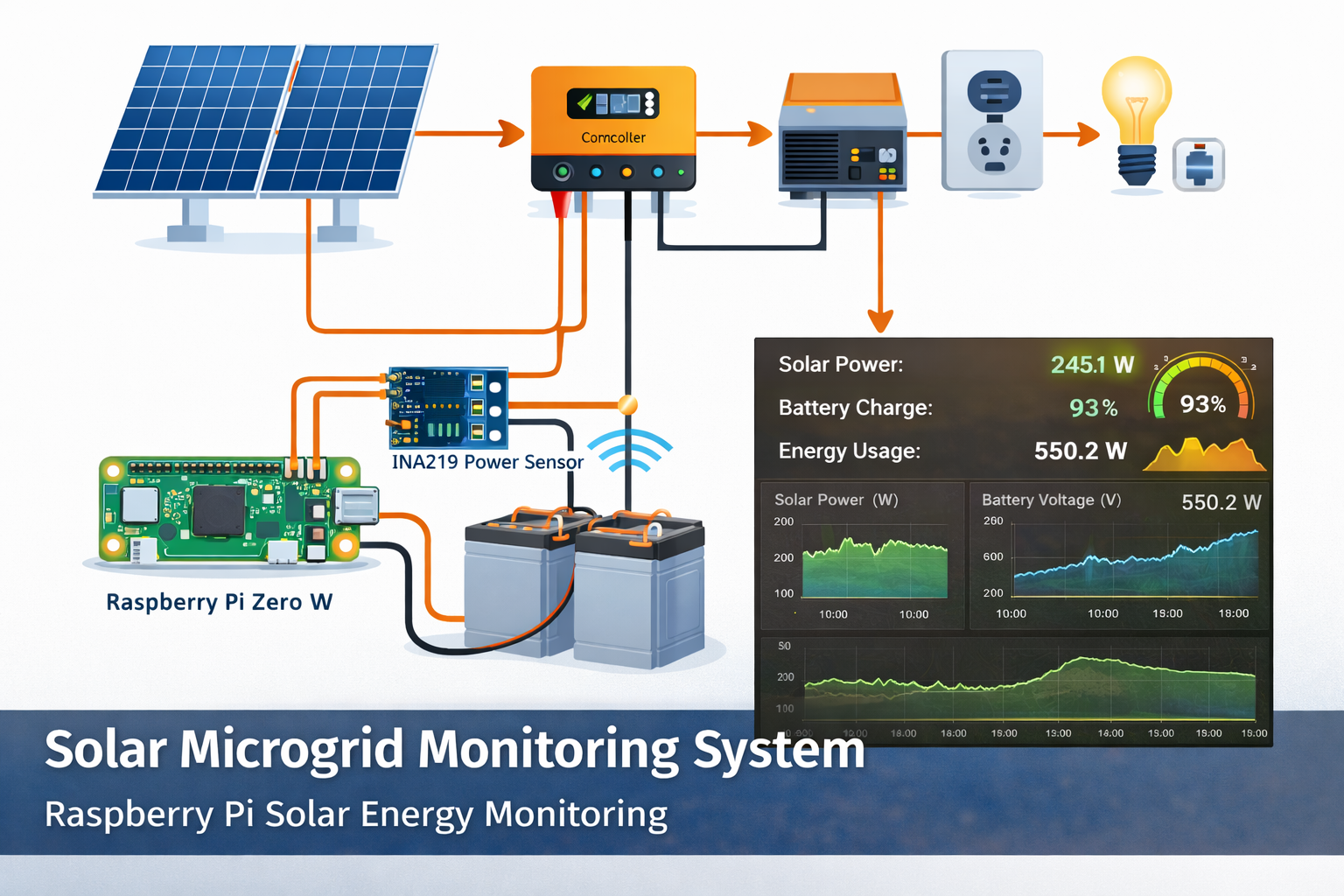
A Raspberry Pi monitoring system can function as the analytical center of a microgrid.
Typical architecture:
Solar Panels → Charge Controller → Battery Bank → Inverter → Electrical Loads
The Raspberry Pi connects to sensors that measure:
- solar panel voltage
- solar panel current
- battery voltage
- system power output
- energy consumption
Collected data can be stored locally or transmitted to dashboards for visualization.
Bill of Materials
- Raspberry Pi 4 or Raspberry Pi Zero 2 W
- INA219 current and voltage sensor
- solar panel array
- solar charge controller
- battery storage system
- DC-AC inverter
- microSD card
- power supply or DC converter
The INA219 sensor is commonly used for measuring electrical current and voltage in renewable-energy systems because it provides a compact and practical interface for low-voltage DC monitoring.
Engineering Specifications
| Parameter | Specification |
|---|---|
| Compute platform | Raspberry Pi 4 or Raspberry Pi Zero 2 W |
| Primary sensor | INA219 current and voltage sensor |
| Measured variables | voltage, current, power, logged energy trends |
| Interface | I2C |
| Storage options | CSV, SQLite, dashboard export |
| Output options | console, local dashboard, optional cloud integration |
| Deployment mode | microgrid edge-monitoring node |
| Target scope | educational, prototype, and experimental renewable-energy monitoring |
Connecting the INA219 Power Sensor
The INA219 communicates with the Raspberry Pi through the I2C interface.
Typical wiring:
- INA219 VCC → Raspberry Pi 3.3V
- INA219 GND → Ground
- INA219 SDA → GPIO 2
- INA219 SCL → GPIO 3
The sensor measures both voltage and current, allowing the system to calculate real-time power generation. In practical deployments, wiring quality and current-path design matter significantly for stable readings.
Python Code for Solar Energy Monitoring
The following Python example reads voltage and current from an INA219 sensor and calculates instantaneous power.
import time
import board
import busio
from adafruit_ina219 import INA219

i2c_bus = busio.I2C(board.SCL, board.SDA)

sensor = INA219(i2c_bus)

while True:

    bus_voltage = sensor.bus_voltage
    current = sensor.current

    power = bus_voltage * (current / 1000)

    print("Solar Voltage:", bus_voltage)
    print("Current (mA):", current)
    print("Power (W):", power)

    time.sleep(5)
This script collects voltage and current measurements and calculates instantaneous power output from the solar panel.
Logging Energy Production Data
Energy monitoring systems typically store observations for long-term analysis.
import csv
import datetime

with open("solar_energy_log.csv","a") as file:

    writer = csv.writer(file)

    writer.writerow([
        datetime.datetime.now(),
        bus_voltage,
        current,
        power
    ])
Over time, this dataset can reveal patterns in solar energy production, load variability, and system efficiency.
Energy Monitoring Dashboards
Visualization platforms help translate energy measurements into actionable insights.
Popular tools include:
- Grafana dashboards
- InfluxDB time-series databases
- custom Flask web dashboards
These tools allow operators to track renewable energy production, battery performance, and electrical load in real time.
AI Applications in Renewable Energy Systems
Machine learning techniques can improve microgrid performance by predicting energy production and optimizing power distribution.
Possible applications include:
- solar generation forecasting
- battery life optimization
- load demand prediction
- anomaly detection in electrical systems
Edge-based AI models running on Raspberry Pi hardware can analyze energy data locally and provide predictive insights without requiring continuous cloud processing.
Microgrids and Energy Resilience
Solar microgrids provide important resilience benefits.
Distributed renewable-energy systems can:
- maintain electricity during grid outages
- reduce reliance on fossil fuels
- expand energy access in remote areas
- support disaster-recovery infrastructure
Monitoring systems ensure that these microgrids operate safely and efficiently. Without monitoring, operators may not detect declining battery health, unstable generation patterns, or changing load conditions until reliability is already compromised.
Engineering Notes
A few technical considerations are especially important in this build:
- sensor placement: the quality of energy observations depends on where and how current paths are measured.
- storage realism: long-term energy analysis requires reliable local persistence and time stamping.
- battery context: generation data is only part of the story; storage behavior matters equally in microgrids.
- dashboard value: visualization improves operational usefulness significantly.
- edge resilience: local logging and local analytics reduce dependence on permanent connectivity.
These considerations make the project more than a simple sensor demonstration. It becomes a prototype renewable-energy data infrastructure node.
Validation and Testing
To bring this project closer to engineering-grade documentation, validation should include:
- verify I2C communication with the INA219
- compare voltage and current readings against a known reference meter where possible
- confirm that calculated power values remain plausible under known load conditions
- test CSV or SQLite logging over repeated intervals
- evaluate dashboard export or local visualization if used
- run extended trials to assess uptime and data retention
If the system behaves inconsistently, the issue may be related to wiring, sensor limits, current-path design, power stability, or storage configuration rather than to the monitoring concept itself.
Suggested Performance Metrics
For a more rigorous evaluation, the monitoring system can be assessed using several simple metrics:
- sensor stability: consistency of repeated voltage and current readings under unchanged conditions
- logging reliability: whether energy observations are stored without loss over long runs
- uptime: how consistently the node continues operating without intervention
- data completeness: whether the expected number of records is captured over time
- operational usefulness: whether the monitored data helps explain system behavior under varying sunlight and load
Even simple tracking of these metrics improves the project’s value as an experimental microgrid monitoring platform.
Renewable Energy Data and the Future of SDG 7
As renewable energy adoption accelerates worldwide, monitoring technologies will become increasingly important.
Energy monitoring networks allow governments, researchers, and communities to:
- evaluate renewable energy performance
- optimize microgrid operation
- improve energy planning
- support sustainable development policies
Low-cost computing platforms such as Raspberry Pi make it possible for educational institutions, citizen science initiatives, and small communities to experiment with renewable-energy monitoring systems. These projects demonstrate how open hardware and open-source software can strengthen energy governance while advancing SDG 7 – Affordable and Clean Energy.
Reproducibility
All code, documentation, and supporting build materials necessary to reproduce the prototype are included in the project repository. The design intentionally relies on widely available Raspberry Pi hardware, open-source Python libraries, and common power-monitoring components so that it can be rebuilt in classrooms, labs, and independent renewable-energy projects.
The system is intended as a reference implementation rather than a certified utility monitoring node. Engineers adapting it for longer-term deployment should validate power stability, sensor placement, battery integration assumptions, data retention, and enclosure resilience under local operating conditions.
Conclusion
Building a Raspberry Pi solar microgrid monitoring system demonstrates how embedded sensing and local computation can support stronger renewable-energy infrastructure. By combining power sensors, local logging, and optional dashboard integration, the platform creates a flexible foundation for distributed clean-energy observation.
Although compact, the design reflects a broader sustainability principle: energy resilience depends on energy visibility. When renewable systems can be measured continuously and interpreted effectively, communities are better positioned to optimize performance, expand access, and strengthen clean-energy transitions.