
This project demonstrates how a Raspberry Pi can function as a smart biodiversity monitoring node that captures wildlife images, stores observations locally, and supports optional computer vision analysis for species classification. While simple, the design reflects a broader sustainability principle: ecological resilience improves when biodiversity can be measured clearly and continuously.
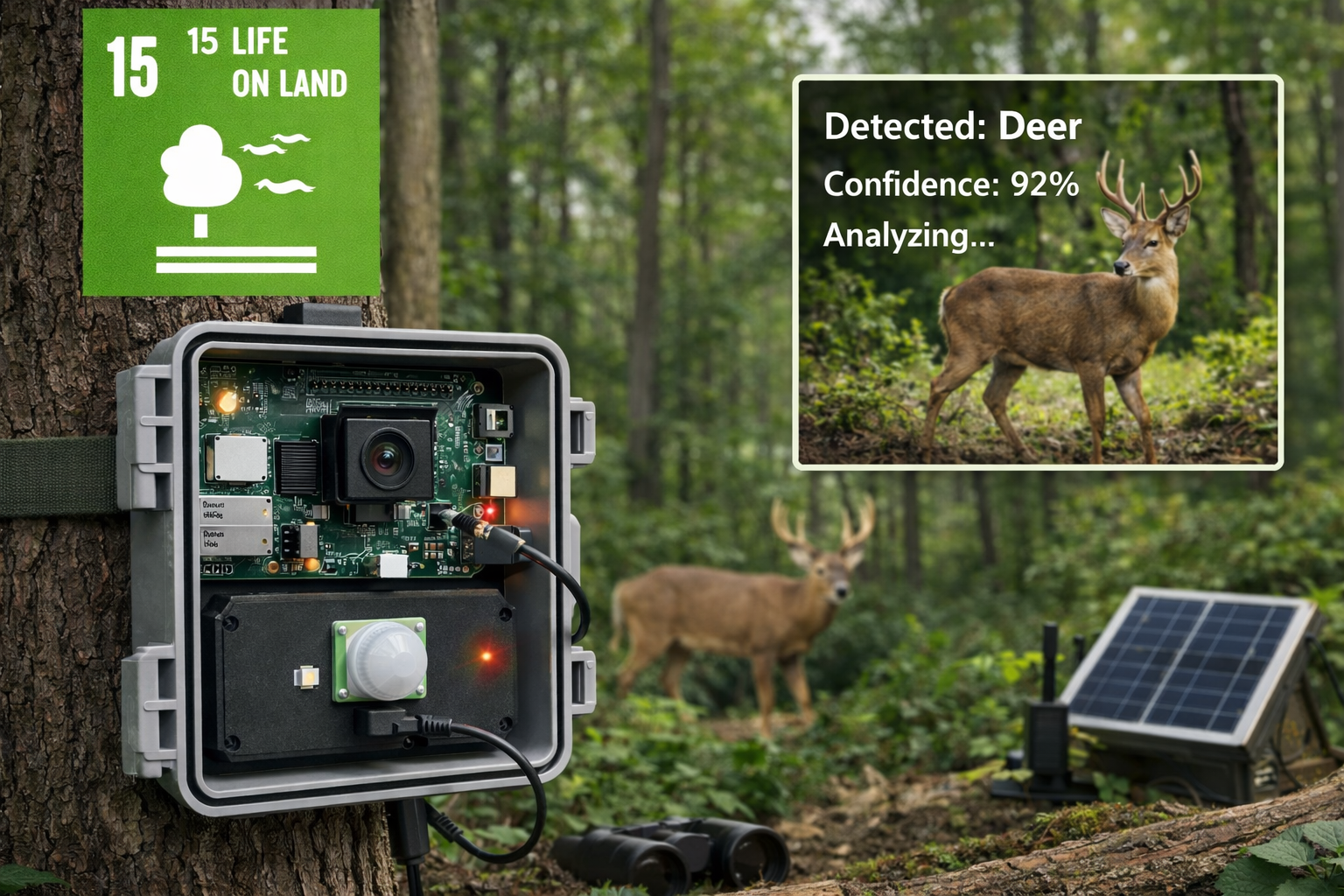
Table of Contents
- Abstract
- Prototype Repository
- SDG Alignment
- Why Biodiversity Monitoring Matters
- SDG 15 and the Measurement Challenge of Conservation
- Camera Traps and Edge AI
- System Architecture
- System Architecture Overview
- Bill of Materials
- Engineering Specifications
- Connecting the PIR Motion Sensor
- Python Code for Motion Detection
- Capturing Images with the Raspberry Pi Camera
- Combining Motion Detection and Image Capture
- Logging Ecological Metadata
- Extending the System with Edge AI
- Example: TensorFlow Lite Classification Workflow
- Computer Vision and Ecological Research
- Power, Deployment, and Field Design
- Biodiversity Monitoring and Climate Resilience
- Engineering Notes
- Validation and Testing
- Suggested Performance Metrics
- The Future of Biodiversity Monitoring
- Reproducibility
- Conclusion
Abstract
This project presents a prototype Raspberry Pi biodiversity camera trap built around motion-triggered image capture, local file storage, metadata logging, and optional TensorFlow Lite inference. The system responds to PIR motion events, captures wildlife images, stores ecological observations, and can optionally classify images locally using lightweight edge-AI models.
From an engineering perspective, the platform demonstrates a compact autonomous observation system with sensing, capture, local storage, and optional inference layers. From a sustainability perspective, it illustrates how low-cost embedded systems can expand biodiversity monitoring capacity and support SDG 15 – Life on Land through field-ready ecological observation.
Prototype Repository
This project is published as an open prototype so that engineers, researchers, students, and advanced makers can reproduce and extend the design. All code, documentation, setup notes, and example ecological data structures are available in the project repository.
GitHub Repository:
Raspberry Pi Biodiversity Camera Trap with Edge AI – Source Files and Documentation
The repository contains the complete prototype build materials:
- Python motion-detection scripts
- camera capture code
- metadata logging examples
- TensorFlow Lite inference examples
- deployment notes
- example biodiversity datasets
Engineers can clone the repository, fork the design, or download the complete project using GitHub’s Download ZIP feature.
All materials are released under the MIT License to support reuse in research, education, and prototype engineering work.
Repository Structure
raspberry-pi-biodiversity-camera-trap-edge-ai/

README.md
LICENSE
requirements.txt

src/
  detect_motion.py
  capture_image.py
  capture_and_log.py
  classify_image_tflite.py
  log_observation.py

docs/
  setup_guide.md
  deployment_notes.md
  sensor_notes.md

data/
  example_biodiversity_observations.csv

hardware/
SDG Alignment
This project aligns most directly with SDG 15: Life on Land, which emphasizes the protection, restoration, and sustainable management of terrestrial ecosystems.
It also connects to:
- SDG 9: Industry, Innovation and Infrastructure — through distributed ecological sensing and low-cost monitoring infrastructure
- SDG 13: Climate Action — because biodiversity monitoring helps reveal ecosystem response to climate stress
Camera traps support conservation by making wildlife presence, movement, and habitat use visible over time without requiring continuous human presence in the field.
Why Biodiversity Monitoring Matters
Biodiversity is one of the foundational conditions of ecological resilience. Species diversity supports pollination, nutrient cycling, soil health, water regulation, and food systems. Yet biodiversity loss continues globally due to habitat destruction, climate change, pollution, and land-use change.
Monitoring systems help researchers answer key ecological questions such as:
- which species are present in a given habitat?
- how frequently do animals use a corridor or landscape?
- how do activity patterns change over time?
- how is biodiversity responding to environmental stress?
Camera traps are especially useful because they allow observation without direct human presence. This reduces disturbance and makes it possible to collect data continuously over long periods.
SDG 15 and the Measurement Challenge of Conservation
SDG 15 calls for the protection, restoration, and sustainable use of terrestrial ecosystems. Achieving that goal depends heavily on ecological measurement.
Large conservation organizations and research institutions often use satellite imagery, acoustic sensors, environmental DNA, and camera traps to monitor biodiversity. However, many habitats remain under-observed because high-end monitoring systems can be expensive or difficult to deploy at scale.
Low-cost embedded platforms such as Raspberry Pi create opportunities for smaller research teams, community science groups, and educators to experiment with biodiversity monitoring systems that are affordable, programmable, and adaptable to local conditions.
Camera Traps and Edge AI
Traditional camera traps capture images or short video clips when motion is detected. These systems are effective, but they often generate large numbers of files that must be reviewed manually.
Edge AI changes this workflow by allowing the monitoring device to perform at least some analysis locally. Instead of capturing images alone, the system can begin to answer questions such as:
- was an animal present?
- was the image likely empty?
- can the image be classified into broad species categories?
When lightweight machine learning models run on-device, the Raspberry Pi can reduce storage waste, prioritize relevant images, and generate richer ecological datasets.
System Architecture
A Raspberry Pi biodiversity camera trap integrates several layers:
Sensor Layer
- camera module for image capture
- PIR motion sensor for movement detection
- optional temperature or humidity sensor for habitat context
Processing Layer
- Raspberry Pi computing platform
- Python control scripts
- optional TensorFlow Lite inference engine
Data Layer
- local storage for images and metadata
- optional SQLite database
- optional cloud synchronization
Typical architecture:
Motion Sensor → Raspberry Pi → Camera Capture → Local Storage → Optional AI Classification → Database / Dashboard
This architecture allows the system to operate both as a traditional camera trap and as an edge-AI ecological monitoring node.
System Architecture Overview
The camera trap can be understood as a small autonomous observation system that responds to motion events, captures ecological evidence, and stores it for later interpretation.
Typical data flow:
PIR Motion Sensor → Raspberry Pi Trigger Logic → Camera Module Image Capture → Local File Storage → Optional TensorFlow Lite Inference → Metadata Logging / Species Classification
This structure makes the project more than a wildlife camera. It becomes a field-ready biodiversity data collection system capable of supporting both observation and analysis.
Bill of Materials
- Raspberry Pi 4 or Raspberry Pi Zero 2 W
- Raspberry Pi Camera Module
- PIR motion sensor
- microSD card
- portable battery or solar power system
- weather-resistant enclosure
- optional infrared lighting for nighttime capture
The Raspberry Pi Zero 2 W is especially attractive for low-power field deployments, while a Raspberry Pi 4 offers more computing power for on-device inference.
Engineering Specifications
| Parameter | Specification |
|---|---|
| Compute platform | Raspberry Pi 4 or Raspberry Pi Zero 2 W |
| Primary trigger sensor | PIR motion sensor |
| Image capture device | Raspberry Pi Camera Module |
| Optional inference | TensorFlow Lite image classification |
| Storage options | local image files, SQLite metadata logging |
| Power options | battery, solar-assisted battery, or fixed supply |
| Deployment mode | field biodiversity observation node |
| Target scope | educational, prototype, and experimental conservation monitoring |
Connecting the PIR Motion Sensor
The PIR sensor detects motion and triggers image capture when movement is observed in front of the camera.
Typical wiring:
- VCC → 5V
- GND → Ground
- OUT → GPIO 17
This configuration allows the Raspberry Pi to listen for motion events and initiate camera capture only when needed.
Python Code for Motion Detection
The following Python example listens for PIR motion events.
import RPi.GPIO as GPIO
import time

PIR_PIN = 17

GPIO.setmode(GPIO.BCM)
GPIO.setup(PIR_PIN, GPIO.IN)

try:
    while True:
        if GPIO.input(PIR_PIN):
            print("Motion detected")
        time.sleep(1)

except KeyboardInterrupt:
    GPIO.cleanup()
In a full deployment, motion detection would trigger image capture and metadata logging rather than just a console event.
Capturing Images with the Raspberry Pi Camera
The following example captures a still image from the Raspberry Pi camera module.
from picamera2 import Picamera2
import time

picam2 = Picamera2()
picam2.start()

time.sleep(2)
picam2.capture_file("wildlife_image.jpg")
In practice, the script can be integrated with the PIR sensor so that wildlife images are captured automatically when motion is detected.
Combining Motion Detection and Image Capture
The following example turns the device into a basic motion-triggered camera trap.
import RPi.GPIO as GPIO
import time
from picamera2 import Picamera2

PIR_PIN = 17

GPIO.setmode(GPIO.BCM)
GPIO.setup(PIR_PIN, GPIO.IN)

picam2 = Picamera2()
picam2.start()

try:
    while True:
        if GPIO.input(PIR_PIN):
            filename = f"wildlife_{int(time.time())}.jpg"
            picam2.capture_file(filename)
            print("Captured:", filename)
            time.sleep(5)
        time.sleep(1)

except KeyboardInterrupt:
    GPIO.cleanup()
Logging Ecological Metadata
Images become far more useful when paired with metadata such as timestamps, locations, or broad habitat variables. A lightweight SQLite database can store these records.
import sqlite3
import datetime

conn = sqlite3.connect("biodiversity_monitor.db")
cursor = conn.cursor()

cursor.execute("""
CREATE TABLE IF NOT EXISTS observations (
    timestamp TEXT,
    filename TEXT,
    classification TEXT
)
""")

def log_observation(filename, classification="unclassified"):
    cursor.execute("""
    INSERT INTO observations VALUES (?, ?, ?)
    """, (
        datetime.datetime.now().isoformat(),
        filename,
        classification
    ))
    conn.commit()
This creates a simple biodiversity observation log that can later be reviewed, exported, or enriched with classification results.
Extending the System with Edge AI
Once a camera trap is collecting wildlife images, machine learning can significantly improve its usefulness.
Possible edge-AI extensions include:
- filtering empty frames
- detecting animal presence
- classifying images into broad species groups
- prioritizing images for review
Lightweight models such as TensorFlow Lite classifiers can run on Raspberry Pi hardware and provide useful inference without requiring a cloud connection.
Example: TensorFlow Lite Classification Workflow
The following example illustrates the basic structure of local image inference.
import tensorflow as tf
import numpy as np
from PIL import Image

interpreter = tf.lite.Interpreter(model_path="wildlife_model.tflite")
interpreter.allocate_tensors()

input_details = interpreter.get_input_details()
output_details = interpreter.get_output_details()

image = Image.open("wildlife_image.jpg").resize((224, 224))
input_data = np.expand_dims(image, axis=0).astype(np.float32)

interpreter.set_tensor(input_details[0]["index"], input_data)
interpreter.invoke()

output_data = interpreter.get_tensor(output_details[0]["index"])
print("Prediction:", output_data)
In a real deployment, the model would be trained on ecological image datasets relevant to the habitat or species of interest.
Computer Vision and Ecological Research
Computer vision is becoming increasingly important in biodiversity science. Large ecological datasets are difficult to analyze manually, especially when camera traps operate continuously over weeks or months.
Edge AI can help by reducing manual review time and making monitoring systems more scalable. Even simple models that separate “animal present” from “empty frame” can significantly improve efficiency.
More advanced systems may eventually support:
- species classification
- behavioral detection
- habitat-use analysis
- automated biodiversity indexing
Power, Deployment, and Field Design
Real-world biodiversity monitoring systems must operate reliably outdoors. That means power management and enclosure design matter.
Typical field considerations include:
- battery life
- weather resistance
- camera mounting angle
- nighttime visibility
- storage capacity
Solar-assisted power systems can make longer deployments possible, while careful enclosure design protects the device without interfering with the camera’s field of view or the PIR sensor’s motion detection.
Biodiversity Monitoring and Climate Resilience
Biodiversity monitoring is not only about counting species. It is also about understanding how ecosystems respond to environmental change.
Camera trap systems can help reveal how wildlife activity shifts in response to:
- habitat fragmentation
- climate stress
- human land-use change
- seasonal environmental variability
In that sense, biodiversity monitoring supports not only SDG 15 – Life on Land but also broader resilience strategies that depend on understanding ecological conditions over time.
Engineering Notes
A few technical considerations are especially important in this build:
- false triggers: PIR-based systems can capture irrelevant motion if placement is poor.
- storage management: image-heavy workflows require disciplined file and metadata handling.
- power budget: camera, storage, and inference workloads increase energy demand significantly.
- model realism: useful classification depends on habitat-relevant training data.
- field reliability: deployment success depends on enclosure quality, mounting, and environmental hardening.
These issues make the project more than a software workflow. It is a field engineering system for ecological observation.
Validation and Testing
To bring this project closer to engineering-grade documentation, validation should include:
- verify PIR triggering under controlled movement conditions
- confirm that the camera captures images reliably after motion events
- test file naming and storage behavior across repeated events
- validate SQLite metadata logging if used
- check TensorFlow Lite inference outputs against known test images
- evaluate battery/runtime behavior under realistic capture frequency
If the system behaves inconsistently, the issue may be related to PIR placement, lighting, camera initialization, storage throughput, or power stability rather than to the ecological monitoring concept itself.
Suggested Performance Metrics
For a more rigorous evaluation, the platform can be assessed using several simple metrics:
- trigger reliability: whether motion events consistently produce captures
- capture success rate: percentage of valid images per trigger event
- storage reliability: whether images and metadata are preserved without corruption
- classification usefulness: whether inference helps reduce manual review workload
- field endurance: how long the system operates under realistic deployment conditions
Even simple tracking of these metrics improves the project’s value as an experimental biodiversity monitoring platform.
The Future of Biodiversity Monitoring
Ecological monitoring is increasingly combining:
- camera traps
- acoustic sensors
- satellite imagery
- machine learning models
- distributed environmental data systems
Platforms such as Raspberry Pi make it possible for researchers, students, and conservation innovators to prototype these systems at relatively low cost. Projects like this demonstrate how accessible computing technologies can support more scalable and intelligent biodiversity observation systems.
Reproducibility
All code, documentation, and supporting build materials necessary to reproduce the prototype are included in the project repository. The design intentionally relies on widely available Raspberry Pi hardware, open-source Python libraries, and common field components so that it can be rebuilt in classrooms, labs, and independent biodiversity monitoring projects.
The system is intended as a reference implementation rather than a certified field research instrument. Engineers adapting it for long-term deployment should validate enclosure resilience, power systems, image storage workflows, and habitat-appropriate model behavior under real operating conditions.
Conclusion
Building a Raspberry Pi biodiversity camera trap with edge AI demonstrates how embedded systems and local inference can support ecological observation. By combining motion-triggered capture, metadata logging, and optional on-device classification, the system creates a flexible platform for conservation-oriented monitoring.
Although compact, the design reflects a broader sustainability principle: ecosystem protection depends on ecological visibility. When biodiversity can be measured clearly and continuously, conservation strategies become more informed and more responsive.