
Last Updated June 18, 2026
Creative Form, Composition, and Interpretation examines how works are made, structured, revised, performed, received, and understood. This article map explores creative form as a disciplined field of inquiry: how medium, material, constraint, composition, craft, revision, audience, performance, context, and interpretation shape meaning.
Creative work is not only inspiration or self-expression. It is a process of giving form to perception, feeling, thought, memory, material, and possibility. A poem, painting, essay, song, performance, design system, sculpture, film, ritual object, or public installation becomes meaningful through choices of structure, rhythm, sequence, scale, emphasis, closure, openness, voice, gesture, and relation.
This article map sits within the broader Meaning category. Its focus is both practical and interpretive: how creative works come into being, how composition organizes experience, how interpretation gives works an afterlife, and how responsible creative practice attends to authorship, influence, audience, culture, tools, and agency.
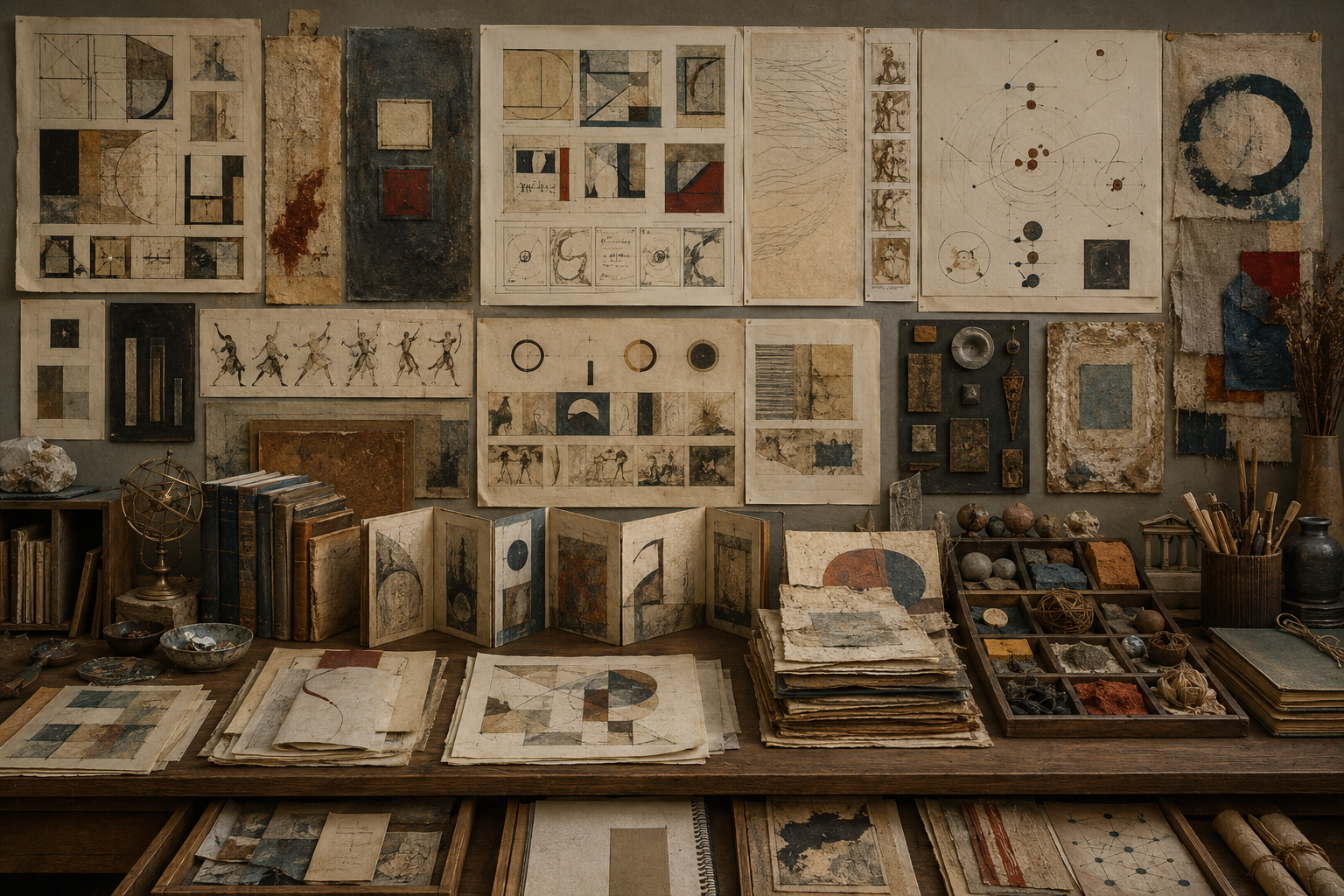
Creative Form, Composition, and Interpretation provides a practice-centered layer within the Meaning category. It asks how works become meaningful through making: through the selection of medium, the pressure of constraint, the discipline of revision, the organization of parts, the shaping of rhythm, the presence of audience, and the interpretive life that begins once a work enters the world.
This map treats creativity as a serious form of thought. Making is not separate from thinking; it is one way thinking becomes visible, audible, material, spatial, performative, and shareable. Creative form is where intention meets resistance: the resistance of medium, genre, audience, convention, culture, memory, technique, and ethical responsibility.
The articles in this map move from foundations of creative form into composition, structure, craft, revision, audience reception, interpretation, performance, embodiment, collaboration, authorship, tools, and responsible creative agency. Together, they provide a framework for understanding how creative works are shaped and how they continue to generate meaning after they are made.
GitHub Repository
This article map is supported by companion studio-lab scaffolding for creative-process records, composition studies, revision logs, interpretation matrices, genre comparisons, performance notes, audience-response models, creative ethics checklists, and reproducible research workflows.
Complete Code Repository
The Creative Form, Composition, and Interpretation companion repository includes article-level folders, creative-process notes, composition frameworks, revision and draft-tracking examples, interpretation matrices, genre and medium comparison tables, audience-response scaffolds, documentation, Python workflows, R summaries, SQL catalogs, notebooks, calculators, Canvas cards, and reproducible studio-lab materials for responsible creative practice.
Creative Form, Composition, and Interpretation as a Field of Inquiry
Creative form is the study of how works take shape. It asks how an idea becomes a poem, image, performance, essay, composition, design, film, installation, ritual object, or public artifact. It studies the relation between intention and medium, imagination and material, technique and discovery, structure and openness, craft and interpretation.
Composition is the study of arrangement. It asks how parts become wholes, how sequence creates expectation, how rhythm guides attention, how contrast produces emphasis, how framing shapes perspective, how closure resolves or withholds, and how scale, balance, repetition, variation, and development create meaningful form.
Interpretation is the study of how works are understood. It asks how audiences respond, how contexts shape meaning, how genres create expectations, how ambiguity invites multiple readings, how performance changes a work, and how creative works continue to live beyond the moment of making.
This field belongs to Meaning because creative works do not merely transmit content. They organize experience. They make feeling perceptible, give thought structure, make memory available, shape public imagination, and invite shared interpretation. Creative form is therefore not an accessory to meaning. It is one of meaning’s central vehicles.
Why Creative Form Belongs Under Meaning
Creative form belongs under Meaning because form is how meaning becomes available to perception. A work does not communicate only through what it says. It communicates through how it is shaped: through rhythm, sequence, silence, emphasis, texture, density, genre, scale, repetition, point of view, closure, and relation.
The same theme can become entirely different depending on its form. A story of loss can become elegy, satire, protest, myth, confession, ritual, archive, performance, or public monument. A visual idea can become diagram, painting, interface, emblem, map, installation, or typographic system. A sound can become song, chant, noise, atmosphere, score, improvisation, or ritual cue. Meaning changes as form changes.
Creative form also belongs under Meaning because interpretation begins in the act of making. A creator does not simply place meaning into a finished object. Meaning often emerges through revision, mistake, material resistance, discovery, collaboration, audience feedback, and the tension between intention and form. Making is a way of learning what a work can become.
This article map therefore connects creative practice with interpretive responsibility. It studies how works are made, but also how they are received, reused, misunderstood, performed, inherited, credited, contested, and cared for.
What This Article Map Studies
This article map studies creative form, composition, medium, material, constraint, process, making, intention, interpretation, unity, variety, coherence, rhythm, sequence, framing, scale, closure, openness, revision, craft, technique, practice, discipline, failure, experiment, discovery, audience, reception, context, ambiguity, genre, convention, performance, embodiment, improvisation, collaboration, authorship, influence, cultural responsibility, creative tools, and responsible agency.
At the compositional level, it studies how structure organizes experience. This includes balance, contrast, emphasis, rhythm, development, framing, point of view, proportion, resolution, and openness. At the practice level, it studies revision, sketches, drafts, studies, technique, constraint, habit, discipline, experimentation, and failure. At the interpretive level, it studies how works invite meaning through audience response, context, ambiguity, genre, and reception.
At the performance level, it studies voice, gesture, presence, embodiment, improvisation, repetition, mastery, collaboration, and ensemble form. At the ethical level, it studies influence, borrowing, originality, authorship, collaboration, creative credit, cultural context, audience care, tools, technology, and agency.
The goal is to treat creativity neither as mystery alone nor as production alone. Creative work is a disciplined, interpretive, ethical, and material process through which meaning is formed and shared.
Major Themes in Creative Form, Composition, and Interpretation
One major theme is making as thinking. Creative work often discovers its own direction through practice. The artist, writer, designer, musician, performer, or maker does not always know in advance what the work will become. Form emerges through attempts, revisions, choices, constraints, failures, and discoveries.
A second theme is composition. Composition organizes relationships among parts. It shapes attention, sequence, expectation, emphasis, contrast, unity, variation, development, and resolution. Composition gives a work its internal intelligibility.
A third theme is medium. Every medium offers possibilities and imposes limits. Paint, language, sound, movement, clay, code, film, interface, space, body, and voice each shape what can be made and how it can be understood.
A fourth theme is interpretation. Works do not end when they are finished. They enter audiences, institutions, traditions, archives, performances, classrooms, public debates, and future contexts. Interpretation gives works an afterlife.
A fifth theme is embodiment and performance. Creative meaning is often carried through gesture, voice, timing, presence, movement, repetition, and physical skill. Performance shows that form can be live, situated, and event-like rather than only object-like.
A sixth theme is responsibility. Creative work involves influence, borrowing, authorship, audience care, collaboration, representation, cultural context, and technological mediation. Responsible form-making asks not only what can be made, but how, with whom, from what sources, for whom, and with what consequences.
Creative Form, Composition, and Interpretation Article Map
The map below organizes the Creative Form, Composition, and Interpretation series into six parts, moving from foundations of creative form into composition, craft, revision, interpretation, performance, embodiment, collaboration, ethics, tools, and responsible agency.
Part I — Foundations of Creative Form
- What Is Creative Form? (planned) — A foundational article on creative form as the organization of medium, structure, intention, material, and meaning.
- Composition as Creative Judgment (planned) — An article on composition as the disciplined arrangement of parts into meaningful relationships.
- Medium, Material, and Constraint (planned) — A study of how materials and media enable, resist, shape, and transform creative intention.
- The Creative Process from Idea to Form (planned) — An article on how ideas become works through sketching, drafting, testing, revision, and discovery.
- Making as a Mode of Thinking (planned) — A study of creative practice as inquiry, experimentation, interpretation, and embodied thought.
- Form, Intention, and Interpretation (planned) — An article on how creator intention, formal structure, and audience interpretation interact.
Part II — Composition and Structure
- Unity, Variety, and Coherence (planned) — An article on how works hold together while preserving difference, richness, and internal movement.
- Balance, Contrast, and Emphasis (planned) — A study of how attention is guided through tension, opposition, weight, focus, and visual or structural priority.
- Sequence, Rhythm, and Development (planned) — An article on ordering, pacing, recurrence, transition, escalation, and formal growth across time or space.
- Framing, Perspective, and Point of View (planned) — A study of how works define what is seen, from where, by whom, and under what interpretive frame.
- Scale, Proportion, and Structural Clarity (planned) — An article on size, relation, hierarchy, proportion, density, and the clarity of formal organization.
- Closure, Openness, and Formal Resolution (planned) — A focused article on endings, unresolved structures, ambiguity, return, completion, and interpretive openness.
Part III — Craft, Revision, and Practice
- Revision as Creative Thinking (planned) — An article on revision as interpretation, refinement, discovery, restructuring, and care for the work.
- Drafts, Sketches, and Studies (planned) — A study of preparatory forms, working notes, sketches, mockups, studies, prototypes, and exploratory artifacts.
- Technique, Skill, and Artistic Judgment (planned) — An article on the relationship between craft knowledge, trained perception, technical control, and judgment.
- Constraint as a Source of Creativity (planned) — A study of limits, rules, materials, forms, genres, prompts, and conditions as generative forces.
- Creative Habits, Practice, and Discipline (planned) — An article on repetition, routine, training, attention, stamina, notebooks, exercises, and long-term creative development.
- Failure, Experiment, and Discovery (planned) — A focused article on mistakes, failed attempts, risk, iteration, accident, surprise, and creative learning.
Part IV — Interpretation and Reception
- How Works Invite Interpretation (planned) — An article on how form, ambiguity, symbol, genre, medium, and context invite acts of meaning-making.
- Audience, Reception, and Response (planned) — A study of how audiences interpret, resist, extend, misread, preserve, and transform creative works.
- Context and the Meaning of Creative Works (planned) — An article on historical, cultural, institutional, biographical, material, and situational context.
- Ambiguity, Openness, and Interpretive Depth (planned) — A study of works that hold multiple meanings, resist closure, or invite sustained interpretation.
- Genre, Convention, and Reader Expectation (planned) — An article on how genre frames interpretation, expectation, variation, surprise, and recognition.
- The Afterlife of Creative Works (planned) — A study of how works continue through performance, quotation, teaching, adaptation, controversy, memory, and reinterpretation.
Part V — Performance and Embodiment
- Performance as Interpretation (planned) — An article on performance as an act of reading, shaping, translating, and renewing a work.
- Voice, Gesture, and Presence (planned) — A study of how embodied expression carries meaning through tone, timing, posture, movement, and presence.
- Improvisation and Live Form-Making (planned) — An article on real-time creation, responsiveness, constraint, risk, ensemble awareness, and emergent form.
- Repetition, Practice, and Mastery (planned) — A study of how repeated practice deepens skill, perception, timing, and interpretive freedom.
- Embodied Knowledge and Creative Skill (planned) — An article on tacit knowledge, craft memory, gesture, touch, movement, and bodily understanding.
- Collaboration, Ensemble, and Shared Form (planned) — A study of co-creation, distributed authorship, shared timing, negotiation, and collective creative intelligence.
Part VI — Creative Ethics and Responsibility
- Influence, Borrowing, and Originality (planned) — An article on influence, imitation, homage, transformation, borrowing, derivation, and the myth of pure originality.
- Authorship, Collaboration, and Creative Credit (planned) — A study of ownership, contribution, attribution, collective practice, ghost labor, and creative recognition.
- Cultural Context and Creative Responsibility (planned) — An article on cultural borrowing, sacred forms, representation, community authority, and responsible transformation.
- Audience Care and Interpretive Responsibility (planned) — A study of harm, difficulty, challenge, vulnerability, emotional burden, and the ethics of address.
- Tools, Technology, and Creative Agency (planned) — An article on digital tools, AI-assisted creation, automation, mediation, authorship, and human agency.
- Making, Meaning, and Responsible Form: A Capstone (planned) — A capstone article on creative process, composition, interpretation, ethics, technology, and responsible form-making.
Python Workflow: Creative Process Records, Composition Maps, and Revision Logs
A useful Python workflow for this article map is a creative-process and composition-mapping workflow. The workflow can begin with structured records for works, media, constraints, drafts, revisions, formal elements, interpretive questions, audience responses, and ethical cautions. Python can then generate CSV tables, JSON records, Markdown summaries, revision histories, composition maps, and lightweight dashboards for research planning.
This workflow belongs naturally with articles on creative process, composition, revision, drafts, interpretation, audience response, genre, collaboration, authorship, and tools. For example, a Python script can track how a draft changes across versions, organize compositional elements by function, map interpretive questions to formal choices, or preserve a transparent record of how a creative concept develops.
The workflow should not imply that creativity can be automated. Its purpose is documentation, reflection, and research support. Python can help make process visible, preserve assumptions, organize examples, and generate reusable teaching materials, but creative judgment remains human, contextual, embodied, and interpretive.
R Workflow: Composition Themes, Interpretation Summaries, and Practice Patterns
A useful R workflow for this article map is a composition-theme and practice-pattern workflow. A structured teaching dataset can include article titles, creative domains, compositional principles, process stages, media, interpretive themes, performance dimensions, ethical questions, and research sources. R can summarize recurring themes, compare categories, generate tables, and support article planning.
This workflow belongs naturally with articles on unity, contrast, rhythm, revision, craft, audience response, ambiguity, genre, performance, collaboration, and creative ethics. For example, R can help summarize which articles focus on process, which focus on structure, which focus on interpretation, which focus on performance, and which focus on responsibility.
As with the Python workflow, the goal is not to reduce creative form to data. The goal is to make research organization more transparent. Creative practice remains experimental, interpretive, cultural, material, and embodied. R simply helps make patterns in the article map easier to review and extend.
Ethics, Authorship, and Responsible Creative Agency
Creative work always takes place within relationships. A work may draw from traditions, genres, communities, archives, influences, teachers, collaborators, technologies, institutions, audiences, and prior works. Creativity is rarely isolated. It is shaped by inheritance, borrowing, transformation, and response.
That is why authorship and originality require care. Influence can be generative, but it can also become appropriation, erasure, extraction, or uncredited labor. Collaboration can expand creative possibility, but it can also obscure contribution. Tools can enhance agency, but they can also hide dependencies, automate style, or weaken accountability. Creative freedom is real, but it exists within ethical and cultural contexts.
Audience care is another part of creative responsibility. Works may challenge, disturb, unsettle, provoke, heal, dignify, or burden audiences. The ethical question is not whether creative work should avoid difficulty. Difficult work can be necessary. The question is whether the work understands its address, context, representation, power, and consequences.
Responsible creative agency does not make art obedient or harmless. It makes creative practice more aware of its relations: to sources, audiences, cultures, collaborators, tools, and future interpretation.
Creative Form, Composition, and Interpretation in a Wider Intellectual Context
Creative Form, Composition, and Interpretation belongs within a wider knowledge architecture because making links aesthetics, craft, cognition, culture, performance, ethics, and interpretation. It sits under Meaning because creative works are among the primary ways human beings shape and share worlds of significance.
This map connects to aesthetics and the philosophy of art through form, beauty, judgment, expression, and interpretation. It connects to symbolism through motifs, cultural forms, images, gestures, and public meaning. It connects to music theory through rhythm, performance, improvisation, timing, and embodiment. It connects to design through composition, hierarchy, material constraint, visual communication, and audience experience. It connects to storytelling through structure, sequence, point of view, genre, and reception.
It also connects to technology and ethics through AI-assisted creation, digital tools, authorship, creative agency, and responsible use of computational systems. Creative practice is increasingly shaped by platforms, tools, archives, generative models, and distribution systems. A serious article map must therefore treat making as both expressive and infrastructural.
By giving creative form its own map, the site recognizes that meaning is not only interpreted after the fact. It is also made: drafted, arranged, revised, performed, embodied, shared, contested, and renewed.
Related Reading
- Meaning
- Beauty, Aesthetics, and Meaning
- Aesthetics and the Philosophy of Art
- Color Theory, Typography, and Design
- Music Theory, Form, and Meaning
- Mathematics, Art, Music, and Pattern
- Symbolism, Style, and Cultural Meaning
- Storytelling and Narrative Systems
Further Reading
- Arnheim, R. (1974). Art and Visual Perception: A Psychology of the Creative Eye. Berkeley: University of California Press.
- Barthes, R. (1977). Image Music Text. Translated by S. Heath. New York: Hill and Wang.
- Csikszentmihalyi, M. (1996). Creativity: Flow and the Psychology of Discovery and Invention. New York: HarperCollins.
- Dewey, J. (1934). Art as Experience. New York: Minton, Balch & Company.
- Eco, U. (1989). The Open Work. Translated by A. Cancogni. Cambridge, MA: Harvard University Press.
- Elbow, P. (1998). Writing with Power: Techniques for Mastering the Writing Process, 2nd edn. New York: Oxford University Press.
- Gadamer, H.-G. (2004). Truth and Method, 2nd rev. edn. London: Continuum.
- Ingold, T. (2013). Making: Anthropology, Archaeology, Art and Architecture. London: Routledge.
- Iser, W. (1978). The Act of Reading: A Theory of Aesthetic Response. Baltimore: Johns Hopkins University Press.
- Ricoeur, P. (1984). Time and Narrative, Volume 1. Translated by K. McLaughlin and D. Pellauer. Chicago: University of Chicago Press.
- Sennett, R. (2008). The Craftsman. New Haven: Yale University Press.
- Sullivan, G. (2010). Art Practice as Research: Inquiry in Visual Arts, 2nd edn. Thousand Oaks, CA: Sage.
References
- Arnheim, R. (1974). Art and Visual Perception: A Psychology of the Creative Eye. Berkeley: University of California Press.
- Barthes, R. (1977). Image Music Text. Translated by S. Heath. New York: Hill and Wang.
- Booth, W.C. (1983). The Rhetoric of Fiction, 2nd edn. Chicago: University of Chicago Press.
- Csikszentmihalyi, M. (1996). Creativity: Flow and the Psychology of Discovery and Invention. New York: HarperCollins.
- Dewey, J. (1934). Art as Experience. New York: Minton, Balch & Company.
- Eco, U. (1989). The Open Work. Translated by A. Cancogni. Cambridge, MA: Harvard University Press.
- Elbow, P. (1998). Writing with Power: Techniques for Mastering the Writing Process, 2nd edn. New York: Oxford University Press.
- Gadamer, H.-G. (2004). Truth and Method, 2nd rev. edn. London: Continuum.
- Ingold, T. (2013). Making: Anthropology, Archaeology, Art and Architecture. London: Routledge.
- Iser, W. (1978). The Act of Reading: A Theory of Aesthetic Response. Baltimore: Johns Hopkins University Press.
- Jauss, H.R. (1982). Toward an Aesthetic of Reception. Translated by T. Bahti. Minneapolis: University of Minnesota Press.
- Krauss, R. (1979). ‘Sculpture in the Expanded Field’, October, 8, pp. 30–44.
- Nelson, R. (2013). Practice as Research in the Arts: Principles, Protocols, Pedagogies, Resistances. London: Palgrave Macmillan.
- Ricoeur, P. (1984). Time and Narrative, Volume 1. Translated by K. McLaughlin and D. Pellauer. Chicago: University of Chicago Press.
- Sennett, R. (2008). The Craftsman. New Haven: Yale University Press.
- Sullivan, G. (2010). Art Practice as Research: Inquiry in Visual Arts, 2nd edn. Thousand Oaks, CA: Sage.
- Wallas, G. (1926). The Art of Thought. New York: Harcourt, Brace and Company.