
Last Updated May 21, 2026
Play is one of the most serious forms of development because it is one of the primary ways children experiment with reality, rules, symbols, bodies, relationships, emotion, culture, and possible selves. Developmental psychology has often had to defend play against the suspicion that it is merely leisure, excess energy, entertainment, or the opposite of learning. But play is not the absence of developmentally meaningful work. It is one of the earliest and most powerful modes through which development proceeds. In play, infants and children rehearse action, test causality, explore objects, negotiate rules, practice language, regulate emotion, inhabit roles, transform experience into symbol, and move between reality and imagination in ways that deepen cognitive, social, and emotional life.
To study play is therefore not to leave serious development behind. It is to enter one of the clearest sites in which development becomes visible. A child stacking blocks, pretending to cook, arguing over a game rule, turning a blanket into a cave, chasing another child across a playground, caring for a doll, inventing a monster, or repeating the same scenario again and again is doing more than filling time. The child is experimenting with action, meaning, risk, attachment, power, narrative, fear, repair, cooperation, identity, and possibility.
Main Library
Publications
Article Map
Developmental Psychology
Related Topic
Cognitive Psychology
Related Topic
Social Psychology
Related Topic
Risk & Resilience
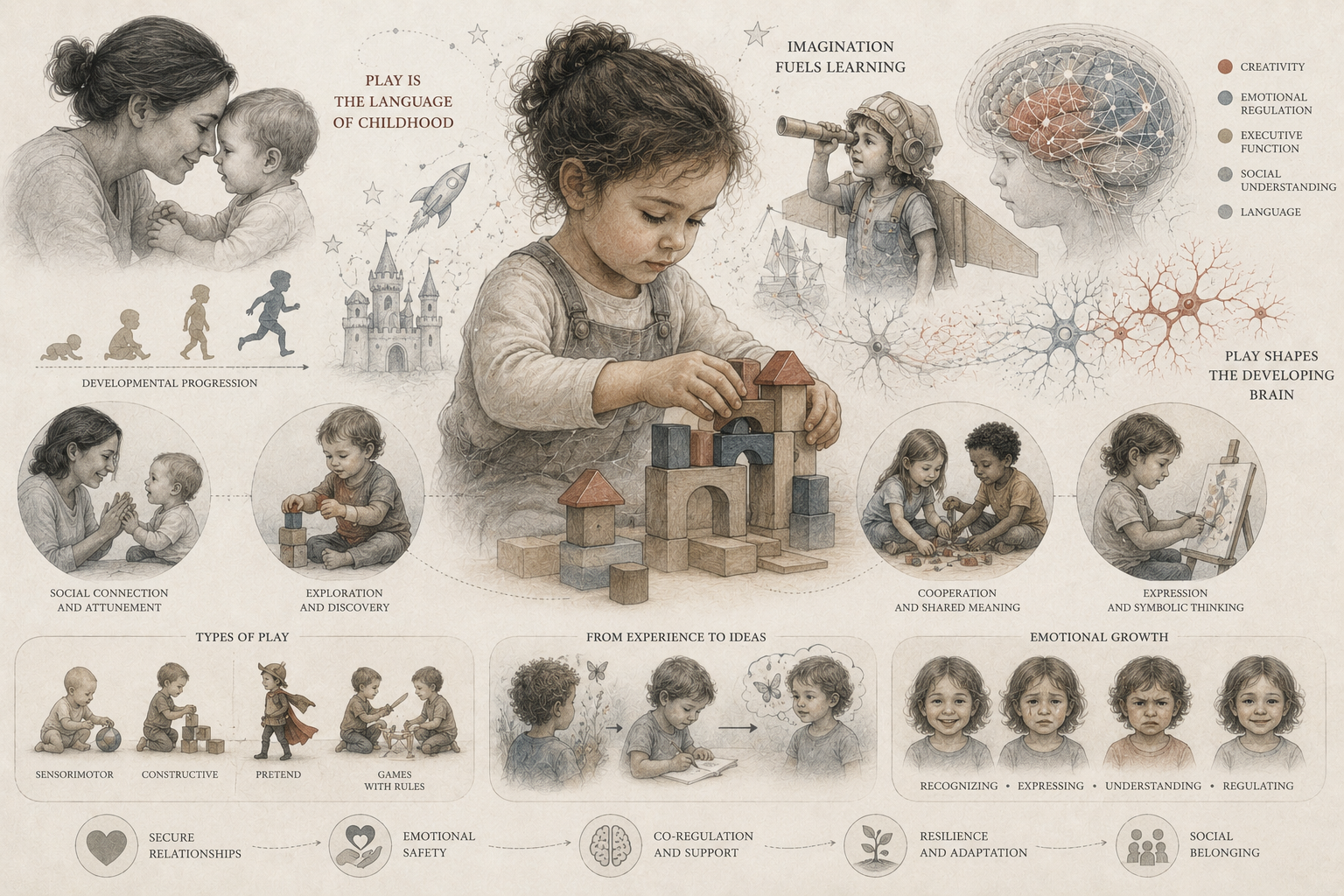
Contemporary developmental and child-health institutions treat play as closely tied to early learning, growth, and well-being. The NICHD “Play to Learn” guidance states that a healthy balance between independent play and structured play with parents supports early learning and development, while the CDC’s developmental milestones explicitly include how children play, learn, speak, act, and move as key signs of development from birth to age 5. The WHO Nurturing Care Framework likewise emphasizes responsive caregiving and opportunities for early learning as foundational conditions for healthy early development.
Play therefore belongs at the center of developmental psychology because it links imagination, relationship, embodiment, learning, regulation, culture, and institutional opportunity in a single developmental process. It is not a decorative supplement to real learning. It is one of the main ways children build the capacities that later appear as reasoning, creativity, language, self-regulation, social competence, resilience, and symbolic thought.
Why Play Matters
Play matters because it allows development to proceed through experimentation rather than only through instruction. A child stacking blocks, repeating a sound pattern, inventing a role, testing a boundary, or negotiating a game is not simply “having fun” in a trivial sense. The child is learning what objects do, how other people respond, what rules can be bent or shared, how frustration rises and falls, how symbols can stand in for reality, and how imagined possibilities can be held in mind long enough to become action.
This is one reason play appears so persistently across early development. It is one of the organism’s most flexible ways of learning under conditions of relative freedom. Unlike formal instruction, play allows children to vary action, repeat actions that matter, test boundaries, reverse roles, improvise, and make mistakes without every action being judged as failure. A child can build a tower and knock it down, become the baby and the parent, lose a game and try again, or transform fear into a monster that can be chased, named, escaped, or defeated.
Play also matters because it is developmentally integrative. It is not only cognitive, only emotional, or only social. A single play episode can involve movement, turn-taking, attention, memory, language, impulse control, frustration tolerance, symbolism, laughter, conflict, repair, and perspective-taking all at once. In that sense, play is one of the clearest windows into development because it reveals how multiple systems coordinate in real time.
Play matters for learning because it makes exploration meaningful. Children often sustain effort longer in play than in externally imposed tasks because play is organized by curiosity, pleasure, mastery, repetition, and possibility. A puzzle, tower, pretend shop, neighborhood game, or improvised story can recruit attention and persistence without reducing the child to a passive receiver of adult knowledge. The child is an active maker of meaning.
Play also matters for emotional development. It allows children to experience excitement, frustration, loss, fear, anticipation, pride, and uncertainty in settings that are often contained enough to learn from. Play gives children chances to lose and recover, lead and follow, imagine danger and survive it, test power and repair harm. This is why play should not be confused with an absence of challenge. Much play is difficult. Its developmental value often lies in the fact that challenge remains flexible, symbolic, negotiable, and revisable.
The ethical importance of play is equally clear. Children need time, space, safety, materials, peers, responsive adults, and permission to explore. When poverty, unsafe neighborhoods, over-surveillance, institutional pressure, disability exclusion, screen displacement, or premature academic performance narrows play, development loses one of its most generative environments. Play is therefore not only a child behavior. It is a developmental right, a cultural practice, and an institutional responsibility.
What Play Is and What It Is Not
Play is difficult to define precisely because it takes many forms: sensorimotor play, object play, social play, rough-and-tumble play, constructive play, pretend play, fantasy, exploratory play, rule-based games, dramatic play, outdoor play, and imaginative world-building. Yet most serious accounts share several features. Play is typically marked by intrinsic engagement, relative flexibility, openness of outcome, and a mode of action in which exploration matters at least as much as external performance.
Play can be solitary or social, quiet or vigorous, highly imaginative or materially grounded. A toddler repeatedly dropping a spoon, a preschooler turning a cardboard box into a spaceship, a group of children inventing rules for a chase game, a child lining up objects, a pair of siblings negotiating pretend roles, or an adolescent creating a fictional world with friends may all be playing. The surface form differs, but each involves exploratory action structured by interest, meaning, and possibility.
Play is not simply the opposite of work. Children often work very hard in play. They persist through difficulty, solve problems, revise plans, coordinate with others, and return to unfinished projects. Nor is play merely whatever adults decide looks educational. When adults over-script every activity, the child may still be active, but play’s exploratory freedom can narrow. An activity can be colorful, child-facing, and full of educational language without preserving the openness that makes play developmentally powerful.
Play also should not be romanticized as automatically innocent or emancipatory. Children can rehearse hierarchy, exclusion, cruelty, gender stereotypes, racialized meanings, fear, domination, and social status in play as well as creativity and joy. A pretend game can become coercive. A playground can become a site of humiliation. A rule-based game can become a mechanism of exclusion. Play is developmentally powerful not because it is always benign, but because it provides a medium in which children organize experience, emotion, social relation, and cultural meaning in forms that are partly self-directed and symbolically rich.
It is also important to distinguish play from mere stimulation. A child can be entertained without deeply playing. Passive consumption, constant adult direction, or rapid novelty can occupy attention without giving the child much room to create, negotiate, imagine, repeat, or transform. Play requires some degree of agency. The child must be able to do something with the world, not only receive the world as a stream of stimuli.
Play is best understood as a developmental mode: a flexible way of acting in which reality can be explored, varied, symbolized, mastered, contested, and shared. It is not one activity, one toy category, one classroom technique, or one age-limited behavior. It is a human capacity for exploratory meaning-making that begins in early life and continues, in transformed forms, across the lifespan.
Play in Developmental Theory
Play has occupied a central but shifting place in developmental theory. For Piaget, play was linked to assimilation: the child incorporates the world into existing schemas and reworks reality into manageable symbolic forms. This made play important to cognitive development because it revealed how children actively organize experience rather than passively receive it. Sensorimotor play, symbolic play, and games with rules all reflected changing developmental structures.
For Vygotsky, play was even more socially and culturally consequential. Pretend play allowed children to act “a head taller than themselves,” taking on roles, rules, and meanings that exceeded immediate reality. In this view, play is not simply spontaneous expression. It is a developmental zone in which children practice culturally structured forms of thought and action. The child pretending to be a doctor, shopkeeper, teacher, parent, animal, or hero is not merely escaping reality. The child is entering a symbolic system where roles, rules, language, and social meanings become available for practice.
Psychoanalytic and psychodynamic traditions gave play another meaning: a symbolic medium through which children express, displace, and work through emotional experience. Fear, loss, jealousy, aggression, dependency, care, power, and repair can all appear in play. While not every play act should be overinterpreted, the broader insight remains important: play allows children to transform emotionally charged experience into symbolic form. Repetition in play may sometimes signal mastery, rehearsal, or emotional processing rather than emptiness.
Ecological and developmental systems perspectives extend these theories by locating play within bodies, spaces, materials, caregivers, peers, schools, neighborhoods, and institutions. Play is not only inside the child’s mind. It depends on whether children have time, safety, social partners, cultural permission, responsive adults, accessible environments, and freedom from excessive threat or surveillance. A child’s play is shaped by the ecology in which play becomes possible.
More recent developmental science has also treated play in relation to executive function, language, social cognition, creativity, school readiness, emotion regulation, and resilience. These connections should not be reduced to simple claims that play automatically causes every desirable outcome. The relationship between play and development is complex. But the theoretical tradition is clear: play is one of the major ways children coordinate action, symbol, emotion, and social relation.
The field’s best account of play therefore combines several insights: Piaget’s active construction, Vygotsky’s cultural and symbolic role-taking, psychodynamic attention to emotional meaning, and ecological attention to the environments that make play possible. Play is at once cognitive, social, emotional, embodied, cultural, and institutional.
Forms of Play: Exploration, Construction, Pretend Worlds, Games, and Risk
Play takes multiple forms, and each form recruits different developmental capacities. Sensorimotor play appears early as infants explore movement, texture, sound, rhythm, balance, and bodily action. The infant who kicks, grasps, bangs, rolls, mouths, drops, and repeats is not simply producing random behavior. The infant is learning through body-world contact: what can be touched, moved, repeated, anticipated, and changed.
Object play develops as children explore what materials can do. Blocks stack and fall. Cups nest. Clay changes shape. Sand pours. Water spills. Wheels roll. Objects become tools for testing causality, spatial relation, force, balance, texture, and persistence. This kind of play is deeply cognitive because it lets children test physical properties through action before they can articulate formal concepts.
Constructive play builds on object play but adds intention. Children build towers, houses, roads, machines, drawings, patterns, costumes, forts, or small worlds. Constructive play requires planning, revision, problem solving, persistence, and often collaboration. It also teaches children that imagined form can become material structure. Something pictured internally can be built externally, changed, and shared.
Pretend play introduces symbolic transformation. A stick becomes a wand, a stone becomes food, a child becomes a doctor, a table becomes a ship, a corner becomes a home. In pretend play, children coordinate reality and unreality at once. They know what something is and what it stands for. This dual awareness supports symbolic thought, language, narrative, perspective-taking, and emotional flexibility.
Rule-based games add another dimension. Children learn that play can be organized by agreed constraints. Rules can be followed, disputed, modified, enforced, or broken. Games teach fairness, self-regulation, memory, inhibition, competition, cooperation, and social negotiation. A child must often subordinate immediate desire to a shared structure, which makes rule-based play a major context for executive function and moral development.
Rough-and-tumble and risky play also deserve serious attention. Climbing, chasing, wrestling, balancing, jumping, hiding, and testing limits help children learn bodily confidence, risk calibration, arousal regulation, trust, and boundary recognition. Risky play does not mean careless exposure to danger. It means developmentally meaningful encounters with uncertainty, challenge, and embodied competence. Children need chances to learn what their bodies can do, what fear feels like, and how to recover when something is hard.
These forms often overlap. A single play episode may include construction, pretend roles, rules, physical movement, emotion regulation, and social negotiation. The categories are useful analytically, but children rarely experience them as separate domains. Play’s developmental power lies partly in this integration.
Imagination, Symbols, and Pretend Worlds
Imagination is one of play’s deepest developmental powers. In pretend play, objects become other things, rooms become worlds, children become parents, animals, superheroes, teachers, enemies, healers, monsters, travelers, or creatures of their own invention. This does not mean that children are confused about reality. On the contrary, pretend play often demonstrates a growing grasp of reality precisely because children can suspend it, reframe it, and symbolically transform it.
A block can stand for a phone only because the child has developed enough representational flexibility to let one thing signify another. A blanket can become a cave because the child can hold two frames at once: what the object is and what it means within the play world. This symbolic capacity matters enormously for development. It supports language, narrative, social perspective-taking, rule use, memory, planning, and the ability to imagine alternatives to immediate reality.
Pretend play also allows children to inhabit roles. The child pretending to be a caregiver, teacher, doctor, mechanic, parent, animal, villain, patient, or baby is experimenting with social position. Roles carry rules: doctors examine, teachers instruct, parents comfort or discipline, babies need care, animals move differently, villains threaten, heroes rescue. Through role play, children learn that behavior is socially organized by meaning. They practice scripts before fully mastering them.
Pretend worlds can also help children metabolize experience. Fear, desire, jealousy, conflict, power, loss, care, punishment, illness, family change, danger, and social aspiration can all be reworked through imagination. Play is not therapy in every case, but it can function as a symbolic medium through which emotionally charged experience becomes more graspable. This is one reason imaginative play is often repetitive. Repetition can be a sign of developmental working-through.
Imagination also opens possibility. Children can try out versions of the self not yet available in ordinary life: powerful, small, brave, hidden, magical, responsible, mischievous, endangered, rescued, rescuing, alone, together. This kind of possibility matters because development is not only adaptation to the world as it is. It is also the capacity to imagine how the world might be otherwise.
In that sense, pretend play belongs to the roots of creativity, moral imagination, narrative thought, and social critique. The child who can imagine a different world is practicing one of the capacities that later supports art, science, political imagination, design, empathy, and ethical reasoning. Play is not only rehearsal for the existing world. It is also rehearsal for transformation.
Play, Social Development, and Emotional Life
Play is one of the earliest social laboratories children inhabit. Through play, children learn turn-taking, cooperation, conflict, rule negotiation, competition, compromise, leadership, imitation, exclusion, and repair. Social play can be exhilarating precisely because it is unstable enough to demand emotional and interpersonal work. Games dissolve, rules are disputed, roles are hoarded, and misunderstandings emerge. These frictions are often part of play’s developmental value. Children are learning how shared worlds are made and unmade.
Social play teaches children that meanings must be coordinated. If one child says the blanket is a cave and another says it is a hospital, the play world must be negotiated. If one child always chooses the best role, others may object. If the rules of a chase game are unclear, conflict may erupt. If a child is excluded, the group must decide whether the play world is open or controlled. These negotiations are not trivial. They are early forms of social governance.
Emotion is equally central. Play involves excitement, frustration, anticipation, pride, embarrassment, fear, delight, disappointment, and sometimes shame or anger. It gives children repeated opportunities to experience arousal in forms that are often containable enough to learn from. A child can lose a game, feel upset, return to play, and try again. A child can feel fear in a monster game while knowing, at some level, that the fear is held inside play. A child can experience conflict and then repair it through renewed participation.
Play also gives children opportunities to practice empathy. Caring for a pretend baby, rescuing a friend in a game, negotiating a role, noticing that another child is upset, or including someone left out can all become sites of moral and emotional development. But play can also teach the opposite when cruelty, exclusion, or domination go unchecked. Children learn from both inclusion and exclusion. The moral climate of play matters.
For children who have experienced stress, loss, trauma, displacement, or instability, play may become emotionally charged in distinctive ways. Themes of danger, control, separation, rescue, repetition, or aggression may appear. Developmental interpretation should be careful: such play is not automatically pathological, but it may reveal what the child is trying to organize symbolically. Play can carry joy and distress at the same time.
Social and emotional development are therefore not separate from play. They are practiced within it. Play gives children a medium for learning how feelings move through bodies, how others respond, how conflict can be repaired, and how shared meaning can survive disruption.
Play, Self-Regulation, and Executive Function
Play is a major context for self-regulation and executive function because it asks children to hold goals in mind, inhibit impulses, shift roles, follow rules, manage emotion, and coordinate action with others. In pretend play, the child must remember the role, sustain the scenario, inhibit behavior that breaks the frame, and adapt when another child changes the story. In rule-based games, the child must wait, follow sequence, remember rules, tolerate losing, and resist cheating. In constructive play, the child must plan, persist, revise, and recover from failure.
This makes play a natural regulatory training ground. Unlike externally imposed compliance tasks, play often motivates children from within. They regulate because the play matters to them. A child may wait for a turn not because an adult demands waiting, but because the game depends on it. A child may use careful hands not because fine-motor control is being drilled, but because the tower will fall otherwise. A child may manage frustration because leaving the play world would mean losing the desired activity.
Pretend play is especially important because it creates rules inside imagination. A child pretending to be asleep must inhibit movement. A child pretending to be a shopkeeper must follow the role’s script. A child pretending that the floor is lava must coordinate movement with an imagined rule. This is a striking developmental achievement: the child regulates behavior in relation to a rule that exists only because the play world has created it.
Play also supports cognitive flexibility. The same object can become different things. The same child can move from leader to follower, parent to baby, monster to friend. The play scenario can shift when new ideas appear. Children practice moving between frames: real and pretend, self and role, rule and exception, conflict and repair. This kind of flexibility is central to executive function and later problem solving.
At the same time, play can overload regulation. Some children struggle with transitions out of play, losing games, sharing materials, managing sensory intensity, or negotiating unpredictable peer worlds. These struggles do not mean play is unhelpful. They indicate where scaffolding may be needed. Adults can support regulation by helping children anticipate transitions, name emotions, negotiate rules, repair conflict, and re-enter play after difficulty.
Play is therefore not an escape from self-regulation. It is one of the environments where self-regulation becomes meaningful, embodied, social, and worth practicing.
Play, Learning, Language, and Cognition
Play supports cognitive development because it invites children to test causality, compare outcomes, sort categories, imagine alternatives, and sustain attention under intrinsically motivating conditions. Blocks, puzzles, pretend shops, board games, sand play, water play, drawing, sorting, building, hiding, searching, and storytelling all recruit forms of thinking that later appear in more formal academic settings. What matters is not that play secretly disguises school drills. It is that cognition often grows best when children can manipulate materials, symbols, and rules in exploratory ways.
Play supports scientific thinking in early form. Children make predictions, test effects, observe patterns, and adjust strategies. Will the tower stand? What happens if the ramp is steeper? Can this container hold more water? Why did the ball roll there? What happens if the rule changes? These questions may not be spoken as formal hypotheses, but they are cognitive experiments. Play allows children to discover relations through action.
Language is deeply implicated in play. Pretend roles require naming, narrating, negotiating, and explaining. Rule-based games require instruction and interpretation. Shared imaginative worlds require participants to align meaning through speech, gesture, gaze, or movement. Children often learn what language can do by using it in play before they fully command it in more formal settings. Play therefore supports not only vocabulary growth but pragmatic language, narrative coherence, turn-taking, repair of misunderstanding, and the social use of symbols.
Play also supports narrative development. Children learn that events can be sequenced, characters can have motives, problems can arise, and endings can be revised. A pretend world may have danger, rescue, transformation, return, and repetition. These are not merely childish stories. They are early forms of narrative organization through which children learn how events become meaningful.
Schooling sometimes narrows this developmental insight by treating play as preparatory rather than constitutive of learning. Yet the strongest developmental account recognizes that play itself is one of the modes through which learning happens. This is especially true in early childhood, where learning is embodied, relational, sensory, and symbolic. Play does not need to be turned into worksheets to become educational. It is already educational when it allows children to explore, create, communicate, imagine, and revise.
This does not mean every form of play automatically produces cognitive gains, or that adult instruction has no place. The developmental question is one of balance and fit. Children need both open exploration and guided support, both freedom and structure, both repetition and novelty. The most powerful learning environments often preserve play’s agency while adding responsive adult language, materials, safety, and challenge.
Play, Culture, Inequality, and Institutional Life
Play is culturally shaped. What counts as appropriate play, imaginative freedom, risk, gendered role performance, adult participation, peer autonomy, or educational value varies across communities and traditions. Some play worlds are highly intergenerational. Some are peer-driven. Some are materially sparse but symbolically rich. Some rely heavily on storytelling, song, rhythm, movement, outdoor exploration, religious festivals, family labor, or neighborhood sociality. Developmental psychology becomes thin when it universalizes one historically specific model of play, especially one tied to privileged access to space, toys, leisure time, and adult availability.
Play also carries culture into development. Children rehearse family roles, gender norms, occupational scripts, caregiving practices, religious rituals, media narratives, political symbols, consumer desires, social hierarchies, and community stories. This makes play a site where culture is not only transmitted but transformed. Children imitate what they see, but they also exaggerate, invert, parody, resist, and recombine it. Play is one of the ways children become cultural participants.
Inequality profoundly shapes play. Safe outdoor space, time free from adult labor demands, access to toys or books, quality childcare, neighborhood trust, and freedom from violence are not evenly distributed. Children whose lives are heavily surveilled, institutionally over-structured, or constrained by unsafe environments do not receive the same developmental permissions for exploratory play as more protected children. Play deprivation is not only an individual family issue. It reflects housing, labor, school policy, public space, policing, environmental safety, and social trust.
Institutional attitudes matter too. When schools and care settings crowd out play in favor of premature performance metrics, children may lose one of the key mediums through which development naturally integrates cognition, emotion, and social life. This is especially consequential in early childhood, where movement, imagination, sensory exploration, and social play are not distractions from learning but conditions of learning.
Play can also be unequally interpreted. The play of privileged children may be read as creativity, leadership, curiosity, or confidence, while the play of marginalized children may be read as disorder, aggression, defiance, or lack of readiness. Developmental psychology must therefore examine not only how children play, but how adults and institutions interpret play across race, class, disability, language, gender, and culture.
Play is therefore a political and institutional question: who gets room to imagine, explore, risk, gather, move, improvise, and recover? A society’s treatment of children’s play reveals what kinds of childhood it is willing to protect.
Outdoor Play, Risk, and Embodiment
Outdoor play matters because children develop through bodies as well as minds. Running, climbing, jumping, balancing, digging, hiding, carrying, crawling, throwing, chasing, and navigating uneven space all support motor development, sensory integration, confidence, spatial reasoning, risk calibration, and bodily awareness. A child’s body is not merely a vehicle for cognitive development. It is one of the main sites through which development happens.
Outdoor environments often offer forms of variability that indoor settings do not. Weather changes, surfaces differ, sounds vary, distances expand, and materials behave less predictably. Sticks, mud, leaves, stones, insects, puddles, shadows, slopes, and open spaces invite exploration that is less scripted than many manufactured toys. This does not make nature automatically ideal or safe, but it does make outdoor play developmentally distinctive.
Risk is part of this developmental value when it is managed rather than eliminated. Children need opportunities to learn what their bodies can do, where their limits are, how fear feels, how to judge distance, how to recover balance, and when to seek help. A childhood with no risk is not necessarily safer developmentally; it may deprive children of practice in risk assessment. The task is not to expose children to serious danger, but to create environments where challenge is available without preventable harm.
Embodied play also supports emotional regulation. Movement can help children discharge arousal, organize attention, recover from frustration, and re-enter social life. Some children regulate better through movement than through stillness. This is especially important in schools and care settings that demand long periods of sitting from children whose developmental systems need movement to think and regulate.
Outdoor play is also unequal. Safe parks, clean air, accessible playgrounds, shaded spaces, walkable neighborhoods, and adult confidence in public space are not evenly distributed. Children with disabilities may face inaccessible equipment or surfaces. Children in highly policed or unsafe neighborhoods may have fewer permissions to roam. Children in extreme heat or polluted environments may lose outdoor opportunities. Embodied development therefore depends on public infrastructure and environmental justice.
A serious developmental psychology of play must therefore treat bodies, places, and risk as central. Children do not play only in imagination. They play in bodies, on surfaces, within climates, under rules, and inside unequal built environments.
Risk, Disability, Neurodivergence, and Developmental Difference
Play has to be understood through developmental difference. Not all children play in the same way, at the same pace, or with the same kinds of interest. Neurodivergent children, disabled children, children with sensory differences, children with communication differences, children with trauma histories, and children under high stress may engage play worlds differently from dominant developmental expectations. Difference should not automatically be read as deficit.
Some children may prefer repetitive object manipulation, solitary imaginative immersion, highly structured rule systems, sensory-specific forms of play, intense special interests, parallel play, movement-based play, or forms of play that do not appear socially typical. These patterns can be developmentally meaningful even when they do not match adult expectations of sociable or symbolic play. A child lining up objects may be exploring pattern, order, sensory regulation, prediction, or control. A child repeating the same pretend scenario may be working through a theme, practicing mastery, or enjoying predictability.
At the same time, developmental psychology should not romanticize all differences indiscriminately. Some play differences can signal barriers in communication, hearing, mobility, regulation, pain, fatigue, social access, or environmental fit that deserve support. A child may not join peer play because the playground is inaccessible, because language demands are too high, because sensory overload is intense, because bullying is present, or because adults have not scaffolded inclusion. The important point is interpretive care: play differences should be read contextually, not moralistically.
Disabled and neurodivergent children also need access to play on their own terms. Inclusion is not merely placing a child near other children. It involves accessible materials, sensory-sensitive environments, communication support, adult facilitation when needed, peer education, flexible rules, and respect for different forms of participation. A child should not have to perform typicality in order to be recognized as playing.
For children living under trauma, deprivation, displacement, or chronic instability, play may narrow, intensify, become repetitive, or take on the logic of reenactment. This does not make play less developmental. It may make it more revealing. Play under strain can show how children symbolically reorganize difficult realities in the only medium available to them. Developmental psychology should therefore see play not as evidence of an untroubled childhood, but as a flexible mode through which both joy and difficulty are worked through.
Play is not one universal script. It is a family of developmental practices shaped by bodies, brains, cultures, supports, stressors, and environments. To respect play seriously is to respect the diversity of ways children explore and make meaning.
Digital Play and Imaginative Worlds
Digital play has become part of contemporary childhood and adolescence. Games, virtual worlds, creative platforms, collaborative building environments, storytelling tools, video sharing, role-play communities, and interactive media can extend play into networked spaces. Digital play should not be dismissed automatically as unreal or developmentally empty. Some digital environments support creativity, problem solving, collaboration, design thinking, narrative construction, spatial reasoning, and social connection.
Yet digital play also changes the conditions of play. It can intensify reward loops, reduce embodied movement, commercialize attention, expose children to social comparison, or limit open-ended agency when design is overly controlling. It can also blur play and performance, especially when children play before an imagined or real audience. A child building a digital world may be exploring creativity; a child constantly monitoring likes or competitive ranking may be operating under social pressure that changes the emotional meaning of play.
The developmental question is not whether digital play is good or bad in the abstract. The better question is what kind of play a digital environment makes possible. Does it allow creation or only consumption? Does it support collaboration or fuel harassment? Does it invite problem solving or simply capture attention? Does it expand imagination or narrow behavior into repetitive reward-seeking? Does it respect children’s privacy and agency? Does it coexist with embodied, outdoor, social, and material play?
Digital play can be especially important for children who are isolated, disabled, chronically ill, geographically constrained, or socially marginalized. Networked play may offer access to communities, identities, creative tools, and friendships not available locally. But these benefits depend on safety, accessibility, moderation, adult support, and digital literacy.
A serious developmental account should therefore treat digital play as a real form of play, but not as an uncomplicated substitute for all other forms. Children need multiple play ecologies: embodied, social, material, symbolic, outdoor, imaginative, and digital. The developmental task is balance, access, safety, and agency.
The Lifespan Residue of Play
Although play is most visibly associated with childhood, its developmental significance does not end there. The imaginative flexibility, exploratory stance, humor, improvisation, role-taking, and symbolic experimentation cultivated in play do not disappear when formal adulthood arrives. They remain present in creativity, art, collaborative problem solving, storytelling, scientific curiosity, design, humor, spiritual practice, political imagination, and the ability to inhabit alternative viewpoints in moral and civic life.
Childhood play leaves what might be called a lifespan residue: habits of imagination that continue to shape adult cognition and culture. The child who builds worlds may later design systems, write stories, imagine institutions, invent tools, create music, develop theories, or solve social problems. The child who practices role-taking may later become more capable of empathy, performance, negotiation, caregiving, or moral perspective-taking. The child who learns to test possibilities may later remain open to experimentation and revision.
This matters because it prevents play from being treated as merely immature behavior. Play is better understood as a foundational developmental mode that later becomes specialized, disciplined, or institutionalized into other forms. Scientific modeling, artistic practice, engineering design, legal argument, theatrical performance, religious ritual, political strategy, and philosophical thought all contain traces of play: hypothetical worlds, imagined alternatives, symbolic transformation, rules, roles, and experimentation.
Adults continue to need play, although often under different names: creativity, recreation, improvisation, simulation, exploration, design, brainstorming, rehearsal, experimentation, or art. A society that devalues play may weaken not only childhood development but adult imagination. The capacity to ask “what if?” is not childish. It is one of the roots of cultural renewal.
The child at play is therefore not practicing the opposite of serious life. The child is learning one of the deep structures through which human beings remain capable of invention.
What Play Can and Cannot Explain
Play can explain a great deal about development. It helps explain how children integrate movement, sensation, language, emotion, social negotiation, executive function, imagination, and cultural meaning. It shows how children learn through self-directed exploration, repeated practice, symbolic transformation, and shared worlds. It also helps explain why deprivation of time, space, safety, and social permission can matter developmentally.
Play can also correct narrow ideas of learning. Children do not learn only when adults instruct them directly. They learn by trying, pretending, failing, repeating, imagining, negotiating, building, moving, and transforming. A child’s play can reveal cognitive strengths, emotional concerns, social patterns, cultural worlds, sensory preferences, and emerging identities that formal tasks may miss.
But play cannot explain everything. Not every developmental outcome should be attributed to play, and not every play activity has the same meaning or effect. Play is shaped by temperament, disability, family conditions, trauma, culture, school design, neighborhood safety, digital environments, and material resources. It is one developmental pathway among many, not a universal cure.
Play should also not become another form of adult pressure. When adults insist that play must always produce measurable outcomes, play can lose some of its developmental freedom. The value of play is partly that it allows children to act without every action being turned into assessment. A child does not need every block tower to become a STEM lesson, every story to become literacy training, or every playground conflict to become a formal intervention. Play matters because it gives children room to organize development in their own terms, within safe and supportive conditions.
Finally, play cannot be separated from justice. When some children are granted spacious, protected, exploratory childhoods while others are over-disciplined, over-tested, unsafe, or denied accessible environments, play reveals inequality. A serious developmental psychology should therefore defend play not as nostalgic innocence, but as part of the social infrastructure of childhood.
An Analytical Framework for Play and Development
A stylized developmental outcome \(D_{it}\) for child \(i\) at time \(t\) can be represented as a function of play opportunity, social interaction, and support:
D_{it} = \alpha_i + \beta_1 P_{it} + \beta_2 S_{it} + \beta_3 C_{it} – \beta_4 R_{it} + \varepsilon_{it}
\]
Interpretation: \(P_{it}\) is play opportunity or play engagement, \(S_{it}\) is social interaction quality, \(C_{it}\) is caregiver or contextual support, and \(R_{it}\) is chronic stress, restriction, or unsafe constraint. This reflects a simple developmental intuition: play contributes to development most effectively when children have both opportunity and supportive social conditions.
To model cumulative change across time, we can add state dependence:
D_{it} = \rho D_{i,t-1} + \beta_1 P_{it} + \beta_2 S_{it} + \beta_3 C_{it} – \beta_4 R_{it} + \varepsilon_{it}
\]
Interpretation: Prior developmental status shapes current developmental status. This captures the common developmental reality that earlier cognitive, emotional, and social competencies condition how children use play and what they derive from it.
Because imagination and pretend play may have distinct developmental effects, symbolic play can be made explicit:
D_{it} = \alpha_i + \beta_1 O_{it} + \beta_2 G_{it} + \beta_3 I_{it} + \beta_4 C_{it} – \beta_5 R_{it} + \varepsilon_{it}
\]
Interpretation: \(O_{it}\) is object or constructive play, \(G_{it}\) is game or rule-based play, and \(I_{it}\) is imaginative or pretend play. This allows analysts to distinguish among play forms rather than treating play as a single undifferentiated category.
Because play unfolds within settings like homes, classrooms, childcare centers, and neighborhoods, a multilevel version is often more realistic:
D_{ijt} = \alpha + u_j + \beta_1 P_{ijt} + \beta_2 S_{ijt} + \beta_3 C_{ijt} – \beta_4 R_{ijt} + \varepsilon_{ijt}
\]
Interpretation: \(u_j\) captures contextual effects at the level of family, classroom, childcare setting, neighborhood, or school. The developmental meaning of play depends on whether space, safety, time, peers, materials, accessibility, and responsive adults are available.
Digital play can be included as a distinct play ecology:
D_{it} = \rho D_{i,t-1} + \beta_1 M_{it} + \beta_2 E_{it} + \beta_3 N_{it} – \beta_4 Q_{it} + \varepsilon_{it}
\]
Interpretation: \(M_{it}\) represents material or embodied play, \(E_{it}\) represents exploratory outdoor play, \(N_{it}\) represents networked or digital play, and \(Q_{it}\) represents harmful comparison, over-structuring, or loss of agency. This helps separate creative digital play from passive or coercive digital environments.
The point of this framework is not to mathematize play for its own sake. It is to clarify that play is developmentally consequential, multidimensional, and nested within unequal social conditions.
R: Simulating Play, Support, and Developmental Trajectories
The following R example simulates children observed across eight waves. It includes imaginative play, social play, constructive play, outdoor play, caregiver support, peer inclusion, chronic stress, play restriction, and a developmental outcome that can be interpreted as a combined cognitive-social-emotional score. The data are synthetic and intended for methodological demonstration.
# Simulating play, support, and developmental trajectories
# -------------------------------------------------------
# This synthetic example models play as a longitudinal developmental
# process shaped by imaginative play, social play, constructive play,
# outdoor play, caregiver support, peer inclusion, chronic stress,
# play restriction, and contextual support.

suppressPackageStartupMessages({
  library(dplyr)
  library(tidyr)
  library(lme4)
  library(ggplot2)
})

set.seed(2026)

n_children <- 820
n_waves <- 8
n_contexts <- 32

children <- data.frame(
  child_id = 1:n_children,
  context_id = sample(1:n_contexts, n_children, replace = TRUE),
  baseline_development = rnorm(n_children, mean = 50, sd = 8),
  imaginative_play_base = rnorm(n_children, mean = 0, sd = 1),
  social_play_base = rnorm(n_children, mean = 0, sd = 1),
  constructive_play_base = rnorm(n_children, mean = 0, sd = 1),
  outdoor_play_base = rnorm(n_children, mean = 0, sd = 1),
  caregiver_support_base = rnorm(n_children, mean = 0, sd = 1),
  chronic_stress = rbinom(n_children, size = 1, prob = 0.30)
)

contexts <- data.frame(
  context_id = 1:n_contexts,
  play_space_quality = rnorm(n_contexts, mean = 0, sd = 0.6),
  adult_responsiveness = rnorm(n_contexts, mean = 0, sd = 0.6),
  inclusion_climate = rnorm(n_contexts, mean = 0, sd = 0.6),
  outdoor_safety = rnorm(n_contexts, mean = 0, sd = 0.6),
  play_material_access = rnorm(n_contexts, mean = 0, sd = 0.5)
)

panel_data <- children |>
  slice(rep(1:n(), each = n_waves)) |>
  group_by(child_id) |>
  mutate(
    wave = 0:(n_waves - 1),
    current_imaginative = rnorm(n_waves, mean = imaginative_play_base, sd = 0.6),
    current_social_play = rnorm(n_waves, mean = social_play_base, sd = 0.6),
    current_constructive = rnorm(n_waves, mean = constructive_play_base, sd = 0.6),
    current_outdoor = rnorm(n_waves, mean = outdoor_play_base, sd = 0.6),
    current_support = rnorm(n_waves, mean = caregiver_support_base, sd = 0.6),
    current_stress = rnorm(n_waves, mean = 0.35 * chronic_stress, sd = 0.8)
  ) |>
  ungroup() |>
  left_join(contexts, by = "context_id") |>
  mutate(
    play_restriction = rnorm(
      n(),
      mean = 0.35 * chronic_stress - 0.20 * play_space_quality - 0.20 * outdoor_safety,
      sd = 0.7
    ),
    peer_inclusion = rnorm(
      n(),
      mean = 0.35 * inclusion_climate + 0.25 * current_social_play - 0.20 * play_restriction,
      sd = 0.7
    ),
    play_support_context =
      current_support +
      peer_inclusion +
      play_space_quality +
      adult_responsiveness +
      inclusion_climate +
      outdoor_safety +
      play_material_access,
    development_score =
      baseline_development +
      1.30 * wave +
      1.20 * current_imaginative +
      1.05 * current_social_play +
      1.00 * current_constructive +
      0.90 * current_outdoor +
      1.00 * current_support +
      0.90 * peer_inclusion +
      0.75 * play_space_quality +
      0.70 * adult_responsiveness +
      0.65 * outdoor_safety +
      0.65 * play_material_access -
      1.20 * current_stress -
      0.95 * chronic_stress -
      0.90 * play_restriction +
      0.25 * play_support_context +
      rnorm(n(), mean = 0, sd = 2.7)
  )

model <- lmer(
  development_score ~ wave + current_imaginative + current_social_play +
    current_constructive + current_outdoor + current_support +
    current_stress + chronic_stress + play_restriction +
    peer_inclusion + play_space_quality + adult_responsiveness +
    inclusion_climate + outdoor_safety + play_material_access +
    play_support_context +
    (1 + wave | context_id/child_id),
  data = panel_data
)

summary(model)

trajectory_summary <- panel_data |>
  group_by(wave, chronic_stress) |>
  summarize(
    mean_development = mean(development_score),
    standard_error = sd(development_score) / sqrt(n()),
    .groups = "drop"
  ) |>
  mutate(
    lower = mean_development - 1.96 * standard_error,
    upper = mean_development + 1.96 * standard_error,
    stress_group = ifelse(chronic_stress == 1, "Higher chronic stress", "Lower chronic stress")
  )

ggplot(trajectory_summary, aes(x = wave, y = mean_development, linetype = stress_group)) +
  geom_line(linewidth = 1) +
  geom_ribbon(aes(ymin = lower, ymax = upper, group = stress_group), alpha = 0.12) +
  labs(
    title = "Simulated Play and Development Across Time",
    x = "Wave",
    y = "Development score",
    linetype = "Group"
  ) +
  theme_minimal()

context_summary <- panel_data |>
  group_by(wave) |>
  summarize(
    average_imaginative = mean(current_imaginative),
    average_social_play = mean(current_social_play),
    average_constructive = mean(current_constructive),
    average_outdoor = mean(current_outdoor),
    average_peer_inclusion = mean(peer_inclusion),
    average_play_restriction = mean(play_restriction),
    average_stress = mean(current_stress),
    average_development = mean(development_score),
    .groups = "drop"
  )

ggplot(context_summary, aes(x = wave)) +
  geom_line(aes(y = average_imaginative, linetype = "imaginative play"), linewidth = 1) +
  geom_line(aes(y = average_social_play, linetype = "social play"), linewidth = 1) +
  geom_line(aes(y = average_constructive, linetype = "constructive play"), linewidth = 1) +
  geom_line(aes(y = average_outdoor, linetype = "outdoor play"), linewidth = 1) +
  geom_line(aes(y = average_play_restriction, linetype = "play restriction"), linewidth = 1) +
  labs(
    title = "Synthetic Play Context Across Waves",
    x = "Wave",
    y = "Average index",
    linetype = "Measure"
  ) +
  theme_minimal()

# Analysts can extend this model by:
# 1. separating pretend play from symbolic storytelling;
# 2. adding classroom, neighborhood, or childcare random effects;
# 3. introducing play-deprivation and play-restoration scenarios;
# 4. modeling peer conflict and repair explicitly;
# 5. comparing unstructured and adult-scaffolded play;
# 6. adding disability access and sensory-fit variables;
# 7. estimating nonlinear growth or latent play profiles.
This simulation highlights a central developmental idea: play’s benefits depend not only on play itself, but on stress, inclusion, space, materials, caregiver support, peer access, and the institutional conditions under which play is possible.
Python: Modeling Pretend Play, Social Interaction, and Developmental Growth
The following Python example simulates children’s developmental pathways over ten periods using pretend play, social play, constructive play, outdoor play, caregiver support, peer inclusion, play restriction, context quality, and stress exposure. The outcome can be read as a broad developmental functioning measure. The data are synthetic and intended for conceptual demonstration.
# Modeling pretend play, social interaction, and developmental growth
# ------------------------------------------------------------------
# This synthetic example models play as a dynamic developmental process
# shaped by pretend play, social play, constructive play, outdoor play,
# caregiver support, peer inclusion, context quality, play restriction,
# chronic stress, and prior developmental organization.

from __future__ import annotations

import numpy as np
import pandas as pd
import statsmodels.formula.api as smf
import matplotlib.pyplot as plt

np.random.seed(2026)

n_children = 900
n_periods = 10
n_contexts = 36

children = pd.DataFrame({
    "child_id": np.arange(1, n_children + 1),
    "context_id": np.random.choice(np.arange(1, n_contexts + 1), size=n_children),
    "baseline_development": np.random.normal(50, 8, n_children),
    "pretend_play_base": np.random.normal(0, 1, n_children),
    "social_play_base": np.random.normal(0, 1, n_children),
    "constructive_play_base": np.random.normal(0, 1, n_children),
    "outdoor_play_base": np.random.normal(0, 1, n_children),
    "caregiver_support_base": np.random.normal(0, 1, n_children),
    "chronic_stress": np.random.binomial(1, 0.30, n_children)
})

contexts = pd.DataFrame({
    "context_id": np.arange(1, n_contexts + 1),
    "play_space_quality": np.random.normal(0, 0.6, n_contexts),
    "adult_responsiveness": np.random.normal(0, 0.6, n_contexts),
    "inclusion_climate": np.random.normal(0, 0.6, n_contexts),
    "outdoor_safety": np.random.normal(0, 0.6, n_contexts),
    "play_material_access": np.random.normal(0, 0.5, n_contexts)
})

panel = children.loc[children.index.repeat(n_periods)].copy()
panel["time"] = np.tile(np.arange(n_periods), n_children)
panel = panel.merge(contexts, on="context_id", how="left")

panel["current_pretend"] = np.random.normal(
    loc=panel["pretend_play_base"],
    scale=0.7,
    size=len(panel)
)

panel["current_social_play"] = np.random.normal(
    loc=panel["social_play_base"],
    scale=0.7,
    size=len(panel)
)

panel["current_constructive"] = np.random.normal(
    loc=panel["constructive_play_base"],
    scale=0.7,
    size=len(panel)
)

panel["current_outdoor"] = np.random.normal(
    loc=panel["outdoor_play_base"],
    scale=0.7,
    size=len(panel)
)

panel["current_support"] = np.random.normal(
    loc=panel["caregiver_support_base"],
    scale=0.7,
    size=len(panel)
)

panel["current_stress"] = np.random.normal(
    loc=0.35 * panel["chronic_stress"],
    scale=0.8,
    size=len(panel)
)

panel["play_restriction"] = np.random.normal(
    loc=(
        0.35 * panel["chronic_stress"]
        - 0.20 * panel["play_space_quality"]
        - 0.20 * panel["outdoor_safety"]
    ),
    scale=0.7,
    size=len(panel)
)

panel["peer_inclusion"] = np.random.normal(
    loc=(
        0.35 * panel["inclusion_climate"]
        + 0.25 * panel["current_social_play"]
        - 0.20 * panel["play_restriction"]
    ),
    scale=0.7,
    size=len(panel)
)

panel["play_support_context"] = (
    panel["current_support"]
    + panel["peer_inclusion"]
    + panel["play_space_quality"]
    + panel["adult_responsiveness"]
    + panel["inclusion_climate"]
    + panel["outdoor_safety"]
    + panel["play_material_access"]
)

panel = panel.sort_values(["child_id", "time"]).reset_index(drop=True)
panel["development_score"] = np.nan

for child in panel["child_id"].unique():
    child_rows = panel["child_id"] == child
    child_data = panel.loc[child_rows].copy()

    previous_score = child_data["baseline_development"].iloc[0]

    for idx in child_data.index:
        time = panel.at[idx, "time"]
        pretend = panel.at[idx, "current_pretend"]
        social = panel.at[idx, "current_social_play"]
        constructive = panel.at[idx, "current_constructive"]
        outdoor = panel.at[idx, "current_outdoor"]
        support = panel.at[idx, "current_support"]
        stress = panel.at[idx, "current_stress"]
        chronic = panel.at[idx, "chronic_stress"]
        restriction = panel.at[idx, "play_restriction"]
        peer = panel.at[idx, "peer_inclusion"]
        space = panel.at[idx, "play_space_quality"]
        adult = panel.at[idx, "adult_responsiveness"]
        outdoor_safety = panel.at[idx, "outdoor_safety"]
        materials = panel.at[idx, "play_material_access"]
        context = panel.at[idx, "play_support_context"]

        current_score = (
            0.70 * previous_score
            + 0.85 * time
            + 1.15 * pretend
            + 1.05 * social
            + 1.00 * constructive
            + 0.90 * outdoor
            + 1.00 * support
            + 0.90 * peer
            + 0.75 * space
            + 0.70 * adult
            + 0.65 * outdoor_safety
            + 0.65 * materials
            - 1.15 * stress
            - 0.90 * chronic
            - 0.90 * restriction
            + 0.25 * context
            + np.random.normal(0, 2.5)
        )

        panel.at[idx, "development_score"] = current_score
        previous_score = current_score

panel["lag_score"] = panel.groupby("child_id")["development_score"].shift(1)

regression_data = panel.dropna(subset=["lag_score"]).copy()

model = smf.ols(
    formula="""
    development_score ~ lag_score + time + current_pretend +
    current_social_play + current_constructive + current_outdoor +
    current_support + peer_inclusion + current_stress + chronic_stress +
    play_restriction + play_space_quality + adult_responsiveness +
    inclusion_climate + outdoor_safety + play_material_access +
    play_support_context
    """,
    data=regression_data
).fit(cov_type="HC3")

print(model.summary())

trajectory = panel.groupby(["time", "chronic_stress"], as_index=False).agg(
    average_development=("development_score", "mean"),
    average_pretend=("current_pretend", "mean"),
    average_social_play=("current_social_play", "mean"),
    average_constructive=("current_constructive", "mean"),
    average_outdoor=("current_outdoor", "mean"),
    average_stress=("current_stress", "mean"),
    average_restriction=("play_restriction", "mean"),
    average_peer_inclusion=("peer_inclusion", "mean"),
    standard_error=("development_score", lambda x: x.std() / np.sqrt(len(x)))
)

trajectory["stress_group"] = trajectory["chronic_stress"].map({
    0: "Lower chronic stress",
    1: "Higher chronic stress"
})

plt.figure(figsize=(8, 5))
for group_name, subset in trajectory.groupby("stress_group"):
    plt.plot(
        subset["time"],
        subset["average_development"],
        marker="o",
        label=group_name
    )

plt.xlabel("Time")
plt.ylabel("Average development score")
plt.title("Simulated Play, Imagination, and Development Across Time")
plt.legend()
plt.tight_layout()
plt.show()

context_summary = panel.groupby("context_id", as_index=False).agg(
    play_space_quality=("play_space_quality", "mean"),
    adult_responsiveness=("adult_responsiveness", "mean"),
    inclusion_climate=("inclusion_climate", "mean"),
    outdoor_safety=("outdoor_safety", "mean"),
    play_material_access=("play_material_access", "mean"),
    average_development=("development_score", "mean"),
    average_play_support_context=("play_support_context", "mean"),
    average_play_restriction=("play_restriction", "mean"),
    average_peer_inclusion=("peer_inclusion", "mean")
)

print(context_summary.sort_values("average_development", ascending=False).head())

# Analysts can extend this framework by:
# 1. modeling rule-based games separately;
# 2. adding school, childcare, neighborhood, or family context;
# 3. introducing constraints on outdoor or peer play;
# 4. testing whether support buffers stress effects on play;
# 5. comparing symbolic and non-symbolic play pathways;
# 6. adding disability access, sensory fit, or language access;
# 7. estimating nonlinear growth, latent classes, or networked peer effects.
The analytical value of a model like this is that it makes explicit what developmental theory has long implied: play is not peripheral to development, but one of the pathways through which development is organized through imagination, social relation, material exploration, embodied action, and contextual support.
GitHub Repository
Complete Code Repository
Access the full companion repository for this article, including reproducible analysis materials and multi-language code workflows for play, imagination, pretend worlds, social interaction, constructive play, outdoor play, caregiver support, peer inclusion, stress, play restriction, and developmental growth across time.
Conclusion
Play, imagination, and development belong together because play is one of the principal ways children learn to inhabit the world symbolically, socially, emotionally, cognitively, and physically. Through play, children explore objects, roles, rules, danger, safety, competition, care, narrative, power, conflict, and possibility. They practice what reality is, what it is not, and what it might become. In that sense, play is one of the earliest human forms of world-making.
The strongest developmental psychology does not treat play as a luxury to be fitted around serious learning. It treats play as one of the mediums through which serious learning, emotional development, social life, language, imagination, and self-regulation are formed in the first place. Play is shaped by culture, inequality, disability, stress, caregivers, peers, outdoor space, digital environments, and institutions, but it remains one of the clearest developmental spaces in which children become more capable than they were before.
To understand play seriously is to understand that development often advances most powerfully where freedom and form meet. Children need room to explore, repeat, build, imagine, move, negotiate, fail, recover, and transform. A society that protects play is not indulging childhood. It is protecting one of the conditions through which human intelligence, creativity, resilience, and social life develop.
Related Articles
- What Is Developmental Psychology?
- Cognitive Development and the Growth of Mind
- Language Development and the Social Formation of Speech
- Attachment, Caregiving, and Early Emotional Development
- Temperament and Individual Differences in Development
- Brain Development, Plasticity, and the Developing Nervous System
- Continuity, Discontinuity, and the Logic of Developmental Change
- Developmental Psychopathology, Risk, Trauma, and Adaptation
- Developmental Psychology knowledge series
Further Reading
- Developmental Psychology knowledge series
- Bruner, J. (1972) ‘Nature and uses of immaturity’, American Psychologist, 27(8), pp. 687–708.
- Pellegrini, A.D. (2009) The Role of Play in Human Development. New York: Oxford University Press.
- Singer, D.G., Golinkoff, R.M. and Hirsh-Pasek, K. (eds.) (2006) Play = Learning: How Play Motivates and Enhances Children’s Cognitive and Social-Emotional Growth. New York: Oxford University Press.
- Tomasello, M. (2019) Becoming Human: A Theory of Ontogeny. Cambridge, MA: Harvard University Press.
- Vygotsky, L.S. (1978) Mind in Society: The Development of Higher Psychological Processes. Cambridge, MA: Harvard University Press.
- Whitebread, D., Basilio, M., Kuvalja, M. and Verma, M. (2012) The Importance of Play. Brussels: Toy Industries of Europe.
- Yogman, M. et al. (2018) ‘The power of play: A pediatric role in enhancing development in young children’, Pediatrics, 142(3).
References
- American Psychological Association (2002) ‘The power of pretending’, Monitor on Psychology. Available at: https://www.apa.org/monitor/mar02/pretend.
- American Psychological Association (2020) ‘The many wondrous benefits of unstructured play’. Available at: https://www.apa.org/topics/children/kids-unstructured-play-benefits.
- Centers for Disease Control and Prevention (2026) CDC’s Developmental Milestones. Available at: https://www.cdc.gov/act-early/milestones/index.html.
- Centers for Disease Control and Prevention (2025) ‘Outdoor Play and Safety for Children in ECE’. Available at: https://www.cdc.gov/early-care/communication-resources/outdoor-play-and-safety-for-children-in-ece.html.
- Eunice Kennedy Shriver National Institute of Child Health and Human Development (2017) ‘Infographic: Play to Learn’. Available at: https://www.nichd.nih.gov/newsroom/digital-media/infographics/PlayToLearn.
- Eunice Kennedy Shriver National Institute of Child Health and Human Development (2021) ‘How can parents and caregivers promote early learning?’ Available at: https://www.nichd.nih.gov/health/topics/early-learning/conditioninfo/promote.
- World Health Organization (2018) Nurturing care for early childhood development. Available at: https://www.who.int/publications/i/item/9789241514064.
- World Health Organization (2020) Improving early childhood development. Available at: https://www.who.int/publications/i/item/9789240002098.
- World Health Organization (n.d.) ‘Nurturing care for early childhood development’. Available at: https://www.who.int/teams/maternal-newborn-child-adolescent-health-and-ageing/child-health/nurturing-care.