
Last Updated May 21, 2026
Language development is never only the growth of vocabulary or the acquisition of grammar. It is the social formation of speech through which human beings enter shared worlds of meaning, relation, memory, instruction, identity, imagination, and thought. To learn language is not simply to attach labels to objects. It is to become capable of reference, dialogue, narrative, request, refusal, repair, symbolic play, self-guidance, cultural participation, and increasingly complex forms of social understanding. Developmental psychology has always recognized language as one of the central achievements of childhood because it transforms cognition, social life, emotional expression, schooling, memory, and selfhood at once.
Language is therefore not a narrow developmental subtopic beside cognition or social development. It is one of the central processes through which mind becomes social and social life becomes thinkable. Infants begin life already oriented toward voices, rhythm, facial expression, touch, and patterned exchange. Long before children produce fluent speech, they participate in proto-conversations of gaze, sound, gesture, turn-taking, shared attention, and emotional response. Speech emerges from this relational field. It is shaped by bodies, ears, nervous systems, caregivers, siblings, peers, classrooms, books, songs, screens, cultures, institutions, and unequal conditions of opportunity.
Main Library
Publications
Article Map
Developmental Psychology
Related Topic
Cognitive Psychology
Related Topic
Social Psychology
Related Topic
Risk & Resilience
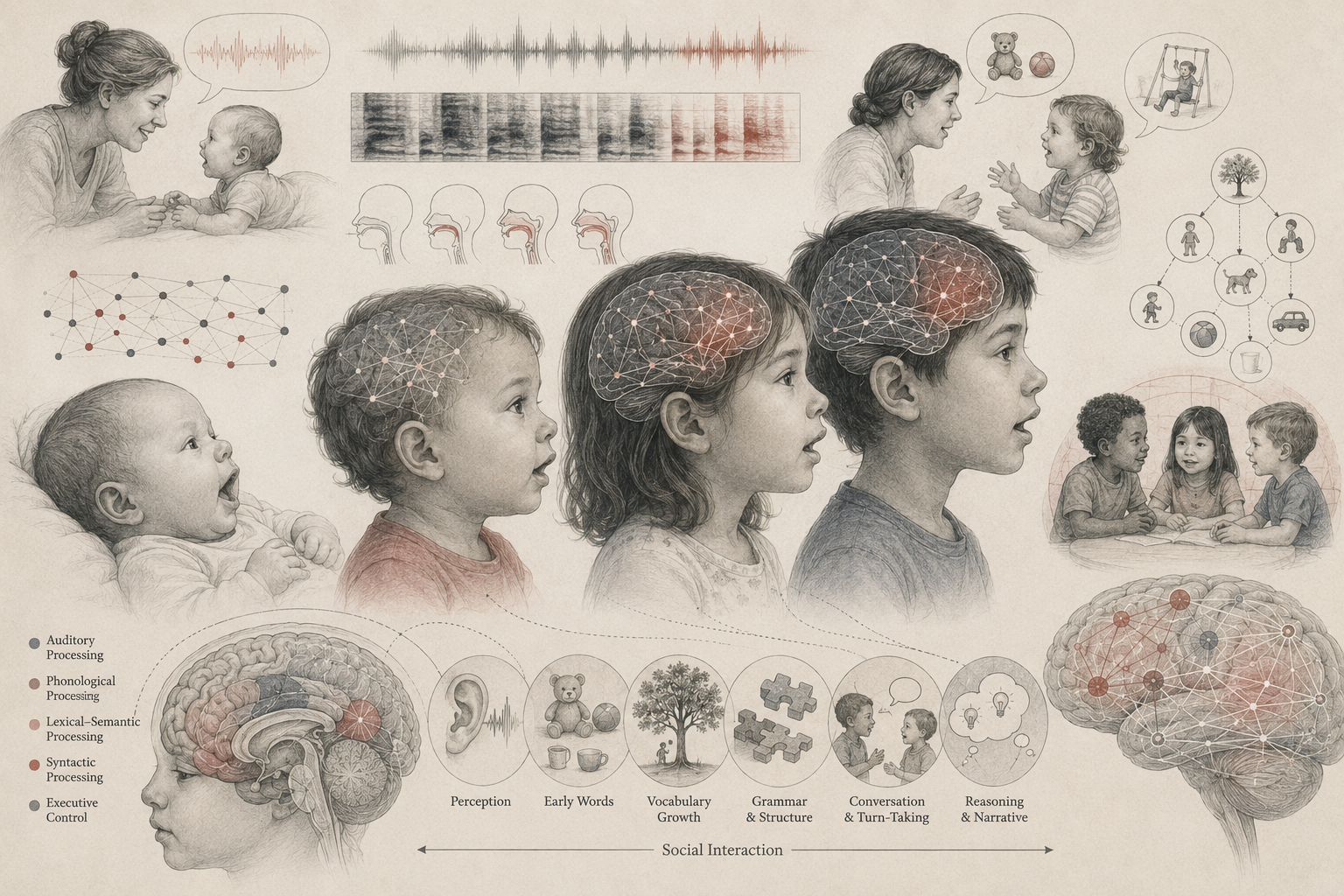
Contemporary developmental research treats language as a process shaped by biology, perception, hearing, gesture, caregiving, attention, memory, culture, schooling, and unequal opportunity. The APA Dictionary of Psychology defines language development as the process by which children learn to use language, while the NICHD TALK initiative frames early language development as a major scientific concern, including the learning trajectories and needs of late-talking children. The CDC’s developmental milestones include language and communication as core developmental domains, and the World Health Organization places language within the broader framework of early childhood development and nurturing care.
A serious developmental psychology therefore approaches language not as a simple internal skill, but as a developmental achievement formed through relation, embodiment, and environment. Children do not acquire language in isolation. They acquire it through hearing and touch, face and gesture, rhythm and repetition, pointing and naming, stories and songs, correction and repair, silence and response, home language and school language, private speech and public speech, play and instruction, belonging and exclusion. Language development is one of the clearest places where developmental psychology shows that human growth is biological, social, cultural, and institutional all at once.
Why Language Development Matters
Language development matters because speech and language reorganize human life. Through language, infants and children come to name, request, refuse, recall, imagine, classify, explain, narrate, question, joke, argue, persuade, apologize, and participate in the symbolic worlds of family, school, community, and culture. Language is not only a tool for expressing thought already complete within the child. It is one of the means through which thought itself is formed, stabilized, shared, and revised.
To gain language is to gain new forms of memory. Events can be named, sequenced, and returned to. A child can say what happened yesterday, what might happen tomorrow, what they want, what they fear, what they remember, and what they imagine. Language also creates new forms of social coordination. A child can ask for help, negotiate a rule, explain a conflict, seek comfort, resist a demand, join a game, or tell another person what matters. These are not minor developmental gains. They transform the child’s participation in human worlds.
Language also matters because it is one of the primary bridges between social development and cognitive development. Children learn words from others, but those words also become tools for thinking. Language helps children sort categories, remember instructions, regulate behavior, tell stories, form identities, and enter school-based learning. A child who can use language to guide attention, explain a need, narrate a feeling, or ask a question has new developmental possibilities available.
At the same time, language development is one of the clearest places where developmental psychology must resist narrow universalism. Children learn language in different social worlds, different linguistic environments, and under different conditions of hearing, health, attention, disability, schooling, caregiver time, and institutional support. A child’s language trajectory is not merely a private timetable unfolding inside the brain. It is shaped by the worlds of speech, gesture, sound, silence, expectation, and opportunity around the child.
Language development also matters ethically because language is tied to recognition. Children who cannot make themselves understood, or whose language is not valued by institutions, may be misread as less capable than they are. Children who speak a home language different from the school language may be treated as delayed when they are navigating multiple linguistic systems. Children with speech, hearing, communication, or neurodevelopmental differences may be judged through narrow norms of verbal performance. A serious account of language development must therefore ask not only how children learn speech, but whose speech counts, whose communication is recognized, and whose language worlds are respected.
What Language Development Is
Language development is the developmental process through which children acquire the ability to perceive, understand, produce, and use meaningful communication through sounds, gestures, signs, words, grammar, discourse, narrative, and later literacy-linked symbolic systems. In everyday discussion, language development is often confused with speech alone. But speech is only one dimension. Language also includes comprehension, vocabulary, morphology, syntax, pragmatics, narrative structure, gesture, turn-taking, symbolic reference, and the social use of meaning in context.
This broader framing matters because children may differ across these components. A child may produce fewer words than expected but understand much more than they can say. Another child may speak fluently yet struggle with pragmatic use, perspective-taking, or conversational repair. A child with hearing differences may have different access to spoken input. A child exposed to multiple languages may distribute vocabulary, grammar, and pragmatic competence across more than one linguistic system. A child who uses sign, augmentative communication, gesture, or assistive technology is still participating in language development, even when speech is not the primary mode.
Language development includes receptive language and expressive language. Receptive language refers to understanding: recognizing words, following directions, interpreting tone, making sense of questions, and understanding stories or explanations. Expressive language refers to production: sounds, words, phrases, sentences, signs, gestures, or other communicative forms. These domains often develop together, but not always at the same pace. Many children understand more than they can express, especially early in development.
Language development also includes phonology, the sound system of language; semantics, the organization of meaning; morphology, the structure of word forms; syntax, the rules for combining words into sentences; and pragmatics, the use of language in social context. A child’s language system is therefore not a single skill. It is an interconnected developmental architecture linking perception, motor control, memory, categorization, symbolic understanding, social intention, and cultural practice.
Most importantly, language development is not just acquisition of an abstract code. It is participation in shared meaning. Children learn not only words and grammar but when to speak, when to listen, how to ask, how to refuse, how to repair misunderstanding, how to narrate experience, how to address different people, how to joke, how to show respect, how to disagree, and how to move between home, peer, school, and public language worlds. To learn language is to learn how meaning lives between people.
From Sound to Symbol
Language development begins before fluent words. Infants orient to voices, rhythms, patterns, and prosody long before they can speak. Early vocalization, cooing, babbling, and patterned sound exchange are not trivial preludes. They are part of the developmental movement from sound to symbol. Children do not suddenly acquire language from nowhere. They pass through a long process in which auditory discrimination, social timing, imitation, memory, gesture, and shared attention prepare the conditions for meaningful speech.
Sound becomes developmentally meaningful because it appears in patterned relation. A caregiver speaks, pauses, smiles, repeats, responds, sings, names, points, and exaggerates tone. The infant listens, vocalizes, turns, smiles, cries, reaches, or shifts attention. These exchanges gradually organize the infant’s sense that sound can be connected to people, objects, actions, comfort, and expectation. Before the child knows words as words, the child is learning that human sound matters.
Babbling is part of this transition. It helps infants practice speech-like rhythms, syllable patterns, vocal control, and social exchange. Babbling is also social: caregivers often respond to it as if it were meaningful conversation, and that response matters. The infant’s sounds are pulled into a communicative world. A repeated syllable can become part of turn-taking before it becomes a word. Language begins in the social treatment of sound as meaningful.
The movement from sound to symbol also includes the child’s growing ability to link sound patterns with stable reference. A word is not merely a noise. It points beyond itself. It can refer to a person, object, action, feeling, relation, absence, memory, or imagined possibility. This symbolic leap transforms development. Once a child can use a word to refer to something not immediately present, language becomes a tool for memory, planning, imagination, and shared attention.
The deeper developmental lesson is that language rests on a prior history of perception, relation, and symbolic readiness. Words become meaningful because children have already been participating in worlds of turn-taking, attention, rhythm, and patterned response. Speech emerges from relation, not from isolated sound production alone.
Hearing, Perception, and the Embodied Conditions of Speech
Language development is embodied. It depends on ears, mouths, breath, vocal tracts, hands, eyes, bodies, nervous systems, sensory systems, motor control, and social environments. Spoken-language development depends heavily on access to patterned auditory input, though language itself is not limited to speech. Sign languages, gesture, visual communication, tactile communication, and augmentative systems all remind developmental psychology that language is broader than sound. Still, for spoken language, hearing and auditory perception are foundational conditions.
Infants must learn to discriminate relevant sound patterns from the stream of surrounding noise. They must detect rhythm, stress, tone, repeated patterns, phonemic contrasts, and the difference between speech and other sounds. This work is not purely passive. The developing infant is actively tuning to the language environment. Over time, perception becomes increasingly shaped by the language or languages present in the child’s world.
Hearing differences matter because they can alter access to spoken-language input, especially when they are unidentified or unsupported. WHO’s hearing-and-language milestone materials emphasize the developmental importance of common hearing and language landmarks and the need for early attention when those landmarks are absent. Developmental psychology must therefore treat hearing not as a narrow medical variable, but as part of the social and communicative ecology of the child. Screening, support, assistive technology, sign language access, caregiver guidance, and early intervention can all shape language trajectories.
Speech production is also embodied. Children must coordinate breath, articulation, timing, tongue movement, lips, jaw, hearing feedback, and motor planning. Some children understand language well but have difficulty producing speech sounds. Others may have motor-speech, oral-motor, hearing, auditory-processing, or broader developmental differences that affect how language appears. A developmental account must not confuse speech production with intelligence or communicative intent.
The body also shapes language through affect and regulation. A tired, hungry, overstimulated, anxious, ill, or stressed child may speak differently from the same child under calmer conditions. Communication is not detached from arousal. Children need bodies organized enough to attend, listen, imitate, gesture, and respond. Language development is therefore never just in the head. It is embodied communication in a social world.
Caregiving, Turn-Taking, and Joint Attention
Language is socially formed. Infants learn language not by listening passively to detached noise, but through interaction with caregivers and other speakers who respond, repeat, gesture, point, label, sing, narrate, and take turns. The earliest “conversations” are not fully verbal, but they are already structured: gaze, smile, vocal exchange, pause, response, and mutual orientation. A caregiver speaks as if the infant can answer; the infant responds with sound, movement, facial expression, or attention; the caregiver treats that response as meaningful. This is how communication begins before speech is fluent.
Turn-taking is central because conversation is not only sound production. It is a social rhythm. The child learns that communication involves timing, alternation, response, waiting, interruption, and repair. Even before words, the infant participates in this rhythm through vocalization, gaze, movement, and affect. Later, turn-taking becomes the basis for dialogue, storytelling, peer interaction, classroom participation, and social understanding.
Joint attention is especially important because it helps bridge the child’s attention and the speaker’s meaning. When an adult and child attend to the same object, action, person, or event, words become anchored in shared reference. A caregiver points to a dog and says “dog”; the child looks, hears, and links sound, object, gesture, and social intention. This process is profoundly social. It ties language learning to trust, timing, perception, and the child’s expectation that communication is meaningful.
Caregivers also shape language through expansion and recasting. A child says “doggie run,” and an adult responds, “Yes, the dog is running.” The adult does not merely correct. They extend the child’s utterance into a richer linguistic form. A child points and says “that,” and an adult names, describes, or narrates. Through thousands of such exchanges, children encounter vocabulary, grammar, pragmatics, emotional tone, and cultural meaning in use.
Responsive interaction matters more than sheer verbal quantity alone. Children need language that is directed, meaningful, contingent, and embedded in shared activity. Talking at children is different from talking with them. Language develops through reciprocal exchange: listening and response, not sound exposure alone. This is why reading, singing, storytelling, conversation, play, and shared attention remain central to early language development.
Gesture, Pointing, and Early Communication
Gesture is not secondary to language development. It is one of language’s earliest developmental bridges. Before children speak fluently, they reach, point, wave, show, give, push away, nod, shake their heads, raise their arms, imitate actions, and use facial expression to communicate. These gestures are not merely substitutes for missing words. They help organize meaning, attention, intention, and social response.
Pointing is especially important because it creates shared reference. A child points not simply to move an adult’s eyes, but to coordinate attention around something meaningful. Pointing may request an object, show interest, ask for a name, invite shared enjoyment, or direct another person toward something surprising. In this sense, gesture already contains a theory of social communication: the child expects that another person can attend with them.
Gesture also supports vocabulary growth. When caregivers respond to gestures by naming, describing, or elaborating, gesture becomes a bridge into speech. A child points to a bird, and an adult says, “Bird. The bird is flying.” The gesture opens a language-learning moment. The child’s communicative act is recognized, answered, and expanded.
Gesture remains important after speech begins. Children use gesture to clarify meaning, support memory, explain spatial relations, dramatize stories, regulate conversation, and supplement words. In multilingual households, gesture may help bridge languages. For children with speech or hearing differences, gesture, sign, and visual communication may be central rather than supplementary. A developmental psychology that privileges spoken words alone risks missing much of early communication.
Recognizing gesture also helps adults avoid underestimating children. A child who speaks little may still communicate richly through gesture, gaze, movement, pointing, signs, or other symbolic systems. Language development includes the growth of communicative competence, not only the number of spoken words a child produces.
Vocabulary, Grammar, and Meaning
Vocabulary growth is the most visible part of language development, but it is not the whole of language. Children do not merely accumulate words. They learn how words relate to objects, actions, categories, feelings, people, time, place, and social expectation. They also learn how meaning changes with context. The same word can comfort, command, tease, warn, invite, refuse, or name depending on tone and situation. Vocabulary is therefore not simply a list. It is a network of meanings embedded in life.
Children often learn words first in routines: meals, dressing, bathing, play, books, songs, family names, repeated games, and emotionally meaningful events. Words are easier to learn when they matter. “More,” “up,” “no,” “mine,” “mama,” “go,” “ball,” “bye,” or “again” are not abstract vocabulary items in the child’s world. They are tools for action, relation, and desire. Language grows because words do things.
Grammar develops as children learn how words combine. They begin to express relations: who did what, what belongs to whom, what happened before, what might happen later, what is not true, what is desired, what is remembered. Morphology and syntax allow children to communicate increasing complexity. They can mark tense, plurality, possession, negation, question, comparison, cause, and conditional possibility. Grammar is therefore not an ornament added to vocabulary. It is the structure that allows language to carry relation and thought.
Meaning also develops through error. Children overextend words, underextend categories, regularize irregular grammar, and invent forms that reveal active rule-making. A child may say “goed” not because they have failed to learn language, but because they have inferred a pattern. Such errors show that children are not merely copying adult speech. They are building systems.
Vocabulary size alone can be misleading if separated from grammar, comprehension, discourse, and pragmatic use. A child’s language world includes not only naming objects but participating in stories, following directions, repairing misunderstanding, explaining causes, asking questions, and learning when speech is used differently across home, school, peer, and public settings. The developmental significance of language lies in this widening communicative competence, not only in raw word count.
Conversation, Pragmatics, and the Social Use of Language
Pragmatics is the social use of language: how people use speech, gesture, tone, timing, and context to communicate meaning with others. A child does not fully know a language simply because they can produce words and sentences. They must also learn how to enter conversation, wait, respond, repair misunderstanding, change speech for different listeners, interpret indirect meaning, understand jokes, follow social rules, and recognize what can or cannot be said in a given context.
Pragmatic development is visible in ordinary life. A toddler learns to request help. A preschool child learns that a story must include enough information for someone else to understand. A school-age child learns when a joke has gone too far. A child learns that speaking to a baby differs from speaking to a teacher, friend, grandparent, or stranger. Language use becomes socially calibrated.
Conversation also requires perspective-taking. The speaker must consider what the listener knows, wants, sees, misunderstands, or expects. This makes language development inseparable from social cognition. A child who can explain a game rule to a younger sibling, tell a story to someone who was not there, or repair a misunderstanding is using language as a social-cognitive tool.
Pragmatic development also shows why language cannot be understood outside culture. Conversational norms differ. Some communities value directness; others value restraint. Some encourage children to speak freely with adults; others emphasize listening, observation, or respect for hierarchy. Some value elaborate storytelling; others value concise response. A child’s pragmatic competence must be understood within the language world in which it developed, not only through dominant institutional norms.
Pragmatic language is also an area where neurodivergent children and children with communication differences are often misread. A child may communicate differently without lacking social intention. Eye contact, turn-taking, literal interpretation, topic intensity, response timing, gesture use, and conversational style all vary. Developmental psychology must distinguish difference from deficit while still identifying support needs when communication barriers affect learning, relationships, or well-being.
Narrative, Memory, and Selfhood
Language development transforms memory because children become increasingly able to organize experience into narrative. A child can say what happened, who was there, what came first, what came next, what felt scary, what was funny, and what might happen tomorrow. Narrative gives experience a temporal and social structure. It allows events to be held, shared, revised, and connected to identity.
Narrative development begins in relational contexts. Caregivers often help children remember by asking questions, filling gaps, naming emotions, and sequencing events: “You fell down, then you cried, and then we got a bandage.” Such exchanges do more than record memory. They teach children how experience becomes story. The child learns that life can be narrated, interpreted, and shared.
Stories also support emotional development. A child who can narrate fear, disappointment, anger, or joy can begin to organize those feelings symbolically. Language gives emotional life shape. It allows children to say “I was scared,” “I wanted it,” “I missed you,” “I don’t like that,” or “I’m sorry.” These statements do not merely report feeling. They help regulate it by making it communicable.
Narrative also participates in selfhood. Children learn who they are partly through stories told about them and by them. Family stories, cultural stories, migration stories, religious stories, school stories, and peer stories all become materials of identity. A child may learn they are brave, difficult, funny, careful, loved, annoying, gifted, responsible, or invisible through repeated narrative framing. Language does not simply express the self. It helps form the self.
This makes narrative development ethically important. Children need opportunities to tell their own stories, not only be described by adults. They need language for their experiences, including experiences of disability, exclusion, trauma, culture, family change, grief, joy, and belonging. Narrative is one of the ways children become interpreters of their own lives.
Vygotsky and the Social Formation of Speech
No major theorist is more important for this topic than Lev Vygotsky. Vygotsky argued that higher mental functions emerge through social interaction and are later internalized. Speech, in this account, is first interpersonal before it becomes intrapersonal. Children learn to participate in dialogue with others and gradually transform this social speech into inner speech that helps organize memory, attention, planning, and self-guidance.
This theory remains central because it explains why language development is not simply about output. Speech is a developmental bridge between society and mind. It enables the child to carry social guidance inward and use language for thinking. When an adult says, “First put on your shoes, then get your bag,” the child may later repeat something similar aloud to themselves, then eventually guide action silently. Social instruction becomes private regulation. Dialogue becomes thought.
Vygotsky also helps explain why language is a cultural tool. Children do not invent language alone. They inherit symbolic systems, narratives, categories, values, and modes of explanation from social worlds. Language is the medium through which culture becomes available to the developing mind. The child learns not only words, but culturally organized ways of seeing and acting.
His framework also emphasizes mediation. Children learn language through cultural tools, instructional interaction, play, storytelling, and structured participation. A child’s development is shaped by the tools and relationships available in their environment. This insight remains powerful for thinking about schooling, literacy, multilingualism, disability supports, digital media, and inequality.
Vygotsky’s limitation, if simplified, is that his framework can be invoked too abstractly without sufficient attention to power, linguistic hierarchy, disability, colonial language politics, or the material conditions under which some children receive rich responsive input and others do not. Still, his central insight remains decisive: speech is socially formed before it becomes inwardly organized. Language is not merely learned by the child. It is shared with the child, practiced between people, and then partially transformed into thought.
Private Speech, Inner Speech, and Self-Regulation
Private speech is one of the clearest signs that language development and self-regulation are connected. Young children often talk to themselves while playing, solving problems, drawing, building, dressing, or managing frustration. Adults may hear a child say, “No, this goes here,” “Careful,” “I can do it,” “First this,” or “Don’t touch.” This speech is not meaningless chatter. It is language being used to organize action.
Over time, private speech often becomes quieter, abbreviated, and internalized. What was once spoken aloud may become inner speech: the silent verbal guidance that helps people plan, remember, inhibit, rehearse, and reflect. This process links social language to executive function. Children first receive guidance from others; then they use language aloud to guide themselves; later, they use internal language to organize thought and behavior.
Private speech also shows why language development is not simply communication outward. Language becomes communication inward. The child learns to become both speaker and listener within the self. This is one of the great developmental transformations of childhood. Language becomes a tool for thinking, not only a tool for talking.
Self-regulation through language is visible in school settings. Children use words to remember rules, follow instructions, plan steps, calm themselves, and recover from mistakes. A child who can say “I need help,” “I’ll try again,” or “I’m mad but I won’t hit” has gained a regulatory tool. Emotional language is especially important because feelings become easier to manage when they can be named, shared, and interpreted.
Yet inner speech differs across people. Some individuals think more visually, spatially, emotionally, musically, or sensorimotorically. Some neurodivergent people may experience internal language differently. A serious developmental account should not assume that all thought becomes verbal in the same way. The important point is not that language replaces all thought, but that language introduces a powerful new medium for self-guidance, reflection, and social meaning.
Late Talkers, Hearing, and Developmental Variation
Language development does not unfold identically for all children. Some children speak earlier; some later. Some show strong comprehension but slower expressive language. Some are multilingual and distribute growth across more than one language system. Some encounter hearing differences, neurodevelopmental differences, motor-speech differences, or broader developmental conditions that affect language timing or form. The NIH-wide TALK initiative was created in part to better understand early language development and the trajectories and needs of late-talking children. That focus reflects an important developmental principle: variation is not noise outside the system. It is part of what developmental science must explain.
Late talking requires nuance. Some late-talking children catch up without major long-term difficulty; others continue to show language, literacy, learning, or communication challenges. Developmental psychology must therefore balance patience with timely attention. A slower expressive timeline is not automatically pathology, but neither should caregiver concern be dismissed. Screening, hearing evaluation, speech-language assessment, and supportive intervention can be developmentally protective when concerns persist.
Hearing is especially important because language learning depends on access to patterned auditory input in spoken-language pathways. WHO’s hearing-and-language milestone materials emphasize that the absence of common hearing and language landmarks may indicate hearing loss and should prompt early attention. Developmental psychology must take such variation seriously without reducing all difference to alarm. The right question is not whether a child perfectly matches a standardized timeline, but how language, comprehension, hearing, interaction, and broader development are unfolding together.
Variation also appears in the relationship between comprehension and production. A child may understand directions, stories, and social meaning but produce few words. Another may produce words but have difficulty understanding complex language. Another may have clear vocabulary growth but difficulty with pronunciation, fluency, grammar, or pragmatic use. A good developmental account asks which part of the language system is developing differently, not simply whether the child is “delayed.”
Early support matters because language is connected to later learning, social participation, and emotional expression. But support should not be stigmatizing. The goal is not to force children into a narrow timeline. It is to ensure that communication, hearing, interaction, and language access are supported as early and respectfully as possible.
Multilingual Development and Language Ecologies
Many children grow up in multilingual language ecologies. They may hear one language at home, another at school, another in religious settings, another in media, and another among peers or extended family. Multilingual development is not a developmental exception. It is a normal human condition across much of the world. Developmental psychology becomes distorted when it treats monolingual development as the default human template and multilingualism as a complication.
Multilingual children may distribute vocabulary and expressive ability across languages. A child may know family words in one language, school words in another, religious or cultural words in another, and peer slang in yet another. Measuring only one language can therefore underestimate the child’s total linguistic competence. A child may appear to have fewer words in the school language while possessing rich knowledge across the full language ecology.
Code-switching is also often misunderstood. Moving between languages within a conversation is not confusion. It can reflect pragmatic skill, identity, audience awareness, and flexible use of linguistic resources. Children may code-switch depending on topic, person, emotion, setting, or available vocabulary. This is not evidence that multilingualism harms development. It is evidence that language is socially situated.
Multilingualism also carries emotional and cultural significance. Home language can connect children to grandparents, religious life, cultural memory, migration histories, family humor, songs, stories, and identity. When institutions pressure families to abandon home languages in favor of dominant school language, children may gain one form of institutional access while losing another form of cultural connection. A serious developmental account should support school-language learning without treating home language as an obstacle.
The strongest approach recognizes multilingual development as a language ecology. Children develop through multiple streams of meaning, each tied to relationships, places, identities, and opportunities. The developmental question is not whether multiple languages confuse the child, but whether the child’s full linguistic world is supported, respected, and understood.
Culture, Inequality, and Language Worlds
Language development is always cultural. Children do not acquire a generic language in a generic environment. They acquire particular languages, registers, rhythms, styles of address, conversational norms, narrative forms, and pragmatic expectations. Some children grow up in multilingual households. Some move between home language and school language. Some are socialized toward deference, some toward expressive assertiveness, some toward elaborate narrative performance, and others toward more observational or context-dependent speech. Developmental psychology becomes distorted when it treats one dominant linguistic style as the natural template of healthy language development.
Culture shapes what counts as competent communication. In some settings, children are expected to speak directly to adults; in others, careful listening and restraint are valued. Some families use frequent child-directed speech; others expect children to learn through observation, participation, sibling interaction, or overheard conversation. Some communities emphasize storytelling and verbal performance; others emphasize respect, silence, or indirect communication. These differences are not developmental deficits. They are language worlds.
Inequality matters just as much. Language development is shaped by caregiver time, stress load, access to books, health care, hearing evaluation, early education, safe housing, responsive conversation, and institutional respect for home language. Families under stress may have less time and stability for extended conversation not because they value language less, but because labor, housing, health, discrimination, and economic strain shape daily life. Developmental psychology must avoid turning unequal conditions into cultural blame.
This is especially important in debates over socioeconomic difference and language input. Research on language exposure has sometimes been interpreted in ways that stigmatize low-income families or communities of color. A more serious interpretation asks how structural inequality shapes the conditions under which interaction, reading, rest, healthcare, childcare, and schooling occur. The problem is not that some families are “language poor” in a simplistic cultural sense. The problem is that unequal social conditions affect the stability, time, health, and institutional support through which language opportunities are distributed.
To speak of language development without speaking of language worlds would therefore be a mistake. Children are not only learning speech. They are learning how speech is valued, interpreted, rewarded, corrected, constrained, and sometimes punished in the worlds they inhabit. Language development is inseparable from power because institutions decide which languages, accents, dialects, and communication styles are treated as intelligent, professional, respectful, or deficient.
Disability, Neurodivergence, and Communication Difference
Language development must be understood through disability and neurodivergence. Children vary in hearing, speech production, motor planning, auditory processing, sensory regulation, social communication, attention, memory, and language processing. Some children use spoken language early; others use few spoken words but communicate through gesture, sign, eye gaze, assistive technology, picture systems, typing, or other augmentative and alternative communication. Communication difference should not be equated with absence of meaning.
Autistic children, children with ADHD, children with developmental language disorder, children with hearing differences, children with intellectual disabilities, children with cerebral palsy, children with apraxia of speech, children with selective mutism, and children with trauma histories may all show different language pathways. Some may have strong vocabulary but difficulty with pragmatic use. Some may speak in scripts or echolalia. Some may understand much more than they can produce. Some may communicate best through visual supports, routines, or assistive systems. These patterns require interpretation, not quick judgment.
Echolalia, for example, has often been misread as meaningless repetition. In many cases, repeated language can serve communicative, regulatory, emotional, or meaning-making purposes. A child may use a repeated phrase to request, comment, self-soothe, participate, or process experience. A serious developmental account asks what the communication does before dismissing it.
Children with communication differences often suffer not only from language challenges but from misrecognition. Adults may assume that limited speech means limited understanding, that atypical eye contact means lack of attention, that scripting means absence of thought, or that assistive communication is less authentic than spoken language. These assumptions can harm development by denying children access to rich communication, education, autonomy, and respect.
Supporting language development therefore requires a broad communication ecology. Children need access to speech-language support, hearing assessment, sign language when appropriate, augmentative and alternative communication, sensory-sensitive environments, patient conversation partners, peer inclusion, and adults who presume communicative intent. Language development should be about expanding meaningful participation, not forcing all children into one narrow model of speech.
Schooling, Literacy, and Institutional Language
Schooling transforms language development because it introduces children to institutional language: classroom directions, academic vocabulary, narrative conventions, explanation, argument, questioning, written symbols, disciplinary terms, and formal registers. The child who communicates effectively at home may still need support learning the language of school. This does not mean the home language world is deficient. It means school is a distinct linguistic institution with its own expectations.
Literacy extends language into print. Reading and writing require children to connect spoken or signed language with visual symbols, phonological awareness, vocabulary, narrative structure, syntax, memory, and attention. Early oral language supports literacy, but literacy also reshapes language by making words visible, durable, revisable, and portable across time. A child who learns to read gains access to language beyond immediate conversation.
School also evaluates language. Children are asked to answer questions, follow directions, retell stories, define words, explain reasoning, write sentences, and participate in classroom discourse. These tasks can reveal language strengths and needs, but they can also reflect cultural and linguistic mismatch. A child may know a concept but not the expected academic word. A child may speak a dialect that is rule-governed and sophisticated but stigmatized. A child may be multilingual but assessed in only one language. A child may understand a story but be unfamiliar with the school’s preferred narrative format.
Teachers and schools therefore shape language development profoundly. Rich classroom talk, dialogic reading, vocabulary instruction, storytelling, peer discussion, language-sensitive teaching, multilingual support, speech-language services, and respect for home language all matter. Punitive correction, humiliation, accent stigma, dialect prejudice, or suppression of home language can harm both language development and identity.
A serious developmental psychology of language must therefore move beyond milestones into institutions. Language development continues in school, and school decides which forms of language are treated as legitimate. The goal should be expansion: helping children gain access to academic and public language without devaluing the linguistic worlds they bring with them.
Digital Media and Language Environments
Digital media now shape many children’s language environments. Video calls, educational apps, streaming media, audiobooks, music, games, captioned content, messaging, and interactive platforms can all expose children to language. But digital language exposure is not developmentally equivalent in every form. The key question is not simply whether media contains words, but whether it supports attention, interaction, comprehension, turn-taking, agency, and meaningful participation.
Video calls with responsive relatives may support social communication differently from passive background television. An interactive shared reading app used with an adult differs from autoplay video consumed alone. A child narrating a game with peers differs from a child passively scrolling through rapid content. Language development depends on contingency: whether communication responds to the child’s attention, action, and meaning.
Digital tools can support language when they expand access. Children with disabilities may use augmentative communication devices. Families separated by migration, work, incarceration, hospitalization, or distance may sustain language relationships through video. Multilingual children may access stories, songs, and relatives in home languages through digital media. Captioning, speech-to-text, text-to-speech, and visual supports can all become part of a communication ecology.
But digital environments can also narrow language experience when they displace reciprocal interaction, sleep, outdoor play, shared reading, conversation, or embodied social engagement. Rapid content can capture attention without building sustained dialogue. Background media can interfere with caregiver-child interaction. Algorithmic feeds may deliver language without relationship. The developmental issue is balance, quality, interactivity, and context.
Digital media should therefore be evaluated as part of language ecology, not treated as automatically harmful or automatically educational. The most useful question is: does this medium deepen shared attention, conversation, story, communication access, and meaningful symbolic participation, or does it replace them?
Language, Cognition, and the Making of Mind
Language development is inseparable from cognitive development. Words help organize categories. Grammar helps express relation and time. Narrative supports memory and continuity of self. Dialogue supports perspective-taking and social understanding. Inner speech supports planning and self-control. The growth of language is therefore also the growth of mind. A child with increasing language capacity can not only communicate more, but think differently, recall differently, and regulate differently.
This does not mean thought is reducible to language. Infants think before they speak, and many forms of cognition are not fully verbal. Spatial reasoning, perception, motor planning, emotion, image, rhythm, and social expectation can all operate without explicit words. But language expands cognition in distinctive ways. It stabilizes symbolic representation, makes abstraction more portable, and allows experience to be named, compared, questioned, and reflected upon.
Language also shapes social understanding. Children learn words for feelings, motives, beliefs, rules, promises, secrets, lies, mistakes, fairness, and belonging. These words help children understand themselves and others. A child who can distinguish “sad,” “mad,” “scared,” “lonely,” “sorry,” and “proud” has more ways to interpret emotional life. A child who can say “I thought you meant…” has a way to represent misunderstanding. Language gives social life conceptual handles.
Selfhood is also linguistic. Children are named, described, praised, corrected, compared, and narrated by others before they can narrate themselves. Over time, they begin to speak about who they are, what they like, what they remember, what they believe, and what they want. Language allows the self to become a story, an argument, a memory, and a possibility. This is one reason language development is tied so deeply to identity.
The growth of speech is therefore one of the most consequential developmental changes in childhood. It links relation to reason, culture to consciousness, and communication to selfhood. Language is not merely something children acquire. It is one of the mediums through which they become persons in shared worlds of meaning.
What Language Development Can and Cannot Explain
Language development can explain a great deal about childhood. It helps explain changes in cognition, memory, self-regulation, social participation, emotional expression, schooling, literacy, peer relations, and identity. It shows why interaction, hearing, gesture, books, songs, storytelling, multilingual support, and responsive caregiving matter. It also shows why developmental assessment must look beyond simple vocabulary counts toward the broader communicative ecology of the child.
Language development can also correct harmful simplifications. A child who speaks little may still understand deeply. A child who speaks a nondominant dialect is not linguistically inferior. A multilingual child is not confused by having more than one language. A neurodivergent child who scripts, signs, gestures, or uses assistive communication is not without meaning. A child whose school language differs from home language is not developmentally deficient because institutional language is unfamiliar.
But language development cannot explain everything. Not every learning difficulty is primarily a language problem. Not every social difficulty is caused by pragmatic language. Not every behavioral struggle reflects inability to verbalize emotion. Language interacts with temperament, hearing, cognition, trauma, disability, sleep, family stress, schooling, peer life, and institutional design. A serious developmental account uses language as one pathway of explanation, not as a totalizing explanation for the whole child.
Language also should not be turned into a narrow instrument of compliance. Children need language to express refusal, dissent, anger, imagination, and alternative meanings, not only to follow instructions. A child’s language development should support agency as well as adaptation. The goal is not merely that children speak in ways institutions prefer, but that they gain fuller access to communication, thought, relationship, and self-expression.
Finally, language development cannot be separated from justice. Languages, dialects, accents, communication styles, and assistive systems are not valued equally by institutions. Developmental psychology must therefore ask which children are heard, which are corrected, which are silenced, which are misunderstood, and which are given the tools and respect needed to participate fully. Language development is a scientific topic, but it is also a question of recognition.
An Analytical Framework for Language Development
A stylized language outcome \(L_{it}\) for child \(i\) at time \(t\) can be modeled as:
L_{it} = \alpha_i + \beta_i t + \gamma I_{it} + \delta H_i + \varepsilon_{it}
\]
Interpretation: \( \alpha_i \) is the child’s starting level of language functioning, \( \beta_i \) is the individual growth rate, \( I_{it} \) captures interactional input such as responsive conversation, shared attention, storytelling, singing, or reading, and \( H_i \) captures more stable conditions such as hearing status, developmental health, or communication access.
To represent nonlinear vocabulary growth, we can extend the model:
L_{it} = \alpha_i + \beta_{1i}t + \beta_{2i}t^2 + \gamma I_{it} + \delta H_i + \varepsilon_{it}
\]
Interpretation: The quadratic term allows for acceleration or deceleration. This is useful because early language growth may appear slow, then rapid, and later more structurally complex rather than merely faster.
To model social formation more directly, we can include joint attention and turn-taking:
L_{it} = \alpha_i + \beta_i t + \gamma_1 J_{it} + \gamma_2 T_{it} + \gamma_3 R_{it} + \varepsilon_{it}
\]
Interpretation: \(J_{it}\) is joint attention, \(T_{it}\) is conversational turn-taking, and \(R_{it}\) is responsive caregiving or interactional richness. Under this formulation, language development is explicitly relational rather than treated as a purely internal maturation process.
Because language grows within families, classrooms, and communities, a multilevel form is often more realistic:
L_{ijt} = \alpha + u_j + \beta t + \gamma X_{ijt} + \delta Z_i + \varepsilon_{ijt}
\]
Interpretation: \(u_j\) captures household, classroom, school, childcare, or community context, \(X_{ijt}\) represents time-varying inputs such as language exposure and support, and \(Z_i\) represents child-level conditions. This matters because language development is never only inside the child. It is nested in social worlds.
To represent multilingual and institutional language ecologies, we can specify language access across contexts:
L_{it}^{(k)} = \alpha_i^{(k)} + \beta_i^{(k)}t + \gamma_1 A_{it}^{(k)} + \gamma_2 Q_{it}^{(k)} + \gamma_3 V_{it}^{(k)} + \varepsilon_{it}^{(k)}
\]
Interpretation: \(k\) indexes a language, dialect, register, sign system, or communication mode. \(A_{it}^{(k)}\) represents access, \(Q_{it}^{(k)}\) represents quality of interaction, and \(V_{it}^{(k)}\) represents institutional value or recognition. This model reflects that children’s language development may be distributed across multiple linguistic worlds.
The point of this framework is not to reduce speech to equations. It is to clarify that language development is time-structured, socially formed, embodied, multilingual, institutionally shaped, and context-sensitive.
R: Simulating Language Growth, Interaction, and Developmental Trajectories
The following R example simulates language development across eight waves. It includes baseline language level, responsive interaction, shared reading, joint attention, conversational turn-taking, hearing-related support, multilingual exposure, chronic stress, and a broad developmental language score. The data are synthetic and intended for methodological demonstration.
# Simulating language growth, interaction, and developmental trajectories
# ----------------------------------------------------------------------
# This synthetic example models language development as a longitudinal
# process shaped by responsive interaction, shared reading, joint attention,
# conversational turn-taking, hearing-related support, multilingual exposure,
# chronic stress, and contextual language support.

suppressPackageStartupMessages({
  library(dplyr)
  library(tidyr)
  library(lme4)
  library(ggplot2)
})

set.seed(2026)

n_children <- 820
n_waves <- 8
n_contexts <- 34

children <- data.frame(
  child_id = 1:n_children,
  context_id = sample(1:n_contexts, n_children, replace = TRUE),
  baseline_language = rnorm(n_children, mean = 48, sd = 8),
  responsive_interaction = rnorm(n_children, mean = 0, sd = 1),
  shared_reading = rnorm(n_children, mean = 0, sd = 1),
  joint_attention = rnorm(n_children, mean = 0, sd = 1),
  conversational_turns = rnorm(n_children, mean = 0, sd = 1),
  hearing_support = rnorm(n_children, mean = 0, sd = 1),
  multilingual_exposure = rbinom(n_children, size = 1, prob = 0.32),
  chronic_stress = rbinom(n_children, size = 1, prob = 0.28)
)

contexts <- data.frame(
  context_id = 1:n_contexts,
  language_ecology_support = rnorm(n_contexts, mean = 0, sd = 0.6),
  book_access = rnorm(n_contexts, mean = 0, sd = 0.6),
  early_education_quality = rnorm(n_contexts, mean = 0, sd = 0.6),
  home_language_recognition = rnorm(n_contexts, mean = 0, sd = 0.6)
)

panel_data <- children |>
  slice(rep(1:n(), each = n_waves)) |>
  group_by(child_id) |>
  mutate(
    wave = 0:(n_waves - 1),
    current_interaction = rnorm(n_waves, mean = responsive_interaction, sd = 0.6),
    current_reading = rnorm(n_waves, mean = shared_reading, sd = 0.6),
    current_joint_attention = rnorm(n_waves, mean = joint_attention, sd = 0.6),
    current_turn_taking = rnorm(n_waves, mean = conversational_turns, sd = 0.6),
    current_stress = rnorm(n_waves, mean = 0.30 * chronic_stress, sd = 0.8)
  ) |>
  ungroup() |>
  left_join(contexts, by = "context_id") |>
  mutate(
    language_support_context =
      current_interaction +
      current_reading +
      current_joint_attention +
      current_turn_taking +
      hearing_support +
      language_ecology_support +
      book_access +
      early_education_quality +
      home_language_recognition,
    language_score =
      baseline_language +
      1.80 * wave -
      0.06 * wave^2 +
      1.35 * current_interaction +
      1.20 * current_reading +
      1.15 * current_joint_attention +
      1.10 * current_turn_taking +
      1.00 * hearing_support +
      0.70 * language_ecology_support +
      0.70 * book_access +
      0.75 * early_education_quality +
      0.65 * home_language_recognition +
      0.50 * multilingual_exposure * home_language_recognition -
      1.25 * current_stress -
      0.85 * chronic_stress +
      0.25 * language_support_context +
      rnorm(n(), mean = 0, sd = 2.6)
  )

model <- lmer(
  language_score ~ wave + I(wave^2) + current_interaction +
    current_reading + current_joint_attention + current_turn_taking +
    hearing_support + multilingual_exposure + current_stress +
    chronic_stress + language_ecology_support + book_access +
    early_education_quality + home_language_recognition +
    multilingual_exposure:home_language_recognition +
    language_support_context +
    (1 + wave | context_id/child_id),
  data = panel_data
)

summary(model)

trajectory_summary <- panel_data |>
  group_by(wave, chronic_stress) |>
  summarize(
    mean_language = mean(language_score),
    standard_error = sd(language_score) / sqrt(n()),
    .groups = "drop"
  ) |>
  mutate(
    lower = mean_language - 1.96 * standard_error,
    upper = mean_language + 1.96 * standard_error,
    stress_group = ifelse(chronic_stress == 1, "Higher chronic stress", "Lower chronic stress")
  )

ggplot(trajectory_summary, aes(x = wave, y = mean_language, linetype = stress_group)) +
  geom_line(linewidth = 1) +
  geom_ribbon(aes(ymin = lower, ymax = upper, group = stress_group), alpha = 0.12) +
  labs(
    title = "Simulated Language Development Across Time",
    x = "Wave",
    y = "Language score",
    linetype = "Group"
  ) +
  theme_minimal()

context_summary <- panel_data |>
  group_by(wave) |>
  summarize(
    average_interaction = mean(current_interaction),
    average_reading = mean(current_reading),
    average_joint_attention = mean(current_joint_attention),
    average_turn_taking = mean(current_turn_taking),
    average_stress = mean(current_stress),
    average_language_support = mean(language_support_context),
    average_language = mean(language_score),
    .groups = "drop"
  )

ggplot(context_summary, aes(x = wave)) +
  geom_line(aes(y = average_interaction, linetype = "responsive interaction"), linewidth = 1) +
  geom_line(aes(y = average_reading, linetype = "shared reading"), linewidth = 1) +
  geom_line(aes(y = average_joint_attention, linetype = "joint attention"), linewidth = 1) +
  geom_line(aes(y = average_turn_taking, linetype = "turn-taking"), linewidth = 1) +
  geom_line(aes(y = average_stress, linetype = "stress"), linewidth = 1) +
  geom_line(aes(y = average_language_support, linetype = "language support"), linewidth = 1) +
  labs(
    title = "Synthetic Language Context Across Waves",
    x = "Wave",
    y = "Average index",
    linetype = "Measure"
  ) +
  theme_minimal()

# Analysts can extend this model by:
# 1. separating expressive and receptive language;
# 2. modeling bilingual or multilingual exposure explicitly;
# 3. adding classroom, childcare, or neighborhood random effects;
# 4. introducing late-talker subgroups;
# 5. estimating nonlinear word-growth dynamics;
# 6. adding sign language or augmentative communication variables;
# 7. modeling literacy transition and school-language exposure.
This simulation highlights a core developmental insight: language growth is shaped not just by time, but by interaction, shared attention, hearing-related support, stress, home language recognition, early education, and the social conditions of communication.
Python: Modeling Vocabulary Growth, Support, and Developmental Difference
The following Python example simulates children’s language development over ten periods. It includes responsive interaction, shared reading, joint attention, conversational turn-taking, hearing support, multilingual exposure, acute stress, institutional language support, and lagged state dependence in language functioning. The data are synthetic and intended for conceptual demonstration.
# Modeling vocabulary growth, support, and developmental difference
# ----------------------------------------------------------------
# This synthetic example models language development as a state-dependent
# process shaped by responsive interaction, shared reading, joint attention,
# conversational turn-taking, hearing support, multilingual exposure,
# stress, home-language recognition, and institutional language support.

from __future__ import annotations

import numpy as np
import pandas as pd
import statsmodels.formula.api as smf
import matplotlib.pyplot as plt

np.random.seed(2026)

n_children = 900
n_periods = 10
n_contexts = 36

children = pd.DataFrame({
    "child_id": np.arange(1, n_children + 1),
    "context_id": np.random.choice(np.arange(1, n_contexts + 1), size=n_children),
    "baseline_language": np.random.normal(48, 8, n_children),
    "responsive_interaction": np.random.normal(0, 1, n_children),
    "shared_reading": np.random.normal(0, 1, n_children),
    "joint_attention": np.random.normal(0, 1, n_children),
    "conversational_turns": np.random.normal(0, 1, n_children),
    "hearing_support": np.random.normal(0, 1, n_children),
    "multilingual_exposure": np.random.binomial(1, 0.32, n_children),
    "chronic_stress": np.random.binomial(1, 0.28, n_children)
})

contexts = pd.DataFrame({
    "context_id": np.arange(1, n_contexts + 1),
    "language_ecology_support": np.random.normal(0, 0.6, n_contexts),
    "book_access": np.random.normal(0, 0.6, n_contexts),
    "early_education_quality": np.random.normal(0, 0.6, n_contexts),
    "home_language_recognition": np.random.normal(0, 0.6, n_contexts)
})

panel = children.loc[children.index.repeat(n_periods)].copy()
panel["time"] = np.tile(np.arange(n_periods), n_children)
panel = panel.merge(contexts, on="context_id", how="left")

panel["current_interaction"] = np.random.normal(
    loc=panel["responsive_interaction"],
    scale=0.7,
    size=len(panel)
)

panel["current_reading"] = np.random.normal(
    loc=panel["shared_reading"],
    scale=0.7,
    size=len(panel)
)

panel["current_joint_attention"] = np.random.normal(
    loc=panel["joint_attention"],
    scale=0.7,
    size=len(panel)
)

panel["current_turn_taking"] = np.random.normal(
    loc=panel["conversational_turns"],
    scale=0.7,
    size=len(panel)
)

panel["current_stress"] = np.random.normal(
    loc=0.30 * panel["chronic_stress"],
    scale=0.8,
    size=len(panel)
)

panel["language_support_context"] = (
    panel["current_interaction"]
    + panel["current_reading"]
    + panel["current_joint_attention"]
    + panel["current_turn_taking"]
    + panel["hearing_support"]
    + panel["language_ecology_support"]
    + panel["book_access"]
    + panel["early_education_quality"]
    + panel["home_language_recognition"]
)

panel = panel.sort_values(["child_id", "time"]).reset_index(drop=True)
panel["language_score"] = np.nan

for child in panel["child_id"].unique():
    child_rows = panel["child_id"] == child
    child_data = panel.loc[child_rows].copy()

    previous_score = child_data["baseline_language"].iloc[0]

    for idx in child_data.index:
        time = panel.at[idx, "time"]
        interaction = panel.at[idx, "current_interaction"]
        reading = panel.at[idx, "current_reading"]
        joint_attention = panel.at[idx, "current_joint_attention"]
        turn_taking = panel.at[idx, "current_turn_taking"]
        hearing = panel.at[idx, "hearing_support"]
        multilingual = panel.at[idx, "multilingual_exposure"]
        stress = panel.at[idx, "current_stress"]
        chronic = panel.at[idx, "chronic_stress"]
        ecology = panel.at[idx, "language_ecology_support"]
        books = panel.at[idx, "book_access"]
        education = panel.at[idx, "early_education_quality"]
        home_language = panel.at[idx, "home_language_recognition"]
        support_context = panel.at[idx, "language_support_context"]

        current_score = (
            0.70 * previous_score
            + 0.95 * time
            - 0.015 * time**2
            + 1.30 * interaction
            + 1.10 * reading
            + 1.05 * joint_attention
            + 1.00 * turn_taking
            + 0.95 * hearing
            + 0.70 * ecology
            + 0.70 * books
            + 0.75 * education
            + 0.65 * home_language
            + 0.50 * multilingual * home_language
            - 1.20 * stress
            - 0.90 * chronic
            + 0.25 * support_context
            + np.random.normal(0, 2.5)
        )

        panel.at[idx, "language_score"] = current_score
        previous_score = current_score

panel["lag_score"] = panel.groupby("child_id")["language_score"].shift(1)

regression_data = panel.dropna(subset=["lag_score"]).copy()

model = smf.ols(
    formula="""
    language_score ~ lag_score + time + I(time ** 2) +
    current_interaction + current_reading + current_joint_attention +
    current_turn_taking + hearing_support + multilingual_exposure +
    current_stress + chronic_stress + language_ecology_support +
    book_access + early_education_quality + home_language_recognition +
    multilingual_exposure:home_language_recognition +
    language_support_context
    """,
    data=regression_data
).fit(cov_type="HC3")

print(model.summary())

trajectory = panel.groupby(["time", "chronic_stress"], as_index=False).agg(
    average_language=("language_score", "mean"),
    average_interaction=("current_interaction", "mean"),
    average_reading=("current_reading", "mean"),
    average_joint_attention=("current_joint_attention", "mean"),
    average_turn_taking=("current_turn_taking", "mean"),
    average_stress=("current_stress", "mean"),
    average_language_support=("language_support_context", "mean"),
    standard_error=("language_score", lambda x: x.std() / np.sqrt(len(x)))
)

trajectory["stress_group"] = trajectory["chronic_stress"].map({
    0: "Lower chronic stress",
    1: "Higher chronic stress"
})

plt.figure(figsize=(8, 5))
for group_name, subset in trajectory.groupby("stress_group"):
    plt.plot(
        subset["time"],
        subset["average_language"],
        marker="o",
        label=group_name
    )

plt.xlabel("Time")
plt.ylabel("Average language score")
plt.title("Simulated Language Development Under Support and Stress")
plt.legend()
plt.tight_layout()
plt.show()

context_summary = panel.groupby("context_id", as_index=False).agg(
    language_ecology_support=("language_ecology_support", "mean"),
    book_access=("book_access", "mean"),
    early_education_quality=("early_education_quality", "mean"),
    home_language_recognition=("home_language_recognition", "mean"),
    average_language=("language_score", "mean"),
    average_stress=("current_stress", "mean"),
    average_language_support=("language_support_context", "mean")
)

print(context_summary.sort_values("average_language", ascending=False).head())

# Analysts can extend this framework by:
# 1. modeling multilingual exposure in specific languages;
# 2. separating grammar from vocabulary growth;
# 3. introducing hearing-loss screening or intervention timing;
# 4. comparing expressive and receptive trajectories;
# 5. simulating late-talker developmental subgroups;
# 6. adding sign language and augmentative communication variables;
# 7. estimating nonlinear growth, latent classes, or hierarchical Bayesian models.
The analytical value of a model like this is that it makes speech development explicit as a social and developmental process rather than a mysterious unfolding of words from within the child alone. Language grows through time, but time alone is not enough. Interaction, hearing, shared attention, recognition, schooling, stress, and language ecology all matter.
GitHub Repository
Complete Code Repository
Access the full companion repository for this article, including reproducible analysis materials and multi-language code workflows for language development, vocabulary growth, grammar, responsive interaction, joint attention, conversational turn-taking, hearing support, multilingual exposure, language ecology, school-language recognition, stress, and developmental trajectories across time.
Conclusion
Language development is one of the central achievements of human development because it is the process through which sound becomes meaning, communication becomes thought, and social exchange becomes part of the architecture of mind. Speech is socially formed before it is inwardly organized. Children learn language through relation, hearing, gesture, turn-taking, shared attention, memory, embodiment, and participation in particular linguistic worlds.
The strongest developmental psychology therefore treats language not as a narrow milestone sequence or a simple vocabulary count, but as the social formation of speech through which children enter culture, cognition, narrative, and selfhood. Language development is at once biological, interactive, cultural, institutional, and unequal. It reveals as clearly as any topic in the field that development is never just inside the child. It is formed between persons, within institutions, and across the symbolic worlds human beings inhabit together.
Language is also one of the clearest developmental sites where justice matters. Children’s words, signs, accents, dialects, languages, gestures, scripts, assistive systems, and narrative forms are not equally valued by schools and institutions. A humane developmental science must therefore ask not only whether children are developing language, but whether the worlds around them are listening well enough to recognize the language, meaning, and intelligence already present.
To understand language development seriously is to understand that children are not merely learning how to speak. They are learning how to enter shared reality, how to think with others, how to remember themselves, how to imagine beyond the present, and how to become participants in the human world of meaning.
Related Articles
- What Is Developmental Psychology?
- Cognitive Development and the Growth of Mind
- Brain Development, Plasticity, and the Developing Nervous System
- Temperament and Individual Differences in Development
- Continuity, Discontinuity, and the Logic of Developmental Change
- Stage Theories of Development: Promise, Power, and Critique
- Developmental Psychopathology, Risk, Trauma, and Adaptation
- Developmental Psychology knowledge series
Further Reading
- Developmental Psychology knowledge series
- Bruner, J. (1983) Child’s Talk: Learning to Use Language. New York: Norton.
- Hoff, E. (2013) Language Development. 5th edn. Belmont, CA: Wadsworth.
- Kuhl, P.K. (2004) ‘Early language acquisition: cracking the speech code’, Nature Reviews Neuroscience, 5(11), pp. 831–843.
- Nelson, K. (1996) Language in Cognitive Development: Emergence of the Mediated Mind. Cambridge: Cambridge University Press.
- Tomasello, M. (2003) Constructing a Language: A Usage-Based Theory of Language Acquisition. Cambridge, MA: Harvard University Press.
- Vygotsky, L.S. (1978) Mind in Society: The Development of Higher Psychological Processes. Cambridge, MA: Harvard University Press.
- Zubrick, S.R. et al. (2007) ‘Late language emergence at 24 months: An epidemiological study of prevalence, predictors, and covariates’, Journal of Speech, Language, and Hearing Research, 50(6), pp. 1562–1592.
References
- American Psychological Association (n.d.) Language development. Available at: https://dictionary.apa.org/language-development.
- Centers for Disease Control and Prevention (2026) CDC’s Developmental Milestones. Available at: https://www.cdc.gov/act-early/milestones/index.html.
- Centers for Disease Control and Prevention (2026) Milestones by 18 Months. Available at: https://www.cdc.gov/act-early/milestones/18-months.html.
- Centers for Disease Control and Prevention (2026) Milestones by 2 Years. Available at: https://www.cdc.gov/act-early/milestones/2-years.html.
- Eunice Kennedy Shriver National Institute of Child Health and Human Development (2024) Tackling Acquisition of Language in Kids (TALK) Initiative. Available at: https://www.nichd.nih.gov/research/supported/TALK-initiative.
- Eunice Kennedy Shriver National Institute of Child Health and Human Development (2021) About Early Learning. Available at: https://www.nichd.nih.gov/health/topics/early-learning/conditioninfo.
- World Health Organization (2020) Improving early childhood development. Available at: https://www.who.int/publications/i/item/97892400020986.
- World Health Organization (2023) Hearing and language milestones in children. Available at: https://www.who.int/publications/m/item/community-resource-3-hearing-and-language-milestones-in-children.