
Last Updated May 9, 2026
An economic system is the organized structure through which a society sustains material life. It is the patterned arrangement of institutions, practices, rules, infrastructures, incentives, ownership arrangements, financial systems, labor relations, ecological foundations, and social obligations that governs how goods and services are produced, how work is organized, how resources are allocated, how exchange is coordinated, how wealth and risk are distributed, and how the material conditions of society are reproduced across time.
At its most basic, an economic system answers a recurring set of civilizational questions. What should be produced, and in what quantities? How should production be organized? Who should control land, capital, technology, finance, data, energy, and infrastructure? How should income, wealth, opportunity, risk, and security be distributed? What counts as public responsibility, and what is left to private choice? How are scarcity, abundance, debt, insecurity, ecological limits, and social need managed? How does a society preserve the human, institutional, and ecological foundations on which future production depends?
These questions make clear that an economic system is not merely “the market,” nor is it reducible to prices, firms, or consumer choice. Markets may be central to many economic systems, but they are only one mechanism of coordination among several. Economic life also depends on households, public institutions, labor systems, financial structures, welfare arrangements, infrastructures, legal orders, tax systems, monetary regimes, informal economies, technological systems, and ecological conditions that no market creates on its own.
Main Library
Publications
Article Map
Economic Systems
Related Topic
Sustainable Development
Related Topic
Institutions & Governance
Related Topic
Risk & Resilience
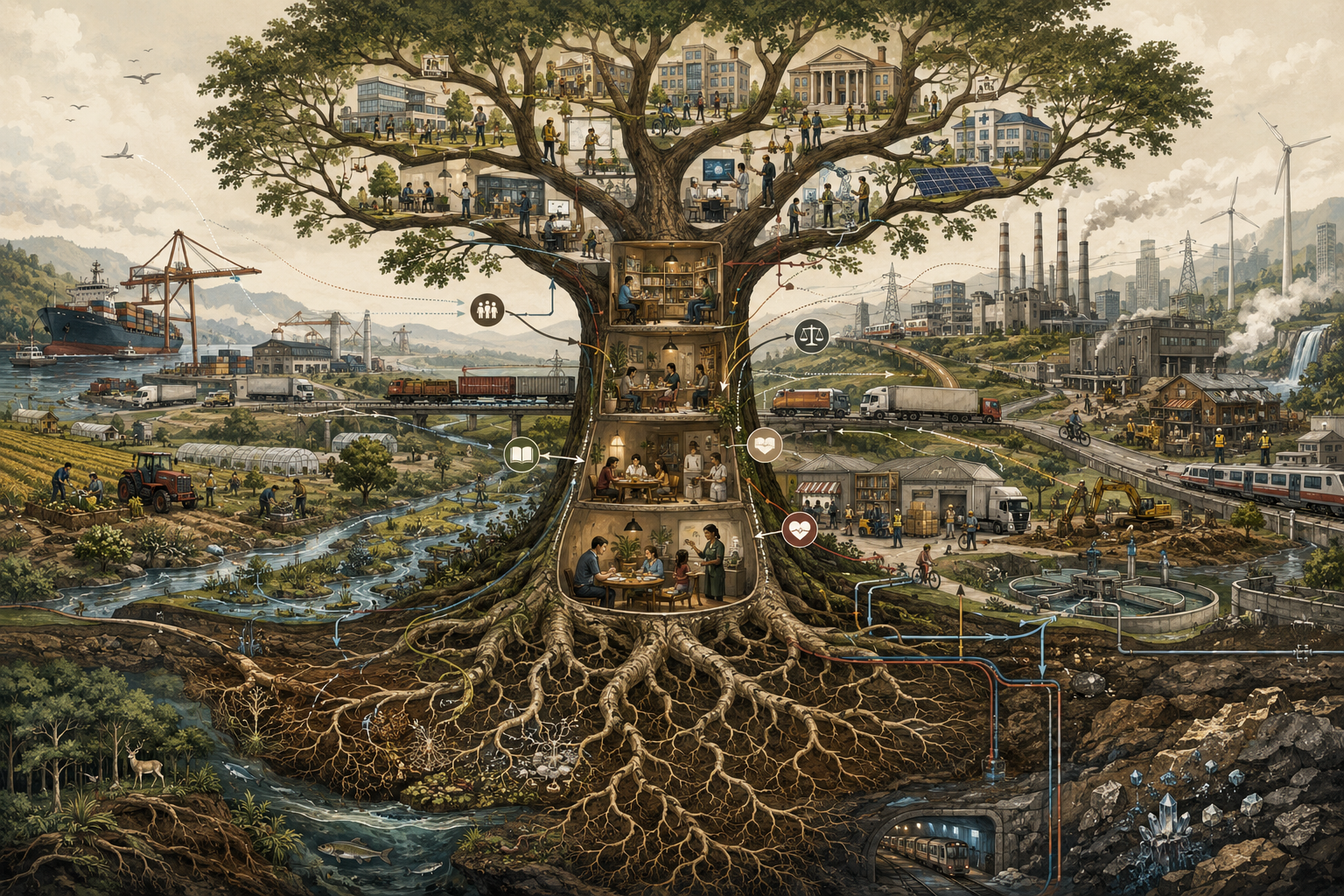
To ask what an economic system is, then, is to ask how a society organizes material survival and collective reproduction under conditions of constraint, interdependence, power, historical inheritance, and ecological dependence. For that reason, the concept is foundational not only for economics, but also for political economy, sustainable development, social theory, institutional analysis, ecological economics, and systems thinking.
Why the Concept Matters
The phrase economic system matters because it widens analysis beyond isolated economic variables and toward the larger architecture of social life. A society’s economic system shapes whether housing is secure or precarious, whether food systems are resilient or fragile, whether labor is dignified or disposable, whether public goods are funded or neglected, whether inequality is moderated or intensified, and whether growth is pursued in ways compatible with long-term ecological stability.
It also prevents a familiar analytical mistake: treating “the economy” as if it were a naturally occurring sphere that exists prior to politics, institutions, law, culture, technology, and ecology. No such autonomous economy exists. Every economy is governed by rules, maintained by infrastructures, stabilized by public authority, and sustained by ecological conditions. Even highly market-oriented societies depend on systems of law, money, contract enforcement, taxation, education, transport, energy, public health, and social reproduction that markets alone do not generate or guarantee.
Once the concept is taken seriously, debates about capitalism, socialism, mixed economies, industrial policy, welfare states, globalization, development, finance, labor rights, and sustainability all become variations on a larger question: how should a society organize the material basis of life, and according to what principles?
This broader framing also connects economics to systems thinking. OECD work on systemic thinking emphasizes the need to understand linkages across issues often treated in separate institutional and disciplinary silos. That is exactly what the concept of an economic system requires: analysis of how production, distribution, finance, law, ecology, households, firms, public institutions, and long-term capacity interact. :contentReference[oaicite:2]{index=2}
A Strong Definition of an Economic System
An economic system can be defined as the structured set of institutions, incentives, norms, infrastructures, ownership forms, legal rules, financial arrangements, labor relations, and governing capacities through which a society organizes production, distribution, exchange, consumption, investment, care, risk management, ecological use, and collective provisioning.
This definition is intentionally broad. It includes not only formal markets and state policies, but also households, care work, informal labor, public goods, ecological inputs, financial arrangements, legal regimes, monetary systems, and the moral rules through which economic coordination becomes possible.
A strong definition should capture at least five truths. First, economic systems are social: they depend on trust, norms, expectations, habits, families, organizations, and institutions. Second, they are political: rules governing property, labor, taxation, money, welfare, and infrastructure are made and enforced through power. Third, they are historical: economic systems change through conflict, innovation, crisis, colonization, industrialization, reform, technological transformation, and path dependence.
Fourth, economic systems are ecological: all economic activity depends on energy, materials, land, water, soil, biodiversity, climate stability, and the capacity of living systems to regenerate and absorb waste. Fifth, they are moral in consequence: the organization of economic life determines who bears hardship, who enjoys security, what forms of dependence are tolerated, and what a society counts as legitimate prosperity.
This broader definition aligns with contemporary efforts to move beyond narrow GDP-centered evaluation and toward integrated measures of wellbeing, sustainability, resilience, inclusion, and future capacity. OECD beyond-GDP work, for example, emphasizes that economic and social performance cannot be fully captured by output measures alone. :contentReference[oaicite:3]{index=3}
Why an Economic System Is More Than a Market
In ordinary language, the economy is often imagined as a marketplace: a domain of buyers and sellers, prices and wages, firms and consumers. That image captures only one part of a larger reality. A market is a mechanism of exchange. An economic system is the wider order within which exchange takes place.
The economic system determines who enters the market with assets or insecurity, who owns productive resources, how contracts are enforced, what regulations exist, how credit is created, what public goods are available, how social risk is absorbed, how infrastructure is financed, and what happens to people whose needs are not met through purchasing power alone.
Markets can communicate information and coordinate decentralized decisions with remarkable speed. But they do not, by themselves, guarantee equitable distribution, public health, education, social insurance, macroeconomic stability, ecological stewardship, or long-term resilience. They do not resolve all collective-action problems. They do not price many essential conditions of life adequately, especially when those conditions involve public goods, common-pool resources, intergenerational harms, irreversible ecological damage, or structural power imbalances.
For that reason, every real economic system includes multiple coordinating mechanisms: markets, states, households, communities, customary rules, public agencies, financial institutions, labor organizations, nonprofit institutions, and administrative systems. The serious question is not whether a society “has markets,” but how markets are embedded within a broader institutional order, what they are allowed to govern, what they are prevented from destroying, and how their outcomes are corrected, supplemented, or constrained when they undermine long-term collective welfare.
The more an economy depends on complex infrastructures, global supply chains, digital systems, financial leverage, ecological stability, and public goods, the less plausible it becomes to treat markets as self-sufficient. Markets operate inside systems. They are not the system itself.
The Core Functions of an Economic System
Every economic system must perform several core functions. These functions may be organized through markets, public planning, households, cooperative institutions, customary rules, administrative systems, or mixed arrangements. What varies is not whether the functions exist, but how they are governed and who benefits from the arrangement.
Production
Every economic system must organize production. It must determine how labor, technology, knowledge, energy, raw materials, land, capital, management, and infrastructure are brought together to create goods and services. Production includes not only the visible output of firms and factories, but also agriculture, logistics, care work, public services, household labor, maintenance, education, health, and ecological restoration.
Distribution
Every system distributes income, wealth, assets, opportunity, security, vulnerability, and risk. It determines how wages, profits, rents, taxes, transfers, and public services are structured; how much inequality is tolerated; whether basic goods depend primarily on purchasing power; and what forms of protection exist for people facing illness, unemployment, age, disability, disaster, or economic shock.
Exchange
Goods and services move through systems of exchange. In some contexts these are market-based; in others they are administrative, customary, reciprocal, cooperative, public, household-based, or hybrid. Exchange mechanisms matter because they affect prices, bargaining power, incentives, information flows, access, and the speed with which resources move through society.
Allocation
All economic systems allocate scarce resources across competing uses. They determine how much goes to immediate consumption, how much to future investment, how much to public goods, how much to military capacity, how much to debt service, how much to welfare, how much to infrastructure, how much to environmental repair, and how much to technological research. Allocation is never purely technical; it reflects institutions, priorities, and power.
Reproduction
An adequate definition of an economic system must include reproduction: the ongoing maintenance of the human, social, infrastructural, and ecological conditions that make future production possible. This includes raising children, caring for the elderly, maintaining public trust, preserving skills, repairing infrastructure, funding education, protecting ecosystems, and ensuring that social cooperation can continue.
Systems that ignore reproduction often appear productive in the short run while quietly consuming the conditions of their own continuity. A society can raise measured output while degrading health, care systems, infrastructure, ecosystems, trust, and future capacity. That is why reproduction is not a soft add-on to economic analysis. It is a structural requirement of any durable economic system.
Coordination, Allocation, and Social Order
One of the deepest questions in economics is the problem of coordination. How do millions of interdependent decisions become socially organized? How are needs, capabilities, resources, expectations, risks, and obligations brought into alignment strongly enough for a complex society to function?
Different economic systems answer this in different ways. Some rely heavily on price mechanisms and decentralized exchange. Others rely more on public planning, sectoral bargaining, state ownership, industrial strategy, public provisioning, cooperative governance, or coordinated institutions. Most actual economies use combinations of all of these. The study of economic systems is therefore not simply about what is produced, but about how complex coordination is achieved under uncertainty, conflict, and constraint.
This coordination problem reveals why economic systems are inseparable from social order. Economic life must be sufficiently stable and legitimate for people to cooperate across time. Contracts must be credible. Money must be trusted. Infrastructure must function. Labor must be reproduced. Ecological foundations must be maintained. Public authority must retain enough legitimacy to tax, spend, regulate, stabilize, and respond to crisis.
Once this wider view is adopted, the economy appears less as a self-balancing machine and more as a fragile, evolving, and contested system of institutional coordination. It is held together by law, norms, technologies, prices, public capacity, financial systems, social trust, and material infrastructures.
The Main Components of an Economic System
Economic systems are made from interacting components. These components are not isolated parts. They mutually shape one another. Households depend on labor markets and public services. Firms depend on infrastructure, finance, law, and workers. States depend on taxation, legitimacy, administrative capacity, and social cooperation. Financial systems depend on trust, regulation, monetary authority, and productive opportunities.
Households
Households are not merely sites of consumption. They are centers of care, budgeting, labor supply, savings, intergenerational transfer, dependency management, informal production, education support, and everyday economic decision-making. Much of the social foundation of economic life rests on household labor, including unpaid and undercounted work that sustains the formal economy.
Firms and Productive Organizations
Firms organize production, investment, innovation, management, employment, and exchange. They vary enormously in scale and form, from small businesses and farms to multinational corporations, cooperatives, public enterprises, platform firms, and mission-driven organizations. Their structure affects productivity, bargaining power, employment quality, innovation, market concentration, and the distribution of gains.
States and Public Institutions
States define property rights, create and stabilize monetary systems, collect revenue, fund public goods, enforce contracts, regulate harms, build infrastructure, insure against risk, and coordinate long-term investment. Far from being external to the economy, public institutions are constitutive of it.
Markets
Markets coordinate exchange through prices, competition, and decentralized decision-making. Under some conditions they can support innovation, specialization, and efficient resource use. Under others they can entrench exclusion, underprovide public goods, ignore long-term harms, amplify concentration, and produce volatility. Their role depends on how they are embedded in law, policy, and institutional context.
Financial Systems
Banking, credit, payments, public debt, capital markets, insurance, and central banking shape the distribution of liquidity, the financing of investment, the tempo of growth, and the stability or fragility of the system as a whole. Finance can support productive transformation, but it can also intensify speculative cycles and systemic risk.
Labor Systems
Labor systems include employment relations, wage formation, bargaining power, skills formation, migration, credentialing, workplace regulation, occupational safety, social protection, and the institutions through which work is organized and valued. No economic system can be understood without asking how labor is mobilized, compensated, protected, and reproduced.
Ecological Foundations
Every economy depends on material and energetic throughput drawn from the natural world. Land, water, biodiversity, minerals, forests, soils, climate stability, and waste-absorbing capacities are not “externalities” in any ultimate sense. They are preconditions of production. The World Bank’s green, resilient, and inclusive development framing reflects this broader recognition that development, resilience, and sustainability must be analyzed together. :contentReference[oaicite:4]{index=4}
Power, Distribution, and Institutional Design
No definition of an economic system is complete without power. Economic systems distribute not only goods and incomes, but decision rights, bargaining leverage, vulnerability, time, risk, recognition, and access to security. Who owns assets? Who controls credit? Who sets labor conditions? Who benefits from public investment? Who bears inflation, debt, pollution, unemployment, and climate risk? Who receives public protection, and who is exposed to market discipline?
These are not side questions. They are part of the system itself. Property law, tax structure, labor rights, welfare provision, competition policy, environmental regulation, monetary governance, industrial policy, financial regulation, and public investment all shape the distributional character of an economy.
Institutional design determines whether gains from growth are broadly shared or concentrated; whether risk is socialized or privatized; whether adaptation to crisis is collectively managed or left to unequal private capacity; and whether future generations inherit capability or depletion.
For that reason, different economic systems are not merely different technical solutions to scarcity. They are different political settlements about authority, obligation, entitlement, dependence, dignity, and acceptable forms of inequality. They decide which needs are guaranteed, which are commodified, which are ignored, and which are treated as collective responsibilities.
A serious account of economic systems must therefore analyze both efficiency and power. An arrangement may appear efficient because it lowers prices or raises output, while also producing insecurity, extraction, monopoly, ecological damage, or political capture. Likewise, a public institution may appear costly in narrow accounting terms while protecting social stability, public health, resilience, or long-term productive capacity.
Major Types of Economic Systems
Economic systems are often grouped into broad types. These categories are useful, but they can also mislead if treated too rigidly. No large modern economy is purely market-based, purely planned, purely customary, or purely cooperative. Actual economies are institutional mixtures.
Market Economies
In market economies, decentralized exchange and price mechanisms play major roles in coordinating production and distribution. Private ownership is often prominent, but market economies still rely heavily on public law, infrastructure, education systems, financial regulation, central banking, taxation, research systems, and welfare arrangements.
Planned Economies
In planned economies, public authorities assume a dominant role in directing production, investment, and distribution. Planning may be comprehensive or sectoral, rigid or adaptive, centralized or decentralized, technocratic or participatory. Historically, planned systems have been associated with attempts to accelerate industrialization, guarantee provision, reduce market instability, or subordinate private profit to broader social goals.
Mixed Economies
Most contemporary economies are mixed economies. They combine private markets with public regulation, private investment with public goods, competitive sectors with strategic planning, and market allocation with redistributive or social-protective institutions. The real analytical question is not whether an economy is “purely” capitalist or statist, but how its coordinating mechanisms are combined and governed.
Customary, Informal, and Cooperative Systems
Many economic lives are also structured by reciprocity, kinship, household production, customary governance, cooperative ownership, mutual aid, and informal work. These domains are especially important in rural economies, lower-income settings, Indigenous communities, care economies, and contexts where formal wage labor or state capacity is incomplete. They remind us that economic systems are often plural rather than singular.
These categories are best understood as ideal types. The deeper question is how production, distribution, coordination, risk, and reproduction are actually organized in a given society. Labels matter, but institutional details matter more.
Economic Systems as Historical Formations
Economic systems are historical formations rather than timeless blueprints. They are shaped by conquest, colonization, enslavement, land enclosure, industrialization, war, technological change, labor struggle, social reform, financial innovation, ecological transformation, and institutional layering. The modern tax state, welfare state, central bank, corporation, labor standard, mass consumer market, public school system, and global supply chain all emerged historically. None are natural givens.
This historical reality matters because it introduces path dependence. Earlier institutional choices create enduring constraints and advantages. Energy systems, urban form, housing policy, welfare institutions, trade dependence, debt burdens, property regimes, racial hierarchies, colonial extraction, and infrastructures lock societies into certain developmental paths while making others harder to pursue.
Understanding an economic system therefore requires more than describing its current rules. It requires asking how those rules were made, whose interests shaped them, what crises reconfigured them, and how reform is constrained by inherited structures.
It also requires attention to the unequal formation of the global economy. Some countries accumulated capital through empire, resource extraction, slave labor, unequal trade, or technological advantage. Others entered the modern world economy under colonial or dependent conditions that constrained their fiscal capacity, industrial structure, land systems, and institutional autonomy. Economic systems are not only national arrangements; they are embedded in global hierarchies.
For this reason, the study of economic systems should resist neutral diagrams that erase history. Institutions have origins. Property has histories. Wealth has pathways. Development has winners and casualties. A serious systems analysis asks not only how the system functions, but how it came to be and who has been made to pay for its stability.
The Embedded Economy: Society, Nature, and Reproduction
One of the most important developments in contemporary systems-oriented thought is the recognition that the economy is embedded within wider social and ecological systems. Economic activity depends on law, trust, education, health, care, political order, public infrastructure, and social reproduction. It also depends on energy, water, land, biodiversity, atmospheric stability, and the capacity of ecosystems to absorb waste without systemic breakdown.
Once the economy is understood this way, the meaning of prosperity changes. Economic success can no longer be equated with output growth alone. A system that raises GDP while deepening inequality, weakening institutional trust, exhausting natural systems, or transferring burdens to future generations may be increasing measured output while undermining the foundations of durable welfare.
The UN Global Sustainable Development Report frames sustainable development as a science-based transformation challenge rather than a narrow sectoral agenda. That framing is important for economic systems analysis because it treats poverty, inequality, climate, institutions, technology, and environmental integrity as interconnected rather than separate policy silos. :contentReference[oaicite:5]{index=5}
Together, contemporary systems, sustainability, and wellbeing frameworks support a more expansive definition of the economic system: not a machine for increasing output at any cost, but a society’s evolving way of organizing material life within ecological, institutional, social, and historical realities.
Why Economic Systems Matter for Sustainability
Sustainability is not merely an environmental add-on to an otherwise self-contained economy. It is a question of economic design. It concerns how energy systems are built, how labor transitions are managed, how infrastructure is financed, how incentives are structured, how public goods are funded, how risk is distributed, how finance is governed, how land is used, and whether development remains compatible with ecological limits and long-term social legitimacy.
This expands the scope of economic analysis. It includes microeconomic questions of household welfare, firm incentives, pricing, resource use, waste, competition, and market power. It includes macroeconomic questions of employment, inflation, fiscal capacity, energy shocks, financial stability, trade dependence, and structural transformation. It includes political-economic questions of inequality, bargaining power, welfare provision, industrial strategy, and international asymmetry. And it includes ecological-economic questions of throughput, depletion, pollution, climate risk, biodiversity loss, and planetary boundaries.
Once those dimensions are brought together, the economic system becomes the central object of analysis for sustainable development. The question is no longer only how to grow, but how to organize production and distribution so that prosperity remains socially legitimate, ecologically viable, and resilient across generations.
Sustainable economic systems must therefore be evaluated by how they provision human needs, protect dignity, allocate risk, maintain public goods, invest in future capacity, and operate within ecological boundaries. Growth may still matter, especially where deprivation remains severe, but growth alone cannot be the final measure of system quality.
How Economic Systems Should Be Evaluated
If economic systems are broad structures of coordination and reproduction, then they should be evaluated by broader standards than output alone. A serious evaluation should ask at least six questions.
| Criterion | Guiding Question | Why It Matters |
|---|---|---|
| Productive Capacity | Can the system generate and maintain the goods, services, and infrastructures needed for human life? | Production is necessary for provisioning, but it must be understood broadly. |
| Distributive Justice | Are gains, risks, and basic protections shared in ways that preserve dignity, legitimacy, and social cohesion? | Distribution shapes security, opportunity, power, and trust. |
| Institutional Capability | Can the system coordinate across sectors, respond to crisis, fund public goods, and adapt to structural change? | Institutions determine whether complexity can be governed. |
| Resilience | Can the system absorb shocks without cascading breakdown, mass insecurity, or prolonged stagnation? | Resilience determines whether disturbances become disasters. |
| Ecological Viability | Does the system preserve the natural systems on which current and future production depend? | Ecology is a foundation of production, not an external afterthought. |
| Intergenerational Durability | Does the system pass on capabilities, infrastructures, ecosystems, and institutional trust? | Short-term output is not durable prosperity if it consumes the future. |
This wider evaluative frame reflects the growing importance of wellbeing, inclusion, resilience, and sustainable development in the study of economic systems. It does not abandon output, productivity, or efficiency. It places them within a larger framework of human capability, institutional legitimacy, ecological continuity, and future responsibility.
A system that produces abundance but leaves many people insecure is incomplete. A system that distributes income but cannot innovate or maintain infrastructure is fragile. A system that grows while degrading climate stability, biodiversity, soils, water, and public trust is consuming its own foundations. The aim is not to choose one value against all others, but to understand economic systems as multi-dimensional structures that must be judged by multiple forms of performance.
Mathematical Lens
Mathematics can clarify the structure of economic systems, but it should not reduce them to a narrow mechanical model. Formalization is useful when it makes relationships visible: allocation trade-offs, input-output interdependence, reproduction constraints, distributional shares, and ecological dependence.
1. A Resource Allocation Identity
One simple way to formalize an economic system is to treat total available output as something that must be allocated across competing uses:
Y = C + I + G + R
\]
Interpretation: \(Y\) is total output or available social product; \(C\) is private consumption; \(I\) is investment in future productive capacity; \(G\) is public provision and collective goods; and \(R\) is restoration, maintenance, and reproduction of social and ecological systems.
This is not a full national accounting identity. It is a systems framing. It reminds us that every economic system must decide how much output goes to present consumption, how much to future capacity, how much to public goods, and how much to maintaining the conditions of continued life.
2. Production as a Social and Ecological Function
A broader production function can be written as:
Y = A \cdot F(K,L,E,N)
\]
Interpretation: \(Y\) is output; \(A\) is organizational and technological capability; \(K\) is produced capital; \(L\) is labor; \(E\) is energy; and \(N\) represents natural systems and material inputs. Production depends not only on labor and capital, but also on energy, ecology, institutions, and organization.
3. Reproduction Constraints
An economic system can appear productive while degrading the conditions that make future production possible. One way to express this is through simple reproduction conditions:
K_{t+1} = K_t + I_t – \delta K_t
\]
Interpretation: Produced capital \(K\) grows when investment \(I\) exceeds depreciation \(\delta K\). If investment fails to offset depreciation, the produced-capital base deteriorates.
N_{t+1} = N_t + G_{n,t} – D_t
\]
Interpretation: Natural capital \(N\) grows when regeneration \(G_n\) exceeds depletion or damage \(D\). If depletion exceeds regeneration, the ecological foundation of production erodes.
4. Input-Output Coordination
Economic systems are also networks of interdependence. A simple input-output form is:
x = Ax + f
\]
Interpretation: Total output \(x\) must satisfy intermediate demand \(Ax\) plus final demand \(f\). Each sector depends on inputs from other sectors.
x = (I – A)^{-1}f
\]
Interpretation: The Leontief inverse \((I-A)^{-1}\) shows the total output required across the system to satisfy final demand. A change in one sector can ripple across the entire production network.
These equations clarify several things. Economic systems are allocation systems, not just exchange systems. Production depends on labor, capital, energy, nature, and organization together. Reproduction and maintenance are structural conditions of continuity. Sectoral interdependence means shocks rarely remain isolated. Formalization is helpful, but it should remain subordinate to reality. A neat identity is not the same as justice. A stable model is not the same as resilience. Measured output is not the same as durable prosperity.
Python Workflow: Economic-System Interdependence
Python is useful for translating systems concepts into reproducible workflows. The following compact example models a small three-sector input-output system and shows how a change in final demand affects total required output across the economy.
# What Is an Economic System?
# Simple input-output workflow in Python

import numpy as np
import pandas as pd

# Inter-industry requirements matrix
A = np.array([
    [0.20, 0.10, 0.05],
    [0.15, 0.20, 0.10],
    [0.10, 0.15, 0.20]
])

sectors = ["Energy", "Manufacturing", "Services"]

# Final demand vector
f = np.array([100, 120, 140]).reshape(-1, 1)

# Leontief inverse
I = np.eye(3)
L_inv = np.linalg.inv(I - A)

# Baseline total output
x = L_inv @ f

# Demand shock: higher manufacturing demand
f_shock = np.array([100, 150, 140]).reshape(-1, 1)
x_shock = L_inv @ f_shock

results = pd.DataFrame({
    "sector": sectors,
    "baseline_output": x.flatten(),
    "shock_output": x_shock.flatten(),
    "output_change": (x_shock - x).flatten()
})

print(results)
This workflow shows that a rise in final demand in one sector requires adjustments elsewhere. It captures, in a simple way, the idea that an economic system is a coordinated structure rather than a collection of isolated markets.
The full GitHub repository expands this example into a five-sector stylized economy with sector metadata, allocation profiles, distribution metrics, ecological intensity, employment intensity, reproduction constraints, SQLite tables, R and Stata replication workflows, and Julia linear-algebra solutions.
R Workflow: Input-Output and Distribution
R is useful for reproducing input-output results, summarizing distributional implications, and producing article-ready figures. The following compact example performs the same input-output calculation and prepares a simple comparison table.
# What Is an Economic System?
# Simple input-output workflow in R

library(dplyr)

# Inter-industry requirements matrix
A <- matrix(c(
  0.20, 0.10, 0.05,
  0.15, 0.20, 0.10,
  0.10, 0.15, 0.20
), nrow = 3, byrow = TRUE)

colnames(A) <- rownames(A) <- c("Energy", "Manufacturing", "Services")

# Final demand vector
f <- matrix(c(100, 120, 140), ncol = 1)
rownames(f) <- c("Energy", "Manufacturing", "Services")

# Leontief inverse
I_mat <- diag(3)
L_inv <- solve(I_mat - A)

# Baseline total output
x <- L_inv %*% f

# Demand shock: higher manufacturing demand
f_shock <- matrix(c(100, 150, 140), ncol = 1)
rownames(f_shock) <- c("Energy", "Manufacturing", "Services")

x_shock <- L_inv %*% f_shock

results <- data.frame(
  sector = rownames(f),
  baseline_output = as.numeric(x),
  shock_output = as.numeric(x_shock),
  output_change = as.numeric(x_shock - x)
)

print(results)
This R workflow reinforces the article’s core point: an economic system is interdependent. A shock to one sector does not remain neatly contained. It changes demand for inputs, output requirements, employment needs, energy use, and distributional outcomes across the system.
Future Economic Systems articles can extend this foundation into social accounting matrices, regional input-output models, supply-chain resilience analysis, ecological footprint accounting, labor-income distribution, fiscal incidence, and wellbeing dashboards.
GitHub Repository
The article body includes selected computational examples so the conceptual, institutional, and mathematical argument remains readable. The full repository contains the expanded research infrastructure: Python input-output analysis, R distribution summaries, Stata applied-economics replication workflows, SQL sector and scenario tables, Julia matrix-based input-output solving, reproduction-constraint simulations, documentation, reproducible sample data, and article-ready figures and tables.
Complete Code Repository
The full code distribution for this article, including selected article examples and advanced research-style computational scaffolding for economic-system mapping, sectoral interdependence, allocation identities, distribution metrics, ecological pressure, social and ecological reproduction constraints, input-output analysis, reproducibility documentation, and cross-language economic analysis, is available on GitHub.
Conclusion
An economic system is the organized structure through which a society sustains material life. It is the institutional pattern that coordinates production, distribution, exchange, labor, finance, public goods, ecological use, and the reproduction of the conditions that make future life possible. It is never merely a market, never merely a state, and never merely a technical arrangement of prices and incentives. It is historical, political, social, and ecological at once.
That is why the concept is so foundational. It opens onto the deepest questions of economics and beyond: how societies coordinate complexity, how power shapes distribution, how prosperity is measured, how resilience is built, how ecological limits are confronted, and what kind of future a civilization is preparing for itself.
To understand any serious debate about labor, finance, welfare, development, climate transition, inequality, public investment, or sustainable development, one must first understand what an economic system is: a society’s way of organizing material life, distributing security and risk, governing interdependence, and reproducing—or depleting—the foundations of the future.
Related Reading
- Economic Systems
- Sustainable Development
- Risk & Resilience
- Institutions & Governance
- Stewardship & Ethics
Further Reading
- Bowles, S. (2004). Microeconomics: Behavior, Institutions, and Evolution. Princeton: Princeton University Press.
- Chang, H.-J. (2014). Economics: The User’s Guide. London: Pelican.
- Daly, H. E. and Farley, J. (2011). Ecological Economics: Principles and Applications. 2nd edn. Washington, DC: Island Press.
- Leontief, W. (1986). Input-Output Economics. 2nd edn. New York: Oxford University Press.
- Mazzucato, M. (2018). The Value of Everything: Making and Taking in the Global Economy. London: Allen Lane.
- North, D. C. (1990). Institutions, Institutional Change and Economic Performance. Cambridge: Cambridge University Press.
- Organisation for Economic Co-operation and Development (OECD) (2018). Beyond GDP: Measuring What Counts for Economic and Social Performance. Available at: https://www.oecd.org/en/publications/beyond-gdp_9789264307292-en.html
- Organisation for Economic Co-operation and Development (OECD) (2020). Systemic Thinking for Policy Making. Available at: https://www.oecd.org/en/publications/systemic-thinking-for-policy-making_879c4f7a-en.html
- Polanyi, K. (2001 [1944]). The Great Transformation: The Political and Economic Origins of Our Time. Boston: Beacon Press.
- Raworth, K. (2017). Doughnut Economics: Seven Ways to Think Like a 21st-Century Economist. London: Random House Business.
References
- Organisation for Economic Co-operation and Development (OECD) (2018). Beyond GDP: Measuring What Counts for Economic and Social Performance. Paris: OECD. Available at: https://www.oecd.org/en/publications/beyond-gdp_9789264307292-en.html
- Organisation for Economic Co-operation and Development (OECD) (2020). Systemic Thinking for Policy Making: The Potential of Systems Analysis for Addressing Global Policy Challenges in the 21st Century. Paris: OECD. Available at: https://www.oecd.org/en/publications/systemic-thinking-for-policy-making_879c4f7a-en.html
- Organisation for Economic Co-operation and Development (OECD) (n.d.). Measuring Well-being and Progress. Available at: https://www.oecd.org/en/topics/measuring-well-being-and-progress.html
- Stockholm Resilience Centre (n.d.). Planetary Boundaries. Available at: https://www.stockholmresilience.org/research/planetary-boundaries.html
- United Nations (2019). Global Sustainable Development Report 2019: The Future Is Now — Science for Achieving Sustainable Development. New York: United Nations. Available at: https://sdgs.un.org/publications/future-now-science-achieving-sustainable-development-gsdr-2019-24576
- World Bank (2021). Green, Resilient, and Inclusive Development. Washington, DC: World Bank. Available at: https://documents.worldbank.org/en/publication/documents-reports/documentdetail/285171633074966748/green-resilient-and-inclusive-development