
Last Updated May 9, 2026
Fiduciary duty is often described too narrowly as a simple obligation to maximize short-term financial return. In law, corporate governance, pension governance, investment management, and institutional stewardship, it is better understood as a structured responsibility of care, loyalty, prudence, oversight, and informed judgment exercised on behalf of another party. A fiduciary is entrusted with power that affects someone else’s interests. That entrusted power must be used with discipline, loyalty, diligence, independence, and accountability.
The question is what fiduciary responsibility requires when the conditions of finance have changed. Climate disruption, biodiversity loss, labour exploitation, supply-chain fragility, political instability, social breakdown, infrastructure exposure, human-rights violations, and systemic ecological risk are not external moral topics floating outside the world of finance. They increasingly affect enterprise value, portfolio resilience, cost of capital, insurance markets, public legitimacy, and the long-term welfare of beneficiaries. Fiduciary duty can therefore no longer be credibly treated as a doctrine that permits indifference to the material conditions of people and planet.
This does not mean fiduciary duty has become a free-floating legal mandate to pursue any ethical preference a fiduciary finds compelling. Fiduciary duty remains office-bound, mandate-bound, jurisdiction-specific, and institutionally constrained. Directors, trustees, investment managers, pension fiduciaries, and other fiduciaries must still act within the legal and governing purposes of their role. But the world in which prudent judgment must be exercised has changed. Long-term value is increasingly tied to social stability, ecological resilience, regulatory transition, human rights, public trust, and the functioning of the real economy.
For Stewardship & Ethics, the deeper issue is that finance is not merely a mechanism for allocating capital. It is one of the central systems through which societies allocate possibility, risk, power, infrastructure, extraction, transition costs, and future vulnerability. Fiduciary duty therefore sits at the intersection of law, finance, institutional trust, delegated authority, long-horizon prudence, systemic risk, and responsibility to people and planet.
Main Library
Publications
Article Map
Stewardship & Ethics
Related Topic
Economic Systems
Related Topic
Institutions & Governance
Related Topic
Sustainable Development
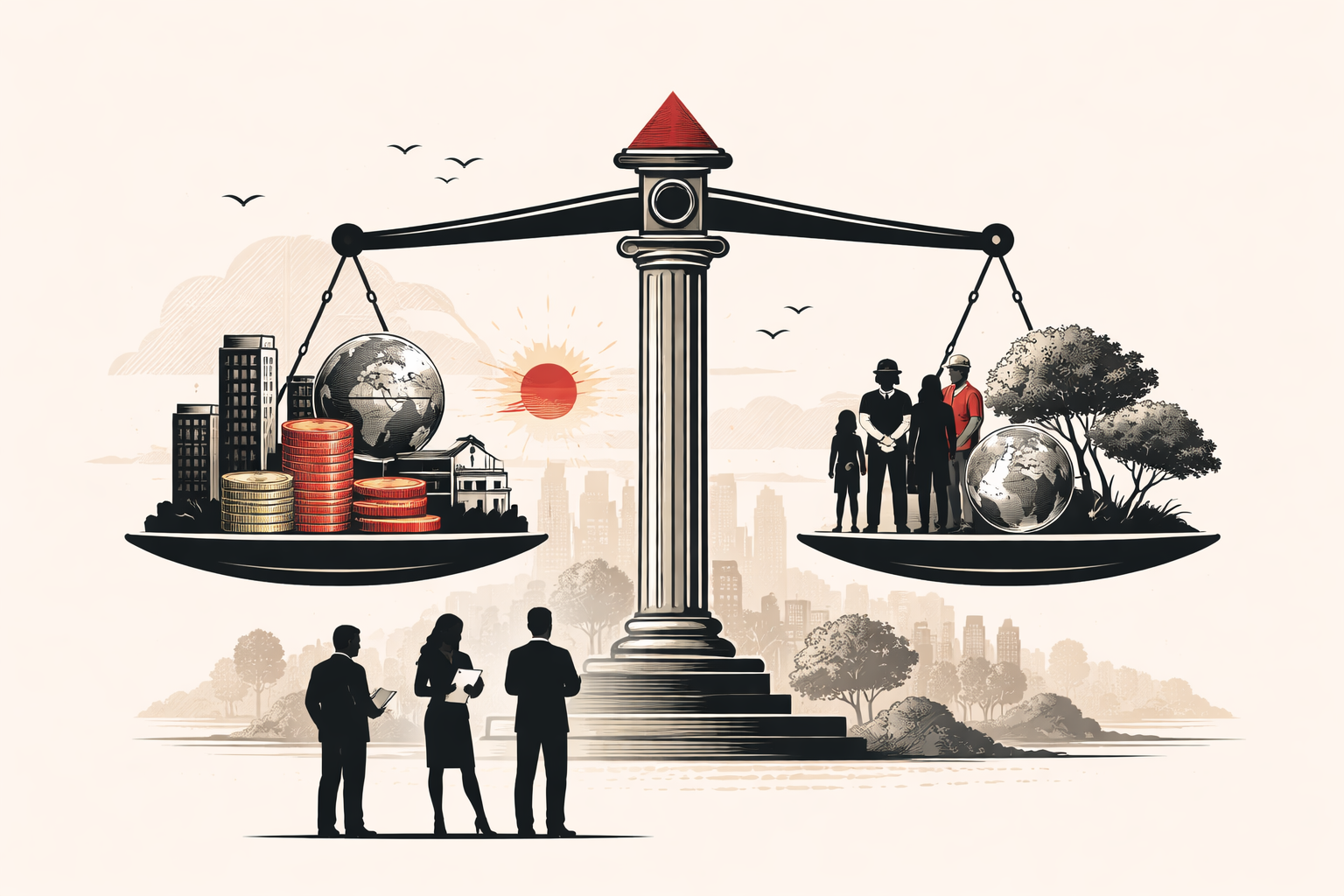
This article argues that fiduciary duty should be understood as a framework of responsible judgment under delegated authority rather than as a narrow mandate for short-term gain. It examines the classical legal structure of fiduciary obligation, why people and planet now enter fiduciary analysis, how beneficiary interests extend across time and system conditions, why shareholder primacy and stakeholder governance must be distinguished carefully, how financial materiality differs from broader moral responsibility, why human-rights due diligence complicates purely financial reasoning, and why long-horizon stewardship has become increasingly important where systemic risk affects the market as a whole.
Why This Belongs in Stewardship & Ethics
Fiduciary duty belongs in Stewardship & Ethics because it concerns the responsible exercise of entrusted power. Finance is often described in impersonal terms: markets, capital, portfolios, returns, asset classes, risk pricing, valuation, diversification, disclosure, and allocation. Yet behind these abstractions are human beings, institutions, ecosystems, workers, communities, beneficiaries, pension savers, policyholders, future generations, and public systems whose stability can be shaped by financial decisions.
A fiduciary does not act only for the self. A fiduciary acts under a duty toward another. That basic structure makes fiduciary duty an ethical as well as legal category. It requires disciplined attention to loyalty, care, prudence, conflicts, oversight, and the proper use of discretion. It also requires judgment about what the relevant interests actually include.
The deeper challenge is that modern finance often operates within systems that reward near-term measurable returns while underpricing delayed harm. Ecological degradation can accumulate slowly. Human-rights harms can be displaced across supply chains. Labour exploitation can remain hidden behind subcontracting arrangements. Climate risk can appear distant until infrastructure, insurance, asset values, or public systems are suddenly exposed. Biodiversity loss, water stress, social fragmentation, and institutional distrust may appear first as background conditions before becoming visible as financial risk.
Stewardship & Ethics therefore asks whether fiduciary duty can remain serious if fiduciaries ignore the social and ecological systems on which long-term value depends. It also asks whether responsibility to people and planet can be expressed honestly within fiduciary doctrine without overstating what that doctrine already requires.
That distinction matters. Fiduciary duty should not be reduced to short-term profit maximization. But neither should it be treated as a substitute for environmental law, labour law, human-rights law, democratic regulation, tax justice, climate policy, or broader institutional reform. It is one important site where finance, power, law, and responsibility meet.
The Classical Core of Fiduciary Duty
At its core, fiduciary duty exists because one party is entrusted with discretionary power over the interests of another. The law responds by imposing standards designed to reduce self-dealing, negligence, bad faith, abuse of entrusted authority, and conflicts of interest. In mainstream corporate governance, these standards are commonly summarized as the duty of care and the duty of loyalty. In pension and investment governance, analogous duties often require prudence, loyalty, diversification, attention to beneficiaries, and disciplined decision-making within the governing mandate.
The duty of care requires fiduciaries to act on an informed basis, with diligence and appropriate attention to relevant risks. The duty of loyalty requires them to act in good faith for the interests they are charged to serve, rather than for personal advantage, conflicted interest, political preference, reputational convenience, or unrelated institutional benefit.
This classical structure prevents conceptual confusion. Fiduciary duty is not a license for directors, trustees, or investment managers to pursue any ethical objective they personally find compelling. It is an office with defined purposes, responsibilities, and constraints. The fiduciary must justify judgment through the mandate, legal framework, and governing interests attached to that office.
For this reason, sustainability arguments become most legally robust when they are linked to risk, value preservation, long-term performance, resilience, compliance, governance quality, beneficiary welfare, or the institution’s authorized purpose. A pension trustee considering climate risk is not simply expressing environmental preference if climate risk affects long-term portfolio resilience. A board considering labour standards is not merely engaging in moral branding if labour conditions affect operations, legal exposure, workforce stability, or reputational legitimacy. An investment committee considering biodiversity risk is not acting outside financial judgment if nature loss affects supply chains, asset value, water security, land productivity, or systemic economic resilience.
Yet the classical framework was never as narrow as modern caricatures often suggest. Prudence has always involved judgment under uncertainty rather than mechanical obedience to short-run price signals. Loyalty has always implied more than opportunistic profit extraction. Properly understood, fiduciary duty is a discipline of responsible decision-making under conditions of delegated power.
That is precisely why changing empirical realities can transform the scope of relevant considerations without abolishing the doctrine itself.
Fiduciary Duty as Delegated Power
Fiduciary duty is easier to understand when it is seen as a response to delegated power. A fiduciary holds authority that another person or group cannot fully exercise directly. Corporate directors exercise authority over the corporation. Pension trustees exercise authority over beneficiary interests. Investment managers exercise authority over assets entrusted to them. Advisors, agents, and managers may exercise specialized judgment that others depend upon but cannot easily verify in real time.
This creates vulnerability. The beneficiary, shareholder, client, worker, pension saver, or principal may depend on the fiduciary’s expertise, discretion, access to information, and control over decision-making. The fiduciary can misuse that position through negligence, self-dealing, short-termism, opacity, conflicts of interest, or failure to consider relevant risk.
Fiduciary duty exists to discipline that asymmetry. It says, in effect: because you have power over another’s interests, you must not treat that power as your own. You must exercise judgment with care. You must avoid conflicts. You must act within the purpose of the office. You must be able to explain why your decision was informed, prudent, loyal, and properly oriented toward the interests you are charged to serve.
This structure matters for finance because capital allocation is not passive. Financial institutions decide which firms receive capital, which projects are underwritten, which risks are priced, which industries expand, which business models are normalized, and how long-term risk is governed. Fiduciary authority therefore becomes a form of delegated power over economic futures.
The ethical question is whether fiduciaries can exercise that power responsibly if their analysis excludes the social and ecological conditions under which long-term value exists.
Where climate instability threatens infrastructure, energy systems, food production, public health, and insurance markets, it is not prudent to treat climate as irrelevant. Where biodiversity loss undermines water systems, land productivity, disease regulation, agriculture, and supply-chain stability, it is not serious to treat nature as an external moral preference. Where labour abuse, forced labour, unsafe working conditions, or human-rights violations create legal, operational, reputational, and legitimacy risks, fiduciary care cannot ignore them.
Fiduciary duty does not make every moral concern legally identical to financial obligation. But it does require fiduciaries to understand the world in which their delegated power operates.
Why People and Planet Now Enter Fiduciary Analysis
For much of modern financial history, ecological degradation and social harm were treated as externalities: real enough, but external to the core logic of investment and governance. Pollution, climate instability, ecosystem loss, weak labour standards, unsafe supply chains, and community harm could be treated as costs borne elsewhere. Financial accounting often converted extraction into return while leaving social and ecological damage outside the main frame of decision-making.
That position has become increasingly untenable.
Climate change affects physical assets, insurance markets, infrastructure, agriculture, energy systems, transport networks, housing, labour productivity, sovereign risk, and supply chains. Nature loss alters water availability, soil productivity, ecological stability, disease risk, food systems, and the viability of resource-dependent business models. Labour exploitation, human-rights abuse, corruption, weak governance, and unsafe working conditions can generate litigation, operational disruption, reputational damage, regulatory intervention, consumer backlash, and long-run fragility.
This matters because once such issues are recognized as financially material, fiduciaries can no longer dismiss them as morally interesting but legally irrelevant. Sustainability-related issues enter fiduciary analysis because they can shape the long-term prospects of firms, assets, portfolios, and beneficiaries. The language of ESG may be politically contested, and some ESG practices may be vague, performative, or poorly designed. But the underlying point is harder to evade: environmental and social realities increasingly affect cash flows, asset values, cost of capital, operational resilience, and systemic stability.
This does not mean fiduciary duty has become a free-standing duty to maximize planetary wellbeing in every circumstance. It means that prudent financial judgment and ecological or social judgment can no longer be treated as separate worlds.
The wall between them has weakened because the structure of the real economy has made it weaker.
Beneficiaries Are Long-Term Humans, Not Abstract Claims
A crucial insight in modern fiduciary analysis is that beneficiaries are not abstractions. Pension savers, policyholders, workers, long-term households, retirees, and future beneficiaries are human beings who live within social and ecological systems. Their interests are not exhausted by quarterly performance metrics. They need stable climates, trustworthy institutions, public health, resilient infrastructure, biodiversity, energy security, social cohesion, and an economy capable of supporting dignified life over time.
For long-horizon investors especially, the background conditions of economic life are not separate from beneficiary welfare. They are part of it.
This matters because the interests of beneficiaries cannot be understood adequately if reduced to short-term financial metrics detached from the conditions under which future life will be lived. A beneficiary may receive a strong near-term return from activities that worsen long-term climate instability, undermine labour conditions, increase systemic fragility, or contribute to social breakdown. That return may look attractive in an isolated accounting frame while eroding the world in which the beneficiary must later live.
For universal owners and broadly diversified institutional investors, economy-wide or planetary instability cannot be diversified away easily. If climate disruption, biodiversity decline, democratic breakdown, pandemics, chronic inequality, or infrastructure failure undermine the productivity and legitimacy of the broader economy, there is no simple portfolio escape. One cannot fully hedge against the collapse of the conditions that make broad market value possible.
Intergenerational and long-horizon thinking therefore enters fiduciary responsibility not as sentimentality, but as an implication of how beneficiary welfare is structured. A responsible fiduciary is not only deciding how to optimize near-term return. Such a fiduciary is also helping to govern the conditions under which long-term value remains possible.
This does not mean beneficiaries all have identical values, risk preferences, time horizons, or legal claims. It means fiduciary analysis must become more honest about the fact that beneficiaries are people living in systems, not merely claims against a spreadsheet.
Shareholder Primacy, Stakeholder Governance, and the Boundaries of Duty
Much contemporary confusion surrounding fiduciary duty arises from a failure to distinguish between different governance models. A shareholder-primacy framework generally treats the corporation’s purpose as the advancement of shareholder interests, subject to law and fiduciary standards. A stakeholder-oriented framework gives more explicit normative weight to workers, communities, consumers, suppliers, ecosystems, and affected publics. These models overlap in practice more than polemical debate often suggests, but they do not begin from identical premises.
This distinction matters because responsibility to people and planet enters legal reasoning differently depending on the institutional form, jurisdiction, governing documents, and fiduciary role in question. Under a stricter shareholder-centered framework, sustainability issues are most easily justified through financial materiality, long-term value preservation, strategic resilience, compliance, or risk oversight. Under broader stakeholder, public-benefit, cooperative, foundation-owned, mission-locked, or purpose-driven forms, fiduciaries may be authorized or required to weigh effects on affected parties more directly.
Serious analysis must therefore avoid two errors.
The first error is to assume that shareholder primacy eliminates all legitimate concern for people and planet. That is too narrow. Even within shareholder-oriented governance, environmental and social issues can be central where they affect long-term value, risk, resilience, compliance, workforce stability, supply-chain integrity, brand legitimacy, or market conditions.
The second error is to assume that fiduciary duty has already dissolved into a general doctrine of stakeholder balancing. That is too broad. In many legal settings, fiduciaries remain accountable to defined mandates, beneficiaries, shareholders, or institutional purposes. They may not simply substitute personal ethical preference for legally structured judgment.
The contemporary landscape is more complex. Sustainability has moved inward toward the center of finance and governance, but through multiple pathways: financial materiality, stewardship, systemic risk, human-rights due diligence, corporate-purpose reform, disclosure regimes, beneficiary welfare, and changing expectations of responsible governance.
The boundaries of duty matter because ethical seriousness requires precision. A fiduciary cannot govern responsibly by pretending the law is narrower than it is. Nor can a fiduciary govern responsibly by pretending the law already does more than it does.
Financial Materiality Versus Moral Completeness
The central unresolved issue is whether fiduciary duty requires only attention to environmental and social issues that affect financial performance, or whether it also creates responsibility for the real-world impacts of finance on people and planet even when those impacts are not yet clearly reflected in market value.
This distinction is crucial.
Financial materiality asks how sustainability issues affect the firm, fund, asset, portfolio, beneficiary, or enterprise value. Impact-oriented reasoning asks how the firm, fund, asset, or portfolio affects society and the biosphere. The two perspectives often overlap, but they are not identical.
A company that destroys ecosystems or tolerates labour exploitation may eventually face regulatory, legal, operational, or reputational costs. In such cases, financial materiality and ethical concern converge. But not all harms are priced quickly, fully, or fairly. Markets often delay recognition of systemic damage. Some costs are displaced onto vulnerable communities, workers, future generations, public institutions, or common ecological systems.
That gap should not be obscured by legal overstatement. Under conventional fiduciary doctrine, the strongest argument usually remains that sustainability-related issues deserve attention because they affect long-term value, resilience, and beneficiary interests. Broader responsibility to people and planet may be legally supportable in certain mandates, institutional forms, investment strategies, benefit-corporation structures, public-interest funds, or stewardship frameworks, but it is not automatically identical to the default rule of fiduciary obligation in every jurisdiction.
At the same time, a purely financial-materiality frame is morally incomplete. It may identify risks to investors without fully addressing harms to workers, communities, Indigenous peoples, ecosystems, or future generations. It may treat human dignity as relevant only when abuse becomes costly. It may treat ecological degradation as significant only when markets price it. It may convert moral injury into financial exposure while leaving deeper questions of justice unanswered.
The challenge is to hold both truths together: fiduciary law requires disciplined attention to the mandate, but the mandate itself operates within a wider moral and ecological world.
Human Rights, Due Diligence, and the Limits of Financial Logic
Human-rights governance introduces an important counterweight to purely financial reasoning. Business responsibility for human rights does not depend solely on whether abuse becomes immediately material to investor returns. Human dignity, bodily security, non-discrimination, freedom from forced labour, freedom of association, safe working conditions, land rights, access to remedy, and protection from violence are not reducible to cost variables. They are normative claims grounded in law, justice, and legitimacy.
This matters because human-rights due diligence provides a framework for identifying, preventing, mitigating, and remedying harms to affected people, rather than merely tracking whether those harms threaten enterprise value. It shifts attention from “How does this affect the company?” to “How does the company affect people?”
In practice, mature governance systems should not choose between financial materiality and human-rights responsibility. They should govern both. Serious harms are often simultaneously ethical failures, operational risks, legal risks, reputational risks, regulatory risks, and sources of institutional illegitimacy. Forced labour, unsafe supply chains, land dispossession, discrimination, retaliation against workers, and violence against communities may become financially material. But they are already morally and legally significant before financial markets fully recognize them.
The tension nonetheless remains real. Fiduciary duty and human-rights responsibility emerge from different normative logics. One is grounded in entrusted authority and the interests of a principal, corporation, or beneficiary class. The other is grounded in obligations toward affected persons and communities.
The challenge for modern finance is not to pretend these frameworks are identical. It is to develop governance structures capable of aligning them as far as possible without collapsing one into the other.
That means boards, investors, lenders, asset managers, and fiduciary institutions need processes that identify salient human-rights risks, integrate them into decision-making, monitor outcomes, provide escalation pathways, and connect affected persons to remedy. It also means recognizing that some harms should be prevented because they are wrong, not only because they are expensive.
Corporate Form, Purpose, and the Governance of Balance
Corporate form matters because fiduciary expectations vary across institutional design. In a standard shareholder-oriented corporation, directors generally justify decisions by reference to the interests of the corporation and its shareholders, subject to applicable law. In alternative forms such as public benefit corporations, directors may be expressly authorized or required to balance shareholder interests with public benefits and the interests of materially affected stakeholders.
This difference is significant because it shows that broader duties toward people and planet are not conceptually impossible within corporate law. They can be built into the organization’s constitutive purpose.
The existence of alternative corporate forms also reveals the limits of the default model. If conventional fiduciary doctrine already fully and explicitly required directors to balance people, planet, and profit in every case, there would be less need for special benefit statutes or purpose-driven corporate forms. The rise of such forms signals both legal evolution and the incompleteness of older assumptions about corporate purpose.
At a deeper level, this raises a structural question: should institutions with immense social and ecological effects be governed by narrow financial mandates alone, or should law increasingly require broader forms of accountability?
Fiduciary duty is central to this question, but it cannot answer it by itself. The broader architecture of corporate law, securities law, labour law, environmental regulation, tax policy, procurement rules, disclosure regimes, antitrust law, human-rights law, and democratic politics all shape what responsible finance becomes.
This is why debates about fiduciary duty should not become substitutes for debates about institutional design. Fiduciaries operate within legal forms. If society wants finance to carry broader obligations to people and planet, legal forms, mandates, disclosures, enforcement systems, and accountability structures must be designed accordingly.
Finance as Allocation and as Governance
Finance is often described as a mechanism for allocating capital efficiently. That description is correct, but incomplete. Capital allocation is also a mode of governance. Decisions about lending, underwriting, investment, engagement, pricing, voting, divestment, and risk assessment help determine which industries expand, which infrastructures persist, which risks intensify, and which communities bear the burdens of transition or neglect.
Finance is never simply observational. It helps organize the social and ecological future.
This matters because fiduciary duty cannot be responsibly understood as if allocation decisions were morally empty. A portfolio tilted toward extractive short-term gain may appear rational under narrow accounting assumptions while intensifying long-run instability. A lender that ignores ecological degradation or labour abuse may generate revenue in the present while contributing to the conditions that undermine future resilience. An investor that treats climate transition as a branding issue rather than a structural risk may fail both ethically and financially.
Such reasoning does not require abandoning disciplined finance. On the contrary, it requires a more serious form of discipline: one that recognizes that distorted accounting and delayed harm do not eliminate risk; they merely conceal it.
Responsibility to people and planet enters finance most forcefully where it exposes the incompleteness of narrow financial measurement. Markets can price some risks. They can also misprice, delay, externalize, or ignore risks until damage has already been distributed across society.
Finance as governance means that fiduciaries must ask not only where returns arise, but what systems those returns depend upon, what harms they may normalize, and whether capital allocation is compatible with long-term resilience. That does not make every fiduciary a planetary policymaker. But it does mean fiduciary judgment cannot pretend that finance floats above the world it helps shape.
Systemic Risk and the Limits of Exit
Traditional financial thinking often assumes that investors can manage risk by diversification or exit. If an asset becomes too risky, an investor can sell it. If a sector becomes unattractive, capital can move elsewhere. If a company behaves poorly, investors can divest. These tools remain important, but they have limits when risks become systemic.
Climate disruption, biodiversity loss, democratic instability, pandemics, cyber fragility, financial contagion, extreme inequality, political violence, and social breakdown can affect the whole market. They can move through infrastructure, insurance, public finance, labour markets, supply chains, sovereign risk, food systems, and energy systems. Such risks cannot be fully avoided by shifting holdings from one company to another if the underlying system itself becomes less stable.
This is especially important for universal owners: large, diversified investors exposed to broad market performance. For such investors, the health of the economic system matters because no narrow portfolio strategy can fully escape systemic decline. If climate instability reduces productivity, damages infrastructure, raises insurance costs, destabilizes public finances, and disrupts supply chains, broad portfolios are exposed. If social breakdown weakens political legitimacy, consumer stability, labour markets, and public institutions, broad portfolios are exposed.
The limits of exit make stewardship more important. Voice, engagement, voting, escalation, public-policy engagement, collaborative investor action, and governance reform may become rational responses to systemic risk. A fiduciary exposed to market-wide instability may have reason to support practices and policies that protect the long-term functioning of the system as a whole.
This does not mean every public-policy position can be justified under fiduciary duty. Fiduciary stewardship still requires evidence, mandate alignment, transparency, and attention to beneficiary interests. But it does mean that systemic risks require tools beyond asset selection.
Where the whole house is on fire, changing rooms is not enough.
Stewardship, Systemic Risk, and Long-Horizon Responsibility
Stewardship has become increasingly important because fiduciaries often hold power not only through capital allocation but through ownership rights, voting rights, engagement, governance influence, and public voice. Investors can influence boards, disclosure practices, executive incentives, climate transition planning, labour standards, risk oversight, audit quality, and corporate strategy.
Stewardship can be narrow or broad. A narrow version focuses on company-specific governance and value preservation. A broader systemic version recognizes that diversified investors may have reason to address risks that threaten market integrity, economic stability, or long-term beneficiary welfare across the whole portfolio.
This broader view is especially relevant in climate and nature-related risk. If firms individually profit from externalizing ecological costs while the diversified investor bears economy-wide consequences, there may be a fiduciary case for stewardship that encourages stronger transition planning, disclosure, regulatory alignment, and public policy capable of reducing systemic harm.
Stewardship, however, must itself be governed carefully. It can become vague, performative, politicized, or reputational if not tied to a coherent mandate and clear reasoning. Responsible stewardship requires:
- clear objectives connected to long-term value, beneficiary welfare, or mandate-specific purpose;
- evidence-based prioritization of material and systemic risks;
- transparent engagement policies;
- credible escalation pathways;
- voting practices consistent with stated priorities;
- monitoring of outcomes rather than only activity counts;
- honest communication with beneficiaries, clients, or principals;
- attention to conflicts of interest and political misuse.
Without such discipline, stewardship language can become a substitute for responsibility rather than an expression of it. Engagement without escalation, disclosure without action, voting without rationale, or sustainability commitments without follow-through can erode trust.
Long-horizon responsibility requires fiduciaries to act with seriousness across time. It asks whether present decisions preserve or degrade the conditions under which future beneficiaries can live and financial systems can function.
What Responsibility to People and Planet Should Mean in Practice
A serious fiduciary framework for responsibility to people and planet should avoid both cynicism and exaggeration. It should neither pretend that fiduciary duty is only about short-term profit, nor claim too casually that the doctrine already guarantees full planetary justice. Instead, it should build practical governance around long-term materiality, systemic interdependence, beneficiary welfare, and institutional legitimacy.
Boards, trustees, and investment committees should treat climate, nature, labour, human-rights, and governance issues as potentially core business and portfolio variables rather than peripheral corporate social responsibility topics. That requires competence, not slogans. Fiduciaries should understand the risks they oversee, the time horizons involved, the quality of available data, the limits of models, the relevance of scenario analysis, and the distinction between financial exposure and real-world impact.
Responsible practice should include:
- clarifying mandate and legal context: fiduciaries should understand the specific duties, beneficiaries, governing documents, investment policy, and jurisdictional rules that apply;
- integrating long-term risk: climate, nature, human-rights, labour, governance, and systemic risks should be considered where relevant to value, resilience, or beneficiary welfare;
- strengthening board and trustee competence: fiduciaries should have access to expertise capable of evaluating sustainability-related risk and opportunity;
- using scenario analysis carefully: long-horizon risks should be examined under plausible transition, physical-risk, regulatory, and systemic-stress scenarios;
- distinguishing materiality types: financial materiality, impact materiality, and rights-based obligations should not be conflated;
- documenting judgment: fiduciaries should record how significant sustainability issues were evaluated and why decisions were made;
- practicing credible stewardship: engagement, voting, escalation, and public-policy activity should be coherent, transparent, and tied to legitimate fiduciary reasoning;
- respecting human rights: finance should incorporate due diligence that identifies risks to affected people, not only risks to investors;
- addressing conflicts: sustainability claims should not conceal self-interest, greenwashing, political opportunism, or reputational management.
Responsible practice also requires honesty about trade-offs. There will be cases where short-term return conflicts with decarbonization, labour standards, biodiversity protection, affordability, or distributive justice. Responsible fiduciary practice does not deny such tensions. It confronts them transparently and with reasons that can withstand scrutiny.
Fiduciary responsibility to people and planet is strongest when it is disciplined enough for legal seriousness and broad enough for moral reality.
Fiduciary Responsibility Diagnostic Table
| Governance question | Narrow financial frame | Stewardship & Ethics frame |
|---|---|---|
| What is fiduciary duty? | A duty to maximize short-term financial return. | A structured duty of care, loyalty, prudence, oversight, and informed judgment under delegated authority. |
| Who is the beneficiary? | An abstract financial claimant. | A long-term human being whose welfare depends on functioning economic, social, institutional, and ecological systems. |
| What is prudence? | Following market signals and avoiding unconventional considerations. | Disciplined judgment under uncertainty, including long-term and systemic risks where relevant. |
| What is financial materiality? | Only near-term effects on price, earnings, or return. | Relevant effects on value, risk, resilience, cash flows, cost of capital, portfolio stability, or beneficiary welfare across appropriate time horizons. |
| How do people and planet matter? | Only if they create immediate financial costs. | They matter where social and ecological conditions affect long-term value, systemic stability, legal obligations, legitimacy, and human welfare. |
| What is the role of human rights? | A reputational or compliance issue if financially material. | A rights-based framework requiring attention to harms affecting people, not only risks affecting investors. |
| What is stewardship? | Shareholder engagement to improve company performance. | Responsible use of ownership, voice, voting, escalation, and policy engagement to address long-term and systemic risks within the fiduciary mandate. |
| What is systemic risk? | A background market condition outside fiduciary concern. | A market-wide threat that may affect diversified portfolios, beneficiary welfare, and the conditions of long-term value. |
| What is the limit of fiduciary duty? | It cannot consider ethical issues at all. | It can consider ethical and sustainability issues where legally relevant, but it does not replace broader public law, regulation, human-rights protection, or democratic governance. |
| What is responsible finance? | Capital allocation focused on return alone. | Capital allocation and governance that preserve long-term value while taking seriously people, planet, rights, risk, legitimacy, and institutional trust. |
The Deeper Ethical Question
The deepest issue is not simply whether fiduciary duty permits sustainability considerations. It is whether finance can remain legitimate while treating ecological stability, human dignity, and social continuity as external to its governing logic.
A financial system that routinely converts depletion into profit, vulnerability into efficiency, and delay into rationality may satisfy narrow accounting metrics while undermining the conditions that make economic life possible. The problem is not that finance should abandon rigor. The problem is that rigor becomes false when it excludes the conditions on which long-term value depends.
Contemporary fiduciary debate increasingly overlaps with questions of justice, intergenerational obligation, democratic legitimacy, ecological resilience, and institutional design. Fiduciary law can absorb more responsibility than older doctrines seemed to allow, especially under long-term and systemic-risk reasoning. But it cannot bear the whole burden alone.
Public law, environmental regulation, labour standards, disclosure regimes, corporate-purpose reform, tax policy, human-rights enforcement, financial supervision, and democratic governance all remain necessary. People and planet cannot be protected by fiduciary doctrine in isolation.
That is not a weakness in the analysis. It is a sign of realism. Fiduciary duty is one institution within a larger moral and political order. Its importance lies not in solving everything, but in shaping how power, judgment, and accountability operate where capital is controlled on behalf of others.
The ethical challenge is to ensure that fiduciaries do not hide behind narrow interpretations of duty to avoid foreseeable systemic harm. But it is also to ensure that society does not outsource planetary responsibility to fiduciaries alone when democratic institutions must set the rules of the economy.
Finance cannot replace politics. But finance also cannot pretend it has no political and ecological consequences.
Conclusion: Fiduciary Duty, Finance, and Responsibility to People and Planet
Responsibility to people and planet within fiduciary duty should not be understood as a choice between legal seriousness and moral seriousness. The stronger position is that fiduciary duty today requires serious attention to environmental and social conditions whenever they affect long-term value, resilience, beneficiary interests, legally relevant governance obligations, or systemic risks that fiduciaries are charged to manage.
This is not a retreat from fiduciary rigor. It is fiduciary rigor updated for a world of planetary interdependence.
The narrow caricature of fiduciary duty as short-term return maximization is increasingly inadequate. It misses the fact that beneficiaries live in the future created by present decisions. It misses the fact that diversified investors cannot escape many systemic risks by simply selling one asset and buying another. It misses the fact that climate, biodiversity, labour, human rights, governance quality, and institutional trust increasingly shape real financial outcomes. And it misses the fact that capital allocation is not merely a market operation, but a form of social and ecological influence.
At the same time, fiduciary duty should not be overstated. It does not automatically turn every fiduciary into a general guardian of planetary justice. It remains shaped by mandate, role, legal form, jurisdiction, governing documents, beneficiary interests, and institutional purpose. In its fullest ethical sense, responsibility to people and planet extends beyond what default fiduciary doctrine alone guarantees.
That is why the issue belongs at the center of serious governance thought. The challenge is to build legal forms, mandates, disclosure systems, stewardship practices, fiduciary processes, and public institutions capable of aligning finance more closely with human dignity and ecological continuity while preserving clarity about what fiduciary office actually requires.
Done well, this is not morality replacing finance. It is finance becoming more honest about the systems on which value depends.
Fiduciary duty asks those entrusted with power to exercise judgment responsibly. In the twenty-first century, responsible judgment cannot ignore the people, communities, institutions, and planetary systems that make long-term value possible.
Related Reading
- Stewardship, Ownership, and Long-Term Corporate Responsibility
- Finance, Disclosure, and Systemic Environmental Risk
- Intergenerational Justice and Long-Term Obligation
- Precaution, Prudence, and Irreversible Harm
- Institutional Stewardship, Governance, and Public Trust
- Justice, Equity, and the Distribution of Environmental Burdens
Further Reading
- OECD (2023) G20/OECD Principles of Corporate Governance 2023. Paris: OECD Publishing. Available at: https://www.oecd.org/en/publications/g20-oecd-principles-of-corporate-governance-2023_ed750b30-en.html
- UNEP Finance Initiative, Principles for Responsible Investment and The Generation Foundation (2019) Fiduciary Duty in the 21st Century. Available at: https://www.unepfi.org/industries/investment/fiduciary-duty-in-the-21st-century-final-report/
- UNEP Finance Initiative, Principles for Responsible Investment and The Generation Foundation (2021) A Legal Framework for Impact: Sustainability Impact in Investor Decision-Making. Available at: https://www.unepfi.org/industries/investment/a-legal-framework-for-impact-sustainability-impact-in-investor-decision-making/
- IFRS Foundation (2026) IFRS S1 General Requirements for Disclosure of Sustainability-related Financial Information. Available at: https://www.ifrs.org/issued-standards/ifrs-sustainability-standards-navigator/ifrs-s1-general-requirements/
- Taskforce on Nature-related Financial Disclosures (TNFD) (2023) Recommendations of the Taskforce on Nature-related Financial Disclosures. Available at: https://tnfd.global/recommendations/
- Office of the High Commissioner for Human Rights (OHCHR) (2011) Guiding Principles on Business and Human Rights: Implementing the United Nations “Protect, Respect and Remedy” Framework. Geneva: United Nations. Available at: https://www.ohchr.org/documents/publications/guidingprinciplesbusinesshr_en.pdf
- U.S. Department of Labor (2022) Prudence and Loyalty in Selecting Plan Investments and Exercising Shareholder Rights. Available at: https://www.dol.gov/agencies/ebsa/about-ebsa/our-activities/resource-center/fact-sheets/final-rule-on-prudence-and-loyalty-in-selecting-plan-investments-and-exercising-shareholder-rights
- International Corporate Governance Network (ICGN) (2020) Global Stewardship Principles. Available at: https://www.icgn.org/policy/global-stewardship-principles
- International Corporate Governance Network (ICGN) (2024) Systemic Stewardship and Public Policy Toolkit. Available at: https://www.icgn.org/sites/default/files/2024-04/4.%20Systemic%20Stewardship%20%26%20Public%20Policy%20Toolkit.pdf
References
- Delaware Code Online (2026) Title 8, Chapter 1, Subchapter XV: Public Benefit Corporations. Available at: https://delcode.delaware.gov/title8/c001/sc15/
- IFRS Foundation (2026) IFRS S1 General Requirements for Disclosure of Sustainability-related Financial Information. Available at: https://www.ifrs.org/issued-standards/ifrs-sustainability-standards-navigator/ifrs-s1-general-requirements/
- International Corporate Governance Network (ICGN) (2020) Global Stewardship Principles. Available at: https://www.icgn.org/policy/global-stewardship-principles
- International Corporate Governance Network (ICGN) (2024) Systemic Stewardship and Public Policy Toolkit. Available at: https://www.icgn.org/sites/default/files/2024-04/4.%20Systemic%20Stewardship%20%26%20Public%20Policy%20Toolkit.pdf
- OECD (2023) G20/OECD Principles of Corporate Governance 2023. Paris: OECD Publishing. Available at: https://www.oecd.org/en/publications/g20-oecd-principles-of-corporate-governance-2023_ed750b30-en.html
- Office of the High Commissioner for Human Rights (OHCHR) (2011) Guiding Principles on Business and Human Rights: Implementing the United Nations “Protect, Respect and Remedy” Framework. Geneva: United Nations. Available at: https://www.ohchr.org/documents/publications/guidingprinciplesbusinesshr_en.pdf
- Taskforce on Nature-related Financial Disclosures (TNFD) (2023) Recommendations of the Taskforce on Nature-related Financial Disclosures. Available at: https://tnfd.global/recommendations/
- U.S. Department of Labor (2022) Prudence and Loyalty in Selecting Plan Investments and Exercising Shareholder Rights. Available at: https://www.dol.gov/agencies/ebsa/about-ebsa/our-activities/resource-center/fact-sheets/final-rule-on-prudence-and-loyalty-in-selecting-plan-investments-and-exercising-shareholder-rights
- UNEP Finance Initiative, Principles for Responsible Investment and The Generation Foundation (2019) Fiduciary Duty in the 21st Century. Available at: https://www.unepfi.org/industries/investment/fiduciary-duty-in-the-21st-century-final-report/
- UNEP Finance Initiative, Principles for Responsible Investment and The Generation Foundation (2021) A Legal Framework for Impact: Sustainability Impact in Investor Decision-Making. Available at: https://www.unepfi.org/industries/investment/a-legal-framework-for-impact-sustainability-impact-in-investor-decision-making/