
Last Updated August 7, 2026
Justice and equity matter for sustainable systems because environmental harm is rarely distributed evenly. Pollution, toxic exposure, climate risk, ecological degradation, infrastructural neglect, waste concentration, extraction, heat vulnerability, flood exposure, and the burdens of industrial development tend to fall disproportionately on those with less wealth, less political power, weaker legal protection, and fewer realistic alternatives for escape, adaptation, or repair.
The distribution of environmental burdens is therefore never only a technical matter of land use, permitting, infrastructure, risk assessment, or environmental management. It is also a question of justice: who bears harm, who enjoys benefit, who decides, who is heard, who is ignored, and whose suffering is treated as politically tolerable.
The deeper reason this issue belongs in Stewardship & Ethics is that environmental burdens are not imposed on a blank social field. They are distributed through histories of inequality, segregation, colonial extraction, racialized land use, uneven infrastructure, weak representation, labor exploitation, regulatory neglect, and cumulative exposure. Communities do not face climate risk, toxic pollution, industrial siting, waste concentration, or ecological loss in identical ways. They face them through existing structures of vulnerability and advantage.
Justice therefore requires more than counting total harm. It requires asking how harm is patterned, whose lives are treated as disposable, whose environments are treated as expendable, whose knowledge is discounted, and whether public institutions are willing to correct rather than reproduce those patterns.
A society cannot call itself sustainable if its ecological order depends on sacrifice zones. It cannot claim environmental seriousness while concentrating pollution, risk, and degradation on communities with the least power to refuse them. Sustainable systems must be judged not only by whether aggregate harm declines, but by whether protection, health, voice, repair, and livability are distributed justly.
Main Library
Publications
Article Map
Stewardship & Ethics
Related Topic
Sustainable Development
Related Topic
Risk & Resilience
Related Topic
Institutions & Governance
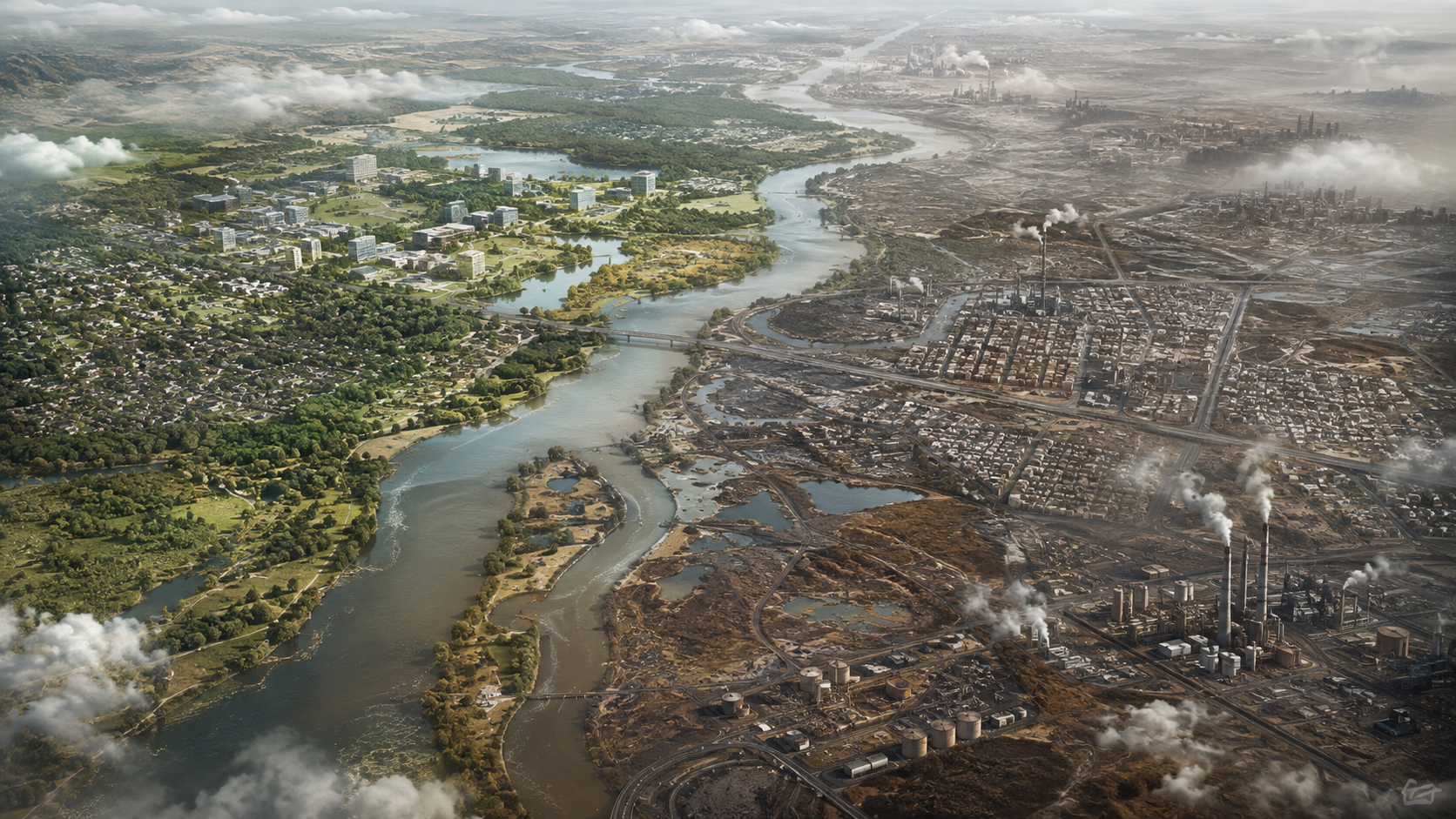
This article argues that justice, equity, and the distribution of environmental burdens should be understood as central rather than secondary to sustainable systems. It examines how environmental burdens become unevenly distributed, why cumulative impacts matter, how distributive, procedural, and recognitional justice interact, why climate change intensifies inequity, how institutions can entrench or reduce harm, why sacrifice zones reveal the moral structure of extraction, and why sustainable systems require more than generalized resilience. They require fairer distributions of protection, voice, risk, accountability, and repair.
Why This Belongs in Stewardship & Ethics
Justice, equity, and the distribution of environmental burdens belong in Stewardship & Ethics because stewardship cannot be morally serious if it protects landscapes, resources, or systems while ignoring who is exposed to harm. Stewardship is not only care for nature in the abstract. It is responsible governance of the relationships among land, water, air, infrastructure, institutions, communities, and future life.
Environmental burdens reveal whether stewardship is real or selective. A society may speak of sustainability while allowing some neighborhoods to absorb industrial pollution, unsafe drinking water, extreme heat, flood risk, highway emissions, toxic waste, degraded ecosystems, or repeated disaster loss. It may protect scenic landscapes while neglecting ordinary places where people breathe polluted air, work in dangerous heat, live near refineries, or raise children beside waste corridors.
This makes environmental justice a core stewardship question. It asks whether care is distributed, whether public protection reaches the burdened, whether institutions listen to those most affected, and whether environmental policy corrects historical exposure or simply makes existing inequality more efficient.
The issue also belongs in Stewardship & Ethics because environmental injustice is rarely accidental. It is produced through zoning, permitting, infrastructure decisions, housing markets, labor systems, enforcement patterns, political exclusion, disinvestment, weak legal remedies, and the normalization of certain communities as acceptable sites of harm.
A stewardship ethic asks not only whether environmental damage is reduced overall. It asks whether harm is still being concentrated on those least able to refuse it. It asks whether repair reaches those already harmed. It asks whether environmental protection is a public good or a privilege distributed by wealth and political power.
Environmental justice is therefore not a side topic within sustainability. It is one of the tests by which sustainability becomes ethically credible.
What Justice, Equity, and Environmental Burdens Mean
Justice, in this context, concerns what is owed to persons and communities in the distribution of environmental harms, protections, benefits, voice, and repair. It asks whether people are treated as full participants in decisions that affect their air, water, land, health, housing, work, safety, and ecological surroundings.
Equity concerns fairness under conditions where people and communities do not begin from the same position. Equal treatment can be inadequate where historical and structural inequalities have produced unequal exposure, unequal capacity, and unequal access to protection. Equity asks what fairness requires when the starting point is already unjust.
Environmental burdens refer to the adverse exposures, risks, and degradations that accompany industrial production, extractive development, waste disposal, infrastructure placement, climate disruption, ecological decline, land conversion, transportation systems, agricultural chemicals, and institutional neglect. These burdens include chemical exposures, but also non-chemical stressors such as noise, heat, psychosocial stress, housing insecurity, lack of green space, inadequate healthcare, weak political representation, and cumulative social vulnerability.
This matters because environmental burdens are not only biophysical facts. They are socially allocated realities. A floodplain, refinery corridor, waste site, degraded water system, overheated neighborhood, or polluted school zone is never purely natural in meaning. It is shaped by planning decisions, political exclusion, housing inequality, labor patterns, regulatory choices, and the uneven capacity of communities to resist harmful siting or demand remediation.
To ask about justice and equity in this domain is to ask whether environmental risk is being imposed in ways that are fair, whether those most exposed are also those with the least power to protect themselves, and whether public institutions distribute protection as seriously as they distribute permission for harm.
Why Environmental Burdens Are a Question of Justice
Environmental burdens are a question of justice because they concern who is made vulnerable by the organization of collective life. Pollution does not simply appear. It is generated, permitted, transported, concentrated, monitored, underregulated, and normalized. Flood risk is not just weather. It is shaped by drainage systems, land use, infrastructure quality, wetland destruction, insurance access, and the history of urban development. Extreme heat is not only a climatic event. It is mediated by housing quality, tree cover, labor conditions, public investment, energy affordability, and neighborhood disinvestment.
What appears as environmental exposure is often inseparable from political structure.
This matters because a society can misdescribe injustice as misfortune. If environmental burdens are treated as unfortunate but impersonal outcomes, institutions can evade responsibility for the choices that organized them. Justice restores that missing accountability. It asks whether the burden was avoidable, whether it was imposed unfairly, whether decision-makers ignored warning signs, whether affected communities were heard, and whether institutions provided meaningful remedy.
Environmental justice begins by rejecting the fiction that the distribution of harm is innocent merely because it has become normal. Normalization is not justification. A neighborhood can be accustomed to pollution and still be unjustly burdened. A community can have lived near industrial facilities for generations and still have a right to clean air, safe water, health protection, and repair. A region can be economically dependent on extraction and still deserve a transition that does not require continued ecological damage.
Once patterned exposure is visible, moral evaluation becomes unavoidable. The question is not only whether an environmental burden exists. The question is why it exists there, why it persists, who benefits from it, and why it has not been corrected.
Equity, Equality, and Unequal Starting Points
Environmental justice requires the distinction between equality and equity. Equality often means applying the same rule to everyone. Equity asks whether the rule produces fair outcomes given unequal starting points, unequal exposure, unequal vulnerability, and unequal capacity to respond.
This distinction matters because formally equal environmental rules can preserve unequal realities. A permitting process may apply the same standard across regions while allowing new facilities in communities already overburdened by existing pollution. A flood insurance rule may be uniform while disadvantaging households that lack savings, legal assistance, or relocation options. A heat warning may be issued equally to all residents while outdoor workers, elderly residents, disabled people, unhoused people, and households without air conditioning face very different risks.
Equity asks institutions to look beneath formal sameness. It asks whether rules account for accumulated exposure, historical neglect, and uneven capacity.
This is not special pleading. It is more accurate moral reasoning. People do not encounter environmental risk from identical positions. A community with safe housing, reliable transportation, political influence, strong healthcare access, insurance coverage, and legal representation does not experience environmental burden in the same way as a community lacking those protections.
Equity therefore requires more than nondiscrimination in the narrow sense. It requires attention to the actual conditions under which harm is borne and protection is accessed.
An equitable environmental system should ask:
- Who is already overburdened?
- Who lacks political or legal capacity to resist new burdens?
- Who has received less investment in protection?
- Who faces cumulative rather than isolated exposure?
- Who needs additional protection because equal treatment would preserve unequal harm?
Equity does not abandon justice. It deepens justice by refusing to treat unequal conditions as though they were morally irrelevant.
Distributive Justice and Unequal Exposure
Distributive justice concerns the fairness of how burdens and benefits are allocated across persons and communities. In environmental terms, it asks whether pollution, waste, hazardous facilities, degraded air and water, flood risk, heat exposure, extraction, ecological loss, and climate vulnerability are distributed inequitably, and whether the benefits of production, mobility, energy use, infrastructure, or consumption flow elsewhere while the harms remain concentrated locally.
This matters because inequality often appears spatially. Some communities live near industrial corridors, shipping routes, highways, waste facilities, extraction sites, degraded water systems, overheated neighborhoods, or severely undermaintained infrastructure. Others enjoy cleaner air, more green space, stronger flood defenses, lower pollution exposure, better public services, and greater political leverage to resist harmful siting.
Distribution is therefore not an abstract pattern. It is a lived geography of uneven safety.
Distributive justice does not require identical outcomes in every place. It does require that environmental burdens not be concentrated on particular communities simply because they are easier to ignore, less powerful in formal politics, historically marginalized, or treated as expendable. Where such concentration persists, distribution itself becomes a moral indictment.
Unequal exposure also reveals how environmental harms and social harms reinforce one another. Pollution can worsen illness. Illness can reduce employment stability. Employment precarity can make relocation impossible. Housing inequality can trap people in high-risk areas. Weak political representation can make remediation slower. Environmental burden therefore becomes part of a larger system of cumulative disadvantage.
Distributive justice asks societies to stop treating the geography of harm as natural. It asks who mapped the burden, who benefits from the map, and who has the authority to redraw it.
Procedural Justice, Voice, and Decision-Making
Justice in environmental affairs is not only about outcomes. It is also about process. Procedural justice asks who gets heard, who receives information, who participates meaningfully in decisions, whose expertise counts, and whether those affected by environmental risk have real influence over the institutions that shape their exposure.
This matters because even formally lawful decisions can be unjust when communities are excluded, information is withheld, consultation is symbolic, or technical expertise is used to override local knowledge. A permit may satisfy regulatory requirements and still fail the test of justice if those most affected were treated as obstacles rather than participants. A public hearing may occur while key decisions have already been made. A technical report may be available while written in a form that ordinary residents cannot meaningfully use.
Procedures matter because power often expresses itself through whose voice is recognized as legitimate.
Procedural justice requires:
- early and meaningful participation before decisions are fixed;
- accessible information in languages and formats communities can use;
- recognition of local knowledge and lived experience as relevant evidence;
- clear explanation of risks, alternatives, trade-offs, and uncertainties;
- real pathways for objection, appeal, review, and remedy;
- protection against retaliation for community advocacy;
- institutional willingness to change decisions based on community input.
Environmental justice therefore requires more than correct outcomes discovered from above. It requires fair process, intelligible participation, timely disclosure, and institutional respect for those who bear the consequences of environmental decision-making.
A process that gives people a microphone but no influence is not participation. It is procedural theater.
Recognitional Justice, History, and the Politics of Invisibility
Recognitional justice concerns whether communities are seen, respected, and understood as full subjects of political and moral concern. Environmental harms often accumulate where populations have been historically marginalized, stereotyped, displaced, segregated, or treated as administratively peripheral. In such settings, injustice is not only distributive or procedural. It is also recognitional.
The burdened community is misrecognized as less worthy of protection, less credible in warning, less knowledgeable about its own conditions, or less entitled to environmental quality.
This matters because patterns of burden are often historical before they are contemporary. Communities living near toxic infrastructure, dangerous waste, degraded water systems, industrial corridors, or underprotected coastlines may do so through long histories of exclusion, racialization, labor exploitation, colonial land appropriation, discriminatory housing, dispossession, weak enforcement, or uneven public investment.
Recognition is therefore not a symbolic add-on to justice. It is one of the conditions for understanding why burdens concentrate where they do.
Without recognitional justice, institutions may attempt technical redistribution while leaving deeper patterns of invisibility intact. A community may receive a new study but not be believed. It may receive a meeting but not respect. It may receive a mitigation plan but not an acknowledgment of the history that made mitigation necessary.
Recognitional justice asks institutions to confront the moral meaning of history. It asks not only what exposure exists today, but whose lives have been repeatedly made less visible in the decisions that produced it.
Sustainable systems require a thicker moral and political understanding of who has been historically exposed, who has been ignored, and why.
Cumulative Impacts and Compounded Vulnerability
One of the most important developments in environmental justice is the recognition that burdens accumulate. A community may face not one isolated exposure but a total pattern of chemical and non-chemical stressors interacting across health, housing, employment, infrastructure, psychosocial stress, ecological degradation, and climate vulnerability.
This matters because isolated assessment can hide structural injustice. A single permit may appear acceptable when examined alone, while the community receiving it is already overburdened by traffic pollution, industrial activity, poor air quality, weak health infrastructure, heat exposure, flood risk, housing insecurity, and ecological loss. A facility-by-facility approach can make each decision look technically defensible while the total pattern becomes morally indefensible.
Cumulative thinking reveals that vulnerability is compounded, not merely additive in a simple way. Multiple stressors can interact so that the whole burden is greater than the sum of individual exposures. Pollution may worsen health. Poor health may increase sensitivity to heat. Low income may limit access to healthcare or relocation. Weak infrastructure may intensify disaster risk. Political exclusion may slow remediation. Each layer deepens the others.
Cumulative impacts therefore shift environmental justice from isolated incident analysis to systems analysis. They ask not merely whether one burden is lawful, but whether the total pattern of burden is tolerable, fair, and politically defensible.
For institutions, cumulative impact analysis requires a change in moral attention. It is not enough to ask whether a new burden is small in isolation. The ethical question is whether adding any further burden to an already burdened community can be justified at all.
Climate Justice and the Distribution of Risk
Climate change intensifies environmental justice because it distributes risks unevenly across class, geography, infrastructure, labor, health, housing, race, disability, age, migration status, and historical inequality. Climate risk rarely falls hardest on those most responsible for producing it. Heat, flood, drought, wildfire smoke, food insecurity, displacement, insurance retreat, energy insecurity, and infrastructure fragility often hit hardest where adaptive capacity is weakest and historical disadvantage is already severe.
Climate justice therefore belongs within the broader question of environmental burdens. It shows that ecological disruption does not simply threaten everyone equally. It amplifies existing patterns of exposure and inequality unless institutions deliberately intervene to alter the distribution of risk and protection.
This matters because climate adaptation can itself become unjust. Wealthy neighborhoods may receive stronger defenses while poorer areas face managed retreat without adequate support. Green infrastructure may raise property values and contribute to displacement. Insurance systems may withdraw from high-risk regions without public alternatives. Heat protections may fail outdoor workers, renters, and people without reliable energy access. Disaster recovery may favor homeowners over renters, documented residents over undocumented residents, and communities with greater administrative capacity over those facing layered barriers.
Climate justice asks whether the transition to a lower-carbon and more climate-resilient society will reproduce older inequalities or repair them.
It also connects intragenerational and intergenerational justice. Some populations bear more immediate risk now, while future generations inherit intensified instability later. A just climate policy must therefore reduce emissions, protect vulnerable communities, support adaptation, address loss and damage, and avoid transferring risk into the future.
Climate justice is not an optional layer added to climate policy. It is part of whether climate policy can be legitimate.
Pollution, Extraction, and Sacrifice Zones
Some of the clearest examples of environmental injustice occur where particular communities are made to absorb concentrated harm for the benefit of wider systems. Industrial corridors, fossil-fuel extraction zones, toxic waste regions, heavily trafficked port areas, plastics production sites, mining landscapes, refinery clusters, and degraded water systems often function as sacrifice zones: places where damage is normalized because the affected populations are politically weaker than the interests served by the activity.
This matters because sacrifice zones reveal the moral structure of extraction. They show that environmental burden is often not accidental but organized. A society may speak of efficiency, growth, energy security, national benefit, or consumer convenience while quietly depending on places and populations whose air, water, health, land, and ecological surroundings are treated as collateral.
The language of sacrifice is important because it asks who is being sacrificed, by whom, for what benefit, and with what consent. Often the answer is ethically damning: the benefits are dispersed or captured elsewhere, while the burdens remain concentrated among communities with fewer resources, weaker representation, and less institutional protection.
Sacrifice zones also expose the limits of compensation. Payment after harm may matter, but it does not fully answer the injustice of making some communities repeatedly available for damage. Nor does it restore lost health, cultural relationships, ecological integrity, or trust in public institutions.
Justice, in this context, requires more than compensating damage after the fact. It requires challenging the institutional logic that renders some communities more sacrificable than others in the first place.
Institutions, Law, and the Allocation of Burden
Environmental burdens are distributed through institutions: zoning regimes, transportation corridors, permitting systems, public utility structures, labor markets, insurance systems, environmental review processes, enforcement patterns, fiscal priorities, property law, public health systems, infrastructure planning, and disaster recovery programs. Law can either reinforce or mitigate these patterns.
This matters because environmental injustice is rarely solved by moral recognition alone. It requires institutional redesign. Where burden has been systematically allocated, justice requires not only acknowledgment but alteration of the rules by which future burden will be assigned.
Institutions allocate burden through what they permit, what they ignore, what they measure, what they fail to measure, what they enforce, and what they decline to repair. A regulatory agency may evaluate one facility at a time while missing cumulative harm. A city may approve development without protecting renters from displacement. A transportation department may expand highways while failing to count health burdens in nearby communities. A disaster recovery system may require paperwork that excludes those most harmed.
Environmental justice therefore requires institutions to change the architecture of decision-making.
This includes:
- cumulative impact assessment before new burdens are approved;
- stronger enforcement in overburdened communities;
- public participation with real influence;
- health and equity analysis in permitting and infrastructure decisions;
- accessible legal remedies;
- repair and remediation funding;
- transparent data on exposure, health, and enforcement;
- protection against displacement when environmental improvements occur.
For sustainable systems, justice must be treated as a design problem as well as a distributive problem. Systems are made fairer when their procedures, metrics, and priorities stop reproducing predictable exposure for the same communities over and over again.
Repair, Remediation, and the Ethics of Environmental Restoration
Environmental justice does not end with preventing future harm. It also requires repair. Communities already harmed by pollution, extraction, unsafe infrastructure, contaminated water, degraded land, or climate disaster should not be told that justice begins only with better decisions going forward. Where harm has accumulated, remediation and repair are part of responsibility.
Repair can include environmental cleanup, health monitoring, medical support, infrastructure investment, safe housing, relocation support where chosen by communities, restoration of waterways and land, economic transition, legal remedy, and formal acknowledgment of past harm. It can also include institutional repair: rebuilding trust, changing decision-making procedures, strengthening enforcement, and creating community oversight.
This matters because environmental injustice often lasts long after a facility closes, a disaster passes, or a permit expires. Contaminated soil remains. Illness continues. Property values decline. Cultural ties are damaged. Trust erodes. Families bear costs across generations. Ecological systems may recover slowly, partially, or not at all.
Repair therefore must be understood as more than cleanup. It is a moral and institutional response to accumulated exposure.
A repair ethic asks:
- What harm remains after the visible event has passed?
- Who pays for remediation?
- Who controls the repair process?
- Are affected communities able to define what repair means?
- Does remediation restore health, land, dignity, and trust, or only legal compliance?
- Are institutions changed so the pattern is not repeated?
Repair also requires humility. Some harms cannot be fully undone. A cleaned site may not restore lost lives, damaged health, or broken ecological relationships. But the impossibility of perfect repair is not an excuse for inaction. It is a reason to treat prevention, accountability, and remediation with greater seriousness.
Environmental justice asks not only that future burdens be distributed more fairly. It asks that past and present burdens be acknowledged and repaired as far as justice allows.
Justice, Equity, and Sustainable Systems
Justice and equity belong at the center of sustainable systems because sustainability is not credible if it protects some populations by exposing others. A system cannot plausibly call itself sustainable when its resilience depends on sacrifice zones, when adaptation is reserved for the well-resourced, when pollution burdens remain concentrated on those least able to refuse them, or when ecological protection is separated from human dignity.
Sustainable systems are not defined only by durability or efficiency. They are also defined by whether protection, risk, and repair are distributed fairly.
This matters because many policy frameworks can become distributively thin. They may improve average outcomes while leaving patterned exposure intact. They may celebrate resilience while ignoring whose neighborhoods are still flooded, whose schools sit near highways, whose water remains unsafe, whose labor remains dangerous, or whose health is treated as a manageable cost of production.
Justice adds the missing question: sustainable for whom, and at whose expense?
A just sustainable system requires:
- clean air and water as public protections rather than privileges;
- climate adaptation directed toward those most exposed;
- cumulative impact analysis in environmental decision-making;
- community voice in siting, permitting, remediation, and infrastructure planning;
- repair for historically burdened communities;
- health-protective enforcement, not only paper compliance;
- transition policies that do not displace or abandon vulnerable populations;
- recognition of environmental protection as part of dignity, not only resource management.
In each case, the core issue is whether systems of power are willing to govern under obligations to those most exposed, least represented, and most at risk of being discounted.
Sustainability without justice may preserve systems. It will not make them worthy of preservation.
Why Environmental Justice Remains Contested
Environmental justice remains contested because it challenges deeply embedded structures of benefit and permission. Disagreement persists over how to measure cumulative harm, what level of disproportionality counts as unjust, how to weigh local burden against broader economic benefit, whether equity requires redistribution or only nondiscrimination, how far institutions should go in correcting historical exposure, and who should pay for repair.
This matters because the contest is not evidence of conceptual weakness. It is evidence that environmental justice reaches into the foundations of planning, production, law, infrastructure, and political economy. Once patterned burden becomes visible, neutrality becomes harder to claim. Institutions must either defend the distribution they have produced or begin to transform it.
Environmental justice is also contested because it forces uncomfortable questions about growth. If economic development depends on concentrating pollution somewhere, who decides where that somewhere is? If clean-energy transition requires minerals, infrastructure, and land, how are new burdens prevented from reproducing old patterns of sacrifice? If climate adaptation raises property values, how are vulnerable residents protected from displacement? If cleanup improves a neighborhood, who gets to remain?
These questions show that environmental justice is not only about past harms. It is also about the future design of sustainability itself.
The persistence of disagreement should therefore be understood as a sign of the concept’s seriousness. Environmental justice remains contentious because it converts normalized exposure into a public question of legitimacy, power, and moral repair.
A society that refuses environmental justice is not avoiding politics. It is preserving the politics of unequal harm.
Environmental Justice Diagnostic Table
| Justice question | Thin environmental frame | Stewardship & Ethics frame |
|---|---|---|
| What are environmental burdens? | Pollution, risk, or degradation managed through technical standards. | Socially allocated harms shaped by power, history, infrastructure, regulation, exposure, and unequal protection. |
| What is justice? | Equal application of environmental rules. | Fair distribution of harm, protection, voice, recognition, accountability, and repair under unequal conditions. |
| What is equity? | A supplement to equal treatment. | Fairness that accounts for unequal starting points, cumulative exposure, vulnerability, and historical burden. |
| What is distributive justice? | Whether environmental benefits and harms are spread evenly. | Whether pollution, risk, and degradation are concentrated on communities with less power while benefits flow elsewhere. |
| What is procedural justice? | Public notice, hearings, and regulatory process. | Meaningful participation, accessible information, influence, recourse, and respect for affected communities. |
| What is recognitional justice? | Respectful language about impacted groups. | Recognition of history, dignity, local knowledge, cultural meaning, and the political invisibility that enables burden. |
| What are cumulative impacts? | Multiple environmental exposures considered together. | The total burden of chemical, non-chemical, social, health, infrastructural, and ecological stressors interacting over time. |
| What is a sacrifice zone? | A highly polluted or degraded area. | A place and community treated as expendable so wider systems can continue benefiting from extraction, production, or waste. |
| What is repair? | Cleanup or mitigation after harm. | Remediation, health support, institutional reform, community-defined restoration, and accountability for accumulated burden. |
| What is the ethical test? | Whether environmental harms remain within legal limits. | Whether systems stop concentrating preventable harm on those least able to refuse it and distribute protection as seriously as risk. |
Conclusion: Justice, Equity, and the Distribution of Environmental Burdens
Justice, equity, and the distribution of environmental burdens matter because they ask whether environmental protection is being distributed as seriously as environmental harm. The central question is not only how much damage occurs, but where it occurs, to whom, through what institutions, and under what patterns of vulnerability, exclusion, history, and power.
This is why the issue belongs at the heart of sustainable systems thought. A society cannot claim ecological seriousness while allowing the burdens of pollution, climate risk, toxic exposure, extraction, degraded infrastructure, and ecological loss to remain concentrated on those with the least power to resist them. Justice requires more than aggregate improvement. It requires fairer distributions of protection, stronger representation for burdened communities, recognition of cumulative exposure, and a willingness to alter the institutional patterns that make some places and people easier to sacrifice.
To take environmental justice seriously is therefore to reject the comforting fiction that environmental harm is simply unfortunate when it is, in fact, patterned. It asks institutions to stop treating repeated exposure as coincidence. It asks sustainability to become more than a language of averages, resilience, and efficiency. It asks whether public systems will protect the communities that have been made most vulnerable by the systems society already built.
Environmental justice is not a distraction from sustainability. It is one of the conditions under which sustainability becomes morally legitimate.
A sustainable society is not one that merely reduces harm in aggregate.
It is one that refuses to build its future on the unequal distribution of damage.
Related Reading
- What Is Stewardship & Ethics?
- Responsibility in the Anthropocene
- Intergenerational Justice and Long-Term Obligation
- Precaution, Prudence, and Irreversible Harm
- Solidarity, Vulnerability, and the Ethics of Protection
- Stewardship and the Ethics of Climate Change
- Participation, Accountability, and Procedural Justice
- Institutional Stewardship, Governance, and Public Trust
Further Reading
- Bullard, R.D. (1990) Dumping in Dixie: Race, Class, and Environmental Quality. Boulder, CO: Westview Press.
- Caney, S. (2020) ‘Climate Justice’, Stanford Encyclopedia of Philosophy. Available at: https://plato.stanford.edu/entries/justice-climate/
- Intergovernmental Panel on Climate Change (IPCC) (2022) Climate Change 2022: Impacts, Adaptation and Vulnerability – Summary for Policymakers. Available at: https://www.ipcc.ch/report/ar6/wg2/chapter/summary-for-policymakers/
- Schlosberg, D. (2007) Defining Environmental Justice: Theories, Movements, and Nature. Oxford: Oxford University Press.
- United States Environmental Protection Agency (EPA) (n.d.) Cumulative Impacts. Available at: https://www.epa.gov/cumulative-impacts
- United States Environmental Protection Agency (EPA) (n.d.) Interim Framework for Advancing Consideration of Cumulative Impacts. Available at: https://www.epa.gov/cumulative-impacts/interim-framework-advancing-consideration-cumulative-impacts
- United Nations Development Programme (UNDP) (n.d.) Environmental Justice. Available at: https://www.undp.org/rolhr/human-rights/environmental-justice
- United Nations Environment Programme (UNEP) (2021) Neglected: Environmental Justice Impacts of Marine Litter and Plastic Pollution. Nairobi: UNEP. Available at: https://www.unep.org/resources/report/neglected-environmental-justice-impacts-marine-litter-and-plastic-pollution
- United Church of Christ Commission for Racial Justice (1987) Toxic Wastes and Race in the United States. New York: United Church of Christ. Available at: https://www.ucc.org/wp-content/uploads/2020/12/ToxicWastesRace.pdf
- Whyte, K. (2018) ‘Settler colonialism, ecology, and environmental injustice’, Environment and Society, 9(1), pp. 125–144.
References
- Bullard, R.D. (1990) Dumping in Dixie: Race, Class, and Environmental Quality. Boulder, CO: Westview Press.
- Caney, S. (2020) ‘Climate Justice’, Stanford Encyclopedia of Philosophy. Available at: https://plato.stanford.edu/entries/justice-climate/
- Intergovernmental Panel on Climate Change (IPCC) (2022) Climate Change 2022: Impacts, Adaptation and Vulnerability – Summary for Policymakers. Available at: https://www.ipcc.ch/report/ar6/wg2/chapter/summary-for-policymakers/
- Schlosberg, D. (2007) Defining Environmental Justice: Theories, Movements, and Nature. Oxford: Oxford University Press.
- United Church of Christ Commission for Racial Justice (1987) Toxic Wastes and Race in the United States. New York: United Church of Christ. Available at: https://www.ucc.org/wp-content/uploads/2020/12/ToxicWastesRace.pdf
- United Nations Development Programme (UNDP) (n.d.) Environmental Justice. Available at: https://www.undp.org/rolhr/human-rights/environmental-justice
- United Nations Environment Programme (UNEP) (2021) Neglected: Environmental Justice Impacts of Marine Litter and Plastic Pollution. Nairobi: UNEP. Available at: https://www.unep.org/resources/report/neglected-environmental-justice-impacts-marine-litter-and-plastic-pollution
- United States Environmental Protection Agency (EPA) (n.d.) Cumulative Impacts. Available at: https://www.epa.gov/cumulative-impacts
- United States Environmental Protection Agency (EPA) (n.d.) Cumulative Impacts Research. Available at: https://www.epa.gov/healthresearch/cumulative-impacts-research
- United States Environmental Protection Agency (EPA) (n.d.) Interim Framework for Advancing Consideration of Cumulative Impacts. Available at: https://www.epa.gov/cumulative-impacts/interim-framework-advancing-consideration-cumulative-impacts
- Whyte, K. (2018) ‘Settler colonialism, ecology, and environmental injustice’, Environment and Society, 9(1), pp. 125–144.